Rudston B Cursus, East Yorkshire

Cursus:  OS Grid Reference – TA 0805 6697 to TA 0944 6755 

  1. Rudston Cursus 2

Archaeology & History

One of the four (known) cursus monuments around Rudston: this one stretches between the Ordnance Survey coordinates TA 081669 near Kilham Grange on the southwestern edge of Rudston, then heads northeast towards the village itself at TA 094675.  Described briefly in D.P.Dymond’s essay on (mainly) Cursus A, he said how Cursus B was part of,
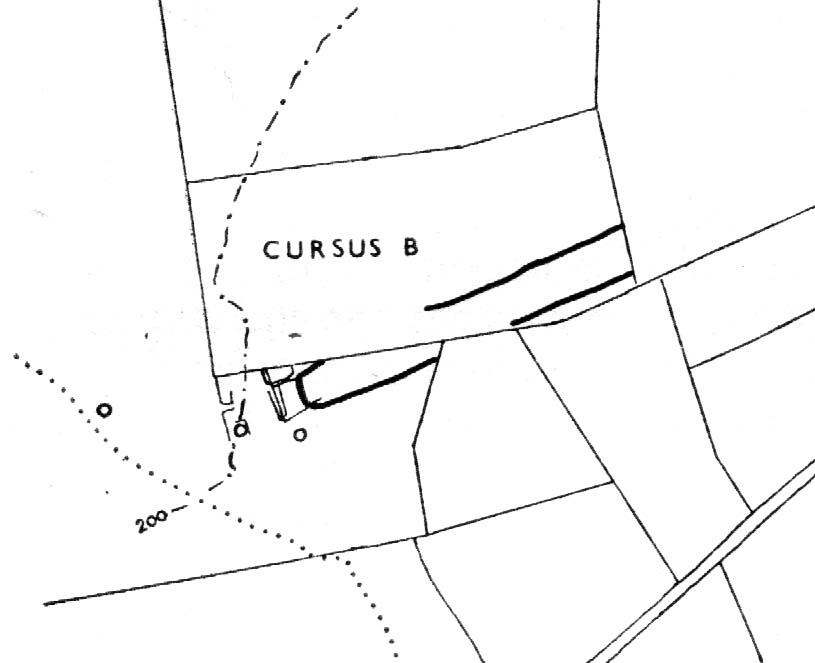
Early ground-plan (after D.P. Dymond)
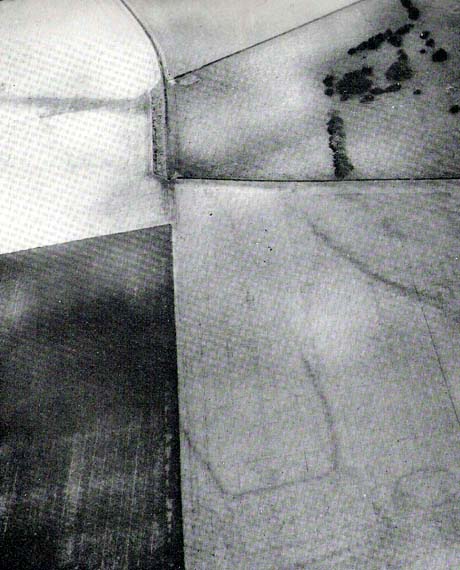
Early photo of Rudston B (after J.K.St Joseph)

“a large complex of crop marks.  The largest feature is the squared, tapering end of Cursus B, which can be traced for 700 yards in a north-easterly direction.  No surface remains seem to survive in an area intensively ploughed, except for a swelling under a hedge on the line of the south-eastern bank (at TA 0834 6703).  West of the square end and partly overlying it, are several small rectangular enclosures, which are probably part of a later (?Romano-British) settlement and field-system.  Also in this tangle of crop-marks there are four roughly circular shapes, which may well be barrow circles associated with the end of the cursus.  On certain barrow just south of the end of the cursus has an inner ring of pits.  Where the cursus is lat visible to the north-east, it is headed roughly for the monolith ¾-mile away.  The width of Cursus B is approximately 90 yards between ditch centres.  It has its square end on the forward slope of a ridge (like Cursus A) at a height of 180 feet OD, and descends towards the village, which is visible from the end, through a shallow valley.”

Dymond’s note about the alignment feature of this cursus, towards the gigantic Rudston monolith, was one echoed in the Hedges & Buckley (1981) survey.  They noted:

“At Rudston, the B cursus extended eastwards aligns upon the Rudston monolith in Rudston churchyard. Destruction of standing stones elsewhere may have removed similar associations between the stones and cursuses.”

This alignment feature was also confirmed by cognitive archaeologist and alignment specialist, Paul Devereux (Pennick & Devereux 1989) in his survey of cursus monuments.

Typical of these fascinating antiquities, nothing of any worth has been found along the length of the cursus that can give us any clues to its nature and function.  However, the presence of this and three others close by indicates that the region was an exceptionally important one in the cosmology of our prehistoric ancestors.  Four of these giant linear cursus monuments occur in relative proximity, and there was an excess of ancient tombs and, of course, we have the largest standing stone in the British Isles stood in the middle of it all.  A full multidisciplinary analysis of the antiquities in this region is long overdue.  To our ancestors, the mythic terrain and emergent monuments hereby related to each other symbiotically, as both primary aspects (natural) and epiphenomena (man-made) of terra mater: a phenomenon long known to comparative religious students and anthropologists exploring the animistic natural relationship of landscape, tribal groups and monuments.

References:

  1. Dymond, D.P., “Ritual Monuments at Rudston, E. Yorkshire, England,” in Proceedings of the Prehistoric Society, volume 32, 1966.
  2. Eliade, Mircea, The Sacred and the Profane, Harvest: New York 1959.
  3. Hedges, John & Buckley, David G., The Springfield Cursus and the Cursus Problem, Essex County Council 1981.
  4. Pennick, Nigel & Devereux, Paul, Lines on the Landscape, Hale: London 1989.

Links:

  1. ADS: Archaeology of Rudston B – Brief archaeological notes on the cursus to the southwest of Rudston.

© Paul Bennett, The Northern Antiquarian 


Great Bride Stones, Todmorden, West Yorkshire

Sacred Rocks:  OS Grid Reference – SD 93329 26737

Getting Here

Follow the same directions to find the Blackheath Circle, but instead of turning onto the golf course, keep going up the steep road until you reach the T-junction at the top; then turn left and go along the road for about 200 yards, past the second track on the left, keeping your eyes peeled across the small moorland to your left where you can see the rocks rising up.  Walk along the footpath towards them.  You can’t really miss the place!

Archaeology & History

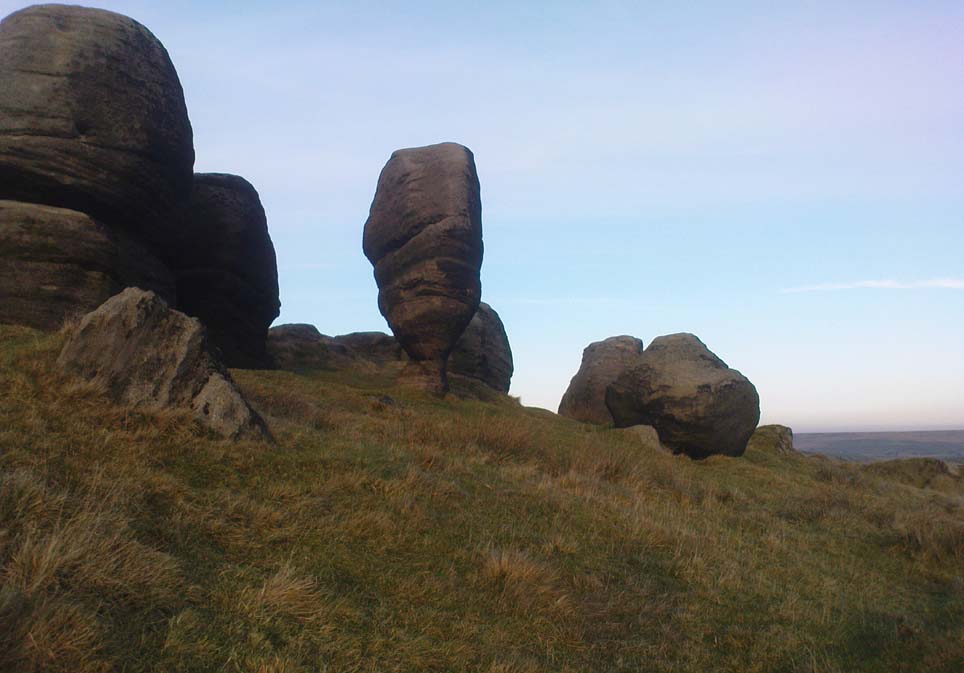
The Bride at sunset – the fallen Groom to her left

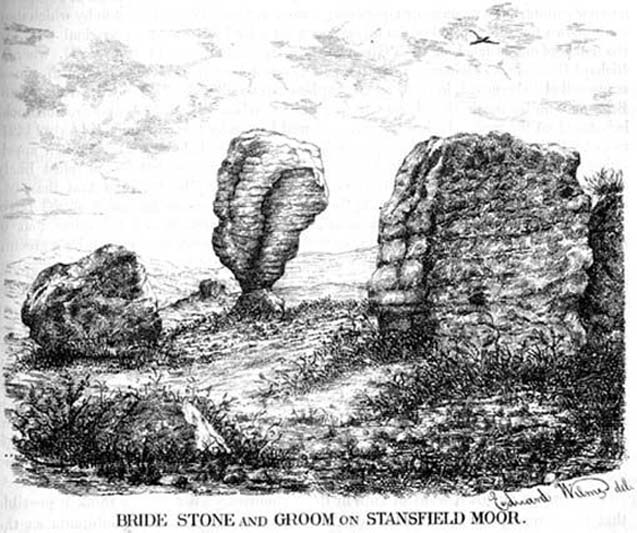
If you’re a heathen or geologist and you aint seen this place, check it out – you won’t be disappointed!  First mentioned in 1491, this has always been a place of some repute. Its legendary companion, the ‘Groom’, lays resting on the Earth after being felled sometime in the 17th century.

F.A. Leyland’s 1860s drawing

A beautiful, remarkable and powerful site of obvious veneration.  First described in local deeds as early as 1491, there are a great number of severely weathered boulders all round here, many like frozen rock giants haunting a magickal landscape.  The modern lore ascribes the stones to be dedicated to Bride, goddess of the Brigantian people.  And like Her legendary triple-aspect, we find here in the landscape a triple aspect to the outcrops themselves: to the west are the Bride Stones; to the east, the Little Bride Stones; with the Great Bride Stones as the central group, surveying everything around here.

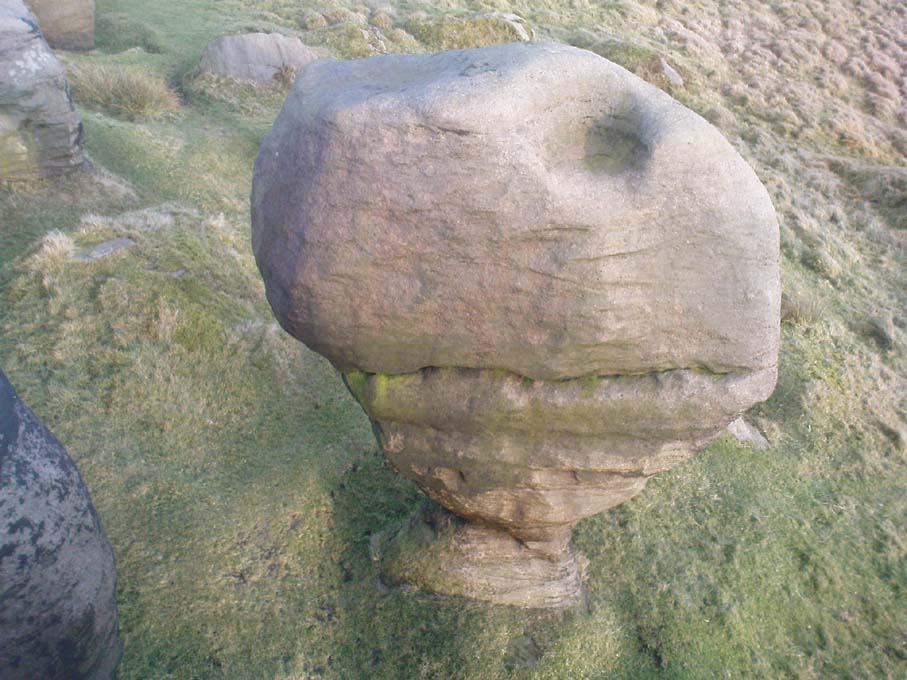
At the main complex is what is singularly known as the Bride itself: a great smooth upright pillar of stone fourteen feet tall and nine feet wide at the top, yet only about two feet wide near its base, seemingly defying natural law.  Watson (1775) described, next to the Bride herself, “stood another large stone, called the Groom…(which) has been thrown down by the country people” – probably under order of the Church.  Crossland (1902) told how the Bride also acquired the title, “T’ Bottle Neck,” because of the stone’s simulacrum of an upturned bottle.

The Bride & her Groom (laid on the earth)
The ‘head’ or top of the Bride Stone

Scattered across the tops of the many rocks hereby are many “druid basins” as Harland and Wilkinson (1882) described them.  Many of these are simply basins eroded over the millenia by the natural elements of wind and rain.  It is possible that some of these basins were carved out by human hands, but it’s nigh on impossible to say for sure those that were and those that were not.  If we could find a ring around at least one of them, it would help — but in all our searches all round here, we’ve yet to locate one complete cup-and-ring.  So we must remain sceptical.

On the mundane etymological side of things, the excellent tract by F.A. Leyland (c.1867) suggested the Bride Stones actually had nothing to do with any goddess or heathenism, but derived simply from,

“the Anglo-Saxon adjective Βñáð, signifying broad, large, vast — hence the name of the three groups known as the Bride Stones.  The name of The Groom, conferred on the prostrate remains, appears to have been suggested by the fanciful definition of the Saxon Brád, as given by (Watson).”

However, the modern place-name authority A.H. Smith (1963:3:174) says very simply that the name derives from “bryd, a bride.”

A “rude stone” was described in one tract as being a short distance below this great rock outcrop; it was turned into a cross by the local christian fanatics and moved a few hundred yards west, to a site that is now shown on modern OS-maps as the Mount Cross.

Folklore

Although local history records are silent over the ritual nature of these outcrops, tradition and folklore cited by the antiquarian Reverend John Watson (1775) tell them as a place of pagan worship.  People were said to have married here, although whether such lore evolved from a misrepresentation of the title, Bride, is unsure.  In the present day though there have been a number of people who have married here in recent years.

If the Brigantian goddess was venerated here, the date of the most active festivities would have been February 1-2, or Old Wives Feast day as it was known in the north.  The modern witches Janet and Stewart Farrar, who wrote extensively about this deity (1987), said of Bride: “one is really speaking of the primordial Celtic Great Mother Herself,” i.e., the Earth Mother.

Telling of further lore, Watson said that weddings performed here in ages past stuck to an age-old tradition:

“during the ceremony, the groom stood by one of these pillars, and the bride by the other, the priests having their stations by the adjoining stones, the largest perhaps being appropriated to the arch-druid.”

New Age author Monica Sjoo felt the place “to have a special and uncanny power.”  This almost understates the place: it is truly primal and possesses the virtues of strength, energy, birth and solace.

References:

  1. Bennett, Paul, The Old Stones of Elmet, Capall Bann: Milverton 2001.
  2. Crossland, Charles, “Place-Names in the Parish of Halifax in Relation to Surrounding Natural Features,” in Halifax Naturalist, volume 7, 1902.
  3. Farrar, Janet & Stewart, The Witches’ Goddess, Hale: London 1987.
  4. Harland, John & Wilkinson, T.T., Lancashire Folklore, John Heywood: Manchester 1882.
  5. Leyland, F.A., The History and Antiquities of the Parish of Halifax, by the Reverend John Watson, M.A., R.Leyland: Halifax n.d. (c.1867).
  6. Smith, A.H., The Place-Names of the West Riding of Yorkshire – volume 3, Cambridge University Press 1963.
  7. Watson, John, The History and Antiquities of the Parish of Halifax, T. Lowndes: London 1775.

© Paul Bennett, The Northern Antiquarian

Duncroisk Burn, Glen Lochay, Killin, Perthshire

Cup-and-Ring Stone:  OS Grid Reference – NN 5281 3635

Also Known as:

  1. Canmore ID 24177
  2. CEN 19 (Morris)
  3. Duncroisk 2 Carving (Canmore)
  4. Tirai Wall Carving
  5. Tullich (Morris)

Getting Here

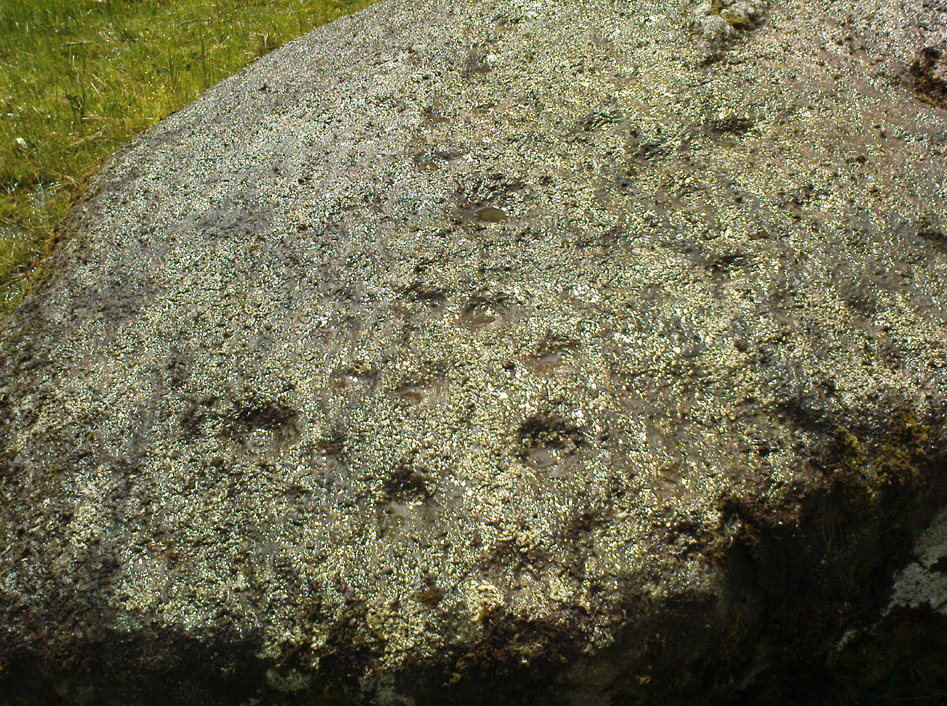
A ring of cups, encircling cups

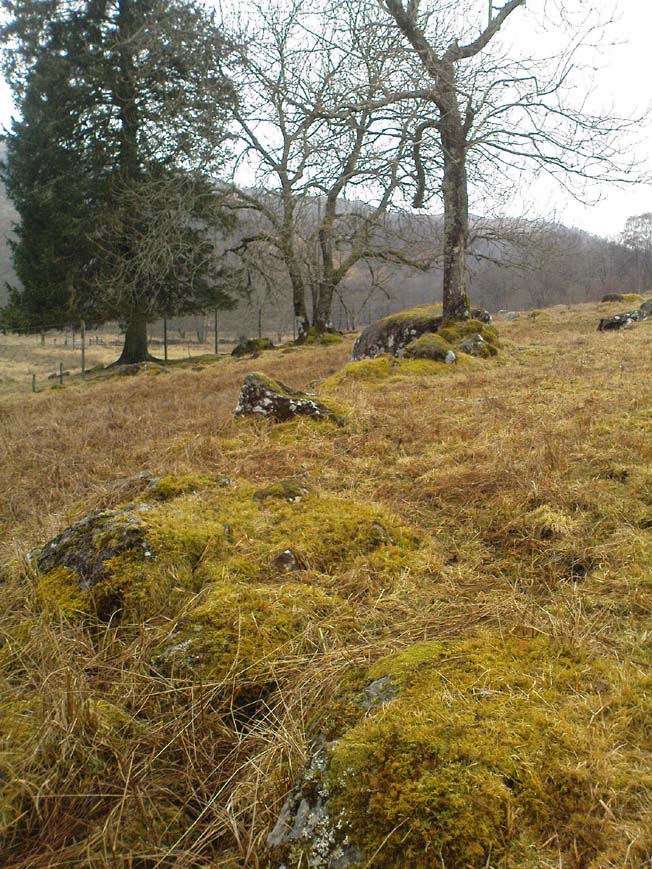
Go thru Killin and, just past the Bridge of Lochay hotel, take the tiny road on your left.  Go down here for 3 miles till you pass the gorgeous Stag Cottage (with its superb cup-and-rings in the field across the road) for another 300 yards, past Duncroisk Farmhouse set back on your right, then over the small river bridge.  Just over the bridge there’s a gate on your left.  Go thru this and up the track until you get to another large gate.  Go thru this, then walk immediately left where you’ll notice a large-ish boulder sat on the nearby slope ahead of you in a part of some very old walling.  That’s your target!

Archaeology & History

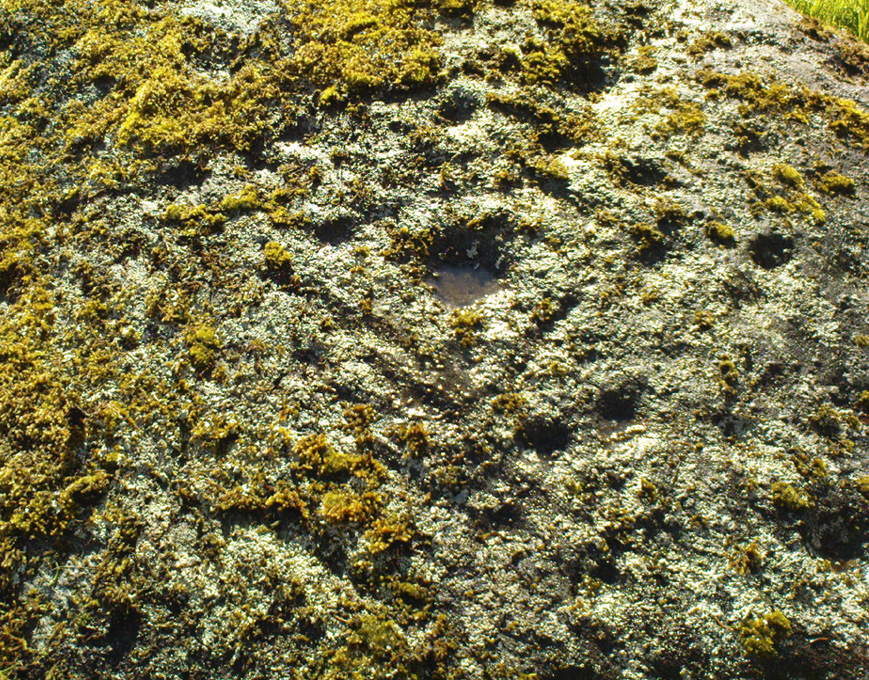
The title of this carving is slightly misleading, as the stone concerned is about 50 yards west of the fast-running burn.  But it’s pretty easy to locate.  When we visited the stone recently, as the photos show, the rock was all-but covered in a beautiful patchwork of lichen and moss, inhibiting the visibility of a quite impressive carving.  But we have to let this be.

The carving’s on the big rock by tree, in the walling
Line of walling clearly evident

The carved rock plays an important part in a line of ancient prehistoric walling, which looks Iron Age in nature, but without an excavation we’ll not know for certain.  The walling is quite extensive and is an integral part of the extended derelict village of Tirai, with its standing stones and other monuments.  This begs the questions: was the carving executed before or after the walling was created?  Was the stone carved in traditional neolithic/Bronze Age periods and later accommodated into the walling?

Even in the grey overcast light of a winter’s day when we first visited here, many cups were clearly visible on the rock’s surface, but they were difficult to contextualize in terms of artificial and natural aspects of the stone.  Later visits here at the end of Spring enabled a much better assessment — though capturing the surrounding “rings” proved difficult.  The carving is shown highlighted on Ron Morris’ (1981) map of the cluster of Duncroisk carvings, and described as a:

“domed schist boulder, 2½m by 2m, 1¼m high (8ft x 6ft x 4ft).  On its top, mostly where sloping…are: 2, and possibly 3, cups-and-one-ring, much weathered and only visible when wet in very low sun, probably un-gapped, and at least 32 cups.  Diameters up to 17cm (6½in) and depths up to 1cm.”

But this is only half the story.  Despite what Mr Morris and the more recent Canmore records tell us about this carving, there are in fact at least 52 cups on the surface of the rock, at least two of which have definite ring-like forms around them.  The largest of the cups has linear features around a large section of it, but to ascribe these elements as ‘rings’ is also stretching it a bit — as one of the photos here clearly shows.  The ‘ring’ consists more of two separate straight lines with curvaceous ends: more like a right-angled carving with a swerve than any traditional ring.  It’s a quite unique feature by the look of things.

Faint cup-and-ring and cups…and…
Cups & right-angled lines

The majority of the carved cups and lines occur on the eastern side of the boulder, with only a few singular cups almost fading their way onto its western sloping sides.  And of primary visual interest are the swirl of cups that surround two small cups at the ESE corner of the rock.  These give the impression of running into another swirl of cups that hedge their ways around the edges of the largest cup-and-right-angled-lines, until bending back up and along the southern-side of the stone.  This possibly deliberate sequence of cups then continues in roughly the same form back upwards to near the top-middle of the rock and onto a complete cup-and-ring.  Just above the top of this runs a short pecked line just detached from the cup-and-ring, but of obvious mythic relevance in the story which this carving once told.

RWB Morris’ sketch of the design

It’s an absolutely fascinating carving which gives the distinct impression of narrating a myth of journeying, by either a person, tribes or ancestral beings.  Of course we’ll probably never know for sure what story it once told; but its tale may have been known by the people of the once proud village of Tirai which was only destroyed a couple of centuries ago, along whose fallen walls this great stone still rests within…

And finally, for those students exploring the potential relationship that cup-and-rings may have with water: please note that in wet conditions, a spring of water emerges right underneath the very base of this large rock.

…to be continued…

References:

  1. Morris, Ronald W.B., The Prehistoric Rock Art of Southern Scotland, BAR 86: Oxford 1981.
  2. Royal Commission on the Ancient & Historical Monuments of Scotland, Archaeological Sites and Monuments of Stirling District, Central Region, Society of Antiquaries of Scotland 1979.

© Paul Bennett, The Northern Antiquarian

Robin Hood’s Penny Stone, Midgley Moor, West Yorkshire

Legendary Rock:  OS Grid References – SE 01831 28436

Also Known as:

  1. Robin Hood’s Pennystone
  2. Robin Hood’s Rock

Getting Here

If you follow the directions to reach the Churn Milk Joan stone, then continue onto the moor following the same directions to find the Miller’s Grave, once you’ve reach this you’ll see a large rounded boulder a couple of hundred yards away on your left, to the northwest.  That’s Robin Hood’s Penny Stone!

Archaeology & History

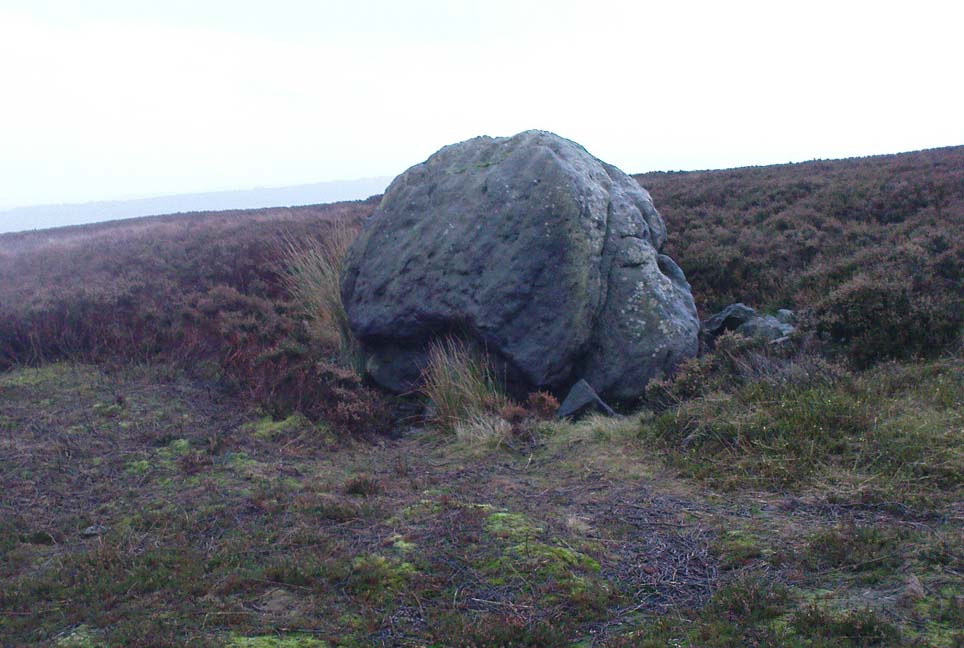
Robin Hood’s Pennystone, Midgley Moor

In terms of this site’s archaeology, it has none to write home about in official records (other than a few flints found nearby), but there’s more to this place than meets the eye.  A large rounded boulder sat upon the moorland plain with a large Nature-worn bowl on its top, the site is some 112 yards (102m) northwest of the little-known, but impressive Miller’s Grave prehistoric cairn (close to being a midsummer/midwinter line).  North and south of the rock are small lines of prehistoric walling — though their context is difficult to assess.  The Greenwood Stone and Greenwood B stone can be found about 200 yards west.

Folklore

A singular footpath once led up to this old boulder, atop of which – in its large ‘bowl’ – vinegar used to be poured. In this, coins were left by local people who suffered the plague and in return food was left for them.  And of course it is said that Robin Hood frequented the place in bygone times.

References:

  1. Bennett, Paul, The Old Stones of Elmet, Capall Bann: Milverton 2001.
  2. Robert, Andy, “Our Last Meeting,” in NEM 37, 1989.
  3. Robert, Andy, Ghosts and Legends of Yorkshire, Jarrold: Sheffield 1992.

© Paul Bennett, The Northern Antiquarian

West Lodge, Touch, Cambusbarron, Stirling

Cairn:  OS Grid Reference – NS 7501 9315

Also Known as:

  1. Canmore ID 46240

Getting Here

The mound of the cairn

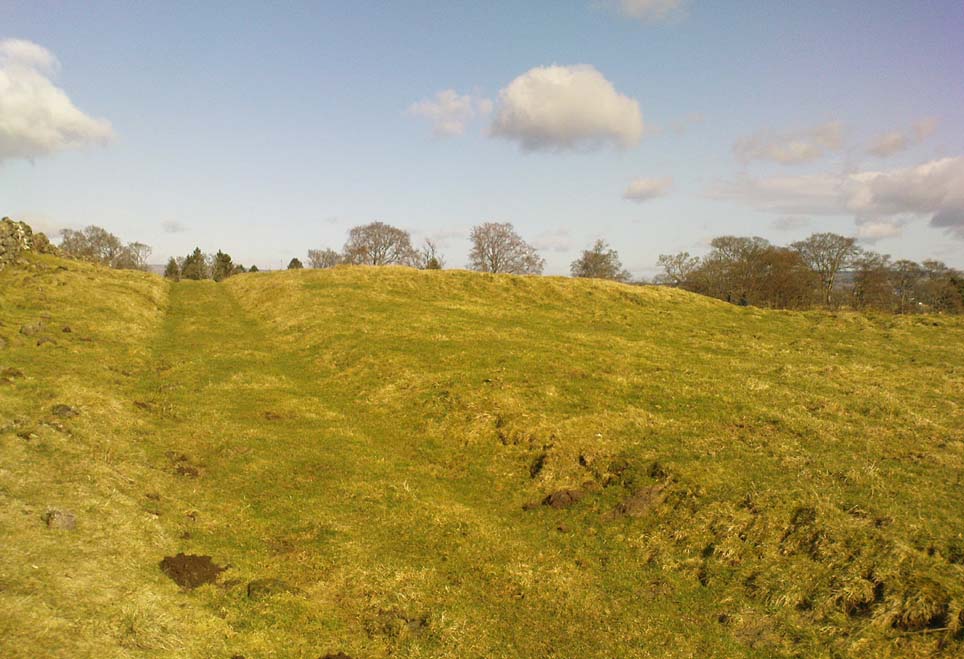
Go west outta Stirling along the Cambusbarron road and along the Main Street until it meets up with Touch Road.  Go along here for a couple of miles, past Touch House and Seton Lodge until you reach the small West Lodge cottage where the road bends.  From here go left up the footpath onto the fields immediately south.  About 200 yards on, where the field rises to the crest of the hill, you’ll note the small mound right next to the track.  If you start walking back down the slope again, you’ve walked past it!

Archaeology & History

Possible peristalith ruins

There’s not too much to see here as the site is very much overgrown, but it’s in a lovely spot looking across to the Ochil Hills eastwards.  And if  records are anything to go by, it’s a pretty isolated prehistoric site with no companions close by — though a prehistoric food vessel was located a short distance to the east on the Touch House Estate grounds many years ago.  It’s quite a large, roughly circular mound.  Several long stones are visible, laid down, on top of its western side, which archaeologists believe may represent the remains of an encircling stone ring that was built to define the cairn.  As far as I’m aware the site remains unexcavated and its condition is still much as it was when the Scottish Royal Commission fellas visited the place in 1956.  Following their brief excursion, they later (1963) wrote the following notes:

“It is circular on plan, measures 65ft in diameter at the base and stands to a height of 2ft 6in.  Now covered with fine pasture, it appears to have been formerly under cultivation, and the flat top measures 50ft in diameter.  The mound may represent a denuded cairn and three earthfast boulders which protrude through the turf near the W edge may be the remains of a peristalith.  The largest stone has a bench-mark carved on it (125.9).”

A later brief report by the Royal Commission (1979) commented that the site was a cairn measuring 20m across and 0.7m high.

References:

  1. Royal Commission on the Ancient & Historical Monuments Scotland, Stirling – volume 1, HMSO: Edinburgh 1963.
  2. Royal Commission on the Ancient & Historical Monuments of Scotland, Archaeological Sites and Monuments of Stirling District, Central Region, Society of Antiquaries of Scotland 1979.

© Paul Bennett, The Northern Antiquarian 

Wallstale, Cambusbarron, Stirling

Dun:  OS Grid Reference – NS 7744 9085

Also Known as:

  1. Canmore ID 46232

Getting Here

To be found on the wooded hill about 160 yards north of Wallstale Farm, on the Polmaise Road on the western side of the M9, a mile or so south of Cambusbarron, below the hugely impressive Murrayshall Quarries.  Walk up the steep slope into the woodland and when you reach the level you’ll find the stonework remains.  It’s on the edge of the slope in the trees.

Archaeology & History

This old fortified walled structure is best seen in the winter months when all the vegetation has fallen back to Earth.  If you come here in the summer, the woods are nice but the monument can’t be seen as clearly.  Found at the top of the slope above the roadside, it was described in the Stirlingshire Royal Commission (1963) account as follows:

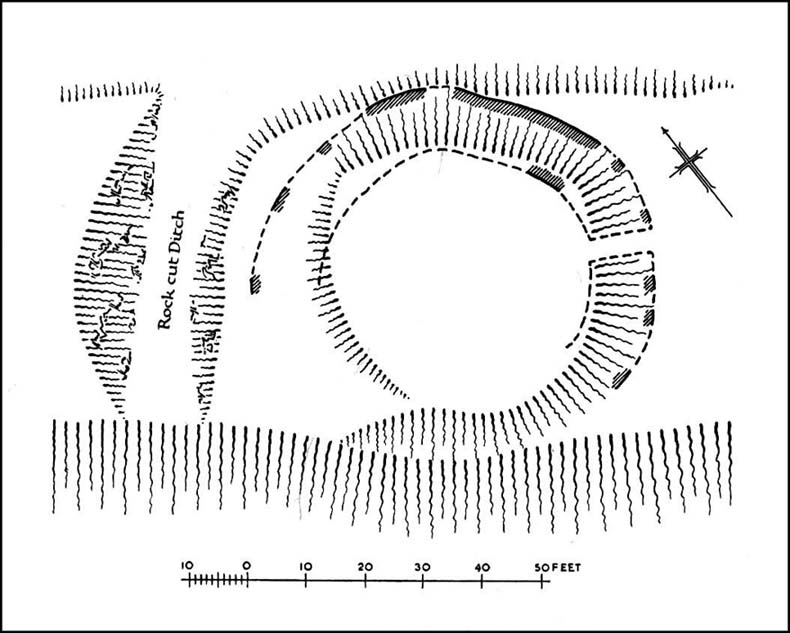
Ground-plan of Wallstale Dun (after RCAHMS 1963)
Wallstale Dun, up there somewhere!

“It is almost circular in plan…measuring about 45ft in diameter within a ruined stone wall some 11ft in thickness.  Except on the ESE side, where the entrance was probably situated, the wall can be traced continuously by patches of rubble core, and round the east half outer facing-stones are visible up to a maximum height of four courses.  In contrast, the inner face is only exposed for a short distance on the ENE.  The interior of the dun is featureless.  On the NW side the dun is protected by a rock-cut ditch of substantial proportions which traverses the spur; it measures 26ft in width at the top and the scarp is 5ft 6in in depth.”

References:

  1. Royal Commission on the Ancient & Historical Monuments Scotland, Stirling – volume 1, HMSO: Edinburgh 1963.

© Paul Bennett, The Northern Antiquarian


Achnacree, Achnacreebeag, Argyll

Chambered Cairn:  OS Grid Reference – NM 9227 3636

Also known as:

  1. Achnacridhe
  2. Canmore ID 23223
  3. Carn Ban
  4. Moss of Achnacree
  5. Ossian’s Cairn

Archaeology & History

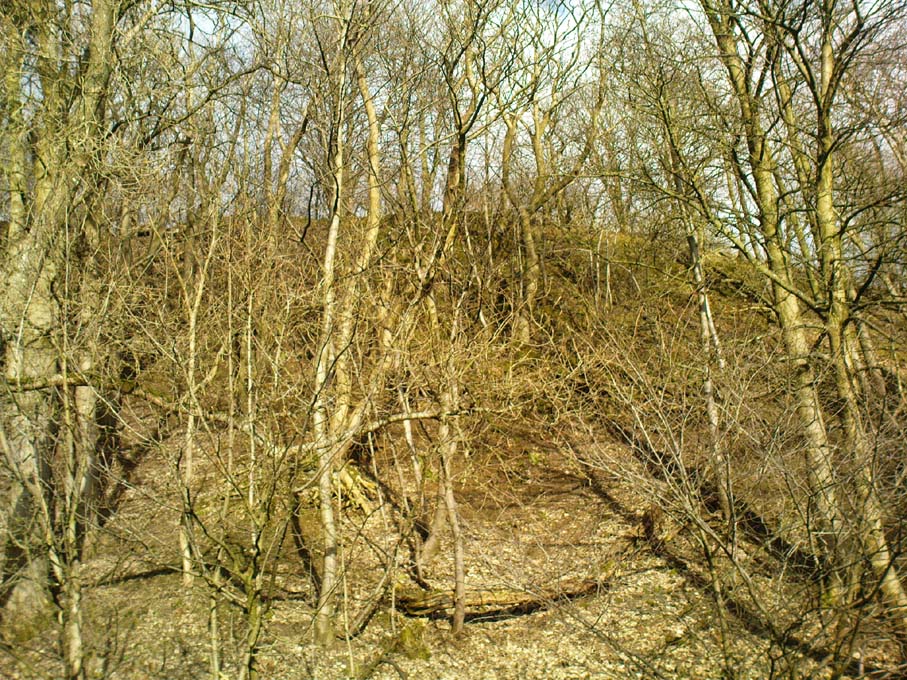
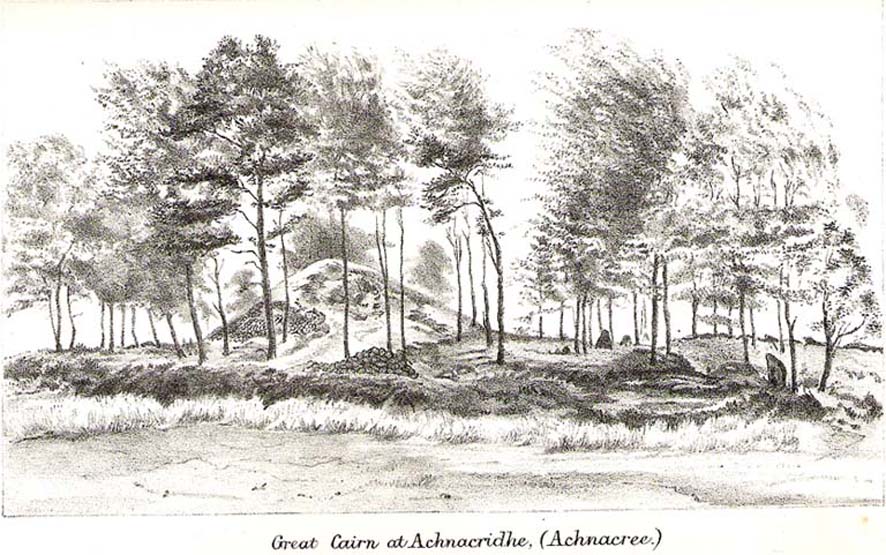
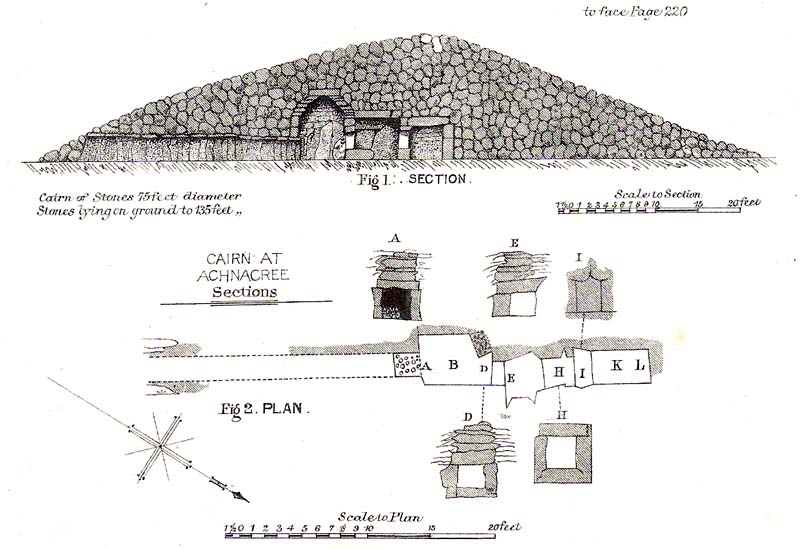
Not to be confused with the Achnacreebeag chambered tomb a short distance to the east, Achnacree is  a site that has been made ruinous over the last 100 years, prior to which — as R.A. Smith’s (1885) illustration here shows — we had a quite grand prehistoric chambered cairn to behold. It’s still worth looking at though!

R.A. Smith’s old drawing
Smith’s early plan of the cairn

The once giant tomb is neolithic in age and nature, and was defined by Audrey Henshall (1972) as a passage grave of the Clyde Cairns group. It appears to have been built over two different periods: the earliest being when the first two internal chambers were done, “which in building technique and plan are comparable to a two-compartment Clyde-chamber and which may have been covered by a small cairn.” (RCAHMS 1974)  Much later, the long passage seems to have been added and built over the original chambers.

Although Smith (1885) and Henshall describe the large cairn, the Scottish Royal Commission (1974) entry gives the most succint archaeocentric summary of the site:

“The cairn is about 24.4m in diameter and now stands to a height of some 3.4m on the S and 4.1m on the NE, although it is said to have been about 4.6m high before excavation; it consists of small and medium-sized stones, interspersed with a few large boulders.  A low platform of cairn material, now grass-covered and about 1m high, extends round the base of the cairn and increases the overall diameter to about 40m.  The entrance to the passage is on the SE side of the cairn and is marked by four upright stones, one of which is now leaning out of position.  The central pair, set about 1.2m apart and protruding 1.3m and 0.4m above the cairn material, are the portal stones on either side of the passage, while the flanking pair may be the remains of a shallow forecourt.  The passage, which measured 6.4m in length and 0.6m in width, was constructed of upright slate slabs about 1m in height, and the roof was composed of similar slabs.  The excavator recorded that the passage was filled with stones, and these seem to indicate a deliberate blocking after the final burial-deposit.  The chamber comprised three compartments.  The outer, measuring 1.8m by 1.2m and about 2.1m in height, was constructed of upright slabs and drystone walling supplemented by corbelling, and was covered by a single capstone.  The central compartment, measuring 2m by 0.7m and 1.6m in height, was entered across a large transverse slab, and the entrance itself appeared to have been deliberately sealed with stones ‘built firmly in after the chamber had been completed.’  The sides of this chamber were formed of blocks of stone supplemented by dry-stone walling, and it was roofed by a singular capstone.  The inner compartment was entered across a sill-stone, and measured 1.4m by 0.9m and 1.7m in height.  A combination of slabs and dry-stone walling had been employed in its construction, and it was roofed by a single massive capstone some 0.4m thick.  Each side-wall was constructed of two slabs set lengthwise one above the other, in such a way that a narrow ledge was formed at their junction.  On these two ledges a number of white quartz pebbles had been deliberately deposited… Three neolithic pottery bowls were discovered in the course of the excavation — a fragmentary vessel from the outer compartment, and one complete and one fragmentary bowl from the inner compartment.”

These bowls were sent to Edinburgh’s National Museum of Antiquities soon after being found.

Folklore

Those of you into earthlights will like this one!  Also known as Carn Ban, or the White Cairn, aswell as Ossian’s Cairn, R. Angus Smith (1885:217) told how,

“it was curious…to listen to the superstitions that came out (about this tomb). One woman who lived here, and might therefore be considered an authority, said that she used to see lights upon it in dark nights.”

Another old local was truly terrified of the place, and said he would not enter this tomb for all the money in Lochnell Estate.

Regarding the various names given to the site, when Mr Smith (1885) wrote about it all those years ago, he told:

“We have often inquired the name of the cairn. The cairn really has had no definite name. Some people have called it Carn Ban or White Cairn, but that is evidently confusing it with the other cairn which we saw over the moss, and which is really whiter. Some people have called it Ossian’s Cairn, but that is not an old name, and even if it had been, we know that it is a common thing to attach this name to anything old.  We call it Achnacree Cairn, from the name of the farm on which it stands.”

References:

  1. Henshall, A.S., The Chambered Tombs of Scotland – volume 2, Edinburgh University Press 1972.
  2. Royal Commission on the Ancient & Historical Monuments of Scotland, Argyll – Volume 2: Lorn, HMSO: Edinburgh 1974.
  3. Smith, R. Angus,”Descriptive List of Antiquities near Loch Etive,” in Proceedings of the Society of Antiquaries, Scotland, volume 9, 1870-72.
  4. Smith, R. Angus, Loch Etive and the Sons of Uisneach, Alexander Gardner: London 1885 (2nd edition).

© Paul Bennett, The Northern Antiquarian 
Beckhampton Penning, Avebury, Wiltshire

Stone Circle (destroyed):  OS Grid Reference – SU 0986 6713

Archaeology & History

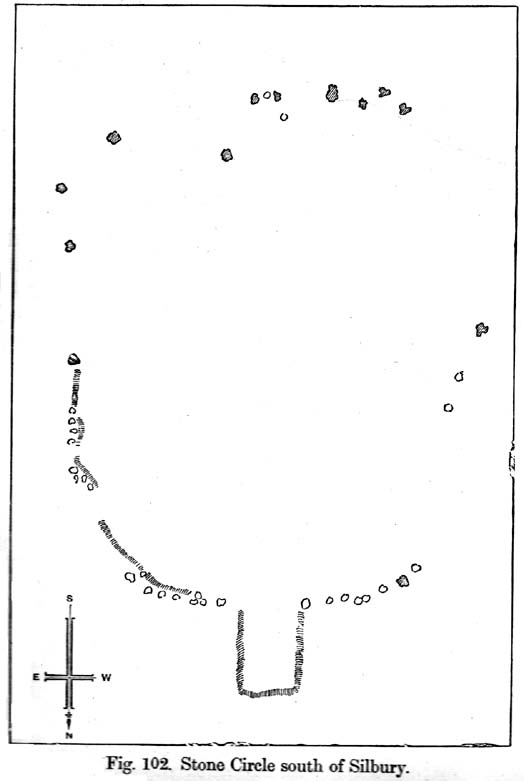
Smith’s plan of the site

This all-but-destroyed megalithic ring is all-but-unknown in most of the archaeological gazetteers — including even Burl’s (2000) magnum opus!  But we know it was there.  And according to the Avebury authority Pete Glastonbury , there “are a couple or three small stones buried on the hill but nothing else to see.”  Which is a pity, as the site sounds like it was something to behold in bygone times.  Although it seems to have been described initially by the legendary druidical antiquarian, William Stukeley, a more lengthy description followed in the 19th century by the reverend A.C. Smith (1885), when he and a friend took it upon themselves to cut back some of the turf that was covering a number of stones — and they weren’t to be disappointed!

The site itself appears to have stood right on the southern boundary line of Avebury parish, meaning that the site could have been named and cited on any early boundary perambulation records that might exist of the parish. (do any of you Wiltshire folk have access to any such old records?)  But if there are no such early accounts, the earliest record we’ll have to stick with is good old Mr Stukeley (1743), who only gave it a passing mention, saying:

“Upon the heath south of Silbury was a very large oblong work like a long barrow, made only of stones pitch’d in the ground; no tumulus.  Mr Smith before-mentioned told me his cousin took the stones away (then) fourteen years ago, to make mere (boundary, PB) stones withal.  I take it to have been an Archdruid’s, tho’ humble, yet magnificent; being 350 feet or 200 cubits long.”

Nearly 150 years later Reverend Smith gave us a more detailed account, and ground-plan, describing the place as,

“a stone circle, of considerable dimensions, though imperfect and formed of very small sarsens, but which I believe to have been in some way connected with Abury.  Though it appears to have been mentioned by Stukeley one hundred and fifty years ago, it had been long since buried, and completely forgotten till I was fortunate enough to discover it by digging in the year 1877.  I was led to the discovery by the suspicious look of certain stones which, though scattered in no regular form, appeared as if they might have once stood erect, in some sort of order, on the segment of a large circle.  I had often stopped to examine them as I wandered over that part of the downs; till at last previous suspicions ripened into conviction, as closer observation revealed sundry other stones just showing above the ground, and there also seemed to be faint indications of a trench, all pointing, with more or less accuracy, to the supposed circle.  Not to dwell upon the details of the investigation, which, however, were of singular interest to me, the result was that (with the permission of both owner and occupier of the land, and assisted by Mr William Long), I probed the ground in every direction, and uncovered the turf wherever a stone was found: and on our first day’s work we unearthed no less than twenty-two sarsen stones, all forming part of the circle, and lying from two to twelve inches below the surface.  These stones were all of small size, some of them very small, but that they were placed by the hand of man in the positions they now occupy, in many cases nearly touching one another, and that they formed part of a large circle or oblong, admits, I think, of no doubt.  I say part of a circle, because, though the northern, southern and eastern segments are tolerably well defined, I could find scarcely a single stone on what should be the western segment to complete the circle.  That the area thus enclosed is not insignificant will appear from the diameter (in length, or from north to south, 261 feet; and in breadth, or from east to west, 216 feet).  Again, its position (due south of Silbury, and within full view of it, as well as the Sanctuary on Overton Hill, and with Abury immediately behind Silbury, due north of it, from which also Silbury is equidistant) seems to intimate that it may have had some connection with the great temple.”

A ley running through the circle (image courtesy Paul Devereux)

Smith then proceeded to query the nature of the monument, commenting on how Sir John Lubbock and members of the British Archaeological Association were intrigued by the remains, but a little perplexed and unable “to form any opinion” as to the exact nature of the site.  But this didn’t stop mythographer and historian Michael Dames (1977) who, in his classic Avebury Cycle, suggested that the site “marked the navel of the landscape goddess” in the region.

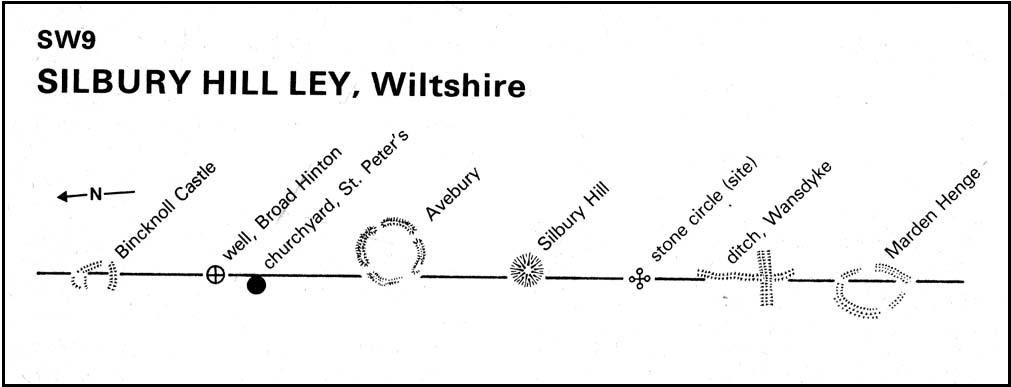
The site didn’t go unnoticed in Devereux and Thomson’s (1979) classic Ley Hunter’s Companion, where it plays an important point along a ley that runs north-south for 13 miles between Bincknoll Castle at the north, to Marden Henge at the south.  Such an alignment had been noted much earlier by other archaeologists and historians.

The site does look strange for a stone circle in Smith’s ground-plan and has more the hallmarks of a type of enclosure or settlement of some sort.  It certainly wouldn’t be out of place, design-wise, as a prehistoric settlement in our more northern climes.  However, without further data it seems we may never know the true nature of this old stone site…

References:

  1. Dames, Michael, The Avebury Cycle, Thames & Hudson: London 1977.
  2. Devereux, Paul & Thomson, Ian, The Ley Hunter’s Companion, Thames & Hudson: London 1979.
  3. Glastonbury, Pete, “Silbury ‘stone circle’ Query,” private comm., March 6, 2011.
  4. Smith, A.C., A Guide to the British and Roman Antiquities of the North Wiltshire Downs, Wiltshire Archaeological & Natural History Society 1885.
  5. Stukeley, William, Abury, A Temple of the British Druids, W. Innys & R. Manby: London 1743.

© Paul Bennett, The Northern Antiquarian


Martinsell Hill, Oare, Pewsey, Wiltshire

Hillfort:  OS Grid Reference – SU 1764 6396

Also Known as:

  1. Martin’s Hill

Archaeology & History

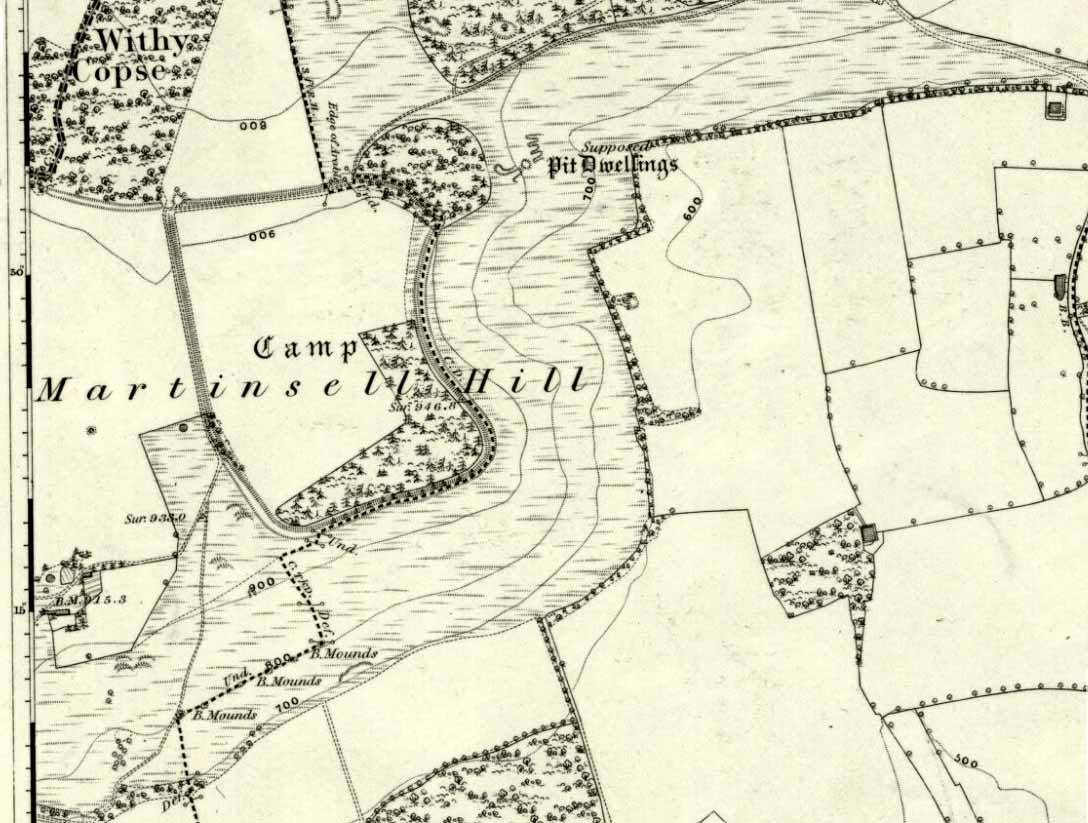
Martinsell Hill on 1888 map

The second highest of Wiltshire’s prehistoric camps or hillforts, Martinsell Hill was described as early as the 13th century as ‘Mattelsore’ and was known in local dialect and literary forms as variants around the word mattels, until the 16th century, when the title became altered in literature and for the first time became known as ‘Martinshall’ (and variants thereof), which has stuck ever since.  As the etymologists Gover, Mawer & Stenton (1939) proclaimed,

“the first element (mattels, PB) must be associated with the old english name for the camp which stands on top of it: the Mætelmesburg of the Pewsey charter” —

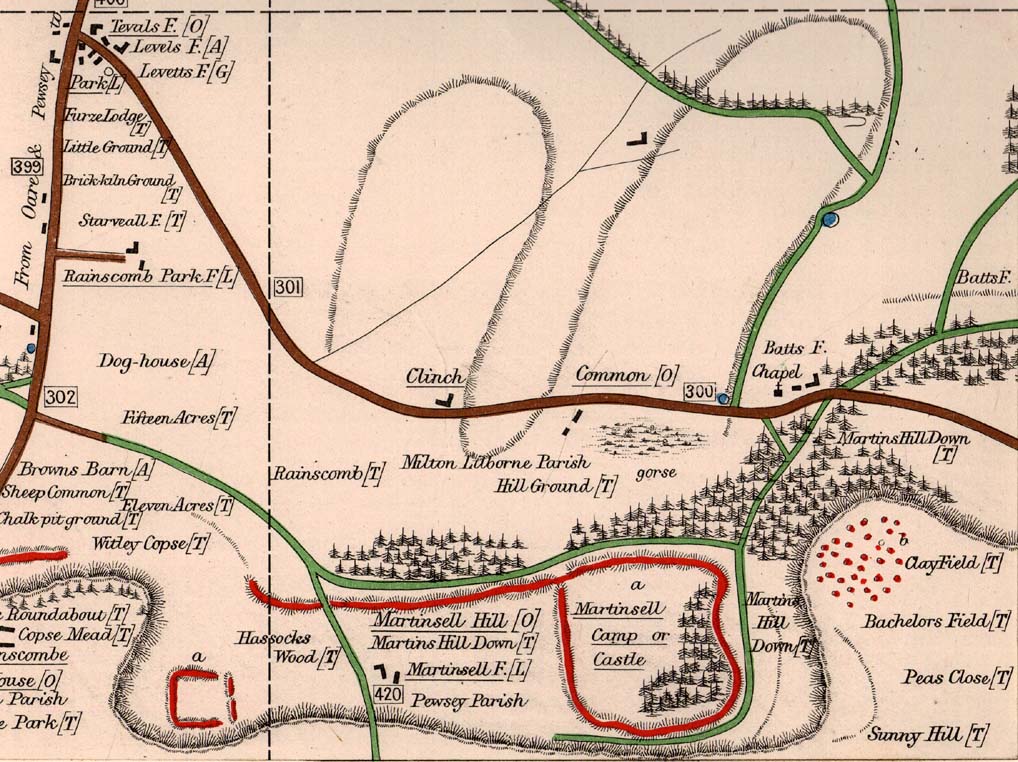
A.C. Smith’s old map

Which the authors think derived from “Mætelmesora, i.e., ‘Mæþelhelm’s bank'”, being the name of a tribal leader or elder who gave his name to the hill upon which the fort was built.  Margaret Gelling echoes the sentiment in her Place-Names in the Landscape, but we must keep in mind that such derivation is still a quite speculative etymology and one which doesn’t seem to be able to be proven (as yet!).

The hillfort and its remains were described in some detail in the second volume of Colt Hoare’s classic Ancient Wiltshire (1819: 107), where he wrote:

“Martin’s Hill or Martinshal Hill is in North Wilts what Long Knoll near Maiden Bradley is in South Wilts, ‘collis longe spectabilis’.  This elevated point commands a most advantageous prospect of the rich vale that separates the northern and southern districts of our county, , and is rendered interesting to the antiquary by an extensive earthenwork that crowns the summit of the hill.  Its form resembles an oblong square on all sides, except towards the east, where it bends inward in order to humour the natural shape of the hill.  Its area, which is in tillage, comprehends thirty-one acres; and as several entrances have been made through the ramparts for the convenience of agriculture, it is difficult to ascertain on which side were the original approaches to the camp.  This hill, in its formation, presents a peculiarity rather contrary to the usual system of nature, by rising in height towards the east, where a bold and tremendous precipice of smooth turf shelves down from the summit to the base of the hill.  This eminence is more remarkable for the rich and extensive prospect which it affords than for the plan of its entrenchments, which consists of a single vallum and fosse.  Not having discovered by digging any certain marks of ancient populations within its area, I am inclined to think that it may be considered as an asylum to which the Britons, who were very numerous in its environs, sent their families and herds in times of danger: the single vallum and ditch prove its British origin, and the great extent of its area seems to warrant this conjecture.”

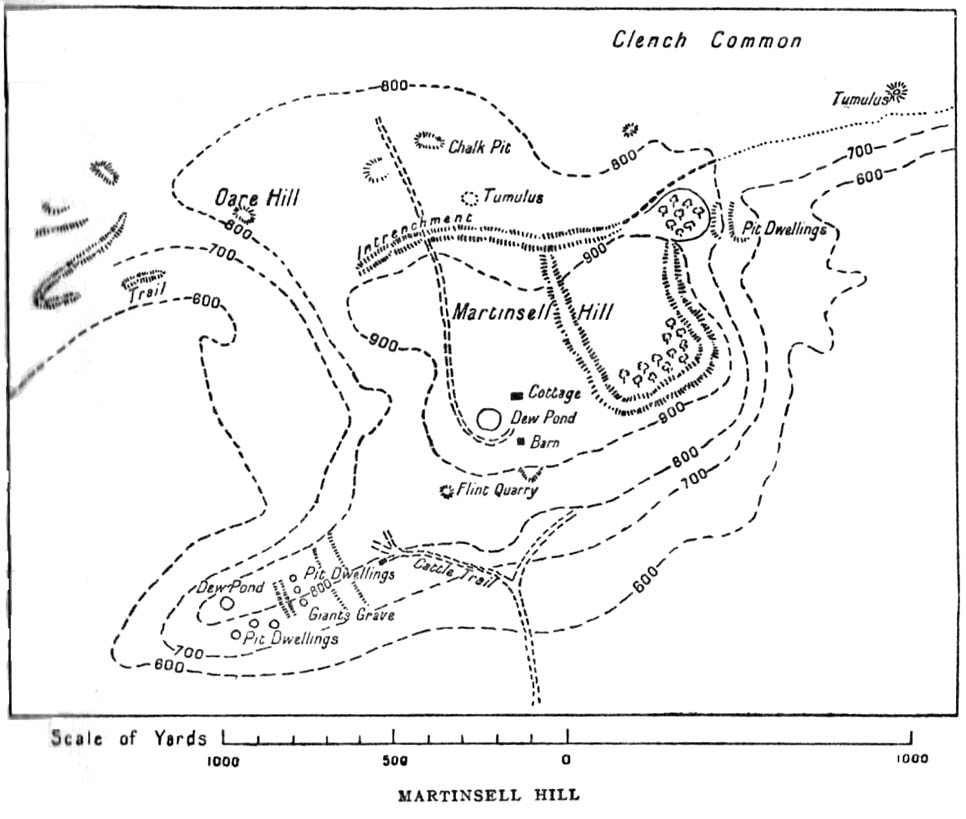
Hippisley Cox’s ground-plan

This aint a bad assumption for a fella who wrote this 200 years ago without the aid of excavation or modern archaeocentric analysis.  But we can see that Hoare was utilizing that dying virtue of common sense here, and find that much of what he said remains the echoed narrative of modern archaeologists who, I believe, still aint done a detailed excavation on the site themselves. (weird for down South!)  Later in the 19th century, when the reverend A.C. Smith (1885) visited and wrote about the hillfort, he added little to Hoare’s earlier words.  And the descriptive narrative of the site remained roughly the same (Massingham’s intriguing ascriptions aside!) even after a small excavation was undertaken in 1907, which found very little.  Hippisley Cox (1927) passed this way in his fine travelogue of ancient roads and trackways in Wessex, describing the enclosed top of this hill as

“the site of a complete neolithic settlement, including dew-ponds, a cattle compound, a flint quarry, lynchetts, dicthes of defence and deep cattle tracks formed by much going and coming of beasts from the valley.”

He may have been right!  In more recent times Geoffrey Williams (1993) describes the Martinsell hillfort, which again only gives slightly more info than Colt Hoare’s 1819 narrative.  The site covers 32 acres in size, is roughly rectangular in form, measuring roughly 330 yards (302m) across east to west, and 480 yards (439m) north to south.   There appears to be at least one entrance on its northeastern edge.

Folklore

What seems to be a survival of prechristian sun lore is found in one or two of the events that used to happen upon and around Martinsell.  A number of local history books give varying descriptions of the events here, but Devereux and Thomson (1979) condense the information nicely, telling us that

“The camp seems to have been a focus for curious Palm Sunday ‘games’ in past centuries, one of which involved a line of boys standing at intervals  from the base to the summit of the hill.  Using hockey sticks, they then proceeded to knock a ball in succession up the hill to the top.  Another activity was the throwing of oranges down the hill slopes with boys going headlong after them.  Evene more strangely, local youths used to slither down the escarpment on horses skulls.”

Mythographer and writer Michael Dames (1977) thought that such festive activities on and around the hill related to remnants of ancient goddess worship here.

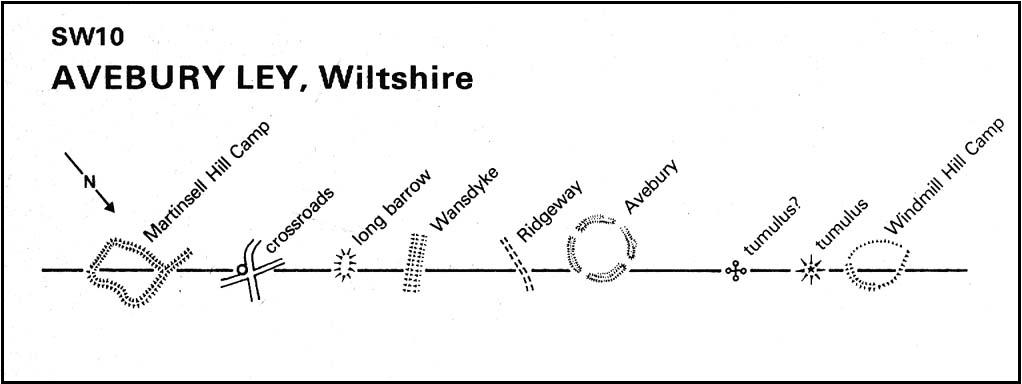
Ley line running from Martinsell (image courtesy Paul Devereux)

In Paul Devereux & Ian Thomson’s (1979) ley hunter’s guide, the Martinsell Hill site stands at the beginning of a ley, which then runs northwest for more than seven miles, eventually ending at the well known causewayed enclosure of Windmill Hill — but not before passing by the Avebury stone circle and several prehistoric tombs on route.  This ley is a simple alignment between sites (as the ‘discover’ of leys, Alfred Watkins described them) and has nothing to do with the modern contrivance of energy lines.

…to be continued…

References:

  1. Bradley, A.G., Round about Wiltshire, Methuen: London 1948.
  2. Dames, Michael, The Avebury Cycle, Thames & Hudson: London 1977.
  3. Devereux, Paul & Thomson, Ian, The Ley Hunter’s Companion, Thames & Hudson: London 1979.
  4. Gomme, Alice B., “Folklore Scraps from Several Localities,” in Folklore Journal, 20:1, 1909.
  5. Gover, J.E.B., Mawer, A. & Stenton, F.M., The Place-Names of Wiltshire, Cambridge University Press 1939.
  6. Harding, D.W., The Iron Age in Lowland Britain, RKP: London 1974.
  7. Hoare, Richard Colt, The Ancient History of North Wiltshire, Lackington, Hughes, Mavor & Jones: London 1819.
  8. Massingham, H.J., Downland Man, Jonathan Cape: London 1926.
  9. Partidge, T.B., “Wiltshire Folklore,” in Folklore Journal, 26:2, 1915.
  10. Smith, A.C., A Guide to the British and Roman Antiquities of the North Wiltshire Downs, Wiltshire Archaeological & Natural History Society 1885.
  11. Williams, Geoffrey, The Iron Age Hillforts of England, Horace Books 1993.

© Paul Bennett, The Northern Antiquarian

Duncroisk (3), Glen Lochay, Killin, Perthshire

Cup-and-Ring Stone:  OS Grid Reference – NN 53447 35669

Also Known as:

  1. Canmore ID 24181
  2. Duncroisk 5 (Canmore)

Getting Here

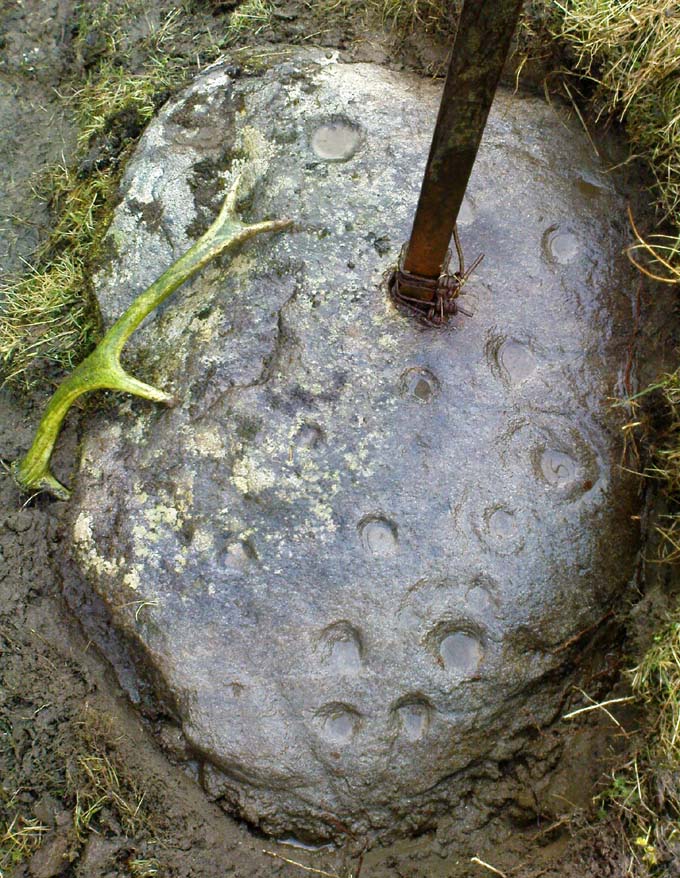
Duncroisk 3 Carving
Duncroisk 3 Carving

Two real ways to get here. Either (i) follow the directions to get to the Stag Cottage carvings of Duncroisk 1, then walk down to the fence by the riverside and walk along to the left for a coupla hundred yards till you reach a second metal fence-post sticking out of a rock on the other side of the deer-fencing; or (ii) from the roadside burn a coupla hundred yards along the road before you reach Stag Cottage, follow it down to the riverside, then head along the footpath behind the fencing, parallel with the river’s edge.  It aint far.  Within 100 yards you’ll reach the stone with the metal pole sticking out of it and the carvings are on this!

Archaeology & History

Confusingly redesignated as Duncroisk 5 carving by the usually efficient Canmore people, we’re sticking with this stone’s original name given by Ronald Morris (1981) in his British Archaeological Report of this and nearby carvings — and a quite fascinating carving this is as well!

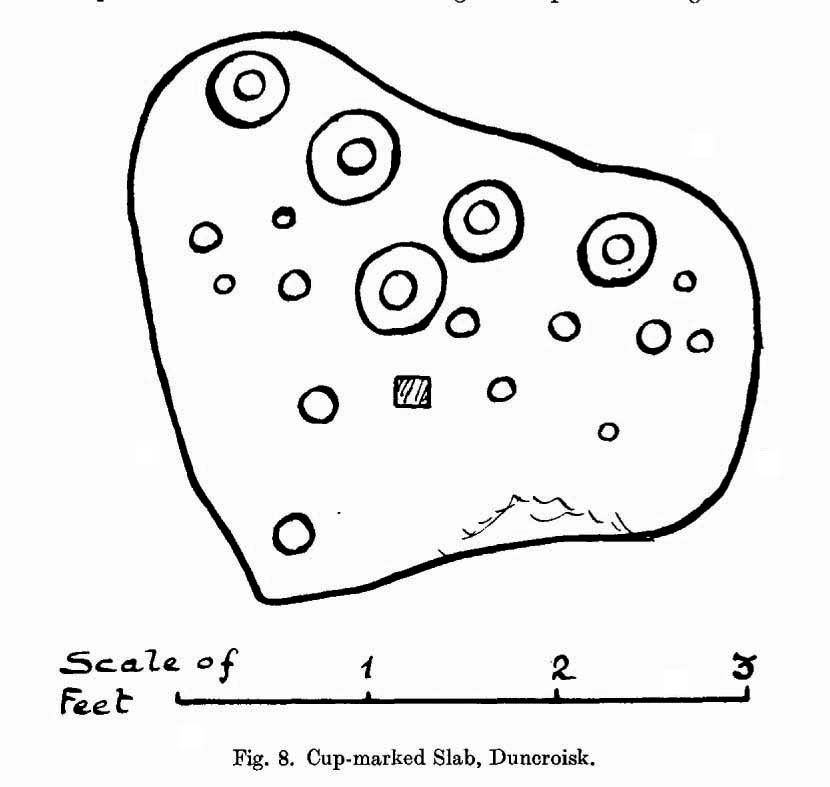
C.G. Cash’s drawing
Duncroisk 3 stone

As with many cup-and-rings, erosion and lighting has a powerful effect on seeing the design correctly.  On my visit here in recent months there were quite distinct additional elements in the carving which haven’t been noted by previous archaeologists.  But in saying that, there were also some elements that were reported by the earliest antiquarians that proved difficult to see in the grey light of day when I was here.  The earliest report of the carving by C.G. Cash (1912) told there to be five rings, whereas today only 3 or 4 are visible (though this will probably change when viewed in other lighting conditions).

When Mr Cash told of this stone in his essay on the antiquities of Killin it sounded as if it was lucky to have survived, as it had previously been dug out and left by the roadside, before then being reused by a local to fix a fence-post in!  Mr Cash told us that the local,

“had used it as the foundation stone of the stretching post at the south end of the easternmost fence on the farm, and there I found it, near the brink of the river, buried in sand and turf.  I cleared it and then in pouring rain crouched over it to make a hasty sketch.  It bears eighteen cups, of which five are surrounded by rings.  The largest cups are 2½ inches and the rings 6 inches in diameter.”

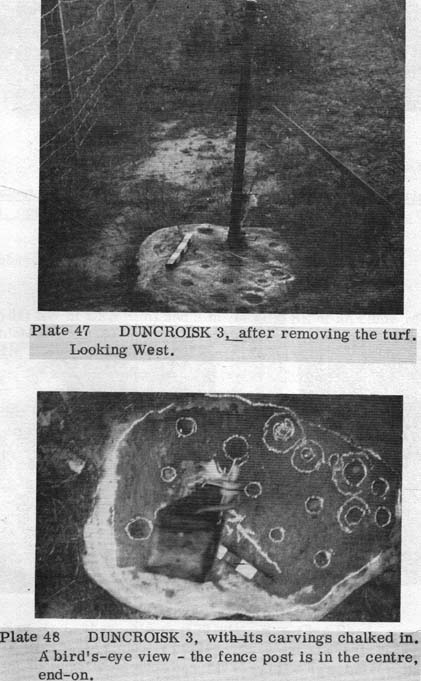
Ron Morris’ images

When I visited the place the weather was much the same as Mr Cash described: lovely teeming rain, typical of the mountains, with the surrounding trees breathing moisture onto the slopes as ever.

Years later when Ronald Morris (1981) came here he saw “4 cups-and-one-ring…probably complete rings, up to 12cm (5 in) in diameters and 10 cups up to 2cm deep.”

If you stand and face the stone, the cup-marking on its lower right side (see Morris’ old photo, above) has a pecked line running from it further to the right and down to the edge of the rock.  You can clearly make it out on the top photo.  This carved line also seemed to touch another carved line which can be seen running along the outer edge of the stone — although the poor light didn’t allow me to view this with absolute confidence.  I’ll have another look at it again when I’m up in the area in May and hopefully confirm or deny it with greater confidence (and if anyone else gets here in the meantime, have a look and see what y’ think).

References:

  1. Cash, C.G., “Archaeological Gleanings from Killin,” in Proceedings of the Society of Antiquaries of Scotland, volume 46, 1911-12.
  2. Morris, Ronald W.B., The Prehistoric Rock Art of Southern Scotland, BAR 86: Oxford 1981.

© Paul Bennett, The Northern Antiquarian