Craven Hall Hill (2), Hawksworth Moor, West Yorkshire

Ring Cairn:  OS Grid Reference – SE 14442 44281

Getting Here
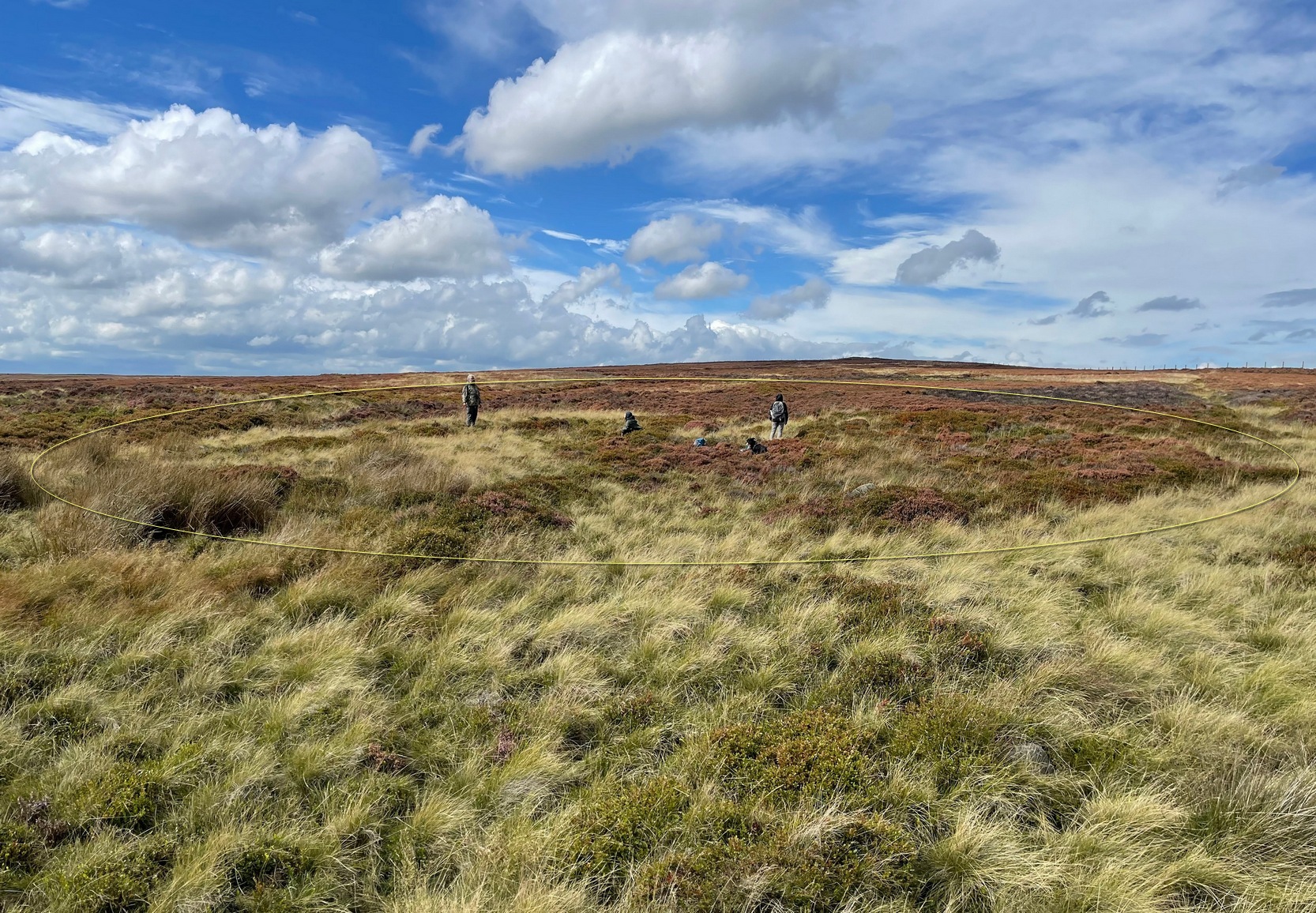
Craven Hall ring cairn

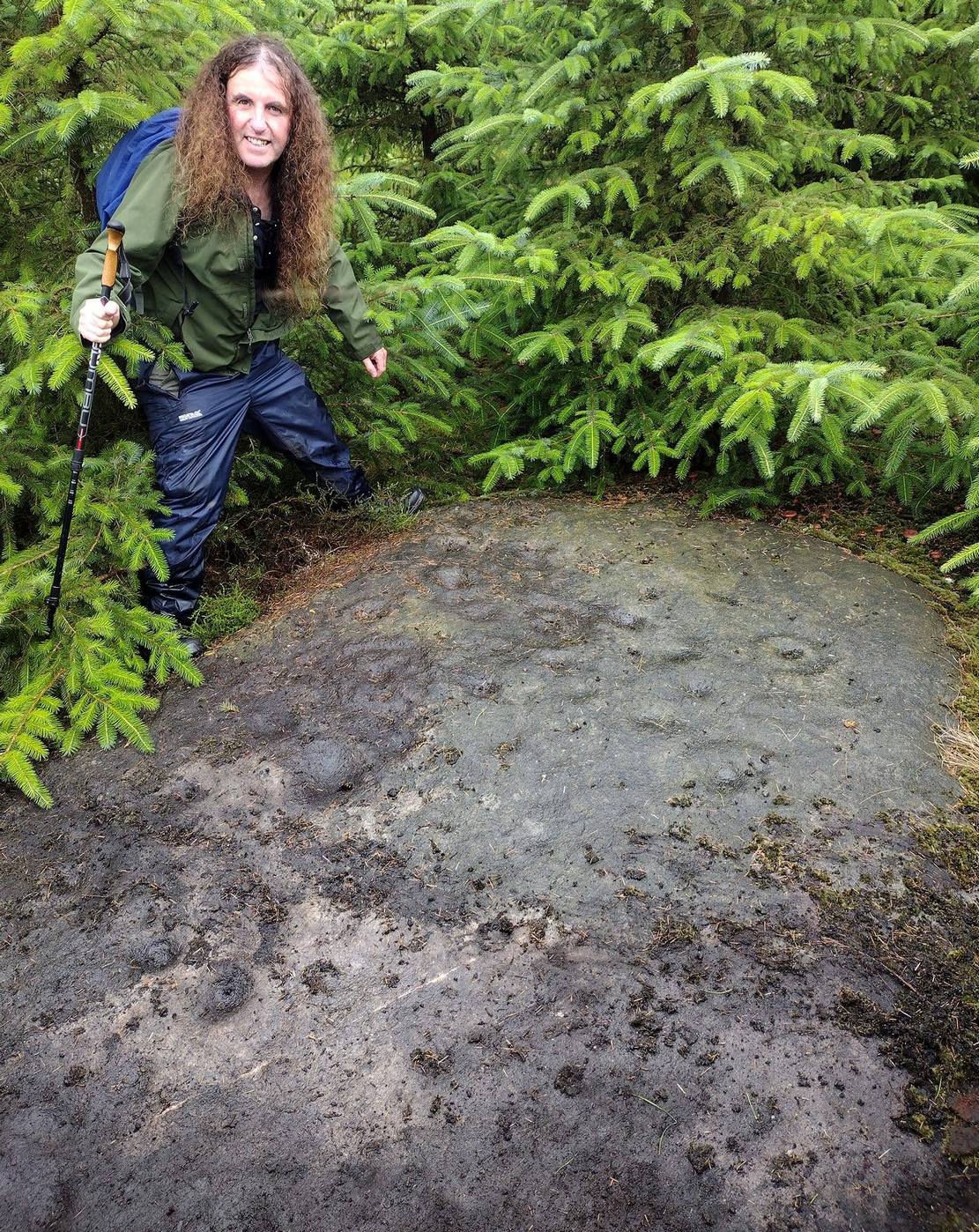
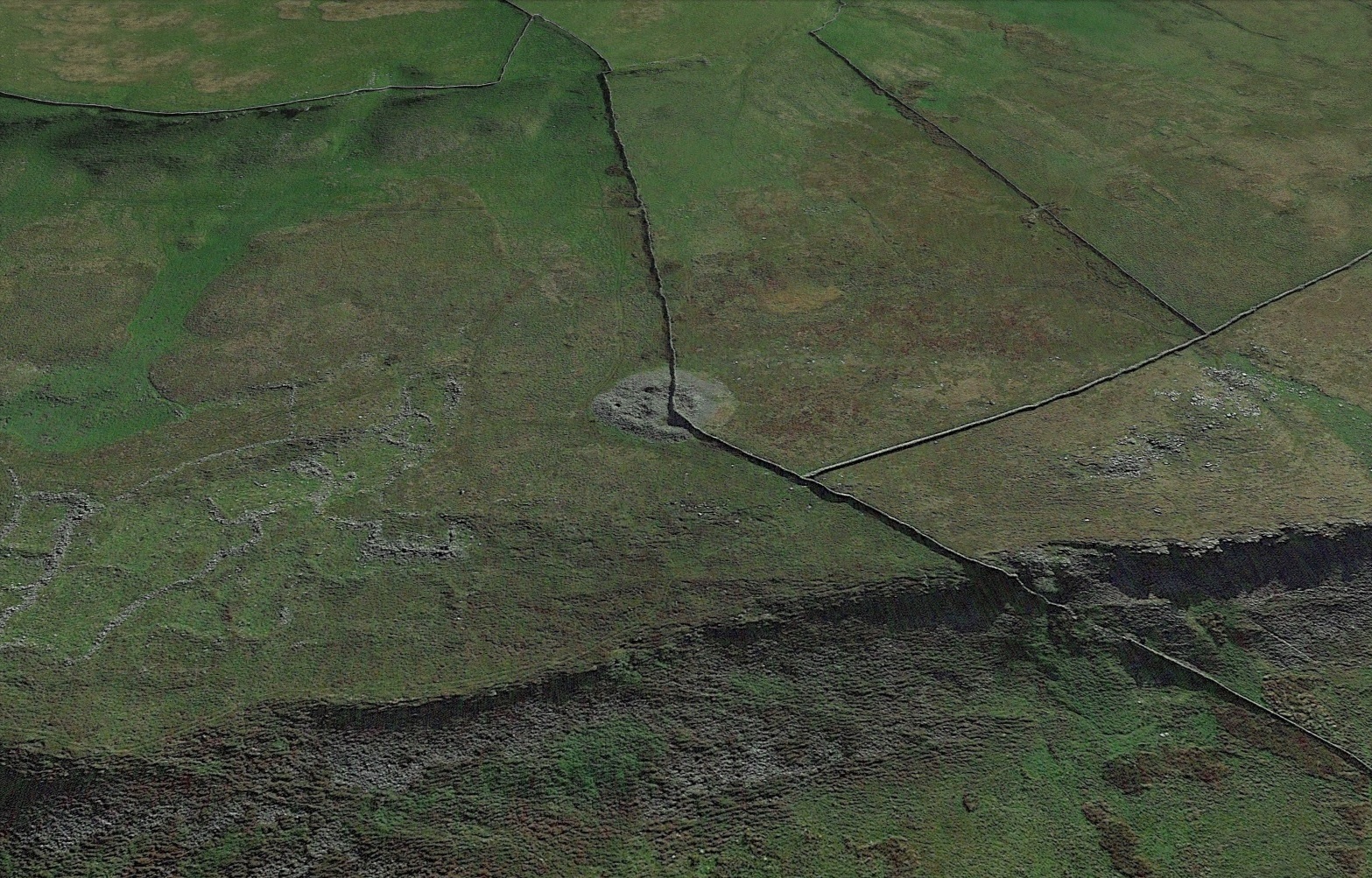
Your best starting point is from the Great Skirtful of Stones giant cairn.  From here follow the fencing that runs down the slope to your left (south-east) for roughly 160 yards (148m) – past the Great Skirtful Ring – until you reach the gate.  Go through it and keep walking down the same fence-line for 300 yards then walk south onto the moorland proper (there are no paths here).  You’ll pass over several undulations in the heather (some of these are the edges of ancient trackways) and 55-60 yards south from the fencing you’ll walk over and into this overgrown prehistoric ring.  It’s very difficult to see when the vegetation is deep, so persevere!

Archaeology & History
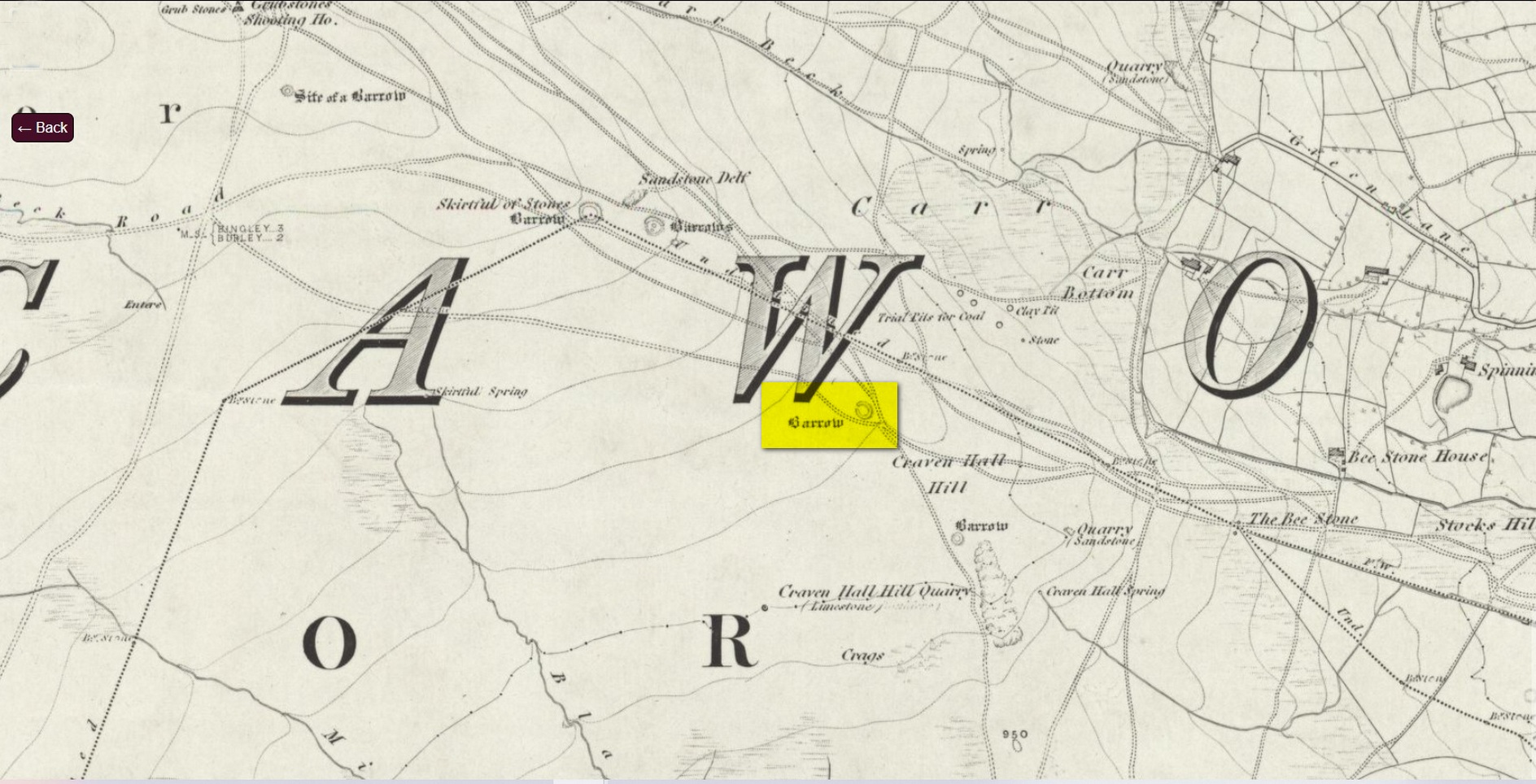
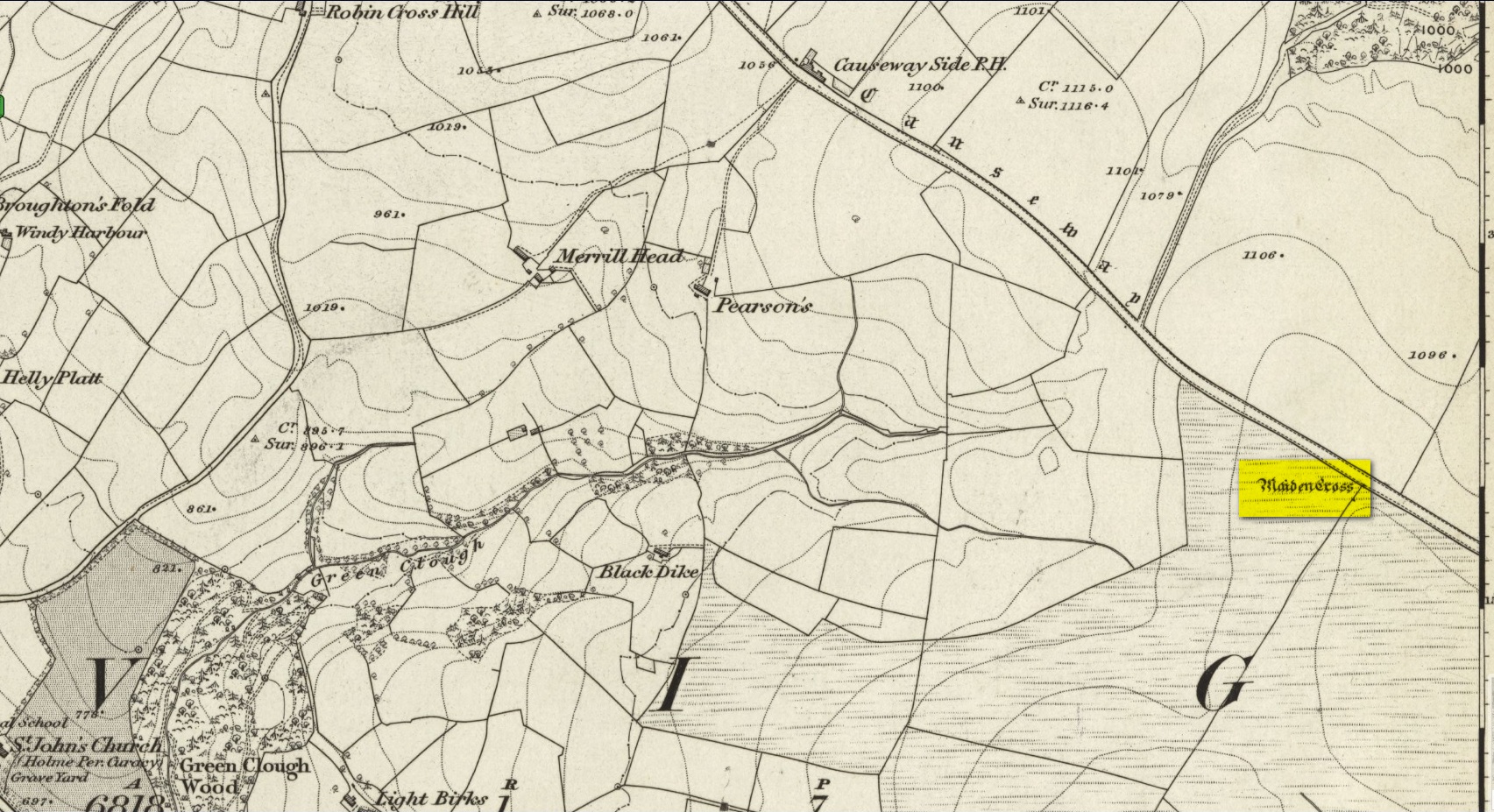
Site shown on 1851 map

This is an interesting site.  Marked on the 1851 Ordnance Survey map as a “barrow” (right), it is shown with trackways on either side of it to the north and south, and with an opening or entrance on its northwestern side.  Yet since that date, very little archaeological attention has been given to it and the site remains unexcavated, despite its location being repeated on all subsequent maps since then.  The designation of the site as a barrow or burial site, without being excavated, was educated guesswork at the time as the place seems to be what we today define as a ring cairn.  And whilst this seems likely, there are some oddities here.

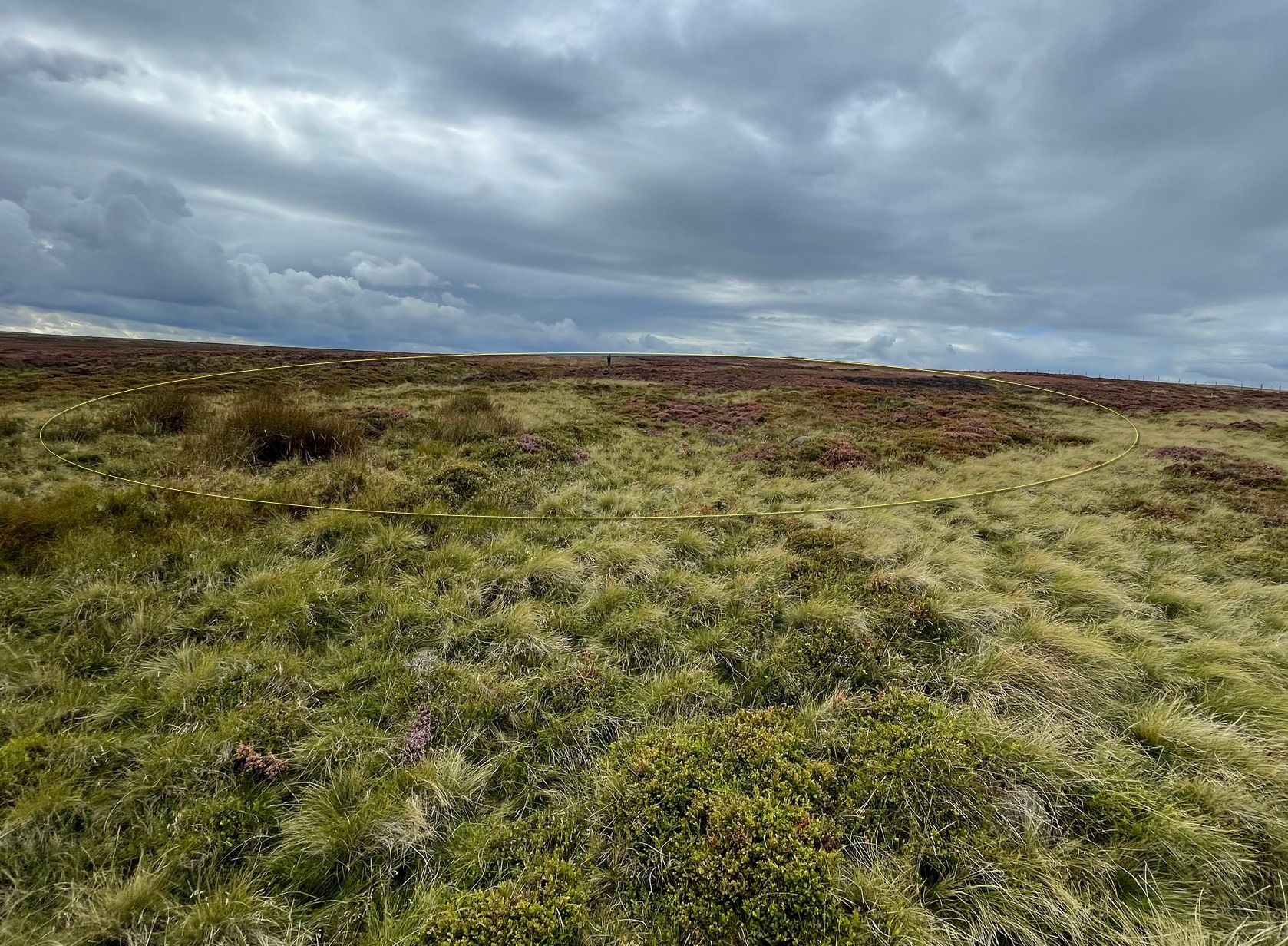
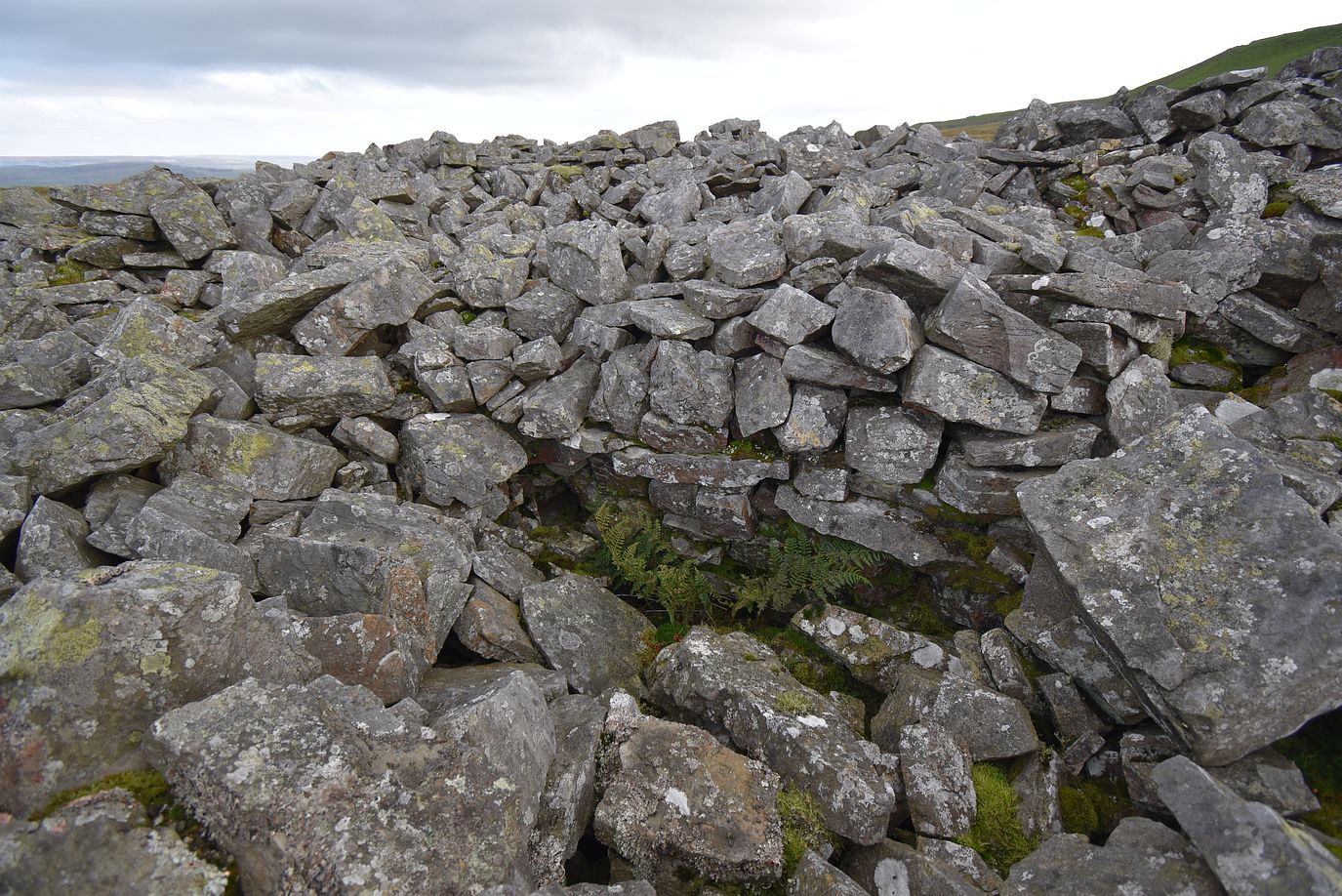
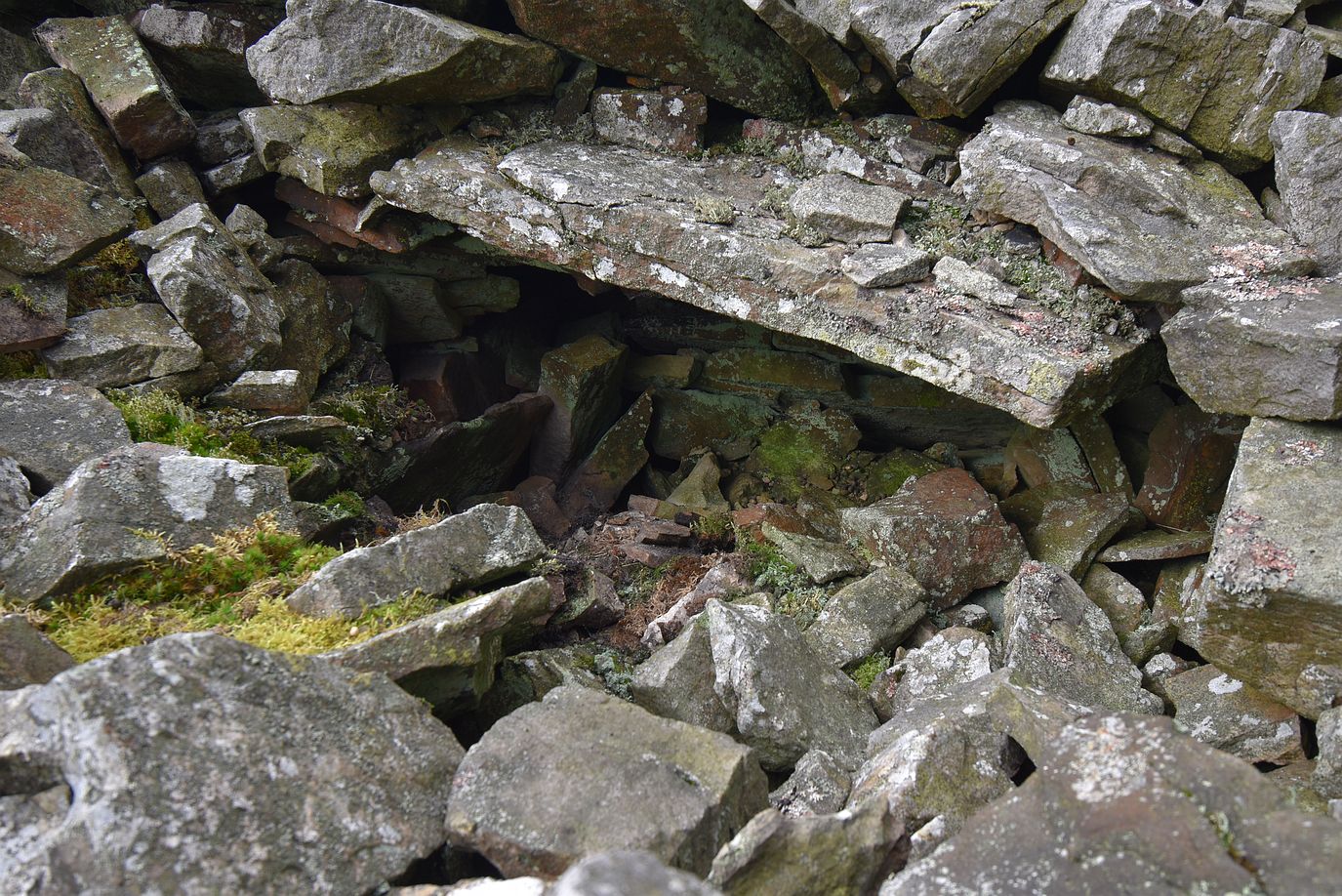
Measuring roughly 25 yards (SE – NW) by 21 yards (NE – SW), this overgrown oval ‘ring’ is a similar architectural structure to the more famous Roms Law circle more than half-a-mile northwest of here—but bigger!  And, unlilke Roms Law, this overgrown circle seems to have been untouched for many centuries.  The oval surrounding ‘ring’ itself is composed of thousands of small packing stones between, seemingly, a number of much larger upright stones, reaching a maximum height of more than three feet high at the northernmost edge.  The ‘ring’ ostensibly looks like a wide surrounding wall which measures two yards across all round the structure.
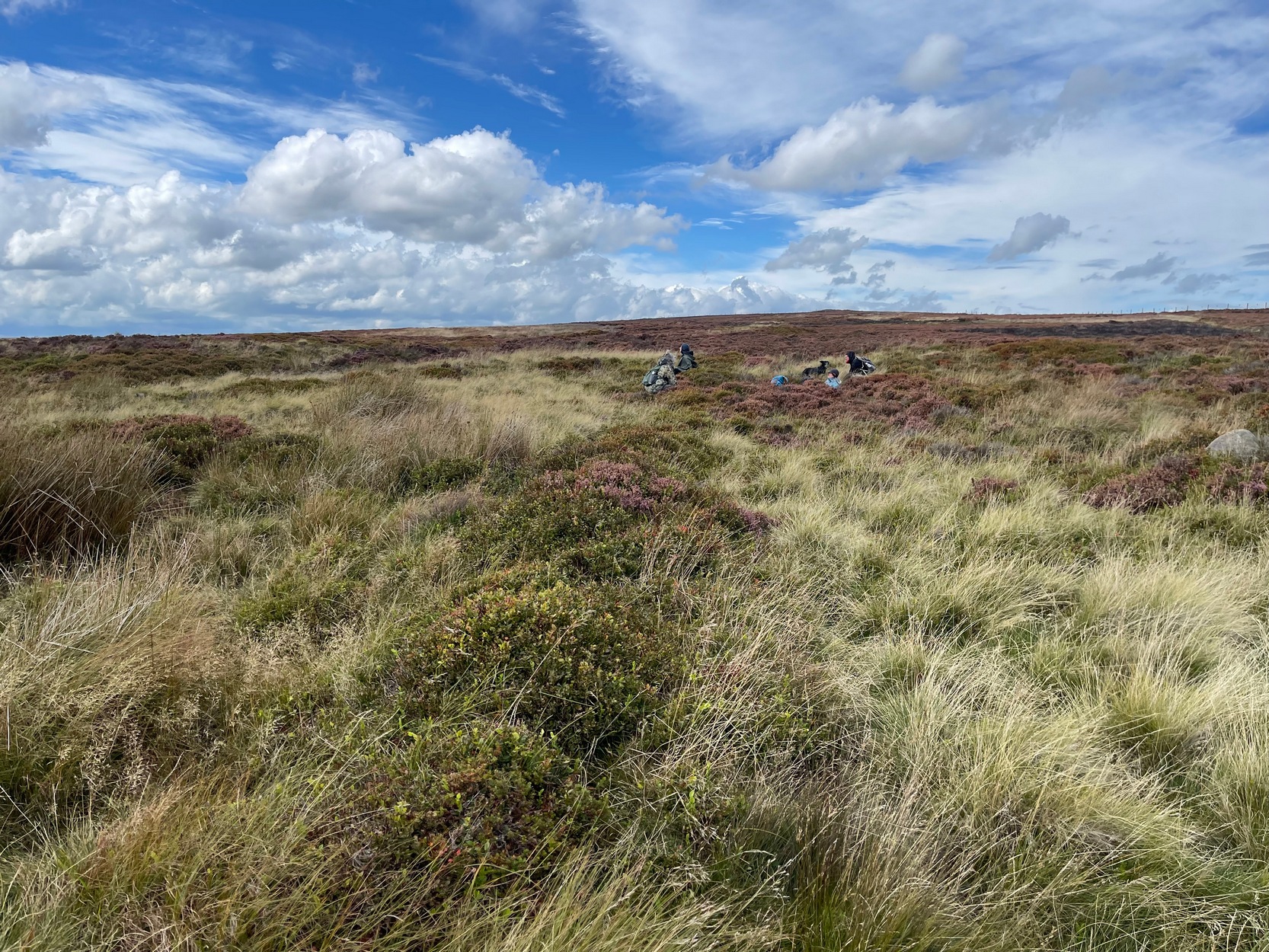
Track running into the ring
Raised line into the ring

Internally, there seems little evidence of a burial — although our recent visits here, as the photos indicate, took place when the moorland vegetation was deep and covered almost the entire site.  The outline of the site is obviously visible, even in deep heather, but the smaller details remain hidden.  But in addition to the main ring, another very distinct ingredient here is the existence of an extended length of man-made parallel walling, probably a trackway, that runs into the circle from the southeast all the way through the circle and out the other side and then continuing northwest heading roughly towards the Great Skirtful giant cairn on the horizon 500 yards to the northwest.
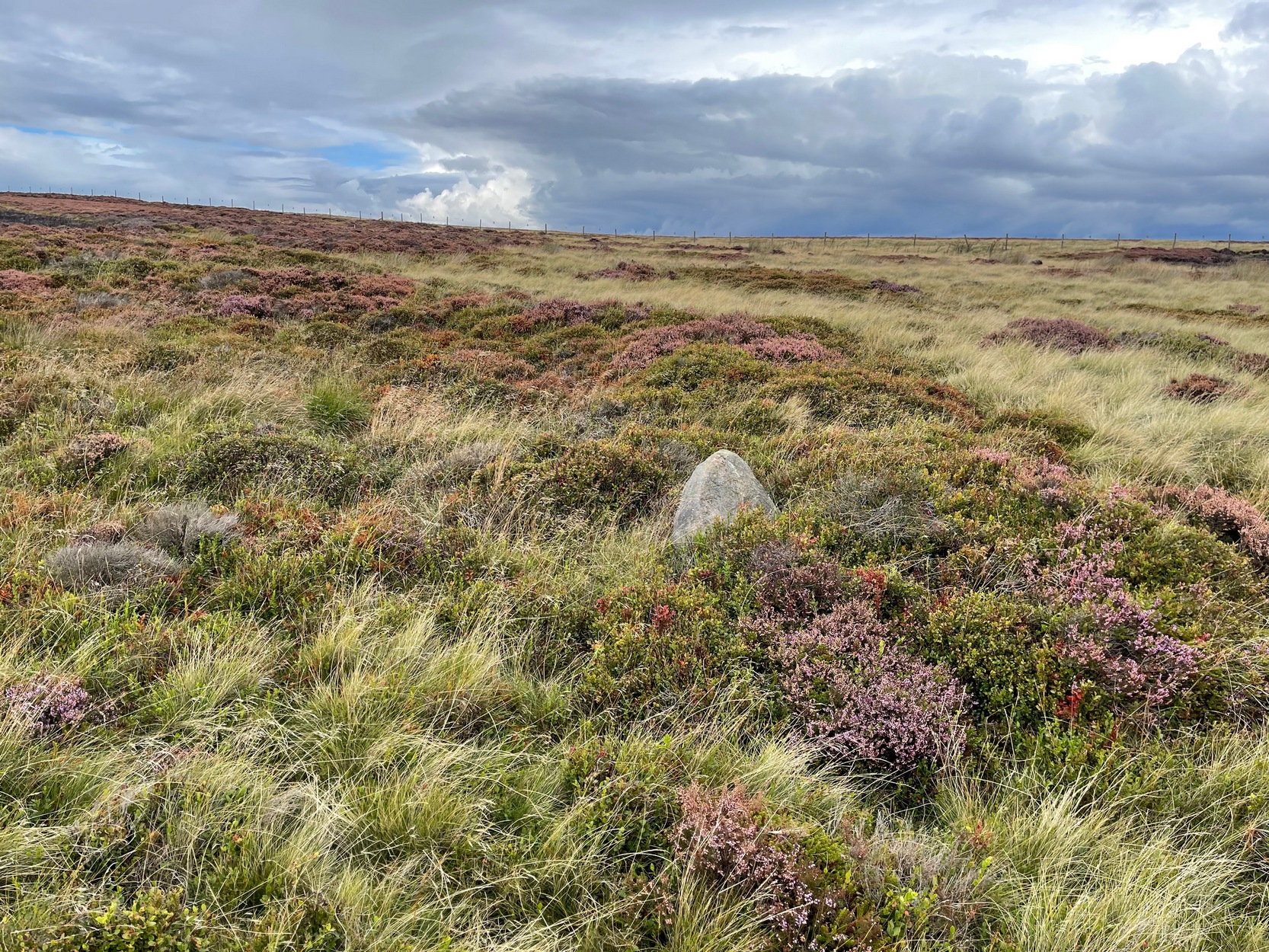
Stone at NE arc of walling

Due to the landscape being so overgrown, it’s difficult to ascertain where this ‘trackway’ begins and ends.  Added to this, we find that there are additional ‘trackways’ that run roughly parallel to the one that runs through the circle—and these ‘trackways’ are very old indeed, some of them likely have their origins way back in prehistory.  The one that runs through the middle of this ring cairn may be a ceremonial pathway along which, perhaps, our ancestors carried their dead.  If we follow it out from here and keep walking along the track 300 yards to the southeast, we eventually run right to the edge of the Craven Hall (3) circle.  Parallel to this is another ancient trackway that runs northwest to the edge of the Roms Law circle.  It seems very much as if we have ceremonial trackways linking sites to each other: ancestral pathways, so to speak.

Have a gander at this when you’re next in the area.  There are many other sites nearby that are off the archaeological radar.  In recent years, a number of northern antiquarians wandering over this landscape are finding more and more ancient remains: walling, circles, cairns, trackways.  It’s a superb arena—but sadly, most of it is hidden beneath deep moorland vegetation.

References:

  1. Faull, M.L. & Moorhouse, S.A. (eds.), West Yorkshire: An Archaeological Guide to AD 1500 – volume 1, WYMCC: Wakefield 1981.

Acknowledgements:  Huge thanks for use of the Ordnance Survey map in this site profile, reproduced with the kind permission of the National Library of Scotland

© Paul BennettThe Northern Antiquarian
Jenny Lane, Baildon, West Yorkshire

Cup-Marked Stone (removed):  OS Grid Reference – SE 1579 3995

Archaeology & History

Jenny Lane carving

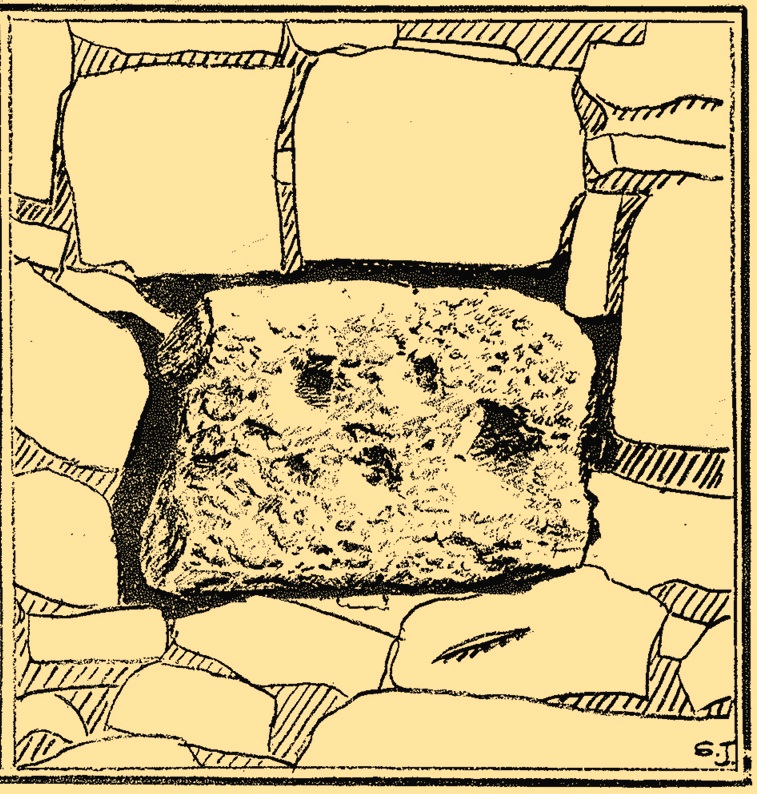
A small, seemingly broken cup-marked stone that may have once been part of a prehistoric tomb, found itself being included in an old wall at some time in the not-too-distant past: in the south-facing wall of the cricket ground at the top end of town.  No one seemed to know it was there until it was noticed in the 1950s by a local man who brought it to the attention of Sidney Jackson (1958), editor of the local Bradford archaeology mag at the time.  Jackson visited the site and thankfully did a sketch of what it looked like, before it was removed at a later date.  He wrote:

“The small rectangular stone bearing four cup-shaped hollows…is another of Mr George Pritchard’s finds.  It forms part of the high wall which bounds the Baildon Cricket Club’s ground in Jenny Lane… Its appearance suggests that it is part of a Bronze age cup-marked rock which was split to make building stones.”

Following its removal more than twenty years ago, it ended up in the hands of a dude from Cononley called Gerald Wright.  I’m not sure whether it still lives over there or has subsequently found a new abode.  Does anyone know what’s become of it…?

Folklore

Although there’s nothing specific to this carving, the place where it was found, on Jenny Lane, was where a phantom black dog used to be seen in bygone years.  It was renowned as the harbinger od death.

References:

  1. Jackson, Sidney, “Cup-Marked Stone in Jenny Lane, Baildon,” in Cartwright Hall Archaeology Group Bulletin, volume 3, part 10, 1958.

© Paul BennettThe Northern Antiquarian
Shipley Glen (136), Baildon, West Yorkshire

Cup-and-Ring Stone:  OS Grid Reference – SE 13266 38928

Also Known as:

  1. Carving BM14 (Hedges)
  2. Carving no.136 (Boughey & Vickerman)

Getting Here

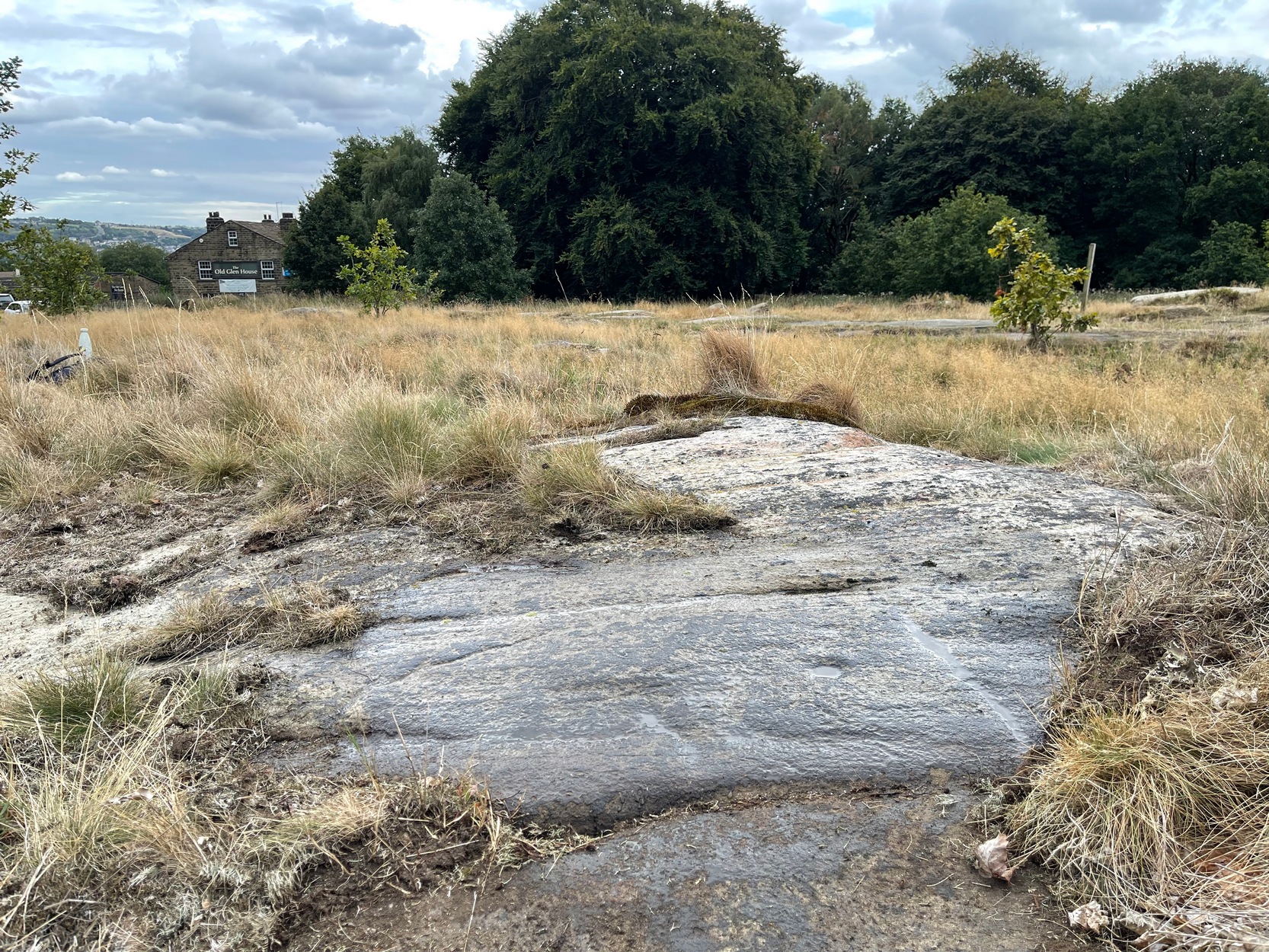
Faint carving no.136

Once you’ve got yourself to the start of Shipley Glen, from the Old Glen House pub, from the car-park outside walk up the road for 60 yards (if you reach the next small car-parking spot, you’ve gone too far) then step off-road into the vegetation on your left and you’ll see the large flat fractured section of earthfast rock.  Get low down and seek out the cup-mark first!

Archaeology & History

This is a very faded and quite basic design and unless you get decent low sunlight, it can be very difficult to discern.  On my most recent visit here, conditions weren’t too good, as the photos here indicate.

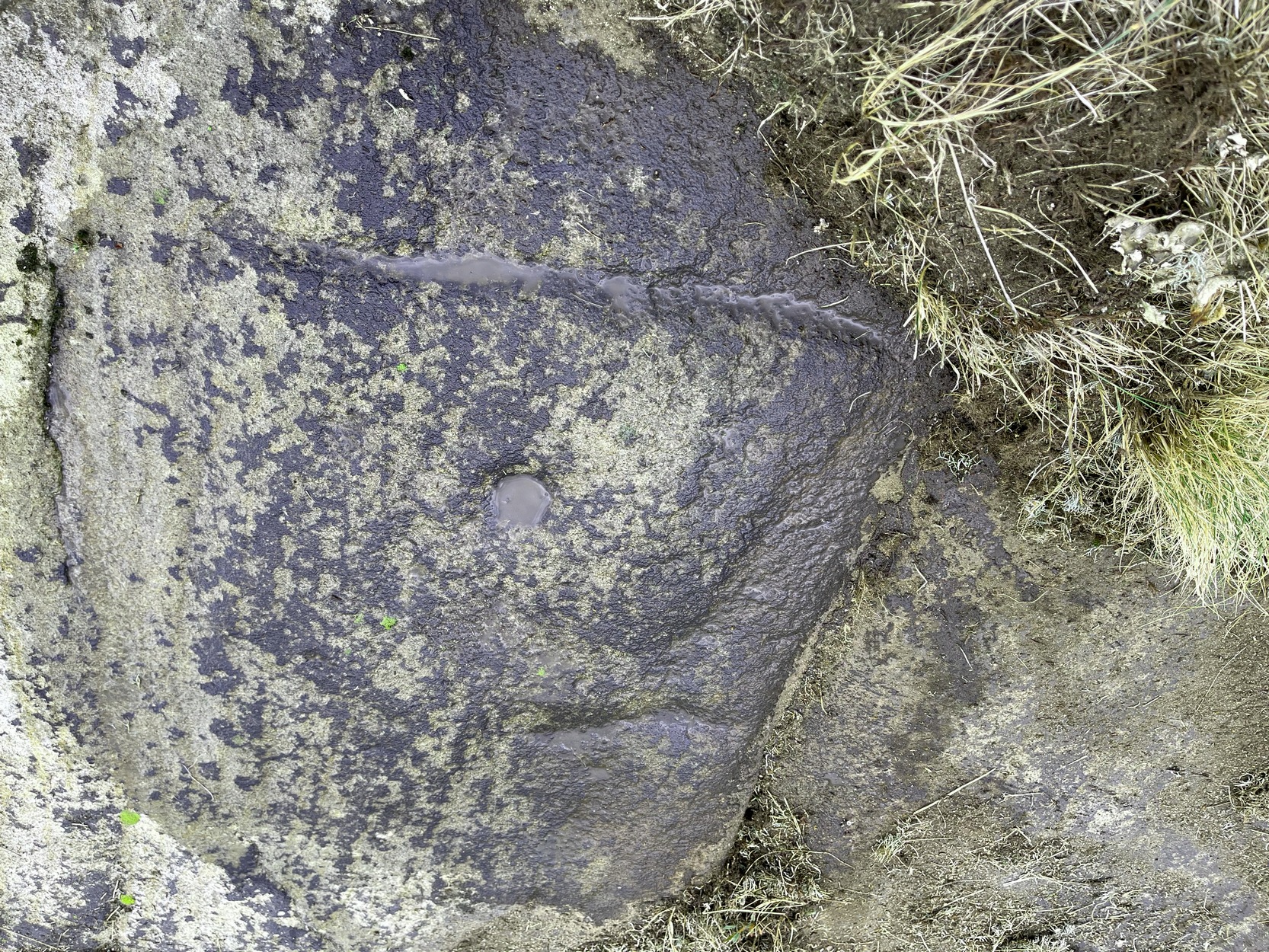
The main feature is a single cup-mark surrounded by a very wide ‘square’ ring (if y’ get mi drift).  It was first mentioned and illustrated in John Hedges (1986) survey, who described it simply:

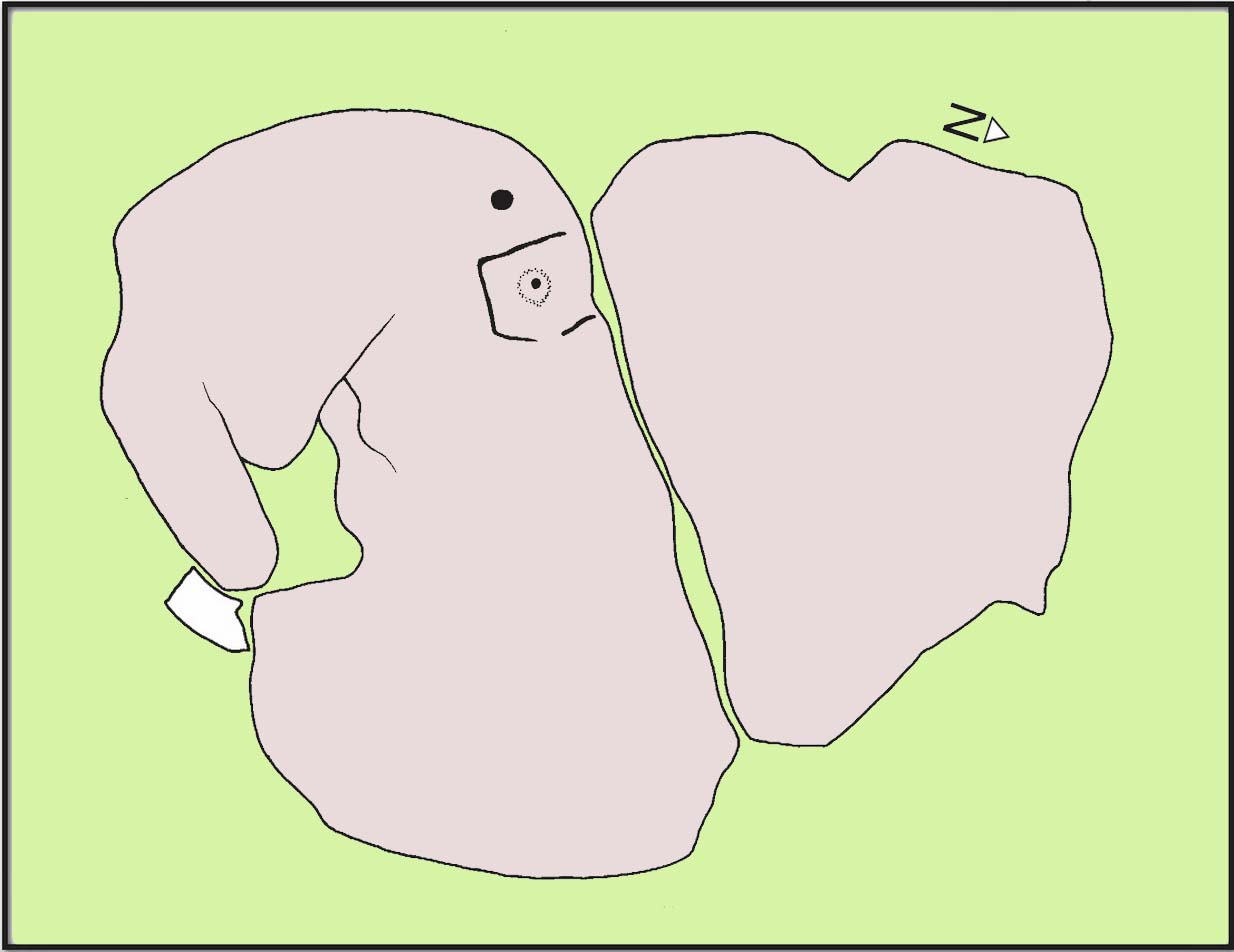
“Striated, pitted bedrock with crack down centre, in grass and amongst other rocks and bedrock. Carving, centre and W end: enclosure type angular grooves and two cups.”

John Hedges 1986 sketch
Cup & surrounding lines

One of the two cups is presently beneath some shallow vegetation (easily removed if anyone’s passing), but the main feature of the large enclosing square and its central cup is presently exposed and can be seen when your eyes eventually adjust.  Interestingly, Hedges shows the existence of a faint ring around the central cup inside of the larger square enclosure.  If someone is able to capture a photo of this, please add it on our Facebook page. 🙂

I must point out that somewhere, not too far from this carving, was once found a very similar design known as the Brackenhall Green carving that possessed the same curious squared-ring feature that we find on this stone.

References:

  1. Boughey, Keith & Vickerman, E.A., Prehistoric Rock Art of the West Riding, WYAS: Wakefield 2003.
  2. Hedges, John (ed.), The Carved Rocks on Rombalds Moor, WYMCC: Wakefield 1986.

© Paul BennettThe Northern Antiquarian
Brackenhall Green, Baildon, West Yorkshire

Cup-and-Ring Stone (destroyed):  OS Grid Reference – SE 133 389

Archaeology & History

The lost carving of Brackenhall, in 1888

I first came across a description of this lovely-looking cup-and-ring carving during some research I was doing in the archives at Bradford Central Library in the 1980s—and decided there and then that I had to find it!  It was described and illustrated for the first time by William Glossop (1888) when he made a short survey of some of the prehistoric sites on Baildon Hill and Shipley Glen.  He told that it was one amidst “a cluster of rocks on Bracken Hall Green”—but was seemingly destroyed not too long after he wrote about it.  There was some discussion in the late-1980s that it may have been a petroglyph that was cataloged by John Hedges as carving ‘BM14’ (at SE 13272 38924), due to it possessing a similar ‘artistic’ element (or motif, as some like to call it) and which is also along the Brackenhall plateau by the roadside about 160 yards below the entrance to the Brackenhall centre—but it turned out not to be the case.

A few years after Mr Glossop uncovered this carving, a short note by J.H. Turner (1894) described two cup-marked stones, “both now destroyed” that could be seen in the same area just as you entered “the plateau where the Easter fair is now held”.  And his description closely fitted Glossop’s sketch.  Turner wrote:

“The cups were three inches in diameter, and one inch deep, in an oblong 18 by 12 inches, with line 6 feet long towards the east.  The second oblong, same size, had also an eastern pointer and one cup in the centre. These have both disappeared since June, 1889; I fear by wanton mischief.”

This would seem to be the same carving illustrated by Glossop, although it’s still difficult to say with any accuracy where it was located.  The great historian W.Paley Baildon (1913) thought it may have been the same carving which Harry Speight (aka Johnnie Gray) described at the Glen Gate—and it does sound similar, but until we are able to ascertain (i) where Glen Gate was; and (ii) whether it coincided with the location of “where the Easter fair” was held, we must err on the side of caution.  Tis an intriguing mystery… (Note: the grid-reference given for this site profile is an educated guesstimate!)

References:

  1. Baildon, W. Paley, Baildon and the Baildons – volume 1, Adelphi: London 1913.
  2. Glossop, William, ‘Ancient British Remains on Baildon Moor,’ in Bradford Antiquary, no.1, 1888.
  3. Gray, Johnnie, Through Airedale from Goole to Malham, Walker & Laycock: Leeds 1891.
  4. Turner, J. Horsfall, ‘Cup Marks, Shipley Glen,’ in Yorkshire County Magazine – volume 4, J.E. Watmough: Idel 1894.

© Paul BennettThe Northern Antiquarian

Slinger Stone, Rivock, Silsden, West Yorkshire

Cup-and-Ring Stone:  OS Grid Reference – SE 07540 44730

Getting Here

The Slinger Stone carving

A real pain-in-the-arse to find this one, and even describing how to get there is troublesome—but I’ll try my best!  I think the best starting point would be from the track that runs through Rivock plantation.  Follow directions to reach the Ripple Stone carving, then walk 35-40 yards east to the ornate multiple-ringed stones of Rivock (067) and company.  Now comes the tricky bit.  From here walk, zigzag fashion (it’s the only way y’ can do it!) up the slope ever-so-slightly east of due south until you reach the top of the slope, where the land levels out.  If you walked in a dead straight line from the triple-ringed Rivock (66) carving, it is almost bang on 100 yards. Anyhow, now you’re on top of the slope, zigzag about and look for the large flat oval-shaped stone.  Take your time—you’re gonna need it!

Archaeology & History

Section of carving

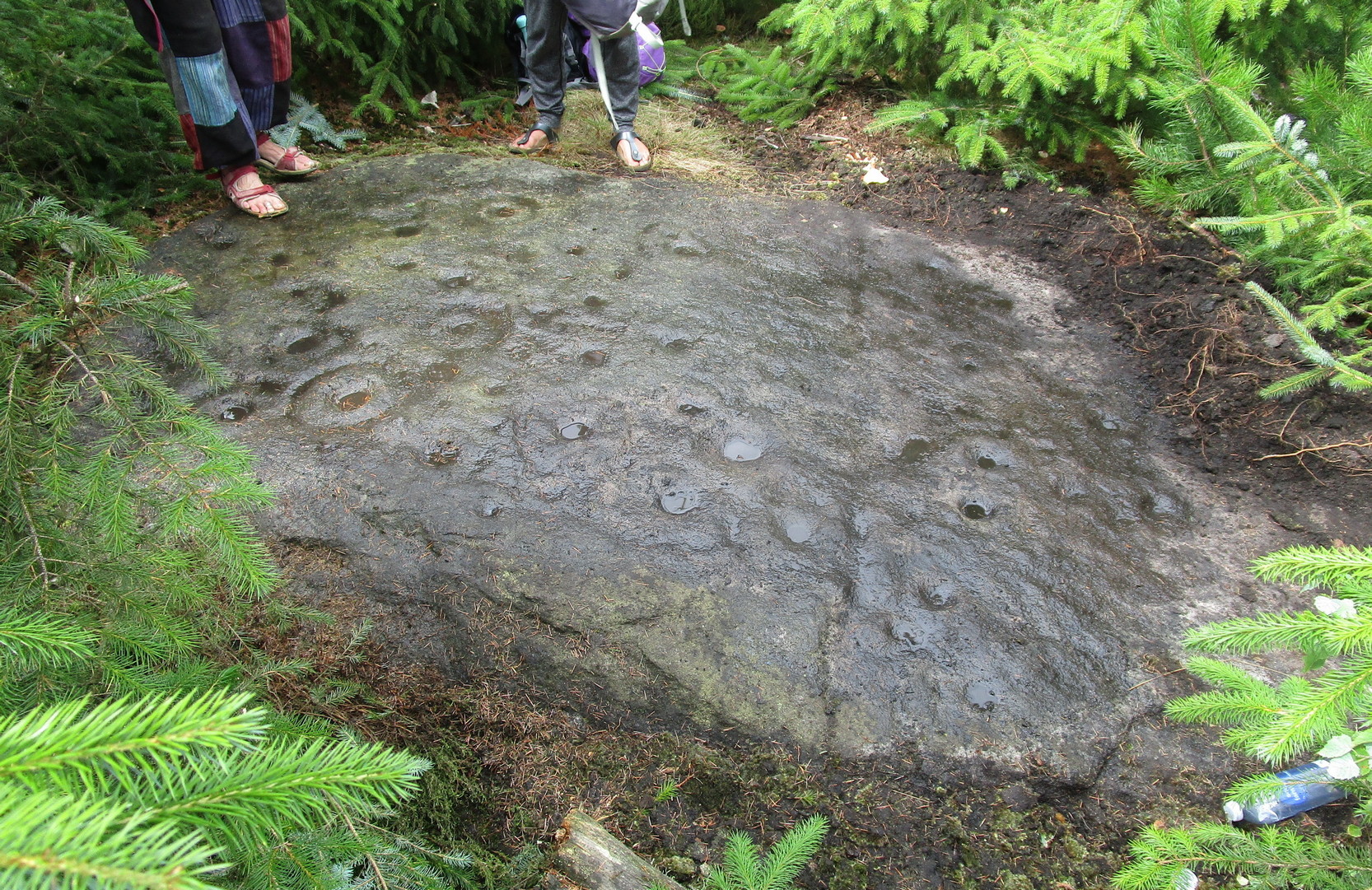
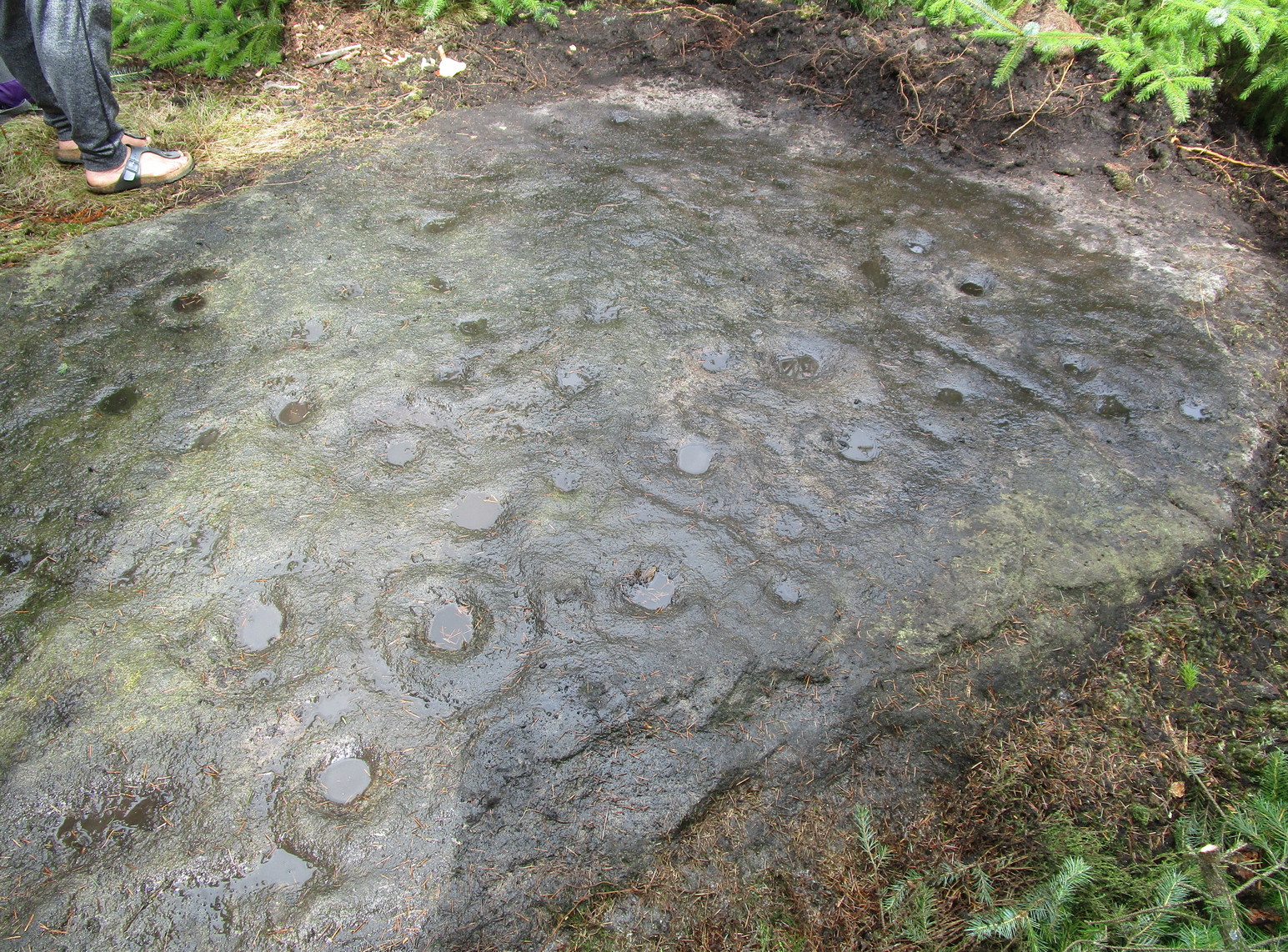
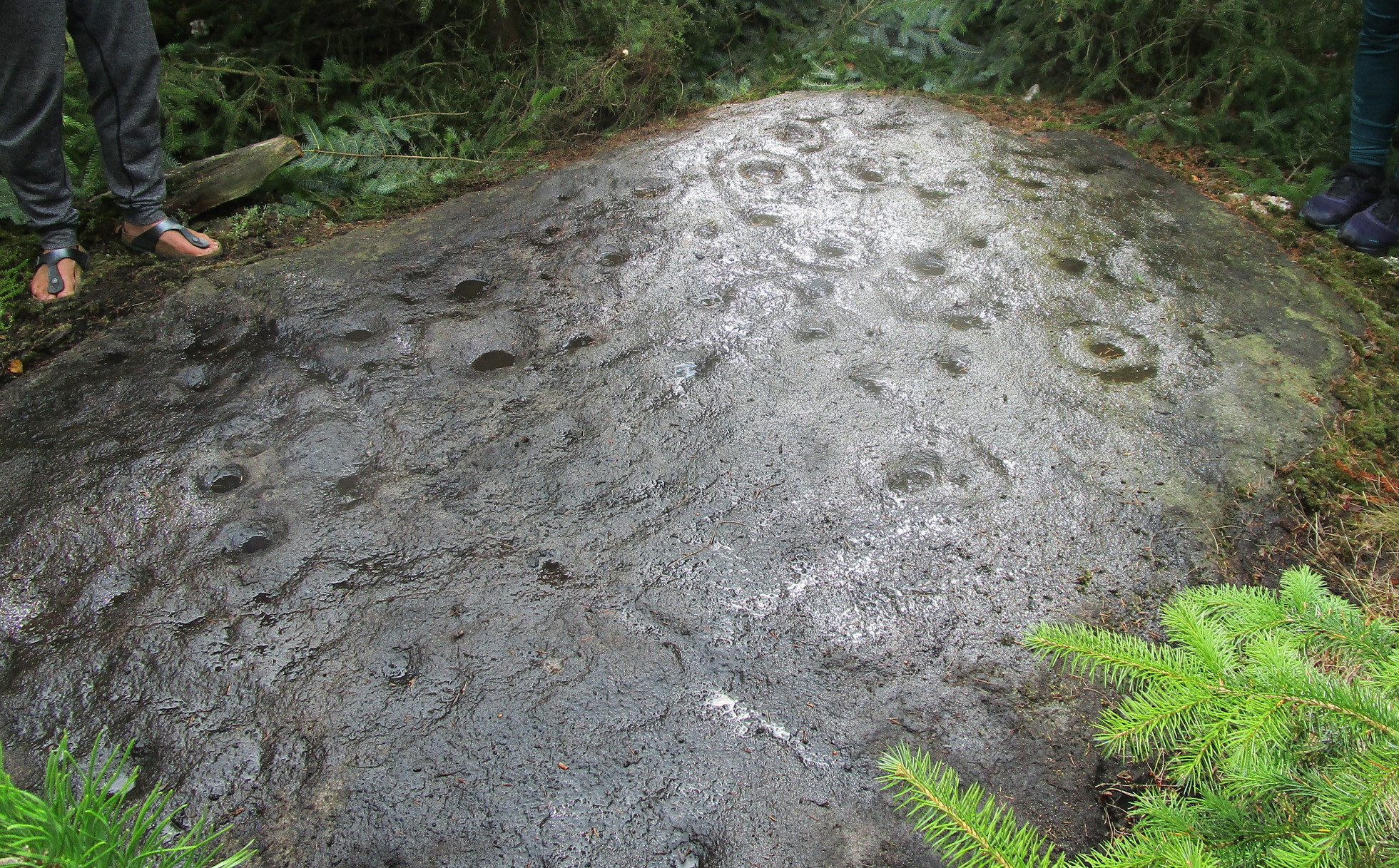
Laid amongst the dense mass of cheap crappy pine trees that plagues some of our upland countryside depriving the land of necessary nutrients for animals, flowers and other trees, this impressive multiple cup-and-ringed marked rock lies sleeping.  It was rediscovered in 2017 by local hunter Chris Slinger during one of his many ventures through the undergrowth.  I’m informed that one of his compatriots reckons that he already knew about it some forty years prior to Chris claiming it—but as yet we have no way of knowing that for sure, so the name of the carving goes to Mr Slinger.  And it’s a beauty—one helluva beauty!

Main line & ring cluster
Scattered mass of rings

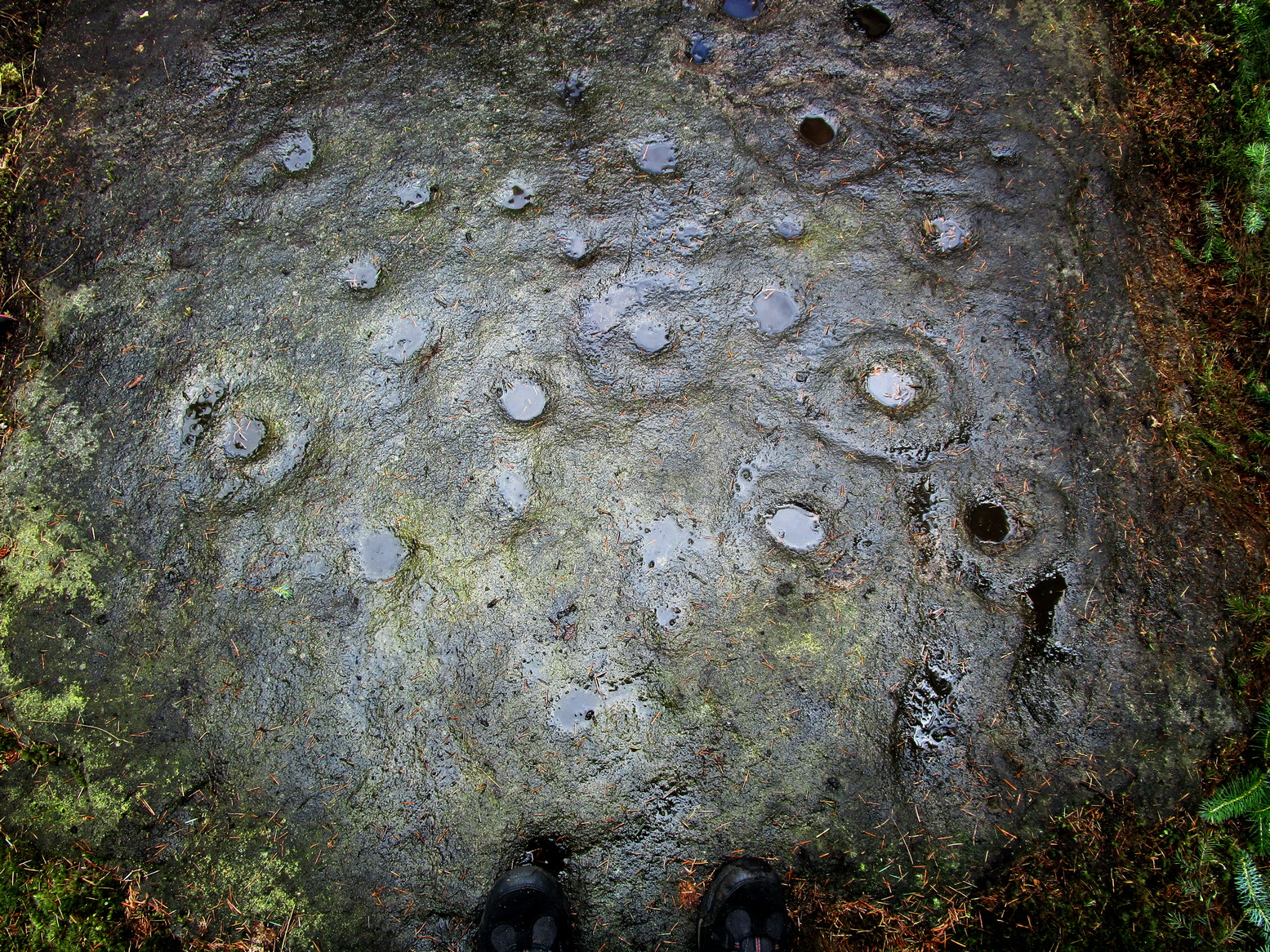
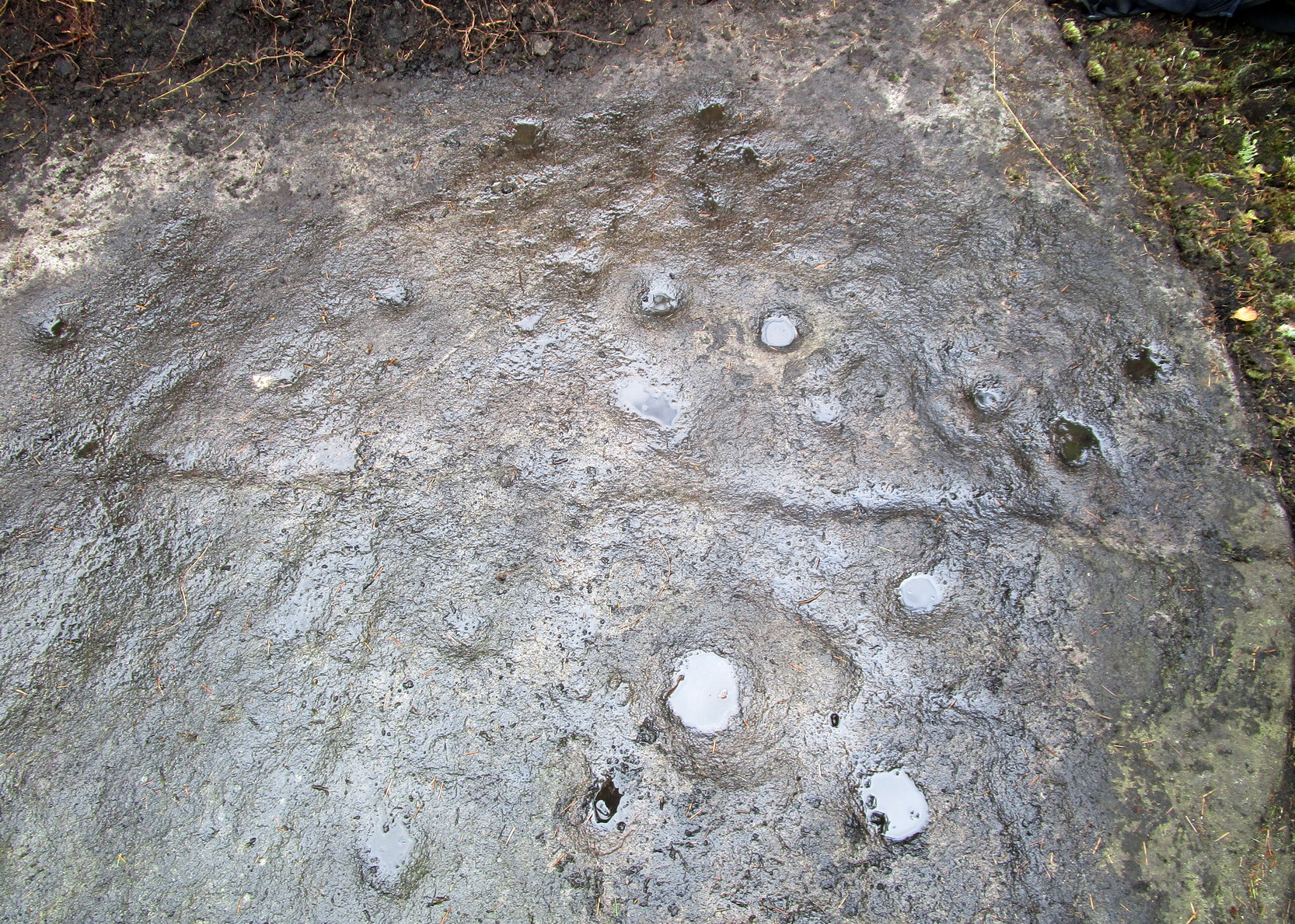
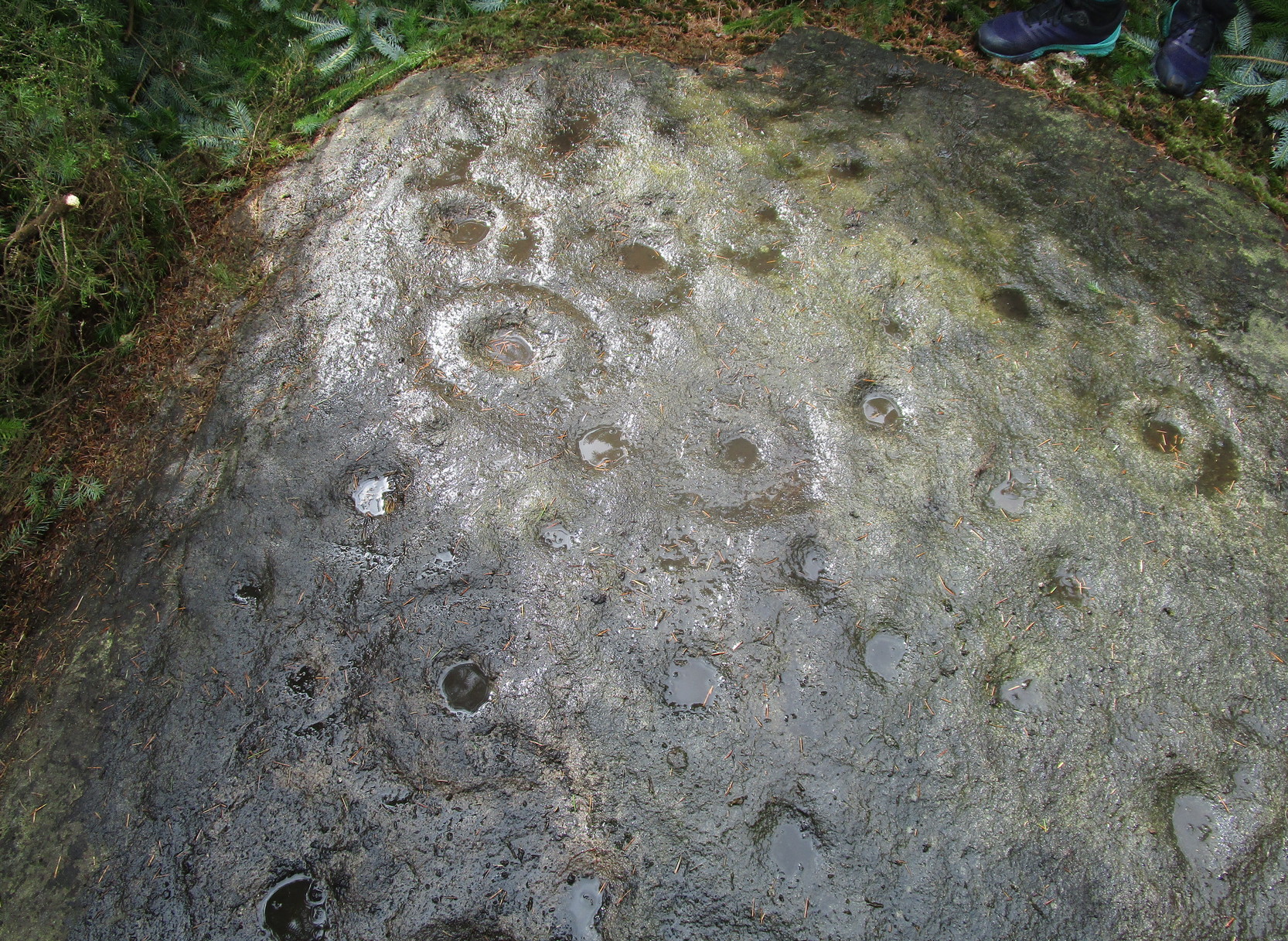
This large, flat, ovoid-shaped stone, roughly 10 feet by 7 feet across, is virtually covered from head to foot in large and not-so-large cup-and-rings at varying levels of erosion.  The carving appears to have been partitioned, so to speak, into two sections that are clearly defined by a carved line that runs the breadth of the stone.  On the top, larger section above this main line are about 30 cup-marks, with perhaps a dozen of them having rings around them—some complete, some incomplete—scattered about in the usual non-linear manner.  One or two of the cup-and-rings may have double-rings, but due to dark conditions in here none of us could be sure.  On one visit, a local lady (Liz of Fell Edge if I remember rightly) noticed that the largest cluster of cup-and-rings near one quarter of the stone seemed to be arranged in a similar form to the Swastika Stone, 1.9 miles northeast of here!

Main line, cups & rings
Cluster of cup & rings

On the lower smaller section of the carving, beneath the main line if you like, there’s not quite as much going on.  At least twelve cup-marks are apparent here, at least five of which have rings around them.  The main little bunch of these are pushed right up against the long carved line, seemingly communicating with other rings on the top-side of it. In some photos it looks as if, in this section of the stone, carved lines link the cup-and-rings on each side of the main dividing line (if y’ get mi drift).  There’s a lot going on here.  It’s a pretty complex carving as you can see: one of the best in the Rivock cluster and one that I’d like to spend more time with, if only to get a complete picture of what the carving looks like in full as we’ve not yet got to the outer edges of the stone itself, meaning that there may be more of it beneath the vegetation.

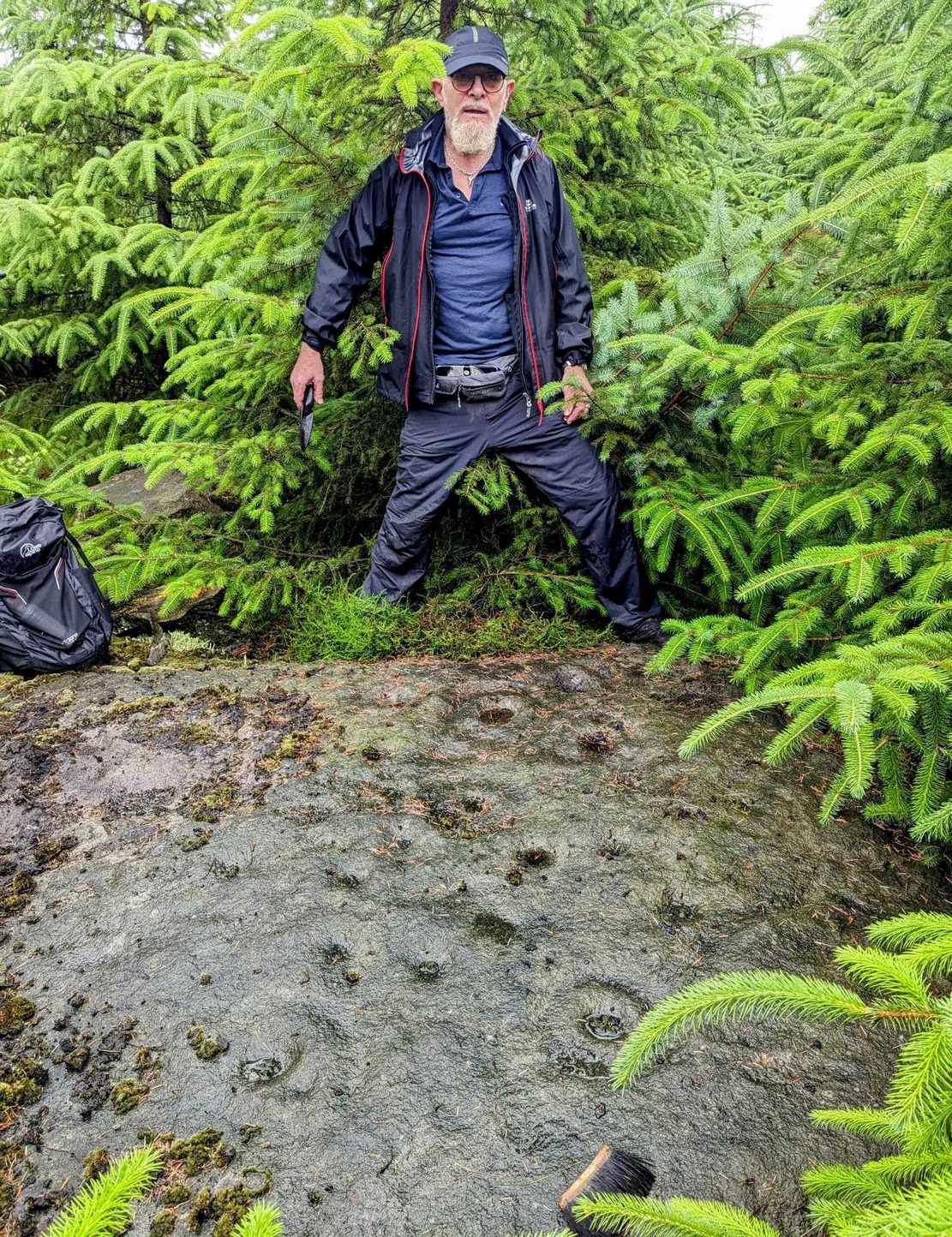
Stone-fondler Koot
Stone-fondler Sean

I was hoping to get some much better photos of this site and clear back more of the covering foliage, but as the carving is now all but covered in dense forestry, we may have seen the last of it for a few decades.  Even worse, there’s the great possibility that the carving will be destroyed when the forestry lads come to cut down the trees—through no fault of their own—as they’ll have no idea that it’s directly beneath their machinery.  It would be good if some local volunteers could perhaps completely clear and protect this stone to avert such a likely disaster a few decades from now.  A small metal fence with a little notice-board would do the trick!

Acknowledgements:  Firstly, to Chris Slinger for rediscovering the carving; then to the modern stone-fondlers Rod ‘Koot’ Chambers and Sean Dillon for beginning the cleaning process, and for their photographs in this site profile; and then to Sarah Walker, Sarah Jackson and Marianna, for helping to bring the entire stone into view.

© Paul BennettThe Northern Antiquarian
Maiden Cross, Mereclough, Burnley, Lancashire

Cross (replaced):  OS Grid Reference – SD 8936 2883

Archaeology & History

“Maiden Cross” stone

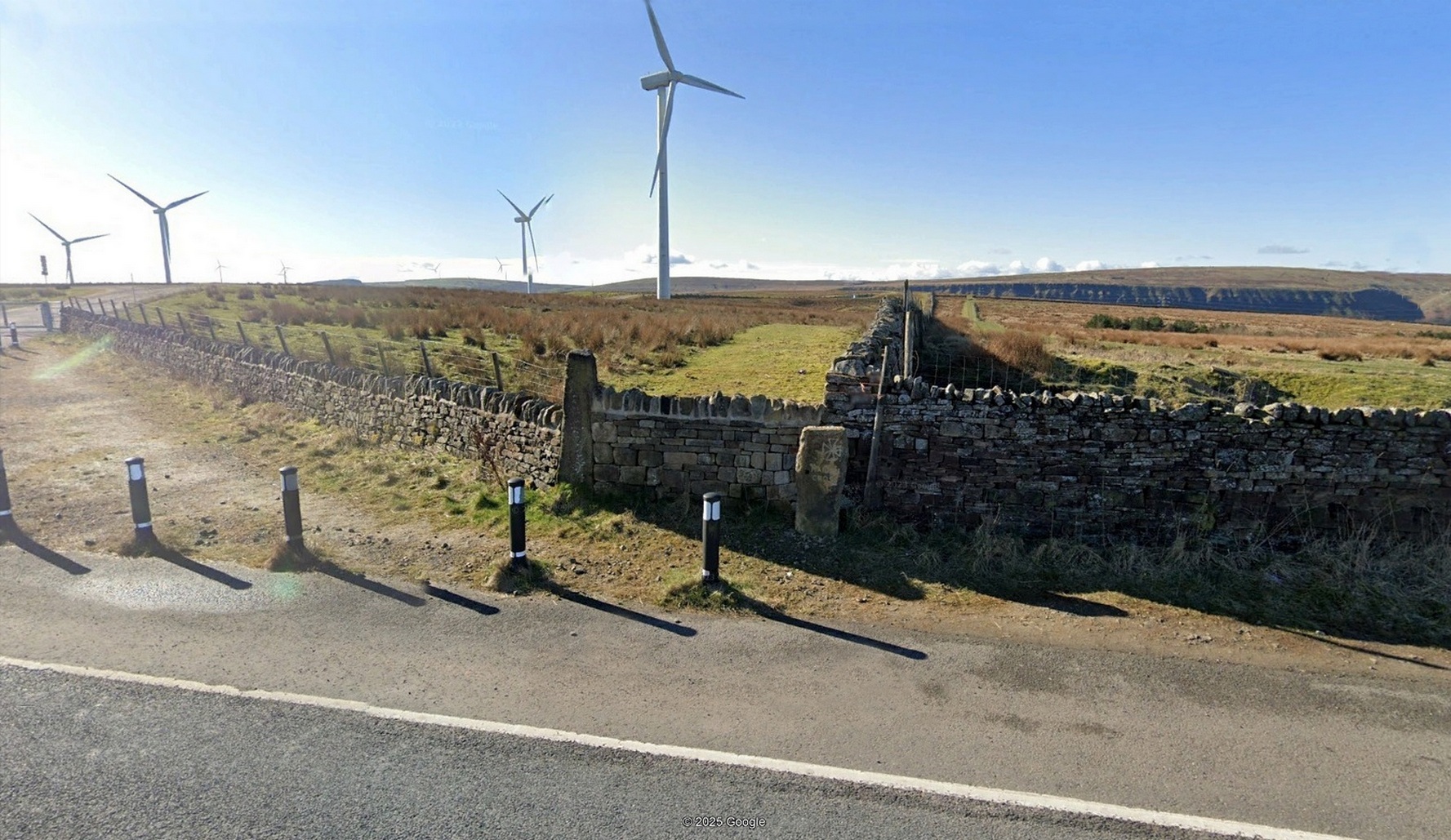
Highlighted on the 1848 Ordnance Survey map, the original stone ‘cross’ has apparently been moved from its location up against the walling 30-40 yards away and placed by the roadside, just as you’re going into where the windmills are, right at the very crown of the hill, across from the car-park.  I’m not so sure it’s the original one to be honest—but I may be wrong.  Clifford Byrne (1974) certainly thought this is the original stone.  He may be wright.  Byrne told that “the Marquis of Colne had a photograph of the stump of the cross in situ,” which would be good to compare.  It’s nowt special to look at, but at least the site has been remembered, so to speak.

Site shown on 1848 map

The Maiden Cross was one in a series of wayside crosses along this ancient high road—known as the Long Causeway—not only marking it out when the snows covered it in the old Winters that we used to get, but also possessing religious importance to travellers.  It was first moved sometime in the 19th century and “utilised as a gatepost into Maiden Cross colliery”—itself long gone.

Folklore

The name given to the ‘cross’ comes from a story that’s found at a number of other ‘maiden’ place-names.  There may be an element of truth in it.  It was told to the great historian and folklorist T.T. Wilkinson by his grandfather in 1766 and, according to him, his grandfather before that!  J.A. Waddington (1884) subsequently wrote down the tale that Wilkinson told him:

“During the time of the great rebellion, this was the trysting-place of a young shepherd with his lady love. Often did they meet to pledge their simple vows at this lonely place, until one day a messenger came from Towneley to collect as many young men as he could get to swell the ranks of Rupert when he passed through this part to join the Royal forces at York, a march which ended with the disastrous fight at Marston Moor, on whose bloody sod lay stretched the chivalrous Towneley, and a many of his followers, including this young man, the victims of a tyrannical and ambitious king. For many a long year after this tragical event the poor demented maiden would repair to this hallowed spot, repeating with a sorrowful voice his promise to return.”

This was curiously described by Ormerod (1906) as “a pathetic tradition”!  He much preferred the simple idea of this (and the other crosses along the road) as merely serving “the capacity of guideposts to the traveller (overtaken in a mist or by the swiftly lowering shades of light) who might be traversing these lonely roads”, as Waddington put it.  Ormerod cited a conversation he had with “an old road mender” which for him confirmed the idea:

“Asked if he had heard what was the object of these crosses, he said, that “Joonas Lee said as they were put up 250 yer sin, for guideposts for’t pack horses, between Halifax and Brunshaw” (Burnley), adding, as if to give more weight to the authority he had quoted: “An he wur a far larned chap wur Joonas—he wur a preycher.”’

Walter Bennett (1941) meanwhile, thought its name derived from the Virgin Mary and this cross, at least, possessed religious importance.

References:

  1. Bennett, W., The History of Burnley – volume 1, Burnley County Council 1946.
  2. Byrne, Clifford, A Survey of the Ancient Wayside Crosses in North-East Lancashire, privately printed 1974.
  3. Holden, Joshua, A History of Todmorden, Manchester University Press 1912.
  4. Ormerod, T., Calderdale, Lupton Bros: Burnley 1906.
  5. Waddington, J. Arthur, ‘The Crosses in and Around Burnley’, in Transactions Burnley Literary & Scientific Club, volume 1, 1884.

Acknowledgements:  Huge thanks for use of the Ordnance Survey map in this site profile, reproduced with the kind permission of the National Library of Scotland

© Paul BennettThe Northern Antiquarian
Stony Raise, Addlebrough, Thornton Rust, North Yorkshire

Cairn:  OS Grid Reference – SD 95065 86916

Also Known as:

  1. The Golden Chest of Greenhay
  2. Stan-Rise
  3. Stone Raise
  4. Stoney Raise

Getting Here

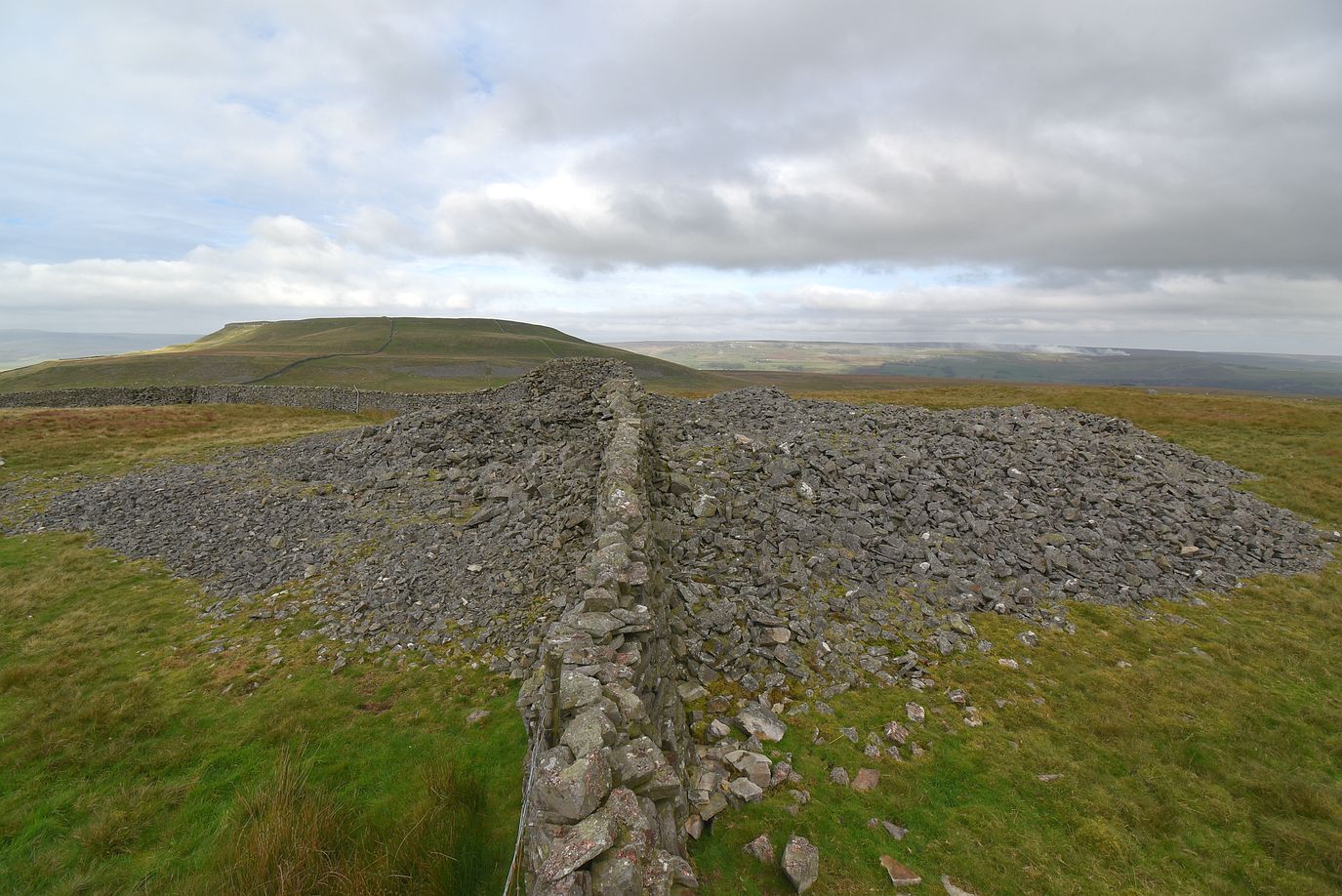
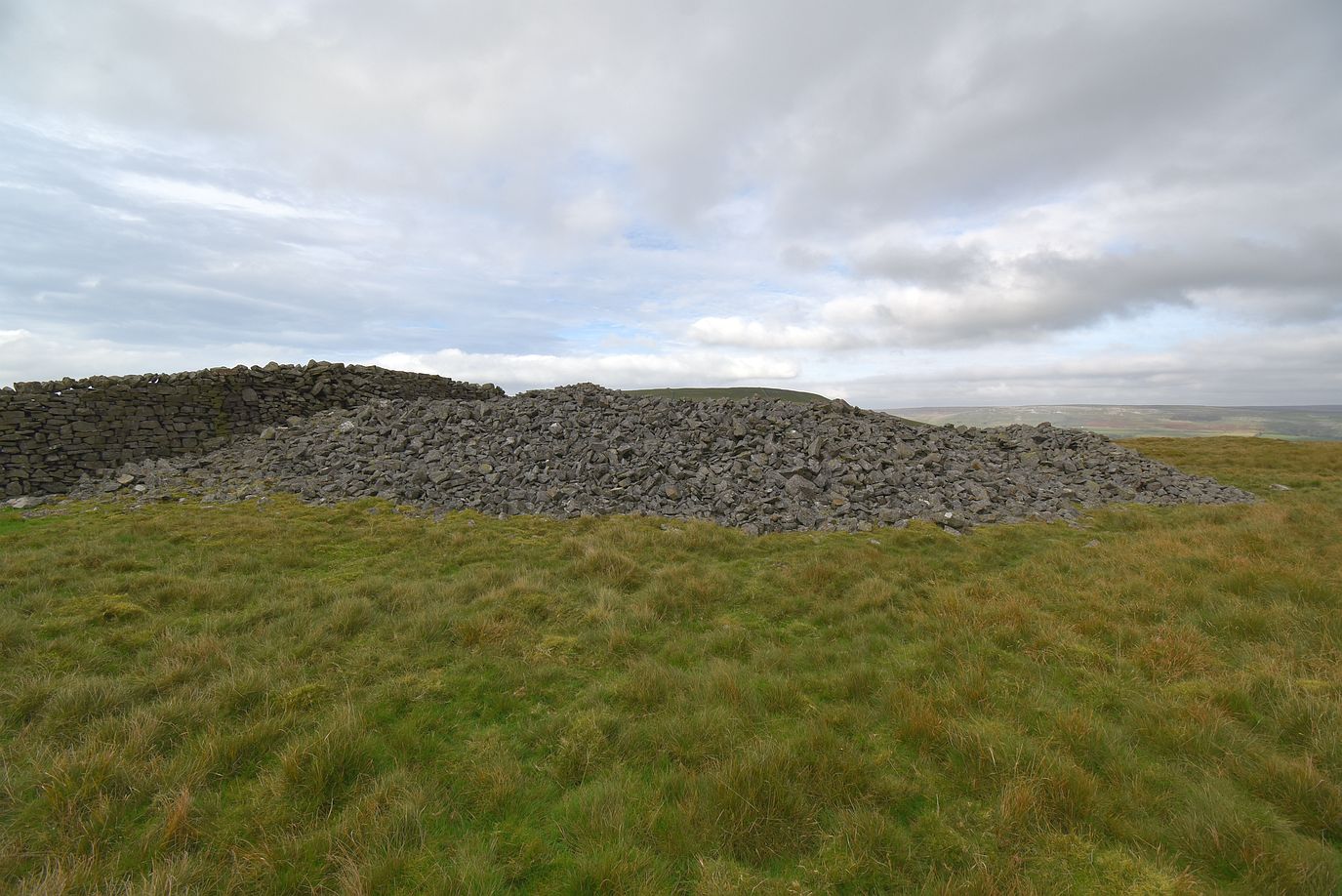
Stoney Raise giant cairn

From Bainbridge, take the A684 road east to Aysgarth.  Just out of the town, 200 yards over the bridge, take the right turn down Blean Lane.  Nearly ½-mile along, take the minor road on your left and go along here for 1½ miles where, a few hundred yards before the solitary farm of Carpley Green (lucky buggers!), you can park up. (keep plenty of room for a tractor to get in the fields)  Walk down the track past the farm and 250 yards along, where the first field ends, a gate leads you into the hills on your left.  Go through here and then the next gate 120 yards on, then walk straight along th elong geological ridge ahead of you, veering to the top-side until it meets the walling.  You’ll see the giant Stoney Raise cairn on the other side.

Archaeology & History

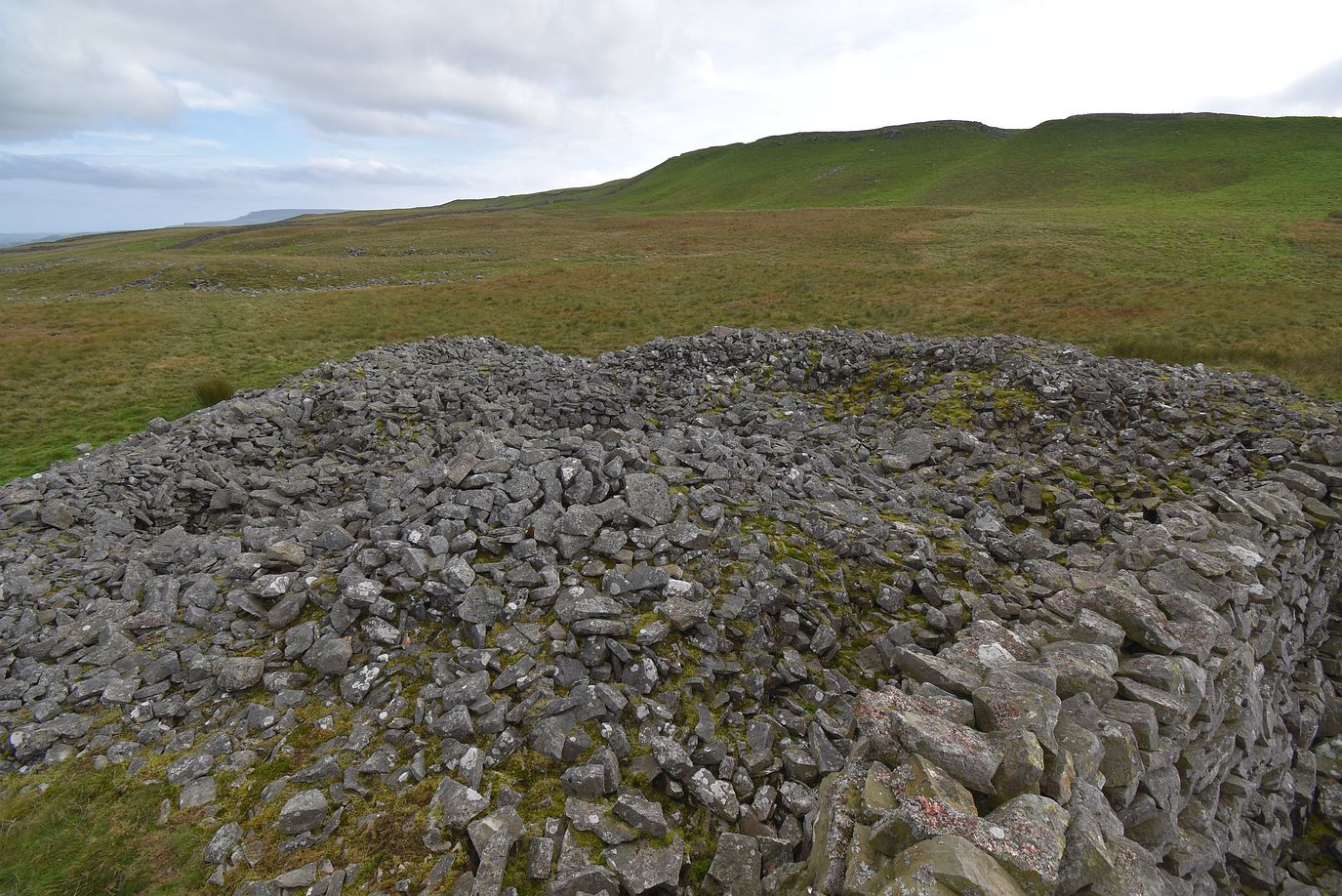
Stony Raise from above

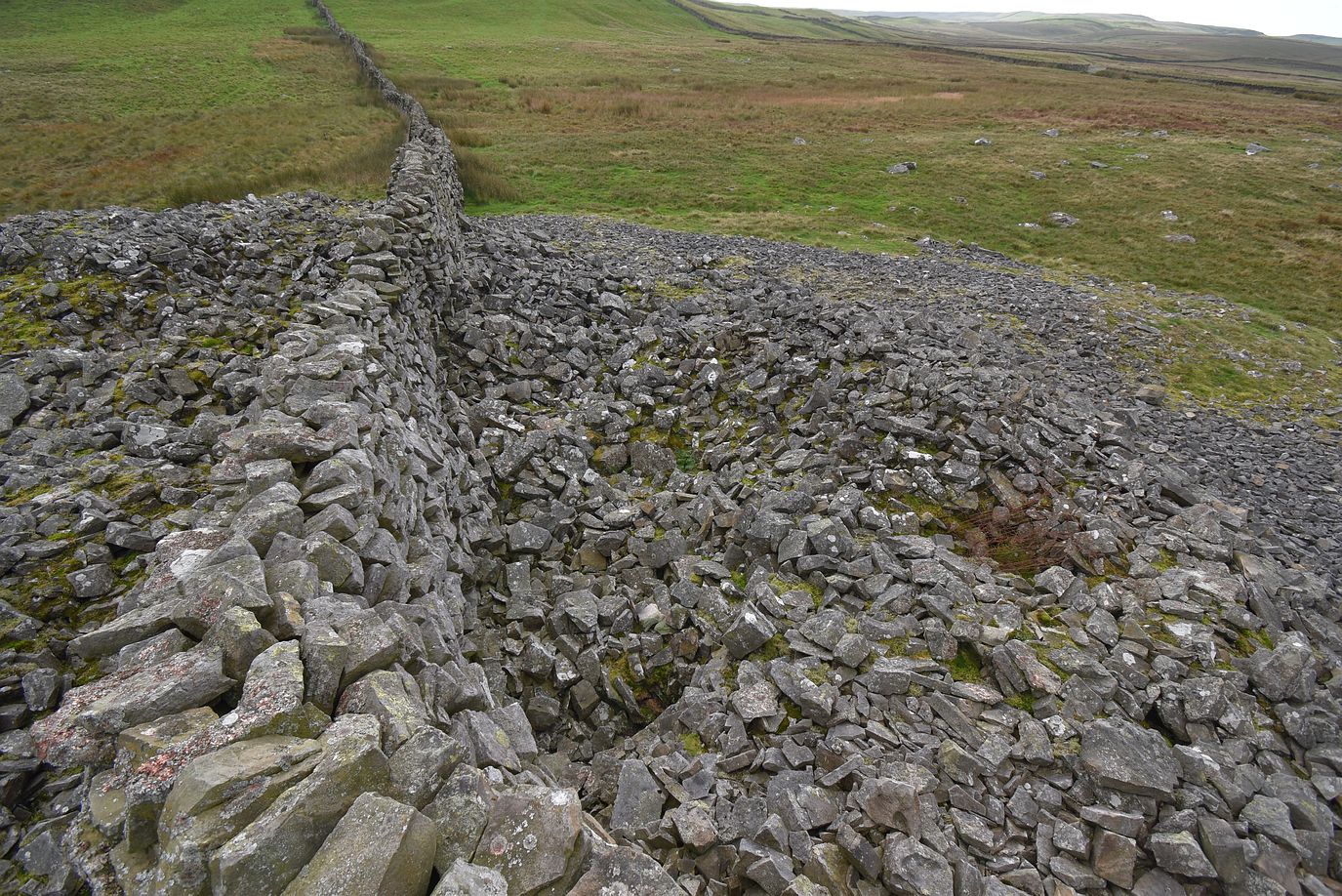
The remains we find here are nigh-on immense!  If giant cairns get you going (like the Great Skirtful of Stones or the denuded Devil’s Apronful near Pendle, etc), this one will blow you away!  Along its widest axis, to this day it’s nearly 40 yards across and nearly 7 feet high!  But in earlier times it was even bigger—much bigger!  The first known description of the site was made by one Charles Fothergill, a Yorkshire-born politician and ornithologist, who wrote a diary of his walking excursions to various places in North Yorkshire at the beginning of the 19th century. (Romney 1984)  His account of it was a good one for that period and thankfully he recorded information that would otherwise have been forgotten.  After his visit here in September 1805, he told about this,

“wonderful tumulus called Stone raise which is a great curiosity: it is formed entirely of large stones piled up without earth or gravel, differing in that respect from any I have seen.  Notwithstanding that upwards of a thousand, nay ’tis said several thousand, loads of stones have been led away from it to build walls with, it yet remains a stupendous monument of this species of antiquity: we measured the base of it as well as we could by our strides and made it 369 feet in circumference and of such an height as to be seen for a considerable distance.  It has been most completely rifled…and it now presents a number of small craters formed by the investigations of the money searchers.  It is situated upon a hill about half a mile south of Addlebrough.  In addition to the particulars I formerly mentioned, I may say the men who first opened it about 50 years ago worked incessantly for 33 days.  It stands on Thornton moor, and tho’ the Thornton men would not assist in the labour, they intended to share in the profit if there was any; but the adventurers who had all the work resolved they should not and they carried a large sword with them every day to defend the treasure in case they found any; the wise man who read ’till the stones shook and rattled was a schoolmaster at Bainbridge: the teeth they found were deposited in a hollow place in the bottom of the tumuli formed long and narrow like a coffin by a walling of stones.  Tho’ the tumulus has apparantly been compleatly rifled, I do not believe the whole base has been sufficiently searched, but if it was to commemorate one great individual, which appears to have been the case, perhaps nothing more may be found.”

Fothergill’s description of “upwards of a thousand” cartloads of stone being removed from Stony Raise has been doubted by some archaeologists, but this claim should not be dismissed so lightly without evidence.  There are immense tombs from northern Scotland to the unholy South that have remained untouched by the hand of industrialists that easily enter the category of such giants and this may have had equal stature.

A few years after Fothergill’s visit, Thomas Whitaker (1823) briefly described the site in his magnum opus, but added very little, simply telling that on the hills behind Addlebrough,

“there is still on that elevated spot a cairn, called Stone Raise, about 120 yards in circumference at the base, to which the usual tradition of its containing a treasure of gold having been attached, two persons were several years ago induced to make the experiment; but having penetrated to the centre, found, to their great disappointment, what an antiquary would have prepared them to expect, namely, a kist vaen of flag stones, with the remains of a human skeleton, the teeth of which were still pretty perfect.”

To this day the site remains unexcavated, so we don’t know too much about the place.  It’s likely to have been constructed in neolithic times and its ancestral nature quite obviously venerated.  It may have been re-used during the Bronze Age, but without excavations we may never know.  A decent dig into this site is long overdue!

Folklore

This gigantic tomb is, not surprisingly, said to be haunted.  Strange sounds and visions have been encountered here in bygone times. But the most well-known tale is that it was the site of a great treasure—perhaps hinted at by Fothergill.  There are variations on the theme, but this is overall story:

Structured stonework

The tomb was said to be where a local giant had fallen and with him was buried a great chest of gold which he had dropped before he died. Some say that the ‘giant’ was a Brigantian chief – others a great warrior.  The great treasure chest beneath the cairn is said to looked over by a fairy who lived by the giant’s tomb.  It was this tale which gave the site its local name, the ‘Golden Chest on Greenber’.  Several attempts made to find the treasure have all failed to uncover it.

However, by the time Edmund Bogg came to write of the place in 1908, the giant had by all accounts been found within!  He told that,

The giant’s cist cover?

“this Kist-vaen was opened, many years back, and the skeleton of a chieftain of great stature was unearthed; the treasure chest of that or some other primal savage was not, and has not yet been discovered – for, take heed ye matter-of-fact money hunters, it is said the lucky one must first see the wraith of the ancient warrior to whom it belonged, who will then shew under which part of the immense Raise it is hidden! May this help any reader who is imaginative enough to find it – having seen the wraith he must keep silence – he has then but to stretch out his hand, and draw it forth.”

There are variations on this tale that have subsequently been penned by a number of Yorkshire folklorists, but this is the general lore.  There was also a short rhyme told of toney Raise, that speaks of its apparent use through history by various races:

Druid, Roman, Scandinavia,
Stone Raise in Addlebro’.

References:

  1. Bogg, Edmund, Wensleydale and the Lower Vale of the Yore, E. Bogg: Leeds 1906.
  2. Bogg, Edmund, Richmondshire, James Miles: Leeds 1908.
  3. Elgee, F. & H.W., The Archaeology of Yorkshire, Methuen: London 1933.
  4. Gutch, Mrs E., Examples of Printed Folklore Concerning the North Riding of Yorkshire, David Nutt: London 1899.
  5. Lofthouse, Jessica, Countrygoer in the Dales, Hale: London 1964.
  6. Parkinson, Thomas, Yorkshire Legends and Traditions – volume 2, Elliot Stock: London 1889.
  7. Pontefract, Ella, Wensleysdale, J.M. Dent: London 1936.
  8. Romney, Paul (ed.), The Diary of Charles Fothergill, 1805, Yorkshire Archaeological Society: Leeds 1984.
  9. Whitaker, Thomas Dunham, An History of Richmondshire – volume 1, Longman Hurst: London 1823.
  10. White, Robert, A Landscape through Time, Great Northern: Ilkley 2002.

Links:

  1. One of the best regional archaeology websites (it puts most others to shame), with its profile on Stony Raise – Swaledale & Arkengarthdale Archaeology Group
  2. Stony Raise Cairn on Out of Oblivion

Acknowledgements:  Many many thanks to Graeme Chappell for use of his photos in this site profile.

© Paul BennettThe Northern Antiquarian
Beadnell Caravan Park, Beadnell, Northumberland

Cup-Marked Stone (lost):  OS Grid Reference – NU 2299 2989

Archaeology & History

Tait’s 1971 sketch of the carving

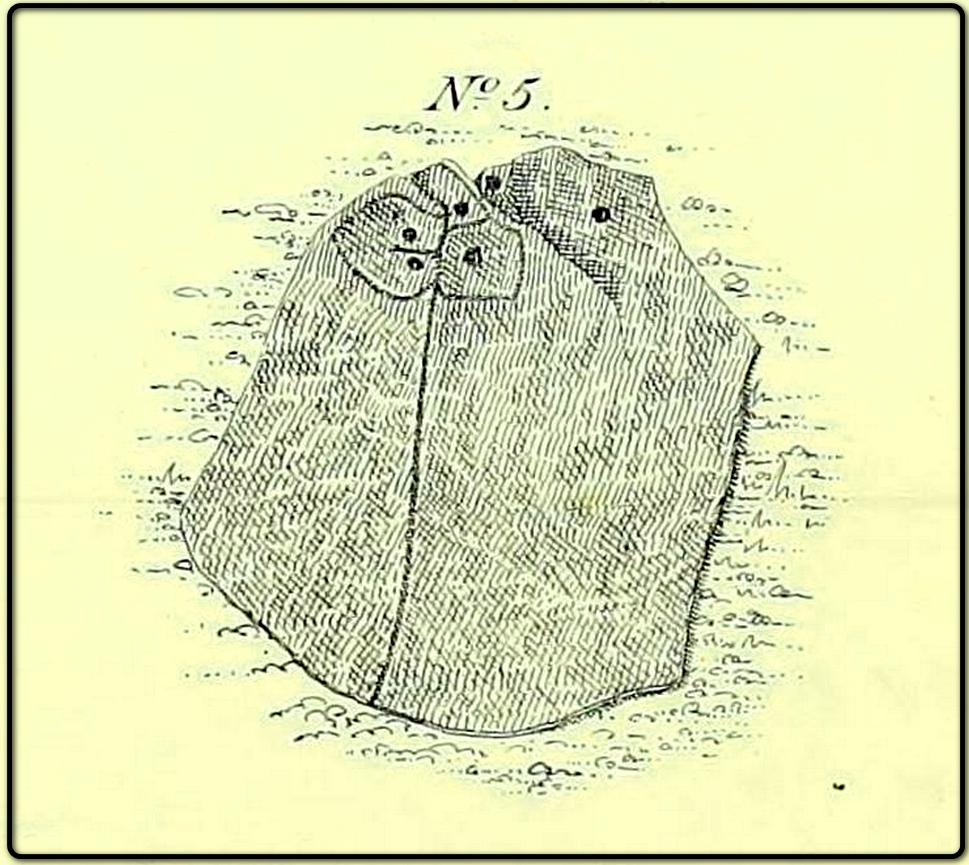
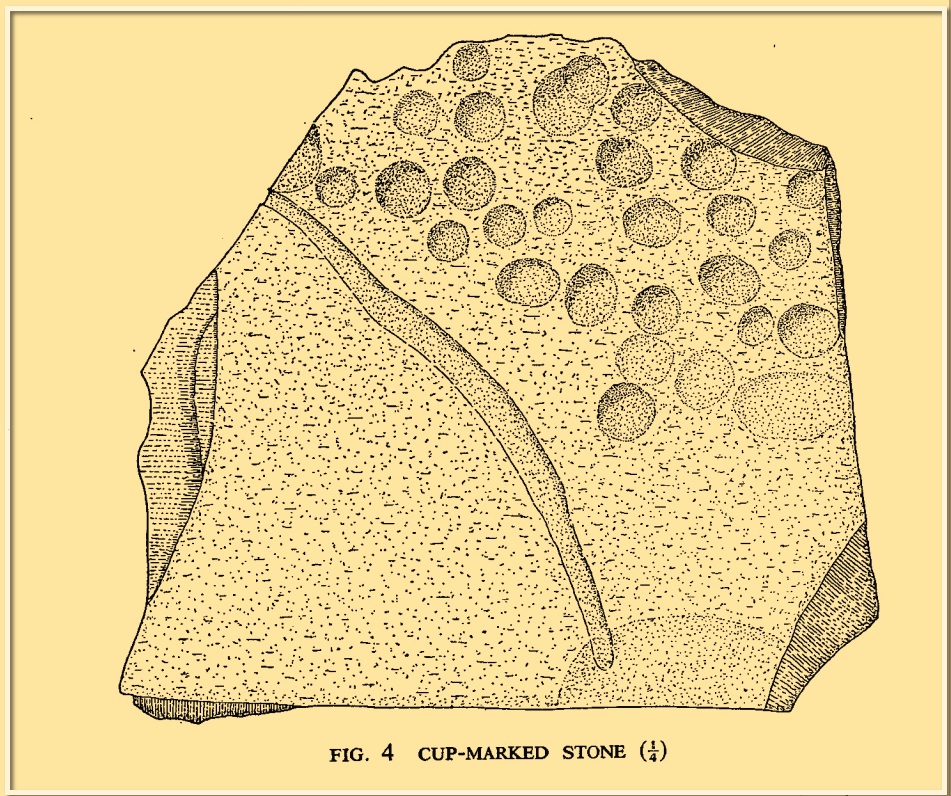
When the Beadnell Caravan Park was being constructed in 1970, in cutting into the Earth the workmen destroyed a couple of prehistoric tombs—but not before one of them (the northernmost one of the two) was thankfully excavated.  It was looked at by John Tait (1971), who described the covering cairn as measuring “nineteen feet in diameter and four feet high”.  Beneath it, within a cist that had been modified at two very different periods in time, were a large number of human remains that had been deposited over equally extended periods, suggesting it was a place of considerable importance to either one family lineage or the tribal lineage (unless it was just a dumping spot for any old Tom, Dick and Harry!).  Outside of the cist itself, but within the rocky mass of the cairn, this cup-marked stone was found (illustrated).  It had already been moved by the workmen before Tait came to excavate it, so he was unable to ascertain its precise position in the tomb.  Carved into a piece of sandstone were a number of odd-sized cup-marks, smaller than usual.  Tait wrote:

“It measures 38cm by 36cm and bears 29 small cup-marks and one slightly sinuous duct leading into what may be part of an earlier and larger cup. It also seems probable that additional cups  were added in antiquity, since some are distinctly more shallow than others and, in one instance, two cups impinge upon one another. The stone had been broken in antiquity and may have come from a larger inscribed slab, as is perhaps the case with some other “portable” stones of burials or cairns and other monuments of the second this nature.”

It is thought that the carving was laid back in the ground whence it was found.

References:

  1. Beckensall, Stan, Prehistoric Rock Motifs of Northumberland – volume 1, Abbey Press: Hexham 1991.
  2. Beckensall, Stan, Prehistoric Rock Art in Northumberland, Tempus: Stroud 2001.
  3. Tait, J. & Jobey,G., “Romano-British burials at Beadnell, Northumberland,” in Archaeologia Aeliana (4th series), volume 49, 1971.

© Paul BennettThe Northern Antiquarian
King’s Ring Well, Enfield, Middlesex

Healing Well (destroyed):  OS Grid Reference – TQ 3496 9623

Also Known as:

  1. King Ring Well
  2. Tim Ringer’s Well

Archaeology & History

Site shown on 1879 map

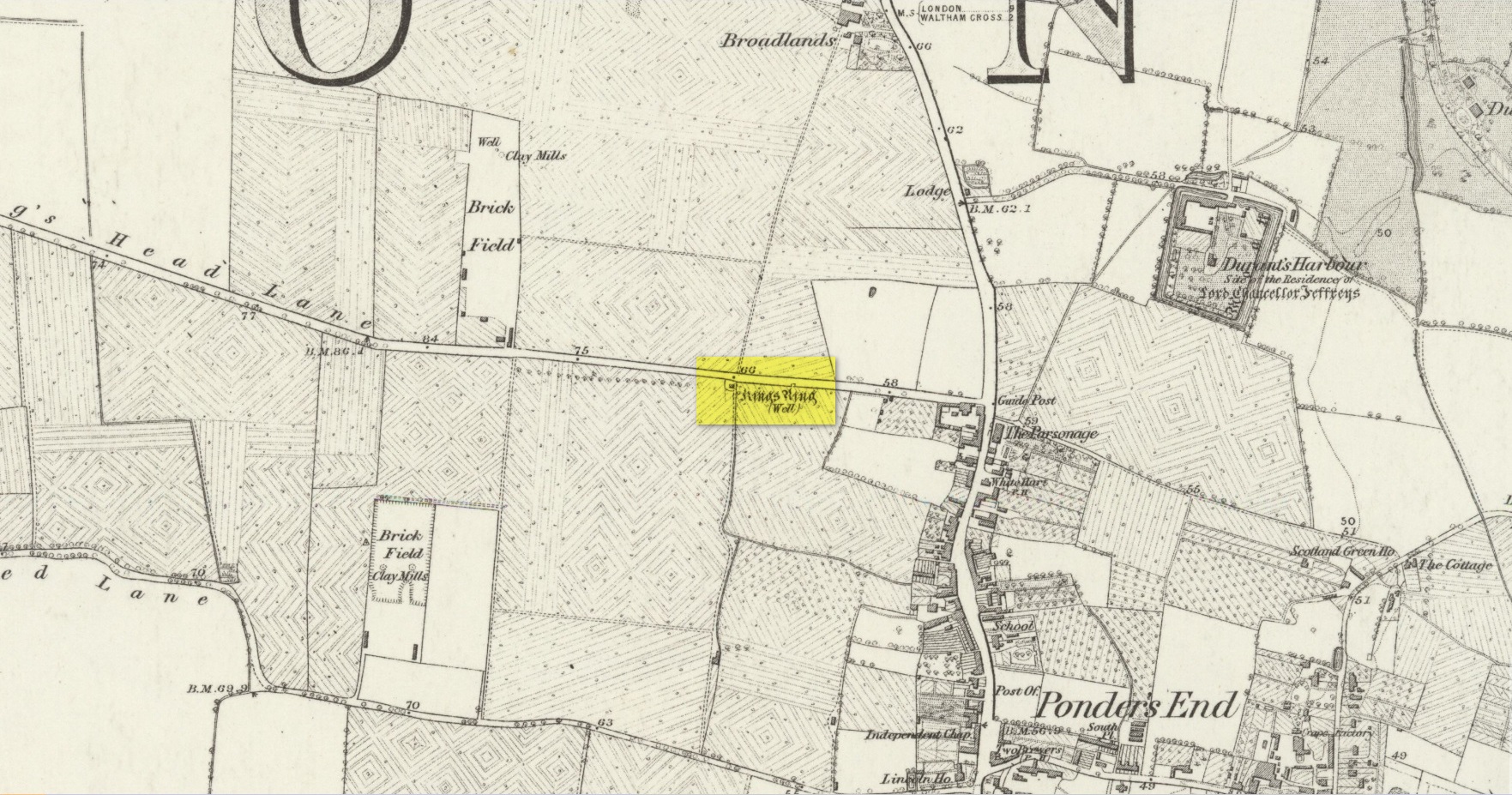
Highlighted on the 1879 Ordnance Survey map, on the south-side of Southbury Road close to Ponders End, this curiously-named water source has a somewhat mundane history to it.  It’s likely that an old stone conduit that was shown on John Ogilby’s 1698 road map of the area is the King’s Ring Well—although it hadn’t acquired that name at the time.  It was described for the first time in Robinson’s (1823) classic work, located “on the south side of Gouldsdown-lane,”—which later became known as Nag’s Head Lane and today is Southbury Road.  Anyhow, he continued telling us that here,

“there is a moat dividing two square fields.  In the first there are remains of stables, barns, &c. and hollows, as of vaults, among the trees.  There is a deep well, bricked, called “King Ring” or “Tim Ringer well,” (Timothy Ring was an opulent farmer who occupied the lands; and it is supposed from his arrogant manner obtained the nic-name of “King Ring.”) whose spring, it is said, never freezes nor dries up, and the water is esteemed very efficacious in disorders of the eyes.”

Robinson noted that the local drovers, “who from being so much exposed to the dust are subject to sore eyes, frequently turn up the lane to use the water, and there have been instances of children being cured of sore eyes by it after the measles.”  He also alluded to a tradition that a religious house or convent once stood hereby, although he never obtained accurate information to prove his idea.  If that was the case, the site may have been a holy well.  The medicinal properties of the waters were repeated in Lewis’ Topographical Dictionary (1848); and again in Hodson & Ford’s (1873) subsequent survey of Enfield, emphasizing that it was “considered infallible as a remedy for inflammation of the eyes.”  Sadly the well has long since been destroyed.

References:

  1. Hodson, George H. & Ford, Edward, A History of Enfield in the County of Middlesex, J.H. Meyers: Enfield 1873.
  2. Hope, Robert Charles, Legendary Lore of the Holy Wells of England, Elliott Stock: London 1893.
  3. Robinson, William, The History and Antiquities of Enfield – volume 1, John Nichols: London 1823.

Acknowledgements:  Huge thanks for use of the Ordnance Survey map in this site profile, reproduced with the kind permission of the National Library of Scotland

© Paul BennettThe Northern Antiquarian
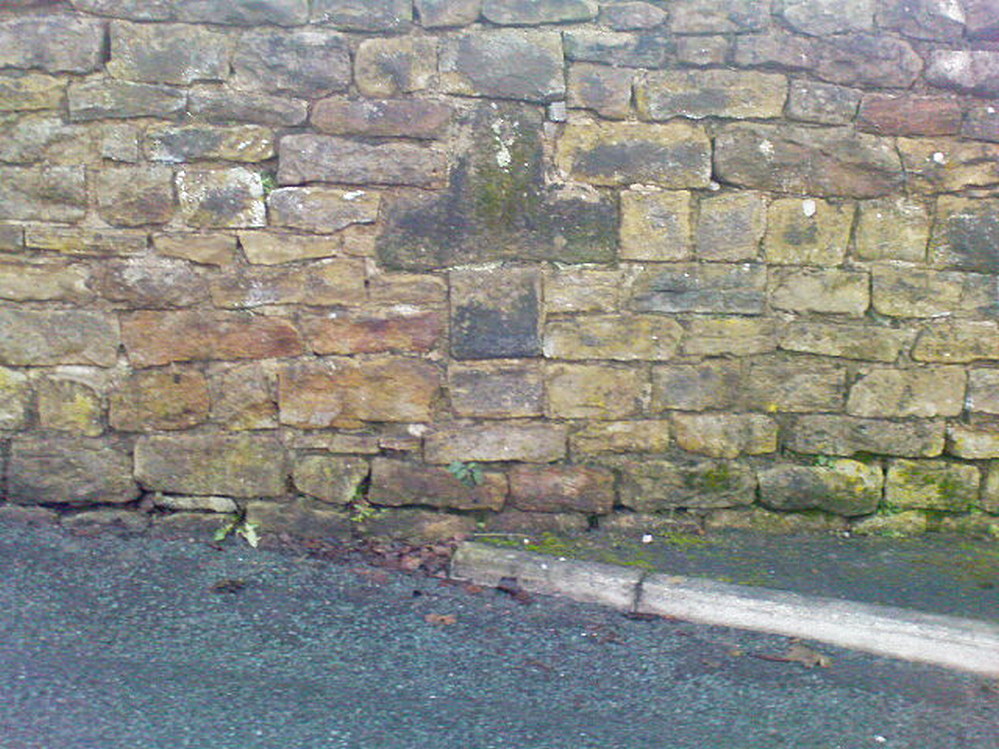
Oxenhope Cross, West Yorkshire

Cross:  OS Grid Reference – SE 03111 35206

Getting Here

The cross in the wall

If you’re coming up to Oxenhope from Keighley, up the A6033 road, when you reach the school on the right-hand side of the road, a one-way street (Cross Lane) is where you need to walk down, for 200 yards, and keep your eyes peeled in the walling just before Cross Farm Court.  Alternatively, via Haworth, go along Marsh Lane for a few hundred yards until your reach Moorhouse Lane on your left.  Go down here for ⅓-mile (0.5km) and then go up Cross Lane on your right. About 120 yards up, in the walling just past the entrance into Cross Farm Court is where you’ll find it.

Archaeology & History

Very little seems to be known about the remains of this cross, embedded into the old walling.  When it was described by Brigg & Villy (1914), they could find no information about it, and surmised that it marked the original track or road to Oxenhope from both Haworth and Halifax, “on the line of the old road by Withens.” Ostensibly it would seem to have been a wayside cross, marking old trackways (ley hunters take note!).

Visitors looking at it today can see that it’s barely noticeable.  It looked no different even in Brigg & Villy’s days.  It simply consists of only part of the original head of the cross, “the shaft having been broken off flush with the horizontal limb.”  Some of the other stones that make up the bottom of this very poor-looking excuse of a cross were probably not part of the original, but were assembled into the wall to at least leave of memory of what it used to look like.  It’s in a sorry state to be honest.  A historic plaque should be placed here.

References:

  1. Brigg, J.J. & Villy, F., “Three Ancient Crosses near Keighley,” in Bradford Antiquary, New Series 6, 1921.

© Paul BennettThe Northern Antiquarian