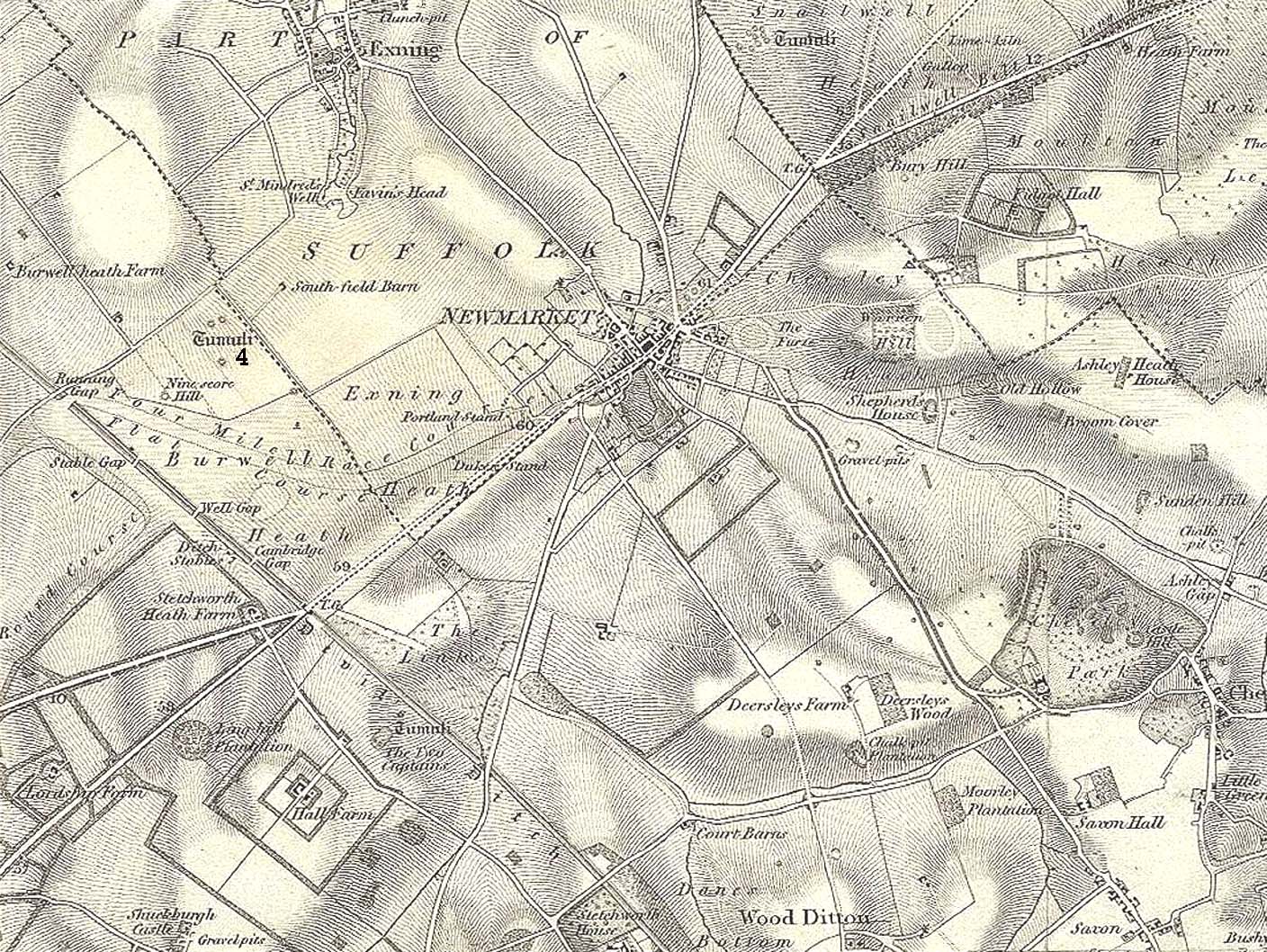
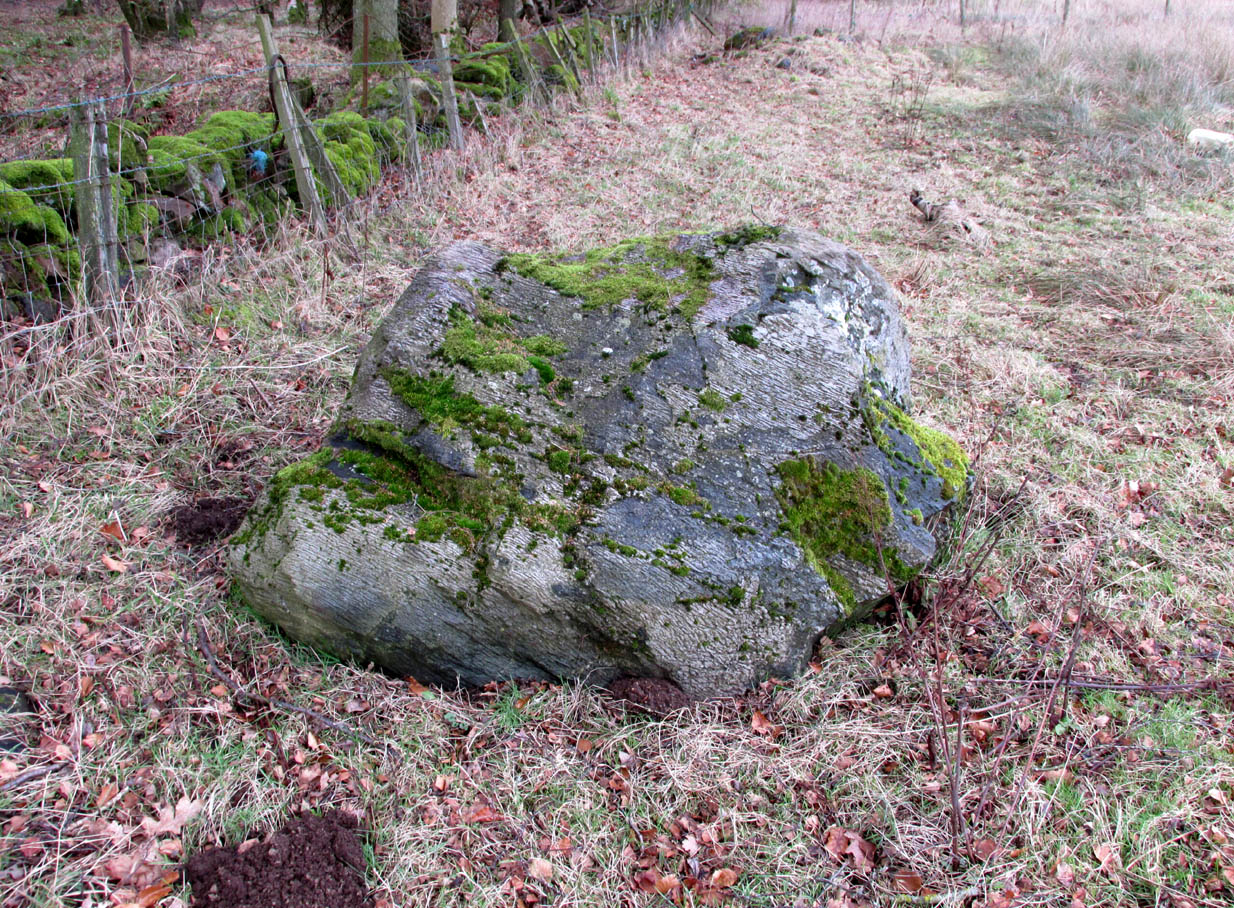
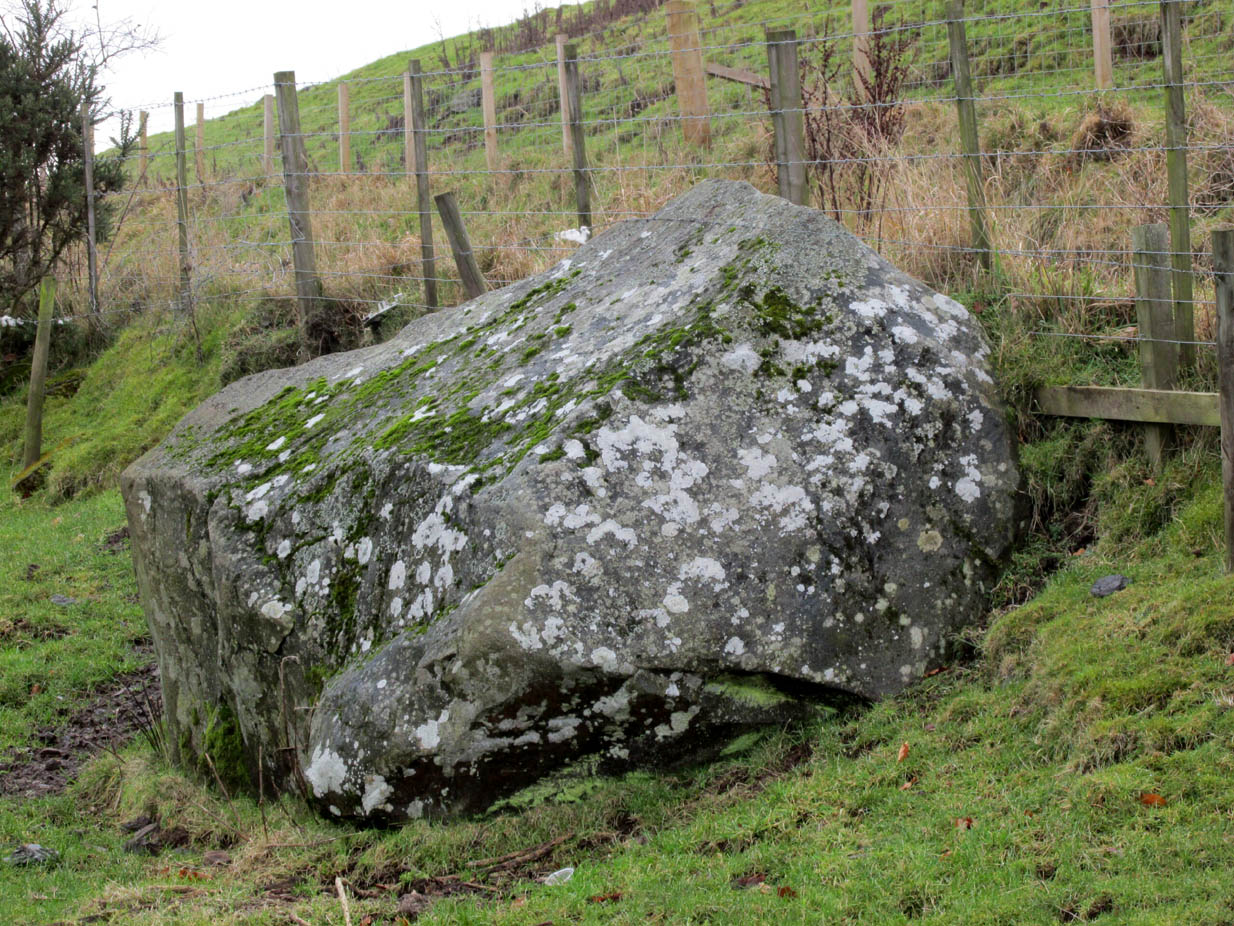
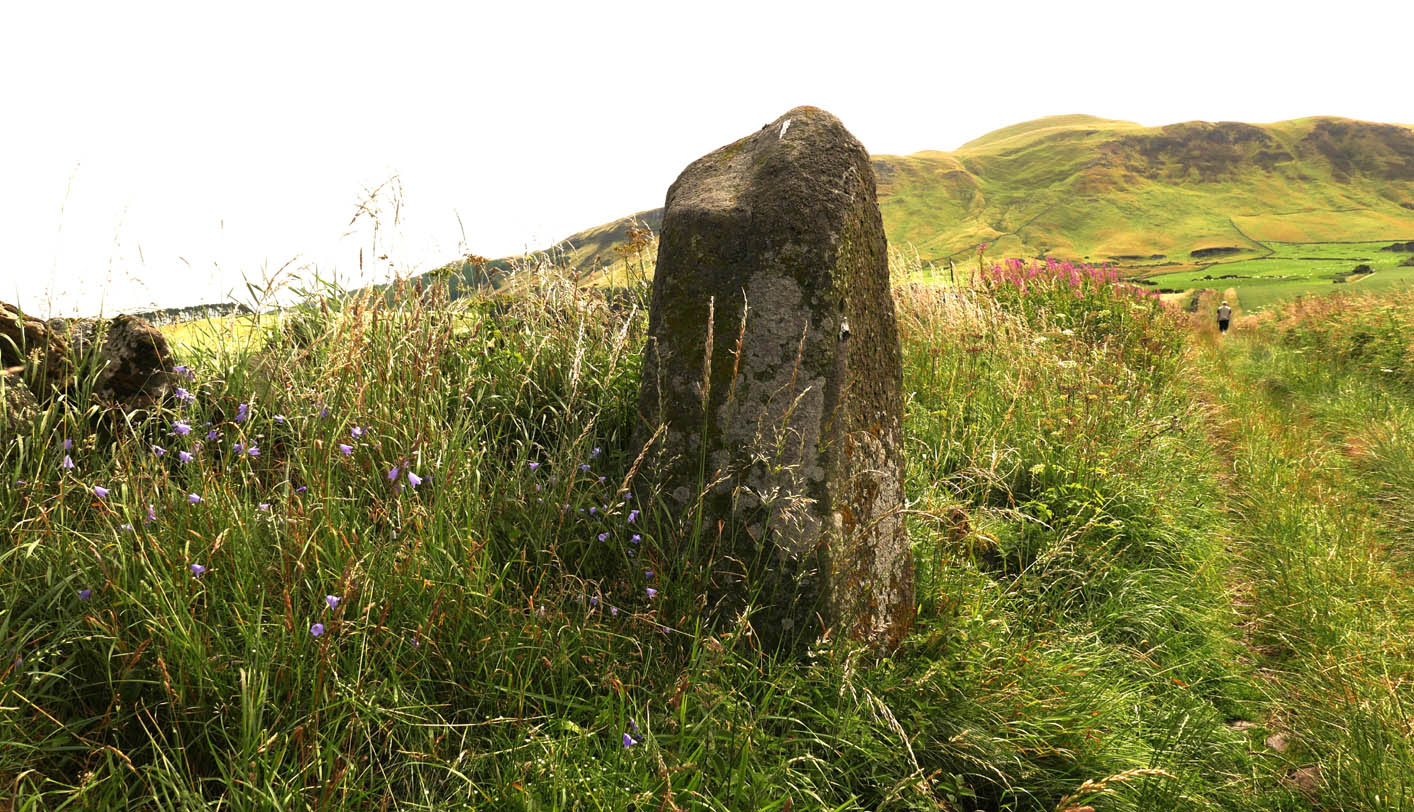
This is one of many long lost prehistoric tombs that were known to have existed in and around the Newmarket race-course, but unlike the Newmarket tumuli 1 – 4 which were all on the first OS-map of the area, this one had been destroyed before the Ordnance Survey lads came here. As a result we don’t know its exact whereabouts.
Described in both the Cambridge Chronicle and Gentleman’s Magazine in 1827, the accounts even then were talking about it in the past tense, albeit pretty recently. The race-course at Newmarket was being modified, leading to the destruction of our ancient landscape—and with it, this tumulus. In those days however, such destruction was deemed as an ‘improvement’, as Sylvanus Urban (1827) tells at the start of his account:
“The improvements making in the exercise ground at Newmarket, Cambridgeshire, have led to some discoveries which may, perhaps, tend to the elucidation of the hitherto obscure origin of the entrenchment commonly called “The Devil’s Ditch.” In removing one of the monumental remains denominated barrows, or tumuli, which are numerous in this neighbourhood, the skeleton of a person was found deposited near the surface, whose remains were too recent to be associated with the area of its place of interment; but, upon clearing away the earth to the centre of the mound, a discovery was made of an urn, of rude construction and materials, containing ashes, together with some beads, which, it is presumed, formed the ornaments of the person to whose honour the barrow was dedicated. There were also found two coins, supposed to be Roman, and a fragment of a cup, of far superior manufacture to the urn, lying promiscuously at the depth of about two feet.”
A summary of this was included in Babbington’s (1883) archaeological survey. But in Cyril Fox’s (1932) list of barrows near Cambridge he seemed to confuse this “tumulus on Exercise Ground” (no.16) with what he thought was another tumulus (no.17), which he described as, “Exact site unknown. Contained a cremation interment. Burnt bones and sherds of Bronze Age type, also Roman sherds.” The two are the same thing.
Royal Commission Ancient Historical Monuments, Inventory of Historical Monuments in the County of Cambridgeshire – Volume 2: North-East Cambridgeshire, HMSO: London 1972.
Urban, Sylvanus, “Domestic Occurrences,” in Gentleman’s Magazine, September 1827.
Tumulus (destroyed): OS Grid Reference – TL 613 633
Archaeology & History
Tumulus 4, centre-left
This is one of at least five prehistoric tombs that were known to have existed in and around the Newmarket race-course. It could be seen five-hundred-and-odd yards northeast of the Ninescore Hill tumulus and about 280 yards southeast of its Newmarket Heath 2 companion. The site was shown as one of the “tumuli” on the 1834 OS-map (right) but, along with its friends, was destroyed sometime around 1883. Unlike its companions, no scar of its remains are visible from the air so we don’t know how big it was, but I’d assume the olde fella to be of a similar size and style to its close neighbours.
Royal Commission Ancient Historical Monuments, Inventory of Historical Monuments in the County of Cambridgeshire – Volume 2: North-East Cambridgeshire, HMSO: London 1972.
Tumulus (destroyed): OS Grid Reference – TL 6091 6304
Also Known as:
Newmarket Heath 1
Ninescore Hill Barrow
Archaeology & History
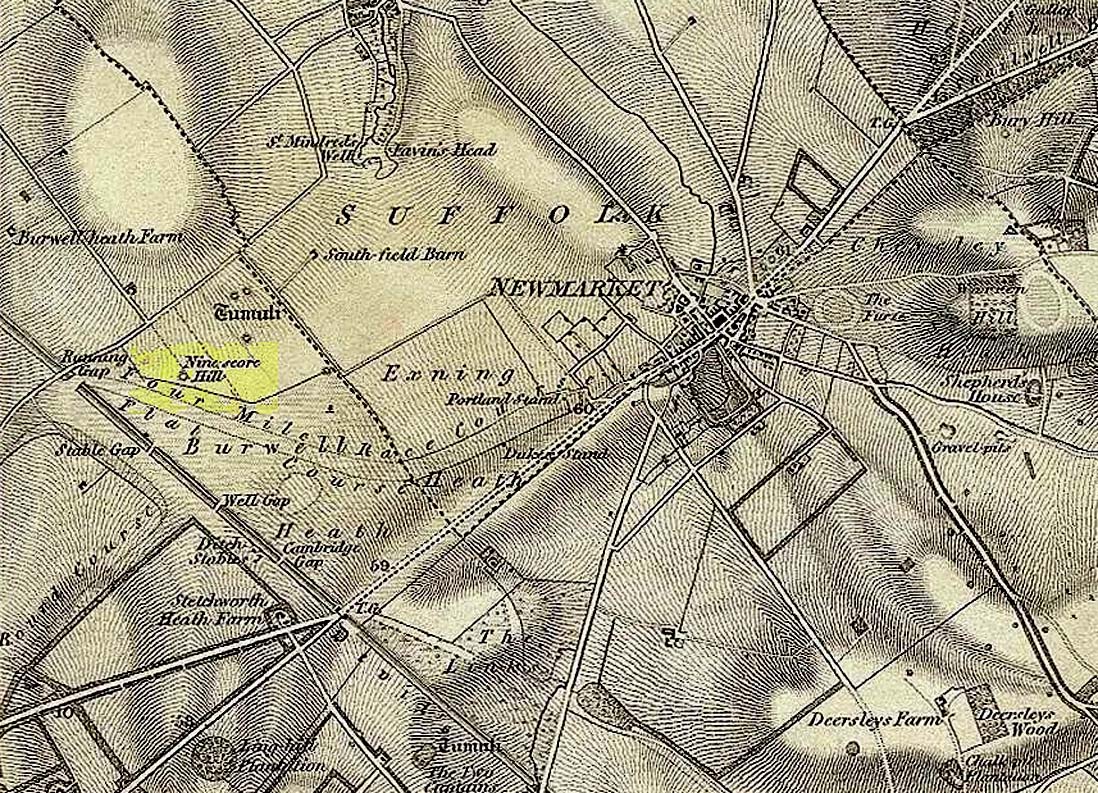
Ninescore Hill on 1834 map
Upon the small and curiously-named Ninescore Hill on the edge of Newmarket’s race-course, the old-school archaeologist Cyril Fox (1923) told that “800 yards due east of Running Gap”, was a prehistoric burial mound that was destroyed in 1885. Highlighted on the 1834 OS-map, a 19th century excavation found that the tomb “contained two inhumation interments associated with beakers,” along with some “flint arrowheads, and a secondary interment, probably Saxon.” In more recent times, the doods from the Royal Commission (1972) added the site to their inventory and noted that a faint outline—known as as ring ditch—is visible from the air when conditions are just right. But there’s bugger all left of it at ground level.
References:
Fox, Cyril, The Archaeology of the Cambridge Region, Cambridge University Press 1923.
Royal Commission Ancient Historical Monuments, Inventory of Historical Monuments in the County of Cambridgeshire – Volume 2: North-East Cambridgeshire, HMSO: London 1972.
From Ilkley town centre take the road up to White Wells (ask any local if y’ can’t find it), but instead of heading up the track to the wells, keep on the road and, after just over 200 yards, turn left up the Keighley Road. Half-a-mile up there’s a dirt-track on your right which leads to Silver Well Farm. Walk along here for about 150 yards, keeping your eyes peeled for a large rock in the heather about 50 yards up onto the moor. You’ll find it.
Archaeology & History
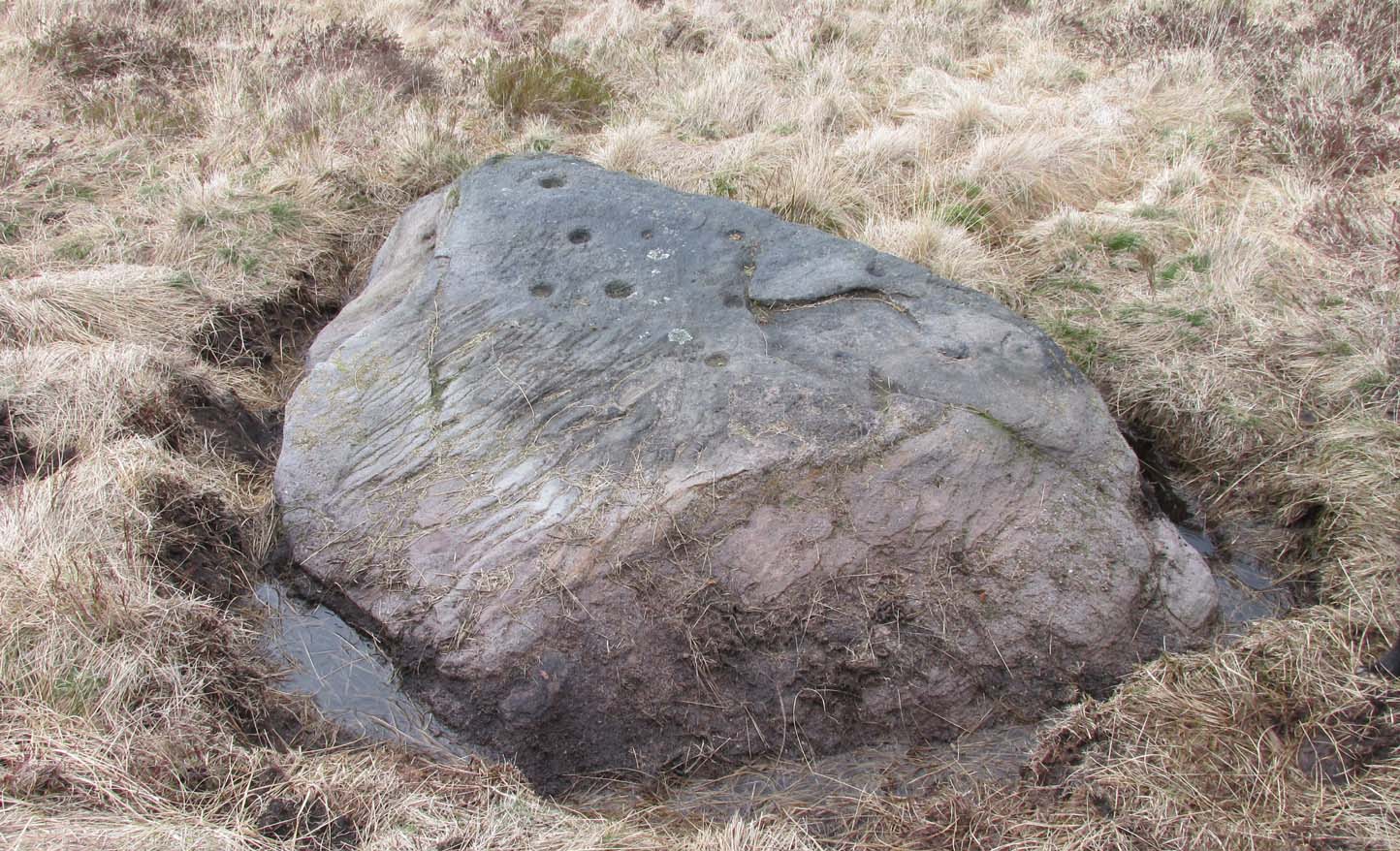
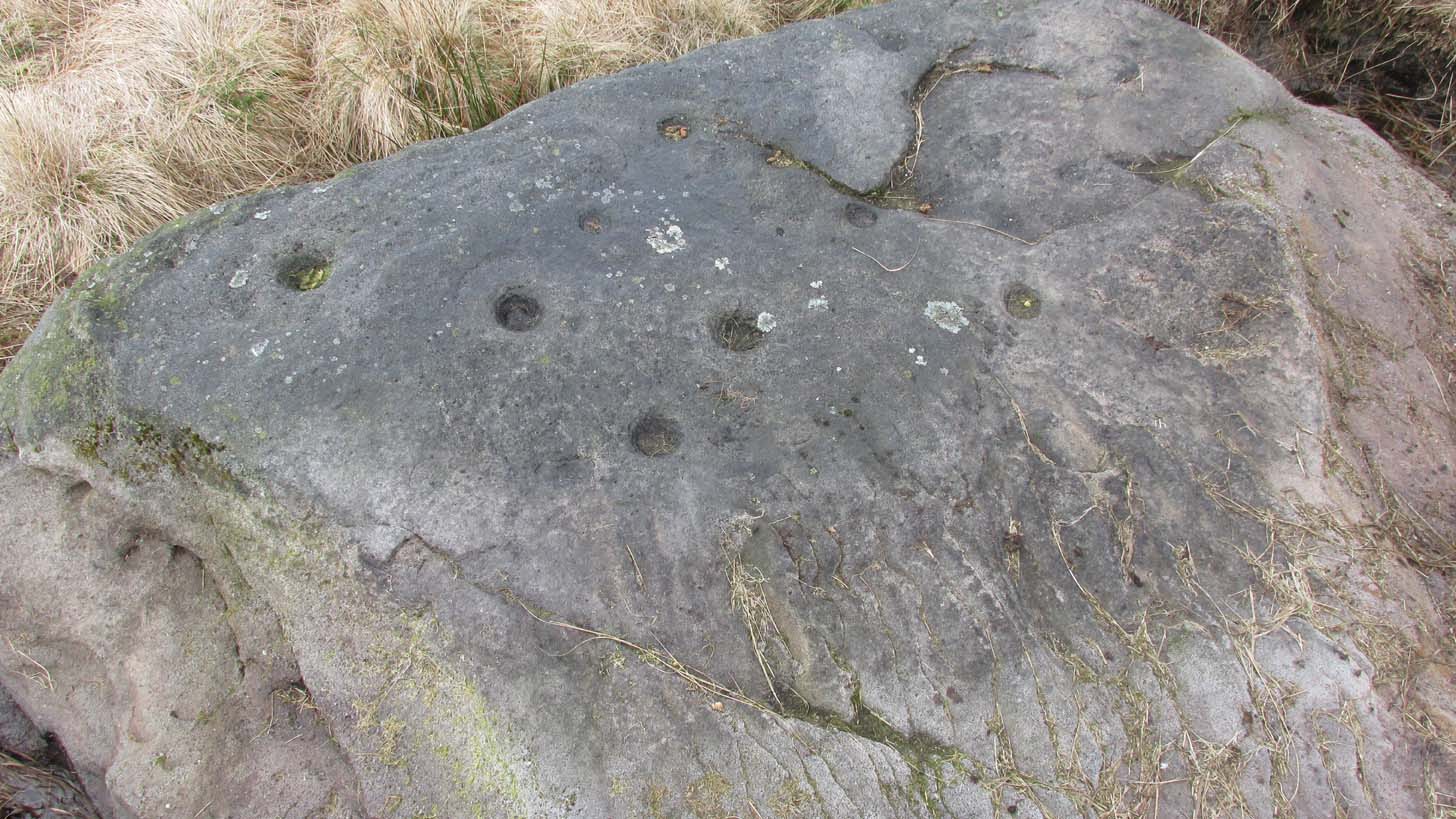
Located just 100 yards west of the old Roman road that effectively runs north-south through the middle of Rombalds Moor and which, when this carving was executed, was a prehistoric trackway, this is an impressive carving, all but unknown by many. On my last visit to this stone—maybe 10 years ago or more—it was a cloudy day. I know this from the fact that the design on the stone was difficult to see in its entirety. But not anymore! When the northern antiquarian Dave Whittaker came a-wandering this way a few years back, the stone so overgrown in vegetation that the design was very difficult to appreciate and, like any healthy curious antiquarian, he wanted to know what the full carving would look like. He enquired whether or not it was OK to uncover the stone from beneath its mass of heather to see the full image and, as far as we were concerned the idea was a good one. And so, following in the footsteps of Beckensall, Currie, Chappell, me and a few others, he got stuck in!
Cup-and-rings from above (photo by Dave Whittaker)Looking across the stone (photo by Dave Whittaker)
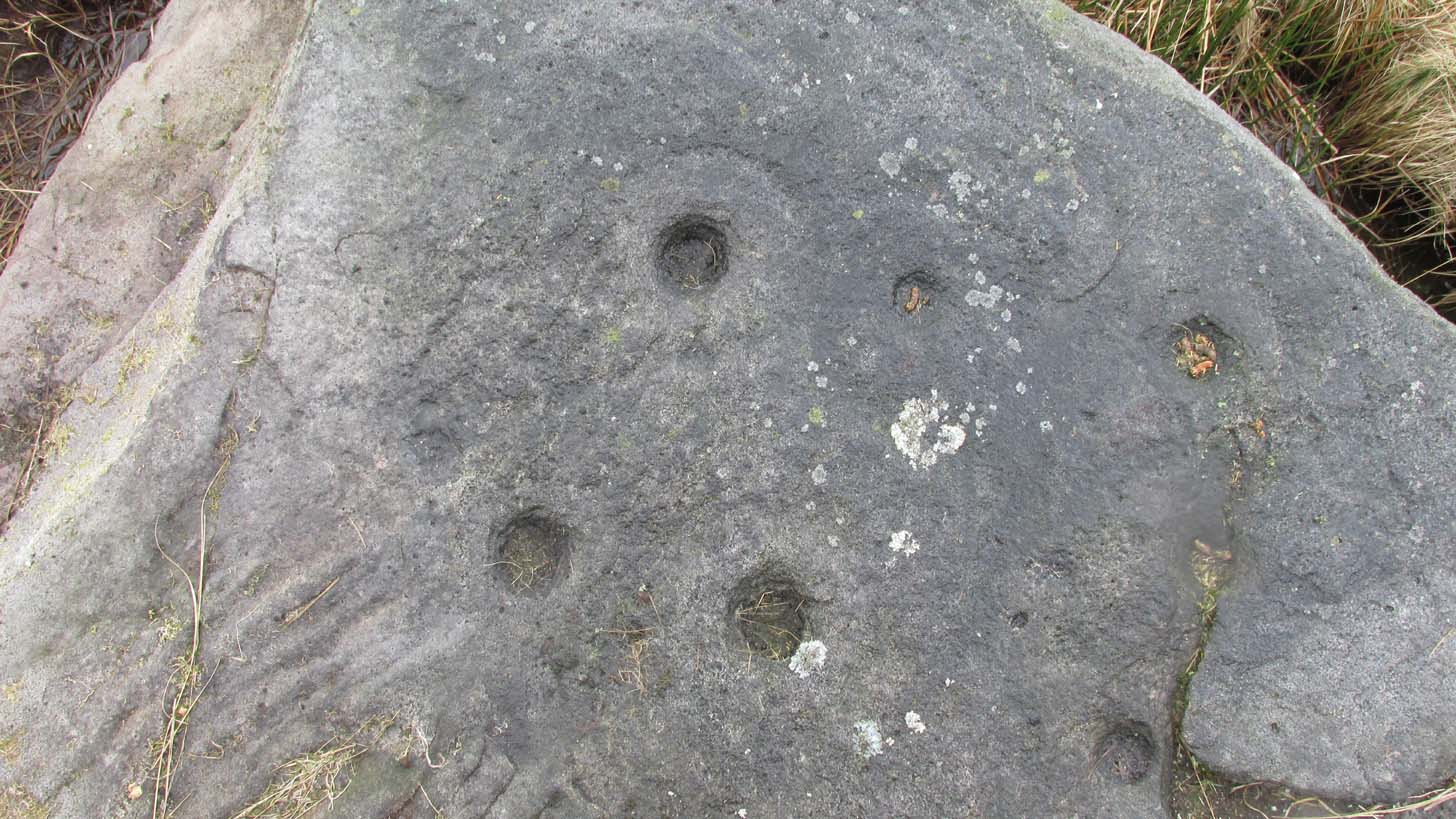
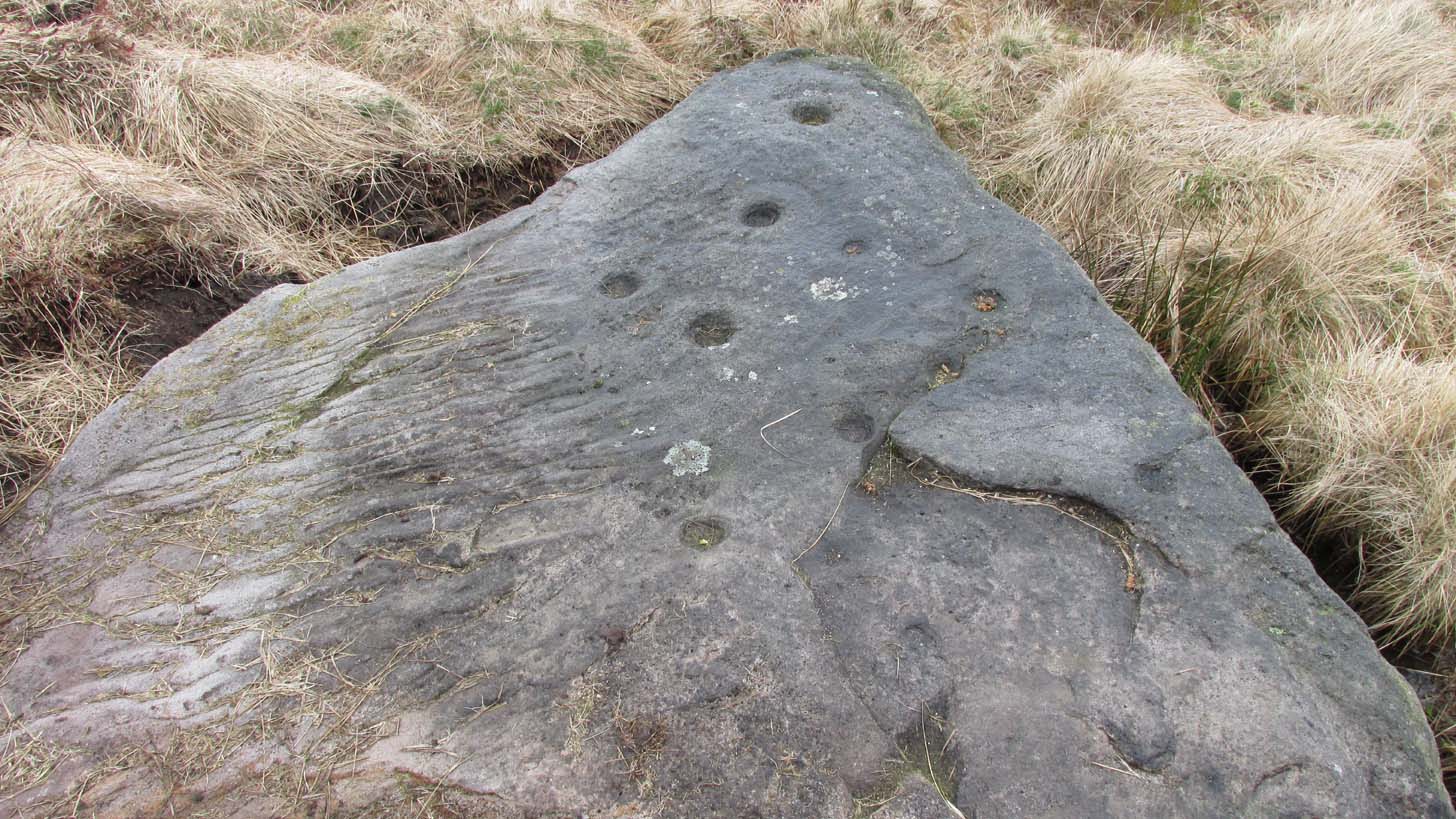
As you can see in Dave’s fine photos, the petroglyph is indeed a fine one. It comprises mainly of four cup-and-rings, two of which are incomplete The rings, as you can see, are very faint, whilst the cups, both in the rings and those outside of them, are notably deep; perhaps indicating that they were carved into many times over a long period.
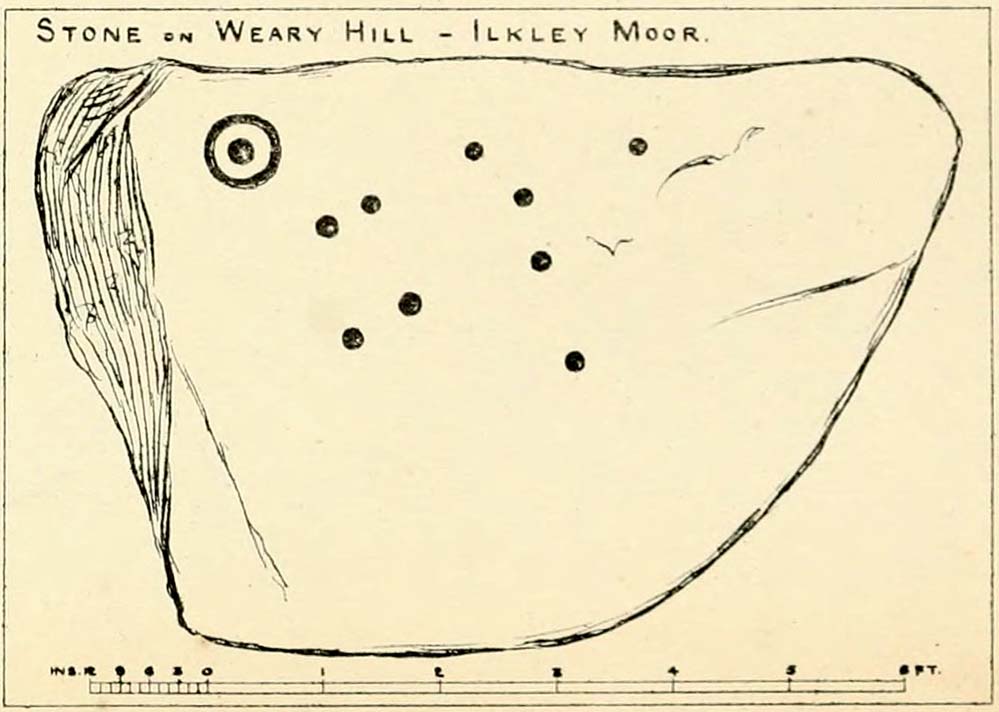
One of the great petroglyphic pioneers, J.Romilly Allen (1882) seems to have been the earliest to record this carving. Allen’s early sketch (below) was obviously drawn on a shady day, as it misses several of of the rings that are clear to see when the the daylight is just right. It’s an easy mistake to make. He wrote:
J.R. Allen’s 1882 sketchHedge’s 1986 sketch
“One mile south-west of Ilkley is a road leading over the top of the Moor…very appropriately as Weary Hill. To the west of the road, and between it and the boundary-wall of Silver Well Farm, is a small boulder of gritstone with cup-markings on it. It lies at a level of 900 ft. above the sea, and it measures 8ft by 5ft. On its upper surface, which is nearly level, are carved ten cups, varying in diameter from 2 to 3 ins., one of them being surrounded by a single ring.”
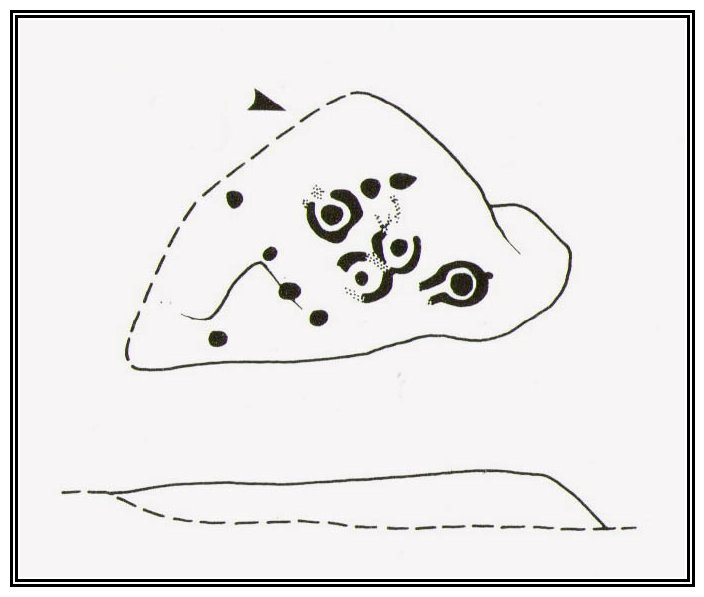
The pseudonymous “A. Reader” (1891) also included the stone in his international overview of prehistoric carvings, but merely copied the notes of his predecessors. Nearly a hundred years later when archaeologist John Hedges (1986) did his survey of these moors, he described this carving simply as:
“Medium seized rock…in grass, heather and crowberry with c.ten cups, four with rings, two with grooves from rings, three depressions and series of probably natural lines running down to bottom edge.”
And as with the pseudonymous A. Reader (1891), Boughey & Vickerman’s (2003) also just copied Hedges’ earlier description.
Seeking numeracy in Alan Davis 1988 sketchAnd from another angle (photo by Dave Whittaker)
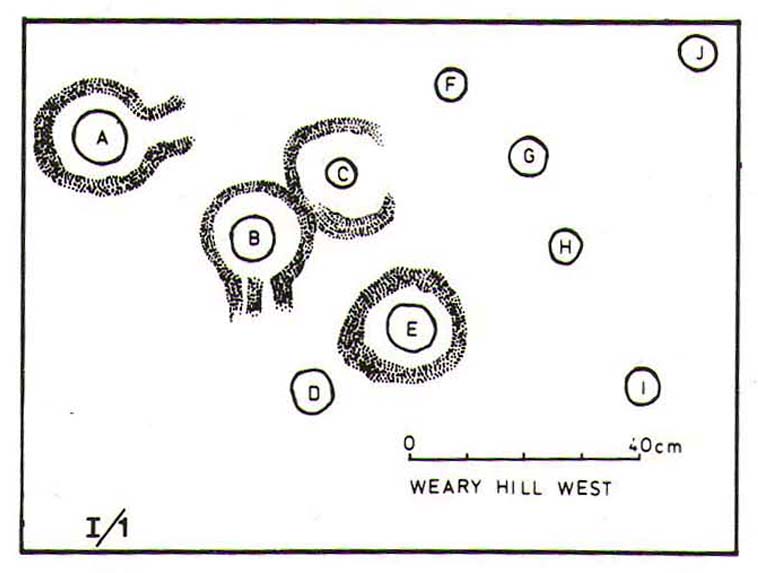
The greatest analysis of this carving to date is by physicist and mathematician Alan Davis. He set out in 1983 to explore the possibility of there being a universal measurement used in neolithic times that was coded into our cup-and-rings—a theory first espoused by the great archaeo-astronomer Alexander Thom. (1968) He selected carvings from Rombalds Moor and Northumberland, including this one at Weary Hill (calling it the I/1 carving) to see if a ‘megalithic inch’ (MI) that was propounded by Thom had any foundation in fact. As a mathematician he was ideally qualified to examine this proposition. His 1983 paper found there to be “substantial support” for this prehistoric megalithic inch. However, in a subsequent 30-page analysis of the same carvings Davis (1988) found that some criteria in his initial investigation needed re-examining. In his updated report he told that “many of these deficiencies have now been remedied.”
His initial 1983 report concluded the Weary Hill carving possessed a deliberate mathematical code in accordance with Thom’s MI. However in the subsequent 1988 report, Davis found that the measurements were based on 5MI and 3 MI, but only in the cup-and-rings and not the single cups. Despite this, there remained an overall scepticism in terms of any deliberate universal use of the MI. My own take on this is a simple one: there was no deliberate use of any MI at carvings. Where we do find precise MIs, this is due simply to the average size of human hands, meaning that some obvious figurative correspondences will occur upon investigation. The more you think about it, the more obvious it becomes.
Anyhow, all this intriguing geometry aside: to those of you who take the time to check this out, have a bimble in the heather barely 100 yards west and you’ll find a few other carvings sleeping quietly, whose site profiles I’ve yet to do…
References:
Allen, J. Romilly, “Notice of Sculptured Rocks near Ilkley,” in Journal of the British Archaeological Association, volume 38, 1882.
Anonymous, Walks Around Cup and Ring Stones, ITIC: Bradford n.d. (1995)
Boughey, K.J.S. & Vickerman, E.A., Prehistoric Rock Art of the West Riding, WYAS: Leeds 2003.
Collyer, Robert & Turner, J. Horsfall, Ilkley, Ancient and Modern, William Walker: Otley 1885.
Davis, Alan, ‘The Metrology of Cup and Ring Carvings near Ilkley in Yorkshire,’ in Science and Archaeology, 25, 1983.
Davies, Alan, ‘The Metrology of Cup and Ring Carvings,’ in Ruggles, C., Records in Stone, Cambridge 1988.
Hedges, John (ed.), The Carved Rocks of Rombald’s Moor, WYMCC: Wakefield 1986.
Reader, A., Archaic Rock Inscriptions, privately printed: London 1891.
Thom, Alexander, “The Metrology and Geometry of Cup and Ring Marks,” in Systematics, volume 6, 1968.
Turner, J. Horsfall, Historical Notices of Shipley, Saltaire, Idle, Windhill, Wrose, Baildon, Hawksworth, Eccleshill, Calverley, Rawdon and Horsforth, Shipley Express: Idle 1901.
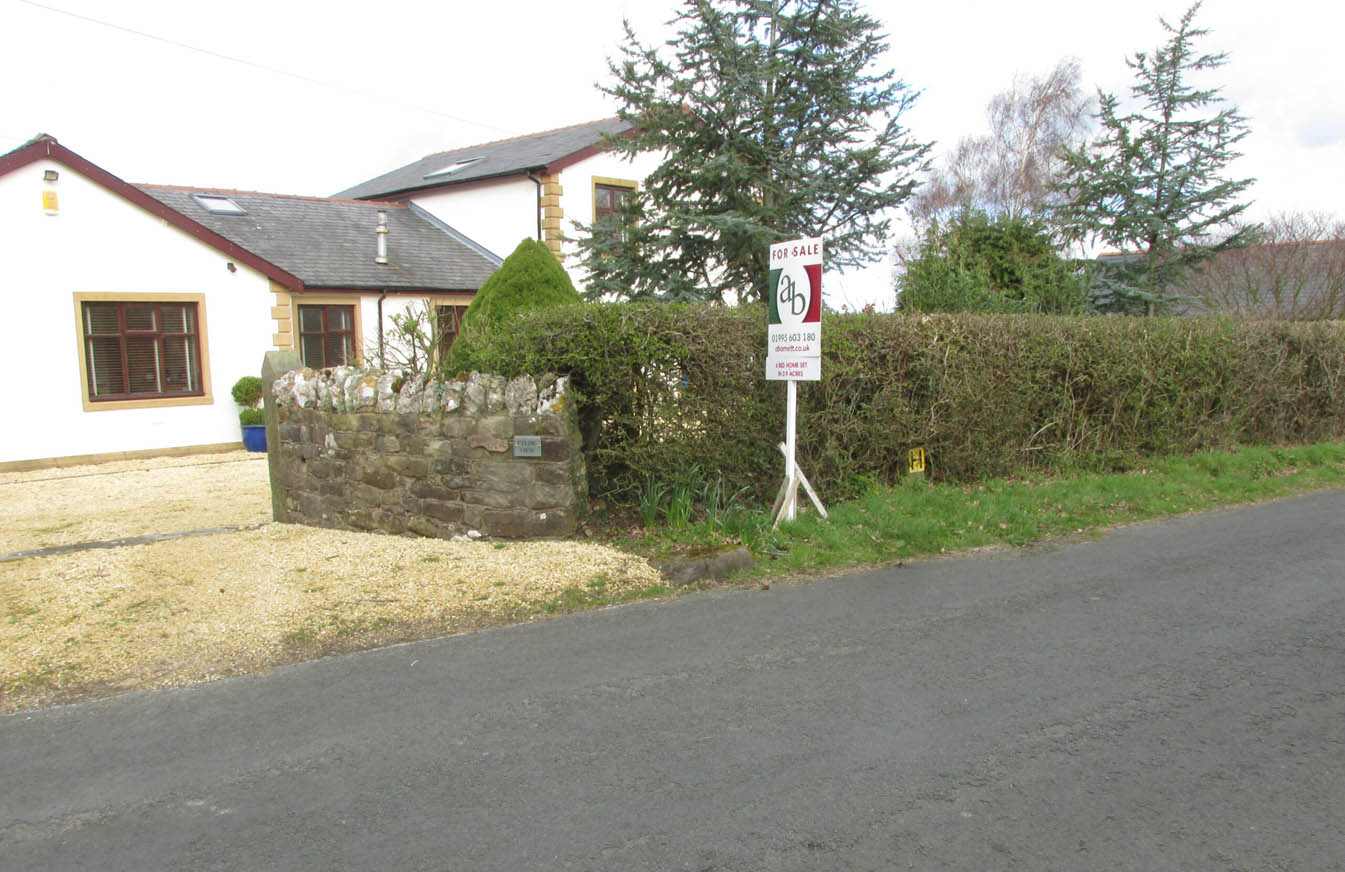
Follow Long Lane northwards from Scorton, over the crossroads at Crosshill Four Lane Ends, and the cross base will be found at the road edge immediately to the right of the driveway of ‘Sandalwood’ on the left hand side of the road.
Archaeology & History
Described in the Historic Buildings listing citation as:
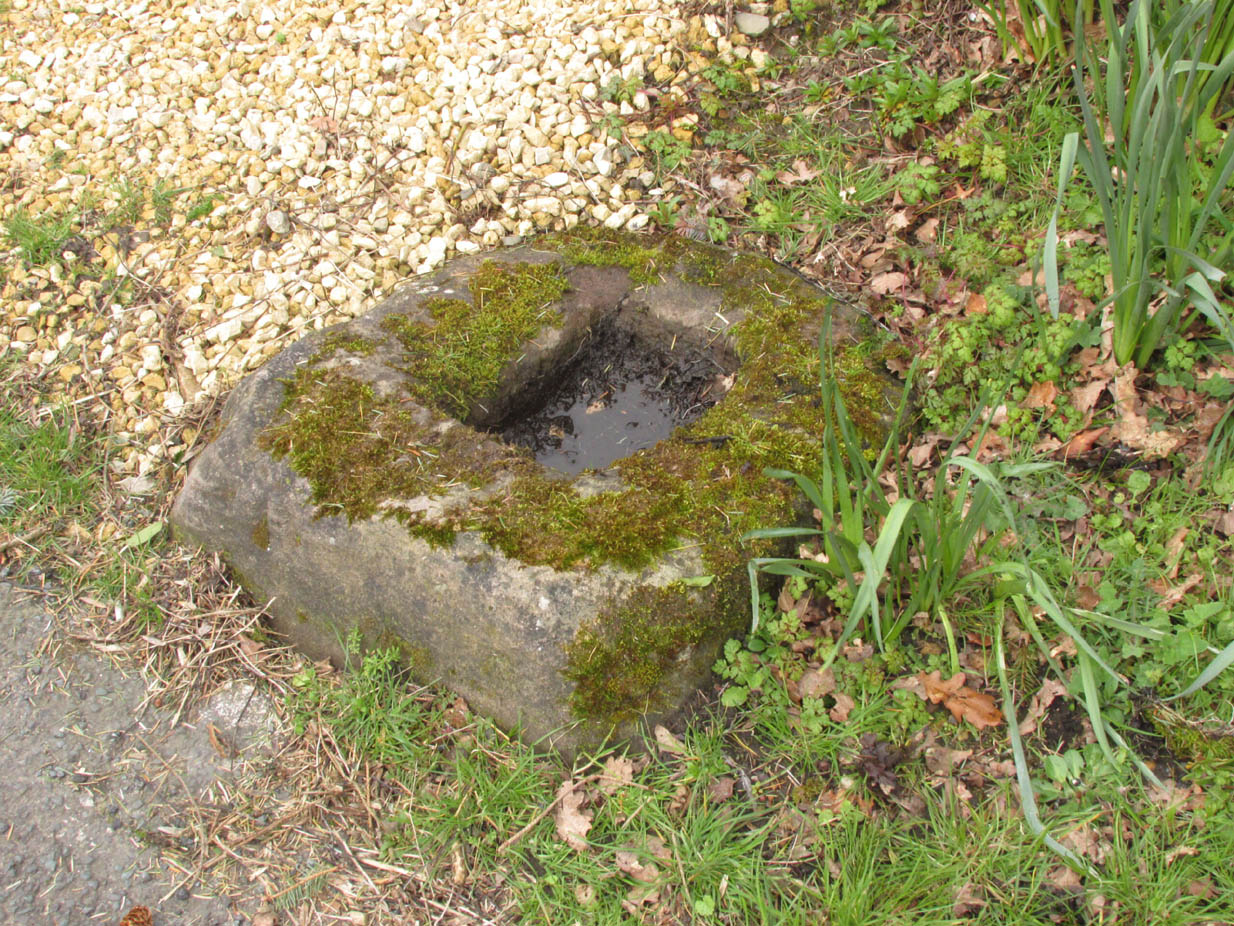
“Cross base, probably mediaeval. A sandstone boulder, roughly rectangular, with rectangular socket.”
Cross base at the roadside‘A sandstone boulder, roughly rectangular’
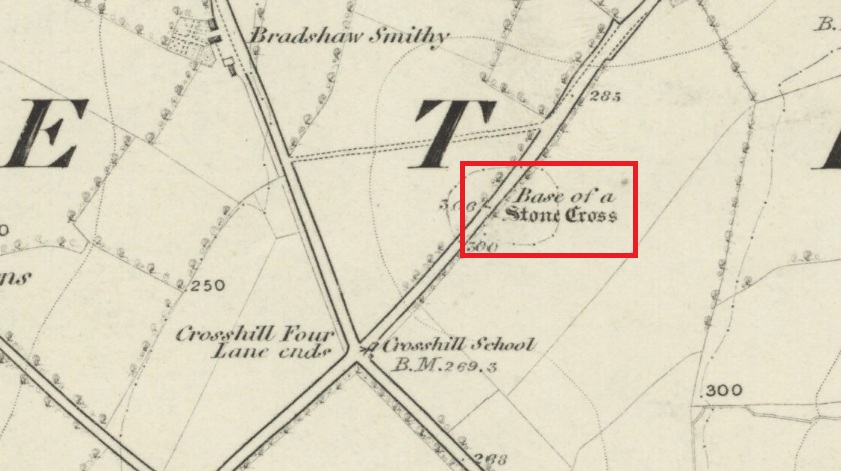
The base of one of the numerous mediaeval wayside crosses that once adorned this part of Lancashire. So what happened to the cross? It’s possible that it was wilfully destroyed in the early nineteenth century as we have a likely culprit in the person of the Reverend Richard ‘Cross Smasher’ Wilkinson (c.1791 – 1823), Curate of Whitechapel, who took it upon himself to destroy the symbol of his religion wheresoever he could find it.
Immediately to the north west of the Cross is Cross Hill. The cross itself was probably a waymarker on the road over Harrisend Fell from Oakenclough, and Bradshaw may be the name of the locality, there being a Bradshaw Bridge just outside Street to the north west, while the 1846 6-inch OS map records a ‘Bradshaw Smithy’ on the same road.
Along the main A913 Perth Road that runs round the northern edge of Abernethy village, as you approach the village from the western side, go right at the mini-roundabout up the Main Street into the village. However, just where this roundabout is, there’s a footpath into the trees known as the Castlelaw. Walk up here, keeping to the left-side of the burn (don’t cross over onto the right-hand side!) and after about 200 yards or so, keep your eyes peeled for a large upright stone, almost overgrown in dark vegetation on your left.
Archaeology & History
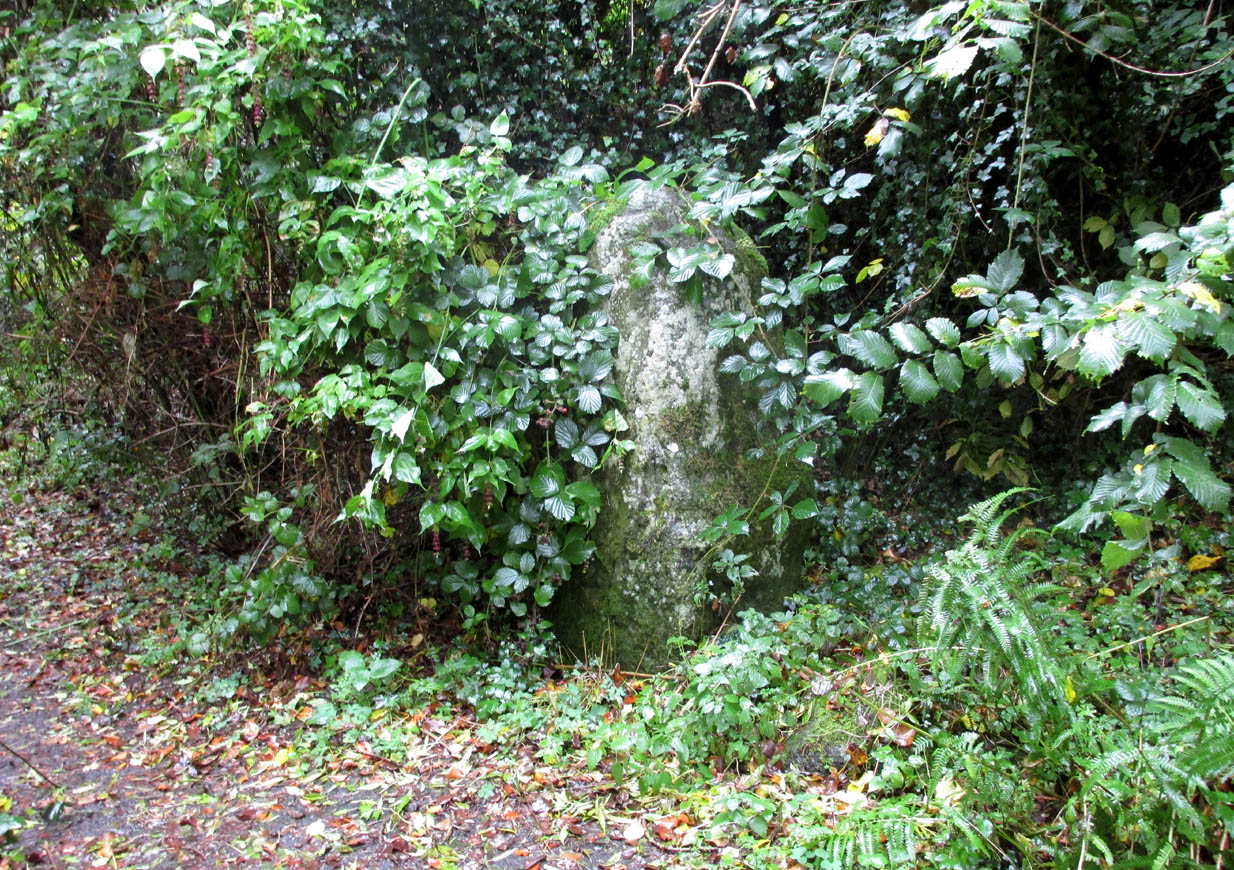
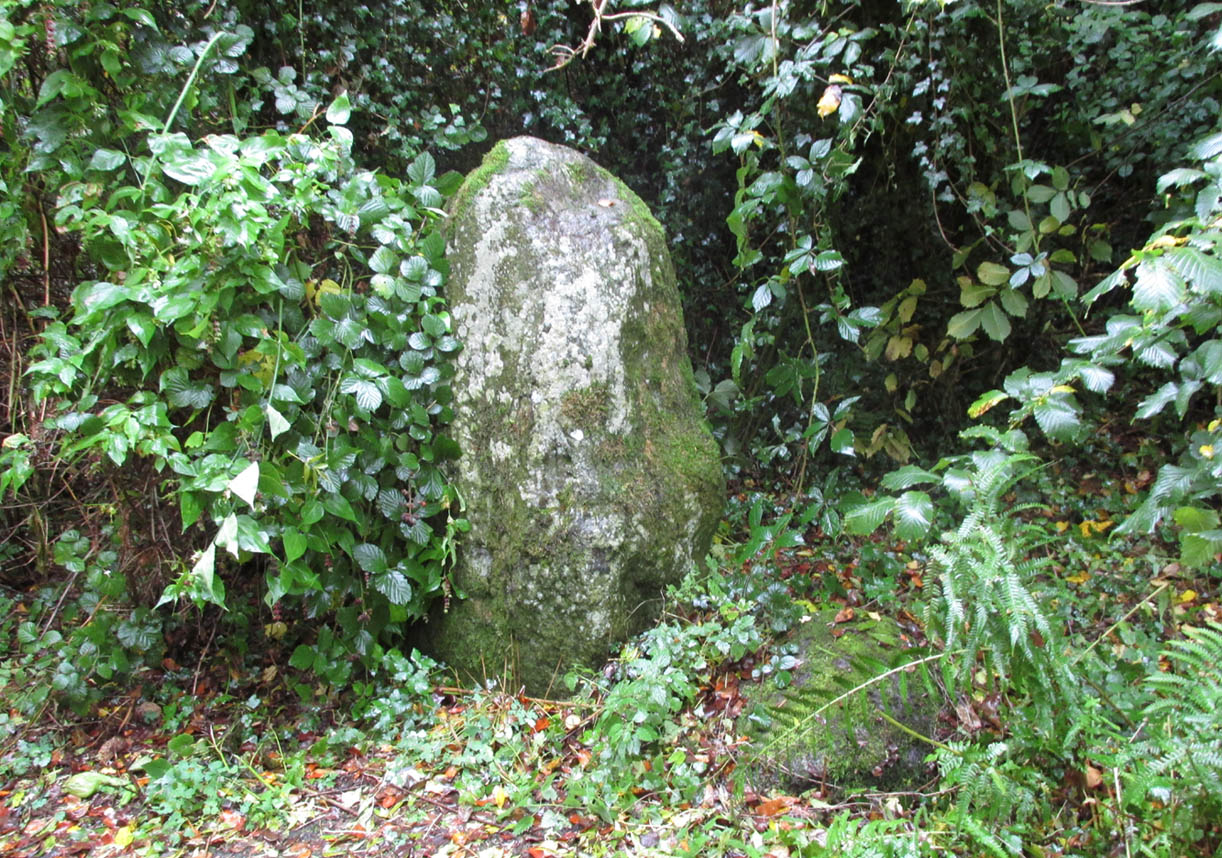
An intriguing standing stone in a most unusual position: a small wooded glen with a steep slope on its immediate eastern side, very enclosed. It’s quite a big thing too, standing some six-feet high with the usual worn rounded crown, typical of olde stones.
The olde stone, unmasked
In the very brief account of this site by Hallyburton & Brown (2000) they describe this “previously unrecorded /lost standing stone and possible ruinous stone circle.” This is also echoed in Canmore’s description. A standing stone we certainly have, but in several visits here there was no evidence of any stone circle either side of the burn. It was suggested that the “circle” may once have been atop of the slope immediately above this stone, but again there is no evidence at all to suggest this and old maps show nothing. I’m extremely doubtful of any megalithic ring here (I’d love to be wrong though).
References:
Hallyburton, I. & Brown, R., “Abernethy Den (Abernethy Parish),” in Discovery & Excavation Scotland, New Series – volume 1, 2000.
This stone has very similar qualities to the one found upon Mullach-geal, ⅔ of a mile to the west, as a place where ritual magick was performed. And, just like the Mullach-geal stone, we only have an approximate position of its whereabouts: “behind the village”, as Mr Sands (1878) said. The same words were used by other St Kildan writers when it came to describing the whereabouts of Tobar Childe, so we must assume it to be reasonably close to the old well.
Folklore
Mr Sands seems to be the first person to write about it, telling us,
“At the back of the village is a stone, which does not differ in external appearance from the numerous stones scattered around, but which was supposed to possess magical properties. It is called Clach an Eolas, or Stone of Knowledge. If any one stood on it on the first day of the quarter, he became endowed with the second sight — could “look into the seeds of Time,” and foretell all that was to happen during the rest of the quarter. Such an institution must have been of great value in Hirta, where news are so scanty. To test its powers I stood on it on the first day of Spring (old style) in the present year, but must acknowledge that I saw nothing, except two or three women laden with peats, who were smiling at my credulity.”
Charles MacLean (1977) mentioned the stone a hundred years later, but seems to have just copied this earlier description. Does anyone up there know its whereabouts?
References:
MacLean, Charles, Island on the Edge of the World, Canongate: Edinburgh 1977.
This is a most intriguing site, whose exact location seems to have been forgotten. It was first mentioned in Macaulay’s History of St Kilda (1764) as being one of four stone altars that the islanders used for worship. Three of them were related to the early christian figure of St. Brendan, whose well and chapel remains are on the south-side of the island. However, this fourth stone altar possessed a purely magickal and heathen function. Macaulay initially gives the location as being “on top of a hill to the southwest” of St. Brendan’s chapel; but subsequently tells us it was upon “Mulach-geall” which is a mile NNW. It was an important place to the people of Hirta and its exact position needs to be found and, hopefully, the altar still exists.
Folklore
Despite Macaulay’s conflicting directions of how to get here (a common feature of early writers), he wrote:
“I have already made mention of one St. Kilda altar, that in Brendans Chapel. There are no less than four more in the island, of which three lie at considerable distances from the holy places. There is one particularly on the top of a hill to the south-weft (sic), dedicated according to tradition to the God who presides over Seasons; The God of thunder, lightning, tempests and fair weather. To avert the terrible judgments inflicted by this mighty Divinity, the ancient St. Kildians offered propitiatory sacrifices on this altar, sacrifices of different forts, much like the old Pagans, who offered a black sheep to Winter, or the Tempest, and a white one to the Spring… The place where the people of this island, offered their victims to Taranis, is called Mulach-geall, that is to say, the White eminence or hill…”
More than a hundred years later, Seton (1878) made mention of it, but added no further details.
The invocation to Nature’s elements is something we find echoed at some sites further east, such as the Well of the North Wind on Iona and its compatriot Well of the South Wind. At both these places, so-called ‘pagan’ rituals were used to both placate and invoke the gods and spirits of the wind. This one on St Kilda possessed additional magickal prowess. But where is it? Have we lost it, or is it sleeping somewhere on the edge of Mullach-Geal…?
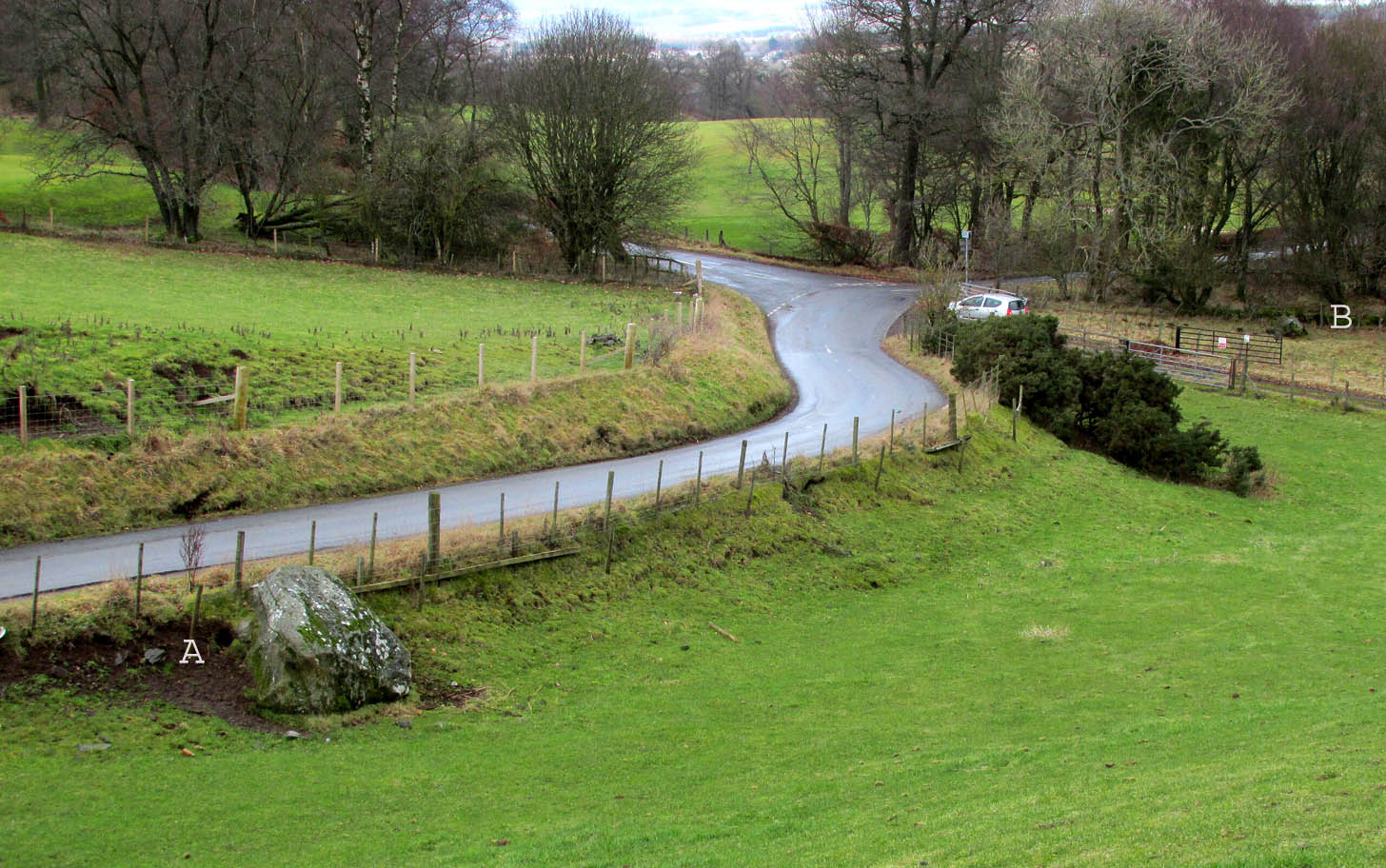
Travelling north from Perth on the A94, take the right turning for Murrayshall just before entering Scone, then take the first right and continue up to the road junction, and park up at the trackway opposite. You’ll see the big stone in the field to the right, up against the road embankment; and the small stone is in the paddock to the left of the trackway at the edge of the trees.
Archaeology & History
Two large glacial erratics which have acquired mythic status and picked up a Christian triumphalist message on the way.
Folklore
In Lawrence Melville’s (1939) excellent local history work, he thankfully put to pen an all-but-forgotten tale of oral tradition:
“Where the road from the Muir of Durdie leaves Kilspindie parish, a grass grown road leads north to Boglebee….. A few yards from the highway lie two large stones, said to have been flung from the Giant’s Hill in Collace parish – the flat topped eminence lying due north from the stones, about two or three miles away, better known as “Macbeth’s Hill”, or “Dunsinane Hill”.
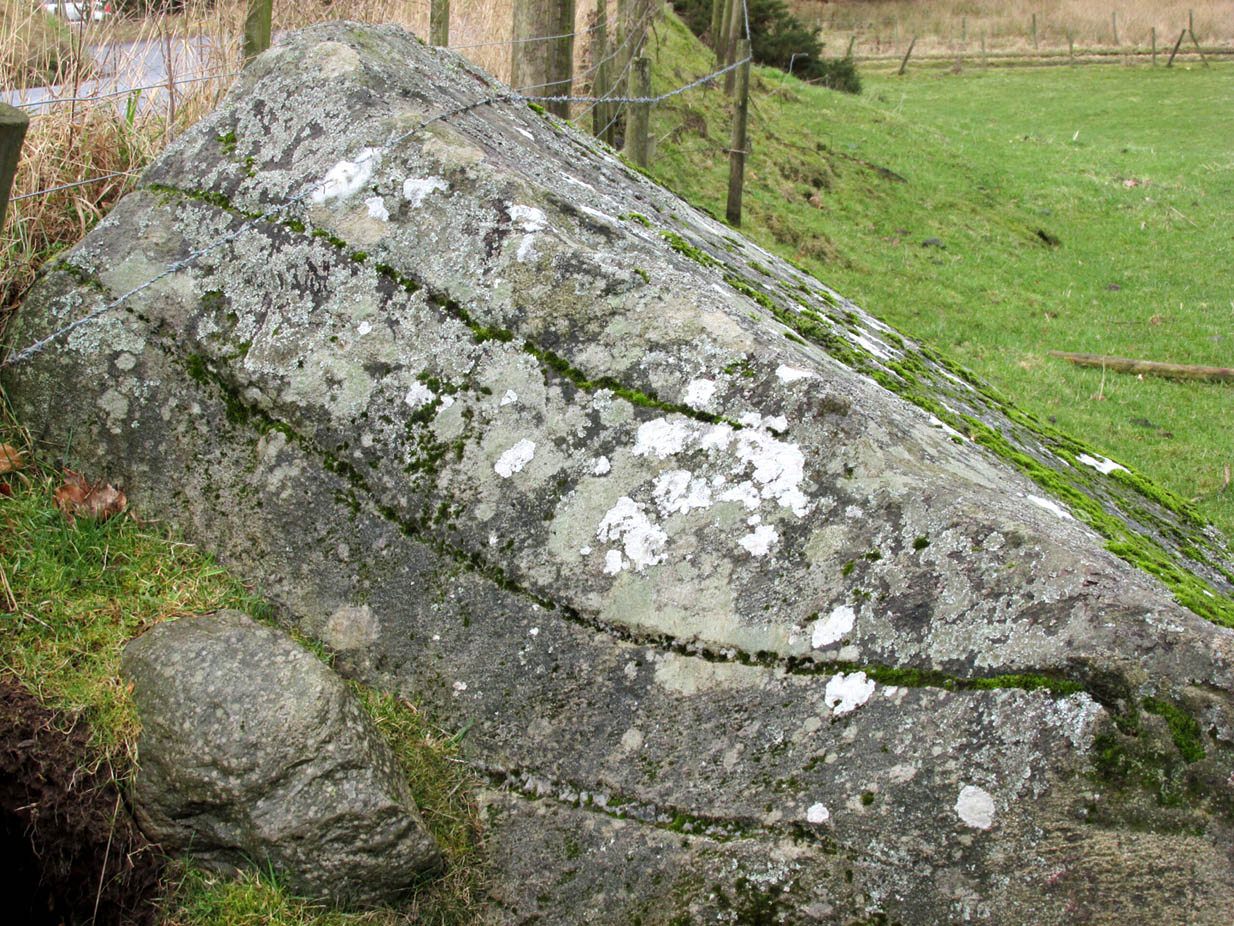
The ‘string’ marks of legendThe smaller stone with its ‘string’ marks
“When the church dedicated to St John in Perth was being built and its tower began to appear, a witch living in Collace was enraged to see this proof of the approach of Christianity and determined to destroy it. She had a son, a giant (after whom the hill receives one of its names), whom she sent to the top of the hill, giving him two huge stones with which to destroy the rising church.
“By her incantations she had supernatural power and knew that when Christianity came her power would be destroyed. She gave him her mutch from her head to be used as sling and in it the giant put the two huge stones. Whirling it around his head, he aimed them in a line with the tower, but, just as he let them fly, the string of his mother’s cap broke and the stones only went the length of Boglebee. The marks on the stones are said to be the marks of the witch’s mutch strings.”
Another view of the larger stone
A familiar folkloric message is remembered the length of Britain: a giant, a devil or other supernatural being throwing stones that either spill out of an apron or otherwise miss their mark. And in this case an unsubtle message to anyone trying to take on the might of the church. But what was the original story of these stones as told by the old time oral storytellers before Christian missionaries stalked the land?
If the string hadn’t broken and the stones had followed their original trajectory they would have fallen south of St John’s Kirk, but it was the thought that counted….
Reference:
Melville, Lawrence, The Fair Land of Gowrie, William Culross: Coupar Angus, 1939.
To find this stone take the A91 to Gateside and turn into Station Road. Follow to the end, then turn right. 200 yards on there is a parking spot for the Bunnet Stane, and a track to follow. As you go up this track towards the Bunnet, approximately 280 yards on is this beauty.
Archaeology & History
At over 6ft high, this previously unrecorded standing stone has quite a presence on this slight incline. It’s hard to tell the true height as he is set in a grassy bank with a drystane wall behind. It has obviously been used as a gatepost at some time in the past, but there’s no hint of being moved for that purpose. There are many ancient relics in this area and there used to be a stone circle across the road and behind Nether Urquhart Farm, along with several burial cairns. I reckon there is a lot more to be found, and we fully intend to go back there.