Askwith Moor (529), North Yorkshire

Cup-Marked Stone:  OS Grid Reference – SE 17396 50745

Getting Here

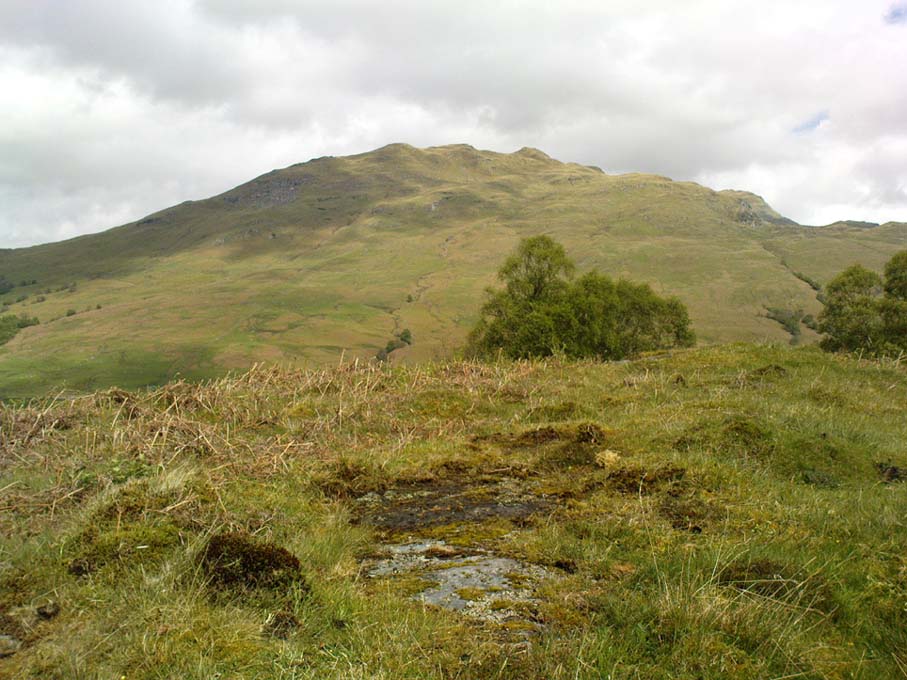
To be found a couple of hundred yards west of Askwith Moor Road, head towards the bottom of the row of grouse-butts, following the fence that runs into the moorland across from the dusty car-park.

Archaeology & History

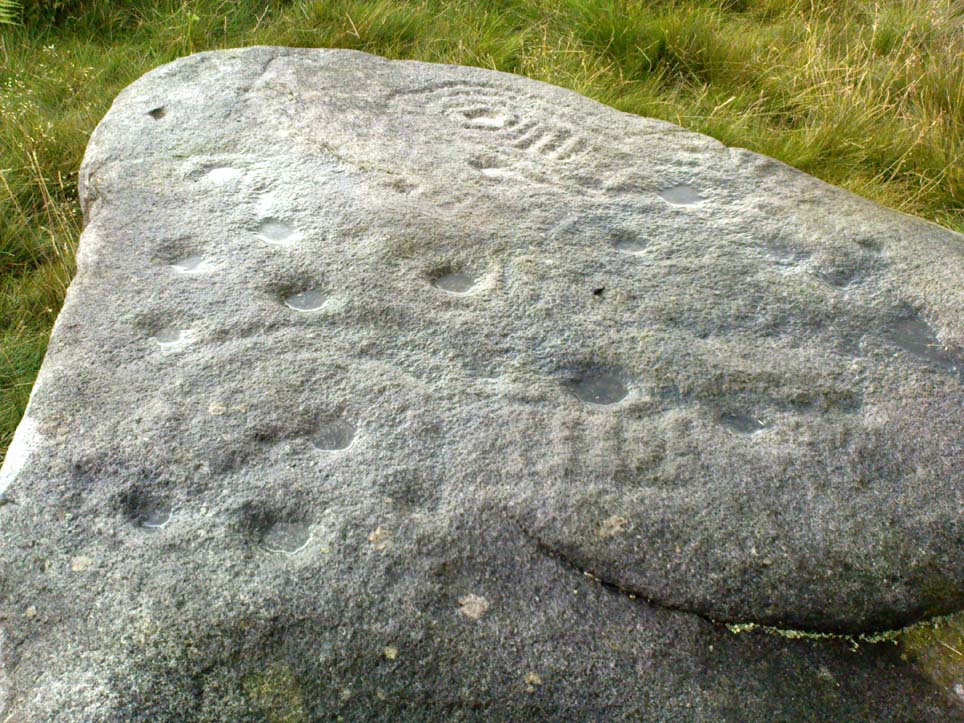
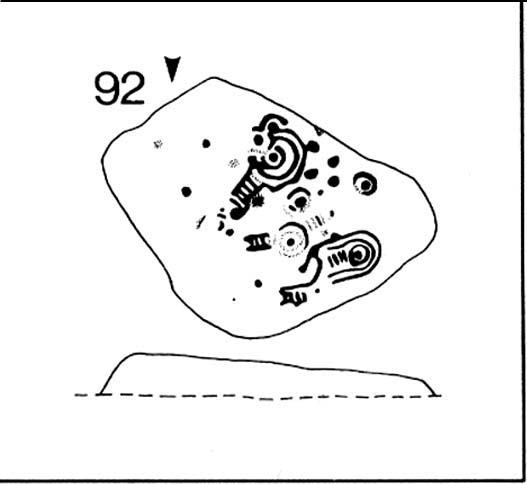
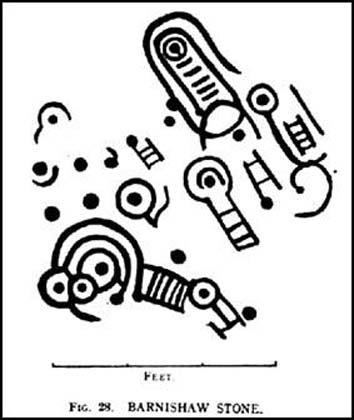
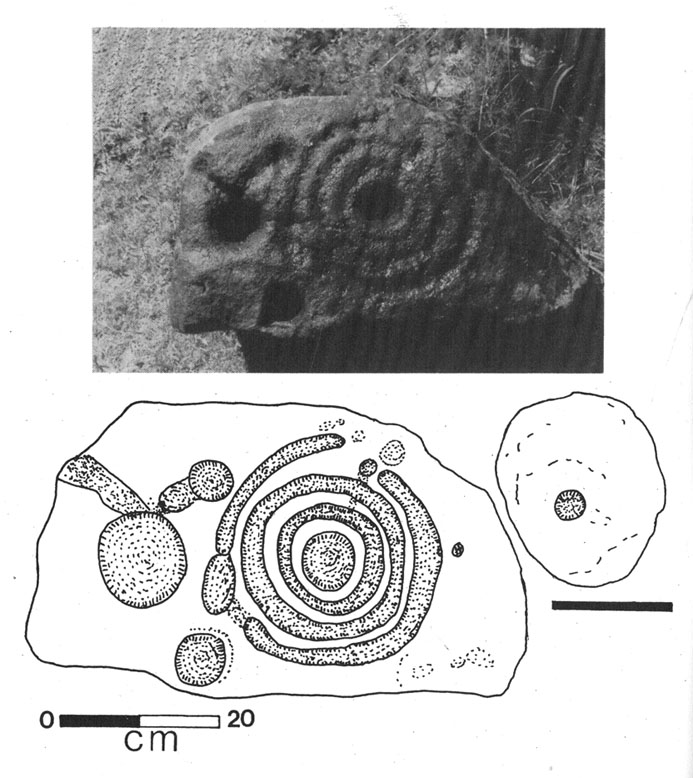
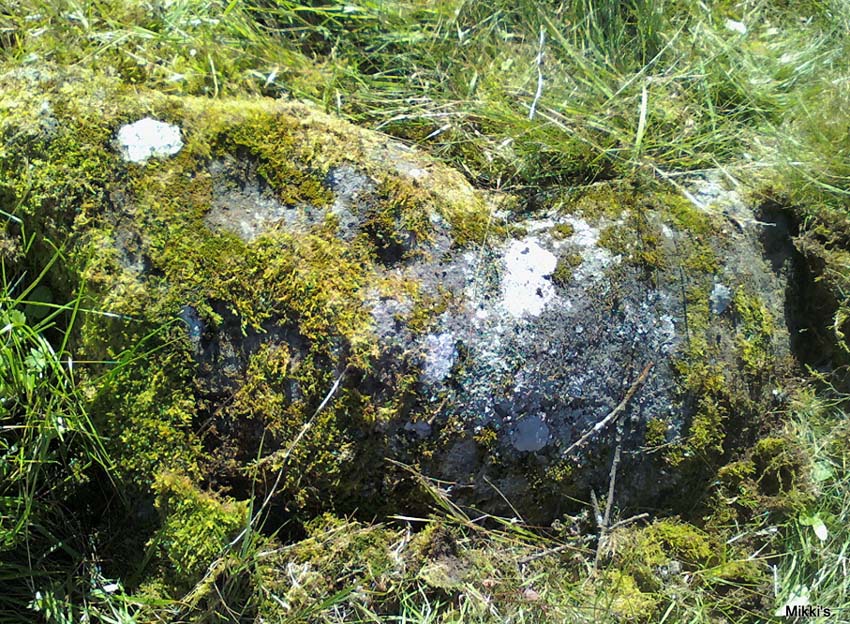
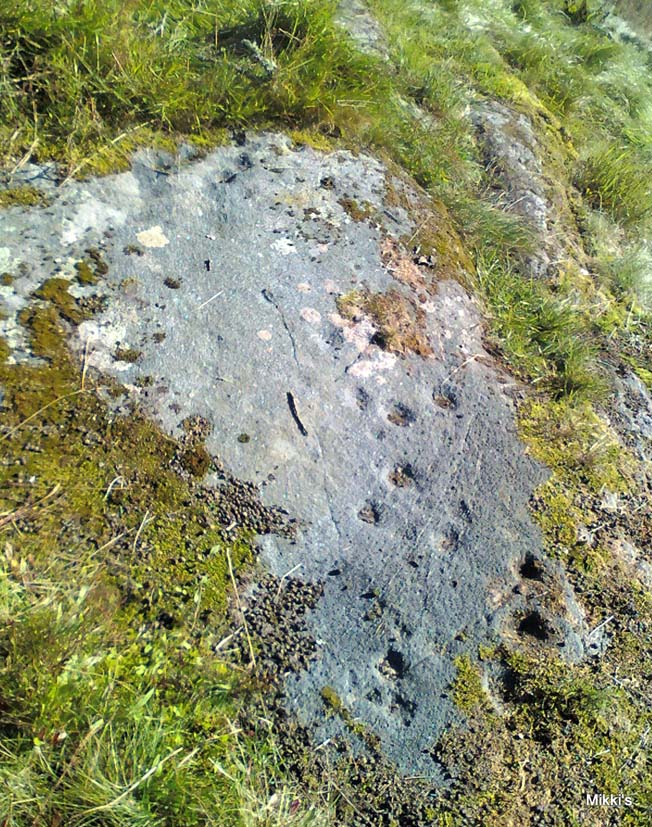
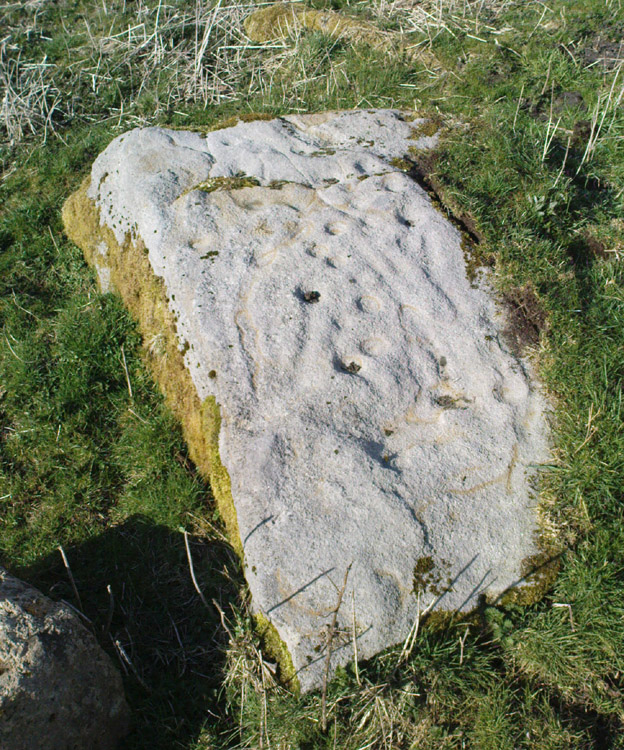
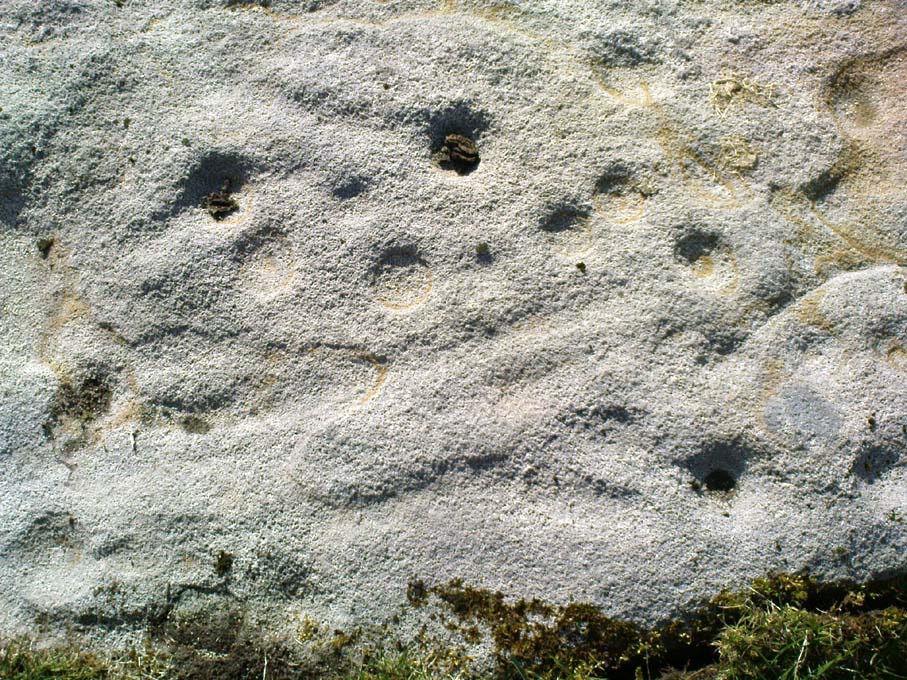
Single cup-marked stone

This single cup-marked stone — list as carved stone no.529 in Boughey & Vickerman’s (2003) survey — was reported when some English Heritage doods came here and found this small upright stone (probably part of a larger prehistoric monument, e.g., walling or cairn) and gave the cup-marking their “all clear” stamp and thought it authentic.  But if memory serves me right (which it doesn’t always do these days!), I’m pretty sure Graeme Chappell came across this possible carving in the early 1990s during one of our many forays over these moors.  It’s a cute little thing — though only for the purists amongst you perhaps — but, of course, needs to be seen in the context of its proximity to the many other prehistoric monuments across this moorland plain.

References:

  1. Boughey, Keith & Vickerman, E.A., Prehistoric Rock Art of the West Riding, WYAS: Wakefield 2003.

© Paul Bennett, The Northern Antiquarian

Lippersley Pike Rock, Denton Moor, North Yorkshire

Cup-Marked Stone:  OS Grid Reference – SE 1471 5233

Also Known as:

  1. Carving no.506 (Boughey & Vickerman)
1992 drawing of CR506

Getting Here

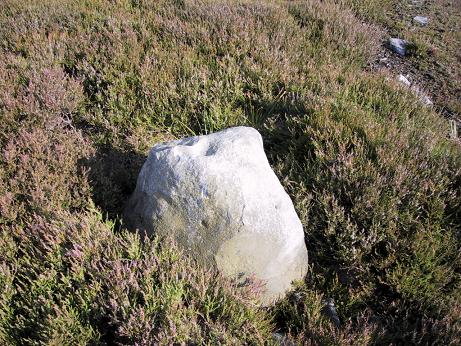
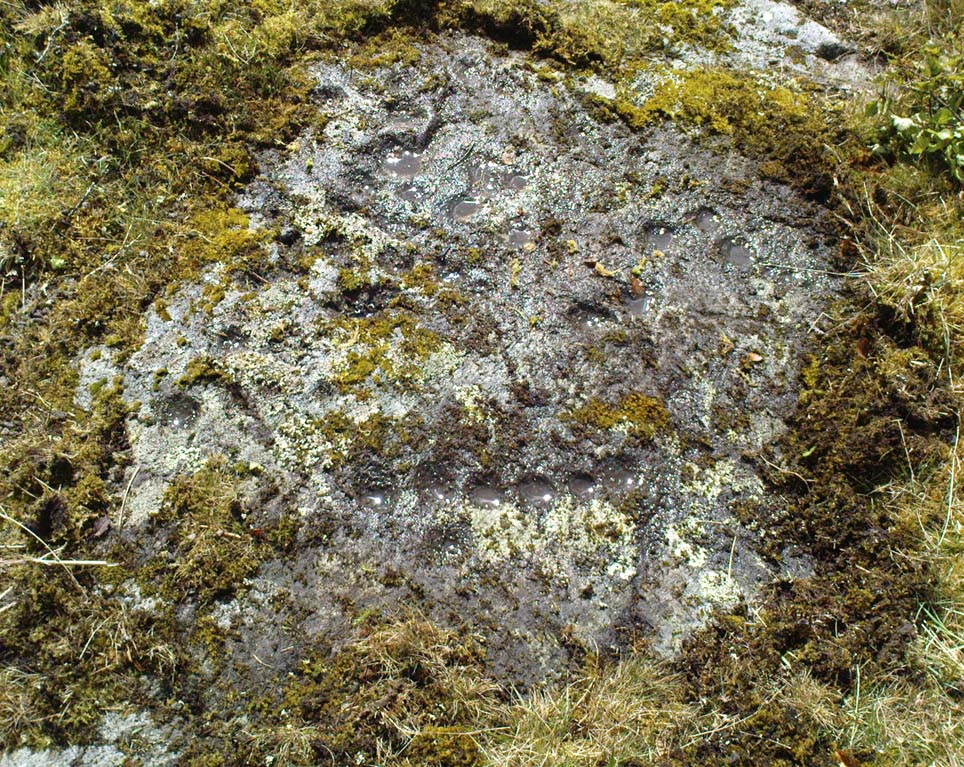
Stuck in the middle of the moor, at the bottom (southern) side of the Lippersley Ridge promontory.  Head towards it from the Askwith Moor Road, along the track past Sourby Farm and onto the end.  Then walk along the easy footpath which that takes you below the southern side of the ridge and, about 100 yards before getting to the end of the rise, look around in the heather.  You’ll find it.

Archaeology & History

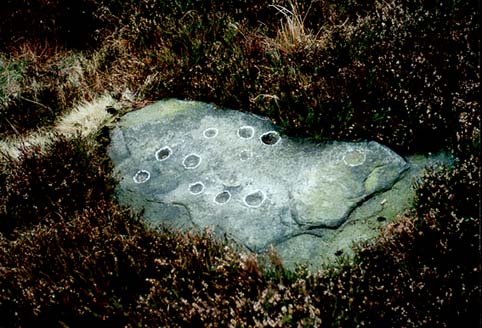
Graeme Chappell’s early photo of the carving

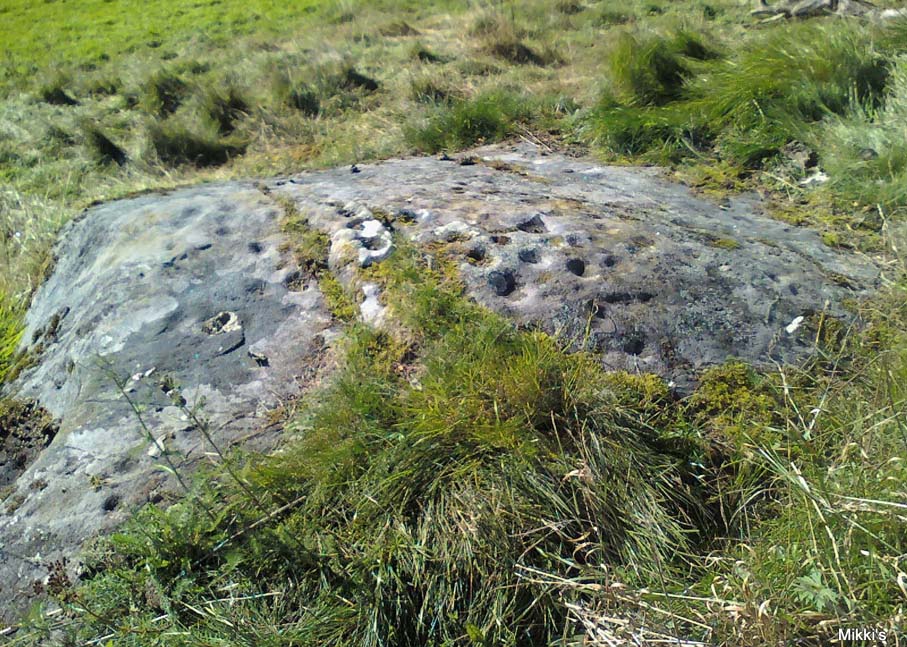
Graeme Chappell rediscovered this seemingly isolated cup-marked stone during one of our many exploratory ambles upon these moors in the early 1990s.  The carving is a pretty simple one, consisting of between 10 and 12 cupmarks on the upper surface of a reasonably large elongated stone.  No discernible rings or other lines seem to be visible.  There are no other cup-and-ring stones close by; but two small prehistoric cairns can be found along the same sloping ridge east and west of here when the heather is low, and the larger Lippersley Pike Cairn stands out on the western end of the ridge 450 yards away.  A more detailed exploration of this part of the moor may bring other previously unknown findings to light.

References:

  1. Boughey, Keith & Vickerman, E.A., Prehistoric Rock Art of the West Riding, WYAS: Wakefield 2003.

© Paul Bennett, The Northern Antiquarian

Green Gates stone (257), Ilkley Moor, West Yorkshire

Cup-and-Ring Stone:  OS Grid Reference – SE 11499 46049

Also Known as:

  1. Carving no.103 (Hedges)

Getting Here

Green Gates (257) stone

Take the road from Ilkley town centre up towards the White Wells and keep following it along until it curves up and onto the moor itself and becomes a rocky dirt-track.  Go up here, past the old quarries (left) until you hit the footpath which runs east (left) onto the flat level of the moorland. Follow this footpath along for literally half-a-mile, where a footpath runs up onto the tops of the moorland.  Go up here for 100 yards and you’ll see a small standing stone by the right-hand side of the footpath; on the left, into the moorland about 20 yards away, this carving is to be found!

Archaeology & History

This is an excellent, archetypal cup-and-ring stone carving and is in a very good state of preservation.  Found just a few yards away from the aptly-named Pitchfork Stone, the carving here on a large single stone mainly comprises of a double cup-and-ring.  A couple of other possible outlying cup-marks can be seen: one just below the double-ring, and the other towards the top-end of the rock.  It was first reported by Stuart Feather in the Bradford Archaeology Group’s journal in 1961, then listed in the surveys of Hedges (1986) and his followers.

Carving 257, looking NE

When Michala Potts, Dave Hazell and I we visited this carving the other day, some halfwit had been up here in the not-too-distant past and, as with some of the carvings on the moors north of Ilkley, had daubed some paint or oily resin onto the carvings themselves to specifically highlight aspects of the carved rock (not one part of the uncarved stone had anything on it).  We aint quite sure exactly what the substance is that’s been daubed onto the carvings (it aint ordinary paint), but seems like an oil or industrial substance.  And, whoever’s done this, obviously seems to have some knowledge of the rock art they’re painting over: they certainly have good grid-references and enjoy walking the hills.  This aint just some idiot/s into vandalizing the carvings for the sake of it, nor the whim of some airy-fairy New-Ager.  Whoever’s done this (and it’s been done on other cup-and-rings around this locale) have deliberately set out to locate and paint over specific carvings — a number of them off-path — with the intention it would seem to highlight them for photographic enhancement.  So — whichever retard has done this, might I suggest that you keep your industrial waste where it belongs: in your own house you fucking moron!   If anyone knows who is doing this to the carvings round here, please email me (anonymously if necessary) with all relevant info.  Any such communications regarding this matter will be kept strictly confidential.

References:

  1. Boughey, Keith & Vickerman, E.A., Prehistoric Rock Art of the West Riding, WYAS: Leeds 2003.
  2. Hedges, John, The Carved Rocks on Rombald’s Moor, WYMCC: Wakefield 1986.

© Paul Bennett, The Northern Antiquarian

Coronation Cairn carving (270), Ilkley Moor, West Yorkshire

Cup-and-Ring Stone:  OS Grid Reference – SE 1226 4636

Getting Here

Walk up from Ilkley to the White Wells and keep following the footpath upwards, up the steps and onto the moor itself.  Once you’ve got to the top of the steps above the rocky valley, look straight up the slope in front of you and walk directly up the hill.  As you near the top, there’s a large cairn sat on the brow of the hill (known as the Coronation Cairn).  This ‘ere carving is just a few yards below it.

Archaeology & History

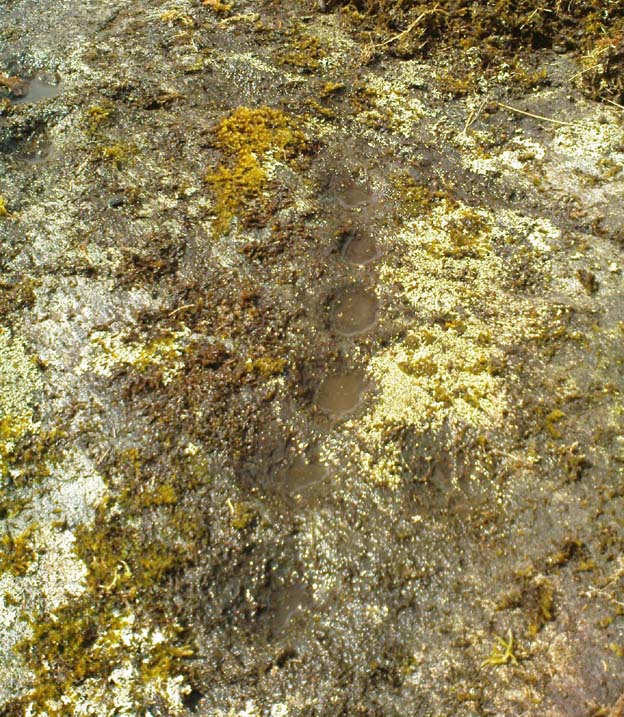
Very little has been written of this albeit innocuous carving — if indeed it is a carving!  Found on the large (though overgrown) flat stone just a few yards below the Victorian cairn, all that we appear to have here is a large cup-marking with a small arc pecked around its southern side and a distinct straight line running outwards from the cup (though the line doesn’t actually touch the cup-mark and does give the distinct impression of being pretty recent).  A sort of “cup-and-half-ring” with extended line is perhaps the best description!

Close-up of cup & lines
Carved Stone 270

It was first reported by some English Heritage archaeologist — which, as is generally acknowledged, isn’t necessarily a good pointer for authenticity when it comes to identifying prehistoric rock art.* But it’s certainly got a bit more about it than some “carvings” they’ve reported in the past!  Boughey & Vickerman (2003) made the following notes of this stone:

“”Low, flat gritstone rock quarried away on E side, fairly smooth but uneven.  One large cup and deep groove slightly curving round edge of cup.”

Which is about right.  I don’t really think too many of you will be into this unless you’re a real rock-art fanatic!

References:

  1. Boughey, Keith & Vickerman, E.A., Prehistoric Rock Art of the West Riding, WYAS: Leeds 2003.
  2. Hedges, John, The Carved Rocks on Rombald’s Moor, WYMCC: Wakefield 1986.

* A number of cup-marked stones identified by English Heritage archaeologists have transpired to be nothing more than natural erosion. 

© Paul Bennett, The Northern Antiquarian


Snowden Carr Stone (612), Askwith, North Yorkshire

Cup-and-Ring Stone:  OS Grid Reference – SE 18120 51201

Also Known as:

  1. Naked Jogger Carving

Getting Here

Naked Jogger Stone

From Askwith village go up the Moor Lane and at the crossroads go straight across, down and along Snowden Carr Road until the road levels out and, watch carefully, for a small crag of rocks in the fields above on your left.  Keep a keen eye out for the gate into the field immediately below these rock, right by the roadside (it’s easily missed).  This carving is the large rock sticking out on the slope in front of you thru the gate (carving 613 is lower down to the right).

Archaeology & History

When seen in the right light, this carving’s a beauty!  What you could call, an archetypal cup-and-ring stone.  But the toll of time has played its part — on the uppermost section of the rock in particular.   It seems as if the top, higher section of the boulder has always been exposed to the elements, whereas the slightly lower part of the rock has only been unearthed and exposed to the elements in more recent decades — perhaps by Stuart Feather, who made notes of some carvings in this region in 1973.  This assumption is especially apparent when we look at the excellent, well-preserved multiple ringed design near the southern edge of the stone…and from where the carving gets its title, the Naked Jogger Stone.

Faint cup-and-rings
Boughey & Vickerman’s sketch

But let’s deal with the uppermost section of the stone first.  There are various natural undulations and cracks over its surface and, at first sight, they can interfere or confuse some of the man-made carved aspects to this stone.  But the main feature here — which becomes more and more noticeable the more you gaze and look — are at least two very faded multiple-rings surrounding faded central cups.  It’s unknown whether or not these rings ever completely surrounded the cups, or whether they were actually left deliberately unfinished.  The more faded of these two multiple-rings has between three or four cups around the outer ring at selected intervals (visible in the photo here).  A few feet away from this we can also make out the faded remains of another cup-and-half-ring design.  Several other cups have also been carved along this upper portion of the stone.  When you sit above and look across this from the grass to the side, one may be forgiven for adding a solar interpretation to this section of the carving!

Lower section of carving
Jogging male with large erection?

But another, more extrovert interpretation can be forgiven for the most notable aspect of this cup-and-ring stone.   Near the southern edge of this large rock is the well-preserved multiple-ring design, surrounding a single cup.  It’s impressive!  And when you first see this you get the impression that it was uncovered in the very recent past (turf dug away obviously) as it is in such an excellent state of preservation.  But there are other, odd-looking aspects below this primary feature: of cracks and lines and deep cups along this same level of the rock.  The majority of the cups and lines on this part of the stone are in a much better state of play than the artistic elements on the upper layer of the stone.  And one section of the carving in particular here gave me at least (pervert that I am!) the impression of a man running, with a distinctive hard-on sticking out in front as he’s jogging away!  Keep looking at it in the photo here and see if that’s what you see as well. Note that the torso section of the ‘body’ (between his cock and the multiple-ringed head) is made-up primarily of a natural crack in the rock, but this should not be seen as unusual; for in rock art across the world, many of the natural cracks and markings on stones are regularly utilized.  We know that such ‘cracks’ in rocks have been used by shamans as entrance points for their spirit to enter the rock itself.

Early carvings of humans in other parts of the world show bloke’s with hard-ons, either dancing or hunting — so why not here aswell, in deepest Yorkshire!? (check Dennis Slifer’s Serpent and the Sacred Fire for many North American examples)  It could, of course, be little other than my very simple minds response to non-linear etchings in the old Rorscharch ink-blot style.  Either way, it doesn’t really matter — unless of course you’re some academic or witchy character who’s after isolating early prehistoric fertility carvings for your thesis or religion.  Oh – and there’s the more renowned Tree of Life carving a bit further up this hill, about 150 yards away: alleged in folklore to have been a place for Beltane rites—wholehearted fertility no less!

In the important archaeo-academia files, little has ever been written of this fine, ornate petroglyph.  It was described by Boughey & Vickerman (2003) thus:

“About twenty cups, two very large, one cup having three rings and two more also having traces of three rings, with at least four others having parts of single rings, all very worn.”

Simple and to-the-point I suppose.  But this old carving has much more grace and mythic history embedded within its scarred surface.  It clearly speaks to other aspects of the landscape (as do some of the other carvings further up the hill, where oracular aspects predominate), but much more work is needed here before any archaeoholistic framework can be moulded.  Nonetheless, this is an excellent meditation site!

References:

  1. Boughey, Keith & Vickerman, E.A., Prehistoric Rock Art of the West Riding, WYAS 2003.
  2. Slifer, Dennis, The Serpent and the Sacred Fire: Fertility Images in Southwest Rock Art, Museum of New Mexico Press: Santa Fe 2000.

© Paul Bennett, The Northern Antiquarian

Tree Of Life Stone, Snowden Carr, Askwith, North Yorkshire

Cup-and-Ring Stone:  OS Grid Reference – SE 17978 51161

Also Known as:

  1. Carving no.598 (Boughey & Vickerman)

Getting Here

Tree of Life Stone (photo credit, Yorkshire Daz)

From Askwith village go up the Moor Lane and at the crossroads go straight across (Snowden Moor is to your left).  Go down and along Snowden Carr Road until the road levels out and, watch carefully, about 500 yards on from the crossroads on your left you’ll see a small crag of rocks in the fields above.  Stop and go through the gate walking up the field.  At the top is a gate: go thru this and turn right, up the footpath for 100 yards, keeping your eyes peeled!  You’re damn close!

Archaeology & History

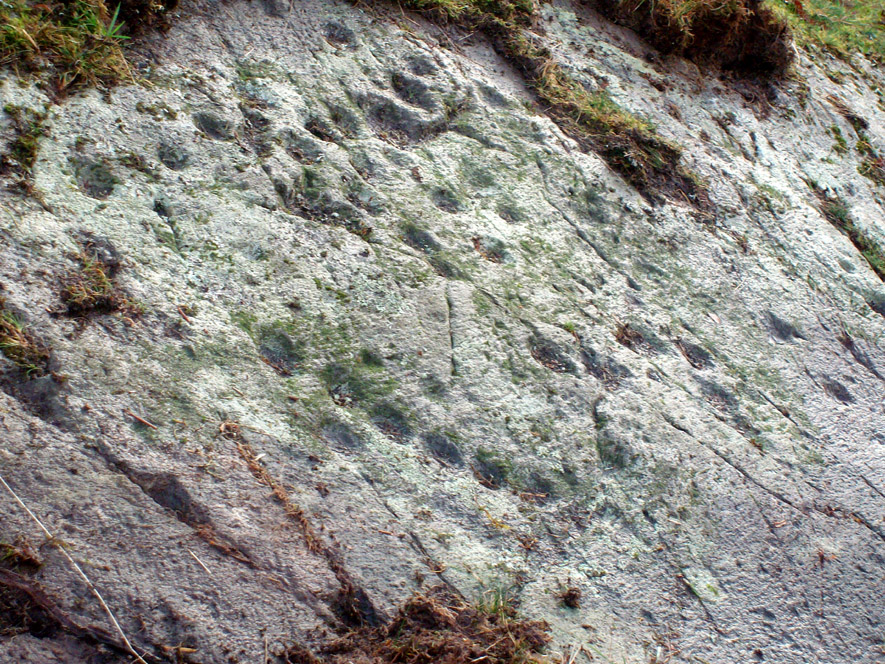
The most well-known and one of the more decorative of all the carvings in and around the Snowden Moor region is the Tree of Life Stone.  In the 1930s, Eric Cowling first reported how, “this fine marking is the only one which appears to be known to the people of the district,” due in part to it being a site of local social activities (though nothing is said of this place in William Grainge’s [1895] survey).  Cowling (1937) described the carving thus:

close-up of main features
Eric Cowling’s sketch

“This stone lies alongside the bridle path which skirts the southwest corner of the enclosed moorland above the hamlet of Low Snowden.  A large flat rock surface at ground level has a number of cups joined together by a series of curved grooves, which in their turn are connected to a central straight groove.  Immediately above the design, a broad groove has been cut across a raised central area as though to isolate the markings from several scattered cups which are to be found on the remaining surface.”

The modern surveyors Boughey & Vickerman (2003) tell us that this highly ornate stone comprises of,

“about 25 cups, with a group at the highest…end and a few isolated, but most in complex design with enclosing grooves suggesting a tree in fruit: hence the name ‘Tree of Life Rock.'”

The Tree of Life Stone
Boughey & Vickerman’s sketch

The Coped Stone carving is just a few yards away and, on the slopes below here — as well as on the moor stretching above you — there is an excess of prehistoric remains: enclosures, hut circles, lengths of walling, cairns, other cup-and-ring stones — the vast majority of which has yet to be excavated in any formal sense (are any rich doods out there reading this who might wanna get things going…?).  It appears that both the Coped Stone and the Tree of Life carving may have been linked by some ancient walling that appears to run between them.

Another possible variant on the Tree of Life Stone has recently been uncovered on the outskirts of Ilkley; but on this newly-discovered example we find the central ‘trunk’ of the ‘tree’ is a natural crack that runs up the middle of the rock. Up the ‘trunk’ are several short branches with cup-marks on either side, not unlike apples on a tree.  Altogether there are at least 12 cups and one ring, with several curious lines, some of which seem geophysical in nature.  After several visits to the site, it’s obvious that the ‘tree’ design is more obvious and there are additional faint carved sections on the stone which weren’t visible when it was discovered in heavy rain and poor light.

Folklore

Tree of Life Stone (by James Elkington)

This is one of very few cup-and-ring stones with folklore attached.  Cowling (1937; 1946) reported it to be site of early morning Beltane (May 1) gatherings.  The title of the stone, the Tree of Life, was one he heard local people call this site, but “no reason is offered”, he said. About 100 yards below this we find a curious erectile, fertility image on the impressive carving 612, which (he says tenuously!) may (and that’s a dodgy “may”!) relate to the Beltane rites at the Tree of Life.

Tree of Life in situ

In more modern folklore, the old earth mysteries writer Guy Ragland Phillips (1976) suggested the Tree of Life Stone to be an important focal point along one helluva highly speculative ley line: running from the Irish Sea, across land and the Tree of Life stone, continuing way east until hitting the North Sea!  If this old ley did have any validity (it doesn’t!), the Tree of Life’s carved partners east and west of here — the Coped Stone and carving no.597 — would have also been on the same line.

References:

  1. Boughey, Keith & Vickerman, E.A., Prehistoric Rock Art of the West Riding, WYAS 2003.
  2. Cowling, Eric T., “Cup and Ring Markings to the North of Otley,” in Yorkshire Archaeological Journal, part 131, 33:3, 1937.
  3. Cowling, Eric T., Rombald’s Way: A Prehistory of Mid-Wharfedale, William Walker: Otley 1946.
  4. Phillips, Guy Ragland, Brigantia — A Mysteriography, RKP: London 1976.

Acknowledgements: Many thanks to James Elkington and to Yorkshire Daz for use of their photos.

© Paul Bennett, The Northern Antiquarian 

Snowden Carr Carving (582), Askwith, North Yorkshire

Cup-and-Ring Stone:  OS Grid Reference – SE 17803 51012

Getting Here

Cowling’s 1937 sketch

Not too difficult to locate if you don’t mind wandering to and fro in deep heather.  From the Askwith Moor Road parking spot, walk up the road (north) 300 yards until you see the disused quarry on the moor to your right.  From here, head onto the moor, straight down past the quarry for about 200 yards, angling slightly to your right.  You’ll notice some overgrown ‘lumps’ in the heather — deemed as a cairnfield by archaeologists — go just below these and watch out for some rocks emerging from the heather.  This carving (and its neighbours) is on one of ’em!

Archaeology & History

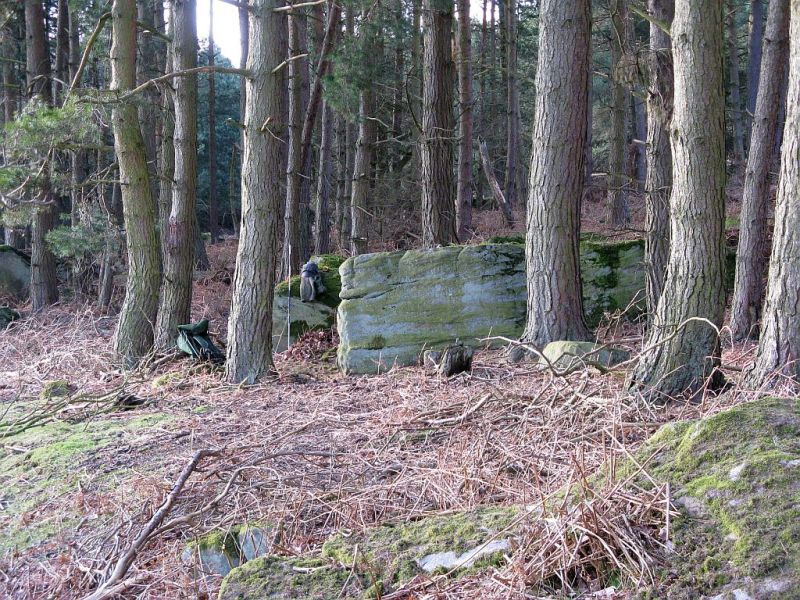
This curiously-shaped large rock has several worn cup-and-rings on its upper surface, with several cup-marks aswell.  Two deeply etched lines running down the edge of the rock have also been pecked away as part of the carving, in contrast to the distinguishing natural water-worn line that runs diagonally along and down to the bottom of the stone.

The site was first described by Eric Cowling (1937), who labelled it as Carving no.9 in his survey, saying:

Carving 582, looking SW
Carving from above

“At the eastern and lower end of the barrow group on Snowden Carr is a cluster of angular boulders, one of which has several markings cut on the upper surface.  There is a cup and ring on the highest, and alongside two rings are joined together and enclose separate cups. One corner of the area is isolated by a groove running from edge to edge, and within this enclosure are three cups.”

Catalogued as ‘stone 582’ in Boughey & Vickerman’s (2003) survey, their description of the carving was one with “fourteen possible cups, several with indications of a ring, some of which intersect; grooves.”

References:

  1. Boughey, Keith & Vickerman, E.A., Prehistoric Rock Art of the West Riding, WYAS 2003.
  2. Cowling, Eric T., “Cup and Ring Markings to the North of Otley,” in Yorkshire Archaeological Journal, part 131, 33:3, 1937.
  3. Cowling, Eric T., Rombald’s Way: A Prehistory of Mid-Wharfedale, William Walker: Otley 1946.

© Paul Bennett, The Northern Antiquarian


Stoup Hill Carving, Askwith Moor, North Yorkshire

Cup-Marked Stone:  OS Grid Reference – SE 177 501

Getting Here

Cup-marked stone, Stoup Hill

From the Askwith Moor car-park, walk down the road (south) for 2-300 yards until you reach the gate on the right-hand side of the road.  Go thru this and turn immediately left, following the fence along, parallel to the road for about 100 yards (if you reach the small disused quarry, you’ve gone 100 yards too far), then walk into the heath, up near the top of the little peak and walk down the other side of the slope for about 80 yards.  You’re getting damn close — look around!

Archaeology & History

First found on the afternoon of May 13, 2010, in the company of Dave Hazell — though at the time the light was poor and the sky was grey and overcast, not allowing for any decent images being made.  We returned here yesterday under a lovely clear sky for most of the day (and without the polluting roars of planes from the nearby airport, thanks to that great Icelandic volcano [keep it going!], making it even better) and got some decent photos this time.

Sketch of basic design
Close-up of some cups

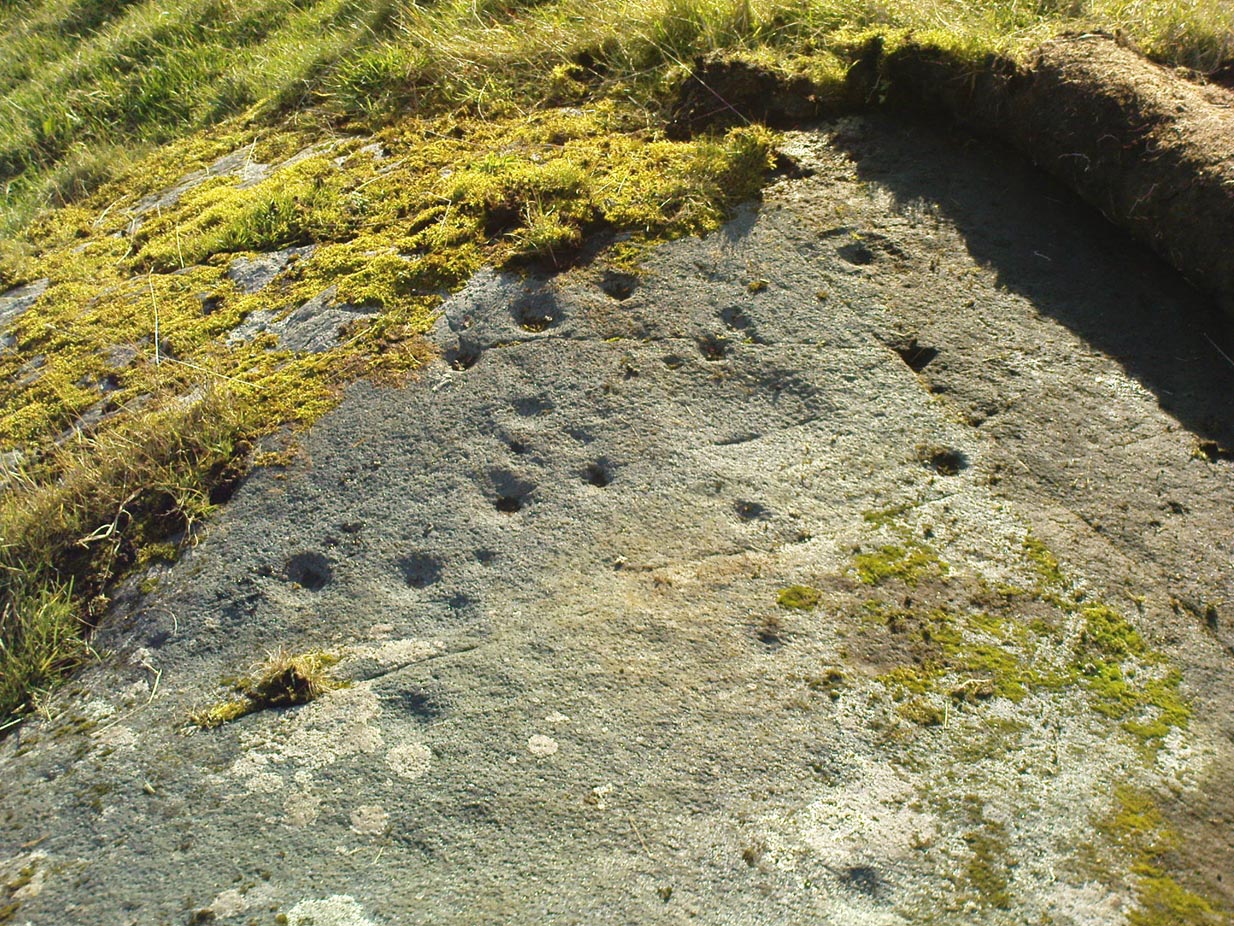
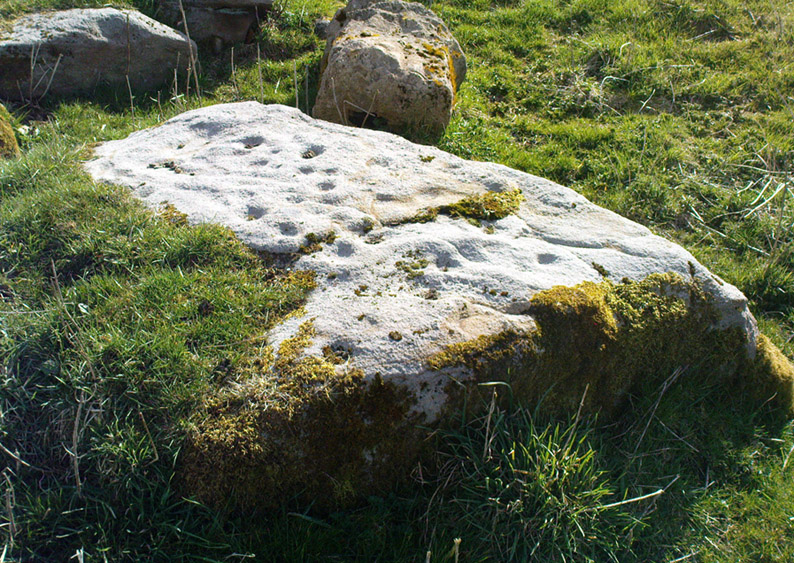
It’s only a small low stone, slightly sloping (similar in size and form to carving no.535 about 100 yards west of here), and is gonna be very difficult to find when the heather is in full growth.  But thankfully when we found it last week, the heather had been burnt back. Whilst there are two large and very notable cups here — one on the west-facing vertical edge of the stone, the other on its south-facing slope — several others are more troublesome to see clearly, both through a mixture of age and erosion.  The other cups are a little smaller aswell, being very similar in status to the curious small cup-markings on the Lattice Stone carving (no.481).  One cluster of these smaller cups are arranged in a curved T-shape formation around the middle to eastern-side of the rock.  Below this are what seems to be a long singular cup, but upon feeling this — the Beckensall technique — the hardworking Keighley volunteer Michala Potts found it seemed to consist of three small cups all linked to each other.  Attached to this section, a small groove runs up to the aforementioned T-formation cluster.  Whilst at the top-end of the stone is what seems to be another larger cup-marking, but I’m not sure whether it’s Nature’s handiwork, or artificial.  A few more visits here might enable us to say one way or the other!

There are no other archaeological remains immediately adjacent.  Another “possible” cup-marked rock (more than twice the size of this stone) can be found about 30 yards further uphill, next to another large stone.  But one of the nice things about this small carving is its position in the landscape: an excellent view opens up of mid-Wharfedale below you, and the uphills of Rombald’s Moor is on the far side of the valley.  Make of it what you will…

References:

  1. Boughey, Keith & Vickerman, E.A., Prehistoric Rock Art of the West Riding, WYAS 2003.

© Paul Bennett, The Northern Antiquarian

Baildon Moor Carving (169), West Yorkshire

Cup-and-Ring Stone:  OS Grid Reference – SE 13838 40138

Getting Here

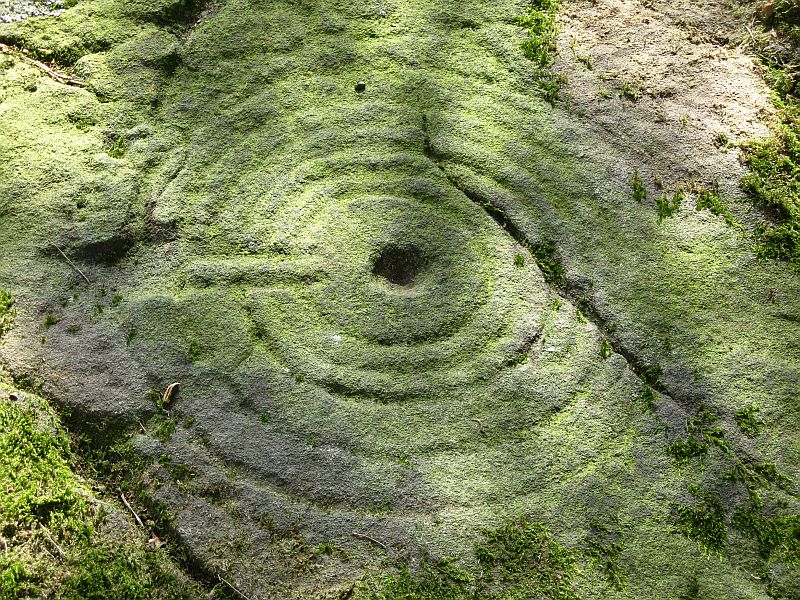
Basic cup&ring design

From Shipley Glen, walk up to the Dobrudden caravan park on the western side pof Baildon Hill and then in the long grasses immediately north of here, on the Low Plain, this old carving could once be found.  I’m told it’s been moved in recent years (but have a mooch round anyway – there’s a number of other old cup-and-rings in the locale).

Archaeology & History

This small carving is not in its original position, having been moved to where it now sits a short distance northeast of the Dobrudden caravan park.  It was first described briefly in Mr Baildon’s magnum opus here, seemingly omitted from the Hedges (1986) and reclassified as ‘stone 169’ by Boughey & Vickerman (2003).  I’m not 100% certain that the illustration here by Joseph Rycroft and carving no.169 are one and the same – but they seem incredibly alike.  If anyone knows for sure, one way or the other, please lemme know and I’ll amend as necessary!

References:

  1. Baildon, W. Paley, Baildon and the Baildons – part 7, Adelphi Press: London 1913.
  2. Boughey, Keith & Vickerman, E.A., Prehistoric Rock Art of the West Riding, WYAS 2003.
  3. Hedges, John (ed.), The Carved Rocks on Rombalds Moor, WYMCC: Wakefield 1986.

© Paul Bennett, The Northern Antiquarian

Pike Hill, Stamfordham, Northumbria

Cup-and-Ring Stone:  OS Grid Reference – NZ 0774 7048

Archaeology & History

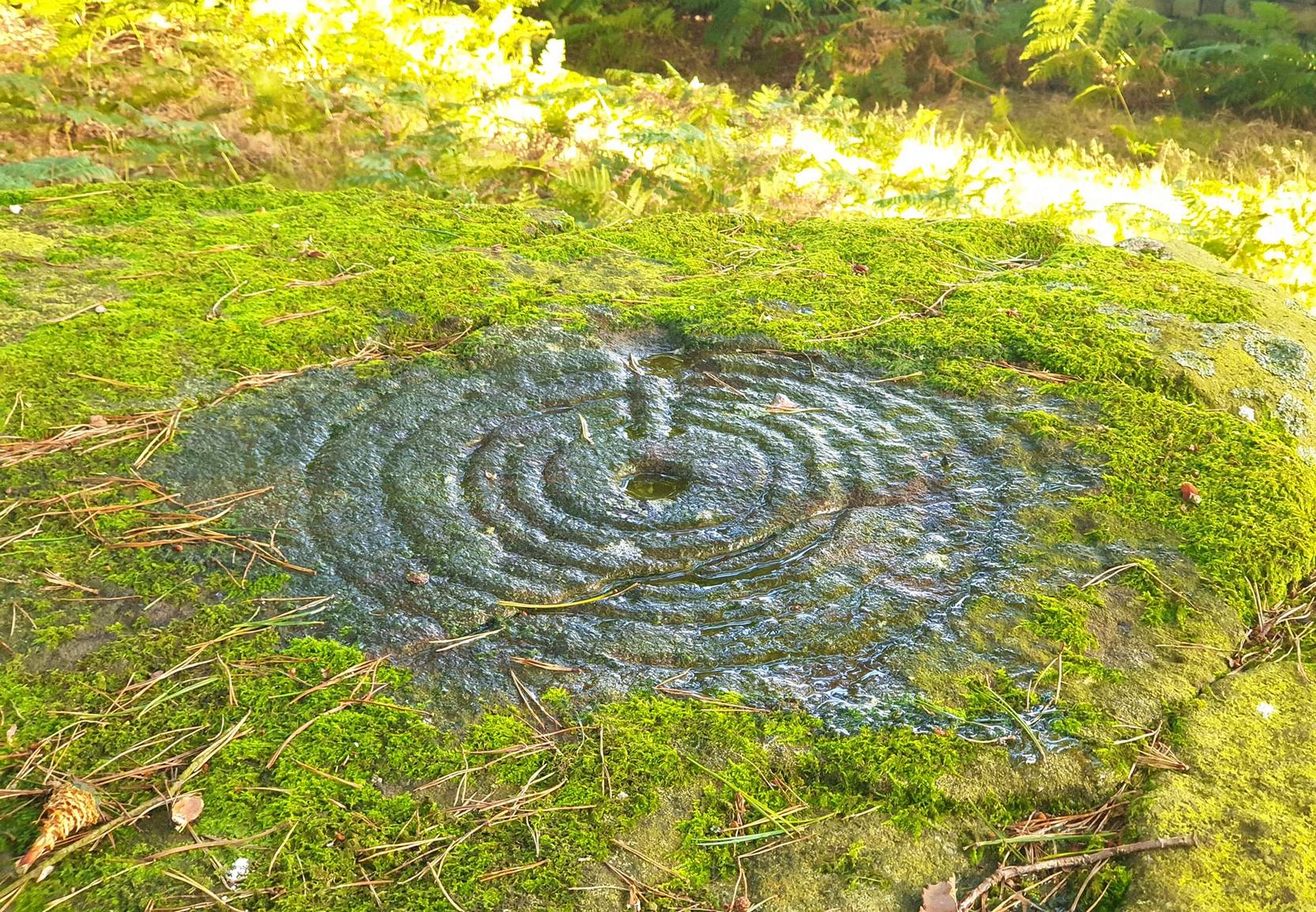
1928 photo of carving

Found inside a prehistoric tomb that was excavated in the late 1920s “by Messrs R.C. and W.P. Hedley at Pike Hill, near Stamfordham,” this fascinating-looking carving was found on a stone that “was overlying the primary burial” cist in the middle of the tumulus, measuring “2 feet 9 inches long by 2 feet wide and 12 inches deep, with an orientation on the longer axis of NE.”  As we can see in the old photo that accompanied Mr Hedley’s (1928) short article in Antiquity journal, four single cups are arranged in a rough square and are joined with each other by a single line, running from cup to cup, outlining a clear quadrilateral formation.  Two other single cups are outliers on the left and right side of the ‘square.’

A second smaller cist was also found inside the same mound and on the central inner face of this was another, more simplistic carving described as “a very fine cup-mark 1½ inch in diameter and ¾-inch deep.”  These carvings are no longer in situ (I think they’re in Newcastle Museum) and apparently this second single cup-marked stone can no longer be located.

References:

  1. Beckensall, Stan, Northumberland’s Prehistoric Rock Carvings, Pendulum: Rothbury 1983.
  2. Beckensall, Stan, Prehistoric Rock Motifs of Northumberland – volume 2: Beanley to the Tyne, Abbey Press: Hexham 1992.
  3. Hedley, R. Cecil, “Ancient British Burials, Northumberland,” in Antiquity Journal, volume 2, December 1928.

© Paul Bennett, The Northern Antiquarian