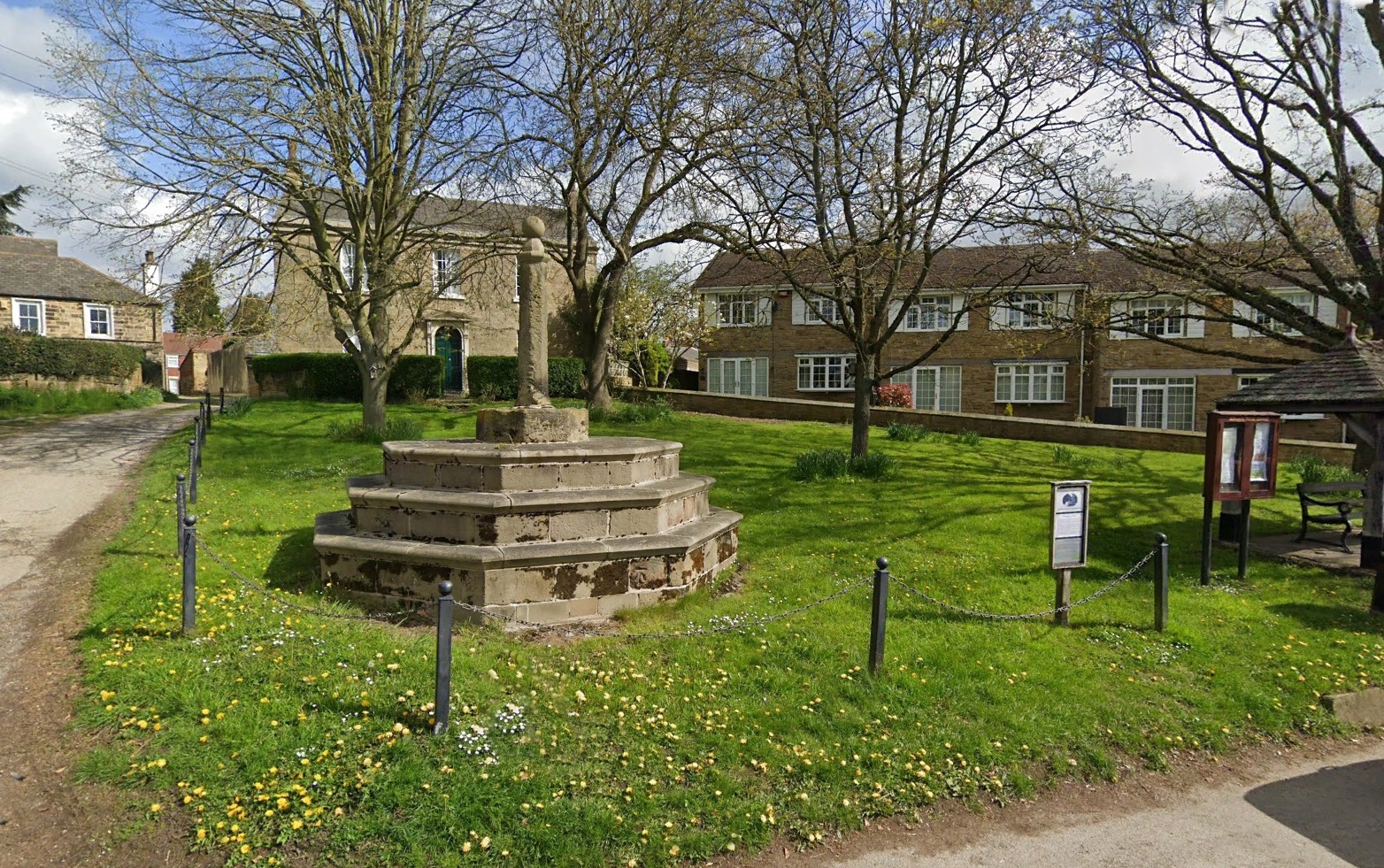
This old stone edifice is easy to find. As you’re going along the old A628 Pontefract Road through High Ackworth, just where the road junction takes you on the B6421 (Purston Lane), park up where the track takes you up to the church on the right. And there, just set back off the north-side of the road by the steps and curious old shelter, with the greenery and houses to the rear, you’ll see what you’re looking for.
Archaeology & History
Although this old village cross is set up on a three-tiered rise of steps, these steps are not as old as the cross remnant that surmounts it, as they were constructed in the 20th century. The final ‘step’ however—a part of the old cross-base—is much older. It’s precise age is unknown, but tradition relates it as being 16-17th Century.
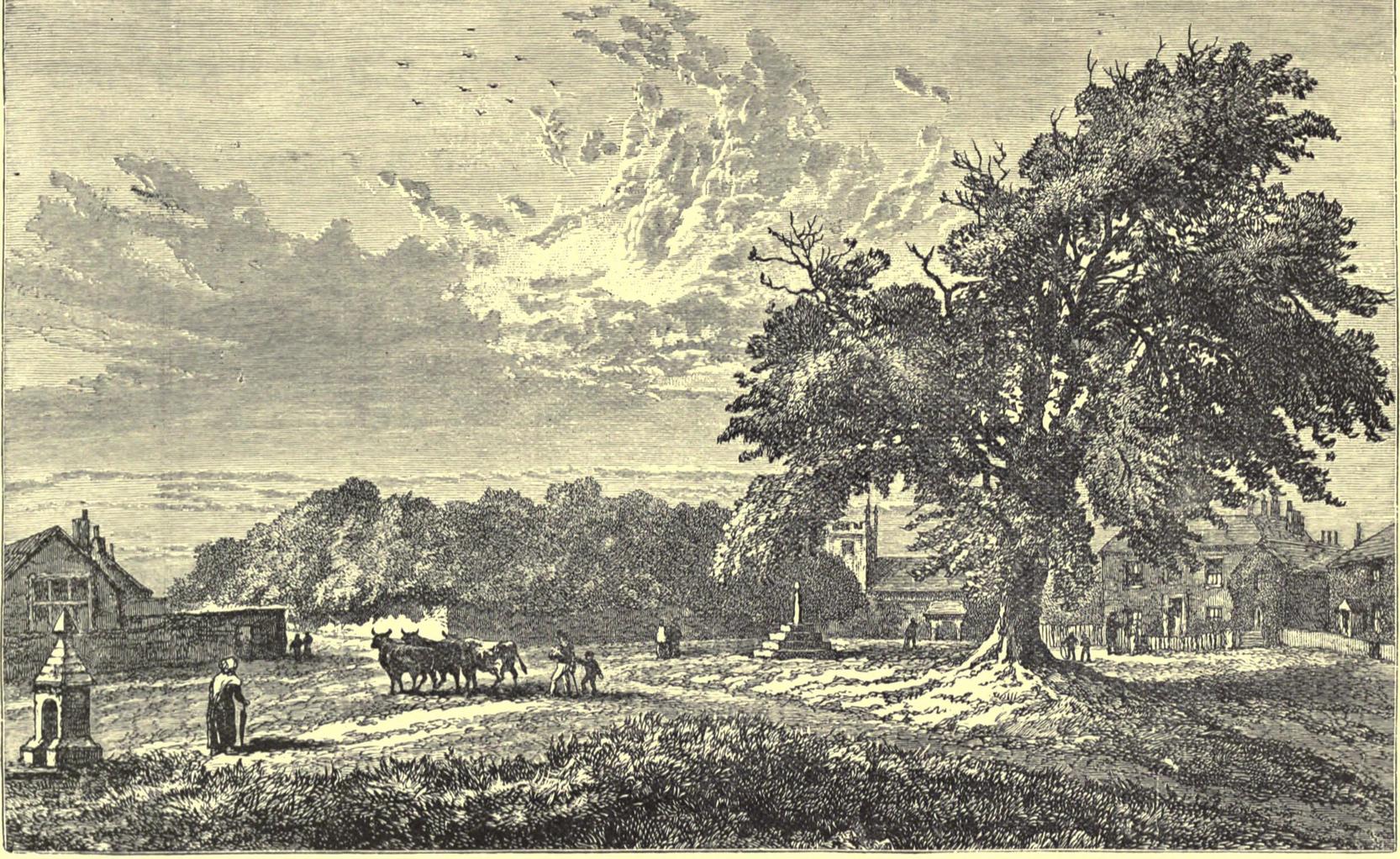
Tradition relates the creation of the village cross to a great illness that befell the local villagers, whose tale was cited at some length by one of Ackworth’s early historians. It formerly stood beneath the boughs of a great elm tree, whose offspring are hopefully still around. Henry Thompson (1879) wrote:
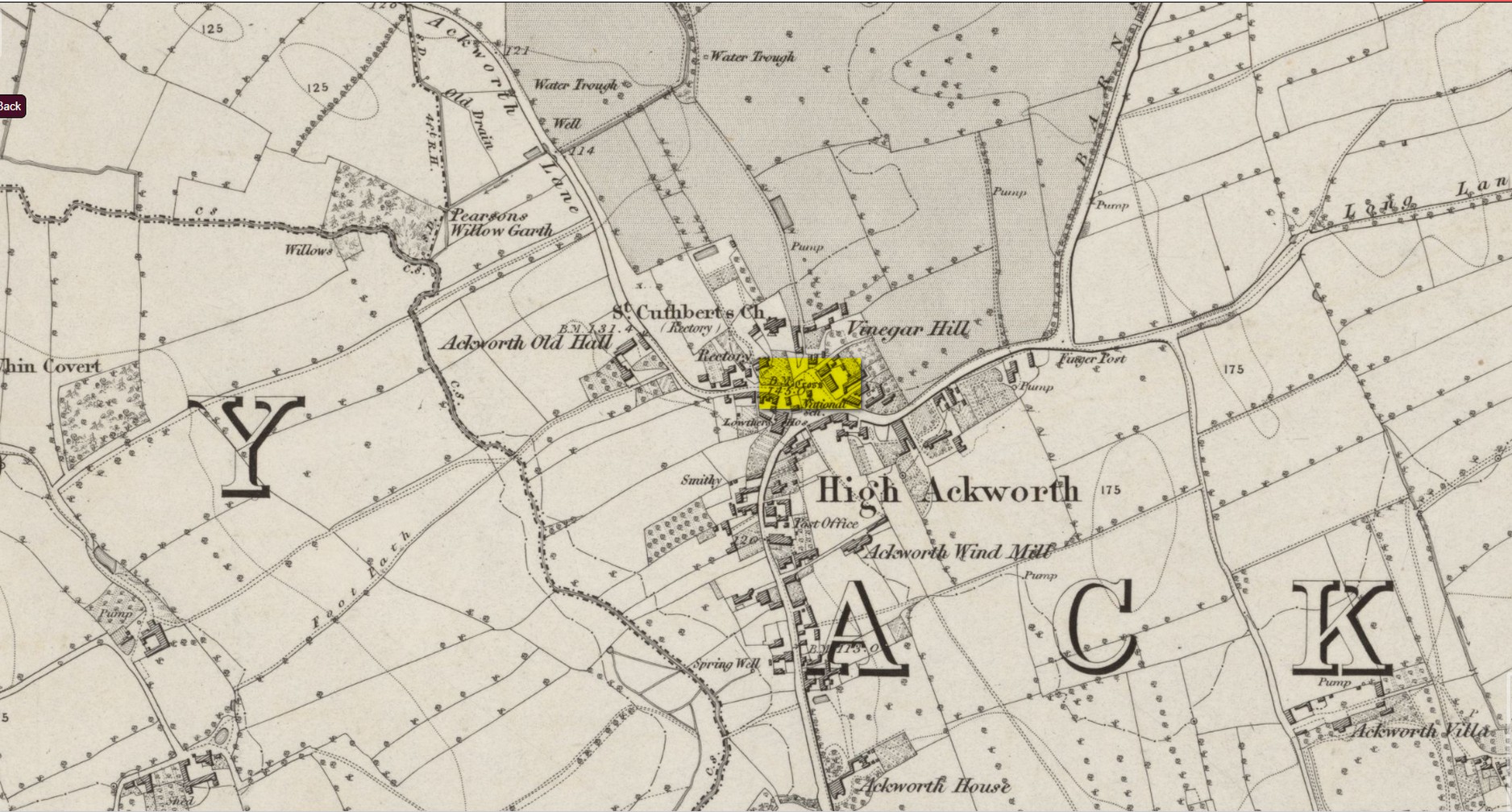
The cross on the Green, 1870Cross shown on 1852 map
“The Cross under the shadow of this kingly tree has a curious history in its keeping. From its steps, in the pre-Reformation times, the monks from the neighbouring priory at Nostel were wont on Fridays and Sundays to preach to the people. One of these, a man of noble soul and kindly heart, won the affections of the people in a wondrous manner. Children clung to his skirts in delight and love—the strong man admired and revered him, the old and weak reposed upon him as a pillar of strength and a tower of refuge. But business or piety called him to Rome. The villagers gave him their tears and he gave them his blessing. Under the shadow of the Vatican he was smitten by the Plague and died. Such was the love which his brethren of the Priory bore him, that they could not rest without having him sepultured in their midst. In its transit, the body passed through Ackworth; and nothing would satisfy the ignorant but faithful love of his old hearers but once more to see, even in death, the face of one who had loved them so well. The leaden coffin was opened, the village was stricken with the Plague and three or four hundred fell victims to the dread visitant.”
And it was here, wrote Saywell (1894) that,
“the Cross is said to have been erected on the exact spot where the body rested, to commemorate at once that event, and also the dire consequences which were permitted by God to flow from it. The date of its mutilation, the removal of the Cross, and the substitution of a ball (the emblem of the world), is generally ascribed to the time of the Great Rebellion.” (in 1642)
In addition to this, a Plague Stone was erected on the northern outskirt of the village, known as “the great stone on Castle Syke Hill”. Due to the condition of all the villagers, they became taboo to all who lived beyond Ackworth and so the old stone, said Thompson, became
“the only point of contact between them and the outer world. Upon that stone the Ackworth purchaser dropped his money into a vessel of water, for which, a few hours afterwards, he found his return in merchandise.”
The old Plague Stone can still be seen, a half-mile north of the village on the west-side of the Pontefract Road, just before Sandy Gate Lane….
References:
Saywell, J.L., The Parochial History of Ackworth, James Atkinson: Pontefract 1894.
Thompson, Henry, History of Ackworth School, Centenary Committee: Ackworth 1879.
Acknowledgements: Huge thanks for use of the Ordnance Survey map in this site profile, reproduced with the kind permission of the National Library of Scotland.