Cup-Marked Stone: OS Grid Reference – SE 10252 46583
Also Known as:
- Carving no.60 (Hedges)
- Carving no.225 (Boughey & Vickerman)
Getting Here
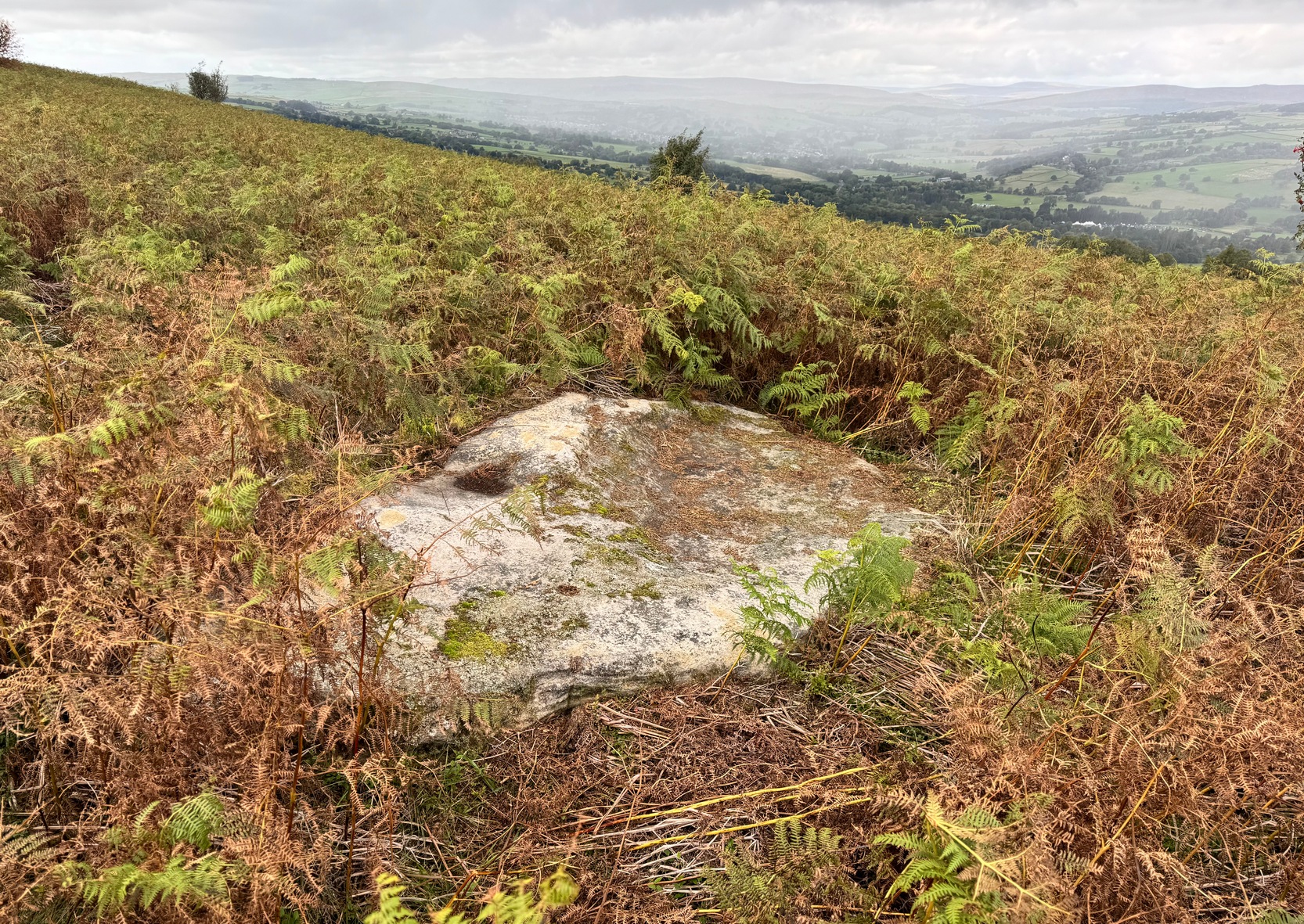
From Ilkley central, go up Wells Road and, several hundred yards past the cattle-grid, keep your eyes peeled and turn left up the small moorland road for a half-mile and park-up at the start of the track to Silver Well cottage. Walk along here and, on the way, you may as well pass the cup-and-ring marked Weary Hill Stone, and the other Silver Well carvings further west through the heather. From the Silver Well (3) cup-marked stone, follow the walling uphill for nearly 100 yards until your reach the small gate. Go through it and stick to the footpath for 200 yards and then keep your eyes peeled for a large wonky ovoid stone less than 20 yards to your right. It’s a big thing, so you’ll find it easily enough.
Archaeology & History
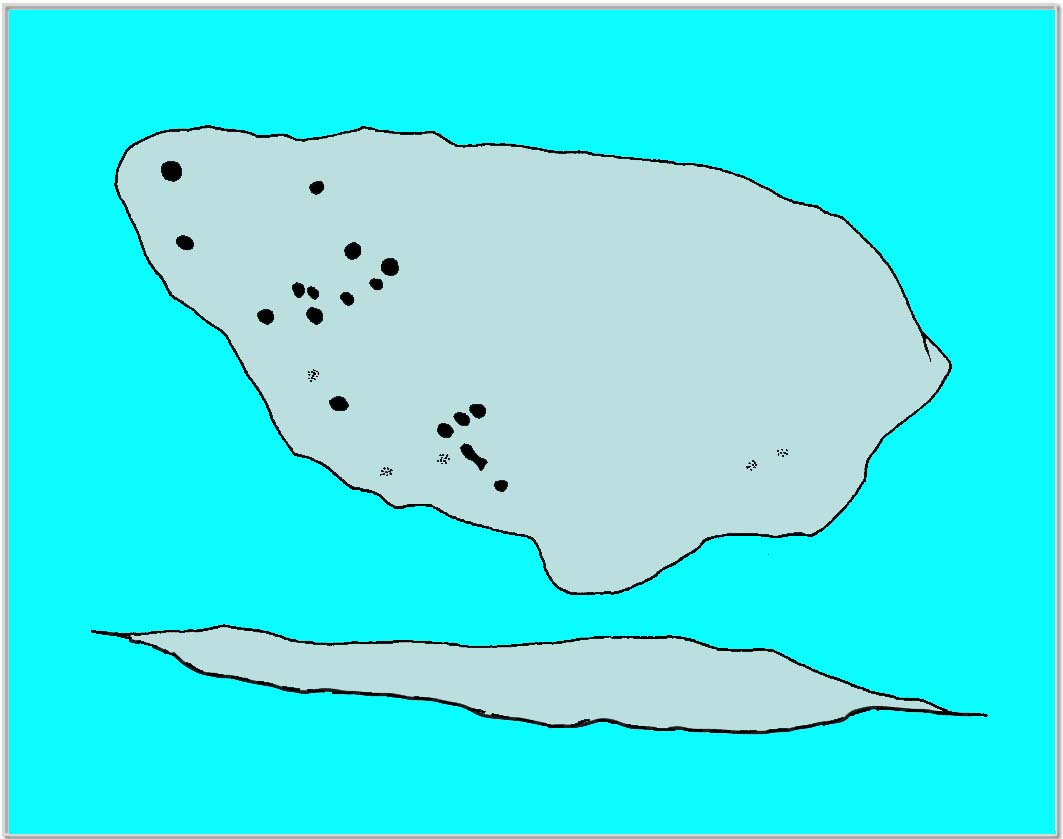
Although this is primarily a cup-marked stone (a faint ring is possible around one of them), it’s a good design. It does it for me anyway! Sitting on a ridge at the top of a slope overlooking the Wharfe valley, from here the landscape opens up for many miles ahead of us looking mainly to the north, although the horizons both east and west also call our attention as the rising and setting sun would speak around the equinoxes. But it’s the airt of north which mainly calls from here. A scatter of cups splatter the rock surface, all of them on one half of the stone acting out in usual disorderly conduct apart from one spot where there are three deep cups in a line: this is the most notable part of the carving. At the top (southern) nose of the stone is a triangle of them and they then becoming increasingly disordered as you move along the stone. There are seemingly twenty of them altogether (perhaps more) with one of them having a short groove oozing out of it which can be difficult to see when the light isn’t quite right.
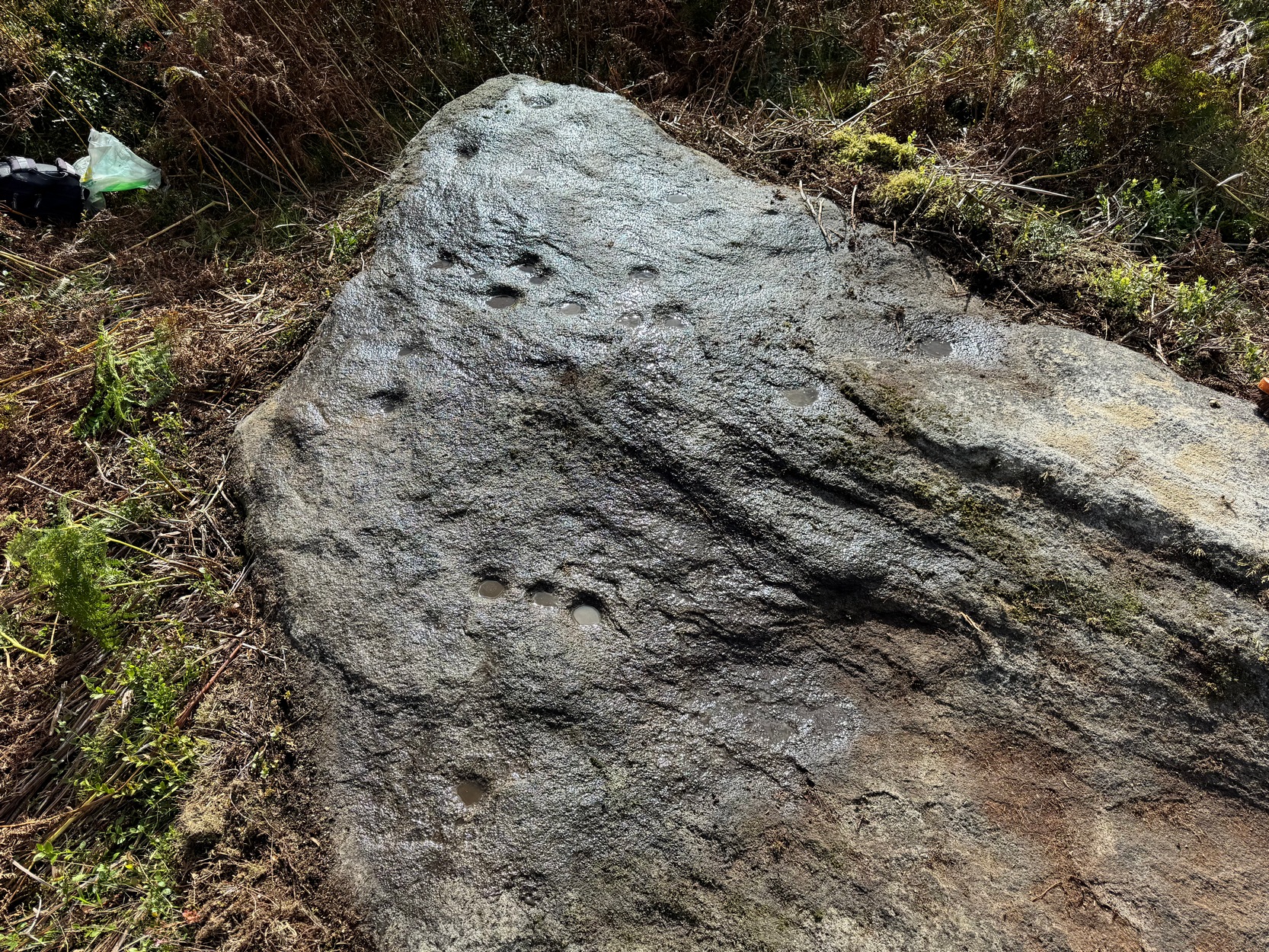
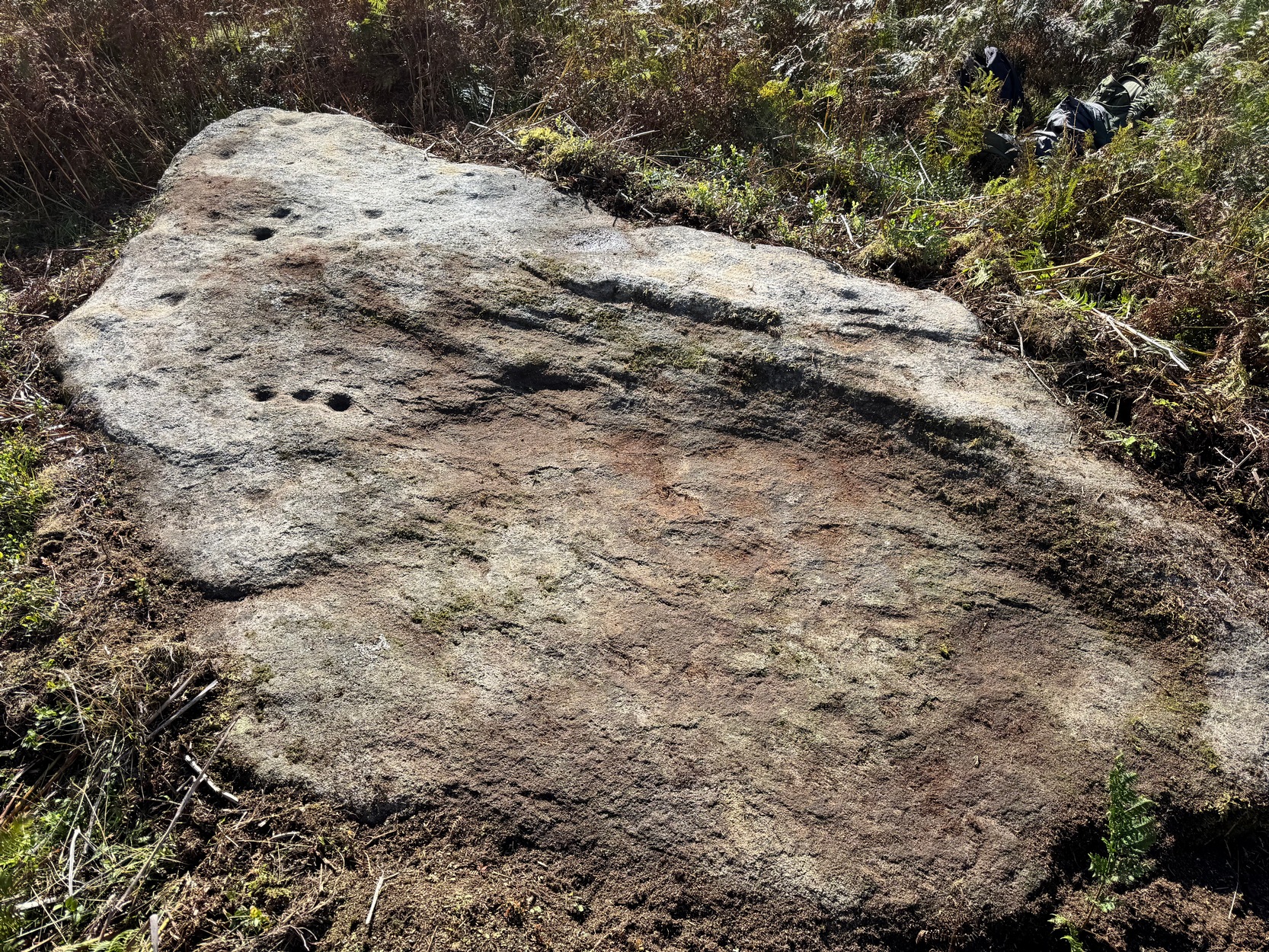
It was first described in Hedges (1986) survey, where he told it to be a “large flat rock in bracken with sixteen clear cups, four other possible cups, grooves and one basin”—although at the same time somehow, erroneously, he thought the carving may have been uncovered by Stuart Feather in 1970, confusing this stone with two more complex petroglyphs 300 yards to the west of here. Give it your attention when you’re walking on this ridge, before walking to the two others 300 yards to the west. It’s certainly worth looking at.
References:
- Allen, J. Romilly, “Notice of Sculptured Rocks near Ilkley,” in Journal of the British Archaeological Association, volume 38, 1882.
- Anonymous, Walks Around Cup and Ring Stones, ITIC: Bradford n.d. (1995)
- Boughey, K.J.S. & Vickerman, E.A., Prehistoric Rock Art of the West Riding, WYAS: Leeds 2003.
- Hedges, John (ed.), The Carved Rocks of Rombald’s Moor, WYMCC: Wakefield 1986.
- Morris, Ronald W.B., “The Prehistoric Rock Art of Great Britain: A Survey of All Sites Bearing Motifs more Complex than Simple Cup-marks,” in Proceedings of the Prehistoric Society, volume 55, 1989.
Acknowledgements: Big thanks to the petroglyphic hands of Graeme Chappell and Tom Cleland for the work at this stone. Huge thanks for use of the Ordnance Survey map in this site profile, reproduced with the kind permission of the National Library of Scotland.
© Paul Bennett, The Northern Antiquarian
Discover more from
Subscribe to get the latest posts sent to your email.
