Clach Brath, Baile Mor, Iona

Bullaun Stone:  OS Grid Reference – NM 286 244

Also known as:

  1. Clacha Brath
  2. Clachan-nan-Druidhean
  3. Day of Judgement Stone
  4. Druid’s Stone
  5. World’s End Stone

Folklore

On this curious, broken, basin-shaped rock — thought by some to have at one time played a part in an old cross whose remains are in the Abbey Museum — are two deep cup-shaped hollows, in which were once “three noble globes of white marble” that were used for oracular purposes and were said to have originated in druidical rites.  In Miss McNeill’s (1954) survey of the island, she tells that:

“near the edge of the path leading to St. Oran’s Chapel, there lies a broad, flat stone, with a slit and a cavity on its surface. Here there used to lie some small round stones which pilgrims were wont to turn sunwise within the cavity; for it was commonly believed that the ‘brath’, or end of the world, would not arrive until this stone should be worn through.”

The small stones that were once in the Brath were ordered by the Church to be thrown into the sea; but local folk replaced them with three other small stones, maintaining the traditional rites of this stone until they eventually stopped sometime in the 19th century.  But in Major-General James Forlong’s (1906) study, he tells of a somewhat earlier mythic origin to this old stone, saying:

“In Iona the Druids are said to have made the flat altar stone called Clachan-nan-Druidhean, or Druid’s Stone, the stone of fate or of the last day, with round stones fitted into cup hollows on the surface, which the pious pilgrim turns round.  The world will end when the stone is worn through.  The Culdee monks preserved this monument.”

And what little is left is still preserved to this day.  The curious “end of the world” motif was something that was grafted onto an earlier mythos: what Mircea Eliade called the “myth of the eternal return”, wherein Nature’s annual cycle —from birth, life to death and subsequent renewal, endlessly, through the seasons—was the original status, later transmuted by the incoming judaeo-christian cult of linear time and milleniumism relating to a literal “end of the world” when their profane myth of Jesus returning to Earth occurs.  We might also add that the stones which once rested into the hollows of the Clach Brath would likely have possessed divinatory and healing qualities, as comparatiove studies suggest.

References:

  1. Eliade, Mircea, The Myth of the Eternal Return,
  2. Forlong, J.G.S., Faiths of Man – volume 1, Bernard Quarithc: London 1906.
  3. Holder, Geoff, The Guide to Mysterious Iona and Staffa, Tempus: Stroud 2001.
  4. McNeill, F. Marion, Iona: A History of the Island, Blackie & Son: Glasgow 1954 (4th edition).

© Paul Bennett, The Northern Antiquarian

Clach a’ Phoanais, Strontian, Inverness-shire

Standing Stone:  OS Grid Reference – NM 81581 61360

Also Known as:

  1. Branks Stone

Getting Here

As you enter the village from the east, onto the A861 road, the Strontian Hotel is on the right-hand side of the road and you can’t fail to notice. Stop!

Archaeology & History

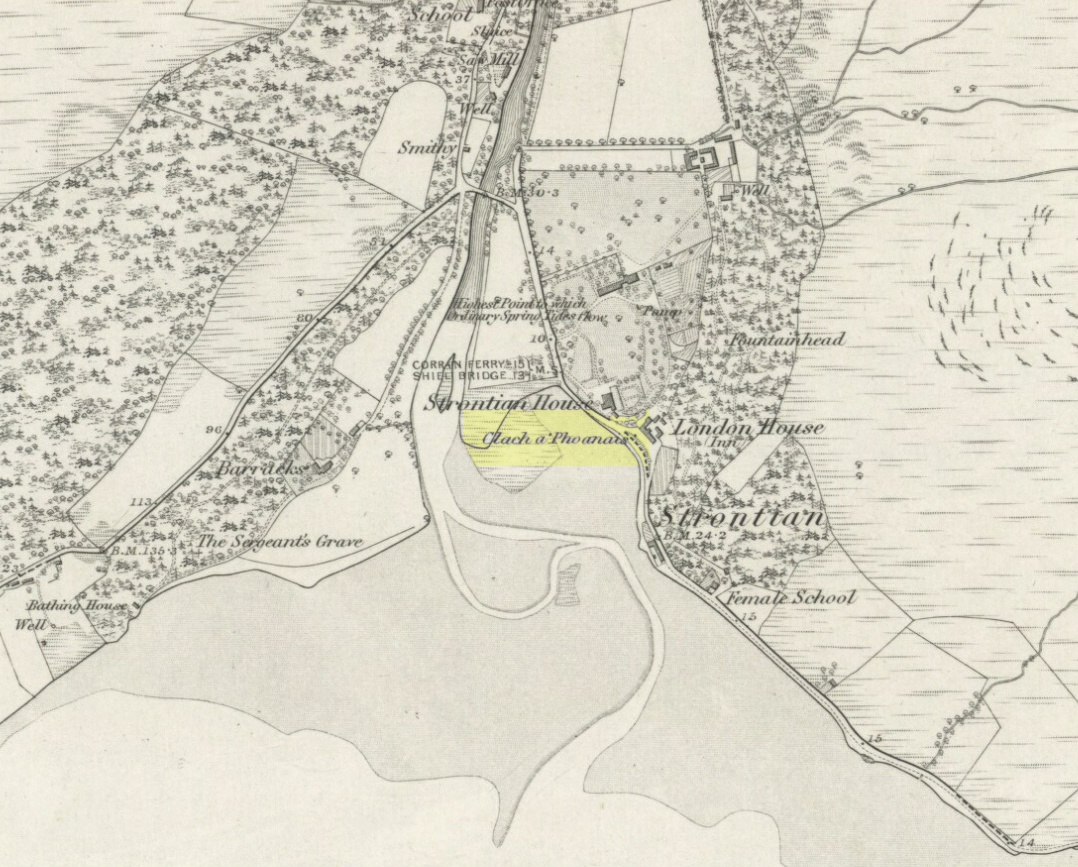
Clach a’ Phaonais on 1872 map

Shown on the first edition OS-map of the region in 1875, this old worn standing stone, more than six-feet tall, can be seen at the edge of the drive.  There’s an iron ring is attached to it, which I thought might have made it an old Bull Stone in bygone days, but no such lore is remembered.  Also known as the Branks Stone, it’s Gaelic name probably means the ‘stone of penance,’ and folk were chained to it in eaelier days for bad behaviour.  It was widespread across the Highlands to tie criminals to stones and wooden poles, naked, for 24 hours and let the midges get to them.  Crime was down to a minimum up here!

Folklore

As the locals at Strontian Hotel told me (thanks Finlay), “several stories have emerged locally. It marks a clan chief’s grave, a sighting stone for the equinox but the most plausible one is based on the fact that there is an iron ring on the side of the stone facing the loch and it was used to tie up barges taking lead from the local lead mine.  It supplied the raw material for shot during the Napoleonic and Crimean wars.”

Aknowledgements:  Big thanks to Anne and the Megalithic Portal for additional help on this one.

© Paul Bennett, The Northern Antiquarian

Buckton Castle, Mossley, Lancashire

Hillfort:  OS Grid Reference – SD 9892 0161

Archaeology & History

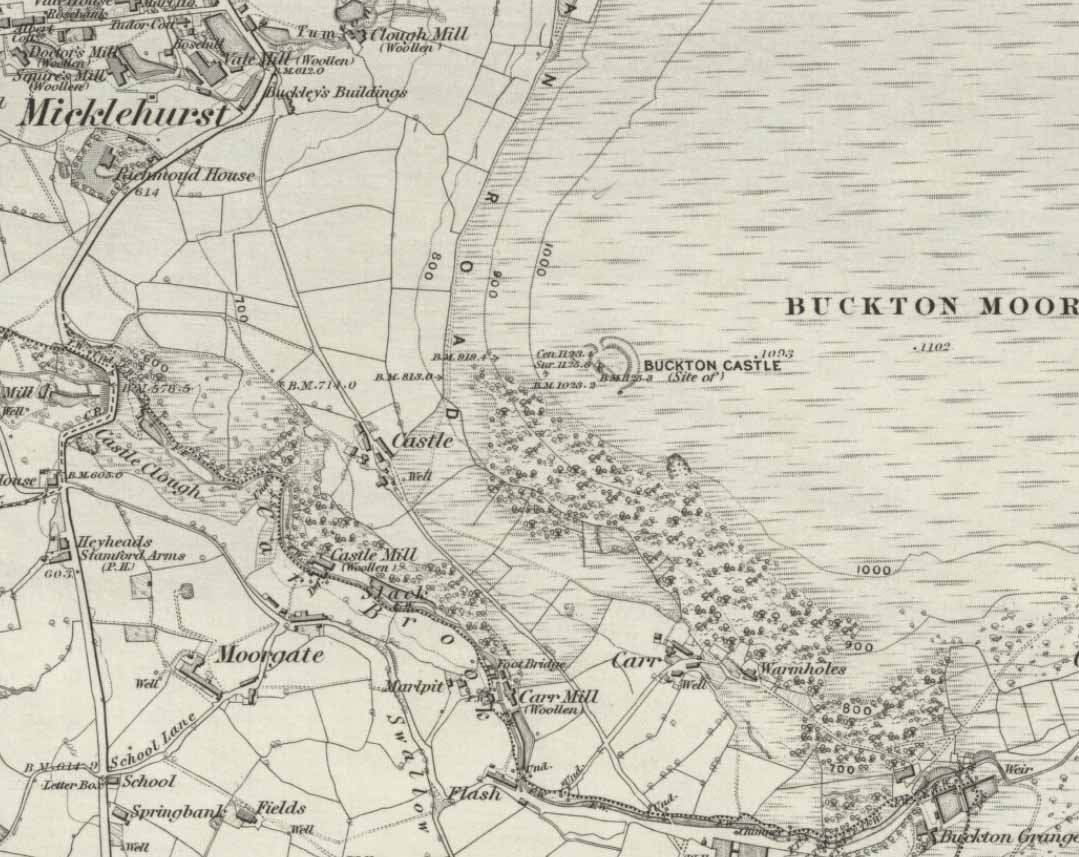
Buckton Castle on 1882 map

This giant site—deemed as Iron Age by some and medieval by others—is on the verge of complete destruction as the adjacent quarrying company cuts closer and further into the sides and top of the monument. Local people and archaeologists need to do something about this, or it will be lost forever as the Industrialists once again destroy more of our ancient heritage in order that they can feed their god of Money.

Folklore

Legend has always told that great treasure existed beneath the grounds of this Brigantian hillfort, found on the moor-edges to the east of Manchester. Long ago, one man came along to see if he could find the treasure, said to consist of a huge chest of gold. The man brought two horses and the ground within the fort was gradually cleared away until, to the man’s surprise, the legendary chest was revealed!

Attaching chains to it and the horses, the man shouted:

“Gee, whoa, whoo! Bonny, Buck and Bell,
I’ll have this chest o’ gowd, i’ spite o’ all t’ devils in hell!”

But barely had the words left his mouth and the chest began to move, when the devil himself appeared in the shape of a huge hen that breathed fire! This scared the horses so much that they bolted and snapped the chains, taking their master with them but leaving the treasure-chest still in the ground. To this day the chest still remains, hidden in the Earth.

References:

  1. Winterbottom, Vera, The Devil in Lancashire, Cloister: Stockport 1962.

© Paul Bennett, The Northern Antiquarian

Brotton Howe, Brotton, Cleveland, North Yorkshire

Cairn (destroyed):  OS Grid Reference – NZ 6950 1886

Archaeology & History

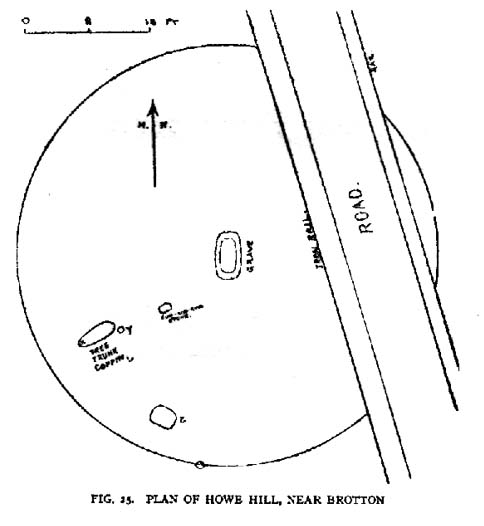
Frank Elgee’s 1930 plan

Another old site that has sadly succumbed to that bollox called ‘progress’! It’s in the North Yorkshire region some halfwits have taken to calling Cleveland — but which a lotta local folk still correctly call Yorkshire.  But that aside…

In an article by local students William Hornsby and Richard Stanton written in 1917, we find that this was just one of at least seven hillocks presumed to be barrows here — but all the others had gone even in their day.  When Crawford (1980) came to survey the site in the late 1970s, he told that,

“this large barrow is now only visible as a low swell in an arable field… (but) the profile of the barrow is retained in the hedgeline that bisects it from north to south, but the whole of its eastern half has been obliteratd by the Brotton-Kilton road.”

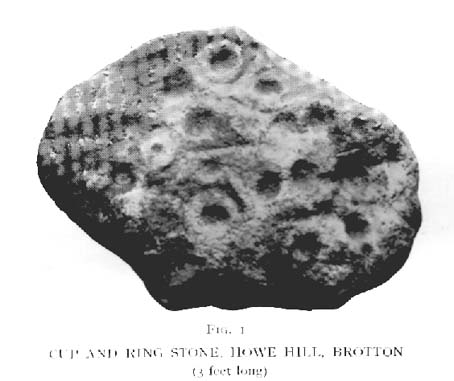
Elgee’s 1930 photo of one of the carvings
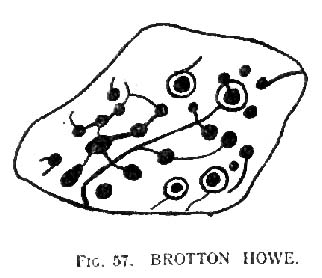
E.T. Cowling’s drawing of one of the carvings

When Hornsby and Stanton checked the place out it measured 54 feet in diameter and had an extensive covering of small stones, like a large cairn, with a single grave at the centre, aligned north-south; and a tree-trunk coffin on the southwestern side.  Of the stones which filled the central grave, eight of them were found to have cup-markings on them; whilst 16 stones covering the tree-trunk grave also possessed cup-markings. Roughly equidistant between the two burials was another stone found to be resting face-down on the original ground-level, and covered with 20 cups and 5 cup-and-rings!  Awesome stuff!

G.M. Crawford’s (1980) description of the site was as follows:

“Howe Hill was excavated by Hornsby and Stanton in 1914; they discovered that the mound was made up with a clay floor, overlain by ‘a cairn 30 feet long and 3 feet high’ of diorite cobbles, capped by a layer of earth. Cut into the clay floor were two graves: the first was oriented north-south and measured 2m long by 0.9m wide at the old land surface and was 0.7m deep. The grave was filled with ‘medium sized stones’ with a ‘thin dark layer,’ thought to be an inhumation burial, on the floor; 8 of the stones bore cup-marks. The second grave, oriented northeast-southwest, was 2.5m long by 0.9m wide at the old ground surface, reducing to 1.8m long by 0.5m wide at its bottom, 1.3m below. This grave, which was filled with stones, also contained a tree-trunk coffin or oak, measuring 1.5m long… At the head (northeast) were found the unburnt skull fragments of a man laid on its right side. Unaccompanied cremations had been placed at both ends of the coffin. 16 cup-marked stones were among the infill of the grave.”

This was obviously a site of considerable importance and it’s a huge pity (if not a disgrace) that today no trace of the site remains.

References:

  1. Cowling, Eric T., Rombald’s Way, William Walker: Otley 1946.
  2. Crawford, G.M., Bronze Age Burial Mounds in Cleveland, Cleveland County Council 1990.
  3. Elgee, Frank, Early Man in North-east Yorkshire, John Bellows: Gloucester 1930.
  4. Hornsby, William & Stanton, Richard, “British Barrows near Brotton,” in Yorkshire Archaeology Journal, 24, 1917.
  5. Smith, A.H., The Place-Names of the North Riding of Yorkshire, Cambridge University Press 1928.

© Paul Bennett, The Northern Antiquarian

Beinn na Cailleach, Islay, Argyll

Sacred Mountain:  OS Grid Reference – NR 450 596

Also Known as:

  1. Beinn na Caillich

Folklore

Another great mountain of the ‘Old Woman’: primal creation deity of these hills. Whether she holds sway over the land here for many months, as she does on Mull and Skye, I cannot find.  One creation legend here tells that one of the furrows down the side of the mountain – called Sgrìoh na Caillich – was said to be made by her as she slid down it in a sitting position. The small loch on the way up to her summit – Lochan na Caillich – was one of her washing places; and the Beinn na Caillich Beag, immediately east, speaks of other legends, now seemingly lost to us.  It’s highly likely that some of the megalithic remains nearby had some mythic relationship with this old hill, though I aint found any studies along these lines…yet!

© Paul Bennett, The Northern Antiquarian

Hood Hill Stone, Kilburn, North Yorkshire

Legendary Rock:  OS Grid Reference – SE 503 812

Getting Here

From Kilburn village, take the north road up past the church for about 300 yards, bearing up the track on your left and walk up into the wooded hill a mile ahead of you.  It’s in there!

Folklore

In this region there’s a teeming cluster of druid, fairy, devil and spook-lore, along with numerous prehistoric remains. Not sure this site has such an archaic pedigree, though the creation myth told of this rock (marked on the 1st edition OS-map as an antiquity) seems to imply as such. Our old devil disguised himself as a druid many moons ago in an attempt to gain favour with the old priests, but was discovered in his plans and so, in anger, flew out across the hills carrying a great stone with him which he dropped from the skies and it landed where the Hood Hill Stone still remains. Also in anger he jumped down and stood on the great rock, and in doing so left his footprint impressed upon the stone. (There’s the possibility this is an unrecognised cup-marking – having not been here I can’t say misself).  Edmund Bogg (1906) also tells us that,

“The monk’s hood-like configuration of the crest is said to have originated its name. The busy tongue of tradition, however, says that the name commemorated Robin Hood who, with his merry men, affected the hill-fastnesses hereabouts; but the hill was named ‘Hode’ long, long before the famous Robin came this way at all.”

The same writer also told how,

“legend, too, has it that the happy valley just north of Hood Hill…was a secluded and sacred retreat of the druids, and at the introduction of christianity into these parts, a great assembly gathered to consider which of the two religions should in future be adopted.”

Yet another legend – and an old one, says Bogg – is “that when the dinner-bell rang at Osgodby Hall the stone rolled down for its repast, and regularly returned to the crest after the meal.”

It’s blatantly obvious that something of antiquity this way hides.  The “enclosure” shown on the modern OS-maps here could do with being looked at little closer.

References:

  1. Bogg, Edmund, Richmondshire and the Vale of Mowbray (volume 1), James Miles: Leeds 1906.

© Paul Bennett, The Northern Antiquarian

Ardlamey, Gigha, Argyll

Cairn:  OS Grid Reference – NR 63091 48258

Also Known as:

  1. Canmore ID 38524

Archaeology & History

A decent-sized cairn, around 50 feet across (even though much of the stone has been nicked) and about 3 feet high, with a singular large cist near its centre. When the Scottish Royal Commission lads checked the place out in 1967, at least four of the kerb stones were still in situ (on its north, west and southwest sides) – the tallest being its northern stone, more than 6 feet high. The northern stone also had a peculiar deposit of white quartz and pebbles laid at the base, placed there quite deliberately – unlike the others which rested on a level of sand and gravel.

The Scottish Royal Commission (1971) also reported the former existence of two cists not far from here, “uncovered by the plough during the 19th century on the farm of Ardlamey”: one at NR 637 484, and the other at NR 635 484.

References:

  1. Royal Commission on the Ancient & Historical Monuments of Scotland, Argyll – Volume 1: Kintyre, Glasgow 1971.

© Paul Bennett, The Northern Antiquarian


Taynuilt, Lorn, Argyll

Standing Stone:  OS Grid Reference – NN 0120 3115

Also Known as:

  1. Canmore ID 23497

Archaeology & History

Nearly twenty years have passed by since I last saw this rather small standing stone – ‘small’ for Argyll that is!  It’s near the corner of a field half-a-mile east of Taynuilt village, about 300 yards off the main Oban road. The Scottish Royal Commission (1974) chaps describe it quire accurately, telling it to be,

“a granite boulder, roughly triangular in shape at the base, and measuring 0.75 metre by 0.60 metre by 0.55 metre at ground-level. It now stands to a height of 1.2 metres (nearly four-feet tall in normal language! – Ed), but pieces have been split off in comparatively recent times and it may originally have been taller.”

It’s about time I got my arse back up ambling and exploring around this part of Scotland.  Tis a gorgeous part of the world…

References:

  1. Royal Commission on the Ancient & Historical Monuments, Scotland, Argyll – volume 2, HMSO: Edinburgh 1974.

© Paul Bennett, The Northern Antiquarian


Llangynidr Bridge, Llangynidr, Breconshire

Standing Stone:  OS Grid Reference – SO 1562 2039

Also Known as:

  1. Gliffaes Stone
  2. Llywn y Fedwen

Getting Here

Not too difficult – and its size makes it pretty easy to spot!  About 100 yards across the river bridge from Llangynidr, there’s a small path heading into the trees by the riverside. Walk along it, or whichever way you find easiest to walk along the riverbank.  Then as you reach the third field along, look up into the hedgerow-cum-fence above you and you’ll notice the old stone sticking up!  Head for it!

Archaeology & History

A 14 foot tall standing stone with a most peculiar ‘modern’ history to it.  Some of you will like this, others may have palpitations – but… In recent times, since the notion of “energy at megaliths” have been in vogue, this was one of the first monoliths found to possess magnetic anomalies.  Described by the writer Francis Hitching (1976), he asked the Welsh dowser Bill Lewis to dowse at this stone and checked the results. Lewis dowsed a spiral of ‘energy’ rising up the stone as he did at many standing stones, and urged Hitching to see if he could bring his findings to the attention of any scientists.  So Hitching contacted the physicist professor John Taylor — he of Black Holes fame, of Kings College, London — who felt that Lewis’ dowsing finds were probably due to him sensing subtle changes in the magnetic field of the stone.  And so with this in mind, he sent a young Argentinian physicist called Eduardo Balanovski, armed with a gaussmeter, to see what they could find. As Hitching later wrote:

“What Balanovski found surprised him very much. After checking the background levels and setting the meter at zero, he pointed the measuring probe at the stone. The needle on the dial shot up, showing an anomaly far greater than the few thousandths or hundredths of a gauss that would have been normal…

“Balanovski has no doubt that the basic anomaly…is significant: ‘The point is that a water-diviner told us about it, and we went there and found something measurable. It may be the stone contains, geologically, the reason for the anomaly. Or it may be caused by something we don’t yet understand. But I do not personally believe that the stone was accidentally chosen or accidentally placed. The people who put it there knew about its power, even if they didn’t know about electromagnetism.'”

This initial finding brought Taylor himself to the place, where he, Balanovski and Lewis set to work.

“Lewis was filmed marking with chalk the places on the stone where he dowsed ‘energy nodes.’ When the gaussmeter probe was passed down the stone, it did register increases of magnetism at the marked points – there seemed to be ‘a very strong field on and around the stone, which seemed to fall in bands,’ as Hitching put it. It was a very impressive demonstration. Taylor urged caution, pointing out that much more work would need to be done to be sure of such reactions.”

Further work was eventually carried out by the Dragon Project, where no anomalous readings were found. Hmmm….

References:

  1. Devereux, Paul, Places of Power, Blandford: London 1990.
  2. Hitching, Francis, Earth Magic, Cassell: London 1976.

© Paul Bennett, The Northern Antiquarian


Askwith Moor (521), North Yorkshire

Cup-Marked Stone:  OS Grid Reference – SE 17162 50530

Also Known as:

  1. Round Rock

Getting Here

To find this, head for the line of old grouse-butts which run north-south, a few hundred yards west of the Askwith Moor Road. Just before y’ get to the one nearest the bottom of the line, frobble about a bit.  If by any chance you end up at the Woman Stone carving, walk back up the slope until you’re on the level.  Not far ahead of you are the upright stone remains of a grouse-butt.  This carving is just a few yards away.  You’ll find it.

Archaeology & History

Image © Richard Stroud

This was another carving found on one of the many forays of Mr Chappell and I when we were young, sometime in 1993.   A short while after, Graeme wrote to Edward Vickerman to inform him of the find, which ended up in their rock art survey a decade later.

It’s another one of those simple designs: what seems like at least 5 cup-markings on a small rounded rock, with two of them linked together by a groove — possibly natural, possibly man-made — though there may in fact be seven or more cups etched onto its upper surface.  It’s difficult to tell.  It gives you the impression that its present position isn’t its original one and is suggested by Boughey & Vickerman (2003) to have been “moved from pipeline?” close by.  It may even have been dug out and cast here, possibly once being a part of a cairn.  In the Boughey & Vickerman survey they give its OS-coordinate as SE 17163 50527 – and describe it as a “medium-sized, free-standing rock of fine grit. Five cups, some perhaps natural.”  When Richard Stroud and I visited the site, he found the GPS coordinate was SE 17162 50530; and we have to say that instead of describing it as a free-standing rock, it’s a movable stone (though it’d take a bit of effort), that may once have been part of a larger monument.

References:

  1. Bennett, Paul & Chappell, Graeme, Personal Communication, 1993.
  2. Boughey, Keith & Vickerman, E.A., Prehistoric Rock Art of the West Riding, WYAS: Wakefield 2003.

© Paul Bennett, The Northern Antiquarian