Rollright Stones, Chipping Norton, Oxfordshire

Stone Circle:  OS Grid Reference – SP 29578 30869

Also known as:

  1. King’s Men
  2. The Rollrights
  3. Rowldrich

Getting Here

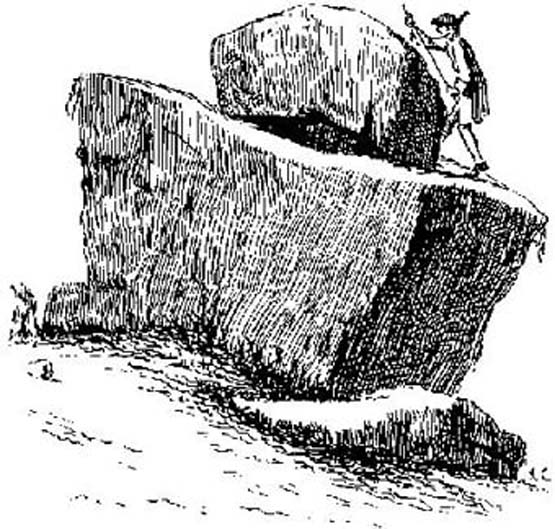
One of Camden’s early drawings

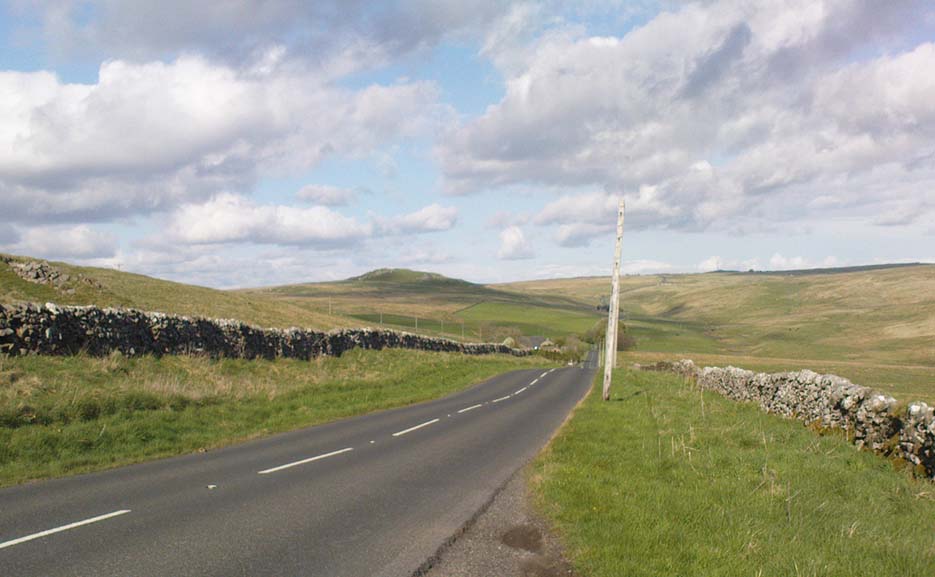
All sorts of ways to get here – all via road I’m afraid.  Those southern-types aint into walking over fields and ambling about like we can do ‘ere up North.  Best way to get here really, is get to Chipping Norton (a good little town with many good folk there), and ask!  Take the road out of the town to Over Norton, taking the first road left as you enter the village. Go along this country  lane for a mile until you reach a crossroads at the top of the hill. Turn right at the crossroads and watch out for the parking space at the roadside a few hundred yards along. Stop there and walk through the gate to go round to the other side of the trees. (if there’s a Rollright Trust member there loitering in the entrance asking you for some money to walk or sit by the stone circle – don’t give ’em it!  They’ve used the cash for poisoning the wildlife in the past (killing the moles, field mice and other indigenous creatures there) and then lied about what they did (reckoning it was nowt to do with them!), so I wouldn’t trust them).

Archaeology & History

Southern arc of stones

There’s masses to be said on this site, which can’t possibly be added all in one go (I’ve literally got a full unpublished book on the many aspects of this lovely site) — so this entry will be updated occasionally with additional bits and bats of info and images as time floats by.

This remarkable and quite atmospheric megalithic complex has so much to say for itself that entire books have been written on the place (see the extensive references below), dealing with its archaeology, folklore and ritual use.  I was very fortunate around the turn of the 21st century, to be able to live in an old hut that used to stand in the copse of trees just outside the circle, where I had numerous weird and wonderful experiences with people, wildlife, and what some might call the more eosteric life of the place…

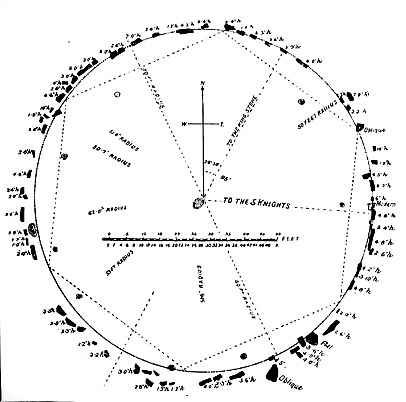
1920s Ground-plan
Mr Taunt’s 1907 plan

The King’s Men is a near-perfect circle of oolitic limestone uprights.  Thought for centuries to be the memorial site of some victory by the Danish King Rollo, they have been described by many historians, travellers and antiquarians from the 14th century upwards.  Several early writers described a sort of “avenue” running from the circle, not unlike the one perceived at Stonehenge and elsewhere.  Evidence for this cannot be fully disregarded, as there are some recumbent monoliths along the road beside the stone complex, known as the Jurassic Way.  This was a prehistoric trade route and it is more likely than not that some other uprights would have been nearby.

The Rollright Stones were used as the prime base for what was known as the Dragon Project: an exploratory examination of potential electromagnetic anomalies that were recorded at the standing stones here by scientists, geomancers and archaeologists who were involved daily monitoring work over many years.  Much of this was published in Paul Devereux’s book, Places of Power – required reading for everyone who pretends an interest in megalithic sciences.
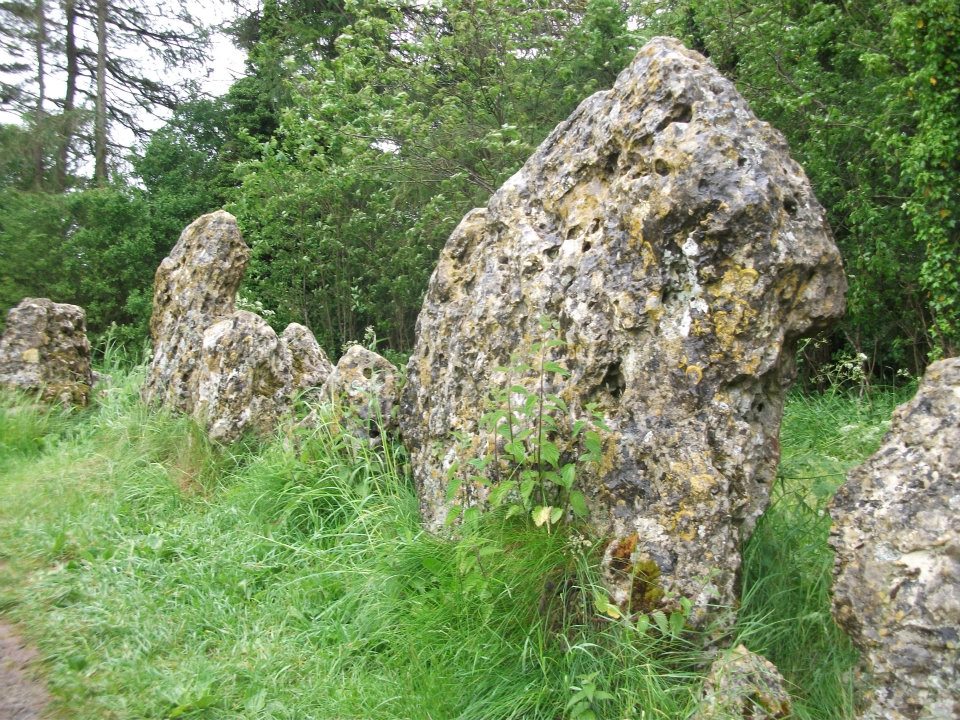
Northern section of the ring

The Rollright complex today consists primarily of three sites: the Whispering Knight’s portal dolmen, the King’s Men stone circle, and the King Stone.  Of these, it is the stone circle which draws most attention. Several alignments are connected with the complex.  The original ritual use of the place would have, primarily, involved rites of passage and death rituals; though it seems obvious that menstrual rites were also an important social event here.  After dark, this stone circle has distinctly ‘female’ spirit, sometimes manifesting in a quite wrathful form (please don’t confuse any of the modern witchcraft mythos with such things – they are fundamentally different in both social and ritual aspects). Women obviously played a large part in the ritual use and geomantic layout of the original complex.  It also seems likely that the stone circle was used as a moot spot, which may have been in use until medieval times.  The recent discovery of the carving of a family crest, at least 500 years old, implies this.

Until Tom Wilson and I lived in the hut at the circle in the 1990s, previous reports of ‘carvings’ at the stone circle were few and debatable.  But two of the stones in the Rollright circle have quite distinct carvings on them.  The most pronounced is etched on the tallest stone (stone 1 – Barnatt Survey) and comprises of a typical heraldic shield – although we cannot, as yet, ascertain the motif in the middle of the shield.  This was first seen by a visiting tourist who wanted to remain anonymous, but the finding was written up in an article I wrote shortly afterwards. (Bennett 1999)  The image below – reproduced courtesy of Alistair Carty’s Archaeoptics Limited laser scanning company – clearly shows the carving, which confirmed the initial discovery.  The report of his findings can be read here.

Shield carving on tallest stone
Shield carving on tallest stone (© Archaeoptics Ltd)
L.V. Grinsell’s 1930 photo

Not unsurprisingly, since the discovery of the shield various screwy interpretations have been put forward to account for the design.  My favourite has to be the one suggested by a pagan friend of the Rollright Trust, who, occult-like and all secret (y’ get the drift) reckoned it was all to do with King Arthur!  Needless to say, my response of, “Y’ talking bollox mate!” was received somewhat nervously by pagan Karin Attwood and the twee little entourage who were discussing the shield, in the usual ‘secrecy – secrecy’ hush-hush tone of false witches and similar idiots!

A few months later I found another set of carvings on stone 62 (Barnatt survey), comprising a set of Ogham letters. These Ogham are very faint and are best observed before midday, when lighting conditions highlight them much clearer. If anyone can decipher them, it would be greatly appreciated. (though please don’t gimme some shit about King Arthur)

Folklore

Folklore ascribes that the number of stones in the complex cannot be counted (a motif found at other megalithic sites) and, intriguingly, of the surveys done here, no two are the same!  One early illustration of the circle shows 30 stones, nother describes 46, and one survey describes just 22 stones!  As the 20th century progressed the numbers increased dramatically, with surveys differing at 58, 60, 71, 72, 73, 77 and 105. The present-day ‘guesstimate’ is about 77. Weird!

Folklore tells that if you can count the stones three times in a row and get the same number, you may have any wish you choose.  But recently this has become reversed and it is said to be a curse if you count three times the same.  Intriguingly, modern visitors who allege no superstitious beliefs, will not count the stones a third time if the same number crops up twice.

The best-known folk tale of this place is of the King, his men and the knights, who “were once men who were changed into vast rocks and fossilised,” as Camden first put it in 1586.  The King’s men sometimes go to drink at a well near Little Rollright, as does the king, but he only goes at certain times.  At midnight however, on certain days, the King’s Men have sometimes been known to come to life, join hands and dance in a circle.  This sounds more like a folk remnant of ritual use here.

Faerie folk are said to live beneath the circle, in great caverns, some of which are linked up to the single monolith across the road. Ravenhill [1926] described how local folk had sometimes seen the little people dancing around the circle by moonlight, but nobody has seen them of late.

References:

  1. Anonymous, The Rollright Stones: Theories and Legends, privately printed, n.d.
  2. Anonymous, ‘Oxfordshire Mysteries,’ in The Ley Hunter 86, 1979.
  3. Aubrey, John, Monumenta Britannica, Milbourne Port 1980.
  4. Barnatt, John, Stone Circles of Britain (2 volumes), BAR: Oxford 1989.
  5. Beesley, T., ‘The Rollright Stones,’ in Trans. N.Oxon Arch. Soc., 1, 1855.
  6. Bennett, Paul, ‘Remarkable Carving found at the King’s Men Stone Circle, Rollright, Oxfordshire,’ in Right Times 5, 1999.
  7. Bennett, Paul & Wilson, Tom, The Old Stones of Rollright and District, Cockley Press: London 1999.
  8. Bloxham, Christine, Folklore of Oxfordshire, Tempus 2005.
  9. Bord, Janet & Colin, The Secret Country, Paul Elek: London 1976.
  10. Bord, Janet & Colin, A Guide to Ancient Sites in Britain, Paladin 1979.
  11. Brooker, Charles, ‘Magnetism and the Standing Stones,’ in New Scientist, January 1983.
  12. Burl, Aubrey, A Guide to the Stone Circles of Britain, Ireland and Brittany, New Haven & London 1995.
  13. Burl, Aubrey, Great Stone Circles, Yale University Press: New York & London 1999.
  14. Burl, Aubrey, The Stone Circles of Britain, Ireland and Brittany, Yale University Press 2000.
  15. Clayton, Peter, Archaeological Sites of Britain, Weidenfeld & Nicolson: London 1976.
  16. Cooper, Roy, ‘Some Oxfordshire Leys,’ in The Ley Hunter 86, 1979.
  17. Cowper, B.H., ‘Oxfordshire Legend in Stone,’ Notes & Queries (1st series), 7, January 15, 1853.
  18. Crawford, O.G.S., Long Barrows of the Cotswolds, John Bellows: Oxford 1932.
  19. D., A.J., ‘Rollwright or Rollright,’ in Notes & Queries, 2nd series, 7, 1859.
  20. Devereux, Paul, ‘Is This the Image of the Earth Force?’ in The Ley Hunter 87, 1979.
  21. Devereux, Paul, ‘Operation Merlin,’ in The Ley Hunter 88, 1980.
  22. Devereux, Paul, ‘Operation Merlin 2,’ in The Ley Hunter 89, 1980.
  23. Devereux, Paul, ‘The Third Merlin,’ in The Ley Hunter 92, 1981.
  24. Devereux, Paul, Places of Power, Blandford: London 1990.
  25. Devereux, Paul, The Sacred Place, Cassell: London 2000.
  26. Devereux, Paul, Steele, John & Kubrin, David, Earthmind, Harper & Row: New York 1989.
  27. Devereux, Paul & Thomson, Ian, The Ley Hunter’s Companion, Thames & Hudson: London 1979.
  28. Dyer, James, Discovering Regional Archaeology: The Cotswolds and the Upper Thames, Shire: Tring 1970.
  29. Evans, Arthur J., ‘The Rollright Stones,’ in Trans. Bristol & Glouc. Arch. Soc., 40, 1892.
  30. Evans, Arthur J., ‘The Rollright Stones and their Folklore (3 parts),’ in Folklore Journal, 1895.
  31. Graves, Tom, Dowsing, Techniques and Application, Turnstone: London 1976.
  32. Graves, Tom, Needles of Stone, Granada: London 1980.
  33. Graves, Tom (ed.), Dowsing and Archaeology, Turnstone: Wellingborough 1980.
  34. Gray, William, The Rollright Ritual, Helios: Cheltenham 1975.
  35. Grinsell, Leslie V., The Ancient Burial Mounds of England, Methuen: London 1936.
  36. Grinsell, Leslie V., The Rollright Stones and their Folklore, Toucan Press: Guernsey 1977.
  37. Hamper, W., ‘Observations on certain Ancient Pillars of Memorial, called Hoar Stones,’ in Archaeologia, 25, 1833.
  38. Hawkes, Jacquetta, A Guide to the Prehistoric and Roman Monuments in England and Wales, BCA: London 1973.
  39. Higgins, Geoffrey, The Celtic Druids, Rowland Hunter: London 1829.
  40. Krupp, E.C., In Search of Ancient Astronomies, Chatto & Windus: London 1979.
  41. Lambrick, George, The Rollright Stones: The Archaeology and Folklore of the Stones and their Surroundings, Oxford Archaeology Review 1983. (Reprinted and updated in 1988.)
  42. Liebreich, Karen, UneXplained: Spine-tingling tales from Real Places in Great Britain and Ireland, Kindle 2012.
  43. Michell, John, Megalithomania, Thames & Hudson: London 1982.
  44. Millson, Cecilia, Tales of Old Oxfordshire, Countryside Books: Newbury 1983.
  45. Ravenhill, T.H., The Rollright Stones and the Men Who Erected Them, Little Rollright 1926.
  46. Richardson, Alan, Spirits of the Stones, Virgin: London 2001.
  47. Robins, Don, ‘The Dragon Awakes,’ in The Ley Hunter 87, 1979.
  48. Robins, Don, ‘The Dragon Project and the Talking Stones,’ in New Scientist, October 1982.
  49. Robins, Don, Circles of Silence, Souvenir Press: London 1985.
  50. Saltzman, L.F. (ed.), Victoria County History of Oxford, Dawsons: London 1970 (first published 1939).
  51. Stanley, Christopher C., ‘A Rollright Processional Way?’ in The Ley Hunter 90, 1981.
  52. Taunt, Harry, The Rollright Stones: The Stonehenge of Oxfordshire, Oxford 1907.
  53. Thom, Alexander & Thom, A.S., ‘Rings and Menhirs: Geometry and Astronomy in the Neolithic Age,’ in E.C. Krupp, 1979.
  54. Thom, Alexander, Megalithic Sites in Britain, Oxford University Press 1967.
  55. Thom, A., Thom, A.S. & Burl, H.A.W., Megalithic Rings, BAR: Oxford 1980.
  56. Turner, Mark, Folklore and Mysteries of the Cotswolds, Hale: London 1993.

AcknowledgementsHUGE thanks to Marion Woolley for her images in this site profile, and other memorable ventures at this awesome megalithic ring!

Links

  1. Rollright Stones on The Megalithic Portal

© Paul Bennett, The Northern Antiquarian

St. Anthony’s Well, Edinburgh, Midlothian

Holy Well:  OS Grid Reference – NT 27522 73653

Also known as:

  1. Canmore ID 52448
  2. St. Anton’s Well

Getting Here

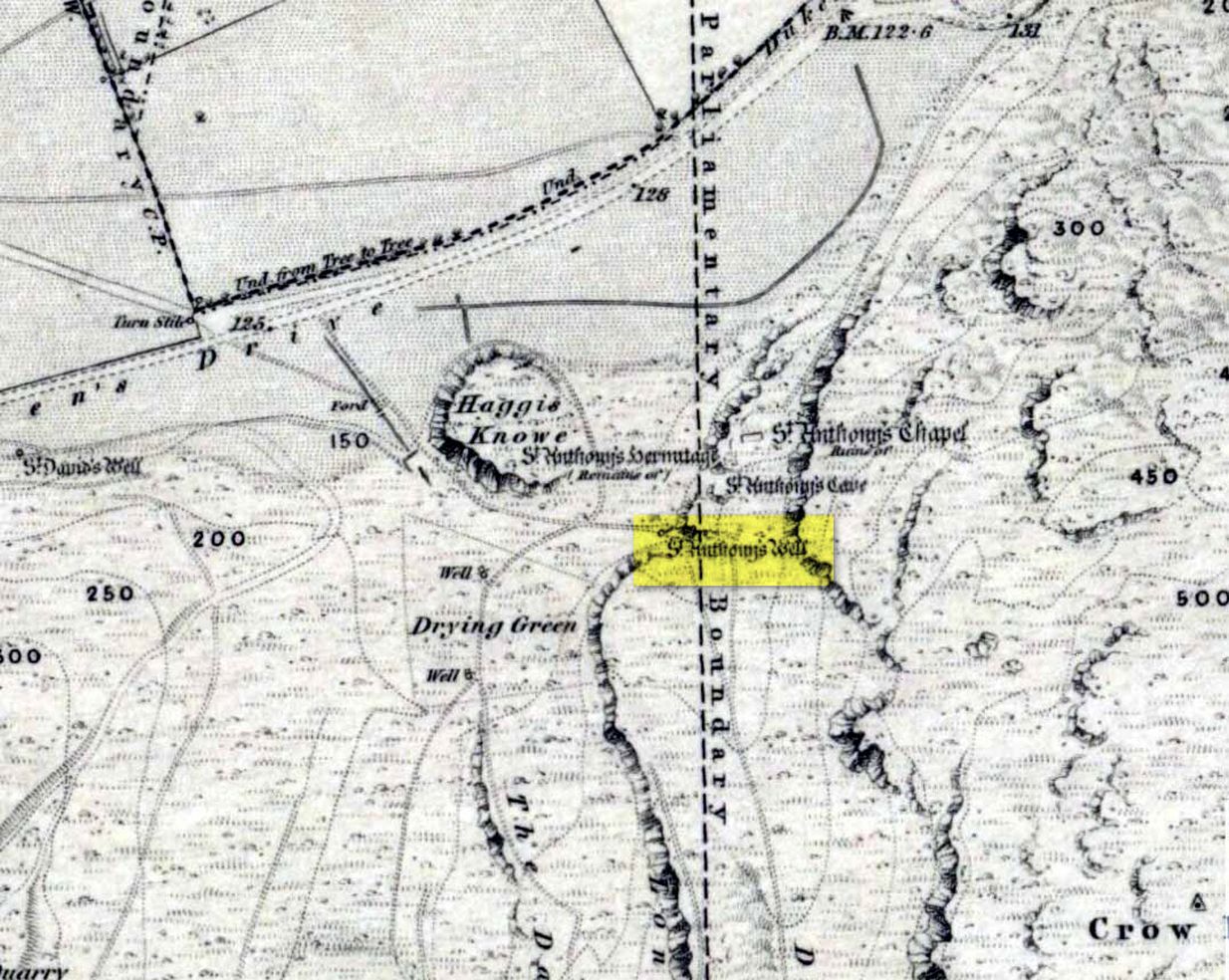
St Anthony’s on 1853 map

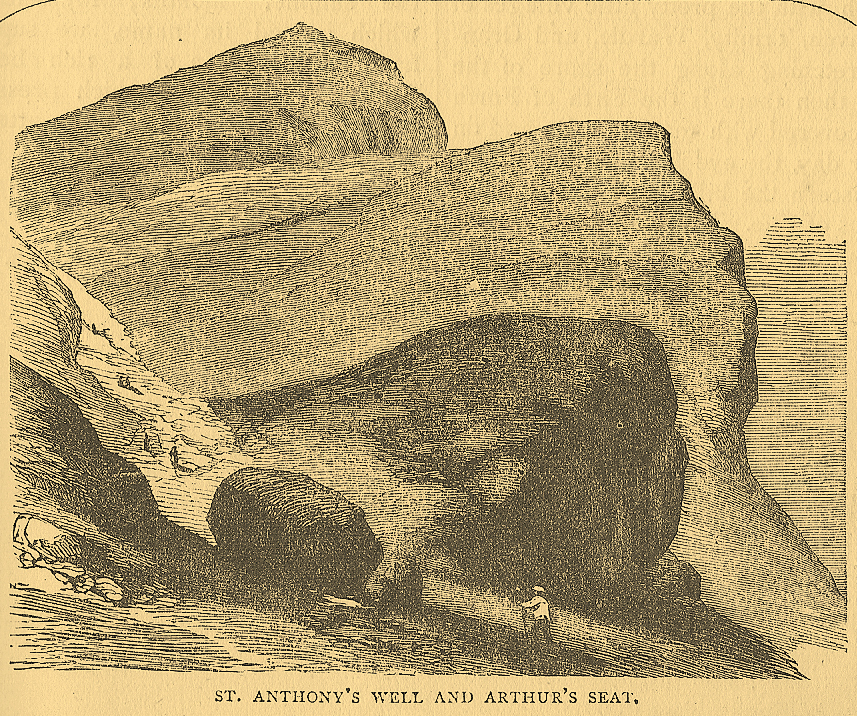
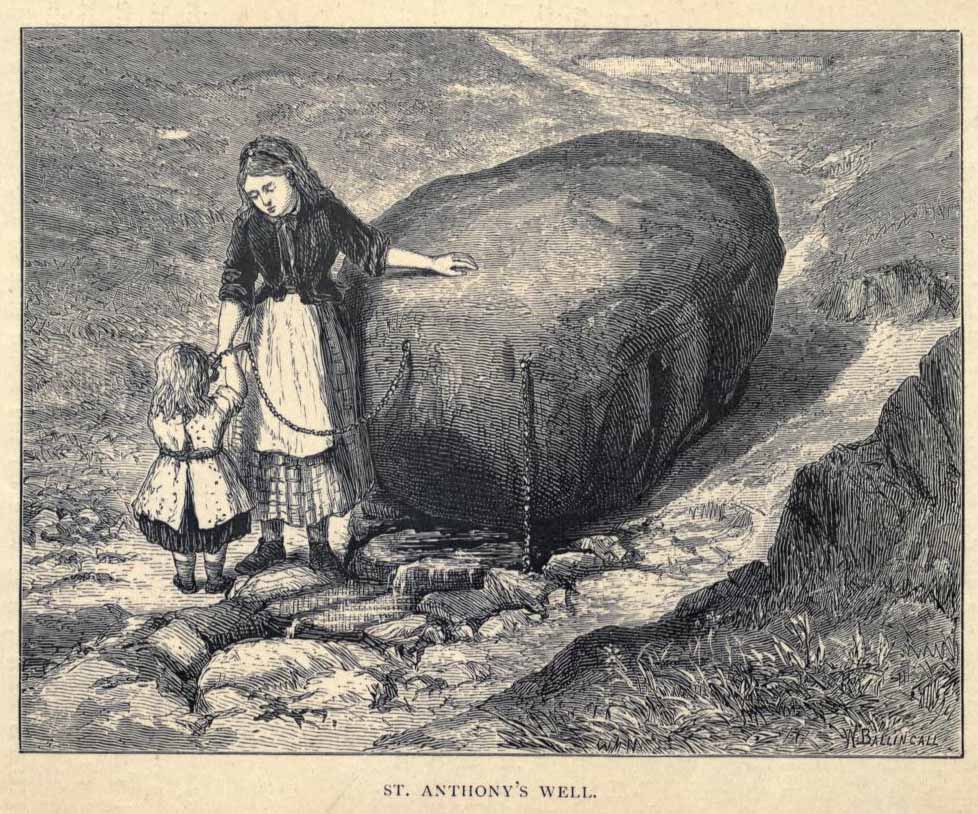
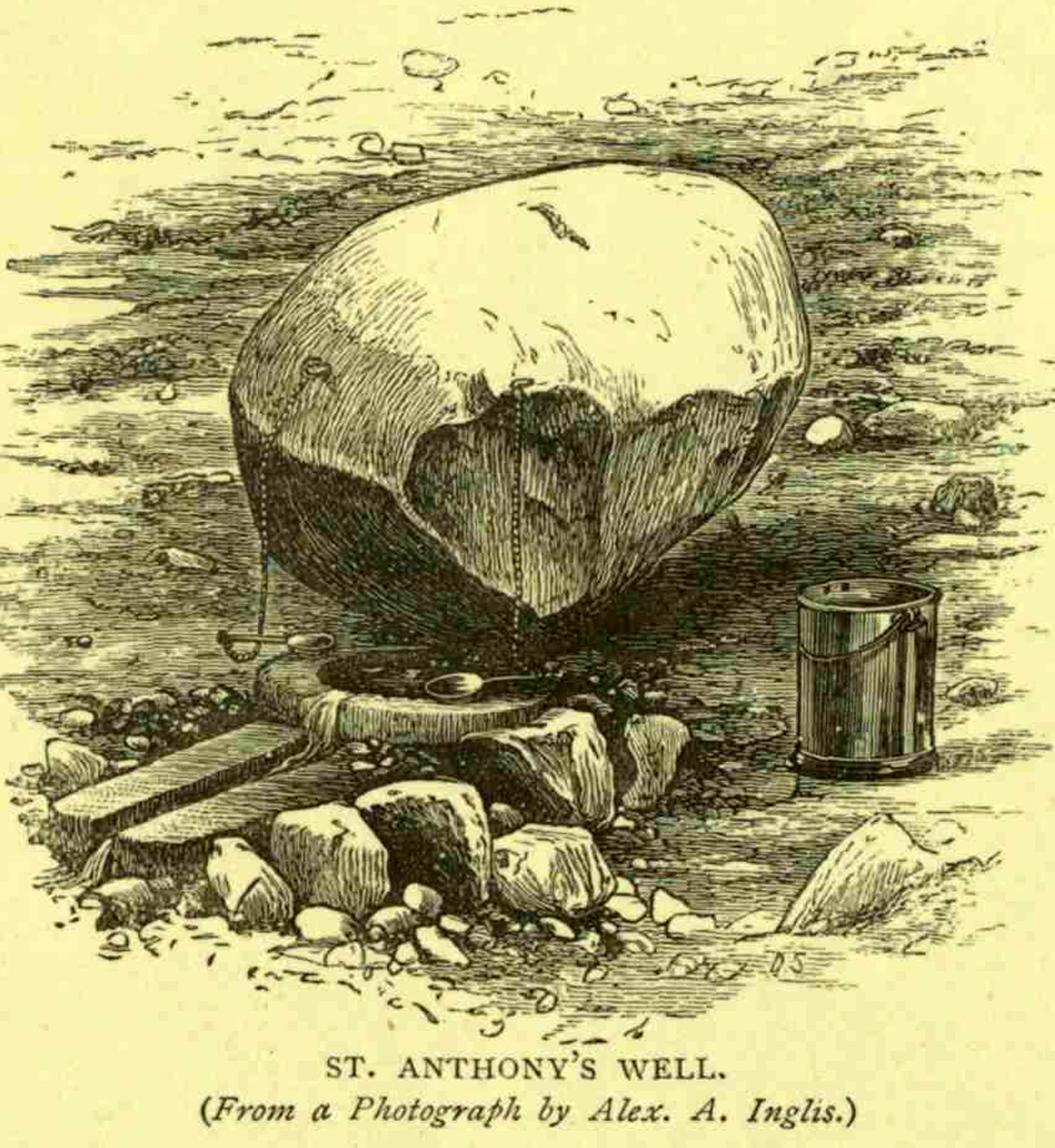
Not too difficult to find really.  Get to the northern part of the road which encircles Arthur’s Seat and when you get to St. Margaret’s Loch (near St. Margaret’s Well), look up the slopes on your right where you see the remains of St. Anthony’s Chapel.  You need to head up the footpath here until you reach a large-ish ovoid boulder, with a small circular trough into which the waters run (the drawing of the place here, with the rock in the lower-left, just in front of the fella walking towards it, is just right!).  You’re here!

Archaeology & History

St Anthony’s Well, Arthurs Seat

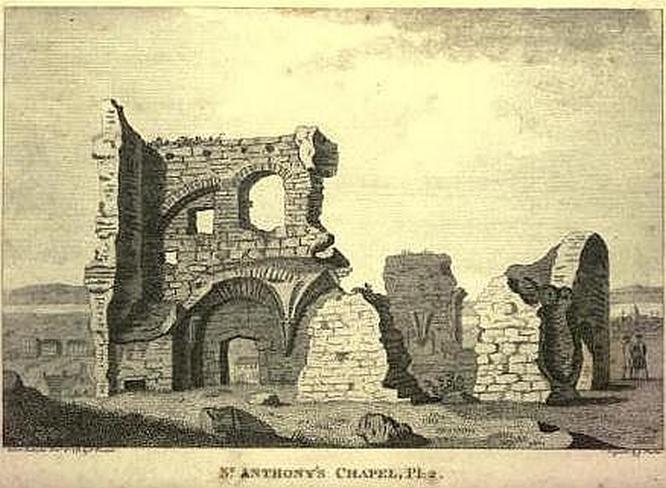
Tradition tells that the remains of St. Anthony’s Chapel was built on the northern ridge by Arthur’s Seat, “mainly for guardianship of the holy well named after the saint” — which sounds rather like the christianization story of a heathen site.  Francis Grose (1797) told that “this situation was undoubtedly chosen with an intention of attracting the notice of seamen coming up that Frith; who, in cases of danger, might be induced to make vows to its tutelar saint.” If this was the case, it sounds even more like a site that had prior heathen associations. Grose also told us that just a short distance from the chapel, were the remains of an old hermitage:

“It was partly of masonry worked upon the natural rock.  At the east end there are still two niches remaining; in one of which formerly stood a skull, a book, an hour-glass, and a lamp, which, with a mat for a bed, made the general furniture of the hermitage.”

I like the sound of the place!  Just up my street!  Little other archaeological info has emerged from this tiny spot — but the healing waters of the well would obviously have been of importance to our indigenous inhabitants (anyone who wants to think otherwise is simply a bit dim!) as there is a wealth of archaeological sites and relics all round Arthur’s Seat.

Folklore

A number of writers have described this old well, which has sun-lore, healing properties, and Beltane rites surrounding its past.  Local people of all social classes frequented this ancient spring, particularly on that most favoured of heathen days, Beltane.  The site was of considerable mythic importance with a certain order about it.  As Hone (1839) said:

“…the poorer classes in Edinburgh poured forth at daybreak from street and lane to assemble on Arthur’s Seat to see the sun rise on May-morning.  Bagpipes and other musical intruments enlivened the scene, nor were refreshments forgotten.  About six o’ clock a crowd of citizens of the wealthier class made their appearance, while the majority of the first-comers returned to the town.  At nine o’ clock the hill was practically deserted.”

Another early account describing St. Anthony’s Well is from an article in the great PSAS journal of 1883.  Here, J.R. Walker wrote:

St Anthonys Well

To an incident which showed that the faith and belief in the healing virtues of the wells is still strong, the writer was but a few months ago an eye-witness.  While walking in the Queen’s Park about sunset, I casually passed St. Anthony’s Well, and had my attention attracted by the number of people about it, all simply quenching their thirst, some possibly with a dim idea that they would reap some benefit from the draught.  Standing a little apart, however, and evidently patiently waiting a favourable moment to present itself for their purpose, was a group of four.  Feeling somewhat curious as to their intention, I quietly kept myself in the back ground, and by and by was rewarded.  The crowd departed, and the group came forward, consisting of two old women, a younger woman of about thirty, and a pale, sickly-looking girl — a child of three or four years old.  Producing cups from their pockets, the old women dipped them in the pool, filled them, and drank the contents.  A full cup was then presented to the younger woman, and another to the child.  Then one of the old women produced a long linen bandage, dipped it in the water, wrung it, dipped it in again, and then wound it round the child’s head, covering the eyes, the youngest woman, evidently the mother of the child, carefully observing the operation, and weeping gently all the time.  The other old woman not engaged in this work was carefully filling a clear flat glass bottle with the water, evidently for future use.  Then, after the principal operators had looked at each other with an earnest and half solemn sort of look, the party wended its way carefully down the hill

Earlier still we find more lore of the place in Wilson’s Edinburgh [1848] where he told:

St Anthony’s Chapel 1785

“The ancient Hermitage and Chapel of St. Anthony, underneath the hangings of Arthur’s Seat, are velieved to have formed a dependency of the preceptory at Leith, and to have been placed there, to catch the seaman’s eyes as he entered the Firth, or departed on some long and perilous voyage; when his voews and offerings would be most freely made to the patron saint, and the hermit who ministered at his altar.  No record, however, now remains to add to the tradition of its dedication to St. Anthony; but the silver stream, celebrated in the plaintive old song, ‘O waly, waly, up yon bank,’ still wells clearly forth at the foot of the rock, filling the little basin of St. Anthony’s Well, and rippling pleasantly through the long grass into the lower valley.”

Votive offerings made here eventually turned the waters into a simply wishing well for incomers, even in Victorian times (oh how the locals must have hated such trangression…).  The great Scottish holy wells writer J.M. MacKinlay (1893) told in his day the tale of,

“a little girl from Aberdeenshire, when on a visit to Edinburgh, made trial of the sacred spring.  She was cautioned not to tell anyone what her wish was, else the charm would have no effect.  On her return home however, her eagerness to know whether the wish had…been fulfilled, quite overcame her ability to keep the secret.  Her first words were, ‘Has the pony come?’  St. Anthony must have been in good humour with the child, for he provided the pony, thus evidently condoning the breach of silence in deference to her youth.”

In the middle of the 20th century, the great folklorist F.M. MacNeill (1959) wrote:

“Even in Edinburgh, little bands of the faithful may be seen making their way through the King’s Park to Arthur’s Seat, and, as in the eighteenth century:

On May-Day, in a fairy ring,
We’ve seen them round St. Anton’s spring,
Frae grass the caller dew-drops wring,
To weet their een,
And water clear as crystal spring,
To synd them clean.”

And when Ruth and Frank Morris (1982) got round to their excellent survey, they found that this old well was still being used “by youths and maidens, who come to wash their faces with the dew on May Day mornings, a wish at St. Anthony’s being a part of the ritual.”  But this final remark may have the simple prosaic coincidence of them observing people like I, when younger, who frolicked with girlfriends around May morning, in the grasses near the old well — though at the time I knew nothing about the old sacred waters on the slopes just above us!

References:

  1. Bennett, Paul, Ancient and Holy Wells of Edinburgh, TNA: Alva 2017.
  2. Grose, Francis, The Antiquities of Scotland – volume 1, Hooper & Wigstead: London 1797.
  3. Hone, William, The Every-Day Book and Table-Book, Thomas Tegg: London 1839.
  4. MacKinlay, James M., Folklore of Scottish Lochs and Springs, William Hodge: Glasgow 1893.
  5. McNeill, F. Marian, The Silver Bough – volume 2, William McLellan: Glasgow 1959.
  6. Morris, Ruth & Frank, Scottish Healing Wells, Alethea: Sandy 1982.
  7. Walker, J. Russel, “‘Holy Wells’ in Scotland,” in Proceedings of the Society of Antiquaries of Scotland, vol.17 (New Series, volume 5), 1883.
  8. Wilson, Daniel, Memorials of Edinburgh in Olden Times, Hugh Paton: Edinburgh 1848.

© Paul Bennett, The Northern Antiquarian

Wycoller Bridge, Trawden, Lancashire

Cup-Marked Stones:  OS Grid Reference – SD 931 393

Getting Here

Easy enough to find once you’ve actually got to Wycoller.  By car, the only real way to get here is from Colne, through the village of Winewall, and along the Wycoller road, which runs to a dead end.  Once here, the old packhorse bridge with these cup-marks on it can’t be missed!

Archaeology & History

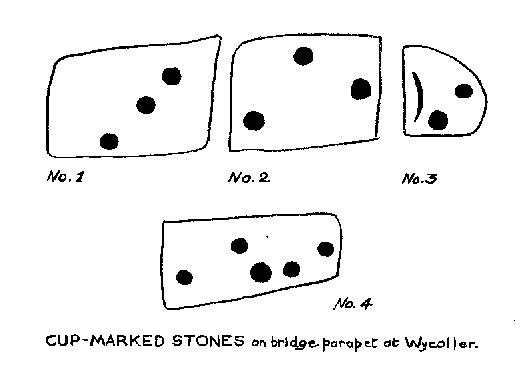
Wycoller Bridge's cup-marked stones (after Jackson, 1962)
Wycoller Bridge’s cup-marked stones (after Jackson, 1962)

A weird one this!  On the famous packhorse bridge close to the old hall, four of the stones have cup-markings etched onto them.  It seems that at least three of the carvings are archaic; with cups on one of the stones being somewhat deep and may actually be medieval.  But we simply don’t know….  A short article describing them was in the Bradford Cartwright Hall Archaeology Bulletin (1962) where they were equally as puzzled about them.  In 1979, J.A. Heginbottom described them in his survey on the prehistoric rock-art of upper Calderdale.  It’s possible that the stones on which the cups were carved might have been taken from a prehistoric tomb on the edge of the moor further up the valley from here.

Folklore

Just next to this bridge is another, much older one, known locally as the Clapper or Druid’s Bridge which perhaps has some bearing on the curious cup-markings.  Legend tells that this older construction was so called “because legend has it that it led to an amphitheatre where the druids held human sacrifices” – and the field just up from here (to the southwest) was known as the Dripping Stone Field.  Hmmmmm…..

References:

  1. Bentley, John, Portrait of Wycoller, Nelson Local History Society 1975.
  2. Heginbottom, J.A., The Prehistoric Rock Art of Upper Calderdale, unpublished report: 1979.
  3. Jackson, Sidney, ‘Cup-Marked Stones at Wycoller,’ in Cartwright Hall Archaeology Group Bulletin, October 1962.

© Paul Bennett, The Northern Antiquarian

The Great Stone, Downham, Lancashire

Legendary Rock:  OS Grid Reference – SD 78212 44402

Also Known as:

  1. Downham Cross (Byrne 1974)

Getting Here

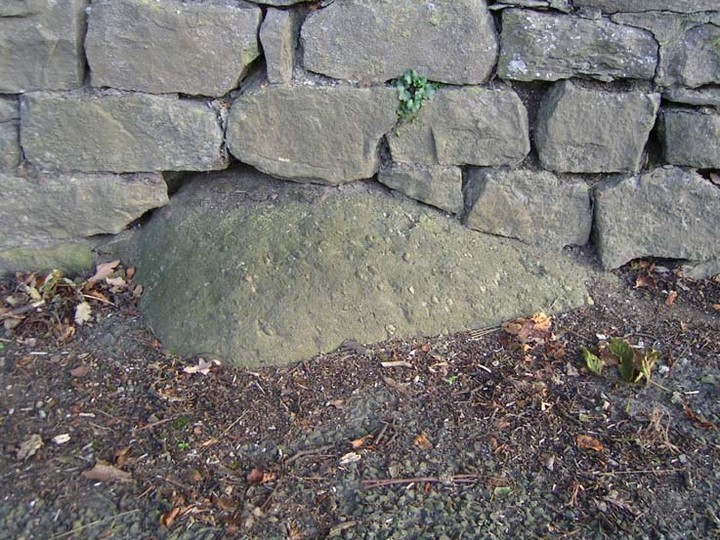
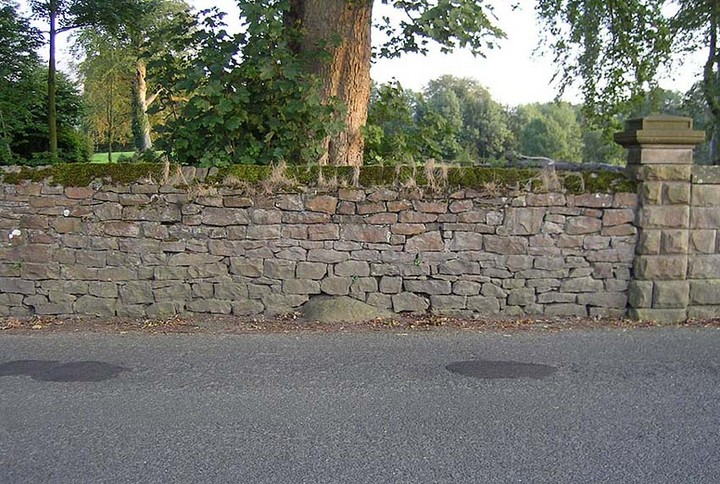
The best way to locate this is probably by starting from the pub opposite the old church of St. Leonard and heading west along the village road, past three large gate-entrances, until reaching the conspicuous milestone by the road junction.  On the other side of the road, just before the gate entrance to Downham Hall, edged into the base of the wall, we find this ‘ere The Great Stone.

Archaeology & History

The Great Stone, Downham

What a truly beautiful little village we find in Downham, nestled quietly and with age at the northern edge of Pendle hill.  It’s tucked away, off any main road so maintaining its sense of age and almost reclusive nature.  There is hidden history a-plenty scattering the landscape here, but tales of our Great Stone — thought by some as an old monolith; remains of a Roman milestone by others; whilst some just denote it as nowt but a small stone — is what brought me here.  It’s name betrayed my expectation (I always hope for too much it seems…), but the small pock-marked stone has been embedded in its present position for at least 150 years, as the growth of soil and tree behind it shows.  Archaeo-historians say little of it (reputations y’ know!) until something substantial is found; but thankfully we came upon the lovely couple who are Lord and Lady Clitheroe of Downham Hall, who told us more…

Folklore

“There are a couple of humourous legends told of the Great Stone,” Lord Downham began… But to a (sometimes) courteous megalithomaniac like myself, the tales rang the all-too-familiar bell.

Close-up of the Great Stone

The original position of the stone, though not known for certain, was some short distance away either across the road, or further along in a nearby field.  When it was moved – Lord Downham said around 1830 – the remains of a body were found beneath it; but another source told in fact that it marked “the final resting place of two legionaries who died on the nearby Roman road during trouble with the Brigantes.” (An old Roman road is nearby)  But apparently this old stone also moves. When the church bell strikes midnight the stone is said to turn itself around upside-down. Where have we heard that before!?

The site is described in Clifford Byrne’s (1974) unpublished manuscript on the crosses of Lancashire, where he cites it as being the remains of a cross pedestal, but adds that “if ever a cross stood by the village green, no memory of seems now to exist.”  But Mr Byrne also described the all-too-familiar heathen folk tales, saying:

“A local man told the writer that the object is called Downham Stone and that it turns over every night at midnight.  We read elsewhere that the boulder is called “the great stone of Downham” and that it turns at the stroke of midnight by the church clock.”

References:

  1. Byrne, Clifford H., “A Survey of the Ancient Wayside Crosses in North East Lancashire,” unpublished manuscript, 1974.
  2. Lofthouse, Jessica, Three Rivers, Robert Hale: London 1946.
  3. Lofthouse, North Country Folklore, Robert Hale: London 1976.
  4. Winterbottom, Vera, The Devil in Lancashire, Cloister: Stockport 1963.

© Paul Bennett, The Northern Antiquarian

Skirtful of Stones, Horton-in-Ribblesdale, North Yorkshire

Cairn (destroyed):  OS Grid Reference – SD 785 747

Getting Here

Although apparently long gone, we could find this giant prehistoric tomb on the eastern side of the great Ingleborough and was one of many with this name once scattering the mid-Pennines. It was found less than a mile south of the hamlet of Selside, a few miles above Horton-in-Ribblesdale, on the west side of the B6479 and its existence is thankfully preserved in the place-name, ‘Borrens’, where the giant tomb was once found, 200 yards south of Gill Garth Farm.  If you look on the OS-map, you’ll notice an ancient settlement site close by.

Archaeology & History

In 1892, the great Yorkshire historian Harry Speight told us:

“We have no proper account of it, but it was doubtless ransacked and removed in the expectation of finding treasure. It is mentioned…in the Gentleman’s Magazine for 1761, as follows:

‘In the valley above Horton, near the base of this mountain (Ingleborough), I observed a large heap or pile of greet-stones all thrown promiscuously together, without any appearance of building or workmanship, which yet cannot be reasonably thought to be the work of Nature. Few stones are found near it, though ’tis computed to contain 400 of that country cart-loads of stones, or upwards. There is likewise another at the base north-east, in resemblance much the same, but scarce so large.'”

Speight speculated that it may have been raised to commemorate “some dire conflict between the Romans and the native hill tribes, as it lay on the old Roman thoroughfare across Ribblehead to the camp under Smearside.” We may never know this for sure, but there are plenty of Iron- and Bronze Age remains scattering this region – and just a few hundred yards south of this lost cairn are the old remnants of an ancient settlement…whose pages and images (it is hoped) will appear on TNA in the near future…

References:

  1. Smith, A.H., English Place-Name Elements, volume 1, Cambridge University Press 1956.
  2. Smith, A.H., Place-Names of the West Riding, volume 6, Cambridge University Press 1961.
  3. Speight, Harry, The Craven and Northwest Yorkshire Highlands, Elliott Stock: London 1892.

© Paul BennettThe Northern Antiquarian 


Simon’s Seat, Skyreholme, North Yorkshire

Sacred Hill:  OS Grid Reference – SE 0788 5981

Getting Here

Simon’s Seat in the centre & the Lord’s Seat immediately east

Tons of ways here.   To those who drive, take the Grassington-Pateley Bridge (B6265) road and a couple of miles past the village of Hebden, you’ll see the high rocks climbing on your southern horizon, with another group of rocks a few hundred yards along the same ridge.  That’s it!

Archaeology & History

This is an awesome site, full of raw power. It commands a brilliant view all round, but it is the north which truly draws the eye’s attention. Beneath the great drop of this huge outcrop is the haunted and legendary Troller’s Ghyll. The scent of as yet undisclosed neolithic and Bronze Age sites purrs from the moors all round you and there can be little doubt that this was a place of important magick in ancient days.

What seems to be several cup-markings on one of the topmost rocks are, to me, authentic. Harry Speight mentioned them in his 1892 work on the Craven and Northwest Yorkshire Highlands – but there are a number of other rocks in this giant outcrop with “possibles” on them.

Folklore

The name of this great rock outcrop has long been a puzzle to historians and place-name experts.  One tale that was told of Simon’s Seat to the travelling pen of one Frederic Montagu in 1838, told that,

“It was upon the top of this mountain that an infant was found by a shepherd, who took it to his home, and after feeding and clothing it, he had the child named Simon; being himself but a poor man, he was unable to maintain the foundling, when it was ultimately agreed to by the shepherds, that the child should be kept “amang ’em.”  The child was called Simon Amangham and the descendants of this child are now living in Wharfedale.”

The usually sober pen of Mr Speight thinks this to have been one the high places of druidic worship, named after the legendary Simon Druid. “It is however, hardly likely,” he wrote, “that he ever sat there himself, but was probably represented by some druidical soothsayer on whom his mystic gifts descended.”

I’ve gotta say, I think there’s something distinctly true about those lines. Visit this place a few times, alone, during the week, or at night – when there’s no tourists about – and tell me it isn’t…

References:

  1. Bogg, Edmund, Higher Wharfeland, James Miles: Leeds 1904.
  2. Montagu, Frederic, Gleanings in Craven, Simpkin Marshall: London 1838.
  3. Speight, Harry, The Craven and Northwest Yorkshire Highlands, Elliott Stock: London 1892.

© Paul Bennett, The Northern Antiquarian

Robin Hood’s Penny Stone, Wainstalls, West Yorkshire

Stone Circle (destroyed):  OS Grid Reference – SE 046 288

Archaeology & History

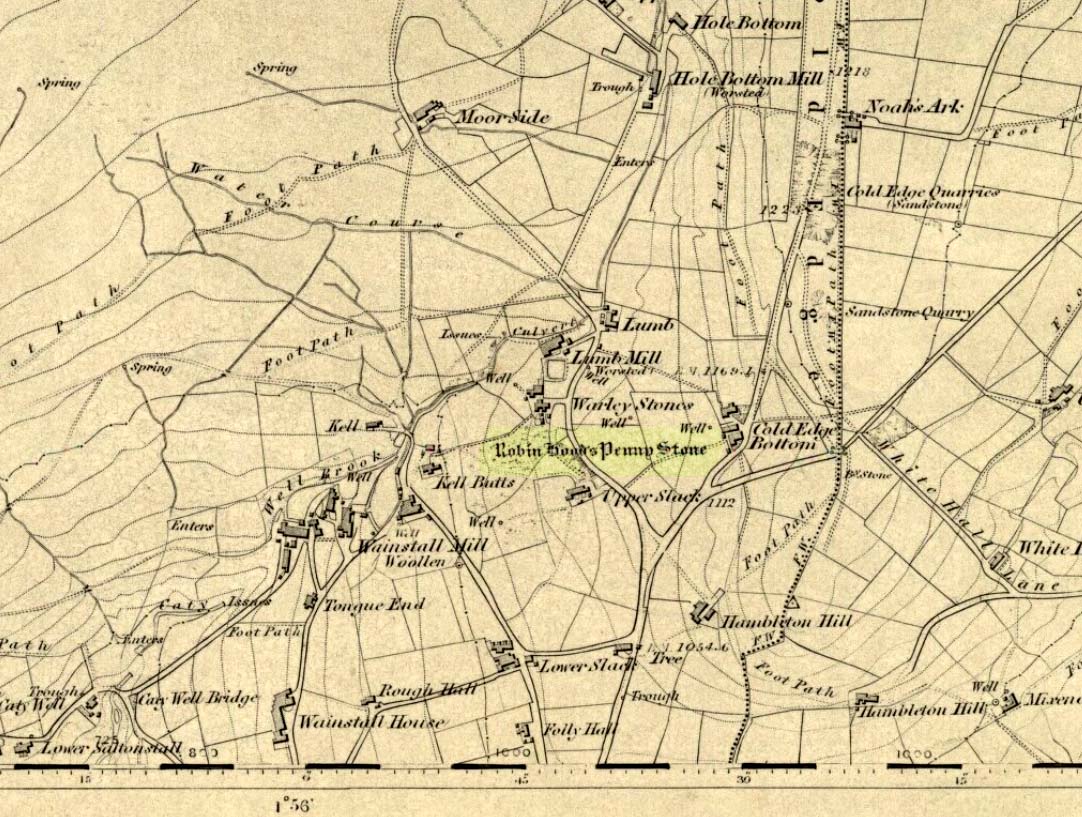
The Pennystone on 1852 map

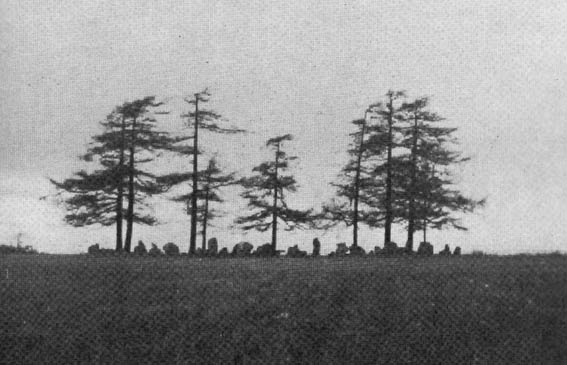
All remains of this site, first mentioned as a stone circle in 1836, have gone. The place could be found by the appropriately named Stone Farm at the top end of Wainstalls and was first mentioned by John Watson (1775), who strangely said nothing about any circle here.  However, this changed when John Crabtree (1836) arrived and described a ring of stones surrounding a large boulder in the centre (illustrated here). The boulder itself was actually called the Robin Hood Penny Stone.

Folklore

Watson's 1775 drawing
Watson’s 1775 drawing

This was one of the many legendary sites from where our legendary outlaw practiced shooting his arrows.  He was also said to have picked up and thrown a large standing stone from this spot, until it landed three-and-a-half miles away on the hillside on the other side of the Calder Valley. (this was known as the Field House, or Sowerby Lad Standing Stone)

References:

  1. Bennett, Paul, The Old Stones of Elmet, Capall Bann 2001.
  2. Crabtree, John, Concise History of the Parish and Vicarage of Halifax, Hartley & Walker: Halifax 1836.
  3. Dobson, R.B. & Taylor, J., Rymes of Robyn Hood, Alan Sutton: Gloucester 1989.
  4. Faull, M.L. & Moorhouse, S.A., West Yorkshire: An Archaeological Guide (4 volumes), WYMCC: Wakefield 1981.
  5. Varley, Raymond, “A Stone-Axe Hammer, Robin Hood’s Penny Stone and Stone Circle at Wainstalls, Warley, near Halifax,” in Yorks. Arch. Journal 69, 1997.
  6. Watson, John, The History and Antiquities of the Parish of Halifax, T. Lowndes: London 1775.

© Paul Bennett, The Northern Antiquarian

Wart Stone, Bradford, West Yorkshire

Standing Stone (destroyed):  OS Grid Reference – SE 15940 34211

Also known as:

  1. Ash Stone
  2. Pin Stone

Archaeology & History

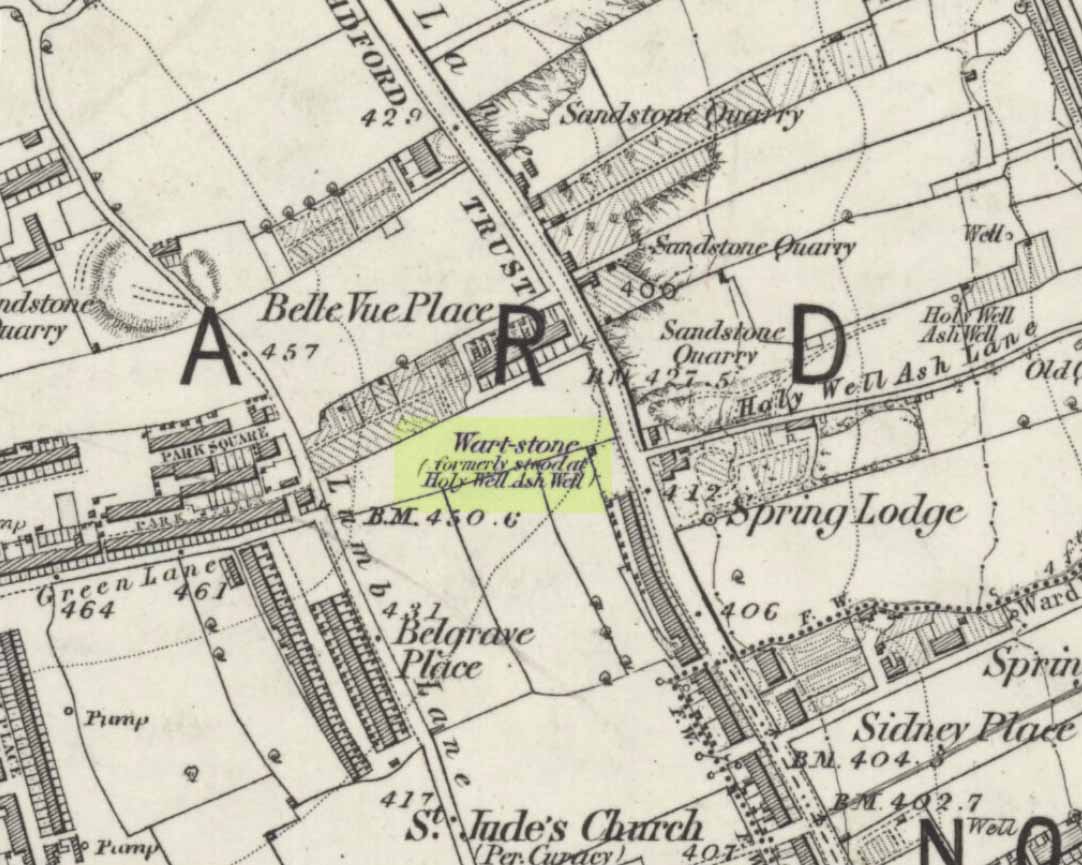
Wart Stone on 1852 OS-map

At Bradford City’s football ground there used to be the holy well known as the Holy Ash Well, adjacent to which was this old stone (as shown on the 1852 OS map).  For some reason it was uprooted and moved further up the hill around the end of the 19th century and was resurrected beside the old Belle Vue Hotel on Manningham Lane.  From thereon however, I’ve not been able to trace what happened to it, and presume it’s been destroyed.  It was known by local people to have had a ritual relationship with the adjacent healing well, to which people were said to visit from far and wide.

It seems to have been described first by Abraham Holroyd (1873), who told us that:

“In Manningham Lane there is a fine well, in old deeds called Hellywell, i.e., holy well, in a field now called Halliwell Ash, now a stone quarry… Near this is the ancient Pin Stone.”

The Bradford historian William Preston also made mention of the stone in one of his early surveys, where he told how local people also knew the stone as the Ash Stone, due to its proximity and ritual relationship to a great old tree.

Folklore

Also known as the Wart Stone, thanks to its ability to cure them and other skin afflictions.  Intriguingly, the building which now stands on the site is said to be haunted.

As my old school-mate, Dave Pendleton (1997), said of the place and its associated well:

“Prior to 1886 the only feature of any real note in the Valley Parade environs was a holy well that emerged near the corner of the football grounds Midland Road and Bradford End stands; hence the road Holywell Ash Lane. Today the site of the well is covered by the football pitch.

Only the road name survives as a reminder of what was apparently one of the district’s foremost attractions. On Sundays and holidays people would gather to take the waters and leave pins, coins, rags and food as offerings to the spirit that resided in the waters.

Accounts suggest that the well was covered and had a great ash tree standing over it (hence ‘holy ash’). There was also a standing stone called the wart stone of unknown antiquity. The stone had a carved depression that collected water. It was believed that the water was a miraculous cure for warts. Indeed, as early as 1638 the Holy Well had been credited with healing powers.

The well suffered a decline in popularity during the late nineteenth century and its keepers resorted to importing sulphur water from Harrogate, which they sold for a half penny per cup. The well disappeared under the Valley Parade pitch during the summer of 1886 and the wart stone was moved to the top of Holywell Ash Lane – which then ran straight up to Manningham Lane. The stone was still there as late as 1911 but thereafter it seems to have disappeared into the mists of time.”

Unfortunately we have no old photos or drawings of this lost standing stone – though I imagine that some local, somewhere must be able to help us out with this one.  Surely there’s summat hiding away…

References:

  1. Bennett, Paul, The Old Stones of Elmet, Capall Bann: Milverton 2001.
  2. Holroyd, Abraham, Collecteana Bradfordiana, Saltaire 1873.
  3. Pendleton, David & Dewhirst, John, Along the Midland Road, Bradford City AFC 1997.

© Paul Bennett, The Northern Antiquarian 


Ox-Foot Stone, South Lopham, Norfolk

Standing Stone (destroyed):  OS Grid Reference – TM 052 809

Folklore

This slab of sandstone apparently used to stand upright in one of the fields of Oxfootstone Farm and on its surface is supposed to be the burnt impression of a cow’s hoof-print. Legend tells that there was a fairy cow which would come into the area when times of hardship occurred. During such periods she would freely give her milk to the people, but when the drought was over she stamped down on the stone upon which she stood, burning the imprint of her hoof onto it and magically vanished back from whence she came. A variation of the tale tells of a normal cow whose milk normally supplied the local villagers. But one night a drunken man (in another tale it is a witch) milked the cow dry through a sieve, until only blood came from her udders. At this point, the cow cried out in pain and kicked the stone so hard that she left the mark of her hoof-print on it.

Another tale tells that an ox got a large thorn stuck in its foot and rampaged through the local village, eventually stamping its hoof onto the stone so hard that it left the imprint of its foot here.

Now this might sound presumptious of me — but this tale has all the hallmarks of it being an old folk-remnant telling the origin of some cup-and-ring marked stone.  We find a number of cup-and-rings with creation tales similar to this.  Are there any local archaeologists or enthusiasts in Norfolk who might be able to locate any remains of this possible carved stone?

References:

  1. Burgess, Michael W., The Standing Stones of Norfolk and Suffolk, ESNA 1: Lowestoft 1978.
  2. Dutt, W.A., The Ancient Mark-Stones of East Anglia, Flood & Sons: Lowestoft, 1926.

© Paul Bennett, The Northern Antiquarian

Nursery Knot, Appletreewick Moor, North Yorkshire

Sacred Hill:  OS Grid Reference – SE 081 636

Also known as:

  1. Nursa Knott
  2. Nursery Hill

Getting Here

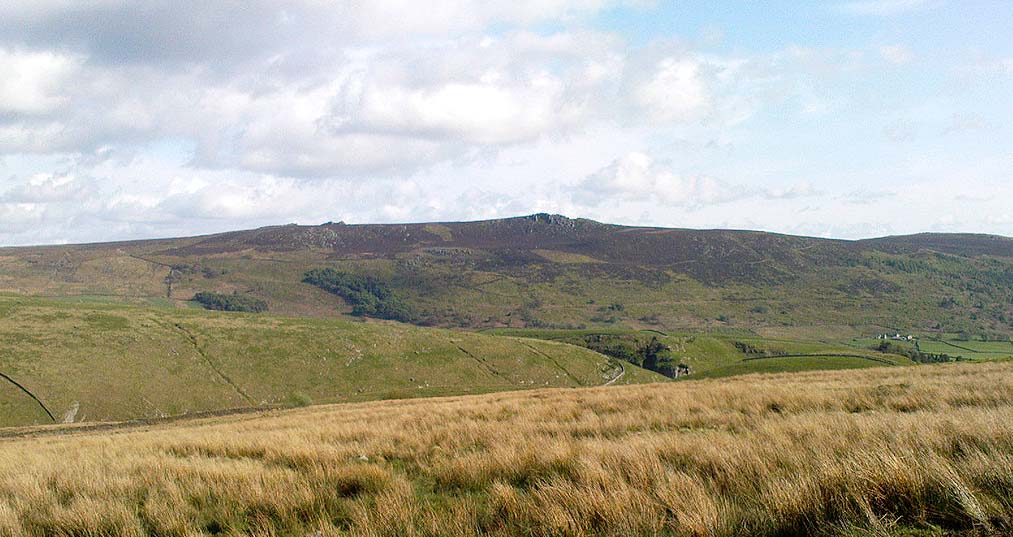
Dead easy.  Follow the Grassington-Pateley Bridge road (B6265) east and about 2 miles past Hebden village, the craggy hill rises to the left-hand side of the road, as you can see in the photo below.  Simple!

Archaeology & History

Nursery Knott hill
Nursery Knott hill

When fellow rock-art freaks Graeme Chappell, Richard Stroud and I were exploring the cup-and-ring stones in the area just south of here a few years back, this hill kept calling out with some repeated awe. “There’s summat about that place,” were the remarks we kept saying – but we could never put our finger on it. (still haven’t if truth be had!).  Between here and the awesome Simon’s Seat to the south, a whole panoply of neolithic and Bronze Age remains scatter the land — and if ritual landscape has any validity, this hill is undoubtedly enmeshed in the mythic framework of such a paradigm. But without any folklore I didn’t feel right to include it here…

At the northern or rear-end of this great outcrop (SE 082 640) is a scattering of many boulders, one of which in particular at Knot Head was explored by a Mr Gill in 1955 and found to have a number of Mesolithic worked flints all round it. Seems as if folk have been up to things round here for even longer than we first thought.  Microlith or flint-hunters would probably do well on the moors up here!

Folklore

It’s the old pen of our Yorkshire topographer Edmund Bogg which brings the lost folktale of this place back to life – and it’s typical of aboriginal creation myths from elsewhere in the world. In his Higher Wharfeland he had this to say of old ‘Nursa Knott’, as it was locally known:

“The old legend is that the devil, for some reason anxious to fill up Dibb Gill,* was carrying these ponderous crags in his apron when, stumbling over Nursa Knott, the strings broke and the crags fell. Legend also says, should the crags be removed they will be carried by some invisible power back to their original position.”

He then reminds us of links with old Wade, plus the settlement of old Grim, a short distance to the north.

Across the road down the track running south to Skyreholme, Jessica Lofthouse ( 1976) told the tale of a ghostly horseman, seen by her great-grandfather no less! Suggesting he may have been ‘market merry’ (i.e., pissed!), she told how he “struck out at a spectral white horse at the Skyreholme three-land ends near Appletreewick – and his stick passed through it!”

References:

  1. Bogg, E., Higher Wharfeland: The Dale of Romance, James Miles: Leeds 1904.
  2. Lofthouse, Jessica, North Country Folklore, Hale: London 1976.
  3. Walker, D., ‘A Site at Stump Cross, near Grassington, Yorkshire, and the Age of the Pennine Microlithic Industry,’ in Proceedings of the Prehistoric Society, 1956.

* Dibb Gill is nearly a mile due west of here – and Dibble’s Bridge which crosses the beck was also known as the Devil’s Bridge, with a few typical creation myths of its own attached.

© Paul Bennett, The Northern Antiquarian