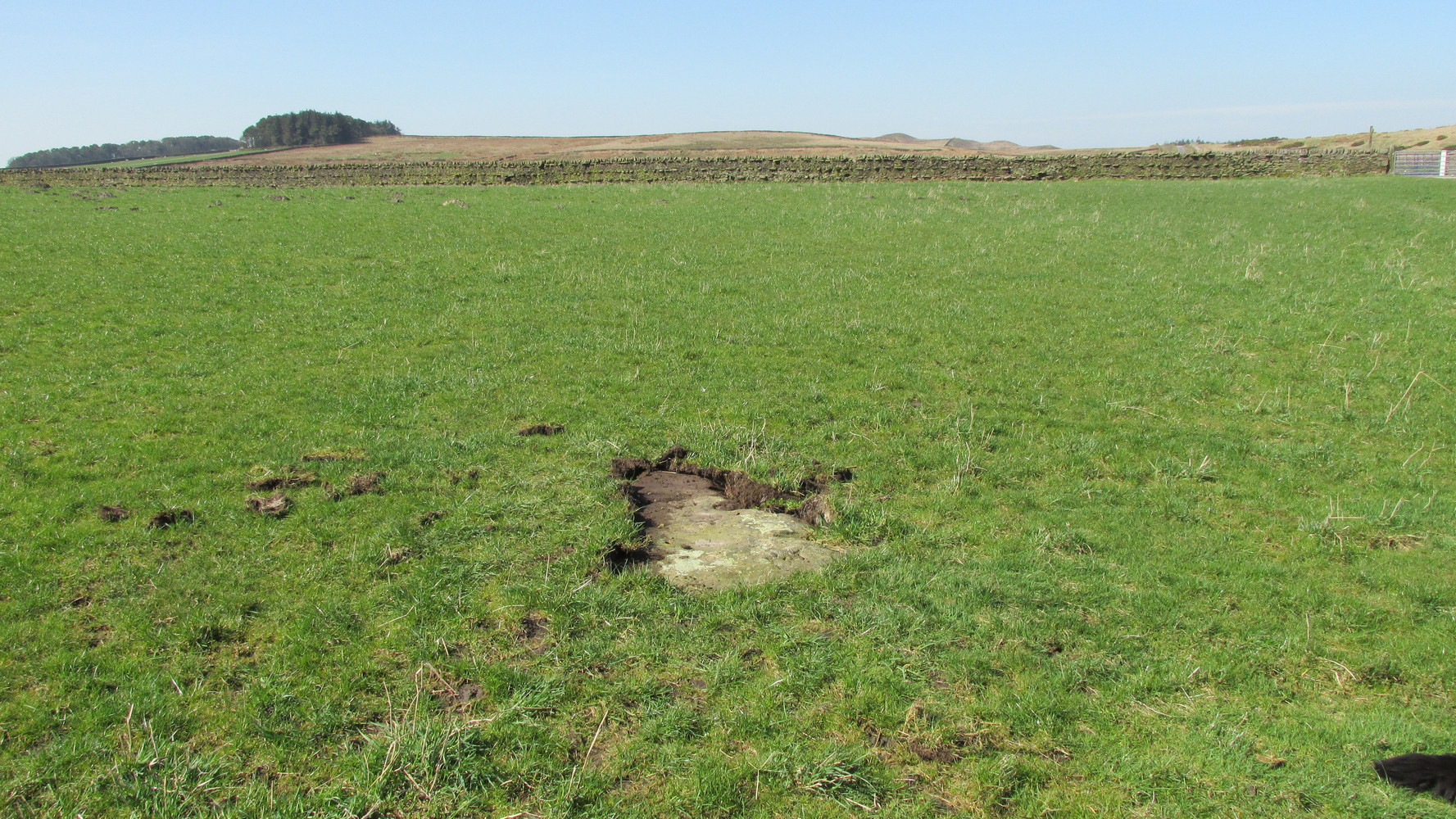
Killiesmont, Keith, Moray

Cup-Marked Stone (destroyed):  OS Grid Reference – NJ 4124 5308

Archaeology & History

Diagonally across the road from Killiesmont, about a hundred yards up the sloping field on “a piece of ground called the Helliman Rig,” could once be seen a large flat stone with cup-markings on its surface.  Walter Gregor (1881) told that,

“It lay on the top of a rising ground, and commanded a very wide view of the country, stretching for many miles over the hills of Banff and Moray.  In a part of it the rock–a kind of slate–came to the surface.  In the rock were cut out nine cups in three rows.”

The carving was earlier described in one of the Topographical Gazetteers of Scotland (1848) where its story is bound up with local tradition and folklore of the land where it lie.  There it was described as being “a flat circular stone of about 8 feet in diameter, in which there are a number of holes, but for what purpose tradition is silent.”  Subsequently the local historian J.F.S. Gordon (1880) talked of this “large flat circular Stone, of about 8 feet in diameter, in which there was a number of half-pierced holes…. It was too large for a Quern or even a Millstone; and its purpose remained an enigma.”

The stone came to light when a local farmer was digging in the field and, “at the upper end of the Rig, there was found a rude Cist among a heap of stones, which contained ashes.”  The cup-marked stone was “turned up” at the same time.  It has sadly been destroyed—along with the associated cairn that probably had some relationship with the carving.  Prehistoric tombs and rock art are frequent bedfellows and it seems likely that the equation occurred here.  But the location of the site had some fascinating local lore told of it…

Folklore

The location of this carved stone in the field called ‘Helliman Rig’, was also known as the Guidman’s Croft or the Gi’en Rig.  This was a portion of land that was never to be touched or ploughed as it was “given or appropriated…to the sole use of the devil, in order to propitiate the good services of that malign being.”  This devilish tradition superseded the earlier faith of it being a place set aside for the fairy folk and their allies—nature spirits no less.  And it’s a tradition found in many places across Scotland and elsewhere, as the account in the Scottish Gazetteer told :

“Like other crofts of this description in Scotland, the present remained long uncultivated, in spite of the spread of intelligence (pedantic bastard! PB).  The first attempt to reclaim it was made not more than 50 years since, when a farmer endeavoured to improve it; but, by an accidental circumstance, it happened that no sooner had the plough entered the ground than one of the oxen dropped down dead. Taking this as an irrefragable proof of the indignation of its supernatural proprietor, the peasant desisted, and it remained untilled till it came into the possession of the present occupant…”

This of course fortified the old folklore in the eyes of local people.  I’ve found that even up to recent times, such folklore is still held quite seriously by some of the old folk in the mountain villages and hamlets.

References:

  1. Anon, The Topographical, Statistical and Historical Gazetteer of Scotland – volume 2, A. Fullarton: Edinburgh 1848.
  2. Gregor, Walter, Notes on the Folk-lore of the Northeast of Scotland, Folklore Society: London 1881.
  3. Gordon, J.F.S.,  The Book of the Chronicles of Keith, Grange, Ruthven, Cairney and Botriphnie, Robert Forrester: Glasgow 1880.

© Paul BennettThe Northern Antiquarian

Chapel Well, Botrea, Sancreed, Cornwall

Holy Well (lost):  OS Grid reference – SW 4025 3062

Archaeology & History

Just over a mile northwest of the superb Sancreed Well, we find documentary evidence from 1778 recording the field-name of Chapel Well Close here, although there seems to be no remaining spring or well and nothing is shown on the early OS-maps.  Official records define it as a “medieval well” and speculate that it may have been associated with the nearby Boscence Chapel and possibly dedicated to St. Winwaloe.

References:

  1. Anon., The Church and Parish of Sancreed in the County of Cornwall, Brewer: Sancreed c.1960.

© Paul BennettThe Northern Antiquarian

Old Wives’ Well, Stape, Pickering, North Yorkshire

Sacred Well:  OS Grid-Reference – SE 7944 9406

Also Known as:

  1. Nattie Fontein

Archaeology & History

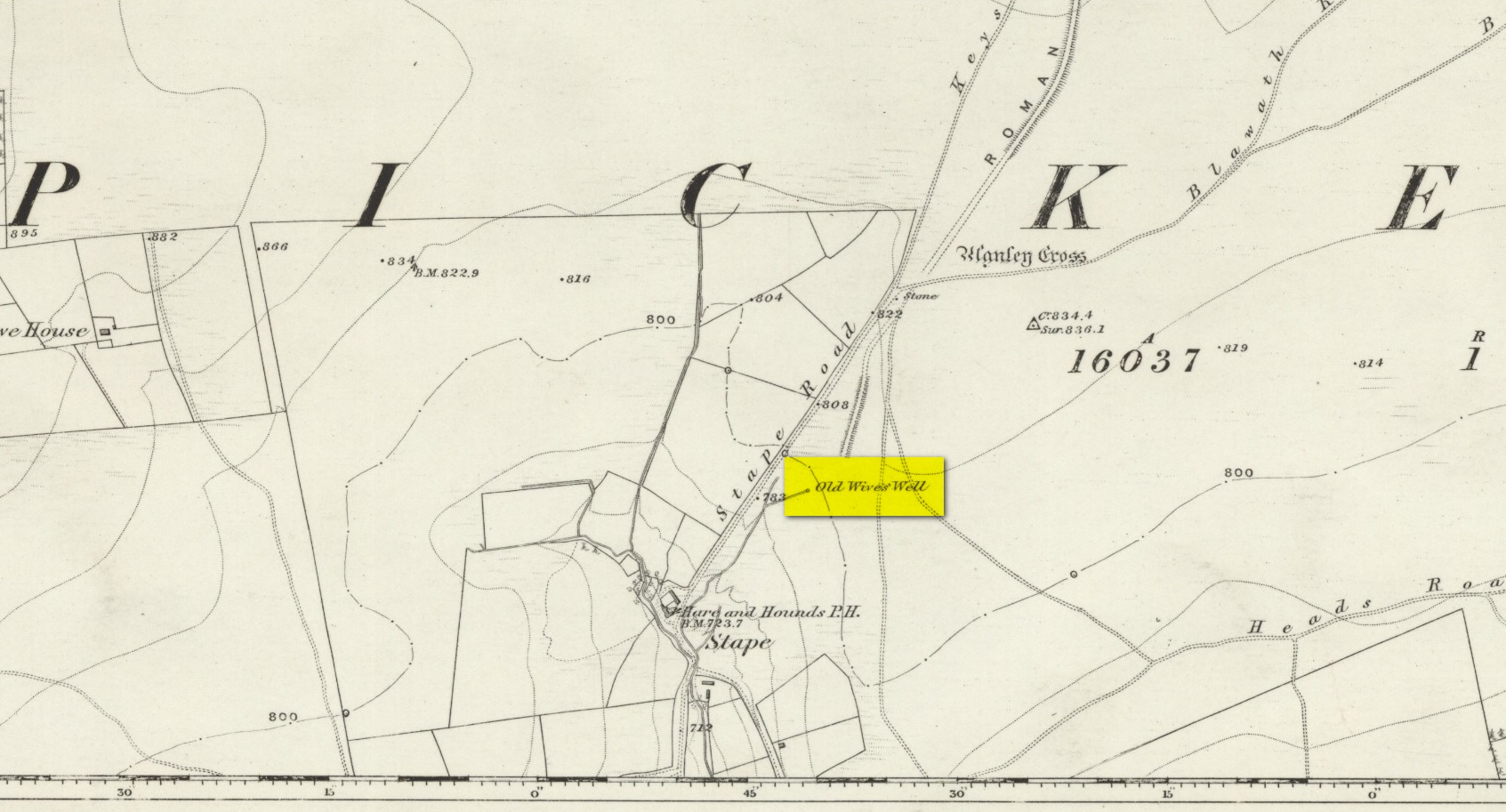
Old Wives Well, 1848 OS-map

The history of the site is scanty to say the least.  It first seems to have been recorded when the Ordnance Survey lads came here in the 1840s, although they left no record as to why the site was given such a dedication.  It’s a decidedly pre-christian title as the name “old Wife” is usually indicative in northern counties as being related to the primal Earth deity of northern England and lowland Scotland (when we reach the Highlands and Ireland, She becomes known—amongst other names—as the cailleach).  However, apart from its name we have no additional information.  Neither the holy wells writer Edna Whelan (1989; 2001), nor hydrolatry researcher Graeme Chappell were been able to find anything about the place in their own researches.  And so we must go on name alone…

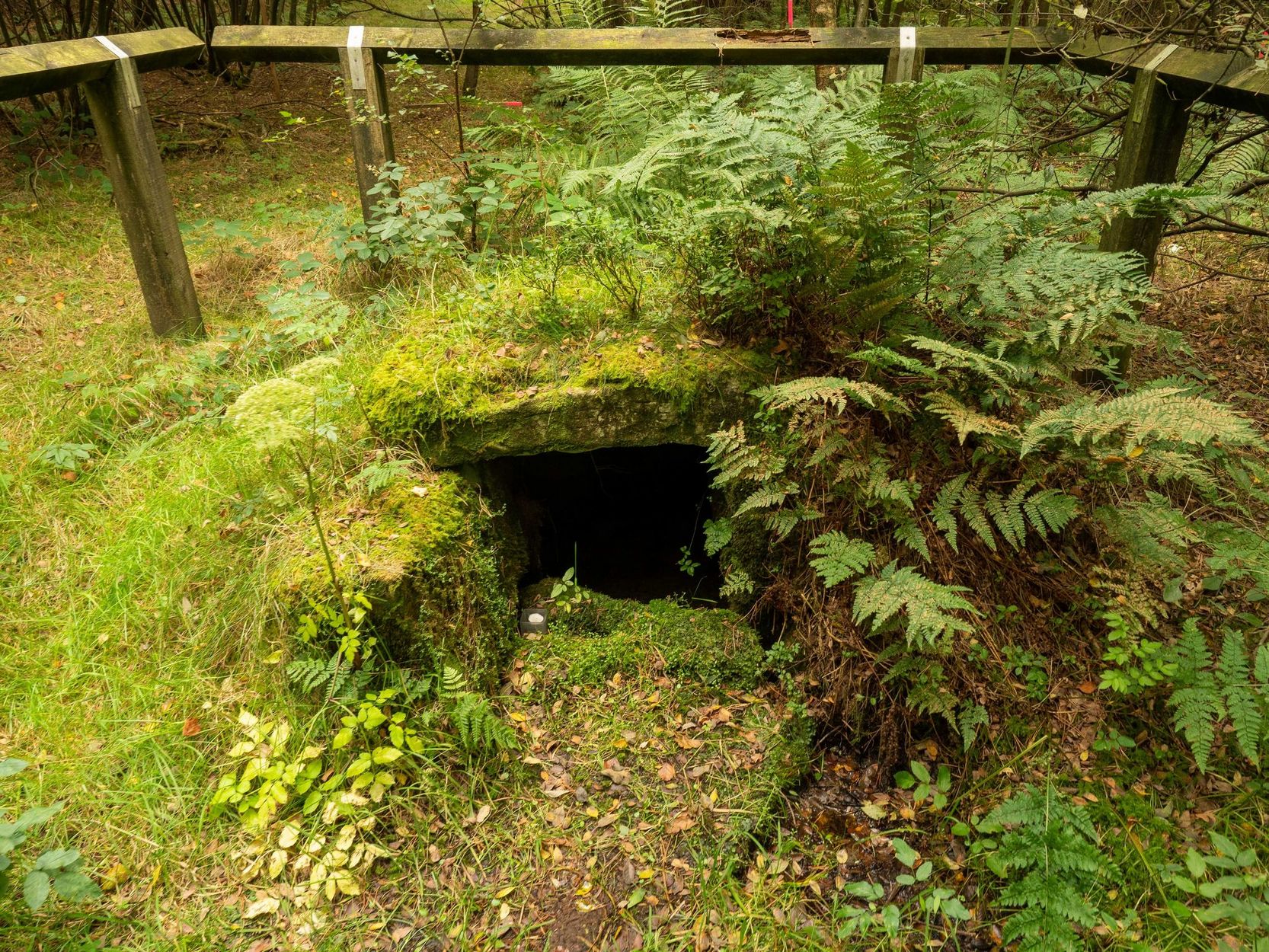
The waters bubble up into a small stone-lined chamber with the words Nattie Fontein carved into the lintel.  This is something of a mystery in itself, for, as Edna Whelan (1989) told,

“it would be most unusual for the word fonten to be used for a spring in North Yorkshire: ‘keld’ is the local word.  The rather roughly inscribed word may be a corruption of Fons Natalis, the name of a Celtic water nymph.”

Graeme Chappell (2000) meanwhile, noticed in a visit to the site in June 1999,

“that the N and A in “NATTIE” are carved in such a way that the word could be read as “MATTIE FONTEIN” perhaps meaning “Mother Fountain”. This might then be another reference to the Old Wife?”

He then goes on to note how,

“the latin word ‘natalis‘ meaning ‘birth’ and its link with the roman Festival ‘Dies Natalis Sol Invictus‘ (day of the birth of the unconquered sun) which took place on the 25th December. Natalis also gave rise to the welsh word ‘Nadolig‘ – meaning Christmas.”

This Yuletide element has an intriguing relationship with the name of the well; for to the west of Yorkshire’s borders into Cumbria there was annual gathering known as Old Wives’ Saturday that took place on the first Saturday after Christmas, or first Saturday of the New Year in a person’s house or inn, where a feast was had to bring in the New Year; but there is no known written lore of such a tradition here.

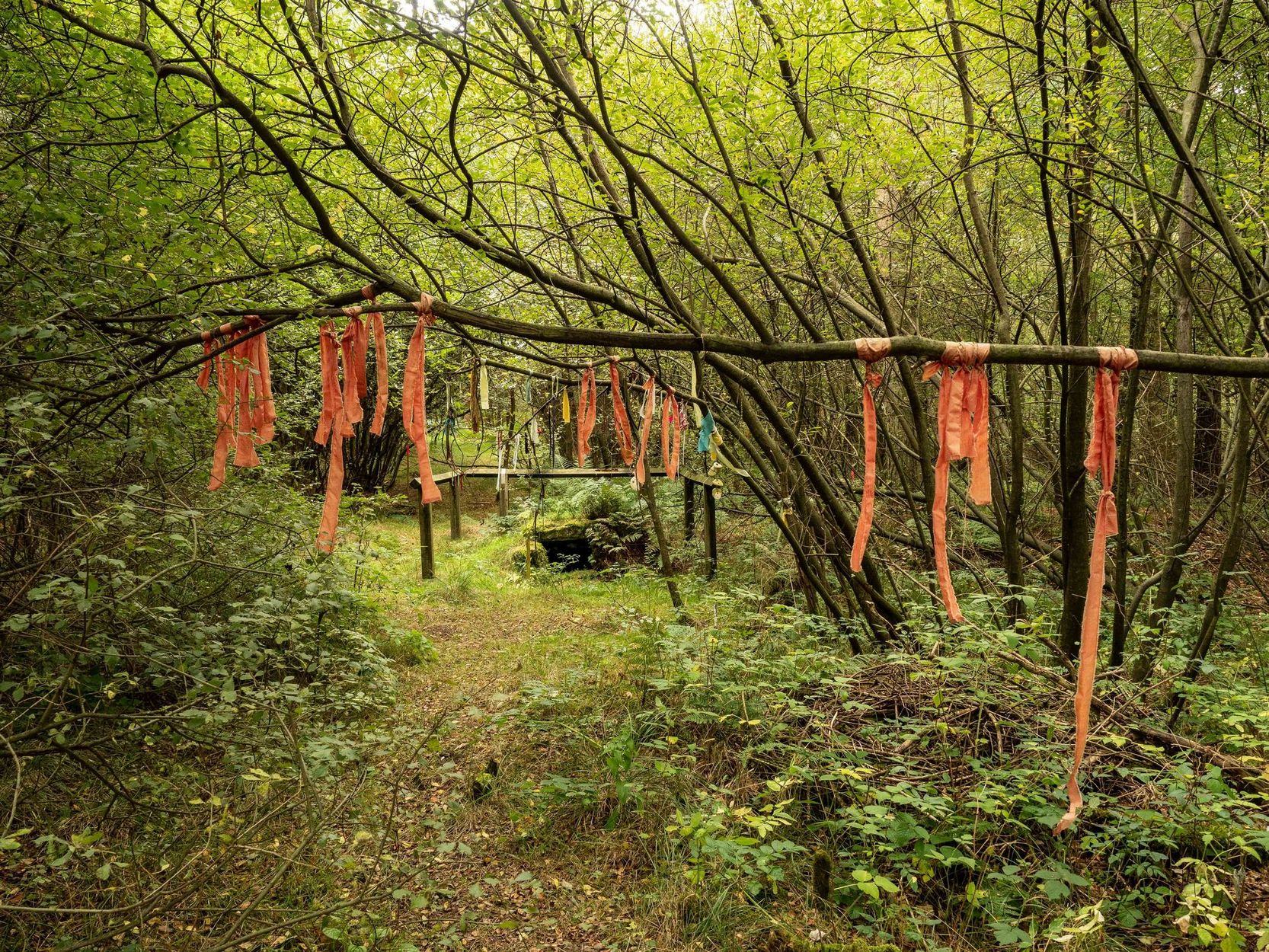
Nowadays the old tradition of hanging rags on the trees surrounding the well as offerings to the spirit of the place (known as memaws in parts of Yorkshire, and clooties in Scotland) has become a regular practice of those who hold such sites as sacred in their own way.  Whelan mentioned seeing memaws here in the 1908s, but the Northern Antiquarian contributor Jon Barker told that, “The rags are a comparatively recent addition to the well, it is not a tradition there. When I used to go in the ’60s therewere no rags.”

On an even more curious note: very recently (from when this profile was written), the Northern Antiquarian contributor and photographer James Elkington visited Old Wives’ Well for the first time.  It was a grey overcast day and when he arrived here, there was a woman ahead of him at the head of the well.  I’ll let him tell the rest of it in his own words:

The Old Wives Well, Stape  (James Elkington)
Old Wives Well at Stape (James Elkington)

“In front of the well was a lady dressed in what looked like a white nighty, she had her back to me.  There was a candle lit nearby, and her hands were in the water moving slowly about like she was washing something.  She had long dark shoulder length hair.  As I was about 25 feet away I was sure she wasn’t aware of me, and I thought it would make a good photograph.  I quietly put my bag on the ground and got my camera out, and looked up and…she was gone!  I couldn’t have taken my eye off her for more than 5 or 6 seconds.  I looked all around and there was no sign of her.  Even if she had legged it through the woods I would have seen her.  I think it was then that I realized that I may have had ‘an encounter’.  I quickly took three pics of the Well and got the hell out of there!”

He rang me once he had regained his senses in a somewhat emotional state and recounted over and over what had just happened.  Whether this was a visual manifestation of the genius loci of the we can’t say.  But such encounters are not unknown at numerous sacred water sites all over the world.  We can only hazard a guess that this is what he was fortunate to encounter.

Just a few hundred yards north is the old Mauley or Malo Cross, which may or may not have had some mythic relationship with our Old Wives…

References:

  1. Chappell, Graeme, “Old Wives’ Well, Stape,” YHW 2000.
  2. Elgee, F., Early Man in Northeast Yorkshire, Frank Bellows: Gloucester 1930.
  3. Whelan, Edna, The Magic and Mystery of Holy Wells, Capall Bann: Chieveley 2001.
  4. Whelan, Edna & Taylor, Ian, Yorkshire Holy Wells and Sacred Springs, Northern Lights: Dunnington 1989.

Links:

  1. Yorkshire Holy Wells

© Paul BennettThe Northern Antiquarian

Witches’ Stone, Horndean, Berwickshire

Standing Stone:  OS Grid Reference – NT 9050 4960

Archaeology & History

The first that I read of this place was in an article of the Scottish Ecclesiastical Society journal, on the parish history of Horndean.  Standing originally at the edge of the ruined remains of the old churchyard, the author W.S. Moodie (1915), told that a long lost,

“grim relic of olden days is said to have existed here till fifty years ago.  This was the Witches Stone—an upright pillar with a hole in it, to which the bodies of the poor unfortunates were fastened after they had been glede, while the faggots were piled around.”

A perusal in the Royal Commission inventory (1915) of the same year told that it had been moved several miles northeast to Paxton Cottage (NT 9279 5229) in the adjacent village.  It was described as being,

“about 4 feet 6 inches in height above the ground, some 2 feet in breadth, tapering towards the upper end, and about 7 inches thick.  Near the top are two perforations, not quite on the same level, about 2 inches in diameter at the surface on either side, constricted towards the Centre, and about 9 inches distant from centre to centre.”

Is this old stone still in existence…?

References:

  1. Moodie, W. Steven, “Ladykirk, or the Kirk of Steill, Berwickshire,” in Transactions of the Scottish Ecclesiological Society, 4:3, Aberdeen 1915.
  2. Royal Commission Ancient & Historical Monuments, Scotland, Inventory of Monuments and Constructions in the County of Berwick, HMSO: Edinburgh 1915.

© Paul BennettThe Northern Antiquarian

Craig Hill cluster (4), Kenmore, Perthshire

Cup-and-Ring Stone:  OS Grid Reference – NN 81303 44419

Getting Here

Craig Hill cluster (4) stone

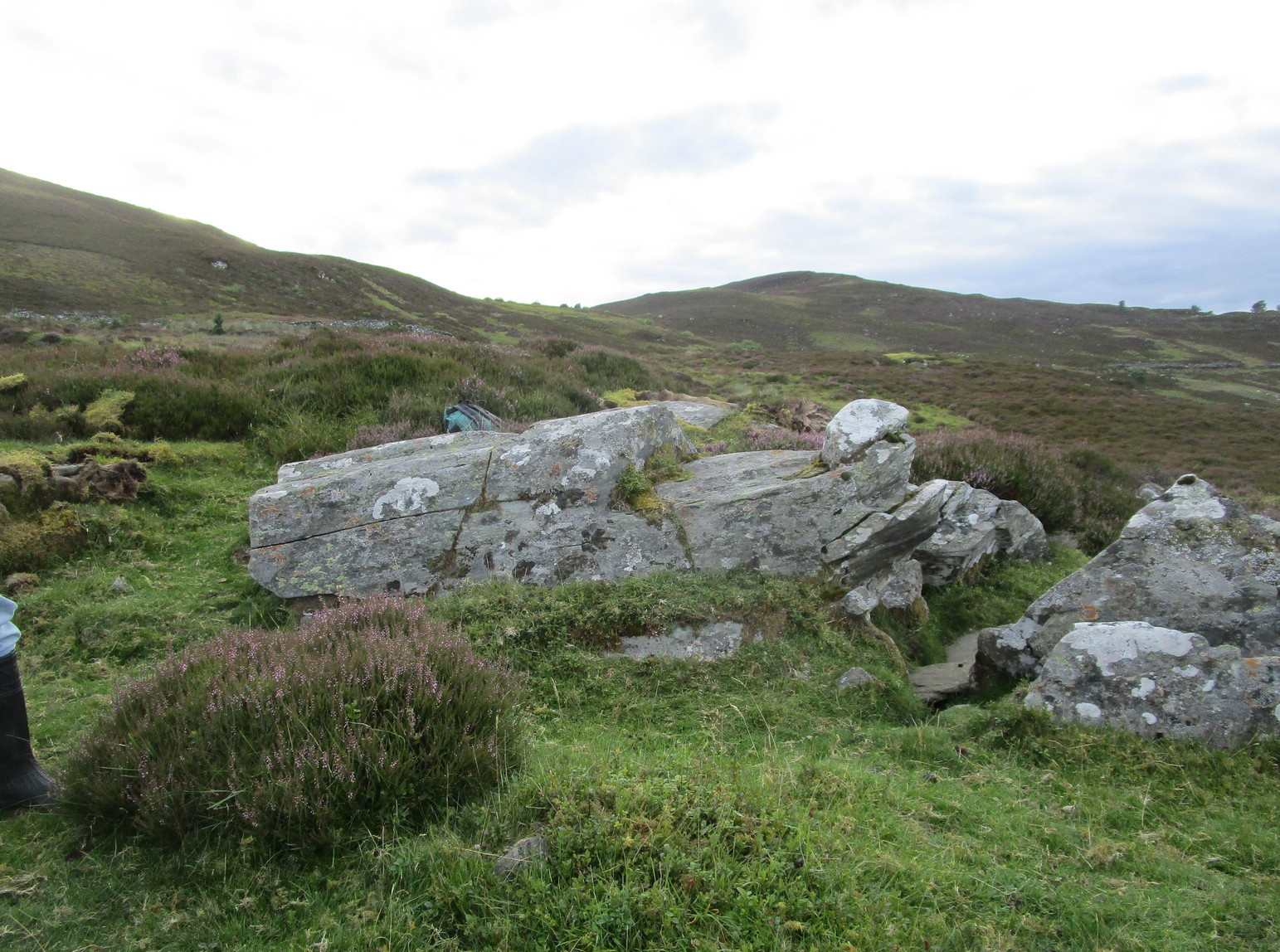
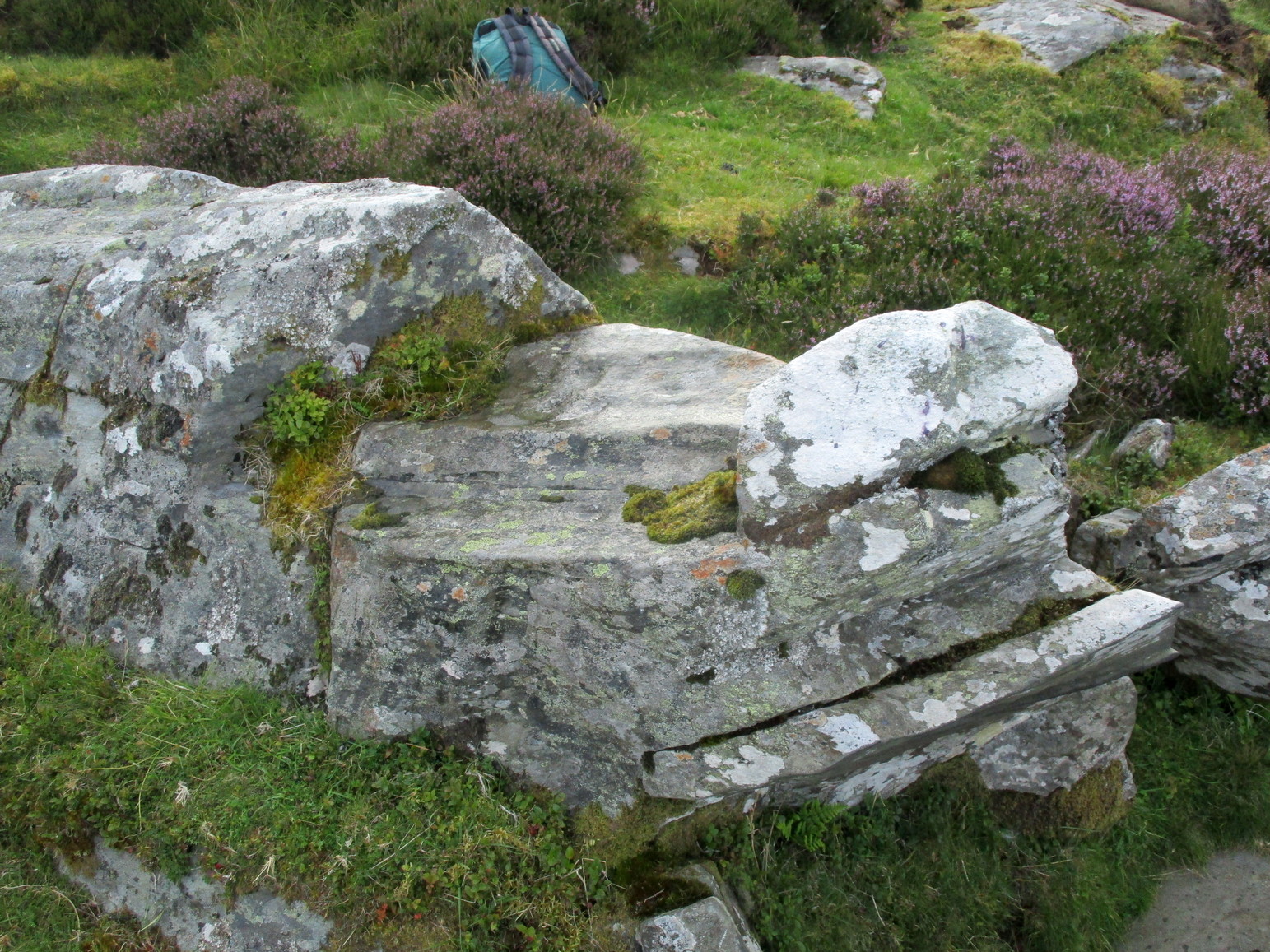
From Kenmore go east up the steep mountain road towards Glen Quaich, or if you’re coming from Amulree, go west along the same glen.  After 2½ miles (4km) up the Kenmore route (nearly 9 miles on the Amulree route) you’ll reach a small lochan on your left (you’ve got a very small parking spot a coupla hundred yards before the loch).  A gate and stile past the loch takes you east along a track into the moors.  More than a mile on, the track splits, but you need to keep to the left and follow the track along the wall-side for another 400 yards or so, where you’ll see a small crag of rocks 100 yards down the slope on your right. Once here, the elongated rock with a “seat” that you can sit in is the stone in question.

Archaeology & History

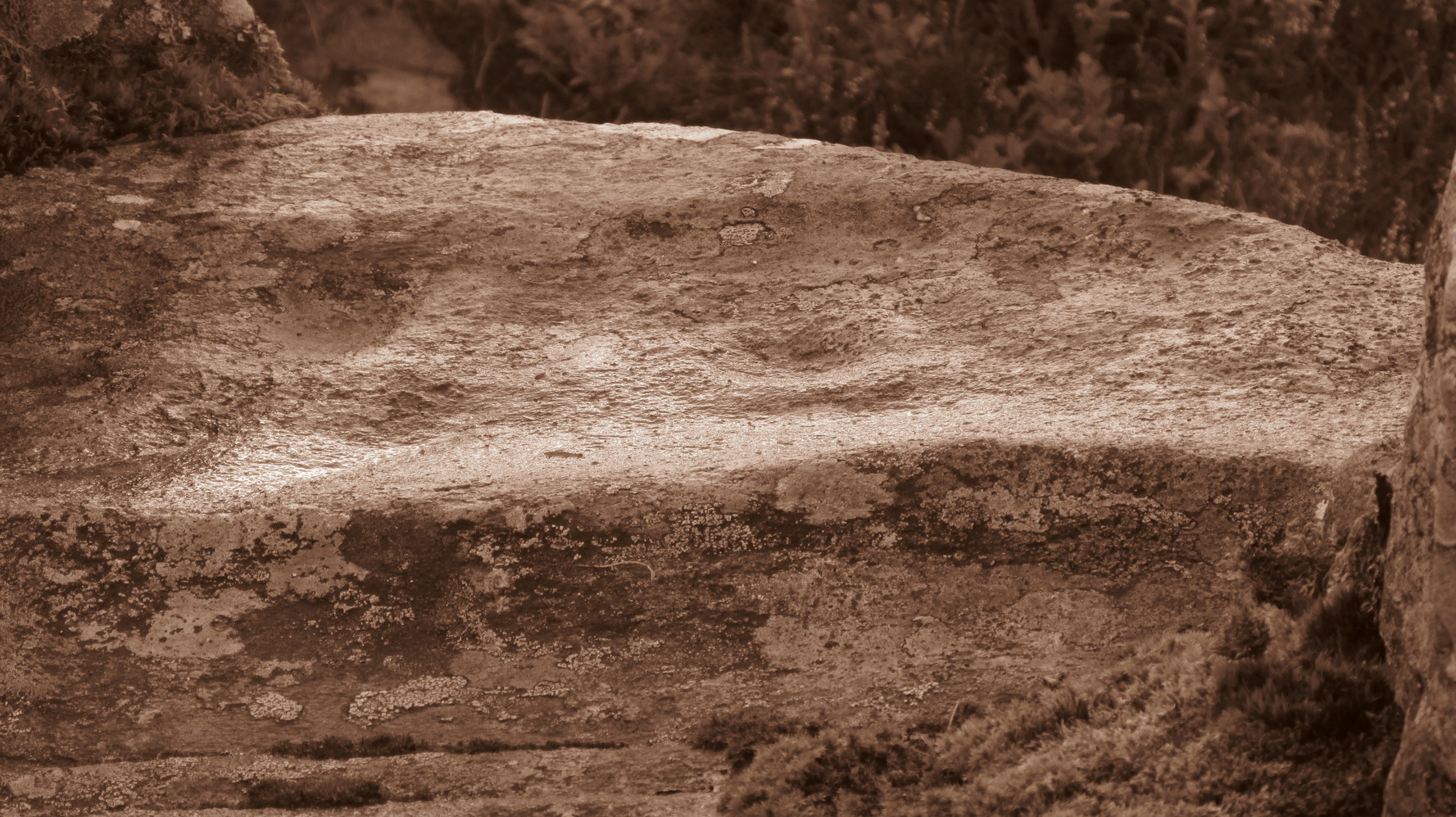
At first sight this stone doesn’t seem to have anything petroglyphic about it, and—as when we visited the other carvings in this Craig Hill cluster—the weather was grey and overcast, so it was difficult to discern anything at first.  But as we walked round and round inspecting the Craig Hill cluster-5 carving, a glance at this adjacent stone seemed to indicate one or two cup-marks within the curious chair-like aspect of the rock, but we couldn’t initially work out whether they were simple geophysical elements or not.

Very faint cup-&-half ring near the centre
Close-up of the C&R

So we poured water onto the stone in the hope that something might show up.  And the more we walked round and round, bending down, looking from as many angles as possible, not only did we see what looked like several cups, but one of them had a half-ring that curved round what may or may not be a natural cupmark.   You can see it pretty clearly in the attached photos.  In other photos that we took, the faint cup-and-half-ring seems to plays its part in a line of three or four other cups; although in order to ascertain whether these elements are man-made or not, we could do with the help of a good geomorphologist.

Acknowledgements:  Huge thanks to Prof Paul Hornby for use of his photos in this site profile; and to Myrna Hurley for getting us up there.  Cheers doods. 😉

© Paul BennettThe Northern Antiquarian

Thief Thorne, Draughton Moor, North Yorkshire

Standing Stone:  OS Grid Reference – SE 0405 5106

Getting Here

Thief Thorne Stone

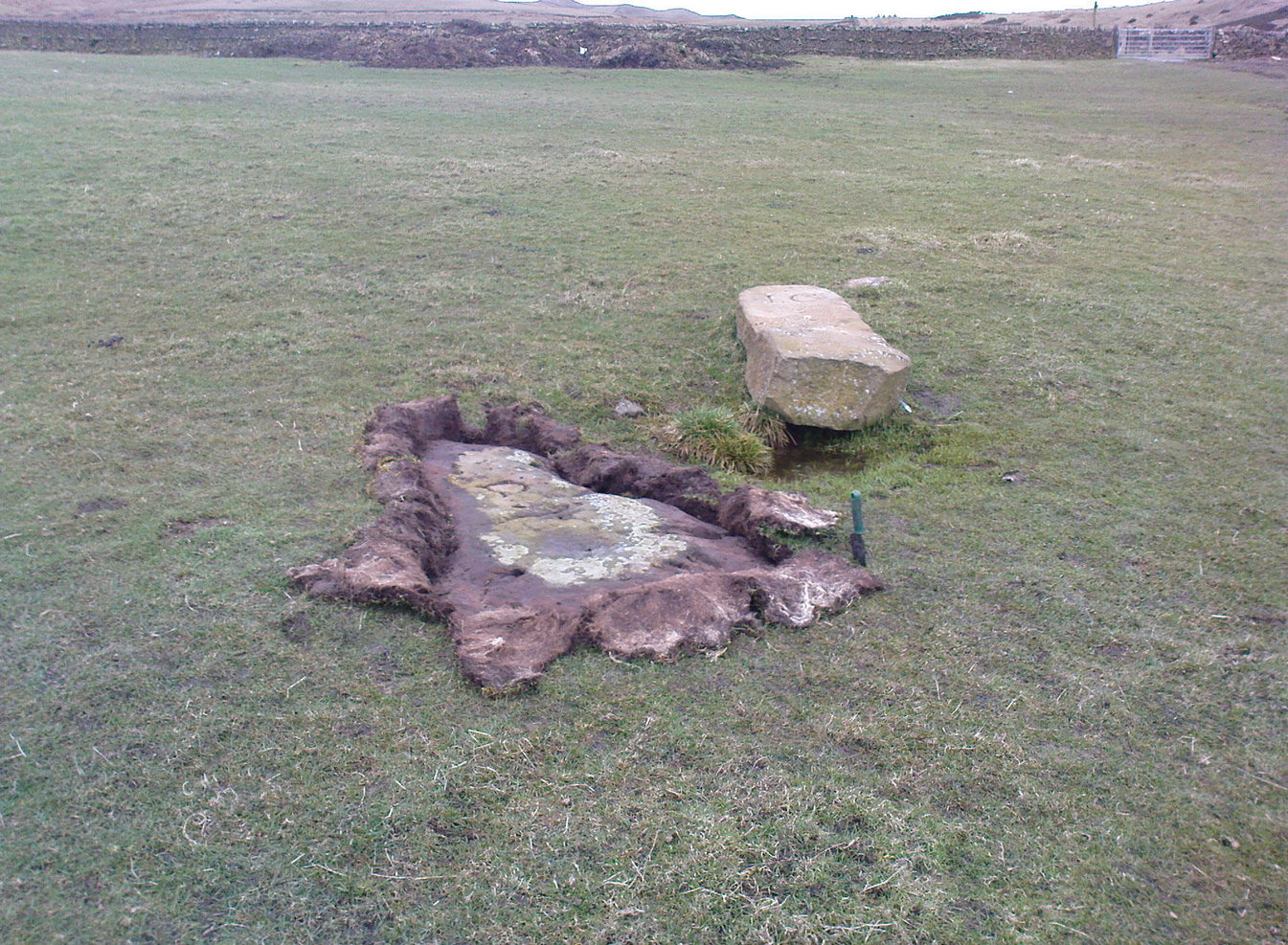
Probably the easiest way here is to take the well-trodden Dales High Way track westwards, under the bypass from Addingham, and along the old Roman Road. After 1.7 miles (2.7km) you’ll reach the Heights Lane country road.  Stop here!  Walk back on yourself along the track for maybe 50 yards and look in the field to your right (south) between 10-20 yards in the short grass and there, somewhere under your feet next to a modern stone, you’ll see peeking up at you (probably somewhat covered on the whole by the soil) a long flat stone.  That’s what you’re looking for.

Archaeology & History

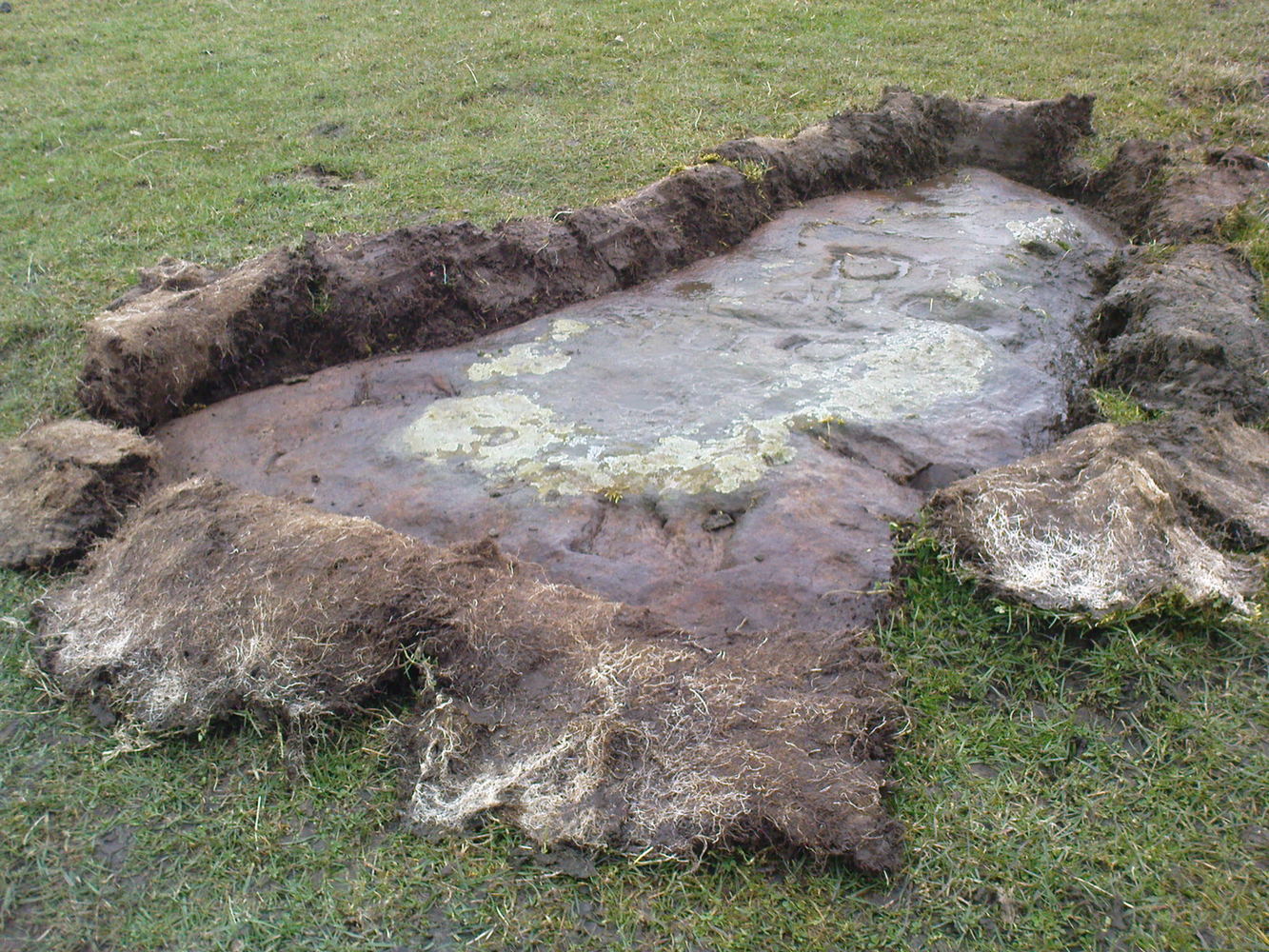
This old stone had been sought after by various groups and people for many years and I was fortunate to relocate it about thirty years ago, laid down and all-but-hidden beneath the grasses.  The stone appears to have been buried nearly 100 years earlier, because when Harry Speight (1900) wrote about it in 1900 he described it as still upright.  In more recent years, it seems that the farmer has put  a replacement stone next to its position with the letters “JC” cut  into it.  You can see it in the above photo.

Thief Thorne uncovered
Thief Thorne, looking W

First mentioned in the 16th century and included in boundary perambulation records of 1709, and again in 1781, someone during that period turned it into a milestone, etching the words “To Skipton 3 m. To Addingham 2 m.”  It stood by the old Roman road, but its considerable erosion and shape is decidedly prehistoric.  Nearly 6 feet long, it is now laid in the earth and almost completely covered over.  A sure case for resurrection.

References:

  1. Bennett, Paul, The Old Stones of Elmet, Capall Bann: Milverton 2001.
  2. Speight, Harry, Upper Wharfedale, Elliott Stock: London 1900.

© Paul BennettThe Northern Antiquarian

Giant’s Grave, Cloghfin, County Donegal

Chambered Cairn (destroyed):  OS Grid Reference – H 277 998

Archaeology & History

Included in Eamon Cody’s (2002) magnum opus, this site has long since gone.  It was highlighted on the 1845-47 OS-map of the area and the only subsequent information about it was written in the 1903 Ordnance Survey Name Book, where it was described as a “supposed Giant’s Grave” that was marked by a large spread of boulders.

Perhaps the only thing we can ascertain here is from the name Giant’s Grave.  Invariably, giants are part and parcel of creation myths in early traditional societies.  Such giants, as well as being huge mythical creatures, can also be the progenitor of tribes and communities, i.e., the person who laid the initial foundation of where the tribe came to live, usually an early queen, king or shaman figure.  So, in the case of this Giant’s Grave, it was likely to have been known as the burial place of such a figure: mythical in importance as well as size.

References:

  1. Cody, Eamon, Survey of the Megalithic Tombs of Ireland: Volume VI – County Donegal, Duchas: Dublin 2002.

© Paul BennettThe Northern Antiquarian

Trows Well, Birsay, Orkney Isles

Sacred Well:  OS Grid Reference – HY 26157 26838

Archaeology & History

On the northwest side of the Loch of Boardhouse can still be found a spring of water which was, in bygone times, the abode of the supernatural creature known as the troll or trow.  The site is described in local place-name records and is located near the foot of a slope near Westerhouse, from where a small channel of water runs down into the Loch of Boardhouse about forty yards away. When it was last described in the 1960s, all folk memory of its heathen inhabitants had seemingly been forgotten and no folk-tales seem to have been recorded.  Thankfully, the Well itself is still shown to exist on modern OS-maps.

© Paul BennettThe Northern Antiquarian

Moses’ Well, Morton, Thornhill, Dumfriesshire

Holy Well:  OS Grid Reference – NX 8799 9431

Archaeology & History

Moses Well on 1861 map

This little-known Biblical-sounding spring has apparently long since fallen back to Earth (perhaps there might be some local folk who could find out for certain).  Shown on the 1861 Ordnance Survey map as being at the side of the wall in the small copse of trees—immediately east of kirk- place-names and a half-mile north of St Ninian’s Well—it was briefly described by T.C. Ramage (1876), who seemed to know nothing of its lore, merely telling us that,

“on Templand farm, close to the wooden bridge over the Cample, there is Moses’ Well, an unusual designation, but which some Knight Templar may have given in remembrance of his toils in Palestine.”

The Templar designation was deemed by Ramage to come from the name of the farm.  However, a few years prior to this, the early Scottish place-name surveyors were traversing the area and found from local people how it derived “its name from a Tinker named Moses Marshall who with his family lived near it in a Camp during the time they had the small pox.”  The Well was also included in the Morris survey (1982), but without comment.  Another Moses Well can be found 44½ miles to the northeast, near Galashiels at NT 4046 4306.

References:

  1. Morris, Ruth & Frank, Scottish Healing Wells, Alethea: Sandy 1982.
  2. Ramage, Craufurd T., Drumlanrig Castle and the Douglases, J. Anderson: Dumfries 1876.

© Paul BennettThe Northern Antiquarian

Port Cross, Port of Menteith, Stirlingshire

Cross / Sacred Tree:  OS Grid Reference – NN 581 012

Also Known as:

  1. Law Tree

Archaeology & History

As a folklorist and antiquarian, I find this long lost site more than intriguing.  Most ancient crosses are stone; but in early centuries many were made from wood which, obviously, have decayed down the years.  But this cross, located on the northeast edge of the Lake of Menteith, was actually a tree: a hawthorn no less.  This choice would have been made based on it being one of the few trees that are deemed sacred in both christian and indigenous lore.  It was described—albeit briefly—in A.F. Hutchison’s (1899) excellent history book of the area: 

“The cross of the burgh is said to have been the trunk of an old hawthorn tree, which stood by the lake side, opposite the manse of Port, and was known as ” the law tree.” Around this tree an annual fair was held in the month of September, and called after St. Michael.”

We’re obviously seeing here the traditional animistic veneration of trees by local people, with the incoming christian symbol being grafted onto it.  Hawthorns were one of the potent protections against witchcraft and so the handshake between christian and pre-christian systems obviously worked here.  Faerie-lore was also rampant at many places for many miles around this site.

References:

  1. Hutchison, Andrew F., The Lake of Menteith – Its Islands and Vicinity, Eneas Mackay: Stirling 1899.

© Paul BennettThe Northern Antiquarian