Snowden Moor Settlement, Askwith, North Yorkshire

Settlement:  OS Grid Reference – SE 1785 5128

Getting Here

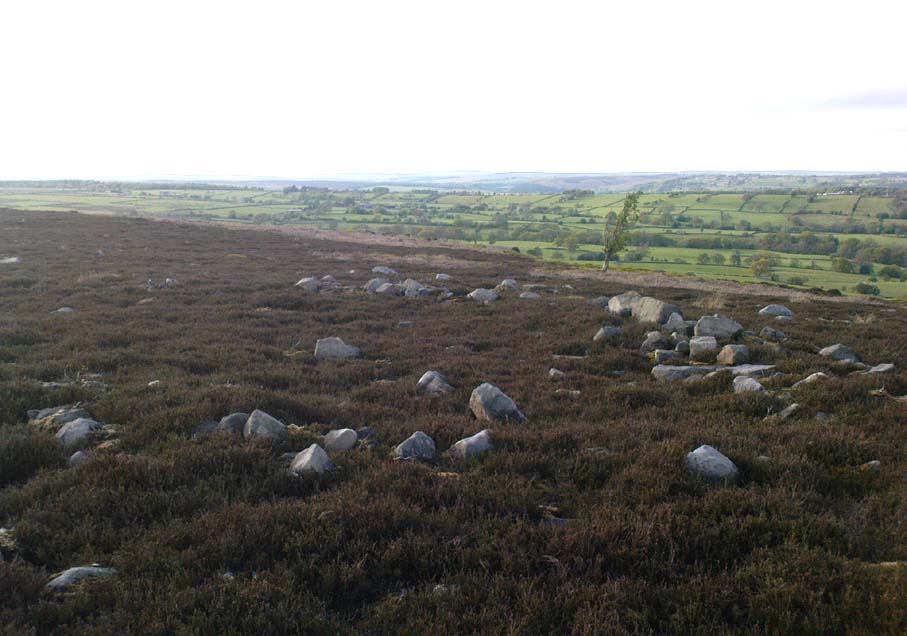
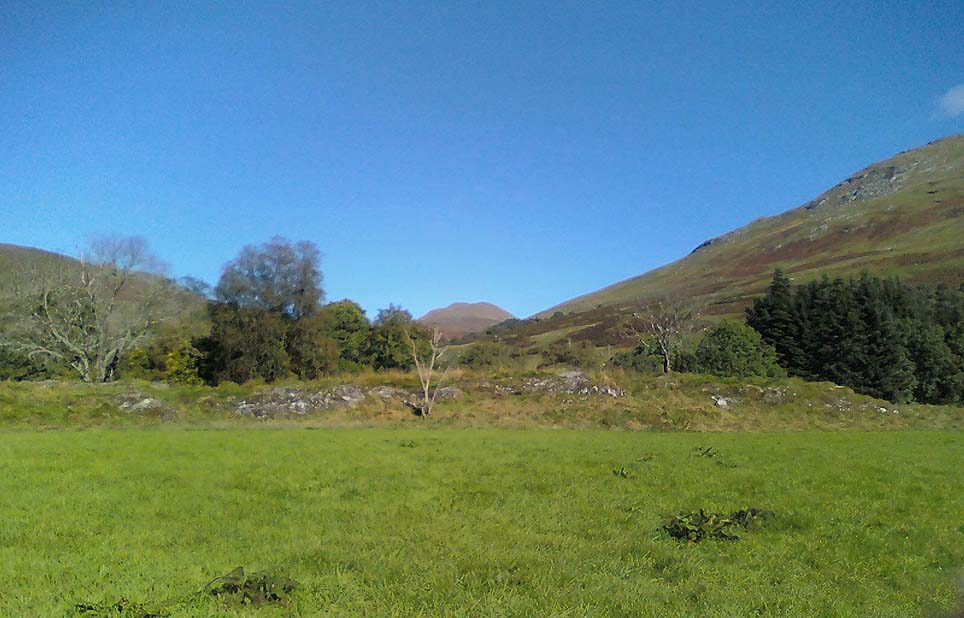
Travel along the Askwith Moor Road between Blubberhouses and Askwith (near Otley) and park-up at the large gritted parking post on the moor edge.  Walk straight onto Snowden Moor (east) and walk a few hundred yards north until you reach the brow of the small rounded hill, scattered with small stones and outcrop rock.  The settlement is all around you!

Archaeology & History

As we already know from earlier posts on TNA, this moorland region is rich in prehistoric remains, and the settlement that I’m about to briefly describe here is another excellent site – when you can see it!

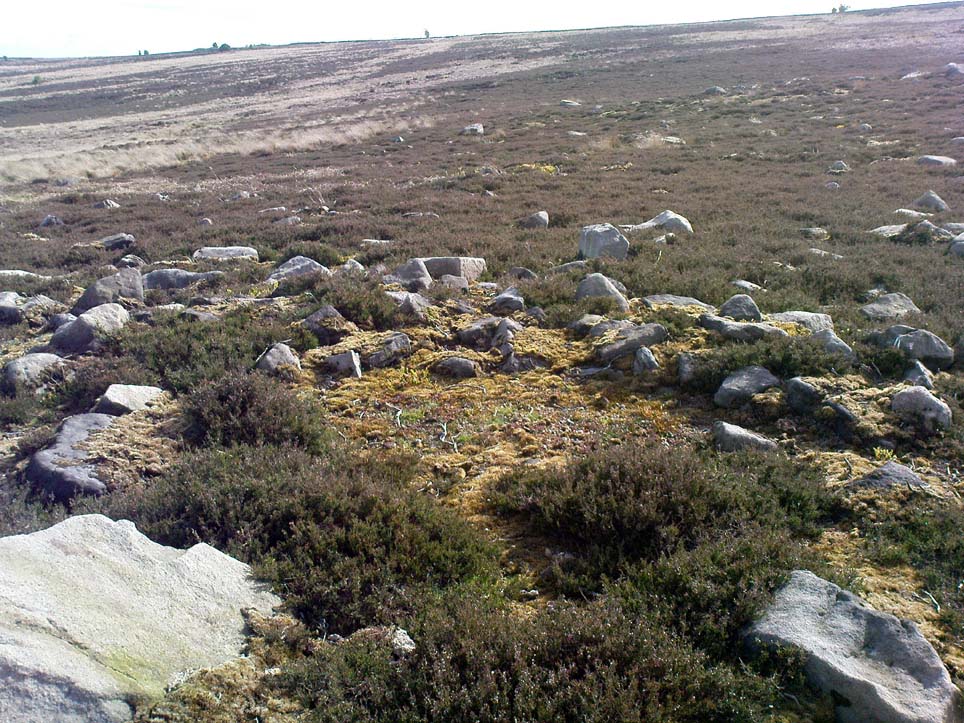
‘Hut circle’ at the rocky knoll

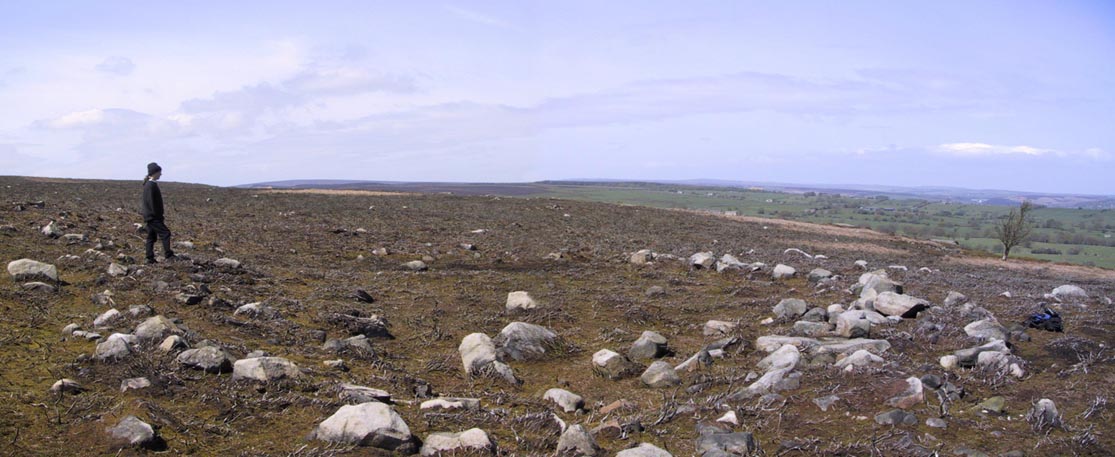
My first exploration here was in the company of Graeme Chappell more than 20 years ago, where we tried locating remains that had been described by Eric Cowling (1946) during a foray taking photographs of the cup-and-ring stones nearby.  But due to an overgrowth of moorland vegetation at the time, the remains which Cowling described proved hard to find.  Years later when Richard Stroud and I visited the place in May 2005, all the heather had been burnt back and much of what looked like the remains of an entire prehistoric village was in plain view for us to see.  I was well impressed!  This occurred again last year, enabling the bunch of us who came here a few times to see even more of the place.  But — just like the newly discovered prehistoric settlement on Blubberhouse Moor a couple of miles north — once the heather grows back again you wouldn’t really think anything of worth was hidden here.   In archaeological terms however — despite the lack of references and research by those who are paid to be archaeologists — we have one helluva little-known prehistoric settlement, complete with walling, hut circles, village hall (!), tombs, cup-and-ring carving and more, much of it probably dating from the Bronze Age, but some of the sites here indicate it was also much in use during the Iron Age period aswell.

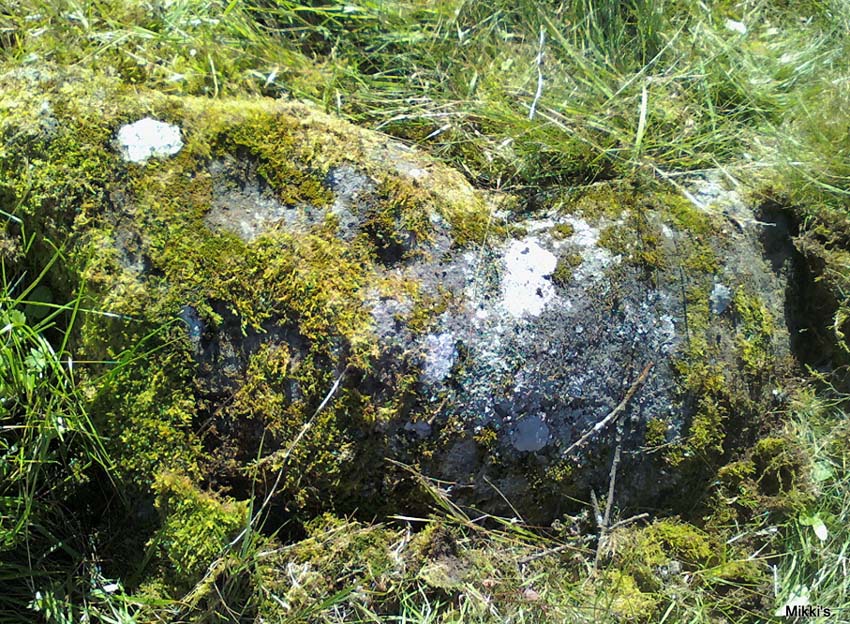
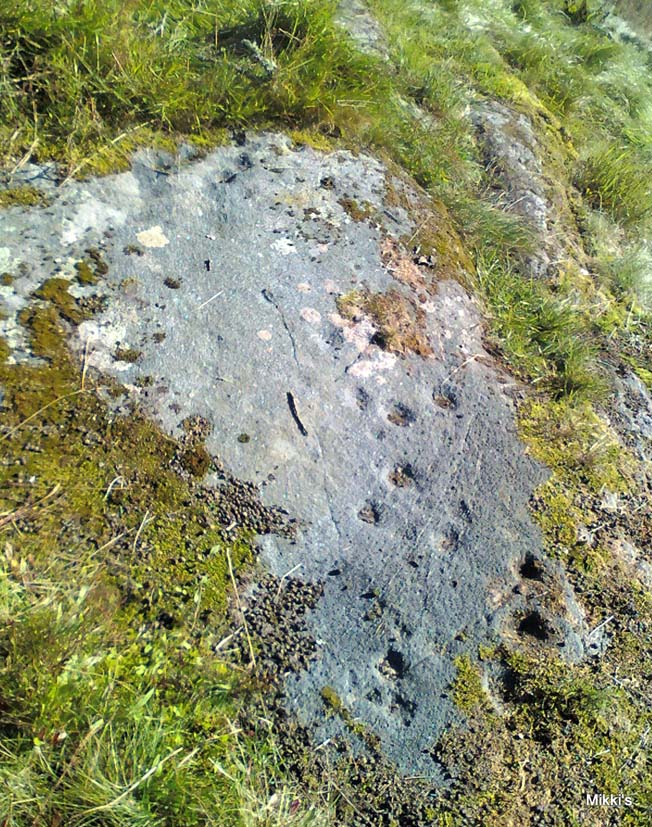
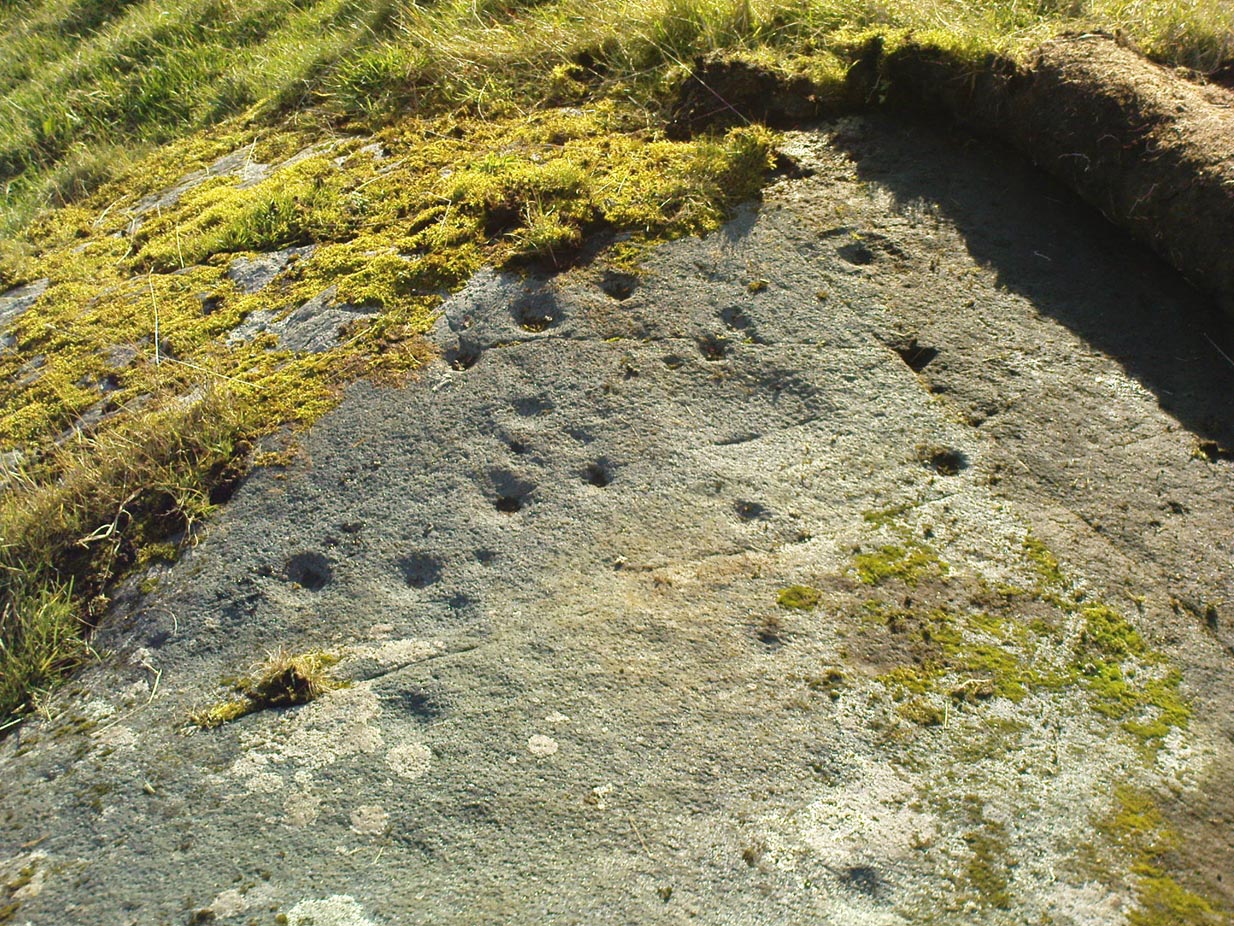
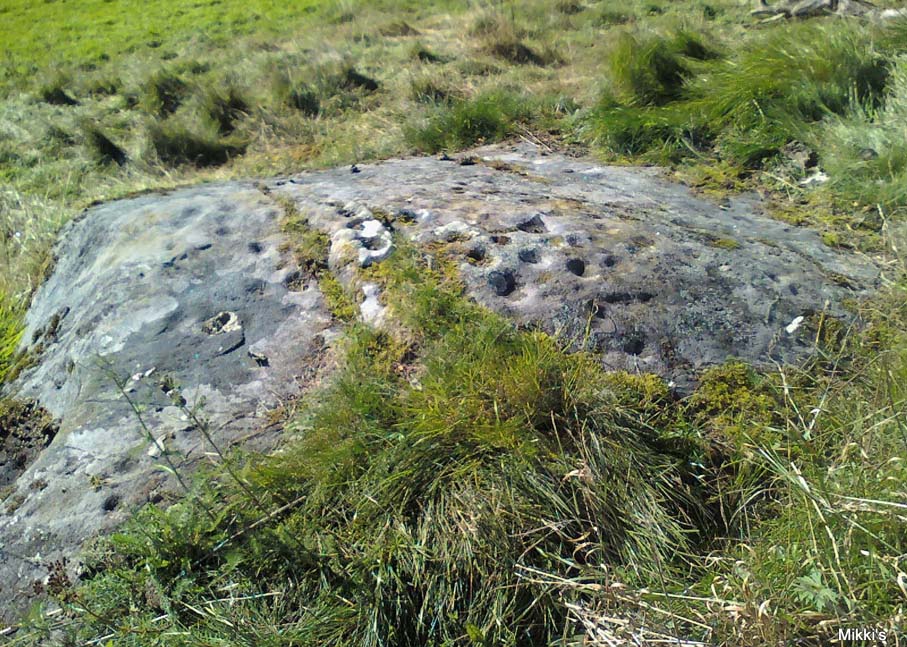
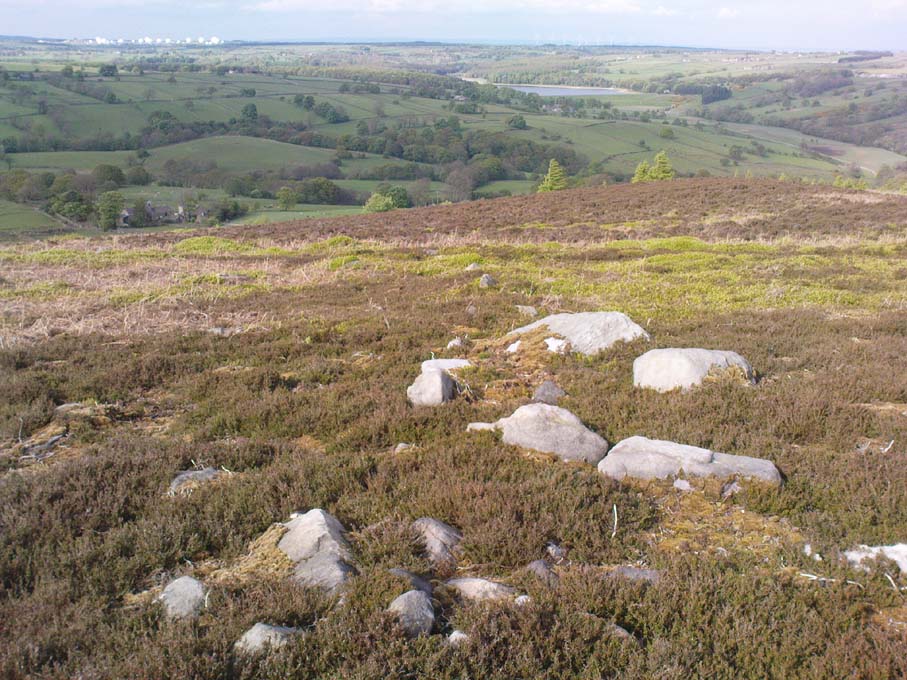
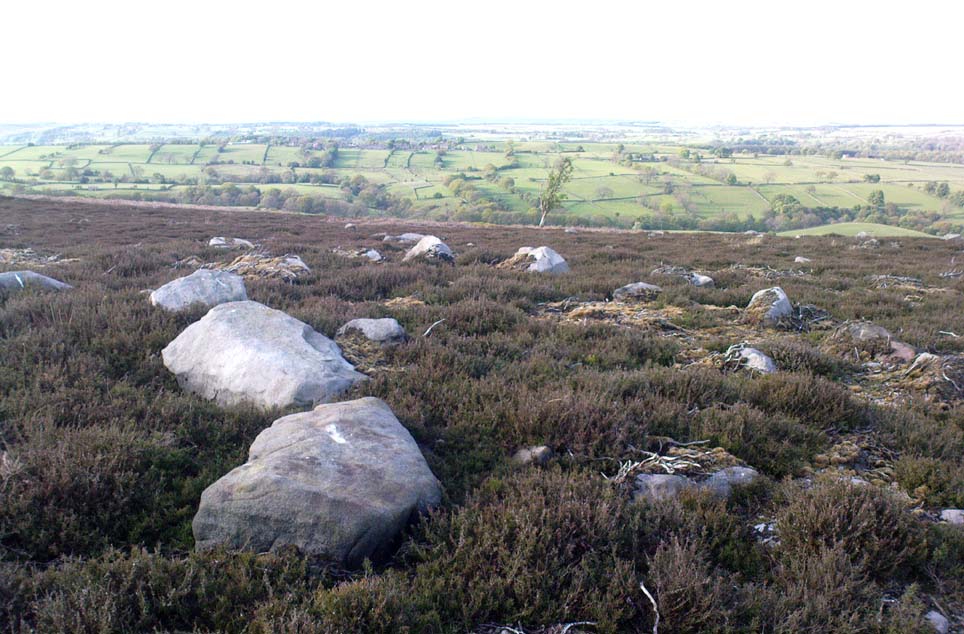
Probably the best place to start exploring here is on the large flat rock on the rounded knoll at the edge of the moor (SE 1785 5129) with a simple cup-mark saying ‘hello’ on its surface, looking east down into the Fewston Valley and across lower Wharfedale, then veering up towards the hills above Nidderdale.  The great prehistoric temple of Brimham Rocks is clearly visible from this spot aswell.  Upon this rocky hillock we have a veritable scattering of several large, earthfast boulders and smaller rocks, from where much of the settlement expands, mainly to the west through to the south, across the open moors in front of you.  On a clear day this is truly beautiful and quiet spot.

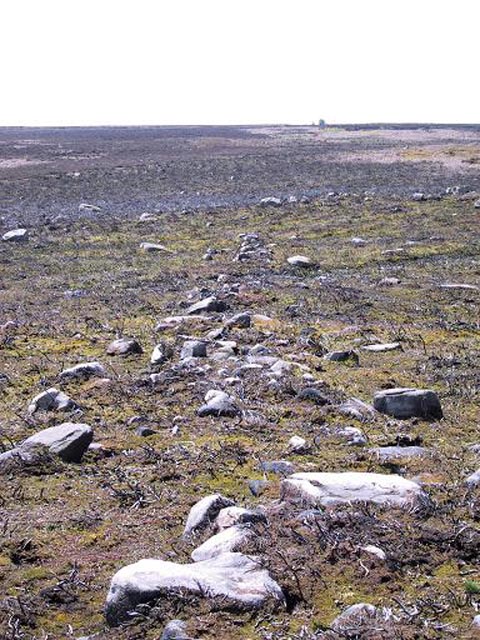
Line of ancient walling, running NE
Line of ancient walling, running SW

Just a couple of yards from the edge of the rocky knoll is a very good example of what would at first sight appear to a prehistoric hut circle.  Its position at the top of this rocky knoll however, implies an additional function other than a purely domestic one.  Also from here is a prominent long straight stretch of walling running roughly southwest for about 90 yards onto the moor, and also to the northeast, downhill off the moorland for some 30 yards before disappearing into undergrowth (we didn’t actually explore this lower section of walling running downhill, so there’s probably more to be found there).  This long section of walling, mainly comprising small stones and rubble, with a number of larger uprights defining much of its length, is just one of several stretches of walls that are clearly visible hereby.  There are also a number of other hut circles to be found scattered around this particular walled sections near the top of the rocky rise. When Eric Cowling (1946) came here he counted 10 of them here; but subsequent explorations have found at least 13 of them hereby.

Upper D-shaped enclosure
Overgrown D-shaped enclosure

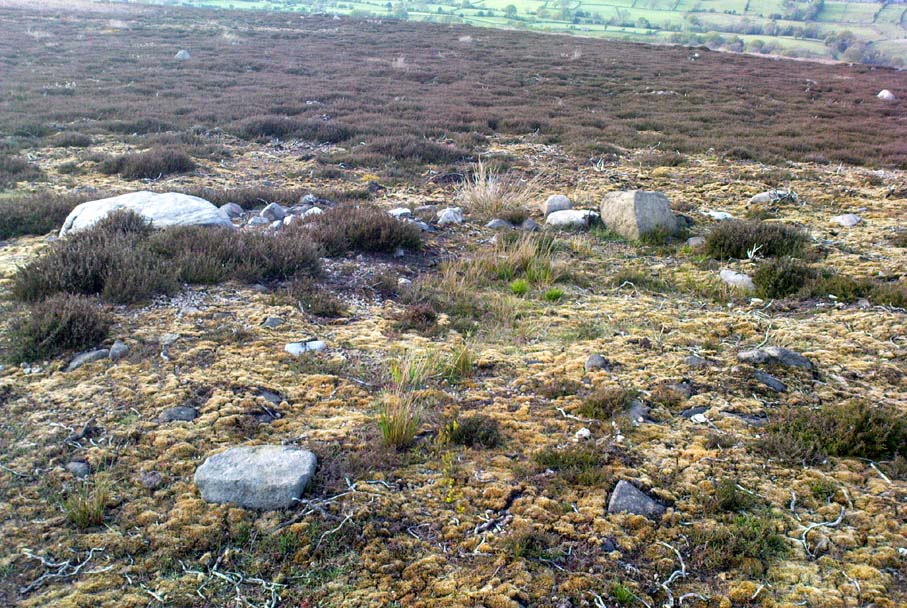
One of the most notable remains here is the large D-shaped enclosure about 25 yards west of the rocky knoll.   This very impressive archaeological site was curiously not included in the Nidderdale Archaeological survey report of sites in this region.  Either they hadn’t done their homework correctly when they came here, or the heather must have been really deep; cos as you can see in the photo here, it’s a decent size!  I tend to see this large stone enclosure as a sort of tribal gathering building of sorts — a bit like a ‘village hall’ so to speak. If you get here and see it all in context, it makes a lotta sense (not that it’s right of course, merely an opinion).  With the exclusion of the Cowling D-shaped enclosure more than 80 yards east of here, this is the largest monument on this section of the moor, measuring some 45ft along the NW to SE axis and 20ft across the NE to SW axis.  The walling in parts is quite thick aswell and the stones making up the main north, east and southern edges are anything between 12 inches to 34 inches tall. Along its northeast edge is a curious stone, with what initially looked to be a most distinct cup-and-ring carving on the outer walling, but once we’d looked and looked again, saw it seemed to be one of the oddest light-created ‘carvings’ we’d ever seen! (i.e., it’s natural)

Denuded cairn? or denuded walling?
Another arc of walling (shit picture though – soz…)

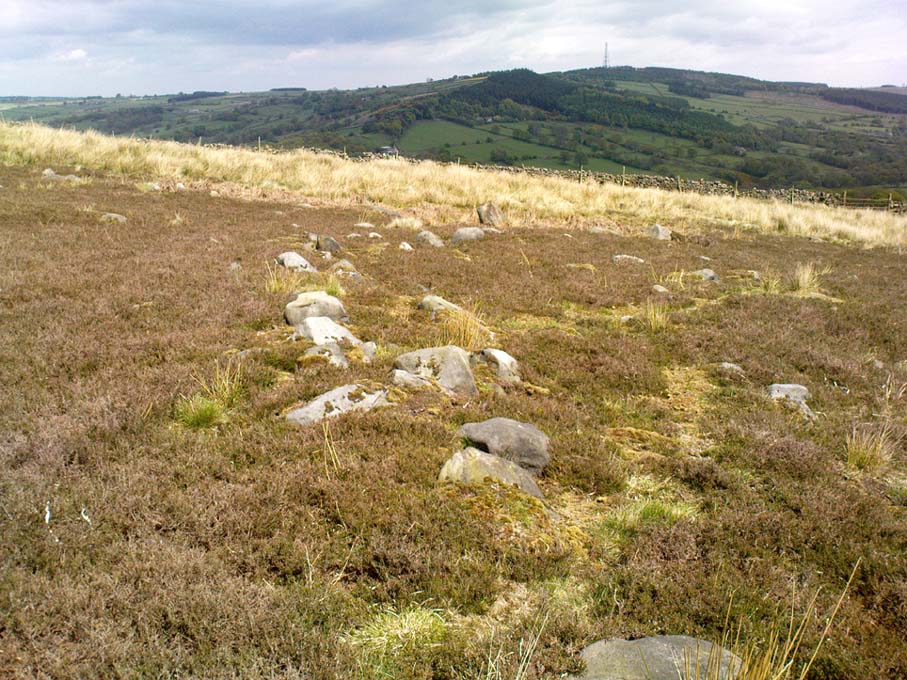
A few yards from here, heading to the little peak close by, more walls emerge. On the small rise in the land about 30 yards west you’ll see an arc of stones running around the contour line of another hillock on the moor.  It’s difficult to say with any certainty, but a lot of this arc of stone is certainly man-made and at least Iron Age in date, perhaps earlier; but the line of stones itself may actually run all round the very edges of the hill on whose sides this section rests (see photo).  You get a distinct impression here that this small hill was actually sectioned off all the way round, so to speak, for some reason or other.  The remains of at least two small cairns can be found on the top of this small enclosed rise, close to one of which Boughey & Vickerman (2003) have designated there to be a cup-marked stone.  From this elongated hillock we look immediately northwest onto the flat moorland plain of the Snowden Moor necropolis …amidst which the hardworking Keighley volunteer Michala Potts recently found the Snowden Crags cairn circle.

Section of Snowden Carr settlement walling

Further down the moorland slope—a couple of hundred yards below Cowling’s D enclosure—are yet more remains, many of which lie outside the geographical boundaries of the “official” Scheduled Monument Record for this settlement (known as SMR 28065).  We’ve located several other cairns in relatively good states of preservation; more extensive lines of another walled enclosure (again in a large D-shape), as well as several cup-marked stones.

The Site and Monuments account of this place tells us simply:

“The monument includes a cairnfield and associated concentration of prehistoric features.  Included in the area are a large sub-rectangular enclosure, two smaller enclosures, at least 17 cairns of various sizes, several lengths of boulder walling, a hollow way, and at least 17 carved rocks. There is also a bare patch of ground on which lumps of lead slag survive. This was produced by medieval or earlier lead smelting.

“This concentration of prehistoric features is situated towards the north east edge of Snowden Carr, and measures c.426m x c.155m.  The cairns occur throughout the area and range in size from an elongated cairn 17m x 7m down to cairns c.4m in diameter. The cairns are best preserved in the north western part of the area. The large sub-rectangular enclosure has an earth and stone bank c.3m wide and c.0.6m high. The bank is double on the east side of the enclosure.  The two smaller enclosures have rubble banks 1m-2m wide and up to c.0.6m high.  They are more irregular in shape than the large enclosure.  The boulder walling consists of a number of approximately linear rubble banks 1m-2m wide. It is concentrated in the area immediately north west of the large enclosure, and in the area to its south. The boulder walls are interpreted as part of a field system contemporary with the large enclosure.  The hollow way is located within the southern group of boulder walls and may be contemporary with them. “

There is still a considerable amount of work that needs doing in and around this settlement complex and it seems any work here is gonna be done by the like of us amateur doods.  Archaeological officials don’t seem interested here.  I was informed by Neil Redfern of the archaeology department of English Heritage for North Yorkshire that they are unable to support any funding that might help towards any decent analysis of this important archaeological arena, nor do they consider the important cairn circle discovered a few months ago on the northern end of this settlement worthy of financial help either, which is of course very disappointing,* but typifies their lack of enthusiasm unless money comes their way.  And so this site profile entry will be added to gradually as our amateur team visit and uncover further aspects of this neglected prehistoric arena – such as the finding of another previously unrecorded ancient circle of stones not too far away!

References:

  1. Boughey, Keith & Vickerman, E.A., Prehistoric Rock Art of the West Riding, WYAS: Wakefield 2003.
  2. Cowling, Eric T., Rombald’s Way: A Prehistory of mid-Wharfedale, William Walker: Otley 1946.

Acknowledgements:  Many thanks for use of their photos to Graeme Chappell and Michala Potts.

* No doubt a church window somewhere will eat up a few thousand quid and weeks of their time to fit the little piece — along with all those prawn sandwich meetings that cost so much to endure.  Much more important!

© Paul Bennett, The Northern Antiquarian 

Stag Cottage, Glen Lochay, Perthshire

Cup-and-Ring Stones:  Grid Reference – NN 5320 3584

The carved rocky outcrop

Also Known as:

  1. Duncroisk 1 (Morris 1981)
  2. Duncroisk 4 (Canmore)
  3. Keeper’s Cottage

Getting Here

From the north side of Killin, take the minor road next to the Bridge of Lochay Hotel at Killin, past the hydroelectric station, through the wooded section until the fields open out again. The first gorgeous old house you come to is on the right-hand side of the road. Stop here! (I could really do with living here misself – tis a truly superb place!) You can ask the lady at the house where the carvings are and she’s very happy to point them out – they’re on the rocky crag near the bottom-end of the field on the other side of the road.

Archaeology & History

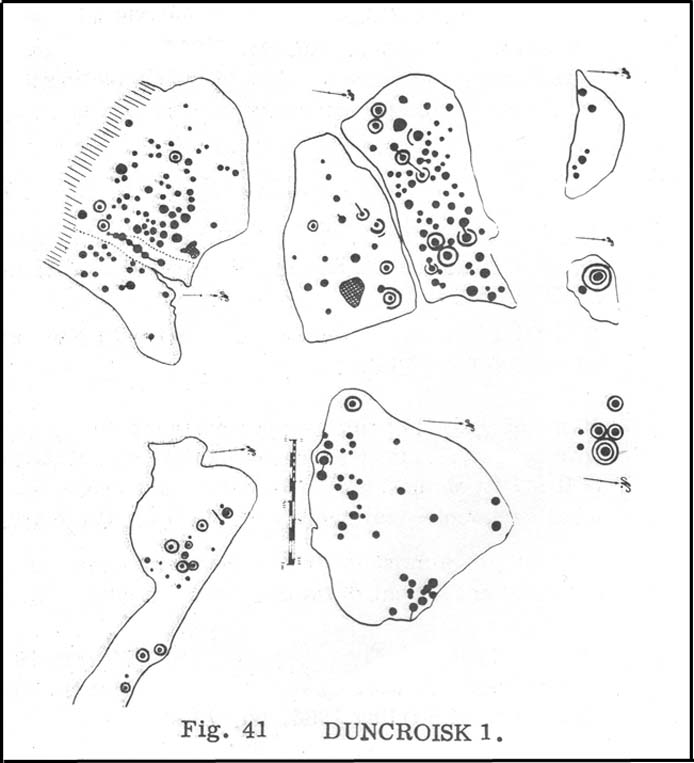
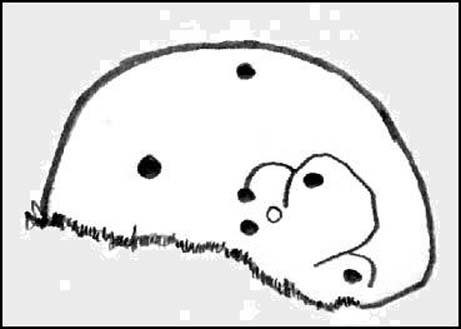
R.W.B. Morris sketch of the main carvings

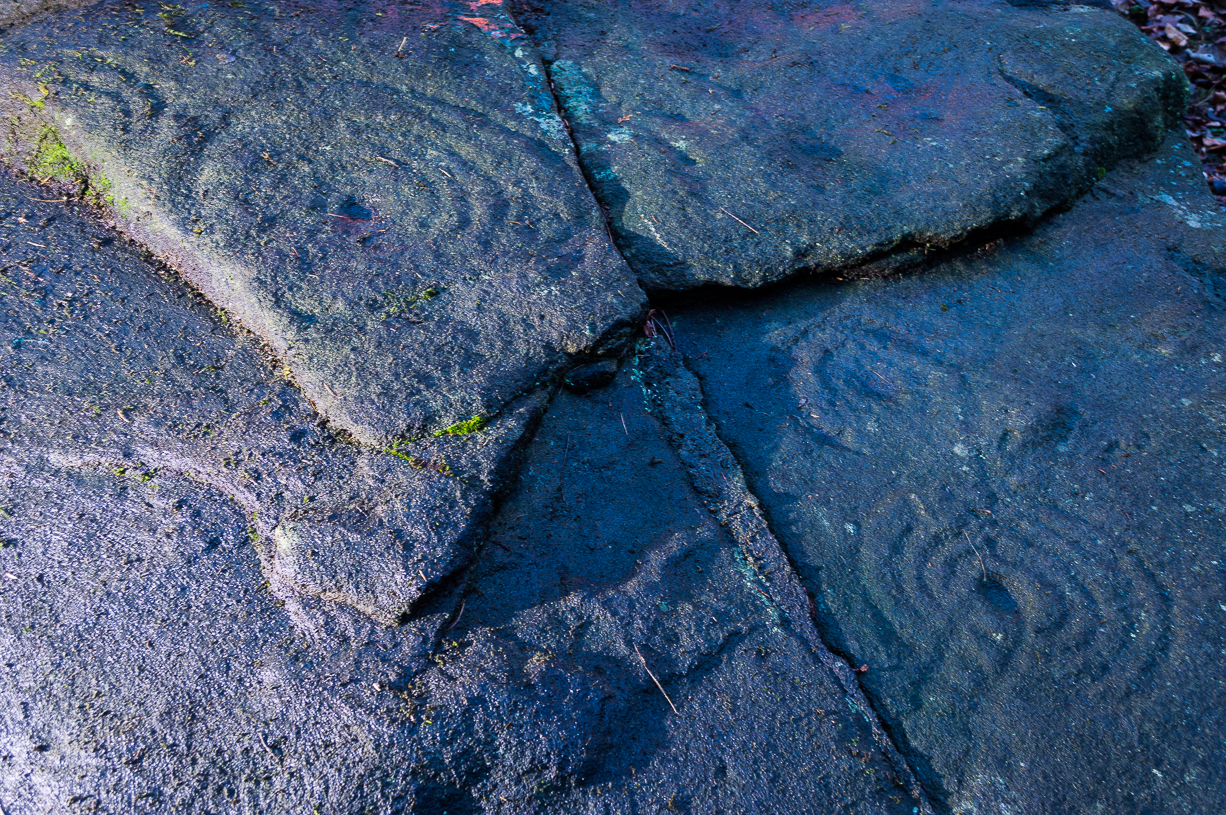
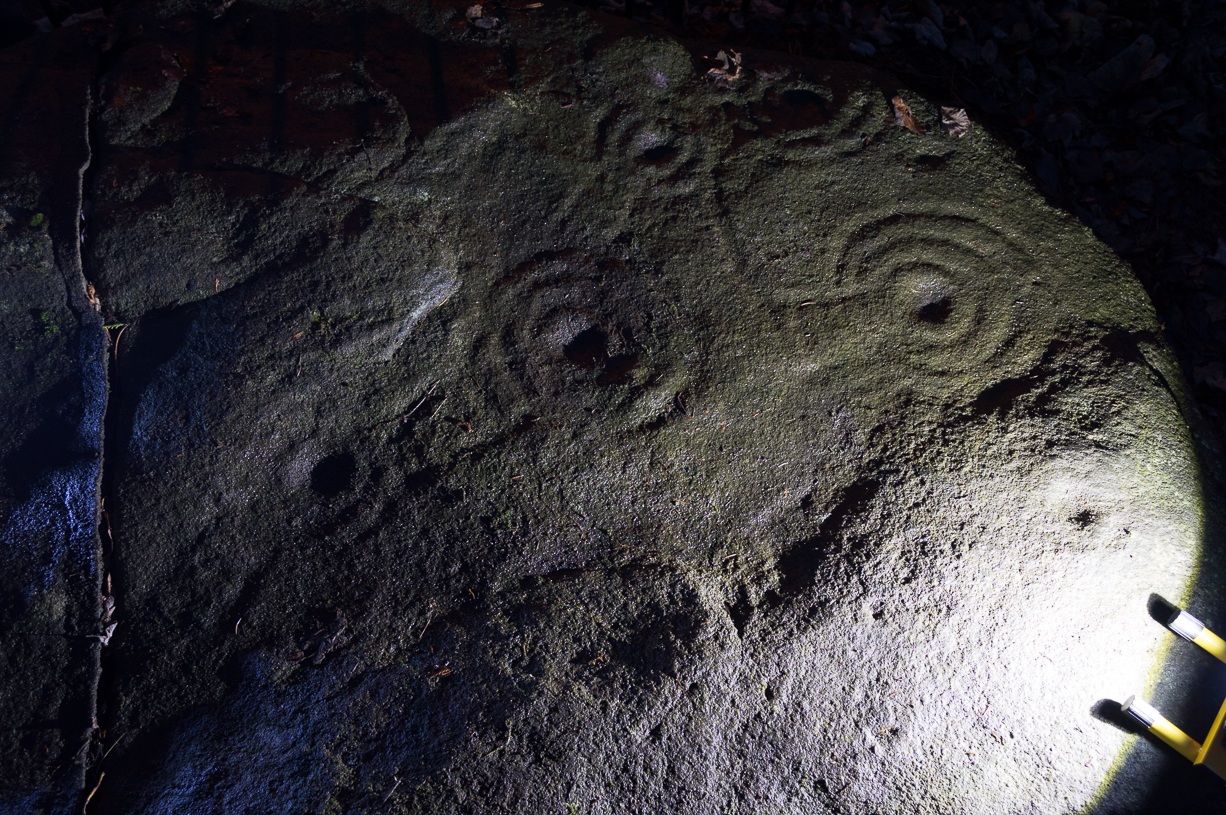
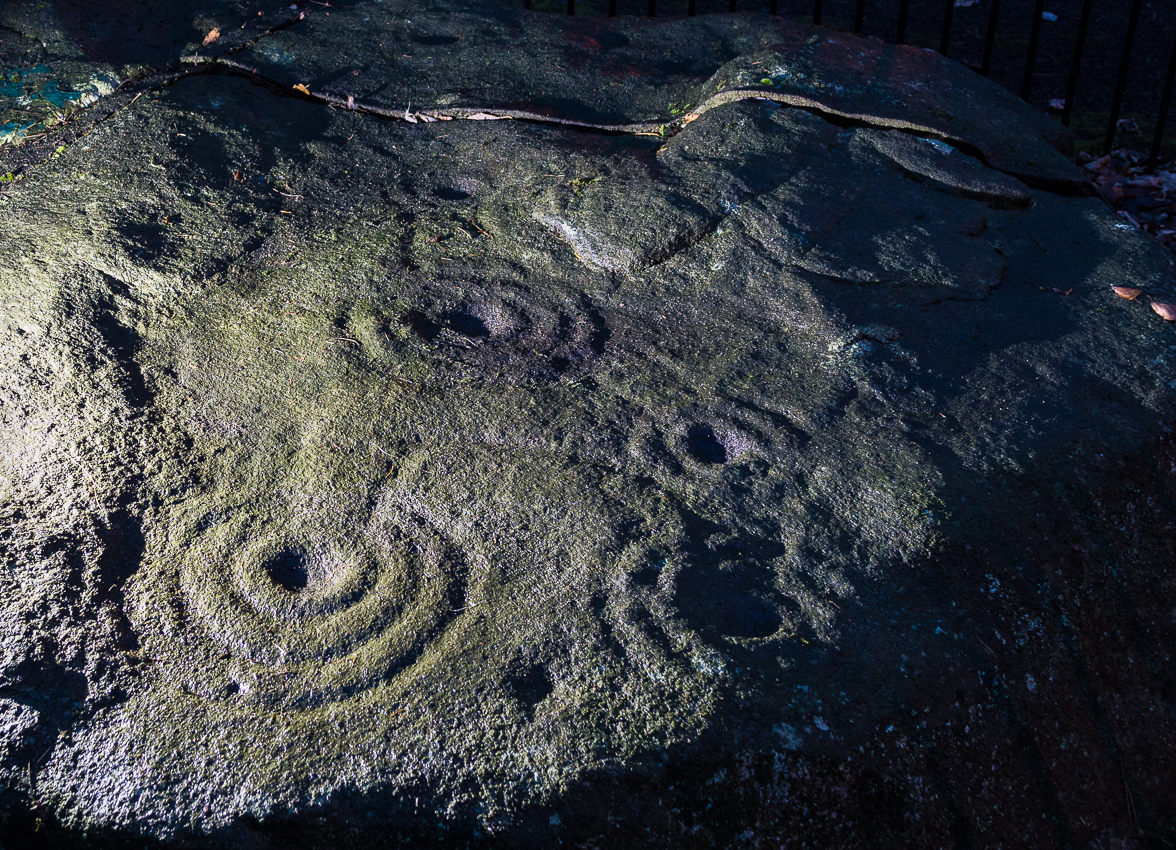
What a brilliant setting and clump of carvings we have here! As you get to the rocky hillock in the field, you see that there are numerous rocks visible along the ridge, a number of which have carvings on them – some with just cups, but most possess a number of cup-and-rings.  It’s an excellent spot!  Depending on the time of year when you come here will determine whether or not you get a better look at the carvings or not.  I’d recommended April and May as the best time, as the vegetation is at its lowest then.  Visiting the site near the end of summer doesn’t give you as good a view — but even then, if you like your rock art, you’ll still love it!  The rocks here are mainly quartzite schist, with a number of the surfaces being almost pure quartz.  Intriguingly, none of the pure quartz sections appear to have been carved on.

The carvings here were first mentioned in an article by D. Haggart (1895), who described them as “a very remarkable set of incised rock sculptures…discovered lately in this neighbourhood by Mr John McNaughton.”  And remarkable they are indeed!  In Ronald Morris’ (1981) survey of this site — which he labelled Duncroisk 1 — he counted eight separate rock surfaces that had been carved, marking them as carvings a-h, but there are at least eleven of them here; and in all honesty, if we could strip the surface of the hill of its vegetation, we’d probably find a few more hidden away!

Cup-marked stone

As you’ve walked across the field from the road, past the first unrecorded cup-marked stone near the start of the rocky rise, we reach Mr Morris’s ‘stone A’ near the easternmost end of the ridge, which is just a small slab of stone with “at least 6 cup-marks” on its surface.  It’s easily missed in poor light, so watch out.  However, if you reach ‘stone b’ (described below), just walk back ten steps and you’ll see it.

Carved Stone B

Ten yards west is ‘Stone B’, seemingly split into two sections, whereupon we find “a cup-and-two-rings and at least 12 cups-and-one-ring, up to 19cm in diameter – some rings gapped, others not, some with and some without a radial groove from the cup, and some with a “runner” or cup in a ring. There are also at least 58 cups” on this section of rock. ‘Stone C’ can also be missed, this time due to its size and the fact that the larger cup-marked surfaces are ahead of you.  But assuming you don’t miss it, this carving consists of “a well-preserved cup-and-two-complete-rings 25cm in diameter, and a cup.”

Carved Stone D

‘Stone D’ is just next to ‘stone C’, but with rather more ornate designs etched upon it.  This is one of the more archetypal petroglyph designs that are found in the photo-guides and textbooks.  Morris (1981) told that it consisted “of a cup-and-two-complete-rings and 2 cups-and-one-complete-ring up to 20cm in diameter, also a cup-and-one-complete-ring and 2 cups.”  The photo here shows it pretty clearly.

Carved Stone E
Curious 'bowl', top-centre
Curious ‘bowl’, top-centre

‘Stone E’ is the next one along, just a foot or two away and Mr Morris (1981) told that the carving consists of “2 cups-and-one-ring up to 13cm in diameters, 1 complete, the others gapped, joined by groove to a cup, and at least 33 cups (C.G. Cash counted 42 in 1911).”  Most of the carved elements on this rock are around the edges of the stone.  A very large faded circular depression, man-made, is also visible on this section of the petroglyph (above left), suggestive of lunar symbolism.

Carved Stone F

‘Stone F’ is less than 10 yards further west and has the greatest number of cup-markings of the entire group here, as Morris described: “3 cups-and-one-complete-ring up to 9cm in diameter, and at least 80 cups, a few of which are widely scattered over a big area sloping steeply further south, beyond the attached diagram.”  It’s perhaps the most notable of the carved rocks along the ridge here — not by virtue of its design, more its geological physique than anything else.

Carved stone G

‘Stone G’ is next along and has a curious look about it, suggestive of more modern times.  At first sight it doesn’t seem to have quite the magnitude that Morris’ description affords it, but on closer inspection by rolling some of the covering turf back away from the rock, you can see what he meant.  This stone has “10 cups-and-one-complete-ring, up to 10cm diameter…and also 15 cups.”  One of the cup-and-rings on this section was found by Morris to have been “the smallest so far recorded by the author in Scotland.”

Then we reach ‘stone H’ at the eastern end of the carved ridge, consisting of simply 3 cup-markings.  One of them has a faint arc pecked around it.  Further along the rock, a complete cup-and-ring is visible close to the edge.

This entire line of petroglyphs is a fine place in a fine setting, perfect for meditative practices!  Other carvings can be found close by: Duncroisk 3 is a coupla hundred yards east across the field just over the fence by the riverside; and Duncroisk 2 is on the other side of the fence down towards the River Lochay on the same side of the adjacent burn less than 100 yards away (though this is trickier to reach). Other prehistoric sites can be found not too far away…

Folklore

Local people tell of having seen curious lights flitting along the edges of the field, river Lochay and roadside close to the carved rocks hereby.

References:

  1. Cash, C.G., “Archaeological Gleanings from Killin,” in Proceedings of the Society of Antiquaries of Scotland, volume 46, 1911-12.
  2. Cormack, E.A., “Cross-Markings and Cup-Markings at Duncroisk, Glen Lochay,” in Proceedings of the Society of Antiquaries, Scotland, volume 84, 1952.
  3. Gillies, William A., In Famed Breadalbane, Munro Press: Perth 1938.
  4. Haggart, D., “Notice of the Discovery of Cup-and-Ring Sculpturings at Duncrosk, near the Falls of Lochay, in Glenlochay,” in Proceedings of the Society of Antiquaries of Scotland, volume 29, 1894-95.
  5. Morris, Ronald W.B., The Prehistoric Rock Art of Southern Scotland, BAR 86: Oxford 1981.

© Paul Bennett, The Northern Antiquarian

Middleton Moor Carving (447), North Yorkshire

Cup-and-Ring Stone:  OS Grid Reference – SE 10931 51278

Getting Here

Follow the same directions as to reach the so-called Smiley Stone carving and look just 10 yards SE.

Archaeology & History

About 10 yards away from the Smiley Stone is another of Middleton Moor’s ‘dubious carvings’ to me. I remember seeing the drawing of this years back, perhaps a decade after Stuart Feather first described it (1966) and remember thinking it looked a bloody good carving. But when I saw it for the first time in February 2005 with Richard Stroud, not only could I hardly see what was supposed to be there, but once I’d seen the alleged design, some doubt came over me regarding its archaic nature. That doubt still remains.

Faint cups & lines
Design on carving 447

There certainly seems to be a few faded cup-marks on the stone — which looks to be broken from a larger, circular worked stone of a much more modern age (an old mill stone perhaps?) — but the lines which both Feather and the grand pair of Boughey & Vickerman (2003) copy into their survey, are all too vague and certainly not ancient in my book.  Perhaps some local folk were still etching cup-marks and lines onto stones into the medieval period and later, like the ones found on the Churn Milk Joan monolith near Hebden Bridge…

References:

  1. Boughey, Keith & Vickerman, E.A., Prehistoric Rock Art of the West Riding, WYAS: Leeds 2003.
  2. Feather, Stuart, “Mid-Wharfedale Cup-and-Ring Markings, no.47: Middleton Moor, Ilkley,” in Cartwright Hall Archaeology Gorup Bulletin, 11:9, 1966.

© Paul Bennett, The Northern Antiquarian

Churn Milk Joan, Midgley Moor, West Yorkshire

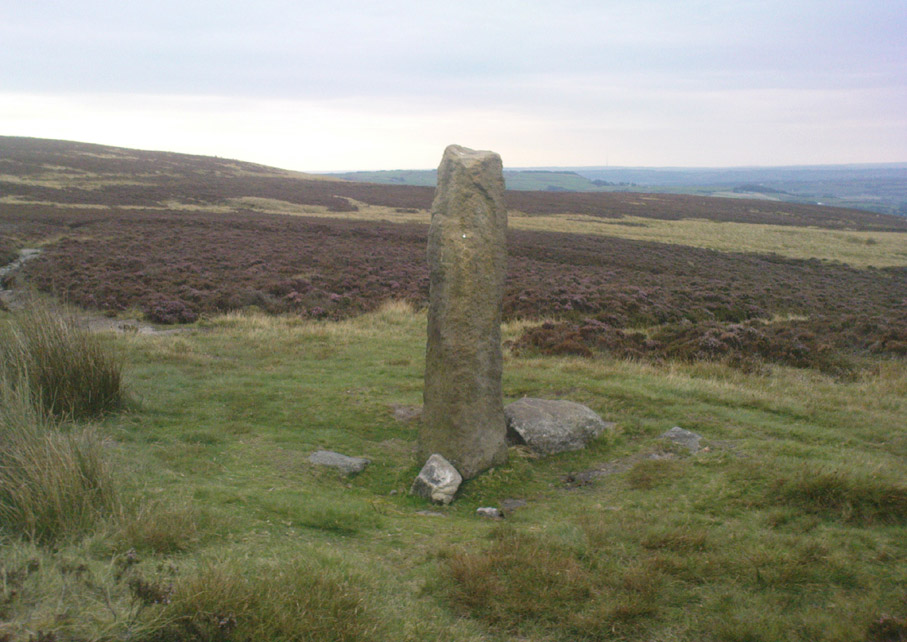
Standing Stone:  OS Grid Reference – SE 01974 27684

Also Known as:

  1. Saville’s Low

Getting Here

Churn Milk Joan, Midgley

From the village of Midgley, high above the A646 Halifax-to-Todmorden road, travel west along the moorland road until you reach the sharp-ish bend in the road, with steep wooded waterfall to your left and the track up to the disused quarry of Foster Clough.  Go up the Foster Clough track for 100 yards and, when you reach the gate in front of you, go over it but follow the line of the straight walling uphill by the stream-side (instead of following the path up the quarries) all the way to the top. Here you’ll see the boundary stone of  Churn Milk Joan.

Archaeology & History

The present large standing stone you see before you isn’t prehistoric.  However, the small broken piece on the ground by its side may have been its prehistoric predecessor; and there is certainly something of an archaic nature here — albeit a contentious one — as we find old cup-markings cut into its eastern face.

Two ‘cup-marks’ on eastern face

The upright is roughly squared and faces the cardinal points.  It was described in Mr Heginbottom’s  (1977) unpublished survey on Calderdale rock art, where he described there being a few cup-markings inscribed on its east- and south-facing edges, some of which may be prehistoric — though they would obviously have had to have been carved upon the upright stone when it still lay earth-fast.  However, we must posit the the notion (unless some of you have better ideas) that the tradition of etching cup-marks onto rocks was still occurring in this part of Yorkshire until the late Middle Ages, as this stone was, as we know from boundary records, only placed upright to mark the meeting of the three boundaries of Wadsworth, Hebden Royd and Sowerby.

Churn Milk Joan’s other name, Saville’s Low, originates from the great Saville family who owned great tracts of land across the region in the fourteenth century, possibly when the Churn Milk Joan we see today was created.  The word “lowe” may derive from the old word meaning, “moot or gathering place,” which this great stone probably served as due to its siting at the junction of the three townships.*

Folklore

In modern times the stone has become a focus for a number of local pagans and New Agers who visit and ‘use’ the site in their respective ways at certain times of the day, albeit estranged (ego-bound) from the original mythic nature of the site.

The name of the stone comes from an old legend about a milk-maid named Joan who, whilst carrying milk across the moors between Luddenden and Pecket Well, got caught in a blizzard and froze to death.  When her body was found many days later, the stone we see here today was erected to commemorate the spot where she died.  Although such a scenario is quite likely on these hills, as Andy Roberts (1992) said,

“Considering the sheer amount of sites with similar legends this explanation is unlikely to be true and we should looker deeper for the meaning behind Churn Milk Joan, to be found in its positioning in the landscape and ourindividual feelings about it.”  [see profiles for the Two Lads and the Lad o’ Crow Hill sites)

The monolith’s other title, Churnmilk Peg, is the name given to an old hag who is said to be the guardian of nut thickets.  How this female sprite came to find her abode upon these high hills is somewhat of an enigma, but it was first stated as such in an article by Andy Roberts (1989) in “Northern Earth Mysteries” magazine.  E.M. Wright (1913) noted this supernatural creature in her work on folk dialect, describing it as a West Yorkshire elemental who, along with another one known as Melsh Dick:

“are wood-demons supposed to protect soft, unripe nuts from being gathered by naughty children, the former being wont to beguile her leisure by smoking a pipe.”

Another legend of the stone tells how it is said to spin round three times on New Year’s Eve when it hears the sound of the midnight bells at St. Michael’s church (St. Michael was a dragon-slayer) at Mytholmroyd in the valley below.  Another piece of folklore tells that coins used to be left in a small hollow at the very top of the stone which, according to Haslem (1981), was “a gift to the spirit world, to bring luck” – a common folk motif.  It may equally originate from the custom of it as a plague stone.  This tradition of leaving coins atop of the stone is still perpetuated by some local folk.

Mr Haslem also made some interesting remarks about the nature of Churn Milk Joan standing as a boundary stone, representing something which stands not just as a physical boundary, but as a boundary point between this and the Other- or spirit world.  In folklore, streams and rivers commonly carry this theme.  But here on Midgley Moor, as a standing stone at the junction of three boundaries, we may be looking at the place as an omphalos: a centre point from which the manifold worlds unfold. (see Almscliffe Crags, the Ashlar Chair and the Hitching Stone)

The other motif here, of milk and snow [both white], have been speculated to represent power of the sun at midwinter, and geomantically we find the position of the stone in the landscape exemplifying this: it stands midway in the moorland scenery facing south, the direction of solar power, yet is bounded as an equinox marker from east and west.  The winter tales it has nestled around it are merely complementary occult augurs of its more wholesome elements at this point in the hills.

There is however, another much more potent element that has not been conveyed about the site and its folklore—and one which has more authenticity and primary animistic quality.  Regardless of ‘Joan’ or ‘Peg’ being the elemental preserved in the landscape title, the ‘churning’ in its name and the ‘spinning’ of the stone in myth at the end of one year and the start of the next at New Year, are folk memories of traditional creation myths that speak of the cyclical seasons endlessly perpetuated year after year after year, in what Mircea Eliade (1954) called the ‘myth of the eternal return.’  As season follows season in the folk myths of our ancestors, everything related to the natural world: a world inhabited (as it still is) by feelings and intuitions learned from an endless daily encounter, outdoors, with the streams, hills, gales, snow and fires.  Their entire cosmology, as with aboriginal people the world over, saw the cycles of the year as integral parts of their daily lives.  Here, at Churn Milk Joan with its central landscape position along an ancient boundary, the churning and turning of the year was commemorated and mythologized year after year after year; with maybe even the Milky Way being part of the ‘milk’ in its title, from which, in the shamanistic worlds that were integral to earlier society, the gods themselves emerged and came down to Earth.

References:

  1. Bennett, Paul, The Old Stones of Elmet, Capall Bann: Milverton 2001.
  2. Eliade, Mircea, The Myth of the Eternal Return, Bollingen 1954.
  3. Haslem, Michael, “Churn Milk Joan: A Boundary Stone on Midgley Moor,” in Wood and Water, 1:8, 1980.
  4. Heginbottom, J.A., “The Prehistoric Rock Art of Upper Calderdale and the Surrounding Area,” Yorkshire Archaeology Society 1977.
  5. Ogden, J.H., “A Moorland Township: Wadsworth in Ancient Times,” Proceedings of the Halifax Antiquarian Society, 1904.
  6. Robert, Andy, “Our Last Meeting,” in NEM 37, 1989.
  7. Robert, Andy, Ghosts and Legends of Yorkshire, Jarrold: Sheffield 1992.
  8. Wright, Elizabeth Mary, Rustic Speech and Folk-Lore, Oxford University Press 1913.

* The great stone at the cente of the Great Skirtful of Stones, Burley Moor, which previously stood at the centre of the Grubstones Circle, was just such a moot stone.  Upon it is carved the words “This is Rumble’s Lawe”.

© Paul Bennett, The Northern Antiquarian

Dragon Stone, Steeton, West Yorkshire

Cup-and-Ring Stone:  OS Grid Reference – SE 03590 43677

Also Known as:

  1. Hollins Bank Farm Carving

Getting Here

Dragon Stone carving

Go northwest along the country lane running between High Utley (on the outskirts of Keighley) and Steeton known as Hollins Lane, which then becomes Hollins Bank Lane.  You’ll see the fine castle building as you go along, known simply as The Tower arising from the top of the tree-line.  As you get to the driveway leading down to the Tower, a less impressive farm building is on the other side of the road, known as Hollins Bank Farm.  On the right-hand side of this house is an old overgrown road.  Walk along here to the end, going into the field immediately left where a small group of stones can be seen halfway up the field by the tree.  You’re here!

Archaeology & History

First discovered one sunny afternoon on April 7, 2010, in the company of Buddhist scholar Steve Hart, this is a really curious carving, inasmuch as it seems to have been deliberately carved around what may be curious naturally eroded cup-forms.  You’ll have to visit it to see what I mean.  They’re a bit odd.  Almost too perfect as cups to be the ancient eroded ones we’re used to looking at.  But this aside….

…and again
Dragon Stone, looking NW

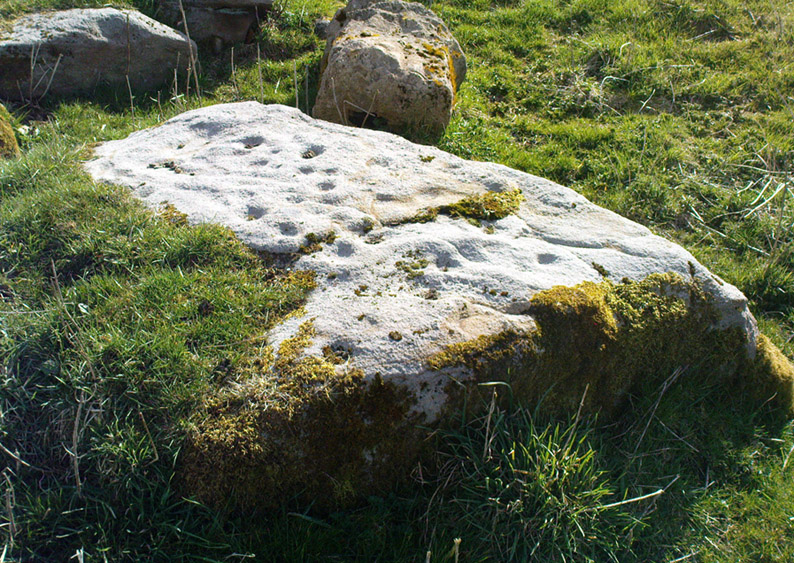
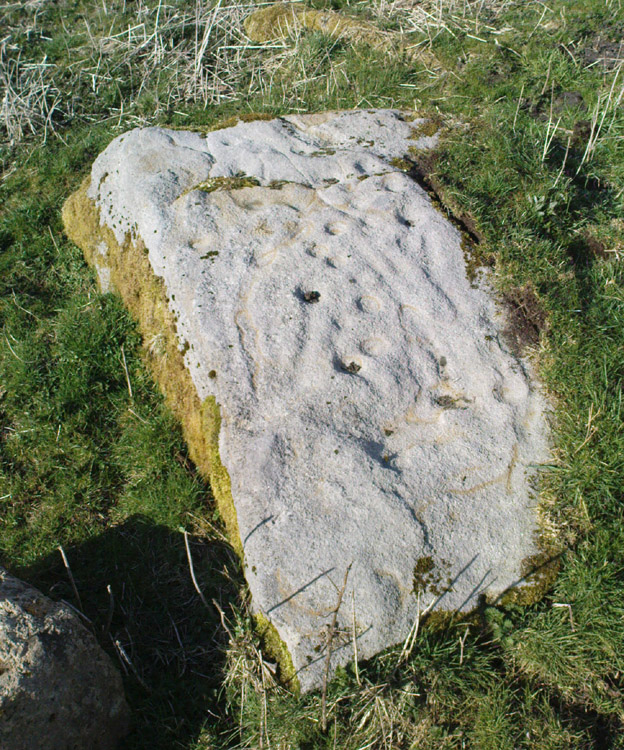
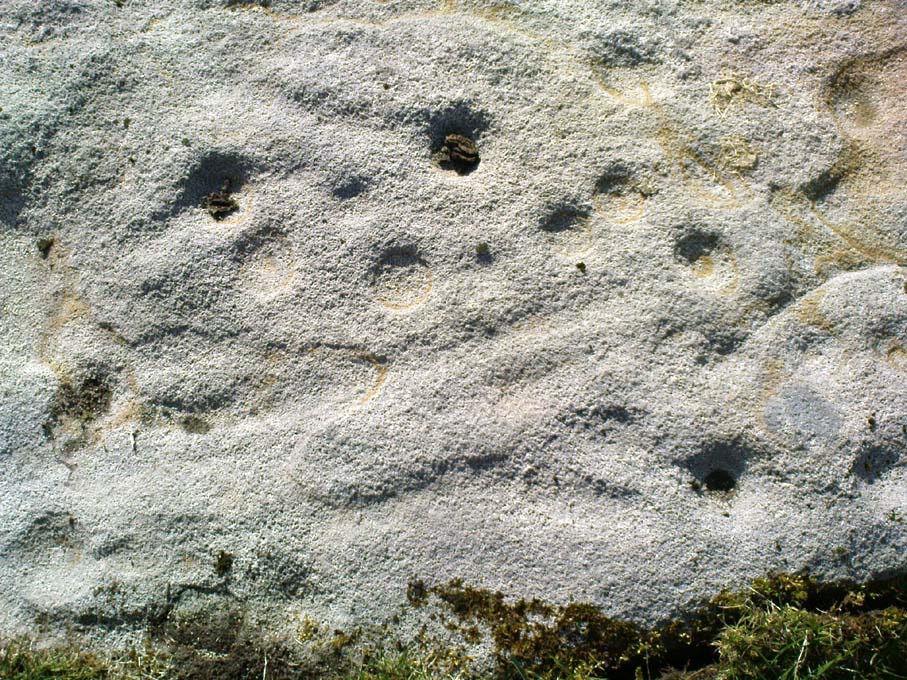
It’s a lovely flat stone, with curvaceous lines running across the middle and edges and into cup-markings.  Although some of the cups give an impression of being natural, others have the authentic-looking ring to them, with at least one of them possessing a near-complete ring encircling it (as you can faintly see in the close-up photo here).  There are at least 19 cup-markings on this stone, and four main ‘lines’ running roughly in north-south directions, with the cups interspersed between them.  At the top (north) end of the rock, separated by a crack, the lines stop and we just have some cup-markings.  The crack in the stone may have been functional here.

Although graphically different, the carving has a similar feel in design (for me at least) to that of the Wondjina Stone at Rivock Edge, on the other side of the Aire Valley a couple of miles east of here — though this newly found carving is in a better state of preservation.  The small scatter of rocks around it seem to have been unearthed or moved recently by the land-owner (who aint keen on you looking on his land, so be careful) and the good state of preservation may be that they were only unearthed sometime this century.  We must also keep in consideration that the lines that run across the surface of this stone are water-lines and may be more the result of Nature’s hand than humans.  It’s obvious that some human intervention has occurred here, but it may be difficult to ascertain the precise degree of affectation between the two agencies.

Close-up of cups & lines

According to the archaeological record-books there are no carvings here, but another simple cup-marked stone accompanies this more extravagant serpentine design just a few yards away; a simple cup-marked stone may be seen at the top of the hill; and the faint Currer Woods carving can be found 0.68 miles (1.09km) due west of here, on the other side of the small valley.  Other outcrop stones scatter the fields and slopes here, some of which still need checking to see whether or not further carvings exist.

…And for those who may bemoan my seemingly romantic title of the carving: remember! — close by in Steeton township, between the years 1562 and 1797, there was an old field-name known well to local folk, of “one parcel of arable land in town field called Drakesyke, 3 acres”, i.e., the dragon’s stream or dyke. (Gelling 1988; Smith 1956)

References:

  1. Clough, John, History of Steeton, S. Billows: Keighley 1886.
  2. Gelling, Margaret, Signposts to the Past, Phillimore: Chichester 1988.
  3. Smith, A.H., English Place-Names Elements – 2 volumes, Cambridge University Press 1956.

© Paul Bennett, The Northern Antiquarian

Salford Cross Cup-Marks, Oxfordshire

Cup-Marked Stone:  OS Grid Reference – SP 28644 28058

Getting Here

Pretty simple this one.  From Chipping Norton, head west on the A44 for a coupla miles till you hit the lovely Salford village.  The church stands out, so head for it and, as you walk towards the building, watch for the small stone cross in front of you.

Archaeology & History

Salford Cross cup-markings

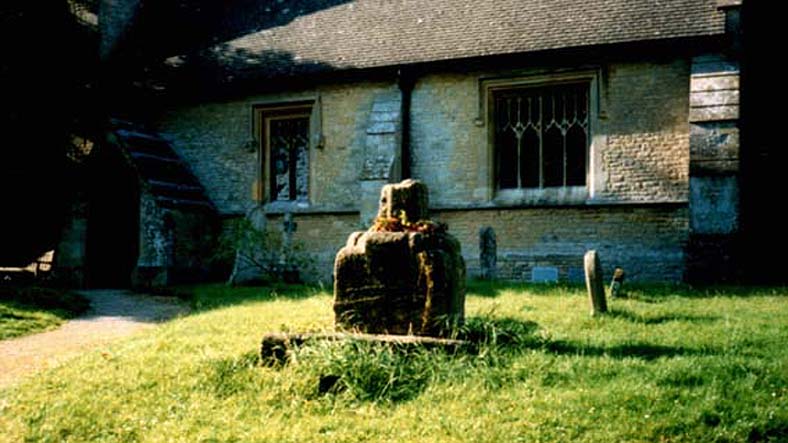
This is curious.  Very curious!  We might expect to find cup-markings occasionally on some of the cross-bases or other early christian monuments in northern England and Scotland, but to find them in the heart of a small Oxfordshire village where the tradition of cup-marked stones is unknown, was something of a surprise when Tom Wilson and I (1999) found it, to say the least!  But this is what we’re looking at here.

Salford Cross remains

On the remains of an old medieval cross, whose broken shaft has seen better days,  as the photo shows — and as a personal viewing shows even clearer — there are 3 simple cup-markings etched on one side of the cross-base in Salford churchyard.   The cups certainly aint natural, but then also they don’t have the archaic looks of the prehistoric carvings from Yorkshire to Scotland.  It would be good if we had a more extensive history of the cross monument itself, perhaps saying precisely where the stones which make it up came from, but local records tell us nothing it seems.  If we could ascertain that parts of it were made up of some remains taken from some local prehistoric ‘pagan’ tomb (and a number of tombs have been found in and around this area), then some sense could be thrown upon its position here.  But until we can ascertain more about the history of the cross, the three clear cup-markings on the cross-base remain somewhat of a mystery.

Folklore

Lovers of ley lore will be intrigued to find this carved cross-base is on a very accurate ley linking the King Stone, Rollright stone circle, Little Rollright church (where a standing stone can be found in the walling just before it), the Salford Cross and the site of another cross on the hill outside the village.

References:

  1. Bennett, Paul & Wilson, Tom, The Old Stones of Rollright and District, Cockley: London 1999.

© Paul Bennett, The Northern Antiquarian

Middleton Moor Carving (484), North Yorkshire

Cup-Marked Stone:  OS Grid Reference – SE 11650 51623

Getting Here

Go over Ilkley Bridge and take your first left, on & over the roundabout, then follow the road as it bends uphill.  Keep going until you reach the fields and moors either side of you, up Hardings Lane, stopping at the bend in the land where it meets a couple of dirt-tracks.  Go up the track onto the moor and follow this right into the moorland (avoiding the path to your right after a few hundred yards) where it follows the edge of the walling again.  After a few hundred yards there’s a gate on your right.  Go thru this and, after 40-50 yards, walk up into the heather.  You’re damn close!

Carving no.484

Archaeology & History

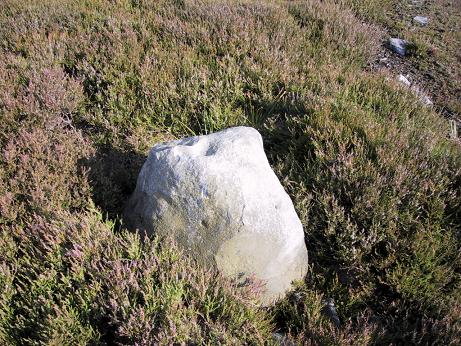
This is another cup-marked stone that’ll only be of interest to the petroglyphic purists amongst you, as it’s another one of those incredibly interesting single cup-marked rocks — this time with an additional single line running from it!  WOWWWW….! The photo here just about does it justice, as in some light conditions you wouldn’t even notice it.  There’s also the possibility that this ‘carving’ was actually Nature’s handiwork.

It was first described by our old mate Stuart Feather in 1965, and was then included in Boughey & Vickerman’s (2003) survey as stone 484, describing it as, “medium-sized, approximately square rock of fairly smooth grit.  One cup with groove leading from it.”

References:

  1. Boughey, Keith & Vickerman, E.A., Prehistoric Rock Art of the West Riding, WYAS: Wakefield 2003.
  2. Feather, Stuart, “Mid-Wharfedale Cup-and-Ring Markings: Nos. 36, 37 and 38, Middleton Moor, Ilkley,” in Cartwright Hall Archaeology Group Bulletin, volume 10, 1965.

ACKNOWLEDGEMENTS: to Richard Stroud for use of his photo

© Paul Bennett, The Northern Antiquarian 

Askwith Moor (529), North Yorkshire

Cup-Marked Stone:  OS Grid Reference – SE 17396 50745

Getting Here

To be found a couple of hundred yards west of Askwith Moor Road, head towards the bottom of the row of grouse-butts, following the fence that runs into the moorland across from the dusty car-park.

Archaeology & History

Single cup-marked stone

This single cup-marked stone — list as carved stone no.529 in Boughey & Vickerman’s (2003) survey — was reported when some English Heritage doods came here and found this small upright stone (probably part of a larger prehistoric monument, e.g., walling or cairn) and gave the cup-marking their “all clear” stamp and thought it authentic.  But if memory serves me right (which it doesn’t always do these days!), I’m pretty sure Graeme Chappell came across this possible carving in the early 1990s during one of our many forays over these moors.  It’s a cute little thing — though only for the purists amongst you perhaps — but, of course, needs to be seen in the context of its proximity to the many other prehistoric monuments across this moorland plain.

References:

  1. Boughey, Keith & Vickerman, E.A., Prehistoric Rock Art of the West Riding, WYAS: Wakefield 2003.

© Paul Bennett, The Northern Antiquarian

Lippersley Pike Rock, Denton Moor, North Yorkshire

Cup-Marked Stone:  OS Grid Reference – SE 1471 5233

Also Known as:

  1. Carving no.506 (Boughey & Vickerman)
1992 drawing of CR506

Getting Here

Stuck in the middle of the moor, at the bottom (southern) side of the Lippersley Ridge promontory.  Head towards it from the Askwith Moor Road, along the track past Sourby Farm and onto the end.  Then walk along the easy footpath which that takes you below the southern side of the ridge and, about 100 yards before getting to the end of the rise, look around in the heather.  You’ll find it.

Archaeology & History

Graeme Chappell’s early photo of the carving

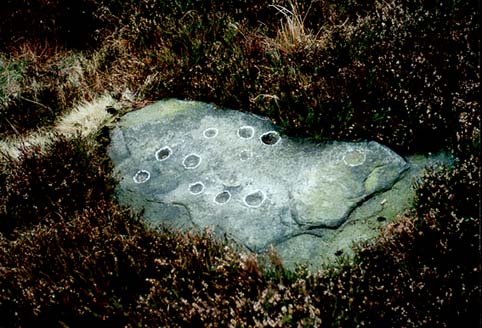
Graeme Chappell rediscovered this seemingly isolated cup-marked stone during one of our many exploratory ambles upon these moors in the early 1990s.  The carving is a pretty simple one, consisting of between 10 and 12 cupmarks on the upper surface of a reasonably large elongated stone.  No discernible rings or other lines seem to be visible.  There are no other cup-and-ring stones close by; but two small prehistoric cairns can be found along the same sloping ridge east and west of here when the heather is low, and the larger Lippersley Pike Cairn stands out on the western end of the ridge 450 yards away.  A more detailed exploration of this part of the moor may bring other previously unknown findings to light.

References:

  1. Boughey, Keith & Vickerman, E.A., Prehistoric Rock Art of the West Riding, WYAS: Wakefield 2003.

© Paul Bennett, The Northern Antiquarian

Clach a’ Choire, Vaul, Tiree

Cup-and-Ring Stone:  OS Grid Reference – NM 027 487

Also Known as:

  1. Kettle Stone
  2. Ringing Stone
  3. Singing Stone

Archaeology & History

This is a fascinating large coastal boulder with around 53 cup-markings on it — but whether these are all man-made is a matter of debate.  Some of them may be natural.  However some of the cups have lines and faint rings around them, showing that at least they’re man-made; and also in one of the large cups are placed small pebbles, similar in form to the well-known Butter Rolls, or bullaun stone at Feaghna, Ireland.

Folklore

This large boulder (suggested to have been dragged and dropped here from the Isle of Rhum in an earlier Ice Age) is known in the modern tongue as the ‘Ringing Stone’ because, allegedly, if you knock the surface hard with another stone it supposedly chimes with a metallic noise.  As one of the links below shows, however, it doesn’t necessarily do the trick!  Local folklore tells that if the stone is ever destroyed, or falls off its present platform of smaller stones, Tiree itself will sink beneath the waves.  Other lore tells that this great rock is hollow; and another that it contains a great treasure. According to Otta Swire (1964),

“Some believe this to be a treasure of gold, others claim it to be the resting place of the Feinn who there await the call to rescue Scotland.”

References:

  1. Royal Commission on the Ancient & Historical Monuments of Scotland, Argyll – volume 3: Mull, Tiree, Coll and Northern Argyll, HMSO: Edinburgh 1980.
  2. Swire, Otta F., Inner Hebrides and their Legends, Collins: London 1964.

Links:

  1. Images of the Clach a’ Choire, from the Images of Tiree website.
  2. Brief video of Tiree’s Ringing Stone (which doesn’t seem to work too well!)

© Paul Bennett, The Northern Antiquarian