Tumulus (destroyed): OS Grid Reference – SD 696 208
Also Known as:
Whitehall Tumulus
Ashleigh Barrow urns (after John Dixon)
Archaeology & History
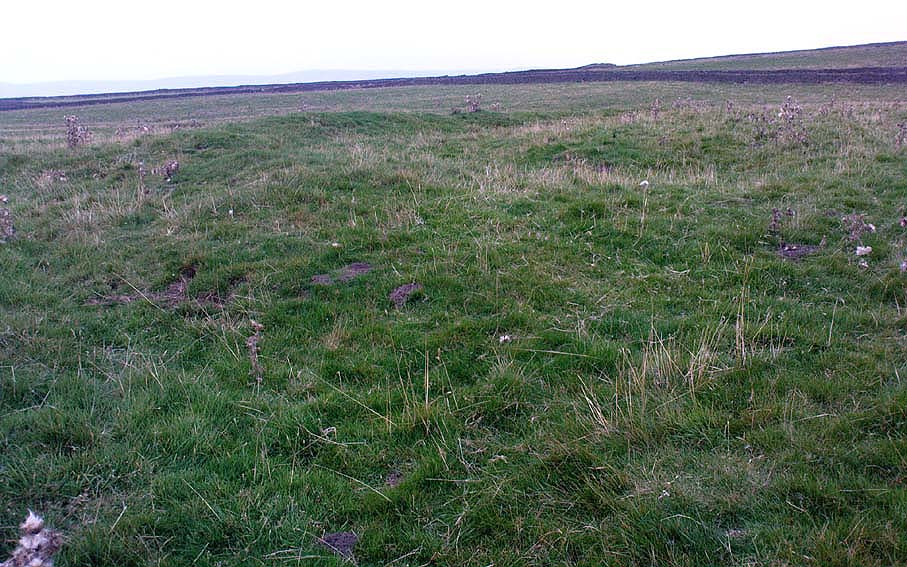
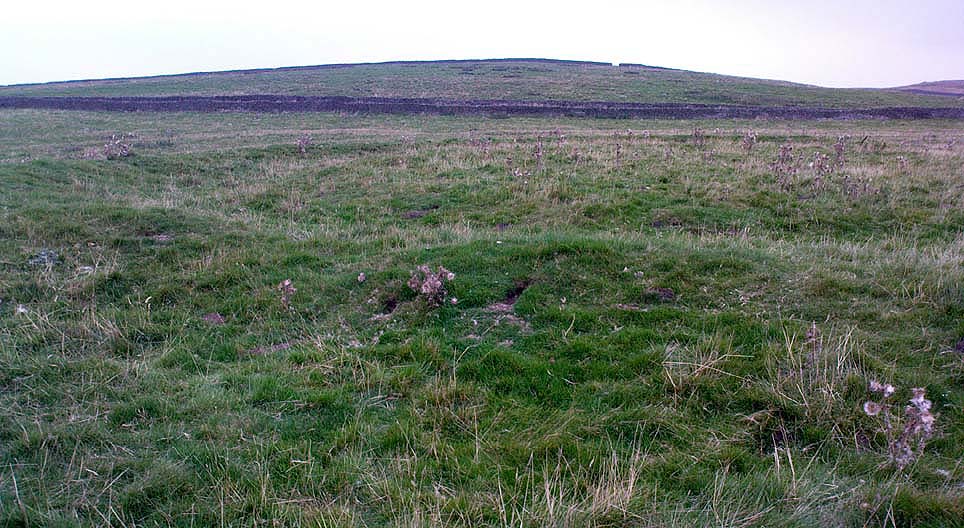
Early accounts of this site tell of its destruction in the 19th century, but a modern reconstruction of the site has been made close to where it once stood. And this tomb sounded quite impressive! Within the ‘tomb’ were found a large number of urns, one of which was curiously empty. In John Dixon’s excellent Journeys through Brigantia (2003) work he told that,
“Contemporary reports about its excavation state that it was of circular form about 30 yards in diameter, being formed on a naze or promontory of an undulating plateau overlooking the Darwen valley. Its height was said to vary between 10 to 12 feet on the east side and between 2 or 3 feet on the west, the centre being about 6 feet in diameter and consisting of a slight hollow.
“Ten interments appear to have been made, one being just a heap of burnt bones, the others, having been enclosed in urns, the majority of which are badly broken, consisted of ashes and fragments of bone together with unrecognizable pieces of bronze. Two urns also contained ‘incense cups’ and another a 7½-inch bronze knife or dagger.
“The design of the urns is similar to those from the Middle Bronze Age… All but two of the urns were found within an area 21 feet by 14 feet, whilst one was 40 feet away. They were, with one exception, placed in the Earth with the orifice pointing upwards and were covered with slabs, the depth at which they were found varying from 1 to 2 feet.”
Remains of the urns can be seen on display in the Darwen Library.
Folklore
Once again in John Dixon’s (2003) fine Journey’s through Brigantia volume, we read of folklore relating to the respect of the dead which local people used to give this old tomb, telling:
“Many superstitions were attached to the barrow and its destruction in the 1860s, with the country people speaking of the place being haunted by ‘boggarts’ and children having been known to take off their clogs or shoes and walk past it barefoot in the night time.”
References:
Dixon, John, Journeys through Brigantia – volume 11: East Lancashire Pennines, Aussteiger Publications: Barnoldswick 2003.
Probably the easiest way is to park up at Stump Cross Caverns on the B6265 road, then walk down the road for 200 yards till you reach the track on your left running over the fields in the direction towards Simon’s Seat. Walk along the track past the Skyreholme Wall carving, where it starts going downhill and, 100 yards before you reach the fork in the tracks, look in the field on your left. The other route is to go east through Appletreewick village up to and through Skyreholme as far as you can drive, where the dirt-track begins. Keep going up till you hit the fork in the tracks. Go left, then thru the first gate you come to and walk up into the second field up where the notable rock stands out. If you can’t see it at first, look around!
Archaeology & History
Boughey & Vickerman’s plan of the carving
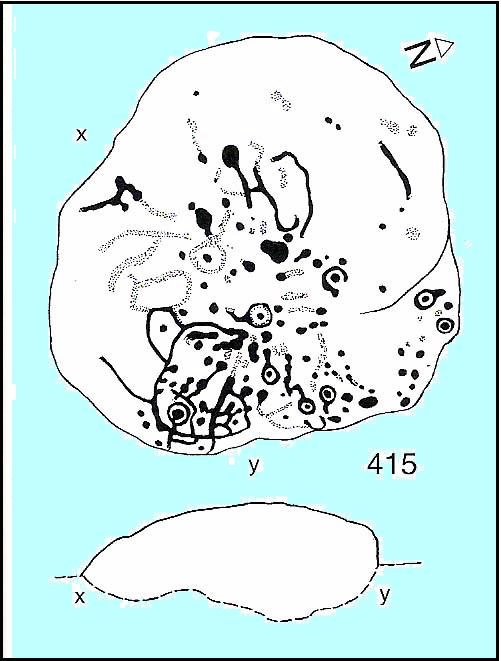
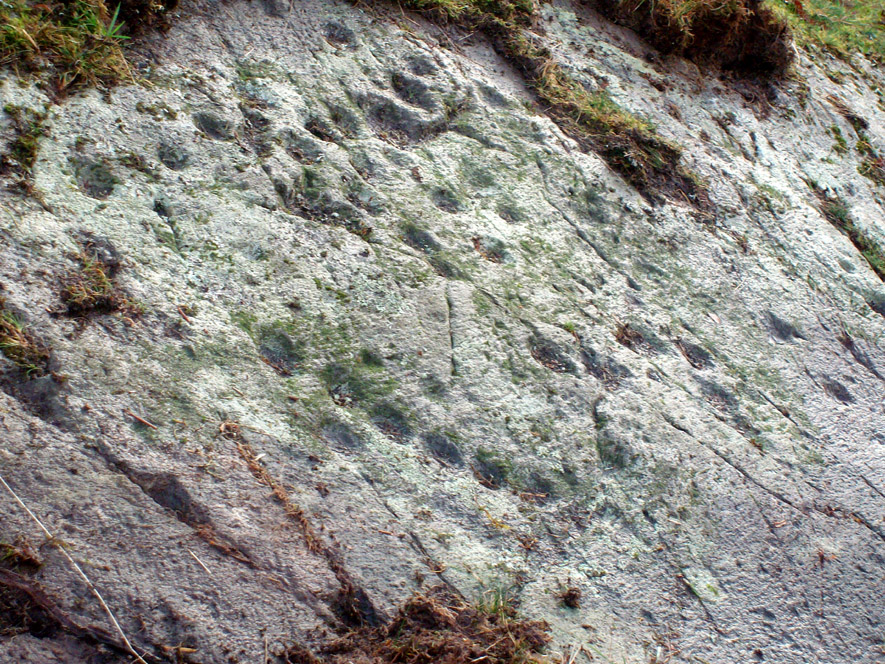
This carving was rediscovered by Stuart Feather (1964) in one of his ambles in the area — and he would have been pretty pleased when he found this one! It is the most complex and ornate of all the prehistoric carvings in and around this large open field. With at least nine cup-and-rings and more than fifty other cups etched onto its rounded upper surface, there are various other lines and grooves linking up some elements of this mythic design. The best ones are on the upright and sloping east-face of the rock, into the rising sun. In animistic terms the rock is distinctly female in nature.
Illustrated in one of Stan Beckensall’s (1999) works, the rock art students Boughey & Vickerman (2003) also include it in their survey, but give an inaccurate grid reference for the site. They nevertheless describe it as:
“Large upstanding rock with slightly domed top surface. Most of top surface decorated but weathering makes detail uncertain: over sixty cups, eight or more with rings, many grooves.”
Many other carvings can be found in the area.
References:
Beckensall, Stan, British Prehistoric Rock Art, Tempus: Stroud 1999.
Boughey, Keith & Vickerman, E.A., Prehistoric Rock Art of the West Riding, WYAS: Wakefield 2003.
Morris, Ronald W.B., “The Prehistoric Rock Art of Great Britain: A Survey of All Sites Bearing Motifs more Complex than Simple Cup-marks,” in Proceedings of the Prehistoric Society, volume 55, 1989.
Acknowledgements: Huge thanks to the pseudonymous ‘QDanT‘ for use of the photo in this profile. Cheers Danny!
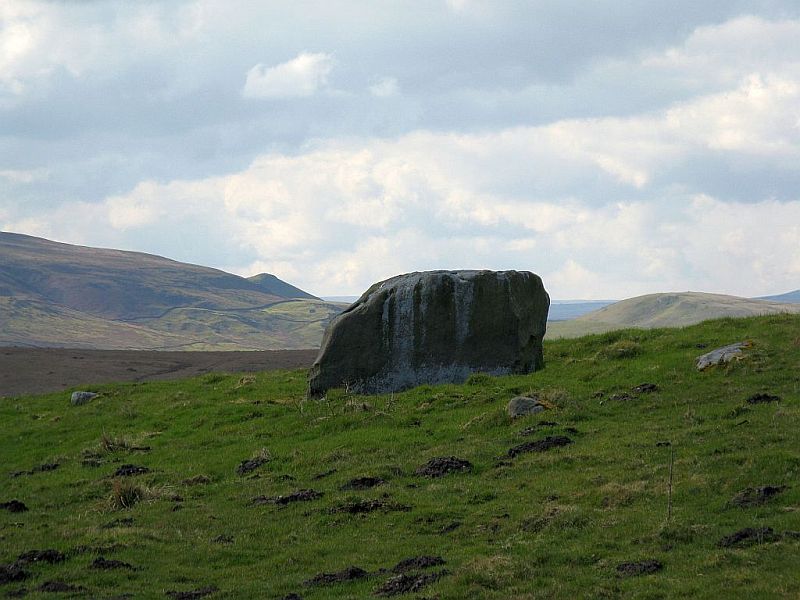
One way is to go east through Appletreewick village up to and through Skyreholme (making sure you bear right at the turn and not go up the left turn, which takes you uphill and elsewhere!) as far as you can drive, where the dirt-track begins. Keep going up till you hit the fork in the tracks, and here, look into the field on your right. The other way is to park up at Stump Cross Caverns on the B6265 road, then walk down the road for 200 yards till you reach the track on your left running towards Simon’s Seat. Walk all the way down this till you reach the fork in the tracks. There’s a gate into the field just yards below the split in the tracks. Go thru it and walk into the middle of the field where the stone unmistakably calls out for you to go sit with it for a while!
Archaeology & History
Boughey & Vickerman’s plan of the cup-marks
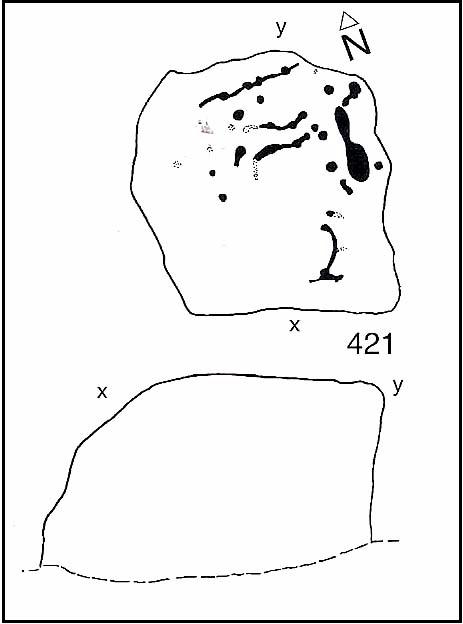
Sat near a ridge due north of the magnificent Simon’s Seat, this faded carved stone gets its name from the field in which it lives — and as Danny’s photo here shows, it’s a fine stone indeed in a very fine setting. The cup-marks on its top were first described by Stuart Feather (1964), who found there to be around 20 cup-markings on the top, with some grooves — possibly natural, possibly man-made — linking them together.
However, in the fields north of here are a number of other cup-and-ring carvings, but much of the landscape has been damaged by industrial workings. It makes you wonder how many there used to be here before the industrialists started digging the land up…
References:
Boughey, Keith & Vickerman, E.A., Prehistoric Rock Art of the West Riding, WYAS: Wakefield 2003.
Morris, Ronald W.B., “The Prehistoric Rock Art of Great Britain: A Survey of All Sites Bearing Motifs more Complex than Simple Cup-Marks,” in Proceedings of the Prehistoric Society, volume 55, 1989.
Acknowledgements:
Huge thanks to the pseudonymous ‘QDanT‘ for use of the photo in this profile. Cheers Danny!
Corrycharmaig 3 stone, with Meall Dhuin Croisg rising…
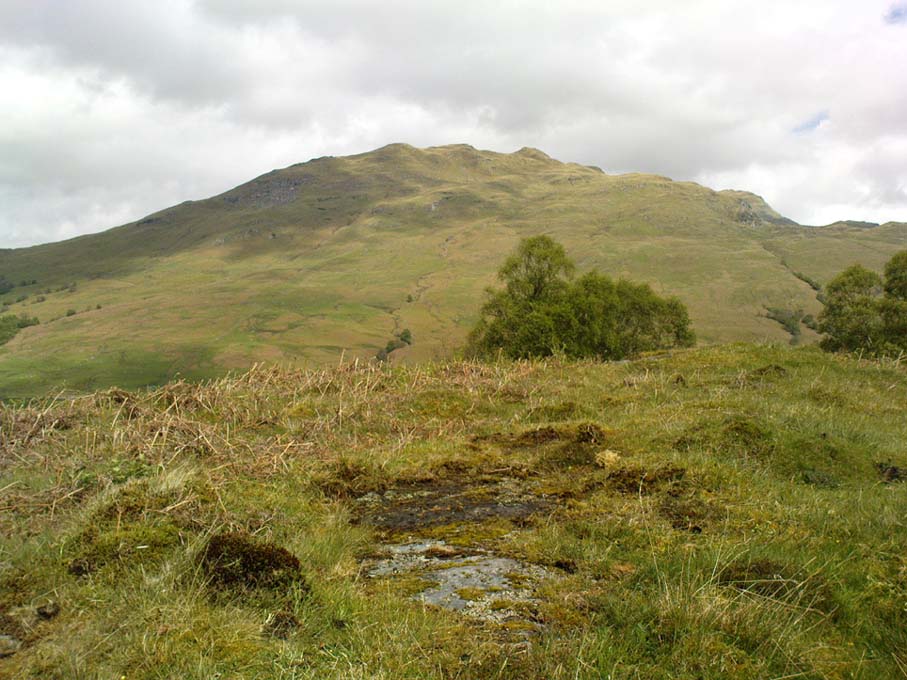
Go thru Killin and, just past the Bridge of Lochay hotel, take the tiny road on your left. Go down here for 3 miles till you pass the gorgeous Stag Cottage (with its superb cup-and-rings in the field across the road) for another 300 yards, until you see Duncroisk Farmhouse set back on your right. On the other side of the road, go thru the giant deer-gates (close ’em behind you) to the river-bridge and across it. Walk along the track till you reach the turning to Corrycharmaig House on the right (over the stream), but here, go up into the field thru the gate. Walk up the hill ahead of you with its trees on the left, walking up onto the grassy level, then up again to the rounded knoll another 100 yards up. You’re here!
Archaeology & History
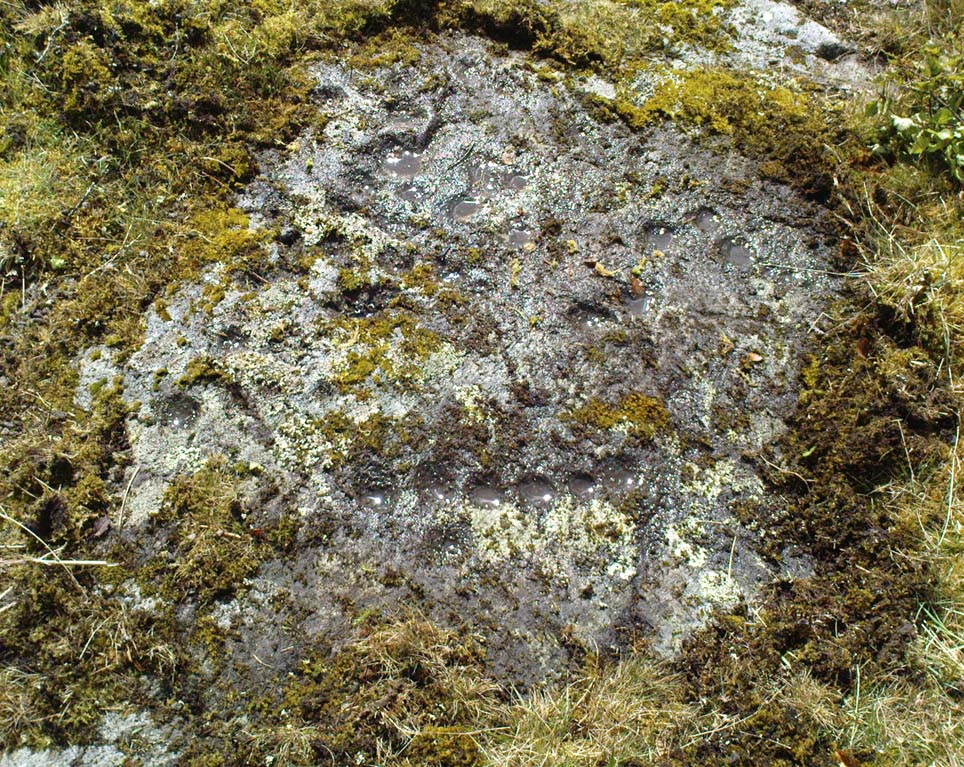
This is the most visually impressive of the set of four cup-marked rocks along this ridge — although if you visit here when the light is poor, or the sky’s overcast, you’ll be lucky if you can actually see much of the material. For example, I counted 38 cups on this particular stone on a day when the sky was bright, but upon checking later, found that Mr Morris (1981) described there being, “40 widely scattered cups of which, however, 29 well-defined cups are in a compact group of which 6 are in line.” Whereas more recently the Canmore website told there to be,
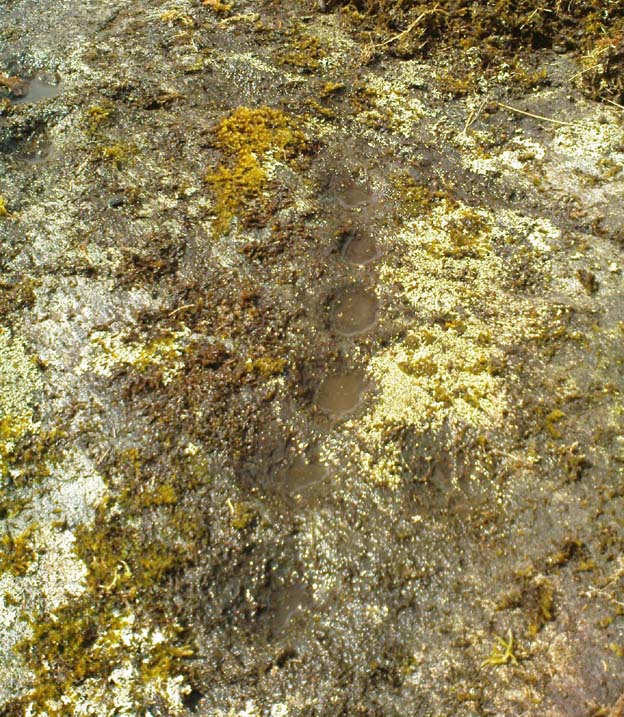
Corrycharmaig-3 carvingClose-up of line of cups
“At least 48 cupmarks are visible on the most westerly exposure. The cupmarks range in size from 25mm in diameter and 5mm in depth to 100mm in diameter and 40mm in depth. A straight line of six cupmarks arranged close together is orientated running from NW to SE.”
This line of six cups is very distinct and stands out as the most notable aspect on this carving, probably because it gives a sense of ‘order’ or linearity, whereas the rest of the carving (as with oh so many of them, thankfully) possess that non-linear feature of scattered cups and lines, dissolving reason and ego, and eliciting the natural meditative state, if one so cares to allow. On our most recent visit here, our eyes and fingers traced what appeared to be the faint remains of a carved line running along the bottom edge of the row of cups and then bending around the bottom cup in the same line — a little bit like the carved lines which run around the edges of the row of cups on Ilkley Moor’s Idol Stone. You can just make this ‘line’ out in the photo, below.
Cup-mark and flintClusters of cups and faint line
On one visit to the site when we’d stayed with the late great Lindsay Campbell of Stag Cottage, other sections of this carving were visible that we’d previously missed, highlighting at least 45 cup-marks that we counted. Several of the cups had been exposed by animals (sheep or deer – we couldn’t tell) cutting into the soaking wet earth and in carefully checking a couple of cups whose edges were exposed, found a small worked flint within one of the cups! I looked at it, held it, puzzled over it, then laid it back where we’d found it. You can see it in the photo here, on the right.
This carving obviously grows on you with time. And like its carved companions of Corrycharmaig (1), (2) and (4) both left and right of here, the stone rests within a natural theatre of dreams, eliciting — if only in a slight way — the non-focal perspective necessary to receive the carvings as its executor knew…
Morris, Ronald W.B., The Prehistoric Rock Art of Southern Scotland, BAR 86: Oxford 1981.
Royal Commission on the Ancient & Historical Monuments of Scotland, Archaeological Sites and Monuments of Stirling District, Central Region, Society of Antiquaries of Scotland 1979.
In Grassington, go up the main street and keep going uphill, out of town. You’re on Moor Road now and it keeps going northeast for about a mile, where the small copse of trees grows just before Yarnbury House. However, on the other side of the road (right) two field before you reach the house, you’ll notice a slightly raised elevation in the field, close to the wall. A footpath runs right past it, so you shouldn’t have too much trouble finding it!
Archaeology & History
This is a fine, roughly circular neolithic monument, sat not-quite-on-the-heights, but still possessing damn good views all round (except immediately west), begging the question, ‘what on earth are you and why were you built here?’ Answers to which, we don’t really know. But ascertaining its geomantic nature wouldn’t be too difficult for local people who have spent years visiting the site. John Dixon (1990) mentioned how, in the winter months,
“the sun falls behind Pendle (Hill) providing it with a sky-red backdrop. In my own view the site is related to the presence of Pendle…and may have been the major factor in the location of the monument.”
He may be right! It has been suggested by one archaeologist (King et al, 1995) that the site was “most probably a wood henge” with upright rings of wooden posts that were built onto the central platform — but until we get a full dig here, we’re not gonna know.
N-NE section of hengeSW section of the henge
Found close to an extensive amount of other prehistoric remains in the area (dating from the neolithic to Iron Age), this henge monument is notable for its size, as it’s only a little fella! It’s like a mini-version of the Castle Dykes henge near Aysgarth, 14 miles to the north! First mentioned as a ‘disc barrow’ in 1929, J. Barrett (1963) added the Yarnbury Henge to the archaeological registers 32 years later, citing it as a “circular platform 60-63 ft diameter, surrounded by a ditch 20ft wide (crest to crest) and an outer bank.” A couple of years later D.P. Dymond (1965) described the henge in slightly more detail, telling:
“At Yarnbury, just over one mile north-east of Grassington there is an earthwork 116ft in diameter overall, consisting of a ditch with external bank. On surface inspection the earthwork appeared to have the characteristics of a henge monument. An excavation carried out in July 1964 , by an archaeological summer school based on Grantley Hall, proved this thesis. There was no trace of an internal mound and the entrance to the southeast was obviously original. No traces were found of any sort of internal structure, and a square pit in the centre of the circle had been caused by an excavation earlier this century. The ditch was rock-cut and the bank of simple dump construction. No dating evidence was found… With its single entrance the Yarnbury henge falls into Atkinson’s Class 1.”
SW area of the henge
In recent years it seems that some damage has been done by digging into the east and southeastern sections of the henge. Summat we hope doesn’t get any worse. In the field on the other side of the road we found traces of prehistoric enclosure walling (along with a curious, large, almost cursiform shadow, 44 yards across and running 110 yards NE), typical of the extensive settlement remains found less than a mile away at Lea Green and High Close Pasture, Grassington. It’s an impressive area, well worth checking out!
References:
Barrett, J., “Grassington, W.R.,” in Yorkshire Archaeological Journal, part 161, 1963.
Dixon, John & Phillip, Journeys through Brigantia – volume 2: Walks in Ribblesdale, Malhamdale and Central Wharfedale, Aussteiger Publishing: Barnoldswick 1990.
Dymond, D.P., “Grassington, W.R.,” in Yorkshire Archaeological Journal, part 163, 1965.
Harding, A.F., Henge Monuments and Related Sites of Great Britain, BAR 175: Oxford 1987.
Harding, Jan, The Henge Monuments of the British Isles, Tempus: Stroud 2003.
King, Alan, et al, Early Grassington, Yorkshire Archaeological Society 1995.
Wainwright, G.J., “A Review of Henge Monuments in the Light of Recent Research,” Proceedings of the Prehistoric Society, volume 35, 1969.
Chambered Cairn (destroyed): OS Grid Reference – SJ 266 223
Also Known as:
Llanymynych Hill
Llech y Wydhon
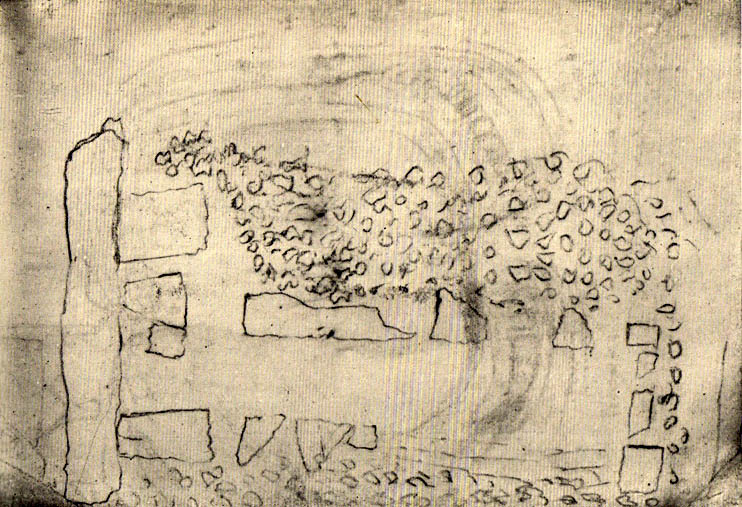
Scruffy 1835 ground plan of the lost tomb
Archaeology & History
An exact grid-reference for this once-impressive chambered tomb is difficult as “nothing remains of this site at the present day” (Daniel 1950) and the majority of the hilltop itself (a prehistoric hillfort no less), has been turned into one of those awful golf courses which are still spreading like cancer over our ancient hills. It was obviously very close to the Shropshire border, as the folklorist Charlotte Burne (1853) said the grave was “on the Shropshire side of Llanymynech Hill,” perhaps placing it in the township of Pant. But traditionally it remains within Llanymynech, within and near the top of the huge hillfort and east of Offa’s Dyke.
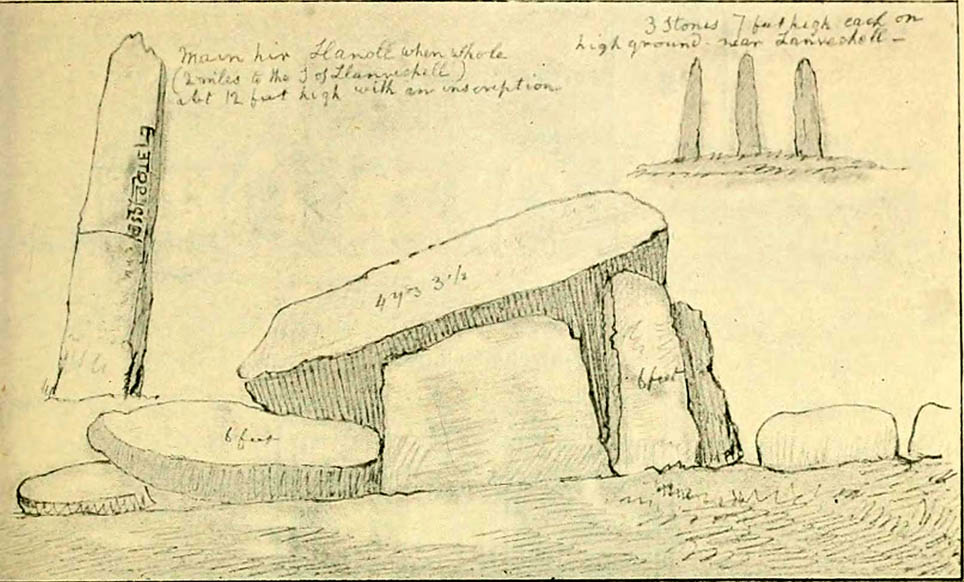
The old tomb was mentioned in an early letter of the great druid revivalist, Edward Lhwyd, who left us with the old ground-plan, reproduced above; and based on Lhwyd’s drawing and early narratives, Glyn Daniel (1950) thought the site “was perhaps a gallery grave”. The best description we have of Bedd y Cawy was penned by John Fewtrell (1878) in his essay on the local parish in which he told:
“This interesting relic of antiquity stood on the north-eastern end of the hill. It was formed of four upright stones, on the top of which was placed a flat slab measuring 7ft by 6ft, and 18 in thickness. It is known by the name “Bedd-y-Cawr” (the Giant’s grave). The British name appears to support the theory that the cromlech is a burying place, and not an altar devoted to religious purposes. The word is derived probably from the Welsh cromen, a roof, or vault, and lech, a stone, meaning a vault formed by a slab supported upon uprights ; or, according to some, ” the inclining flat stone”. Rowlands derives it from the Hebrew cærem-luach, “a devoted stone”, but this is far-fetched for a word or name in common use among our British forefathers. Many regard the cromlech as a distinct species of monument, differing from either a dolmen or a cairn.
“When the covering of stones or earth has been removed by the improving agriculturist, the great blocks which form the monolithic skeleton of the mound and its chamber usually defy the resources at his command. As the skeleton implies the previous existence of the organised body of which it formed the framework, so, upon this theory, the existence of a ‘ cromlech ‘ implies the previous existence of the chambered tumulus of which it had formed the internal framework. Sepulchral tumuli were formerly classified according to their external configuration or internal construction; but more extended and critical observation has shown that mere variations of form afford no clue to the relative antiquity of the structures. But as it has always been the custom of the prehistoric races to bury with their dead objects in common use at the time of their interment, such as implements, weapons, and personal ornaments, we have in these the means of assigning the period of the deposit relatively to the Stone, Bronze, or Iron age.” Sometimes no traces whatever of human remains are found in the chamber. Search was made to some depth in this cromlech, but nothing was found.”
In Fewtrell’s same essay he also described another megalithic site (also destroyed) on the southwestern part of the Llanymynech Hill, where,
“stood two rows of flat stones, parallel, 6 feet asunder, and 36 in length. A tradition exists which states that in digging near this place a Druid’s cell was discovered, but of what shape or size it does not relate. There were a number of human bones and teeth in a state of good preservation also discovered. In digging between the parallel rows a stratum of red earth was found, about an inch thick.”
Folklore
As the name of this old tomb tells, it was once reputed as “the Grave of the Giant”, but in Charlotte Burne’s huge work on the folklore of Shropshire (volume 1), she told it to be the tomb of his lady:
‘The Giant’s Grave’ is the name given to a mound on the Shropshire side of Llanymynech Hill, where once was a cromlech, now destroyed. The story goes that a giant buried his wife there, with a golden circlet round her neck, and many a vain attempt has been made by covetous persons to find it, undeterred by the fate which tradition says overtook three brothers, who overturned the capstone of the cromlech, and were visited by sudden death immediately afterwards.”
There is also a legendary cave beneath Llanymynech Hill which have long been regarded as the above of goblins and faerie folk. More of this will be told in the profile for the hillfort itself.
References:
Burne, Charlotte Sophia (ed.), Shropshire Folk-lore, Trubner: London 1853.
Daniel, Glyn E., The Prehistoric Chamber Tombs of England and Wales, Cambridge University Press 1950.
Fewtrell, John, “Parochial History of Llanymynech,” in Collections Historical & Archaeological Relating to Montgomeryshire, volume 11, 1878.
Wynne, W.W.E., “Letters of E. Lhwyd,” in Archaeologia Cambrensis, vol.3, 1848.
From Tregele village, take the minor southeast road towards Llanfechell, until you pass the second dirt-track on your right (both tracks take you to a local farm). The second track takes you to the aptly-named farmhouse of ‘Cromlech’ – which is where you need to ask the farmer (a friendly chap) if you can have a gander at his rocks! To which he should say, “Aye…it’s over there in the field.” You can’t really miss ’em!
Archaeology & History
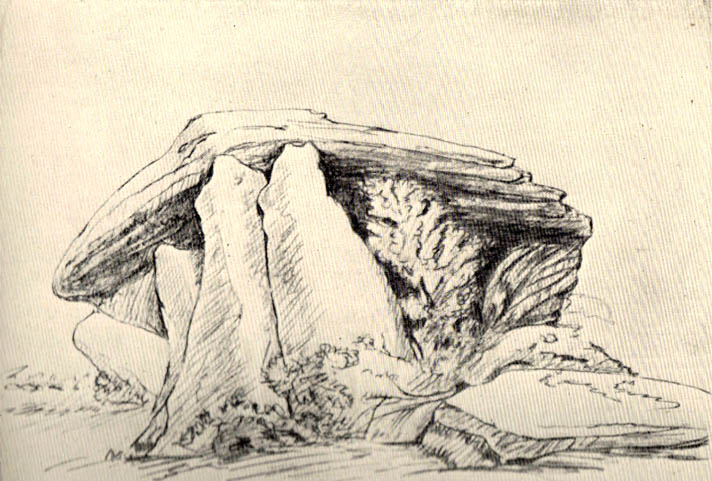
This was once an impressive prehistoric tomb by the size of things, but has been knocked about a bit over the centuries. Even when Glyn Daniel (1950) described it, he said that “at present this site consists of nothing more than a number of large stones lying in a field — some flat and others slightly tilted.” And it hasn’t changed much since then! One of the earliest descriptions of Foel Fawr was by John Skinner (1908) in his fine tour around Anglesey in the early 19th century, where he told:
Skinner’s 1804 drawingFoel Fawr tomb
“From hence passing by an old mansion named Cromlech now tenanted by a farmer we came to the spot where many large stones were lying scattered promiscuously on the ground and one nearly square measuring nine feet across leaning against some uprights about six feet high. From the appearance of this place I should rather imagine that it had been the interior or cistfaen of a carnedd and this opinion seems somewhat confirmed by the accounts of the common people who remember great quantities of stone having been removed to form a wall.”
References:
Daniel, Glyn E., The Prehistoric Chamber Tombs of England and Wales, Cambridge University Press 1950.
Skinner, John, Ten Days’ Tour through the Isle of Anglesey, December 1802, Charles J. Clark: London 1908.
From Ilkley town centre, taken the road north across the River Wharfe, turning left and up the country lane towards Nesfield. As you’re driving with the farmed fields on either side, you’ll go round a couple of swerves in the lane and reach the open moorland on your right, just past the small copse of trees on the same side. There’s a small place to pullover on the right 100 yards on and walk up the footpath running northeast onto the moor. Go past the disused quarry and up further till you reach the rounded hill where the tumulus stands.
Archaeology & History
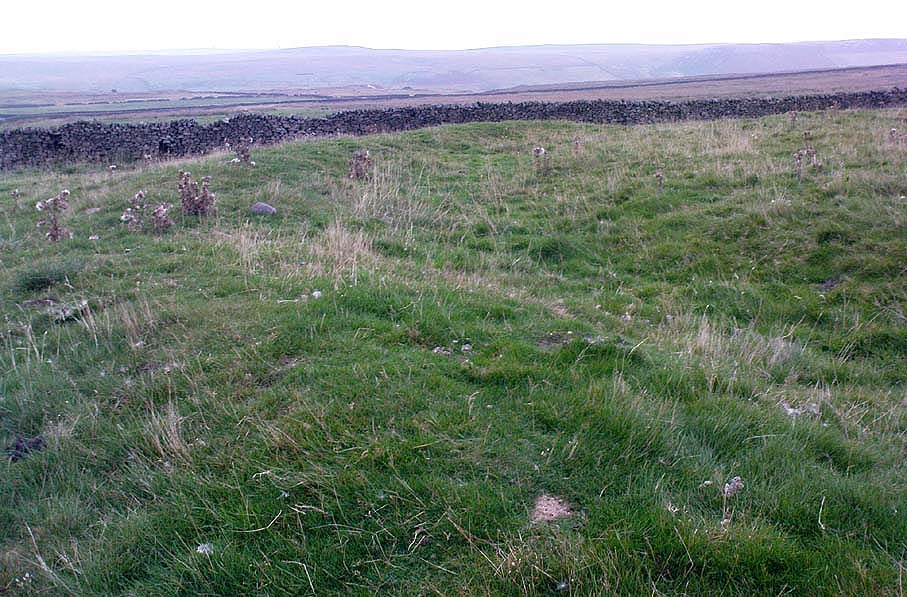
On the moors north of Ilkley – as shown on OS-maps since the 1850s – on the southeastern edge of Middleton Moor, is this singular tumulus, a short distance west of some old quarrying at the curiously-named Lurgy Delf. The small hill is easy to find and appears at the western edge of a whole host of neolithic and Bronze Age remains. It is included as a boundary marker between Middleton and Langbar, as marked by an old stone on its southern side. Eric Cowling (1946) described this as “a spread of stones on Round Hill” in the same context as other burial mounds and cairns in the region, also naming it as the Black Hill tumulus. Many flints had been found all round here and it stands at the western edge of a great number of cup-and-ring stones, stretching eastwards across the moors for several miles. To my knowledge, no excavation has taken place here.
References:
Cowling, Eric T., Rombald’s Way, William Walker: Otley 1946.
From Brodick, walk up the Glencloy dirt-track towards the friendly Kilmichael Hotel but turn off on the left shortly before hand, up another footpath, crossing the stream until you eventually reach the derelict house which was built into the edges of this old tomb. Upon the small rise above here, at the edge of the forestry commission trees, you’ll notice the overgrown ruins of the old tomb.
Archaeology & History
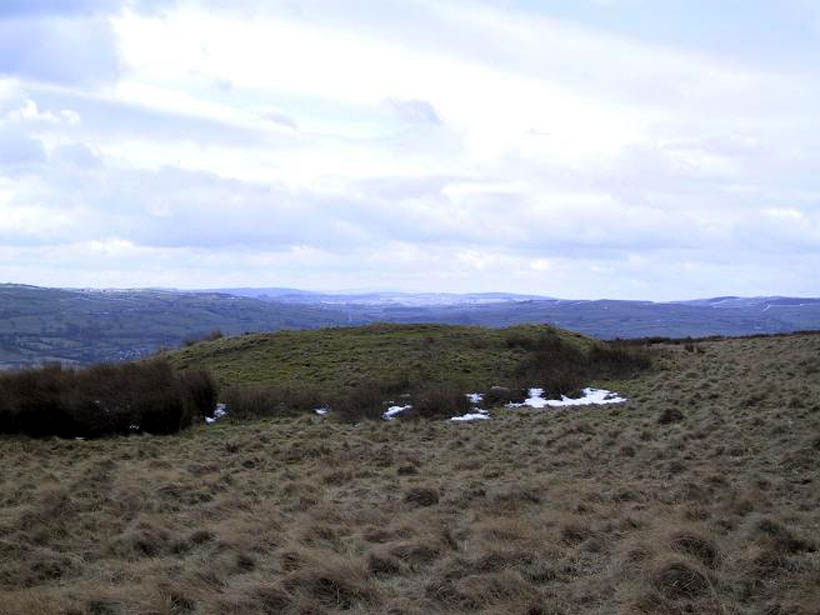
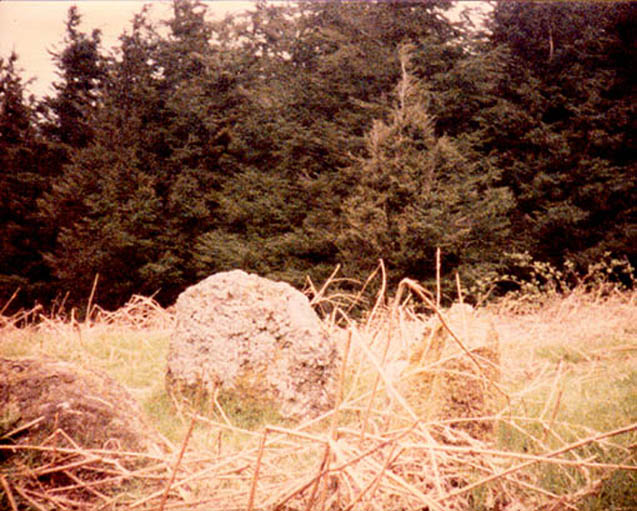
The remains here are somewhat overgrown and ramshackled, but I still like this place and in my younger days used to spend a lot of time here. It can get quite eerie in some conditions and seems to validate some of the folklore said of it. The site was described in Balfour’s (1910) magnum opus as:
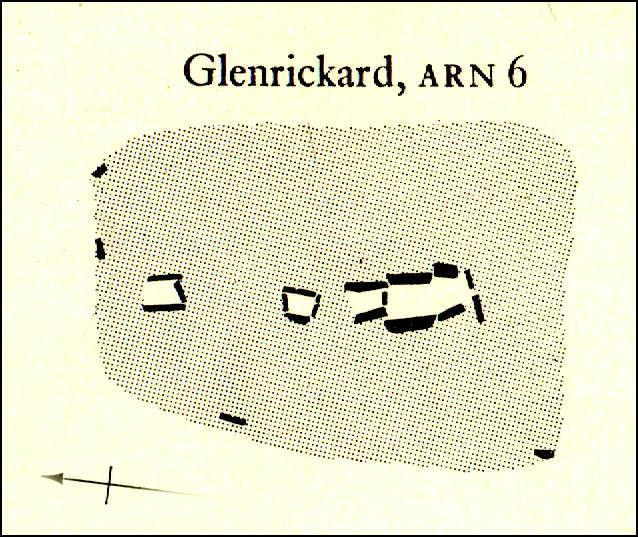
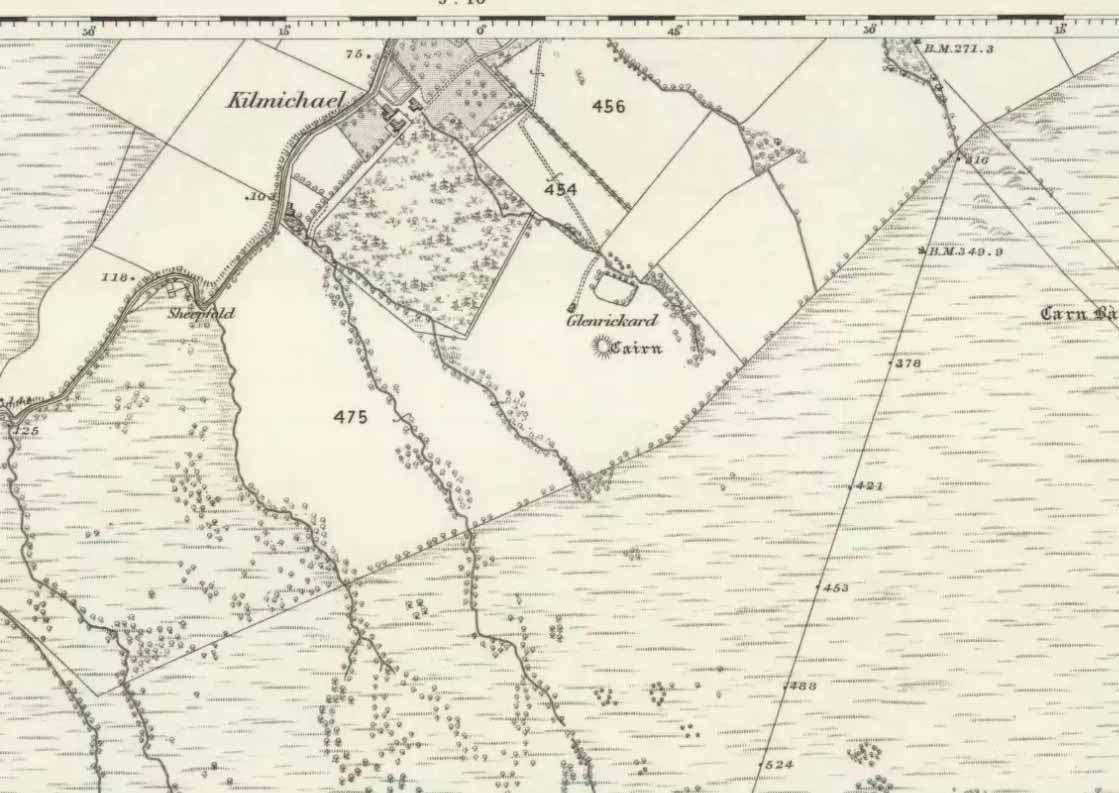
“Situated in Glen Cloy, on the moor above Kilmichael House, close to a cottage called Glenrickard. There are no traces of a cairn or of a frontal semicircle. The chamber is formed of rather light flags, with their upper edges nearly on the same level, so that the monument is more like a series of cists than a chamber. The roof and end stone have gone; there are two portal stones, but the gap between them is only 7 inches. The chamber is directed N and S, with the portal to the south. There have been three compartments, but they are rather smaller than usual, the third from the portal being only 3 feet 10 inches long by 2 feet 2 inches broad. Two feet 6 inches from this compartment is another cist, which is possibly a short cist representing a secondary interment, and 10 feet farther north is a second ruined cist placed at a different angle. This last has the appearance of a short cist, but it is not carefully constructed and differs little from the component compartments of the chamber. The structure is anomalous, and may perhaps be regarded as representing a phase of degeneration in the transitional period.”
Glenrickard ground-plan (after Henshall 1972)Glenrickard on 1868 map
Audrey Henshall (1972) later descried the site in greater details in her own magnum opus and told that “two rude clay urns of the primitive flower-pot pattern (were) found in the chamber”, along with “calcined bones, said to have been in the two vessels.”
Folklore
Said by local people to be haunted, the spirit of the tomb was said to have been disturbed upon the building of the derelict house below it. Ghosts of a middle-aged couple and young child have been seen in the house; whilst the spirit of the site can generate considerable fear to those who visit the place when it is ‘awake.’ To those who may visit this out-of-the-way tomb, treat the site with the utmost respect (and DON’T come here and hang a loada bloody crystals around the place in a screwy attempt to “clean” the psychic atmosphere of the place. If you’re that sort of person, don’t even go here! The spirit of the place certainly wouldn’t want you there).
References:
Balfour, J.A., The Book of Arran: Archaeology, Arran Society: Glasgow 1910.
Henshall, Audrey Shore, The Chambered Tombs of Scotland – volume 2, Edinburgh University Press 1972.
Either reach this from Dorchester’s Dyke Hills by crossing the bridge over the Thames at its southwestern side and walk thru the village and up the fields to the wooded rise on your left; or simply get take the road between Brightwell-cum-Sotwell to the delightful village of Little Wittenham and, on your right-hand side, notes the unmissable clump of trees and rise in the fields on your right. That’s the place!
Archaeology & History
Major Allen’s 1932 photo
To be found on the southern side of the River Thames, across from the huge Dyke Hills camp, this prominent enclosed hillfort was thought to be a place where the tribal peoples of differing groups converged — the Dubonni, the Catuvellauni, and Atrebates peoples. And to this day it remains impressive. Long thought to have been merely the province of Iron Age settlers, in more recent years it has shown to have had a longer and richer history than academics previously dare write about. In Jean Cook’s (1985) fine work on the archaeology of the region, she described the typical narrative Castle Hill elicited from professionals until only a few years back, saying:
“The hillfort on Wittenham Clumps covers approximately 4 hectares (c. 10 acres) and comprises a single ditch and rampart. It commands superb views northwards up the Thames valley and to the south and west across the Vale of White Horse to the Berkshire Downs, where a series of similar hillforts follows the line of an ancient route — the Ridgeway. The fort has never been excavated, although frequent past ploughings have produced Iron Age and early Saxon sherds as well as Romano-British pottery. However, to the south of the hillfort…a well-stratified Iron Age settlement was found. It seems probable on the basis of other excavated sites that the fort was permanently occupied. It would have developed as a regional administrative and political centre, with specialist craftsmen and traders and would have performed some of the same functions as a medieval market town.”
Although Cook’s latter remarks should be addressed with caution (market economics was far from the mythic perspectives of Iron Age people), this great site was of obvious importance. But later excavations at the site in 2002-03 showed that the site had in fact been used by neolithic people and, around the tops, flints and other remains were found that took human activity here back into mesolithic times, with some finds dated around 6000 BC! More surprisingly (to archaeologists anyway) was that Castle Hill continued to be used way into medieval times!
Thankfully much of this place is still pretty well-preserved and is well worth exploring to historians, pagans and walkers.
References:
Cook, Jean, “Before the Roman Conquest,” in Dorchester through the Ages, Oxford University 1985.
Cook, Jean & Rowley, Trevor (eds.), Dorchester through the Ages, Oxford University 1985.