Tom Tallon’s Grave, Kirknewton, Northumberland

Tumulus (destroyed):  OS Grid Reference – NT 9323 2800

Also Known as:

  1. Auld Wife’s Apronful o’ Stanes
  2. Tom Tallon’s Tumulus

Archaeology & History

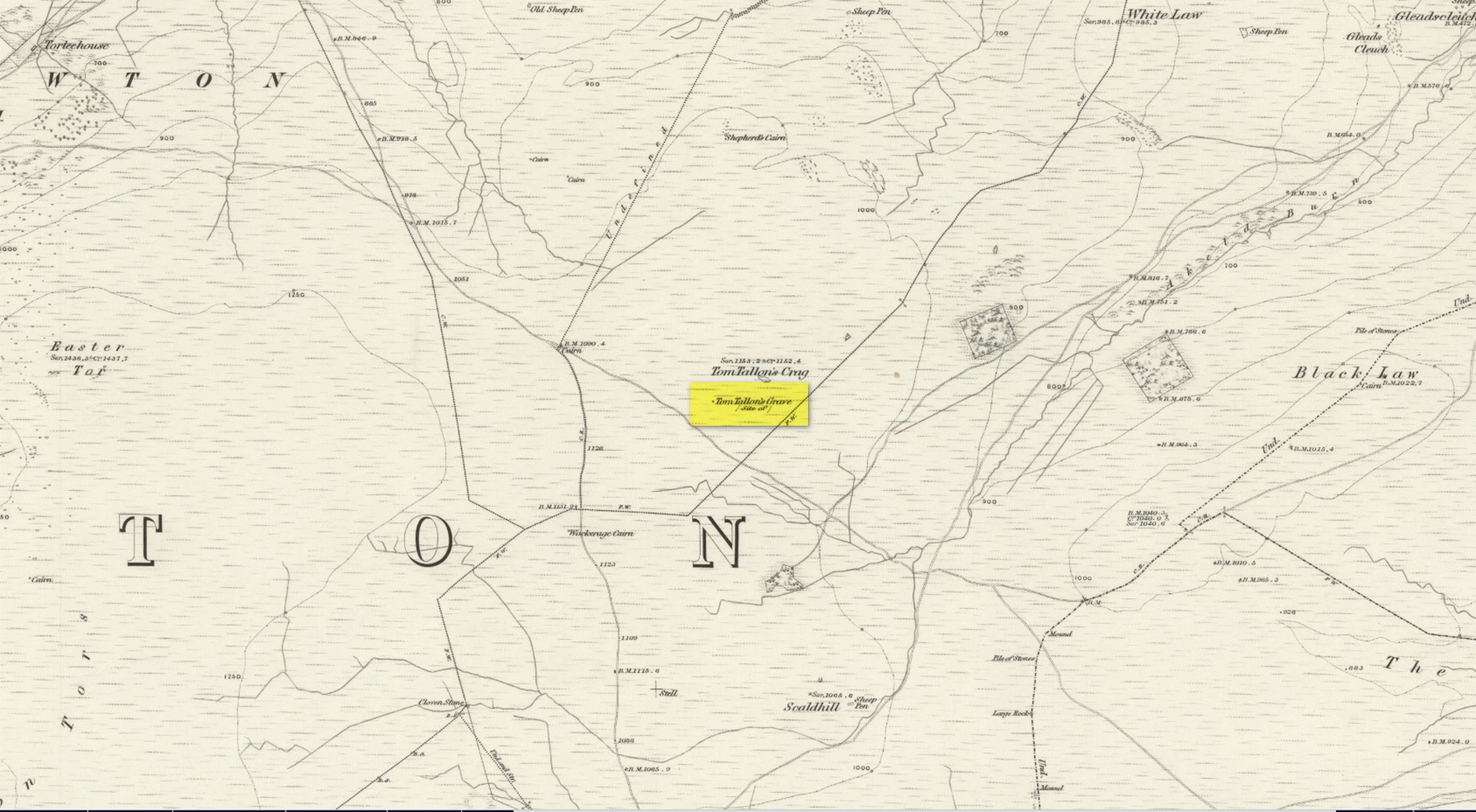
Site on the 1866 OS-map

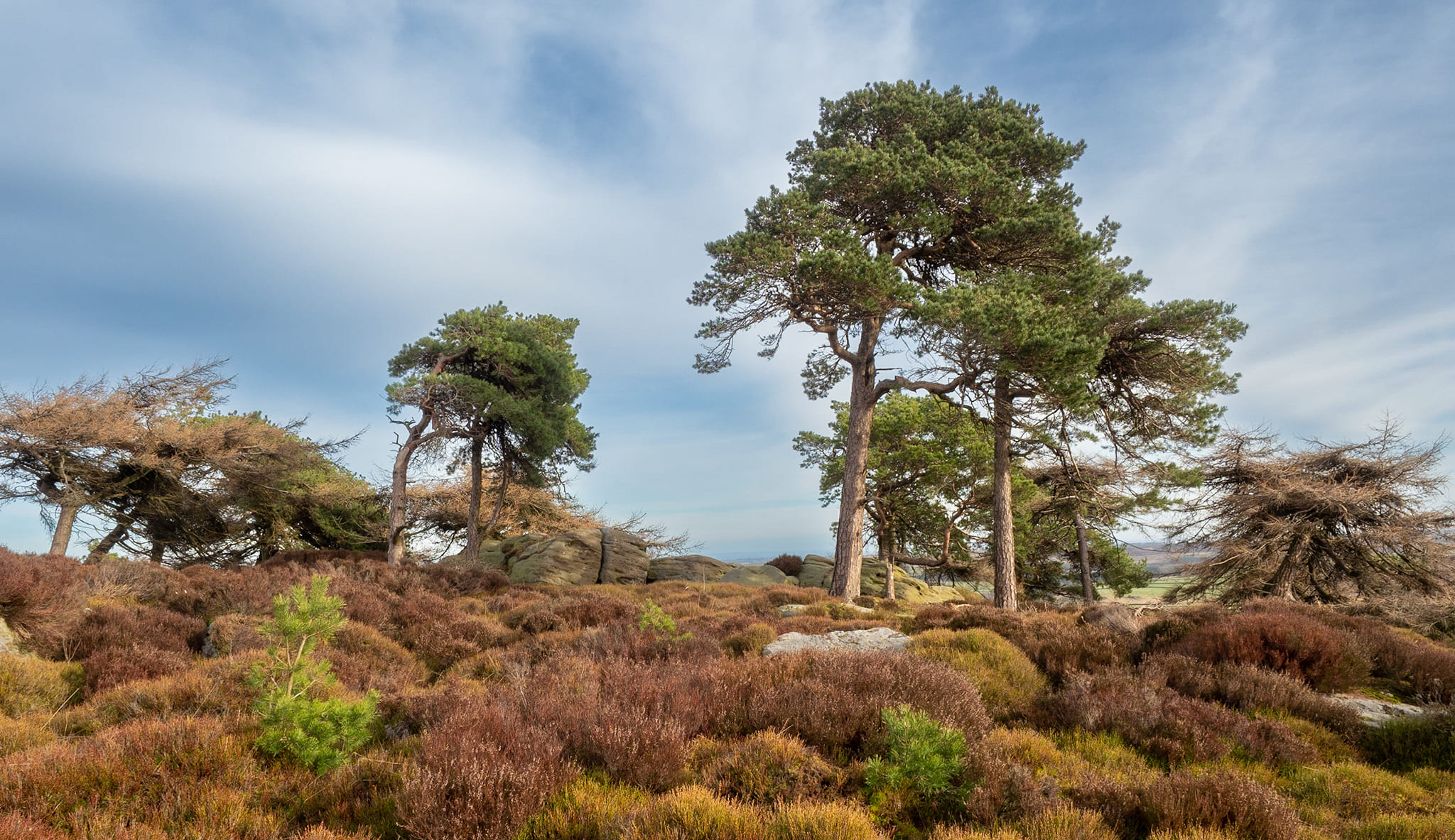
Highlighted on the earliest OS-maps about half a mile to the south of the great prehistoric camp of Yeavering Bell and 100 yards southwest of Tom Tallon’s Crag, there once stood an apparently “massive” Bronze Age tumulus, or cairn, called Tom Tallon.  I’d hedge a bet that it was much older, from the neolithic period.  It was described by P.A. Graham (1921) as “the largest cairn in the district,” but when it was visited by the antiquarian Henry MacLauchlan in July 1858, he reported that “it was being removed to make a fence”!!!  Unbe-fuckin’-lievable… Who were the dickheads that did that?!

Folklore

The Ordnance Survey Name Book of 1860 for Tom Tallon’s Crag told that,

“There is a vague tradition about Tom Tallon having been a Warrior and Slain here – hence the name, but nothing authentic respecting Tom, can now be ascertained.”

The word tom derives from “a rounded hill”, sometimes associated with a tumulus and in Scotland (just over the border) associated “with a dwelling place of the fairies” with tallon suggested by Graham (1921) to derive from “tal, a forehead or promontory, and Llan, an enclosure.”

What is quite obviously an older name, or certainly one that was more recognised by local people, is its title of the Auld Wife’s Apronful of Stones: a title we find associated with a number of the giant cairns in northern England and Scotland.  It relates to the creation myth of the site, whereby the countless stones that made up the cairn were dropped or thrown across the landscape by a giantess who inhabited this area.

References:

  1. Hall, James, A Guide to Glendale, M. Brand: Wooler 1887.
  2. Graham, P. Anderson, Highways and Byways in Northumbria, MacMillan: London 1921.
  3. MacLauchlan, Henry, “Notes on Camps in the Parishes of Branxton, Carham, Ford, Kirknewton and Wooller, in Northumberland,” in History Berwickshire Naturalists Club, volume 24, 1922.

© Paul BennettThe Northern Antiquarian

Little Almscliffe Crags, Stainburn, North Yorkshire

Legendary Rocks:  OS Grid Reference – SE 23237 52275

Also Known as:

  1. Little Almes Cliffe
  2. Little Almias Cliff Crag

Getting Here

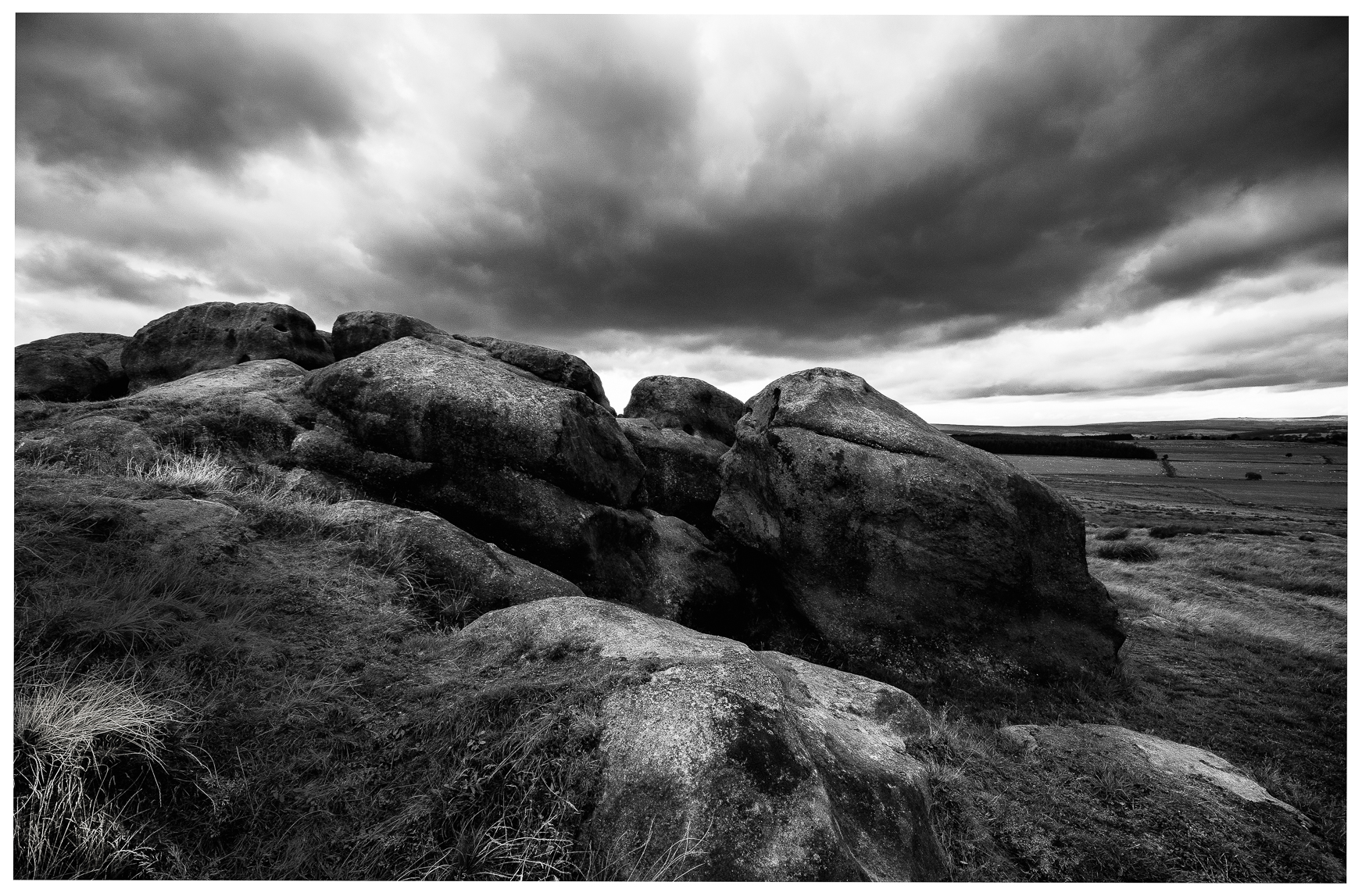
Little Almscliffe Crag (photo – James Elkington)

Coming from Harrogate, take the B6162 and B6161 road to Beckwithshaw, through the village and, 4-500 yards on, turn right onto Norwood Lane.  2 miles along, keep your eyes peeled on your left for a gravelled parking spot and you’ll see the large rock outcrop 200 yards south of the road. …Otherwise, from Otley: go over the river bridge and turn right up Farnley Lane and follow the B6451 for a few miles, thru Farnley village up the Washburn valley, past Norwood and at Bland Hill, turn right along Broad Dubb Road for 1¾ miles where you’ll reach that same gravelled parking spot.

Archaeology & History

Very much the ‘little brother’ of Great Almscliffe, 3 miles (4.83km) to the southeast, this site would be more of interest to the travelling geologist, perhaps, than to antiquarians.  But that depends what tickles y’ fancy I s’ppose.

In 1702 when the northern antiquarian Ralph Thoresby mentioned this and its big brother to the southeast, he described the “two famous crags of Almes Cliff—in some old writings called Aylmoys ut dicitur—but have seen nothing memorial of it, saving its remarkable lofty situation.”  He missed the cup-and-ring carving on the east-side of the crags, obviously, which indicates that it had some form of animistic sanctity in ancient times.

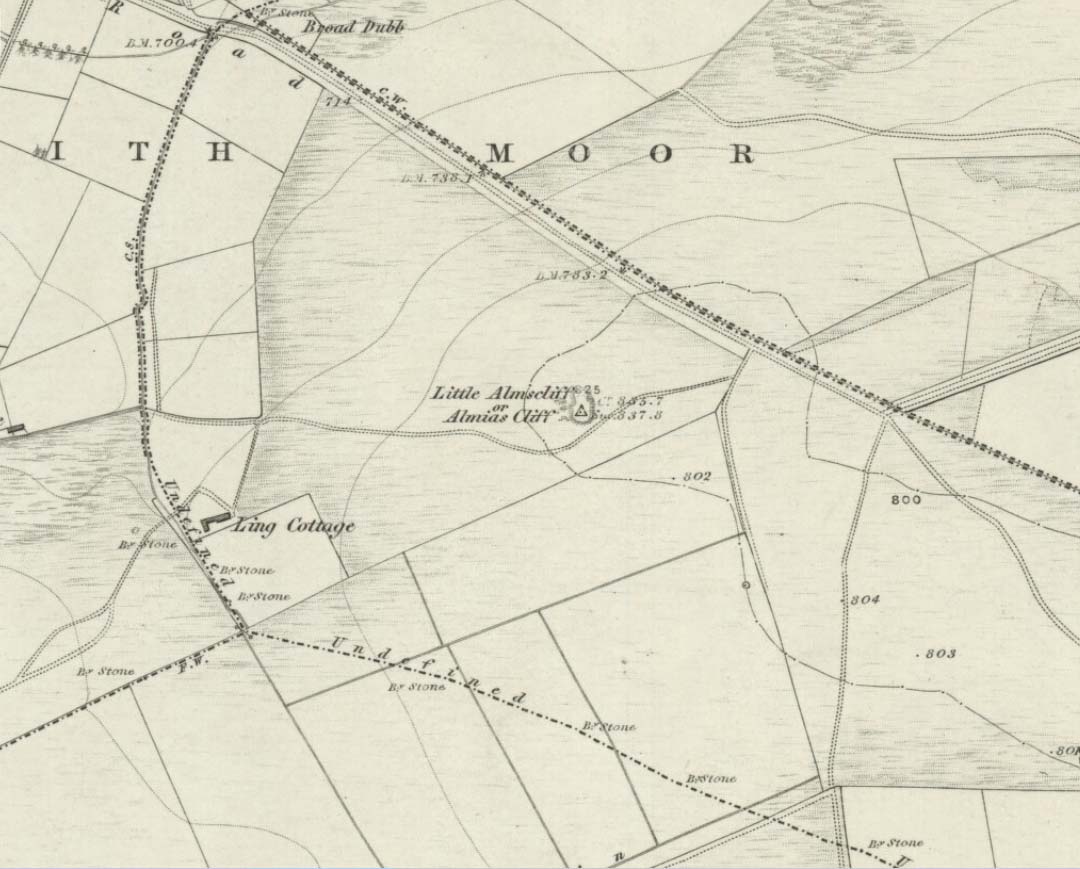
The location on 1851 map
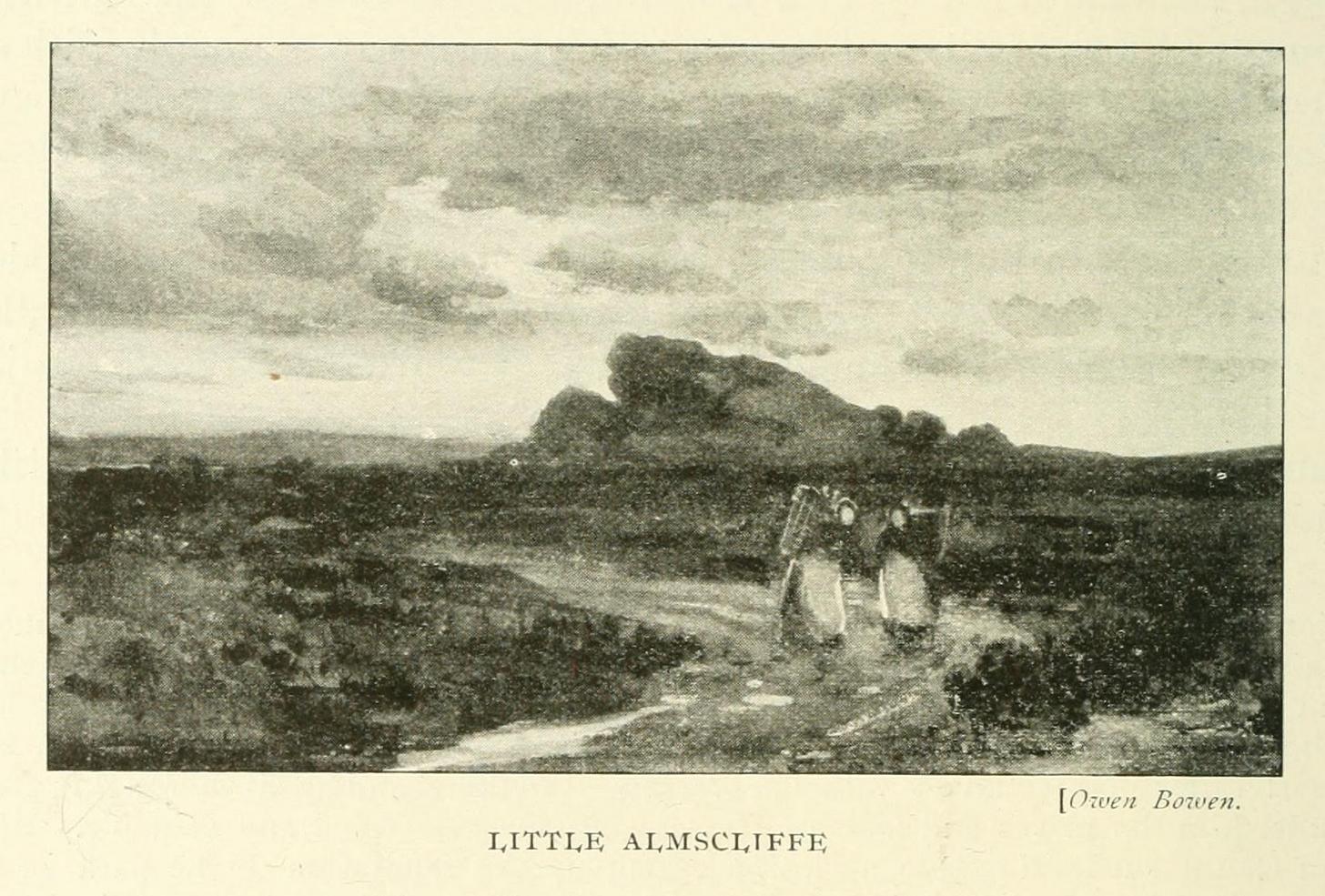
Little Almscliffe c.1900

Little Almscliffe was one of many impressive places located within the ancient Forest of Knaresborough; and although it wasn’t on the original boundary line, a perambulation (i.e., annual ritual walking to the old stones, trees and wells defining the region) of the area written in 1770, in what Mr Grainge called “the Copyhold Forest”, was undertaken by the Enclosure Commissioners.  It differed from the more ancient perambulation rite, in that the newer one included a mention of,

“five bounder stones also marked F to an earth-fast stone, lying northeast of Little Almes Cliffe, marked also with an F; (and) from thence by other four bounder stones marked F to Sandwith Wath…”

The letter ‘F’ here signifying the word ‘forest’, as in the Forest of Knareborough.

William Grainge (1871) also believed these crags to have been a place of druidic worship.  He wasn’t the only one.  Many other writers of the time thought the same thing; and although we have no concrete evidence to prove this, it is highly likely that these rocks would have served some ritual purpose in pre-christian days.  Certainly in more recent times (during the 1980s and ’90s) we know that ritual magickians used this site for their workings.  On a more mundane level, the crags were previously used as a site for for beacon fires.  One was erected here in 1803 when the first Bonaparte threatened to invade England; but I can find no written accounts of earlier beacons here.

References:

  1. Bennett, Paul, The Old Stones of Elmet, Capall Bann: Milverton 2001.
  2. Bogg, Edmund, From Eden Vale to the Plains of York, James Miles: Leeds 1895.
  3. Bogg, Edmund, Higher Wharfeland, James Miles: Leeds 1904
  4. Cowling, E.T., Rombald’s Way, William Walker: Otley 1946.
  5. Grainge, William, History & Topography of Harrogate and the Forest of Knaresborough, J.R. Smith: London 1871.
  6. Parkinson, Thomas, Lays and Leaves of the Forest, Kent & Co.: London 1882.

© Paul BennettThe Northern Antiquarian 

Fairy Well, Liversedge, West Yorkshire

Sacred Well:  OS Grid Reference – SE 1977 2309

Getting Here

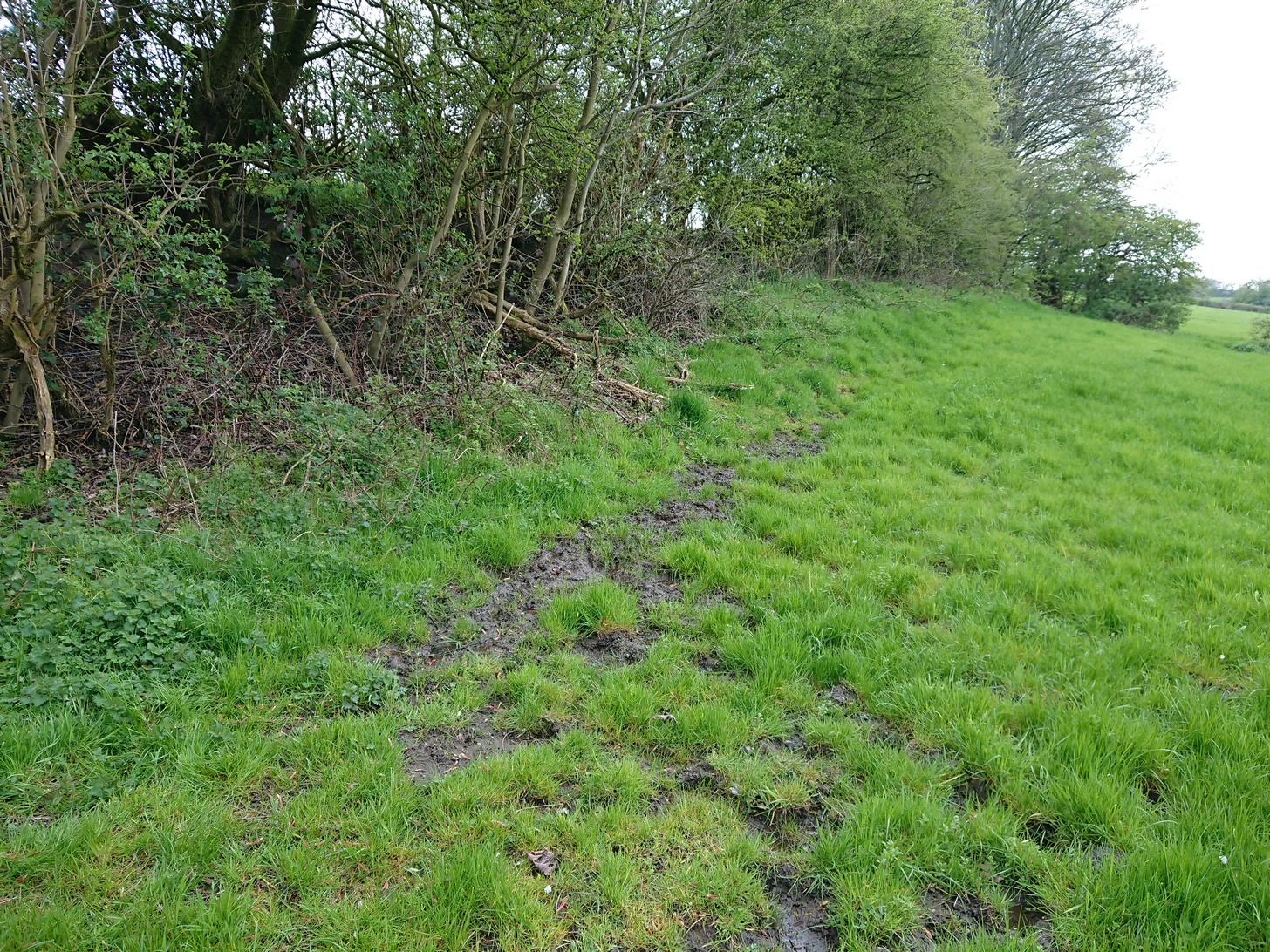
Fairy Well’s boggy ground

Best approached from Heckmondwike/Liversedge and going up Roberttown Road where, just past the Spen Valley High School parking spot, an almost dead straight footpath takes you down (northwest) into the woods.  Walk down here for about 100 yards and then go left over the stile into the small copse of trees.  Once you come out the trees at the other side, walk up the slope in the field that you’re now in.  As you approach the line of trees at the top, you’ll notice the ground gets very boggy.  Look carefully under the trees and you’ll notice an embedded flat stone protruding out and a somewhat trivial trickle of water into the grass at the front.  That’s it!

Archaeology & History

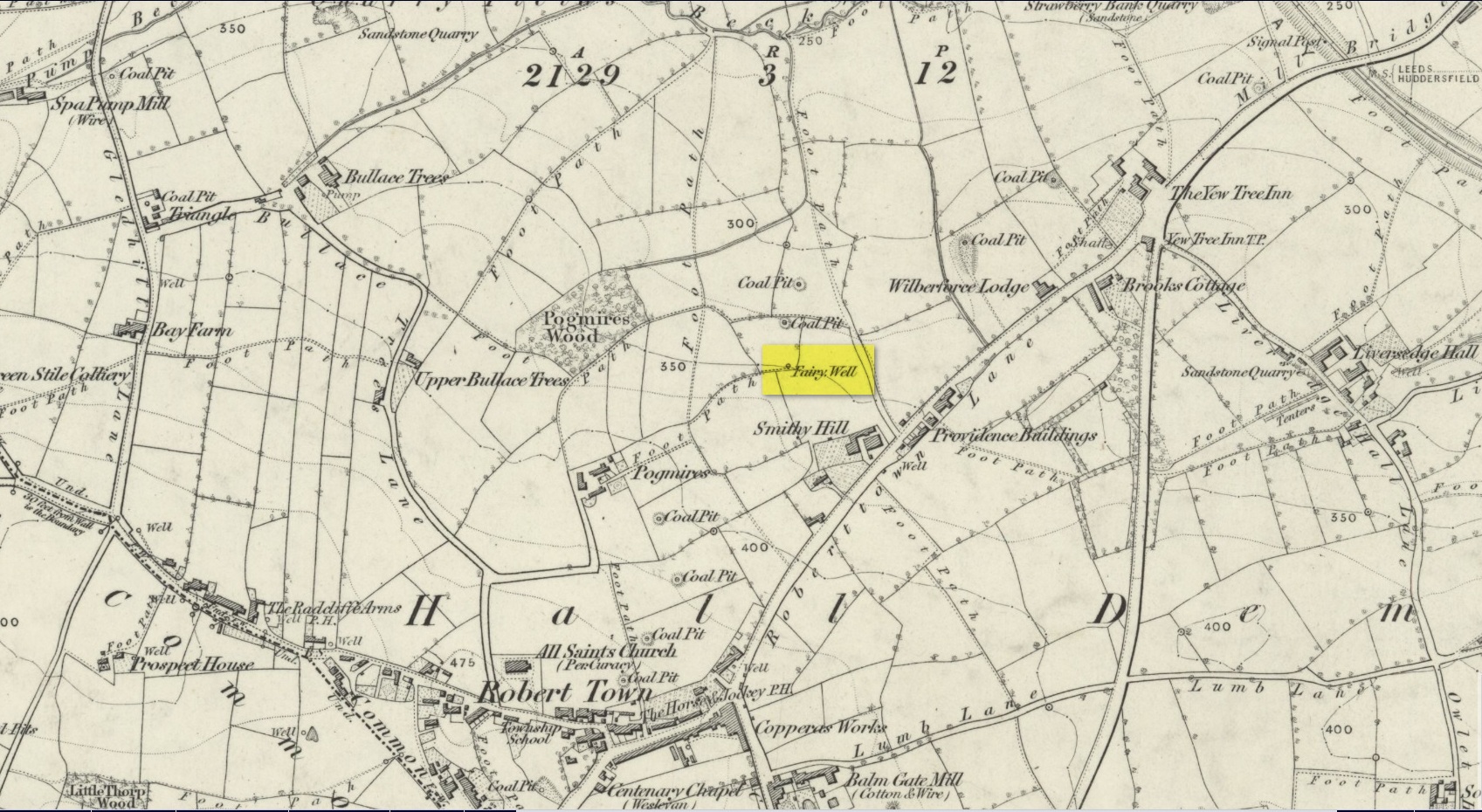
Site on the 1854 OS-map

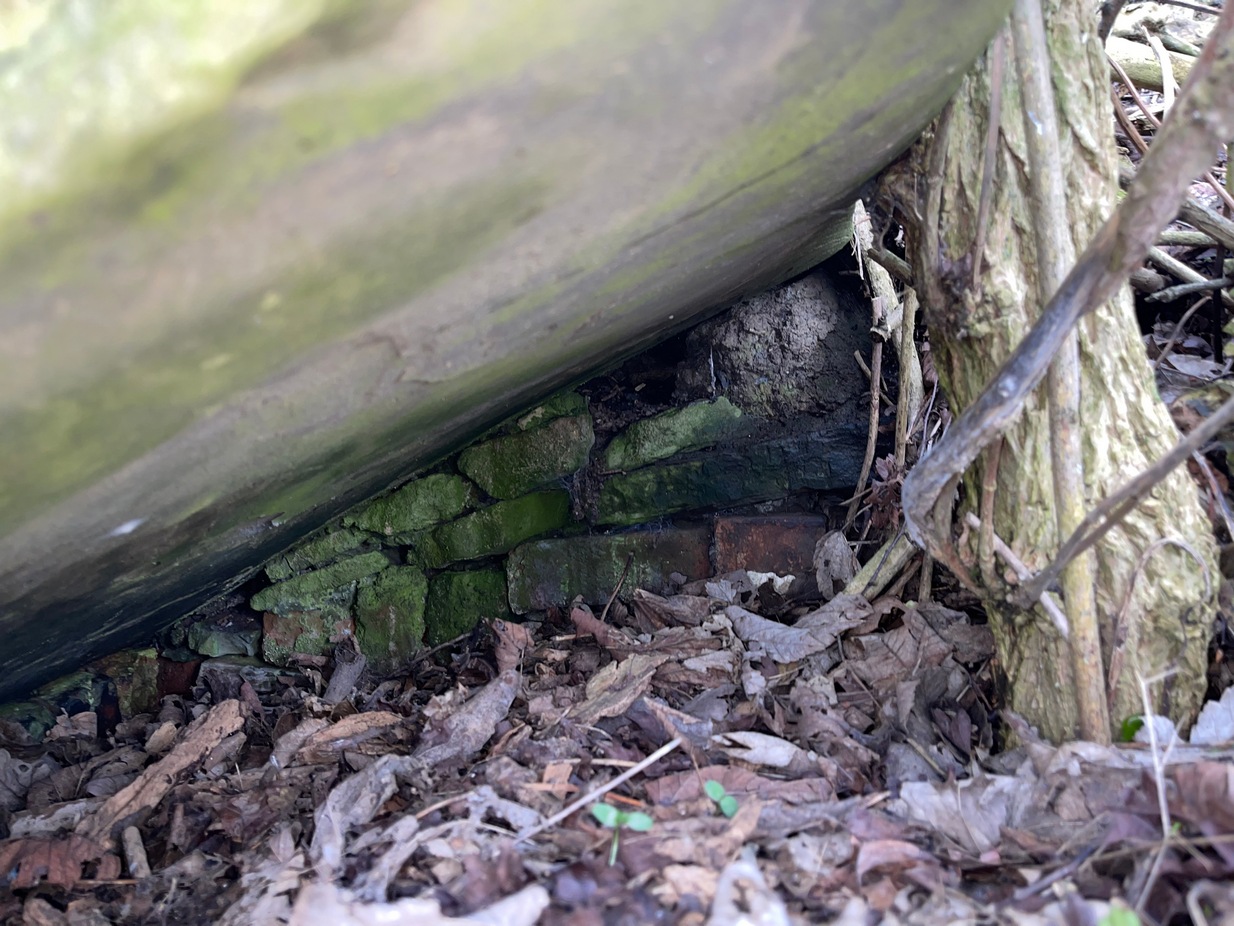
Highlighted on the 1854 Ordnance survey map of the area, this is a somewhat ruinous site which has seen better days.  Even after good downpours it’s not very obvious and, in truth, could do with being cleaned-up, cleared out, and brought back into the old life it once had.  If you look carefully beneath the roots of the covering tree, you’ll notice a  decent-sized flat worked stone sticking out at the bottom of the sycamore and below this, at the back, almost covered in earth, you can make out some brick walling at the rear.  It takes some finding!  This is evidently the remains of a small protective well-house, now in total ruin.

Old cover of the well

When we visited the place a few weeks ago, there seemed to be no water inside.  Instead, the water emerges into a small bog just below the tree-line a few yards away from the covering slab from whence it originally flowed.

Folklore

Obviously the abode of fairy folk in bygone days, all trace of the folklore and habits of them seems to have been lost long ago….

AcknowledgementsHuge thanks to mi old mate Gary Ferner for helping us uncover the source of the waters, which was almost completely covered in soil.

© Paul BennettThe Northern Antiquarian


St. George’s Well, Harrogate, North Yorkshire

Holy Well (destroyed):  OS Grid Reference – SE 2997 5561

Also Known as:

  1. St. George’s Spa

Archaeology & History

About 50 yards away from the Royal Promenade on the east-side of Parliament Street, there used to flow the healing waters of an old holy well, that later became one of Harrogate’s many spa wells.  It was first recognized as a medicinal spring about 1792 when Thomas Garnett (1794) uncovered it beneath the overgrowth of vegetation surrounding the spring-head.  In doing so, it became evident that at some time in the past it had been used by local people as,

“a wall was discovered round the spring, but whether this had been built with an idea of its being a medicinal water, or with an intention of collecting water for cattle, I cannot determine.”

Chalybeate (iron-bearing) in nature, the waters were analyzed by Adam Hunter (1830) in the 1820s and, although possessed of soluble iron, had less than its medicinal compatriots nearby, meaning that its fortifying qualities weren’t quite as good. He told us how,

“it had been known (by locals) for many years, but at no time much used internally; it had acquired some celebrity however as a wash for sore eyes, for which purpose it was well adapted.  As chalybeate water has long been a favourite popular remedy for a wash in various weaknesses, and chronic affections of the eyes, it is proper to state that (the nearby) John’s Well, the Tewit Spa, or the succeeding one at Starbeck, are the only three chalybeates which can at present be recommended for that purpose.”

A few years after Hunter had been here, the well was destroyed “by the making of a highway drain.” (Jennings 1981)

Folklore

St George (saint’s day – April 23) was one of the christian dragon-killers.  There is no known tradition of the saint or festivities that may once have occured here.

References:

  1. Garnett, Thomas, A Treatise on the Mineral Waters of Harrogate, Thomas Gill: Leeds 1794.
  2. Hunter, Adam, The Waters of Harrogate and its Vicinity, Langdale: Harrogate 1830.
  3. Jennings, Bernard, A History of the Wells and Springs of Harrogate, Interprint: Harrogate 1981.

© Paul BennettThe Northern Antiquarian

St. Ann’s Well, Harrogate, North Yorkshire

Holy Well (lost):  OS Grid Reference – SE 298 548

Archaeology & History

Very little is now known about this sacred site that was once found “a few hundred yards east from the New Church at Low Harrogate.” (Hunter 1830)  Even most of travellers and medical experts who wrote about the numerous Harrogate wells in the 18th and 19th century bypassed its quietude; and by the time Mr Hunter wrote about it in his great descriptive catalogue, its healing or medicinal qualities had been forgotten.

He told that “the spirit in the water…or that with which it is infused, has long been most actively engaged in adding real or fancied comforts to the (Harrogate) Fair, and is now in much more general use” than the two other holy wells in the town. It was, he said, “the best water for making tea and more extensively used for that purpose than any in the neighborhood of Harrogate.”  It would also appear to have been built over at some time in the not-too-distant past…

Folklore

St Ann (saint’s day – July 26) was a giant in early christian and Islamic myths.  An apocryphal figure, She was the Great Mother of the mother of Christ—the Virgin Mary—and was Herself a Virgin until, in Her old age, after seeing a bird feeding a chick, decided She wanted a child and so eventually gave birth to Mary.  An old woman giving birth when the Springtime appears (when birds and other animals become fertile) is the same motif found in the lore of the Cailleach in Ireland and Scotland (and parts of northern England).  Pre-christian lore at this old well would seem evident here.

References:

  1. Hunter, Adam, The Waters of Harrogate and its Vicinity, Langdale: Harrogate 1830.

© Paul BennettThe Northern Antiquarian

Fairy Oak, Whitford, Flintshire

Sacred Tree:  OS Grid Reference – SJ 1577 7889

Folklore

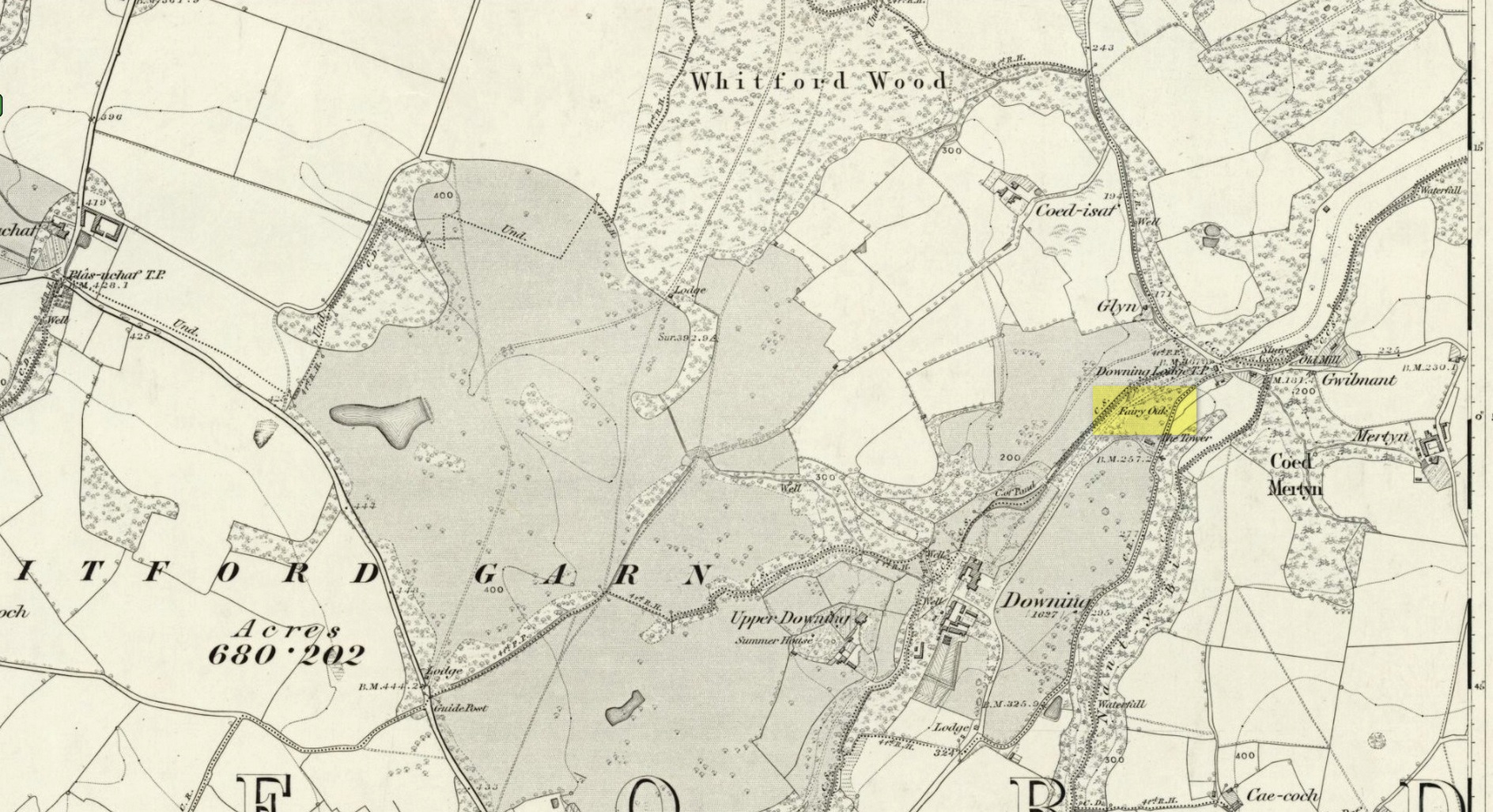
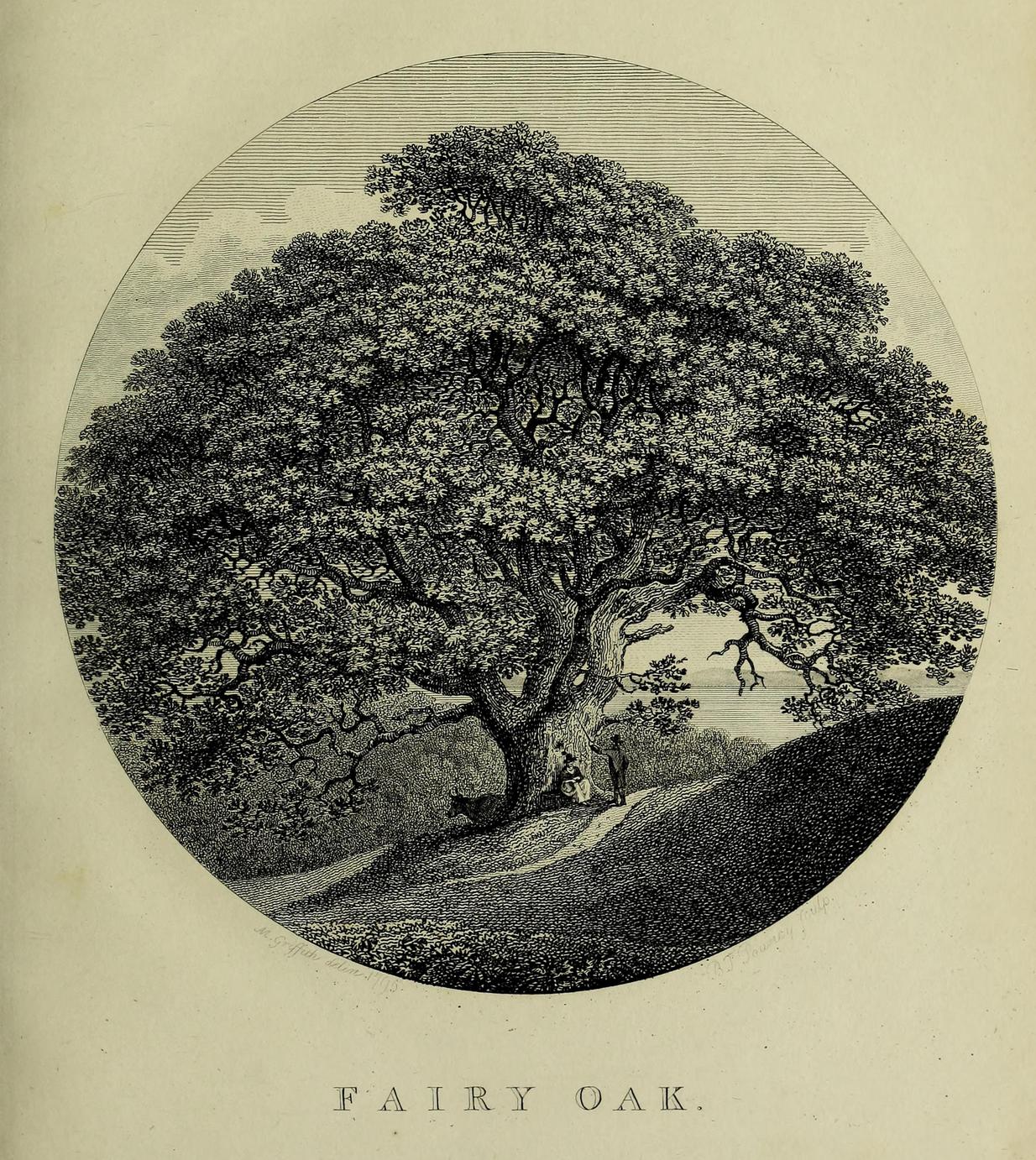
Highlighted on the earliest Ordnance Survey map of the region in 1878 and described much earlier by Thomas Pennant (1796)—almost as legendary as the fairies themselves in some parts—this ancient tree was obviously a place of great repute in the mythic history of the people in previous centuries.  Animistic relationships with the landscape were still deeply embedded in the daily lives of our peasant communities all across the country when Pennant wrote about this place.  In his antiquarian history of the area he described the great mansion of Downing Hall and in its grounds the ruins of Molandina Abbey.  “Above this,” he wrote,

Fairy Oak on the 1878 map
Pennant’s 1796 drawing

“is a spreading oak of great antiquity, size, and extent of branches: it has got the name of the Fairy Oak.  In this very century a poor cottager, who lived near the spot, had a child who grew uncommonly peevish; the parents attributed this to the fairy, and imagined that it was a changeling.  They took the child, put it in a cradle, and left it all night beneath the tree, in hopes that the tylwydd têg, or fairy family, or the fairy folk, would restore their own before morning.  When morning came they found the child perfectly quiet, so went away with it, quite confirmed in their belief.”

Nearby, and in the same grounds of the mansion, Pennant told there to be an even older and greater oak tree that “has in it furrows so deep, and of aspect so uncommonly venerable, as to render its shade as worthy of the solemn rites of the Druids.”

References:

  1. Pennant, Thomas, The History of the Parishes of Whiteford and Holywell, B. & J. White: London 1796.

© Paul BennettThe Northern Antiquarian 

Raven Stones (562), Thruscross, North Yorkshire

Cup-Marked Stone: OS Grid Reference – SE 1194 5810

Getting Here

The Raven stone setting

Take the A59 road from Harrogate and Skipton and at the very top of the moors keep your eyes peeled for the small Kex Ghyll Road on your left(it’s easy to miss, so be diligent!).  It goes past some disused disused quarry and after a mile or so where you hit a junction, turn left, past the Outdoor Centre of West End and straight along Whit Moor Road.  About a mile past the Outdoor Centre go left down to Brays Croft Farm and over the ford, then keeping to the footpath up to the right (west) and note the clump of trees on the moors above you to the west.  That’s where you need to be.

Archaeology & History

Several of the cupmarks

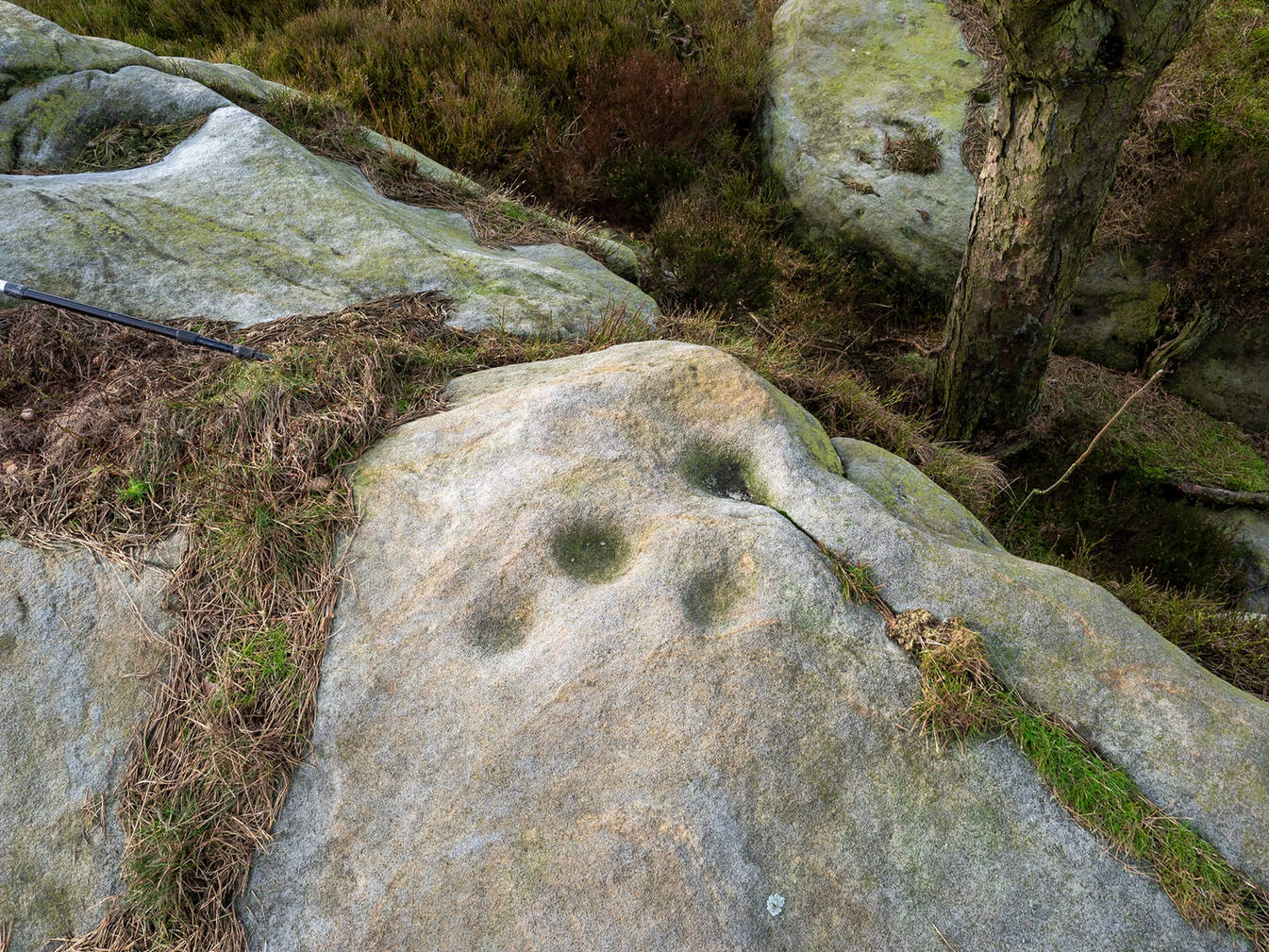
Several natural basins that might have been worked in prehistoric times are accompanied by several distinct cup-marks near the middle-edge of the stone, in a rough triangular formation, with two others slightly more eroded a little further down the same side.  Boughey and Vickerman (2003) noted several other cupmarks on the rock, some distinct, some not so.

Adjacent to this carved stone is another naturally worn stone of some size, with incredibly curvaceous ripples over the top of the rock which, in all probability, possessed some animistic property to the people who carved this and other nearby carvings. Check the place out.  It’s a gorgeous setting!

References:

  1. Armstrong, Edward A., The Folklore of Birds, Collins: London 1958.
  2. Boughey, Keith & Vickerman, E.A., Prehistoric Rock Art of the West Riding, WYAS: Wakefield 2003.

© Paul BennettThe Northern Antiquarian 

Cnoc Dubh, Moulin, Pitlochry, Perthshire

Stone Circle (destroyed):  OS Grid Reference – NN 9424 5871

Archaeology & History

Missing from the primary surveys of Burl (2000) and Barnatt (1989), a mention of this long lost site was made by local historian Hugh Mitchell (1923) in his survey of the area.  He told that,

“On the east side of the Moulin road beyond the Hydro Hotel a knoll and a clump of trees will be noticed on the right, inside the Hydropathic grounds; this knoll is known as the Cnoc Dubh, or “Black Knoll” and still bears an uncanny reputation as being an old site of Pagan worship.  There was at one time a stone circle on it, but the stones are said to have been broken up, fully 100 years ago, to build the old farmhouse of Balnadrum.”

Something ancient was there, obviously, as it was mentioned in another earlier account—albeit just a tourist guide of Atholl—which said that, on

“the knoll known as Knock-Dhu, within the (Pitlochry Hydro) grounds, are the remains of a pre-historic fort, now overgrown with pine trees.”

References:

  1. Anon., Atholl Illustrated, L. Mackay: Pitlochry c.1910.
  2. Dixon, John H., Pitlochry Past and Present, L. Mackay: Pitlochry 1925.
  3. Mitchell, H., Pitlochry and District: Its Topography, Archaeology and History, L. Mackay: Pitlochry 1923.

Links:

  1. Canmore

© Paul BennettThe Northern Antiquarian

Livister, Whalsay, Shetland Isles

Standing Stone (destroyed):  OS Grid Reference – HU 5577 6237

Archaeology & History

Site shown on 1882 map

Highlighted on both the 1880 (25-inch) and 1882 (6-inch) Ordnance Survey maps, this is another one of our ancient stones that has bitten the dust, so to speak.  Local folk said that it stood about five feet tall, but when the Royal Commission doods visited the place in 1935, it had gone.  They were told that it had been “broken up for building purposes in about 1912.”  No traditions were known of it.

References:

  1. Royal Commission Ancient & Historical Monuments, Scotland, Inventory of the Ancient Monuments of Orkney and Shetland – volume 3, HMSO: Edinburgh 1946.

© Paul BennettThe Northern Antiquarian

St. Tredwell’s Loch, Papa Westray, Orkney Isles

Sacred Loch:  OS Grid Reference – HY 495 509

Folklore

I’ve already added a site-profile of the standing stones that used to be close to this loch, and added to it the folklore below; but I realised that for students of water-lore, a separate profile for the loch itself is needed.  For those of you who are not into water-lore, I hope you can forgive this repetition.

The loch, its associated chapel and the standing stones were visited at the end of the 17th century by John Brand, who gave a good account of the rituals performed by local people at the time.  They regarded the waters here as very special indeed, with great medicinal powers.  The loch had sense of sacrality whose nature was intimately tied to the repetition and regeneration of the seasons, valorizing the healing function of the waters.

By the edge of the loch stood St Tredwell’s church, outside of which was a cairn of stones.  When people visited here to be cured of their various ailments, they would pick up one of them and cast it into the loch as an offering (some folk would cast money), so that its waters would heal their illness.  According to Mr Brand and the local minister, such cures were numerous.  The narrative is truly fascinating.  Brand told us that,

“nigh to the east end of which this chapel is, is held by the people as medicinal, whereupon many diseased and infirm persons resort to it, some saying that thereby they have got good; as a certain gentleman’s sister upon the isle, who was not able to go to this loch without help, yet returned without it; as likewise a gentleman in the country who was much distressed wifh sore eyes, went to this loch, and washing there became sound and whole, though he had been at much pains and expense to cure them formerly.  With both which persons he who was minister of the place for many years was well acquainted, and told us that he saw them both before and after the cure.  The present minister of Westra told me that such as are able to walk, use to go so many times about the loch as they think will perfect the cure, before they make any use of the water, and that without speaking to any, for they believe that if they speak this will marr the cure: also he told that on a certain morning not long since he went to this loch and found six so making their circuit, whom with some difficulty he obliging to speak, said to him they came there for their cure.”

For the curing of sore eyes, the loch was specifically resorted to at Easter and during Lent.  Traditions such as these are found at other lochs in Scotland and at lakes in many other parts of the world.

Another interesting feature related to the element of Kingship; for the waters of the loch were said to turn red when anything important was going to happen to a member of the royal family.

St Tredwell herself—also known as St. Triduana—has her saints day on October 8.

References:

  1. Banks, M. MacLeod, British Calendar Customs: Orkney and Shetland, Folk-lore Society: London 1946.
  2. Black, G.F., Examples of Printed Folk-lore Concerning the Orkney and Shetland Islands, Folk-Lore Society: London 1901.
  3. Brand, John, A Brief Description of Orkney, Zetland, Pightland Firth and Caithness, George Mosman: Edinburgh 1701.
  4. Eliade, Mircea, The Sacred and the Profane, Harcourt: New York 1959.
  5. Fergusson, Robert M., Rambling Sketches in the Far North, Simpkin Marshall: London 1883.
  6. MacKinlay, James M., Influence of the Pre-Reformation Church on Scottish Place-Names, William Blackwood: Edinburgh 1904.

© Paul BennettThe Northern Antiquarian