Stone Circle: OS Grid Reference – SP 29578 30869
Also known as:
- King’s Men
- The Rollrights
- Rowldrich
Getting Here

All sorts of ways to get here – all via road I’m afraid. Those southern-types aint into walking over fields and ambling about like we can do ‘ere up North. Best way to get here really, is get to Chipping Norton (a good little town with many good folk there), and ask! Take the road out of the town to Over Norton, taking the first road left as you enter the village. Go along this country lane for a mile until you reach a crossroads at the top of the hill. Turn right at the crossroads and watch out for the parking space at the roadside a few hundred yards along. Stop there and walk through the gate to go round to the other side of the trees. (if there’s a Rollright Trust member there loitering in the entrance asking you for some money to walk or sit by the stone circle – don’t give ’em it! They’ve used the cash for poisoning the wildlife in the past (killing the moles, field mice and other indigenous creatures there) and then lied about what they did (reckoning it was nowt to do with them!), so I wouldn’t trust them).
Archaeology & History

There’s masses to be said on this site, which can’t possibly be added all in one go (I’ve literally got a full unpublished book on the many aspects of this lovely site) — so this entry will be updated occasionally with additional bits and bats of info and images as time floats by.
This remarkable and quite atmospheric megalithic complex has so much to say for itself that entire books have been written on the place (see the extensive references below), dealing with its archaeology, folklore and ritual use. I was very fortunate around the turn of the 21st century, to be able to live in an old hut that used to stand in the copse of trees just outside the circle, where I had numerous weird and wonderful experiences with people, wildlife, and what some might call the more eosteric life of the place…

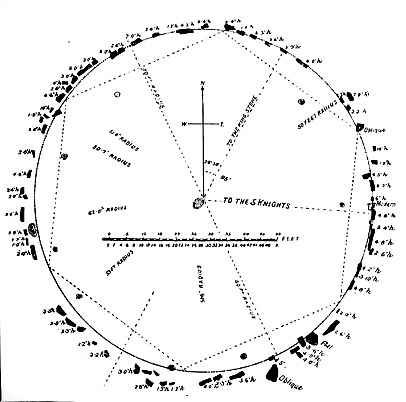
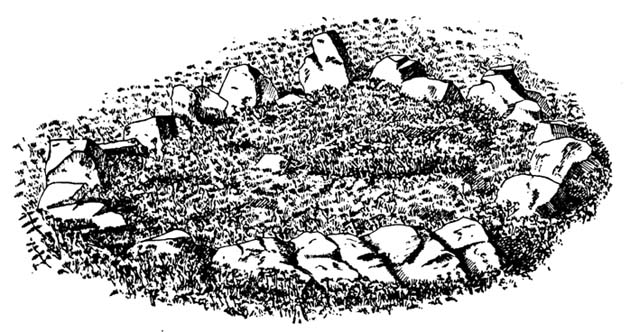
The King’s Men is a near-perfect circle of oolitic limestone uprights. Thought for centuries to be the memorial site of some victory by the Danish King Rollo, they have been described by many historians, travellers and antiquarians from the 14th century upwards. Several early writers described a sort of “avenue” running from the circle, not unlike the one perceived at Stonehenge and elsewhere. Evidence for this cannot be fully disregarded, as there are some recumbent monoliths along the road beside the stone complex, known as the Jurassic Way. This was a prehistoric trade route and it is more likely than not that some other uprights would have been nearby.
The Rollright Stones were used as the prime base for what was known as the Dragon Project: an exploratory examination of potential electromagnetic anomalies that were recorded at the standing stones here by scientists, geomancers and archaeologists who were involved daily monitoring work over many years. Much of this was published in Paul Devereux’s book, Places of Power – required reading for everyone who pretends an interest in megalithic sciences.
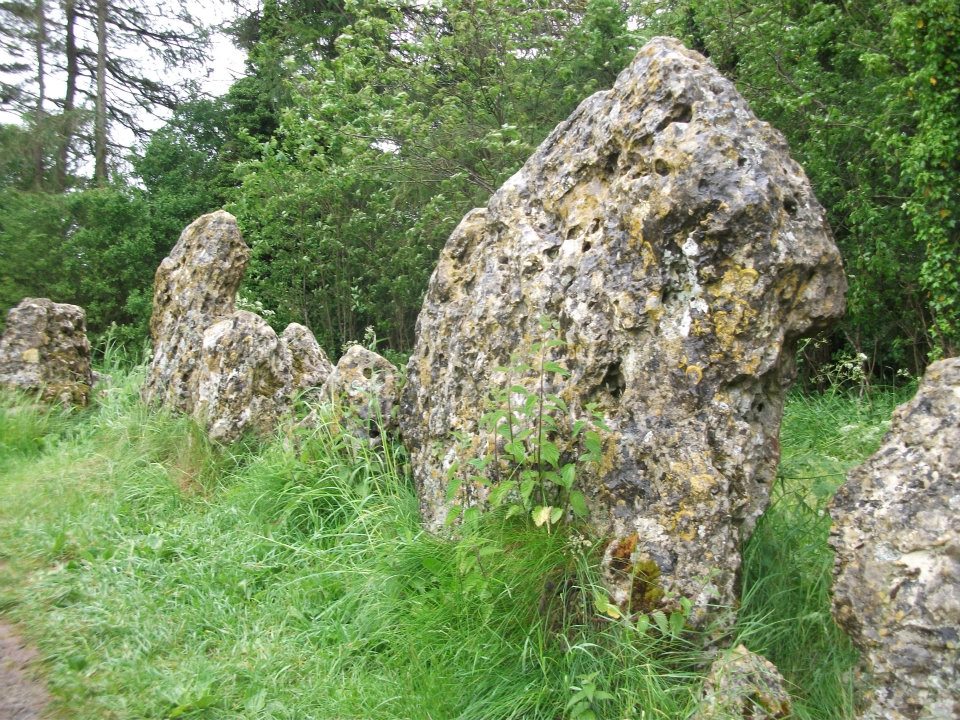
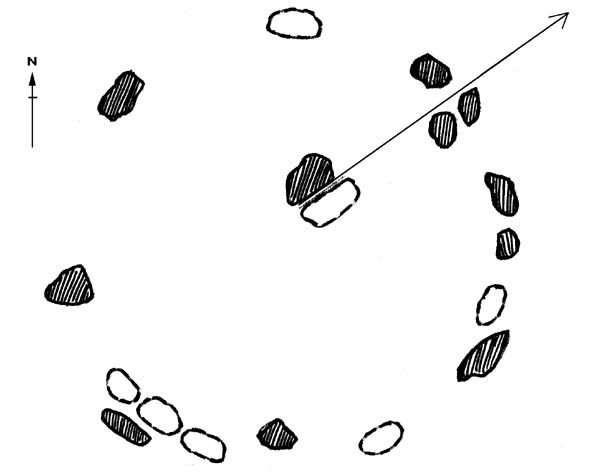
The Rollright complex today consists primarily of three sites: the Whispering Knight’s portal dolmen, the King’s Men stone circle, and the King Stone. Of these, it is the stone circle which draws most attention. Several alignments are connected with the complex. The original ritual use of the place would have, primarily, involved rites of passage and death rituals; though it seems obvious that menstrual rites were also an important social event here. After dark, this stone circle has distinctly ‘female’ spirit, sometimes manifesting in a quite wrathful form (please don’t confuse any of the modern witchcraft mythos with such things – they are fundamentally different in both social and ritual aspects). Women obviously played a large part in the ritual use and geomantic layout of the original complex. It also seems likely that the stone circle was used as a moot spot, which may have been in use until medieval times. The recent discovery of the carving of a family crest, at least 500 years old, implies this.
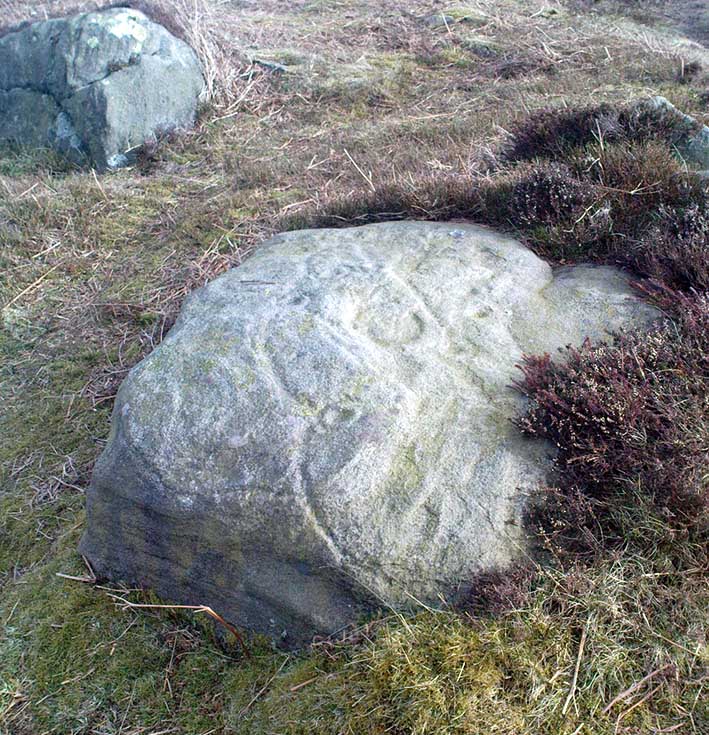
Until Tom Wilson and I lived in the hut at the circle in the 1990s, previous reports of ‘carvings’ at the stone circle were few and debatable. But two of the stones in the Rollright circle have quite distinct carvings on them. The most pronounced is etched on the tallest stone (stone 1 – Barnatt Survey) and comprises of a typical heraldic shield – although we cannot, as yet, ascertain the motif in the middle of the shield. This was first seen by a visiting tourist who wanted to remain anonymous, but the finding was written up in an article I wrote shortly afterwards. (Bennett 1999) The image below – reproduced courtesy of Alistair Carty’s Archaeoptics Limited laser scanning company – clearly shows the carving, which confirmed the initial discovery. The report of his findings can be read here.

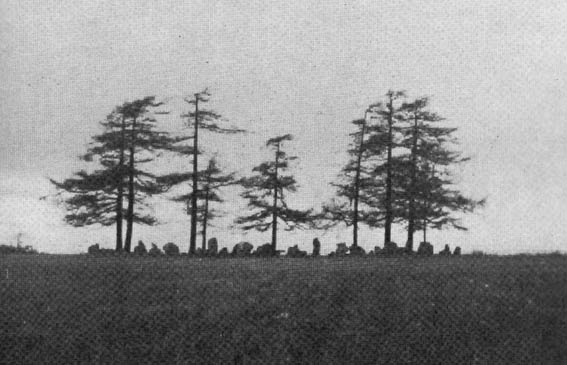
Not unsurprisingly, since the discovery of the shield various screwy interpretations have been put forward to account for the design. My favourite has to be the one suggested by a pagan friend of the Rollright Trust, who, occult-like and all secret (y’ get the drift) reckoned it was all to do with King Arthur! Needless to say, my response of, “Y’ talking bollox mate!” was received somewhat nervously by pagan Karin Attwood and the twee little entourage who were discussing the shield, in the usual ‘secrecy – secrecy’ hush-hush tone of false witches and similar idiots!
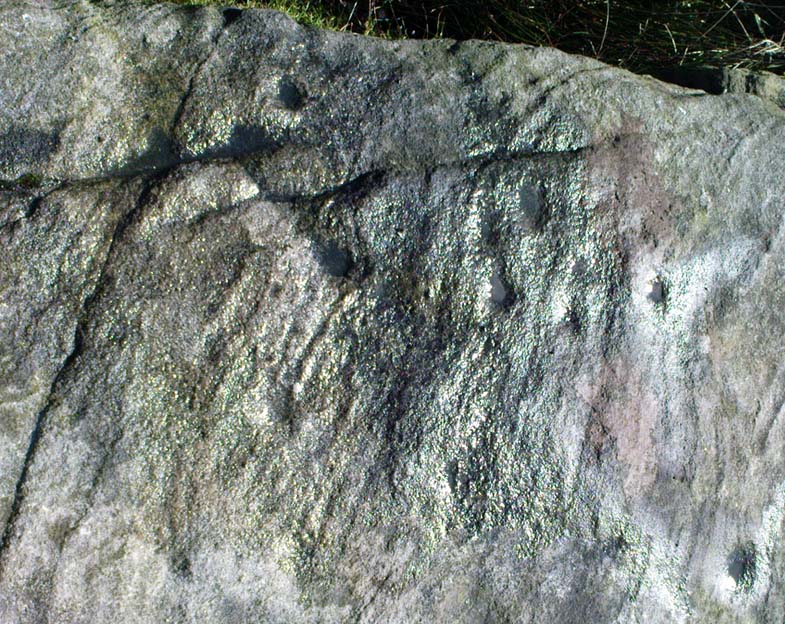
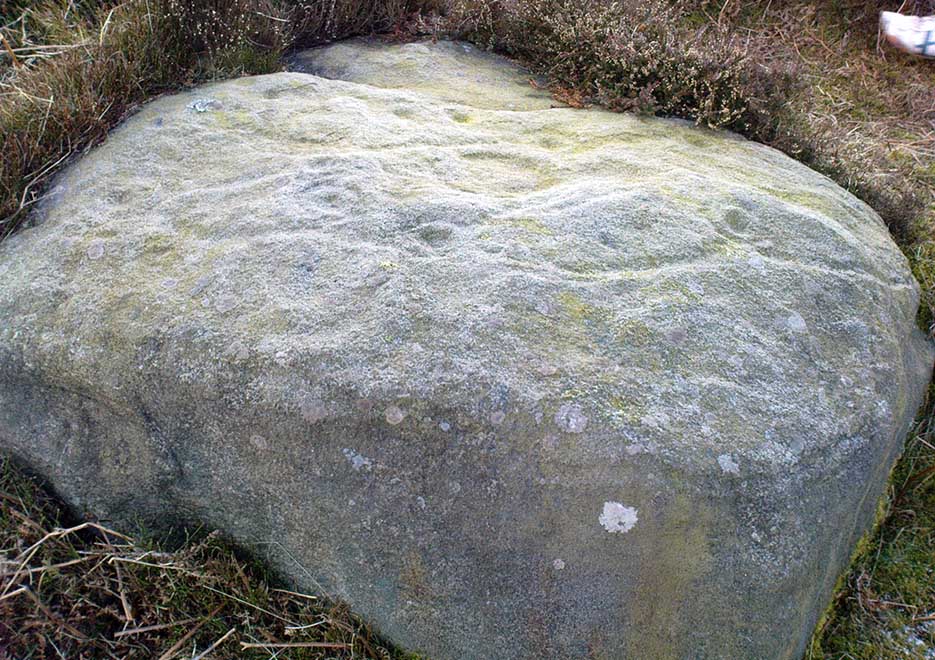
A few months later I found another set of carvings on stone 62 (Barnatt survey), comprising a set of Ogham letters. These Ogham are very faint and are best observed before midday, when lighting conditions highlight them much clearer. If anyone can decipher them, it would be greatly appreciated. (though please don’t gimme some shit about King Arthur)
Folklore
Folklore ascribes that the number of stones in the complex cannot be counted (a motif found at other megalithic sites) and, intriguingly, of the surveys done here, no two are the same! One early illustration of the circle shows 30 stones, nother describes 46, and one survey describes just 22 stones! As the 20th century progressed the numbers increased dramatically, with surveys differing at 58, 60, 71, 72, 73, 77 and 105. The present-day ‘guesstimate’ is about 77. Weird!
Folklore tells that if you can count the stones three times in a row and get the same number, you may have any wish you choose. But recently this has become reversed and it is said to be a curse if you count three times the same. Intriguingly, modern visitors who allege no superstitious beliefs, will not count the stones a third time if the same number crops up twice.
The best-known folk tale of this place is of the King, his men and the knights, who “were once men who were changed into vast rocks and fossilised,” as Camden first put it in 1586. The King’s men sometimes go to drink at a well near Little Rollright, as does the king, but he only goes at certain times. At midnight however, on certain days, the King’s Men have sometimes been known to come to life, join hands and dance in a circle. This sounds more like a folk remnant of ritual use here.
Faerie folk are said to live beneath the circle, in great caverns, some of which are linked up to the single monolith across the road. Ravenhill [1926] described how local folk had sometimes seen the little people dancing around the circle by moonlight, but nobody has seen them of late.
References:
- Anonymous, The Rollright Stones: Theories and Legends, privately printed, n.d.
- Anonymous, ‘Oxfordshire Mysteries,’ in The Ley Hunter 86, 1979.
- Aubrey, John, Monumenta Britannica, Milbourne Port 1980.
- Barnatt, John, Stone Circles of Britain (2 volumes), BAR: Oxford 1989.
- Beesley, T., ‘The Rollright Stones,’ in Trans. N.Oxon Arch. Soc., 1, 1855.
- Bennett, Paul, ‘Remarkable Carving found at the King’s Men Stone Circle, Rollright, Oxfordshire,’ in Right Times 5, 1999.
- Bennett, Paul & Wilson, Tom, The Old Stones of Rollright and District, Cockley Press: London 1999.
- Bloxham, Christine, Folklore of Oxfordshire, Tempus 2005.
- Bord, Janet & Colin, The Secret Country, Paul Elek: London 1976.
- Bord, Janet & Colin, A Guide to Ancient Sites in Britain, Paladin 1979.
- Brooker, Charles, ‘Magnetism and the Standing Stones,’ in New Scientist, January 1983.
- Burl, Aubrey, A Guide to the Stone Circles of Britain, Ireland and Brittany, New Haven & London 1995.
- Burl, Aubrey, Great Stone Circles, Yale University Press: New York & London 1999.
- Burl, Aubrey, The Stone Circles of Britain, Ireland and Brittany, Yale University Press 2000.
- Clayton, Peter, Archaeological Sites of Britain, Weidenfeld & Nicolson: London 1976.
- Cooper, Roy, ‘Some Oxfordshire Leys,’ in The Ley Hunter 86, 1979.
- Cowper, B.H., ‘Oxfordshire Legend in Stone,’ Notes & Queries (1st series), 7, January 15, 1853.
- Crawford, O.G.S., Long Barrows of the Cotswolds, John Bellows: Oxford 1932.
- D., A.J., ‘Rollwright or Rollright,’ in Notes & Queries, 2nd series, 7, 1859.
- Devereux, Paul, ‘Is This the Image of the Earth Force?’ in The Ley Hunter 87, 1979.
- Devereux, Paul, ‘Operation Merlin,’ in The Ley Hunter 88, 1980.
- Devereux, Paul, ‘Operation Merlin 2,’ in The Ley Hunter 89, 1980.
- Devereux, Paul, ‘The Third Merlin,’ in The Ley Hunter 92, 1981.
- Devereux, Paul, Places of Power, Blandford: London 1990.
- Devereux, Paul, The Sacred Place, Cassell: London 2000.
- Devereux, Paul, Steele, John & Kubrin, David, Earthmind, Harper & Row: New York 1989.
- Devereux, Paul & Thomson, Ian, The Ley Hunter’s Companion, Thames & Hudson: London 1979.
- Dyer, James, Discovering Regional Archaeology: The Cotswolds and the Upper Thames, Shire: Tring 1970.
- Evans, Arthur J., ‘The Rollright Stones,’ in Trans. Bristol & Glouc. Arch. Soc., 40, 1892.
- Evans, Arthur J., ‘The Rollright Stones and their Folklore (3 parts),’ in Folklore Journal, 1895.
- Graves, Tom, Dowsing, Techniques and Application, Turnstone: London 1976.
- Graves, Tom, Needles of Stone, Granada: London 1980.
- Graves, Tom (ed.), Dowsing and Archaeology, Turnstone: Wellingborough 1980.
- Gray, William, The Rollright Ritual, Helios: Cheltenham 1975.
- Grinsell, Leslie V., The Ancient Burial Mounds of England, Methuen: London 1936.
- Grinsell, Leslie V., The Rollright Stones and their Folklore, Toucan Press: Guernsey 1977.
- Hamper, W., ‘Observations on certain Ancient Pillars of Memorial, called Hoar Stones,’ in Archaeologia, 25, 1833.
- Hawkes, Jacquetta, A Guide to the Prehistoric and Roman Monuments in England and Wales, BCA: London 1973.
- Higgins, Geoffrey, The Celtic Druids, Rowland Hunter: London 1829.
- Krupp, E.C., In Search of Ancient Astronomies, Chatto & Windus: London 1979.
- Lambrick, George, The Rollright Stones: The Archaeology and Folklore of the Stones and their Surroundings, Oxford Archaeology Review 1983. (Reprinted and updated in 1988.)
- Liebreich, Karen, UneXplained: Spine-tingling tales from Real Places in Great Britain and Ireland, Kindle 2012.
- Michell, John, Megalithomania, Thames & Hudson: London 1982.
- Millson, Cecilia, Tales of Old Oxfordshire, Countryside Books: Newbury 1983.
- Ravenhill, T.H., The Rollright Stones and the Men Who Erected Them, Little Rollright 1926.
- Richardson, Alan, Spirits of the Stones, Virgin: London 2001.
- Robins, Don, ‘The Dragon Awakes,’ in The Ley Hunter 87, 1979.
- Robins, Don, ‘The Dragon Project and the Talking Stones,’ in New Scientist, October 1982.
- Robins, Don, Circles of Silence, Souvenir Press: London 1985.
- Saltzman, L.F. (ed.), Victoria County History of Oxford, Dawsons: London 1970 (first published 1939).
- Stanley, Christopher C., ‘A Rollright Processional Way?’ in The Ley Hunter 90, 1981.
- Taunt, Harry, The Rollright Stones: The Stonehenge of Oxfordshire, Oxford 1907.
- Thom, Alexander & Thom, A.S., ‘Rings and Menhirs: Geometry and Astronomy in the Neolithic Age,’ in E.C. Krupp, 1979.
- Thom, Alexander, Megalithic Sites in Britain, Oxford University Press 1967.
- Thom, A., Thom, A.S. & Burl, H.A.W., Megalithic Rings, BAR: Oxford 1980.
- Turner, Mark, Folklore and Mysteries of the Cotswolds, Hale: London 1993.
Acknowledgements: HUGE thanks to Marion Woolley for her images in this site profile, and other memorable ventures at this awesome megalithic ring!
Links:
- Rollright Stones on The Megalithic Portal
© Paul Bennett, The Northern Antiquarian