Beauly Avenue, Downfield, Dundee, Angus

Cup-Marked Stone (lost):  OS Grid Reference – NO 3975 3340

Also Known as:

  1. Magdalen’s Kirkton Stone

Archaeology & History

In the mid-1890s, workmen ploughing one of the fields near the steading at Magdalen’s Kirkton farm hit a large stone beneath the soil.  It turned out to be the covering stone of a prehistoric burial, or cist, that was aligned east-west.  Whilst the remains in the cist had all but turned to dust, the covering stone had a number of cupmarks on it.  It was described only briefly by R.N. Kerr (1896), who told that,

“The stone forming the lid of the cist is cup-marked.  It weighs 5 cwt., 1 qr., 21½ lbs., and its thickness varies from 9 to 12 inches.  There are 40 or more cup-markings on it, varying from 1 to 3 inches in diameter.”

It would seem that no sketches were made of this carving and I’ve been unable to find any more details about it. Help!

References:

  1. Kerr, R. N., “Notice of a Burial Cist found on the Farm of Magdalen’s, Kirkton, on the Estate of Balmuir, near Dundee,” in Proceedings Society Antiquaries, Scotland, vol. 30, 1896.

© Paul BennettThe Northern Antiquarian

Chesters House, Humshaugh, Northumberland

Cup-and-Ring Stone (lost):  OS Grid Reference – NY 909 702

Archaeology & History

Chesters carving, 1887

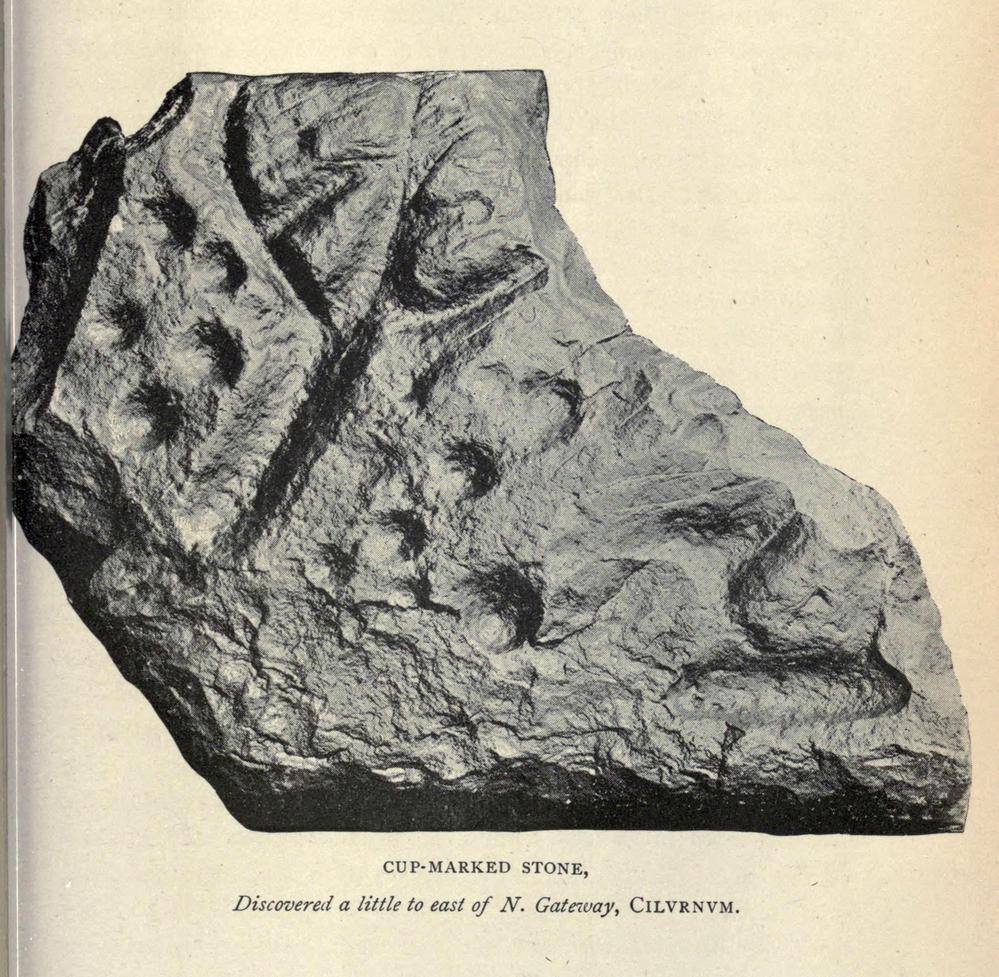
The whereabouts of this carving is somewhat of a mystery.  Originally found three or four hundred yards away to the northeast of Chesters mansion, it was moved from there into the porch entranceway of the place—and here it lived for, hmmmm….well, we’re not quite sure how long it was here.  The only description of the carving seems to have been made by the Rev. G.R. Hall in 1887, and between then and sometime in the 20th century, it’s disappeared to god-knows-where.  The only known photo of the carving (right) suggests that the original design was somewhat bigger as the stone looks to have been broken off from a larger piece.  Mr Hall told us:

“this stone is 3 feet in length by 2 feet 6 inches in breadth, of irregular form.  It has five incised cups on each side of a wide, slightly curved channel, which crosses the stone at nearly its widest part.  Two other grooves intersect this longest channel, one forming a segment of a circle.  At the opposite end of the slab are two nearly parallel grooves passing towards the largest hollow. The ten cups vary from 1½ inches to 3 inches in diameter, and are from half an inch to an inch in depth.”

All being well, the carving is hiding in a wall somewhere, or maybe beneath His Lordship’s bed.  Hopefully it’ll re-appear sometime soon…

References:

  1. Beckensall, Stan, Northumberland’s Prehistoric Rock Carvings – A Mystery Explained, Pendulum: Rothbury 1983.
  2. Hall, G.R., “On Some Cup-incised Stones, found in an Ancient British Burial-mound at Pitlands Hills, near Birtley, North Tynedale,” in Archaeologia Aeliana (2nd Series) volume 12, 1887.

© Paul BennettThe Northern Antiquarian


Mountain Farm, Whittingham, Northumberland

Cup-and-Ring Stone (lost):  OS Grid Reference – NU 053 128

Archaeology & History

This lost carving may have been brought to light as a result of field ploughing which, quite fortunately, uncovered a Bronze Age burial site with a cup-and-ring stone therein.  It was reported by the regional historian David Dixon (1895) in his classic work on this area, although his description was brief and he made no sketch of the design.  He told us:

“A stone-lined grave or cist, similar to that discovered at Mile, was found several years ago on Mountain Farm, in or near to which was a sandstone slab, covered with a fine example of the incised circles, such as are found in the rocks at Routin Lynn, Bewick Hill, Chatton Law and Lordenshaws Camp.”

These other petroglyphs he mentions are bloody impressive!  Sadly they’re not yet on TNA. (site profiles required of them are considerable in size – if anyone would like to write them 😉 )

References:

  1. Beckensall, Stan, Northumberland’s Prehistoric Rock Carvings – A Mystery Explained, Pendulum: Rothbury 1983.
  2. Dixon, David D., Whittingham Vale, Northumberland, Robert Redpath: Newcastle-upon-Tyne 1895.

© Paul BennettThe Northern Antiquarian

Whitelaw, Kirknewton, Northumberland

Cup-and-Ring Stone (lost):  OS Grid Reference – NT 942 295

Also Known as:

  1. Whitelaw Stone

Archaeology & History

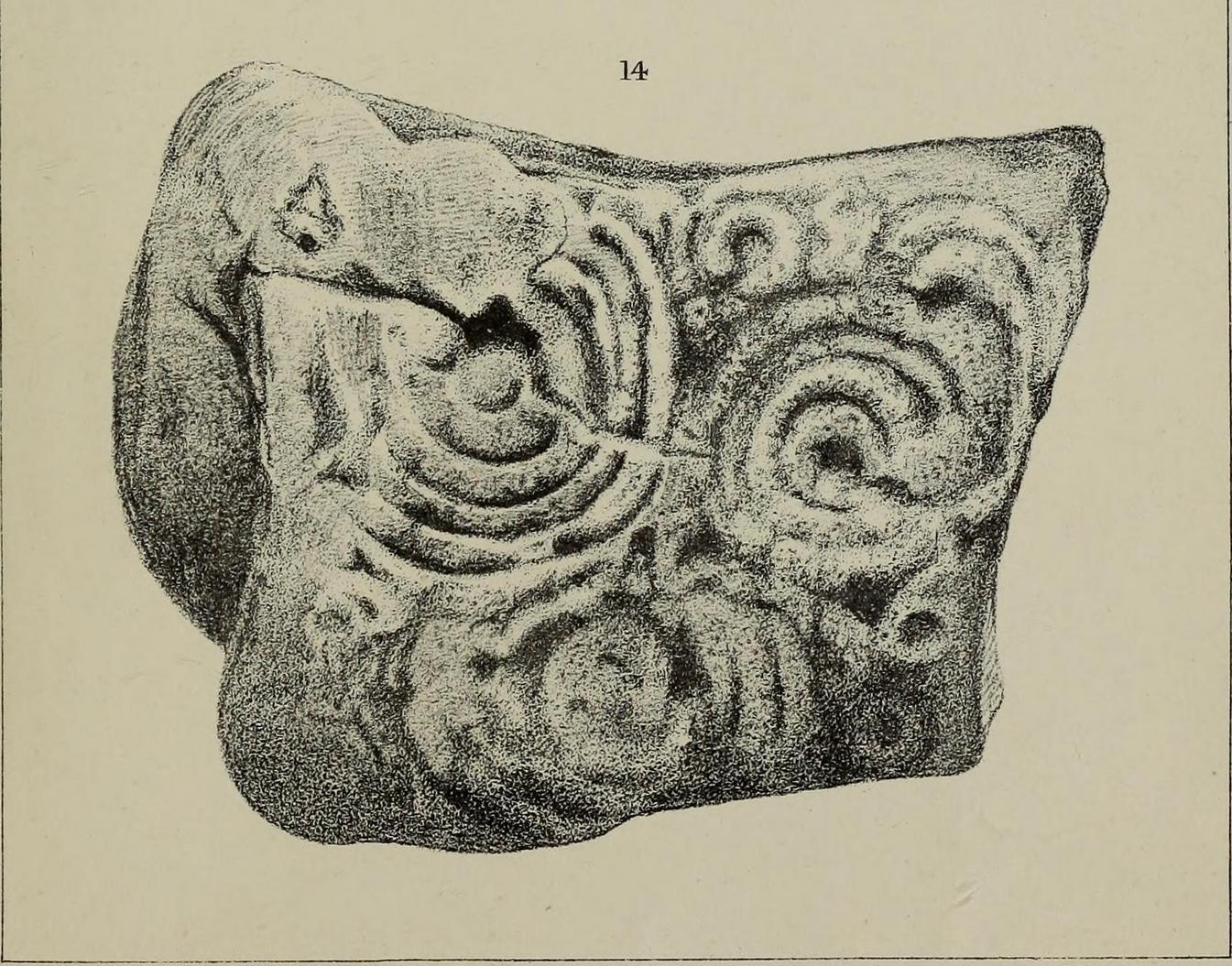
Sometime at the end of the 1860s, a local man—Mr William Wightman of Wooler—was in possession of this impressive-looking petroglyph which, we presume, he uncovered.  The carved stone was, as we can see, broken off from a larger piece and so it’s very evident that this was originally a larger design than the one illustrated here in Mr Middlemass’ (1872) drawing.  The only information we have about it are from his short notes,

The Whitelaw Stone

“was found on the north side of a hill called Whitelaw, the next eminence south-east from Yeavering Bell.  The stone is a very hard gritty sandstone, and bears distinctly the tool marks by which the circles have been cut. The tool must have been of iron or bronze, as the material is too hard to be operated upon by stone implements; moreover, the tool marks shew that the instrument used had a sharp round point, and must have been held in a similar way to the modern chisel.  The marks shew the size of the point.  The object of the artist evidently has been to fill the stone with ornament as between the two great circles; and at the corners he has placed smaller circles to suit the space. The similar nature of the circles on all the stones hitherto figured would seem to show that such stones, if monumental, were not legendary, but, most probably of a religious character; serving, like the Christian cross, to invite the traveller to pay his devotions on a spot rendered sacred by the emblems of worship.”

Searches for this have been made by Stan Beckensall (1983) and his acolytes, but it remains lost. (the grid-ref is an approximation)

References:

  1. Beckensall, Stan, Northumberland’s Prehistoric Rock Carvings – A Mystery Explained, Pendulum: Rothbury 1983.
  2. Middlemass. Robert, “On an Inscribed Stone in the Possession of Mr William Wightman, Bank, Wooler,” in History Berwickshire Naturalists Club, volume 6, 1869-72.

© Paul BennettThe Northern Antiquarian

Soonhope, Peebles, Peeblesshire

Cup-and-Ring Stone (lost): OS Grid Reference – NT 269 419

Also Known as:

  1. Kittlegairy Burn

Archaeology & History

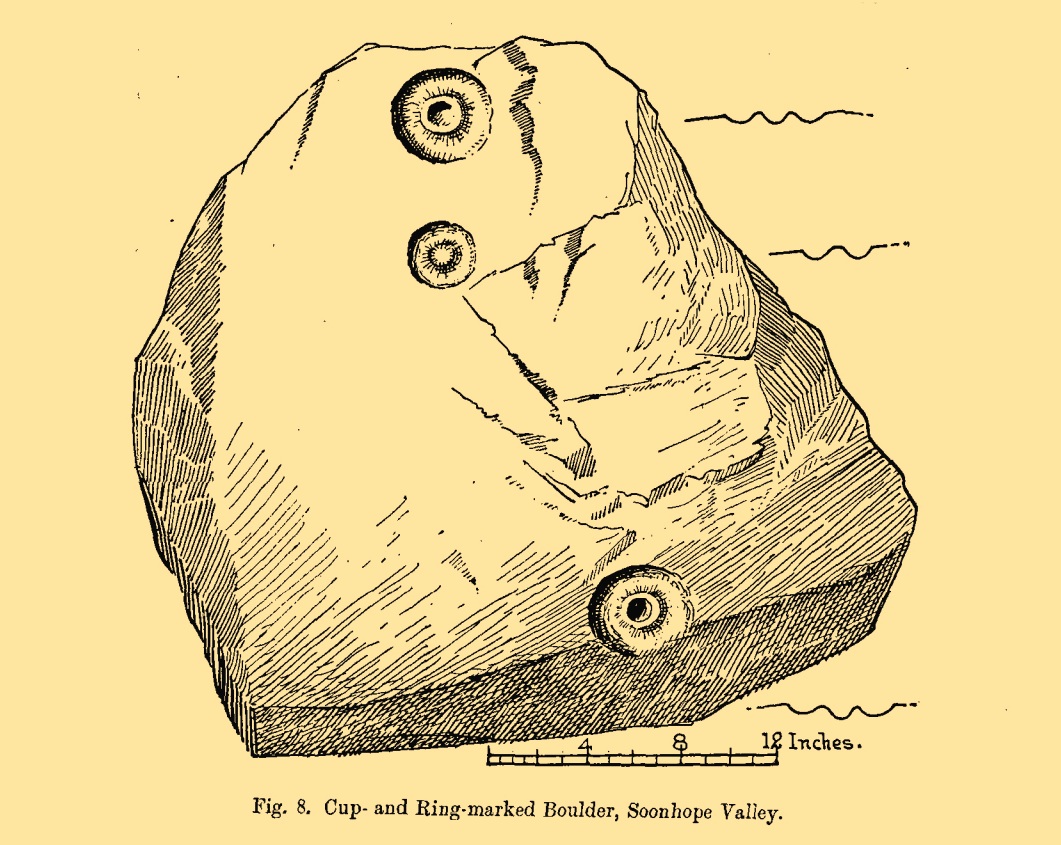
Fred Coles’ 1898 sketch

An apparently isolated cup-and-ring stone was found on the hills north of Peebles at the end of the 19th century by the renowned Scottish megalith explorer, Fred Coles. (1899)  He was having a look at some of the hillforts in the area and—as some of us tend to do—he began meandering off-track, down streams, through bogs and as a result came across the carving that’s illustrated here.  It’s subsequently become “lost” in the hills, but it shouldn’t be too difficult to locate, as the description he gave of its whereabouts is a pretty good one.  He told us:

“A very little over one mile and a quarter up the valley, measuring from the road at Kerfield Cottage, a tiny rivulet called Kittlegairy Burn trickles down from the SE into the main stream.  On the hill to its east, and about 450 feet higher, are the remains of a fort, one of a series of three crowning prominent heights along this side of the valley.  Down the main stream from Kittlegairy Burn is a large ruined sheep-shelter called Soonhope.  Nearly midway between these two points a deep curve has been hollowed out of the E. bank; and, at the foot of this rather high gravel bank, half immersed in the stream, lies the block of stone with the cup-and ring-marks.  They were discovered, 14th September 1896, by my daughter, Helen, on crossing the stream; and we at once proceeded to make a measured drawing, a reproduction of which is given here….  The depth of the rings in proportion to their width is the one most noticeable feature; next, the extreme thinness of the intervening ‘neck’; but, on a minute and careful examination of the nature of the stone itself, taking into consideration that its angularity and sharpness of edge and the absence of moss or even of confervoid growths on its surfaces went against the possibility of its being truly waterworn.”

The rock had obviously fallen from its original position above the burn.  Today, the entire area where this stone exists has been covered by a huge forestry plantation, but if any rock art fanatics from the Peebles area get bored one day and have nothing to do…..

References:

  1. Coles, Fred, “Notices of the Discovery of a Cist and Urns at Juniper Green, and of a Cist at the Cunninghar, Tillicoultry, and of some Undescribed Cup-marked Stones’, in Proceedings Society Antiquaries, Scotland, volume 33, 1899.
  2. Morris, Ronald W.B., “The Cup-and-Ring and Similar Early Sculptures of Scotland; Part 2 – The Rest of Scotland except Kintyre,” in Transactions of the Ancient Monuments Society, volume 16, 1969.
  3. Morris, Ronald W.B., “The cup-and-ring marks and similar sculptures of Scotland: a survey of the southern Counties – part 2,” in Proceedings of the Society of Antiquaries, Scotland, volume 100, 1969.
  4. Morris, Ronald W.B., The Prehistoric Rock Art of Southern Scotland, BAR: Oxford 1981.

© Paul BennettThe Northern Antiquarian

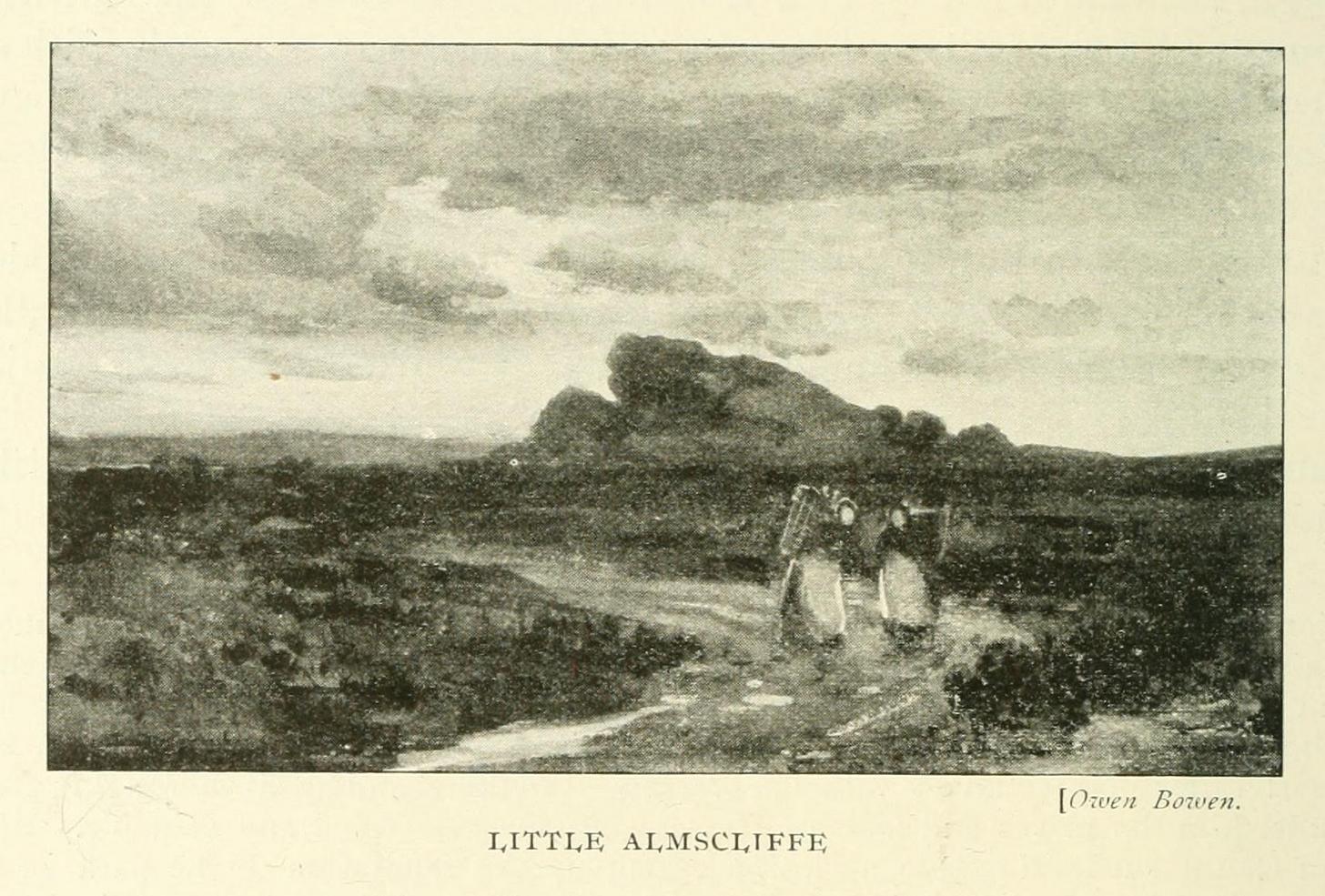
Little Almscliffe Crags, Stainburn, North Yorkshire

Legendary Rocks:  OS Grid Reference – SE 23237 52275

Also Known as:

  1. Little Almes Cliffe
  2. Little Almias Cliff Crag

Getting Here

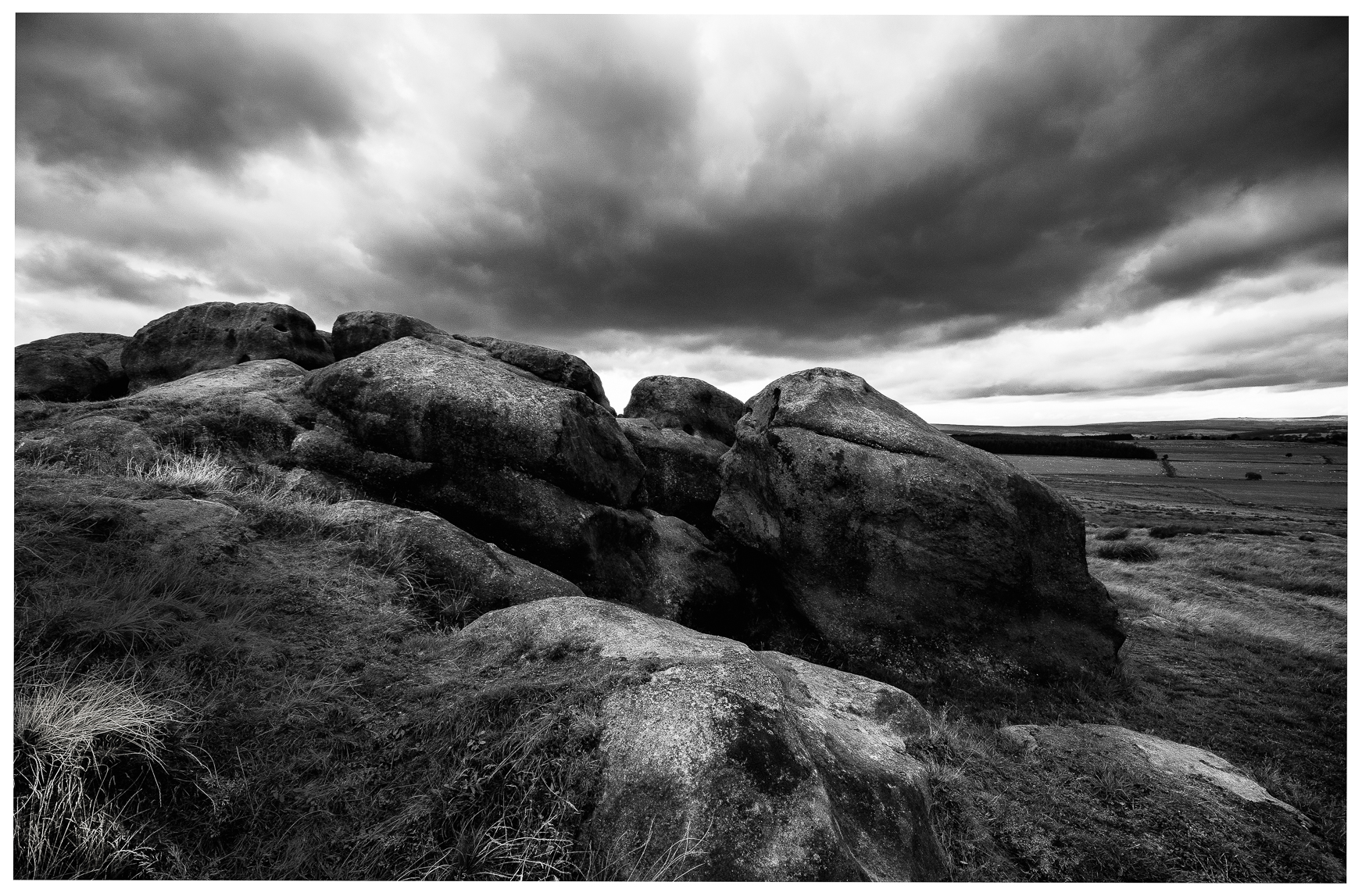
Little Almscliffe Crag (photo – James Elkington)

Coming from Harrogate, take the B6162 and B6161 road to Beckwithshaw, through the village and, 4-500 yards on, turn right onto Norwood Lane.  2 miles along, keep your eyes peeled on your left for a gravelled parking spot and you’ll see the large rock outcrop 200 yards south of the road. …Otherwise, from Otley: go over the river bridge and turn right up Farnley Lane and follow the B6451 for a few miles, thru Farnley village up the Washburn valley, past Norwood and at Bland Hill, turn right along Broad Dubb Road for 1¾ miles where you’ll reach that same gravelled parking spot.

Archaeology & History

Very much the ‘little brother’ of Great Almscliffe, 3 miles (4.83km) to the southeast, this site would be more of interest to the travelling geologist, perhaps, than to antiquarians.  But that depends what tickles y’ fancy I s’ppose.

In 1702 when the northern antiquarian Ralph Thoresby mentioned this and its big brother to the southeast, he described the “two famous crags of Almes Cliff—in some old writings called Aylmoys ut dicitur—but have seen nothing memorial of it, saving its remarkable lofty situation.”  He missed the cup-and-ring carving on the east-side of the crags, obviously, which indicates that it had some form of animistic sanctity in ancient times.

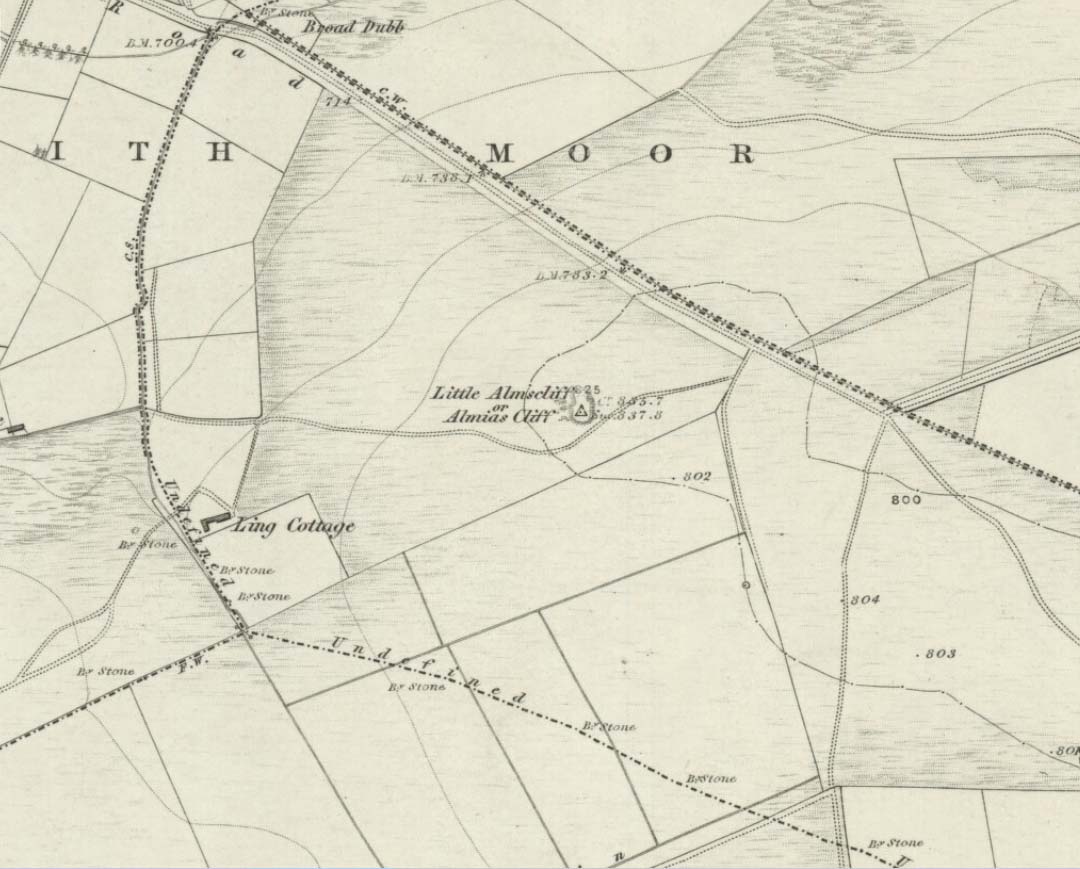
The location on 1851 map
Little Almscliffe c.1900

Little Almscliffe was one of many impressive places located within the ancient Forest of Knaresborough; and although it wasn’t on the original boundary line, a perambulation (i.e., annual ritual walking to the old stones, trees and wells defining the region) of the area written in 1770, in what Mr Grainge called “the Copyhold Forest”, was undertaken by the Enclosure Commissioners.  It differed from the more ancient perambulation rite, in that the newer one included a mention of,

“five bounder stones also marked F to an earth-fast stone, lying northeast of Little Almes Cliffe, marked also with an F; (and) from thence by other four bounder stones marked F to Sandwith Wath…”

The letter ‘F’ here signifying the word ‘forest’, as in the Forest of Knareborough.

William Grainge (1871) also believed these crags to have been a place of druidic worship.  He wasn’t the only one.  Many other writers of the time thought the same thing; and although we have no concrete evidence to prove this, it is highly likely that these rocks would have served some ritual purpose in pre-christian days.  Certainly in more recent times (during the 1980s and ’90s) we know that ritual magickians used this site for their workings.  On a more mundane level, the crags were previously used as a site for for beacon fires.  One was erected here in 1803 when the first Bonaparte threatened to invade England; but I can find no written accounts of earlier beacons here.

References:

  1. Bennett, Paul, The Old Stones of Elmet, Capall Bann: Milverton 2001.
  2. Bogg, Edmund, From Eden Vale to the Plains of York, James Miles: Leeds 1895.
  3. Bogg, Edmund, Higher Wharfeland, James Miles: Leeds 1904
  4. Cowling, E.T., Rombald’s Way, William Walker: Otley 1946.
  5. Grainge, William, History & Topography of Harrogate and the Forest of Knaresborough, J.R. Smith: London 1871.
  6. Parkinson, Thomas, Lays and Leaves of the Forest, Kent & Co.: London 1882.

© Paul BennettThe Northern Antiquarian 

Traquair Churchyard, Traquair, Peeblesshire

Cup-Marked Stone (lost):  OS Grid Reference – NT 3202 3347

Archaeology & History

In 1974, Ordnance Survey reported the existence of “a large piece of sandstone containing two depressions resembling cup marks” in the churchyard wall which, tradition told, originally came from the ruined 12th century parish church (long gone) more than 300 yards to the southwest (at NT 3185 3328).  However, in recent years the cup-marks seem to have disappeared and may be hiding behind the overgrowth of ivy in the boundary wall.  It needs to be recovered.

Halfway between the location of the original church and the present one, waters from the heathen St Bryde’s Well used to flow, but it had already been drained by 1856.

© Paul BennettThe Northern Antiquarian

Broomridge (1), Ford, Northumberland

Cup-and-Ring Stone:  OS Grid Reference – NT 97298 37110

Archaeology & History

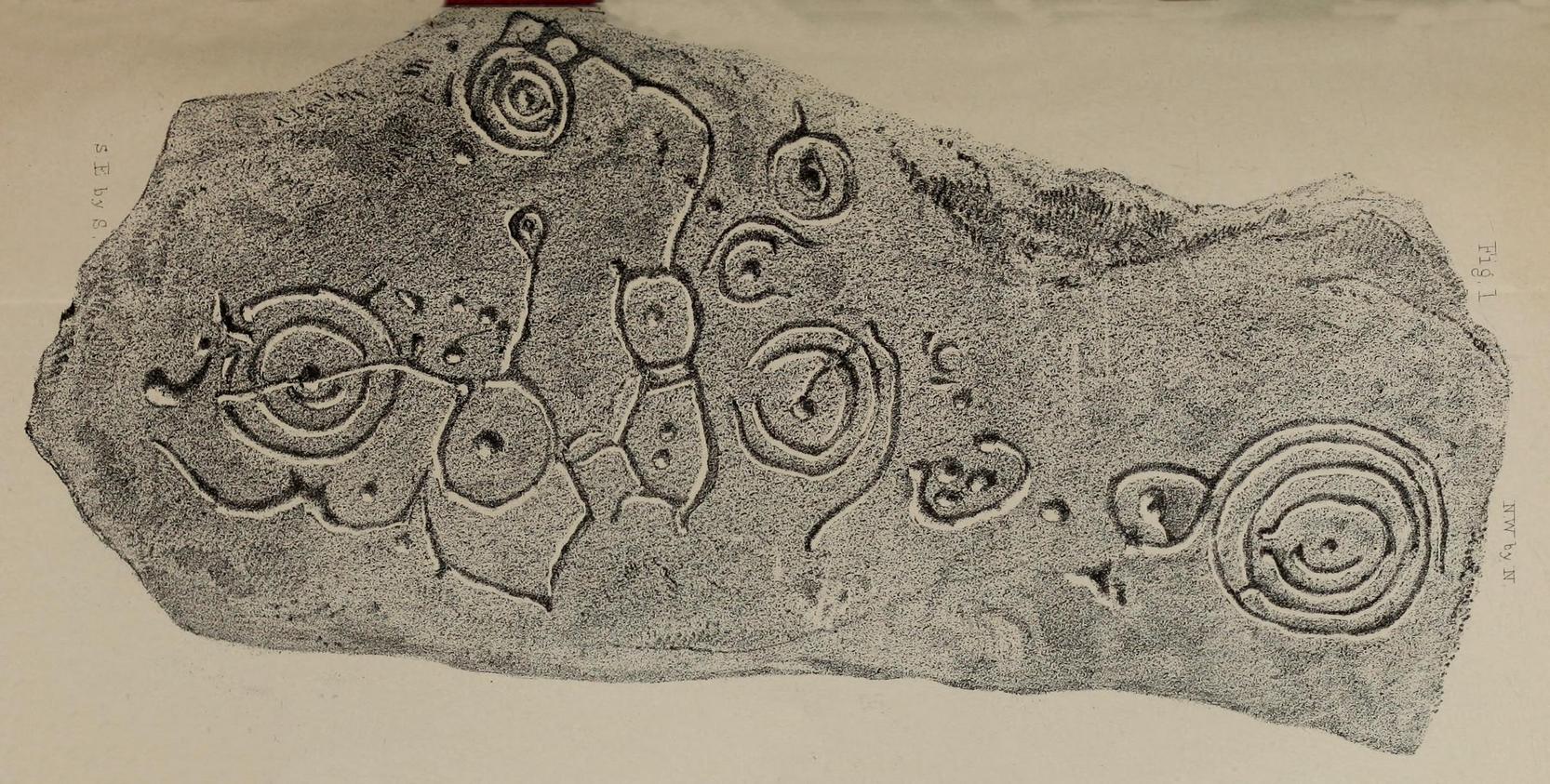
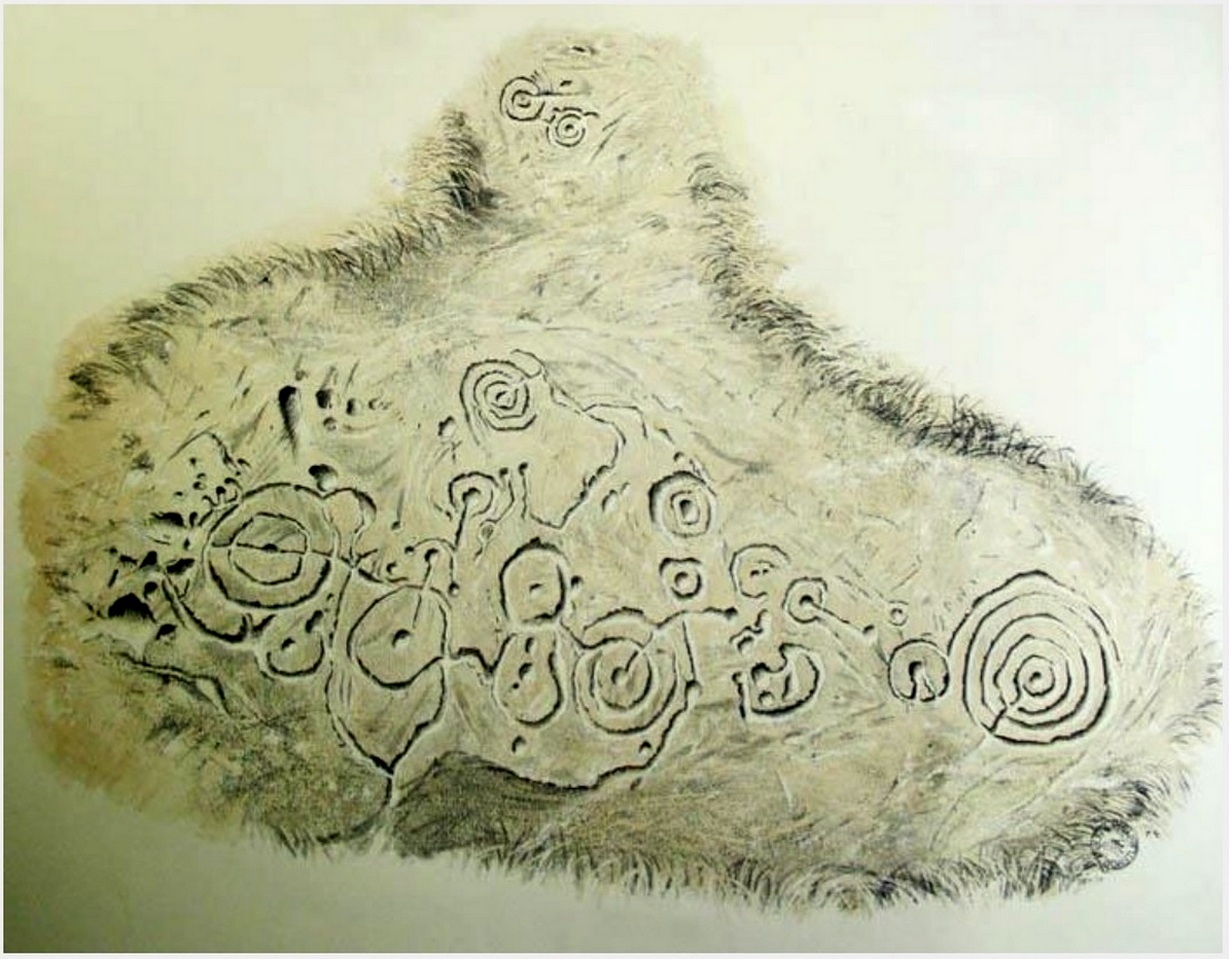
In 1863, a bunch of reputable Victorian authors and antiquarians met with the Duke of Northumberland in Alnwick Castle to discuss the matter of making decent images of the petroglyphs which, at the time, had only just been rediscovered in the area.  At one of their meetings, the floor in one of the Castle rooms was covered with rubbings of carvings that they’d made—this one included.  I’d loved to have been there!  Subsequently, from that meeting, sketches of this carving were done and included in the works by George Tate (1864; 1865) and then a few years later in J. Collingwood Bruce’s (1869) rare tome that had been published with the help of dosh from the Duke.

Found along a raised geological ridge running roughly east-west, a number of other carvings are close by and well worth looking at when you visit here.  The basic (and first) description of the site by Tate told that here,

Tate’s 1864 sketch
J.C. Bruce’s 1869 image

“on a high ridge on Hunter’s Moor, a large surface of rock, some forty yards by twenty, having a gentle slope to the northward, is partially uncovered.  In one part, which has been entirely cleared of turf, fourteen figures are scattered over an area of 15 feet by about from 5 to 7 feet.  Some of the figures are of the common type, one of which is 28 inches in diameter; but others present new features; and several are curiously united by straight and curved grooves.  Across the entire diameter of a group of four concentric circles, runs a groove connecting them with other combined figures.  An irregularly shaped, rounded, angular figure, encloses two hollows or cups; and united to this is a broad oval figure.  One figure around four cups approaches to the reniform.”

When the modern rock art expert Stan Beckensall wrote about this site, he mentioned how his own picture of the carving consisted of a number of elements that weren’t included by the 19th century pioneers—which isn’t unusual.

References:

  1. Beckensall, Stan, Northumberland’s Prehistoric Rock Carvings – A Mystery Explained, Pendulum: Rothbury 1983.
  2. Beckensall, Stan, Prehistoric Rock Motifs of Northumberland – volume 1, Abbey Press: Hexham 1991.
  3. Bruce, John Collingwood, Incised Markings on Stone; found in the County of Northumberland, Argylshire, and other Places, privately printed: London 1869.
  4. Tate, George, “The Ancient British Sculptured Rocks of Northumberland and the Eastern Borders,” in Proceedings of the Berwickshire Naturalists Club, volume 5, 1864.
  5. Tate, George, The Ancient British Sculptured Rocks of Northumberland and the Eastern Borders, Henry Hunter Blair 1865.

© Paul BennettThe Northern Antiquarian

Ballakelly, Santon, Isle of Man

Cup-Marked Stone:  OS Grid Reference – SC 32144 71990

Also Known as:

  1. Oatland

Archaeology & History

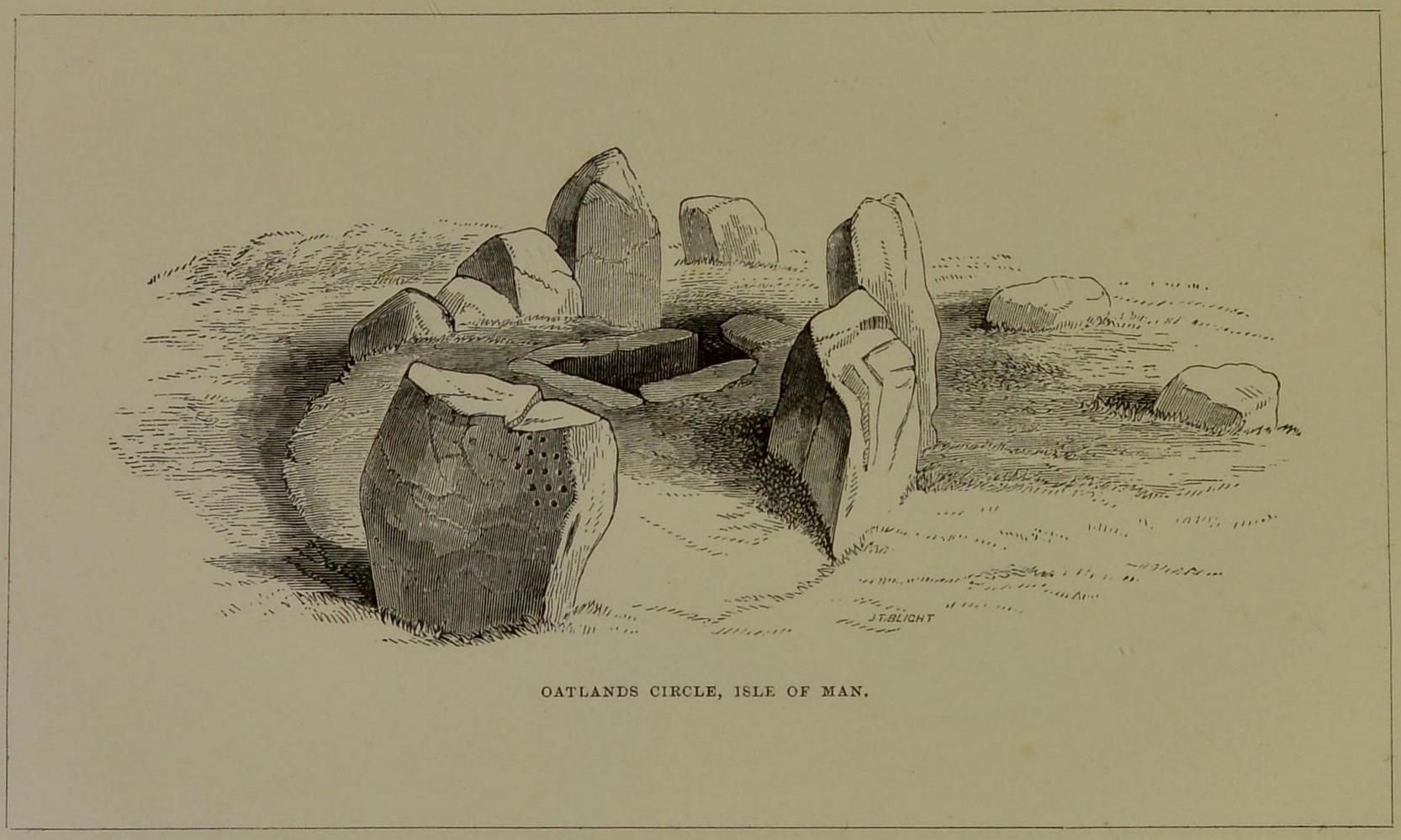
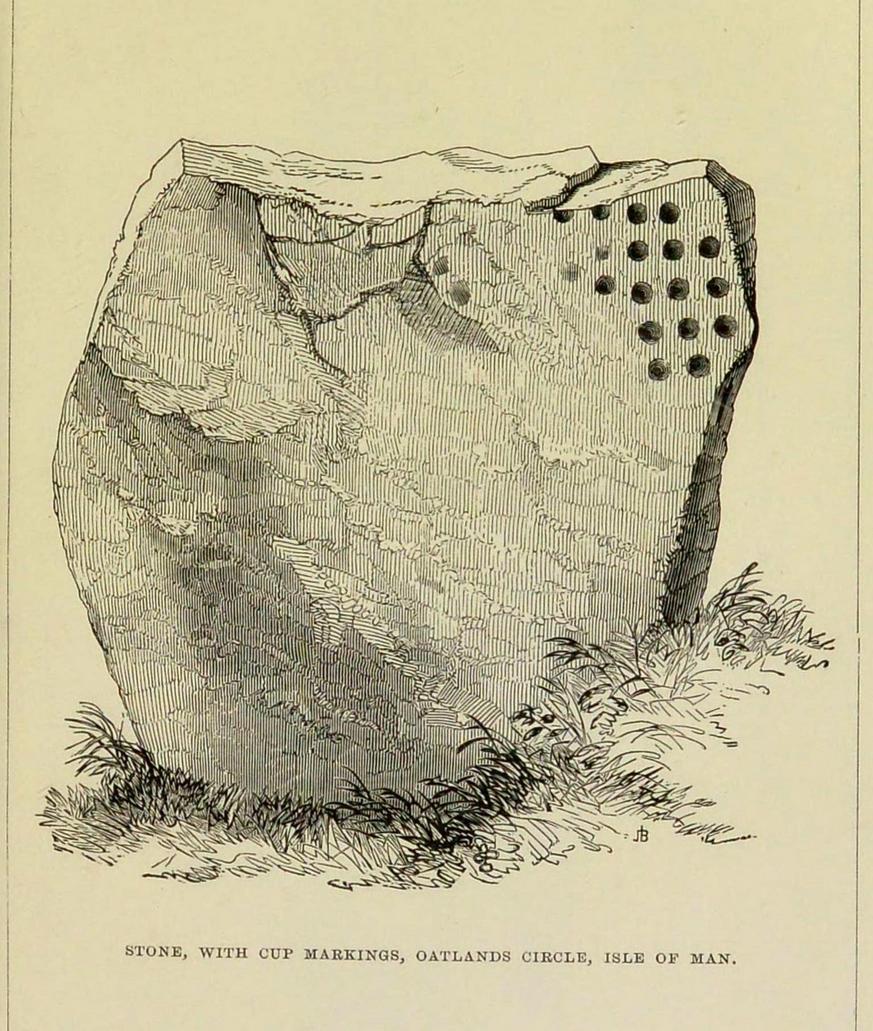
This carving is one that was found inside the remains of a chambered cairn and so, as with all things petroglyphic, it deserves its very own site profile.  It’s been mentioned before—in fact many times before, from the legendary J.T. Blight (1868) to our modern researchers—although it was curiously absent in Ron Morris’ (1989) otherwise excellent survey.  When Mr Blight described the tomb, he told us that,

“Its outer ring, of which but three or four stones are left, was about 45 feet in diameter; the inner one 15 feet, with a kistvaen in its midst.  As on the external face of one of the uprights of the inner circle there are rows of cup carvings … it may be presumed that this was always exposed to view.”

Position of cups in the tomb
E.L. Barnwell’s 1868 sketch

The same year, Barnwell (1868) mentioned the same carvings—albeit briefly—telling us “that one of the stones has several rows of the curious cups.”  The design faced to the north, which is the traditional direction relating to Death in most northern hemisphere cultures.

As you can see, this design is similar to other petroglyphs that some students have suggested have a numeric nature (see the Idol Stone on Ilkley Moor for example).  You can understand why!  The basic linearity of the cups, in rows, certainly gives that impression and indeed it’s not unreasonable to make such an assumption—but, as always, we simply don’t know.  A similar design was found on a stone at Ballagawne in the parish of Kirk Arbory, but the cups were much deeper and deemed as being a medieval game played on stone, known as Nine Man’s Morris.  The original function of the game may have been divinatory.

References:

  1. Barnwell, E.L., “Notes on the Stone Monuments in the Isle of Man,” in J.G.,Cumming (ed.) Antiquitates Manniae, London 1868.
  2. Blight, J.T., “Stone Circles and Megalithic Remains,” in Gentleman’s Magazine 1868.
  3. Cubbon, A. M., Prehistoric Sites in the Isle of Man, Manx Museum: Douglas 1971.
  4. Cumming, J.G. (ed.), Antiquitates Manniae, Manx Society: London 1868.
  5. Gale, J. & Darvill, T., “A Survey of the Ballakelly Chambered Tomb,” in Darvill, & T. Billown (eds.), Neolithic Landscape Project, Isle of Man, 1997, Bournemouth University 1998.
  6. Henshall, A. S., “Manx Megaliths Again: An Attempt at Structural Analysis,” in P. Davey (ed.), Man and Environment in the Isle of Man, BAR: Oxford 1978.
  7. Kermode, P.M.C., “The Ancient Monuments of the Isle of Man,” in Archaeologia Cambrensis, volume 84, 1929.
  8. Kermode, P.M.C. & Herdman, W.A., Manks Antiquities, University of Liverpool 1914.
  9. Simpson, James, Archaic Sculpturings of Cups, Circles, etc., Upon Stones and Rocks in Scotland, England and other Countries, Edmonston & Douglas: Edinburgh 1867.

© Paul BennettThe Northern Antiquarian

Killiesmont, Keith, Moray

Cup-Marked Stone (destroyed):  OS Grid Reference – NJ 4124 5308

Archaeology & History

Diagonally across the road from Killiesmont, about a hundred yards up the sloping field on “a piece of ground called the Helliman Rig,” could once be seen a large flat stone with cup-markings on its surface.  Walter Gregor (1881) told that,

“It lay on the top of a rising ground, and commanded a very wide view of the country, stretching for many miles over the hills of Banff and Moray.  In a part of it the rock–a kind of slate–came to the surface.  In the rock were cut out nine cups in three rows.”

The carving was earlier described in one of the Topographical Gazetteers of Scotland (1848) where its story is bound up with local tradition and folklore of the land where it lie.  There it was described as being “a flat circular stone of about 8 feet in diameter, in which there are a number of holes, but for what purpose tradition is silent.”  Subsequently the local historian J.F.S. Gordon (1880) talked of this “large flat circular Stone, of about 8 feet in diameter, in which there was a number of half-pierced holes…. It was too large for a Quern or even a Millstone; and its purpose remained an enigma.”

The stone came to light when a local farmer was digging in the field and, “at the upper end of the Rig, there was found a rude Cist among a heap of stones, which contained ashes.”  The cup-marked stone was “turned up” at the same time.  It has sadly been destroyed—along with the associated cairn that probably had some relationship with the carving.  Prehistoric tombs and rock art are frequent bedfellows and it seems likely that the equation occurred here.  But the location of the site had some fascinating local lore told of it…

Folklore

The location of this carved stone in the field called ‘Helliman Rig’, was also known as the Guidman’s Croft or the Gi’en Rig.  This was a portion of land that was never to be touched or ploughed as it was “given or appropriated…to the sole use of the devil, in order to propitiate the good services of that malign being.”  This devilish tradition superseded the earlier faith of it being a place set aside for the fairy folk and their allies—nature spirits no less.  And it’s a tradition found in many places across Scotland and elsewhere, as the account in the Scottish Gazetteer told :

“Like other crofts of this description in Scotland, the present remained long uncultivated, in spite of the spread of intelligence (pedantic bastard! PB).  The first attempt to reclaim it was made not more than 50 years since, when a farmer endeavoured to improve it; but, by an accidental circumstance, it happened that no sooner had the plough entered the ground than one of the oxen dropped down dead. Taking this as an irrefragable proof of the indignation of its supernatural proprietor, the peasant desisted, and it remained untilled till it came into the possession of the present occupant…”

This of course fortified the old folklore in the eyes of local people.  I’ve found that even up to recent times, such folklore is still held quite seriously by some of the old folk in the mountain villages and hamlets.

References:

  1. Anon, The Topographical, Statistical and Historical Gazetteer of Scotland – volume 2, A. Fullarton: Edinburgh 1848.
  2. Gregor, Walter, Notes on the Folk-lore of the Northeast of Scotland, Folklore Society: London 1881.
  3. Gordon, J.F.S.,  The Book of the Chronicles of Keith, Grange, Ruthven, Cairney and Botriphnie, Robert Forrester: Glasgow 1880.

© Paul BennettThe Northern Antiquarian