Holy Well, Somersby, Lincolnshire

Holy Well:  OS Grid Reference – TF 3417 7303

Also Known as:

  1. Halliwell

Archaeology & History

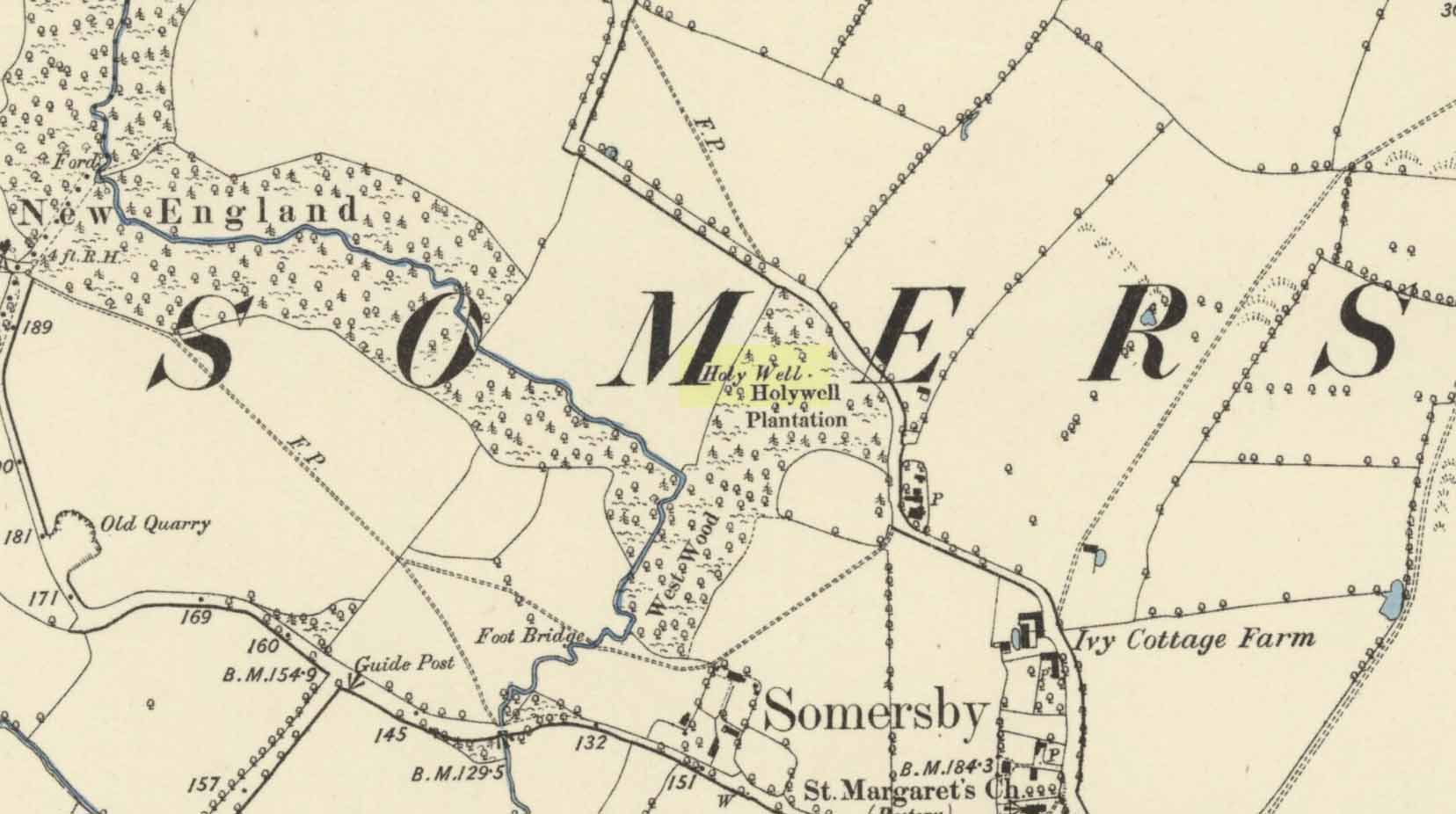
Holy Well on 1887 map

Curiously missing from Thompson’s (1999) Lincolnshire survey, this old watering place can apparently still be found in the appropriately named Holywell Wood, just north of this lovely little hamlet.  Shown on the 1887 OS-map of the area, it’s first literary reference seems to be in George Weir’s (1820) early survey of Horncastle district where he gives it a brief mention, saying:

“In a woody dell in this parish is a spring, gently bursting from the rock, called Holy-well, but the name of the saint to whom it was dedicated is not preserved.”

…Like oh so many others.  But its ‘holiness’ may devive from other more archaic origins, in the spirit of the woods from whence the waters emerge.  Certainly that’s what the poet laureate Alfred Lord Tennyson would have had us believe.  He grew up in Somersby village and this old well was one of his places of inspiration.  When the local writer H.D. Rawnsley (1900) described Tennyson’s affection for this site, he told us that,

“Alfred peopled that Holywell Wood with forms of fairies, and made the whole surrounding circle of the hills, a theatre for enchantment and chivalry.”

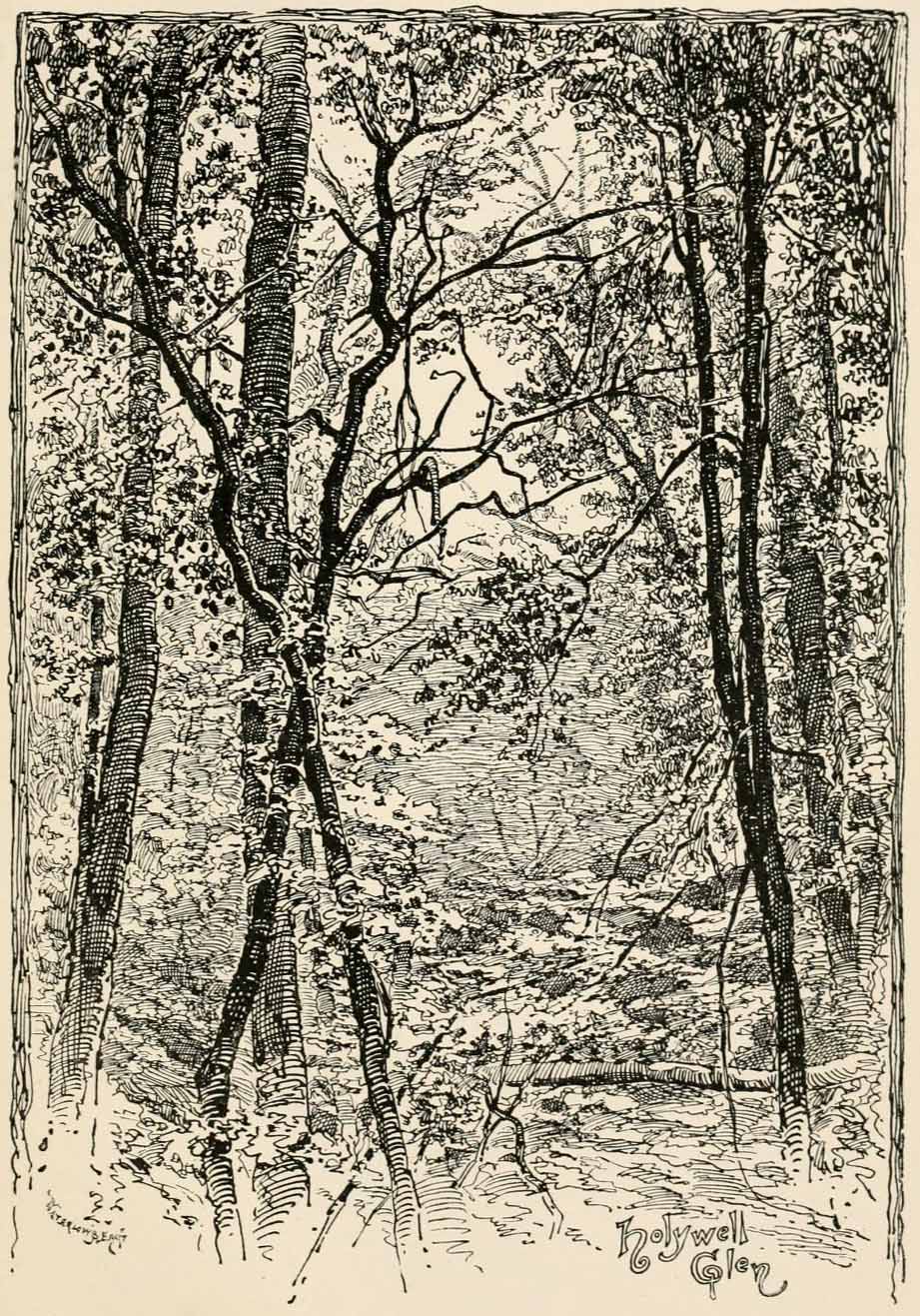
J.C. Walters 1890 sketch

Nature can certainly do that to anyone who wanders Her body with open reverence.

Although the place is now quite overgrown, it wasn’t always this way.  There used to be a well-trodden path with a gateway at the entrance that took you into the woods and up to the well.  Above the gateway there used to be a Latin inscription that read, Intus aquae dulces, vivoque sedilia saxo, Et paulum silvae superest. His utere mecum. (meaning something akin to, “At these sweet waters, by this living seat of stone and small forest remains, Make use of me.”)

When J.C. Walters wrote about it, he told that a “local student” gave him the following particulars:

“A series of steps led down into the well, a post was fixed in front of it, and a cross-bar extended thence to the rock.  On the cross-bar was a ring with a rope attached, so that the bather might safely descend into the well and enjoy the healing virtues of the stream which rushed from the rock.  Geologists say that the wold villages are so closely placed on account of the superior quality of the water which springs up wherever the Spilsby sandstone meets the Kimmeridge clay.  Susan Epton (Mrs. Thompson), Miss Emily Tennyson’s maid, tells me that she can remember the time when visitors came in scores to “take the waters.””

Some of this was later echoed in Rawnsley’s (1900) biographical account of Tennyson.  He talked with a local sexton about the folklore of the area who told him of his memories:

“Halliwell wasn’t growed up then; there was a bath-house with steps down to the watter, and fwoaks in carriages came from far and near to drink it.  Wonderful watter! it was nobbut a bit sen, that our owd nebbur was liggin’ adying and he axed for a cup o’ watter from the Holy Well, and they sent and fetched it, and he took it and went off upon his feet.  Why, i’ my time theer was a school-house down in Halliwell Wood, and a skittle halley close by the well, but all them things is changed now, excep the snowdrops, and they coomes oop reg’lar, a sight on ’em i’ Halliwell.”

References:

  1. Harte, Jeremy, English Holy Wells – volume 2, Heart of Albion Press: Wymeswold 2008.
  2. Howitt, William, Homes and Haunts of the Most Eminent British Poets – volume 2, Richard Bentley: London 1849.
  3. Rawnsley, H.D., Memories of the Tennysons, James MacLehose: Glasgow 1900.
  4. Thompson, Ian, Lincolnshire Springs and Wells, Bluestone: Scunthorpe 1999.
  5. Walter, J. Conway, Records of Woodhall Spa and Neighbourhood, W.K. Morton: Horncastle 1899.
  6. Walters, John Cuming, In Tennyson Land, George Redway: London 1890.
  7. Weir, George, Historical and Descriptive Sketches of the Town and Soke of Horncastle, Sherwood, Neely & Jones 1820.

© Paul BennettThe Northern Antiquarian


Pen Howe (2), Sleights Moor, Sleights, North Yorkshire

Tumulus:  OS Grid Reference – NZ 8566 0369

Archaeology & History

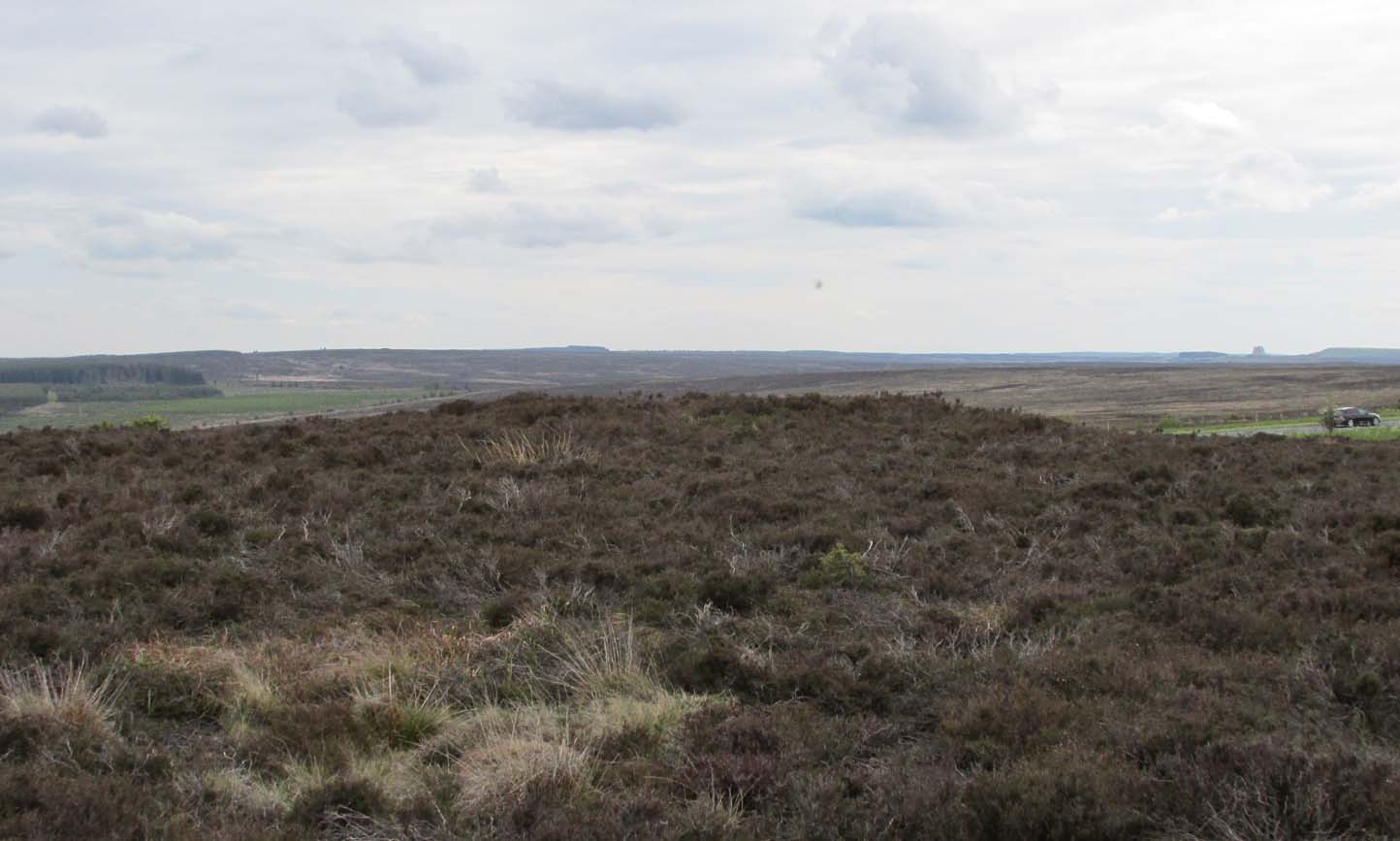
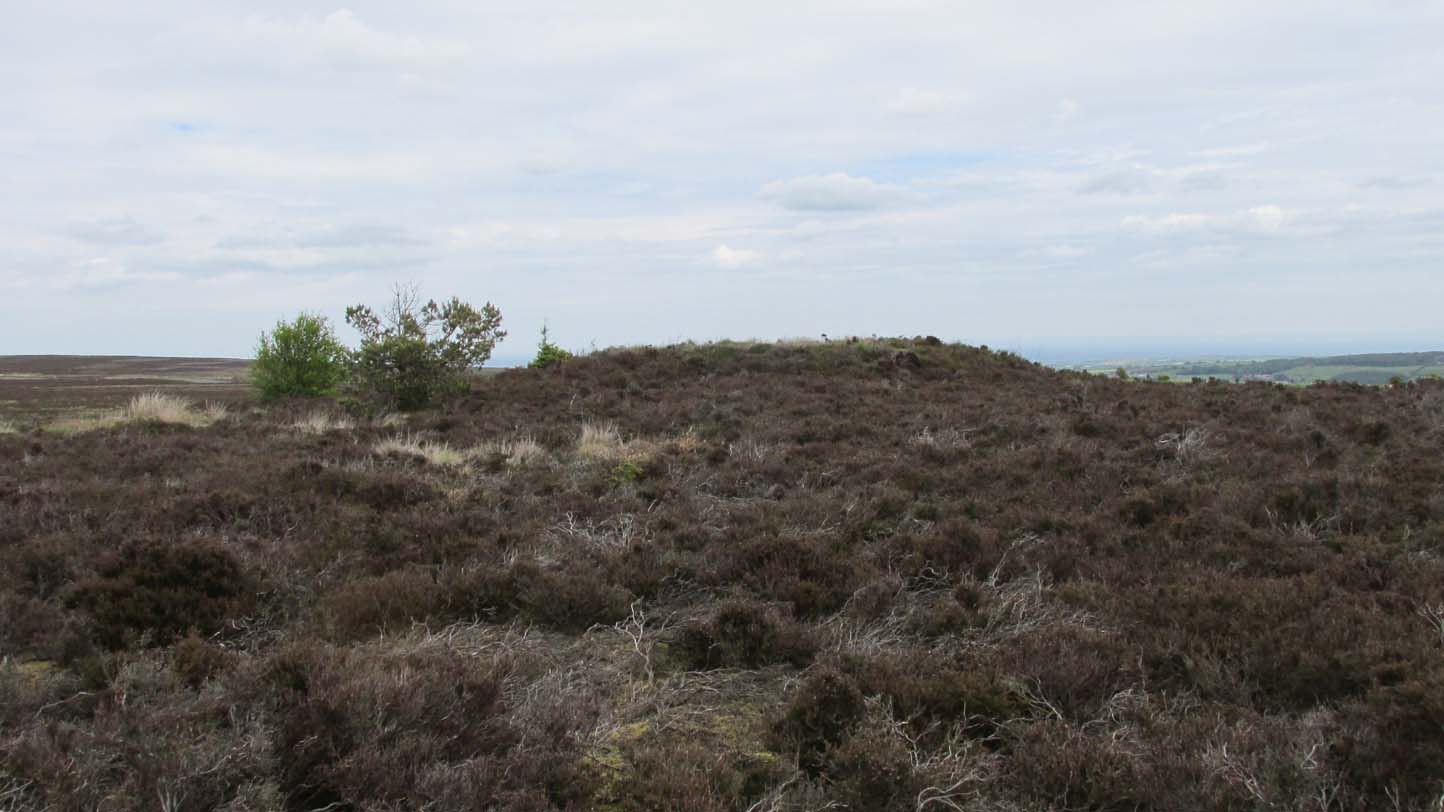
The low rise of Pen Howe-2

Prehistoric companion to the more pronounced Pen Howe (1) Bronze Age cairn just 20 yards to the west, this overgrown tumulus is hardly noticeable when the heather’s deep and is probably only of interest to dedicated antiquarians and geomancers.  Its position in the landscape, whilst not as prominent as its companion and the nearby Breckon Howe, would still have been important to its builders and the relative proximity of the two tombs may imply a continuity of tribal companionship in the Land of the Dead.  But hey! – that’s just a silly idea of mine! 🙂

Rising barely three feet above ground level, this is slightly smaller than Pen Howe (1), being just 13 yards across; and there is no indication that it has ever been dug into.

References:

  1. Elgee, Frank, Early Man in Northeast Yorkshire, Frank Bellows: Gloucester 1930.

Acknowledgements:  Big huge thanks to my Lindsay Mitchell for getting us up to see this old tomb (which is nearly as old as Linzi 🙂).

© Paul BennettThe Northern Antiquarian


Pen Howe (1), Sleights Moor, Sleights, North Yorkshire

Tumulus:  OS Grid Reference – NZ 85638 03722

Getting Here

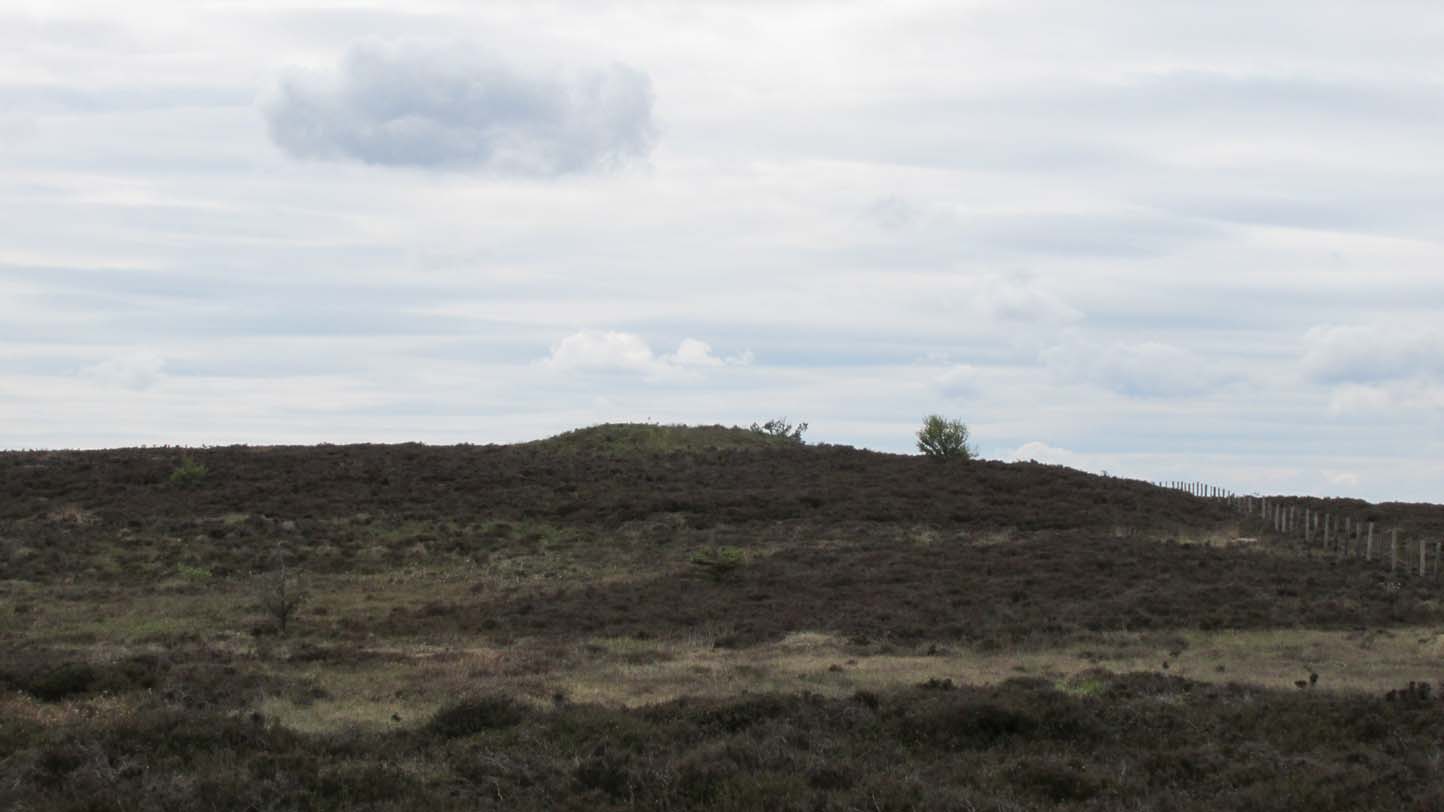
Pen Howe from the north

Along the A169 road between Sleights and Pickering, some two miles south of Sleights turn right as if you’re going to the tombs of Flat Howe and the Bride Stones, but just park up 80 yards along by the cattle grid.  From here, a fence runs southeast and the mound is on the near skyline, just over 100 yards away.  Just walk through the heather to reach it.

Archaeology & History

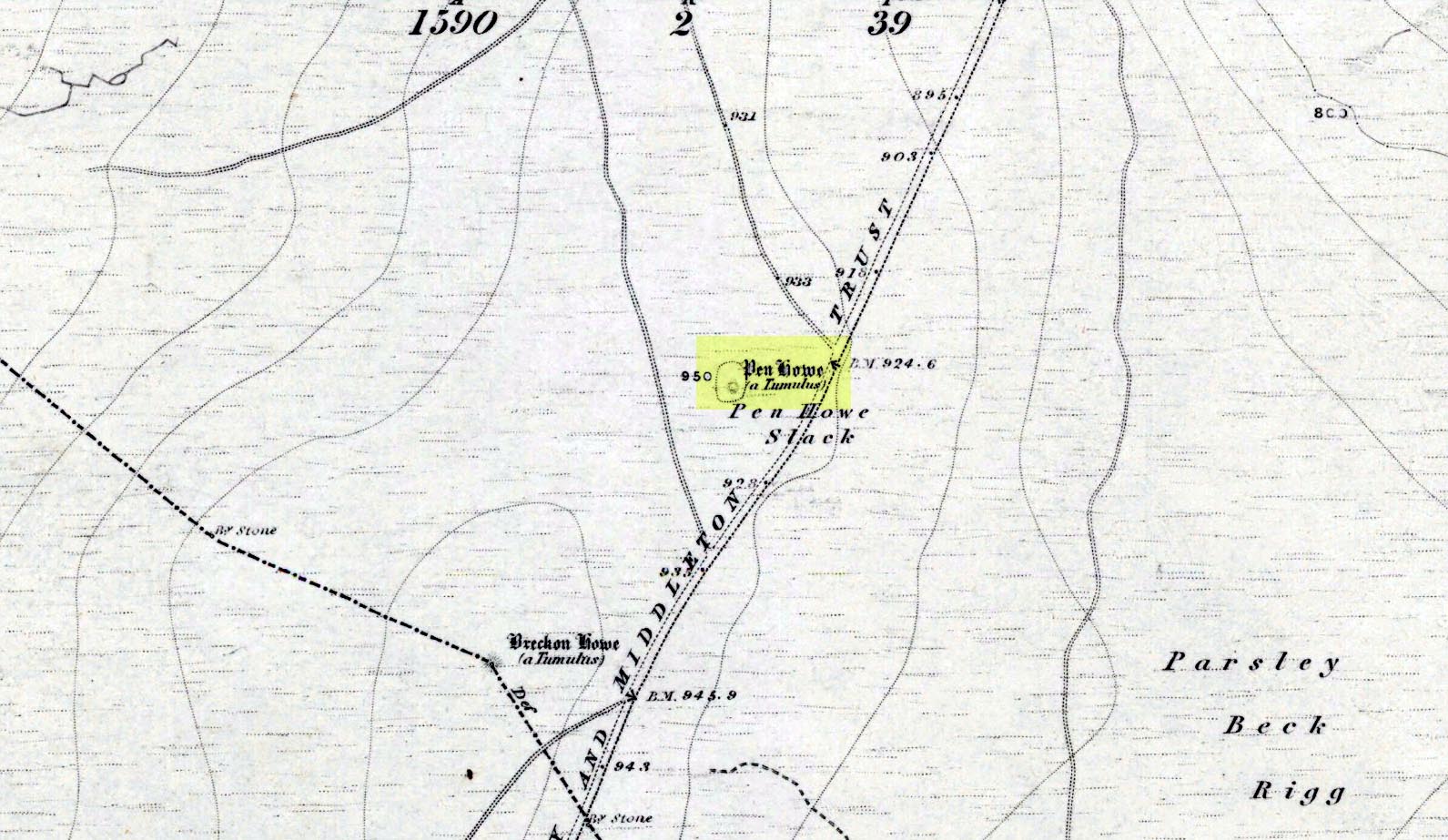
Shown on the first OS map of the area in 1853, this somewhat overgrown prehistoric tomb is one of two in close attendance to each other (see Pen Howe 2); and is some 435 yards (398m) away from the more prominent Breckon Howe tomb to the southwest.  Like others on Sleights Moor, no real archaeological attention has been paid here, with Frank Elgee (1930) only giving it the slightest mention in passing.

Pen Howe on 1853 map
Pen Howe, looking SE

Smaller than its nearby companions of Flat and Breckon Howe, the overgrown cairn raises about four feet above ground level and about 20 yards across.  Probably Bronze Age in origin, it has a slightly concave top that gives the impression that someone at sometime in the not-too-distant past has had a bittova dig here to see if there’s owt inside.  But we have no record of such a thing.

surmounted by a relatively recent boundary stone, sits at the highest point on the moors in these parts.  Despite this (as with others on these moors), very little has been written about the place and it has received only minimal attention in archaeology tomes.  Even the renowned pen of Frank Elgee (1912; 1930) gave it only passing mention.  Perhaps it aint a bad thing to be honest.

References:

  1. Elgee, Frank, Early Man in Northeast Yorkshire, Frank Bellows: Gloucester 1930.

Acknowledgements:  Big huge thanks to my Lindsay Mitchell for getting us up to see this old tomb and its companion.  (which is nearly as old as Linzi 🙂 )

© Paul BennettThe Northern Antiquarian


Holland’s Well, Smalley, Derbyshire

Healing Well:  OS Grid Reference – SK 4077 4436

Also Known as:  

  1. Holly Well

Archaeology & History

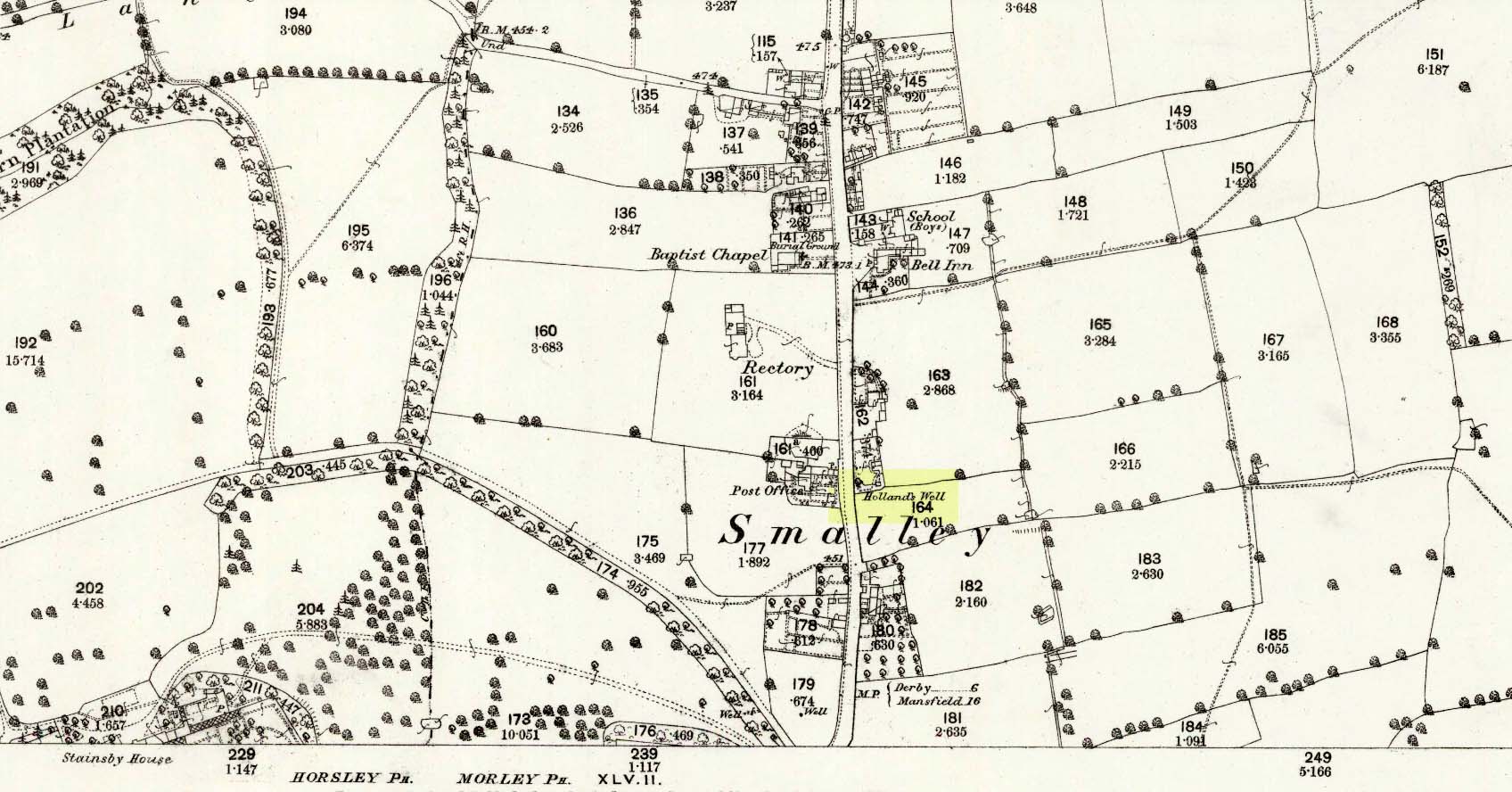
Hollands Well on 1881 map

Once visible near the middle of the village, references to this local water supply seem pretty scant.  According to Kenneth Cameron (1950) it gained its name from a local man called Robert Holland.  This may be the case; but there is a curious entry found in a notice regarding the Land Enclosures of Smalley from November 6, 1784.  In it we read that the land here was at that time owned by one Samuel Kerry (well known in the village as he built The Rose and Crown pub in 1768) who was living “upon the Common” and had “part of a croft” here.  Therein was mentioned a water source named the ‘Holly Well’ instead of the Holland Well.  I can only assume that the two are the same, as the proximity of them are very close indeed.  The account told that,

“a disused well in the triangular croft at the back of the sixth milestone in the village marks the site of (Samuel Kerry’s) original home, and he is said to have dug the “Holly Well” close by for brewing purposes, which has long supplied the vicinity with good water.”

The name ‘Holly’ may infer that a holly tree grew by the side of the well, and that the title ‘Holland’ was a corruption later grafted onto the site.  Are there any local historians out there who know more…?

References:

  1. Cameron, Kenneth, The Place-Names of Derbyshire – volume 2, Cambridge University Press 1950.
  2. Kerry, Charles, Smalley in the County of Derby, Bemrose: London 1905.

© Paul BennettThe Northern Antiquarian


Breckon Howe, Sleights Moor, Sleights, North Yorkshire

Tumulus:  OS Grid Reference – NZ 85374 03406

Also Known as:

  1. Brakken Howe
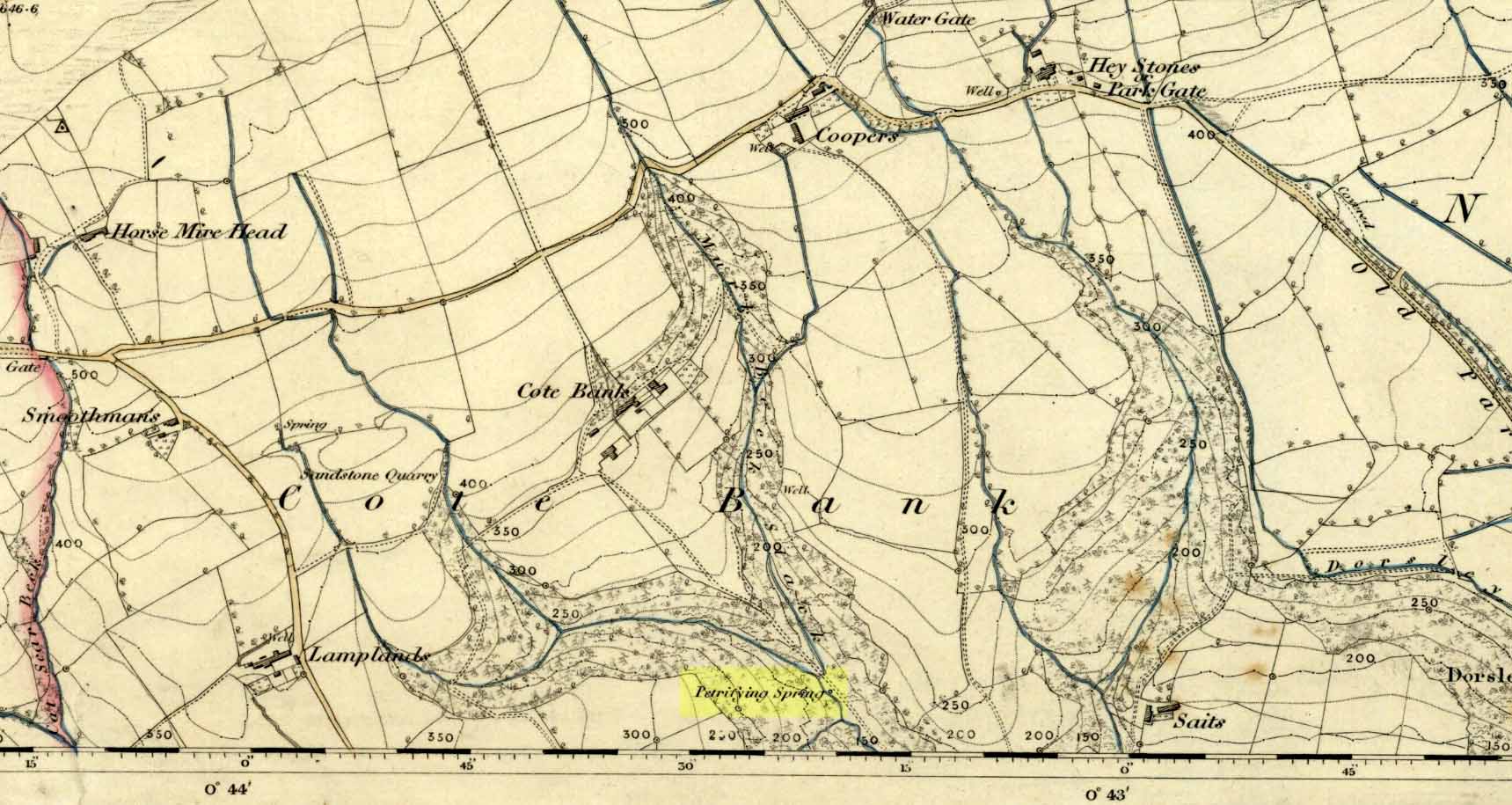
Breckon Howe on 1853 map

Getting Here

Along the A169 road between Sleights and Pickering, some two miles south of Sleights at the highest point on the moors just above the west side of the road, you’ll see a large mound with what looks like a standing stone on top of it.  A minor road turns off the A169 at this point, heading southeast, and the large mound is 150 yards from the roadside. You can’t really miss it!

Archaeology & History

Shown on the first OS map of the area in 1853, this conspicuous prehistoric tomb surmounted by a relatively recent boundary stone, sits at the highest point on the moors in these parts.  Despite this (as with others on these moors), very little has been written about the place and it has received only minimal attention in archaeology tomes.  Even the renowned pen of Frank Elgee (1912; 1930) gave it only passing mention.  Perhaps it aint a bad thing to be honest.

Breckon Howe, from the south

As well as being conspicuous, it’s large.  Rising some six feet above the natural ground level, it measures 26 yards across its east-west axis, and 29 yards north-south, with a rough circumference of 88 yards.  The boundary stone that surmounts its crown sits in a hollow that looks like it was opened up a century or two ago by antiquarians (much like ourselves).  But its position of the tomb in the landscape that is most striking.  The view from here is considerable, having a clear 360º view for many miles around.  Other prehistoric tombs can be seen from here, but more importantly this tomb can be seen on the skyline from many others.  This was probably a deliberate feature intended by its builders–and it’s not uncommon, as many of our upland regions are crowned with ancient tombs like Breckon Howe.  In all likelihood this would have been the resting place of some important ancestral figure: a tribal elder or a shaman, whose spirit after death could view and travel across the landscape they inhabited in life.

Although the tomb presently sits amidst an endless sea of heather (Calluna vulgaris) typical of moorland across our northern lands, the name of the site ‘breckon’, according to George Young (1817) derives from the dialect word meaning ferns or bracken.  This is echoed in Francis Kildale’s (1855) local dialect study and subsequently in Joseph Wright’s (1898) unequalled magnum opus.

Folklore

In the early 19th century, one George Calvert who lived in the area, collected as much folklore as he could, as it was dying off with the coming of the Church.  One such piece told that there was once a hob who lived by this old tomb.  A hob is generally known as a supernatural creature, but in this area it can also be a medicine man.  Some hobs were good, others were malicious.  We know not what type of hob lived lived here, but Calvert simply told us there used to be “T’ Hob of Brackken Howe”.  Nowt more!  It would be good to find the story behind this old character, if it hasn’t been lost entirely…

References:

  1. Elgee, Frank, Early Man in Northeast Yorkshire, Frank Bellows: Gloucester 1930.
  2. Elgee, Frank, The Moorlands of North-Eastern Yorkshire, A. Brown: London 1912.
  3. Kildale, Francis, A Glossary of Yorkshire Words and Phrases Collected in Whitby and the Nieghbourhood, J.R. Smith: London 1855.
  4. Home, Gordon, The Evolution of an English Town, J.M. Dent: London 1905.
  5. Wright, Joseph, English Dialect Dictionary – volume 1, .Henry Frowde: London 1898.
  6. Young, George, A History of Whitby and Streoneshalh Abbey – volume 2, Clarke & Medd: Whitby 1817.

Acknowledgements:  A huge thanks to Lindsay Mitchell for getting us up to see this great tomb and its companion.

© Paul BennettThe Northern Antiquarian


Ellen’s Well, Blair Drummond, Stirlingshire

Healing Well:  OS Grid Reference – NN 7196 0080

Getting Here

Ellen’s Well on 1856 map

This takes some finding!  From the village of Doune take the A84 road towards Stirling and, just over the bridge barely 100 yards along, on your left, walk down the track past the old lodge house.  350 yards along, up the slope on your right where young trees and an excess of boscage prevails, walk up through it until, about 10 yards below an overgrown path at the top, beneath a raised section of old stonework, an old pipe protrudes from the undergrowth.  The small spring of water that emerges 10 yards beneath this, amidst the brambles and reeds, is what you’re looking for.

Archaeology & History

Wells named ‘Ellen’ usually have a long and sacred history behind them, but this one seems unusually silent.   Apart from being shown on the 1866 OS-map—simply as a ‘Well’—it is only mentioned briefly in Mr Mackay’s (1953) survey of Doune, being not far from the Clans Well, and in his day it was “still in use.”  But not anymore!  The water is barely running, but the trickle that still exists is nice and clear and it tastes good.  It’s seen much better days though….

‘Ellen’s Wells’ tend to have one of three origins, being either 1) dedicated to St Helen, whose festival date is August 18; (2) named after or dedicated to the Elder tree (Sambucus niger); or, (3) named after a local person of this name.  At some wells it may be two of these elements with their relative mythologies complimenting each other, overlapping between heathen peasant lore and early christian folklore. This has been the case at a number of St Helen’s Wells I’ve surveyed in Yorkshire and Lancashire.  At this site however, there are no remaining Elder trees, meaning that its name relates to one of the two other options; but without any extant historical references to St. Helen hereby, we must conclude that at some point in the dim and distant past, a local lady called Ellen found her name immortalized in this all-but-forgotten sweet spring.

References:

  1. Mackay, Moray S., Doune Historical Notes, privately printed: Doune 1953.

Acknowledgements:  The map accompanying this site profile is Reproduced with the kind permission of the National Library of Scotland

© Paul BennettThe Northern Antiquarian


Brae of Cultullich (6), Aberfeldy, Perthshire

Cup-and-Ring Stone:  OS Grid Reference – NN 8818 4906

Getting Here

X supposedly marks the spot

Out of Aberfeldy, take the A826 road as if you’re going up Glen Cochill.  Not far up, just where the housing of Aberfeldy itself ends and the green fields open up either side of you, keep on the road for a half-mile where you meet a small copse of trees on your left, with a dirt-track that runs down the slope.  Go along the track for 0.8 miles (1.3km), past the Ursa Major Stone and where the track splits, go left past the Quartz Stone and follow the track through the farmyard.  It’s somewhere there – or is supposed to be!

Archaeology & History

On our visit here, we couldn’t locate the cup-and-ring stone that’s described in Sonia Yellowlee’s (2004) regional rock art survey.  She described it, as archaeologists always do, in the briefest manner, telling us simply:

“Leaning against a pile of rubble in the farmyard there is a split boulder bearing eighteen cupmarks, one of which is ringed.”

It may have been destroyed, as we were told by a couple of locals that there used to be “a real miserable sod” living there.  When we visited the place and tried to ask the present farm owner, sadly he wasn’t to be found.  If any rock art explorer manages to locate this seemingly lost cup-and-ring, please let us know – and mebbe send us some photos so that we can add them to this site profile. 😉

References:

  1. Yellowlees, Sonia, Cupmarked Stones in Strathtay, RCHAMS 2004.

Acknowledgements:  Big thanks to the crew – this time being Neens Harris, Paul Hornby & Frank Mercer.  And the stunning resource of Scotland’s 1st edition OS-maps is Reproduced with the kind permission of the National Library of Scotland

© Paul BennettThe Northern Antiquarian


Quartz Stone, Brae of Cultullich, Aberfeldy, Perthshire

Cup-Marked Stone:  OS Grid Reference – NN 88104 49001

Also Known as:

  1. Brae of Cultullich (4)

Getting Here

The cupmarked Quartz Stone

Out of Aberfeldy, take the A826 road as if you’re going up Glen Cochill.  Not far up, just where the housing of Aberfeldy itself ends and the green fields open up either side of you, keep on the road for a half-mile where you meet a small copse of trees on your left, with a dirt-track that runs down the slope.  Go down here and follow the slightly meandering track for 0.8 miles (1.3km), a short distance past the Ursa Major Stone where the track splits.  Take the track to the left and there, less than 100 yards on you’ll hit a large boulder on your left.  That’s it!

Archaeology & History

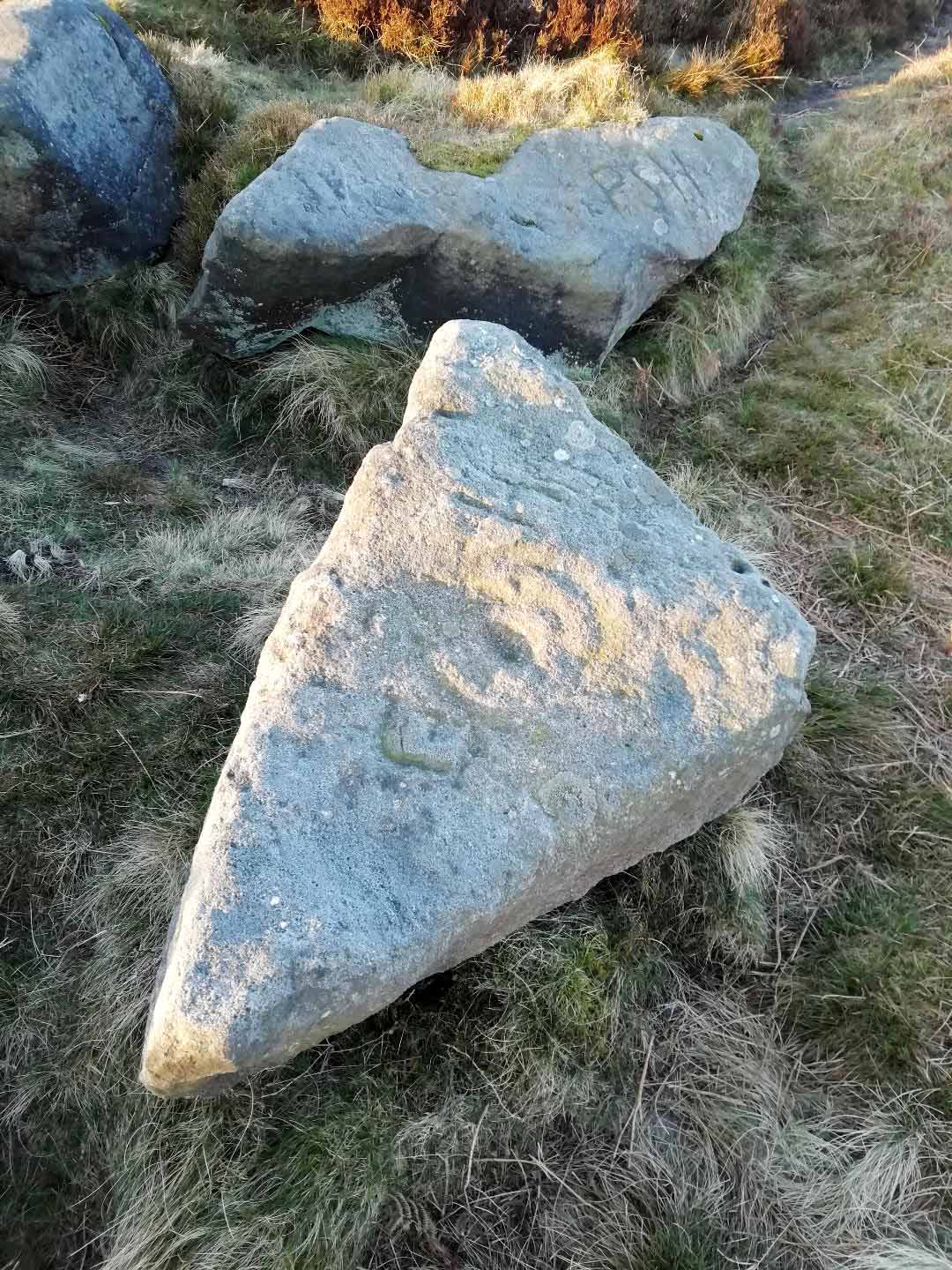
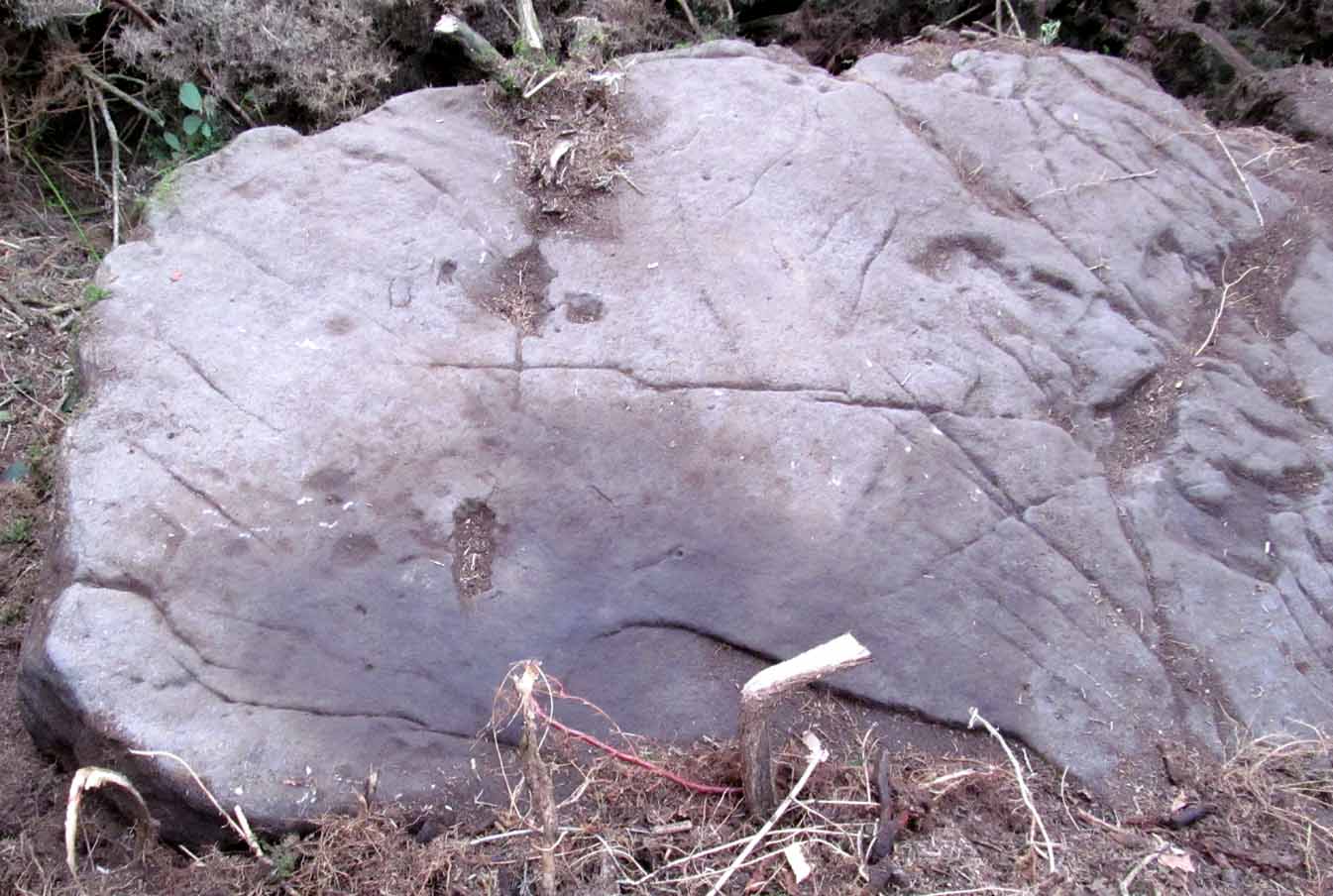
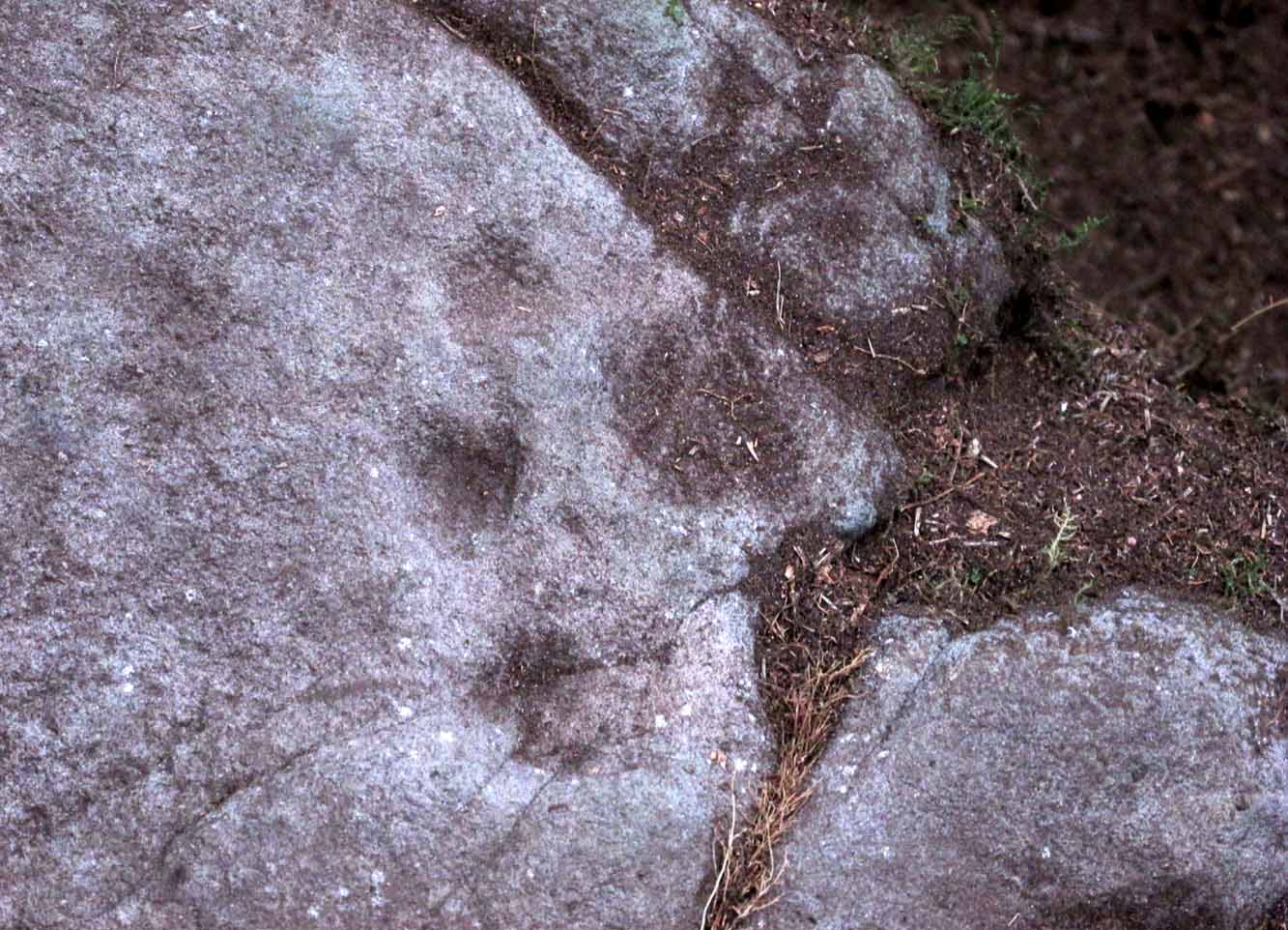
Not previously recorded, this simple cup-marked stone will probably only be of interest to petroglyph aficionados, or those folk who are into  ‘energies’ at sites.  This latter aspect is due entirely to the carving being etched onto a huge rock, much of which is composed of quartz—which isn’t too unusual in this part of the world.  But that aside…

Looking down at the cups
The cupmarks highlighted

It is one in a group of carvings within a few hundred yards of each other, with its nearest neighbour 20 yards to the north.  That one’s covered in cups—but on this large Quartz Stone, only two of them exist, on the top near the centre.  Just a couple of inches across and half-an-inch deep, they’re pretty clear once you see them.  The raised piece of ground behind the stone is artificial and has variously been described by antiquarians and archaeologist alike, as either a prehistoric dun, or a stone circle.  Whatever it may be, some of it is certainly man-made.  Check it out – and mebbe ask the friendly fat fella who lives nearby and what he thinks.

© Paul BennettThe Northern Antiquarian


Ursa Major Stone, Brae of Cultullich, Aberfeldy, Perthshire

Cup-Marked Stone:  OS Grid Reference – NN 87958 49022

Also Known as:

  1. Brae of Cultullich (3)

Getting Here

The stone from the trackside

Out of Aberfeldy, take the A826 road as if you’re going up Glen Cochill.  Not far up, just where the housing of Aberfeldy itself ends and the green fields open up either side of you, keep on the road for a half-mile where you meet a small copse of trees on your left, with a dirt-track that runs down the slope.  Go down the track, bending to the right, then the left and then on for a quarter of a mile until the lines of trees appear either side of you.  Barely 200 yards along, the track swerves slowly to your right, and the field above you slopes uphill.  Keep your eyes peeled at the fencing on your right and you’ll see a stone sloping towards you right by the fence with faint cup-marks on it.  You’ll find it!

Archaeology & History

A truly fascinating cup-marked stone recently uncovered by Paul Hornby on another one of our TNA meanderings. Fascinating because of the curious arrangement of the cups on the stone.  Often, cup-marked stones have little to interest the causal visitor – but this one’s different.  As can be seen quite clearly, the cups are arranged in the shape of the constellation of the Great Bear, or Ursa Major – albeit with an extra ‘star’ in this design.  But it’s damn close!  In all likelihood (he says with his sceptical head on 😉 ), the design is fortuitous when it comes to the Ursa Major.  I know from many years experience how easy it is to see meaningful shapes and designs in the almost entirely abstract British petroglyphs, but the design is very close to the constellation we all got to know when we were kids.

Looking along the stone
Gazing down at Ursa Major

The stone itself slopes upwards at an angle of about 60º, before starting to level out as it rises.  All of the cup-marks have been pecked onto this sloping surface (the vast majority of carvings are found on top of stones).  Altogether, at least twelve faint and shallow cups were exposed when we looked at it—measuring the usual inch to inch-and-half across—but it is likely that more of them are hidden beneath the turf at the top of the stone.  We could discern no rings or other features in the design.

This is just one carving amidst a good cluster of petroglyphs within a few hundred yards of each other (the Quartz Stone being one of the nearest) that are well worth checking out if you like your rock art.  It may also be of interest to astronomy students, or those exploring archaeo-astronomy.

References:

  1. Yellowlees, Sonia, Cupmarked Stones in Strathtay, RCHAMS 2004.

© Paul BennettThe Northern Antiquarian


Wood Well, Shipley Glen, Gilstead, West Yorkshire

Healing Well:  OS Grid Reference – SE 12797 39277

Getting Here

Wood Well on 1852 map

Best reached by going up Shipley Glen, to the Brackenhall Circle enclosure; keep going for a couple of hundred yards and then drop down into the trees, taking the directions directly to the Cloven Hoof Well.  Just past the well, a small footpath leads you downhill towards the large stream at the bottom, where there’s a rocky crossing (an old ford).  Go over here and, barely 50 yards upstream to your right, a large singular moss-covered boulder is set back, just a few yards above the stream with a small pool in front of it.  That’s it!

Archaeology & History

The ‘directions’ to find this might seem a little confusing to locals at first.  This is because the whereabouts of the Wood Well is on the eastern boundary edge of Gilstead – which is down at the bottom of Shipley Glen.  The steep muddy hill above it is almost always slippy and wet through, so it’s easiest to approach from the Baildon side.

The shallow muddy waters in a hot summer

The site is shown on the 1852 map of the area, but I can find no written material telling of its qualities.  If it ever had any medicinal virtues, they have long since been forgotten.  Whilst the water here is fresh and drinkable, in times of drought and low rainfall the water subsides and leaves only a muddy pool – just as it was when I last visited, making it quite undrinkable.  But to me, the main aspect of this site is its natural spirit, its locale, as it’s surrounded by unerring hues of rich greens, cast out by the landscape of mosses prevalent in a region almost bereft of such voices.  If you like y’ wells – check it out!

© Paul Bennett, The Northern Antiquarian