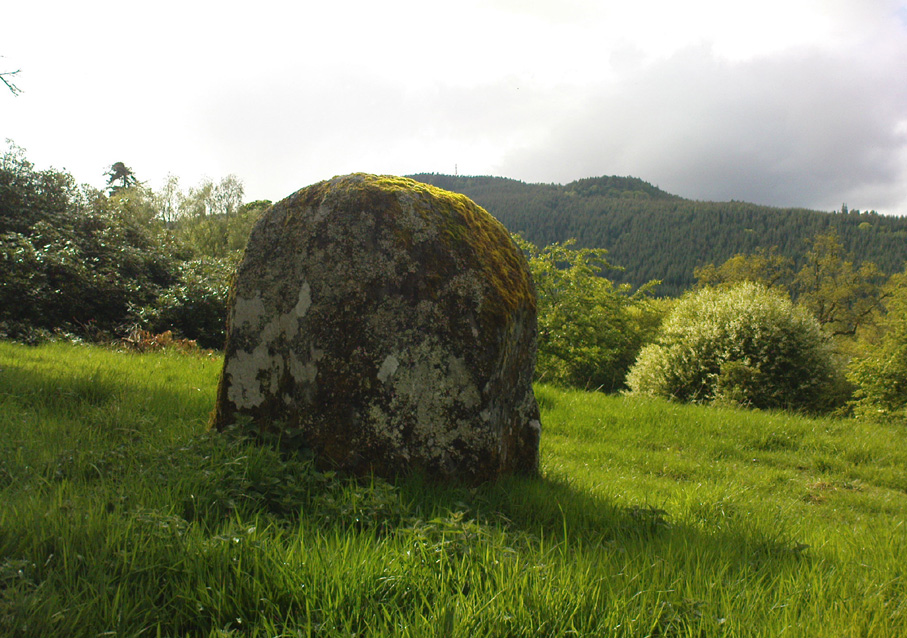
Rudstoop Monolith, Cragg Vale, West Yorkshire

Standing Stone/s:  OS Grid Reference – SD 99269 23652

Getting Here

Site on 1st edition OS-map

From Mytholmroyd, go up the Cragg Vale Road, then 2 miles up take the road steep on your right down and round St. John’s Church, then keep going along the road up to Withens.  About a mile up, a road turns sharply right.  Go up here for a few hundred yards, past the trees, and 100 yards on the road splits in a ‘V’.  Stop here.  Go into the field on your left which slopes downhill and less than 100 yards down you’ll see the large long stone laid in the grass.  That’s it!

Archaeology & History

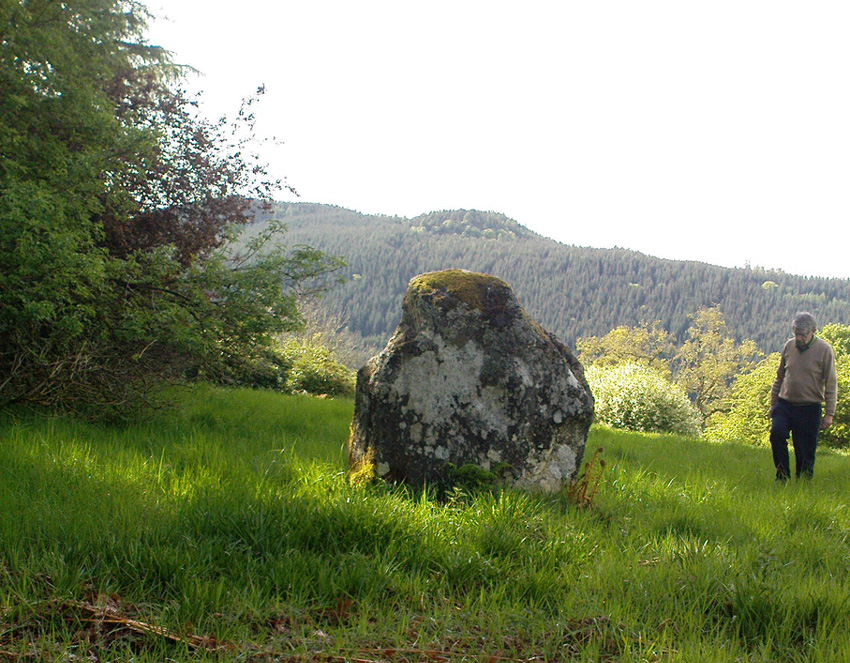
The fallen stone, with Teddy! (image courtesy ‘QDanT’)

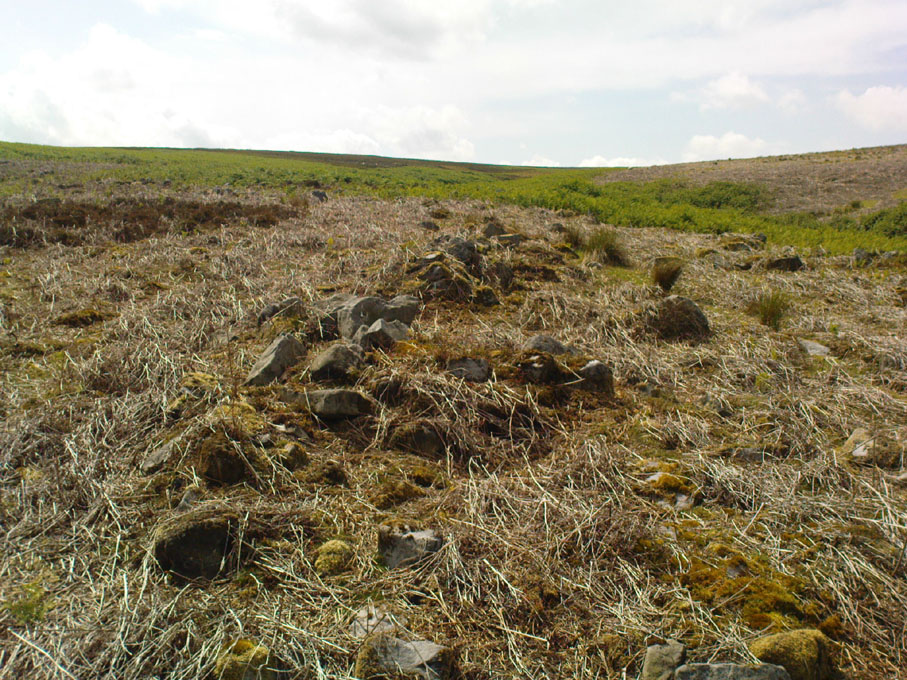
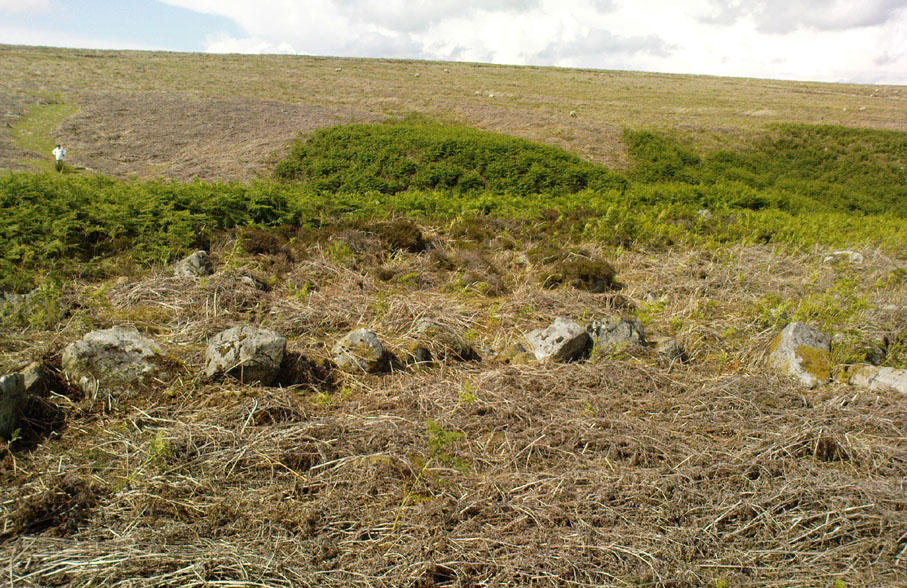
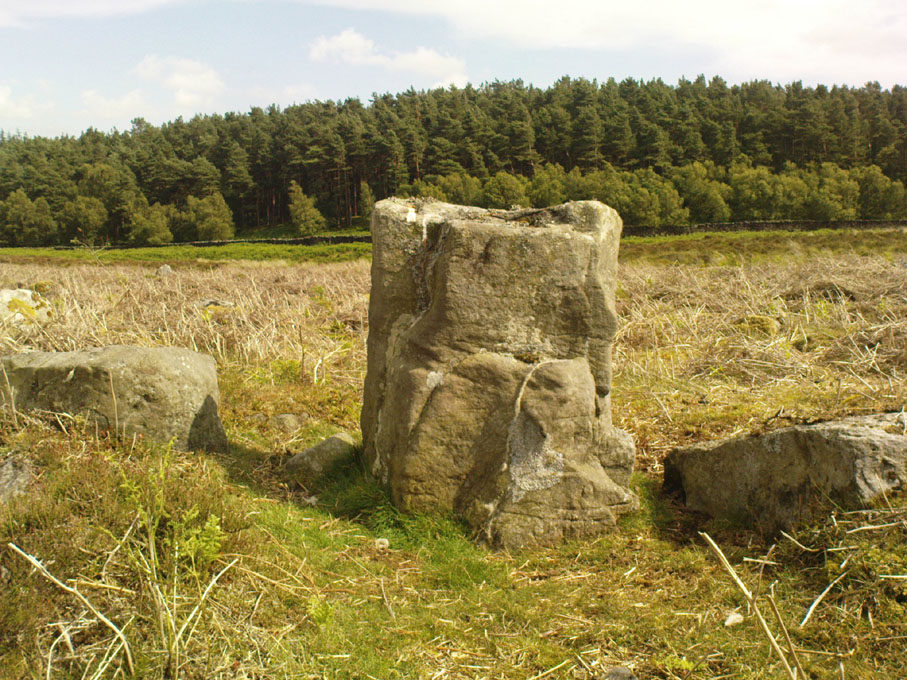
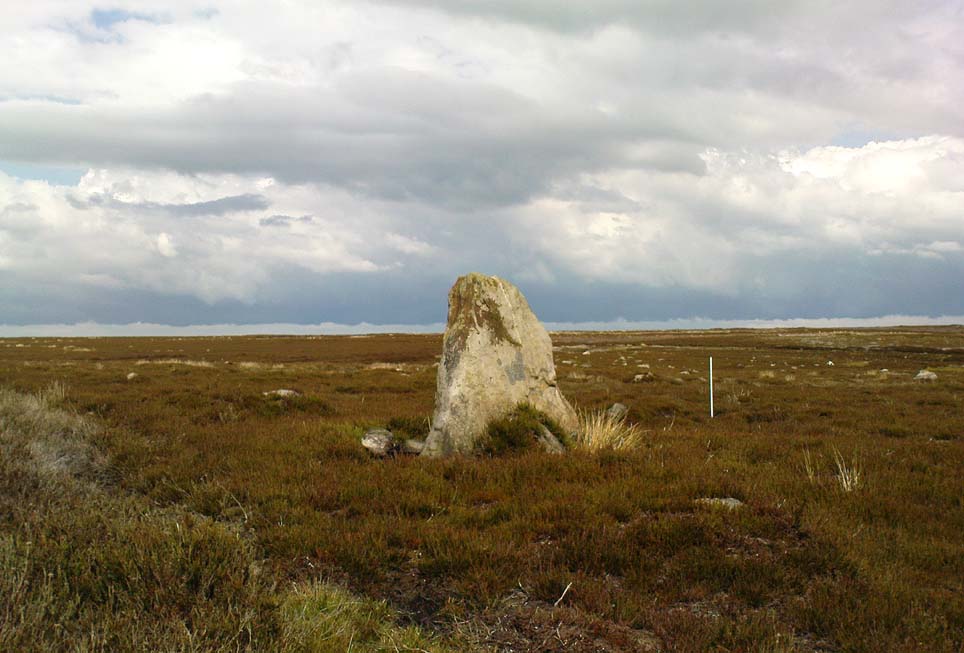
Included in the Addenda of The Old Stones of Elmet (p.222), here is a recumbent monolith more than 8 feet long and 6 feet across which really needs to be resurrected as it would be an impressive sight! Found halfway up Withens Clough, a local land-owner told me it was one in a row of several such stones, though no trace of the others can be found. Found in the appropriately called Standing Stone Fields, it was last shown on the 1850 OS-map, as the attached illustration shows and is positioned just above the “S” of the smaller highlighted “standing stone”, just where the little blob is! The small valley to its immediate west is called Rudstoop, from which I give the stone its name.

A description of the site is given in F.A. Leyland’s scarce commentary on the History of Halifax (c.1867), where he wrote:

“Standing Stone Fields: Not far distant from Hill Top, in this township (Erringden), there is a rough piece of ground known by this name.  It is situated on the slope of the same hill as the remain last described and commands a view of the northern side of Sowerby, with the outlines and rocks of Langfield and the Withens. The locality was anciently the site of a number of upright single stones: most of these have been broken up and used in the construction of the adjoining fences. But one, the last of the series, which the quarrying operations on the spot respected during the whole time they were carried on, was undermined and overthrown a few years ago, by a number of mischievous boys. The rock is a slab of millstone grit, measuring upwards of 9 feet in length, 7 feet 8 inches in width, at the base, and 4 feet 9 inches at the top: at the latter point it is 9 inches thick, and is 1 foot 6 thick at the base. The remain has, originally, been pyramidal in form, but the apex has been either broken off by violence or reduced to its present dimensions by decay.”

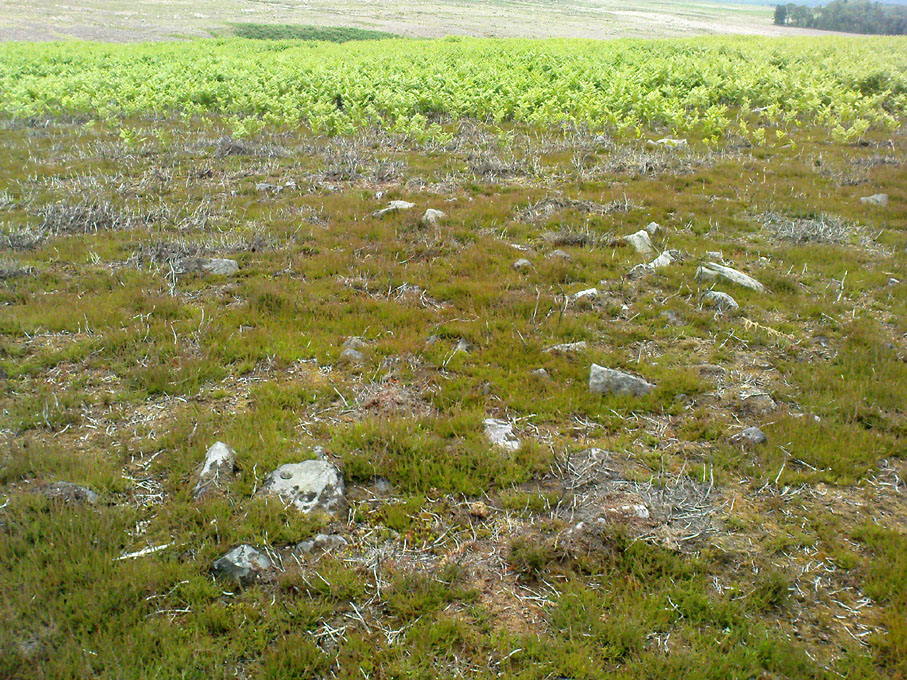
An impression of the land here indicates the other, lost monoliths, were in a row which headed east from here, towards the cup-and ring-marked ‘Upper Lumb Stone’.  There is also the possibility that these monoliths were aligned with the enigmatic Two Lads cairns less than a mile SW of here.

Well worth checking out!

References:

  1. Bennett, Paul, The Old Stones of Elmet, Capall Bann: Milveton 2001.
  2. Leyland, F.A., The History and Antiquities of the Parish of Halifax, by the Reverend John Watson, M.A., R.Leyland: Halifax n.d. (c.1867)

Links:

  1. More images of the fallen monolith

© Paul Bennett, The Northern Antiquarian

Standing Stone Hill, Heptonstall, West Yorkshire

Standing Stone:  OS Grid Reference – SD 95355 30184

Getting Here

Standing Stone Hill monolith

From Hebden Bridge, go up the Heptonstall road, going round the village and onto and through Slack, keeping straight on the road until it goes uphill for a short distance, then levels out; then watch out for the small right-turn and the single-track road heading to a dead-end.  Go right to the end, the very end, and go through the gate and walk up the track onto the moor.  As you reach the ridge and the moorlands north open-up before you, note the small ‘standing stone’ on your right, about 10 yards off-path.  Go up past it, following the path up the small hill and keep going till you hit the triangulation pillar.  From here, keep walking on the same path ESE for another 200 yards.  Y’ can’t miss it!

Archaeology & History

The name of the place rather gives the game away a bit, yeah…?  When I first moved to nearby Hebden Bridge in the 1990s, I noted the conspicuous place-name ‘Standing Stone Hill’ on the maps — so when I met local earth-mystery enthusiast John Billingsley and asked him about any remains up here, he said, with conviction, “there’s nowt up there!” (or words to that effect)

“Are y’ sure?” I asked. To which he repeated his dictum. But I wasn’t convinced of his words and, like any decent chap with energy for old stones and such things, wouldn’t take ‘no’ for an answer and went to check for myself – and wasn’t too surprised when I found this lovely looking standing stone — and a fine specimen of a monolith it is indeed!

Standing stone, looking south
Standing Stone, looking east

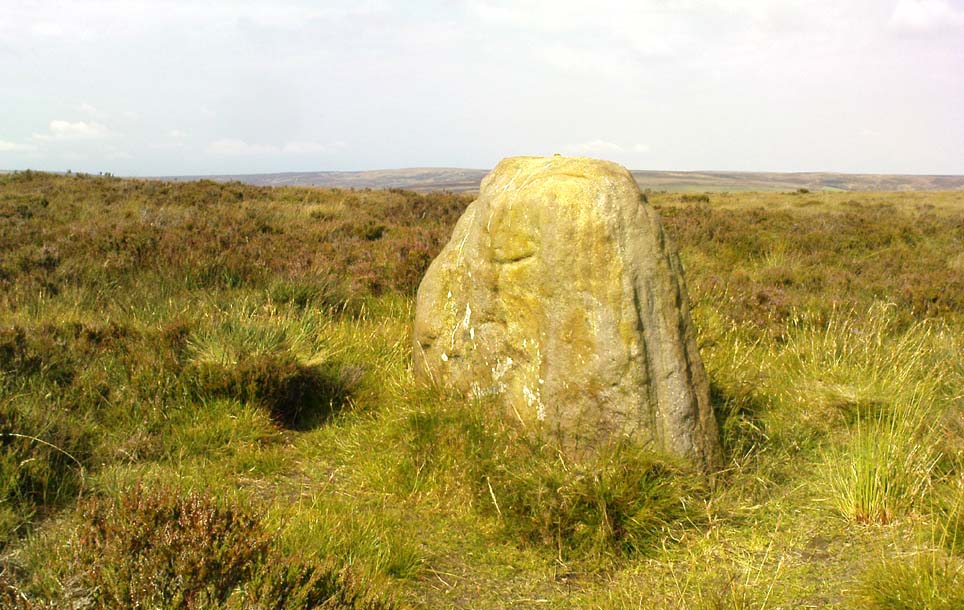
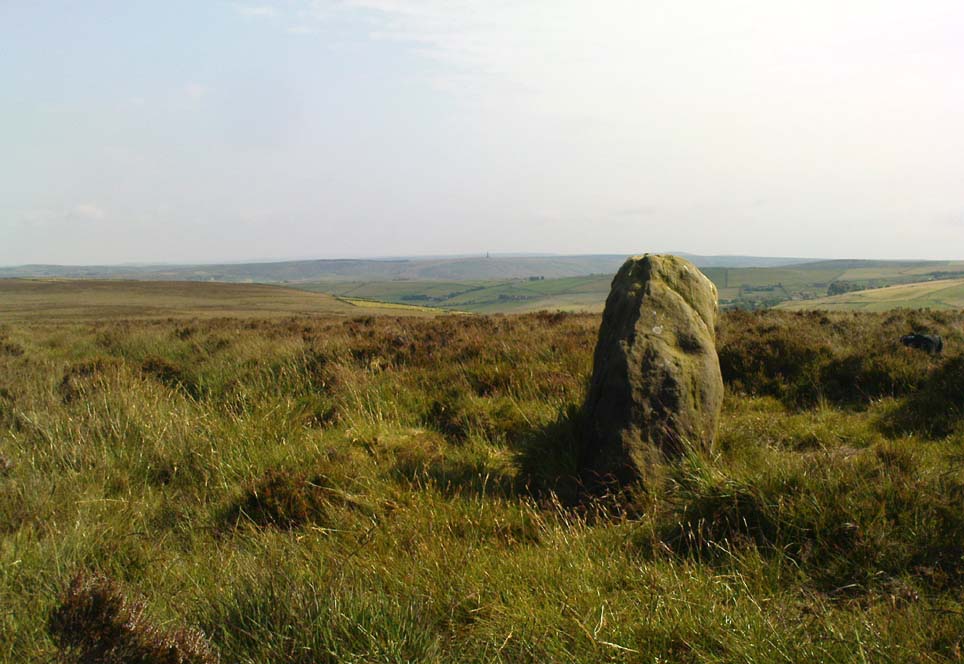
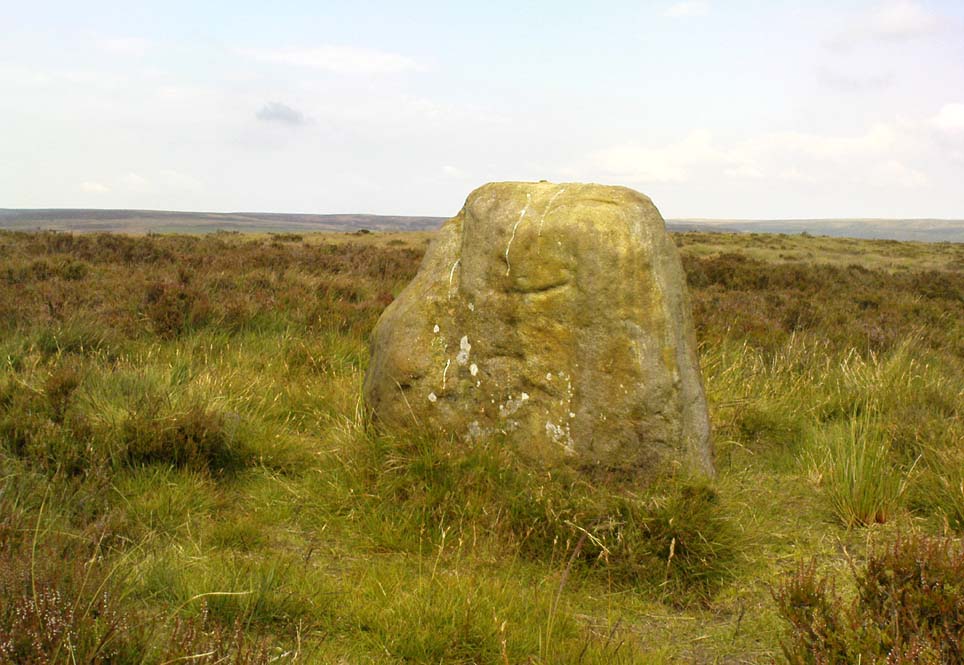
Although not a tall specimen by any means, this rounded and weather-worn upright has fine character and age to it.  Standing more than 3 feet in height and nearly as wide, the stone has a faded but distinct artistic carving of the letter ‘T’ on its western face (which you can make out on the photo, hopefully).  It was thought this may have been an old boundary marking, but the stone aint on any boundary line so possibly relates to some local family who marked it with that deluded notion of ‘ownership’ of this part of the desolate moors.

It’s a beautiful spot up here, out on its own.  I’ve sat here many times, both alone and with good heathen friends, gazing across the endless silence on days coloured with snows, mists, bright sunshine and heavy rains.  It has that feeling of solitude, of being forgotten, of being truly untouched.

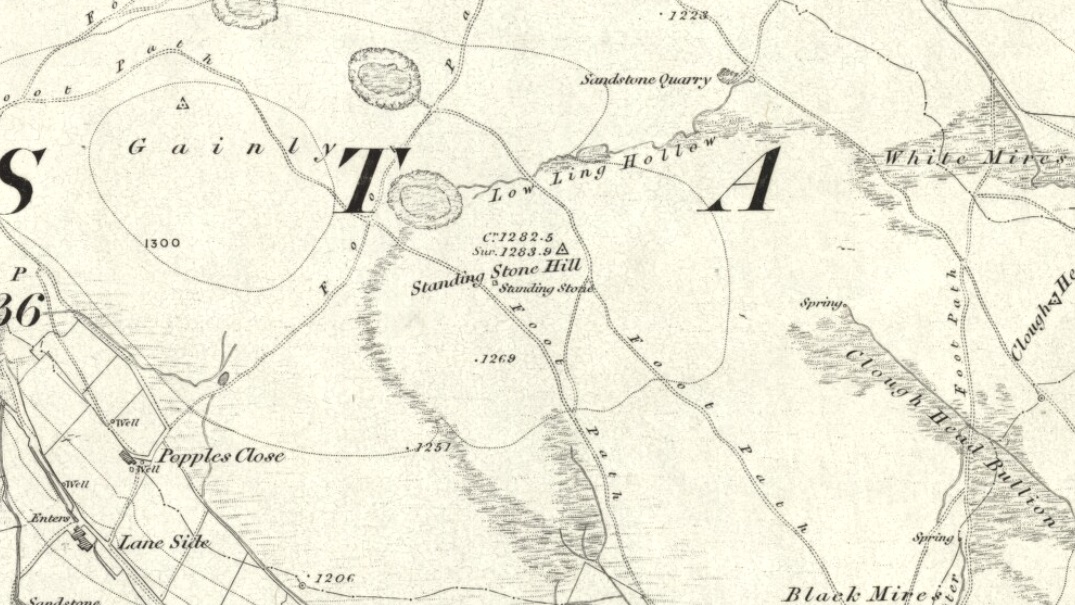
Standing Stone Hill on 1851 map

There are a couple of other possible standing stones on this section of moorland.  One in particular appears to have been taller in bygone times and is marked on the 1851 OS-map of the region about 100 yards southwest of the triangulation pillar (you’ll notice it on your right, off-path, as you’re walking towards the pillar—shown at the position on the map here, right).  Further west is the tall medieval Reaps Cross, where corpses were rested in their journey over the moors.

References:

  1. Bennett, Paul, The Old Stones of Elmet, Capall Bann: Milverton 2001.

© Paul Bennett, The Northern Antiquarian

Gwytherin Churchyard, Denbighshire

Stone Row: OS Grid Reference – SH 8767 6147

Also known as:

  1. Gwytherin Church Standing Stones
  2. The Four Stones

Getting Here

From the Denbigh road (A543 and A544) turn off at Llansannan for Gwytherin on the B5384 for 6 miles or so. At the village of Gwytherin St Winifred’s church stands roughly in the middle of the place at a junction of four roads. The church stands upon a small round hill and within the confines of the churchyard (north side) are four small standing stones – you can’t really miss them!

Archaeology & History

At the northern side of the churchyard near the wall there’s an alignment of four small standing stones probably dating from the Bronze Age.  The stones stand roughly 3 metres or 6 feet apart and are about 1 metre or 3 feet in height.  The westernmost stone has a Latin inscription carved onto it which is ‘VINNEMAGLI FILI SENEMAGLI’, or, ‘The Stone of Vinnemaglus, son of Senemaglus’, which is generally thought to date from the Romano-British period in the 5th-6th century AD and to be a grave marker.  Most probably the inscription was carved onto the prehistoric stone during the early Christian period — the stones themselves being from pre-Christian times.

The general thinking is that these stones belonged to a Bronze Age settlement that stood here long before any church was founded.  Perhaps there were other stones here forming a linear alignment that must have meant something to the ancient folks who lived here.  There has also been speculation as to whether the inscribed standing stone could actually mark the grave of St Winifred herself.

The churchyard is circular, indicating that it is a pagan sacred site.  Celtic churches being built on sites like this to Christianize them, but not entirely forget the meaning to the peoples of “the old religion,” as it’s called.  Also in the churchyard stand three ancient yew trees — yet another sign that the site is a holy one.

The first church in Gwytherin was founded by St Eleri (Elerius), a Welsh prince, in the mid-7th century.  He may be identical with St Hilary, a saint commemorated at a village of that name near Cowbridge, South Glamorgan.  Other than that, Eleri and his mother, Theonia, founded a double monastery here: one for men and the other for women, to which a young St Winifred (of Holywell) came to and was elected second abbess after Theonia.  St Eleri was probably a disciple of St Beuno, uncle to St Winifred, and also her cousin.  Here in 650 or 670 AD Winifred was buried in the churchyard — her relics being taken to Shrewsbury abbey in 1138.

References:

  1. Burl, Aubrey, From Carnac to Callanish, Yale University Press 1993.
  2. Houlder, Christopher, Wales: An Archaeological Guide, Faber & Faber: London 1978.
  3. Hulse, T.G., Gwytherin: A Welsh Cult Site Of The Mid-Twelth Century, (unpublished paper) 1994.
  4. Nash-Williams, V.E., The Early Christian Monuments of Wales, Cardiff, 1950.
  5. Westwood, J.O., “Early Inscribed Stones of Wales,” in Archaeologia Cambrensis, 18:255-259, 1863.

Copyright © Ray Spencer 2011


Old Wife Ridge, Heyshaw Moor, Dacre, North Yorkshire

Sacred Hill:  OS Grid Reference – SE 159 626

Getting Here

Long worn stone on Old Wife Ridge

From the bottom of Pateley Bridge, just out of town take the left turn to Bewerley and go through the village; or from Glasshouses follow the road over the River Nidd and round.  Both ways take you to meet the steep and winding Nought Bank Road, which you should follow all the way to the top of the moorland hill.  You can just park up by the footpath taking you east.  Then cross the road and walk west on the dirt-track to Rowan Tree Crags.  100 yards along, the gentle sloping moor on your left is the Old Wife’s Ridge.

Archaeology & History

The academic history of this moorland is poor, save occasional notes about lead mining and quarrying (Jennings 1967).  Speight (1894) describes the finding of large pieces of lead-worked Roman inscriptions nearby that were found in January 1735 — one of which had the letters ‘BRIG’ cut into it, thought to be a referral to the land or deity, Brigantia.  Examples of prehistoric rock art occur at nearby Guisecliff Woods, due east, but there are no specific notices about the archaeology of this hillside.

Long overgrown stone at Old Wife Ridge

When we visited the place yesterday, much of the heather had been burned (the previous year) and we found two stones which looked suspiciously as if they had stood upright in the past, and may have had played some part in the naming and myth of the Old Wife on this part of the moors.  I can find no other records of any remains here.

Folklore

References to the Old Wife scatter our northern lands and invariably refer to an aspect of the heathen Earth Mother of our peasant ancestors, particularly in Her aspects of winter and early spring.  In Scotland and Ireland She was commonly known as the cailleach.  Sadly I can find no extant lore relating to Her mythic aspects in the landscape on these hills.  A field-name to the south, Nanny Black Hill, may have related to the Old Wife.

References:

  1. Jennings, Bernard (ed.), A History of Nidderdale, Advertiser Press: Huddersfield 1967.
  2. o’ Crualaoich, Gearoid, The Book of the Cailleach, Cork University Press 2003.
  3. Speight, Harry, Nidderdale, Elliot Stock: London 1894.

© Paul Bennett, The Northern Antiquarian

Green Plain, Blubberhouses Moor, North Yorkshire

Settlement:  OS Grid Reference – SE 1492 5378

Getting Here

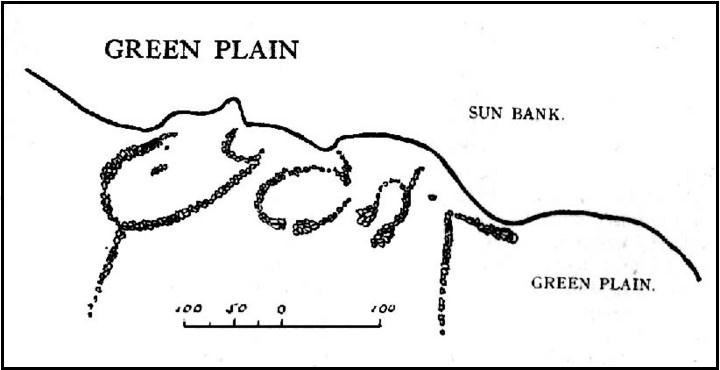
Cowling’s 1946 ground-plan of a portion of the settlement

From Blubberhouses church by the crossroads, walk up the slope (south) as if you’re going to Askwith, for 100 yards or so, taking the track and footpath past the Manor House and onto the moor.  Once you hit the moorland proper, take the footpath that bears left going down into heather and keep going till you hit the dead straight Roman Road path running west onto Blubberhouses Moor.  Go on here for nearly a mile until you hit the valley stream with its Eagle Stone down on your left.  Walk downstream, past the Eagle Stone, and cross over 100 yards down until you’re back on the level ground with the scatter of bracken and heather.  You’re here!

Archaeology & History

On the other side of the stream a short distance southeast of the large cup-marked Eagle Stone is a curious site, first described by Eric Cowling (1946) as “a series of enclosures of varying size and roughly circular shape” which he ascribed as a Bronze Age settlement.  Certainly we have a rather extensive scattered group of walled structures just as he described, but not all of the walling here seems typical of local Bronze Age constructions.  Cowling suggested the remains to be “useful for protection, herding and for shelter,” though admitted archaeological excavation would be the best way to ascertain their specific nature.  Such undertakings have yet to be done — and I wouldn’t hold your breath either.

Large section of walling
Walls of large circular structure

Although he described some of the walls here as nearly four-feet tall, when Graeme Chappell and I first ventured here in the winter of 1990, the walling wasn’t quite as high.  There are a number of individual tall stones sat in the walls that stand three-feet tall, with some that have been cut and dressed in more historic times.  Who did this and when is unknown.  However, if we visited this place when all the vegetation has been cut and burnt back at the end of winter and early months of Spring — a fact not lost on Cowling when he first found this place — we would gain a much clearer picture of things here.

Some sections of lower walling above the streamside appear to be prehistoric in nature, but many other parts of the walled structures across this flatland plain have a much later look and feel about them, illustrating that the site may have been used well into post-medieval periods.  This seems increasingly obvious where we find a number of the stones cut at sharp angles, with some having distinctive quarried grooves in them.  However, I can find no historical records to verify this at present.

Hut circle remains
Medieval cut upright stone?

If we walk up the slight slope westwards however (before bracken and heath grow) there are more distinct prehistoric remains in the form of typical hut circles with low walls emerging from deep peatlands — although even these have been cut in one or two places by metal tools.  My view of this little-known but large settlement arena is that we’re looking at a site initially built in the Bronze Age period, continuing to be used by local tribespeople throughout the Iron Age and, as the cut stones clearly show, was a village that was certainly made use of in the last millenium.  But until someone comes along here and gives the site the attention it deserves, we’re not gonna know…

On the southern fringe of the copious walled structures we also find a very curious medicinal chalybeate spring that may have been of some importance to those who once lived hereby.  A ‘standing stone’ and prehistoric cairn can also be seen close by.

References:

  1. Cowling, E.T., Rombald’s Way: A Prehistory of Mid-Wharfedale, William Walker: Otley 1946.

© Paul Bennett, The Northern Antiquarian

Pillar of Eliseg, Pentrefelin, Llangollen, Denbighshire

Cross:  OS Grid Reference – SJ 20267 44522

Also Known as:

  1. Eliseg’s Pillar

Getting Here

The Eliseg Pillar

From Llangollen, take the A542 north for about three miles up along the famous Vale of Llangollen.  At the ruined abbey of Valley Crucis continue along the same road for another ½-mile whence, at the side of the road in a field and upon a small mound, stands the ancient monument: the Pillar of Eliseg.

Archaeology & History

The sandstone pillar or pillar-shaft stands upon a large square-shaped base stone which sits atop a tumulus — a Bronze Age burial mound (cairn) inside which were found, during excavations in 1803, the remains of a body, perhaps that of a Romano-British or Dark-Ages chieftain (possibly Eliseg?), with what were described as “blue stones” both beneath and on top; the cremated body lying within a stone-slab chamber along with a silver coin.  But the ancient pillar monument itself is much later in date — probably mid-9th century AD, though there has been speculation by some historians that the pillar was actually a tall cross, alas without its head, dating from a couple of centuries earlier, with the inscription being carved onto it sometime between 840-845 AD.  It was erected by Prince Cyngen fab Cadell (Concenn) about the year 844 in memory of his great-grandfather Eliseg or Elise.  Cyngen died in Rome in 854 AD.

Over the centuries the pillar has suffered from the ravages of time.  Its long Latin inscription was originally 31 lines divided into readable paragraphs running horizontally but now only 7 or 8 of these lines are visible.  But fortunately the writer and historian Edward Lhuyd made a drawing of the monument and its inscription back in 1696.  The inscription when translated reads as follows:

1. Concenn son of Cadell, Cadell son of Brochmail, Brochmail son of Eliseg, Eliseg son of Guoillauc

2. Concenn therefore being great-grandfather of Eliseg erected this stone to his great-grandfather Eliseg

3. It is Eliseg who annexed the inheritance of Powys…throughout nine (years) from the power of the English which he made into a sword-land by fire

4. Whosoever shall read this hand-inscribed inscription stone, let him give a blessing on the soul of Eliseg

5. It is Concenn Who…with his hand…to his own kingdom of Powys…and which…the mountain…the monarchy Maximus…of Britain…Concenn, Pascent…Maun, Annan.

6. Britu, moreover, (was) the son of Guorthigirn (Vortigern) Whom (St) Germanus blessed and whom Severa bore to him, the daughter of Maximus the king who slew the king of the Romans and

7. Convarch painted this writing at the command of his king Concenn

8. The blessing of the Lord (be) upon Concenn and all members of his family and upon all the land of Powys Until the day of judgement or doom. Amen.

The upper section of the pillar, which is broken at the top, was re-erected on top of the burial mound in 1779 which probably means that the monument is not in its original place.  The lower section was sadly broken away from the shaft during the English Civil war and has long since disappeared. However, this monument is still quite an impressive site and can be seen from a great distance around.

References:

  1. Bartrum, P.C.,  Early Welsh Genealogical Tracts, Cardiff: UWP, 1966.
  2. Barber, Chris, More Mysterious Wales, Paladin 1987.
  3. Houlder, Christopher, Wales: An Archaeological Guide – the prehistoric, Roman and early medieval field monuments, Faber and Faber, London 1974.
  4. Tyack, George S., The Cross in Ritual, Architecture and Art, William Andrews: London 1900.
  5. Westwood, J.O., Lapidarium Walliæ – The Early Incised and Sculptured Stones of Wales, Oxford University Press 1879.

Copyright © Ray Spencer 2011 


Newtyle, Dunkeld, Perthshire

Standing Stones:  OS Grid Reference – NO 04489 41057

Also Known as:

  1. Doo’s Nest
  2. Druid’s Stones
  3. New Tyle

Getting Here

Newtyle’s standing stones

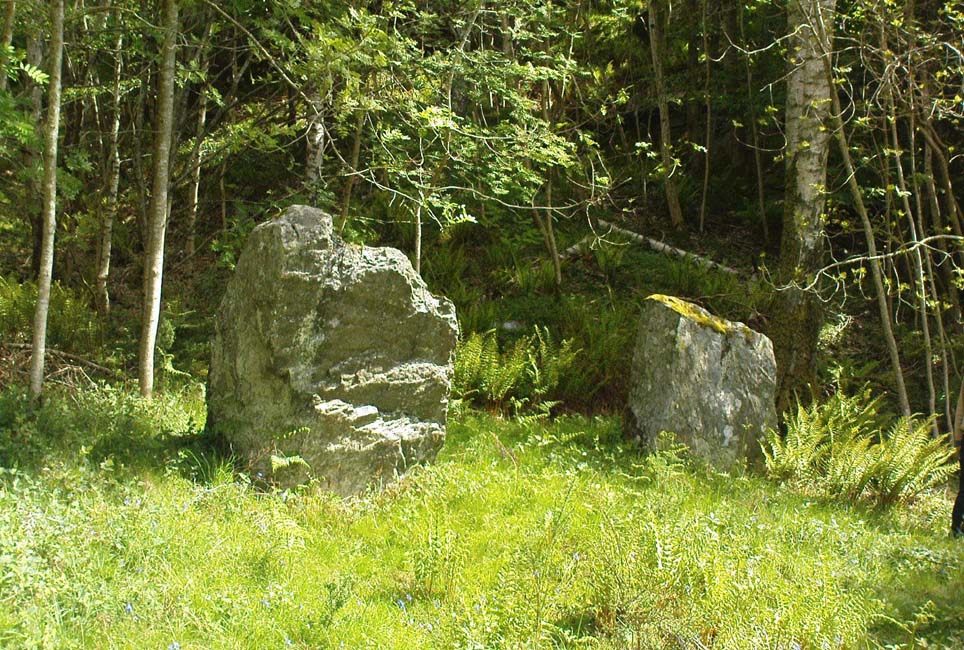
From Dunkeld travel southeast on the A984 road to Caputh and after about 1½ miles, set back a few yards from the road amidst the trees below the Newtyle Quarries (whose mass of slate and loose rocks cover the slopes), you’ll see these two large monoliths.  There’s nowhere to park here, but there’s a small road a coupla hundred yards before the stones aswell as a space to park on the verge by the side of the road a few hundred yards after them.  Take your pick!

Archaeology & History

When we visited these two tall standing stones a few weeks ago, guerilla archaeologist Hornby and I were a little perplexed at the state of these stones, wondering whether they were a product of the fella’s who dug the quarries above here, or whether they were truly ancient.  It seems the latter is the consensus opinion!

They were described by the great Fred Coles (1908) in one of his lengthy essays on the megaliths of Perthshire, where he thought the two stones here were all that remained of a stone circle that once stood on the flat, above the River Tay, but whose other stones “were destroyed in the making of the road” which runs right past here.  Not so sure misself!  He told that,

“An old cart-track runs up between the stones, leading from the main road…up to the quarry. The mean axis of the two stones runs N 13° W and S 13° E (true), and although their broader faces do not point towards the centre of a circle on the west, it is certainly much more probable that the other stones were on this side, the lower and flatter ground, than on the east, where the ground slopes and is more broken and rough.

“Both stones are of the common quartzose schist, but they differ considerably in shape.  A is 6 feet 7 inches high at the north corner, but only 4 feet 10 inches at the south, and its vertical height at the east is only 3 feet.  The basal girth is 13 feet 3 inches, and in the middle 15 feet 9 inches.  The broad east face measures 5 feet.  Stone B is level-topped and 5 feet in height; it has a basal girth of 12 feet 4 inches, and at the middle of 11 feet 8 inches.  Its two broad faces are of the same breadth.”

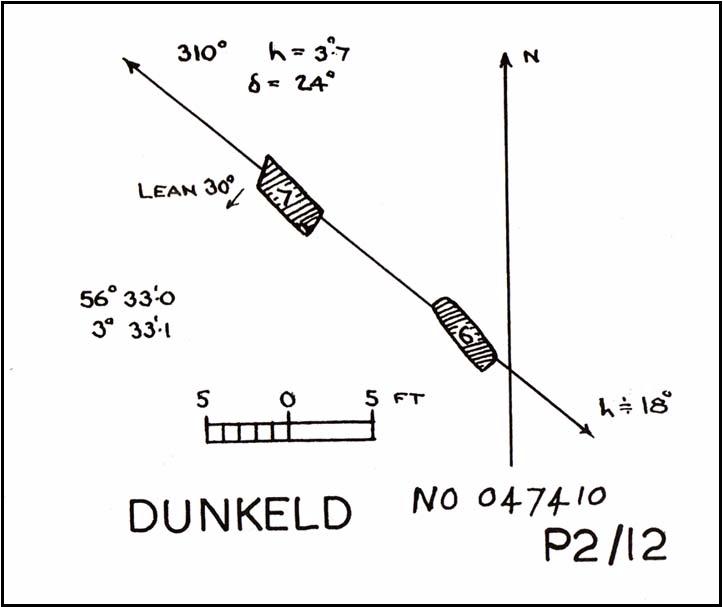
Little else was said of the two stones for many years and, to my knowledge, no real excavation has been undertaken here.  But when Alexander Thom (1990) visited the site he found that,

“This two stone alignment showed the midsummer setting sun.  The south stone may possibly, by itself, have shown the setting Moon at major standstill.”

Aubrey Burl’s description of the stones was succinct and echoed much of what Coles had said decades earlier, telling:

“Two very large stones stand only 9 feet (2.7m) apart in an unusually closed-in environment for a Perthshire pair.  The ground rises very steeply to the east.  To the west the stones overlook the valley of the River Tay.

“Both are of local quartzoze schist and are ‘playing-card’ in shape.  As usual it is the westernmost stone that is taller, 7ft 2in (2.2m) in height.  Its peak tapers almost to a point.  Conversely, its partner is flat-topped and only 4ft 9in (1.5m) high.  The pairing of such dissimilarly shaped stones has led to the interpretation of them as male and female personifications.”

Alex Thom’s groundplan
Back of the smaller stone

Burl’s latter remark thoughtfully recognises that such animistic qualities are found in many other cultures in the world and this ingredient was also an integral part of early peasant notions in Britain; therefore such ingredients are necessities to help us understand the nature and function of megalithic sites.  We must be cautious however, not to fall into the increasingly flawed modern pagan notion of such male and female ‘polarizations’, nor the politically-correct sexist school of goddess ‘worship’ and impose such delusions upon our ancestors, whose worldviews had little relationship with the modern pagan goddess fallacies, beloved of modern Press, TV shows and pantomime festival displays.

Folklore

In Elizabeth Stewart’s history of Dunkeld, she narrates the tale told by an earlier historian who told that,

“these two upright stones at the Doo’s Nest, but says they are supposed to mark the graves of two Danish warriors returning from the invasion of Dunkeld.”

References:

Burl, Aubrey, From Carnac to Callanish, Yale University Press 1993.
Coles, Fred, “Report on Stone Circles Surveyed in Perthshire – Northeastern Section,” in Proceedings of the Society of Antiquaries, Scotland, volume 42, 1908.
Stewart, Elizabeth, Dunkeld – An Ancient City, Munro Press: Perth 1926.
Thom, A., Thom, A.S. & Burl, Aubrey, Stone Rows and Standing Stones – 2 volumes, BAR: Oxford 1990.

© Paul Bennett, The Northern Antiquarian

Brown Beck Stone, Agra Moor, North Yorkshire

Standing Stone:  OS Grid Reference – SE 13499 82440  —  NEW FIND

Also Known as:

  1. Agra Moor Standing Stone

Getting Here

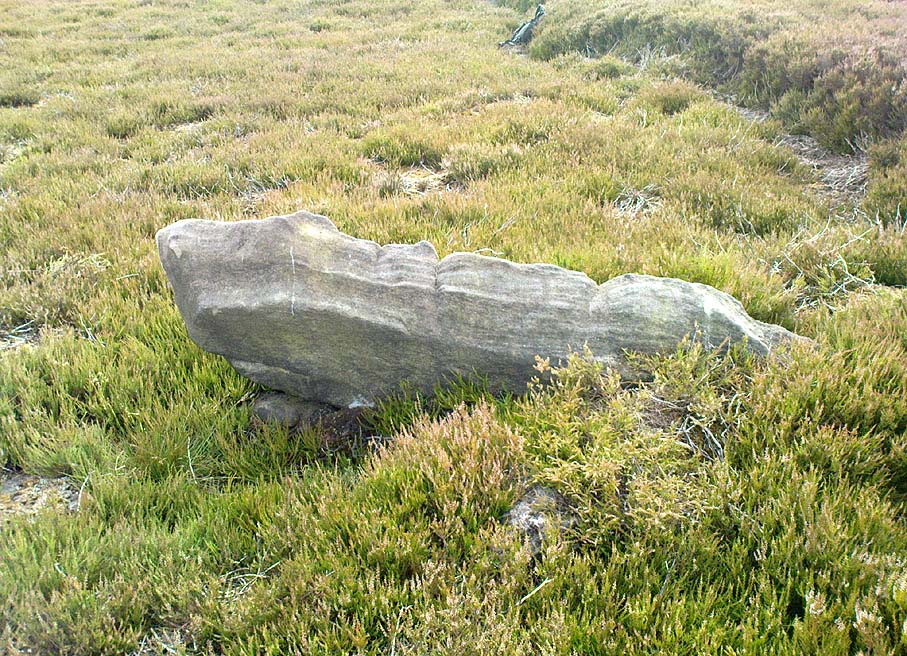
Agra Moor standing stone

From Masham, take the Fearby Road to the village, keep going on the same road through Healey village and less than a mile on where the road forks, bear to the right past and go along the gorgeous little-known vale of Colsterdale.  It’s bloody beautiful!  Less than 2 miles on, walk up the notable track veering to your right, diagonally uphill.  Walk along till you get to the moor edge.  Go thru the gate and follow the swerving uphill path to the bottom of Slipstone Crags.  Once you level out at the Crags top, look across the small valley to your left and, on t’other side, you’ll notice a standing stone upright in the heather, just 100 yards on the flat on the other side of the valley.  Head right for it!

Archaeology & History

Looking west

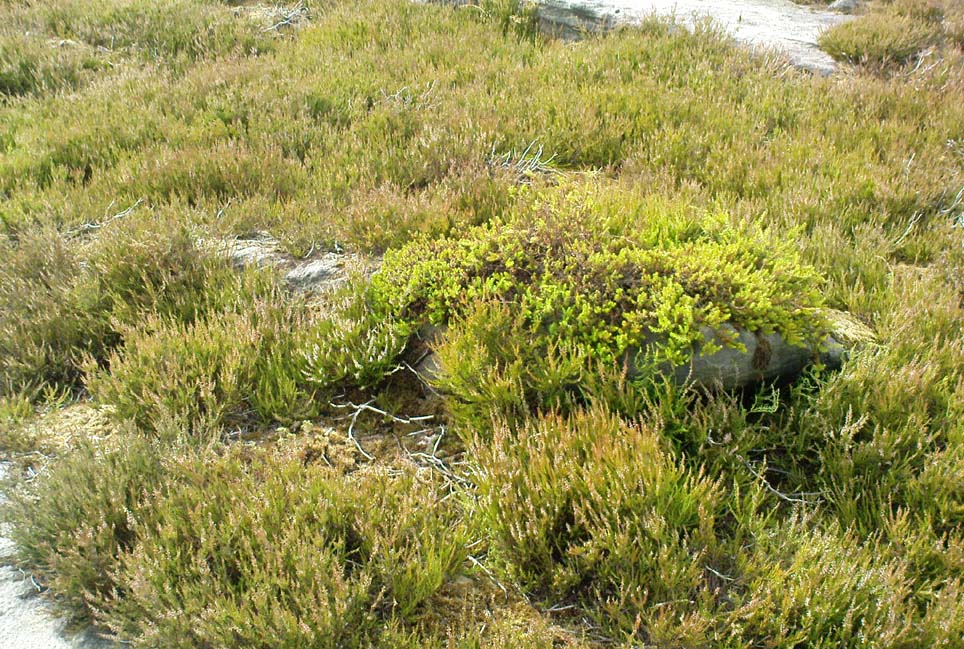
There are no known written references to this standing stone, which we visited for the first time yesterday, in a brief wander to the nearby Agra Woods cup-and-ring stones a few hundred yards southeast.  The monolith stands some four-and-half-feet tall and, at its base, is more than three feet broad and just one foot wide.  Just to its side and almost completely covered in peat and vegetation is what may have been another once-upright companion asleep in the Earth.  Another possibly fallen stone is less than 10 yards west.  The upright stands on the flat moorland overlooking the confluence of two (once) fast-flowing waters of Brown Beck and Birk Gill; and the landscape that reaches out from here is something to behold!

We found the remains of other old monuments on the moor, but some were obviously related to the industrial mining not far away.  However, two or three other small upright stones and a large stone circular structure were also located which very obviously predated any industrial or medieval workings.  We need to revisit this moorland and spend more time exploring to see what other things are hidden, lost midst the peat and heather.

© Paul Bennett, The Northern Antiquarian 

Newhall Bridge, Kenmore, Perthshire

Standing Stones:  OS Grid Reference – NN 7926 4668

Also Known as:

  1. Canmore ID 24910
  2. Newhall Stones
  3. Taymouth Standing Stones
Newhall Stones, Kenmore

Getting Here

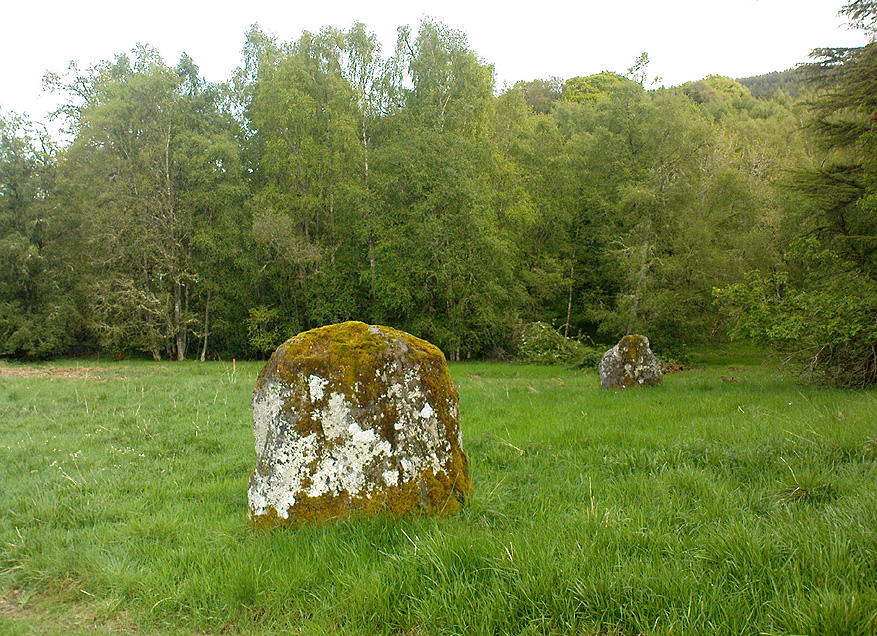
Pretty easy to find.  At the eastern end of Loch Tay, go through the old village of Kenmore along the A827, towards Aberfeldy, for about a mile.  At least a mile past Kenmore, keep your eyes peeled for a small left turn which takes you back into the grounds of Taymouth Castle.  Go on this small road, pass the ornate walling, and you’ll see these two standing stones in front of you, before the trees, on the left.  If you reach the Croftmoraig Stone Circle, you’ve gone a few hundred yards past the turning.

Archaeology & History

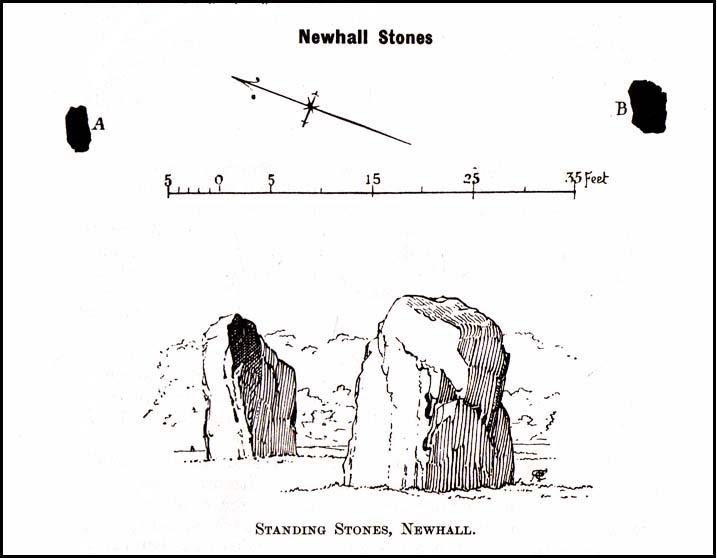
Fred Coles’ drawing & lay-out

These fine-looking standing stones a mile northeast of Kenmore village, on the edge of the grounds of the superb Taymouth Castle, are worthy old monoliths, encrusted by the lichens of many centuries, resting within the long grass beside the track that runs to the castle.  But they have received little attention in archaeological terms.  When Fred Coles (1910) described them, he thought them to be the remains of a stone circle — an impression echoed by Margaret Stewart (1966) many years later (I got the same impression aswell), but no other stones have been found to substantiate this (although Mr Gillies’ folklore remnant is intriguing).  There is a notable rounded hillock immediately behind the two stones which may, or may not, have had other uprights surrounding it; though I can find no further data anywhere to substantiate such a thing.

In William Gillies’ (1938) historical survey of the area he related Mr Coles’ earlier findings of the two stones, telling us:

“There are two great standing stones just within the Principal Gate leading to Taymouth Castle.  The stone A (see plan) stands at a distance of 54 feet to the NNW of B — a somewhat greater diameter than is common among the Perthshire Circles.  These stones are almost equal in height — A is 4ft 9in, B is 4ft 7in — and they are both rugged blocks of a rough species of diorite.  Stone A measures round the base 10ft 8in, and stone B 14ft.”

The western stone
The eastern stone

But it seems that little else has been found about the place.  It’s in a gorgeous setting (but, round here, everything’s in a gorgeous setting!) and must have related to other sites in the area, but it’s hard to contextualize the place on a single visit.  If you stand behind the two stones, the shape of their ‘heads’ fits very nicely onto the rounded hillock on the northwestern skyline — which seems to have later been used as a hillfort.  Whether this has any astronomical potential, I aint checked. (though Thom says nothing about them)

In geomantic terms both of these stones possess a distinct female flavour to them; the easternmost thinner of the two, particularly so.  But then I could just be talking bullshit!  I’d have loved to have spent more time with these two stones — bimbling, sitting, focussing, dreaming — as people of olde naturally did; but we were on the move and had other places to see.  Tis a delightful spot indeed…

(NOTE – This site was first given a grid reference of NN 801 477 in Margaret Stewart’s (1967) fine essay on the standing stones at nearby Lundin; and the grid-ref has since been reproduced in texts by Burl (1993), Thom (1990) and others.  Please note that this grid-ref is incorrect and is nearly a mile away from the actual position of the stones.)

Easternmost stone from another angle

Folklore

There is the possibility that this site once played a part in an important megalithic stone row.  Mr Gillies (1938) once again notes an old tradition told by local people which “says that at one time there was a paved way connecting the circle, of which these stones are the remains, with the great Croftmoraig circle.”  Very intriguing indeed…

References:

  1. Burl, Aubrey, From Carnac to Callanish, Yale University Press 1993.
  2. Coles, Fred, “Report on Stone Circles Surveyed in Perthshire,” in Proceedings of the Society of Antiquaries, Scotland, volume 44, 1910.
  3. Gillies, William A., In Famed Breadalbane, Munro Press: Perth 1938.
  4. Stewart, M.E.C., “The excavation of a setting of standing stones at Lundin Farm near Aberfeldy, Perthshire“, in Proceedings of the Society of Antiquaries, Scotland, volume 98, 1966.
  5. Thom, A., Thom, A.S. & Burl, Aubrey, Stone Rows and Standing Stones – 2 volumes, BAR: Oxford 1990.

© Paul Bennett, The Northern Antiquarian

Acharn, Killin, Perthshire

Standing Stone:  OS Grid Reference – NN 56141 31601

Getting Here

Acharn’s standing stone

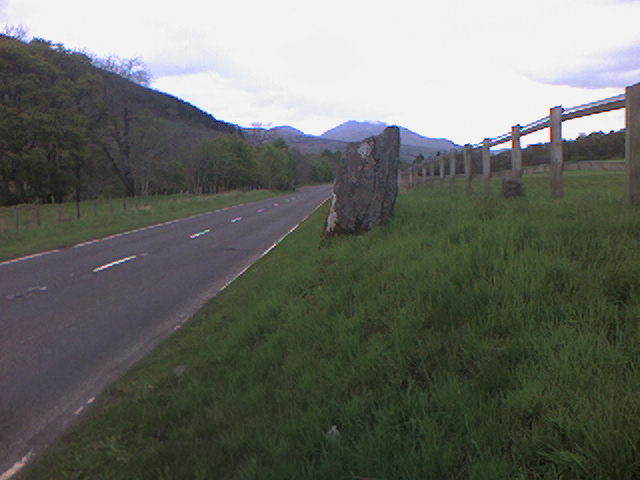
This one’s easy as it’s right by the roadside, so making it dead easy for those lazy ones amongst you who don’t like walking!  You can find it just past the turn-off (signed) for Acharn Lodge, a few hundred yards along the A827 road (off the A85 by the garage) from Lix Toll, less than a mile before reaching Killin.

Archaeology & History

This solitary standing stone, not much more than about three feet tall, originally stood in the adjacent field and was moved to the edge of the road sometime ago.  It was described briefly in William Gillies’ Breadalbane (1938) where he said, “Its height is 3 feet 10 inches and its girth at the base 6 feet 2 inches… This solitary stone is possibly the sole survivor of a group that once formed a circle,” though gives no more information to support this idea.  It seems more likely that the stone accompanied a cairn, that was levelled by farming sometime in the 19th century.

References:

  1. Gillies, William A., In Famed Breadalbane, Munro Press: Perth 1938.

© Paul Bennett, The Northern Antiquarian