Holy Well, Glen Prosen, Angus

Holy Well:  OS Grid Reference – NO 3172 6681

Getting Here

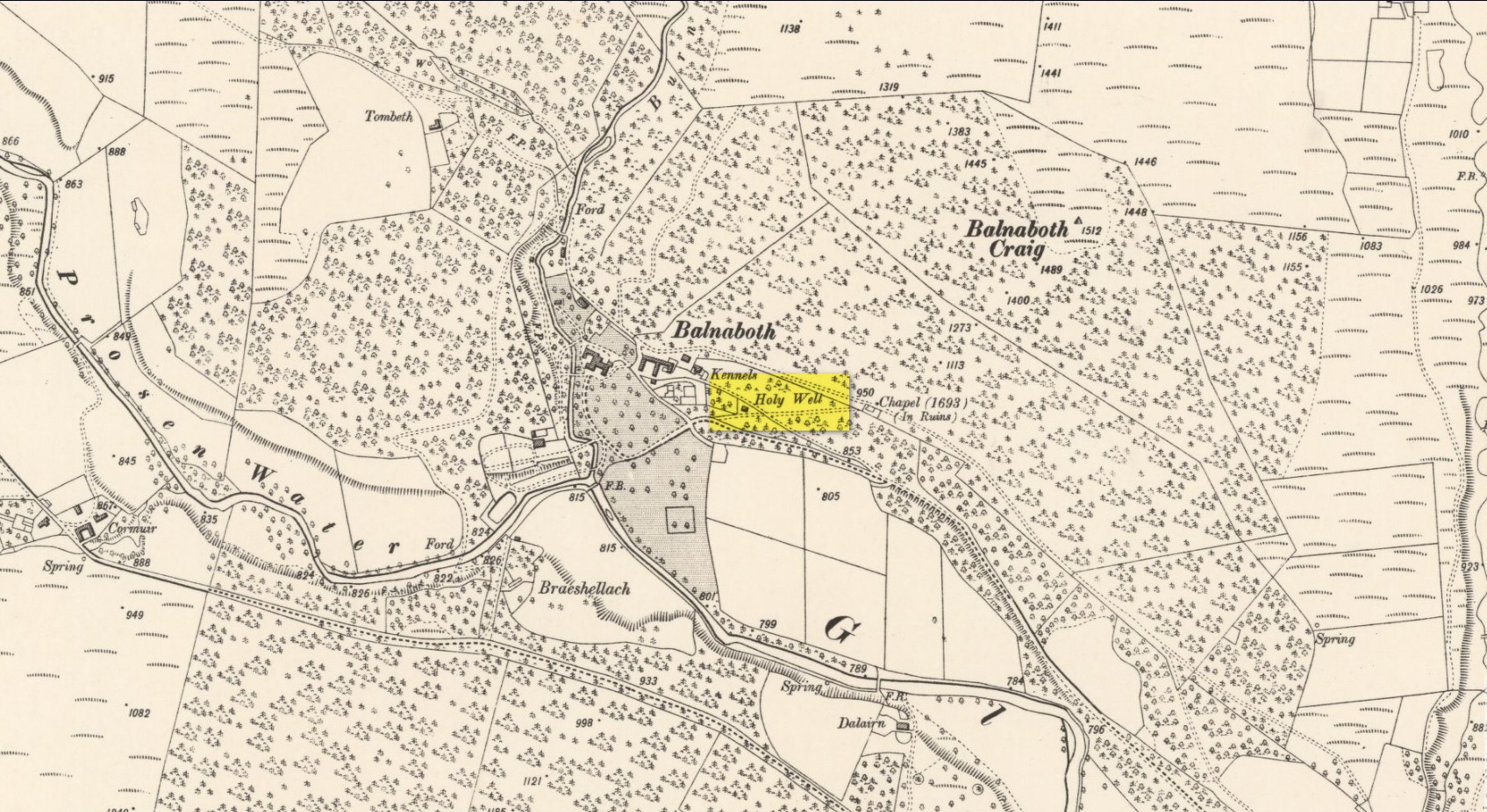
Glenprosen Holy Well

A long long way to go for a single little spring!  From Kirriemuir town centre go up the B956 Kinnordy Road, going straight across at the crossroads up the countryside lane towards Lednathie (signposted 8 miles): dead straight, long-and-winding, up-and-over…. Stick to this single road, all along, ignoring all turn-off junctions until, once reaching the hamlet of Easter Lednathie, stay awake for the turn up to Glenprosen, 2 miles along, over the bridge. Turn left and a few hundred yards along go over the next little bridge until you reach the “Private Road” sign, then walk up the track past Katy’s Cottage.  ¾-mile along just before Balnaboth, keep your eyes peeled to the left for a splatter of quartz rocks with a spring of water thereby.  At long long last, you’ve reached your destination!

Archaeology & History

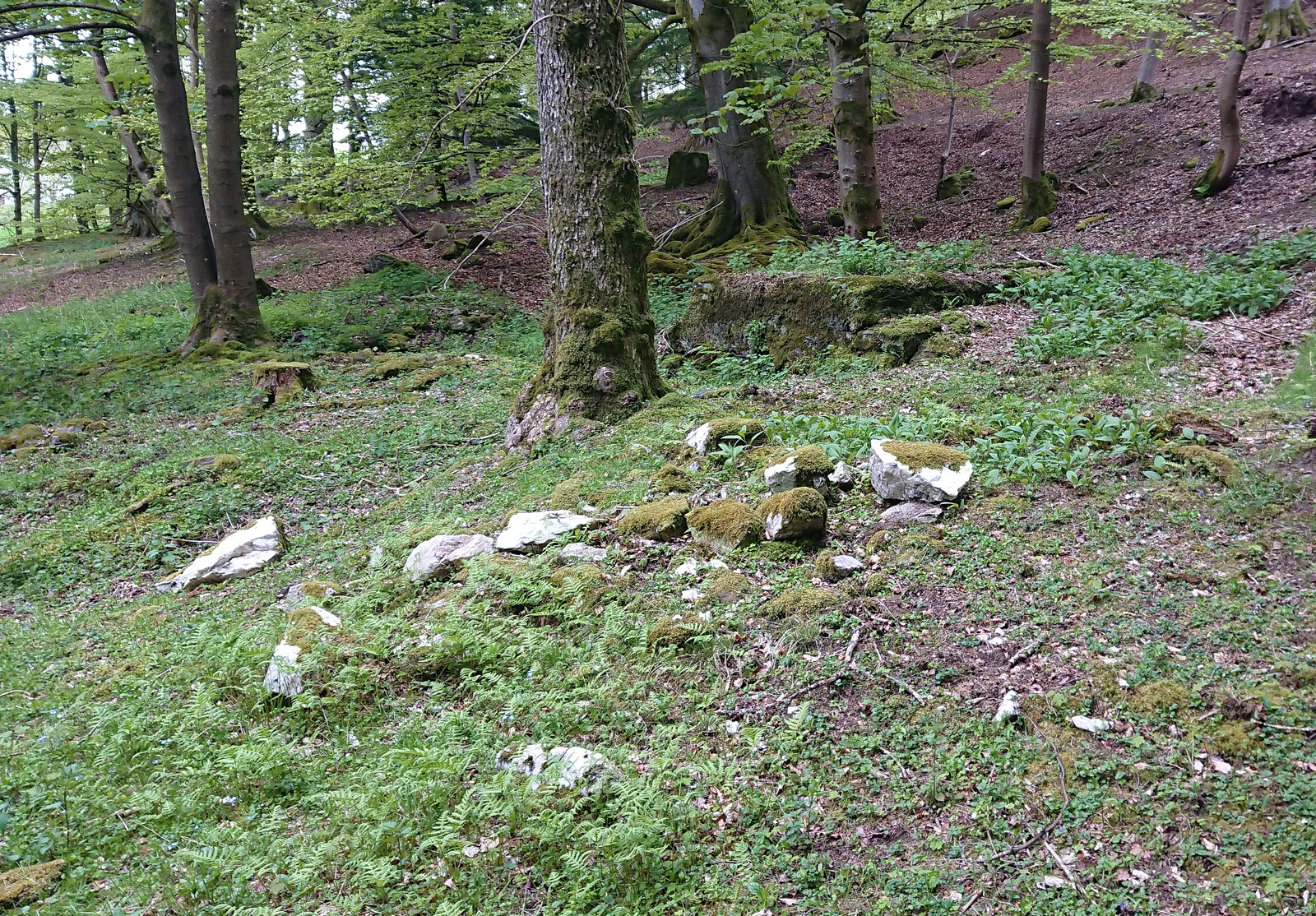
A “splatter of quartz rocks”

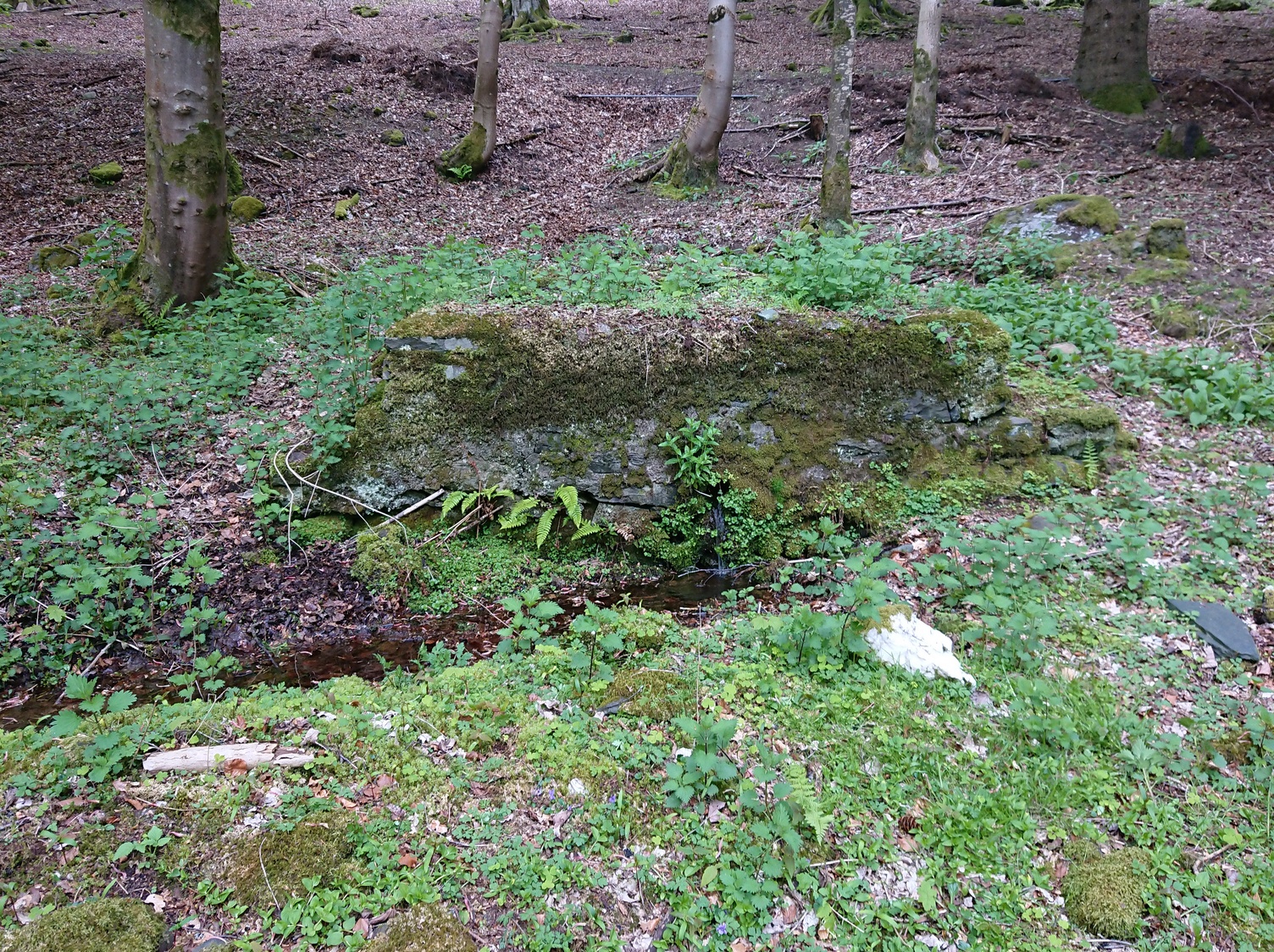
Miles to the winding north of Kirriemuir, in the depth of the olde mountains, this clear spring of iron-bearing water (still fresh and drinkable) was, earlier in the 20th century, covered over by someone-or-other and surrounded by straight slabs of stone.  The waters were maintained however, by the builders who cut a small hole into the moss-embolded rock allowing this pure water to still run freely for all to use…

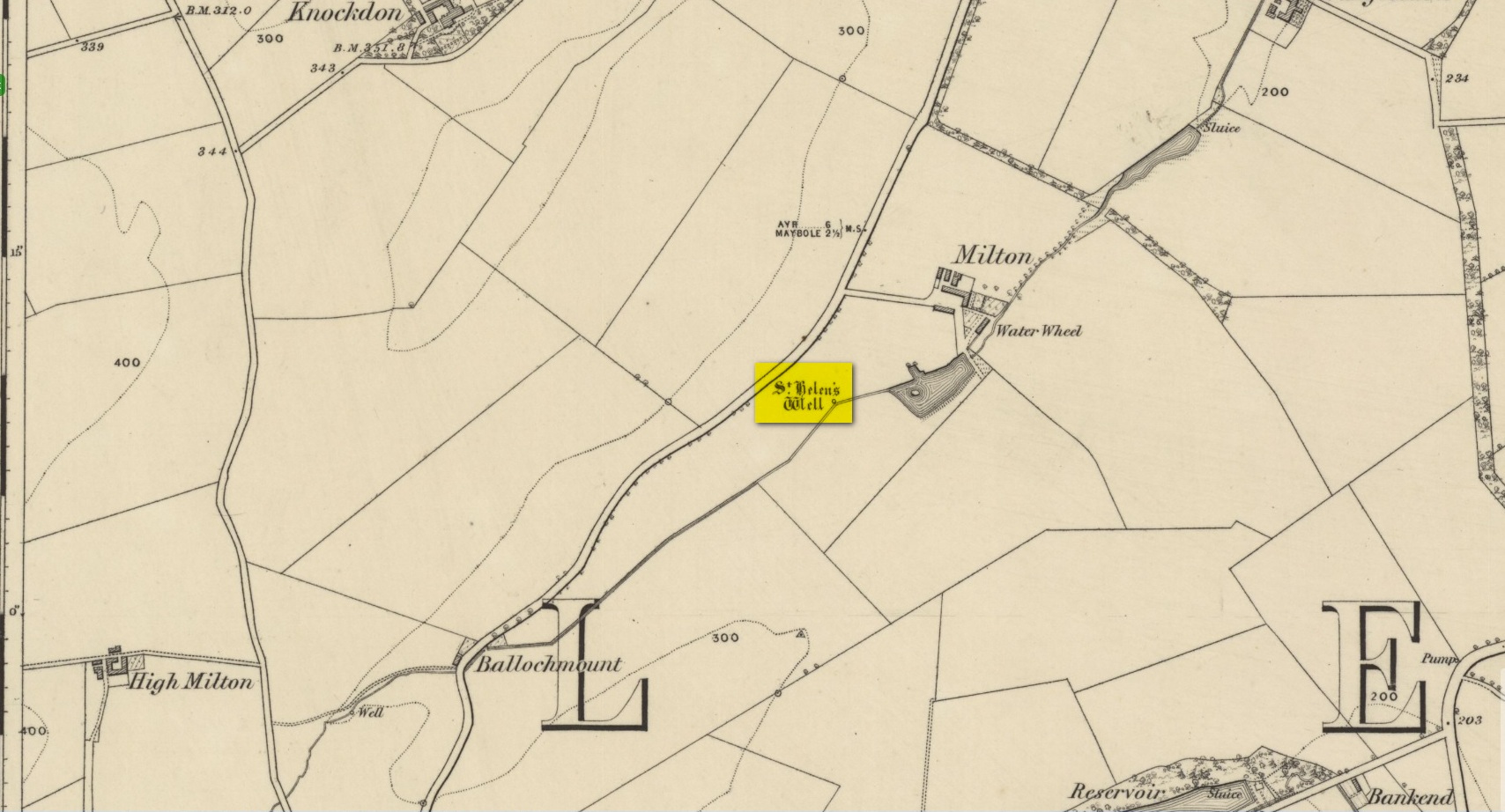
Shown on the early OS-maps, its sacrality or holy association would seem to be lost from the tongues of the older folk, most of whom seem long gone from this beautiful glen-to-nowhere.  The only remaining religious connection we might have relating to the place comes from the ruined 17th century chapel less than 250 yards away to the west on the slope above the track, from where a singular stone-lined footpath runs dead straight to the well.

Site shown on 1900 OS-map

But another important feature found here is the large scatter of quartz rocks a few yards away from the water source.  They are in disarray but would seem to have once been built around the spring where it first emerged from beneath the ground, then being cast aside to their present positions when the more modern stone structure was built above it.  We can’t prove this with any certainty, but there are a number of other holy wells with this quartz-defining feature elsewhere in Scotland: the St Mary’s Well at Callander and Beltane Well of Kenmore to name just two.

References:

  1. Robertson, D.O., Long-Ago Legends of Clova, W.P. Nimmo: Edinburgh 1872.

Acknowledgements:  Huge thanks for use of the Ordnance Survey map in this site profile, reproduced with the kind permission of the National Library of Scotland

© Paul BennettThe Northern Antiquarian

St. George’s Well, Harrogate, North Yorkshire

Holy Well (destroyed):  OS Grid Reference – SE 2997 5561

Also Known as:

  1. St. George’s Spa

Archaeology & History

About 50 yards away from the Royal Promenade on the east-side of Parliament Street, there used to flow the healing waters of an old holy well, that later became one of Harrogate’s many spa wells.  It was first recognized as a medicinal spring about 1792 when Thomas Garnett (1794) uncovered it beneath the overgrowth of vegetation surrounding the spring-head.  In doing so, it became evident that at some time in the past it had been used by local people as,

“a wall was discovered round the spring, but whether this had been built with an idea of its being a medicinal water, or with an intention of collecting water for cattle, I cannot determine.”

Chalybeate (iron-bearing) in nature, the waters were analyzed by Adam Hunter (1830) in the 1820s and, although possessed of soluble iron, had less than its medicinal compatriots nearby, meaning that its fortifying qualities weren’t quite as good. He told us how,

“it had been known (by locals) for many years, but at no time much used internally; it had acquired some celebrity however as a wash for sore eyes, for which purpose it was well adapted.  As chalybeate water has long been a favourite popular remedy for a wash in various weaknesses, and chronic affections of the eyes, it is proper to state that (the nearby) John’s Well, the Tewit Spa, or the succeeding one at Starbeck, are the only three chalybeates which can at present be recommended for that purpose.”

A few years after Hunter had been here, the well was destroyed “by the making of a highway drain.” (Jennings 1981)

Folklore

St George (saint’s day – April 23) was one of the christian dragon-killers.  There is no known tradition of the saint or festivities that may once have occured here.

References:

  1. Garnett, Thomas, A Treatise on the Mineral Waters of Harrogate, Thomas Gill: Leeds 1794.
  2. Hunter, Adam, The Waters of Harrogate and its Vicinity, Langdale: Harrogate 1830.
  3. Jennings, Bernard, A History of the Wells and Springs of Harrogate, Interprint: Harrogate 1981.

© Paul BennettThe Northern Antiquarian

St. Ann’s Well, Harrogate, North Yorkshire

Holy Well (lost):  OS Grid Reference – SE 298 548

Archaeology & History

Very little is now known about this sacred site that was once found “a few hundred yards east from the New Church at Low Harrogate.” (Hunter 1830)  Even most of travellers and medical experts who wrote about the numerous Harrogate wells in the 18th and 19th century bypassed its quietude; and by the time Mr Hunter wrote about it in his great descriptive catalogue, its healing or medicinal qualities had been forgotten.

He told that “the spirit in the water…or that with which it is infused, has long been most actively engaged in adding real or fancied comforts to the (Harrogate) Fair, and is now in much more general use” than the two other holy wells in the town. It was, he said, “the best water for making tea and more extensively used for that purpose than any in the neighborhood of Harrogate.”  It would also appear to have been built over at some time in the not-too-distant past…

Folklore

St Ann (saint’s day – July 26) was a giant in early christian and Islamic myths.  An apocryphal figure, She was the Great Mother of the mother of Christ—the Virgin Mary—and was Herself a Virgin until, in Her old age, after seeing a bird feeding a chick, decided She wanted a child and so eventually gave birth to Mary.  An old woman giving birth when the Springtime appears (when birds and other animals become fertile) is the same motif found in the lore of the Cailleach in Ireland and Scotland (and parts of northern England).  Pre-christian lore at this old well would seem evident here.

References:

  1. Hunter, Adam, The Waters of Harrogate and its Vicinity, Langdale: Harrogate 1830.

© Paul BennettThe Northern Antiquarian

Holy Well, Aston, Oxfordshire

Holy Well:  OS Grid Reference – SP 35833 02611

Archaeology & History

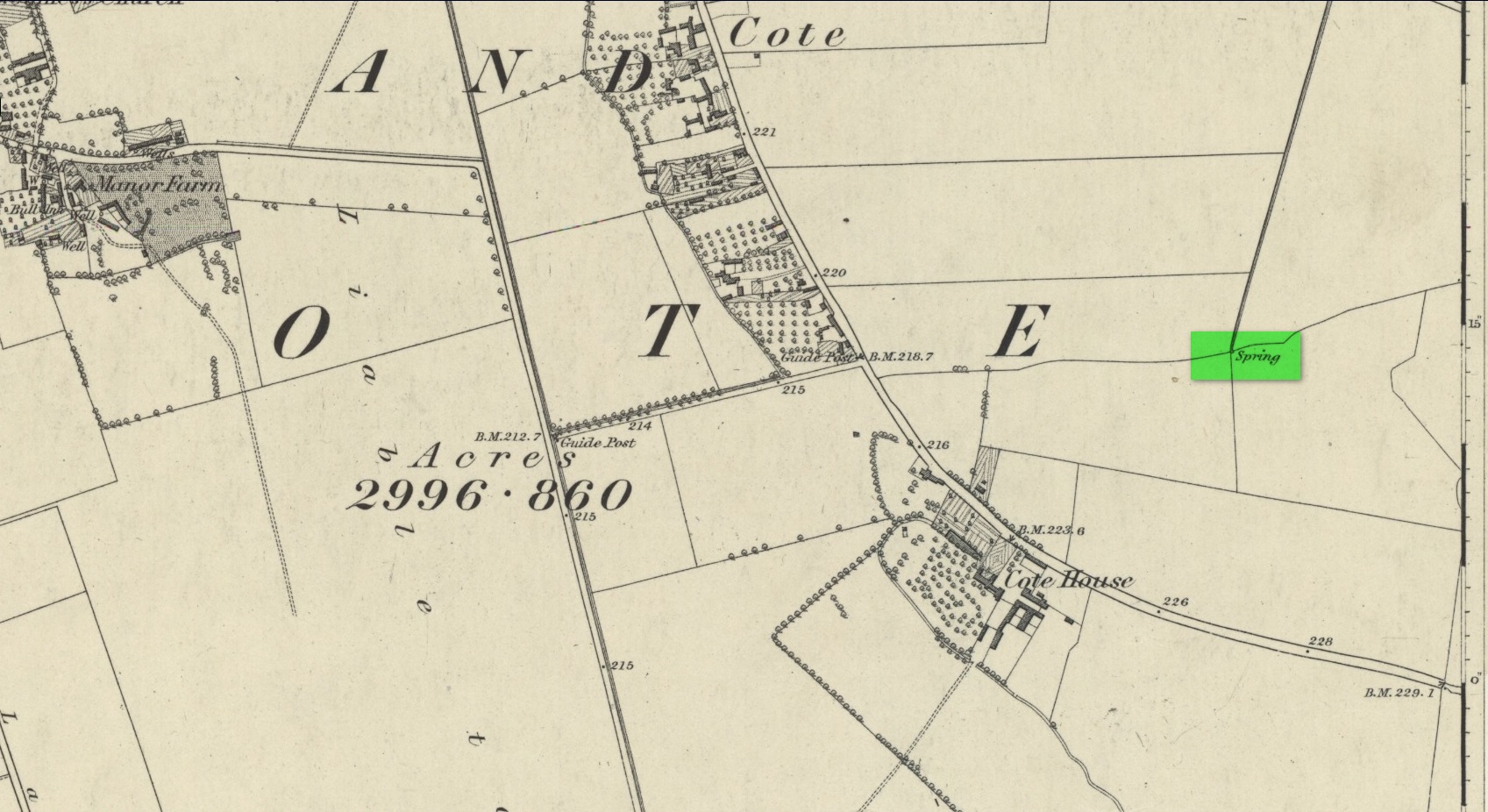
‘Spring’ marks the holy well

First mentioned as the field-name Holywellefield in the Court Roll of 1432, there is a possibility that this seemingly lost site still exists.  It was mentioned briefly in John Giles’ (1848) old history book of the area where he told us that, “a field beyond Cote House on the road to Shifford is still called ‘Holy-well field’, (but) no legend has been recorded.”

If we go 400 yards northeast across the field on the other side of the road from Cote House, a “Spring” that was shown on the early OS-maps would still seem to be actively feeding a dyke that runs roughly north from here.  This is probably the holy well that was described in those Court Roll records—and it still seems to exist.

References:

  1. Gelling, Margaret, The Place-Names of Oxfordshire – volume 2, Cambridge University Press 1954.
  2. Giles, J.A., History of the Parish and Town of Bampton, privately published: Bampton 1848.

Acknowledgements:  Huge thanks for use of the Ordnance Survey map in this site profile, reproduced with the kind permission of the National Library of Scotland

© Paul BennettThe Northern Antiquarian

Chalybeate Well, Inverkeithing, Fife

Healing Well:  OS Grid Reference – NT 1486 8466

Archaeology & History

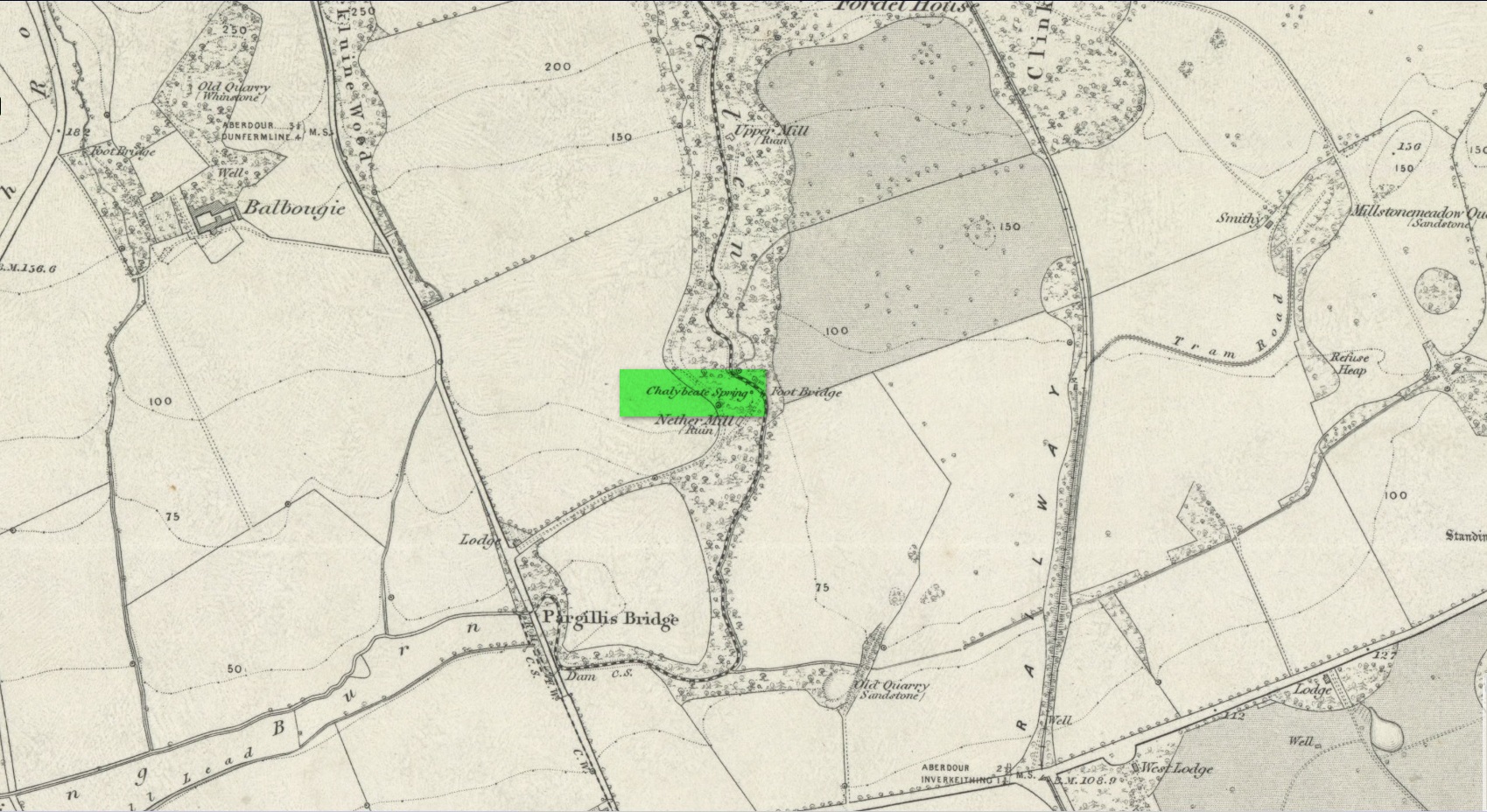
Site shown on 1856 map

This little-known iron-bearing spring takes some finding!  It’s all but lost beneath a mass of invasive rhododendrons that cover the slopes here (it needs to be severely cut back) and will only be found by the truly adventurous amongst you.  In notes of this site by Ordnance Survey in 1854, they told that “there was formerly a fountain to protect the Spring, but the fountain has been allowed to go to ruin” and I could see no remnants here on my visit.

In a detailed and lengthy analysis of the spring water that was done by W. Robertson in 1829, the principal minerals in it were found to be iron, magnesia and lime, but the spring was said to have no medicinal renown locally.

References:

  1. Robertson, W., “Analysis of the Water of a Spring on the Estate of Fordel near Inverkeithing,” in Edinburgh New Philosophical Journal (ed. Robert Jameson), volume 14, 1829.

Acknowledgements:  Huge thanks for use of the Ordnance Survey map in this site profile, reproduced with the kind permission of the National Library of Scotland

© Paul BennettThe Northern Antiquarian

Cairney Mount, Carluke, Lanarkshire

Standing Stone (destroyed):  OS Grid Reference – NS 855 507

Archaeology & History

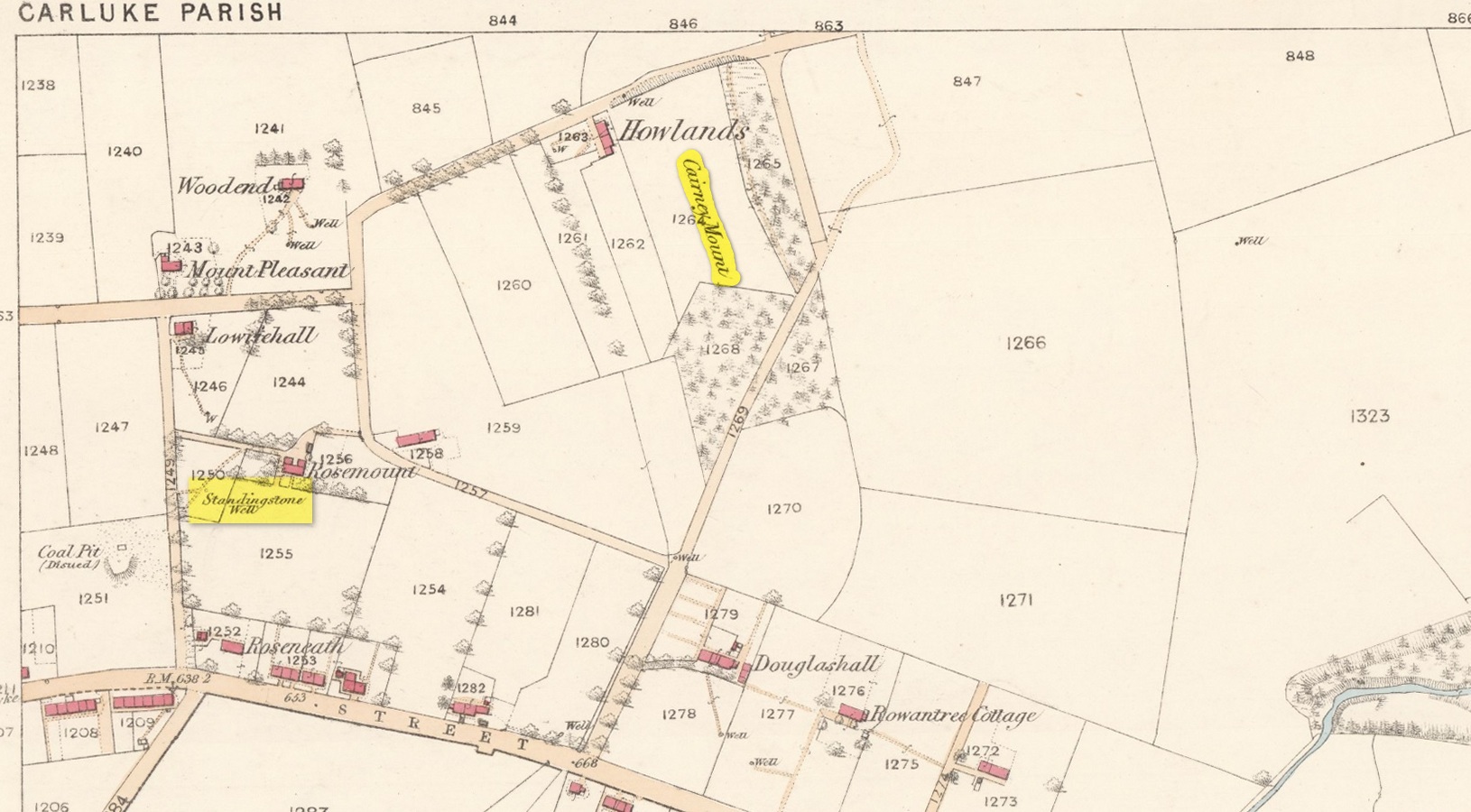
The Well & the field-name on the 1860 OS-map

An ancient standing stone on the eastern side of Carluke isn’t something that most local people are aware of.  Sadly it’s long gone, but we find what seems to be a reference to it, both in the place-name Stanistone Road and the adjacent Standing Stone Well.  The monolith would seem to have stood immediately east of the well, as a description of it by Rev John Wylie (1845) in the New Statistical Account (1845) indicates.  Wylie told us that:

“Till lately, one of those remarkable monuments of antiquity, called standing stones, stood at Cairney Mount; but the hope of finding a hidden treasure induced some rude hand to destroy it.”

Cairney Mount is a field-name 300 metres east of the well, so it would seem highly likely there was an association between them, and the stone obviously stood somewhere between these two points.

References:

  1. Royal Commission on the Ancient & Historical Monuments of Scotland, Lanarkshire: An Inventory of the Prehistoric and Roman Monuments, HMSO: Edinburgh 1978.
  2. Wylie, John, “Parish of Carluke,” in New Statistical Account of Scotland – volume 6: Lanarkshire, William Blackwood: Edinburgh 1845.

© Paul BennettThe Northern Antiquarian

St. Bride’s Well, Traquair, Peeblesshire

Holy Well (destroyed):  OS Grid Reference – NT 3190 3339

Also Known as:

  1. St Bryde’s Well

Archaeology & History

Site shown on 1858 map

Two hundred years ago, located halfway between Traquair’s present parish church and that of the demolished (apparently) 12th century church of St. Bride to the southwest, were the flowing waters of this once sacred water source.  But it’s long since been destroyed.  It was drained sometime prior to when the Ordnance Survey lads came here in 1856 and its water taken to supply the nearby manse.  Subsequent surveys by the Royal Commission (1967) and Mr & Mrs Morris (1982) affirmed its demise.  It was listed in the early Scottish holy well surveys, without comment, and I can find no local history accounts of the place.

References:

  1. Hallen, A.W. Cornelius, “Holy Wells in Scotland,” in The Scottish Antiquary, volume 9, 1895.
  2. Morris, Ruth & Frank, Scottish Healing Wells, Alethea: Sandy 1982.
  3. Royal Commission on the Ancient & Historical Monuments, Scotland, Peeblesshire – volume 2, Aberdeen University Press 1967.
  4. Walker, J. Russel, “‘Holy Wells’ in Scotland,” in Proceedings of the Society of Antiquaries of Scotland, volume 17,, 1883.

Acknowledgements:  Huge thanks for use of the Ordnance Survey map in this site profile, reproduced with the kind permission of the National Library of Scotland

© Paul BennettThe Northern Antiquarian

St. Ninian’s Well, Blairgowrie, Perthshire

Holy Well (destroyed):  OS Grid Reference – NO 180 452

Archaeology & History

The Well Meadow in the middle of Blairgowrie was once the place where the 5th century Apostle of the Southern Picts, or St Ninian, baptised local folk into the so-called “new faith”.  It’s long since gone.  The local historian John MacDonald (1899) told that it was located opposite the buildings on the north-side of the square, adding:

“St Ninian, one of the earliest Christian Celtic missionaries, on his tour through Scotland, pitched his camp where the Wellmeadow now is, and quenched his thirst at an old well or spring which ever afterwards bore the name of “St Ninian’s Well,” until it was covered in and the water led into the town drains.”

Surely this is a good case for restoration?

Old Ninian’s saint’s day is September 16.

References:

  1. MacDonald, John A.R., The History of Blairgowrie, Advertiser Office: Blairgowrie 1899.

© Paul BennettThe Northern Antiquarian

Holy Well, Trelawne, Cornwall

Holy Well (lost?):  OS Grid reference – SX 2258 5311

Archaeology & History

This spot is where an old field-name has preserved the memory of an all-but-forgotten holy well, known as the “Holywell Ground.”  Although it may have fallen back to Earth, there are two possible spots regarding its position: i) a spring that was marked on the 1882 OS-map at SX 2258 5315, and ii) a “Well” that’s shown on the recent OS-maps (SX 2257 5306).  Hence, the grid-reference I’ve given to this place is the halfway spot between them both. (it has to be pointed out that the “well” on recent maps occurs right next to an old quarry, which are well known to bring forth water sources that were previously deep underground)  Whether or not Sclerder Abbey—about 400 yards west of here and only built in 1843—had anything to do with the sanctifying this well, we can but guess…

© Paul BennettThe Northern Antiquarian

Caesar’s Well, Wimbledon, London, Surrey

Sacred Well:  OS Grid Reference – TQ 2237 7151

Also Known as:

  1. Robin Hood’s Well
  2. Roman Well
  3. Springpond Well

Getting Here

Caesar’s Well in the late-60s

There are numerous ways to get here from all directions: i) from the west-side of Wimbledon Common, on the Robin Hood’s Way A3 road, keep your eyes peeled for the small crossroad  of Robin Hood Lane and Road, obivously taking the one into the park. Keep on the dead straight Robin Hood Ride path until your hit the carpark ¾-mile on; and from here, bear sharp left (NW) for 250 yards or so, where a small slope down on your left takes you there; or, ii) from Wimbledon village side on the A219 Parkside A219 road, where the War Memorial stands, head onto the Common along The Causeway, past the Fox & Grapes going on Camp Road, then up the Sunset Road towards the carpark.  And then, once again go NW for 250 yards or so, where the small slope on your left takes you there.  You’ll find it.

Archaeology & History

Described by William Bartlett (1865) as “the never-failing spring of water, improperly called the Roman Well”, its constant flow was severely tested in the great drought of 1976—and it kept on flowing.  Only just though!  It was highlighted on the early Ordnance Survey map with the plain name of the Springpond Well.  The great historian and folklorist Walter Johnson (1912) gave us the best historical resumé of the site, telling that,

Caesar’s Well around 1900
Caesar’s Well around 1911

“Caesar’s Well, formerly known as Robin Hood or Roman Well—the Springpond Well on the Ordnance Map—issues on the other side of the little watershed above mentioned, at a height of 149 feet O.D.  The well lies in a little hollow, now ringed with Scottish pines. The gathering ground is the land to the east, rising to 198 feet O.D. This area is not large, but quite sufficient to maintain a permanent rill of pure water.  The well, the waters of which once were deemed of special medicinal merit, was enclosed with brick in 1829, and, as the inscription tells us, refaced with granite blocks by Sir Henry W. Peek, M.P., in 1872.  The outflowing waters descend to Brickfield Cottage, where they expand into a turbid duckpond; thence the course is through the yard behind the house, and along the north side of Robin Hood Road to Brook Cottage.  During 1911 the “Well” proper altogether dried up, but water still issued from the stand spout a few yards below, which is supplied by an artificial boring and pipe that tap the spring at a depth of 18 feet.”

Site shown on the 1874 map

The proximity of this never-failing spring to the huge prehistoric enclosure of Caesar’s Camp just a few hundred yards to the south would indicate it was an important water source in Bronze Age times and, I’d hazard, would have been bestowed with some sanctity, as many such wells tended to be.

Folklore

James Rattue (2008) informed us that the name Robin Hood’s Well was known here in the 18th century prior to it being known as Caesar’s Well, but there seems to be no known relationship between Robin Hood and this site.  However, a piece written in 1922 told that there was a lingering tradition that Julius Caesar encamped on Wimbledon Common in 51 BCE and that this folk memory was kept alive in the lore of local children who devoutly believed that the great Roman Emperor drank from the cool depths of this well.

References:

  1. Bartlett, William A., The History and Antiquities of the Parish of Wimbledon, Simpkin Marsall: London 1865.
  2. Hughes, John L., “Caesar’s Well, Wimbledon Common,” in Source magazine, no.9, Spring 1989.
  3. Johnson, Walter, Wimbledon Common – Its Geology, Antiquities and Natural History, T.Fisher Unwin: London 1912.
  4. Rattue, James, Holy Wells of Surrey, Umbra: Weybridge 2008.

© Paul BennettThe Northern Antiquarian