Drumchanachan, Edradynate, Weem, Perthshire

Cup-and-Ring Stone:  OS Grid Reference – NN 87937 52593

Also Known as:

  1. Lurgan

Getting Here

The stone in question

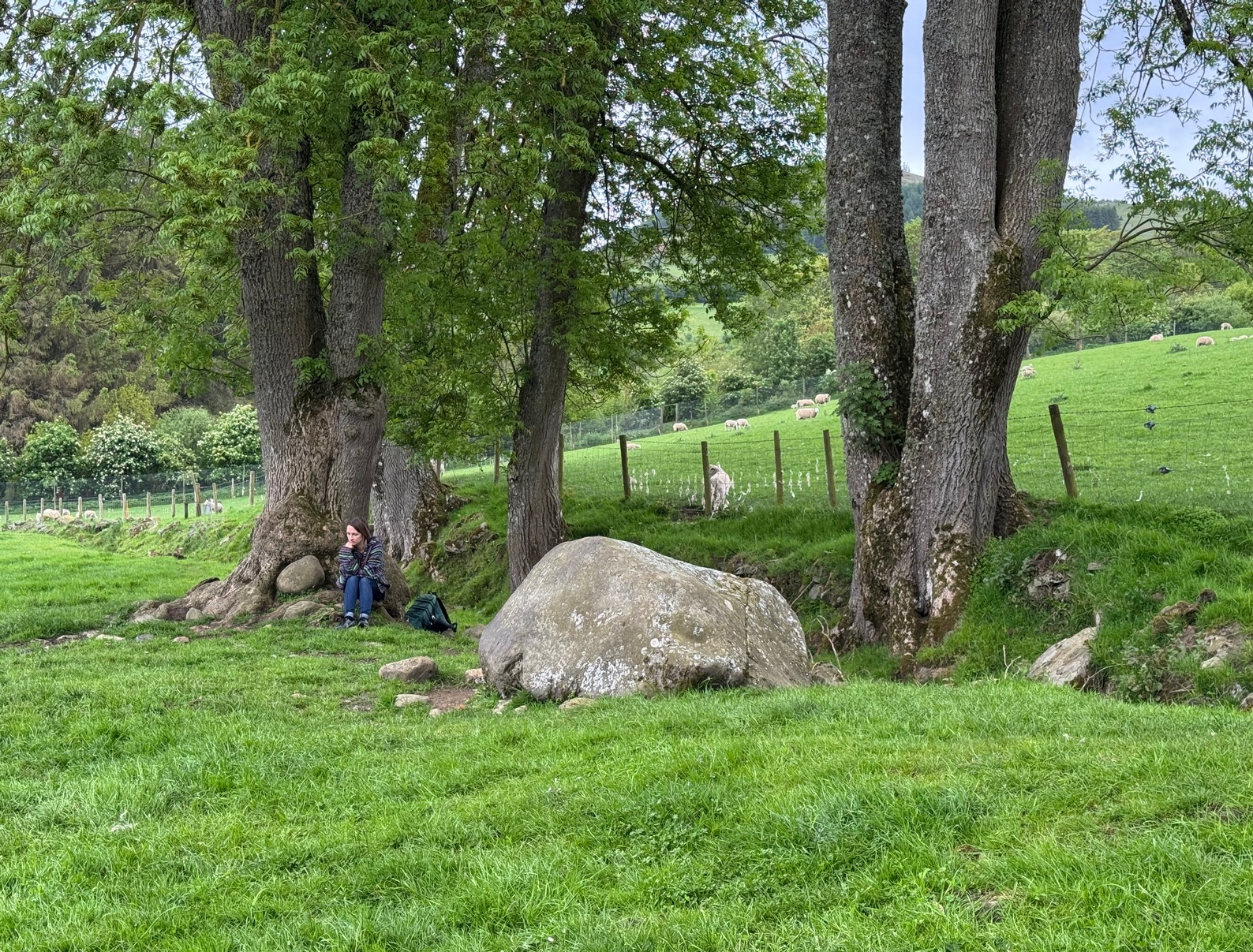
Various ways to get here, but it’s probably easiest if you’re coming via Aberfeldy.  From here, go over the river bridge to Castle Menzies and Weem, but turn right once you’ve crossed the bridge and follow the road parallel to the river for just over 3 miles (4.9km) where you’ll reach a tiny road on your left, going uphill.  You can park the car 150 yards up, on your right – then walk uphill (don’t drive any further).  Walk up the road for just over half-a-mile (0.95km) and take the right turn; go along here for 300 yards where the pond appears and keep walking along the same road for another 250 yards till you reach a cottage by a small crossroads.  From here, walk up (left) for another 300 yards where, near the top of the field, a large boulder sits close to the fence.  You’ve arrived!.

Archaeology & History
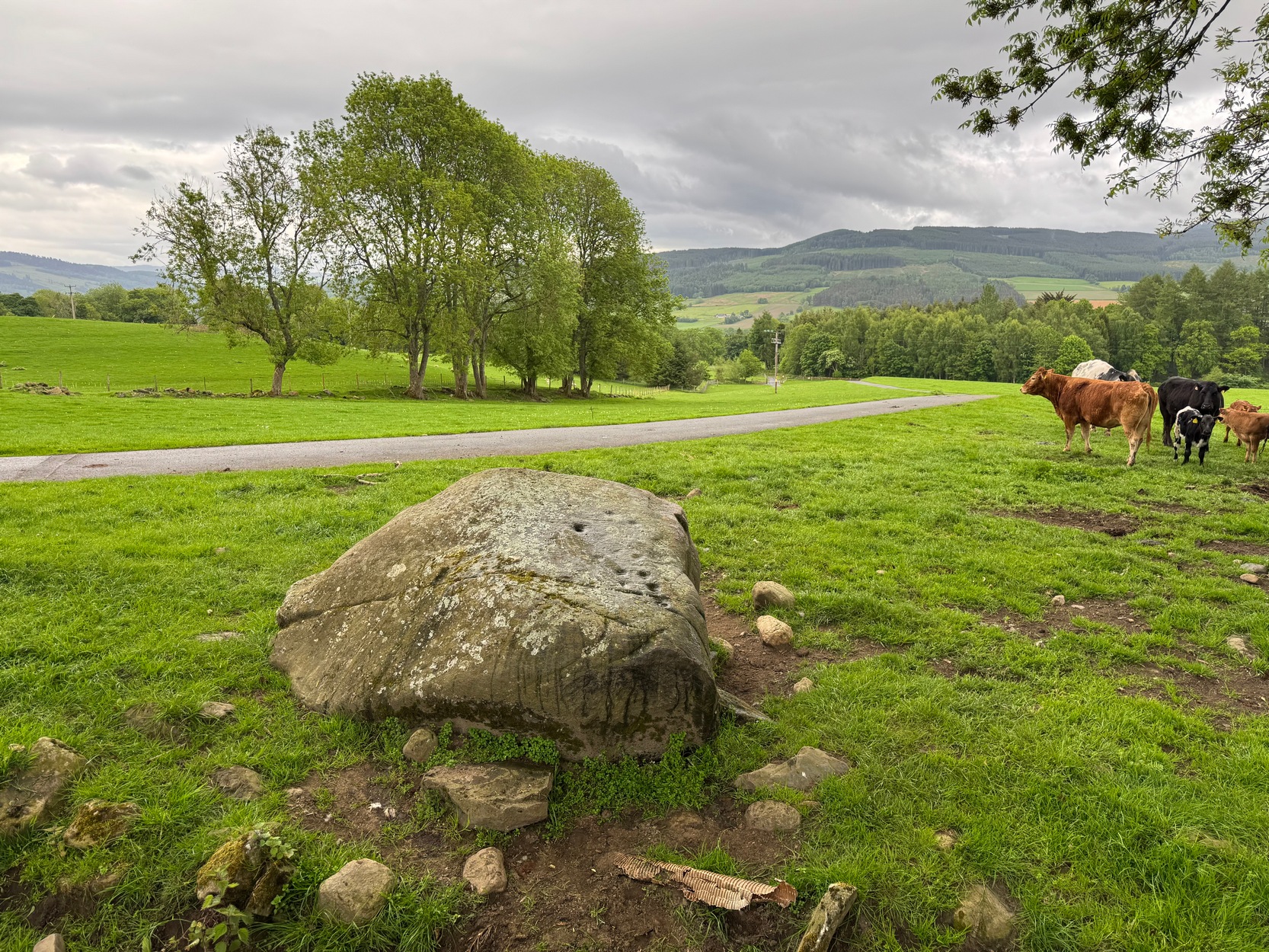
Drumchanachan carving

On the way back down from a bimble to the beautiful and haunted Loch Derculich, Naomi and I stumbled upon this large stone just off the track below Lurgan farmhouse and found there to be a number of cup-marks on its sloping upper surface.  Naomi was really truly excited! 🙂

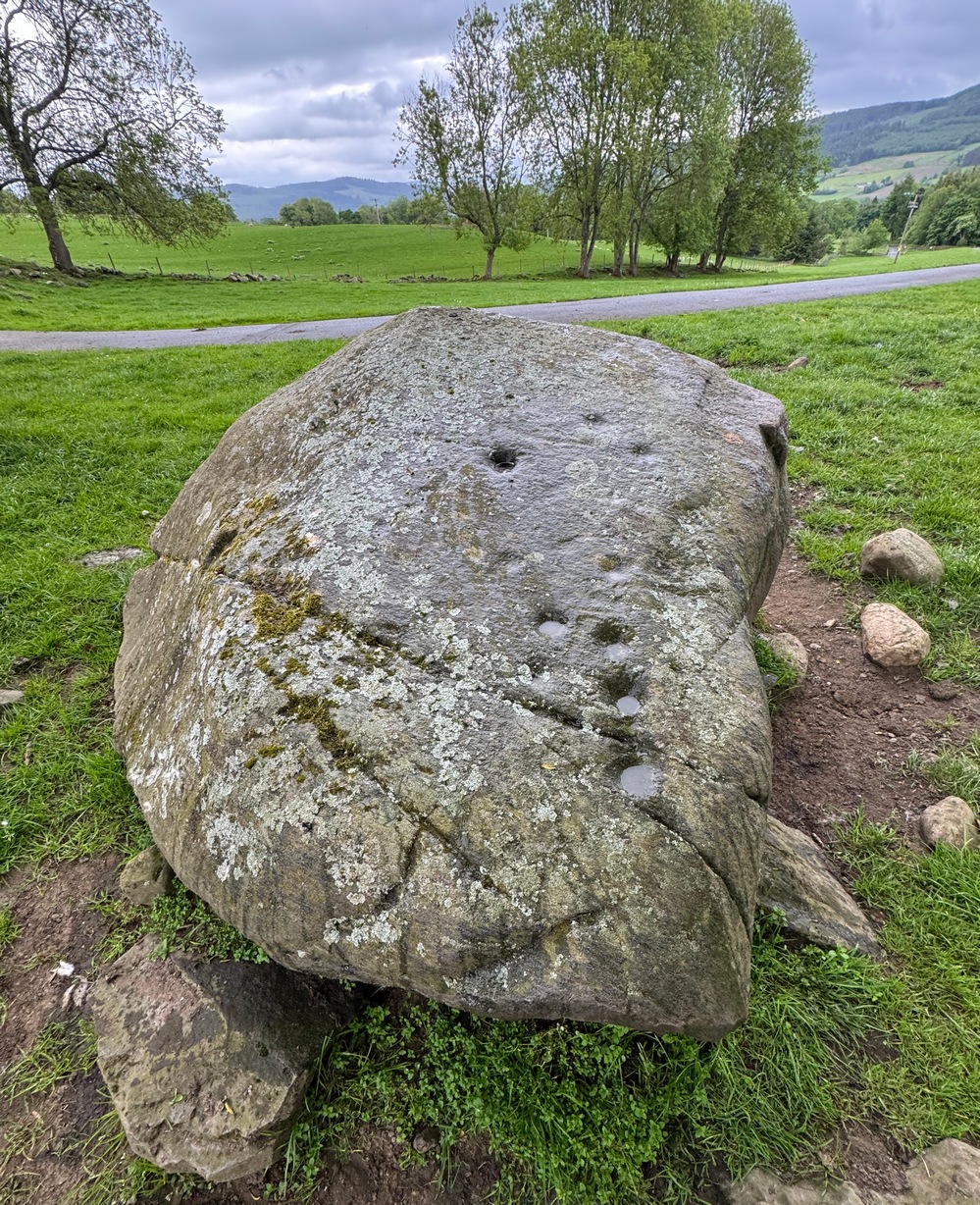
On its northwestern surface there’s is a distinct scattering of cup-marks: one in particular near the middle of the stone that’s been deepened in more recent times, as if it was ready to be blown-up and destroyed but, once realised it was a stone of the fairy folk, the operation was terminated and the stone left here to live!  Thankfully…
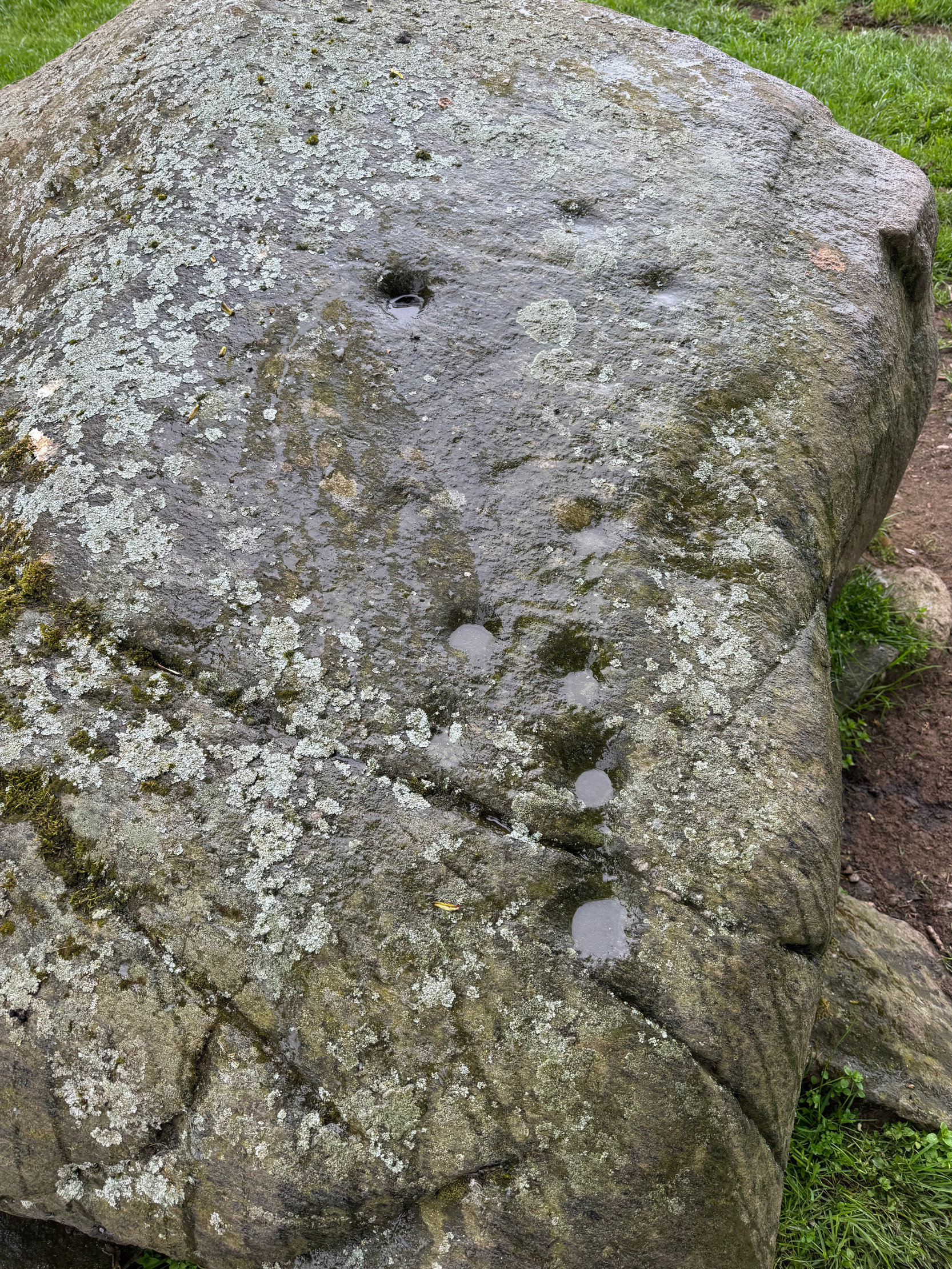
Close-up of cups
Deep lines of cups

It’s a pretty basic design, consisting of at least eleven cup-marks, mainly running in a line upwards along its westernmost side,  following the edge of a natural ridged contour.  Of the two topmost cups, one of them may have a carved line running to it with a faint semi-circle then emerging from the line around the edge of the cup.  But it’s faint—if it’s real—and the daylight was fading when we came here so this and any other design elements that may exist weren’t too easy to see.  Hopefully I’ll get back up here pretty soon and see if there’s anything else hiding beneath the aged shadows.

It’s a wonderful arena above Edradynate, with countless other ancient sites peppered across the landscape hereby…

© Paul BennettThe Northern Antiquarian 

Tobairandonaich, Strathtay, Aberfeldy, Perthshire

Cup-Marked Stone (lost):  OS Grid reference – NN 8866 5320

Also Known as:

  1. Sunday Well
  2. Tobar an Donich

Archaeology & History

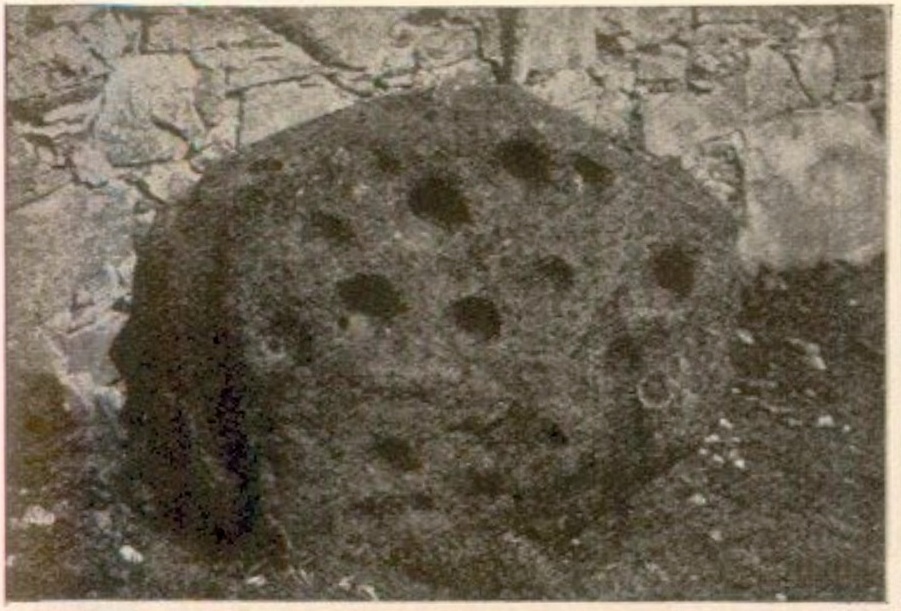
Tobairandonaich stone, c.1920

Located some 30 yards south of a holy well known (in English language) as the Sunday Well, this carving was rediscovered shortly before John Dixon (1922) wrote his survey of petroglyphs in the Strathtay region.  It would seem to have been a large “portable” cup-marked stone that had been placed, face-downward, into an old doorstep at the stable at Easter Tobairandonaich and forgotten about, long long ago.  Then, at the beginning of the 20th century when the people living here had to clear a drain beneath the stable, the stone was moved and the cup-markings were noticed.  The carving was a pretty simplistic design, as you can see, which was described by Mr Dixon as follows:

“The stone…has nineteen cups all on the same face.  The largest cup is 3¾ inches in diameter and 2 inches deep.  The next largest has the same diameter, but is 1½ inch deep.  Other five of the cups are very nearly the same size.  The smallest cup is 1¾ inch in diameter and ½ inch deep, but weathering has effected much towards almost obliterating some of the smaller cups.  The stone is of whinstone with slight veins of quartz.  It is oval in form and varies in thickness from 2½ inches to 4 inches.  Its greatest diameter is 3 feet 2 inches, and its least diameter 2 feet 8 inches.”

Tom MacLaren’s 1921 sketch

The stone would seem to have disappeared as no one has seen it for fifty years or more.  It may (hopefully) be in one of the walls, or perhaps buried somewhere under the soil.  Or maybe, tragically, some fuckwit has destroyed it.  Twouldst be good to find out one way or the other.  The photograph above, taken by Mr Dixon sometime around 1920, is the only thing that remains of the carving.

In this small part of Strathtay we are fortunate in finding a cluster of petroglyphs with folklore about them relating to our faerie and witch folk. Some larger man-made stone “bowls” in the area were also used as “praying stones.”  I have little doubt that the people who originally used this carving as a doorstep were fully aware of the cup-marks—and I’d suggest that they even put it here on purpose, probably as a form of protection from the fairies who might have stolen or caused sickness to the horses.

References:

  1. Dixon, John H., “Cup-Marked Stones in Strathtay, Perthshire,” in Proceedings Society Antiquaries, Scotland, volume 56, 1922.
  2. Kennedy, James, Folklore and Reminiscences of Strathtay and Grandtully, Munro Press: Perth 1927.
  3. Yellowlees, Walter, Cupmarked Stones in Strathtay, Scotland Magazine: Edinburgh 2004.

© Paul BennettThe Northern Antiquarian