Bury Lane (east), East Morton, West Yorkshire

Cup-Marked Stone:  OS Grid Reference – SE 09373 42410

Also Known as:

  1. Carving 51 (Hedges)
  2. Carving 91 (Boughey & Vickerman)

Getting Here

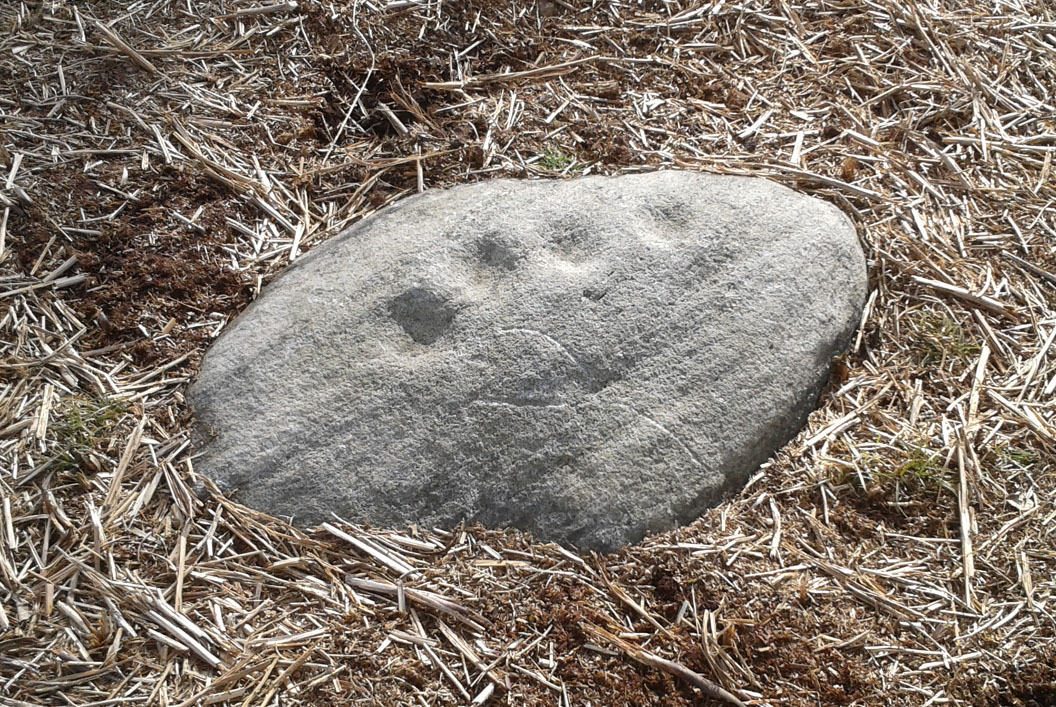
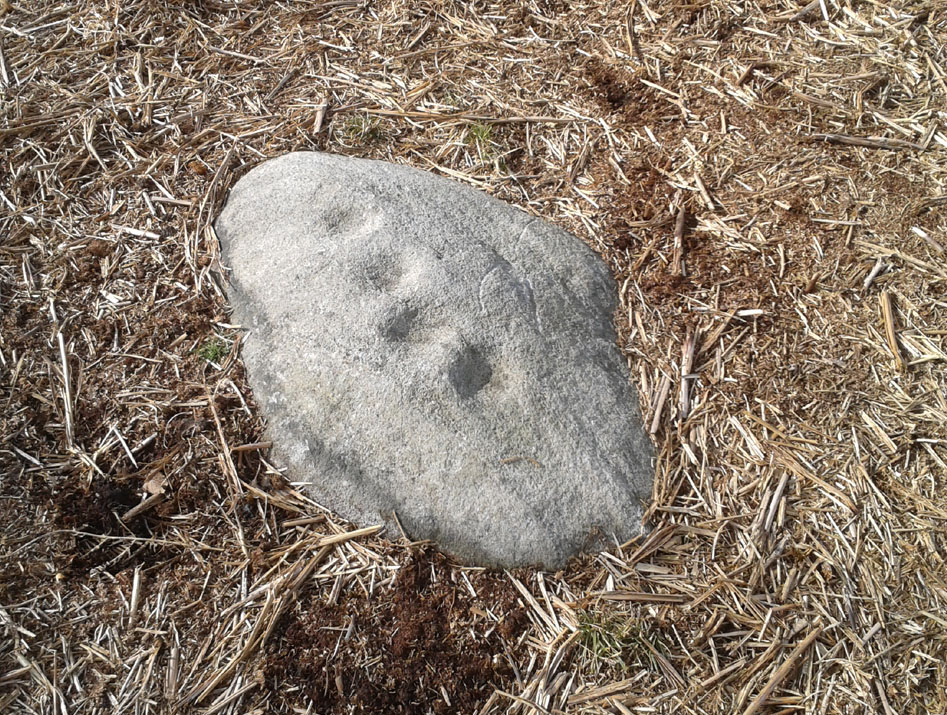
Cup-marked stone, East Morton (photo thanks, Sue Patchett)

From the expanding village of East Morton, by the school at the west-end of the village, walk up the narrow Street Lane for nearly 600 yards, past the houses, until you reach a footpath on your left that takes you across the fields.  Walk along here (following the line of walling) for 250 yards, then, take a sharp left and down the field for 55 yards (50m) until, right beneath the power lines, you’ll find the rock in question.

Archaeology & History

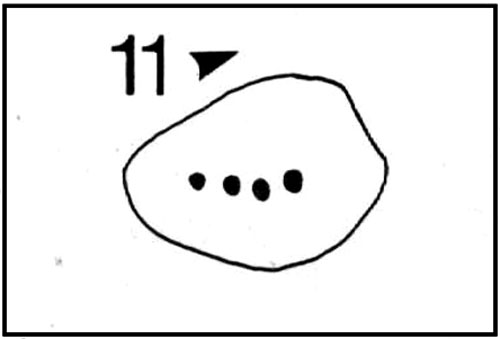
This is one in a small, little-known cluster of  petroglyphs on the western outskirts of East Morton.  It is located at the base of what are thought to be remnants of Iron Age walling.  Carved onto an elongated earthfast stone are a number of very well-preserved cup-marks, with what seems to be a faint carved pecked line running out from one of the southernmost cup-marks and curving back on itself (we could do with a good sketch artist getting us a good drawing of this).  You can see this faint line on the far-left side of the stone in Sue’s photo above.

Hedges 1986 sketch

The petroglyph was rediscovered by the northern antiquarian Stuart Feather (1959) in one of his many sojourns exploring the prehistoric remains of the area.  In John Hedges’ (1986) survey, the carving was described simply as:

“Triangular smooth grit rock with fairly flat top on which are twenty cups, not all clear, some large and oval, a few grooves.”

Boughey & Vickerman’s survey (2003) made no note of any  additional features on the petroglyph.

References:

  1. Boughey, Keith & Vickerman, E.A., Prehistoric Rock Art of the West Riding, WYAS: Wakefield 2003.
  2. Feather, Stuart, “Bronze Age Rock Carvings,” in Keighley News, March 7, 1959.
  3. Hedges, John (ed.), The Carved Rocks on Rombalds Moor, WYMCC: Wakefield 1986.
  4. Jackson, Sidney, “Massive Walling at East Morton,” in Cartwright Hall Archaeology Group Bulletin, 5:9, 1960.
  5. Jackson, Sidney, “East Morton Ancient Walls,” in Cartwright Hall Archaeology Group Bulletin, 6:9, 1961.

Acknowledgements:  Huge thanks to Sue Patchett for use of her photo.  

© Paul Bennett, The Northern Antiquarian 


Vauxhall Well, Lambeth, London, Surrey

Healing Well (destroyed):  OS Grid Reference — TQ 3006 7734

Archaeology & History

Site on 1824 map

In Thomas Allen’s (1827) huge survey of Lambeth parish, he told that there was little of any interest along Wandsworth Road, apart from a good orchard, “and a fine spring called Vauxhall Well.”  According to Daniel Lysons (1792), it was located “not far from the turnpike”; and according to Mr Sunderland’s (1915), was to be found “on the right-hand side of the Wandsworth Road” as you walked down it to the south.  Thankfully its position was highlighted on the 1824 map of the parish (right) that accompanied Mr Allen’s work.

It appears to have been built over in the latter-half of the 19th century, soon after William Thornbury (1878) wrote that he thought the well was still visible, but vanished soon after.

The waters were universally ascribed by all historians, from Mr Allen onwards, as being,

“esteemed highly serviceable in many disorders of the eyes, and in the hardest winter it is never known to freeze.”

The name ‘Vauxhall’ derives from that brilliantly famous family name of ‘Fawkes’ (as in Guy Fawkes), being the ‘hall of Fawkes’.  The name was first recorded here as early as 1241. (Gover et al, 1934)

References:

  1. Allen, Thomas, The History and Antiquities of the Parish of Lambeth, J. Allen: London 1827.
  2. Foord, Alfred Stanley, Springs, Streams and Spas of London: History and Association, T. Fisher Unwin: London 1910.
  3. Gover, J.E.B., Mawer, A. & Stenton, F.M., The Place-Names of Surrey, Cambridge University Press 1934.
  4. Lysons, Daniel, The Environs of London – volume 1,  T. Cadell & W. Davies: London 1792.
  5. Sunderland, Septimus, Old London Spas, Baths and Wells, John Bale: London 1915.
  6. Thornbury, William, History of Old and New London – volume 6, Cassell, Petter & Galpin: London 1878.

© Paul BennettThe Northern Antiquarian 


Stratford St. Mary Cursus, Suffolk

Cursus Monument:  OS Grid Reference – TM 0486 3433

Archaeology & History

Faint flat outline of SE end + ancient circular enclosure

This short and dead straight cursus monument was first described in John Hedges’ (1981) survey, and later mentioned in Harding & Lee’s (1987) corpus on British henges as being in conjunction with a series of circular prehistoric monuments (three circular enclosures existed beyond its southeast and one to its northeast edges, one of which is visible in the aerial image, right).

Cursus ground-plan (courtesy Suffolk Institute Archaeology)

Most of the monument has been completely destroyed by roads and housing, but when complete was said to be 317 yards (290m) long, running from the southeast to the northwest.  The flattened southeastern edge measures nearly 63 yards (57.3m) across, and its northernmost width was close to 65 yards (60m) wide.

In Patrick Taylor’s (2015) assessment of this (and other monuments) he thought that the cursus may have served an astronomical function.  He may be right.  It’s alignment, he told,

“has a very clear orientation 38.5º north of grid west.  This represents an amplitude from true west of 40.9º.  Allowing for a latitude of 51.97º and altitude of 0.95º, adjusted downwards for refraction to 0.50º, we get from (Alexander) Thom’s table a declination for a body setting to the northwest of 24.15.º  This is only 0.23º, just less than half the width of the sun’s disc, more than the sun’s maximum declination in Neolithic times of 23.92º.  The alignment thus points rather accurately towards the upper limb or last setting point of the sun.”

Faint remnants of a second cursus monument have been discovered 400 yards to the east.

References:

  1. Harding, A.F. & Lee, G.E.,, Henge Monuments and Related Sites of Great Britain, BAR 175: Oxford 1987.
  2. Hedges, John D. & Buckley, David, Springfield Cursus and the Cursus Problem, ECC 1981.
  3. Last, Jonathan, “Out of Line: Cursuses and Monument Typology in Eastern England,” in Barclay & Harding’s Pathways & Ceremonies, Oxbow: Oxford 1999.
  4. Martin, Edward A., “When is a Henge not a Henge?” in Proceedings of the Suffolk Institute for Archaeology & History, volume 35, 1981.
  5. Taylor, Patrick, Timber Circles in the East, Polystar: Ipswich 2015.

AcknowledgementsMany thanks to the Suffolk Institute of Archaeology and History, for use of their ground-plan diagram from Edward Armstrong’s article, ‘When is a Henge Not a Henge?’ 

© Paul BennettThe Northern Antiquarian


Holy Well, Didsbury, Manchester, Lancashire

Holy Well (destroyed?):  OS Grid Reference — SJ 8464 9036

Archaeology & History

In Henry Taylor’s gigantic survey on the Ancient Crosses and Holy Wells of Lancashire (1906), he told that “records of the existence of holy wells in this (district) are scanty in the extreme.”  Indeed.  He certainly missed this one which, it seems (if modern lore is correct), has sadly fallen prey to that sickness which those ghastly people call ‘progress’.  Cited to have been in or near the old graveyard of St. James church in the old village, this once ever-flowing spring of water was of great repute in earlier centuries, not only for general health, magick and traditions, but also supposedly in prolonging life itself!

One of the standard historians of Didsbury, Mr Fletcher Moss (1898), was of the view that this Well may have been the “origin of Didsbury, the place the Saxon settlers would choose first for their church and community.”  He may be right.  He told that,

“It was said ‘to be holy in papist times.’  Only last summer I several times saw three young ladies who came every morning to bathe their eyes and faces in it, saying, “It was good for sore eyes.”  I could not see anything the matter with their eyes, but that may have been my ignorance, or that they were already getting better. In the spring time or early in May the well has often been nearly choked with wild flowers, and pins have been put in for luck.  If rags or crutches were ever left there, it was when the water bubbled up in the roadway on the hillside.  The flow of it is lessened by drains or sewers, and now it is taken down in pipes.  The lane is enclosed with brick walls, and all the romance is gone; but in the longest drought or severest frost the water from the holy well has never failed, and though it may come from the churchyard, we and many others drink no other.”

In an earlier passage (Moss 1891), he talked about the longevity and good health of the local people and who credited the good water here:

“Like most of the old Didsbury folk who never bothered with doctors or change of air, Sam Gaskill, the last clerk, lived to be long past the fourscore years, for I remember him and others much older than he was, regularly going to the Holy Well for the water for their households.  As in patriarchal and primitive times the villagers went to the well or spring at eventide and tarried and talked while the water flowed.  It mattered nought to them that the water flowed from the churchyard, from the burial-place of their forefathers; they had always been healthy as their forefathers had been healthy, and they wanted no other water and would have no other; that always bubbled up fresh and sparkling in summer or winter, in drought or frost, and never failed.”

Nearby to the east, spirits of the dead were said to come from the old trees of Parrs Wood, long since destroyed by those self-righteous Industrialists…

References:

  1. Million, Ivor R., A History of Didsbury, E. J. Morten 1969
  2. Moss, Fletcher, Didisburye in the ’45, Cornish: Manchester 1891.
  3. Moss, Fletcher, Folklore, Old Customs and Tales of My Neighbours, privately printed: Manchester 1898.

Acknowledgements:  With big thanks to Bret Gaunt, Paul Hornby and Geraldine Dowsing for their input.

© Paul BennettThe Northern Antiquarian 


Gatepost Stone, Ilkley Moor, West Yorkshire

Cup-and-Ring Stone:  OS Grid Reference – SE 09497 46961

Getting Here

Cup-and-rings on gatepost (photo credit, Dave Whittaker)

From Ilkley, follow the same directions as if you’re going up to the superb Swastika Stone.  Keep walking on the footpath, west, for 65 yards (59m), then walk into the heather on your left.  Barely 5 yards in, you’ll see this fallen standing stone or gatepost.

Archaeology & History

First described in one of Stuart Feather’s (1964) old rambles, I first saw this stone in my late-teens and was as puzzled by it then as I am today.  Upon an obviously worked stone that may once have stood upright (or was intended to do), two faint and incomplete cup-and-rings were carved – but when exactly?  If this stone was cut from a larger rock into its present shape, were the petroglyphs already on it, or were they done when the ‘gatepost’ was created?

It was first described in one of Stuart Feather’s (1964) rambles up here and later included in Hedges’ (1986) survey, where he told it to be a, “recumbent gatepost with one cup with almost complete ring and one cup with vestigial ring.”  Boughey & Vickerman’s (2003) survey added little more.  And when a group calling itself Carved Stones Investigation got itself about £250,000 to “investigate” the Ilkley petroglyphs, I was hoping that they could have at least turned this stone over to see if other carvings were on the stone – but they just revisited all those found by others, made a new list, and took the money to be honest (no website and no book – as they should’ve done).  Thankfully, local folk are having a look at this and others and doing the work they should have.  Check it out when you’re next up at the Swastika.

References:

  1. Bennett, Paul, Megalithic Ramblings between Ilkley and Baildon, unpublished: Shipley 1982.
  2. Boughey, Keith & Vickerman, E.A., Prehistoric Rock Art of the West Riding, WYAS: Wakefield 2003.
  3. Feather, Stuart, “Mid-Wharfedale Cup-and-Ring Markings: no.26, 27, 28 – Black Pots, High Moor, Silsden, near Keighley,” in Cartwright Hall Archaeology Group Bulletin, 9:10, 1964.
  4. Hedges, John, The Carved Rocks on Rombalds Moor, WYMCC: Wakefield 1986.

AcknowledgementsHuge thanks to Dave Whittaker for the photo.  Good luck with the plans fellas.

© Paul BennettThe Northern Antiquarian 


Barton Cross, Barton, Preston, Lancashire

Wayside Cross: OS Grid Reference – SD 53502 37332

Also Known as:

  1. Historic England Grade II Listed Monument 1073555

Getting Here

The Barton Cross from the road, showing the original socketed base and the cup marked paving stone to the right.

The cross is at the roadside on the south side of Barton Lane at the cross roads with the minor road between Cross House Farm and Barton House.

Archaeology and History

All that survives is the socketed base of a mediaeval cross on a raised paved platform with low raised square section pillars at each corner. Behind the original cross socket stands a large stone block (Described in the Historic England citation as “probably part of a cheese press“) surmounted by a pyramidal block upon which a modern carved stone cross has been placed.

Henry Taylor (1906) writes in his Ancient Crosses and Holy Wells of Lancashire:

The South face of the Cross

Barton Cross. These words occur on the map in ancient Gothic letters in Barton Lane, one and a half miles in a westerly direction from Goosnargh Church, showing that in the year 1848 a complete cross stood here. The site is at the intersection of country lanes, and the map shows a small recess or lay-bye in which the cross was planted. Mr. Collinson [Reverend S.E. Collinson, Vicar of Broughton] writes that the base was thrown into a neighbouring pit at the time Daniel’s pedestal was buried. The base and part of the shaft of the Barton Cross have lately been restored to the old site. A new cross has been erected just behind by Mr. Myerscough.
Mr. Collinson tells me that in going through some of the old parish registers he found an entry referring to ‘Barton Christ’. He not unnaturally thinks that there must have been a figure on the Cross giving rise to the name. Nothing else would account for it. The neighbourhood of Barton (a pre-Norman settlement) is interesting and deserves a thorough investigation.

The ‘Daniel’s pedestal’ refers to Daniels Cross, near Broughton, of which Taylor writes:

The base was removed about sixty years ago. It is now in a neighbouring pit. The facts were obtained from an old man who helped at the destruction of this landmark.”

The 1895 6″ map showing the Cross, with the nearby marl-pits coloured blue

The pyramidal stone block upon which the modern cross stands is inscribed on the northern face: “Barton Cross re-erected by Councillor R. Myerscough of Preston 1901” while the southern face is inscribed: “Refurbished by Barton Parish council 2000“.

One of the paving stones that surround the cross has pre-historic cup markings on it, and is the subject of a separate site profile.

Bearing in mind what was written about the original cross having been ‘thrown into a neighbouring pit’, it may be worth probing the nearby marl pits to see whether the original could be found.

Reference:

  1. Taylor, Henry, The Ancient Crosses and Holy Wells of Lancashire, Manchester, Sherratt and Hughes, 1906

© Paul T. Hornby, The Northern Antiquarian 2017


Cow Keeper’s Field (1), Boulby, Easington, North Yorkshire

Cup-Marked Stone:  OS Grid Reference – NZ 75398 19218

Also Known as:

  1. BOU-5 (Brown & Chappell)

Archaeology & History

Cup-marked stone inside Cow keepers Field tomb

Inside the once prominent prehistoric tomb on the Cow Keeper’s Field, the northern antiquarians William Hornsby and John Laverick (1920) came across two small petroglyphs in association with a cremation burial, several feet south of the central cist: the Cow Keeper’s Field 2 carving, plus this small, triangular-shaped stone, 8in by 6in, consisting of five standard cup-marks, with two of the cups (as the photo shows) connected to each other.  It is akin to the numerous ‘portable’ cup-marked stones which, in other cultures, were deposited onto cairns in remembrance of the ancestral spirits of the tomb.  Such widespread practices may also have occurred here.  Petroglyph researcher and writer Graeme Chappell (2017) informed us that the carving “is in storage in the Dorman museum in Middlesborough.”

References:

  1. Brown, Paul & Chappell, Graeme, Prehistoric Rock Art in the North York Moors, Tempus: Stroud 2005.
  2. Chappell, Graeme, Personal communication, October 4, 2017.
  3. Crawford, G.M., Bronze Age Burial Mounds in Cleveland, Cleveland County Council 1990.
  4. Elgee, Frank, Early Man in North-East Yorkshire, John Bellows: Gloucester 1930.
  5. Hornsby, William & Laverick, John D., “British Barrows round Boulby,” in Yorkshire Archaeological Journal, volume 25, 1920.

© Paul BennettThe Northern Antiquarian 


Cow Keeper’s Field (2), Boulby, Easington, North Yorkshire

Cup-and-Line Stone:  OS Grid Reference – NZ 75402 19222

Also Known as:

  1. BOU-5 (Brown & Chappell)

Archaeology & History

Cup-marks and linear forms

Inside the once prominent prehistoric tumulus on the Cow Keeper’s Field (now destroyed), the northern antiquarians William Hornsby and John Laverick (1920) came across two small portable petroglyphs: the Cow Keeper’s Field 1 carving, plus this “peculiarly marked stone” as they put it, some “5ft south of the centre” where a cist, or stone-lined burial existed.  Measuring 18in by 7in, the rock carving consists of at least one large cup-marking which is clearly evident on top of the stone, plus what seems to be another one next to it, half-covered.  Along the side of the stone, a series of twelve roughly parallel lines have been carved out, running down to the bottom of the stone.  Rock art researcher and writer Graeme Chappell (2017) tells us the carving is supposed to be “in storage in the Dorman museum in Middlesborough,” although no one has seen it in years.  It would be worthwhile if fellow research students could visit the said museum to recover this and other portable cup-marked stones that were found in the area.

References:

  1. Brown, Paul & Chappell, Graeme, Prehistoric Rock Art in the North York Moors, Tempus: Stroud 2005.
  2. Chappell, Graeme, Personal communication, October 4, 2017.
  3. Crawford, G.M., Bronze Age Burial Mounds in Cleveland, Cleveland County Council 1990.
  4. Elgee, Frank, Early Man in North-East Yorkshire, John Bellows: Gloucester 1930.
  5. Hornsby, William & Laverick, John D., “British Barrows round Boulby,” in Yorkshire Archaeological Journal, volume 25, 1920.

© Paul BennettThe Northern Antiquarian


Cow Keepers Field, Boulby, Easington, North Yorkshire

Tumulus (destroyed):  OS Grid Reference – NZ 75400 19220

Also Known as:

  1. Boulby Barns

Archaeology & History

This prehistoric tomb was one in a cluster of tumuli in the Boulby district, uncovered by the northern antiquarians, William Hornsby and John Laverick in 1918.   Most of them have subsequently been destroyed – this one included.  When they visited the site, they described it as “a barrow…with a diameter of 36 feet.”  Once they began digging into it,

“at the centre we found a cist, the top of which was 2ft 7in below the present surface. The cist lay north 64° west, and south 64° east.  It had no cover and the slab at the north-west end was wanting.  The cist measured: side 3ft 6in, end 3ft 2in.  Its depth was 2ft 2in.  In it we found nothing except sandstone chips.  With these there was no admixture of soil. Above the cist and covering a space of 5 ft by 5 ft there was a layer of burnt earth and black ashes (of furze bushes).  At a distance of 5 ft south of the centre, and 1ft 10in below the present surface, there was a burnt burial, 20in in diameter.  With this we found many flint chips, a shale pendant, and the peculiarly marked stone” we’ve called, simply the Cow Keeper’s Field 2 carving.

A second cup-marked stone was also found inside the tomb, a few feet south of the cist. When G.M. Crawford went to survey the burial mound in the late 1970s, he reported “there is no trace of it” and “has probably been destroyed by ploughing.”

References:

  1. Brown, Paul & Chappell, Graeme, Prehistoric Rock Art in the North York Moors, Tempus: Stroud 2005.
  2. Crawford, G.M., Bronze Age Burial Mounds in Cleveland, Cleveland County Council 1990.
  3. Elgee, Frank, Early Man in North-East Yorkshire, John Bellows: Gloucester 1930.
  4. Hornsby, William & Laverick, John D., “British Barrows round Boulby,” in Yorkshire Archaeological Journal, volume 25, 1920.

© Paul BennettThe Northern Antiquarian 


Lytham Cross, Lytham, Lancashire

Wayside Cross: OS Grid Reference – SD 3603 2718

Getting Here

Roadside position of the cross

The cross is situated in a small railed enclosure adjoining the pavement on the North side of Church Road on the west side of Lytham, opposite Lowther Gardens.

Archaeology & History

Henry Taylor (1906), author of The Ancient Crosses And Holy Wells Of Lancashire, writes:

“The old market place of Lytham is triangular in shape…Church Road leads out of it, and not far from the church the pedestal of an ancient cross was at one time to be seen. The words ‘Site of Benedictine Priory’ occur on the map close to Lytham Hall, indicating the position of this small religious house, dedicated to SS Mary and Cuthbert, and subject to Durham.”

The mediaeval base set into the pavement in 2009

Lieutenant-Colonel Fishwick writes in his History of the Parish of Lytham:

“Not far from the Parish church on the road to Blackpool is still to be seen the stone socket of a cross, and tradition says that it marks one of the resting places of the body of St. Cuthbert when carried to Durham”

All that survives of the mediaeval original is the socketed base, into which a modern carved stone cross has been inserted. A bronze plaque attached to the cross reads:  “According to ancient tradition the body of St Cuthbert about the year 882AD once rested here.”

The modern cross with its bronze plaque.

It is not known whether the destruction of the original cross was the handywork of the local ‘Cross Smasher’ Rev. Richard Wilkinson.

According to an online source, The Very Reverend Monsignor Gradley commissioned a painting by Charles E. Turner entitled: ‘The Monks of Lindisfarne arriving at Lytham with the body of St. Cuthbert, A.D. 878’, intended to be hung in St Joseph’s Seminary, Upholland.  Gradley wrote in the October 1889 edition of Merry England magazine:-

” In 875 Halfdene invaded Bernicia, the northern portion of Northumbria, . . . Lindisfarne was no longer a safe place for the monks, and they dared no longer expose their great treasure, the relics of St. Cuthbert, to the ruthless impiety of the northern hordes, With their Bishop Eardulf they set out on a weary pilgrimage of seven years.… From Yorkshire they proceeded to Lancashire, and as we find that the holy relics rested at Mellor, near Blackburn, we may suppose they would journey through Ribblesdale, passing on their way the ruined city of Bolmetonacae, the modern Ribchester. They were a numerous company, for besides the venerable Bishop Eardulf there were the Abbot of Carlisle, the monks of Lindisfarne, and many of the natives of that island. In going to Lytham it is probable the party would pass through Preston, where a few houses had gathered about the church built in honour of St. Wilfrid, the great contemporary of St. Cuthbert.

‘The Monks of Lindisfarne arriving at Lytham with the body of St. Cuthbert, A.D. 878’, by Charles E. Turner.

Their way from Preston to Lytham lay through a country abounding in forest and fen. But they would have the advantage of the old Roman road as far as Kirkham. However, the pilgrims met with a hospitable reception, and to this day Lytham is the seaside home of St. Cuthbert on our western coast.”

A small plaque on an adjacent bench records that the cross was re-dedicated by the Very Reverend Michael Sadgrove, M.A., Dean of Durham on Sunday 6th September 2009.

References:

  1. Taylor, Henry, The Ancient Crosses and Holy Wells of Lancashire, Manchester, Sherratt and Hughes, 1906.
  2. Fishwick, Lieutenant-Colonel, The History of the Parish of Lytham in the County of Lancaster, Manchester, The Chetham Society, 1907.
  3. Gradley, Most Reverend Monsignor, Article in the October 1889 edition of Merry England magazine, abstracted by www.amounderness.co.uk

Acknowledgements:  With thanks to Sue Ybarras for directing me to this site.

© Paul T. Hornby, The Northern Antiquarian 2017