Cow Clout Stone, Parton, Kirkcudbrightshire

Legendary Rock:  OS Grid Reference – NX 6694 7336

Also Known as:

  1. Cowcloot Stone

Getting here

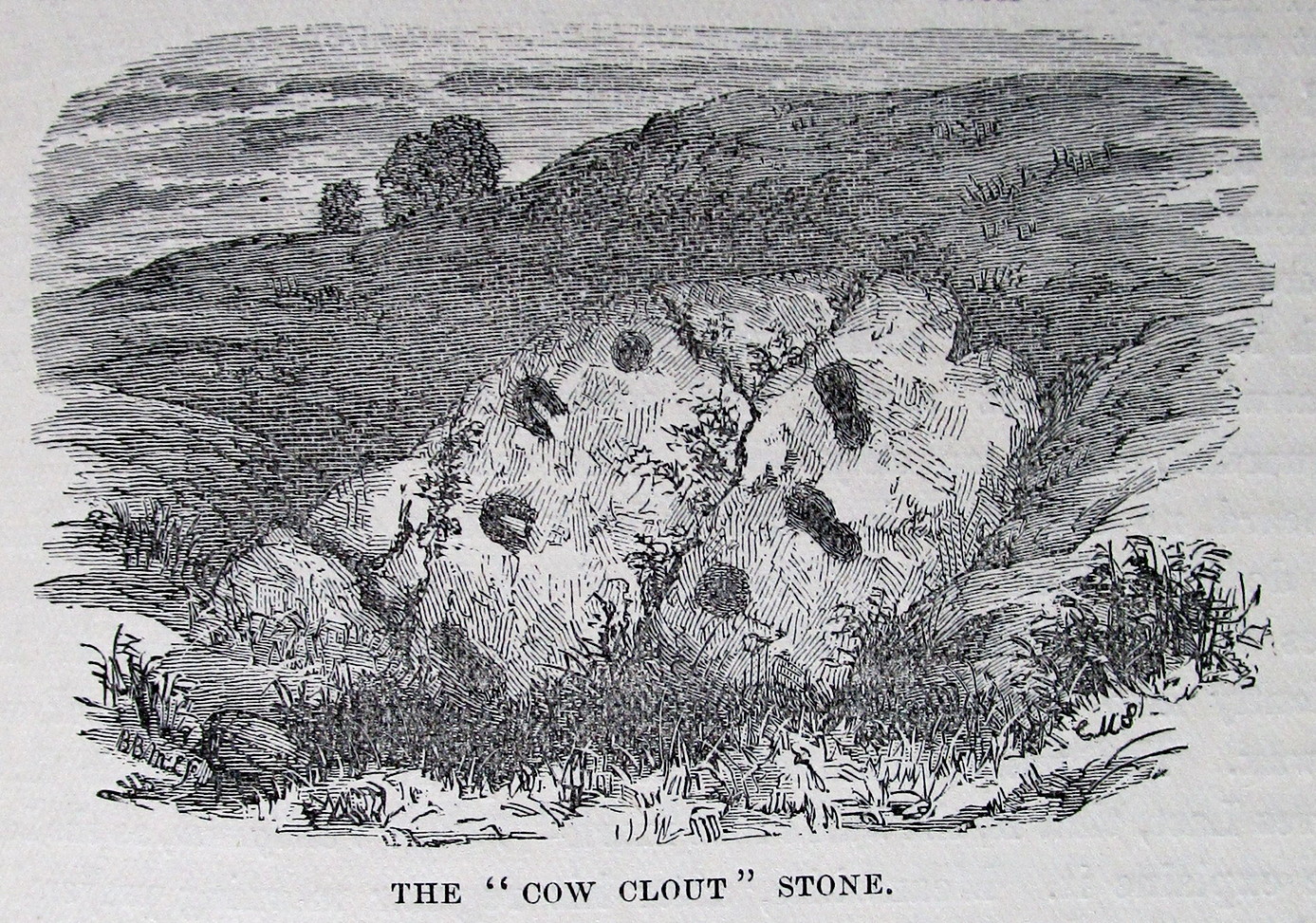
Harper’s 1876 sketch of the Cow Clout Stone

OK—I’m cheating here, as I’ve not visited this site (bad of me!).  The directions given here are from Harper’s 1876 Rambles in this area.  He told that the stone “stands about 100 yards to the north of the march dyke betwixt Upper Ervie, now Ken-Ervie and Nether Ervie. There is little to indicate its whereabouts, but the visitor coming from Kenmure Bridge, and leaving the road on the left, opposite Ringour and Bennan farms, on the opposite side of Loch Ken, would come upon it without much trouble by following the march dyke half a mile up.”  Basically, along the A713 just over 2 miles north of the bridge at Parton (½ mile before reaching the Galloway Activity Centre), 60 yards from the “Farm Access No Parking” spot, in the trees a long straight line of walling runs uphill.  That’d be my route—straight up!

Archaeology & History

This is a curious entry that I’ve added without visiting the site; but as I might never get to see it I thought it should be displayed in the hope that others might check it out.  The earliest literary reference to it is from Crosbie’s (1845) entry in the New Statistical Account, where he implies that the markings on the stone are not of Nature’s handiwork.  In Malcolm Harper’s (1876) fine work exploring the history and folklore of this region, he gave us the first illustration of the stone, which looks suspiciously like elements that we find on cup-and-ring stones.  Many years later when the Royal Commission (1914) lads followed up on Crosbie’s entry, they thought the markings were probably Nature’s handiwork.  They told that:

“It is an irregular mass of outcropping rock about 3 feet in diameter, and bears on its surface certain depressed markings supposed to represent a cow’s foot, a horse-shoe, and impressions which might be made by a man’s foot and knee in the act of kneeling. The markings appear to be natural.”

But it’s the animistic elements and traditions here which are important and which gave the stone its very name…

Folklore

When Rev. W.G. Crosbie (1845) first wrote about this stone, he was narrating the tale told of it by local people, whose traditions were greatly neglected by the majority of writers at that time.  Such stories should be preserved at all times, as they tell us more about the psychocosms of pre-industrial cultures.  Here,

“On the farm of Arvie, there is a flat stone about three feet in diameter, on which are the marks of what might be supposed a cow’s foot, a horse shoe, the four nails on each side being very distinct, and the impression which might be made by a man’s foot and knee while he was in the act of kneeling, the knot of the garter being quite evident.  The tradition connected with this remarkable stone, commonly called the ‘Cow Clout,’ is, that the proprietor, in order to get up arrears of rent, “drave the pun,” or in other words, carried off the hypothecated stock, while a fierce resistance was made by the people, and that over this stone, on which a man had just been praying for relief against his enemies, the cattle passed followed by an officer on horseback, and that it remains as a memorial to posterity of the cruel deed.”

If someone in that neck o’ the woods can find out if the stone’s still there and perhaps send us a photo, or stick it on our Facebook group, that’d be great! 🙂

References:

  1. Coles, Fred, “The Recent Cup and Ring Mark Discoveries in Kirkcudbrightshire”, in Proceedings Dumfriesshire & Galloway Natural History and Antiquarian Society, volume 5, 1888.
  2. Crosbie, W.G., “Parish of Parton,” in New Statistical Account of Scotland – volume 4, William Blackwood: Edinburgh 1845.
  3. Harper, Malcolm M., Rambles in Galloway, Edmonston & Douglas: Edinburgh 1876.
  4. Royal Commission Ancient & Historical Monuments & Constructions of Scotland, Inventory of Monuments and Constructions in Galloway – volume 2: County of the Stewatry of Kirkcudbrightshire , HMSO: Edinburgh 1914.

© Paul BennettThe Northern Antiquarian
Intake Farm, Hawksworth, West Yorkshire

Cup-Marked Stone:  OS Grid Reference – SE 15867 41244

Getting Here

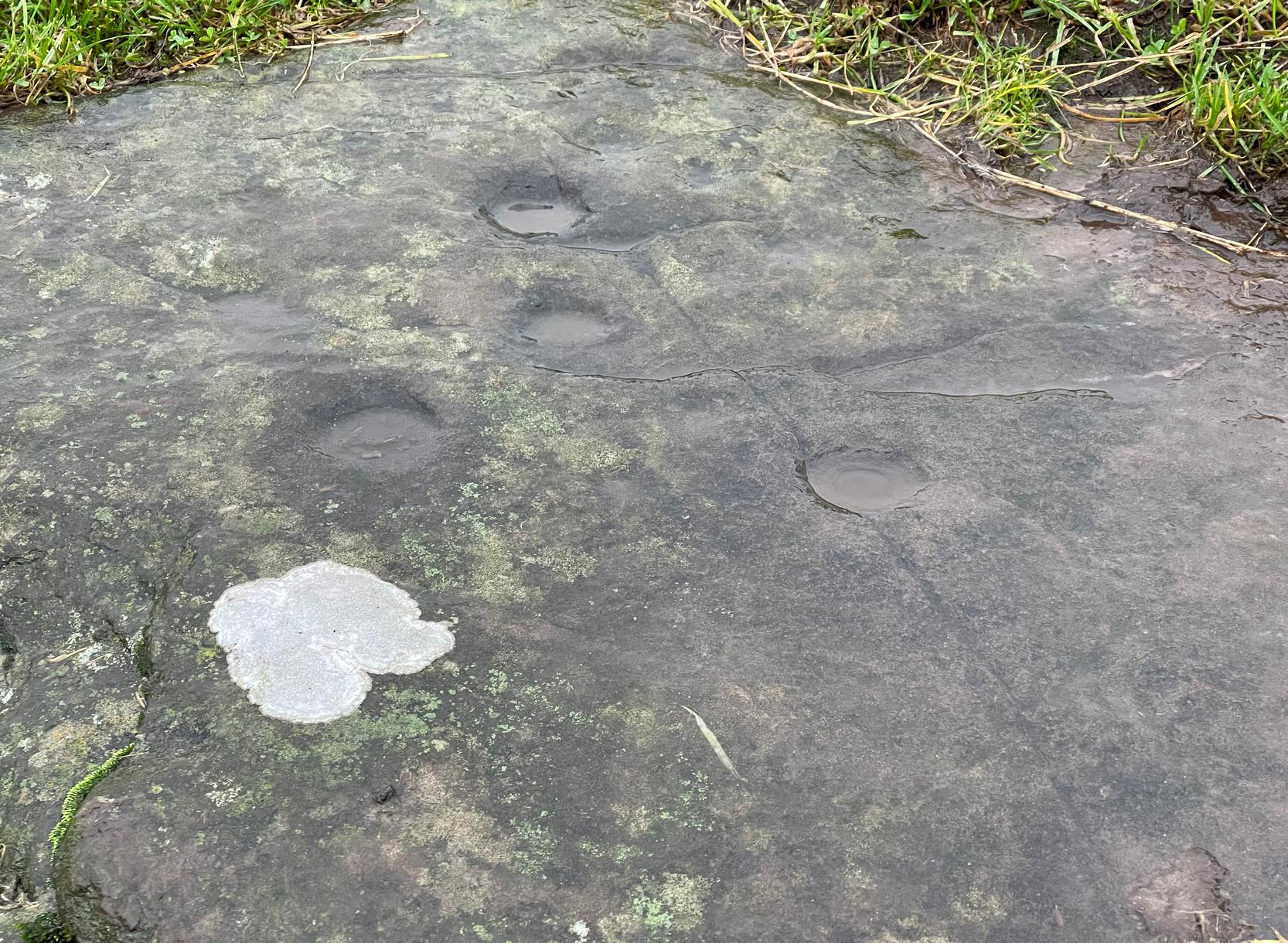
Intake Farm carving

In Hawksworth village, less than 100 yards past the primary school, take the footpath on your left into the open fields.  200 yards down the fields, go over the stile on your right, into the next field and walk diagonally across it (SW) for 250 yards until you reach the wall; then walk alongside it, west, for another 150 yards where the walling goes due south and walk down here for 135 yards, going through the gate at the bottom into the next field and, at the bottom of this one go through the gate and bear right.  OK, now walk along the wall-side for 55 yards and you’re just about standing on it!  Alternatively you can reach it via the Hawksworth Spring (1) and (4) carvings, following the wall along for roughly 150 yards till you reach the gate. Go through here and walk diagonally NNW across the field for nearly 150 yards where you’ll see the stone stuck out in front of the wall.

Archaeology & History

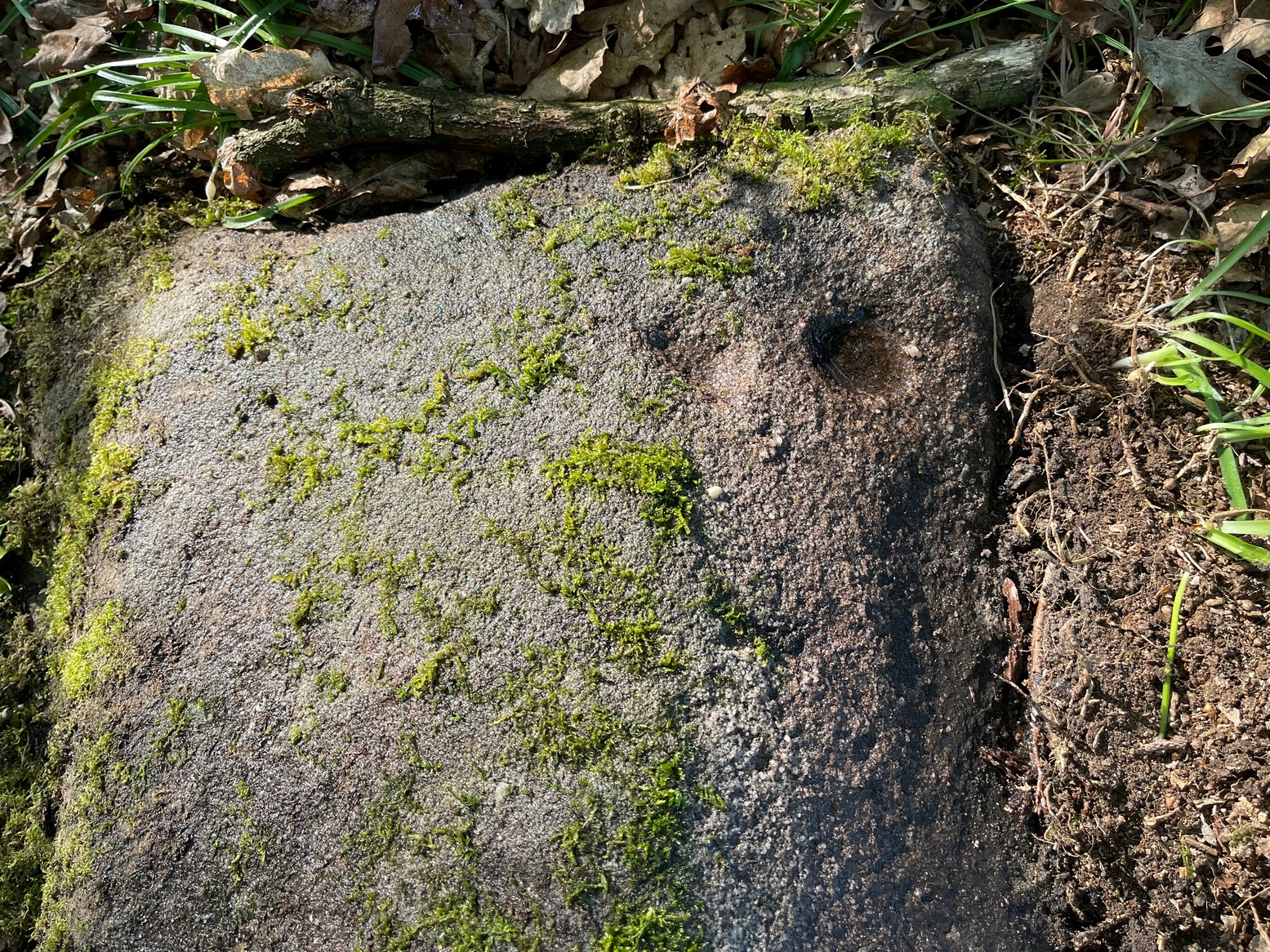
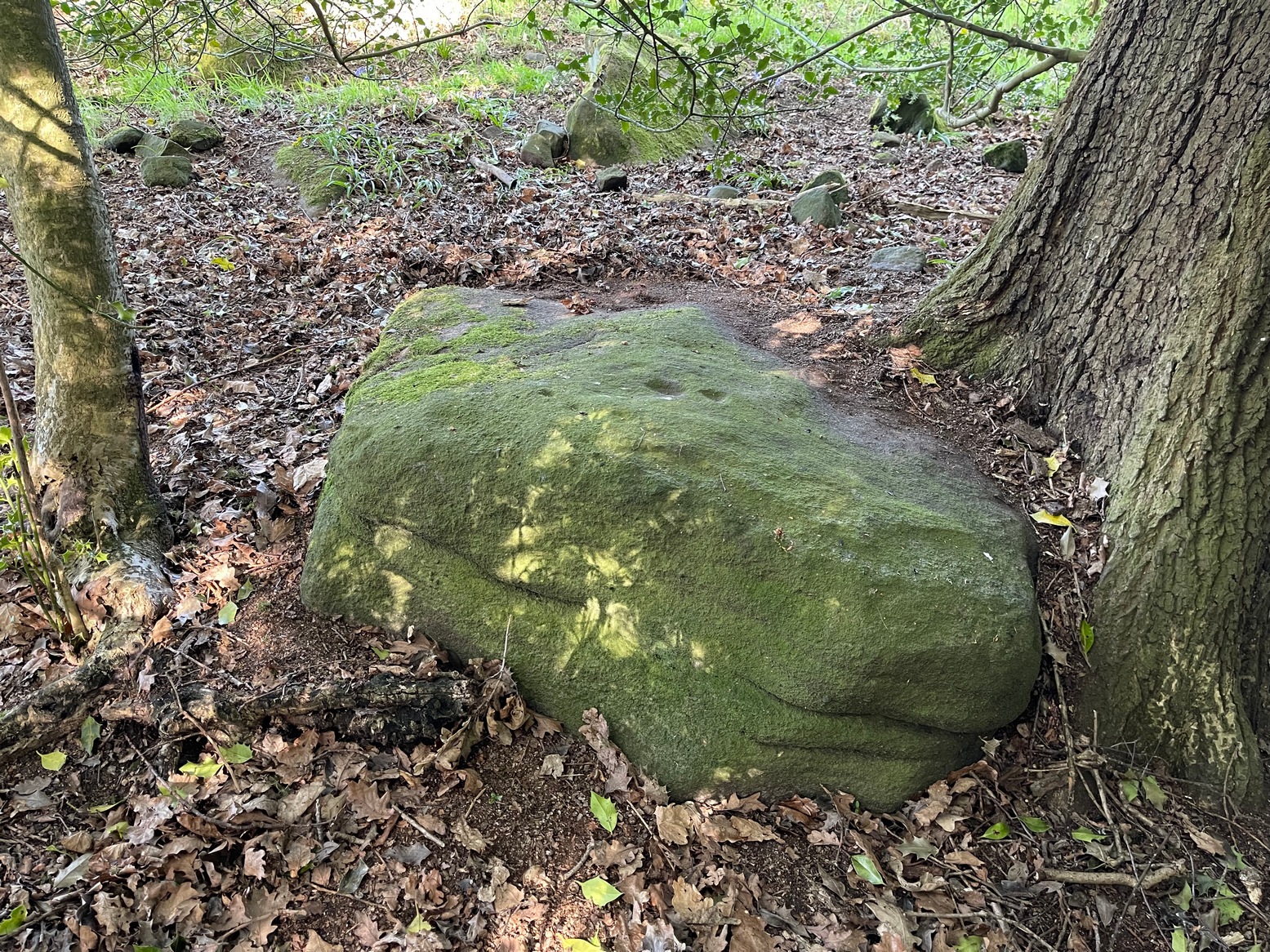
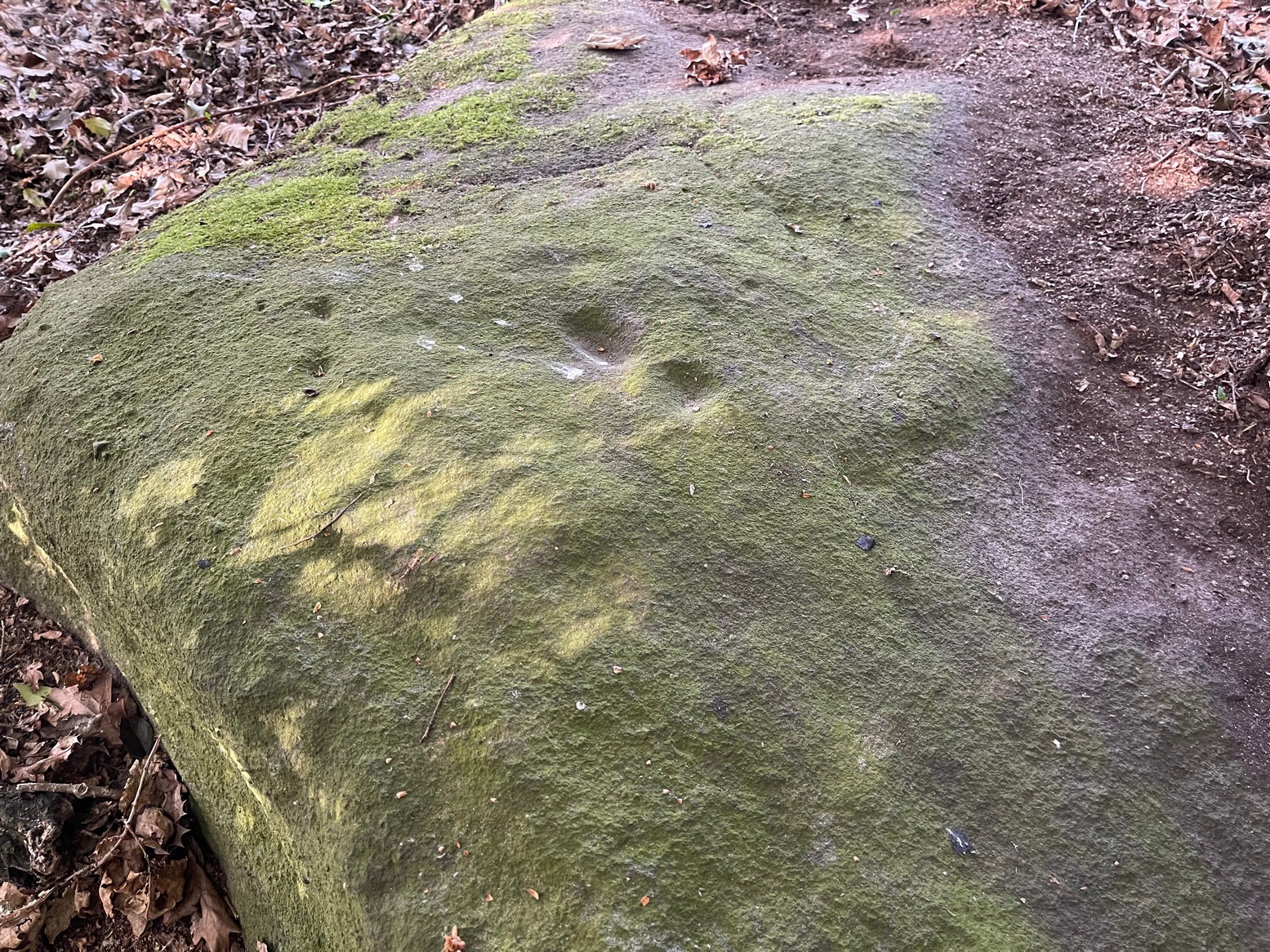
My first sight of this came about as I walked alongside the walling.  Approaching the stone, I noticed what looked like a recent cup-like marking with a curved line emerging from it on its eastern surface; but it didn’t look too old and was more like the scratch-marks you see sometimes when farmers have been dragging rocks along to be used in walling.  So I shrugged in slight disappointment—until the far-side, the western-side of the stone came into view.

Line of cups
Main scatter of cups

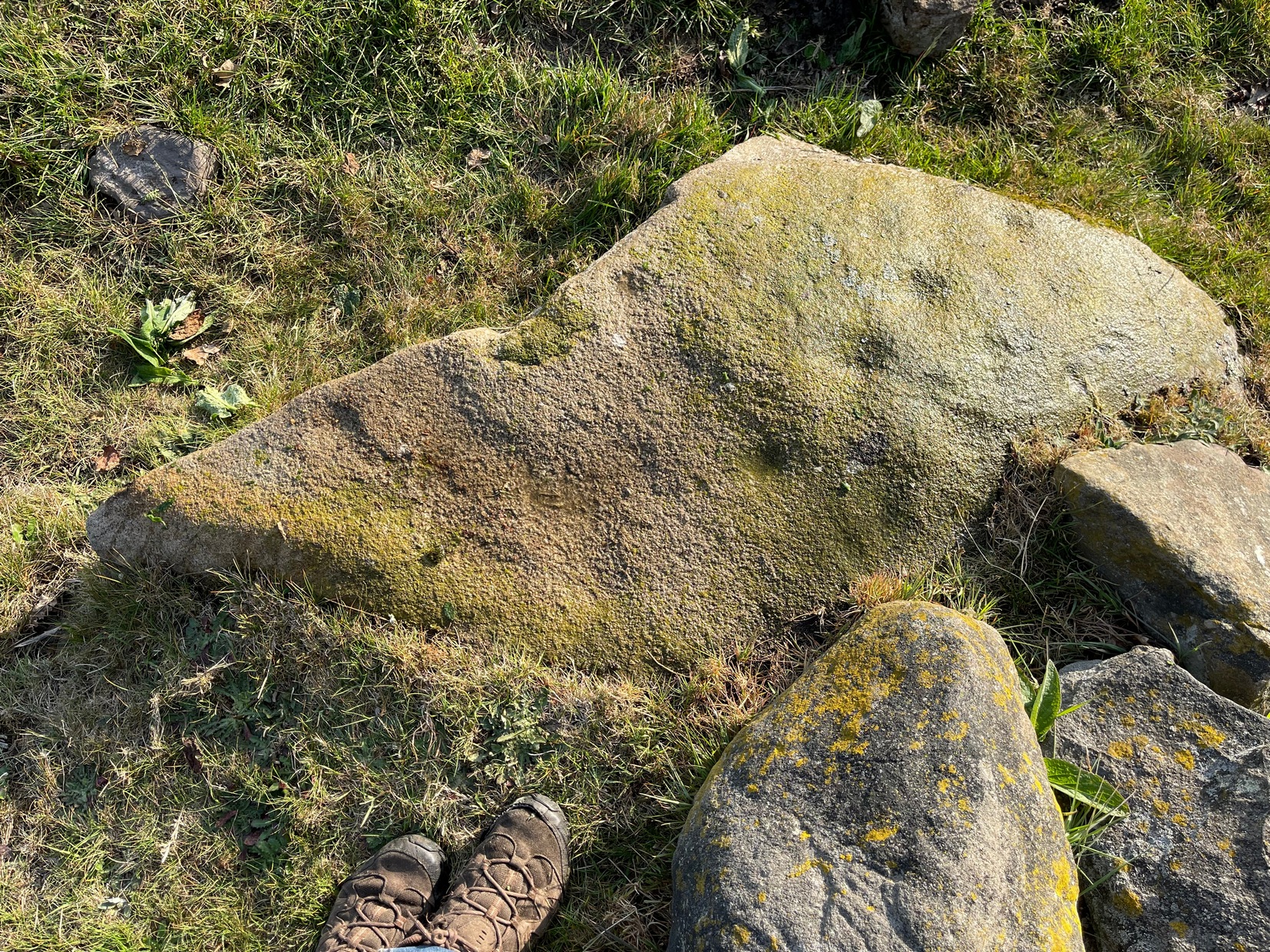
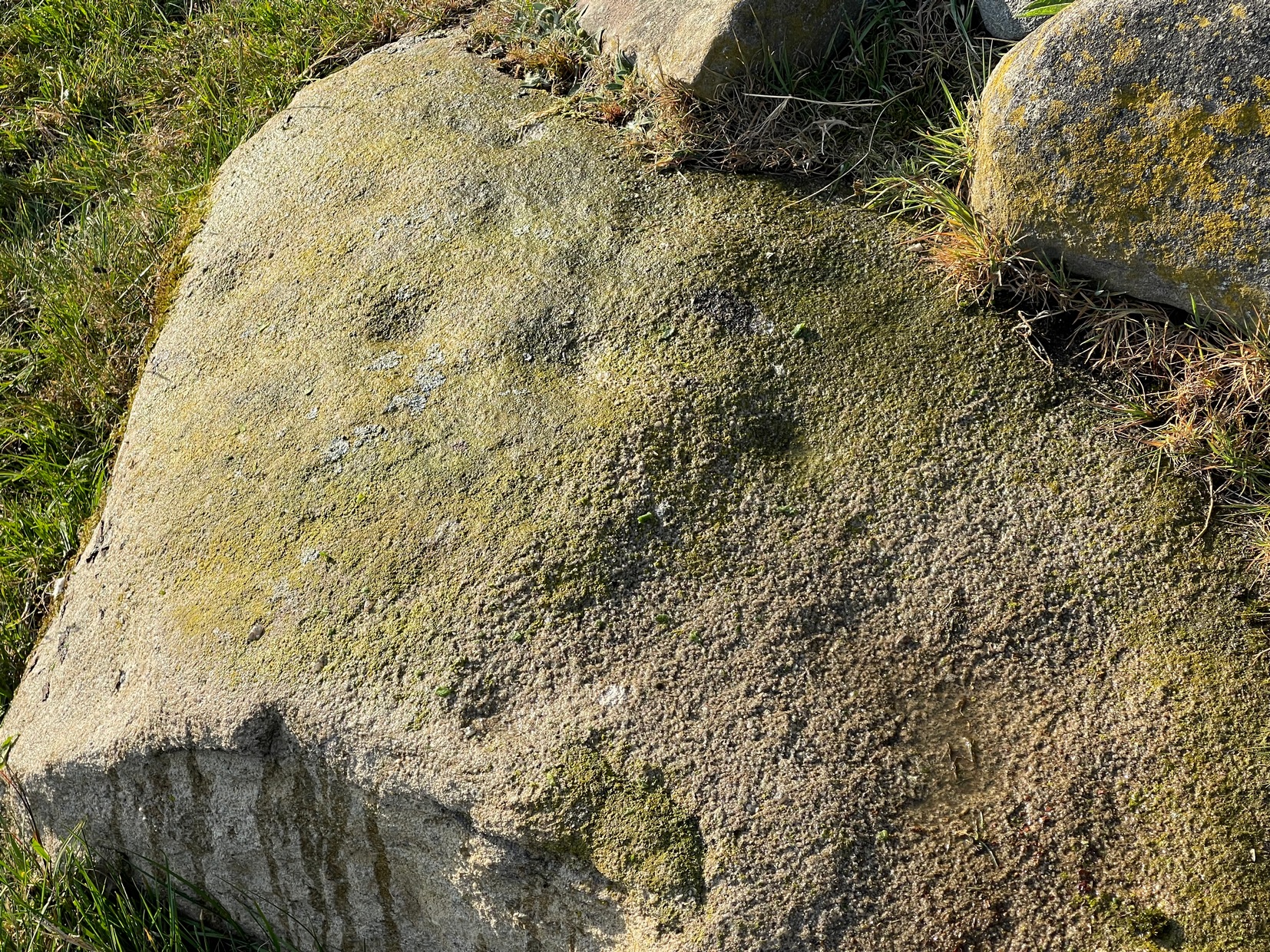
Sloping ever-so-slightly down into the ground, the surface of the stone had a cluster of quite worn, shallow, but distinct cup-markings between one and two inches across, four of which ran in a line from the top to the edge of the stone in a slight curve.  As I walked round it, looking from different angles, it became obvious that two or three other cups existed—mainly from the top to the western side of the rock.  One seemed to exist near the edge, whilst two other faint ones sat to the side of the line-of-four—almost creating a square formation.  From some angles it looked as if there may be faint lines running between some of the cups but (as usual) the sunlight didn’t really help highlight them and they could just be faded erosion lines.

Looking down at the cups
Water & sunlight & cups

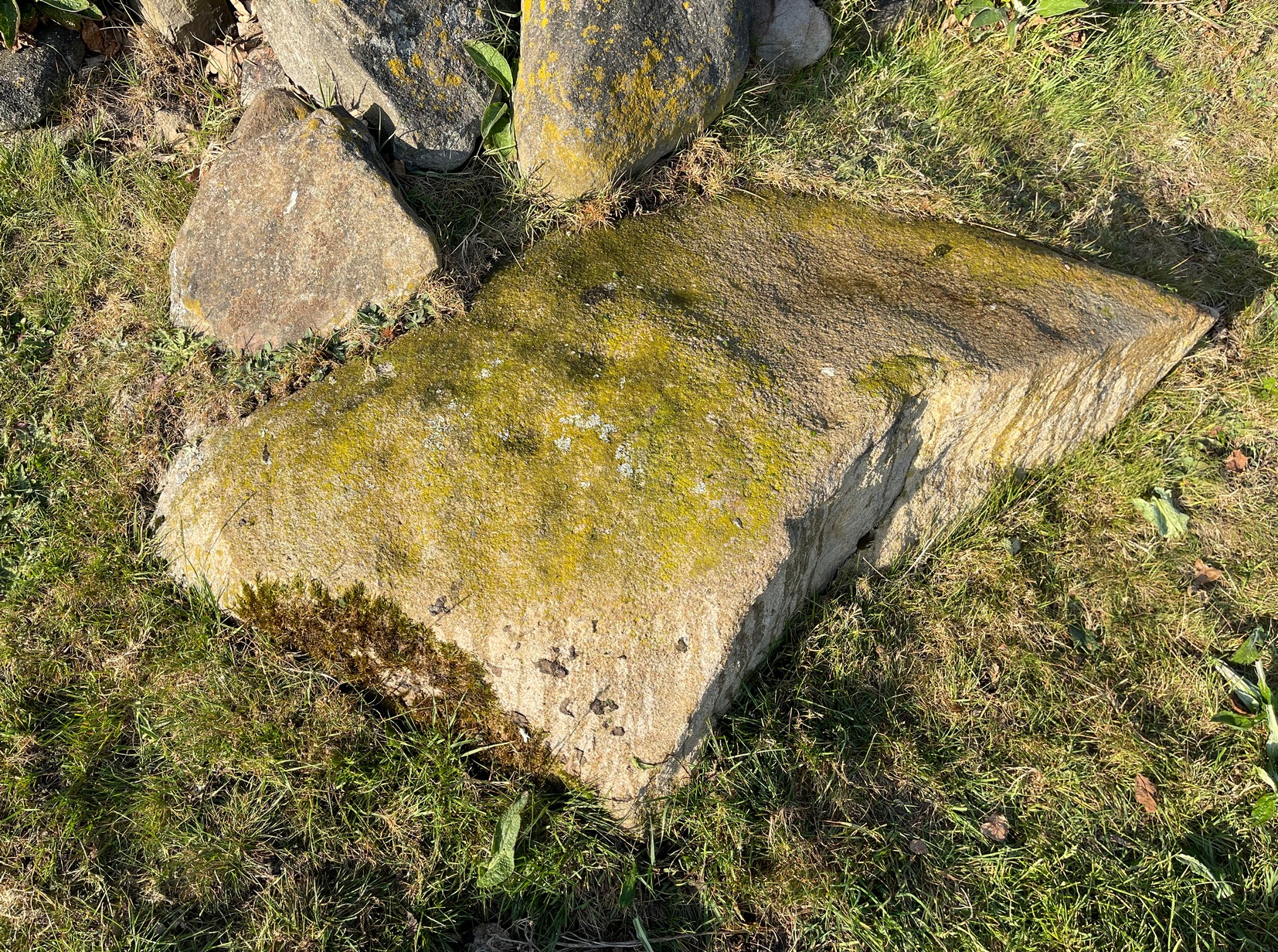
It was obvious that a section of the stone on its southern edge had been broken off in the not-too-distant past, raising the idea that the design may originally have been larger than its present form.  This thought returned when I walked another 60 yards west along the wall and came across a broken section of stone that had been placed into it, pretty recently, and on its vertical face noticed a single cup-mark in a good state of preservation, indicating that it had either been cut recently or instead been dug out of the ground not too long ago and shown intself to the world after a sleep of several millenia.  Look at it when you have a gander at the main carving here and make up your own mind….

© Paul BennettThe Northern Antiquarian
Hawksworth Spring (04), Hawksworth, West Yorkshire

Cup-Marked Stone:  OS Grid Reference – SE 15802 41206

Getting Here

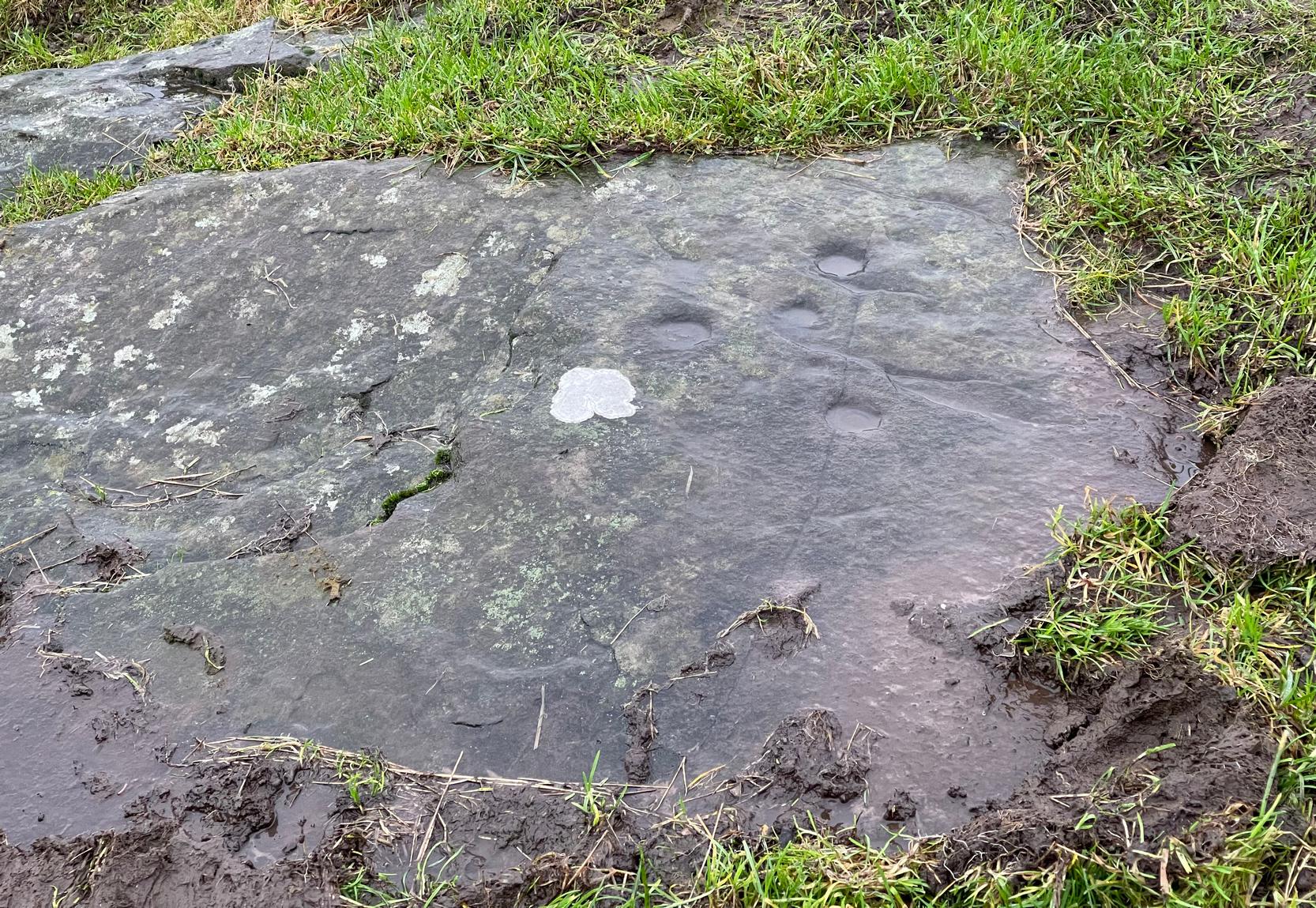
Hawksworth Spring (04)

Take the same directions as if you’re going to visit the Hawksworth Spring (1) carving.  From here, the small footpath at its side keeps going uphill, curving to the right and following the line of walling.  After about 20 yards where the land begins to level out, keep your eyes peeled for a small elongated earthfast rock, less than three feet long, just to the left of the path and only three or four yards away from the wall.  If the leaves have covered the stone, get on your hands and knees and scrub around a bit.  You’ll find it!

Archaeology & History

Primary cup-marking

This was a frustrating find as there are several elements on the stone, only one of which I could be 100% certain about – and that’s the singular cup-marking on the top-left of the stone.  Just next to this is what looks to be another one, unfinished, cut into a natural fissure in the rock—but the daylight was frustrating, allowing only glimpses of visual clarity on the stone.  At the other end of the stone, as the photo shows, are what stand out as two or three more cup-marks, but these seem geophysical in nature—although examples such as these scatter the works of Boughey & Vickerman (2003; 2018) as authentic, which shows the problem we all have as rock art students. Anyhow, at least one of these cups is the real deal.  I’ll let the computer-tech lads sort the rest of it out for us…

© Paul BennettThe Northern Antiquarian
Hawksworth Spring (03), Hawksworth, West Yorkshire

Cup-Marked Stone:  OS Grid Reference – SE 15807 41196

Getting Here

Hawksworth Spring (3) CR

Once you’ve located the carvings of Hawksworth Spring (1) and (2), walk up the slope towards the topmost section of the walling where the land begins to level out.  Hereby you’ll see the Hawksworth Spring (4) carving (if it’s not covered in leaves) several yards below the wall. Turn around and look diagonally to your left, into the trees, where you need to walk into and beneath the overhanging holly branches.  Here you’ll reach the large earthfast rock whose edge rests up against the trunk of a larger tree.  You can’t miss it!

Archaeology & History

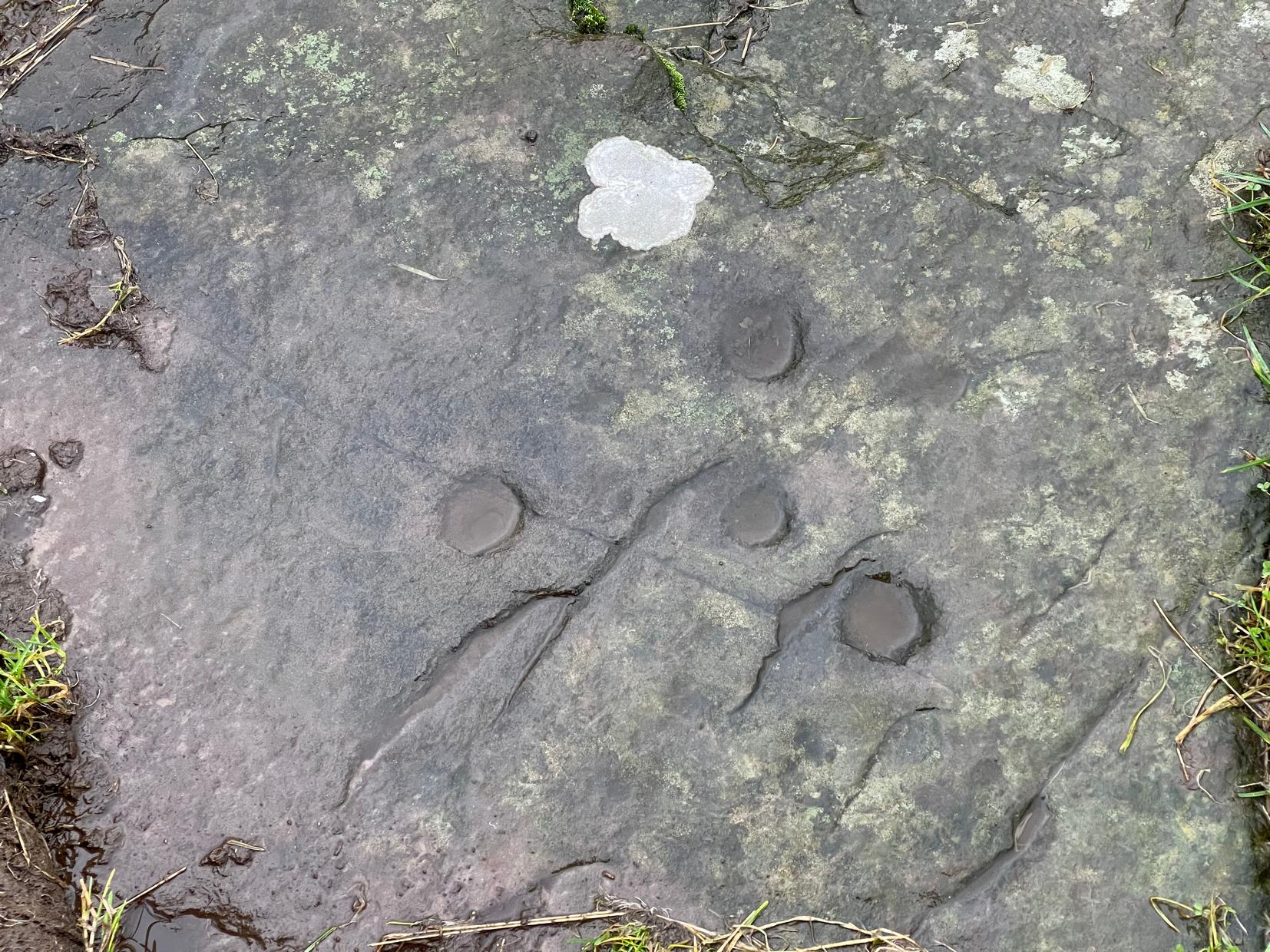
Notable curious “cups”

I’m not 100% convinced that this a prehistoric design, despite it being listed as such in Boughey & Vickerman’s (2003) survey—although, to be fair, they do suggest it as being “doubtful.”  The two most notable so-called “cups” have more of a recent hallmark to them and the other elements are troublesome to see with any certainty, but they may be geophysical in nature.  Their description of it told us this was a “fairly large fine-grained rock with some included pebbles.  Two pairs of cups, one pair connected by groove”.  Make of it what you will….

References:

  1. Boughey, Keith & Vickerman, E.A., Prehistoric Rock Art of the West Riding, WYAS: Wakefield 2003.

© Paul BennettThe Northern Antiquarian
Tweed Ford, Drumelzier, Peeblesshire

Cup-and-Ring Stone (removed):  OS Grid Reference – NT 12364 32627

Also Known as:

  1. Drumelzier Carving

Archaeology & History

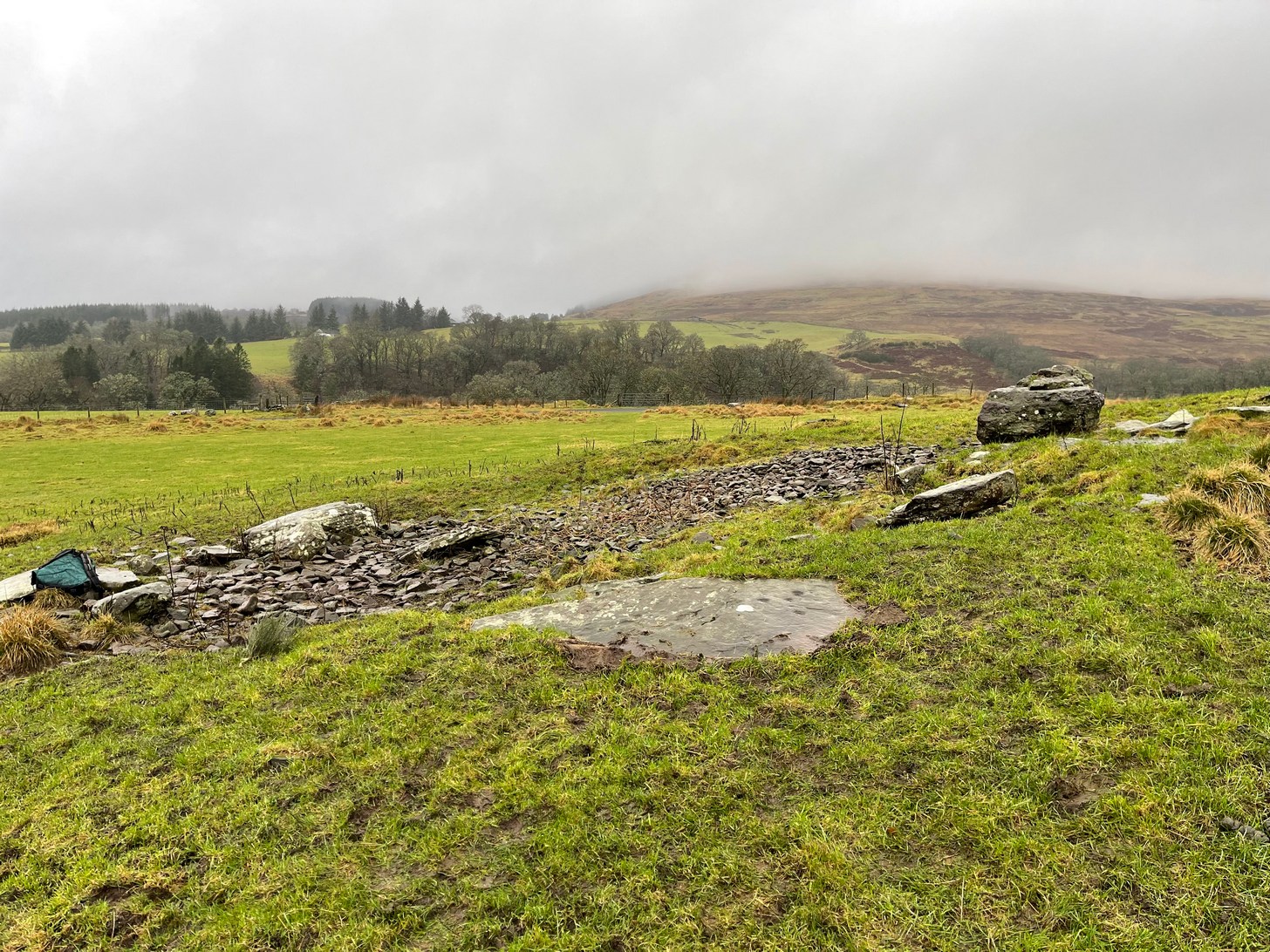
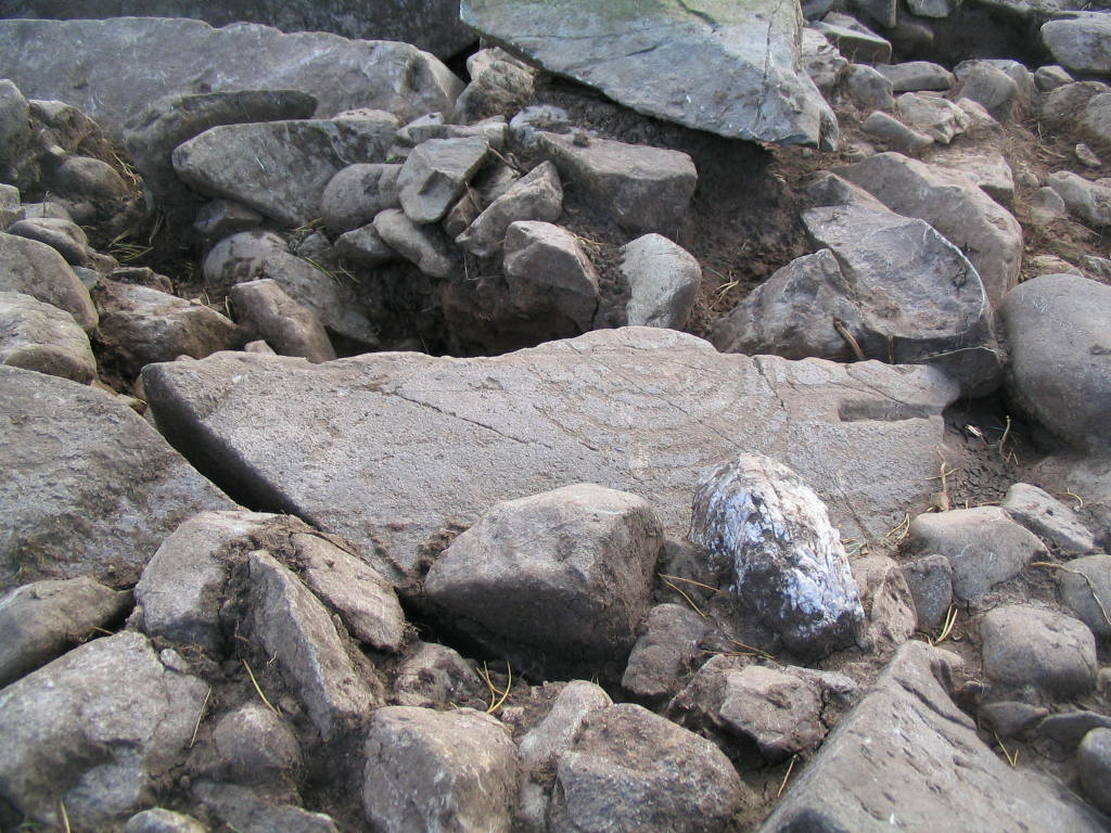
Position of stone in cairn

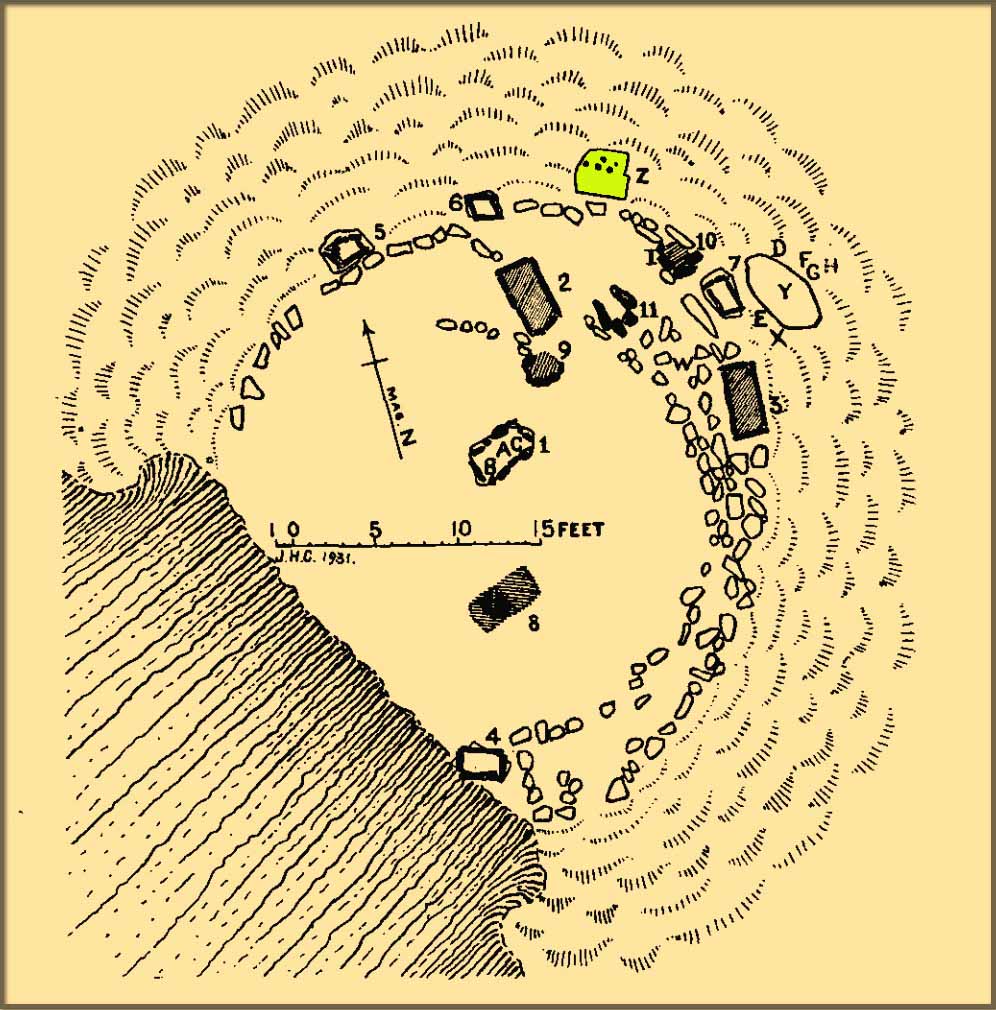
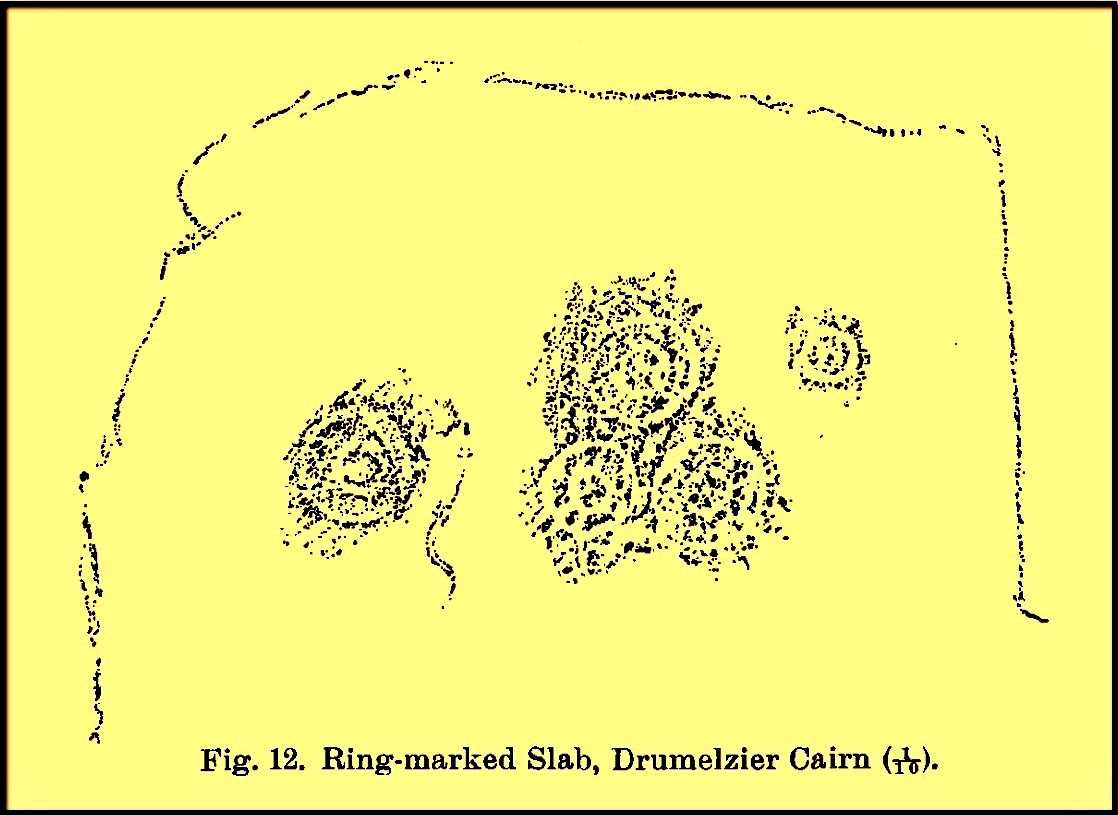
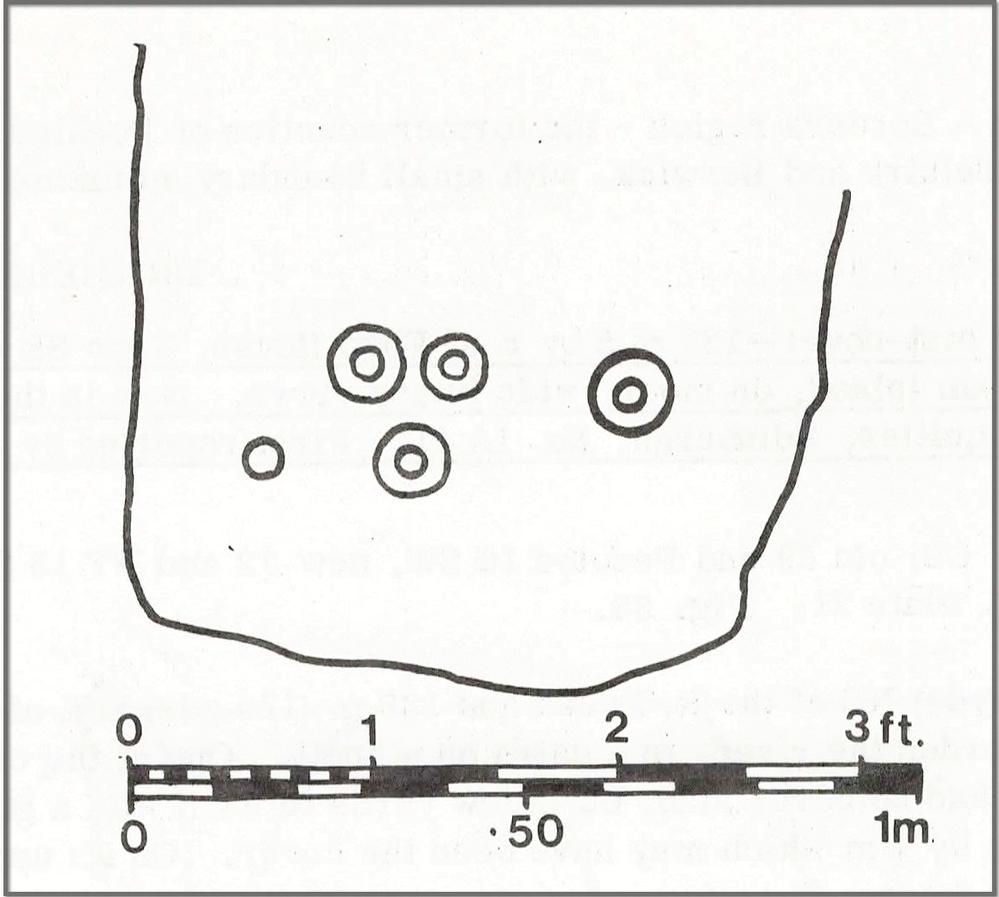
A carving that was located at the edge of a cairn on a knoll on the east-side of the River Tweed, this is an odd design that now lives in Edinburgh’s central museum: odd, inasmuch as the design looks as if it’s a typical cup-and-ring carving, yet none of the cups on this stone were ever hollowed or pecked out, and so the “cups”, so to speak, are actually small rings (if that makes sense!).  There are a number of similar unhollowed “cups” on other carvings that are found associated with prehistoric tombs, so perhaps this aspect was something of a burial trend—amongst a very small tribal group, perhaps… It’s an element that was remarked upon in Simpson & Thawley’s (1972) examination of petroglyphs in neolithic tombs that were called “passage grave style” carvings: a sort of dyslexic cup-and-ring design no less!  The intriguing thing about this carving is that it’s one in a small cluster of dyslexic cup-and-rings that are found in this part of Scotland—in an area where rock art itself is pretty scarce.  Which begs the question: was it a local tribal style?  Anyhow…

The carving was first uncovered when J.H. Craw (1930) excavated the aforementioned cairn, finding therein a number of cists.  There’s speculation that the petroglyph might originally have been a covering stone for one of the cists, but we don’t know for sure. Craw described the carving as follows:

Craw’s 1930 sketch
Ron Morris’ 1981 sketch

“The ring-marked slab…measures 3 feet by 2 feet by 6 inches.  It lay at the north side of the cairn (highlighted in sketch, PB), outside the encircling ring, but may originally have been the cover of cist No.2.  On the upper side are five shallow ring-markings, four being double and one single.  The former measure 3 inches to 4 inches in diameter, and the latter 1¾ inch.  The figures are thus much smaller than in typical cup-and-ring-marked stones, and the lines are only ¼ inch in width.  The only similar markings known to me are on a slab which I found a number of years ago near the site of several former cairns, and forts at Harelawside near Grant’s House, Berwickshire.  The stone is now in our Museum.”

The “museum” in question being Edinburgh’s National Museum (I don’t know if it’s in a box somewhere or on public display, which is where it needs to be).  If anyone can get a good photo of this carving, please send it to us or add it on on our Facebook group.

References:

  1. Craw, J.H., “The Excavation of a Cairn at Drumelzier, Peeblesshire,” in Proceedings of the Society of Antiquaries, Scotland, volume 65, 1930.
  2. Morris, Ronald W.B., “The Cup-and-Ring and Similar Early Sculptures of Scotland; Part 2 – The Rest of Scotland except Kintyre,” in Transactions of the Ancient Monuments Society, volume 16, 1969.
  3. Morris, Ronald W.B., “The Cup-and-Ring Marks and Similar Sculptures of Scotland: A Survey of the Southern Counties – part 2,” in Proceedings of the Society of Antiquaries, Scotland, volume 100, 1969.
  4. Morris, Ronald W.B., The Prehistoric Rock Art of Southern Scotland, BAR: Oxford 1981.
  5. Ritchie, Graham & Anna, Edinburgh and South-East Scotland, Heinnemann: London 1972.
  6. Royal Commission on the Ancient & Historical Monuments, Scotland, Peeblesshire – volume 1, Aberdeen University Press 1967.
  7. Simpson, D.D.A. & Thawley, J.E., “Single Grave Art in Britain,” in Scottish Archaeological Forum, no.4, 1972.

Acknowledgements:  Huge thanks for use of the Ordnance Survey map in this site profile, reproduced with the kind permission of the National Library of Scotland

© Paul BennettThe Northern Antiquarian
Easter Brackland, Callander, Perthshire

Cup-Marked Stone:  OS Grid Reference – NN 65736 07989

Getting Here

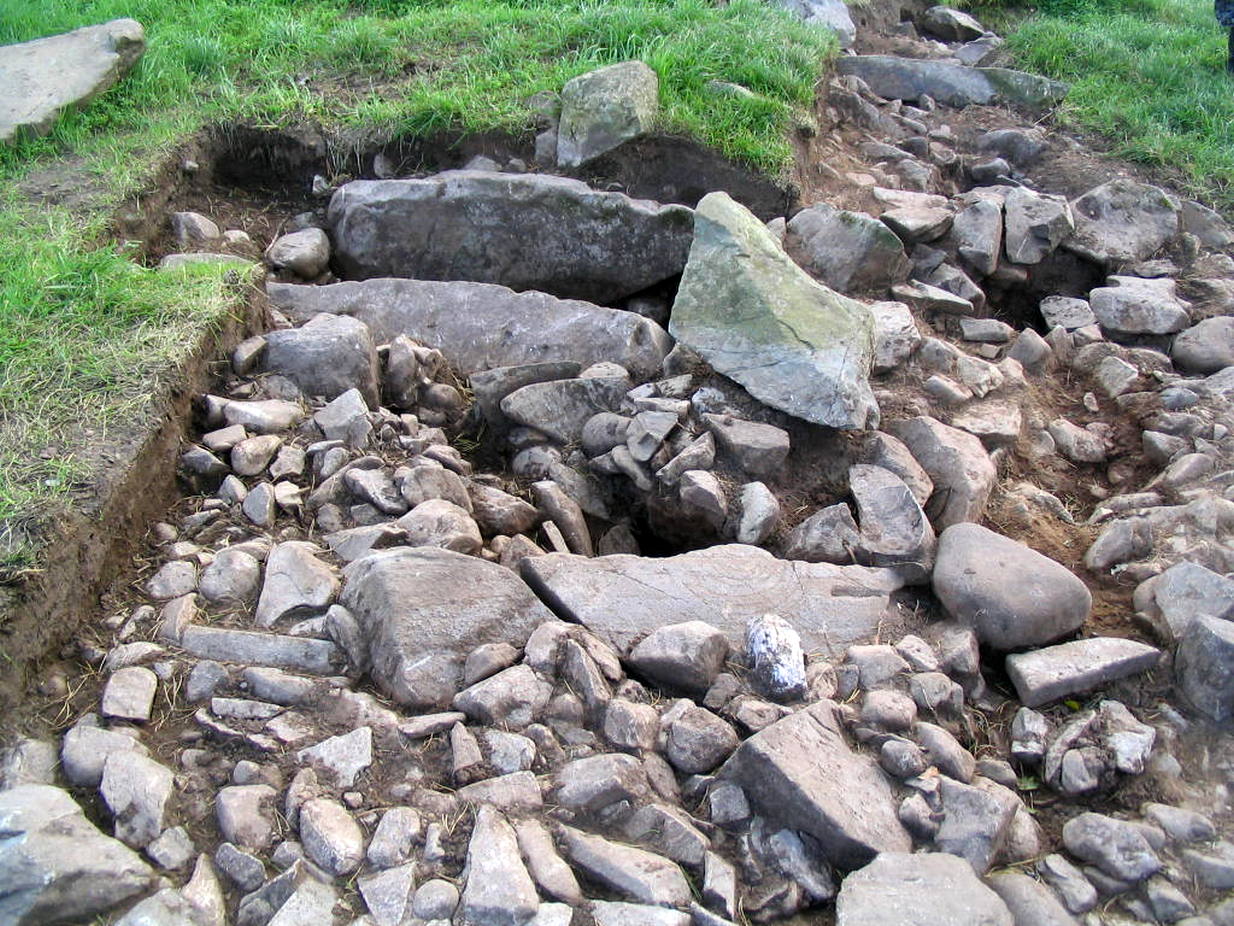
The carved stone in situ

Less than a mile east of Callander on the main A84 road, nearly 300 yards just past the entrance into the Keltie Bridge caravan park, take the tiny road on your left (north) and barely 100 yards along where a small crossroads can be said to exist, go straight forward up the tiny single-track road ahead of you.  Literally 0.62 miles, or 1km up, park on the right-side of the road where a small grassy track runs up the slope.  From here, you need to keep walking up the road itself, bearing right just past the small bridge and, about 350 yards along you’ll see a notable rise in the field on your right less than 100 yards in.  Head straight for it!

Archaeology & History

Despite this being a very basic simplistic design, I’m somewhat disappointed in myself as when we visited here, She was pouring with rain and for some reason or other I didn’t indulge myself in the soaking muddy ground and peel back the dung-infested turf to see the entire surface of this stone—and so, as a result, didn’t see the carving in its entirety.  I’d have got soaked and been covered in shit! 🙂  But later this day we were visiting an antique centre and book-dealer straight afterwards, so for once I couldn’t play in the mud.  Damn those neat and tidy folk!

It’s nowt special to look at in all honesty, but it’s in a good state of preservation as it was seemingly uncovered in pretty recent times beneath the curious large mass of loose stones right next to it.  The stone mass gives the impression of it being a ruined cairn, but seems more likely to be a clearance cairn that was piled up, quite fortuitously, next to the cup-marked rock.

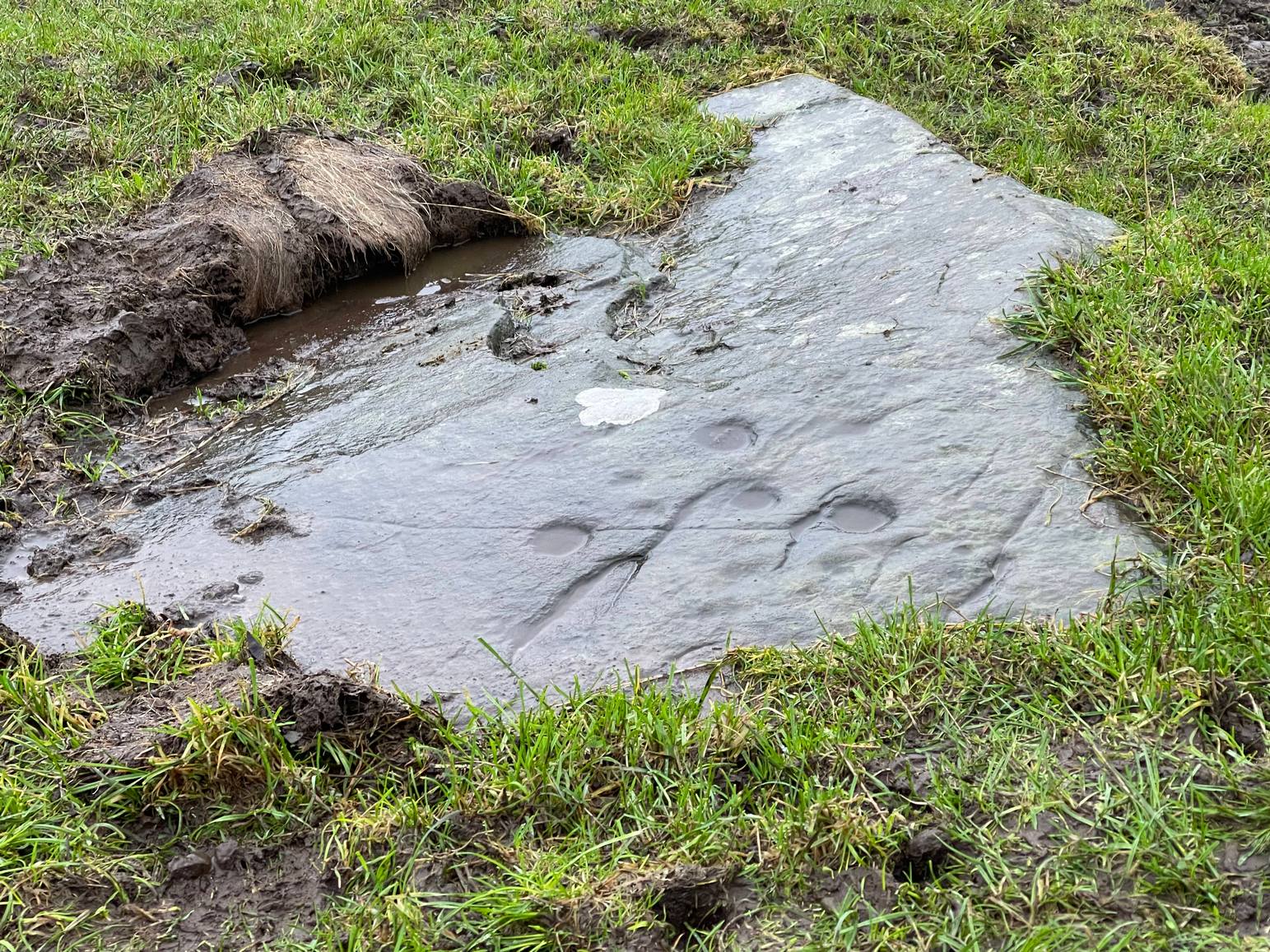
The carving consists of eight cup-marks (not all shown in these photos): five large and prominent, one not so prominent, and two that are small and very shallow.  The more distinct cups would seem to have been worked and re-worked many times, obviously possessing a practical nature of some sort.  As we can see in the photos, four of the larger cups stand out, whilst the small ones can be difficult to see.  If there are any petroglyphic locals who fancy getting up here to clear the rest of the stone to see if there are more cup-marks underneath the soil, please let us know!  Perhaps check it out when you’re looking at the nearby cairns at Ballachraggan and beyond.

References:

  1. Main, Lorna & Page, R., “Easter Brackland, Stirling,” in Discovery & Excavation Scotland, volume 2, 2001.

© Paul BennettThe Northern Antiquarian
Woodend, Mossfennan, Broughton, Peeblesshire

Cup-and-Ring Stone:  OS Grid Reference – NT 12136 31360

Also Known as:

  1. Mossfennan Farm

Archaeology & History

Carving, looking W: courtesy Jim Ness

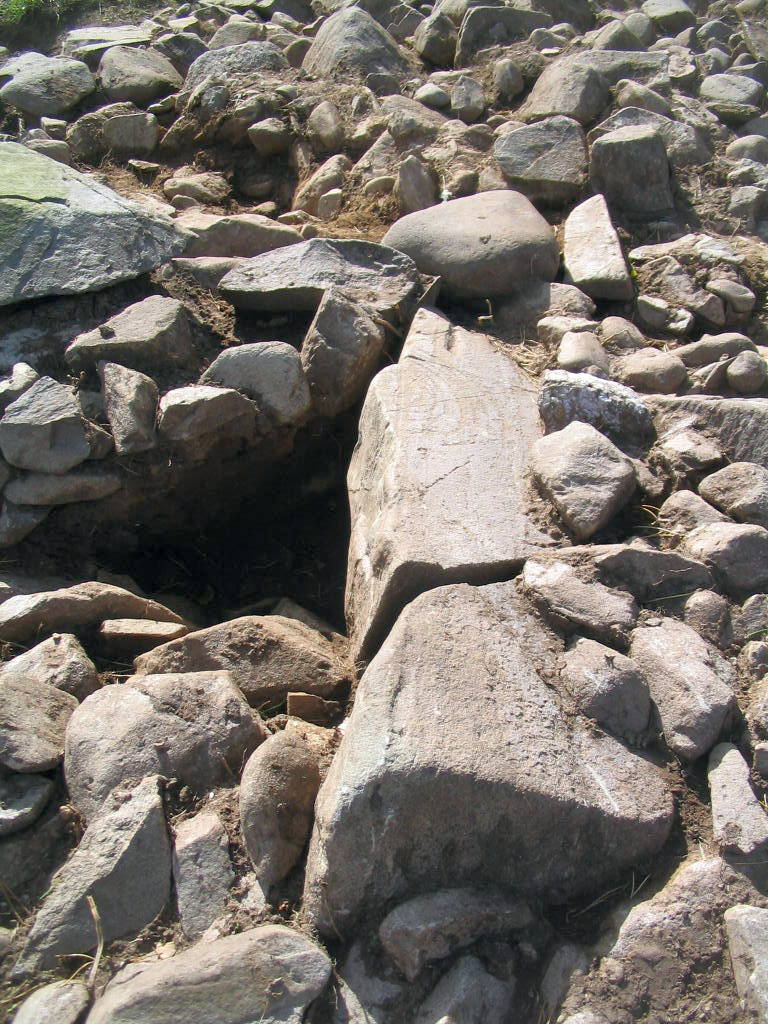
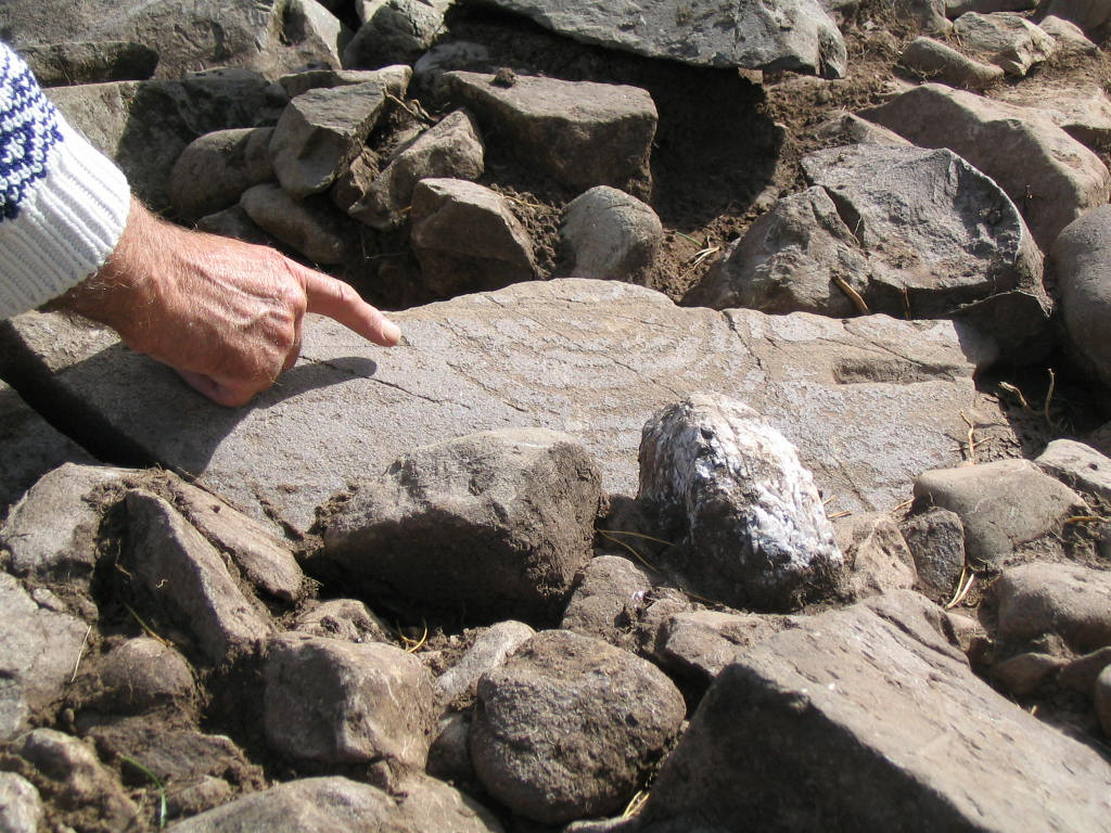
A little-known multiple ringed carving was discovered a few years ago during the excavation of a prehistoric cairn just immediately east of the A701 roadside, several miles south of Broughton.  The cairn itself had been recognised many years prior to the recent excavation, when one of two cists inside it was noted by R.B.K. Stevenson (1940), and which was subsequently described in slightly more detail in the Royal Commission Inventory (1967).  But when the modern investigation was undertaken by the Biggar Archaeology Group in 2008, a damaged but impressive carving was uncovered that somehow hadn’t been noticed before.  It was described in Tam Ward’s (2008) excavation report where he told that,

Carving in situ (photo courtesy Jim Ness)
Carving looking N: courtesy Jim Ness

“lying almost immediately on the east side of Cist 1 is an angular rock…measuring 1m long and over 0.3m wide on the uppermost face, itself lying at an angle facing SW and away from  the cist.  The rock has fractured due to weathering in post deposition times, as indeed several other surface stones had, but on the widest part of the upper surface are at least seven concentric lines faintly pecked into the smooth flat surface of the stone. The lines are up to 10mm wide and appear to have been intended to form semi ovals on the edge of the rock.  The outer ring forms an arc of c270mm on the long axis by c140mm on the short one (the former measurement being straight between the ends of the lines and the latter being a radius across the design). The terminals of the inner curved line are about 80mm apart. The lines are slightly irregular in distance from one another. Although it is far from certain, it does not appear that the rock has been part of a larger one with a more complete design on it, rather the pecking appears not to have been finished since the surface of the rock is similar in appearance overall while the abrasion of the carving varies.”

Fractured design (photo courtesy Jim Ness)

The carving remains in place with the cist, which was covered back over when the excavation had been finished.

Carvings such as this are uncommon in this neck o’ the woods; although less than a mile downstream from here, on the other side of the river, another petroglyph—known as the Drumelzier carving—accompanied another prehistoric tomb.  Apart from this, there’s a great scarcity of carvings scattering the Lowlands—although it’s likely that there are others hiding away, waiting to be found on these hills…

References:

  1. Royal Commission on the Ancient & Historical Monuments, Scotland, Peeblesshire – volume 1, Aberdeen University Press 1967.
  2. Stevenson, R.B.K., “Cists near Tweedsmuir,” in Proceedings Society Antiquaries, Scotland, volume 74, 1940.
  3. Ward, Tam , “Excavation of a Bronze Age burial cairn at Woodend, Mossfennan Farm, Upper Tweeddale,” Biggar Archaeology 2008.

Acknowledgements:  Huge thanks to Jim Ness and Tam Ward of the Biggar Archaeology Group for use of the photos in this site profile. 

© Paul BennettThe Northern Antiquarian
Cross Oak, Berkhamsted, Hertfordshire

Sacred Tree:  OS Grid Reference – SP 964 079

Archaeology & History

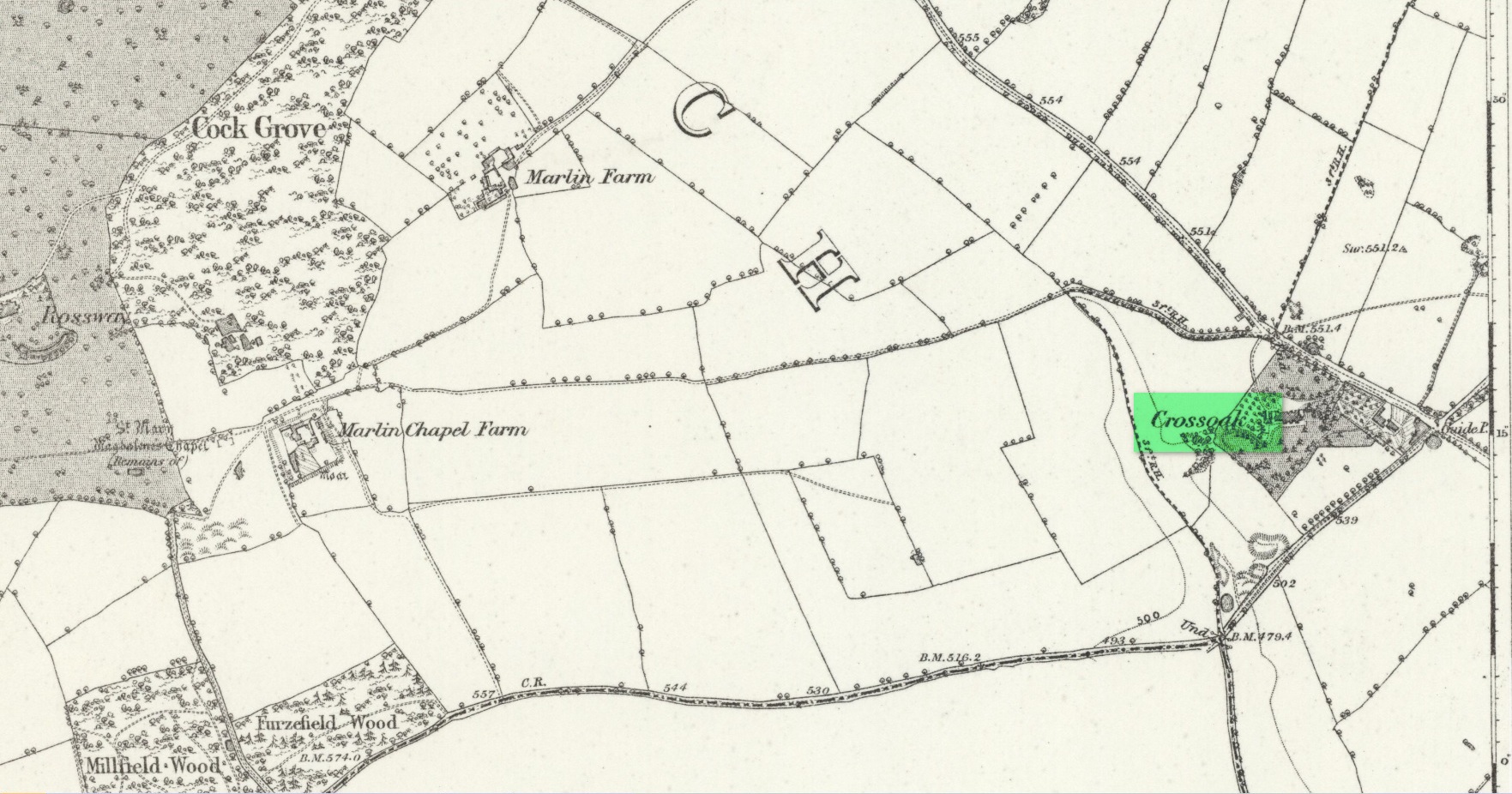
Location of the Cross Oak, shown on 1883 OS-map

About mile south of Northchurch, on the far side of the A41 dual carriageway, somewhere past the old crossroads (or perhaps even at the crossing) an ancient tree lived—and truly lived in the minds of local people, for perhaps a thousand years or so.  Mentioned in the Lay Subsidy Rolls in 1307, the Cross Oak gave its name to the old building that once stood in the trees and the hill itself, at the place now known as Oak Corner.  Whether or not a “cross” of any form was set up by this old oak, records are silent on the matter.  Its heathen ways however, were pretty renowned! (a plaque should be mounted here)

Folklore

The first reference I’ve found of this place is in William Black’s (1883) folklore survey where he told that “certain oak trees at Berkhampstead, in Hertfordshire, were long famous for the cure of ague”—ague being an intense fever or even malaria. But a few years later when the local historian Henry Nash (1890) wrote about this place, he told that there was only one tree that was renowned for such curative traditions, that being the Cross Oak.  He gave us the longest account of the place, coming from the old tongues who knew of it when they were young—and it had it’s very own ritual which, if abided by, would cure a person of their malady.  “The legend ran thus”, wrote Mr Nash:

“Any one suffering from this disease was to proceed, with the assistance of a friend, to the old oak tree, known as Cross Oak, then to bore a small hole in the said tree, gather up a lock of the patient’s hair and make it fast in the hole with a peg, the patient then to tear himself from the tree, leaving the lock behind, and the disease was to disappear.

“This process was found to be rather a trying one for a weak patient, and by some authority unknown the practice was considerably modified. It was found to be equally efficacious to remove a lock of hair by gentle means, and convey it to the tree and peg it in securely, and with the necessary amount of faith the result was generally satisfactory. This is no mere fiction, as the old tree with its innumerable peg-holes was able to testify. This celebrated tree, like many other celebrities, has vanished, and another occupies its place, but whether it possesses the same healing virtues as its predecessor is doubtful.  It is however a curious coincidence, that the bane and the antidote have passed away together.”

The lore of this magickal tree even found its way into one of J.G. Frazer’s (1933) volumes of The Golden Bough, where he told how the “transference of the malady to the tree was simple but painful.”

Traditions such as this are found in many aboriginal cultures from different parts of the world, where the spirit of the tree (or stone, or well…) will take on the illness of the person for an offering from the afflicted person: basic sympathetic magick, as it’s known.  Our Earth is alive!

References:

  1. Black, William G., Folk Medicine, Folk-lore Society: London 1883.
  2. Frazer, James G., The Scapegoat, MacMillan: London 1933.
  3. Jones-Baker, Doris, The Folklore of Hertfordshire, B.T. Batsford: London 1977.
  4. Nash, Henry, Reminiscences of Berkhamsted, W. Cooper & Nephews: Berkhamsted 1890.

Acknowledgements:  Huge thanks for use of the Ordnance Survey map in this site profile, reproduced with the kind permission of the National Library of Scotland

© Paul BennettThe Northern Antiquarian
Witch’s Stone, Bankfoot, Perthshire

Standing Stone:  OS Grid Reference – NO 04236 37526

Getting Here

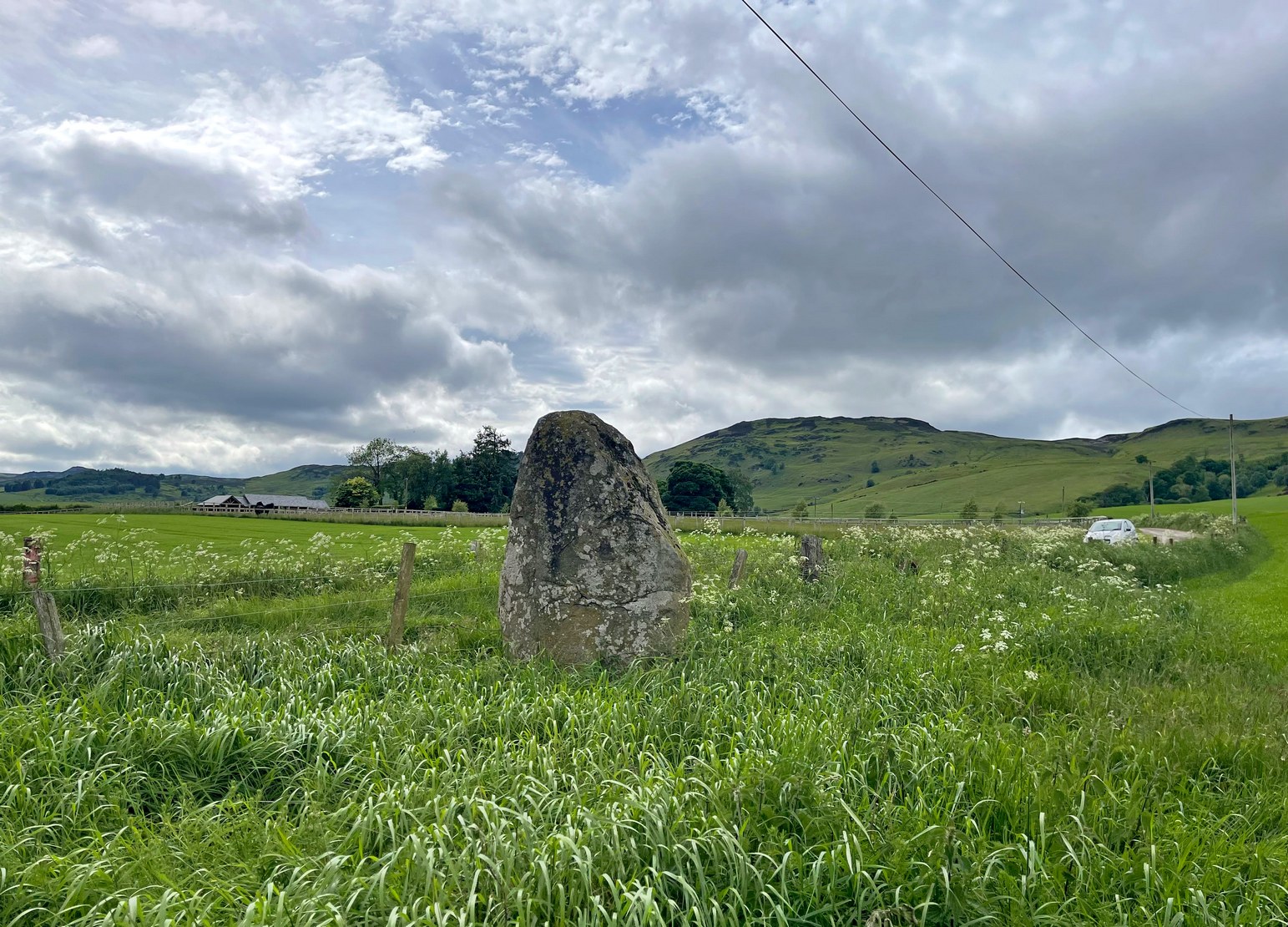
Witch’s Stone, looking NW

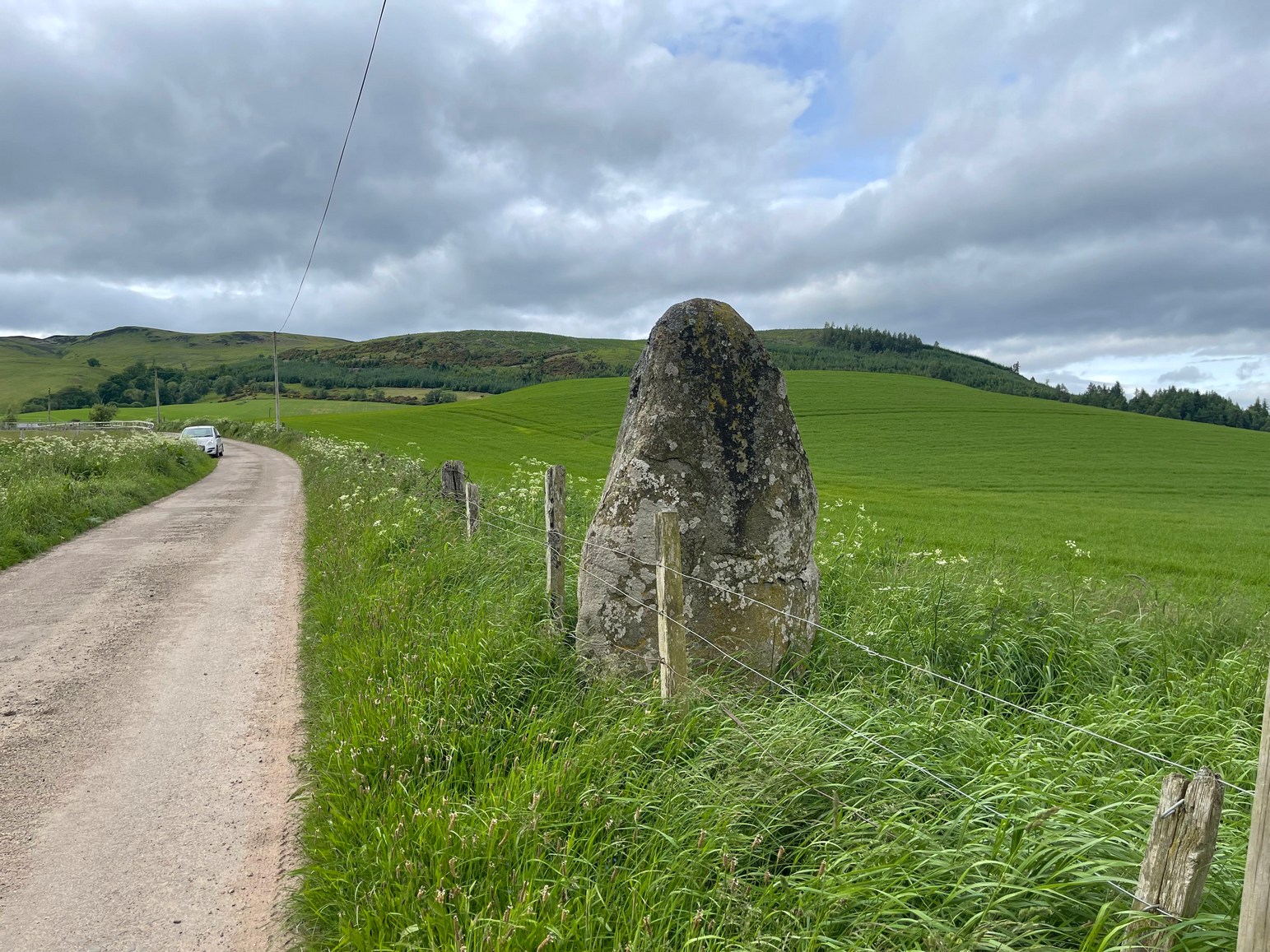
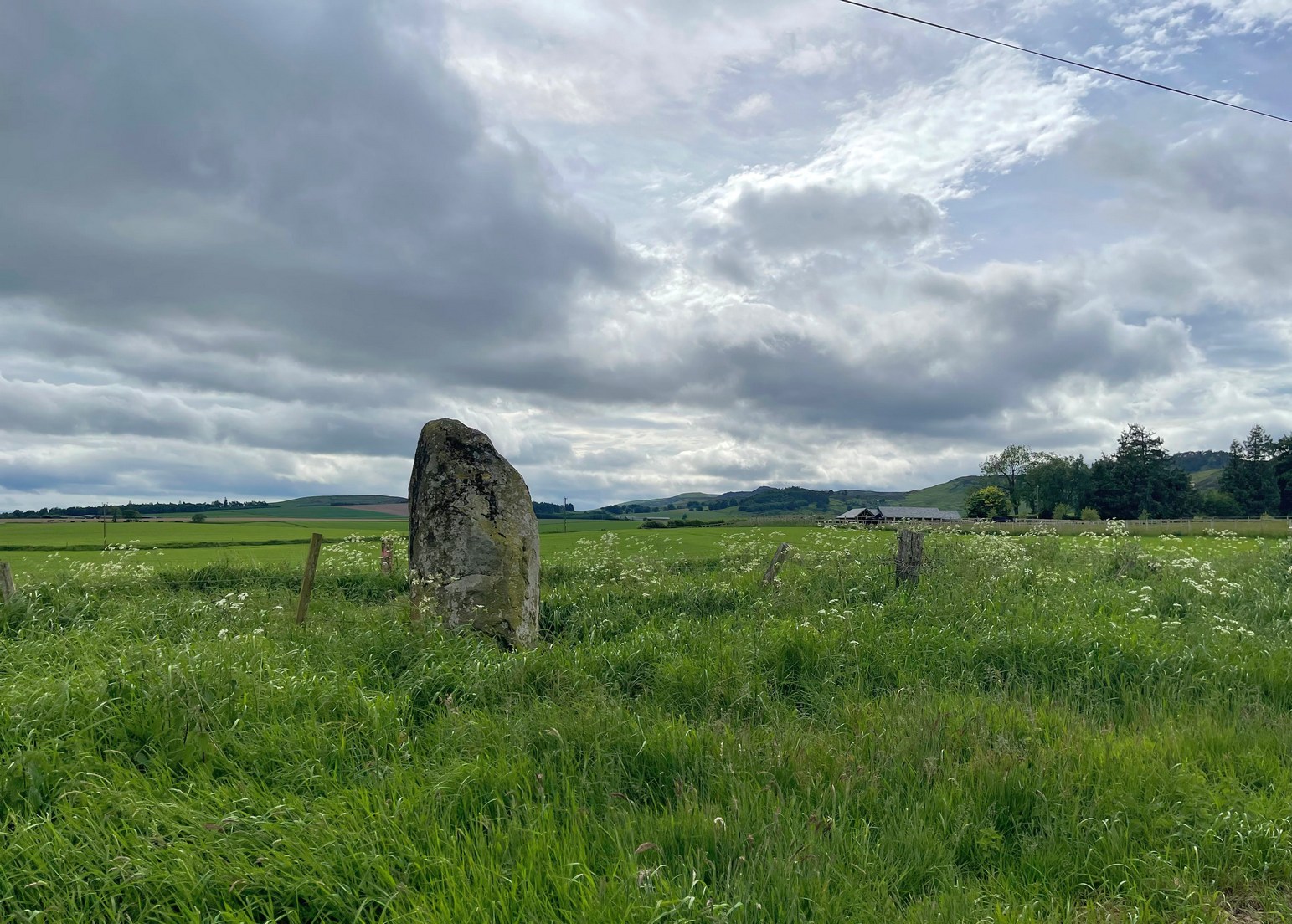
Travel along the B867 road from Bankfoot to Dunkeld (running roughly parallel with the A9) and you’ll reach the hamlet of Waterloo about one mile north of Bankfoot.  As you approach the far end of the village, keep your eyes peeled for the small turning on your left and head up there for just over a mile.  The road runs to a dead end at Meikle Obney farm, but shortly before reaching there you’ll pass this large standing stone on the right-side of the road, just along the fence-line.  It’s almost impossible to miss!

Archaeology & History

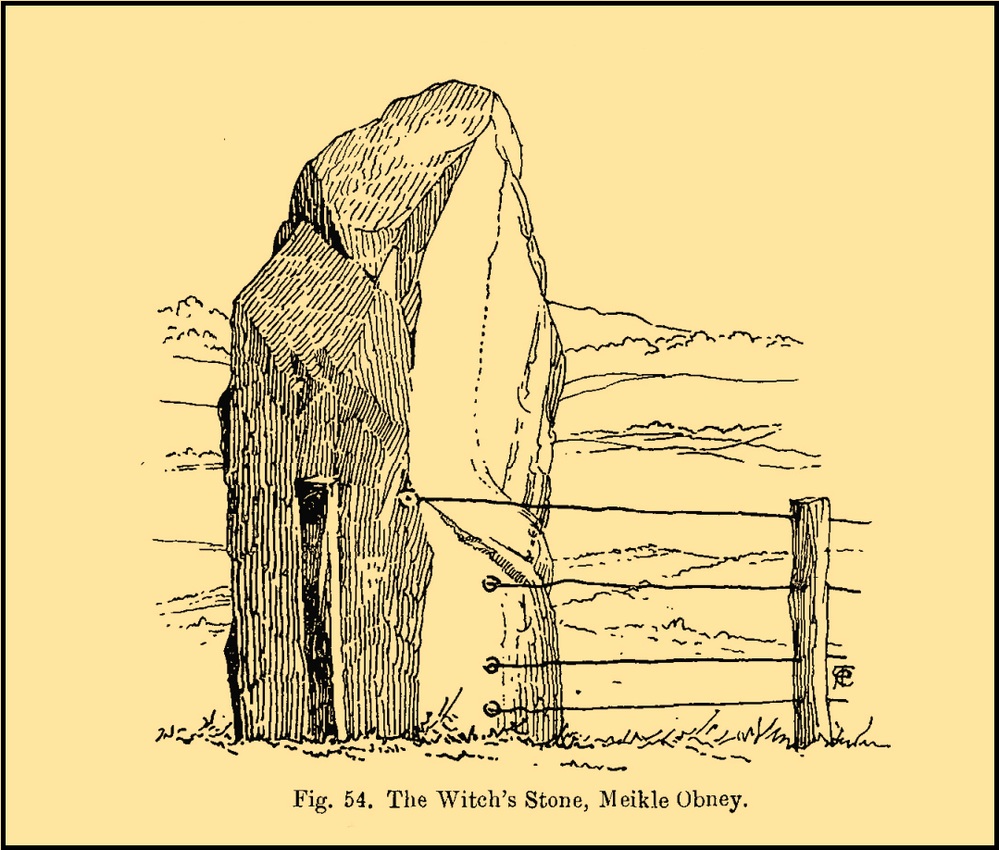
This is one of “the large rude upright stones found in the parish” that William Marshall (1880) mentioned briefly, amidst his quick sojourn into the Druidic history of Perthshire.  It’s an impressive standing stone on the southern edges of the Obney Hills that doesn’t seem to be in its original position.  And it’s another one that was lucky to survive, as solid metal staples were hammered into it more than a hundred years ago when it was incorporated into the fencing, much like the massive Kor Stone 6½ miles south-west of here.

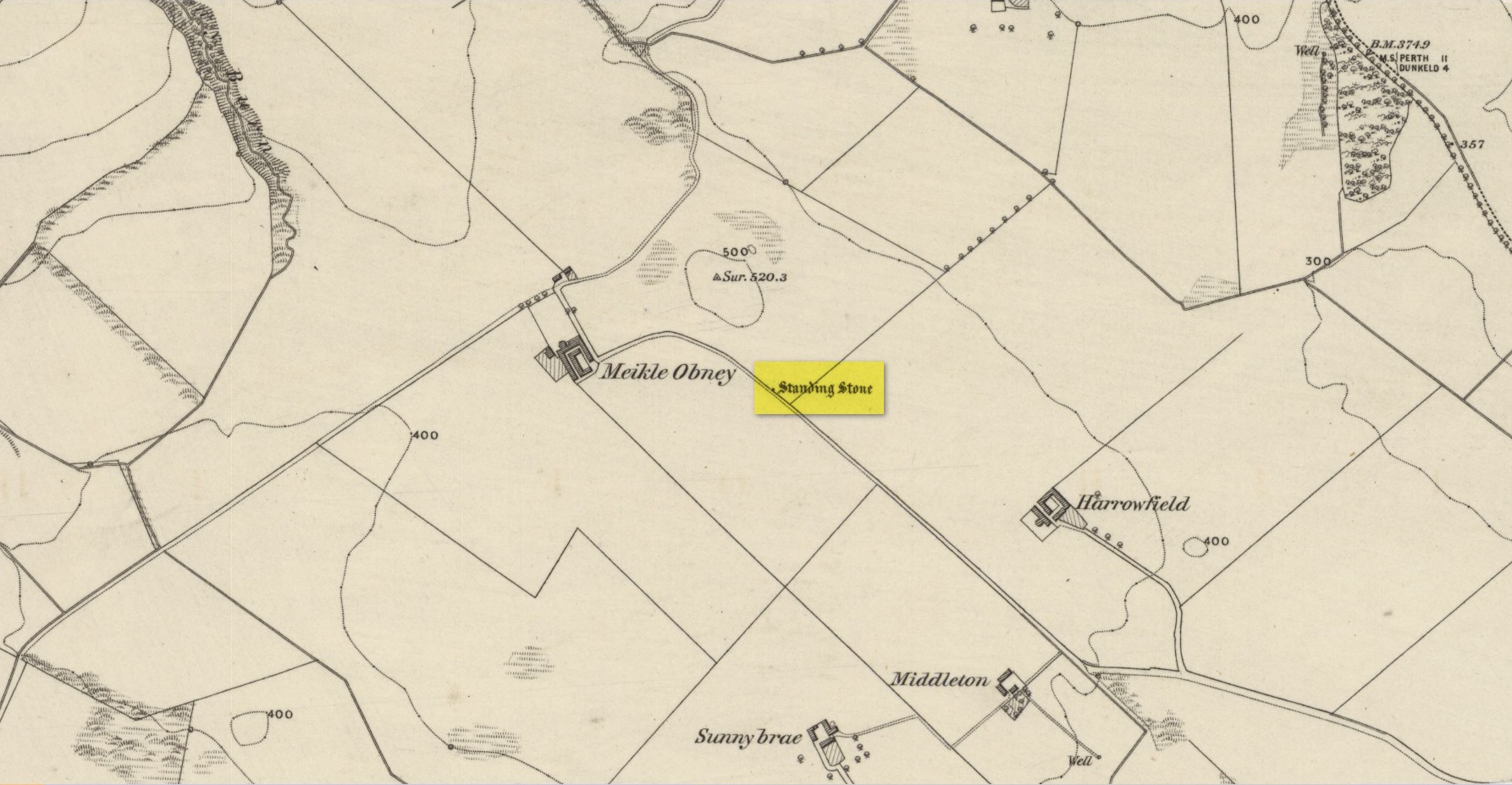
Site shown on 1867 map
Witch’s Stone at roadside

Shown on the first Ordnance Survey map of the area in 1867, its bulky 6½-foot-tall body stands all alone on this relatively flat plain, with open views to the east, south and west.  It gave me the distinct impression that it was once part of a larger megalithic complex, but I can find no additional evidence to substantiate this.  Call it a gut-feeling if you will.  Intriguingly, the closest site to this are two standing stones just out of view literally ⅔-mile (1.07km) to the northeast, aligned perfectly to the Witch’s Stone!  Most odd…

Folklore

The story behind this old stone is a creation myth that we find all over the country, but usually relating to prehistoric tombs more than monoliths.  The great Fred Coles (1908) wrote:

“the common legend is told of a witch who, when flying through the air on some Satanic behest, let the Stone fall out of her apron.”

References:

  1. Coles, Fred, “Report on Stone Circles Surveyed in Perthshire – North-eastern Section,” in Proceedings Society Antiquaries, Scotland, volume 42, 1908.
  2. Marshall, William, Historic Scenes in Perthshire, William Oliphant: Edinburgh 1880.
  3. Stewart, Elizabeth, Dunkeld – An Ancient City, Munro Press: Perth 1926.

Acknowledgements:  Huge thanks for use of the Ordnance Survey map in this site profile, reproduced with the kind permission of the National Library of Scotland

© Paul BennettThe Northern Antiquarian
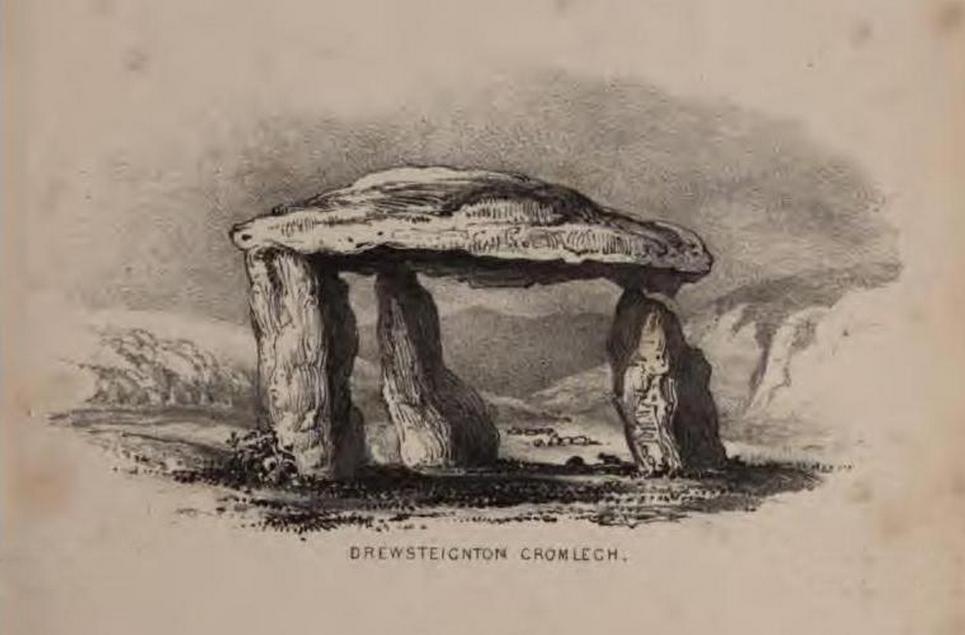
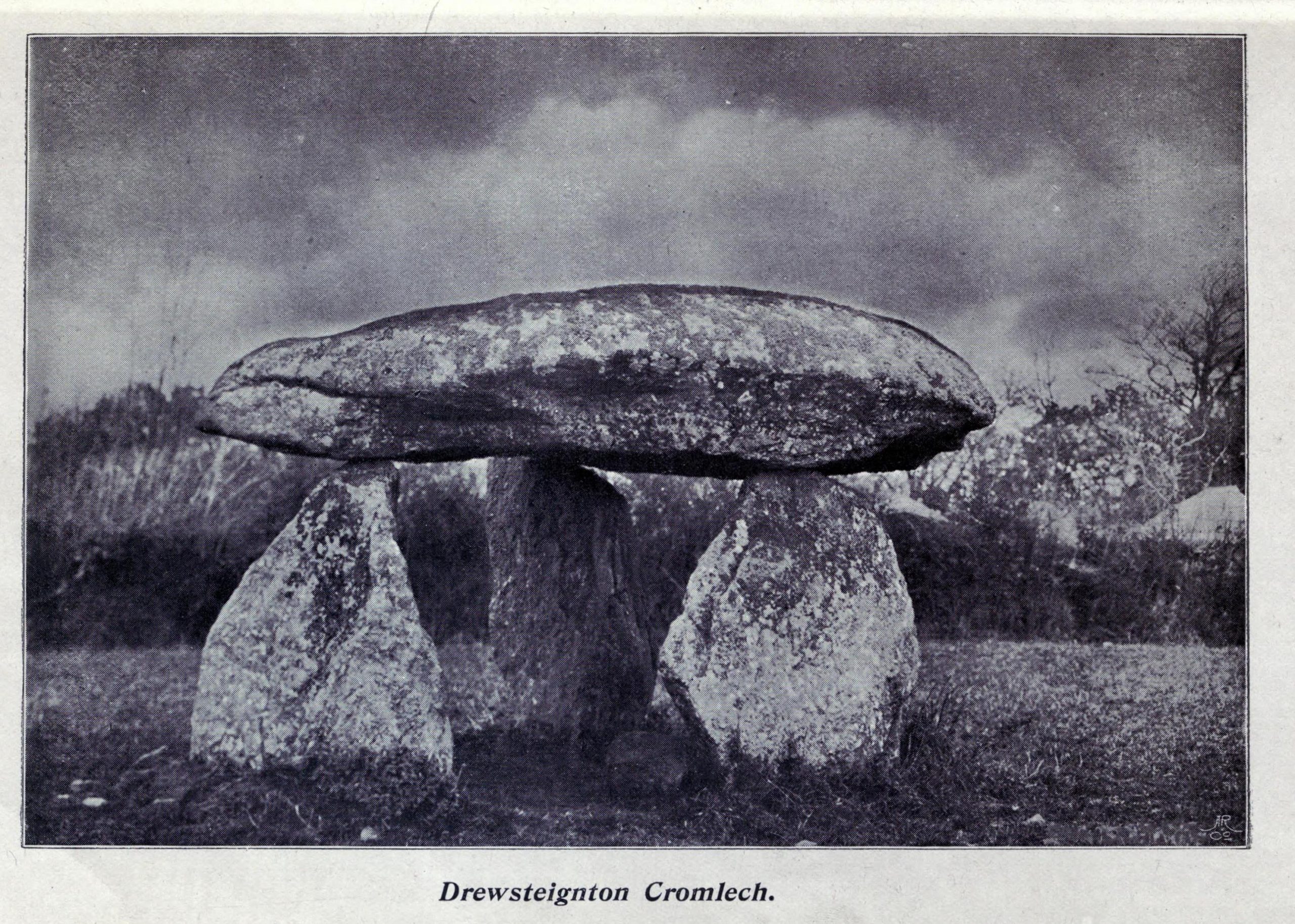
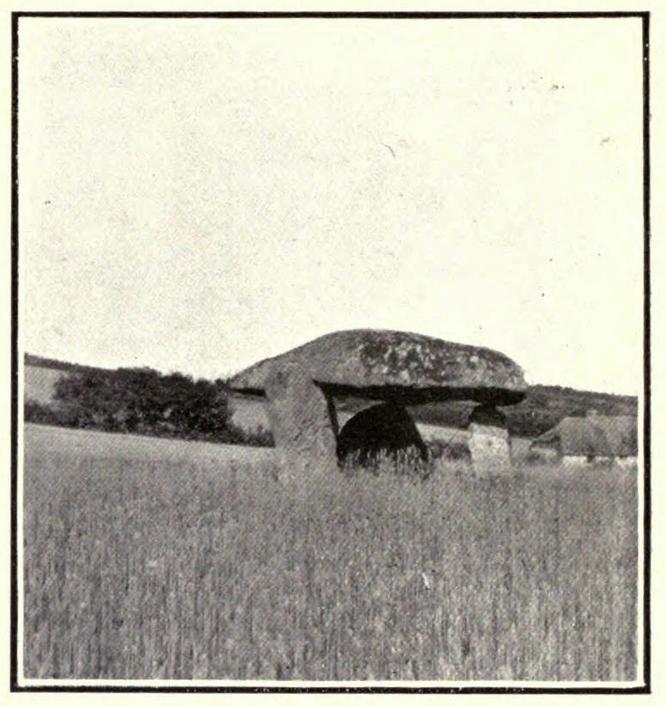
The Spinsters’ Rock, Drewsteignton, Devon

Dolmen:  OS Grid Reference – SX 70092 90783

Also Known as:

  1. Drewsteignton (1)

Archaeology & History

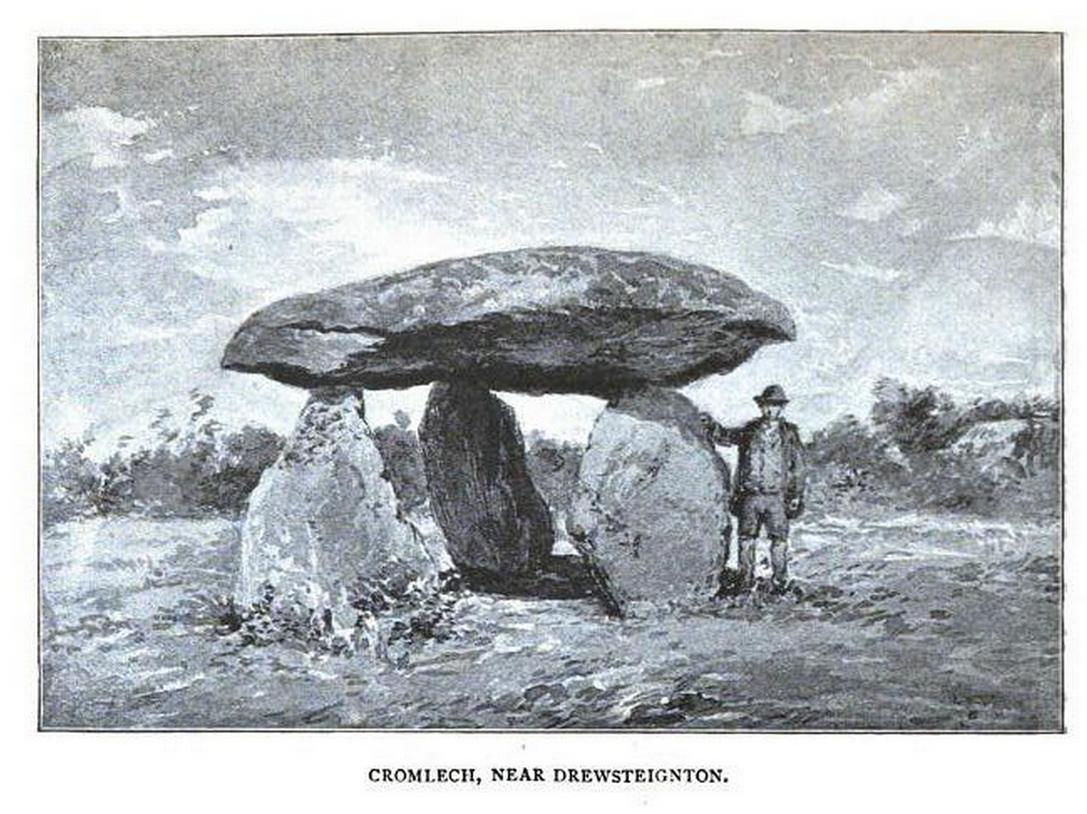
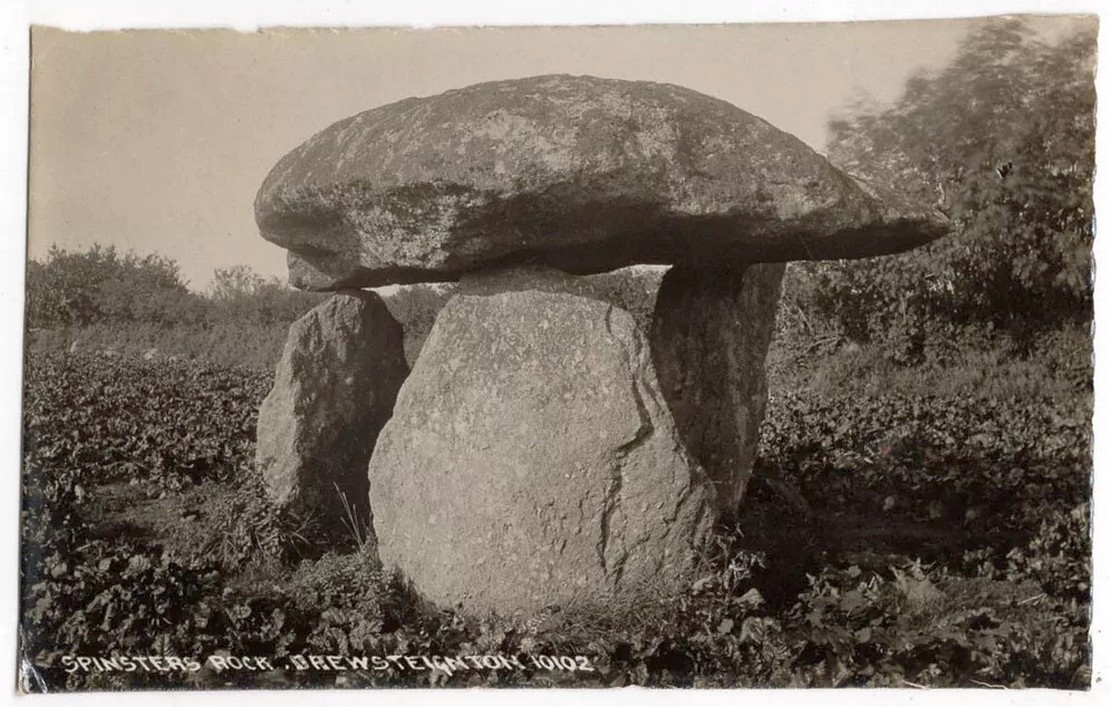
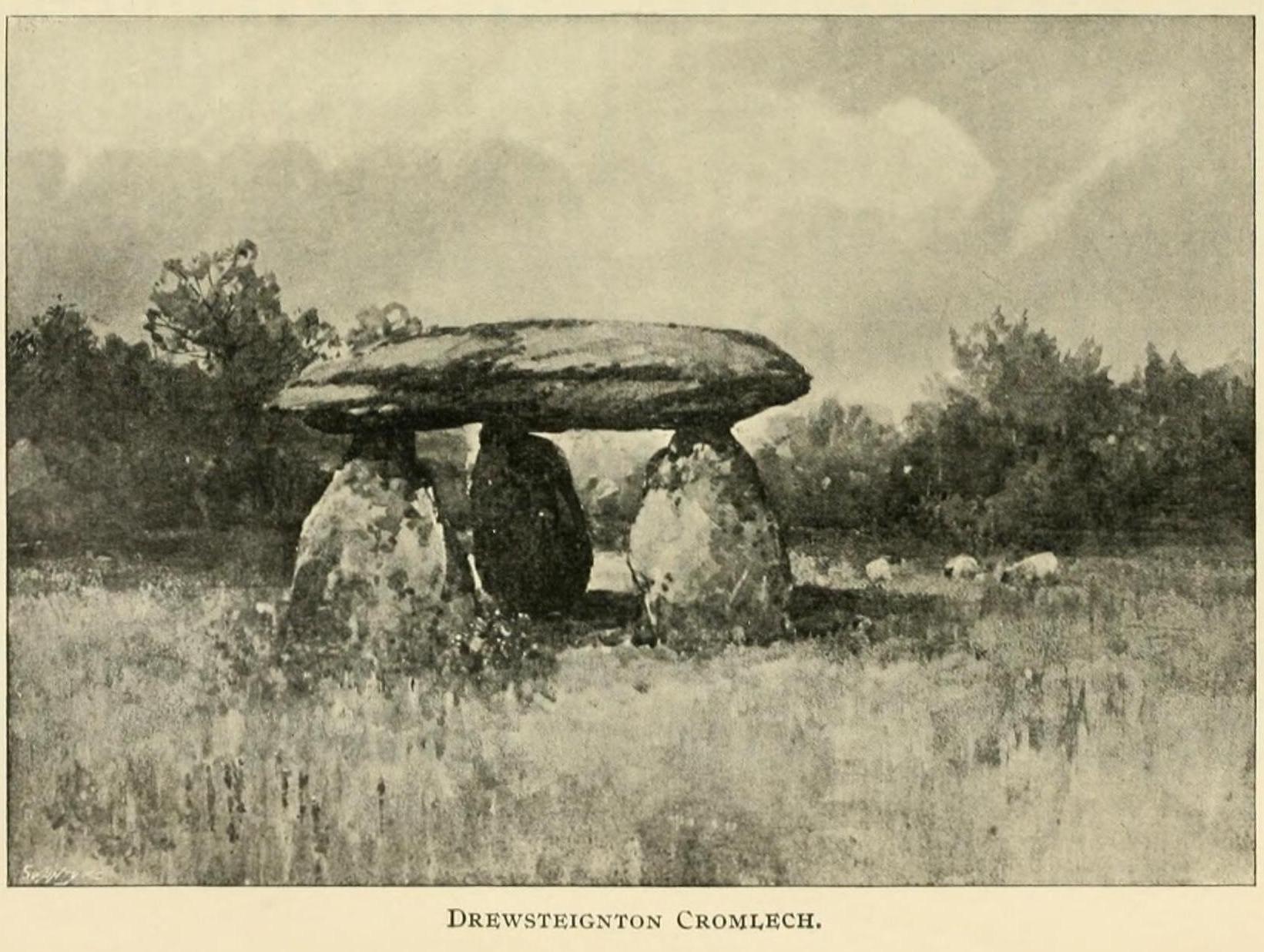
Highlighted on Benjamin Donn’s map of Devon in 1765, this impressive neolithic dolmen consists of three large granite support stones between 5 ft 7 in and 7 ft 7 in tall, surmounted by a large capstone measuring 15 feet by 10 feet.  It collapsed in 1862 but was restored later the same year.


Folklore

In Murray’s (1851) Handbook for Travellers he told the following tale of the site:

This interesting old monument derives its name from a whimsical tradition that three spinsters (who were spinners) erected it one morning before breakfast; but “may we not,”* says Mr. Rowe (Peramb. of Dartmoor), “detect in this legend of the three fabulous spinners the terrible Valkyriur of the dark mythology of our Northern ancesters – the Fatal Sisters, the choosers of the slain, whose dread office was to ‘weave the warp and weave the woof of destiny.'”

Polwhele informs us that the legend varies, in that for the three spinsters some have substituted three young men and their father, who brought the stones from the highest part of Dartmoor; and in this phase of the legend has been traced an obscured tradition of Noah and his three sons.

.. The hill on which it stands commands an excellent view of Cawsand Beacon. About 100 yds. beyond the cromlech on the other (N.) side of the lane, is a pond of water, of about 3 acres, called Bradmere Pool, prettily situated in a wood. It is said to be unfathomable, and to remain full to the brim during the driest seasons, and some regard it as artificially formed and of high antiquity – in short a Druidical pool of lustration connected with the adjacent cromlech..

.. The country-people have a legend of a passage formed of large stones leading underground from Bradmere to the Teign, near the logan stone..

References:

  1. Baring-Gould, Sabine, A Book of Dartmoor, London 1900.
  2. Crossing, William, Gems in a Granite Setting, Western Morning News: Plymouth 1905.
  3. Falcon, T.A., Dartmoor Illustrated, James G. Comin: Exeter 1900.
  4. Murray, John, A Hand-book for Travellers in Devon & Cornwall, John Murray: London 1851.
  5. Ormerod, G. Waring, Notes on Rude Stone Remains Situate on the Easterly Side of Dartmoor, privately printed 1873.
  6. Page, John Lloyd Warden, An Exploration of Dartmoor and its Antiquities, Seeley: London 1892.
  7. Worth, R. Hansford, Worth’s Dartmoor, David & Charles: Newton Abbot 1967.

Acknowledgements:  Huge thanks for use of the Ordnance Survey map in this site profile, reproduced with the kind permission of the National Library of Scotland

© Paul BennettThe Northern Antiquarian