Kilninver, Oban, Argyll

Standing Stone (destroyed):  OS Grid Reference – NM 8250 2207

Also Known as:

  1. Canmore ID 22969

Archaeology & History

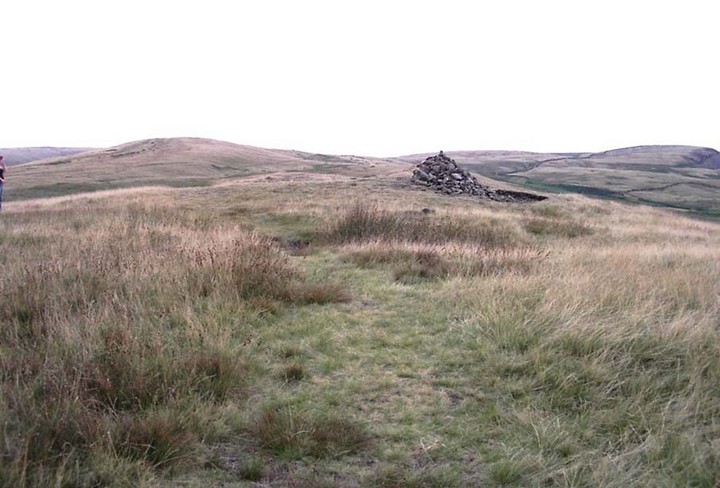
Marked on the earliest 6-inch Ordnance Survey map of this area (1875), this 4ft tall standing stone (now gone) once stood on the east bank of the River Euchar. The prehistoric cairn 400 yards to the west on the other side of the river would seem to have had some relationship with the stone, as they aligned to the equinoxes.

References:

  1. Royal Commission on the Ancient & Historical Monuments of Scotland, Argyll – volume 2: Lorn, HMSO: Edinburgh 1974.

© Paul Bennett, The Northern Antiquarian

Keill Vreeshey, Crosby, Isle of Man

Standing Stone:  OS Grid Reference – SC 3316 8014

Archaeology & History

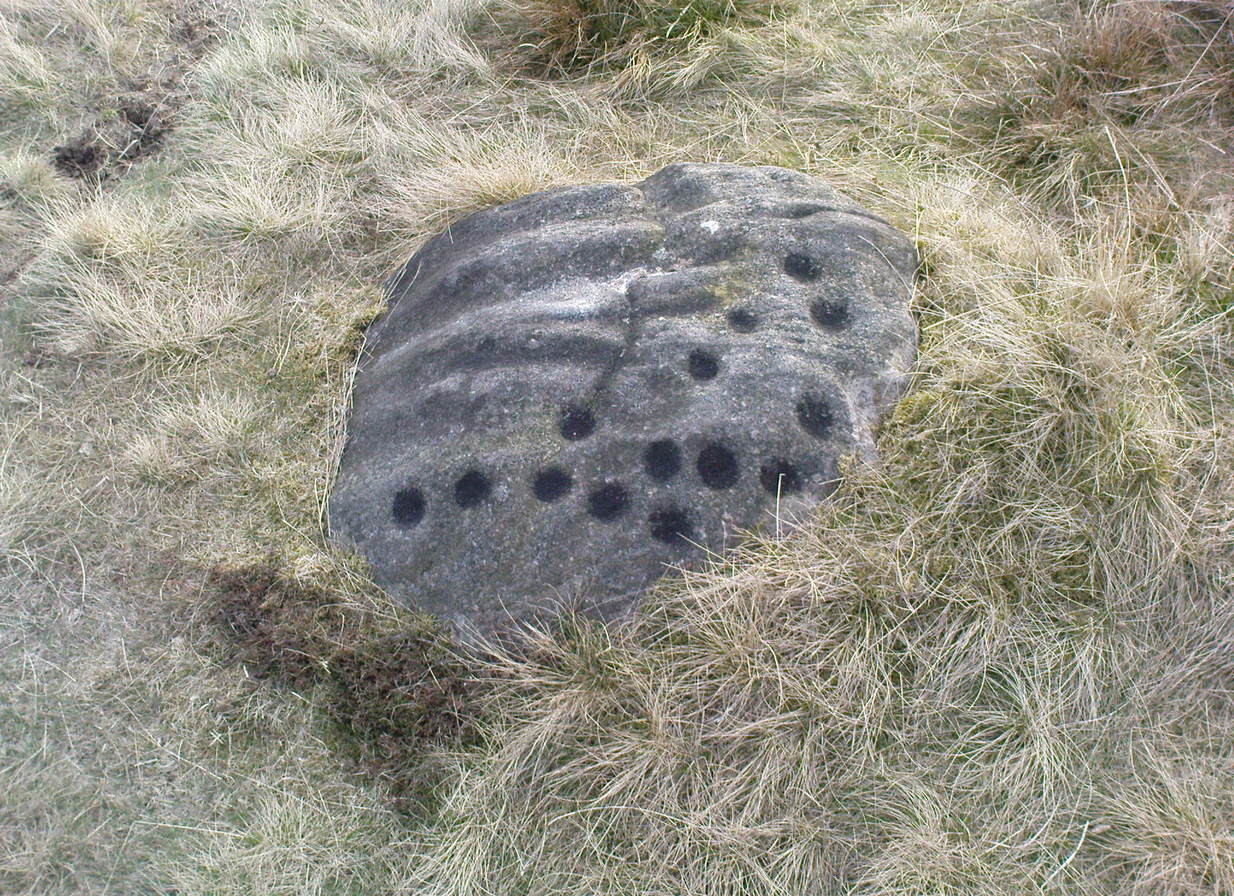
Keeill Carved Stone (Shaw 1877)

Seemingly destroyed, this carved standing stone was first described in Shaw’s Tourist Guide to the Isle of Man (1877), where he says it stood by the wall of the chapel, telling how it was “one of several stones inscribed with various designs and inscriptions.”

Hope that I’m wrong, but it seems like we’ve lost some more good old cup-and-ring art…

References:

  1. Shaw, N., Tourist Guide to the Isle of Man, 1877.

© Paul Bennett, The Northern Antiquarian

High Street Barrow, Towthorpe, East Yorkshire

Tumulus:  OS Grid Reference – SE 881 637

Also Known as:

  1. Towthorpe Barrow 1

Getting Here

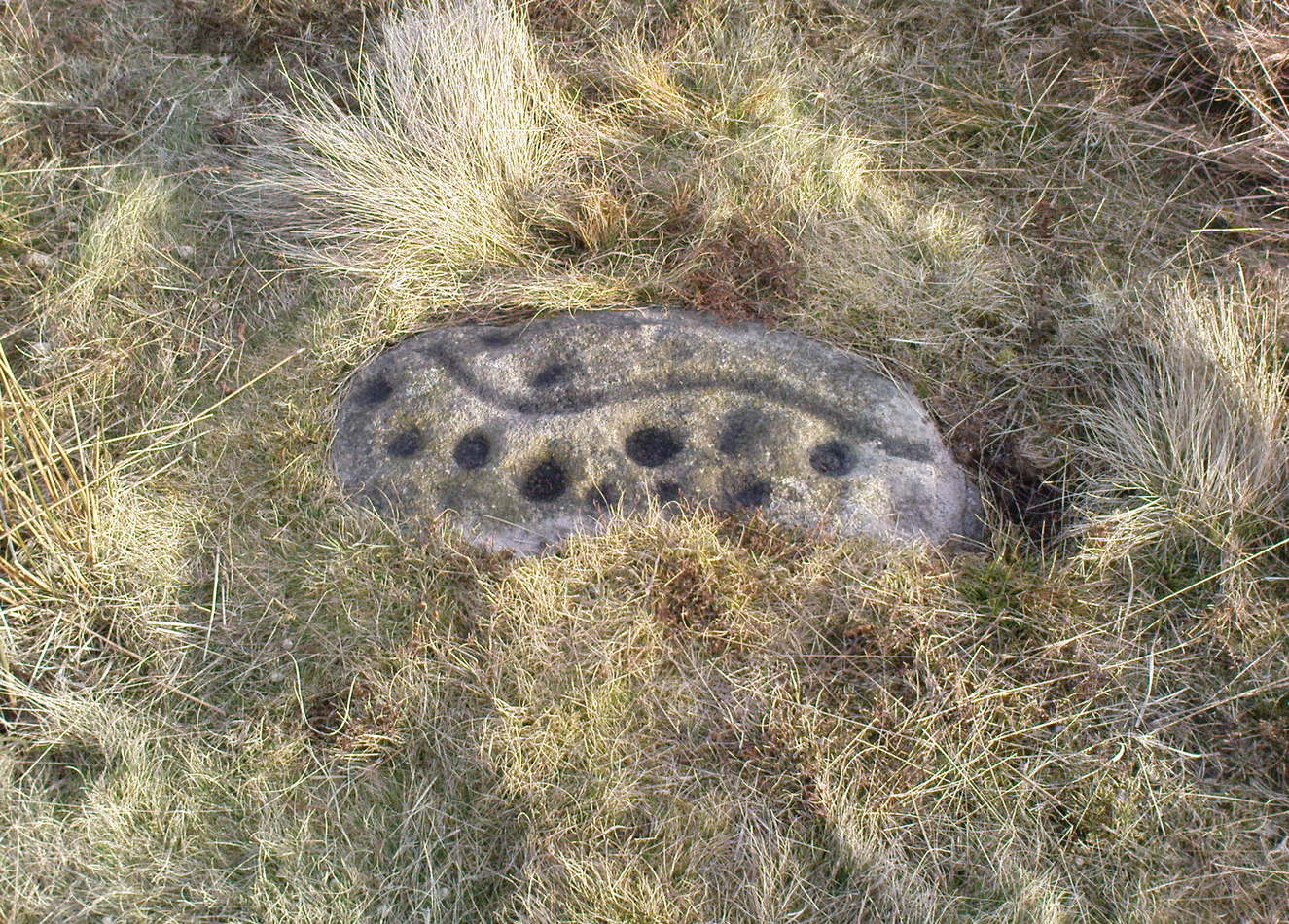
Mortimer’s sketch of Towthorpe-1 barrow

The faded remains of this old burial mound can vaguely be seen just off the right-hand (east) side of the B1248, across the road from the track which leads down to Burdale North Wold farmhouse, between Fimber and Wharram-le-Street.

Archaeology & History

Known as Towthorpe Barrow No.1 in the Mortimer survey (1905), there are a number of prehistoric tombs and other remains close to this site (which will be described on TNA as time goes by).  Some of you might think the lengthy description here a little unworthy, but I believe the extensive archaeological notes on this site by an archaeological legend, J.R. Mortimer, is a good indicator of the dedication and interest to which he gave each and every tomb that he opened (this’ll be the first of many). His slightly edited account told:

“This mound is situated near the centre of the (Towthorpe) group, close to High Towthorpe. Here the green lane…is crossed by the high road from Malton (B1248), through Wharram-le-Street… Part of this road, for some distance south and north of the barrow, is called ‘High Street’ by the old inhabitants of the neighbourhood…

“On 4 May, 1863, the writer, with the assistance of R. Mortimer and two workmen, commenced to open this mound. It was the first British barrow he had the pleasure of examining. A trench 10 feet wide was cut across its centre from the northern to the southern margin…

“The upper portion E, to a depth of 16 inches, consisted chiefly of the surface soil of the neighbourhood, the bottom part of which was reddened as if by the action of fire. Close below this was a stratum of wood and ashes and other dark matter, 2-3 inches in thickness; and then a lenticular bed of tough drab-coloured clay, 29 feet in diameter, and 12-14 inches thick in the centre, gradually thinning towards the circumference. The upper part of this bed of clay, which was in contact with the stratum of wood ashes, was reddened by fire; its under surface had a similar appearance and rested upon what seemed to be a second stratum of burnt and decayed matter, 2-3 inches in thickness, similar to that already described. The clay forming this lenticular bed contained numerous small fragments of grey flint, characteristic of the chalk of the neighbourhood. It must have been obtained from one of the valley bottoms (either Burdale, Wharram-le-Street or Duggleby), in which are exposures of the Kimeridge clay. In these places, angular pieces of flint and chalk crumble from the hillside, and mix with the clay, imparting a greyish colour to it. This is especially the case at Burdale, where there is a fine spring at the base of the chalk, and a small pond resting on the Kimeridge; and it is probably from this place that most of the clay for the construction of this barrow was obtained. It is not easy to explain the method by which the clay was transported, but several tons had evidently been used in this case. Many other instances in which material from a distance has been used in the erection of the barrows of this neighbourhood are recorded in (the Yorkshire Wolds).

“In the centre of the mound, at the base of the lenticular bed of clay and below the ashes (which probably represent the residue of a funeral pyre) stood two food vases, close together, and near to these, decayed bones (the remains of a human body) and a chipped flint. The smaller and more ornamented vase was situated to the south of its fellow. It measures 4.5 inches in neight, 5.5. inches in diameter at the top, and about the same across the shoulders. The ornamentation had been impressed on the plastic clay by a thin square-ended tool, about half-an-inch in length, which showed in the impression of a fine notched structure, and was equally divided into ten ridges about the size of the indentations on the milled edge of a shilling, and almost as truly cut. In the lower groove which runs round the vase are four pierced projections.

“The other vase is about 5 inches high and about 6 inches in diameter at the top and across the shoulders. Three encircling lines of short vertical cuts, rudely and apparently hastily made, previous to baking the vase, represent its entire ornamentation.

“During the excavation we collected from the material of the mound a dozen hand-struck flint flakes of various sizes, and a small splinter from the cutting-edge of a green-stone celt.”

Mr Mortimer returned to do further excavations here on Christmas Eve and Christmas Day in 1865, with the hope of finding more — but apart from a finely-cut knife made of black flint, nothing else was located. This was the first of Mortimer’s hundreds of diggings into the tombs and dykes of East and North Yorkshire.

References:

  1. Marsden, Barry M., The Early Barrow Diggers, Tempus: Stroud 1999.
  2. Mortimer, J.R., Forty Years Researches in British and Saxon Burial Mounds of East Yorkshire, A. Brown: London 1905.

© Paul Bennett, The Northern Antiquarian

High Carr Rocks, Keighley, West Yorkshire

Cup-and-Ring Stones:  OS Grid Reference – SE 0578 4395

Getting Here

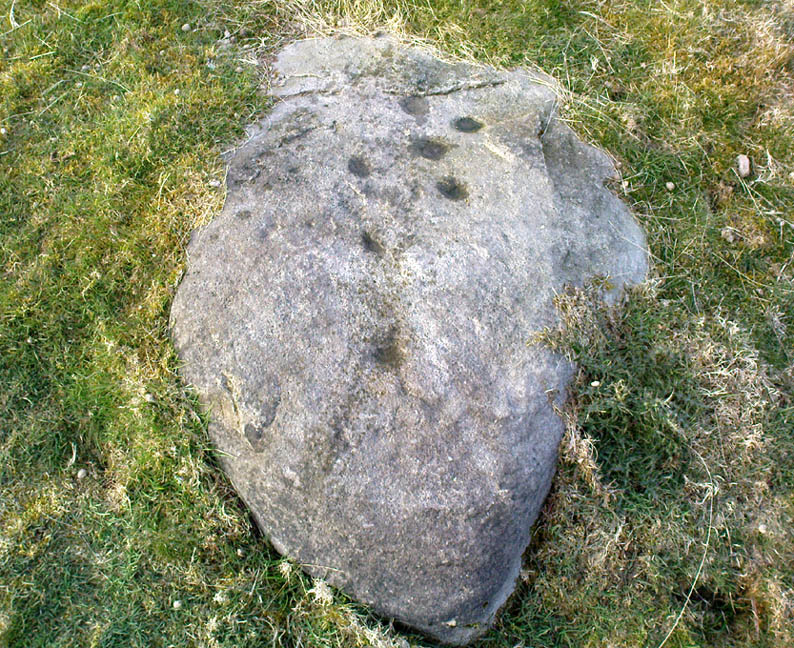
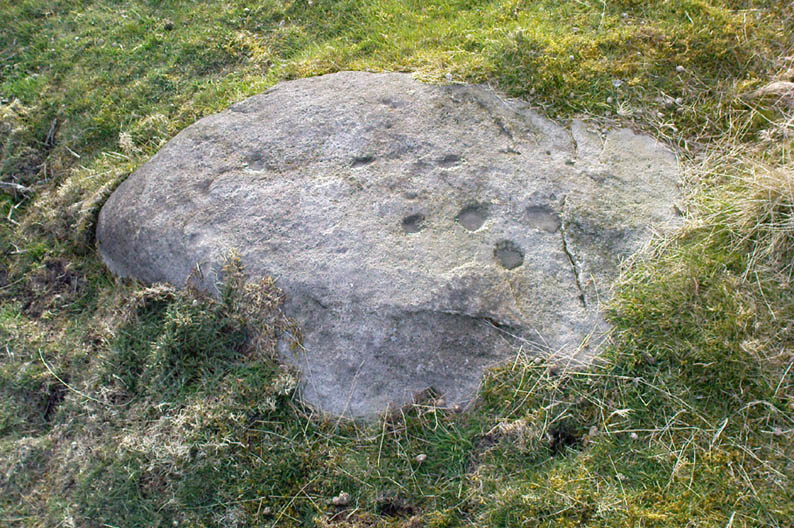
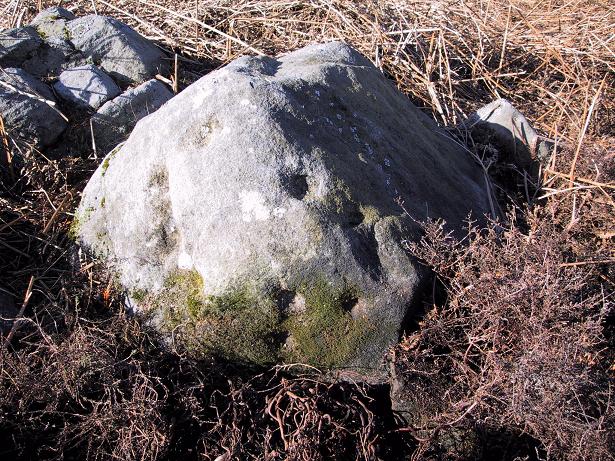
High Carr Cup-Markings (1 & 2)

Loadsa ways to get to this little outcrop, which the Boughey & Vickerman survey (2003) says comprises of five different carvings (CRs 33-37).  I’m not so sure misself.  When Stuart Feather first found these in the 1950s, he only thought three stones were carved, which I think is the more accurate.

Most folk would probably prefer to walk down the slope from Holden Gate down the footpath past Jaytail Farm, then dropping down to the very bottom of the fields (south) where you’ll see a small knoll with a cluster of rocks just in front of the tree-line.  But I wandered up thru the ‘Private’ (ahem!) woodland, wet-thru in the pouring rain, and clambered over the wall right to the very spot (the old dowser’s ‘seek-and-find-rock-art’ nose worked again!).

Archaeology & History

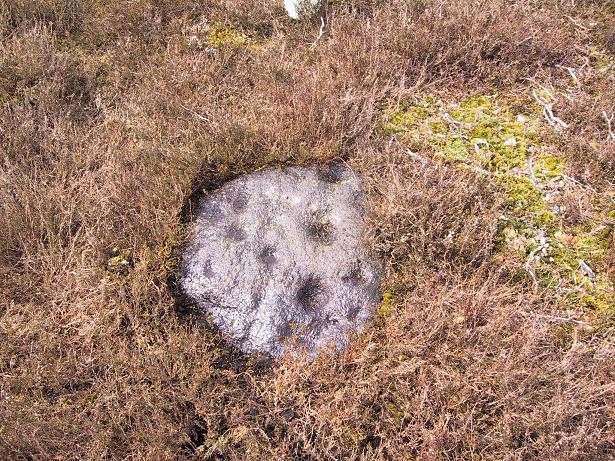
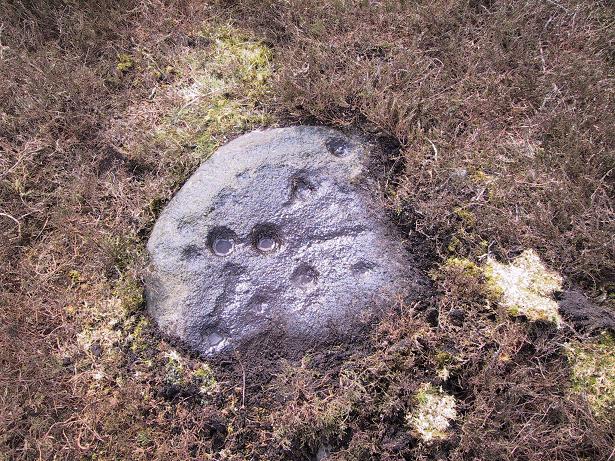
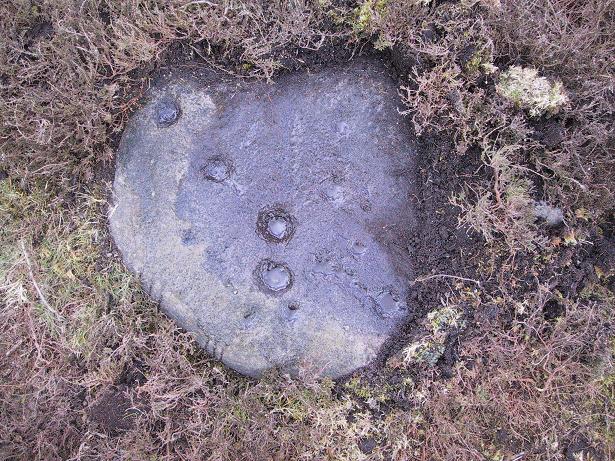
High Carr Cup-Marked Stone
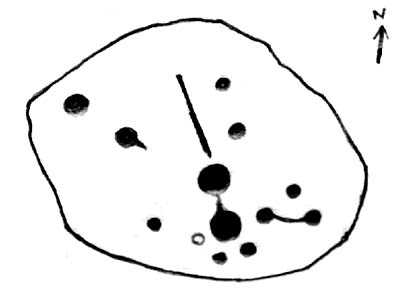
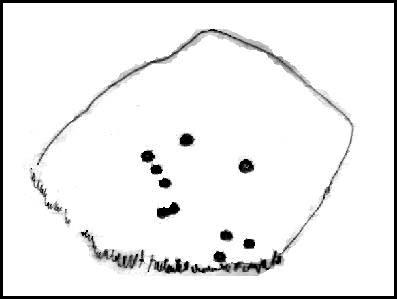
High Carr Cup-Marked Stone – from Hedge’s Carved Rocks on Rombald’s Moor

Listed in John Hedge’s (1986) survey as carvings 1-5, I’d say there’s one “definite” carving here, but the others – comprising simply of cups – are a little dubious.  The main carving has at least six definite cup-markings, found on the rock at the highest point of the knoll at the bottom of the field.  The drawing in Hedge’s survey shows as many as 12 cups on this stone, but I’m not totally convinced.  Another stone right next to the main one has, perhaps, a cup-marking or two on it – but again, these may be natural.

Of the other alleged carvings, it was difficult to work out as they were literally covered in tons of cow-shit. It seems this rock-outcrop is the local bovine toilet!  A lovely secluded place though, with plenty of wildlife to see.  Next stop from here: the great Holden waterfalls!

References:

  1. Boughey, K. & Vickerman, E.A., Prehistoric Rock Art of the West Riding, WYMCC: Wakefield 2003.
  2. Feather, S., ‘Three Bronze Age Rock Carvings near Keighley,’ in CHAGB 4:3, 1959.
  3. Hedges, John D., The Carved Rocks on Rombald’s Moor, WYMCC: Wakefield 1986.

© Paul Bennett, The Northern Antiquarian

Hawksnest, Langshaw, Melrose, Roxburghshire

Cup-and-Ring Stone:  OS Grid Reference – NT 499 403

Archaeology & History

The Scottish Royal Commission reported how,

“in 1936 a cup-marked boulder measuring 3ft 10in in length, 3ft 8in width and 1ft 8in in thickness, was found in a cultivated field half a mile southeast of Hawksnest and 75 yards north of the road from Hawksnest to Ladhopemoor.”

The carved stone had been scarred a little by the plough, but had “23 shallow cup-marks on its upper surface varying from 1in to 1.75in diameter.”  This carving is curiously omitted from Ronald Morris’ Prehistoric Rock Art of  Southern Scotland (1981), so perhaps the carving has been lost.  Does anyone know owt more about it?

References:

  1. Royal Commission on the Ancient & Historical Monuments of Scotland, Roxburghshire – volume 2, HMSO: Edinburgh 1956.

© Paul BennettThe Northern Antiquarian 


Harden Moor Circle, Bingley, West Yorkshire

Ring Cairn:  OS Grid Reference – SE 07496 38675

Getting Here

Harden Moor circle01
Harden Moor Circle, looking SE

From Harden, go up Moor Edge High Side (terraced row) till you reach the top. Follow the path thru’ the woods on the left side of the stream till you bend back on yourself and go uphill till you reach the moor edge. Keep walking for about 500 yards and keep an eye out to your immediate left.  The other route is from the Guide Inn pub: cross the road and go up the dirt-track on the moor-edge till you reach a crossing of the tracks where a footpath takes you straight onto the moor (south). Walk on here, heading to the highest point where the path eventually drops down the slope, SE. As you drop down, watch out for the birch tree, cos the circle’s to be found shortly after that, on your right, hidden in the heather!

Archaeology & History

This aint a bad little site hidden away on the small remains of Harden Moor, but is more of a ‘ring cairn’ than an authentic stone circle (a designation given it by previous archaeologists).  An early description of it was by Bradford historian Butler Wood (1905), who also mentioned there being the remains of around 20 small burials nearby.  When the great Sidney Jackson (1956; 1959) and his team of devoted Bradford amateurs got round to excavating here, he found “four or five Bronze Age urns” associated with the circle.  His measurements of the site found it to be 24 feet across, and although the stones are buried into the peat with none of them reaching higher than 3 feet tall, it’s a quietly impressive little monument this one.  About 20 upright stones make up the main part of the ring.

I’ve visited the place often over the last year or so since a section of the heather has been burnt away on the southern edges of the circle.  This has made visible a very distinct surrounding raised embankment of packing stones about a yard wide and nearly two-feet high, particularly on the southern and eastern sides of the circle, giving the site a notable similarity in appearance and structure to the Roms Law circle (or Grubstones Ring) on Ilkley Moor a few miles to the north.

There is also the possibility that this ring of stones was the site described by local historian William Keighley (1858) in his brief outline of the antiquities of the region, where he wrote:

“On Harden Moor, about two miles south of Keighley, we meet with an interesting plot of ground where was to be seen in the early days of many aged persons yet living, a cairn or ‘skirt of stones,’* which appears to have given name to the place, now designated Cat or Scat-stones. This was no doubt the grave of some noted but long-forgotten warrior.

* The Cairn was called Skirtstones by the country people in allusion to the custom of carrying a stone in the skirt to add to the Cairn.”

However, a site called the ‘Cat stones’ is to be found on the nearby hill about 500 yards southeast – and this mention of a cairn could be the same one which a Mr Peter Craik (1907) of Keighley mentioned in his brief survey of the said Catstones Ring at the turn of the 20th century.  We just can’t be sure at the moment.  There are still a number of lost sites, inaccuracies and questions relating to the prehistoric archaeology of Harden Moor (as the case of the megalithic Harden Moor Stone Row illustrates).

Section of the inner ring

The general lack of an accurate archaeological survey of this region is best exemplified by the archaeologist J.J. Keighley’s (1981) remark relating specifically to the Harden Moor Circle, when he erroneously told that, “there are now no remains of the stone circle on this site” — oh wot an indicator that he spent too much time with paperwork!  For, as we can see, albeit hidden somewhat by an excessive growth of heather, the ring is in quite good condition.

It would be good to have a more up-to-date set of excavations and investigations here.  In the event that much of the heather covering this small moorland is burnt back, more accurate evaluations could be forthcoming. But until then…..

References:

  1. Bennett, Paul, The Old Stones of Elmet, Capall Bann: Milverton 2001.
  2. Craik, Peter, “Catstones Ring,” in C.F. Forshaw’s Yorkshire Notes & Queries, volume 3 (H.C. Derwent: Bradford 1907).
  3. Faull, M.L & Moorhouse, S.A. (eds.), West Yorkshire: An Archaeological Survey to AD 1500 – volume 1, WYMCC: Wakefield 1981.
  4. Jackson, Sidney, “Harden Moor Circle,” in Cartwright Hall Archaeology Group Bulletin, 1:18, June 1956.
  5. Jackson, Sidney, “Harden Circle Found,” in Cartwright Hall Archaeology Group Bulletin, 2:1, July 1956.
  6. Jackson, Sidney, “Bronze Age Urn found on Harden Moor,” in Cartwright Hall Archaeology Group Bulletin, no.7, 1959.
  7. Keighley, J.J., “The Prehistoric Period,” in Faull & Moorhouse, WYMCC: Wakefield 1981.
  8. Keighley, William, Keighley Past and Present, Arthur Hall: London 1858.
  9. Wood, Butler, ‘Prehistoric Antiquities of the Bradford District,’ in Bradford Antiquary, volume 2, 1905.

© Paul Bennett, The Northern Antiquarian

Water Sheddles Cross, Oakworth Moor, West Yorkshire

Standing Stone:  OS Grid Reference – SD 9711 3826

Also known as:

  1. Hanging Stone
  2. Standing Stone
  3. Waterscheddles Cross

Getting Here

The old stone, lost amidst the colour of hills

Pretty easy to find.  Go along the Oakworth-Wycoller road, between Keighley and Colne, high up on the moors.  When you get to the Water Sheddles Reservoir right by the roadside (y’ can’t miss it), stop!  On the other side of the road walk onto the moor, heading for the walling a coupla hundred yards to your east (right).  Where the corner edge of the walling ends, your standing stone is right in front of you!  If for some reason you can’t see it, wander about – though beware the very boggy ground all round here.

Archaeology & History

This seven-foot tall monolith, leaning to one side thanks to the regularly water-logged peat beneath its feet, stands on the Yorkshire-Lancashire.  It is locally known as the Hanging Stone and the Standing Stone, but the name ‘Water Sheddles’ is a bittova puzzle.  The place-names authority, A.H. Smith (1961) thinks it may derive from the middle-english word, shadel, being a ‘parting of the waters’ – which is pretty good in terms of its position in the landscape and the boggy situation around it.  But ‘sheddle’ was also a well-used local dialect word, though it had several meanings and it’s difficult to say whether any of them would apply to this old stone.  Invariably relating to pedlars, swindling or dodgy dealings, it was also used to mean a singer, or someone who rang bells, or a schedule, aswell as to shuffle when walking.  Perhaps one or more of these meanings tells of events that might have secretly have been done here by local people, but no records say as such — so for the time being I’ll stick with Mr Smith’s interpretation of the word!  Up until the year 1618 it was known simply as just a ‘standing stone’, when it seems that the words “Hanging Stone or Water Sheddles Cross” were thereafter carved on its west-face, as the photo below shows.

Cross carved on the head of the stone
Cross carved on top of the stone
The old stone, with its names carved for all to see

Whether or not this stone is prehistoric has been open to conjecture from various quarter over the years.  Is it not just an old boundary stone, erected in early medieval times?  Or perhaps a primitive christian relic?  Certainly the stone was referred to as “le Waterschedles crosse”, as well as “crucem”, in an early record describing the boundaries of the parish of Whalley, dating from around the 15th century.  This has led some historians to think that the monolith we see today is simply a primitive cross.  However, sticking crosses on moortops or along old boundaries tended to be a policy which the Church adopted as a means to ‘convert’ or christianize the more ancient heathen sites.  It seems probable in this case that an old wooden cross represented the ‘crucem‘ which the monks described in the early Whalley parish records.

Site marked on 1892 map

This monolith likely predates any christian relic that might once have stood nearby; although the carving of a ‘cross’ on the head of the stone may have supplemented the loss of the earlier wooden one.  But it seems likely that this carved ‘cross’ was done at a later date than the description of the ‘crucem‘ in the parish records — probably a couple of centuries later, when a boundary dispute was opened, in 1614, about a query on the precise whereabouts of the Yorkshire-Lancashire boundary.  After several years, as John Thornhill (1989) wrote,

“the matter was resolved on the grounds that the vast Lancastrian parish of Whalley had claimed territorial jurisdiction as far east as the Hanging Stone, thus the county boundary was fixed on the Watersheddles Cross.”

Water Sheddles stone looking SW

Certainly the stone hasn’t changed in the last hundred years, as we can tell from a description of it by Henry Taylor (1906), who said:

“The remains consist of a rough block of stone, leaning at an angle of about forty-five degrees against a projecting rock. The top end has been shaped into the form of an octagon, on the face of which a raised cross is to be seen. The stone is about six feet long and two feet wide, tapering to eleven inches square at the upper end, and appears once to have stood upright. Some local authorities have cut on it the words, ‘Hanging Stone or Waterscheddles Cross.'”

So is it an authentic prehistoric standing stone?  Tis hard to say for certain I’m afraid.  It seems probable – but perhaps no more probable than the smaller Great Moss Standing Stone found just a couple of hundred yards away in the heather to the west, on the Lancashire side of the boundary.  Tis a lovely bitta moorland though, with a host of lost folktales and forgotten archaeologies…

References:

  1. Bennett, Paul, The Old Stones of Elmet, Capall Bann: Milverton 2001.
  2. Brigg, J.J., ‘A Disputed County Boundary”, in Bradford Antiquary, 2nd Series, no.8, 1933.
  3. Smith, A.H., The Place-Names of the West Riding of Yorkshire – volume 6, Cambridge University Press 1961.
  4. Taylor, Henry,The Ancient Crosses and Holy Wells of Lancashire, Sherratt & Hughes: Manchester 1906.
  5. Thornhill, John, ‘On the Bradford District’s Western Boundary,’ in Bradford Antiquary, 3rd Series, vol.4, 1989.
  6. Wright, Joseph, English Dialect Dictionary – volume 5, Henry Frowde: Oxford 1905.

© Paul Bennett, The Northern Antiquarian

Hameldon Pasture, Worsthorne, Lancashire

Cup-Marked Stone:  OS Grid Reference – SD 891 327

Archaeology & History

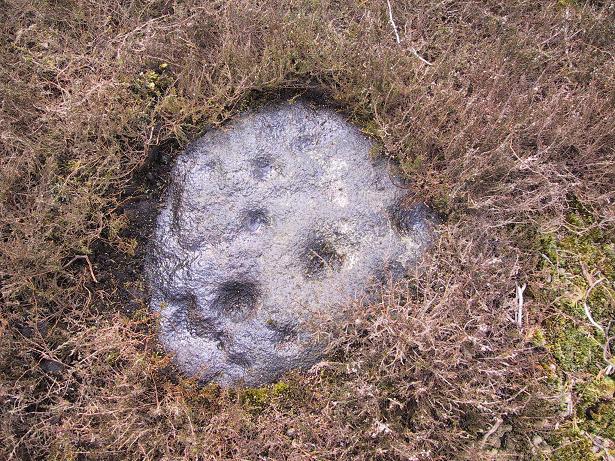
Hameldon Pasture cup-marked stone

In the vicinity of the denuded ring-cairn and old tumulus of Wortshorne Hill, the Calderdale historian Mr J.A. Heginbottom (1979) described finding this simple cup-marked rock, a hundred yards or so northwest of the old circle. In my ambles here I was unable to locate it. The stone may have been reburied or destroyed.  Prehistoric cup-marked carvings are (officially at least) rare things in Lancashire – and usually where you find one, others lurk close by.  Do any local folk out there know anything more about this site?

References:

  1. Heginbottom, J.A., The Prehistoric Rock Art of Upper Calderdale and the Surrounding Area, YAS: Leeds 1979.

© Paul Bennett, The Northern Antiquarian

Hamblethorpe, Low Bradley, Skipton, North Yorkshire

Standing Stones:  OS Grid Reference – SE 00303 47622

Getting Here

Hamblethorpe Stones, Low Bradley

Take the single-track country lane between Farnhill and Low Bradley until you reach Hamblethorpe farmhouse.  Where the birch woodland is on the slope going uphill, the field on the other side of the road, protected by walling, is where the stones are, just south of the farmhouse.  There’s nowhere to park any car hereabouts, so it’s best walking here.

Archaeology & History

It seems that nothing has previously been written of this place.  Hidden away at the top of the field we find two curious-looking standing stones: one nearly six-feet tall, and its companion about four-feet.  They’re near the bottom of the slope from the giant Round Cairn and Long Cairn tombs of Low Bradley Moor, several hundred yards to the east— and were it not for the fact that they have a distinctive Castlerigg-like appearance about them, perhaps I wouldn’t have given them a second chance.  Curious earthworks are in the same field, to which written records also appear silent.  Tis a lovely little spot…

© Paul Bennett, The Northern Antiquarian


Haer Stanes, Llanbryde, Banffshire

Stone Circle (destroyed):  OS Grid Reference – NJ 2691 5985

Also Known as:

  1. Haerstanes
  2. Harestones

Archaeology & History

Haer Stanes on the 1871 map

This site had already passed into memory when the Ordnance Survey lads visited the area in 1870, but at least they included it on their early survey.  Fred Coles (1906) described this site in his essay on the megaliths of Banffshire, where once could be found perhaps five stone circles close to each other – but all are now gone!  Bloody disgraceful really.  When Coles explored here, although the site was still shown on maps, little could be seen of the place.

“On the farm,” he wrote, “we heard long-handed-down tradition of the Circle, and the site was, rather vaguely, pointed out.” But there was nothing there. He described one reference to the place written by a Mr James Morrison, who said, “We have remains of two so-called Druid Circles, and during the last half-century three others have been swept away. One of these was in horse-shoe form and was called the Haer Stanes.” The same writer later says, “These stones were unfortunately found to lie in the line of a road then formed (1830) and were ignominiously tumbled down the slope on which for ages they had rested, and buried in a gravel pit by the side of the road.”

References:

  1. Cole, Fred, ‘Report on Stone Circles Surveyed in the North-East of Scotland…’, in Proceedings of the Society of Antiquaries, Scotland, volume 40, Edinburgh 1906.

© Paul Bennett, The Northern Antiquarian