From Wooler High Street, walk east past Market Place and then down The Peth, across the A697 road, go over the river bridge and then left up the long dead straight Brewery Road. It bends left about half-a-mile up and just over 100 yards past the bend (just where another sharp bend in the road occurs), make sure to take the hidden footpath that runs into the shrubs. 700 yards along, the path levels-out as you hit the edge of the moor and you reach a ‘crossroads’ of paths. Bear left (NE) and walk another 800 yards (past a gate or 2) where you hit a small woodland; keep walking straight along the same path until you hit the next copse of trees on your left, and here walk sharp right, through the field for 300 yards (past some more trees), through the gate and another 100 yards or so through the next gate. Ahead of you is a covered rocky ridge with some gorse bushes. Look around!
Archaeology & History
…from another angle
We were fortunate on our first visit here. For, in spite of what several tomes and local guides have said of this carving—i.e., “the site is hard to find as it’s covered by gorse bushes”—local folk have cleared it and made it accessible and much easier to find. Thank fuck! For on the day we came here, in spite of considerable cloud cover, it was very hot and humid—and the last thing I needed was working to rummage through vegetation on a day like that!
It was certainly in a crappy state when the old rock art writer Maarten van Hoek (1982) came here: “covered by sheep dirt” as he called it! But he cleaned it up – and thankfully the tradition amongst the local folks continues.
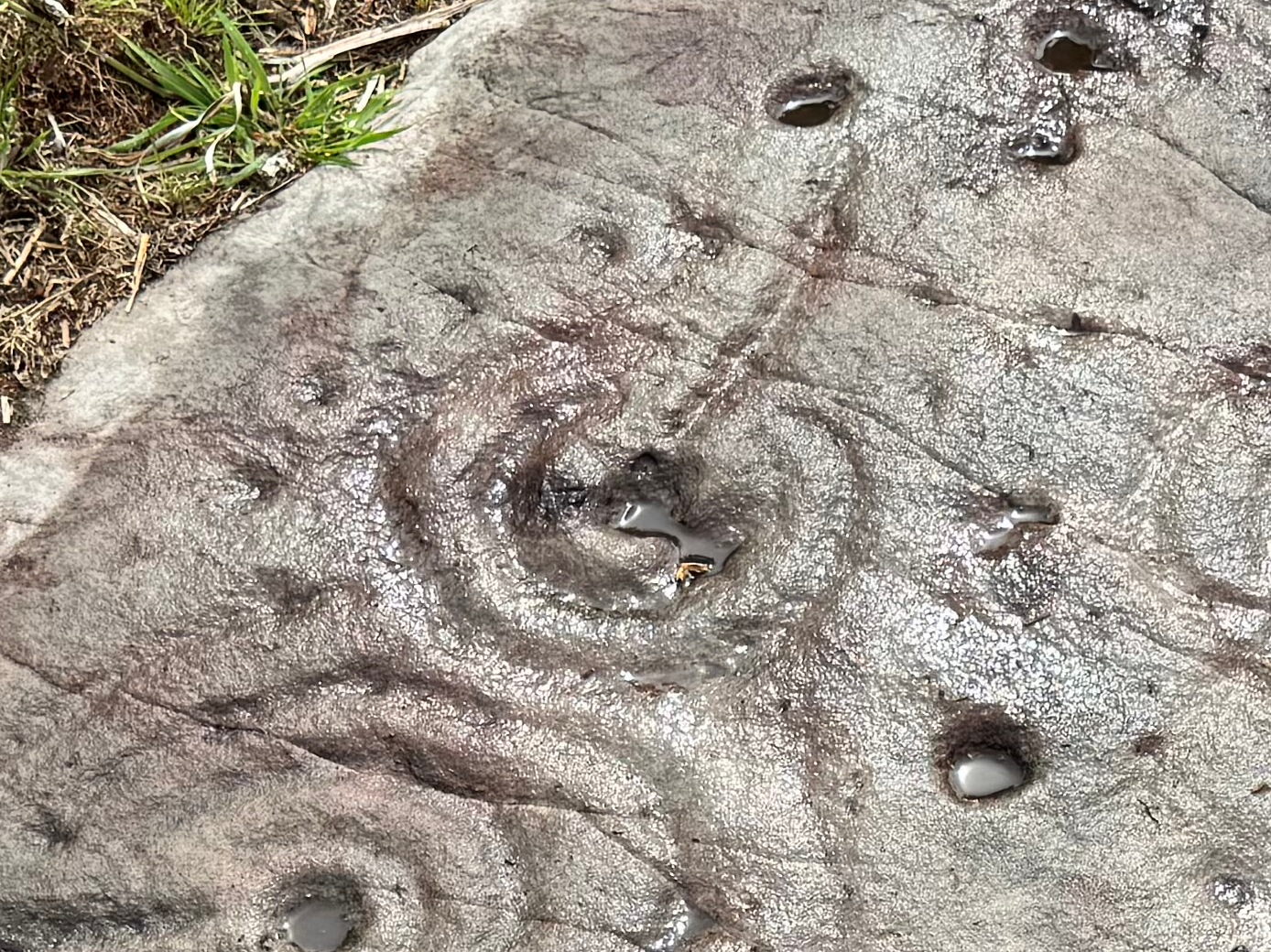
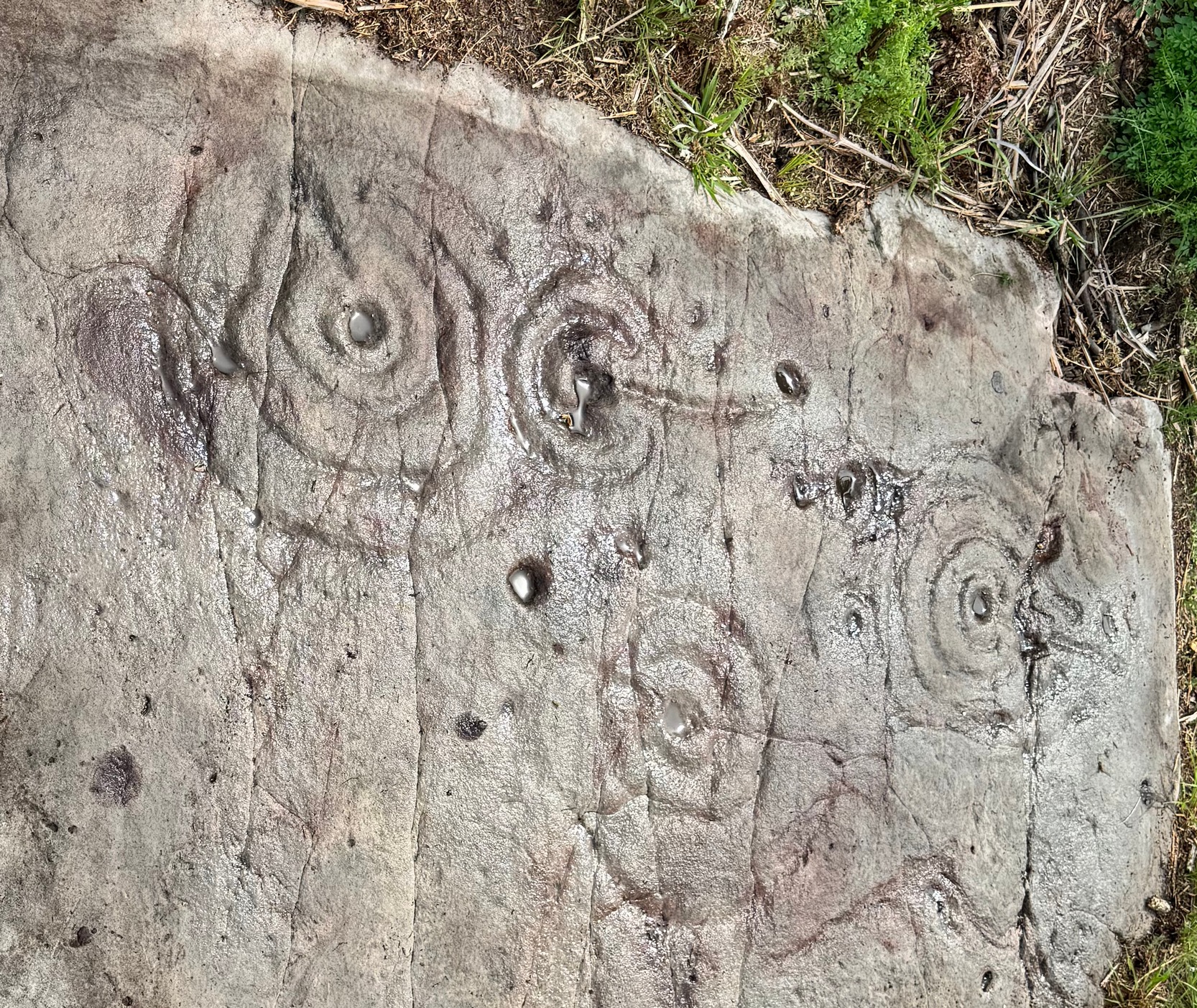
Arc of cups & double-ringClose-up of main design
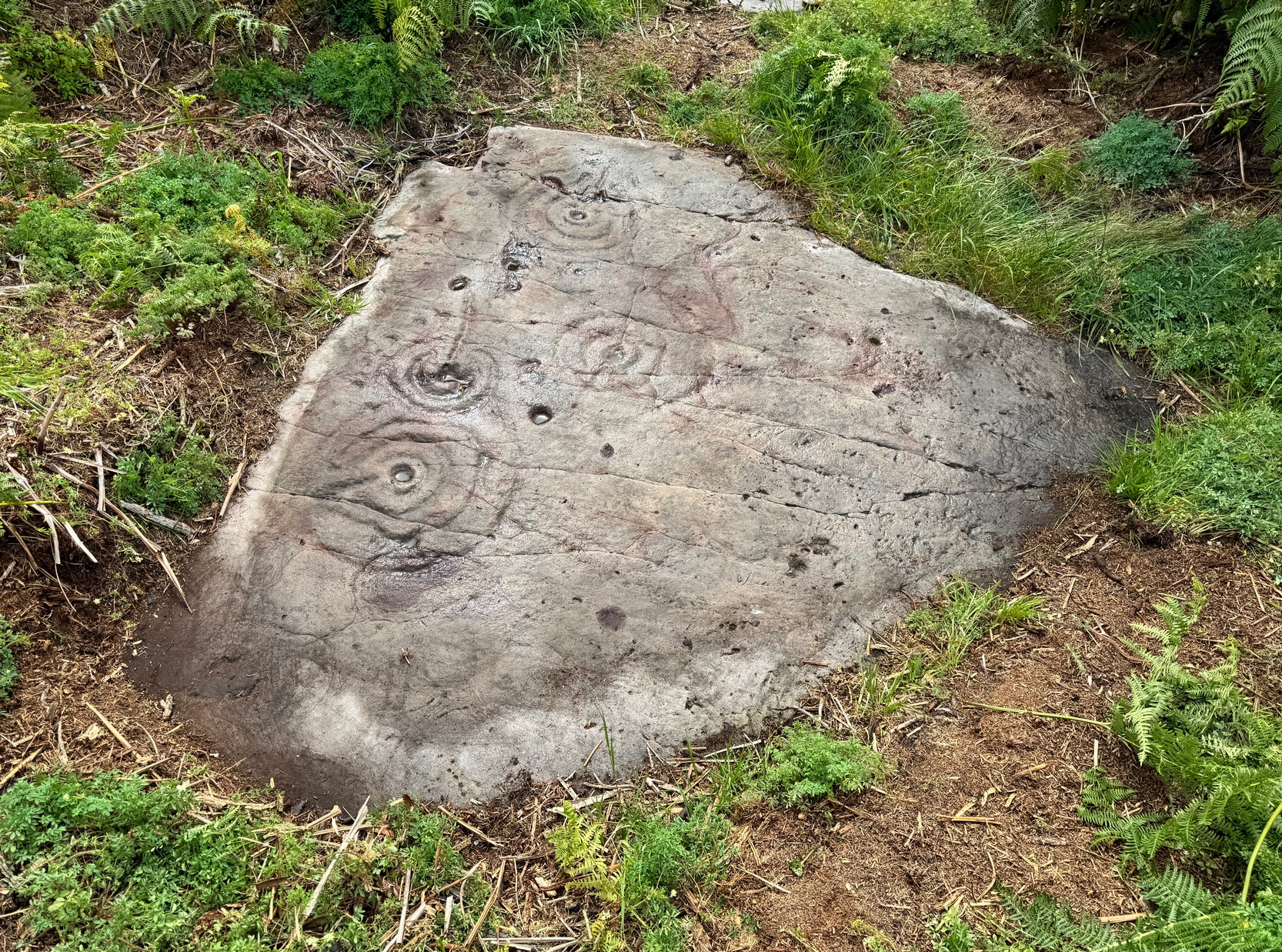
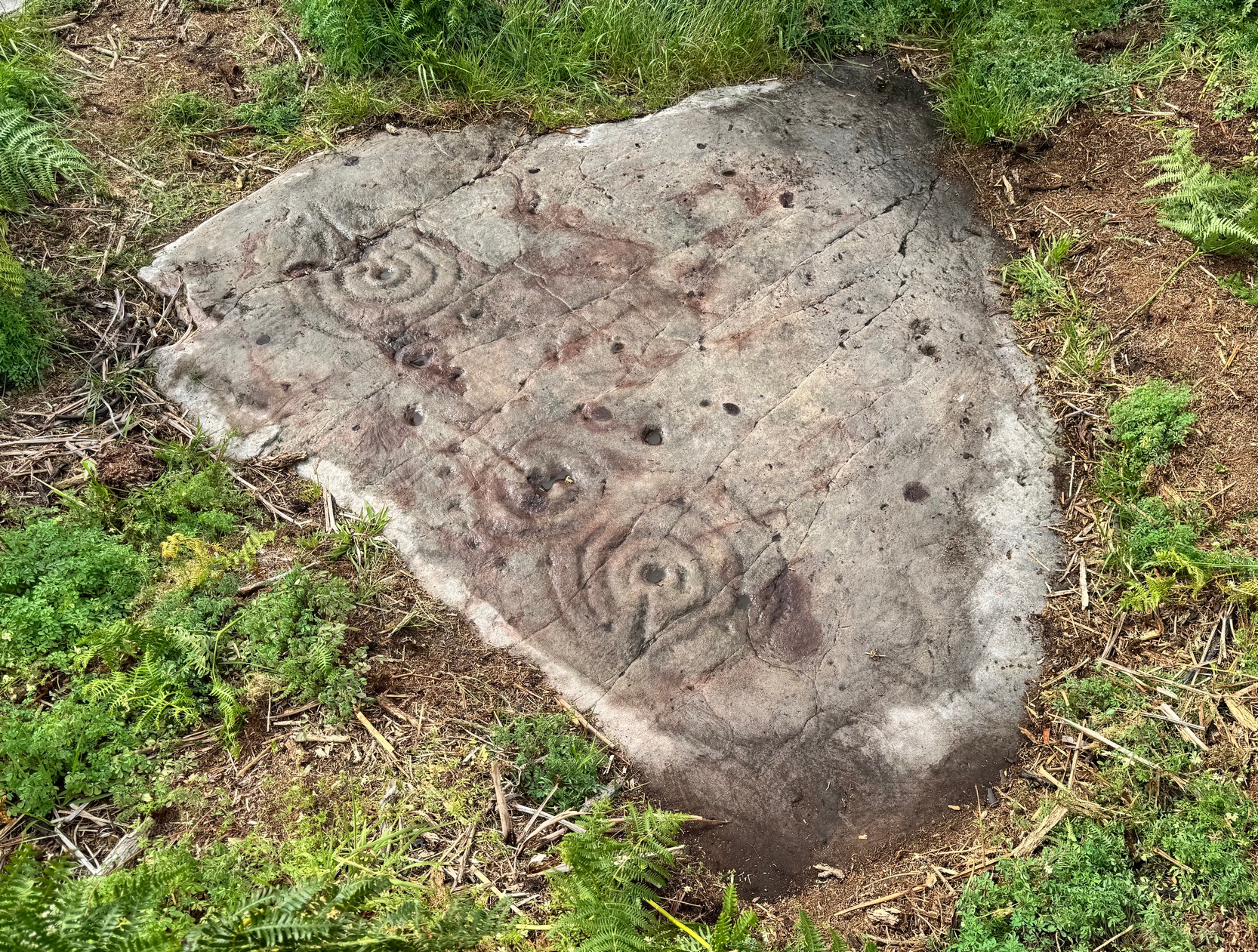
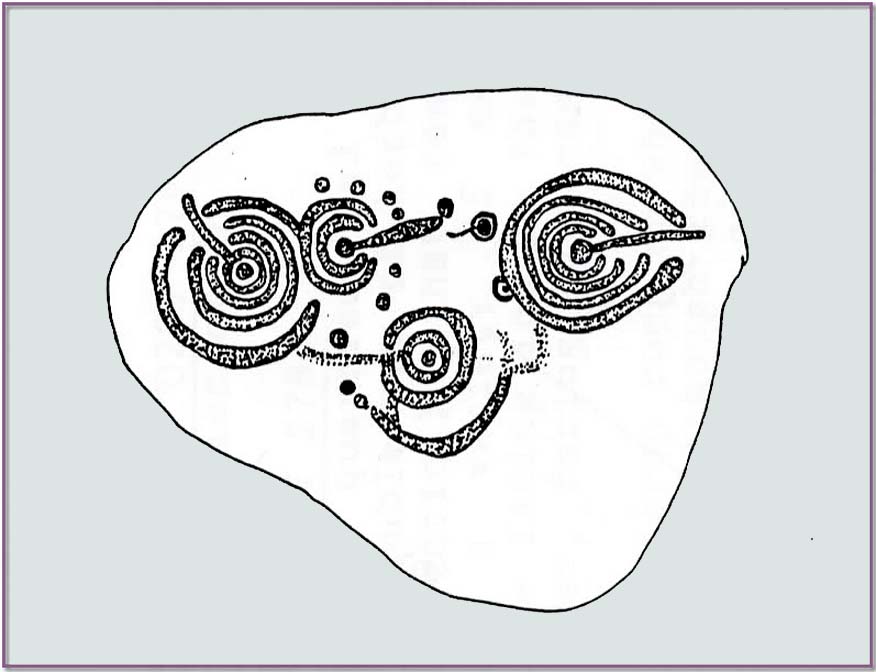
Cut into a rounded triangular-shaped flat rock are a series of multiple cup-and-ring designs, each with lines running in various directions to, or from, the central cup-mark. One of them—the smallest of the lot near the top-middle of the stone—is an incomplete double-ring, and all round the outer south- and western edge is a semi-circle of eight or nine cup-marks which, from my unconscious mind, brought about feelings of lunar phases defined by the cups as the Moon moved through the heavens—and then back on itself along the same movements through the skies. This simple ‘flash’, so to speak, was the unconscious of my youthful astronomical mind that brought it to the fore—and although ‘time’ in the neolithic was defined by the Moon (menstrual rites & all…), this impression, this ‘dreaming’ lacks consensus recognition and so, in the social Darwinian paradigm of modern archaeology, would be promptly put to bed! I still like the impression though; but it begs the question as to what mythos might underlie the rest of the design!
No such impression seems to have hit Maarten van Hoek (1982) upon his visit here. He described the carving thus:
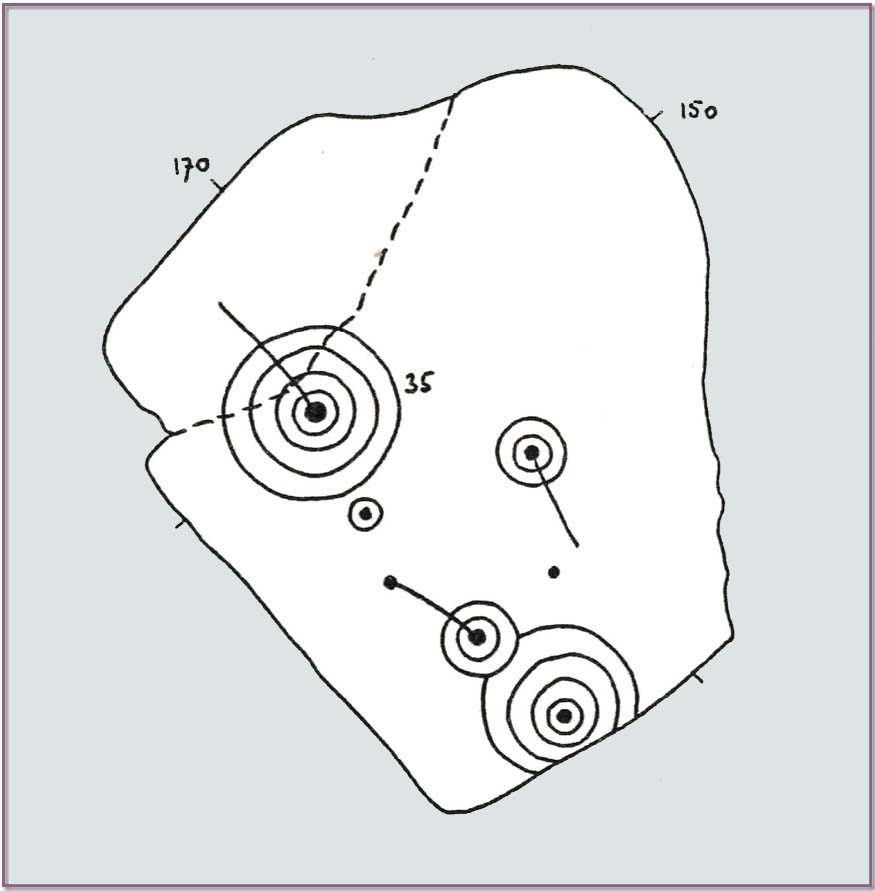
van Hoek’s 1982 sketchBeckensall’s 1991 sektch
“7 cupmarks, 5 of them surrounded by rings. On the N part is a cup and 4 rings with a tail from the cup running to the NW. Through this carving runs a large crack in the rock. Almost touching its outer ring to the S is a small cup and 1 ring. Further E is a cup and 2 rings with a tail from the cup running SE. Near the end of this tail is a single cupmark.
On the S part is a more complex figure: it is a cup and 4 rings, the two outer rings broken off at the edge of the rock. The outer ring is gaped to the NW to enclose the outer ring of a cup and 2 rings. From the central cup of this cup and 2 rings runs a tail to the NW ending in another cupmark.”
On van Hoek’s visit, it was obviously a cloudy grey day, as there are some obvious ‘extras’ on the design that he missed (somehow missing the distinct arc of cups surrounding the double-ring for one thing!). Beckensall (1983) wrote about the carving a year later and picked-up on the omissions, and subsequently updated the details in his later (1991) tome—as we can see from their respective drawings (above); although he too missed a cup or two along the same arc. It’s easily done…
References:
Beckensall, Stan, The Prehistoric Carved Rocks of Northumberland, Frank Graham: Newcastle-upon-Tyne 1974.
Beckensall, Stan, Northumberland’s Prehistoric Rock Carvings – A Mystery Explained, Pendulum: Rothbury 1983.
Beckensall, Stan, Prehistoric Rock Motifs of Northumberland – volume 1, Abbey Press: Hexham 1991.
Beckensall, Stan, Prehistoric Rock Art in Northumberland, Tempus: Stroud 2001.
van Hoek, Maarten, The Carved Rocks near Wooler, privately printed: Oisterwijk 1982.