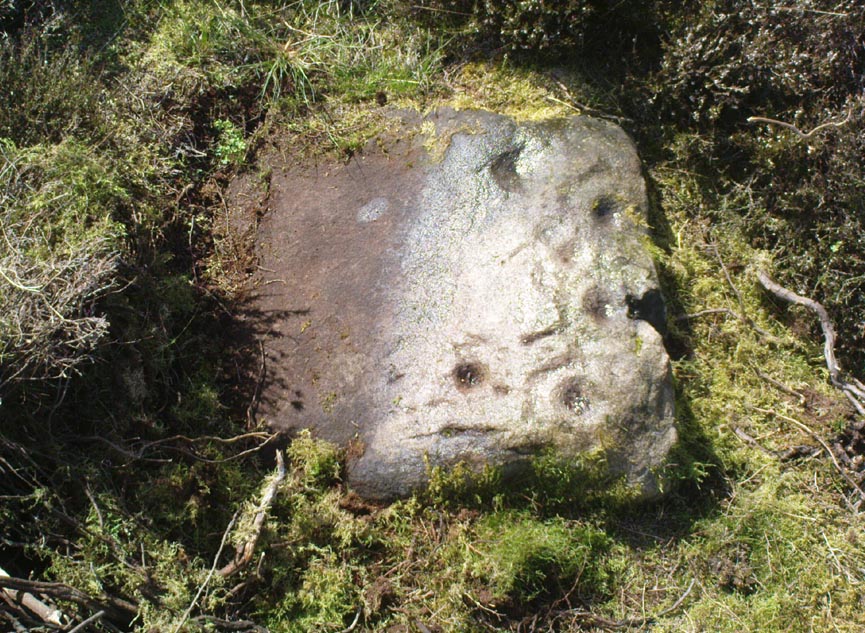
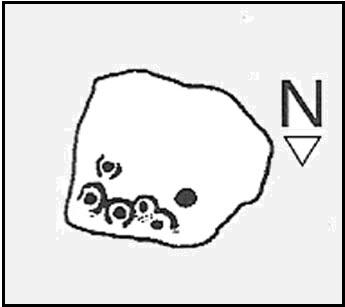
Sheriffmuir Carving, Dunblane, Stirlingshire

Cup-Marked Stone:  OS Grid Reference – NN 83074 02143

Getting Here

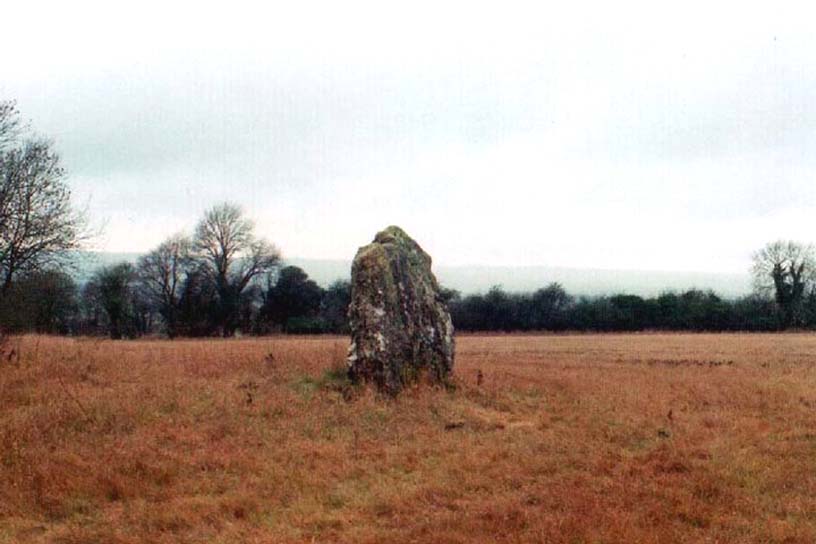
From Dunblane, head up the Glen Road for nearly a mile, turning left up the Sheriffmuir Road and all the wya on till you reach the pub near the T-junction another couple of miles on.  OK – get thru the gate and onto the moor, roughly in a straight line with the pub behind you for about 400 yards.  You’re damn close! (if you find the nice standing stone known as the Wallace Stone, walk  250 yards southwest from here).

Archaeology & History

Almost nothing has been written of this cup-marked stone, found at the southern end of what’s alleged to be an authentic megalithic stone row alignment, running northeast to southwest — although this alignment isn’t included in either Aubrey Burl’s (1993) or Alexander Thom’s (1990) textbooks dealing with such matters.
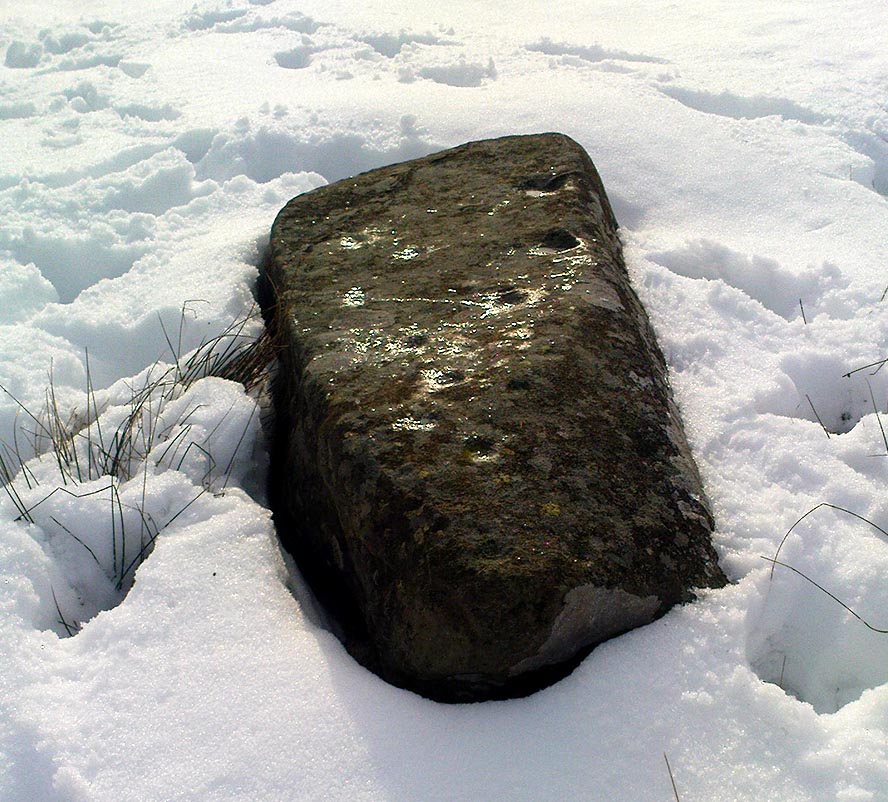
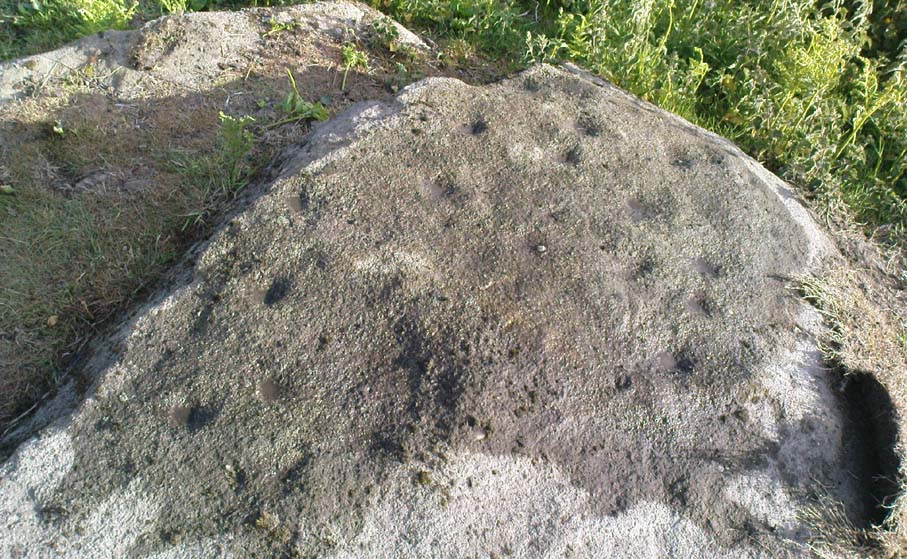
Cup-marks highlighted in ice!
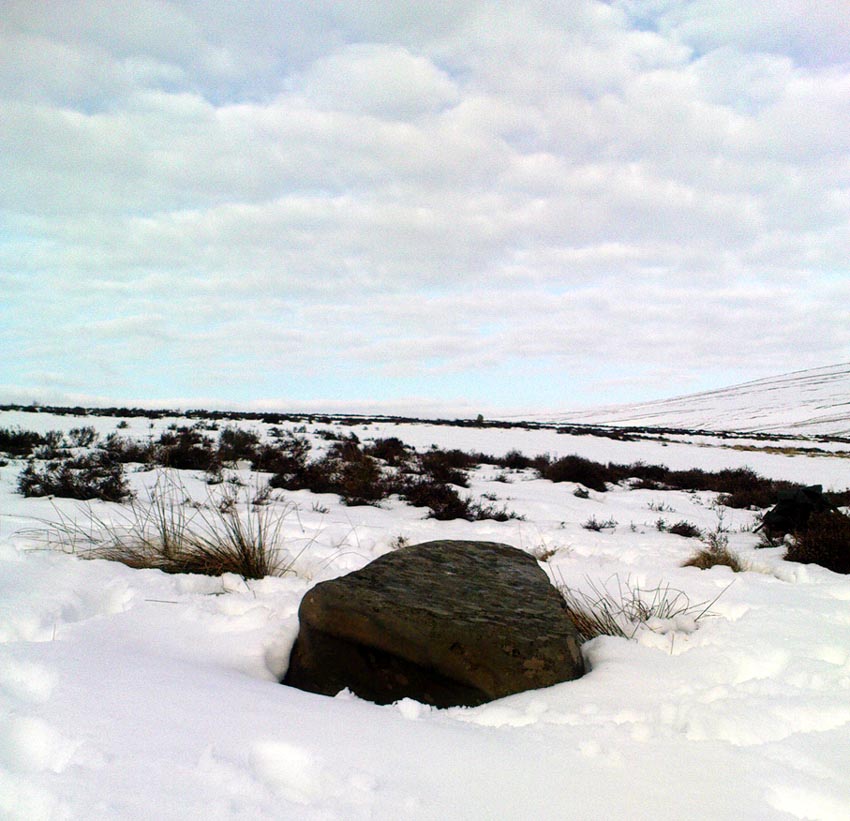
Cup-marked rock with the Wallace Stone in the distance

When we came here last winter in temperatures of around -6°C (one helluva good day!), curiously only this and the other stones along this “stone row” were actually uncovered on the moorland.  Quite bizarre to be honest!  Many of the other rocks scattering this small moorland edge were covered in several feet of snow.  We were lucky I s’ppose…though I’ve gotta get back up here again shortly and see the site in summertime (midges up mi crotch, cleggs-a-biting – oh such joy!) cos I can’t believe this is the only cup-marked stone hereby.

The rock itself is more than seven-feet long and has at least twenty archetypal cups carved into its slightly-slanting face — although when we visited the stone, several of these were difficult to see and, as the images show, even more difficult to photograph (of the 20 I took of this stone alone, only one was of any value in highlight the cups) .  The stone gave the impression that it may have stood upright in the not-too-distant past — which would of course give the notion of this as part of megalithic avenue a considerably more potent status.

Some dood alleged that this potential stone row, with this cup-marked stone at its southwestern end, marked an astronomical alignment — but for the life of me I can’t remember who it was! (it’s my age creeping up on me at last!)

References:

  1. Burl, Aubrey, From Carnac to Callanish: The Prehistoric Stone Rows and Avenues of Britain, Ireland and Brittany, Yale University Press 1993.
  2. Heggie, Douglas C., Megalithic science: ancient mathematics and astronomy in north-west Europe, Thames & Hudson: London 1981.
  3. Thom, A., Thom, A.S. & Burl, Aubrey, Stone Rows and Standing Stones – 2 volumes, B.A.R.: Oxford 1990.

© Paul Bennett, The Northern Antiquarian

Riverbank Cup-Marking, Askwith, North Yorkshire

Cup-Marked Stone:  OS Grid Reference – SE 1659 4744

Getting Here

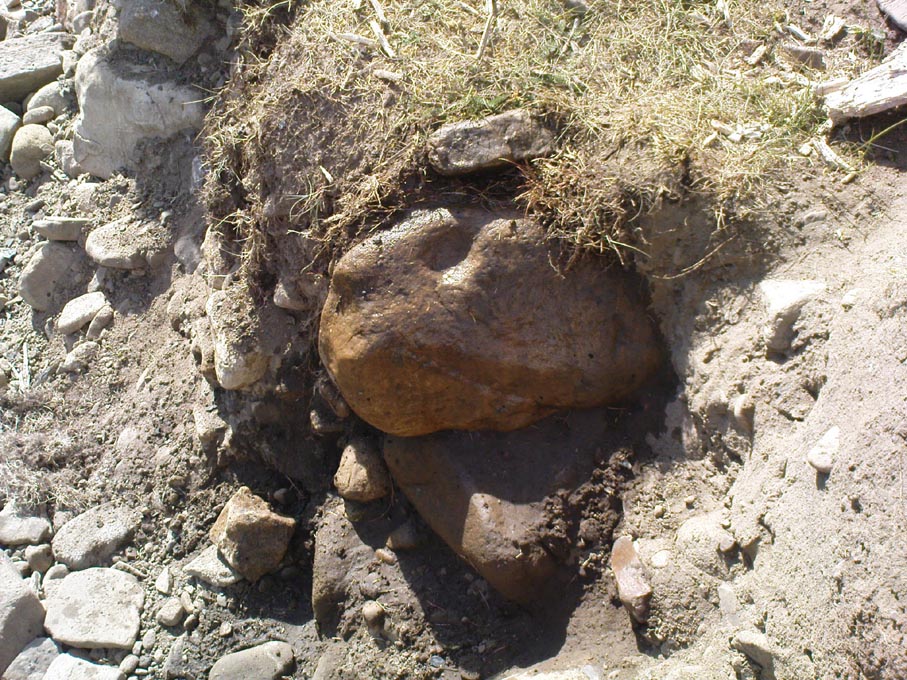
Just over the county boundary on the north side of the Wharfe’s riverbank, the easiest way to find this is from the village of Burley-in-Wharfedale, walking out as if heading towards Ilkley (west) and, just 100 yards or so before reaching the A65(T) road, walk down the footpath that takes you down to the River Wharfe.  Go over the large stepping-stones and, once on the other side, walk down the edge of the riverbank for 10 yards, up the first ridge and there, just below the grass where the edge of the land is coming away, you’ll find this small cup-marking.

Archaeology & History

First discovered t’other day, on Friday, 28 May, 2010, when we were starting on another wander onto the hills.  We’d only just crossed the large stepping-stones over the River Wharfe just outside Burley and heading up to Askwith, when Michala Potts stopped, peered and said summat along the lines of, “Errr….look at this!”

Riverbank Cup-Marking
Close-up of cup-mark

My initial thought was it was gonna be some naturally eroded water-worn stone — but it didn’t seem that way.  Peering out from the edge of the ground n the company of many other small stones and gravel, which was slowly coming away just yards above the edge of the river, a rounded cup-marked stone with just a single cup-mark stood out like a sore thumb!  It was covered in dusty earth and looked a quite decent example; but once we’d cleared the dried earth away and wet the stone, the cup-marking was truly enhanced.  To those of you who have a thing about cup-markings and associations with rivers and streams, this one can be added to your statistics! (20 yards away the Askwith East Beck meets with the river)

Obviously added as part of the river embankment, the stone would obviously have been taken from a nearby source, but we’re unlikely to ever find out where.  It looks typical of cup-marked stones that were added to cairns, but no such site (that we know of) occurred close by.  We were gonna peel some of the embankment back and see if there was anything else here, but time and another ancient site that we’d arranged to see was calling us away, so we just got a few pictures and kept on our way…

© Paul Bennett, The Northern Antiquarian

Snowden Carr Carving (580), Askwith, North Yorkshire

Cup-and-Ring Stone:  OS Grid Reference – SE 17797 51007

Getting Here

Same direction as for cup-and-ring carving 581.  This small pyramidal stone (easily missed if you aint careful) is a yard or two away beneath the heather. You might have to scrabble round on the ground, but you’ll find it.

Archaeology & History

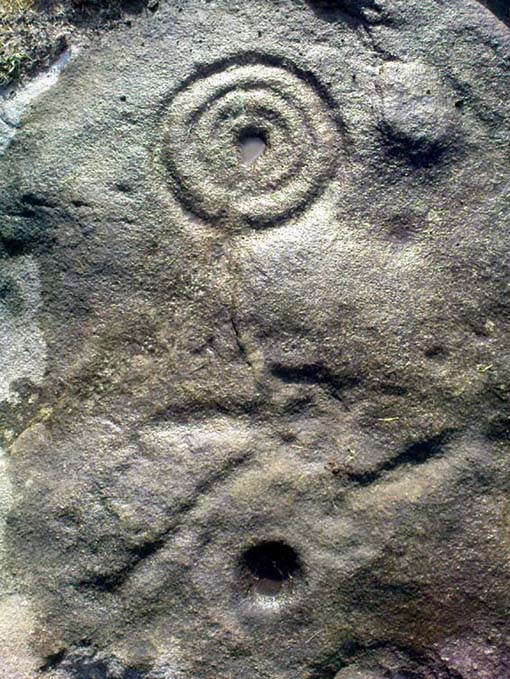
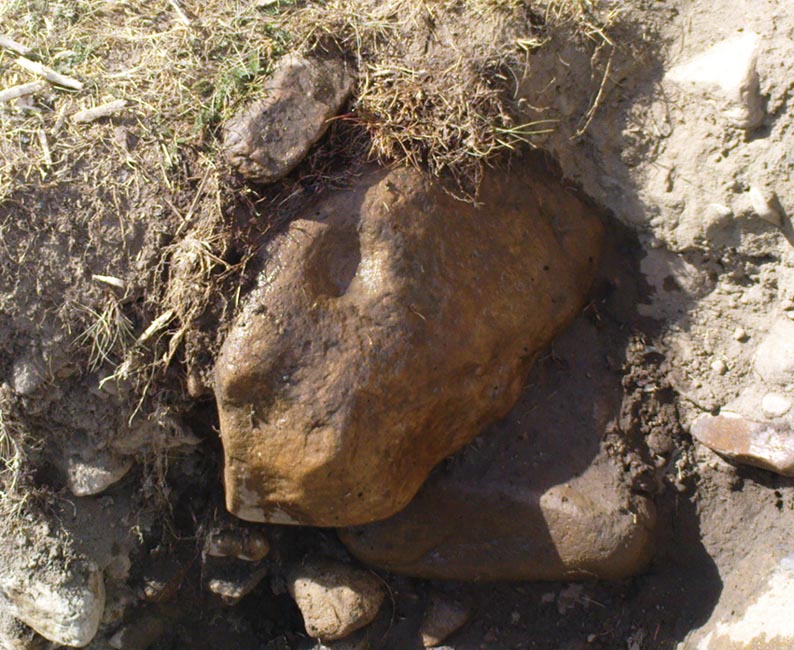
Faint cup-and-ring

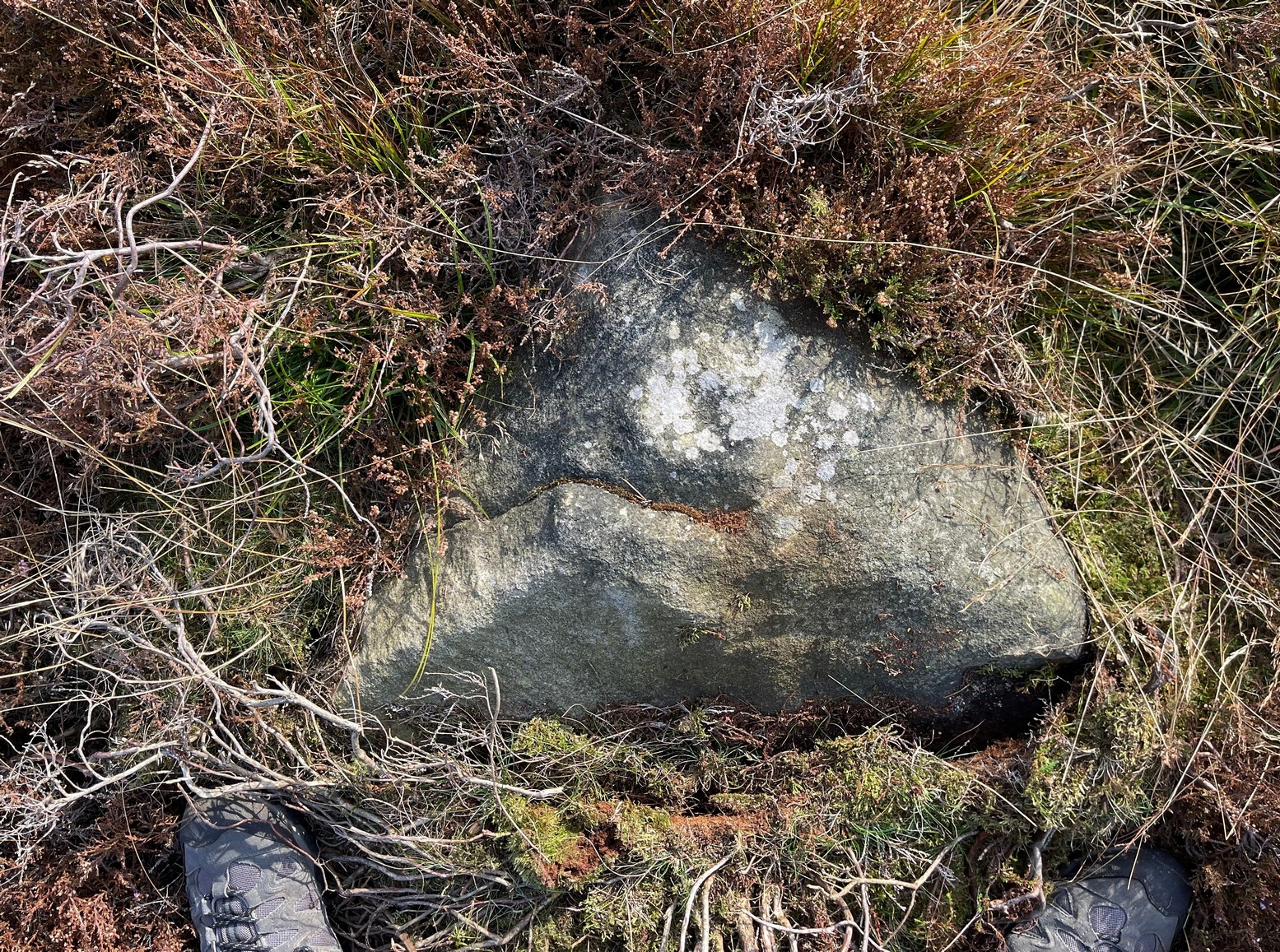
The first description of this little stone was by Boughey & Vickerman (2003). Found amidst the cairnfield first mentioned by Cowling (1937), he missed this in his early days — but it’s easily done!  All we have here on the very top of the stone is a “cup with a gapped ring”, fading away beneath elements and poor light conditions.  As you can see in this photo, it’s hard to make out (so if you can get a good photo or two stick it on our Facebook group).

References:

  1. Boughey, Keith & Vickerman, E.A., Prehistoric Rock Art of the West Riding, WYAS 2003.
  2. Cowling, Eric T., “Cup and Ring Markings to the North of Otley,” in Yorkshire Archaeological Journal, part 131, 33:3, 1937.

© Paul Bennett, The Northern Antiquarian 

Pool Farm, Priddy, Somerset

Cup-and-Ring Stone / Tomb:  OS Grid Reference – ST 5375 5417

Getting Here

Dead easy this! (though a bittova cheat) Get to the Bristol City Museum and look inside.  This Google map should help those of you who don’t know Bristol too well.

Archaeology & History

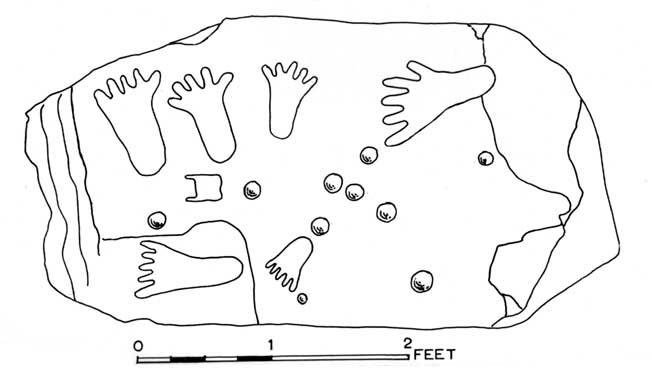
Grinsell’s drawing of the carved slab (PPS 1957)

Found amidst a large cluster of other neolithic and Bronze Age remains—with the amazing line of the Priddy henges just a few hundred yards to the southeast—this is one helluva rare relic this thing: a carved stone, with seeming cup-marks and engraved “feet” no less, which was found when dug out of a prehistoric tomb way down South.  Obviously a buncha northern lads and lasses must’ve been on one helluva piss-up! (y’ never know…)  Although the tomb — a round barrow by all accounts — was well-known and excavated in 1930, the carving was somehow not noticed by the archaeologists when they dug here!  But it has to be said, at that period many archaeologists thought rock art to be insignificant and unworthy of study, so perhaps their ignorance stemmed from  the academic myopia of the time.

But at least they gave a reasonable description of the tomb itself.  It was due to be destroyed and the considerable mass of material from it was used for widening the nearby road!!!  Thankfully, for some reason, “the chamber or cist was left in situ” under the ground.  Leslie V. Grinsell (1957) takes up the tale:

“The barrow appeared to be about 100 feet in diameter and 3¾ feet high, but it had been spread and its height reduced by many ploughings. Excavation showed that the barrow, which was of the bowl type, was composed of fine mould throughout, and had never been enclosed by a ditch.  In the centre of the barrow, there was a stone chamber or cist, the external dimensions of which were 5½ feet long, 4½ feet wide, and 2½ feet high.  The floor, which was ‘crazy-paved’, was approximately on the ground-level.  The cist was placed with its long axis SE-NW.  The late Father Ethelbert Horne, who wrote the excavation report, stated that the south-eastern slab, which was inserted 6 inches deep into the floor, had the character of a ‘closing-slab’, and outside it were several packing stones.  There was a large cover slab of Dolomitic Conglomerate.  The small northwestern slab is of Carboniferous Limestone, and the south-eastern slab is of Liassic Chert, but the large south-western and north-eastern slabs are of sandstone derived from the vicinity.  The essential characteristics of this structure are therefore that is was abnormally large for a stone cist, had a strong suspicion of a ‘closing slab’ (implying some kind of entrance?) at the south-eastern end, and was above ground level, with its floor on that level.

“On the floor of this chamber or cist, at the foot of the approximate centre of the south-western slab, was a heap of burnt human bones, free from any admixture of charcoal.  As these bones had been broken small after being cremated, their determination was by no means easy.  Prof E. Fawcett…expressed the belief that they may have comprised the remains of an adult and a young person.”

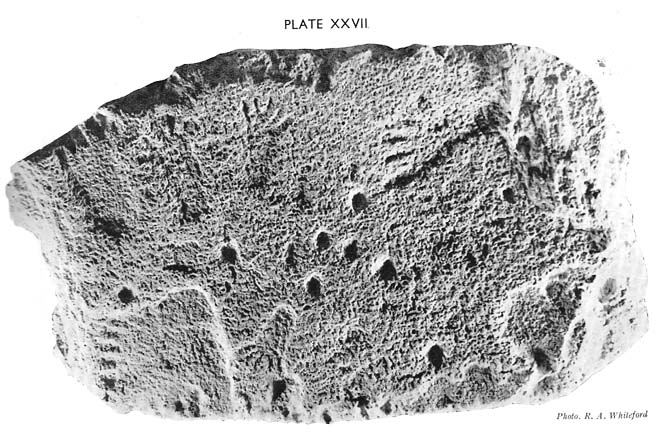
But it was in 1956 that the carvings were noticed on the cist remains — by Mr Grinsell and his friend, C.S. Taylor.  At first they thought that some of the etchings were of human hands, but they later realised they were of human feet.  Grinsell wrote:

The Foot carvings: The feet shown are all single feet, no two forming a left-and-right pair of the same individual.  Nos. 1,2 and 3, in a row, are large, medium and small; no.4 is oblique in form; no.5 is on a slightly recessed portion of the slab; and no.6 represents the foot of a child between about 3 and 4 years old.  No.3 represents the foot of a child about 10-12 years of age.  Nos. 1,2,4 and 5 appear to represent the feet of adults.  No.7 is the symbol of uncertain meaning.  All these foot carvings show rounded heels and toes, in contrast to those on the Calderstones which are nearly all rectangular.  The toes are all splayed, and this carving is likely to be due partly to the nature of the stone and the tools with which they are carved, and partly to the fact that the feet represented are probably those of a people who did not wear shoes, or wore footwear that did not constrict the toes.

The Cup-marks: There are nine (possibly ten) cup-marks; their diameter ranges between 0.9 inches and 1.9 inches, and their depth between 0.1 inch and 0.3 inches… They are on the average about twice as deep as the foot-carvings.  The smallest cup-mark (no.17) is beside the smallest foot-carving; but there is no noticeable relationship between the other cup-marks and foot-carvings…”

Earliest known photo of the carving by R.A. Whiteford

An intriguing carved slab at the very least!  We can say with some certainty that this old tomb was of considerable importance to the people who built and lived around it in the centuries that followed (ancestral spirits and all that).  It may have been a tomb of an important tribal elder, shaman or queen — though we may never truly know.  But one thing which local archaeologists and antiquarians need to keep their eyes open for when opening any more burial sites in and around this region, are other examples of rock art, for the rule tends to be: where there’s one carving, others are close by!  So wherefore art the others…?

References:

  1. Coles, J., Gestsdottir, H. & Minnitt, S., “A Bronze Age Decorated Cist from Pool Farm, West Harptree: New Analyses,” in Proceedings of the Somerset Archaeological and Natural History Society, 144, 2000.
  2. Grinsell, Leslie V., “A Decorated Cist-Slab from Mendip,” in Proceedings of the Prehistoric Society, volume 23, 1957.

© Paul Bennett, The Northern Antiquarian

Snowden Carr Stone (612), Askwith, North Yorkshire

Cup-and-Ring Stone:  OS Grid Reference – SE 18120 51201

Also Known as:

  1. Naked Jogger Carving

Getting Here

Naked Jogger Stone

From Askwith village go up the Moor Lane and at the crossroads go straight across, down and along Snowden Carr Road until the road levels out and, watch carefully, for a small crag of rocks in the fields above on your left.  Keep a keen eye out for the gate into the field immediately below these rock, right by the roadside (it’s easily missed).  This carving is the large rock sticking out on the slope in front of you thru the gate (carving 613 is lower down to the right).

Archaeology & History

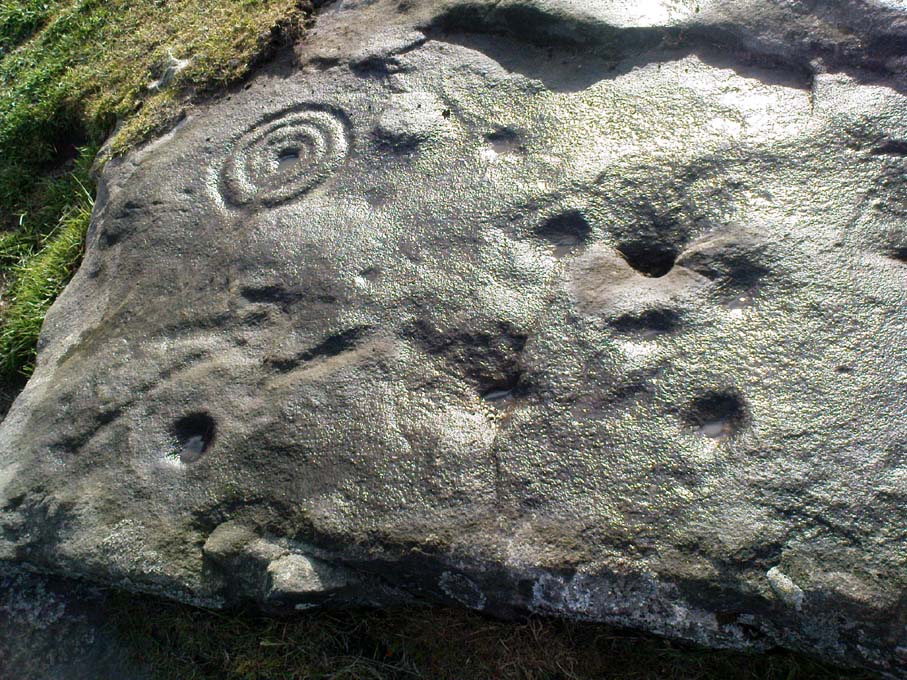
When seen in the right light, this carving’s a beauty!  What you could call, an archetypal cup-and-ring stone.  But the toll of time has played its part — on the uppermost section of the rock in particular.   It seems as if the top, higher section of the boulder has always been exposed to the elements, whereas the slightly lower part of the rock has only been unearthed and exposed to the elements in more recent decades — perhaps by Stuart Feather, who made notes of some carvings in this region in 1973.  This assumption is especially apparent when we look at the excellent, well-preserved multiple ringed design near the southern edge of the stone…and from where the carving gets its title, the Naked Jogger Stone.

Faint cup-and-rings
Boughey & Vickerman’s sketch

But let’s deal with the uppermost section of the stone first.  There are various natural undulations and cracks over its surface and, at first sight, they can interfere or confuse some of the man-made carved aspects to this stone.  But the main feature here — which becomes more and more noticeable the more you gaze and look — are at least two very faded multiple-rings surrounding faded central cups.  It’s unknown whether or not these rings ever completely surrounded the cups, or whether they were actually left deliberately unfinished.  The more faded of these two multiple-rings has between three or four cups around the outer ring at selected intervals (visible in the photo here).  A few feet away from this we can also make out the faded remains of another cup-and-half-ring design.  Several other cups have also been carved along this upper portion of the stone.  When you sit above and look across this from the grass to the side, one may be forgiven for adding a solar interpretation to this section of the carving!

Lower section of carving
Jogging male with large erection?

But another, more extrovert interpretation can be forgiven for the most notable aspect of this cup-and-ring stone.   Near the southern edge of this large rock is the well-preserved multiple-ring design, surrounding a single cup.  It’s impressive!  And when you first see this you get the impression that it was uncovered in the very recent past (turf dug away obviously) as it is in such an excellent state of preservation.  But there are other, odd-looking aspects below this primary feature: of cracks and lines and deep cups along this same level of the rock.  The majority of the cups and lines on this part of the stone are in a much better state of play than the artistic elements on the upper layer of the stone.  And one section of the carving in particular here gave me at least (pervert that I am!) the impression of a man running, with a distinctive hard-on sticking out in front as he’s jogging away!  Keep looking at it in the photo here and see if that’s what you see as well. Note that the torso section of the ‘body’ (between his cock and the multiple-ringed head) is made-up primarily of a natural crack in the rock, but this should not be seen as unusual; for in rock art across the world, many of the natural cracks and markings on stones are regularly utilized.  We know that such ‘cracks’ in rocks have been used by shamans as entrance points for their spirit to enter the rock itself.

Early carvings of humans in other parts of the world show bloke’s with hard-ons, either dancing or hunting — so why not here aswell, in deepest Yorkshire!? (check Dennis Slifer’s Serpent and the Sacred Fire for many North American examples)  It could, of course, be little other than my very simple minds response to non-linear etchings in the old Rorscharch ink-blot style.  Either way, it doesn’t really matter — unless of course you’re some academic or witchy character who’s after isolating early prehistoric fertility carvings for your thesis or religion.  Oh – and there’s the more renowned Tree of Life carving a bit further up this hill, about 150 yards away: alleged in folklore to have been a place for Beltane rites—wholehearted fertility no less!

In the important archaeo-academia files, little has ever been written of this fine, ornate petroglyph.  It was described by Boughey & Vickerman (2003) thus:

“About twenty cups, two very large, one cup having three rings and two more also having traces of three rings, with at least four others having parts of single rings, all very worn.”

Simple and to-the-point I suppose.  But this old carving has much more grace and mythic history embedded within its scarred surface.  It clearly speaks to other aspects of the landscape (as do some of the other carvings further up the hill, where oracular aspects predominate), but much more work is needed here before any archaeoholistic framework can be moulded.  Nonetheless, this is an excellent meditation site!

References:

  1. Boughey, Keith & Vickerman, E.A., Prehistoric Rock Art of the West Riding, WYAS 2003.
  2. Slifer, Dennis, The Serpent and the Sacred Fire: Fertility Images in Southwest Rock Art, Museum of New Mexico Press: Santa Fe 2000.

© Paul Bennett, The Northern Antiquarian

Snowden Carr Stone (613), Askwith, North Yorkshire

Cup-Marked Stone:  OS Grid Reference – SE 18146 51242

Also Known as:

  1. Dave’s Stone

Getting Here

From Askwith village go up the Moor Lane and at the crossroads go straight across, down and along Snowden Carr Road until the road levels out and, watch carefully, for a small crag of rocks in the fields above on your left.  Keep a keen eye out for the gate into the field immediately below these rock, right by the roadside (it’s easily missed).  This carving is the first rock on your right 10 yards through the gate.

Archaeology & History

Cup-marks on CR613

This relatively large, two-tier rock, has simple cup-markings on the topmost level of the stone: thirteen of them according to Boughey & Vickerman (2003).  We looked at this last week, in poor daylight and were unable to ascertain how many cups were on the stone; and again yesterday when the conditions were excellent, and found there are at least fifteen cups carved on the rock.  However, we didn’t really give this stone too much attention (bad of us, I know) as the calling of the adjacent Naked Jogger carving was sticking out demanding our attention!

References:

  1. Boughey, Keith & Vickerman, E.A., Prehistoric Rock Art of the West Riding, WYAS 2003.

© Paul Bennett, The Northern Antiquarian 


Lyneham Barrow, Ascot-under-Wychwood, Oxfordshire

Long Barrow:  OS Grid Reference – SP 2975 2107

Getting Here

Lyneham Barrow stone

Pretty easy really.  From Shipton-under-Wychwood take the A361 road north (to Chipping Norton) for just over 2 miles.  You’ll pass the TV mast on your right and then a small country lane sign-posted to Ascott-under-Wychwood.  Go past this and then stop at the next right-turn a half-mile further up the road.  The barrow is about 100 yards before this turning, in the hedgerow, on the left-hand side of the road!

Archaeology & History

This once great and proud neolithic monument is today but a shadow of its former self.  Described by various antiquarians and archaeologists over the years, O.G.S. Crawford (1925) included it in his fine survey, telling:

“The barrow is between 160 and 170 feet long and stands in two fields on the west side of the Chipping Norton and Burford main road… In the northern field, at the NE end of the barrow, stands a single upright stone, 6 feet high, 5 feet broad and 1 foot 6 inches thick.  This stone is stated to be buried three feet deep in the ground and its height is given by Conder as 10 feet 6 inches.  When visited October 18, 1922, a large piece of the top had been broken off, but replaced in position.”

This damage was reported around the same time and described in the early “Notes” of The Antiquaries Journal by a Mr A.D. Passmore (1925), who wrote:

“About 30ft from the north-east end of this long barrow stands a large monolith now nearly 6ft above ground…and roughly 6ft wide and just under 2ft thick, of local stone.  At the top is an ancient and natural fissure extending right across the stone and penetrating some way downwards obliquely.  Early in 1923, either by foul play or natural decay, another crack appeared spreading towards the first about a right-angle, the result being that a large piece at the top of the monolith became detached.  Such an opportunity of mischief was speedily taken advantage of and the piece of stone, weighing over 4 cwt, was pushed off and fell to the ground.  In August 1924 the owner of the land, his man, and the writer spread a bed of cement and hoisted up the large broken mass and relaid it in its bed.”

But even in their day, the tomb had already been opened up and checked out, by a Lord Moreton and a Mr Edward Conder, in 1894 no less!  Conder’s account (1895) of the inside of this ancient tomb told:

“There were found (1) a chamber at right angles to the long axis of the barrow; on the south-eastern side of the barrow were two uprights, 4 feet 2 inches by 2 feet 1o inches, and 1 foot 9 inches by 2 feet 8 inches.  At the north-western end of the chamber were two uprights set with their long faces (edges?) abutting.  On the surface-line at the level of the base of the barrow were traces of paving and fragments of bone, pottery and charcoal.  (2) Chamber, a little south of the south-east corner of No.1,  slightly above the ground level.  It was formed of three uprights, on the north, east and west sides respectively, and a paving slab with a perforation 4 inches in diameter.  At the north-eastern end of the barrow was a ridge of large ‘rug’ stones up to 8 feet long, 5 feet wide, and 2½ feet thick, terminating in a standing stone…10 feet 6 inches high…buried 3 feet below ground level.  At the southwest end was a standing stone, 4½ feet by 3 feet by 11 inches thick, in a horizontal position lying east and west, 2 feet below the surface. At various points were found skulls and human and animal bones and hearths, with no indications of date, and (as secondary interments) two Saxon graves.”

Today, poor old Lyneham Barrow is much overgrown and could do with a bittova face-lift to bring it back to life.  But I wouldn’t hold y’ breath…..

Folklore

At the crossroads just above this old tomb, the ghost of a white lady is said to roam.  And at the old quarry on the other side of the road a decidedly shamanistic tale speaks of an old lady who lived in a cave and guarded great treasure!  Her spirit is sometimes seen wandering about in and around the fields hereby.

References:

  1. Bennett, Paul & Wilson, Tom, The Old Stones of Rollright and District, Cockley: London 1999.
  2. Brooks, J.A., Ghosts and Witches of the Cotswolds, Jarrold: Norwich 1992.
  3. Conder, Edward, “An Account of the Exploration of Lyneham Barrow, Oxon,” in Proceedings of the Society of Antiquaries, volume 15, 1895.
  4. Crawford, O.G.S., Long Barrows of the Cotswolds, John Bellows: Oxford 1925.
  5. Dyer, James, Discovering Regional Archaeology: The Cotswolds and the Upper Thames, Shire: Tring 1970.
  6. L.V. Grinsell’s Ancient Burial Mounds of England, Methuen: London 1936.
  7. James, Dave, “A Brief Foray into Oxfordshire,” in Gloucestershire Earth Mysteries 14, 1992.
  8. Passmore, A.D., “Lyneham Barrow, Oxfordshire,” in Antiquaries Journal, 5:2, April 1925.
  9. Turner, Mark, Folklore and mysteries of the Cotswolds, Hale: London 1993.

© Paul Bennett, The Northern Antiquarian


Lower Lanshaw Stone (01), Askwith Moor, North Yorkshire

Cup-Marked Stone:  OS Grid Reference – SE 16033 50858 

Getting Here

Lower Lanshaw Cup-marked Stone

Start at the Askwith Moor parking spot on Askwith Moor Road, then walk down the road (south) 300 yards till you reach the gate and track on the other side of the road, heading southeast.  Following the track onto the moor and take the footpath on your right after 75 yards. Follow this along until you hit the gate & fence.  Climb over this, then follow the same fence along (left) and down, and keep following the fence and walling all the way on until you reach the very bottom southwestern edge of Askwith Moor itself.  Now, walk up the slope to your right and, near the top of this rise 200 yards or so away are 2 or 3 rocks close to each other.  You’re here!

Archaeology & History

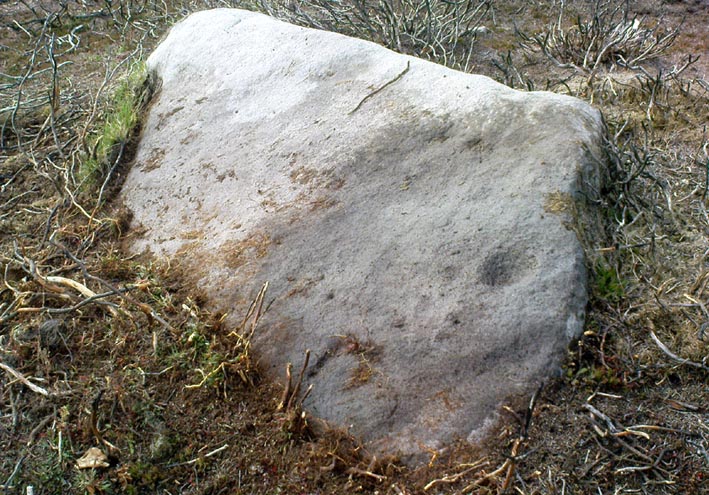
On the small, unnamed hill at the very far southwestern edge of Askwith Moor, within the unrecorded Lower Lanshaw enclosure is this previously unrecorded cup-marked stone that has been found thanks to further heather burning operations hereby.  But it’s nowt much to shout about if you’re after big colourful designs.  This is merely one of the many single cup-marked rocks scattering the Yorkshire uplands.  The large pecked cup, nearly 2 inches in diameter, is found on the lower eastern end of a long, sloping stone. Along the same ridge are also faint remains of ancient walling.

A very faint cup-and-ring stone can be found just over the brow of the hill from here, about 30 yards northeast (at SE 16059 50875) in the northeastern edge of the Bronze Age enclosure walling.

© Paul Bennett, The Northern Antiquarian


Snowden Carr Carving (579), Askwith, North Yorkshire

Cup-and-Ring Stone:  OS Grid Reference – SE 17798 51007

Also Known as:

  1. Small Rings Stone

Getting Here

Follow the directions to reach cup-and-ring Carving 581 and this small stone is about 10 yards above it, up the slight slope amidst the heather.  You might have to look around a bit though, as it’s a small flat stone and gets easily overgrown.

Archaeology & History

Broken cup-and-ring stone

Founds amidst a cluster of what Eric Cowling called “a barrow group,” or a cluster of cairns, is this excellent little carved stone, with a number of cup-and-rings close to what is now the northern edge of the rock.  But this small stone has blatantly been split off from a larger piece (perhaps split in half), but a brief scramble in the heather here couldn’t locate the other part of the stone — which is a great pity.  For although we have four or five cup-and-rings linking onto each other, where the stone has been split, one of the cups has been cut away and it seems obvious that there was more carved onto the other lost section of the stone — wherever it may be!  There is the possibility that this stone was thrown down from a nearby cairn and was broken in the course of its movement; but we might only find this after the heather’s been burnt back in the near future.  Anyway, Boughey & Vickerman (2003) discerned this as a

“small square rock with smooth level surface.  Six cups, five with incomplete rings and some running into one and other.”

It’s a good one (despite what my poor photos may infer) and well worth a look at if you’re into your rock art!

References:

  1. Boughey, Keith & Vickerman, E.A., Prehistoric Rock Art of the West Riding, WYAS 2003.
  2. Cowling, Eric T., Rombald’s Way: A Prehistory of Mid-Wharfedale, William Walker: Otley 1946.

© Paul Bennett, The Northern Antiquarian 

St. Alban’s Well, St. Albans, Hertfordshire

Holy Well:  OS Grid Reference – TL 146 066

Also Known as:

  1. Holy Well of St. Albans

Archaeology & History

The ancient and once sacred water source was described in local place-names such as Holywell strete and Holywellbrugge from the 13th Century onwards; yet despite it being at the heart of one of the cradles of the English church, there are only scant accounts of the legendary well down the centuries.  The most detailed essay on this site was written by Tony Haynes (1986) in the specialist holy well journal, Source, more than 20 years ago.  Haynes tells as much as it known of the site, saying:

“Late in the seventeenth century, when John Churchill, future Duke of Marlborough, pulled down his wife’s house and built a new mansion in the middle of Holywell Hill, thus creating a major diversion, the Holy Well was a feature of his terraced gardens.  Maps of the period show the site of the well to be a focal point of his lawns.

“In 1815, Shaw’s guide to the town states, ‘The holy-well is still held in some esteem for its purity and salubrious qualities’.  The Duke’s residence later became the property of the Earl Spencers. It eventually fell into ruin and was demolished in 1837, and the original route of Holywell Hill was restored, no doubt much to the relief of contemporary coach and wagon drivers. After this time, the grounds were left to decay.  Ten years later little remained of the gardens but a fishpond and the Duke’s ‘canal’ marking the original course of the River Ver.

“Of the Holy Well, in his History of St Albans published in 1893, Charles Ashdowne laments that: “It is now remembered only as a muddy depression, sheltered by the remains of a dilapidated wall and a mournful specimen of blackthorn.”  Eventually the land was acquired by the St Albans School for Boys as a playing field.  “The exigencies of athleticism necessitated the ground being levelled and turfed over,” Ashdown continues, “and it is much regretted that there is nothing to mark the site of what was essentially one of the most ancient of English Holy Wells.”

“This is confirmed by a Miss Lightfoot of Holywell Hill. In 1960, when she was 85, she wrote in a letter to Hertfordshire Countryside magazine:  ‘I remember the well quite well, for as a child I often went round it. It was surrounded by a fence, inside was a tree, water and weeds – not very inviting.’

“The ‘Old boys’ of St Albans School recall, about fifty years ago, there being a concrete slab at one end of their football pitch which they knew as the site of the well. Their playing field fell into disuse in the 1960’s, but the exact site of the well was lost long before this.”

Naff all is visible here nowadays, apart from some concrete square bitta brickwork that betrays any sense whatsoever of a once sacred site.  Very disappointing indeed…..

Folklore

As with a great many British holy wells, this all-but-forgotten site was named after one of the early christian martyrs — in this case from as early as the late 3rd century AD.  A number of early folklore texts describe St. Albans story, with Vernon Brelsford (1958) telling:

“Tradition states that on his way to execution he walked up a neighbouring hill where he prayed for water to quench his thirst, whereupon a fountain of water sprang up under his feet.  Here he was beheaded on June 23, AD 303.”

This date indicates the site probably replaced an earlier, heathen midsummer solstice custom at, or near this spot.  Another tale tells that when St. Alban had been executed, the saint’s head rolled down the hill and into the waters of the well below.  Mr Haynes (1986) described other early folklore which seems to relate to St. Alban’s Well, telling:

“An early reference to the well can be found in the writings of Brompton who lived in the time of Richard II. He recorded that the father of King Arthur, a British Prince, was severely wounded in the battles with the Saxons:

‘A long time he lay confined to his bed until at length he was cured by resorting to a well or spring not far distant from the city. at that time reputed to be salubrious; and for that reason, and for the cures thereby performed, esteemed holy; and blessed in a peculiar manner with the flavour of Heaven.’

“Two devout sisters built a shelter near the well. They served the weary pilgrims who trudged up the steep hill towards Alban’s shrine in the abbey, by dipping, or ‘sopping’ their bread in the holy water and offering it to the thirsty travellers.  Hence was founded Sopwell Priory, nearby.”

References:

  1. Brelsford, Vernon, Superstitious Survivals, Centaur Press: London 1958.
  2. Gover, J.E.B., et al, The Place-Names of Hertfordshire, Cambridge University Press 1938.
  3. Haynes, Tony, “Well-Wishing in St. Albans,” in Source, no.6, 1986.
  4. Hope, R.C., The Legendary Lore of the Holy Wells of England, Elliot Stock: London 1893.

© Paul Bennett, The Northern Antiquarian