Lichen Stone, Burley, West Yorkshire

Cup-and-Line Stone: OS Grid Reference – SE 15065 43578

Also Known as:

  1. Dreadlocks Stone

Archaeology & History

Lichen Stone cup-and-ring
Lichen Stone cup-&-ring

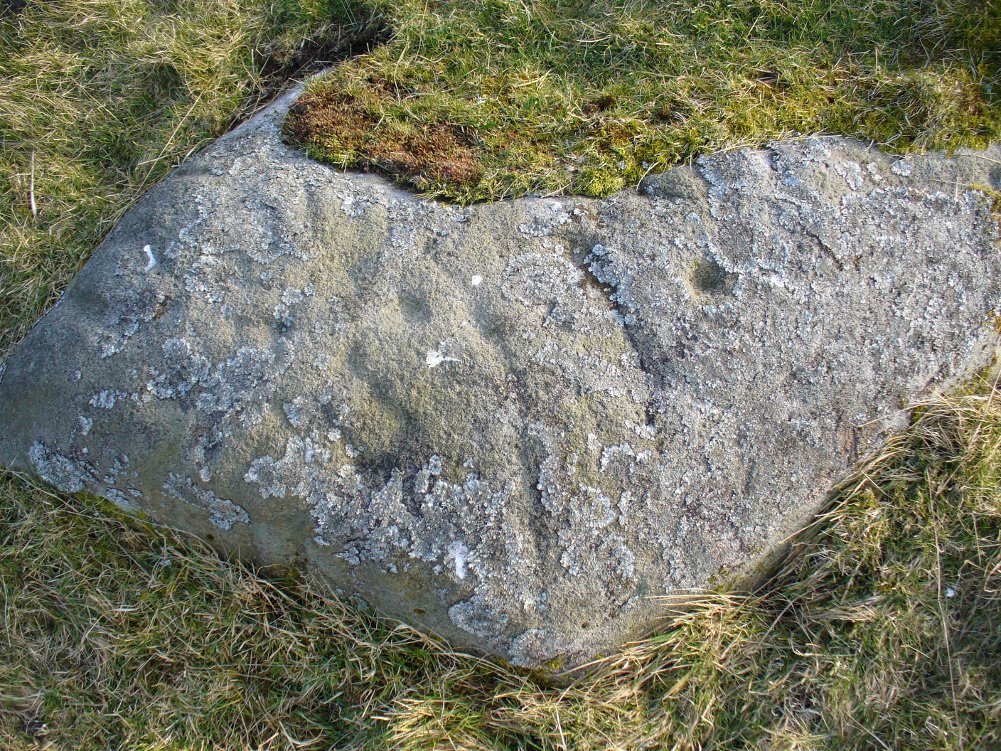
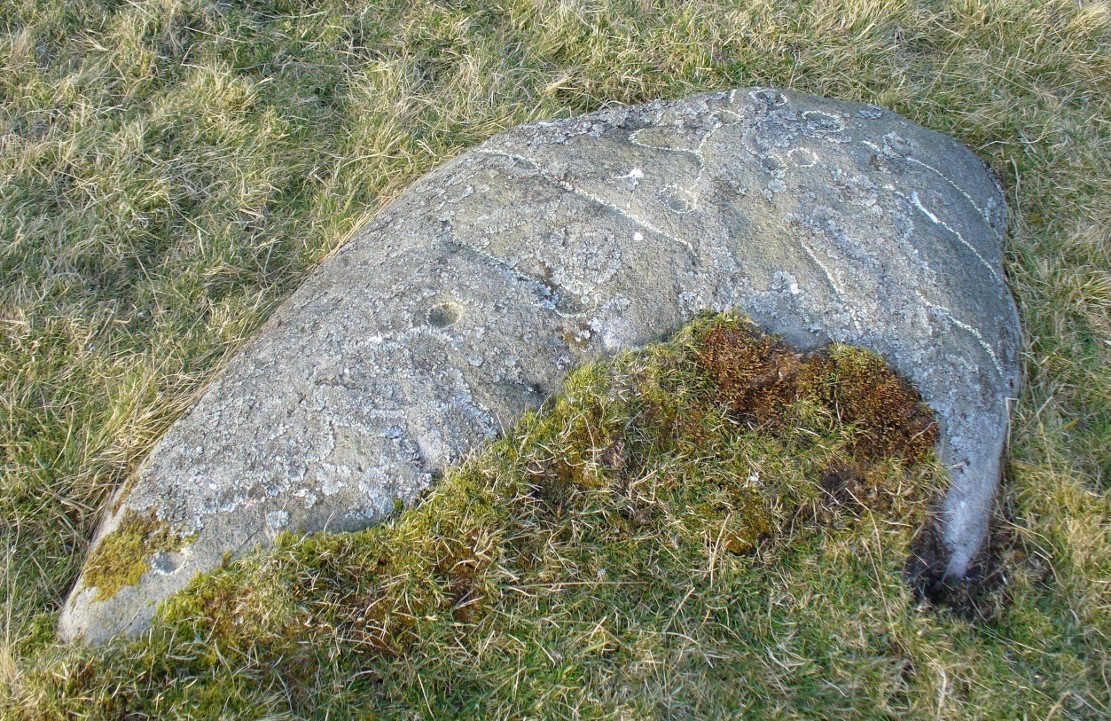
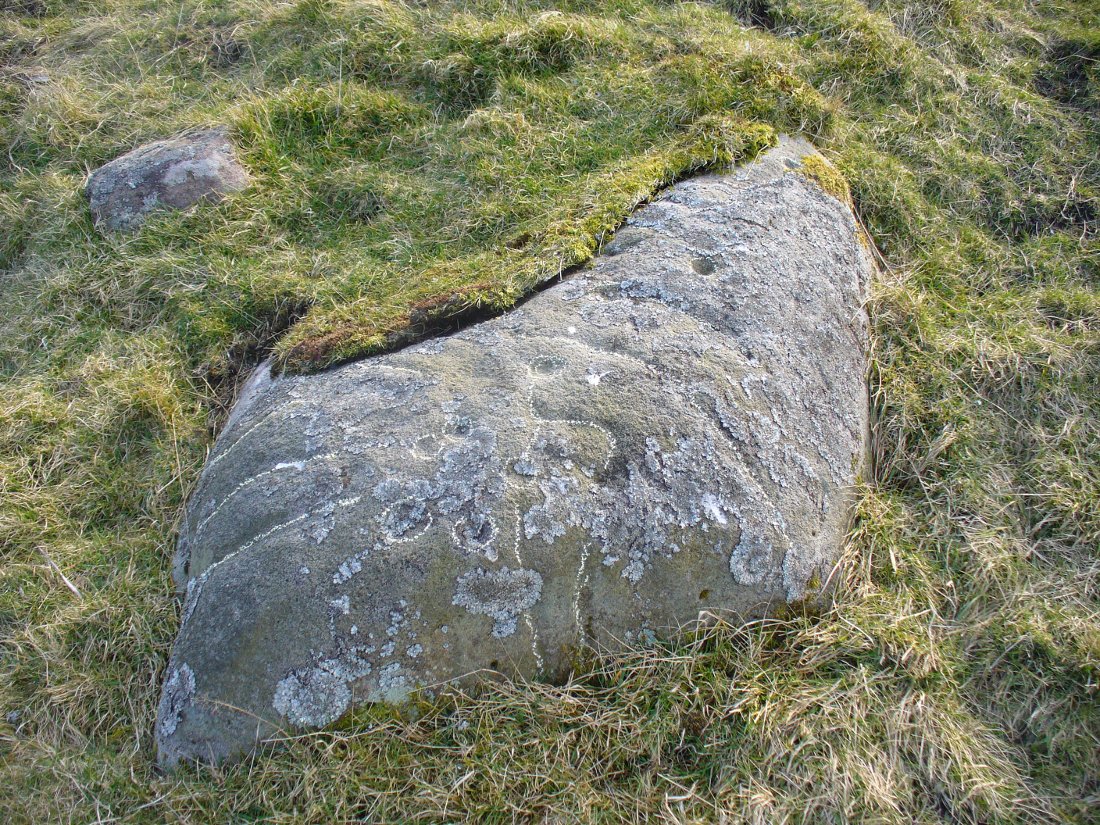
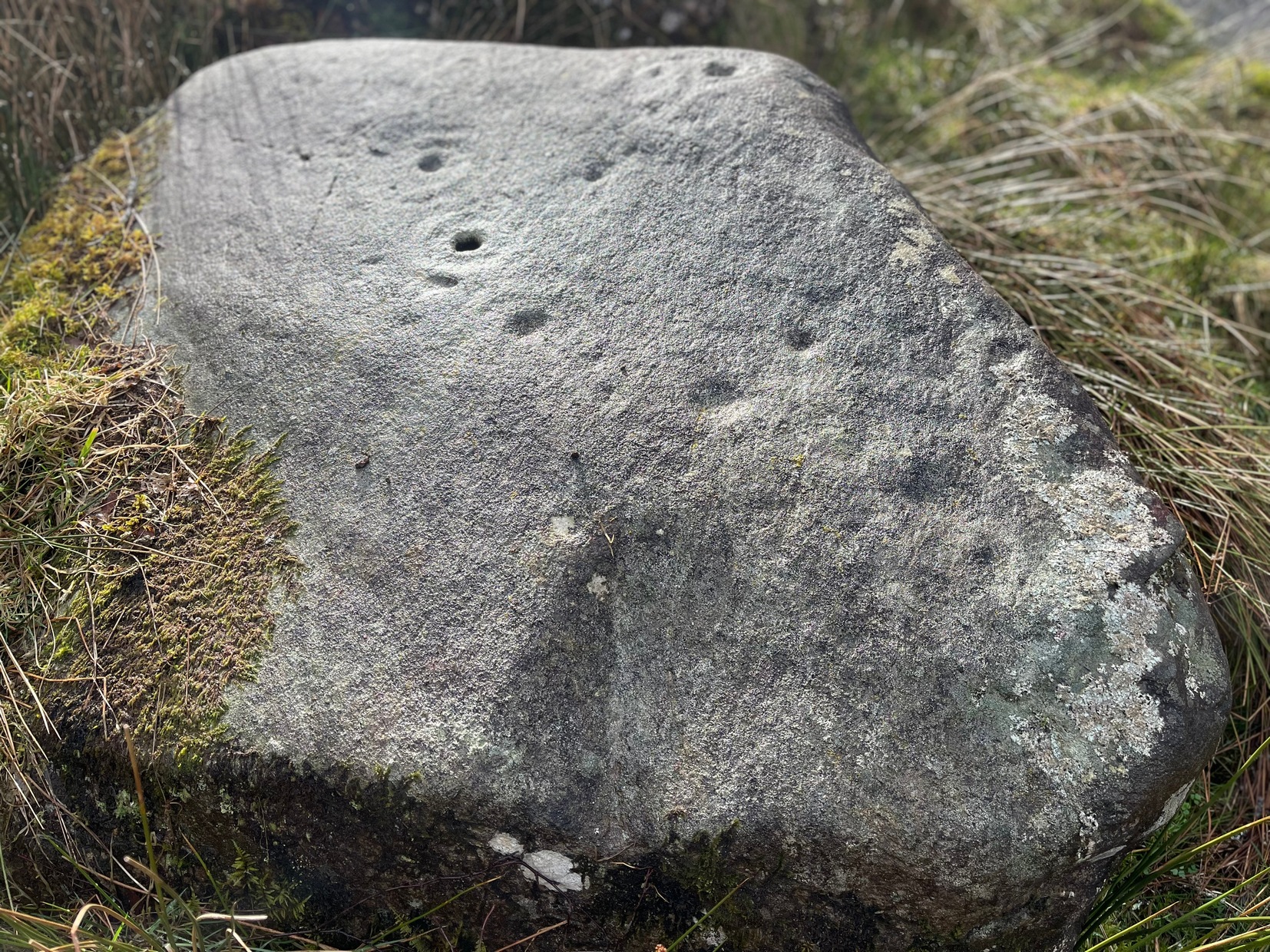
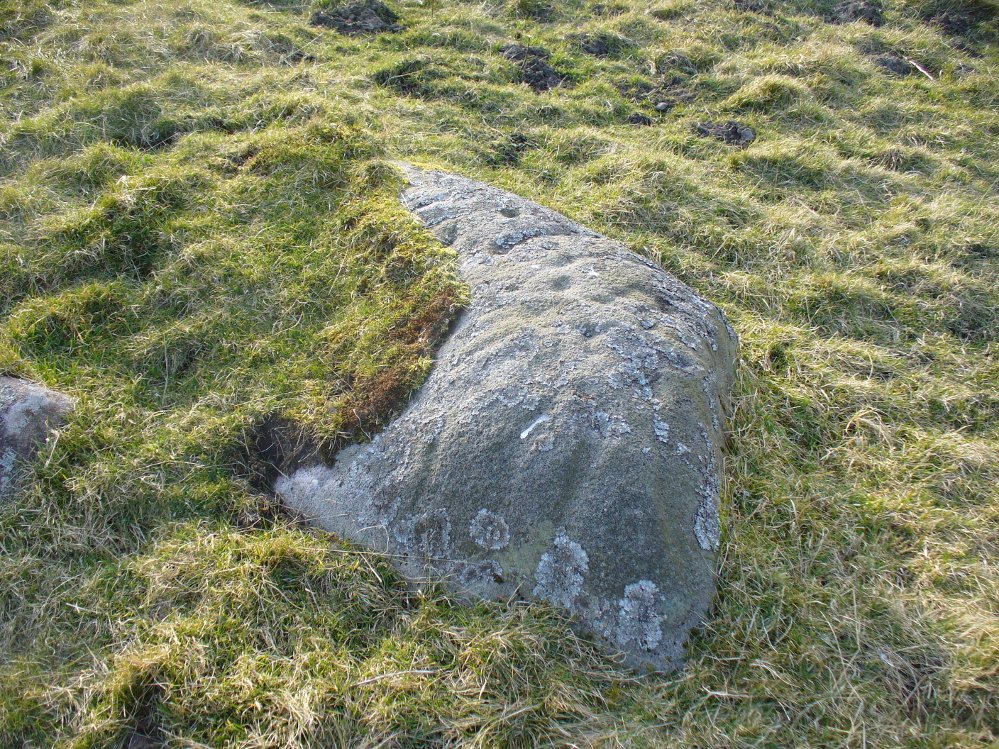
This is another of the many unrecorded cup-and-ring carvings in the region—and one in a small cluster hereby.  It was rediscovered several years ago on a Northern Antiquarian outing and, thankfully, remains in good condition.  Encrusted by layers of gorgeous lichens, deep into the rock, it has hence proven difficult to explore the entirety of the exact design without tearing off the old lichen covering—which I’ve no intention of doing.

Lichen Stone, from above

There are at least a dozen cup-markings etched onto the upper surface of this curved stone, with the majority of them clustering around its eastern side.  It seems there’s only one cup-marking on the western section of the rock, with the majority of them carved near the middle of the rock and then moving to its eastern section.  But the curious features are the interlinking carved lines which you can see have been highlighted on the top and sides of the stone.  Initially you get the impression that they’re natural, but it becomes obvious the more you look at them that they’re an integral part of the carving.  Some of the lines typically link-up with other cups, whilst a number of them have been carved along and down the vertical faces of the rock, primarily on the east and north-east edges.  At least seven of them have been done and they all reach down to ground-level.

Cups & carved lines
Cups & carved lines
Carved lines highlighted

It seemed obvious that an even larger design was apparent on the rock, but the stone had been covered in an age of lichen (hence the name) which I didn’t want to disturb; and although no distinct cup-and-ring can be seen here, it looked as if one such motif might have been hiding beneath the lichen cover.  But let’s leave the rock and lichen to their own quiet life and move on our way…. to the other carvings nearby, like the impressive Fraggle Rock, or the more basic Snake Stone.  Then follow your nose and seek out the other carvings in these fields…

© Paul Bennett, The Northern Antiquarian

Cold Stone, Burley Moor, West Yorkshire

Standing Stone:  OS Grid Reference – SE 14236 45433

Getting Here

Cold Stone, looking NW

From Burley-in-Wharfedale train station, take the road uphill to the moors, turning right at the top, until you hit the bend where the stream and rocky valley of Coldstone Beck appears. Walk up the right-hand (west) side of the beck until the moorland levels out.  Walk along the footpath above Stead Crag for a coupla hundred yards, keeping your eyes peeled for the largest upright stone in the heather about 50 yards into the moors. The other way is to get to Woofa Bank Enclosure and keep walking east through the heather for a coupla hundred yards till you see the tallest upright stone in the heather.

Archaeology & History

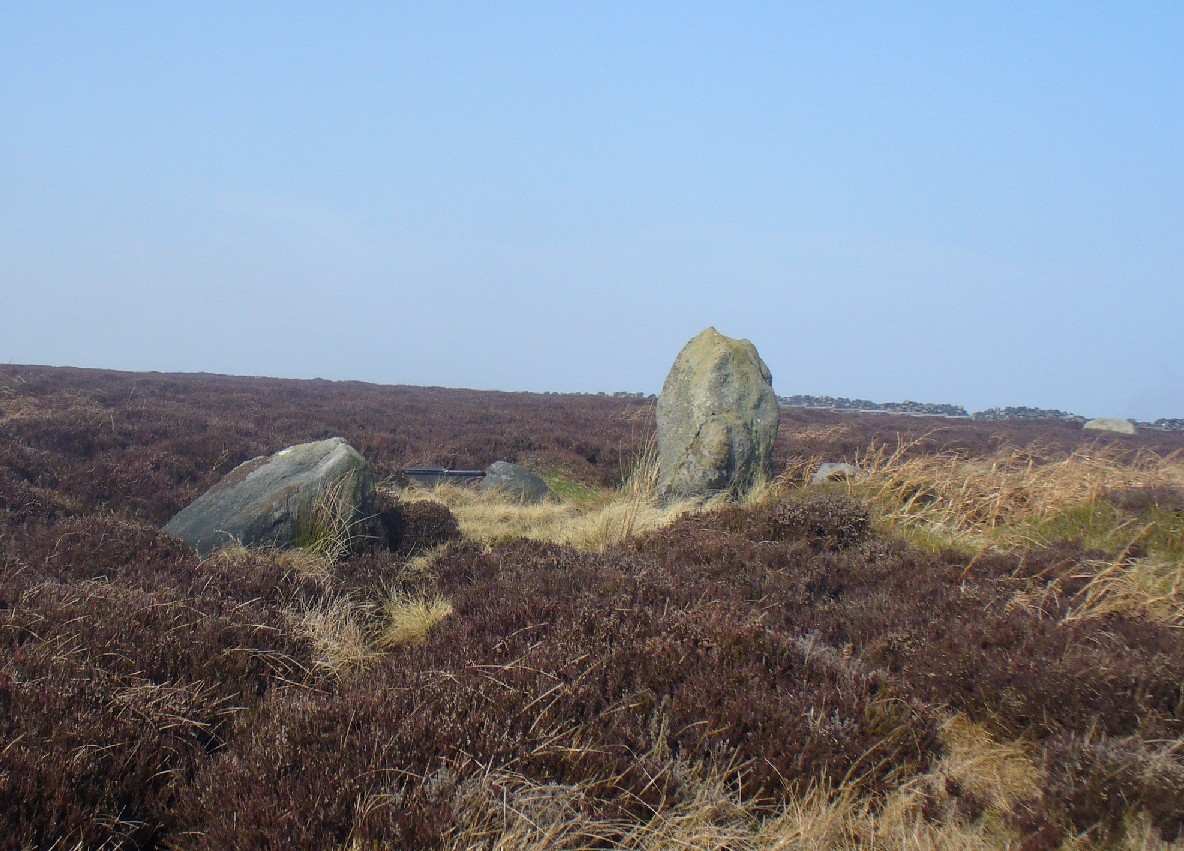
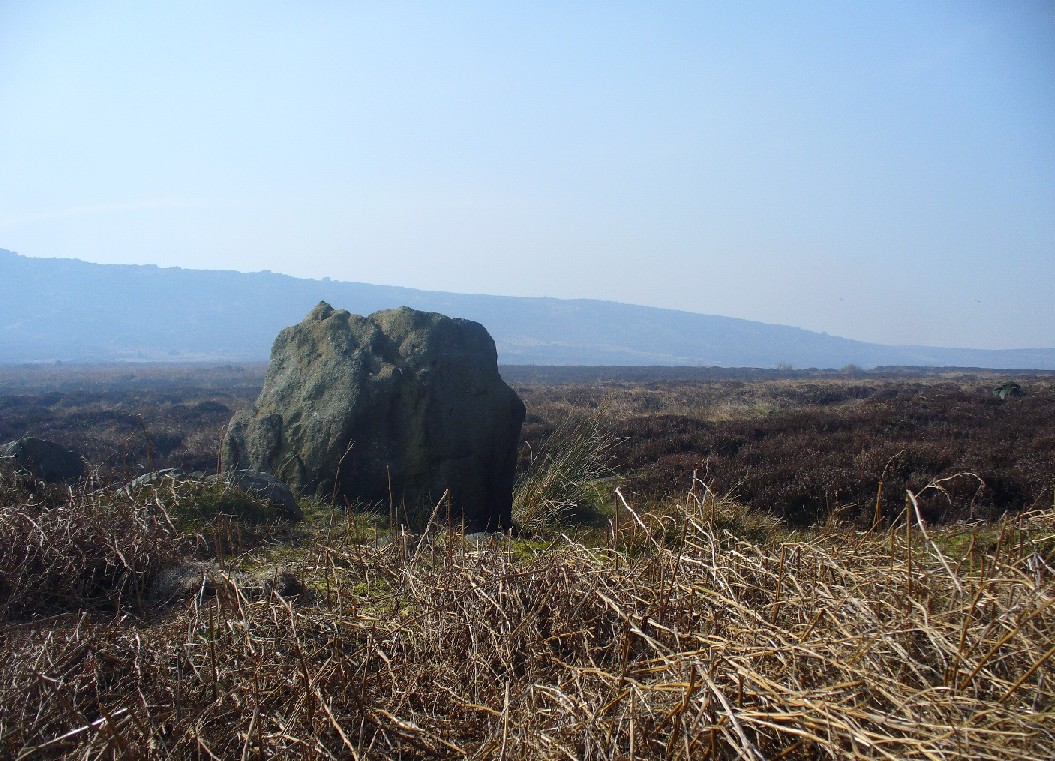
Apart from my own short entry about this site in The Old Stones of Elmet, we have no archaeological account of this standing stone, less than four feet tall and nearly as wide at its maximum, living in a landscape renowned for its excess of neolithic and Bronze Age remains.  For those of us who love our megaliths it’s nothing special — but at the same time it’s worth looking at, if only because of the other mass of prehistoric remains close by.  It received its name from the adjacent Coldstone Beck a short distance to the east, whose etymology isn’t clear.

Cold Stone, looking east
Gazing into a hazy SW

Although we know that many of the sites on this ridge are prehistoric in origin (incredibly some of it still aint registered by those who get paid to do such things), we also need to take into consideration that this site may have been effected by the early industrialists who also made their mark on this section of the moor: they have scarred some cup-and-rings along here, destroyed other remains and left incisions on some rocks which could easily be mistaken as ancient.  There is also the possibility that this upright and its adjacent stones were once part of a cairn.   If evidence comes to light that the Cold Stone is more recent, we will of course amend this site entry.

Folklore

A number of Cold Stones are found scattered across upland Britain, in the form of crags or solitary stones.  In North Yorkshire and beyond, the name is sometimes a corruption of a Call Stone, i.e., a site where village matters were called out prior to the institution of a bell-man.  The old Market Cross in Kendal village, also known as the Cold Stone was where village notices were proclaimed.

References:

  1. Bennett, Paul, The Old Stones of Elmet, Capall Bann: Chieveley 2001.

© Paul Bennett, The Northern Antiquarian


Gawton’s Well, Kynpersley, Biddulph, Staffordshire

Healing Well:  OS Grid Reference – SJ 898 555

Getting Here

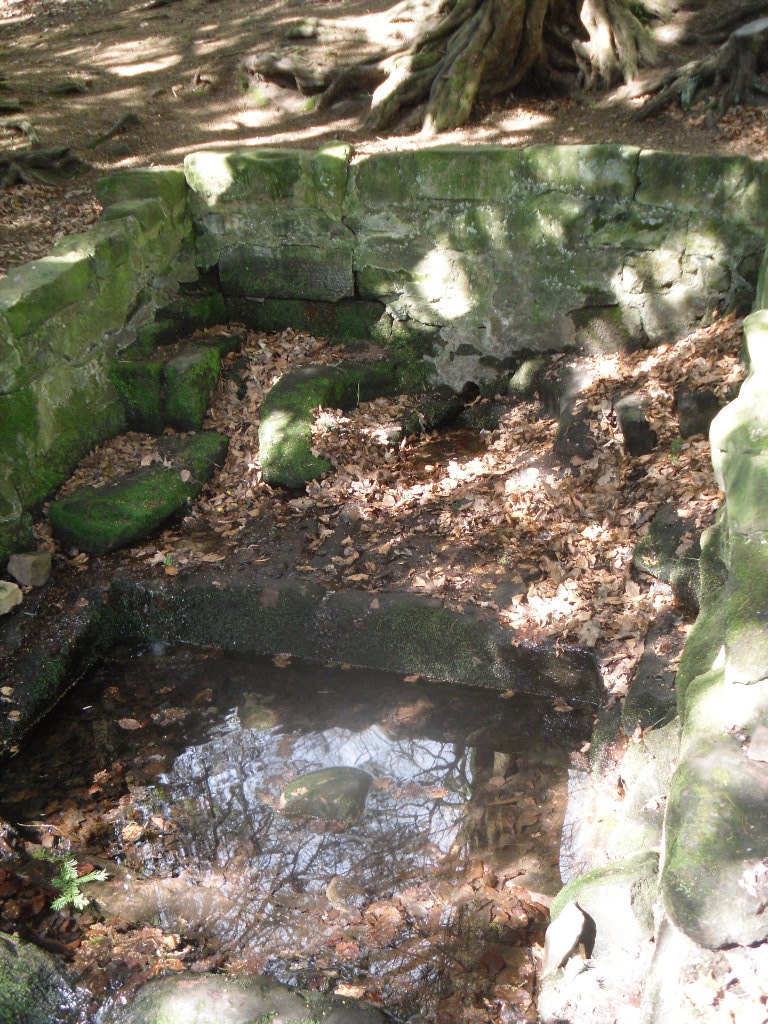
The Gawton Well
The Gawton Well

If you park in the first car park at Greenaway Country Park past the lake, and then walk along the road taking the footpath on the left around the lake, continue until one crosses a bridge, just below the Warden’s Tower taking a path which follows a small stream, past a pond and then continue until there is a bridge on the left.  Just after this is a path on the right you will reach the Gawton Well.

Archaeology & History

The spring, voted one of the most mystical places and certainly one of the most atmospheric of Staffordshire’s ancient wells, is found on the remains of the Kynpersley Estate.  It fills at first an elliptical stone basin, then a small rectangular basin and then a larger one which could have formed a bath.  There is a semi-circular stone just after this and it then flows through a number of large rocks forming a stream.  The site has an excellent arrangement: the juxtaposition between the man-made and the natural.

Perhaps what makes this well one of the most evocative and interesting is the fact that it arises in an oval grove of yew trees.  Some folklorists and New age Antiquarians have seen this as being evidence of some pagan origin of the well and although it is interesting that the site is unconverted to the Christian faith.  However, one must be careful.  Firstly the trees do not look that old and secondly the presence of a nearby Warden’s Tower, a folly, suggests that this is perhaps a 18th century piece of antiquarianism.  I have been unable to find much more of its history.

Folklore

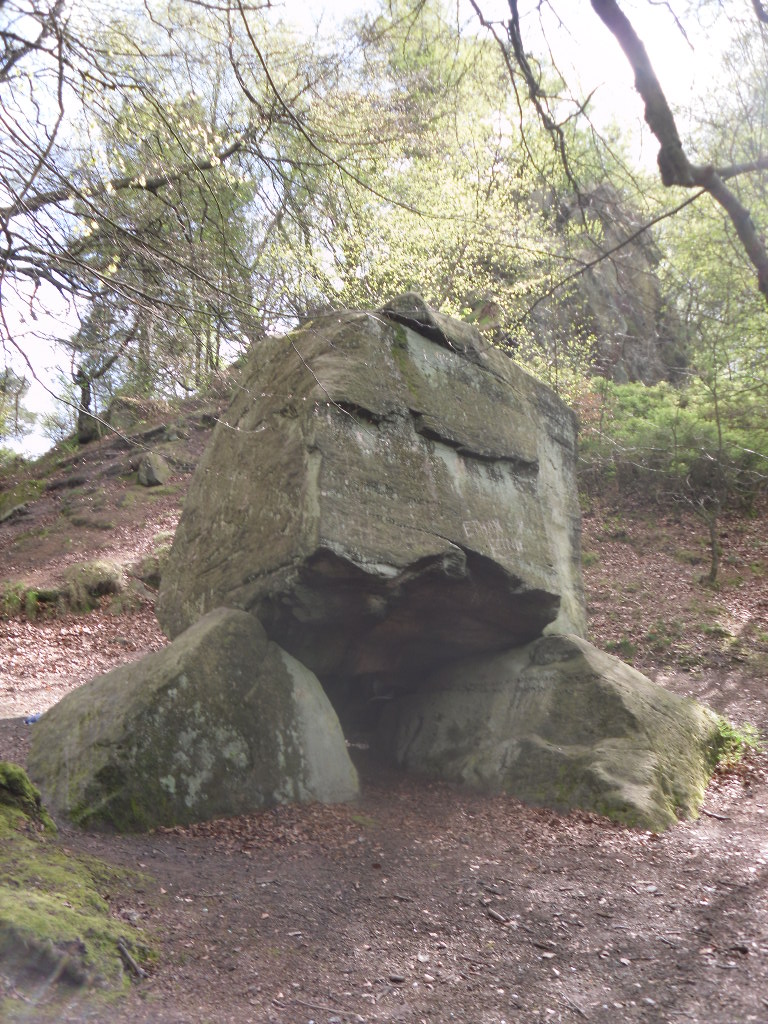
The Gawton Stone
The Gawton Stone

This suggestion of the site being a folly may be justified by the presence of Gawton’s Stone. This is just up from the spring, being a large stone supported by three other stones. Some antiquarians identified erroneously this as either a druidic altar or megalithic structure (it would be impossible to lift the structure). However it is here that legendarily a hermit lived called Gawton who used the well. Often landowners would employ a hermit to add some romance to the estate, although the stone does not particularly look like a comfortable place. Certainly local tradition states that the man came from Knypersley Hall in the seventeenth century, although the house is 18th century and no name is recorded as living there of any note! The house itself dates from the 12th century. Robert Plot (1686) in his work on Staffordshire states that:

“There are many waters such as the water of the well at Gawton Stone…which has some reputation for the cure of the King’s evil..”

The King’s evil was a skin complaint generally called scrofula which was only thought to be cured by the touch of the reigning monarch.  Now rarely do I try out springs, but at this time my little boy was suffering with eczema and having tried all sorts of creams I said flippantly try some of the well’s water.  I collected it from near the source in a drinking bottle, it felt unusually silky to the skin, and applied some to an area of dry peeling skin on his cheek. Remarkably by the time we had walked from the well to the car the area have healed itself rather miraculously.  I only wished I had collected some more to use later, although the area on his face disappeared for good….

In all Gawton’s Well deserves to be more well known, a magical site of which my only clue, many years ago before the internet, to its existence before reaching it was a circle on the OS-map!  A site which may reveal its secrets with greater research, which I plan to undertake whilst preparing for the Staffordshire book below.

References:

  1. Parish, R.B., Holy wells and healing springs of Staffordshire (forthcoming) full set of references within.
  2. Plot, Robert, A Natural History of Staffordshire, Oxford 1686.

Links:

  1. Holy and Healing Wells

© R.B. Parish, The Northern Antiquarian


St. John’s Well, Welham, Nottinghamshire

Holy Well: OS Grid Reference – SK 7255 8280

St John's Well house
St John’s Well house

Getting Here

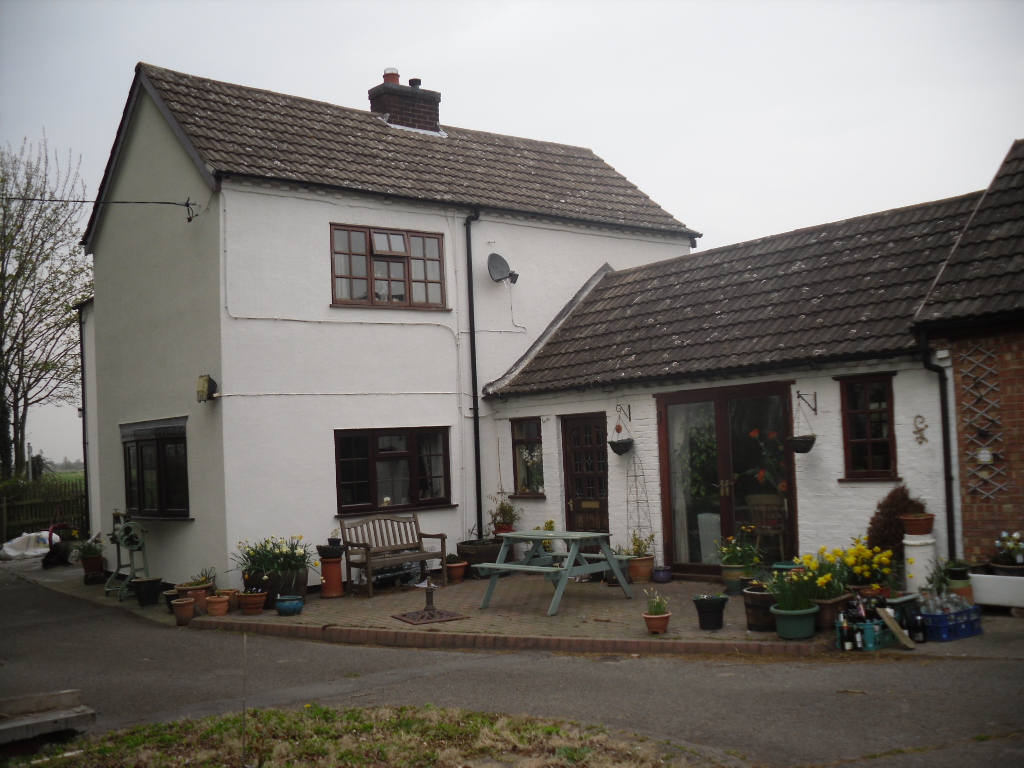
One of the most unusually sited of Nottinghamshire’s holy wells is St. John’s Well at Welham. It lies beneath a private kitchen floor in a house in Bonemill Lane in Welham, just off the Clarborough Road out of Retford.

Archaeology & History

The well itself is undoubtedly an ancient one. The Domesday Book refers to ‘Wellun’; this changed to ‘Wellum’ by 1166, and by the 16th century had become ‘Wellom’; but in Chapman and Andrews map of Nottinghamshire in 1775 was shown as ‘Welham’.  None of these sources call it St John’s Well and it is not so named until 1710, either as a re-dedication once the Reformation zealouts had died down, or perhaps coined by John Hutchinson to give the bath a story to explain its healing waters.  It is shown on Chapman’s map of Nottinghamshire (1774) as ‘Well House’.  Piercy (1828) gives the greatest information and states that the hamlet of Welham was named after St. John’s Well whose waters contained magnesium and gypsum and was:

 “good for rheumatics and scorbutic diseases. Its waters formed into a large bath, and remained entire during the early part of the 18th century, it was famous for many cures, but latterly it has lost much of its celebrity.John Hutchinson, Esq. erected a cottage adjoining, and enclosed the bath, to preserve it from injury. Cold baths like this were formerly regarded with superstitious reverence, being supposed to possess a sovereign remedy for agues such as rheumatism.”

The well-cover
The well-cover
Looking into the well

By 1832 White’s Directory notes that it had lost much of its former celebrity. A Robert Walker was a bath keeper at the Well house and may well have been the last one as it appears the well soon fell into terminal decline and I can find nothing is noted of it until 1938. At this time it is noted that its water was still used to provide several cottages in the village. An article written in 1957 states the bathhouse disappeared stating the coming of the railway encouraged people to move away to find more effective spas around the 1830s. It goes on to note that the actual spring location was lost. This I thought was to be the situation, but local investigations not only showed the house to be still existence but the bath still remained! Records show that the estate, was bought by an Arthur Robert Garland of Welham Hall from the deceased estate of John Henry Hutchinson of Clarborough Hall acres117.3.16 along with Well House Cottage and garden for the sum of £3200 on in 1910. He then sold the cottage and garden to Fred Anderson on 1910 for £130. This was subsequently bought by the late Mr Eric Durham on 1955, later to be purchased by the current owner, Mr Whelan, in 1975.

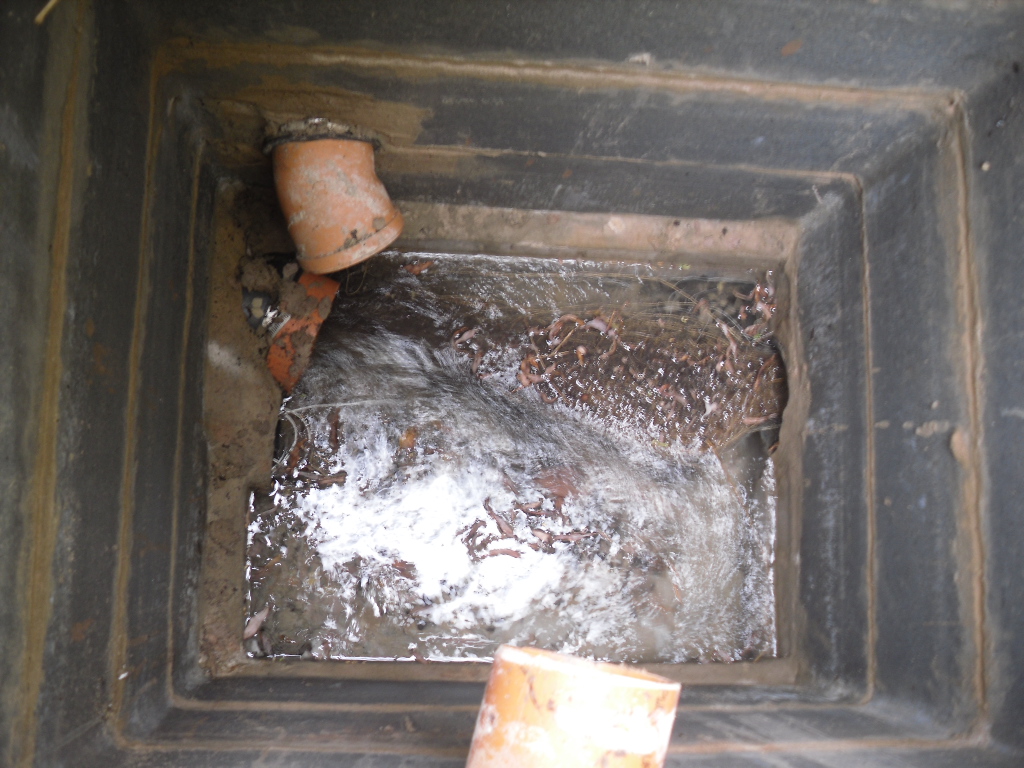
st-johns-well-welham04 The present house, although it had been added onto in the last century, has its core fabric as John Hutchinson built it. The large house being the well keeper’s abode with the side building, now a modern kitchen was the bath house.  Arriving at the house, I was at first shown the site by Mr. Whelan the spring which filled the bath which was diverted to the side of the house, the spring itself arising close to the footpath behind the house. A man-hole cover in the drive way revealed that the spring flows at a fast rate, several gallons per minute. He notes that it had a very high mineral content, soaking through the gypsum in Clarborough hills. He stressed it is drinkable, in small quantities, due to its high magnesium and sulphate (like Andrews Liver Salts). It is quite chalky to taste flat but is very pleasant to drink if aerated. However he did not recommend long term drinking was probably not good for one’s health.

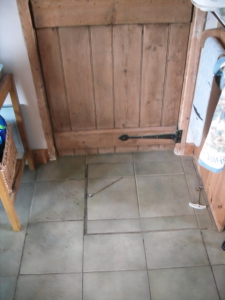
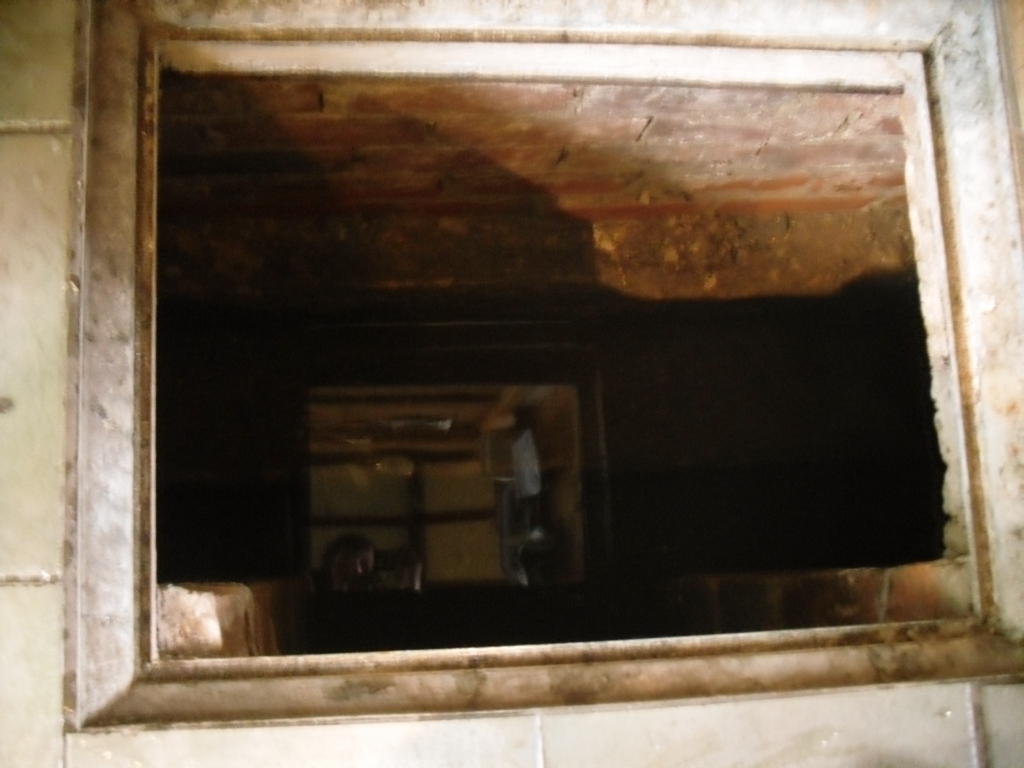
st-johns-well-welham05In the kitchen, a small trap door can be removed and beneath the remains of the bath is revealed. This appears to as Mee (1938) describes; a stone basin twelve feet square with a flight of steps entering the water. I scrambled down into this bath and found it presently to have two stone steps which enter the bath, although bricks built upon these suggest that there may have been more.

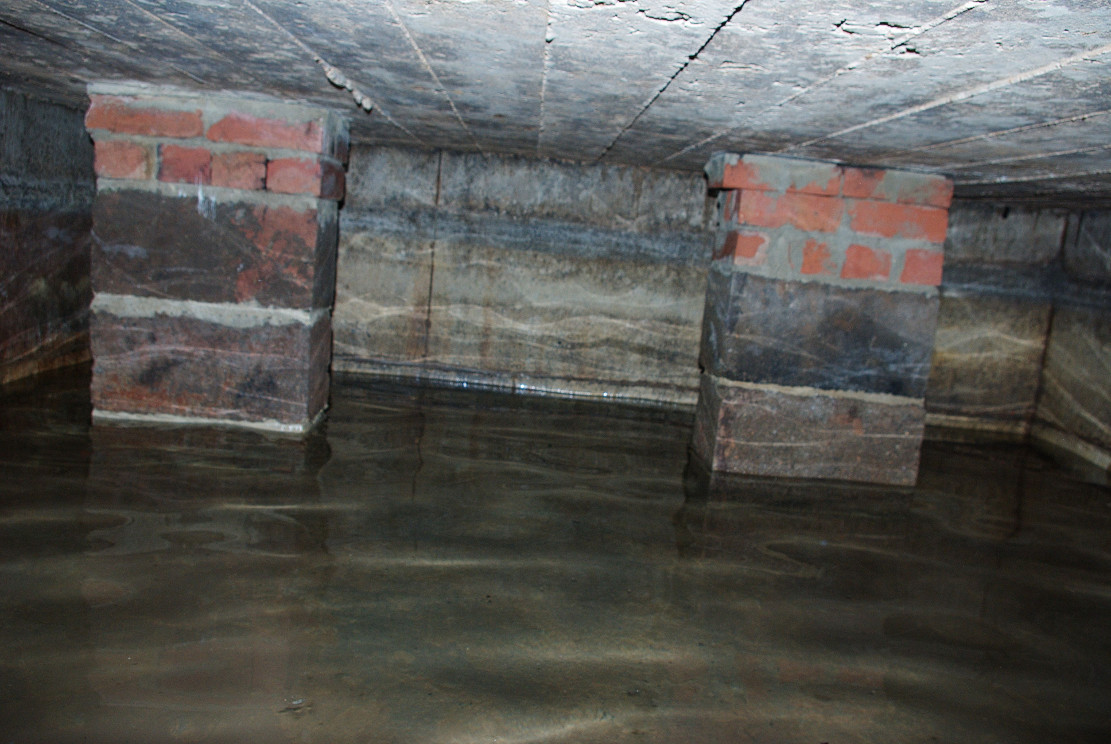
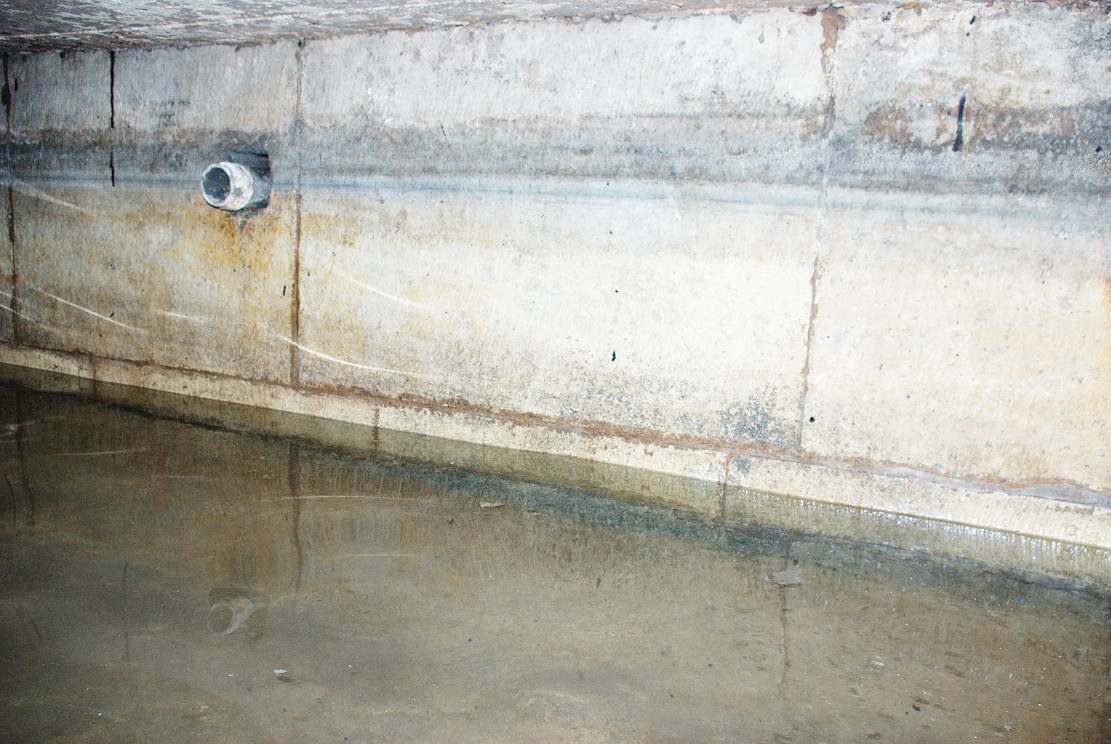
st-johns-well-welham06Remarkably the bath still remains enclosing an area fifteen feet by twelve feet, and despite the water being diverted, was full to over a two foot of water. The present kitchen is supported by four brick pillars but this does not appear to have damaged the fabric of the bath which is in fine condition, being made of good quality neat squared stonework. A pipe is found four feet high or so in the wall and a line around it made by the presence of water indicates that the water was of a considerable depth supporting the fact that it was large enough to be a hazard, explaining how Thomas Heald, Vicar of Babworth drowned in it on the 18th June 1759. Mr. Whelan informs me that although the house is not a listed building previous owners had sensibly preserved the bath. Around 30 years ago he was often showing local school children, but it appears now to forgotten. So there it remains a curious relic preserved in its most unusual place.

Folklore

John Piercy (1828) notes:

“Here was, until lately, a feast, or fair, held annually on St. John’s day, to which the neighbouring villagers resorted to enjoy such rural sports or games as fancy might dictate.”

What is interesting about this account is the reference of games and a fair suggesting that if the well itself did not have such a dedication, the saint was celebrated in the locale. This may indicate that indeed the well was so dedicated or that Hutchinson chose this name because of the local fair. Without further information we shall never know.

It must be noted that due to its location, under a private kitchen, that the site is not readily viewable so please don’t turn up unannounced.

References:

  1. Mee, Arthur, Nottinghamshire, Hodder & Stoughton: London 1938.
  2. Parish, R.B. (2010) Holy Wells and healing springs of Nottinghamshire
  3. Piercy, John S., The History of Retford, F. Hodson: Retford 1828.

Links:

  1. Holy and Healing Wells

© R.B. Parish, The Northern Antiquarian 


Corrie (1), Gartmore, Perthshire

Cup-and-Ring Stone:  OS Grid Reference – NS 49502 95052

Also Known as:

  1. Canmore ID 43472

Getting Here

The cup-and-ring stone

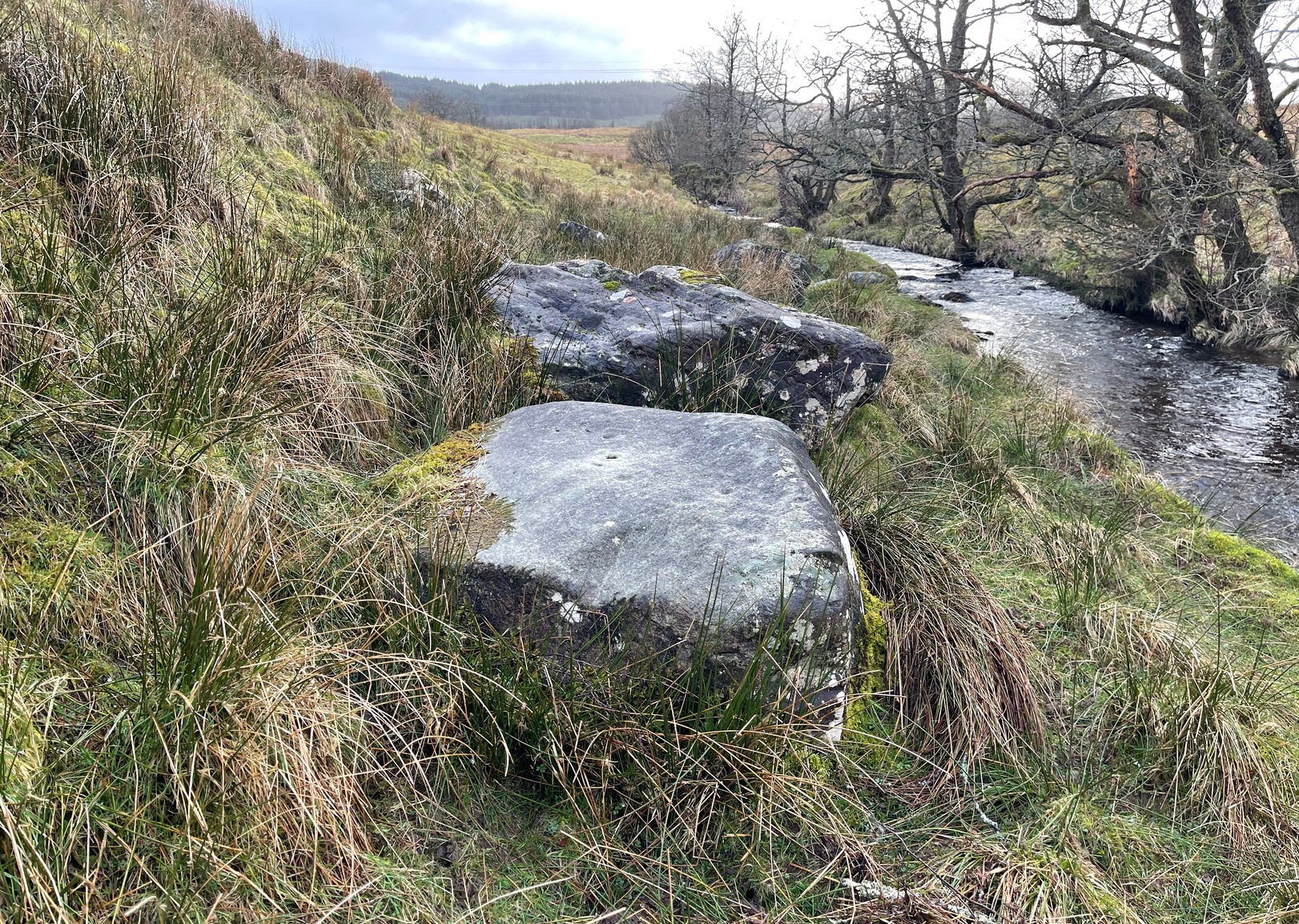
On the A81 road from Aberfoyle to Strathblane, about a mile south of Aberfoyle take the tiny right turn (keep your eyes peeled!) to Gartmore.  At the end of the village, turn right at the T-junction.  Just over a mile along the tiny road, just over the tiny road-bridge, turn right again up up the dead straight road to Drymen for nearly a mile and park up.  A dirt-track is on your right: walk along here for ¾-mile (1.2km) and in a large field on your left a huge rock sits (no carvings on it).  Keep walking on the track and where the field ends, a path to your left runs above a small burn.  Naathen, 150 yards along here, look down at the waters and there’s a clump of large rocks. Check ’em out!

Archaeology & History

Morris’ old photo (from PSAS 1967)

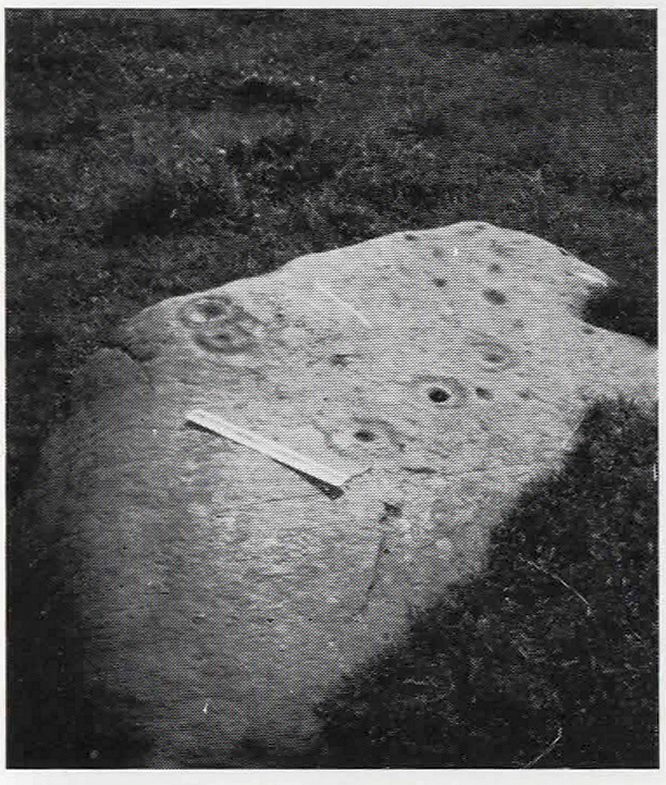
This stone and others were mentioned in MacNair’s (1973) essay in the popular history guide to the region, after it had seemingly been rediscovered a few years earlier by Ron Morris (1967; 1969), who listed it in his petroglyph catalogues.  It was originally located at the top of the slope above the burn, but was rolled down here shortly after Morris discovered the cup-and-rings on it.  The farmer at the time had made a bore-hole into the rock with the intention of blowing it up, but Morris found it just in time and the stone managed to survive!

Faint CnR’s just visible

It’s a large rock with a decent ornate design that was clearly visible when Morris surveyed it (see photo, right).  It comprises of, “a cup-and-two-rings, 18cm (7in) diameter, 6 cups-and-one-ring (2 of which are tangential) and at least 8 cups.  All rings are complete.  Greatest carving depth 2cm (¾in).”  There also appears to be a line of four or five small cup-marks running in a short line by one of the lower cup-and-rings, but these are very faint indeed.  The double cup-and-ring mentioned by Morris is the one at the top-centre in my photo, but the next cup-and-ring down may also be a double-ring.  At the top-right of the photo is where two cup-and-rings are conjoined.

Since being rolled down the slope to the side of the burn, the carving’s much more in the shadows and is more difficult to work out.  Sadly on the day when I visited here, Nature bestowed on me a wet and cloudy firmament, so the design was even more difficult to see, as my photos illustrate.

Morris (1981) told that “other stones in the immediate vicinity bear possible cup-marks,” and one of these may exist just a couple of stones away (Corrie 2), leaning up into the grasses: this is another rock that has been pushed down the slope and has curious natural cup-markings on it, with one or two that could be man-made, but we need a geomorphologist to have a look at it and tell us one way or the other.

References:

  1. Edlin, Herbert L. (ed.), Queen Elizabeth Forest Park, HMSO Edinburgh 1973.
  2. MacNair, A.S., “History,” in Edlin’s Queen Elizabeth Forest Park, HMSO 1973.
  3. Morris, Ronald W.B., “Stirlingshire: Corrie Farm (Gartnabrodnaig) – Cup Marks,” in Discovery & Excavation, Scotland, 1967.
  4. Morris, Ronald W.B., “The cup-and-ring marks and similar sculptures of Scotland: a survey of the southern Counties,” in Proceedings of the Society of Antiquaries, Scotland, volume 98, 1967.
  5. Morris, Ronald W.B., “The Cup-and-Ring and Similar Early Sculptures of Scotland; Part 2 – The Rest of Scotland except Kintyre,” in Transactions of the Ancient Monuments Society, volume 16, 1969.
  6. Morris, Ronald W.B., The Prehistoric Rock Art of Southern Scotland, BAR: Oxford 1981.

© Paul BennettThe Northern Antiquarian

Church Field, North Ockendon, Essex

Church Field, N.Ockendon mapTumuli (destroyed): OS Grid-Reference – TQ 618 850

Also Known as:

  1. Monument No. 414124

Archaeology & History

Lay out of destroyed tumuli

As with many prehistoric sites, this too was unearthed and seemingly destroyed in the 19th century. Although it seems that nothing now remains of the place, the english archaeological fraternity have the site listed as a “Romano-British site”, which seems reasonable; although the lay-out of the barrows or tumuli described and portrayed in the sketch here give a more traditional Bronze Age look. But we may never know for sure.  Thankfully a fellow antiquarian called Walter Field (1863) was on hand to make a record of the place before its final destruction.  In a short paper he wrote for the Essex Archaeological Society, he told that:

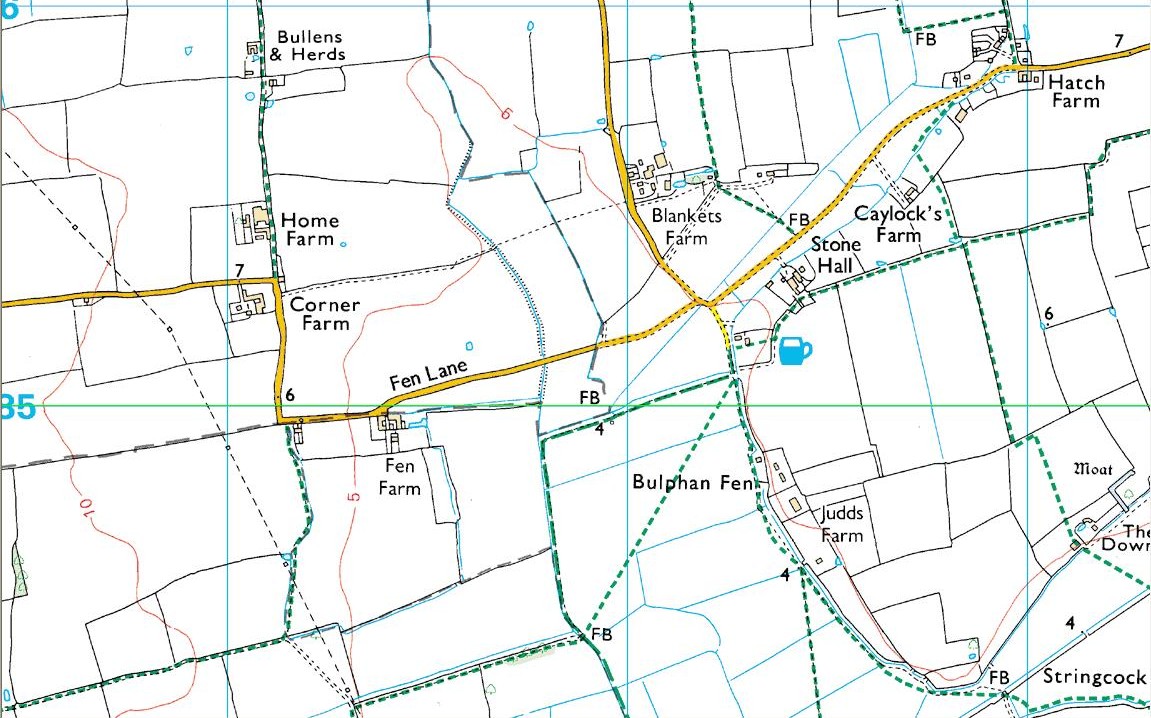
“In the Spring of 1858, a number of labourers were employed in trenching some fields belonging to Holme Farm, forming part of a large tract of land called Bulphan Fen, and situated about a mile-and-a-half west of the village of North Ockenden.  In the course of their operations they found a number of beds of dark soil, in which were a large quantity of bones, supposed at first to be human, together with fragments of pottery and pieces of charcoal.  It was the general belief among the workmen that the field had been the scene of some great battle, a belief supported by some local traditions.  One thing seems certain, that it is the site of a Roman or early British Burial Ground, extending over a space of about sixteen acres; but whether it marks the battlefield of one of those many great struggles which took place in this county between the Britons and Romans, or whether it denotes the peaceful cemetery of a Roman Station, it is perhaps not very easy to determine.

“The little evidence, however, which the plough and the harrow have left remaining, seems in favour of the latter. The regular and almost equidistant arrangement of the lines of dark soil in many parts, and the many fragments of cinerary urns found in nearly all of them, seem to indicate rather the orderly interment of a cemetery, than the more hasty burial of a battle-field; but this is by no means conclusive.

“The graves are at once discernible from the surrounding soil, the natural soil being a yellow clay, whilst the earth of the graves is nearly black.  It is impossible, with any accuracy, to trace the exact forms of the graves, some appear to be circular, and to vary in size from 10 to 40 feet in circumference, others appear to be of an oblong form; one grave is much larger than the rest, and is of about 60 feet in length and 20 in width.  There are doubtless more of these graves in the bordering fields.  It is worthy of note that a neighbouring meadow is called the Church Field, and a portion of the land on which these discoveries were made is still called Ruin Field.  Both these names, probably, have reference to the formerly uneven sur&ce of the ground, caused by a great number of burial mounds.  The fragments of Pottery vary much in their character, some being of the very rudest workmanship, whilst others have been more carefully manufactured; and a few small pieces of Samian Ware were found; mingled with them, were the bones of different animals — the horse, the deer, the boar, etc., but no human bones; much of the earth, stones, and pieces of wood bear evident marks of the action of fire; beyond these there was nothing found, except a portion of a flint arrow-head and a part of a hand mill stone.  Not a single coin or piece of metal was discovered.  The circumstances that all the fragments of pottery, and nearly all the bones of animals, are broken up into small pieces lying equally at the bottom as at the top of the dark soil, and that the graves are about three feet deep, narrow at the bottom and widening to the surface, lead me to think that the present graves are only the trenches of the original barrows, but that the field has been gradually levelled for agricultural purposes, and that the plough and the spade have in process of time filled up the original trenches with the soil, urns, bones, &c., of the burial mound.”

References:

  1. Field, Walter, “Discovery of British and Roman Remains at North Ockenden and White Notley,” in Transactions of the Essex Archaeological Society, volume 2, 1863.

This site entry is dedicated to Sarah Hunt, once of North Ockendon, wherever she may be…

© Paul Bennett, The Northern Antiquarian


Aithernie, Scoonie, Fife

Tumulus (destroyed):  Grid Reference – NO 3769 0339

Also Known as:

  1. Canmore ID 31344

Archaeology & History

Aithernie tumulus on 1855 OS-map

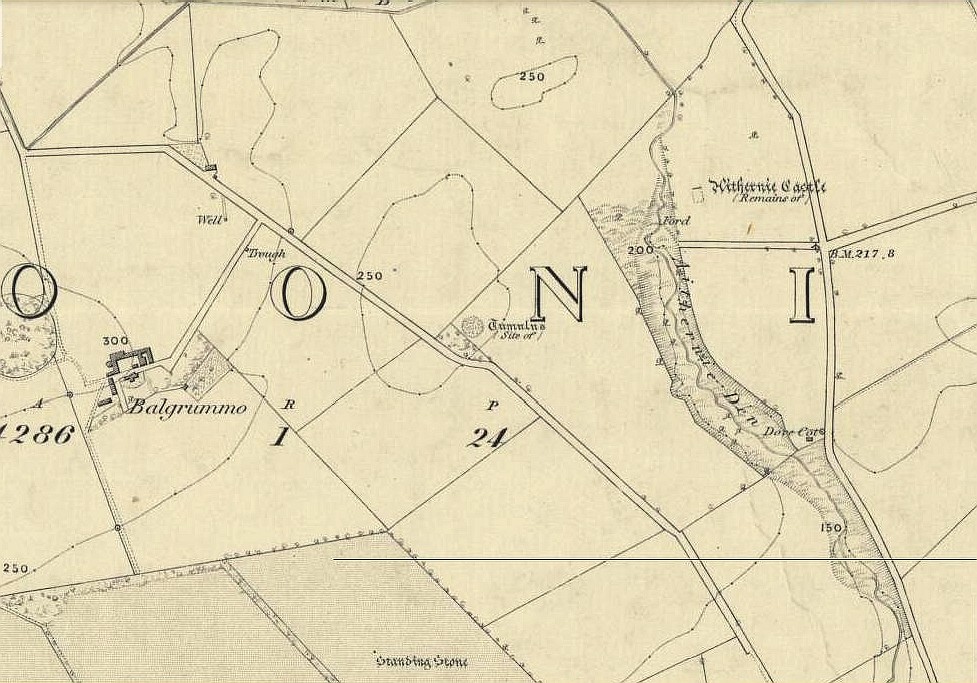
A mile or so WNW of the fantastic standing stones of Lundin, and just a coupla hundred yards above where the lesser standing stone of Balgrummo lives, we could once see an impressive prehistoric burial mound on the small hilltop of Aithernie.  Sadly, like oh too many prehistoric sites in our landscape, it was vandalised and destroyed in the 19th century by the prevailing stupidity of the period.  Thankfully we have a couple of accounts describing the place.

The site had already passed into memory when the Ordnance Survey fellas got up here in 1854, but an account of it was made in the ‘Object Name Book’ of the parish a decade earlier.  Thankfully the story of the site was known locally and, along with the New Statistical Account describing the olde mound, A.S. Cunningham (1906) told the story of when it was “opened” and then of its subsequent demise. He wrote how,

“…in 1821 a much more interesting relic of antiquity…was opened in a field on the estate of Aithernie.  When digging moulding sand for Leven Foundry, the workmen struck right into the heart of an ancient tumulus.  This cemetery of prehistoric times contained as many as twenty rude stone cists.  These cists were typical of the prehistoric burial places found throughout the country.  They were constructed of slabs placed on edge, with a covering stone, and cemented with clay puddling.  Above the coffins was a covering of stones, the stones having hundreds of years before been so firmly cemented together with clay and sand that the workmen required the aid of picks to enable them to “rifle the tombs.”  Small urns were found in two of the coffins, and five of them contained larger urns, 14 inches in diameter and 24 inches in depth, and in another cist quantities of charred wood beads were discovered. All the coffins, except the five in which were the large urns, contained human bones, and innumerable bones were found outwith the mouths of the cists.”

When the Royal Commission (1933) lads visited the place in 1925, they reported “no existing indication of a tumulus” remained.  Gone!

References:

  1. Cunningham, A.S., Rambles in the Parishes of Scoonie and Wemyss, Purves & Cuningham: Leven 1906.
  2. Royal Commission on the Ancient & Historical Monuments, Scotland, Inventory of Monuments and Constructions in the Counties of Fife, Kinross and Clackmannan, HMSO: Edinburgh 1933.

© Paul Bennett, The Northern Antiquarian


Bandrum, Saline, Fife

Bandrum OS-mapStanding Stones:  OS Grid Reference – NT 0348 9188

Also Known as:

  1. Canmore ID 49710

Getting Here

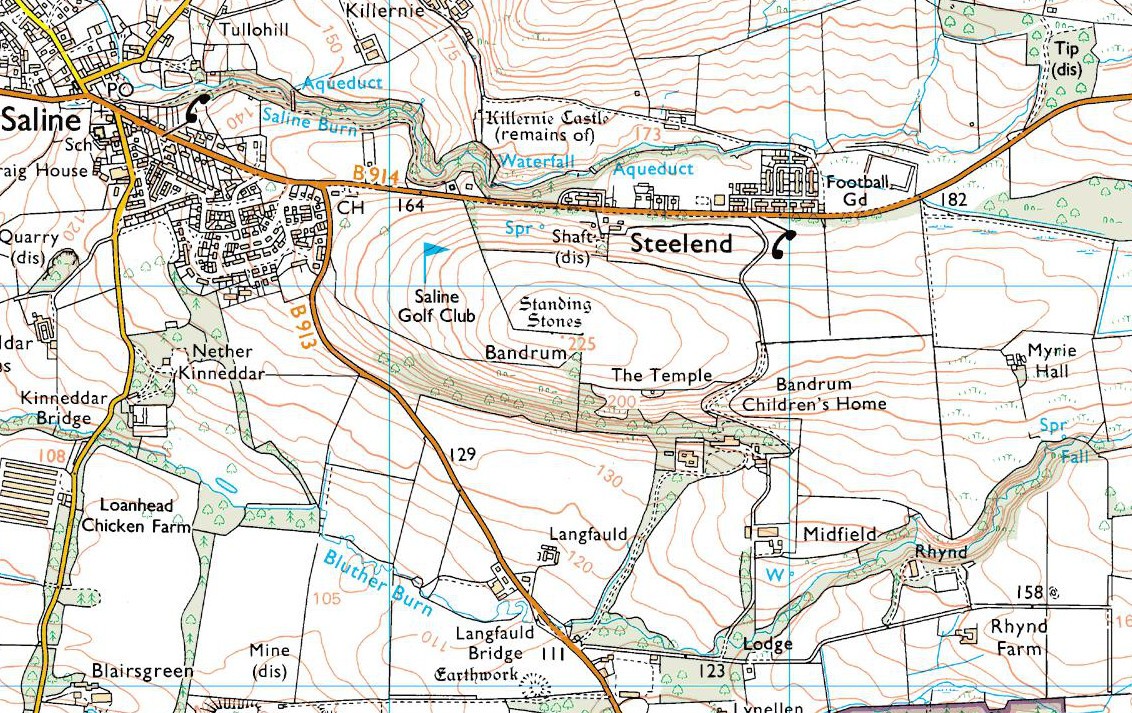
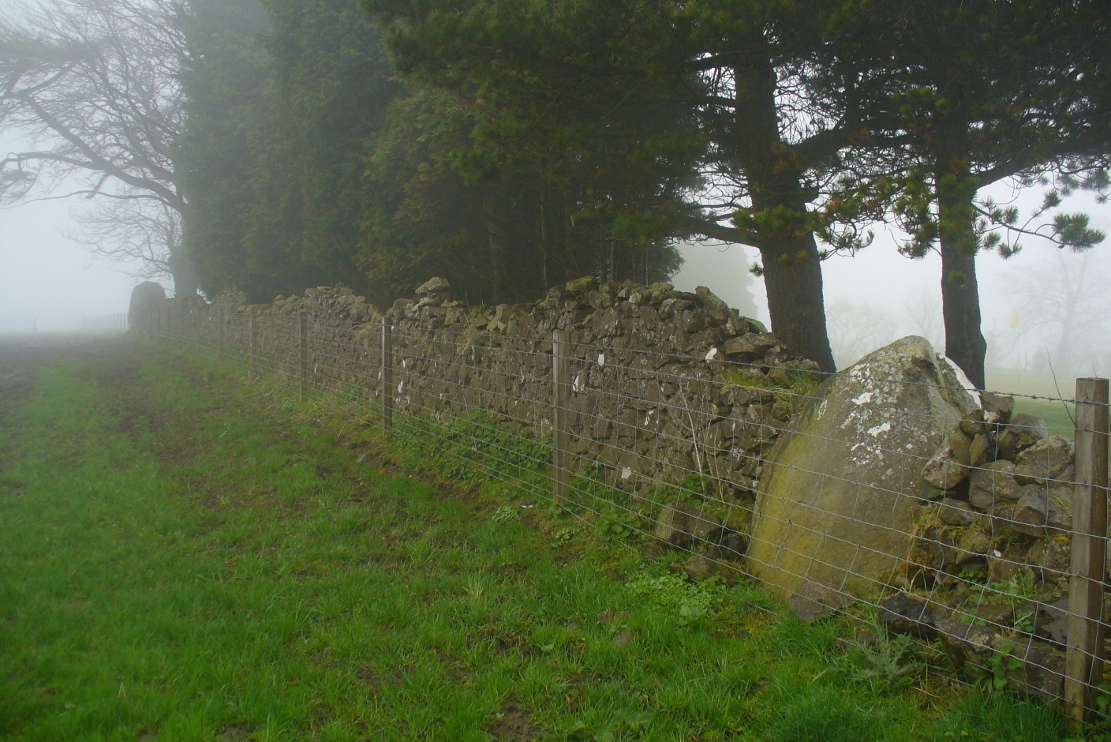
Go east on the B913 through Saline for a mile till you reach Steelend.  Across the road from the houses there’s a dirt-track running uphill (south) into the fields.  When you’re near the top, turn west into the fields, following the straight line of fencing towards the small clump of trees on the skyline.  Near the top, a few hundred yards along you’ll see the large fat stone up against the wall.  But keep walking east and another stone appears before your eyes!

Archaeology & History

The big fella, by the gate

Near the very crown of this long hill, right by the gate separating the fields, you cannot miss this huge and very heavy-looking standing stone, whose position in the landscape was evidently of some importance to the people who put it here.  It’s in a gorgeous spot. You can see in all directions for some considerable distance particularly to the west, and the eye catches other points on the land where prehistoric monuments of other forms speak to each other. (that’s assuming you visit here on a clear bright day, as opposed to when Paul Hornby and I visited the spot when, for much of the afternoon we could barely see 100 yards as the land all around us was cloaked in fog!)

The big fella, face on
And through the fog, from the little fella to the big fella

The site was included in Alexander Thom’s (1990) magnum opus on megalithic stone rows, in which he cites it as a debatable 2-stone row monument.  For if we walk westwards, along the walling, we find another large, possibly prehistoric upright about 50 yards along.  In Aubrey Burl’s (1993) work on the same subject, he merely copies Thom’s earlier questioning of the second stone in his listings.  But in Mr Beveridge’s (1888) regional history work more than a century earlier, he told clearly that on “the ridge of the hill behind Bandrum House, there are built two standing stones.” Of their origin and purpose, Beveridge could find none; but a few years later, A.S. Cunningham (1902) thought simply that

“of the two standing stones on the march fence behind Bandrum House…it is questionable if they ever served any other purpose than a dividing line for properties.”

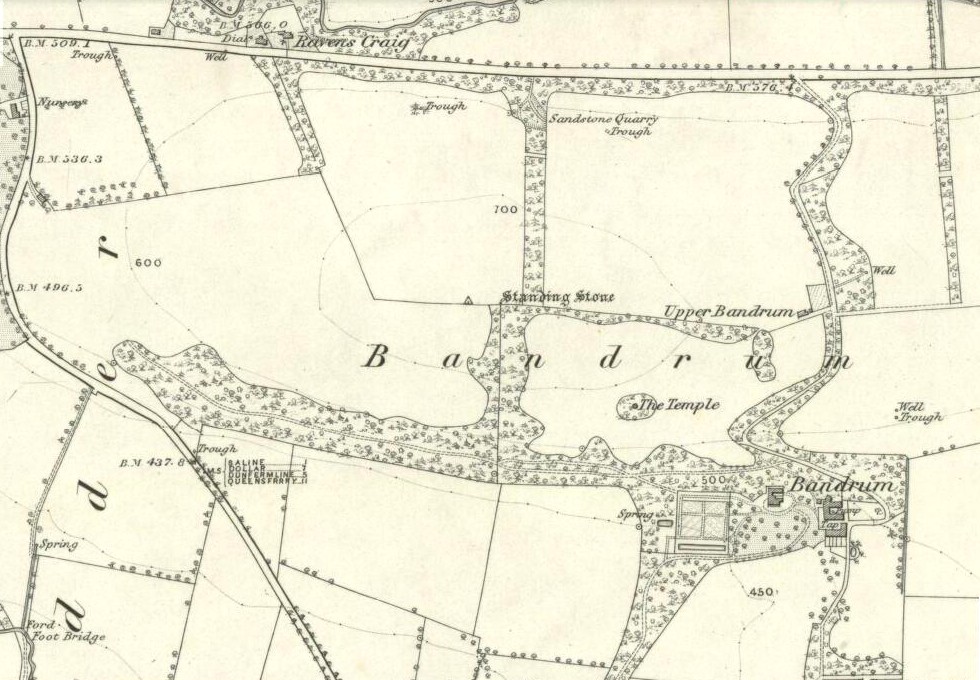
Bandrum Stone on 1854 map

The site was highlighted on the earliest OS-maps of the region in 1854—albeit with only the largest of the two stones marked, at the meeting of the gates—and then many decades later those other official doods, the Royal Commission (1933) lads, made their way up here and included the site in their inventory, where they told:

“On the crest of rising ground at an elevation of 700 feet above sea level, at the end of a dole near to the extreme east end of Saline golf course about a quarter of a mile due west of Bandrum farmhouse, stands a huge whinstone boulder of irregular form.  It measures 7 feet 10 inches in height to the highest point of a somewhat rounded top, and has a slight inclination towards the west.  Its girth at the base is 13 feet 7 inches and at the middle 14 feet 10 inches.  The broadest faces are to the north and south… At a distance of 162 feet due west, there is another large boulder measuring 3 feet 10 inches in height and approximately 10 feet in circumference at the middle, set with a marked inclination towards the east and built into a continuation of the same dike.  The two suggest the remains of a stone circle, the rest of which has been swept away by the cultivation of the neighbouring fields.  There is however, no record of other stones having been removed.”

Thom’s (1990) account of the site was simply put:  “Bandrum. NT 036 915. Huge whin boulder, 7ft 10 (2.4m) h. 162ft (49m) W another 3ft 10 (1.2m) h.”  He gave no indication of astroarchaeological alignments.

References:

  1. Beveridge, David, Between the Ochils and Forth, William Blackwood: Edinburgh 1888.
  2. Burl, Aubrey, From Carnac to Callanish, Yale University Press 1993.
  3. Cunningham, A.S., Romantic Culross, Torryburn, Carnock, Cairneyhill, Saline and Pitfirrane, W. Clarke: Dunfermline 1902.
  4. Royal Commission on the Ancient & Historical Monuments, Scotland, Inventory of Monuments and Constructions in the Counties of Fife, Kinross and Clackmannan, HMSO: Edinburgh 1933.
  5. Thom, A., Thom, A.S. & Burl, Aubrey, Stone Rows and Standing Stones – volume 2, BAR: Oxford 1990.

Acknowledgements: Huge thanks to Paul Hornby for his photos of these standing stones. Cheers Paul!

© Paul Bennett, The Northern Antiquarian

Craigkennockie, Burntisland, Fife

Tumulus (destroyed):  OS Grid Reference — NT 237 861

Archaeology & History

Very little is known about a prehistoric tomb that once existed near the coast at Craigkennockie.  Its existence was briefly described in Andrew Young’s (1913) fine history of the township where he told that it had been highlighted on an old Estate Map of the area and marked as, “an artificial cairn, probably a place of sepulture.”  On old maps just below the cited place we find the place-name of ‘Lammerlaws’, which may indicate a name once given to the site, as the element -law is commonly found relating to prehistoric cairns.

Although the modern place-name researchers in central Scotland have opted that the word ‘law’ is primarily “a rounded hill”, they have curiously forgotten or omitted its other derivation.  Throughout northern England and beyond, the English Place-Name Society finds that many ‘law’ place-names derive from the old English and Saxon word, hlaw, which is originally told to be “a mound, a hill.” This has been the reference cited throughout in Taylor & Markus’ (2006-2012) otherwise fine multi-volume analysis of Fife county.  But there’s much more to it than that.  I hope that readers will forgive me reciting A.H. Smith’s (1956) full entry about this simple term, as it can (and many times does) show our history is much richer than initially thought.  Prof Smith told that law, hlaw, hlæw, has the following etymological origin:

“(1) In OE (old English) the common meaning in literary contexts is ‘an artificial mound, a burial mound, a mound in which treasure is hidden’, as in Boethius Metr. 10.43, ‘in what hlæwa do the bones of Weland cover the ground?; Beowulf 2802, ‘Bid them make a hlæaw…on Hronesnæsse’; Guthlac 4 ‘there on the island was made a great hlæw, which through the lust for treasure had been dug up and broken into’; or Gnomic Verses 26, ‘a dragon shall be on hlæw’, an allusion (as in Beowulf 2773) to the Germanic tradition that mounds containing valuable grave-goods were guarded by dragons.  The word glosses Latin, agger, ‘something heaped up, a mound, a rampart’ (Wright’s Anglo-Saxon & Old English Vocabularies 355.4).  This meaning ‘tumulus, artificial mound, burial mound’ is well attested in place-names.  According to Grundy, it always denotes a tumulus in the OE charters and doubtless those place-names in which it is combined with personal names are the burial places of the men so named; at Taplow at least a remarkable burial treasure was discovered and Cuckhamsley, Berkshire, is named from Cwichelm, the West Saxon king who died in 593.  The majority of such places-names belong to the heathen period when this method of disposing of the dead was practised.  Particular compounds also suggest that it could be an artificial mound which formed the centre of a place of assembly; Oswaldslow Hundred (Place-names of Worcestershire, 87), for example, was created in 964 and it was to meet at a place to be henceforth called Oswaldeslaw in honour of Bishop Oswald (Cartularium Saxonica 1135).

“(2) The meaning ‘hill, a conical hill resembling a tumulus’ is also found in OE, as in Leechdoms Vol.3, 52, ‘they rode over the hlæw’, and local topography establishes this meaning as a common one in place-names and dialects in certain parts of the country; it survives as law in Durham and Northumberland and as low in northwest Midlands…

“(3) The two forms hlaw and hlæw are on record, the latter being better evidenced in literary use, especially in West Saxon texts, and the former in place-names; hlæw normally becomes low, north country law, whilst the i-mutated hlæw (found in place-names only in the south and south Midlands) later becomes lew, as in Lew, Oxfordshire, Lewes, Sussex and is more frequent in middle-english spellings; it is often later replaced by –low as in Dragley, Lancs, Cuckhamsley, Berkshire…”

Smith continues with many topographical evidences regarding a ‘burial-mound’ derivation for the place-name ‘law’, finally adding notes on relative linguistic similarities, like the “Gothic hlaiw, ‘grave’; old High German hleo, ‘grave mound, hill’; old Saxon hleo, ‘grave mound’…”  It seems pretty convincing, and so we need to take this into account in our walks over the hills if we are exploring ancient history.

As if to emphasize this derivation—’law’ as prehistoric tombs—we find it is cited in the massive Scottish National Dictionary (6,1:16) where—alongside the ’rounded hill’ aspect—Mr Grant (1962) tells it to be,

“An artificial mound or hillock, specif.: (1) a tumlus or barrow, grave-mound….”

thereafter giving a number of Scottish examples.  The same meaning is echoed again in the modern version of Concise Scots Dictionary (2005), along with the rounded-hill.  Jamieson’s (1885) Scottish Dictionary cites similarly, ‘law’ as both hill, aswell as “a tomb, grave or mound.”

This association of ‘law’ with ancient burial mounds in Scotland should not be that surprising.  Despite it having an Anglo-Saxon origin, we must remember that the Saxon kingdom is known to have stretched all the way up to the Firth of Forth (Edinburgh) and across to Glasgow. So if the linguistic roots have any credibility at all, it doesn’t take much stretch of the imagination to have this simple word travel further north amongst the people.  Perhaps this is why, more recently, Margaret Gelling (2000) has said that the association of hlaw with burial mounds up here lessens in Scotland.  Nonetheless, let us not presuppose one meaningful definition of the word above another, as it can, consciously or otherwise, be seen as more symptomatic of the all too common English attitude of papering over another country’s rich and ancient heritage by depleting its language—again…

(Law has another element attached which has all but fallen out of historical analysis.  Prof Smith touched briefly upon it, mentioning ‘law’ as being a meeting place—otherwise known ‘moots’.   Moots occurred everywhere in early times: in England, in Europe and in Scotland too.  They were originally where local tribal gatherings took place, for the purpose of what we might call council or political decisions, amongst other things.  Some of these moots occurred on burial mounds of great age, aswell as  stone circles—and evidence indicates that some of them originated way back in prehistoric times.  Although written accounts of many such moot spots have fallen from historical texts, the term law or low (and their variants) is again found in Scottish etymological and topographical lore.  Mr Grant again cites it to mean:

“Law cairns, or court cairns…the judicial sites of baronial court of justice…”

Thereafter giving numerous citations of its use in both the common tongue and sites where it is known.  As far north as the Shetland Isles, where such law-courts aer known from the Scandinavian ting of thing, the 18th century Statistical Account of Tingwall states there being “the Law Stone” at the cite of the parish court.)

Folklore

Also in Mr Young’s (1913) work, he told how this old tomb was a place that seemed cursed or should not be disturbed, saying,

“About 50 years ago, any illness in the neighbourhood of Craigholm was ascribed to the influence of this burial place…”

adding that an adjacent spring of water, of high esteem, was close by.

References:

  1. Grant, William (ed.), Scottish National Dictionary – volume 6, SNDA: Edinburgh 1962.
  2. Jamieson, John, Etymological Dictionary of the Scottish Language, W.P. Nimmo: Edinburgh 1885.
  3. Robinson, Mairi (ed.), Concise Scots Dictionary, Aberdeen University Press 2005.
  4. Smith, A.H., English Place-Name Elements – volume 1, Cambridge University Press 1956
  5. Young, Andrew, History of Burntisland, Fifeshire Advertiser: Kirkcaldy 1913.

© Paul Bennett, The Northern Antiquarian

Split Stone, Bridge of Allan, Stirlingshire

Split Stone mapStanding Stone: OS Grid Reference – NS 81116 99311

Getting Here

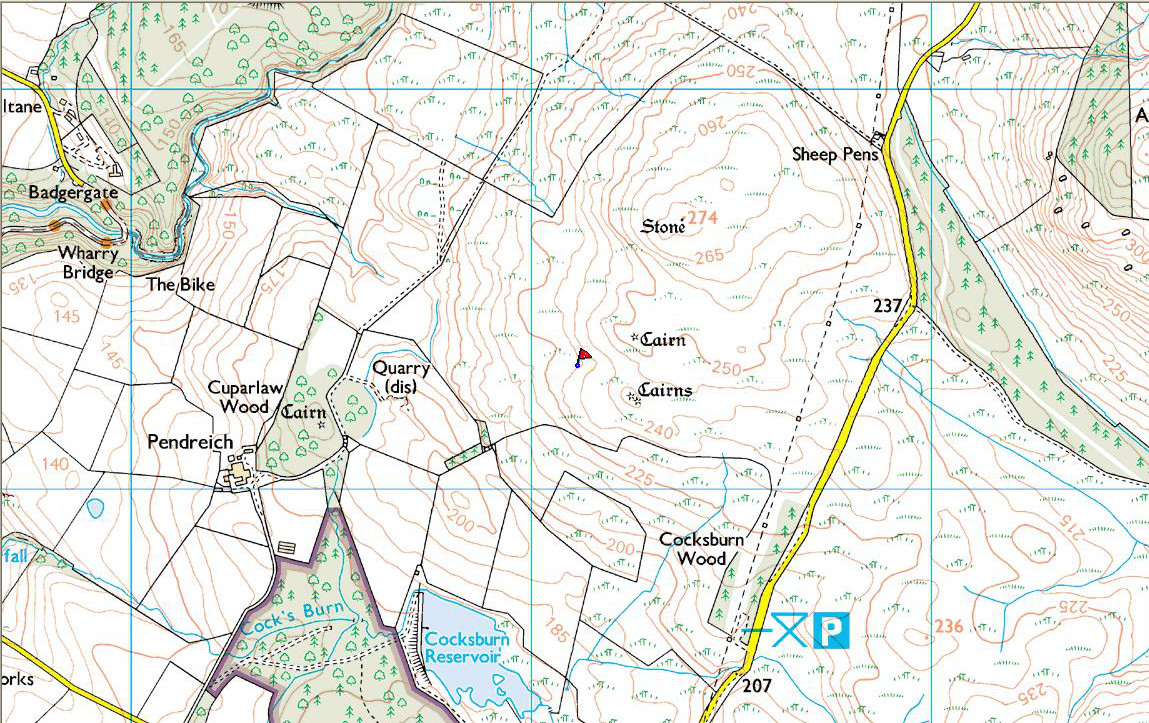
Take the same directions as if you’re gonna find the Pendreich Moor cairn up the hills behind and north of Stirling University (there are 2 very close to each other).  Once upon the cairned hill, walk dead straight WNW for 100 yards or so, or down the slope into the small valley, then westwards.  You’ll hit an overgrown length of very old walling.  Keep walking along here and, below it, you’ll find these stones laying down in the shallow grasses on the south-side of the all-but dried stream.  The large Cuparlaw Wood cairn is 0.4 miles west of here.

Archaeology & History

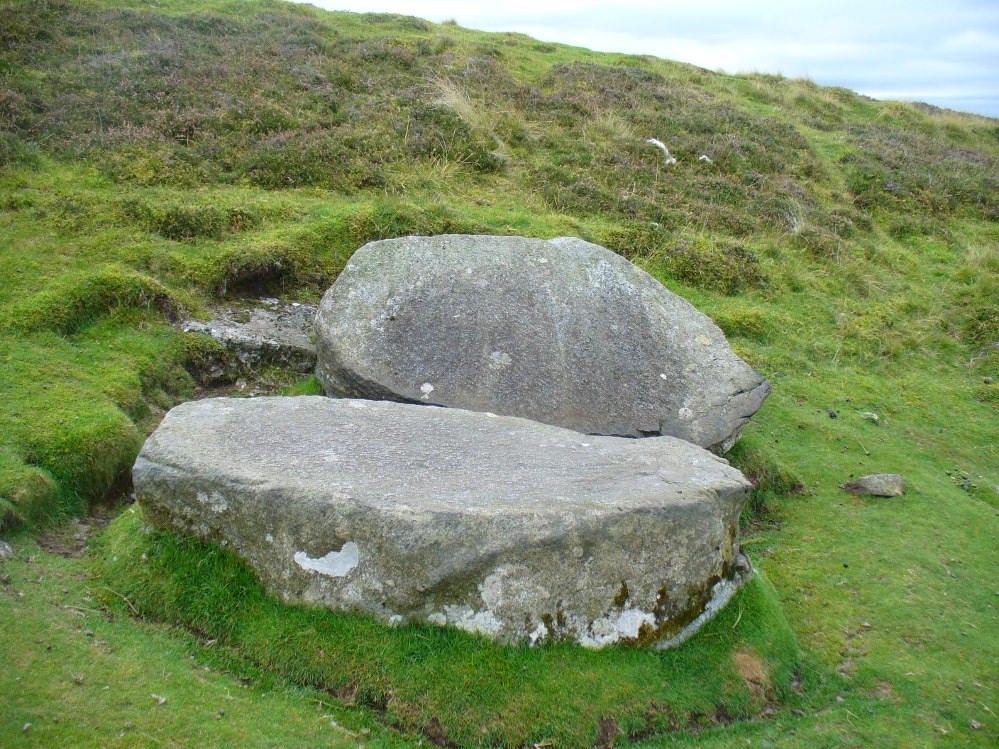
The Split Stone, Pendreich

This is something of an anomaly.  There is no previous written history about the place (that I can find) and archaeologists and historians on The Prehistoric Society and CBA forums can offer no other explanation when asked: is this a standing stone that, many centuries ago, was cut and prepared to be erected, but never made it into the intended monument? (wherever that might have been)  And so, I offer it onto TNA and ask the same of any readers, geologists or archaeo’s who might have an explanation for this curious, large split piece of stone, that lays silently on the western moorland edges of the Ochils, asking the same question.

When I first came across this site I was simply perplexed as to the why’s and wherefore’s of who had cut such a large rock into approximate halves.  I must have walked around it many times, puzzling what the purpose would have been of doing such a thing, and how long ago the ‘split’ had been performed.  About a year later I ventured up again and, when leaving to head back into Stirling, found no resolution to my puzzlement.  It had me truly stumped!

It wasn’t until I visited the prehistoric Witches’ Stone about 15 miles away near Monzie Castle last year, that one of those ‘eureka!’ events occurred.  The last thing on my mind was the curious split rock above Bridge of Allan.  Fellow antiquarian Paul Hornby and I were taking photos of the Witches’ Stone, when one of us remarked how unusually flat and smooth one face of this upright standing stone was – in fact, incredibly flat and smooth – and that’s when it hit me! As I walked round and round the Witches’ Stone, the similarity between this upright example and the one laid on the ground about 15 miles away got stronger and stronger.

The Split Stone, looking east

A week or two later, archaeology student Lisa Samson and I went back to the Split Stone to have another look at it.  Without doubt, the appearance and size and type of rock were one and the same.  The only real difference between the Witches Stone and this Split Stone on the edge of Pendreich Moor, is that one stands upright and the other is laid down.

As you can see from the photos, we have a large rock, 5-6 feet long, which was, at some time many centuries ago, split almost straight down the middle, following a natural line of weakness or mineral deposit running through the stone.  In all probability this was a standing stone prepared and ready to be used in some neolithic or Bronze Age monument not too far way—but for some reason it never made the journey to its intended spot.

The age of this split rock needs assessing correctly by geologists.  Walking around the earthfast halves, it is difficult to see any recent evidence of mason marks that might help us determine when the rock was cut like this.  In looking at erosion marks on cut-and-dressed quarried stone from post-medieval periods, we find no equivalent scars on this Split Stone.  There is what may be faint evidence of some cuts into the stone at the top and side, but these are very debatable; and very probably it seems that the stone must have been cut a very long time ago, thousands of years back, in order to erode all obvious mason marks.  But it would be good to get a geologist to have a look and confirm or deny such things.

…And, as if this isn’t a mystery unto itself:  walk across the dried stream and go up the slope right in front of you immediately north.  There’s a small, almost level ridge you’ll reach after 30 yards up, before the hill then rises further.  If you notice, in the grasses and heather around you, there’s much more of the overgrown ‘walling’ here along this ridge—and some of it, with dips here and there and about three feet tall in places, is in a circle!  It’s man-made, it’s a ring of stones, you can see it on GoogleEarth pretty clearly, and it’s not in any official record books.

Watch this space!

© Paul Bennett, The Northern Antiquarian