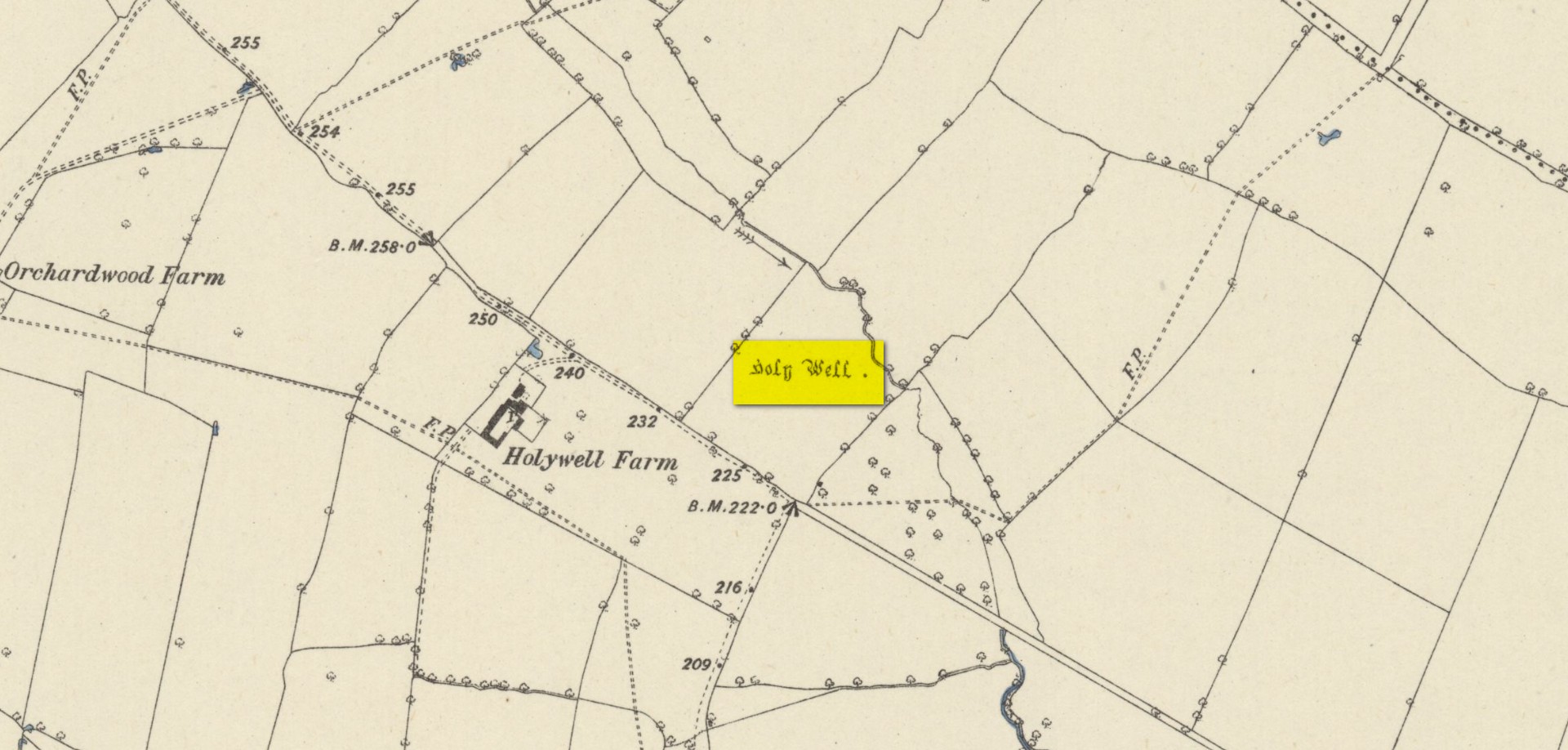
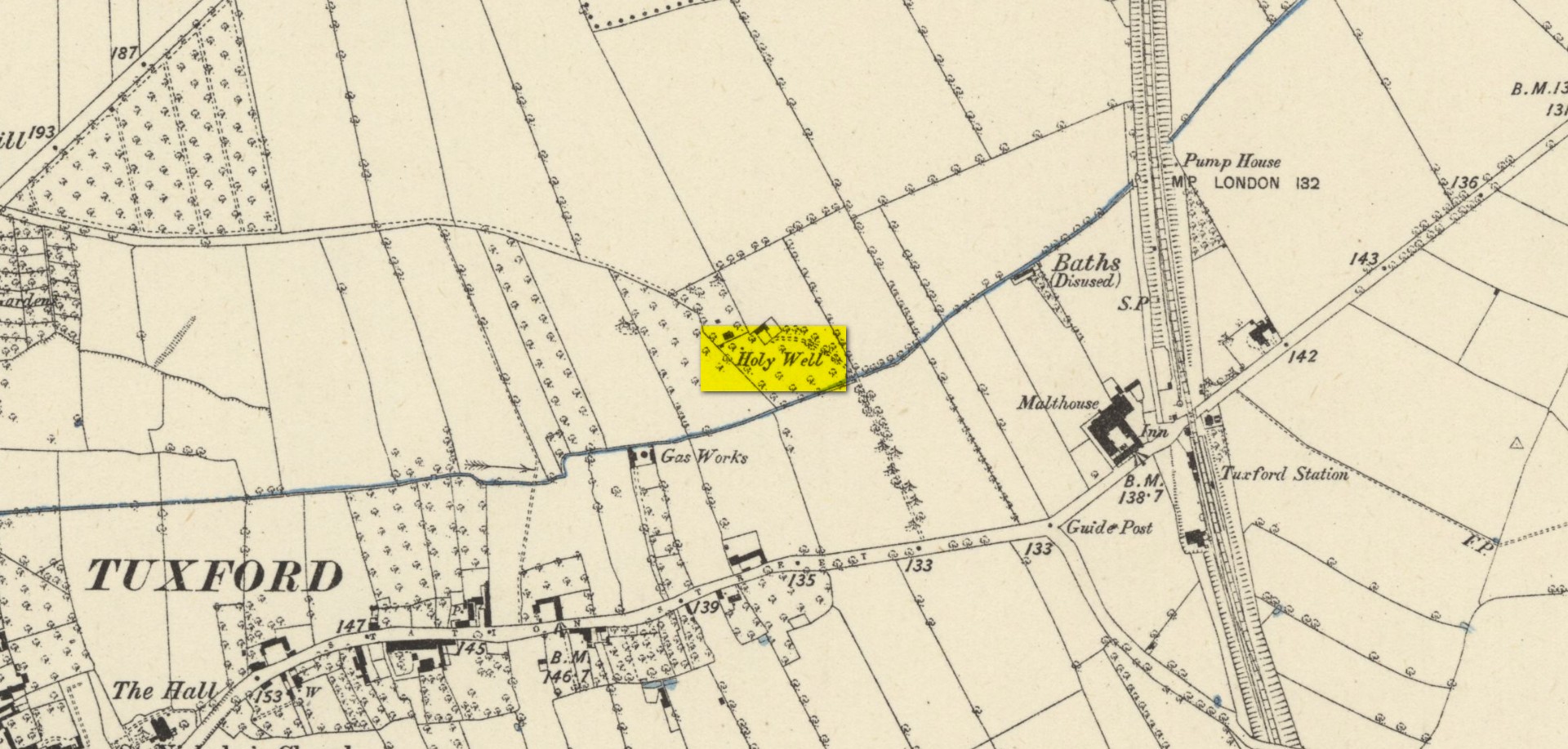
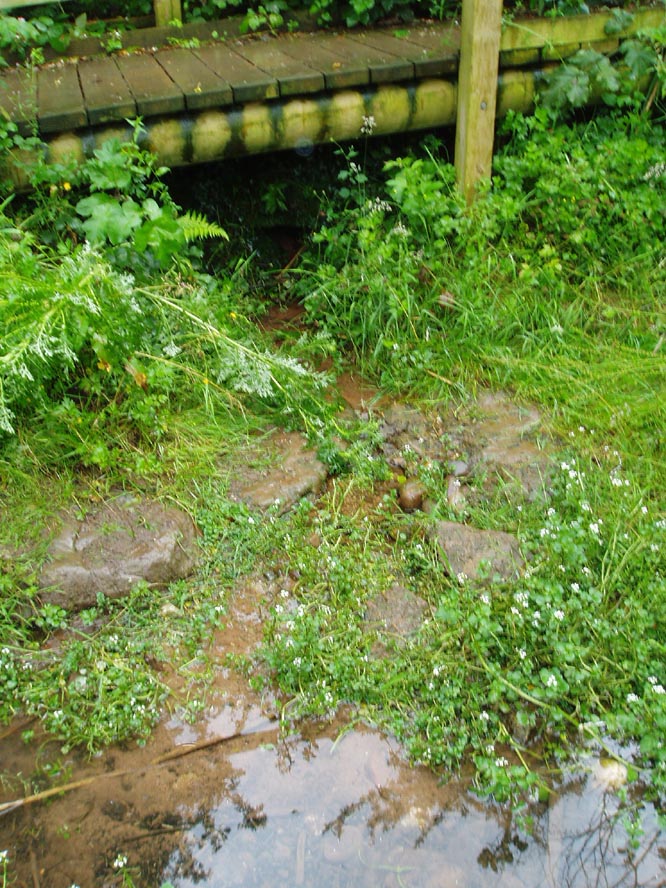
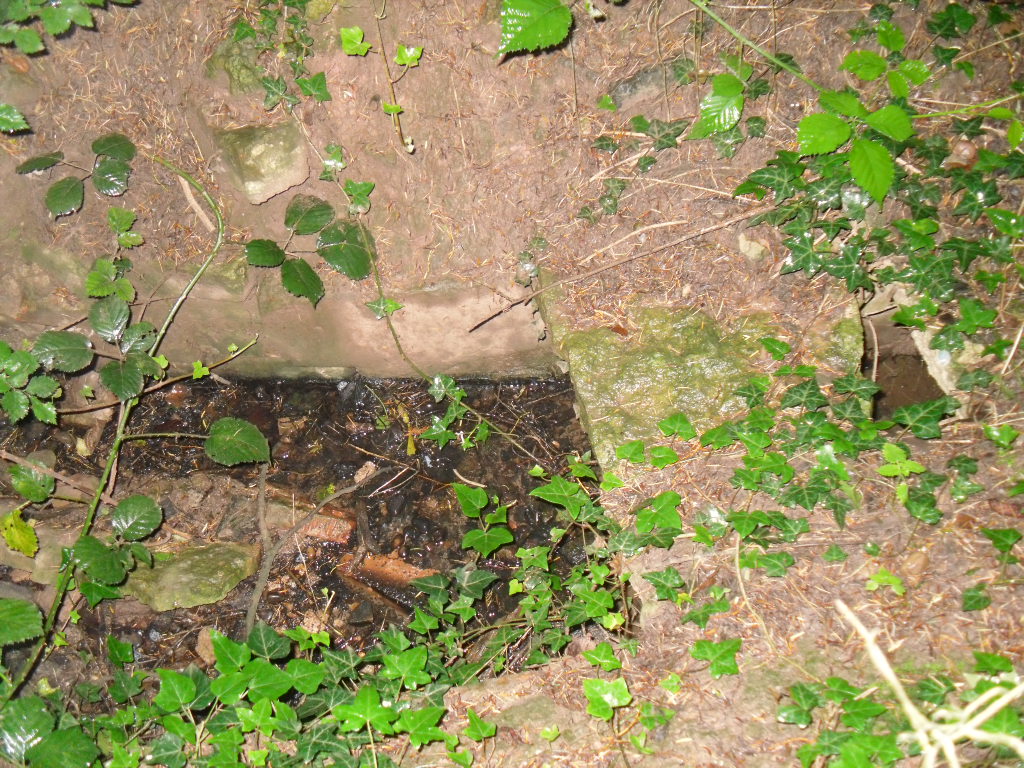
Highlighted on the early Ordnance Survey map of the region by the appropriately named ‘Holywell Farm’, this once important sacred water source would seem to be little more than a muddy patch nowadays. Not good. Its cold waters were reputedly good for curing skin diseases such as scurvy, along with aiding in the affliction of rheumatism.
Local folklore attributed the site to have once fed some Roman baths, but this idea seems to have been a diluted version of it once, historically, supplying some baths a few hundred yards east, albeit in the 19th century and not way way back in Caesar’s days! Of course, the waters of the well would have been used in ancient times, but we have no archaeology or unbroken traditions telling us such things. It was last known to be used as a local water supply in the 1920s. The fact that the spot where it used to run free is still sometimes boggy means that it could be re-animated with a bit of effort from local people.
References:
Morrell, Robert, Nottinghamshire Holy Wells and Springs, Nottingham 1988.
Acknowledgements:Huge thanks for use of the Ordnance Survey map in this site profile, reproduced with the kind permission of the National Library of Scotland.
Hiding away in the Title Deeds of the Willoughby Family of Wollaton, written around 1280 CE, a somewhat lengthy entry on land ownership around the parish of Cossal, showed there once existed a little-known St. Helen’s Well: long since lost it would seem. The account, known as the “Quitclaim (of) William son of Adam le Gaoler,” cited the following information:
“Release by William, son of Adam le Gaoler of Nottingham, and Beatrice (his wife) and Agnes (heirs once of Adam de Cossale in Nottingham) to William de Barre and his wife Dionise [Denyse] of all claims to toft and croft with all its appurtenances, with 10 seliones of arable land with appurtenances in various parcels and sites in town and territory of Cossall; the toft and croft lie between land of Dionise on each side; 3 seliones lie together on Brochisale, 2 lie on Elrinstubbe between land of Robert de Marisco and William Baret, 2 lie on Smalethornchis between land of Henry and Robert son of Adam, 2 lie a square furlong ‘quarentelam’of the spring of St. Elena between land of Stacy le Greyne and Nicholas de Marisco and 1 selione lies on le Westfeld between 2 boundaries.”
A few years later in an early 14th Century Feet of Fines there is another mention of the well, which gave a slightly better description of its whereabouts. It mentions items known as ‘sellions’, which are strips of arable land. The account told of,
“two selions lying together at St Helen’s Well between the land of the church of St Katherine of Cossale on one side, and the land of the said Eustace on the other side, abutting at one end on the croft that Walter Talpe holds, and at the other end upon the north conduit…”
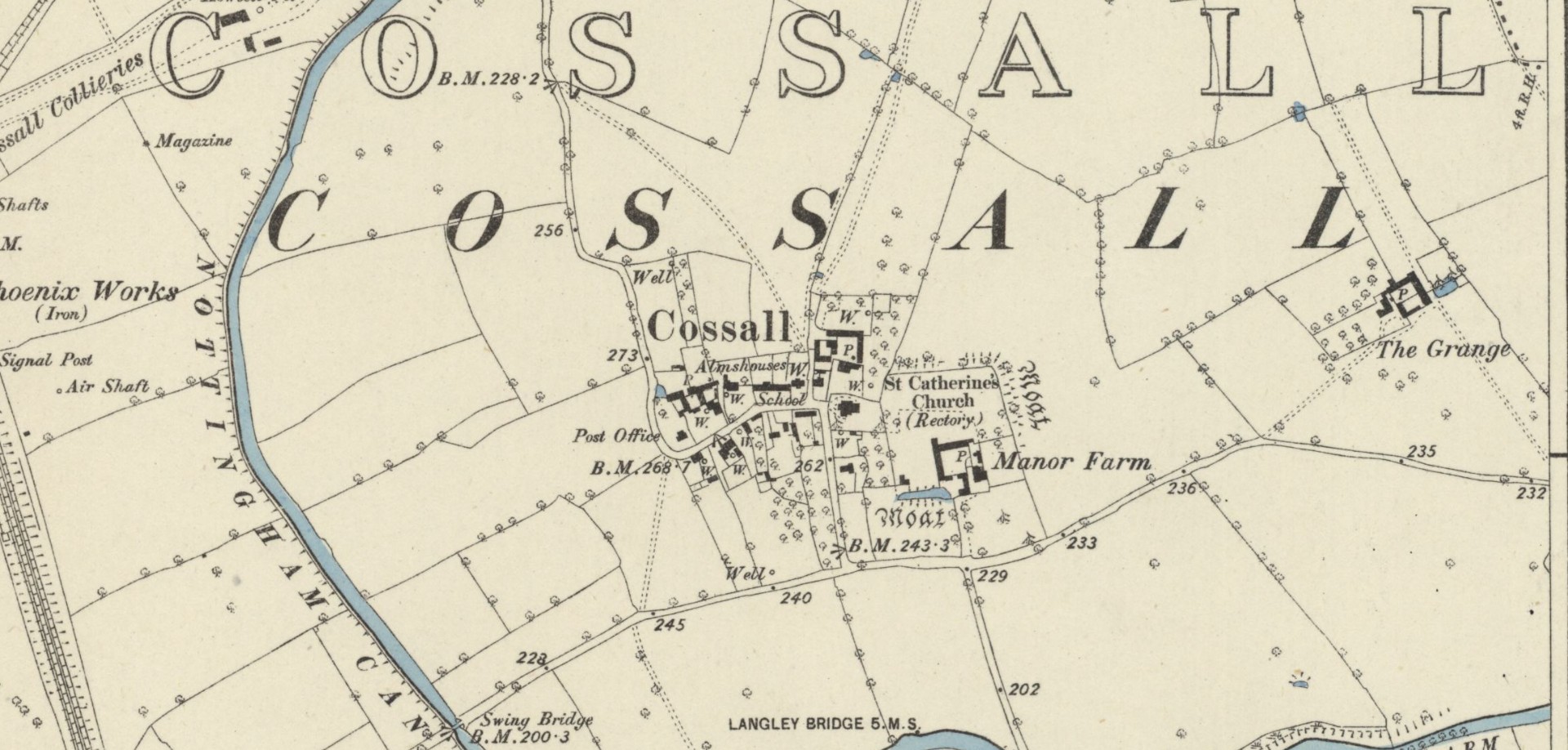
This indicates that the well was close to the village—perhaps even within the village itself. On the early Ordnance Survey maps of Cossall, several wells are shown, and any one of them could be the St. Helen’s Well in question. Does anyone know which one is the forgotten holy well of the village…?
Folklore
St Helen’s feast day is August 18.
References:
Gover, J.E.B., Mawer, Allen & Stenton, F.M., The Place-Names of Nottinghamshire, Cambridge University Press 1940.
Morrell, Robert, Nottinghamshire Holy Wells and Springs, Nottingham 1988.
Acknowledgements:Huge thanks for use of the Ordnance Survey map in this site profile, reproduced with the kind permission of the National Library of Scotland.
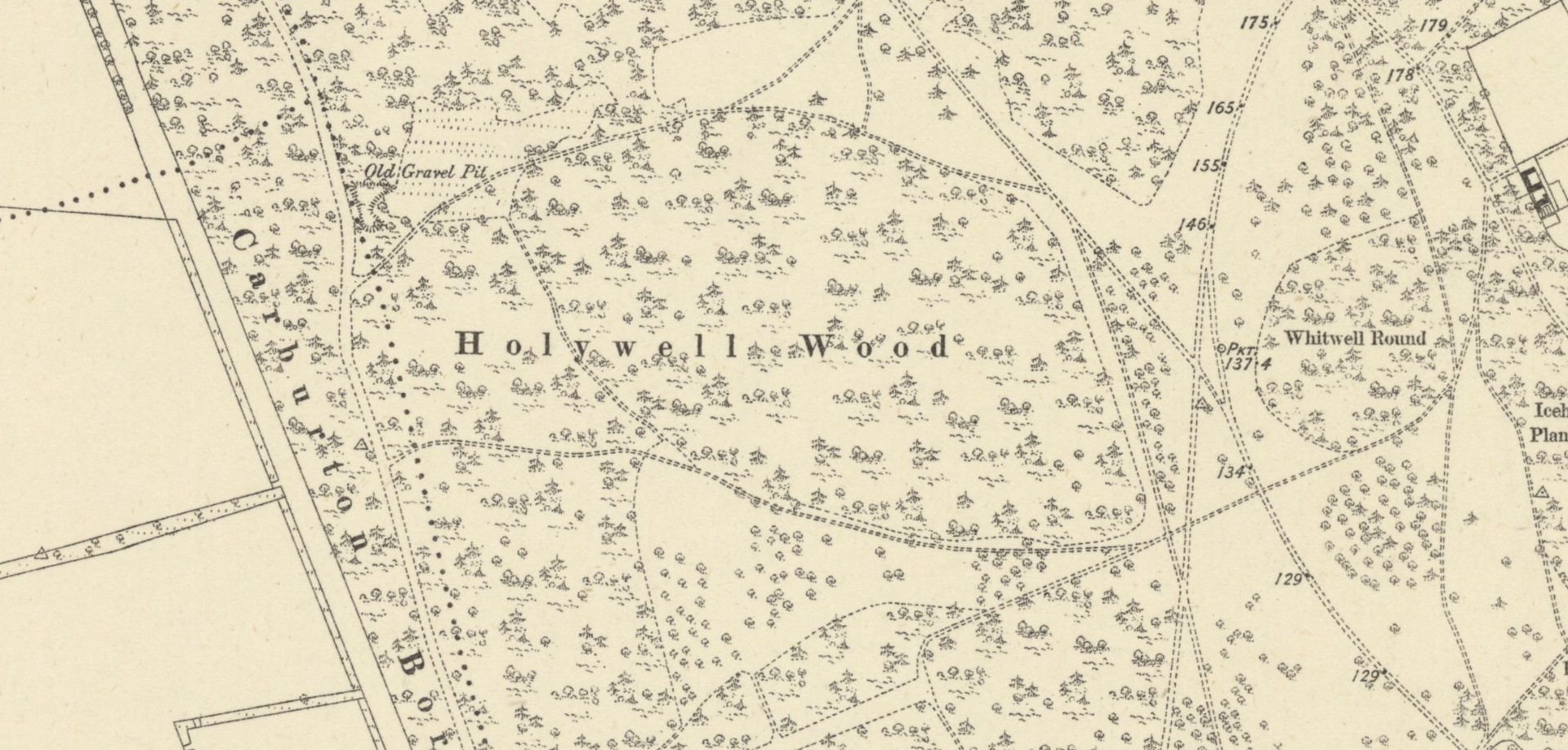
The precise whereabouts of this holy well—in the aptly-named Holywell Wood—is hard to pin down. It was first recorded in the Dukery Records of 1232 as Holywell Dale and the woodland that owes its name to the site was recorded on the 19th Century Ordnance Survey maps (right). Bob Morrell (1988) added the site to his survey of Nottinghamshire holy wells, but he was unable to locate it and its position remains elusive. One account suggested that it marked the line of an ancient boundary—which would place it on the western side of the present woodland. It’s alternative name, the Allenwell, may suggest a dedication to St. Helen. I add the site here in the hope that a local antiquarian might be able to locate it. Please let us know if you re-discover it!
References:
Gover, J.E.B., Mawer, Allen & Stenton, F.M., The Place-Names of Nottinghamshire, Cambridge University Press 1940.
Harte, Jeremy, English Holy Wells – 3 volumes, Heart of Albion press: Wymeswold 2008
Morrell, Robert, Nottinghamshire Holy Wells and Springs, Nottingham 1988.
Acknowledgements:Huge thanks for use of the Ordnance Survey map in this site profile, reproduced with the kind permission of the National Library of Scotland.
First mentioned in place-name records from 1409, this seemingly lost sacred well could be found in the south-side of St. Leodegarius’s churchyard. It was filled-in sometime in the 19th century when the ground around it collapsed to some considerable depth, so the hole was covered. Despite this, water kept re-appearing on and off over the decades and, in Bob Morrell’s (1988) holy wells survey, he told that following constant heavy rains in 1987, it was filled in for the last time.
References:
Bailey, Thomas, Annals of Nottinghamshire, Simpkin Marshall: London 1853.
Gover, J.E.B., Mawer, Allen & Stenton, F.M., The Place-Names of Nottinghamshire, Cambridge University Press 1940.
Harte, Jeremy, English Holy Wells – 3 volumes, Heart of Albion press: Wymeswold 2008.
Morrell, Robert, Nottinghamshire Holy Wells and Springs, Nottingham 1988.
Holy Well (destroyed): OS Grid Reference – SK 589 789
Also Known as:
Prior Well
Archaeology & History
Once to be seen in the ancient landscape immediately northwest of Worksop Priory by the old Mill Pond, this sacred well has sadly been built over, but memory of it is still retained in Priorswell street-name and, previously, the Priorwell Brewery. Not much has been written about it, but thankfully the historian John Holland (1826) gave us a short account, saying:
“There is a spring, now enclosed, called the “Priorwell,” and a meadow, of four acres, denominated from the same; and from which, it might be presumed, that the canons would draw their supplies of water, was it not for the convenient proximity of the river, which they must have had to ford for that purpose. It was “formerly”, says Parkyns, in his Monastic and Baronial Remains, “celebrated for miraculous cures; but since monastic deceptions have unveiled themselves, votaries no longer offer, and consequently cures are no longer performed.” This may have been the case: more recently the well has been resorted to by persons having sore eyes, in the cure of which, it is said to be efficacious, and has probably the common virtue of fresh cool spring-water.”
References:
Holland, John, The History, Antiquities and Description of the Town and Parish of Worksop, J. Blackwell: Sheffield 1826.
Parkyns, George I., Monastic and Baronial Remains – volume 1, Longmans Hurst: London 1816.
White, Robert, Worksop, The Dukery and Sherwood Forest, Simpkin Marshall: London 1875.
In Calverton, take Renals Way off the main street and follow it around until you reach the end and a copse. Take the left hand path. When the footbridge is reached the spring head is encountered.
Archaeology & History
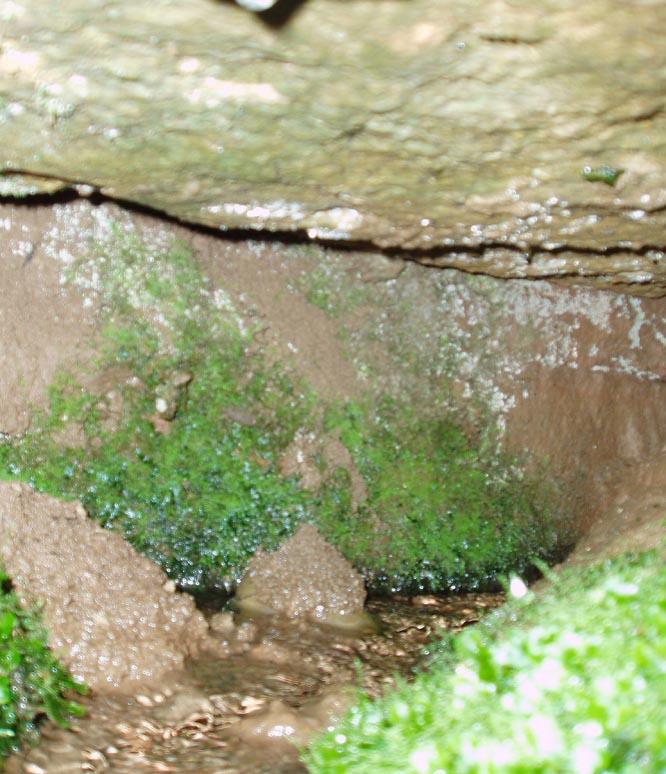
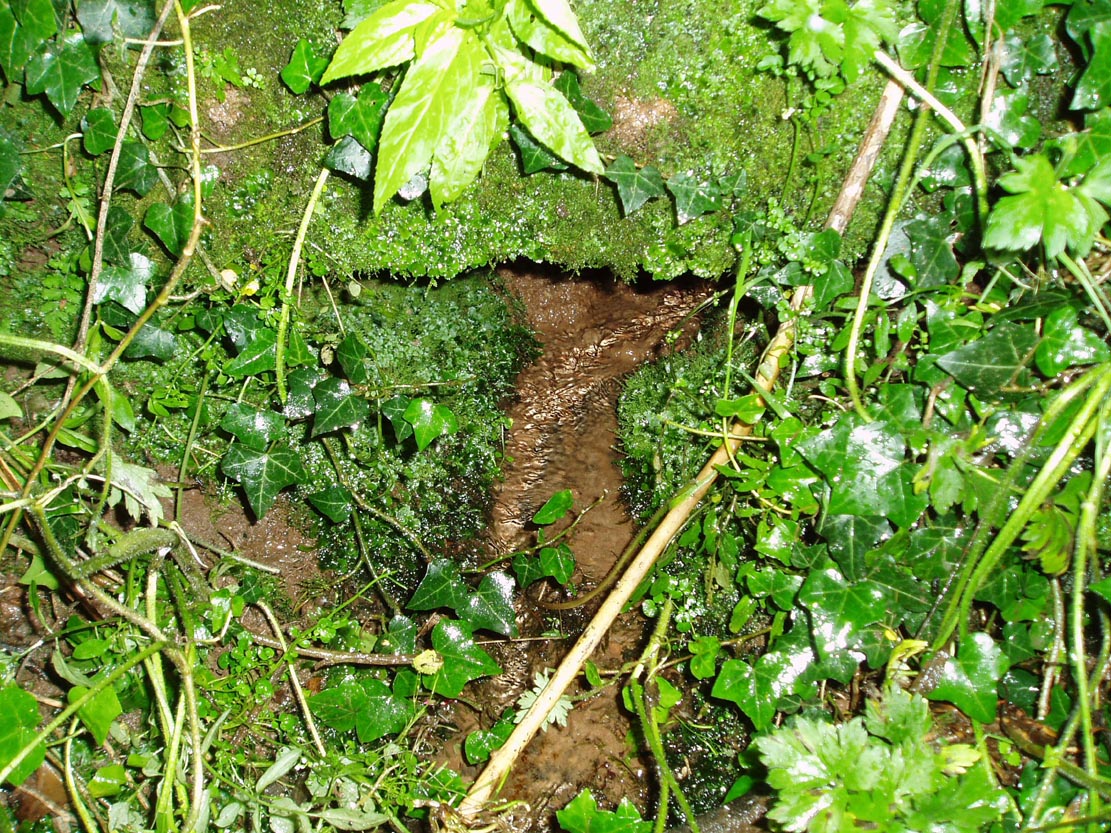
Also known as the Keen Well, fortunately it still survives. It arises between some sandstone blocks forming a small cave where a strong spring flows and fills a small pool with some rough stones around it. The pool does not appear very deep although is it overgrown in parts. A footbridge crosses over the springhead, meaning that one has to peer under it to see the spring. The area surrounding Renals Way and Dark Lane is ear-marked for development and I hope that this spring can survive this stage of its history.
Folklore
Bob Morrell (1988) in his Holy Wells of Nottinghamshire notes a site (although he does not name it), which was attended by pilgrims near and far, and had the tradition that ‘kings’ after hunting in Sherwood Forest would visit it ‘to quaff the nectar’.
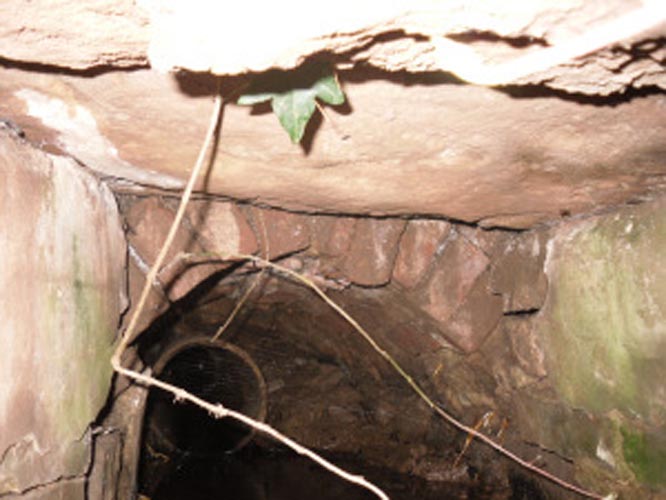
In the well chamber it looks a natural spring
Close view of the spring head
Morrell (1988) fails to state whether it still existed, but the site in question would appear to be the Keen Well. It’s name being possibly derived from King’s Well. According to Mr. Peck of the local history museum, this was supposed to have used by ‘Old Saxon Kings’ to bathe their eyes as a protection against failing sight. One of the medieval kings and his attendants are also reputed to have stopped here whilst travelling to the North.
References:
R.W. Morrell (1988) Nottinghamshire Holy Wells
R.B. Parish (2008) Holy wells and healing springs of Nottinghamshire
First mentioned in Pipe Rolls and referred to by the founder of Wallingwells Benedictine Priory (founded around 1150 CE) as ‘juxta fonts et rivum fontium’, the site Wallingwell or originally Waldon-by-the-Wells, may be significant. The name refers to ‘bubbling wells’, but whether these wells were dedicated appears to be unknown, although it does seem likely. Indeed, an anonymous article from the Worksop Guardian dated 1929 on the Wallingwell Estate, shows the well arising under a rough stone work arch beside the site of a lake. Close by, appears to be a grotto of a similar construction. The article states that the grotto was built 250 years (from 1929 this suggests a date of 1679 which appears a little too early for this folly, a date in the 18th century being more likely). This was done by Thomas White using stone from petrified springs in Derbyshire. No reference is made of the well, but one assumes that it was built at the same time, but whether White was constructing a folly around an existing traditional site again is unknown.
Baker (2000) refers to the castle folly but fails to reference these sites suggesting that it had vanished. However, grotto and well still exist in the overgrown and forlorn garden to the back of the house. The grotto is well-preserved, although signs of ruination are evident and the urn within has gone.
The internal brickwork
The overgrown well
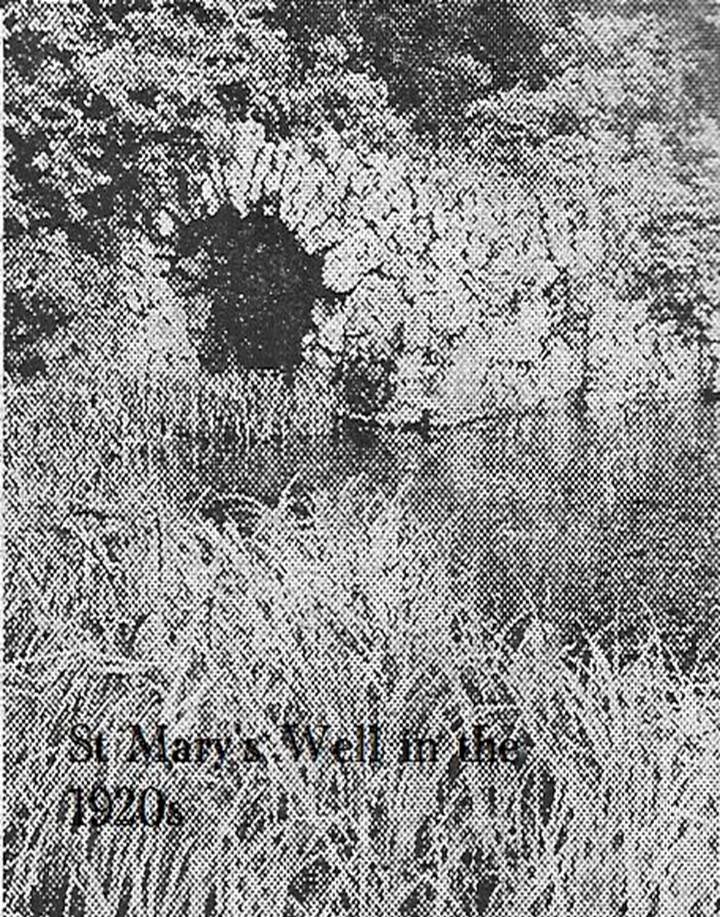
St. Mary’s Well is the most ruined. The archway appears to have fallen or been knocked down but the channel or basin the spring flows into still exists. Observation underneath a flattened stone covering the channel show that the spring flows from a pipe further up and under a series of neat brick arches. It is clear that the well structure was never accessible as it abutts onto the Lake, but was designed to be seen from the other side of the Lake. This view now is difficult due to the considerable plant growth obscuring the sites. It is good to see that the well still exists and hopefully the garden could be restored.
Extracted from R. B. Parish (2009) Holy Wells and Healing Springs of Nottinghamshire
A stone’s throw from Ikea and found off the B600 main road. Travelling to Greasley from Watnall, take first turning on the left after Royal Oak Wood. Travel up Trough Road, past the woods where it is best to park, then walk up Trough Lane and the well can be found on the right hand side, opposite a house called The Springs.
Archaeology & History
I am of the opinion that the ‘holy’ element of this well is a romanticism of the 1800s, but there is a possible record in the ‘The Manor of Bevall in the County of Nottingham’ document, commissioned by the Honourable Dame Elizabeth Capell in 1653. Amongst the records it appears a number of times as:
‘Holy Well Furlong 2 lands bounded with John Richards west and William Hickton east’.
Plaque at the wellFront of the well
A 1724 Capps Survey of Watnall Cantelupe notes that Joseph Richards had some lands lying in a close called the Flatts or Holliwell, which understandably relates to ‘Holy Well’. There is also note of a Holwell Croft field name in the 1500s at Greasley, which again may describe this site or another and such suggests that it derives from O.E. hol, meaning ‘hollow’, a common misconception when identifying prospective holy wells. Jeremy Harte (2008) in his English Holy Wells suggests that those sites called ‘Holy Well’ are pre-Medieval in origin so perhaps this site is one of the most ancient in the county.
The sacred waters
On my first visit to this site I was told by an elderly man that he was baptised there (or water used from it used for his baptism), before attempting inexplicably in trying to discourage me from finding it (due to his wariness of me I failed to discover the nature of his baptism or of what denomination). According to locals in the lane the plaque and present state of the well dates from the 1980s and was done in partnership with the local council.
The house opposite is called ‘The Springs’ was this name of the well before the ‘present’ name and so it is ‘modern’ holy well per se, although I think the 18th century survey is significant.
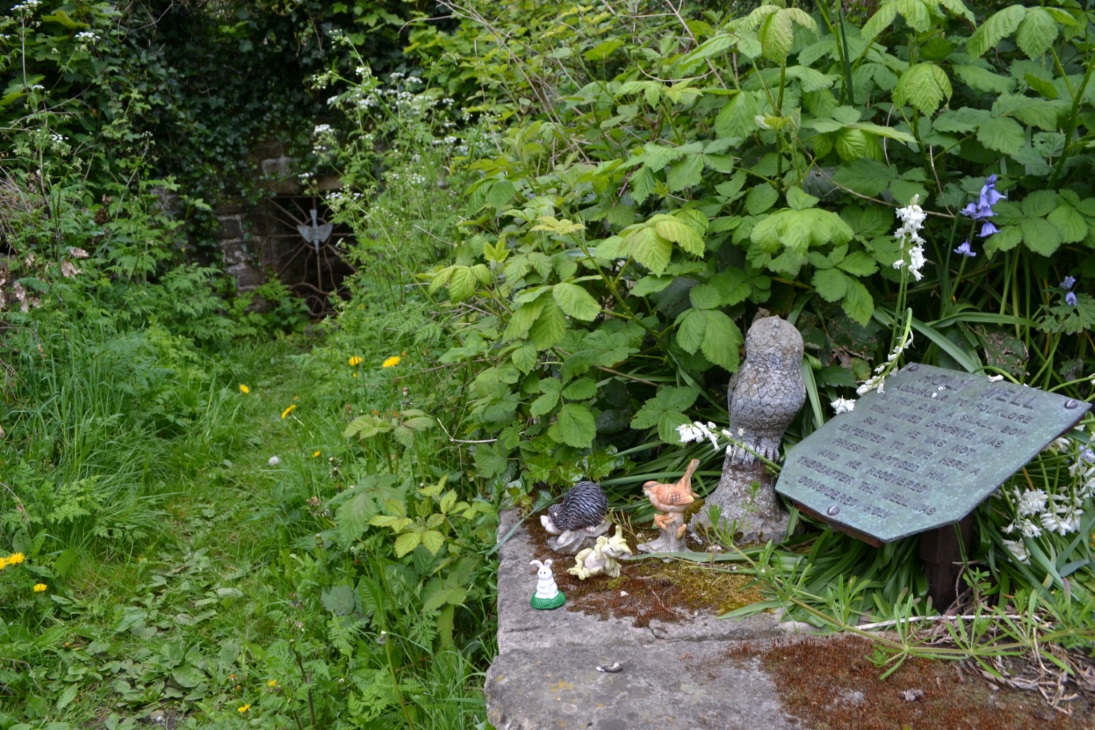
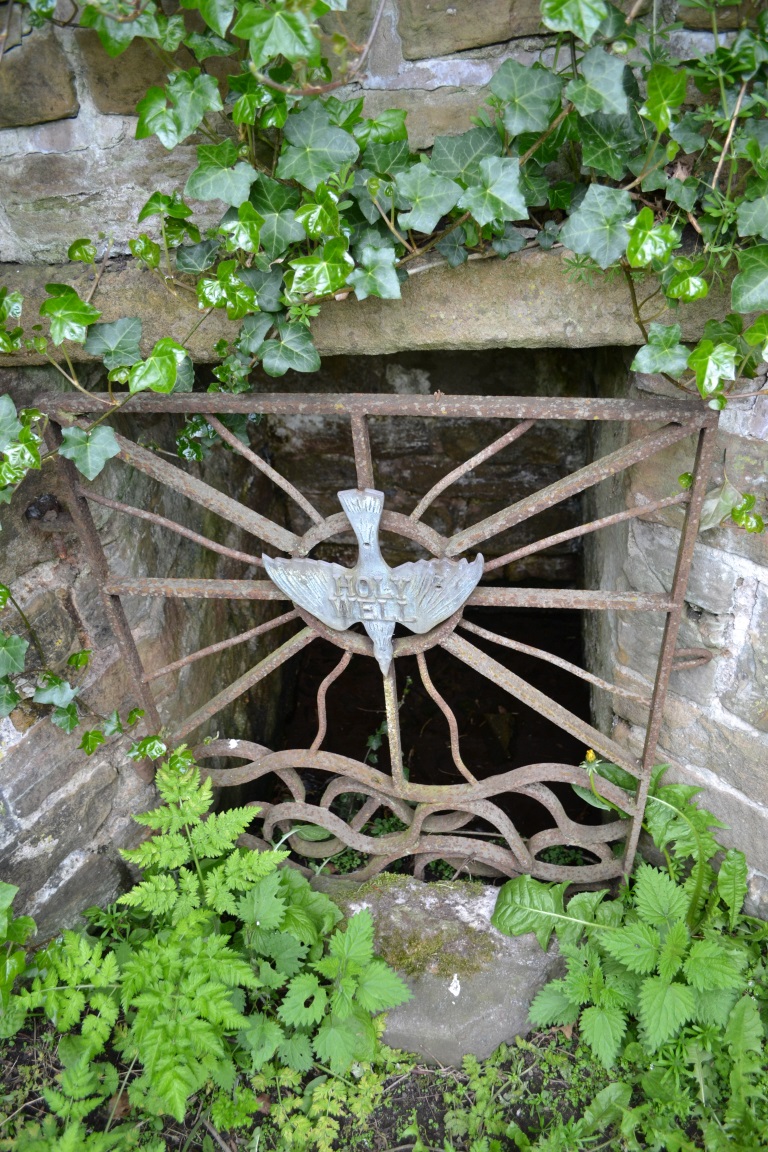
The well itself, is enclosed in a stone recess with a rusty iron gate with a dove affixed on it bearing the legend Holy Well. It is approached by a path walled along both sides which are adorned by a wide range of gnomes and garden ornaments..almost so you could be pixy led!
Folklore
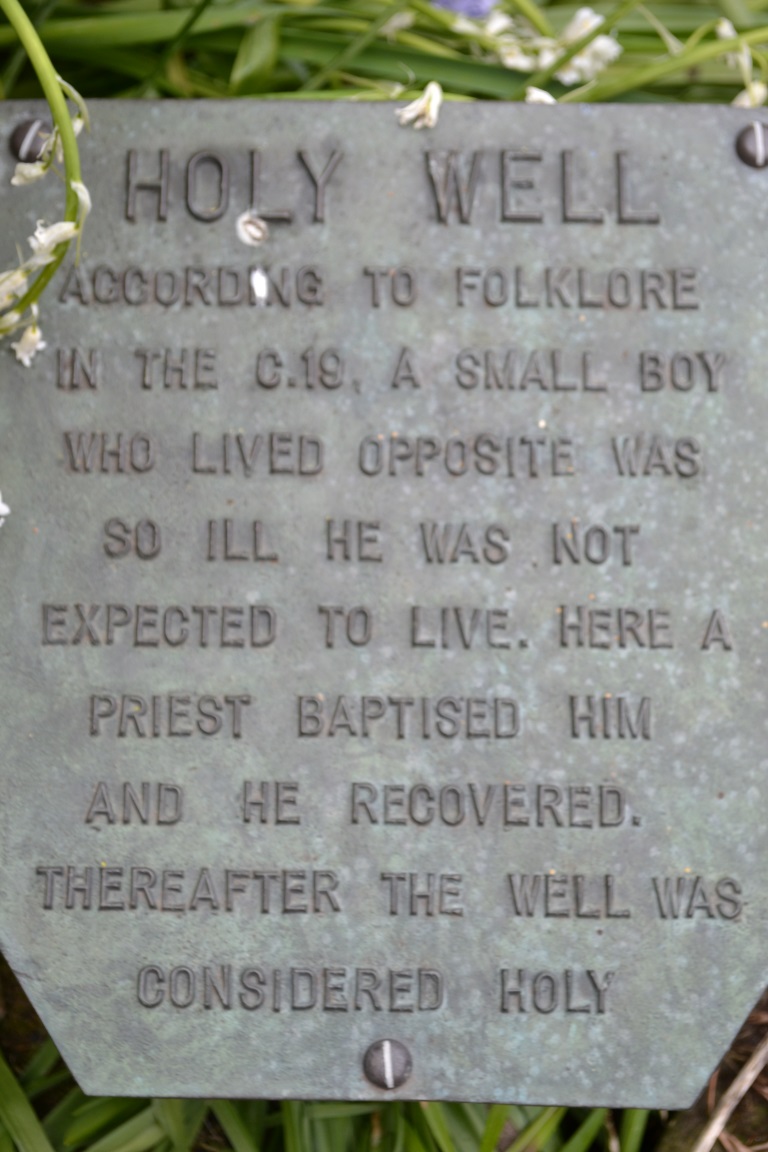
A plaque near the well’s entrance has a local piece of folklore recorded. This relates that a local boy who lived opposite was very ill and bedridden. A local priest called for water to be drawn for the boy from the well. This was done and the boy became well.
Interestingly it’s the only legend of this type—one which records a cure—in all the Nottinghamshire holy wells. It is a shame one cannot find a date or check its provenance, a fact supported by local history author Mr. John Lee. The use of priest is significant. Does the story may indicate the Catholic revival in holy wells in the 19th century? However, the only Catholic associations locally are that of Hilltop at Greasley for there was, and is, only a Methodist chapel in Watnall.
Extracted from Parish, R.B (2008) Holy Wells and healing springs of Nottinghamshire
Follow the road around from Headon village to the Ladywell estate and on the left hand side is a small copse and footpath. It is near the junction of Greenspotts Lane and Lady Well Lane. Park carefully near here and walk down the small ravine to the well.
History & Archaeology
Close-up of the well
Only two dates can be confirmed of this site. One a reference in County records of mending a bridge to a ‘Ladyewell‘ in the nearby Markham parish, but this could easily be another site. A better date is that 1718 which is carved on its arch. It was used as a source of water until the 1930s. One of the most atmospheric and pleasantly situated sites, the spring is located in a small wooded dell and arises from the rock in a small alcove or cave. This is fronted by a red brick arch, and the water fills a trough set partly into the ground with a small overflow lip and a channel to fill it, presumably this was for animals. On the key stone of the arch are the initials ‘HW’ and a date which possibly reads 1718.
Dressed for 2000AD
Folklore
I have found no traditions of healing or other folk belief. However, the site was one of the few Nottinghamshire well dressing sites. This began in 1981 and continued until 1991, and there was a one-off occurred in 2000 AD. It was done on the weekend of the churches Patronal festival—St. Peter’s—and was used to use to pay for the church repairs. The well dressing boards were of a Derbyshire tradition, as can be seen here to the right.
One of the most unusually sited of Nottinghamshire’s holy wells is St. John’s Well at Welham. It lies beneath a private kitchen floor in a house in Bonemill Lane in Welham, just off the Clarborough Road out of Retford.
Archaeology & History
The well itself is undoubtedly an ancient one. The Domesday Book refers to ‘Wellun’; this changed to ‘Wellum’ by 1166, and by the 16th century had become ‘Wellom’; but in Chapman and Andrews map of Nottinghamshire in 1775 was shown as ‘Welham’. None of these sources call it St John’s Well and it is not so named until 1710, either as a re-dedication once the Reformation zealouts had died down, or perhaps coined by John Hutchinson to give the bath a story to explain its healing waters. It is shown on Chapman’s map of Nottinghamshire (1774) as ‘Well House’. Piercy (1828) gives the greatest information and states that the hamlet of Welham was named after St. John’s Well whose waters contained magnesium and gypsum and was:
“good for rheumatics and scorbutic diseases. Its waters formed into a large bath, and remained entire during the early part of the 18th century, it was famous for many cures, but latterly it has lost much of its celebrity.John Hutchinson, Esq. erected a cottage adjoining, and enclosed the bath, to preserve it from injury. Cold baths like this were formerly regarded with superstitious reverence, being supposed to possess a sovereign remedy for agues such as rheumatism.”
The well-coverLooking into the well
By 1832 White’s Directory notes that it had lost much of its former celebrity. A Robert Walker was a bath keeper at the Well house and may well have been the last one as it appears the well soon fell into terminal decline and I can find nothing is noted of it until 1938. At this time it is noted that its water was still used to provide several cottages in the village. An article written in 1957 states the bathhouse disappeared stating the coming of the railway encouraged people to move away to find more effective spas around the 1830s. It goes on to note that the actual spring location was lost. This I thought was to be the situation, but local investigations not only showed the house to be still existence but the bath still remained! Records show that the estate, was bought by an Arthur Robert Garland of Welham Hall from the deceased estate of John Henry Hutchinson of Clarborough Hall acres117.3.16 along with Well House Cottage and garden for the sum of £3200 on in 1910. He then sold the cottage and garden to Fred Anderson on 1910 for £130. This was subsequently bought by the late Mr Eric Durham on 1955, later to be purchased by the current owner, Mr Whelan, in 1975.
The present house, although it had been added onto in the last century, has its core fabric as John Hutchinson built it. The large house being the well keeper’s abode with the side building, now a modern kitchen was the bath house. Arriving at the house, I was at first shown the site by Mr. Whelan the spring which filled the bath which was diverted to the side of the house, the spring itself arising close to the footpath behind the house. A man-hole cover in the drive way revealed that the spring flows at a fast rate, several gallons per minute. He notes that it had a very high mineral content, soaking through the gypsum in Clarborough hills. He stressed it is drinkable, in small quantities, due to its high magnesium and sulphate (like Andrews Liver Salts). It is quite chalky to taste flat but is very pleasant to drink if aerated. However he did not recommend long term drinking was probably not good for one’s health.
In the kitchen, a small trap door can be removed and beneath the remains of the bath is revealed. This appears to as Mee (1938) describes; a stone basin twelve feet square with a flight of steps entering the water. I scrambled down into this bath and found it presently to have two stone steps which enter the bath, although bricks built upon these suggest that there may have been more.
Remarkably the bath still remains enclosing an area fifteen feet by twelve feet, and despite the water being diverted, was full to over a two foot of water. The present kitchen is supported by four brick pillars but this does not appear to have damaged the fabric of the bath which is in fine condition, being made of good quality neat squared stonework. A pipe is found four feet high or so in the wall and a line around it made by the presence of water indicates that the water was of a considerable depth supporting the fact that it was large enough to be a hazard, explaining how Thomas Heald, Vicar of Babworth drowned in it on the 18th June 1759. Mr. Whelan informs me that although the house is not a listed building previous owners had sensibly preserved the bath. Around 30 years ago he was often showing local school children, but it appears now to forgotten. So there it remains a curious relic preserved in its most unusual place.
Folklore
John Piercy (1828) notes:
“Here was, until lately, a feast, or fair, held annually on St. John’s day, to which the neighbouring villagers resorted to enjoy such rural sports or games as fancy might dictate.”
What is interesting about this account is the reference of games and a fair suggesting that if the well itself did not have such a dedication, the saint was celebrated in the locale. This may indicate that indeed the well was so dedicated or that Hutchinson chose this name because of the local fair. Without further information we shall never know.
It must be noted that due to its location, under a private kitchen, that the site is not readily viewable so please don’t turn up unannounced.
References:
Mee, Arthur, Nottinghamshire, Hodder & Stoughton: London 1938.
Parish, R.B. (2010) Holy Wells and healing springs of Nottinghamshire