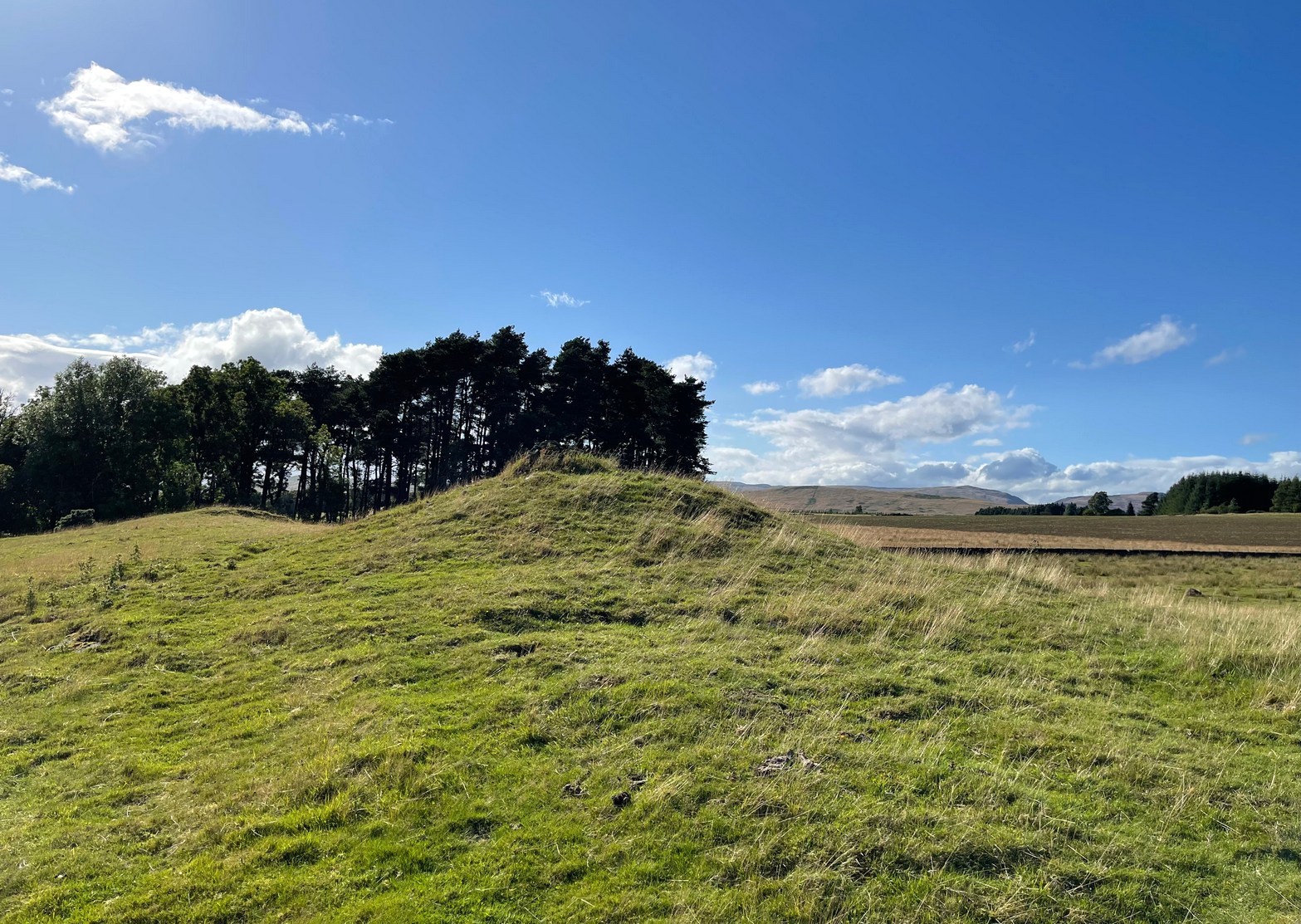
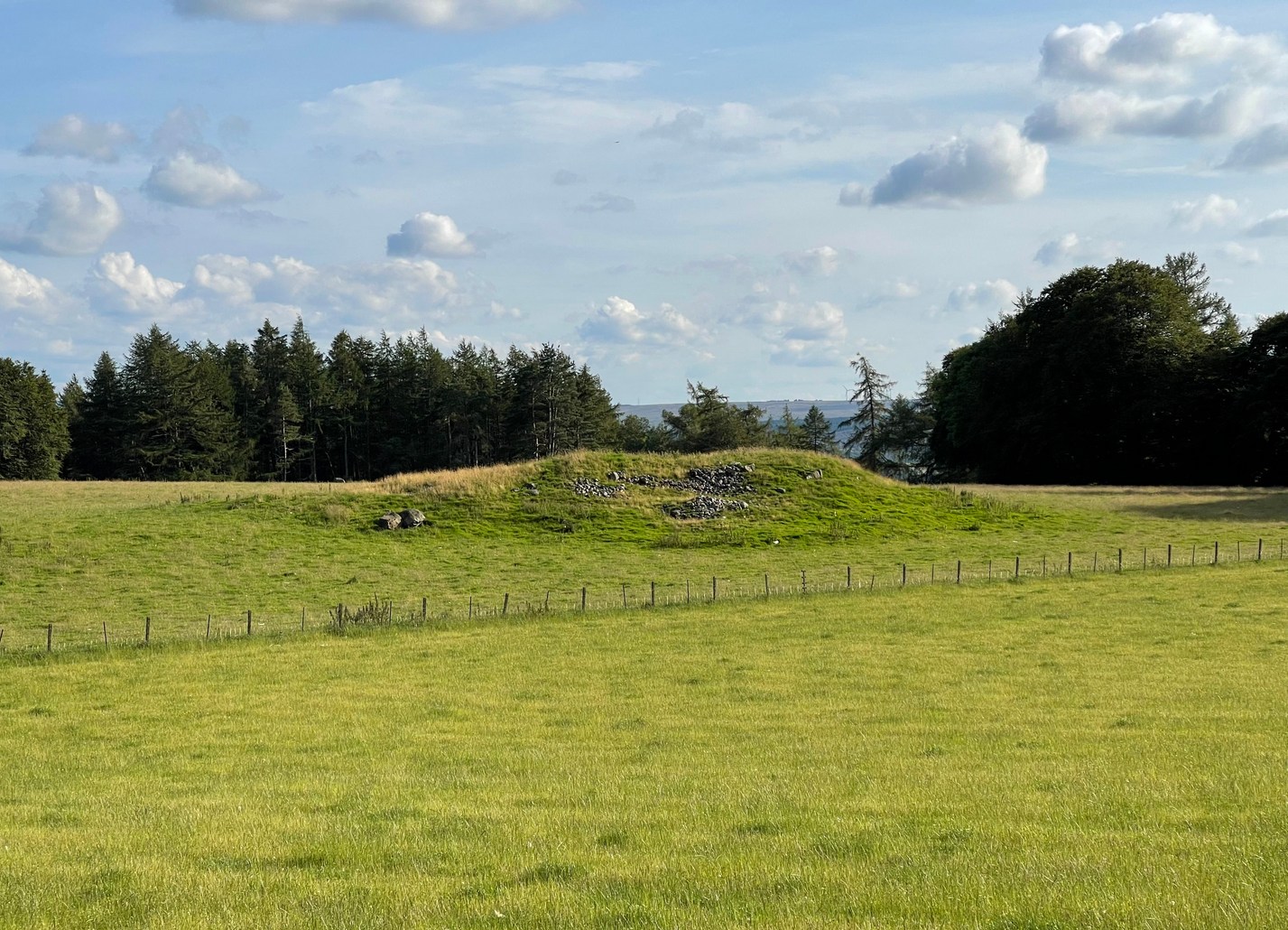
You need to hit the village of Fowlis Wester, which is easiest to approach from both east and west along the A85, between Crieff and Perth: nearly 3 miles east of Gilmerton and about 6½ mile west of Methven. Keep your eyes peeled and take the road up (north) where the large rounded tree-covered tumulus stands and up to the village. Go through the village and uphill for literally ½ a mile (veering sharp left at a junction) where a gate on your right leads into the fields. (a large parking spot is 300 yards further uphill) Walk ¼-mile east and through the other side of the small woodland, over the fence, you’ll see the mound of a typical tumulus. That’s it!
Archaeology & History
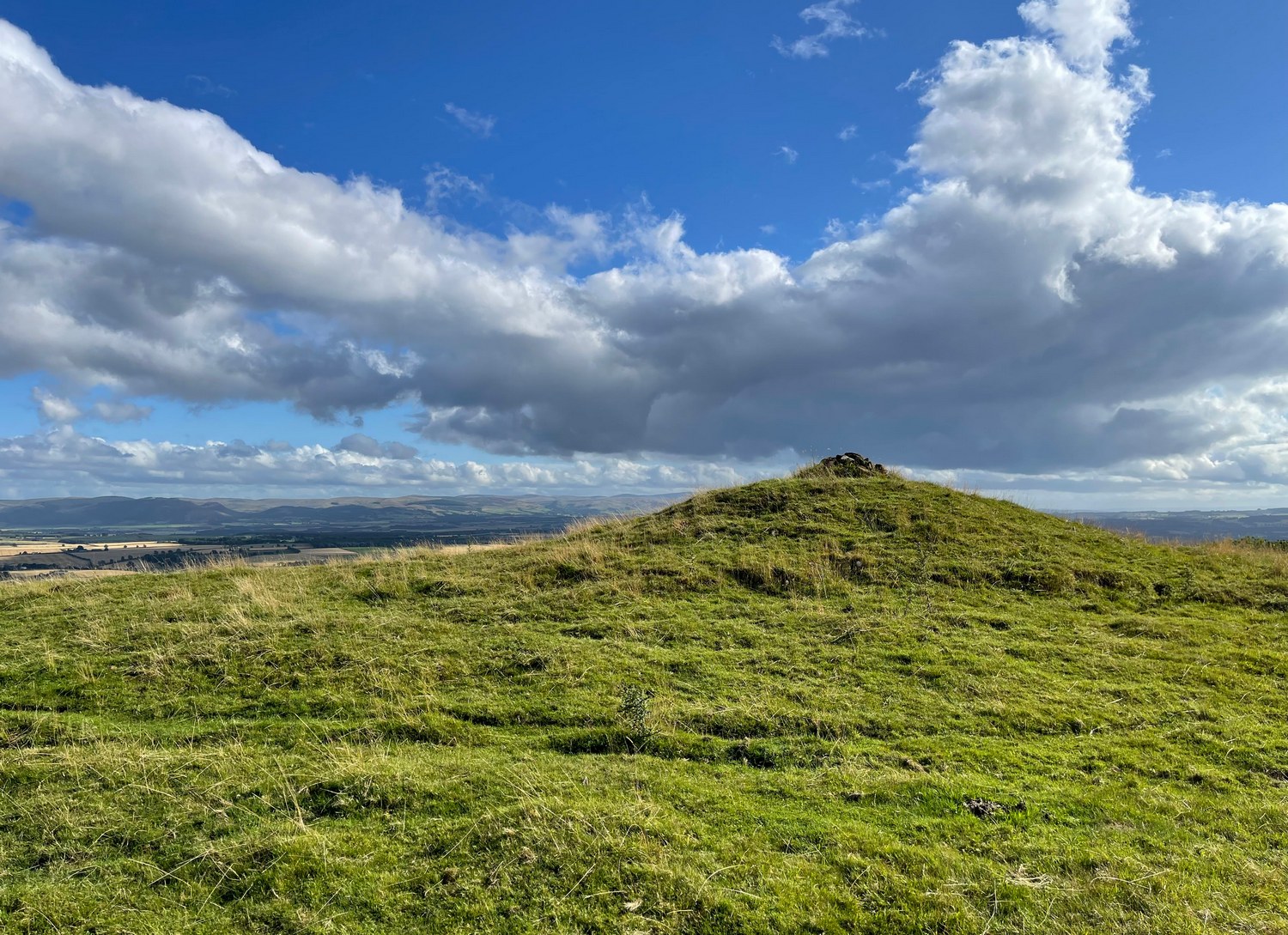
If you’re going to visit the megalithic remains of Fowlis Wester ¾-miles to the west, the antiquarians amongst you might as well give this old burial mound your attention too. It’s not grandiose by any means, but its position in the landscape is quite superb. It’s built upon a long geological promontory with extensive views that reach from south-east to south to south-west for many miles into the distance with the Ochils framing the majority of the southern horizon, but also with the notable pap of the West Lomond hill 20 miles to the south-east mimicking the shape of the tomb itself. It was obviously built here with the extended landscape having some ancestral importance. Visit it and see for yourself!
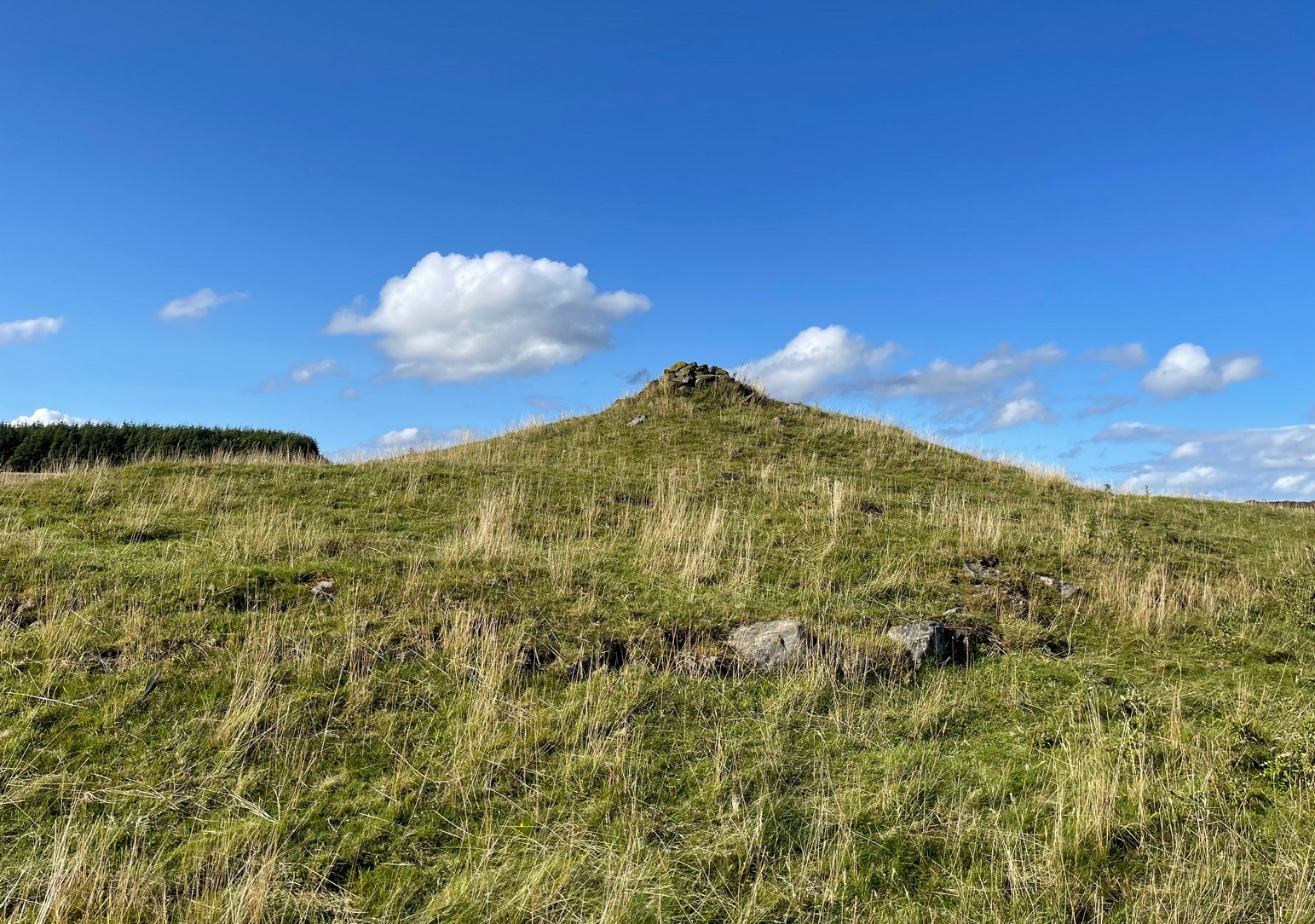
Despite being a notable mound, this tumulus-cum-cairn only seems to have been written about for the first time as recently as 1998, when archaeologist Ian Armit visited the site. Roughly circular in form, it’s about 12 yards across and more than six feet in height. A small pile of stones crowns the very top, placed here in much more recent times. At ground level on its northern side, an arc of low lying stones define the edge of the tomb. The stones probably continue all the way round the entire structure, but it’s overgrown by centuries of soil and vegetation and we lose sight of it as we walk round. When Mr Armit (1998) wrote about the site, he and colleague wrote:
Seat Knowe, looking NWSeat Knowe, looking north
“A grassed-over stony cairn lies on the highest point of Seat Knowe, a ridge commanding extensive views to the south. The cairn has a diameter of c.10m and is up to 2m high. A modern cairn occupies it summit. The low turf foundations of a rectilinear structure, some 6 x 8m, occupy its south flank, and thee are extensive cultivation and field system remains in the vicinity.”
Check it out! You won’t be disappointed.
Folklore
An interesting piece of relatively recent folklore about Seat Knowe, described in the Perthshire Name Book around 1862, told that,
“One of the Earls of Strathearn, desirous of having a church in the vicinity of his Castle, stood on an eminence, on which he had a summer seat, and resolved to erect it where the sun first shone, which was on the spot where it now stands.”
References:
Armit, Ian & Hall, M., “Seat Knowe (Fowlis Wester parish): Cairn,” in Discovery & Excavation Scotland, 1998.
It’s a helluva zigzag to get here. Just out of Crieff along the A85 road to Comrie, turn right up the minor road to Hosh and Glenturret Distillery. Just past the distillery, over the small river bridge, turn left and go up the tiny road for literally ⅔-mile (1.1km) and park up just before the cattle-grid. Naathen, up the slope into the trees at a diagonal behind where you’re parked, walk up and up for half-a-mile where the land levels out and you reach a gate (and my bath, in the undergrowth to your right). A track goes up above the gate (not the one through it) and bends round where, 100 yards up, you reach a gate. Go over it and look at one of the stones in front of you!
Archaeology & History
Very faint cups
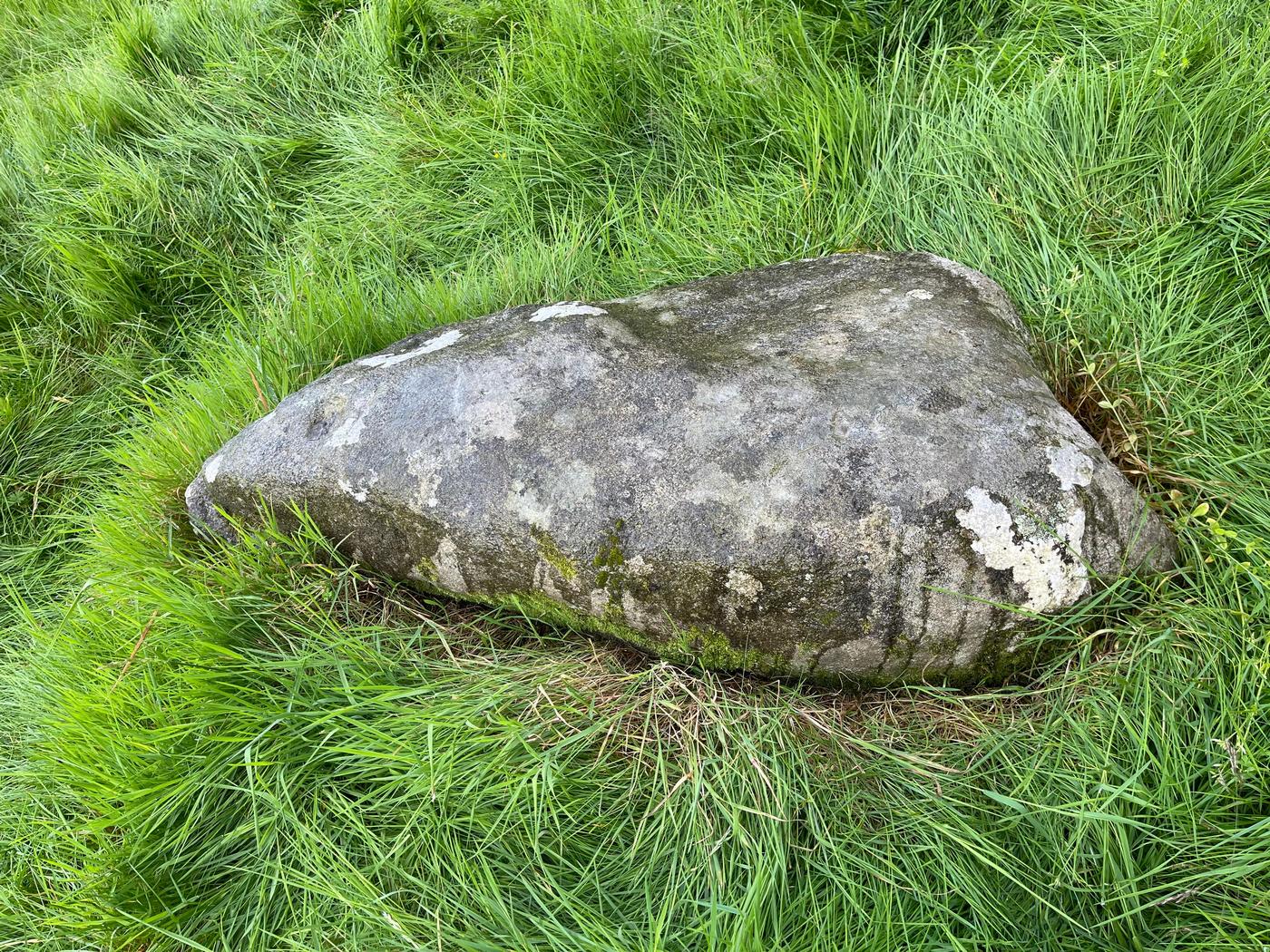
This is another one of those petroglyphs that only the purists amongst you will want to see. On the lower section of this typically smooth female stone, you’ll see a singular cup-mark, half-natural half-carved, a couple of inches across, with a less discernible cup-mark of similar dimensions further up the rock, but entirely man-made. When we visited here yesterday, the shadows of the trees above made it very difficult to get any decent photos of the cups. Give it your eye on the journey up to the impressive standing stone of Stonefield a few hundred yards further up the hill; and if you manage to get any good photos, stick ’em on our Facebook group.
Cup-Marked Stone: OS Grid Reference – NN 8515 2484
Archaeology & History
Site of supposed cupmark
There’s little to see here. In the 1990s, students from the Royal Commission found what they described as “a single cupmark”, 3 inches across by 1 inch deep, on a rock measuring 2-feet by 1½ feet, on the north side of this large (seemingly) natural mound with large scatters of field clearance stones all over its northern face. When I visited the place yesterday (on my way to see the impressive Stonefield monolith 260 yards to the north-east), I zigzagged back and forth over the rocky mound and was unable to find it, although it may have been beneath the summer vegetation. A winter visit may prove more fruitful.
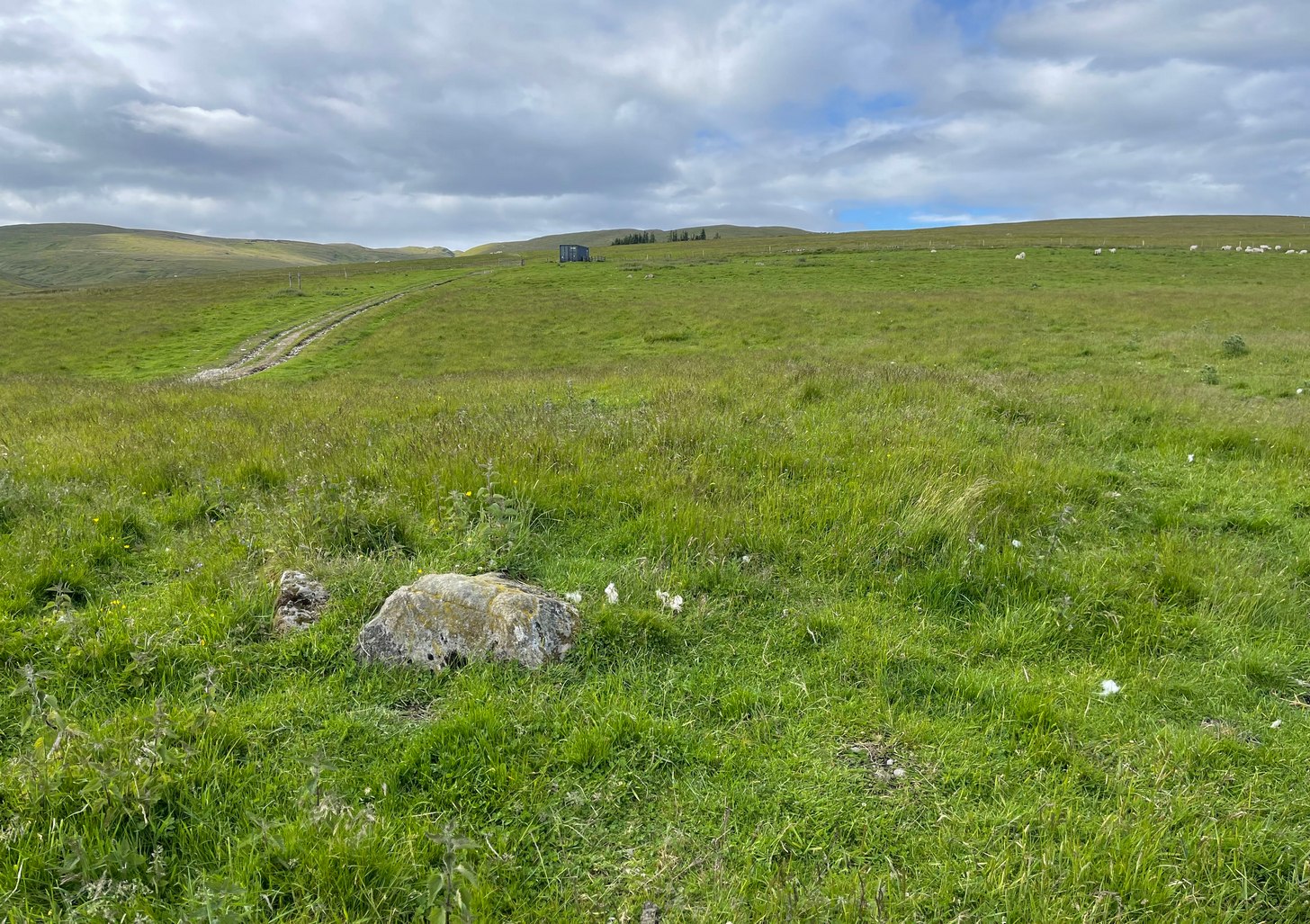
You’re going from Crieff, up the A822 road from the Gilmerton junction and head up towards the Sma’ Glen. And if you’re visiting this stone, you’ve already walked past the carvings of Connachan (2), (4), (5) and (6). So just another 100 yards or so up the dirt-track past Connachan (4), (5) and (6), just where there’s a bend in the track, the land just about levels out (if you’ve reached the gate and fence you’ve gone too far). At this point walk onto the grassland on your right for barely 50 yards, just where the land sweeps back downhill. Look around for a small stone at the edge of some very low indistinct walling. You’ll find it!
Archaeology & History
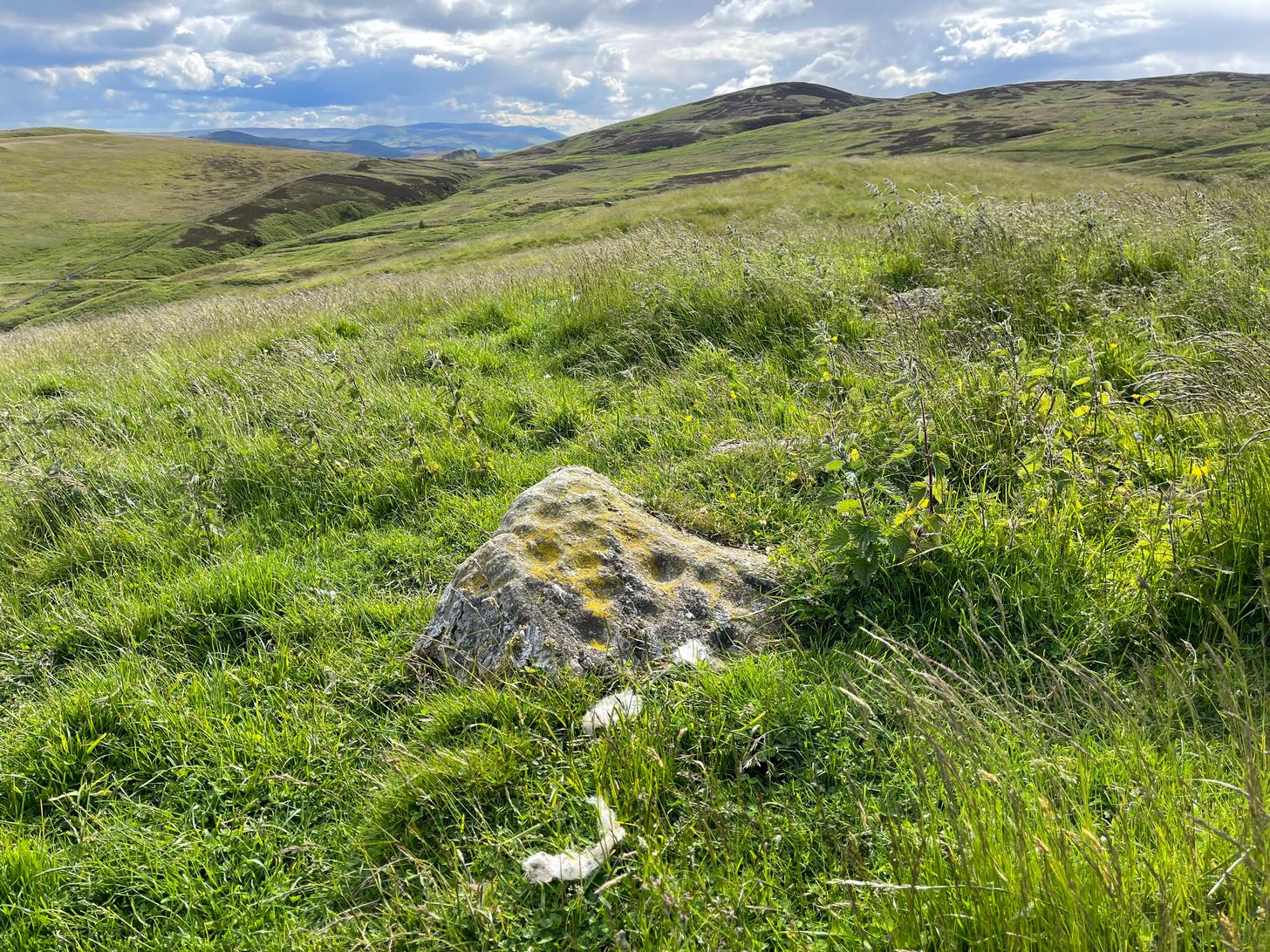
Cluster of cups
A site that’s shown on the modern OS-map as a “cairn” but which is, by the look of things, actually a hut circle — and a somewhat indistinct hut circle at that! You could very easily walk right through it without even noticing you’d done so. However, the cup-marked stone on the outer edge of its southern wall does grab your attention! Once you’ve found the stone, if you pace round a few times you’ll begin to see the vague outline of this prehistoric, probably Bronze Age abode.
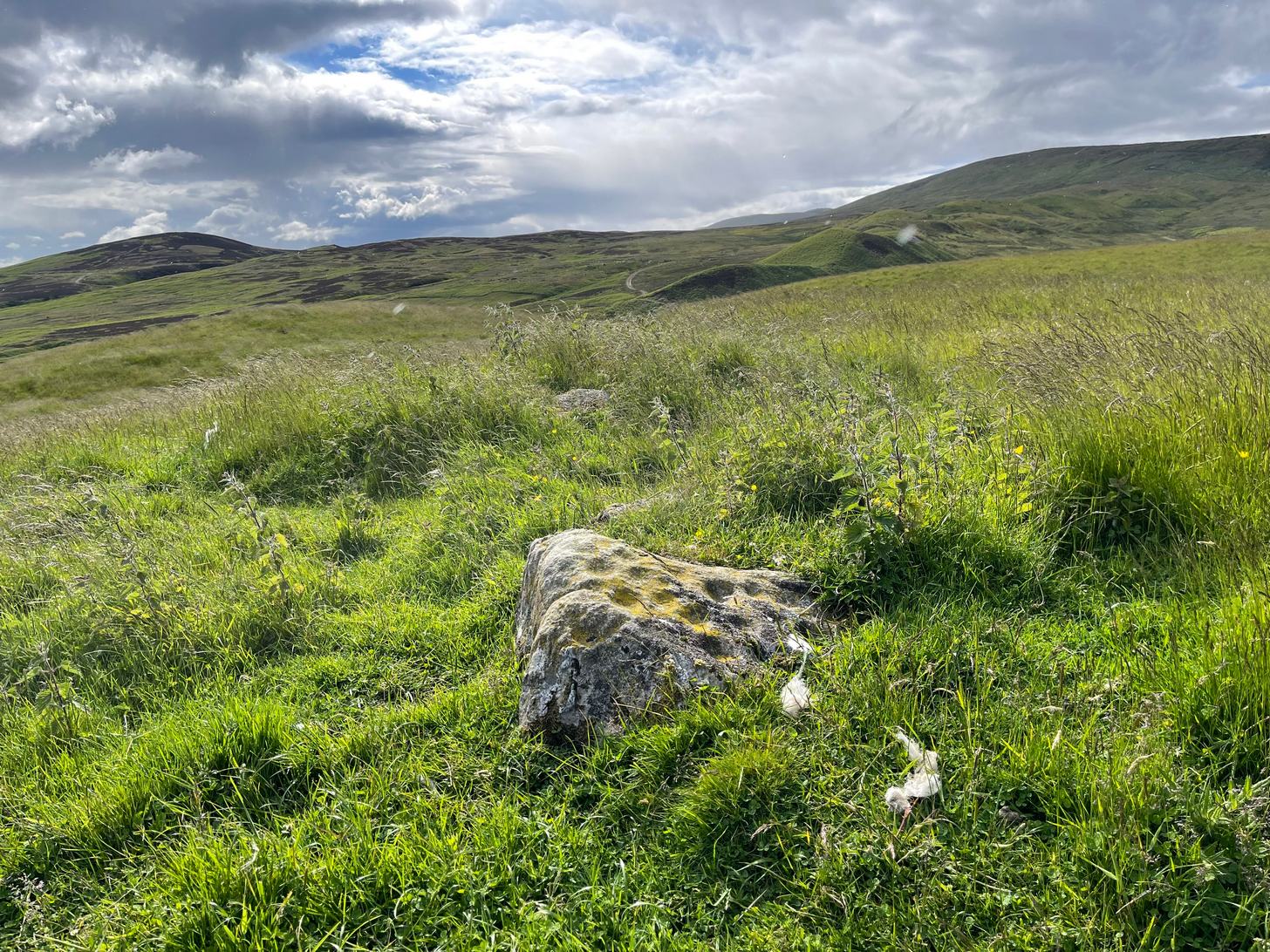
at a slightly different angle
The carving was probably placed here after the hut circle had been built; or perhaps even built deliberately upon the petroglyph itself—but only an excavation would give us the answer. Its incorporation in the hut circle was probably functional, somewhat like the Man Stone carving in North Yorkshire, which is found at the doorway there. But this site is in such a state of neglect (and is somewhat overgrown) that I couldn’t ascertain whether it was at the entrance or not. If it was, then most likely there was a mythic relationship between the design of the cups and the person who lived therein. This relationship was probably a long standing traditional one attached to a particular family, or tribal leader, or even a shaman figure which no doubt stretched over many centuries. (as seems likely with the aforementioned Man Stone)
The carving itself is somewhat basic, as you can see, comprising of a small irregular cluster of between 18 and 20 tightly packed cups on a small stone. The hut circle is about 14 yards across. About 100 yards to the east is a severely robbed-out cairn.
References:
Stewart, Margaret E.C., “Connachan, Crieff – Cup Marks and Hut Circle,” in Discovery & Excavation, Scotland, 1967.
Tumulus (destroyed): OS Grid Reference – SE 6803 8695
Also Known as:
Robin Hood’s Howl
Archaeology & History
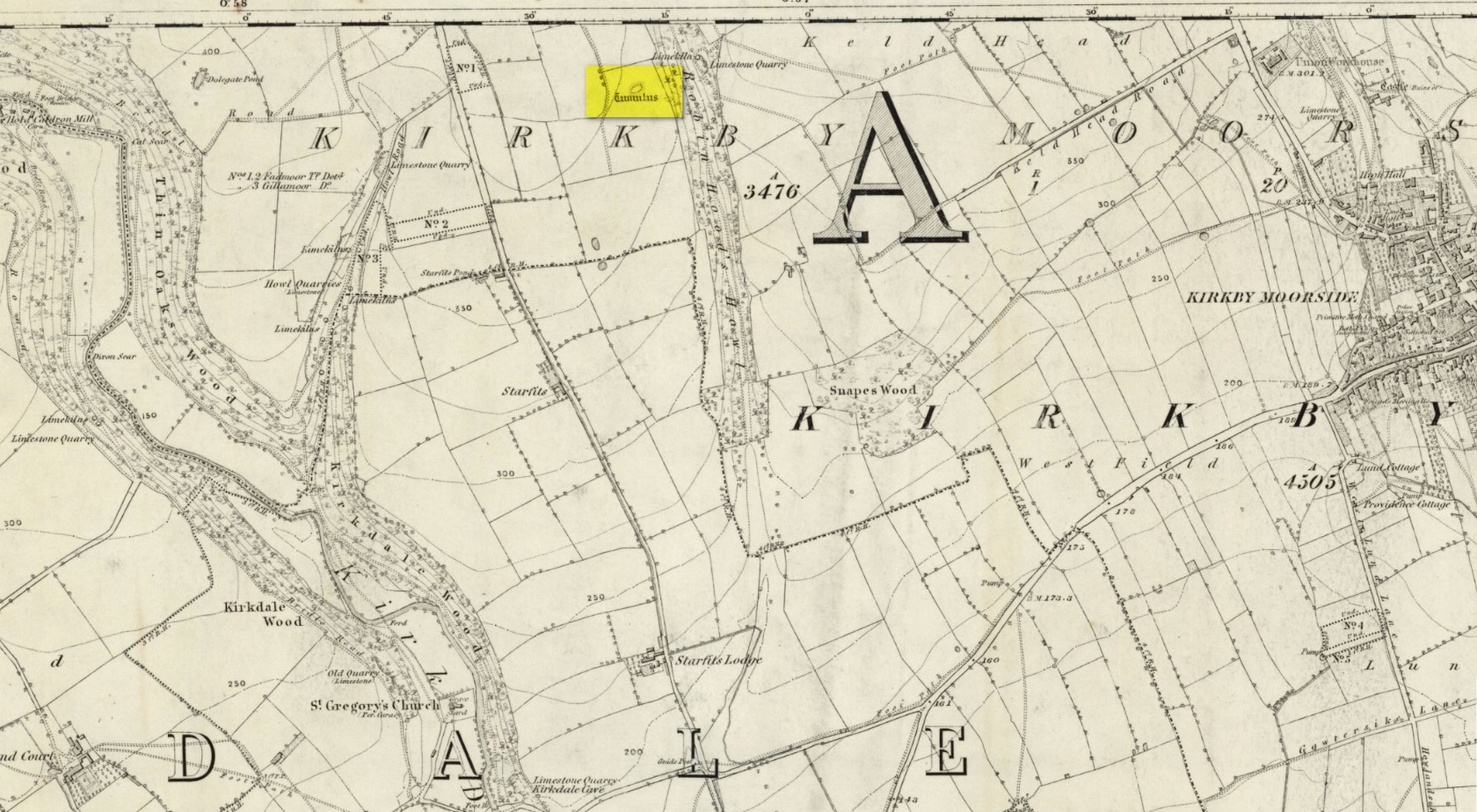
Site on the 1856 OS-map
There once stood a very impressive prehistoric burial mound here, a few hundred yards east of the roadside, just above the wooded valley known curiously as Robin Hood’s Howl. Highlighted on the 1856 Ordnance Survey map as an elongated structure, it was suggested in McDonnell’s (1963) work to have been a long barrow, measuring roughly 70 feet long by 50 feet across and more than six feet in height. It was seemingly written about for the first time by William Eastmead (1824) in his lengthy history of the area and was, he told,
“a tumulus of considerable dimensions (that) was lately opened at a place called the Hag, about a mile northwest of Kirkby-Moorside, in which was found an urn… Great numbers of human bones were also dug out…; and from the immense size of it, a great number of bodies appear to have been burnt indiscriminately, and the ashes of some particular person deposited in the urn.”
The urn would seem to have been either lost or destroyed—as has the tumulus. It was apparently still intact, albeit very denuded, twenty years ago, but has since been ploughed out.
References:
Eastmead, William, Historia Rievallensis: containing the history of Kirkby Moorside, R. Peat: Thirsk 1824.
McDonnell, J. (ed.), History of Helmsley, Rievaulx and District, Stonegate: York 1963.
Acknowledgements:Huge thanks for use of the Ordnance Survey map in this site profile, reproduced with the kind permission of the National Library of Scotland.
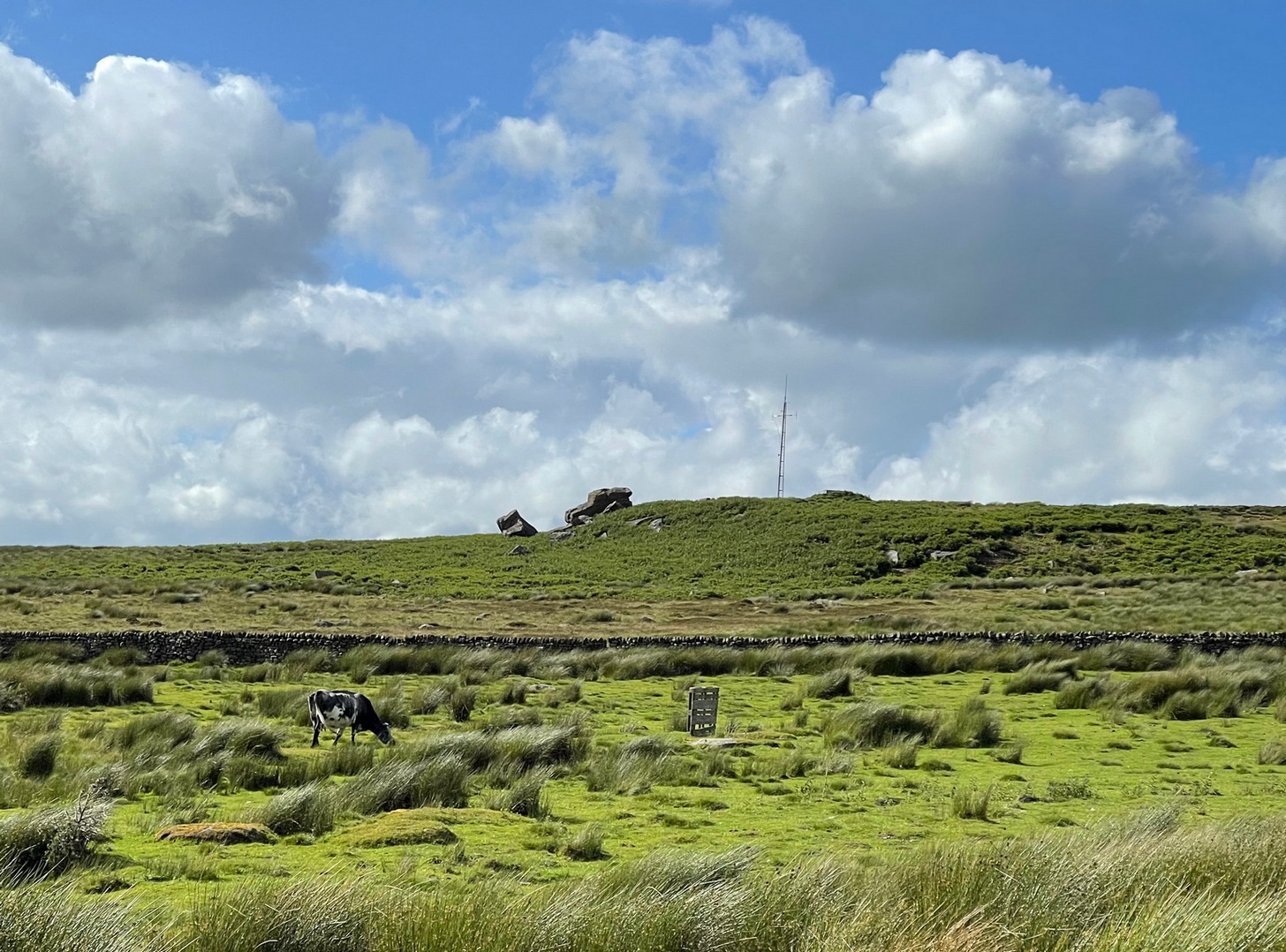
The easiest way to get reach here is via the Doubler Stones, which is usually approached either from the long and winding country lanes Silsden-side (you can’t drive all the way and there are hardly any parking spots en route), or from a long walk over the moors. Taking the latter route, probably the easiest is by starting at Whetstone Gate right on the moortop, on the Ilkley-Keighley road. From here, walk west along the footpath by the wallside for more than ½-mile until you reach the West Buckstones. From here, take the footpath NW (not SW) alongside the walling for literally one mile, where a notable angular skewing of three walls appears: keep to the left and walk alongside that wall for another ⅓-mile (0.5km) then climb over the wall and head straight for the small TV mast. The Giant’s Chair’s just below it.
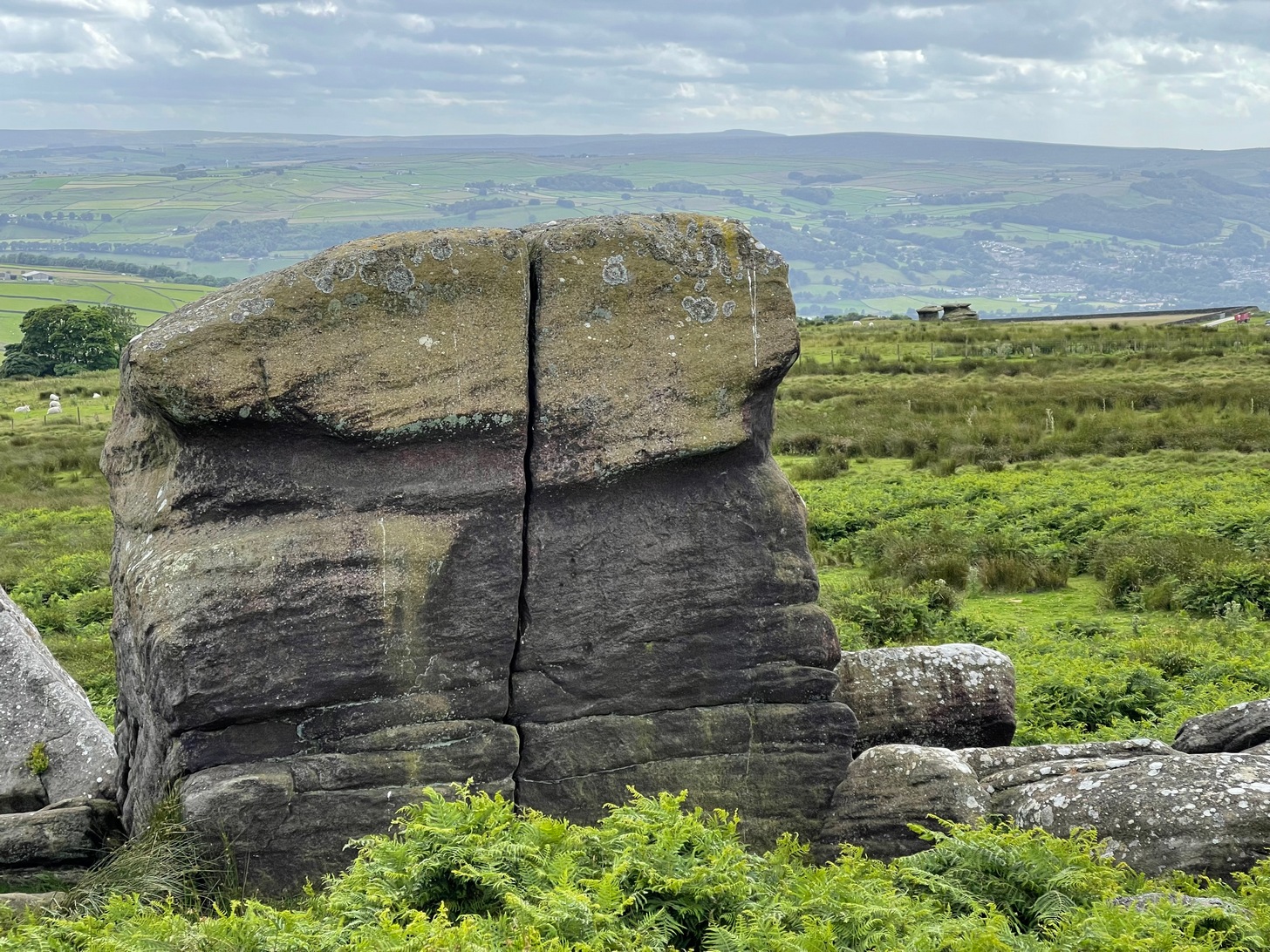
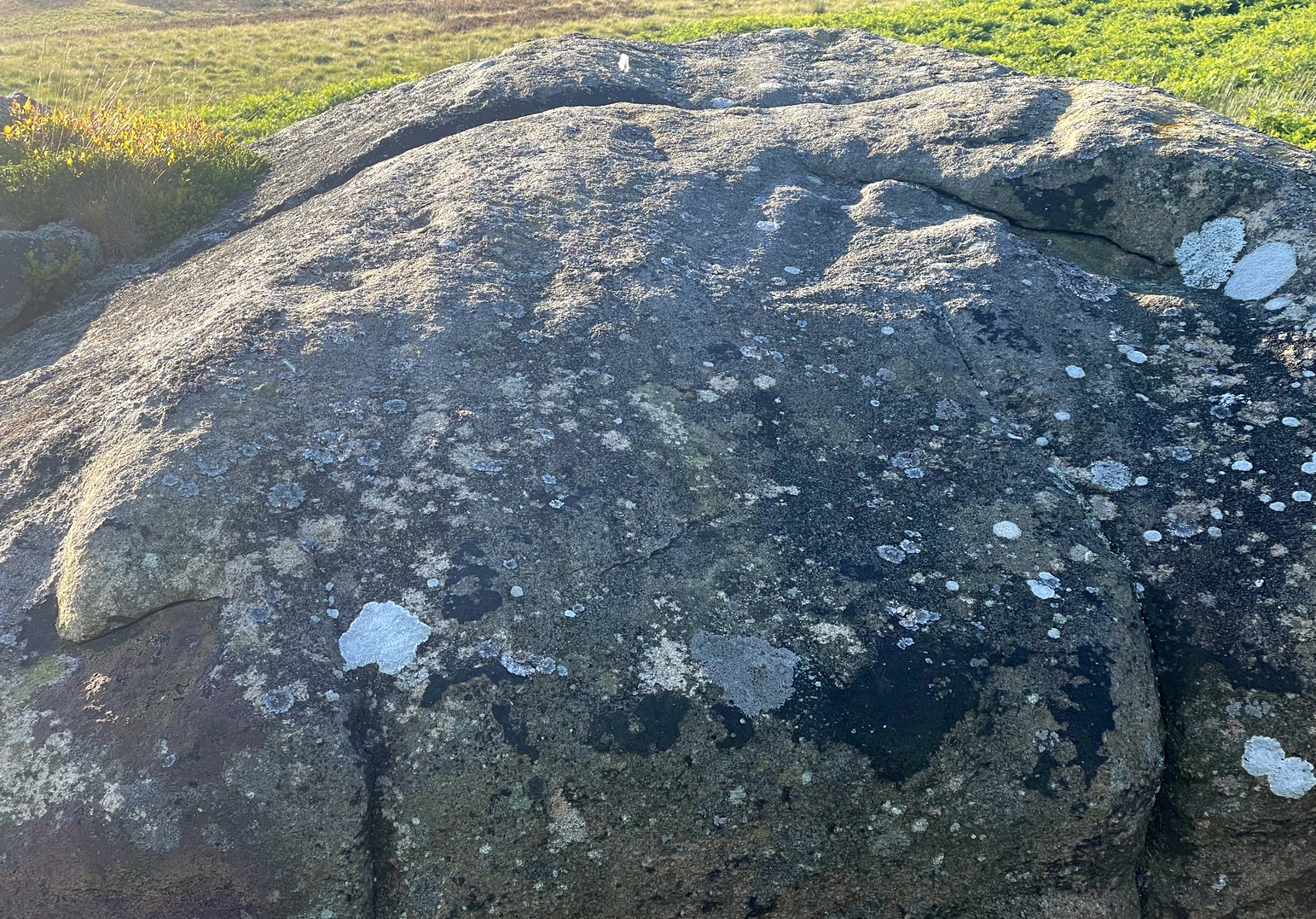
Some time in the mid- to late-1970s, on one of our early ventures to see the legendary Doubler Stones, this great rock outcrop of the Giant’s Chair also, understandably, drew our attention. And, as young fertile teenage lads, we all but flew up onto the top of this great rocky rise with relative ease. Now, nearly fifty years later, I’m unable to climb onto its top without ropes. (sigh….) It’s not easy. Anyhow, when we were on top of this rock as kids, a number of notable cup-markings stood out to us—in no distinct order, as I recall. But on the day of our clambering visit, She was grey and overcast; as She was on the two or three other visits we made to the stone, sitting on its top, fondling the cup-marks and eating our sarnies. All that I ever noticed were the cup-markings.
A few years after my early visits here, John Hedges (1986) wrote about this “very large high rock.” He mentioneed the cup-markings, obviously, but he also mentioned some things that we’d missed, saying that here are,
“Six large shallow worn cups, one with (a) partial ring and another with possible ring. One cup on SW end.”
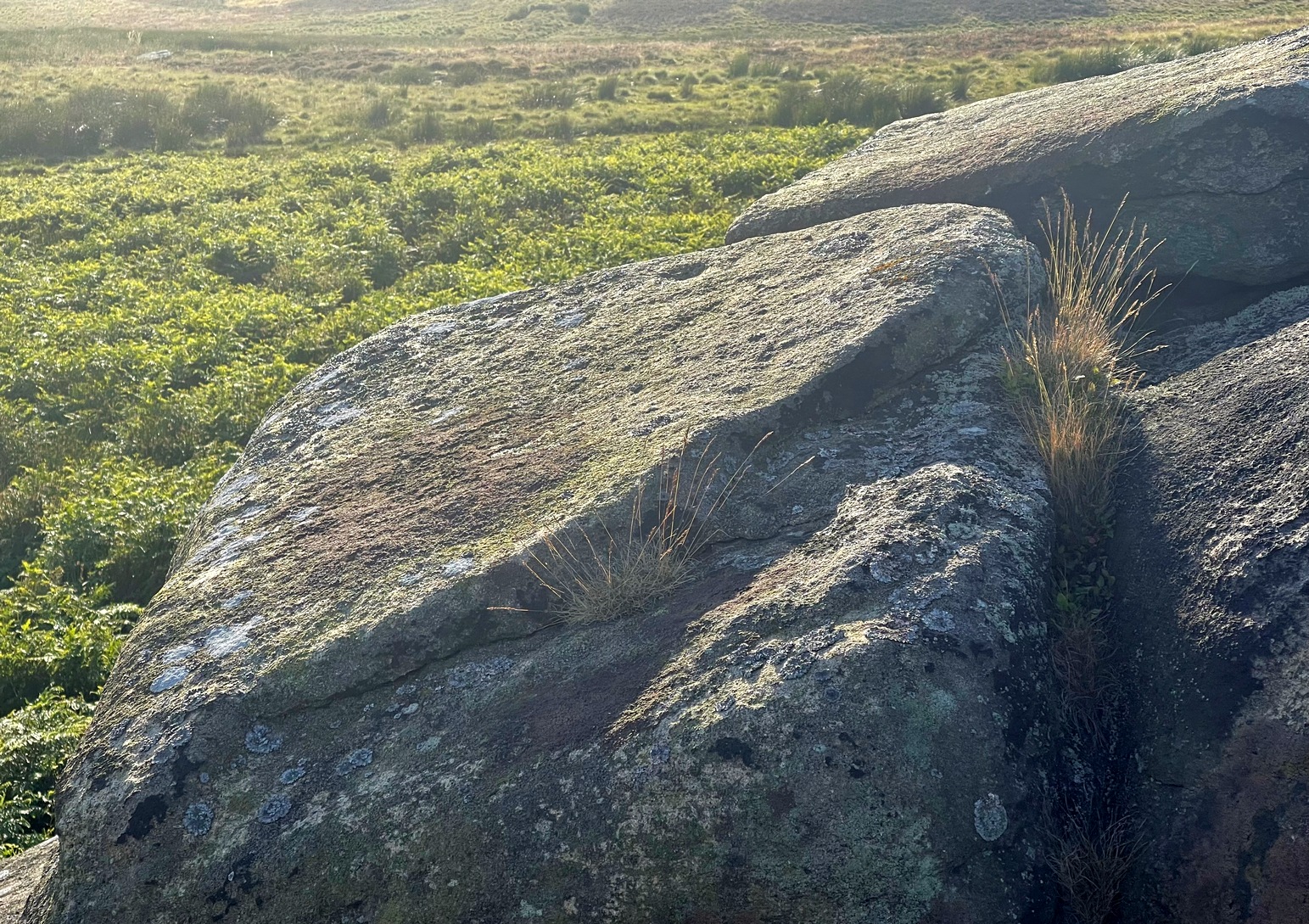
Single cup-mark (?)One of the cup-and-rings (?), top-left
Sadly, I’ve never seen these rings and, these days, my ageing bones might not allow me back onto its surface to see them. (the expression, “sad bastard” comes to mind!) On a recent visit here with Sarah Walker of Silsden, neither of us could get our useless arses on top! (the photos taken here were done with me stood on top of an adjacent rock, hands held high, trying to get at least some elements of the carving—with a minor bit of success, I think) I take comfort in the fact that when Boughey & Vickerman (2003) subsequently added this carving in their enlarged inventory, that they never got to see them either, as they gave it the completely wrong grid-reference! And so, due to the ineptitude of us old folk, I await some younger and more competent explorers who can climb up on top and send us some good photos of the design, when weather and lighting conditions allow for good imagery. Are there any takers…?
References:
Boughey, Keith & Vickerman, E.A., Prehistoric Rock Art of the West Riding, WYAS: Wakefield 2003.
Deacon, Vivien, The Rock Art Landscapes of Rombalds Moor, West Yorkshire, ArchaeoPress: Oxford 2020.
Hedges, John (ed.), The Carved Rocks on Rombalds Moor, WYMCC: Wakefield 1986.
Acknowledgements: Big thanks to Sarah Walker for helping, albeit unsuccessfully, to scale this old rock to see the cup-and-rings on my last visit here. At least we tried…
Cup-Marked Stone (missing): OS Grid Reference – ND 04321 56794
Archaeology & History
When Alastair MacLaren (1955) first excavated an Iron Age hut circle just above the northern edge of Loch Shurrery, he found, “from the tumble of the wall came a cup marked stone.” It emerged from southwestern side of this habitation site, on a small portable-sized stone, and consisted of just a single distinct cup-mark. When the site came to be re-examined many years later, it had gone. MacLaren was of the opinion that the stone had merely “served as core material and was of no other significance to the builders of the hut circle than just a handy bit of rubble to fill the space between the inner and outer faces.” This may have been the case; although it may have originally been carried from one of the many chambered cairns in the region.
Maypole (destroyed): OS Grid Reference – SU 655 781
Archaeology & History
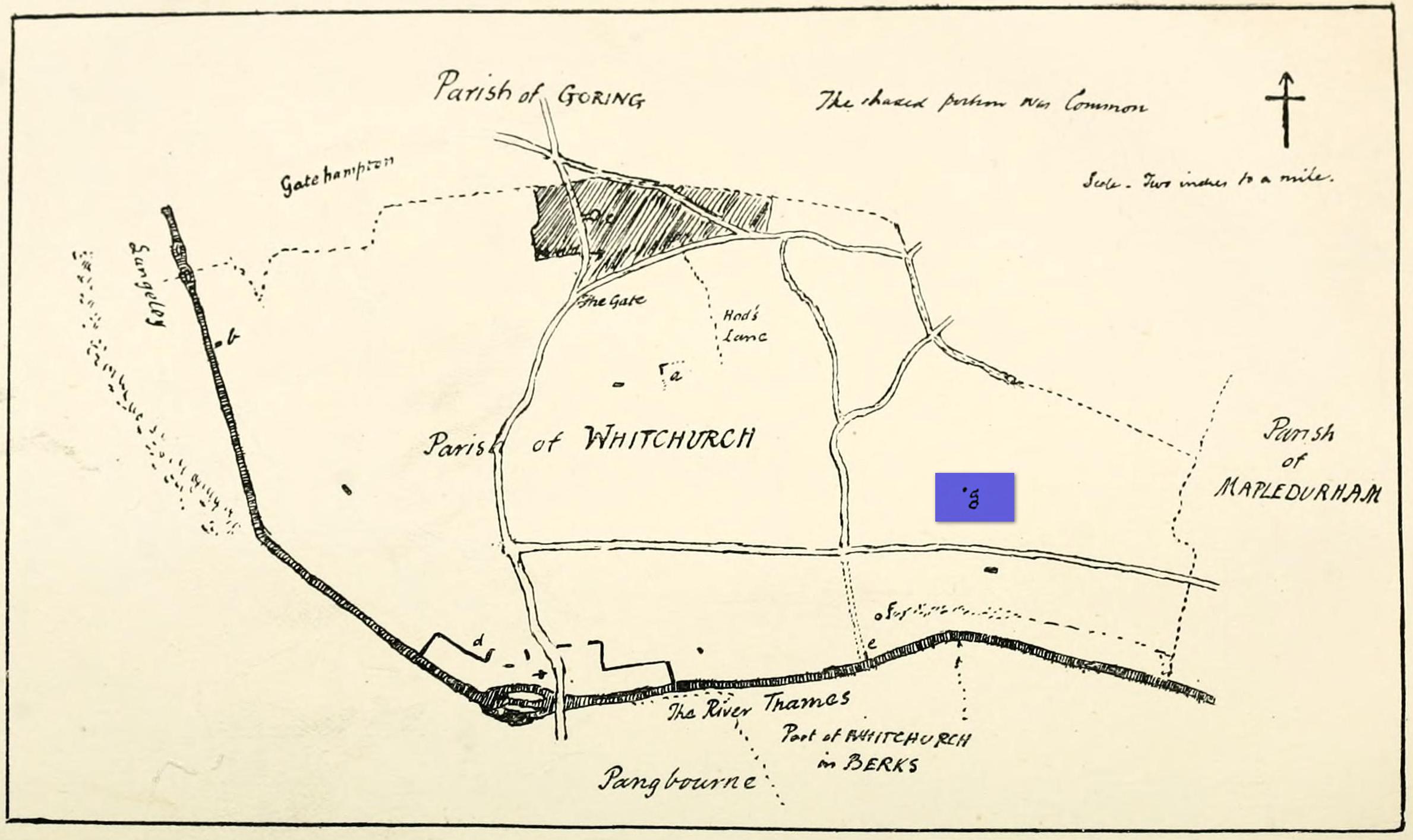
“g” marks the spot!
Very little is known about the history surrounding Whitchurch’s maypole that once stood more than a mile east of the village, somewhere in the woods immediately south of the present-day cannabis-growing Hempem Organics. (damn those hippies!) Mentioned in the Enclosure Acts of 1806 and 1813 as the “May Pole Ground”, the monument was mentioned in the Rev. John Slatter’s (1895) local history work and its approximate location was shown on a hand-drawn map he did of the area, in the grounds north of Hardwick House. He told us that it stood on “an elevated site” and conjectured that it might once have been a place of druidical worship!
“In the centre of the Hardwick property is a plot of ground called the Maypole Piece…. It is an open space, with a tree standing alone, where we may suppose the maypole formerly stood. There is a memorandum made by the last Mrs. Lybbe (nee Isabella Twysden) to this effect:
1713: A maypole set up on ye hill in ye straight way to Collinsend.”
In the event that you manage to discover anything else about the history of this maypole, let us know on our Facebook group.
References:
Gelling, Margaret, The Place-Names of Oxfordshire – volume 1, Cambridge University Press 1953.
Slattter, John, Notes on the History of the Parish of Whitchurch, Elliot Stock: London 1895.
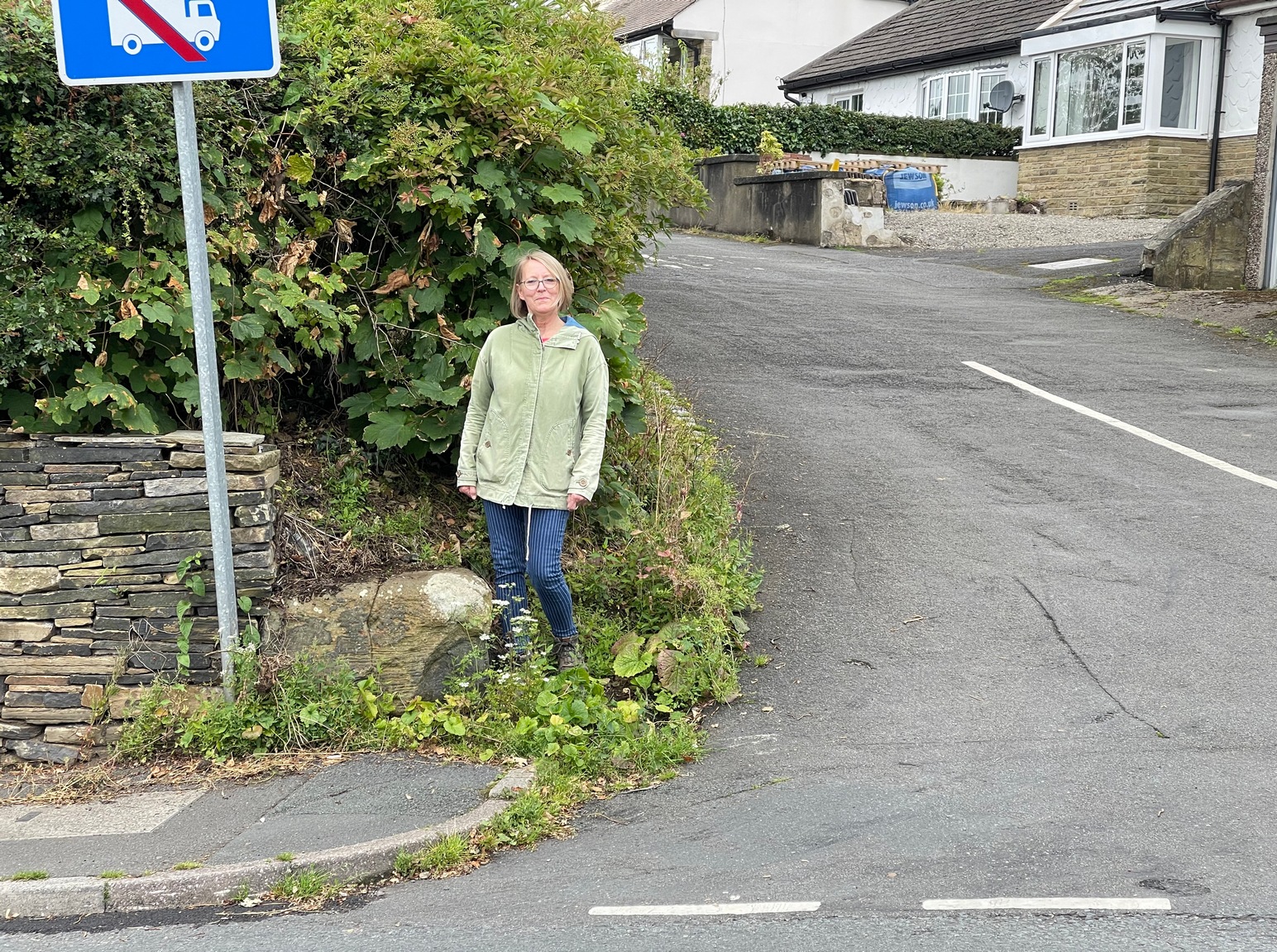
Nice ‘n easy: from Huddersfield central, take the A641 road north to Brighouse, but barely a half-mile out of town turn left up the Halifax Old Road. Go on here for nearly a mile, then keep your eyes peeled for the aptly-named South Cross Road on your right. Go up here all the way to the end where it meets with Cowcliffe Hill Road. Here, at the junction, right by the roadside at the edge of the wall, is the remains of the old cross-base, all but covered in vegetation. You’ll see it.
Archaeology & History
The little-known remains of a post-medieval cross base can still be seen, albeit very overgrown, right by the roadside. The upstanding stone cross that once stood upon it has long since gone (perhaps broken up and built into the wall). It may have been one of two such crosses relatively close to each other: as this one is found at South Cross Road, there may have been another one at the nearby North Cross Road, but history seems to be silent on the matter.
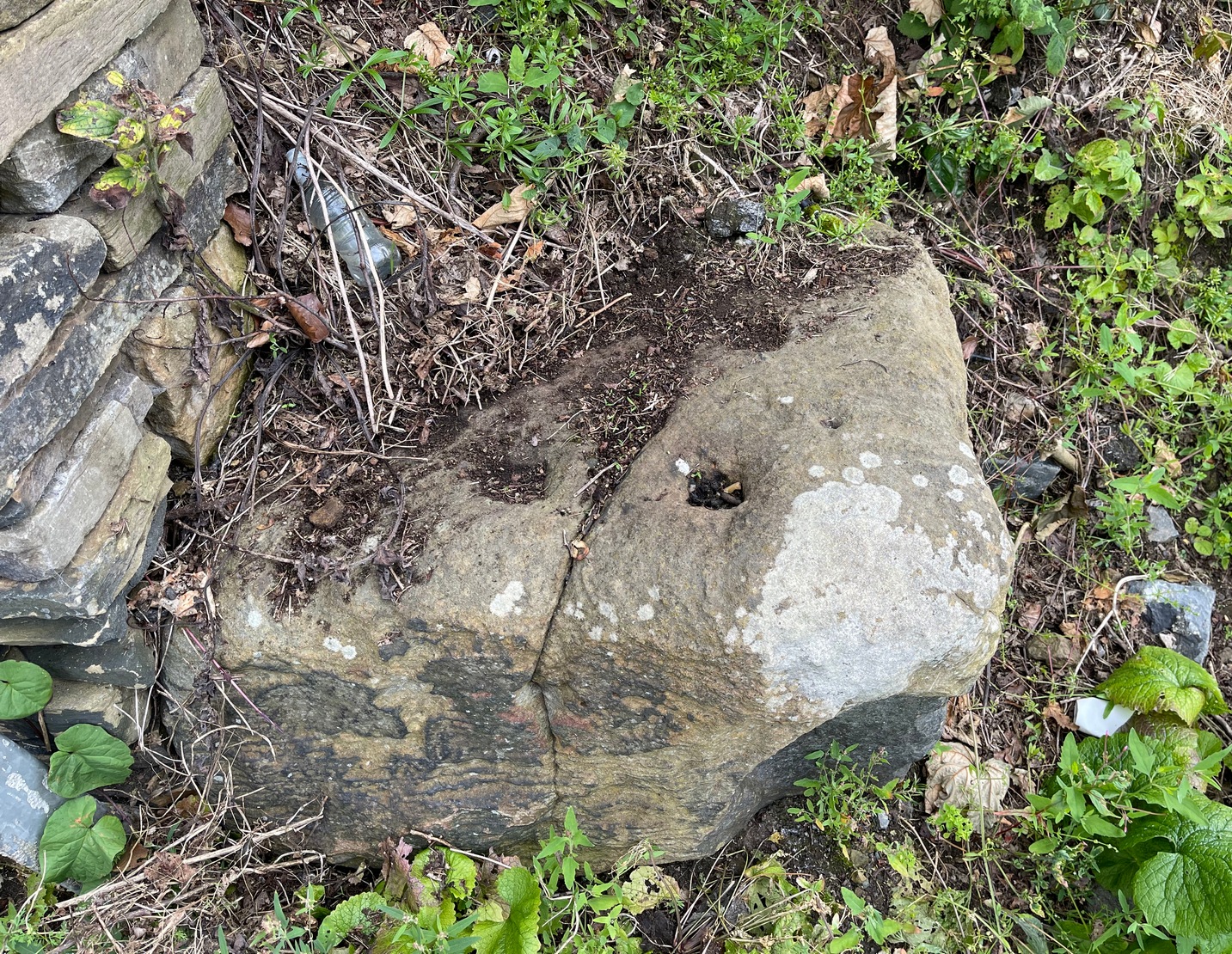
Top of the cross-base
The cross-base itself has several holes cut into it where the standing stone cross was fixed upright. Very little seems to be known about this monument. George Redmonds (2008) told simply that, “the base of a cross survives on Cowcliffe Hill Road, no doubt marking the ancient crossroads. It explains the names North and South Cross Roads.” He added that, “The base of the cross survives, partly hidden in the undergrowth, and it is the only visible evidence we have of several similar crosses in the township.”
References:
Redmonds, George, Place-Names of Huddersfield, GR Books: Huddersfield 2008.
Acknowledgements: Huge thanks to Liz Sykes for helping out big-time to uncover the base from beneath the mass of herbage.
Take the Wells Road from Ilkley centre up towards White Wells, bending to the right as you hit the edge of the moor. Keep along the road, past the old college building with its lake and turn right up Westwood Drive. Keep going all the way up (it becomes Panorama Drive) till you hit the small woodland on your right. Where the woodland ends – stop! Walk into the trees about 10-15 yards and you’ll see the large rocks ahead of you. Brush back the vegetation and you’ll find it.
Archaeology & History
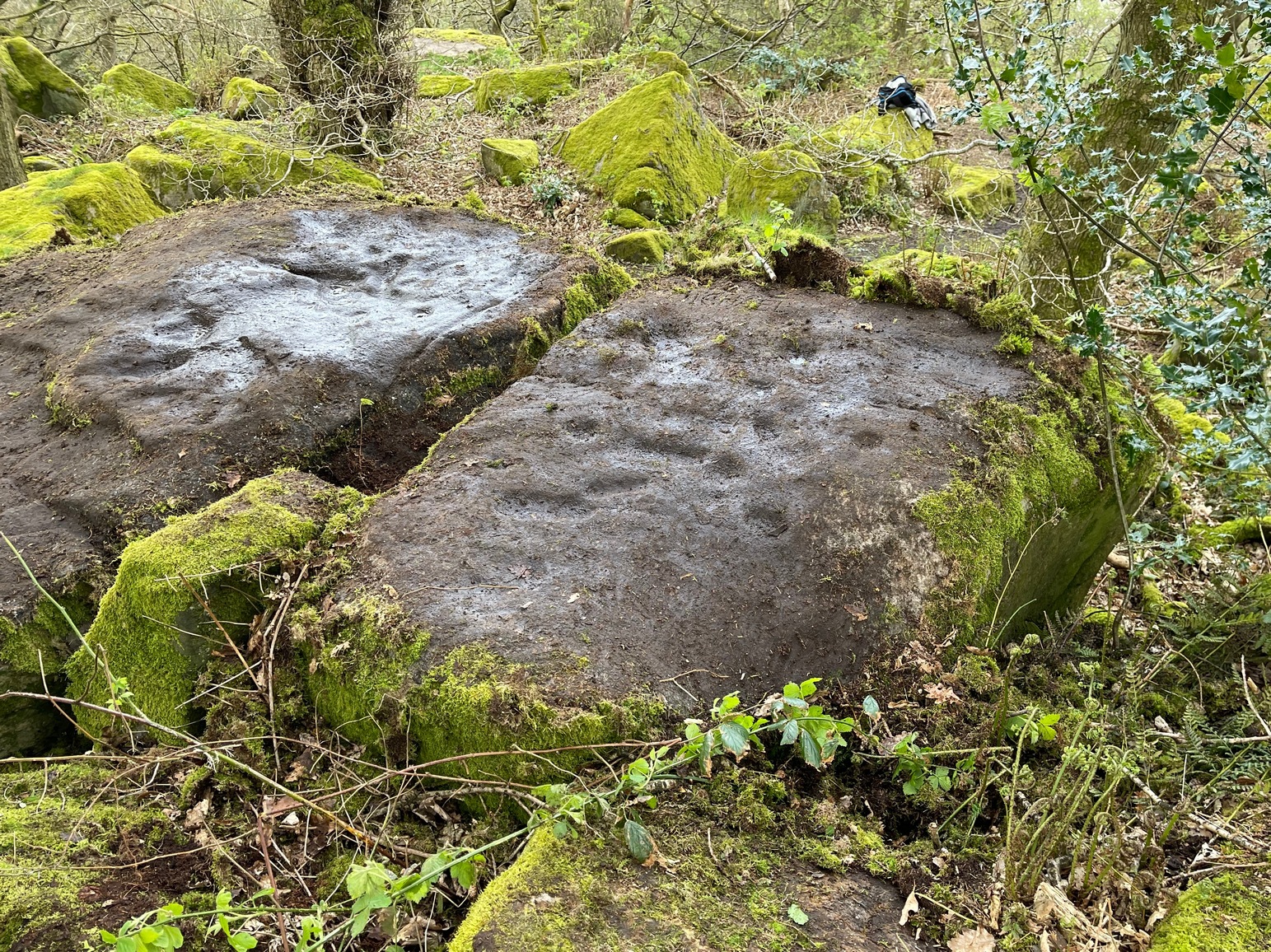
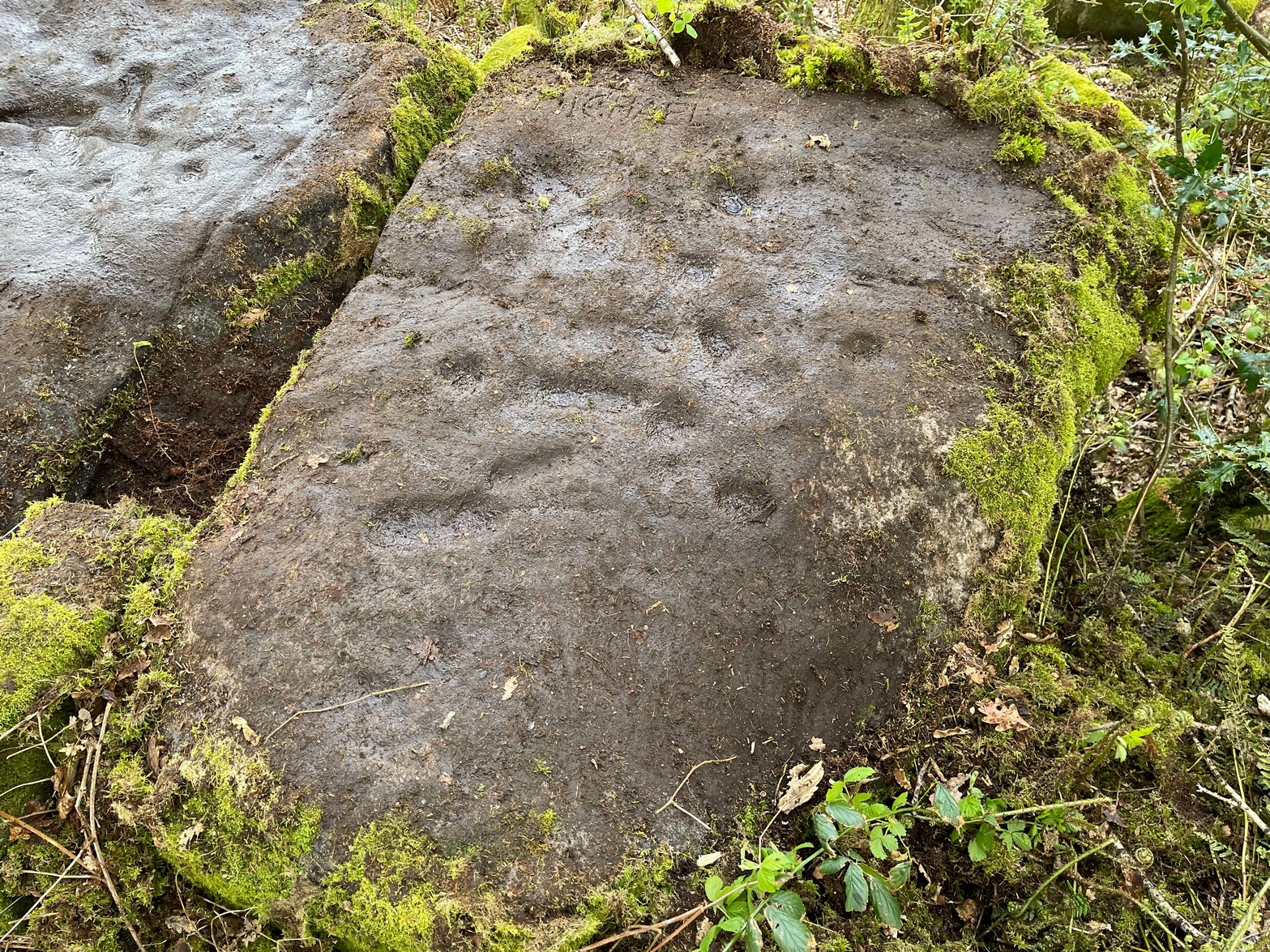
This large flat rock surface has a scattering of archetypal deep cup-markings, with other fainter marks scattered over most of its surface. It sits right next to carving no.232, with its own equally large, naturally worn basins.
Faint cup&ring just visible
It was visited in the 1870s (along with the other Panorama Stones) and subsequently illustrated in the personal sketch-pad of Mr Thorton Dale (we’re hoping to have them scanned in due course for open Creative Commons use) who showed the basic cup-marks and shaped “lines” or footsteps that give this petroglyph its name. Little more was said of it until Hedges (1986) described it in his survey, whose notes were subsequently repeated in Boughey & Vickerman’s (2003) work as being a “medium-sized flat-topped, upstanding rectangular rock. Eight cups, six deep ovals, faint circles and lines on SW end.” One of the most notable cup-and-rings can just be made out near the middle of the stone, on the left-side of one the footprints.
The depth of these incisions in this design strongly suggests that the carving was worked and reworked over many centuries, suggesting utilitarian usage of some kind, be it ceremonial or otherwise. It’s also very unusual inasmuch as elongated footstep-like cuttings are scarcities, not just in Yorkshire petroglyphs, but in prehistoric carvings across Britain. Check it out when you’re next walking up to the Swastika Stone.
References:
Bennett, Paul, The Panorama Stones, Ilkley, TNA: Yorkshire 2012.
Boughey, Keith & Vickerman, E.A., Prehistoric Rock Art of the West Riding, WYAS: Wakefield 2003.
Hedges, John (ed.), The Carved Rocks on Rombalds Moor, WYMCC: Wakefield 1986.