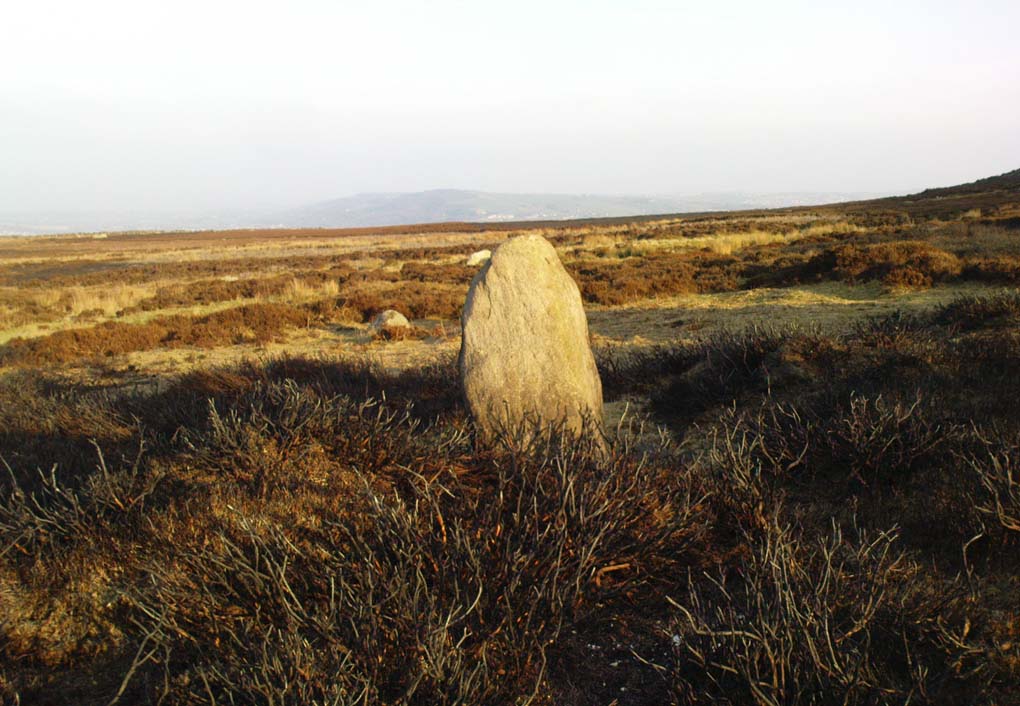
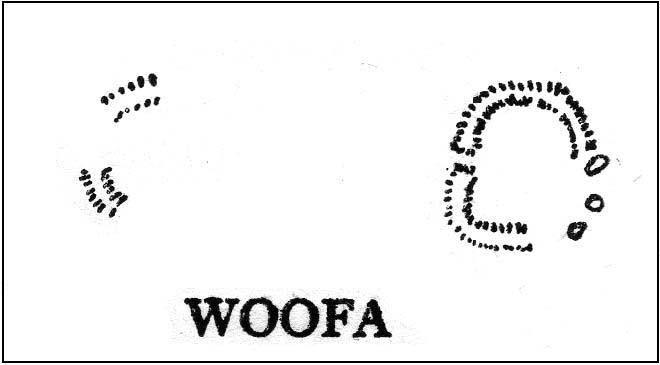
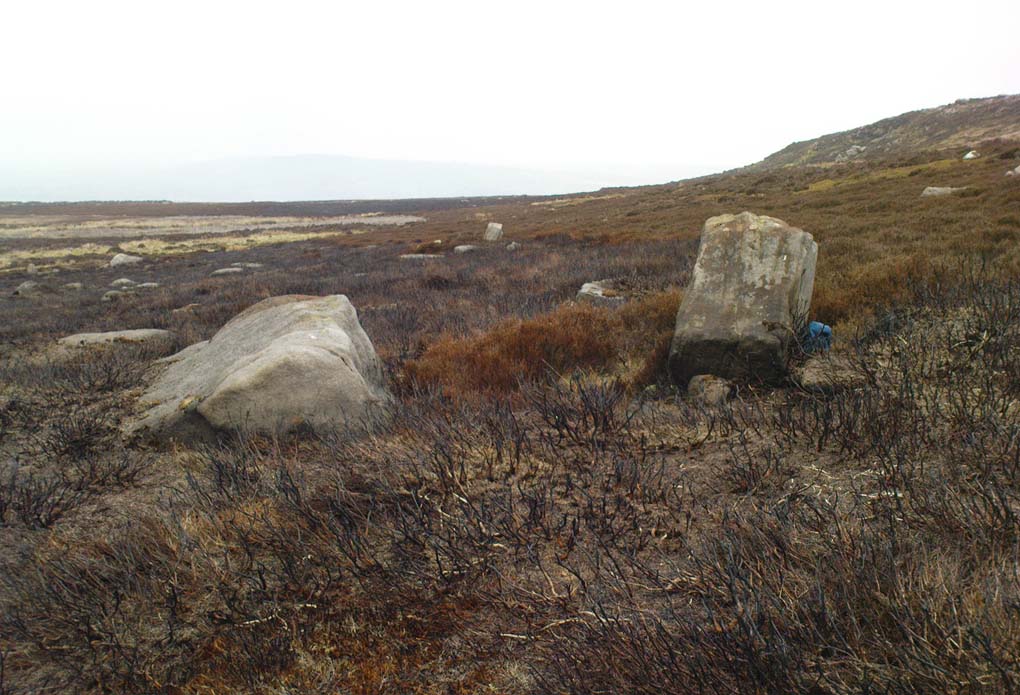
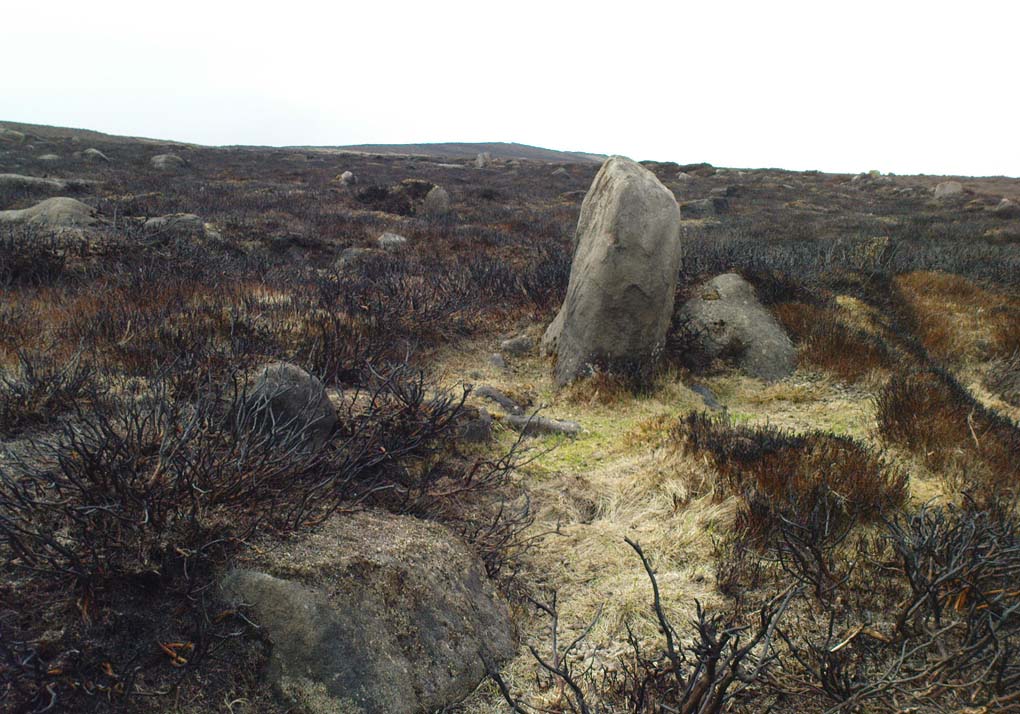
Little Skirtful Carvings, Burley Moor, West Yorkshire

Cup-Marked Stones: OS Grid Reference – SE 13830 45195

East side of Little Skirtful

Also Known as:

  1. Carving nos. 391a, 391b, 391c, 391d
  2. Little Skirtful of Stones’ Carvings

Getting Here

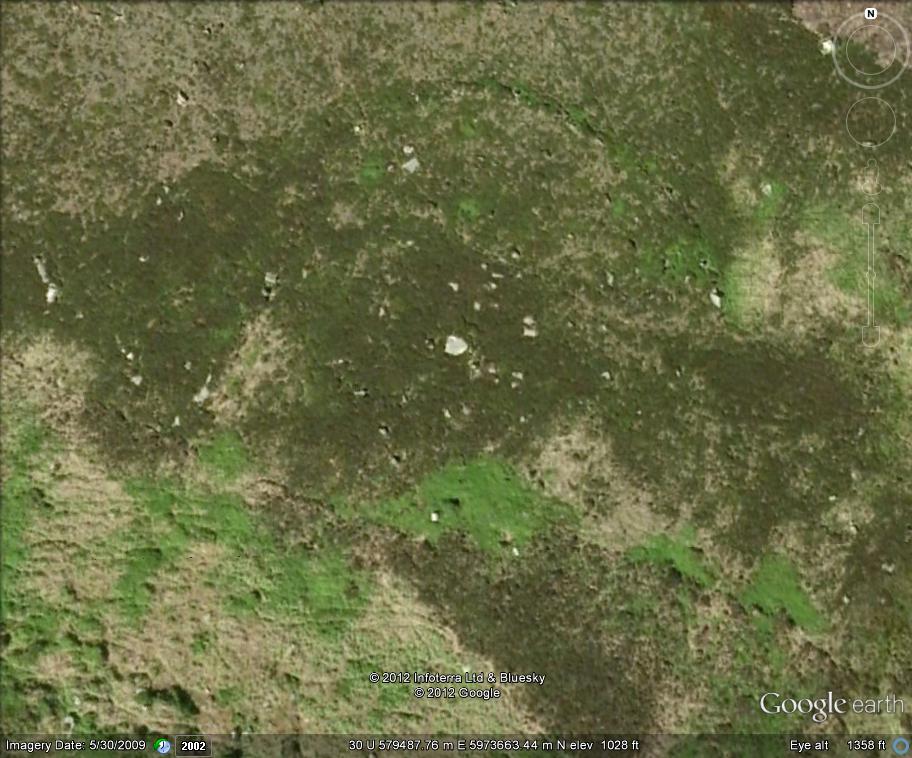
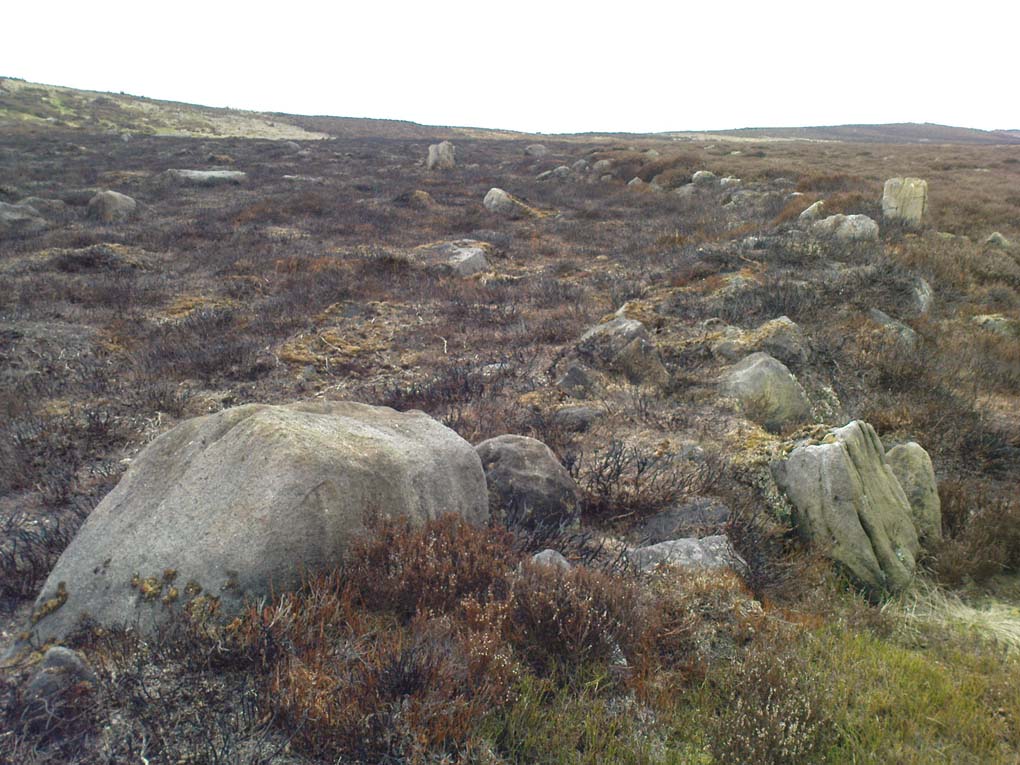
Follow the directions to reach the Little Skirtful of Stones giant prehistoric cairn. Once here, look for the singular rocks out of the many thousands which make up the giant cairn, mainly from the middle to the northern-half of the cairn, and you’ll find them amidst the mass!

Archaeology & History

Cup-marking near the centre of the cairn

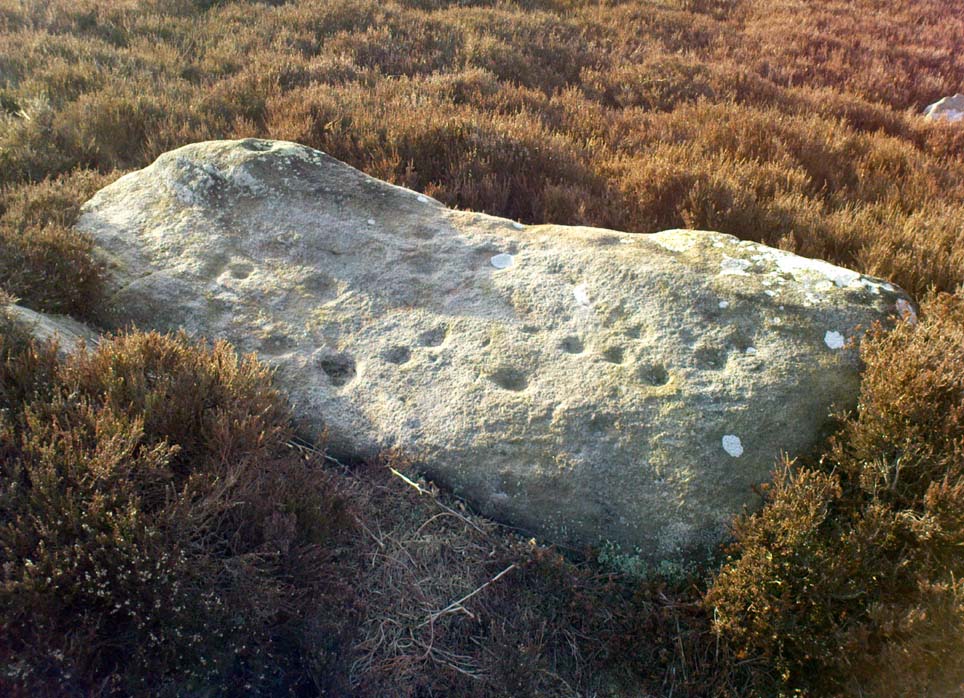
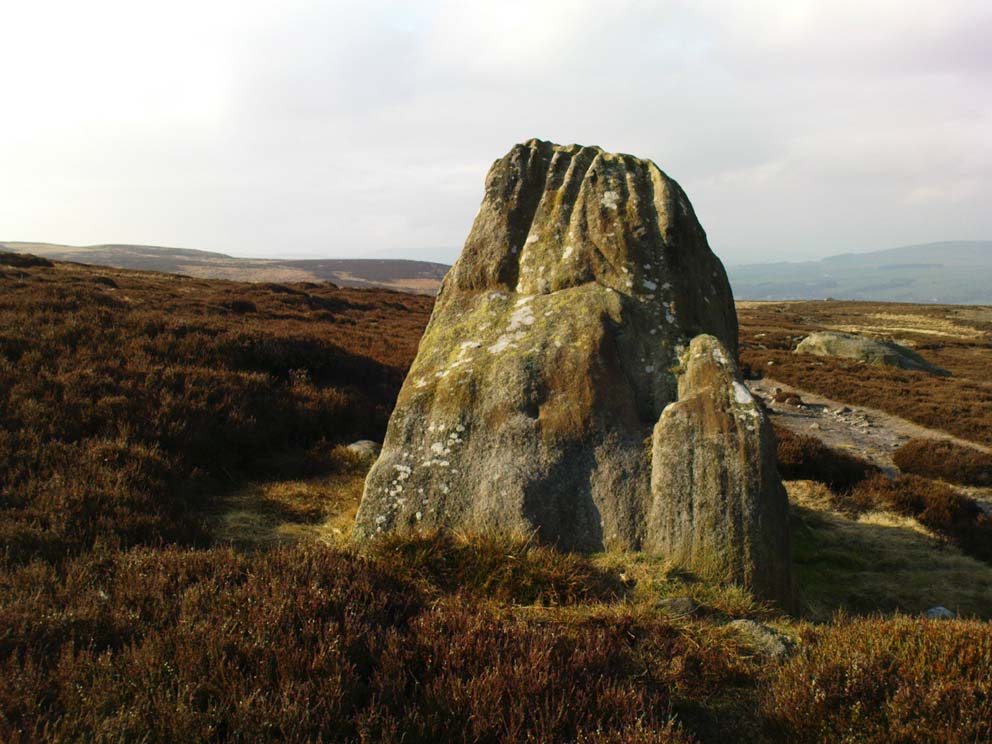
Despite the task sounding difficult, it’s not too hard locating the cup-marked rocks within this giant cairn. As I recall there should be five of them, though the Boughey & Vickerman (2003) survey only list four and I only have photos of four of them as well…so I reckon age is probably getting to me at last!  There could very well be more of them amidst this massive tomb.  But we certainly can’t rely on the Boughey & Vickerman (2003) survey for the carvings at this site as they give the wrong grid references for each of the cup-markings listed, with them all being a kilometre east from the site of the tomb itself! Awesome! God knows what their cartographer was on when he did the profiles for these carvings! (there are plenty of spliff-butts scattered over this moor…..)  Not only that, but the position they cite of the relative cup-markings within the cairn are also wrong.

Another portable stone
Cup-mark at outer edge

But for those of you who like to know the archaeological data, here’s what was said: Carving 391a is a “small rock towards SW edge of cairn, with single worn cup”; but this stone is actually closer to the northern section of the cairn.  Carving 391b was told to be a “small dome-shaped rock at extreme S edge of cairn with single, small clear cup at top of dome.”  This again is more on the northern section of the cairn, away from the centre.  Carving 391c was described as a “small oval, rounded rock at N edge of cairn, with single, broad, shallow worn cup.”  Whilst carving 391d which was told to be a “small rock at SSE edge of cairn, with single small worn cup.”  However, we have to take into account that any errors about their position may simply be down to the fact that the small rocks have been moved.

Smoothed cup
Showing different rock-type

As you’ll see in the photos here, one of them is actually near the very centre of the cairn, with the cup-marking etched into the edge of the small rock itself.  I’m not quite sure if this is the additional fifth carving in the cairn, or whether it’s one of those wrongly ascribed as being in another position.  It’s hard to tell, as the local Ilkley Archaeology team don’t publish their findings and information on-line as they should do and unless you’re in their little club they’re hard to get info out of.  So this will have to do for the time being I’m afraid.  Also note how one of the cup-marked stones is of a rock-type different to the local millstone grit.

Folklore

The creation myth of the Little Skirtful itself tells that the giant Rombald (who gives his name to the moor) was in trouble with his wife and when he stepped over to Almscliffe Crags from here, his giant wife – who is never named – dropped a small bundle of stones she was carrying in her apron. Harry Speight (1900) tells us of a variation of the tale,

“which tradition says was let fall by the aforementioned giant Rumbalds, while hastening to build a bridge over the Wharfe.”

Variations on this story have said it was the devil who made the site, but this is a denigrated christian variant on the earlier, and probably healthier, creation tale. Similar tales are told of the Great Skirtful of Stones, 500 yards south.

The cluster of portable small stones with single cup-marks on them relates to traditions found in other cultures in the world where, usually, women would carry such items in their aprons and deposit them at or on the tomb, in honour of the ancestor or spirit known to be resident at the sacred site.  The folklore found at the Little Skirtful (and Great Skirtful too) of Rombald’s wife dropping the rocks here and forming the giant tomb, probably derive from variants of this same honorary practice.

References:

  1. Bennett, Paul, The Old Stones of Elmet, Capall Bann: Chieveley 2001.
  2. Boughey, Keith & Vickerman, E.A., Prehistoric Rock Art of the West Riding, WYAA 2003.
  3. Cowling, Eric T., Rombald’s Way, William Walker: Otley 1946.

© Paul Bennett, The Northern Antiquarian


East Riddlesden Cross, Keighley, West Yorkshire

Cross:  OS Grid Reference – SE 079 421

Archaeology & History

A little-known early christian relic found in the driveway to East Riddlesden Hall was saved and propped up in the stable floor at the back.  In 1984 however, the National Trust got round to moving it and bringing the relic to greater public attention by putting it on display in the great hall of the building. (I think you’ve gotta pay to go in and see the stone these days – which is a bittova pain if you just want to examine the carving)

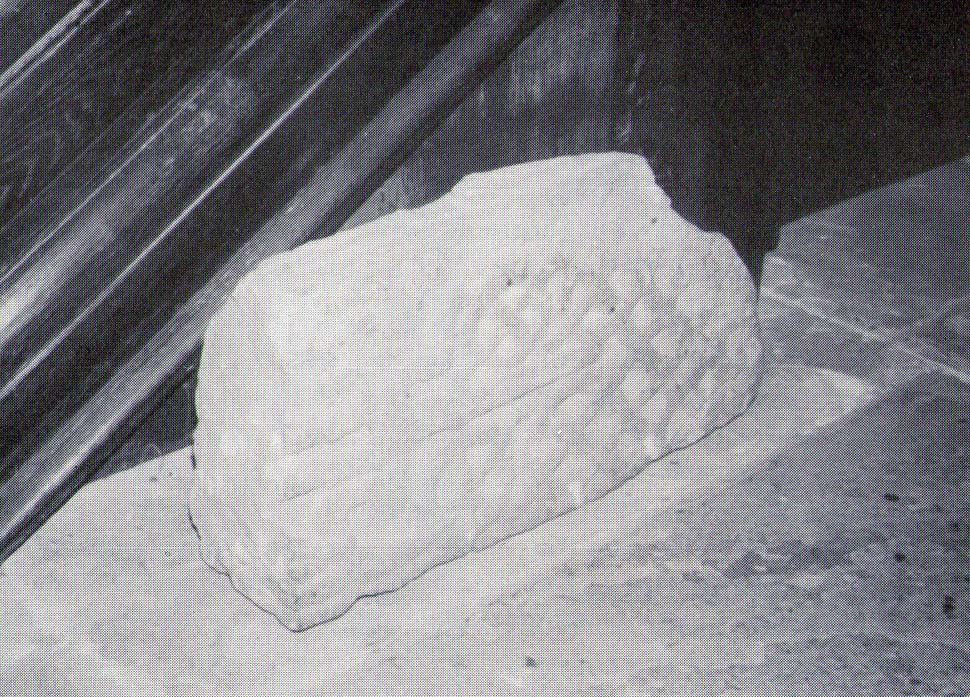
Old photo of the carved stone (after Margaret Faull)

Measuring just 1 foot across and 2 feet high and carved on all sides, the design is all too familiar to those of you exploring early christian or late-Celtic art forms.  Executed sometime between the 5th-10th century, on the main face of the cross we have the traditional ‘Celtic’ interlacing, with a bird-figure emerging on or around an early ‘cross’ symbol.  There are a variety of interpretations of this, but none relate to any modern christian mythic structures.  Indeed, we should cautiously reflect on the more pre-christian nature of this design: carved as it was at a time when the spirit of the natural world (animism) was endemic amongst all people.  This carving would in some way reflect such implicit subjectivity, though perhaps have had emergent ideals relevant to the christian cult within it.  However, we should be cautious about this christian idea, despite it being much in vogue by prevailing groups of consensus trance historians.

References:

  1. Faull, Margaret L., “The Display of the Anglo-Saxon Crosses of the Keighley Area,” in Transactions of the Ancient Monuments Society, New Series no.30, 1986.

© Paul Bennett, The Northern Antiquarian

Rivock East Carving, Keighley, West Yorkshire

Cup-Marked Stone: OS Grid Reference – SE 07640 44215

Getting Here

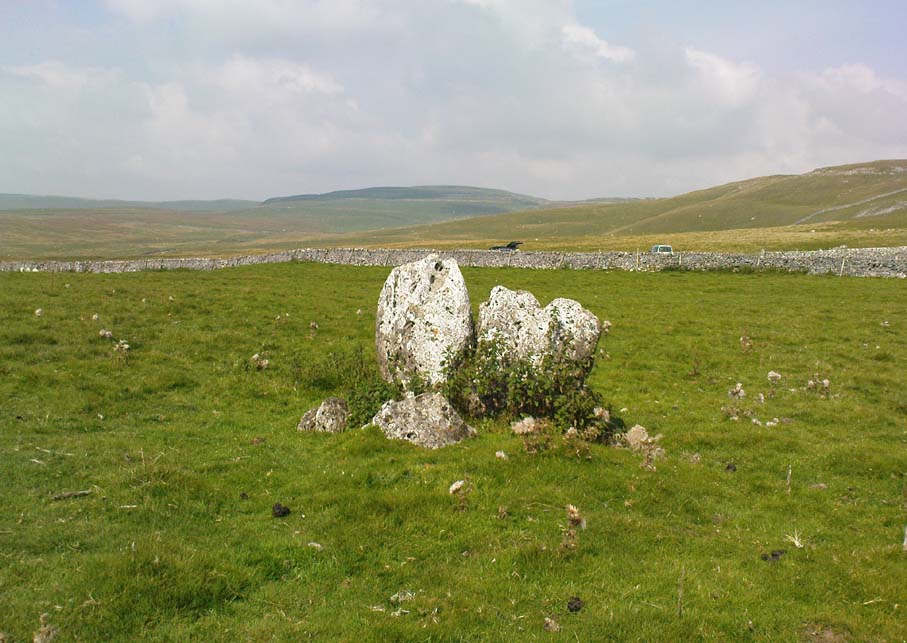
Cupmarks at Rivock East

Take the same directions as if you’re going to Dave’s Stone, to the eastern end of Rivock Edge itself. Then take less than 10 steps further onto the moor itself and you’ll see the stone pretty low down in the heather. (please note that grid-reference above needs revising)

Archaeology & History

…and looking straight down!

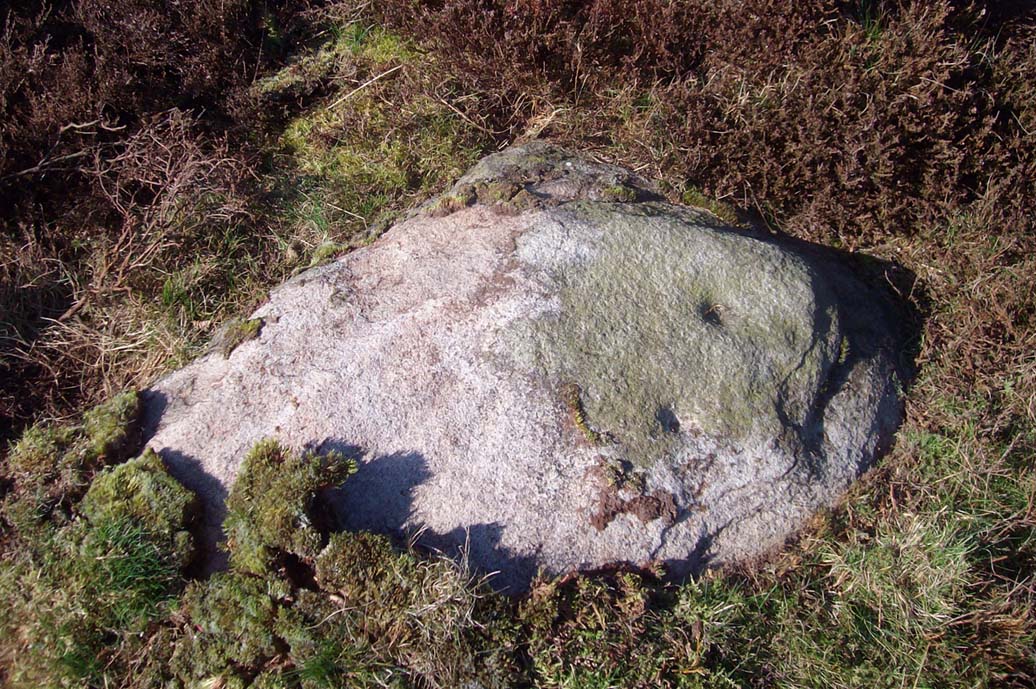
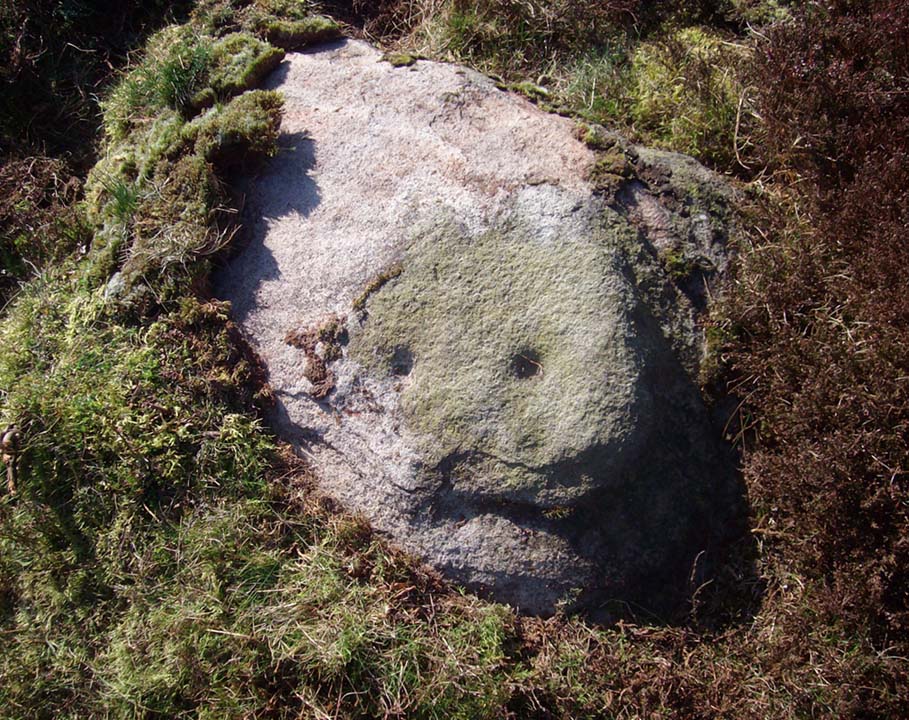
Found about 10 yards onto the flat ridge south of Dave’s Stone cup-marked stone, the vegetation covering this carving had only recently been brushed off when we revisited the place in 2012, by members of the Ilkley CSI team in their own survey of the area.  As you can see, it’s a simple design of just two well-preserved cups on a small rounded stone. What may be the remains of a very faint ring arc is possible over one of the two cups. Nowt much more to say really!

© Paul Bennett, The Northern Antiquarian 

Idol Rock, Ilkley Moor, West Yorkshire

‘Cup-Marked’ Stone:  OS Grid Reference – SE 13296 45898

Also Known as:

  1. Carving no.221 (Hedges)
  2. Carving no.327 (Boughey & Vickerman)

Getting Here

Idol Rock, Ilkley Moor

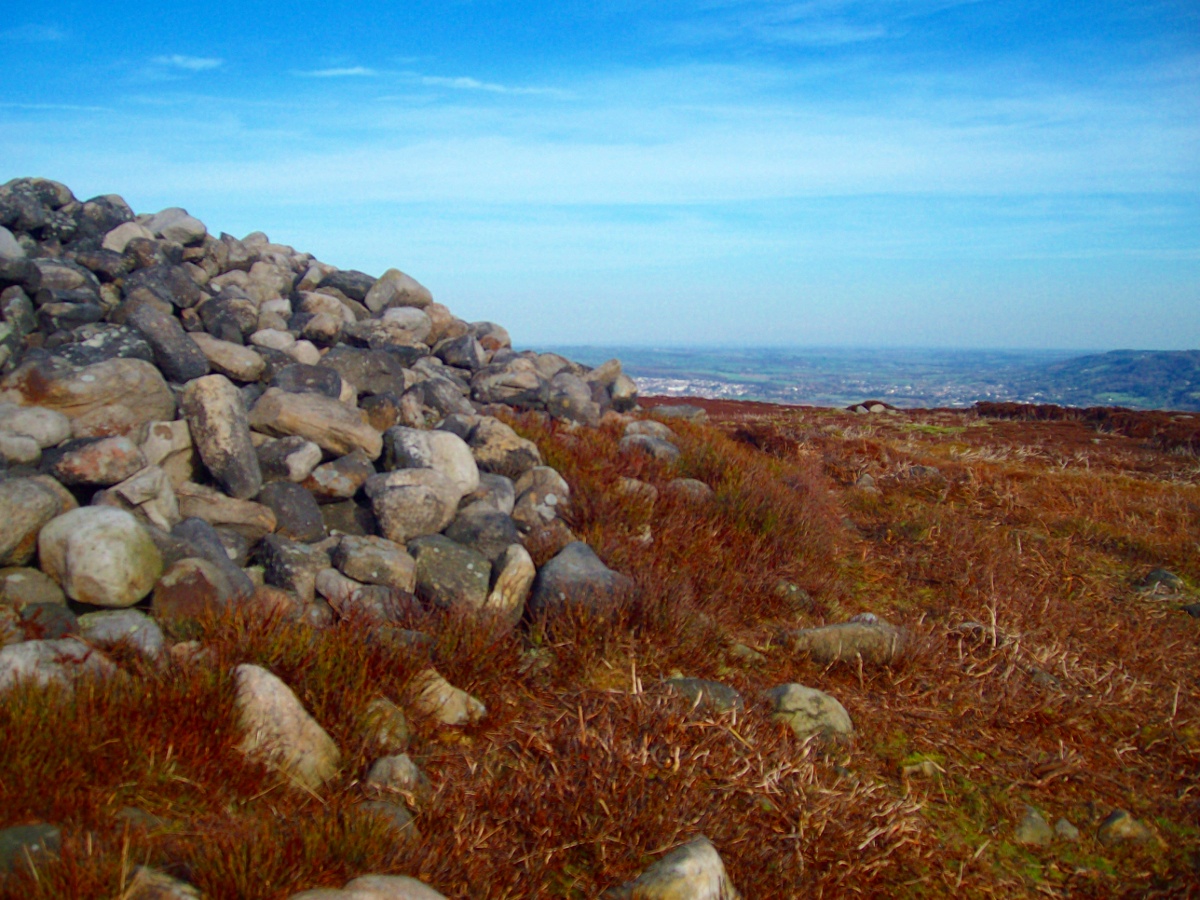
From Cow & Calf Hotel head onto the moor above you, following the same directions to reach the ornately carved Idol Stone (and its immediate companions). Ahead of you on the same footpath, about 100 yards along, as it begins to slope up the hill further onto the moor, you’ll see a large upright pyramid-shaped stone, about 8 feet all, right at the side of the path. Y’ can’t miss it!

Archaeology & History

Deep cups & lines on top

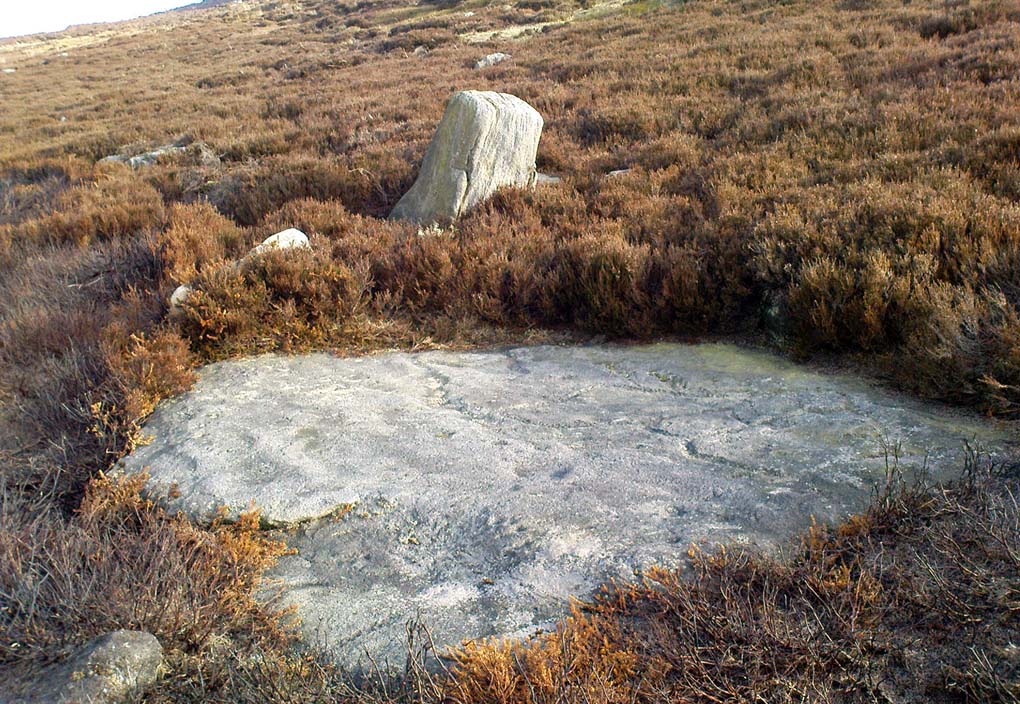
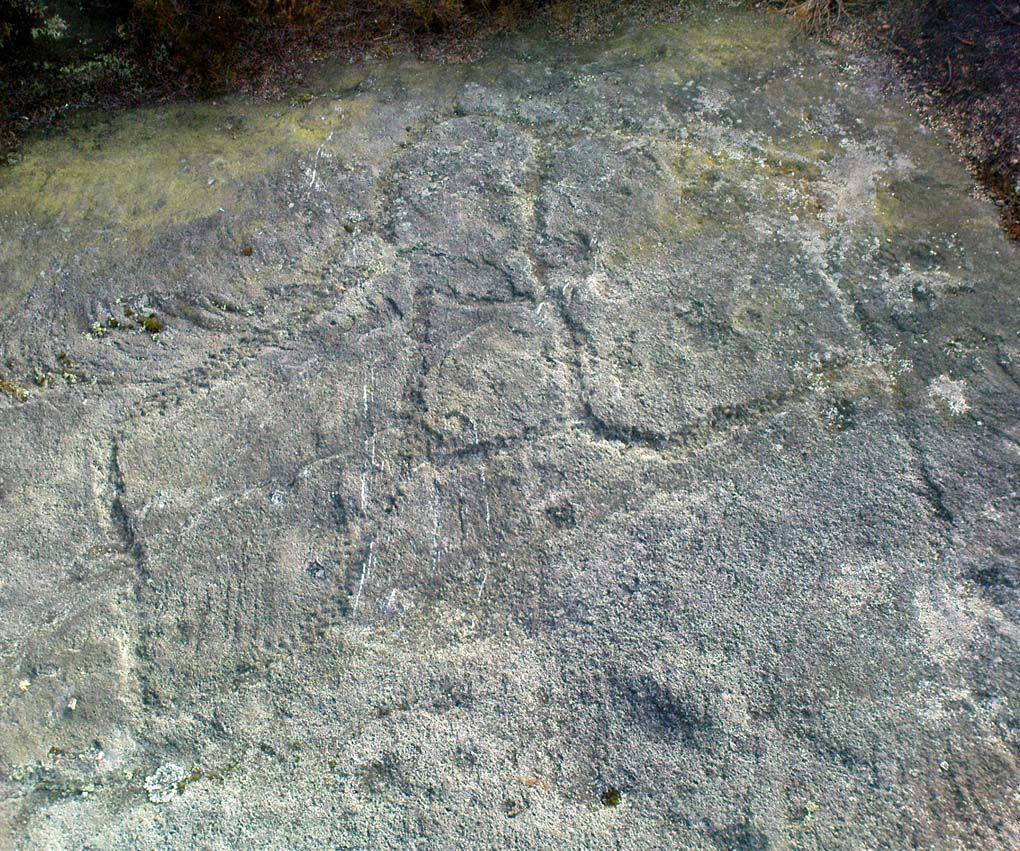
Although ascribed as a cup-marked stone in usual surveys, the cup-markings on top of this rock are seemingly Nature’s handiwork. There is a possibility that cup-markings were carved into the top of the stone, many thousands of years ago, but due to the centuries of wind and weathering, we cannot in anyway assess the curvaceous bowls and lines running across and from the top of this rock to be artificial.

Folklore

The name ‘Idol Stone’ seems to have come about as a result of the judaeo-christian Victorian obsession of satanic idolatry in all things natural – which many of them still fear. Sadly there are no early accounts of practices of idolatry at this rock, until it was used by chaos magickians in the formative years of that Current in the 1980s.

References:

  1. Bennett, Paul, The Old Stones of Elmet, Capall Bann: Milverton 2001.
  2. Boughey, K.J.S. & Vickerman, E.A., Prehistoric Rock Art of the West Riding, WYAS: Leeds 2003.
  3. Cudworth, William, “Rombald’s Moor Antiquities,” in Bradford Scientific Journal, volume 3, 1912.
  4. Forrest, C. & Grainge, William, A Ramble on Rumbald’s Moor, among the Dwellings, Cairns and Circles of the Ancient Britons, W.T. Lamb: Wakefield 1868-9.
  5. Hedges, John (ed), The Carved Rocks on Rombald’s Moor, WYMCC: Wakefield 1986.
  6. Holmes, J., “A Sketch of the Prehistoric Remains of Rombald’s Moor,” in Proceedings of the Yorkshire Geological Society, volume 9, 1887.
  7. Speight, Harry, Upper Wharfedale, Elliott Stock: London 1900.

© Paul Bennett, The Northern Antiquarian 

Quarry Hill, Leeds, West Yorkshire

Settlement (destroyed):  OS Grid Reference – SE 309 336

Archaeology & History

Absolutely nothing is left of the large series of ancient earthworks that were reported to have existed near the very centre of Leeds by Ralph Thoresby, James Wardell and others in the 18th and 19th centuries.  Although we do not know with certainty the age and nature of the site, it would seem very likely to have had a prehistoric provenance.  However, this wasn’t the opinion of either Thoresby (1715) or Thomas Whitaker (1816).  They both thought the remains were of Roman origin – but we must remind ourselves of the inaccuracies made, particularly by Whitaker, when it came to estimating the dates of early monuments (e.g., Whitaker’s assertions of the huge Counter Hill earthworks above Addingham).  Sometime later, James Wardell (1853) thought the remains on Quarry Hill were distinctly pre-Roman; though reasoned that the invading force may have used the site at a later date.  Wardell wrote:

“Traces of a prior occupation were, until recently, observable on the summit of Quarry-hill, along the western edge of which ran an earthwork of considerable length and magnitude, and of semi-circular form.”

We know little else of the place, sadly, but the shape of the site around the hilltop edges would seem to support the likelihood of an Iron or Bronze Age origin.  Further information would, of course, be more helpful…

References:

  1. Thoresby, Ralph, Ducatus Leodiensis, Maurice Atkins: London 1715.
  2. Wardell, James, The Antiquities of the Borough of Leeds, Moxon & Walker: Leeds 1853.
  3. Whitaker, Thomas D., Loidis and Elmete, T. Davison: Leeds 1816.

© Paul Bennett, The Northern Antiquarian


Buck Woods Carving (05), Thackley, Bradford, West Yorkshire

Cup-Marked Stone:  OS Grid Reference – SE 17554 39290

Getting Here

Single cup-marked stone against wall

From Thackley corner, take the Esholt road down Ainsbury Avenue.  Walk past the Thackley football ground and another 50 yards on, to your left, there’s a field.  Cross this and go through the gate into the trees.  Another field is across the footpath, but turn right and walk on the muddy path, keeping parallel with the other field, until the walling bends round to the left.  About 15 yards round where the wall bends left, watch out for the silver birch tree and the small cup-marked rock at its base, right up against the wall.

Archaeology & History

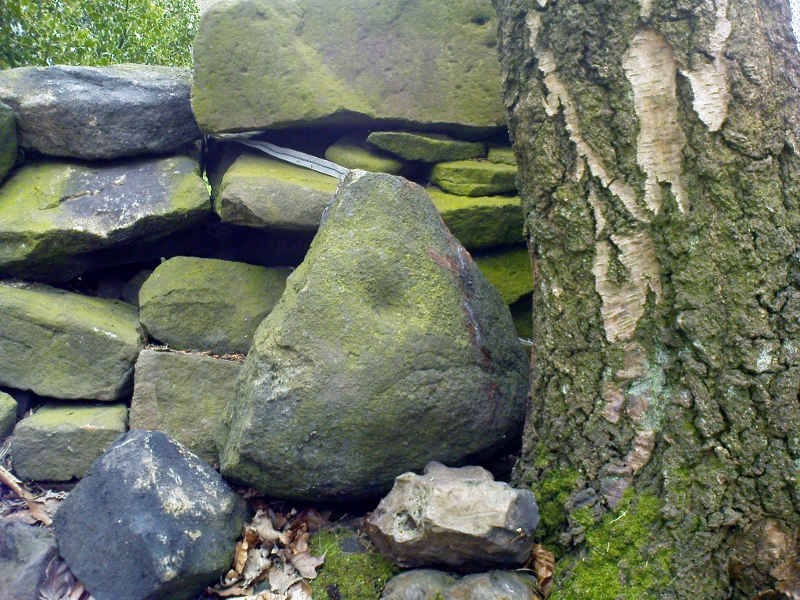
This is an archetypal single cup-marked stone known as a ‘portable’ — though in its original state, when the rock was obviously larger than it is today, I doubt anyone could have carried it further than a couple of yards!  The stone has been split from a larger rock, and we’re unsure the size of its original form—but presume it to have been perhaps double its present size.

The broken rock stands (now) upright against the wall and nice birch tree (Betula pendula), but wasn’t like that when we first found it, and the cup was barely visible as it faced down into the Earth.  As the images show, we have just a single cup-mark on its outer face.  It looks typical of those carvings found in the larger Bronze Age cairns scattering the moors to the north, but we have no evidence nor folklore indicating the existence of such a monument hereby.  The extensive amount of overgrown multiperiod walling all over this woodland may have used up such a cairn, but we will probably never find out, as the woods have been overused by industrialists, who are now, slowly, turning the woods here into a park.

© Paul Bennett, The Northern Antiquarian

Priddy Henges, Priddy, Somerset

Henges:  OS Grid Reference – ST 540 528

Also Known as:

  1. The Castles
  2. Priddy Circles
  3. The Rings

Archaeology & History

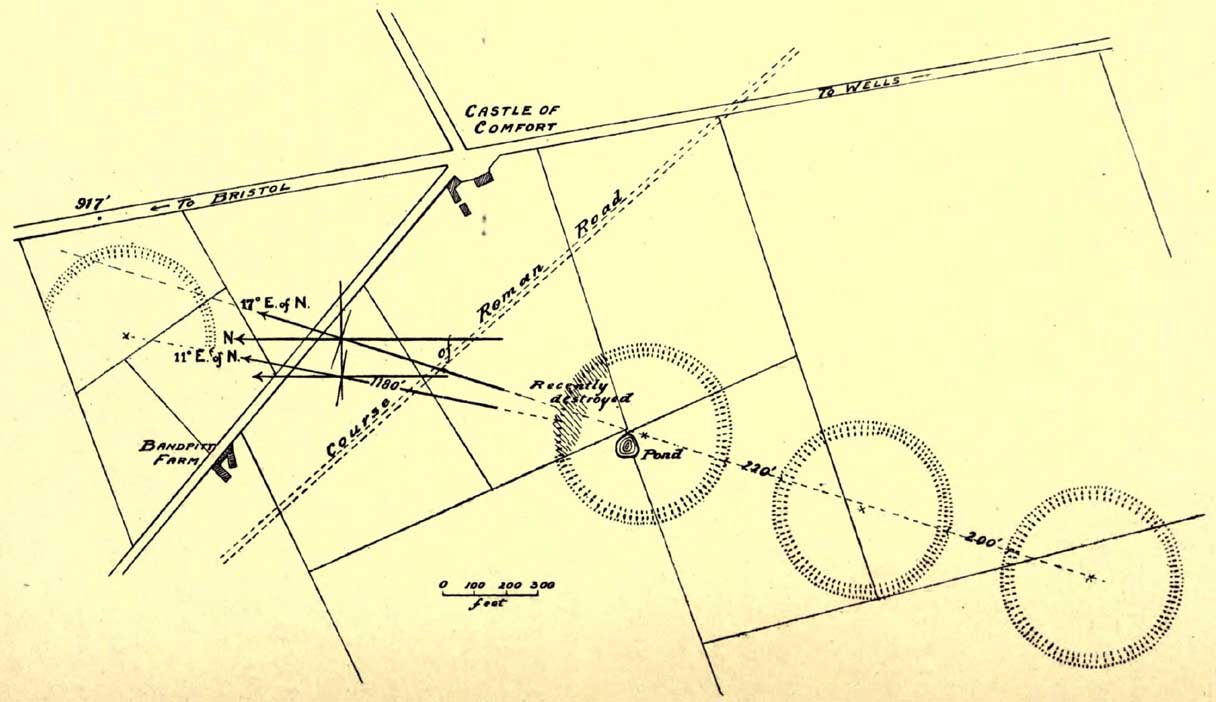
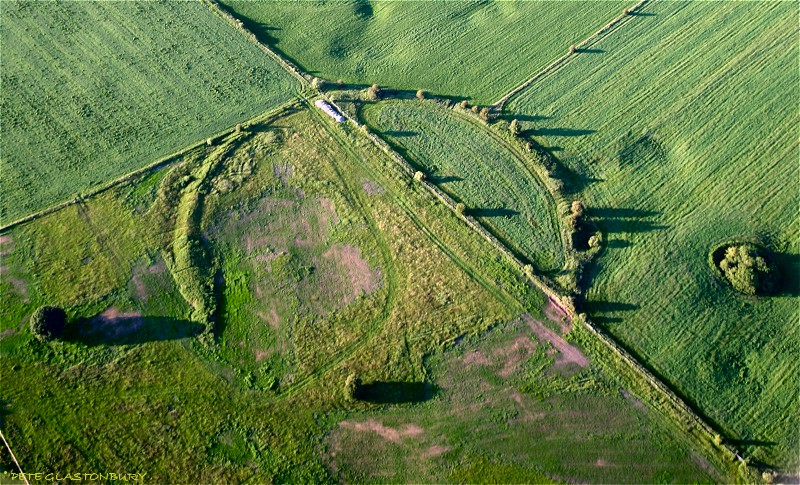
Allcroft’s 1908 plan of the 4 henges

Although cited in all modern archaeology texts as a series of four henge monuments, a recent article by J. Lewis & D. Mullin (2011) inform us that these “are not henges but belong to a tradition of enclosure that predates them and had a different function.”  We’ll have to wait and see what they mean by that!  In the meantime, we’ll have a quick scurry through the historical accounts of these four impressive ‘henges’ as Burl, Piggott and the others call ’em.

Surrounded at all angles by numerous barrows and tumuli, these four great henge monuments were shown on the 1887 Ordnance Survey map as a row of ‘Supposed Ring Forts’, when such ideas were in vogue, running in a line roughly SSW-NNE; the third one up having a couple of ponds within it.  A brief early account of them was given by Harry Scarth (1859)—who was describing the series of nine round barrows a few hundred yards to the south—who told them to be “circular banks” each 500 feet across.  The first more detailed account was in A.H. Allcroft’s (1908) classic text, where he wrote the following:

“…Close to the Castle of Comfort Inn, where the high road to Bristol crosses the line of the old Roman road running north-westward towards Charterhouse, there lies immediately west of the high road a series of four circles…all of one size, all of one plan, and all as mathematically exact as circles could well be when executed in such a soil and on such a scale.  Although they have suffered greatly from the mining operations which have scarred all the Mendips, as well as from the plough — one of the four is almost obliterated — they are still quite easy to make out.  The diameter of each is some 550 feet within the area, which is surrounded by a broad low vallum, and that again by a correspondingly broad and shallow ditch. The height of the vallum above the ditch, where best observable, is some 5 feet. There are no determinable entrances. The most southerly of the group is about 250 feet away from the second ; the second about 200 feet away from the third; and a line joining the centres of the first and third passes through the centre of the second also, and points 17° east of north. The fourth circle lies 1,200 feet away from the third, not in a right line with the others, but slightly to the west. Between the third and fourth circles passes the Roman road. Within the third circle is an old pond of some size.

“With every appearance of being all of one date, and that a venerable one, these circles lack every characteristic of military works. Their peculiar disposition, their painstaking regularity, and their identity of size, all suggest that they must, if really old, be of ritual, and perhaps of astronomical character”

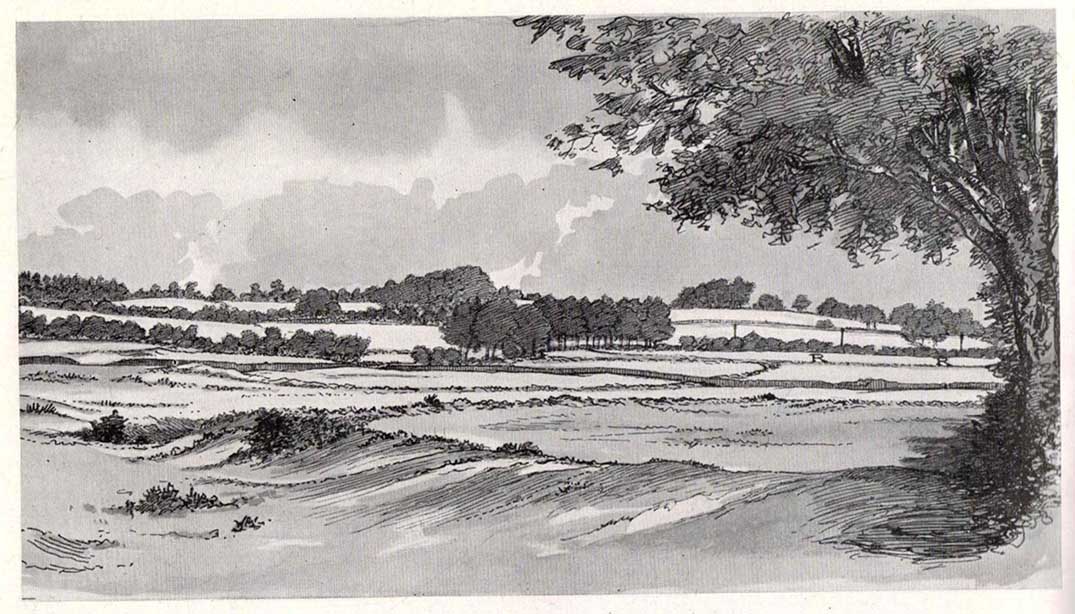
Old drawing of the central henges
Henge 1, recently damaged (courtesy Pete Glastonbury)

Allcroft’s ideas of ritual and astronomy were pretty good for the period, as we take it for granted these days that such events occurred at henges — so the existence of four such sites right next to each other, would have made this one helluva place in neolithic and Bronze Age periods.  A few years after Allcroft, the henges were described in Mr Burrow’s (1924) excellent illustrated survey, from which the drawing of the two central henges is taken (the two ‘R’s in the background highlight the line of the Roman road which runs past them).  Burrow’s didn’t add much more of any note, simply telling:

“…in the fields north and south, are placed earth-work rings, each about 180 yards in diameter, on a line placed slightly north by east.  The most northerly of these rings is almost obliterated, but the three on the west of the road from Chew Stoke to Oakhill are quite clearly defined, as my drawing (above) will show.  I have been able to include two of these remarkable rings in my picture, the edge of the bank (which was, when I saw it, fringed with yellow gorse), being about 6 feet above the level of the ditch outside.  It is generally supposed that these ringed earthworks were connected with some prehistoric ritual, and Hadrian Allcroft thinks were used for primitive astronomical observations or the construction of a primitive calendar.”

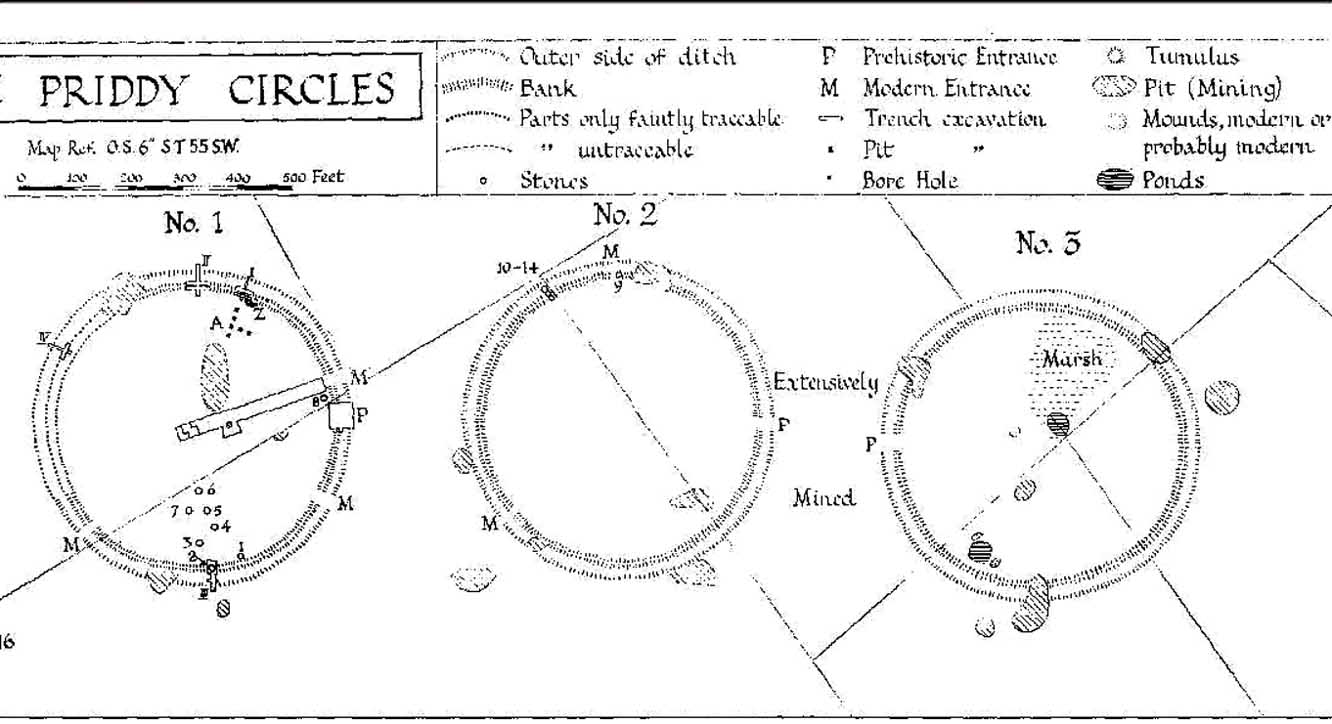
Tratman’s plan of Priddy Henges
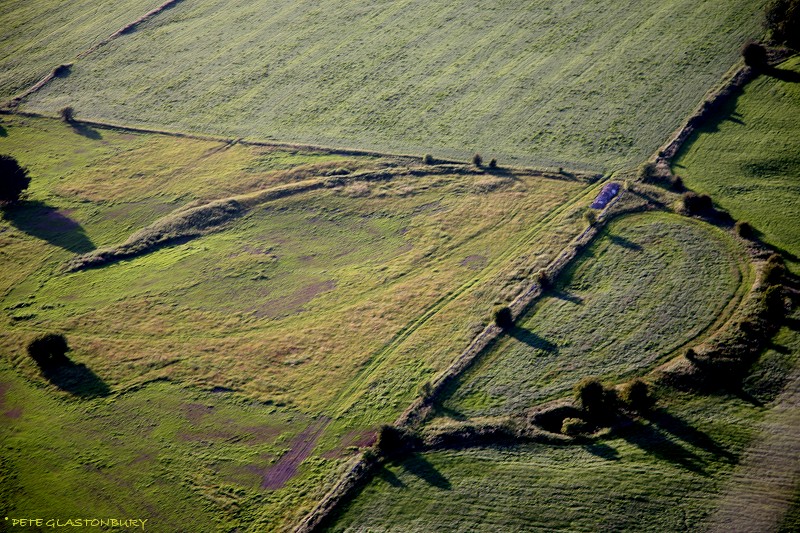
Another view of Henge 1 (courtesy Pete Glastonbury)

Many years later when archaeologist K.S. Painter (1964) came to describe these henges, he listed them as “stone circles” (what the hell was he on!?), but this error may derive from the finding of several stones that once existed inside the southernmost Henge 1.  These were uncovered following excavation work done here by E.K. Tratman (1967) and his colleagues, who explored and numbered the four henges—running from south to north—as follows:

“Circle 1: This is tolerably complete.  A portion of the southwest quadrant has been destroyed by mining and there are three modern gaps in the ring. Mining has involved the ditch on the west and south, and to a small extent on the east.  There is an irregular extensive hollow west of the centre and this too is a product of mining and contains a number of large stones so derived.  The circle is not quite a true one, being flattened slightly on the west.  The circle has a diameter from bank top to bank top of 520ft.  The single original entrance is NNE of the centre.  Stones 1 and 3-7 were removed by the farmer before excavation, but subsequent ploughing immediately after removal did not reveal any change in soil texture or colour.  Stone 8 was placed in its present position quite recently.  It is not known where it came from.  Other stones have recently been placed on top of the bank east of the entrance by the farmer (1964-5).  Stone 2 is in a relatively ancient position.

Circle 2: This is a true circle and its diameter and position of its entrance are similar to Circle 1. It has been considerably disturbed by mining.  A group of stones (10-14) and stone 9 represent modern collections from the field.  None of them is in its original position.  There are two modern gaps in the ring.

Circle 3: This is distinctly flattened on the east and west.  The N-S diameter is 520ft and the E-W 490ft from bank top to bank top.  The northeast quadrant reported by Allcroft as being levelled is still traceable.  The circle has been greatly disturbed by mining… The entrance is SSW of the centre, the opposite pole to circle 1 & 2, and has probably been widened, perhaps by miners.  The marsh may be an original feature or the product of mining.  The two ponds are certainly modern, and so is a small mound, which is probably spoil from the major pond.

Circle 4: This is incomplete. It has a diameter of 560ft, which is considerably larger than any of the others.  The OS map shows only the eastern semi-circle remaining. However, the bank and in part the ditch can be traced…If the visible and proved end of the ditch on the SSW was intended to be at the edge of the causeway, then the entrance would have been in the same position as that of Circle 3.”

Very recently, a local land-owner quite deliberately bulldozed a large portion of the southern henge in this complex, destroying much of it.  This act of criminal vandalism will hopefully not go unpunished and is, at the present time, going through the courts.

…to be continued…

References:

  1. Allcroft, A. Hadrian, Earthwork of England, MacMillan: London 1908.
  2. Burl, Aubrey, Prehistoric Henges, Shire: Princes Risborough 1997.
  3. Burrow, Edward J., Ancient Earthworks and Camps of Somerset, E.J. Burrow: Cheltenham 1924.
  4. Lewis, J. & Mullin, D., “New Excavations at Priddy Circle 1, Mendip Hills, Somerset,” in Proceedings of the University of Bristol Speleological Society, volume 25, 2011.
  5. Painter, K.S., The Severn Basin, Cory, Adams & Mackay: London 1964.
  6. Scarth, Harry M., “Some Account of the Investigation of Barrows on the Line of the Roman Road Between Old Sarum and the Port at the Mouth of the River Axe,” in The Archaeological Journal, volume 16, 1859.
  7. Tratman, E.K., “The Priddy Circles, Mendip, Somerset,” in Proceedings of the University of Bristol Speleological Society, volume 11, 1967.
  8. Wainwright, Geoffrey J., “A Review of Henge Monuments in the Light of Recent Research,” in Proceedings of the Prehistoric Society, volume 35, 1969.

Acknowledgements: – To Pete Glastonbury, for use of his aerial photos of the site. Huge thanks Pete!

© Paul Bennett, The Northern Antiquarian

Panorama Woods (227), Ilkley, West Yorkshire

Cup-and-Ring Stone:  OS Grid Reference – SE 11467 47287

Also Known as:

  1. Carving no.101 (Hedges)
  2. Carving no.227 (Boughey & Vickerman)
  3. Rocking Stone

Getting Here

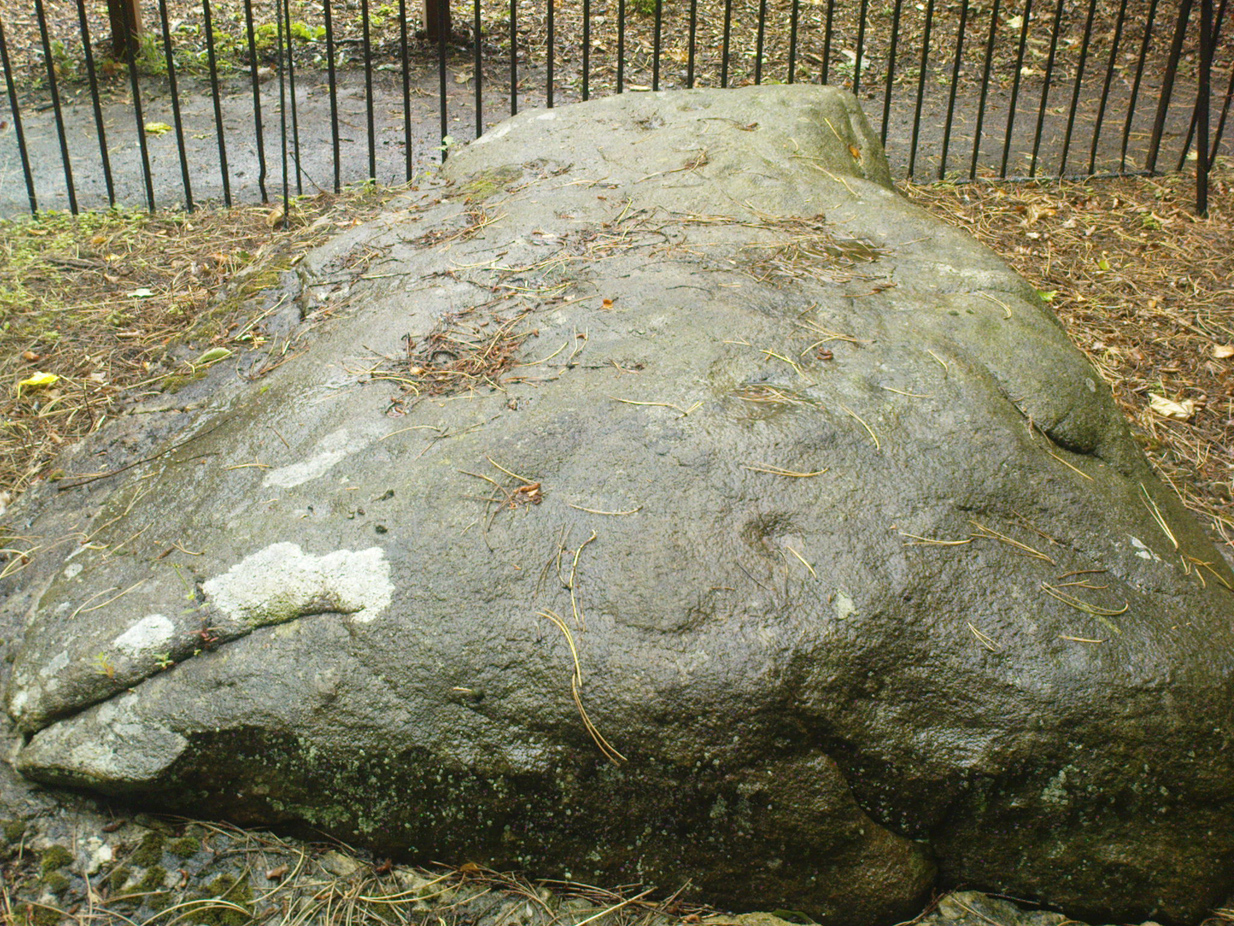
Panorama stone 227 – once a rocking stone

Come out of Ilkley/bus train station and turn right for less than 50 yards, heading left up towards White Wells.  Go up here for less than 100 yards, taking your first right and walk 300 yards up Queens Road until you reach the St. Margaret’s church on the left-hand side.  On the other side of the road, surrounded by trees is a small enclosed bit with spiky railings with Panorama Stones 227, 228 and 229 all therein: the least-decorated one on the left being the one we’re dealing with here.

Archaeology & History

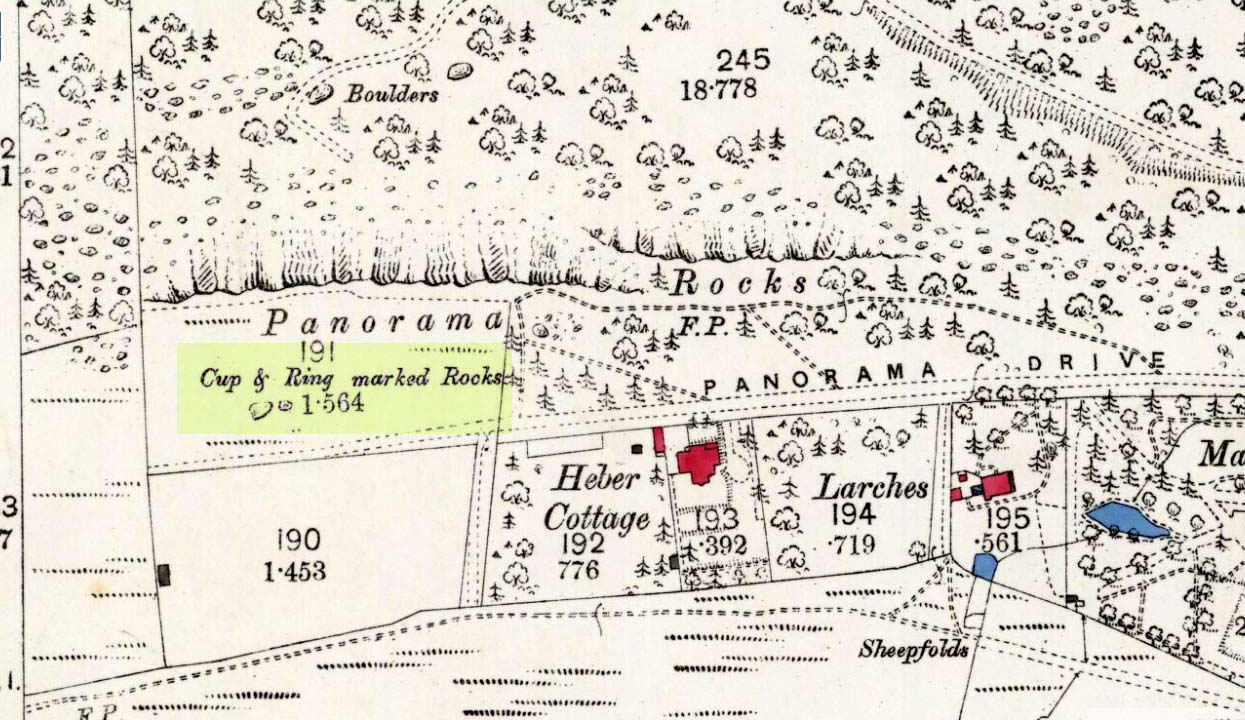
This is another of the caged Panorama Stones, found within the awful spiked fencing across from St. Margaret’s Church, just out of Ilkley centre.  Originally located ¾-miles (1.2km) WSW of its present position in Panorama Woods (at SE 10272 46995), along with its petroglyphic compatriots in this cage, the carving was moved here in 1890 when a Dr. Little—medical officer at Ben Rhydding Hydro—bought the stones for £10 from the owner of the land at Panorama Rocks, as the area in which the stones lived was due to be vandalized and destroyed. Thankfully the said Dr Little was thoughtful and as a result of his payment he had some of the stones saved and moved into their present position.

Original location of stones
J.T Dale’s 1879 sketch

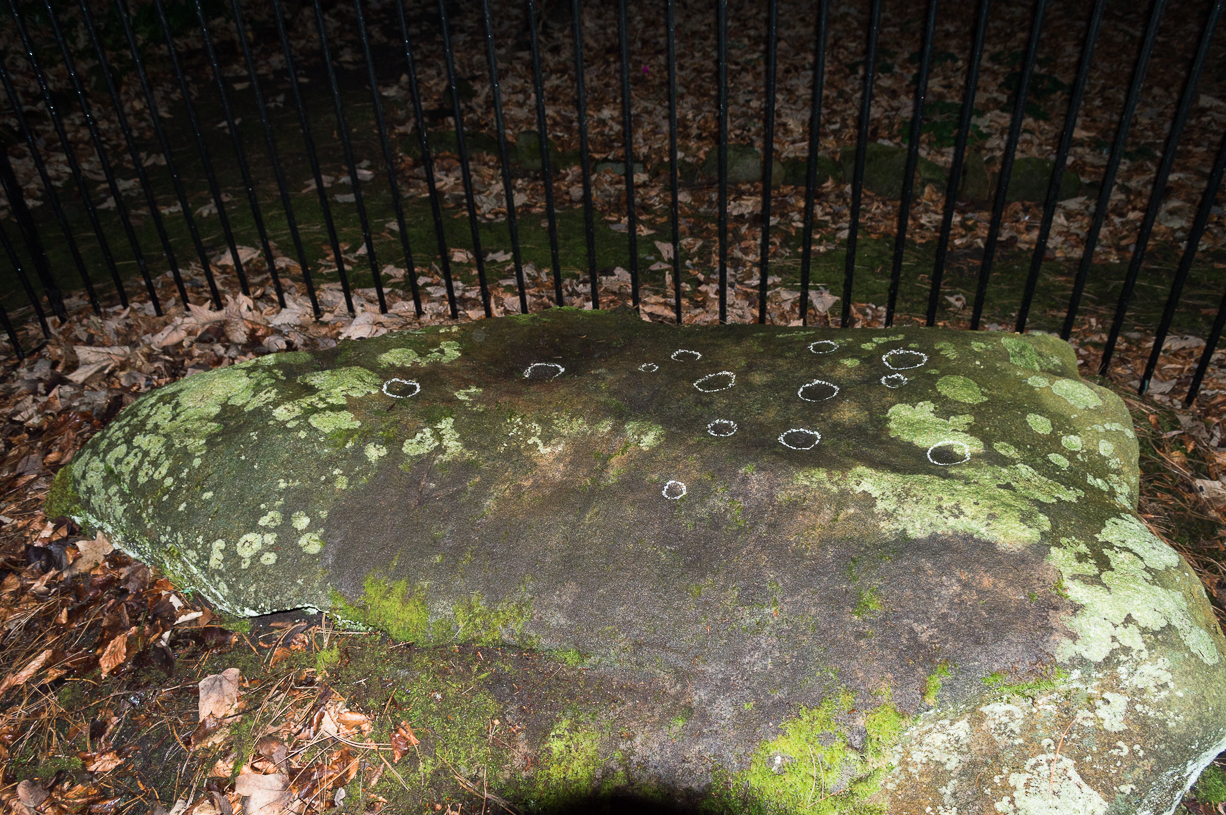
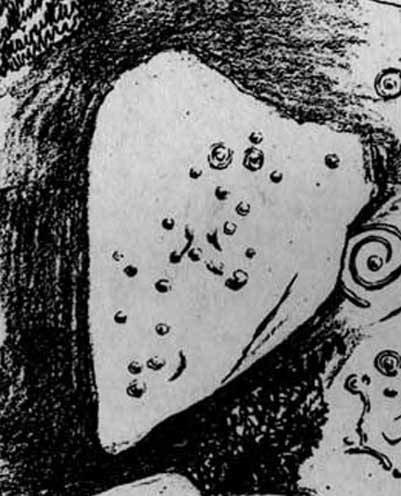
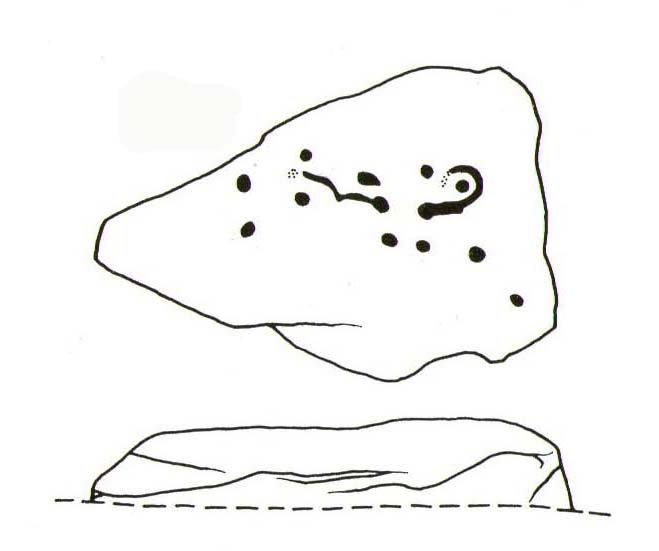
It was first described by the northern antiquarian and petroglyph pioneer, J. Romilly Allen (1879) , who saw it in the now-destroyed “rough inclosure”, as he called it, along with the other stones now in the same Ilkley ‘cage’. Its present position does it no justice whatsoever in terms of its original position.  It was ostensibly a rocking stone: this seemingly trivial-looking boulder was sat on top of the much-cropped Panorama Stone 228 (a yard east of the three in this outdoor cage).  Allen (1879) was fortunate enough to have seen the stone before it was uprooted, telling us how this topmost stone, “has eleven cups, wo of which are surrounded by single rings.”  The modern archaeologist John Hedges (1986) told it to be in a “bad state,” with “very worn carvings, fourteen cups, one with partial ring and groove.” Its situation deteriorated further, as stated by rock art students Boughey & Vickerman (2003), who noted,

“medium-sized, roughly triangular rock, its surface recorded as in a bad state in 1986 and now (2002) even worse.  Fourteen cups, one with partial ring, one groove.”

And its condition isn’t helped by its inaccessibility, when groups like the ‘Friends of Ilkley Moor’ or the local archaeologist should be at least annually cleaning this and the adjacent carvings.  If they’re incapable, there are sincere people in antiquarian, history and pagan groups who would probably help out…

John Hedges 1986 sketch
Faint cupmarks visible

In truth, this carving cannot be seen in isolation, nor merely reduced to a numeric catalogue in some rock art corpus.  We must contextualize its relationship with the once much-larger multiple cup-and-ring stone on which it sat and then see it as it was in the landscape.  Originally of course the rocking stone was Nature’s very own creation.  As humans began migrating over and eventually occupying this once-wooded arena, the rocking stone became intimately related with animistic magickal rites and, over time, petroglyphs began to be etched upon the stone.  Most probably the flat underlying rock surface was carved upon first, and a symbiotic relationship was forged between Earth’s surface and the small rocking stone, both of which were used in oracular and other rites.  Over centuries, as the cups and rings on the earthfast stone grew, the mythic status of this small rocking stone allowed for the encroachment of carvings, and eventually cup-marks began to be etched upon it too.  Later still, as the neolithic period moved into the Bronze Age, the people began to build a low-walled stone enclosure around this and the nearby multiple-ringed carving – similar to the multi-period enclosure at Woofa Bank and other sites on these moors.  It was all a very long and gradual process.

In truth, the mythic status of this once-impressive site would have been maintained—in one form or other—well into the medieval period.  But that’s another matter altogether…

References:

  1. Allen, J. Romilly, “The Prehistoric Rock Sculptures of Ilkley,” in Journal of British Archaeological Association, volume 35, 1879.
  2. Bennett, Paul, The Panorama Stones, Ilkley, TNA: Yorkshire 2012.
  3. Bennett, Paul, Aboriginal Rock Carvings of Ilkley and District, forthcoming.
  4. Boughey, Keith & Vickerman, E.A., Prehistoric Rock Art of the West Riding, WYAS: Leeds 2003.
  5. Cowling, Eric T., Rombald’s Way, William Walker: Otley 1946.
  6. Downer, A.C., “Yorkshire Archaeological and Topographical Association,” in Leeds Mercury, August 28, 1884.
  7. Eliade, Mircea, The Sacred and the Profane: The Nature of Religion, Harcourt, Brace & World: New York 1959.
  8. Hadingham, Evan, Ancient Carvings in Britain, Souvenir Press: London 1974.
  9. Hedges, John, The Carved Rocks on Rombald’s Moor, WYMCC: Wakefield 1986.
  10. Heywood, Nathan, “The Cup and Ring Stones of the Panorama Rocks”, in Transactions Lancashire & Cheshire Antiquarian Society, Manchester 1889.
  11. Speight, Harry, Upper Wharfedale, Elliott Stock: London 1900.

Acknowledgements:  With huge thanks to both Dr Stefan Maeder for help in cleaning up the stones; and to James Elkington for allowing use of his photos in this site profile.

© Paul BennettThe Northern Antiquarian 


Rushy Beck Spring, Burley Moor, West Yorkshire

Healing Well:  OS Grid Reference – SE 1403 4544

Getting Here

Source of the Rushy Beck

From Ilkley centre, take the road up to Cow & Calf, going past the hotel and along Hangingstone Road for a half-mile until you meet some walling on the right of the road. Stop and walk up the small beck, veering to the left as you approach the brow of the hill.  Keep walking up the beck onto the moor where you’ll eventually reach its source, as shown in the photo here!

Archaeology & History

This once fast-flowing spring of fresh sparkling water has seen better days.  The site has two openings in the Earth about 10 yards east and west of each other, both discernible by the notable difference in vegetation on the moors here, where richer hues of green created by the waters cut a small channel down the moorland slopes through the usual hues of heather.

The waters taste fine when they’re in flow, but much of the land here has fallen into shallow marsh and with the inevitable falling of the water table thanks to the stupid arrogant Industrialists, very little of the goodness is available.  But it wasn’t always like this.  Certainly when our prehistoric ancestors carved the rock art close by the source of the waters, then later constructed the large ritual enclosure immediately west of the springs, the waters would have been very important—and in much greater profusion—for simple nourishment and for rituals enacted at the site.


© Paul Bennett, The Northern Antiquarian

Crutch Well, Baildon, West Yorkshire

Healing Well:  OS Grid Reference – SE 14678 38688

Getting Here

Crutch Well pool (Goat Stone carving to rear)

Whether you’re coming here from either Baildon, or Shipley, head for the Cricketer’s Arms on Green Road (ask a local).  About 50 yards uphill from the pub, on the other side of the road, notice the small pool on the green surrounded by large rocks.  That’s y’ spot!

Archaeology & History

First illustrated on the 1851 6-inch to the mile Ordnance Survey map of the region, this little known medicinal spring of water appears to get its name from the northern dialect word, crutch, meaning a plough, a plough-handle, a spade and variants thereof. (Wright 1898)  There is another possibility of it deriving from “an ash or hazel pole” that were given as payment to workers each day in bygone times—a curious custom in itself! But we actually don’t know for sure and could even assume that people came here on crutches to be cured, or something along those lines.

The place has clear running water and had a chapel built near it in the early 19th century.  The old public house across the road (Cricketer’s Arms) has spring water from this well running underneath it, which was said to never run dry and also keeps the drinks forever cool in warm weather!  A few yards above the source of the spring, on the grass to the north is a small cup-marked stone.  Another cupmarked rock listed by archaeologists as a prehistoric carved stone nearby on the same grass verge is probably of more recent industrial origin.

References:

  1. Baildon, W. Paley, Baildon and the Baildons – parts 1-15, Adelphi: London 1913-1926.
  2. Wright, Joseph, English Dialect Dictionary – volume 1, Henry Frowde: Oxford 1898.

© Paul Bennett, The Northern Antiquarian