Black Hill Round Cairn, Low Bradley Moor, Skipton, North Yorkshire

Cairn:  OS Grid Reference – SE 0087 4753

Also Known as:

  1. Black Hill Cairn
  2. Bradley Moor Round Cairn
  3. Queen’s Cairn
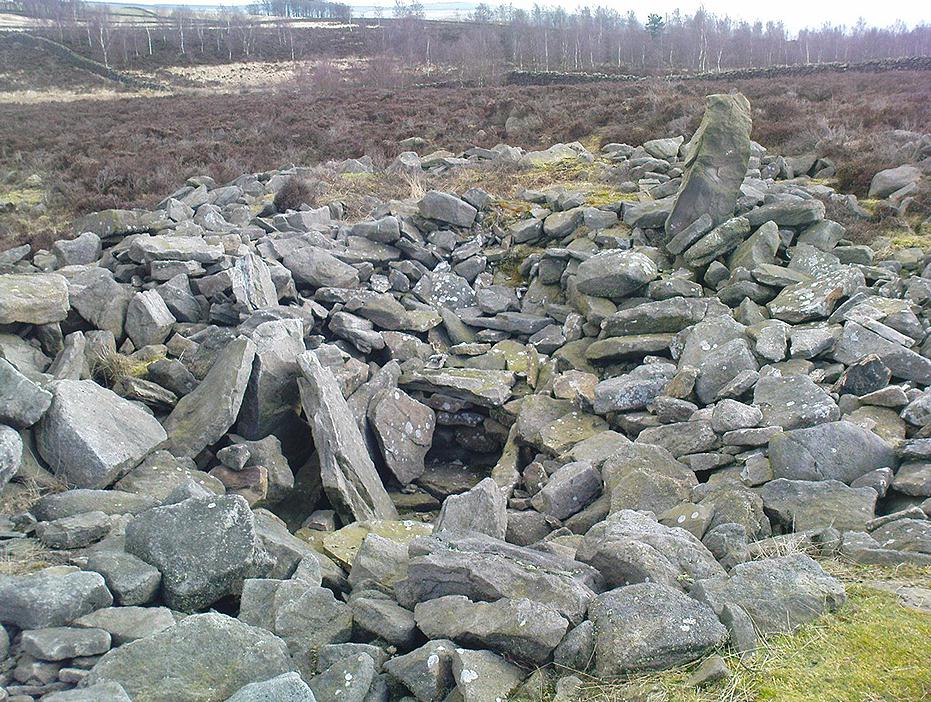
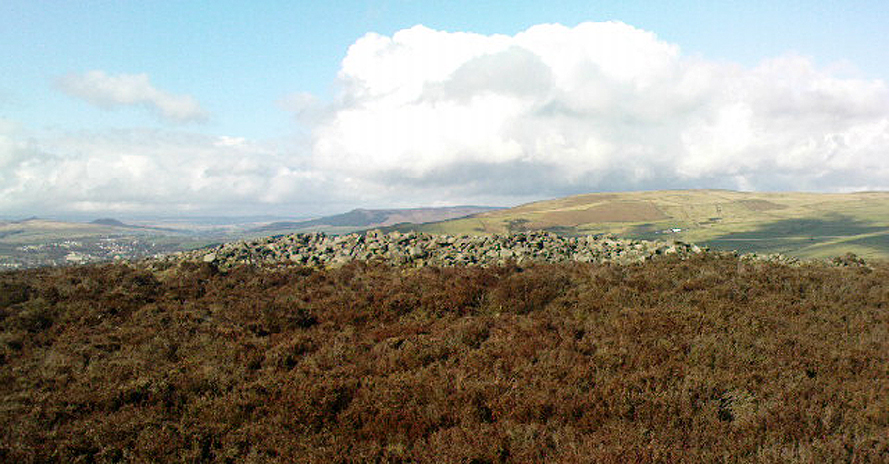
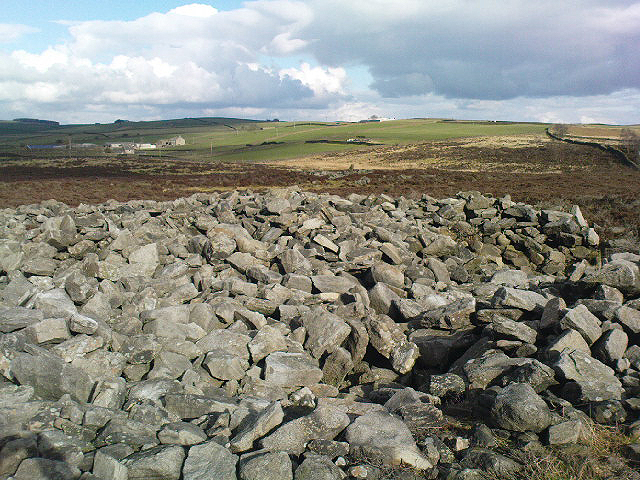
The Black Hill Round Cairn, Bradley Moor - looking north
The Black Hill Round Cairn, Bradley Moor – looking north

Getting Here

Various ways here.  Best is probably taking the footpath onto Farnhill Moor a few hundred yards east of Kildwick Hall.  Head for the cross-bearing Jubilee Tower (supposedly built upon an ancient cairn), NW, keep going past it uphill until you reach the walling 350 yards north, where a seat let’s you have a rest.  Climb over the wall! Alternatively, walk eastwards and up through the steep but gorgeous birch-wooded slopes of Farnhill Wood; and as the moortop opens up before you, the great pile of rocks surmounts the skyline ahead. You can’t miss it! (NB: the spot cited on the OS-map as the cairn is in fact another site, 100 yards NW)

Archaeology & History

Its an awesome place in an awesome setting. You can see 360-degrees all round from this giant mass of rocks — something which was of obvious importance to the people who built it. If it had been placed 20-30 yards either side of here, that characteristic would not occur. Indeed, this is the only place anywhere on these moors where such a great view was possible. Important geomancy, as they say (or whatever modern term they give it these days).

Bradley Moor Cairn - looking down to the Long Cairn
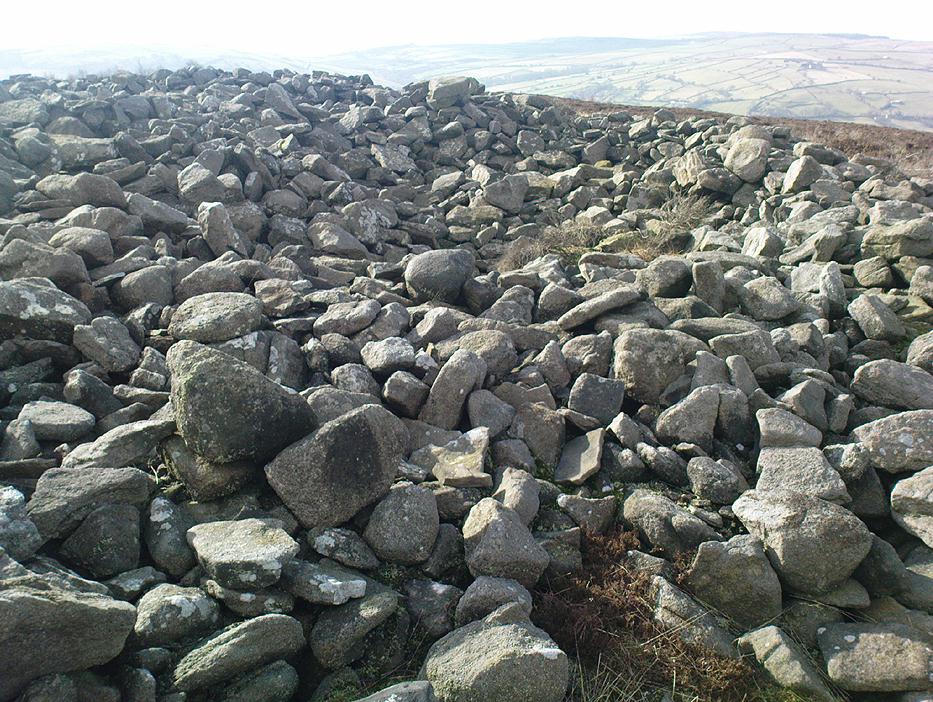
Bradley Moor Cairn – looking down to the Long Cairn
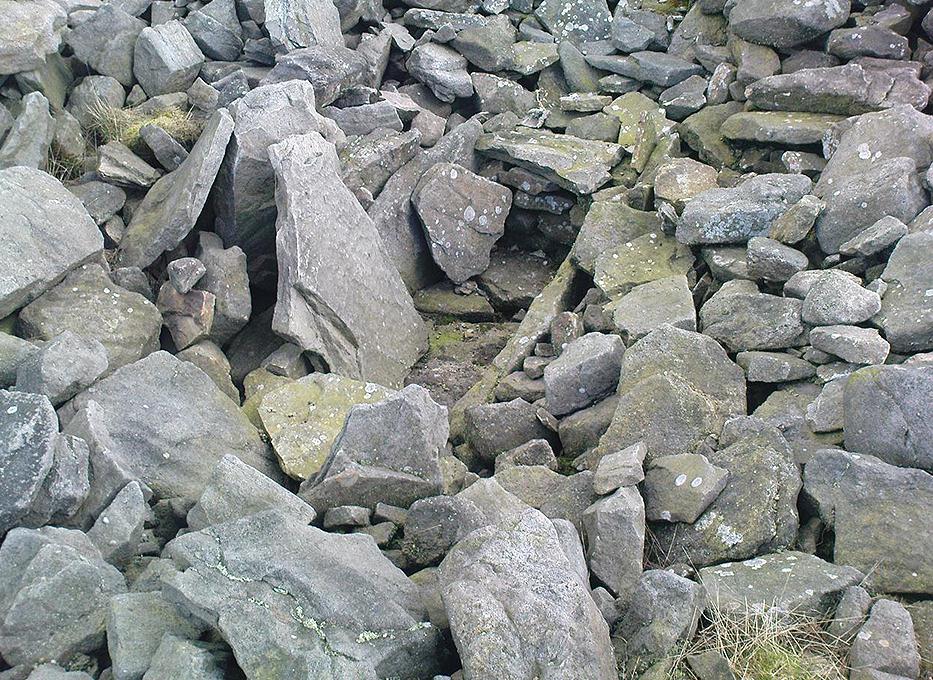
Small section of the old cairn

Although the tomb is still of considerable size (at least 100 feet across) and made up of thousands of stones, it has been severely robbed of stone in years passed, for walling and other building materials.  A number of other small cairns scatter the heathlands a few hundred yards roundabout this central giant (though are hard to find in the deep heather); and there is a distinct cairn circle about 100 yards to the northwest, which has yet to be excavated.  This cairn circle can be made out quite easily if you stand on the ridge about 30 yards west of here, looking down the slope.  An then of course we have the equally huge  Black Hill Long Cairn, less than 100 away, aligned northwest-southeast, which obviously had an important archaeological relationship with this giant round cairn.  Also around this and the adjacent long cairn, numerous flints and scrapers have been found, showing humans have been here since at least the early neolithic period.  And recently, what seems to be a fallen standing stone has been found laying in the heather, 168 yards to the north.

This site in particular gives me the distinct impression that it was the most important of the various sites upon these moors. It’s got a distinctly female flavour to it – and it’s old name of the Queen’s Cairn seems just right.  Maybe it’s the fact that when I first visited the place, a great thunderstorm broke through the previously perfect skies, scattering lightning bolts all round for perhaps thirty minutes — so I stripped myself naked and reached my arms out-stretched, cruciform, screaming to the skies in the pouring rain!  Thereafter, no clouds appeared in the skies for the rest of the day.  It was a brilliant welcome to the place!

References:

  1. Cowling, E.T., Rombald’s Way, William Walker: Otley 1946.
  2. Keighley, J.J., ‘The Prehistoric Period,’ in Faull & Moorhouse’s West Yorkshire: An Archaeological Survey, I, WYMCC: Wakefield 1981.
  3. Raistrick, Arthur, ‘Prehistoric Burials at Waddington and Bradley,’ in YAJ 119, 1936.

© Paul Bennett, The Northern Antiquarian

Clach na Glaistig, Iona, Argyll

Legendary Rocks:  OS Grid Reference – NM 262 222

Also Known as:

  1. Glaistig’s Stone

Folklore

One of the best known supernatural creatures in the Scottish Highlands and Islands was one called the Glaistig: an elemental described variously as, “a thin, grey woman with yellow hair reaching to her heels and attired in green raiment”; or a deity both beneficial and dangerous, “often described as half-woman, half-goat.”  Katherine Briggs (1979) wrote that sometimes this creature

“sometimes has the attributes and habits of the Cailleach Bheur, sometimes assumes animal form, often that of a goat, but more often she is described as half-woman, half-goat.”

Something decidely shaman-like!

In many of the places where she was found, she would tend for the cattle and in order to appease her, local people would pour milk into the hollowed stones by which she lived (at some places these were cup-and-ring stones).  The Iona Glaistig was no exception.  The great Scottish writer A.A. MacGregor (1947) mentioned this creature and its stone in one of his classic books, saying:

“In the shieling days of Iona when, during the summer months, the inhabitants of the east end and of the west end of that island were wont to pasture their cows alternately for fourteen days on the common grazing at a spot known as Staonnaig, a Glaistig dwelt in a hollow rock near at hand. For this Glaistig, the Iona women at milking-time each evening poured a little milk on what is still pointed out at the Glaistig’s Stone.”

This “pouring of milk” onto hollows in stones is a custom found in cultures from Europe eastwards into India and, no doubt, even further afield.  The precise whereabouts of this sacred stone remains hidden.

References:

  1. Briggs, Katherine, A Dictionary of Fairies, Penguin: Harmondsworth 1979.
  2. MacGregor, Alasdair Alpin, The Peat Fire Flame, Ettrick Press: Edinburgh 1947.

© Paul Bennett, The Northern Antiquarian

Holy Well of Isle Maree, Loch Maree, Ross & Cromarty

Holy Well:  OS Grid Reference – NG 9310 7236

Also known as:

  1. Canmore ID 12049
  2. Mourie
  3. St. Maelrubha’s Well

Getting Here

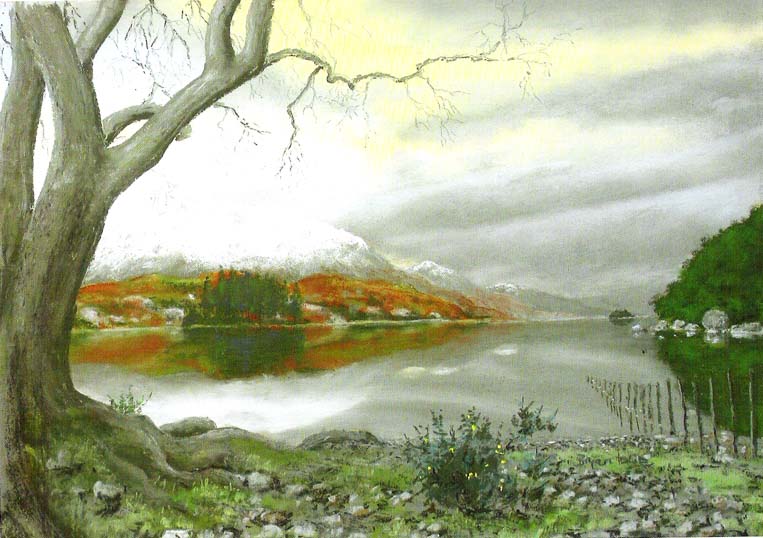
Loch Maree, looking south. Painting © Bryan Islip
Loch Maree, looking S. Painting © Bryan Islip

We were up here again in July 2009, but I’ve still not been across onto the island itself — just stared from the lochside, dying to swim across and spend a night or three alone on the island amidst this legendary landscape.  Basically, get to Talladale on the A832 (halfway between Gairloch and Kinlochewe), then walk up to the loch-side to your right (east) for a mile till you reach the small wooded outcrop.  Look north, betwixt the two isles and its the one in the middle with the Crag of the Bull and Maire’s Cairn rising up the mountain face behind.  But you can reach it via a boat trip from one of the local harbours.  Staying there overnight however, would seem more troublesome.  It seems that a winter visit seems best!

Folklore

This ‘holy well’ has a prodigious occult history which, sez my nose, is still maintained by one or two old Highland folk up here.  This small island (one of many in this long loch) was the Isle of the Druids in old days: legend telling it to be the teaching ground of these shady priests. Even the Iona druids came here. The main relics on on the island are the old holy well, accompanied by an old legendary tree into which all local people flocked and wedged coins at least once in their life. This devotional rite eventually took its toll, with so many of the coins covering the old tree with metallic scales to a height of nine feet, eventually killing it.

The well itself was said to cure insanity — no doubt the remedial quality given to the waters after neophyte druids had spent many days of ritual solitude here, eventually sipping its life-giving fluid to revive them from their ordeal.

It eventually became sanctified by the Church: legend saying it was St. Maelrubha (the same dood who turned the healthy Applecross heathens into church-goers) who was the guilty party.  Indeed, the name Maree itself, was proclaimed as deriving from this old saint, though local lore tells it to derive from the pagan ‘ane god Mourie.’

Elizabeth Sutherland (1985) reported that remains of the sacred tree were still visible. It is also said that no-one makes ritual commemmoration here anymore. Hmmmm… don’t always believe what you read.

In the 18th century, when Thomas Pennant visited this sacred well, he described that,

“in the midst is a circular dike of stones… I expect the dike to have originally been druidical, and that the ancient superstition of paganism had been taken up by the saint (Maelrubha) as the readiest method of making a conquest over the minds of the inhabitants.”

References:

  1. Dixon, John, Gairloch in North-west Ross-Shire, Co-op: Edinburgh 1886.
  2. MacKenzie, Kenneth C., Loch Maree: The Jewel in the Crown, privately printed 2002.
  3. MacKinlay, James M., Folklore of Scottish Lochs and Springs, William Hodge: Glasgow 1893.
  4. Morris, Ruth & Frank, Scottish Healing Wells, Alethea: Sandy 1982.
  5. Pennant, Thomas, A Tour in Scotland and Voyage to the Hebrides, MDCCLXXII, John Monk: Chester 1774.
  6. Polson, Alexander, Gairloch, George Souter: Dingwall 1920.
  7. Sutherland, Elizabeth, Ravens and Black Rain, Constable: London 1985.
  8. Watson, W.J., Place-Names of Ross and Cromarty, Northern Counties Printing: Inverness 1904.

* This beautiful painting is one of many done by local artist, Bryan Islip.  It is taken from his 2010 Calendar, Scotland’s Wester Ross, and is available direct from him. If you’d like to know more, or want copies of his calendar or other artworks, email him at:  pico555@btopenworld.com – or check his website at www.picturesandpoems.co.uk

© Paul Bennett, The Northern Antiquarian
Painting © Bryan Islip


Man Stone, Askwith Moor, North Yorkshire

Cup-and-Ring Stone:  OS Grid Reference – SE 16722 50595

Also Known as:

  1. Carving no.516 (Boughey & Vickerman)

Getting Here

Man Stone (by Inmaculada Ibanez-Sanchez)

Truly takes a bit of finding this one!  I s’ppose the easiest way to locate it is by approaching it from the south, from Askwith village, up Hall Lane.  Keep walking up the footpath to Top Moorside Farm; then past it, sticking to the same path.  A hundred yard or so past here we get onto the moor itself.  As you hit the moor, you’ll see that the land rises slowly ahead of you: this is Hollin Tree Hill and you need to walk up here (don’t do this in the summer as it’ll be covered in bracken and you’ll not find a damn thing!).  Just before the land starts to levels-out at the top of this small rise, you’ll come across some hut circles.  You’re here!

Man Stone
image courtesy of Graeme Chappell

You can also come to this carving via the Askwith Moor parking-bit, then walk along the well-trod footpath, past the triangulation pillar of Shooting House Hill for a coupla hundred yards, then walk straight south into the moor.  But to those of you who aint got the nose for it, there’s no footpaths here and some folk might easily lose their way.  However, if you reach the rise of Hollin Tree Hill a few hundred yards down the moor, watch out for those same hut circles mentioned elsewhere atop of the rising land.  You’re damn close!

Archaeology & History

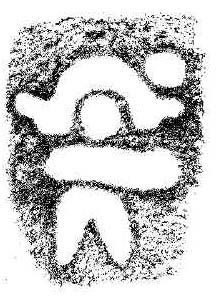
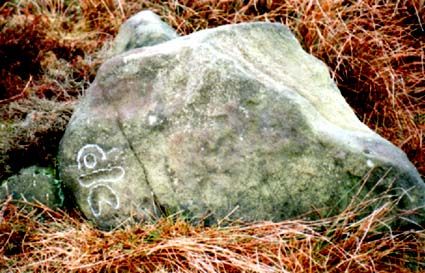
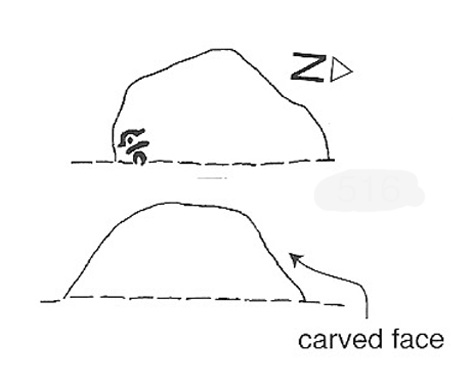
One of my very favourite cup-and-ring carvings this one!  It was discovered about 1991 when Graeme Chappell and I were on one of our many archaeology wanderings, seeking out prehistoric remains on the moors north of Ilkley.  First described and illustrated in Bob Trubshaw’s (1996) archaeomythics journal, it was later included in The Old Stones of Elmet (2001: 149-152).  But when we first found it, this carving – on the vertical face of a small stone, beside an unexcavated hut circle – sent me a bit crazy, as the ‘human’ image in the carving struck me immediately. Needless to say, Graeme was all calm about it while I jumped around like an excited tit!  As far as we’re aware, this is the earliest representation of a human figure in the British Isles.  There are several other contenders in cup-and-ring design, but this seems the most probable of the lot.  Graeme Chappell took a rubbing of the stone several years after we’d found it and the outline clearly shows the image of a human figure.  The carving was later catalogued by rock art students Boughey & Vickerman (2003) in their  Yorkshire survey as ‘stone 516.’  A female compatriot, the Woman Stone, can be found a few hundred yards east of here, at the bottom of the slope by the near horizon.

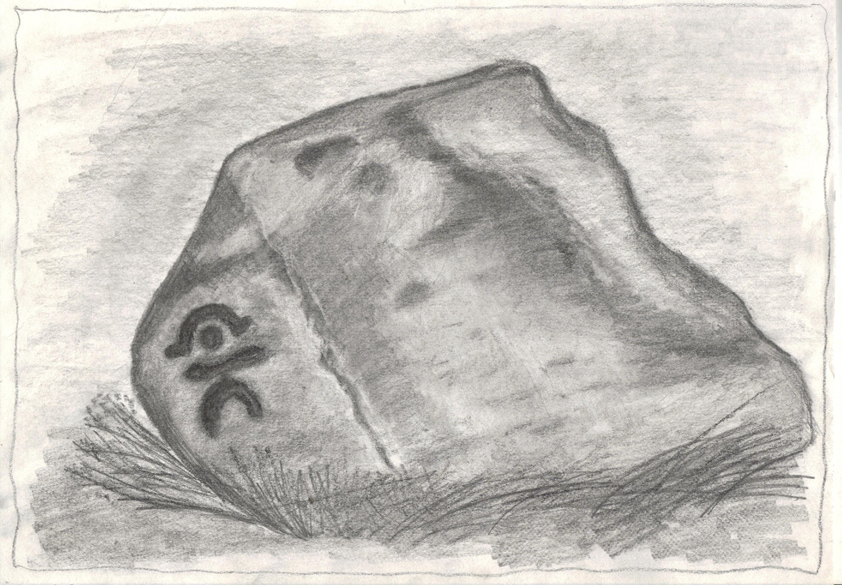
The fact that the carving occurs on the southern vertical face of a prehistoric hut circle may have had some significance about the structure itself.  Petroglyphs on hut circles are rare—and this one occurs right at the entrance to the structure, the door into the circle.  It may represent an image of the person who lived in this hut circle, or perhaps symbolized the nature of the character living there.  The carving shows that the person was wearing a head-dress, akin to a horned-man figure – but much much earlier than anything previously recognised in British iconography.  The figure may well be a shaman who, perhaps, lived at this circle.  The carving was probably painted in lichens and other dyes

The Man Stone carving
Boughey & Vickerman sketch

Be careful not to wander around looking for this when there’s fog on the hills.  You’re unlikely to find it!  On an excursion up here several years back with Prof. Thomas Dowson and students from the Southampton University Rock Art course, we wandered about all over the place in the dense fog but were unable to find the damn thing!  Twas a bittova freaky day, as half the students started crying (they thought I’d got them truly lost in the middle of nowhere as I didn’t have a map, a compass, walking boots, etc – which is how I usually do my wanderings, but they weren’t to know that!) and we must have walked within 10 yards of the carving, but it remained hidden from our prying eyes.  But if you like your rock art, check this one out!

References:

  1. Bennett, Paul, The Old Stones of Elmet, Capall Bann: Milverton 2001.
  2. Boughey, Keith & Vickerman, E.A., Prehistoric Rock Art of the West Riding, WYAS 2003.
  3. Trubshaw, Bob, “Unique British Anthropomorphic Rock Carving”, in At the Edge, no.4, December 1996.

© Paul Bennett, The Northern Antiquarian