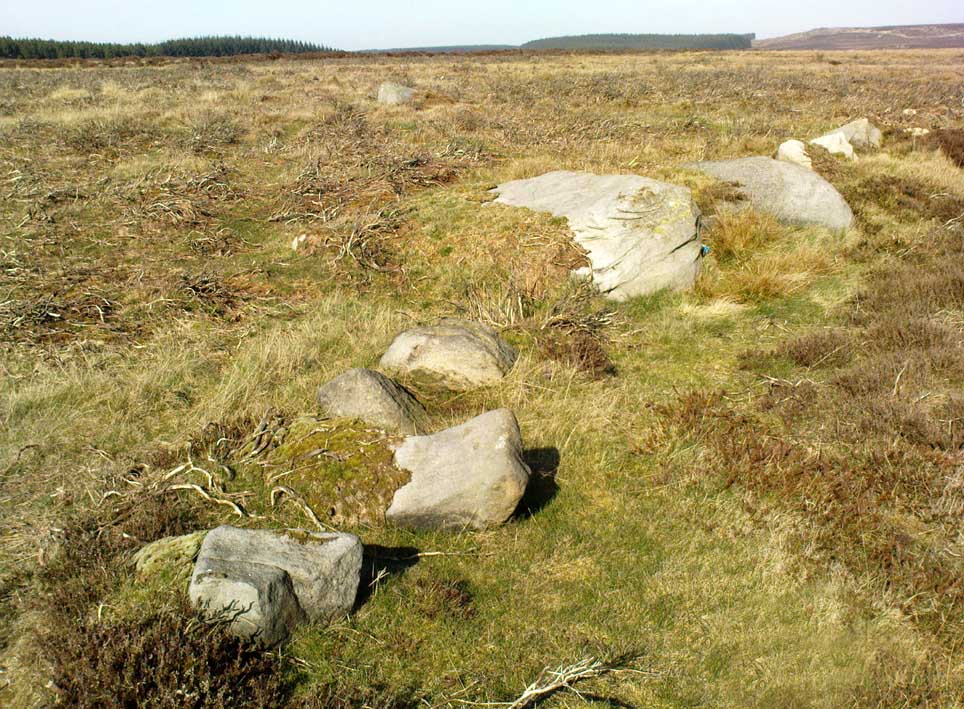
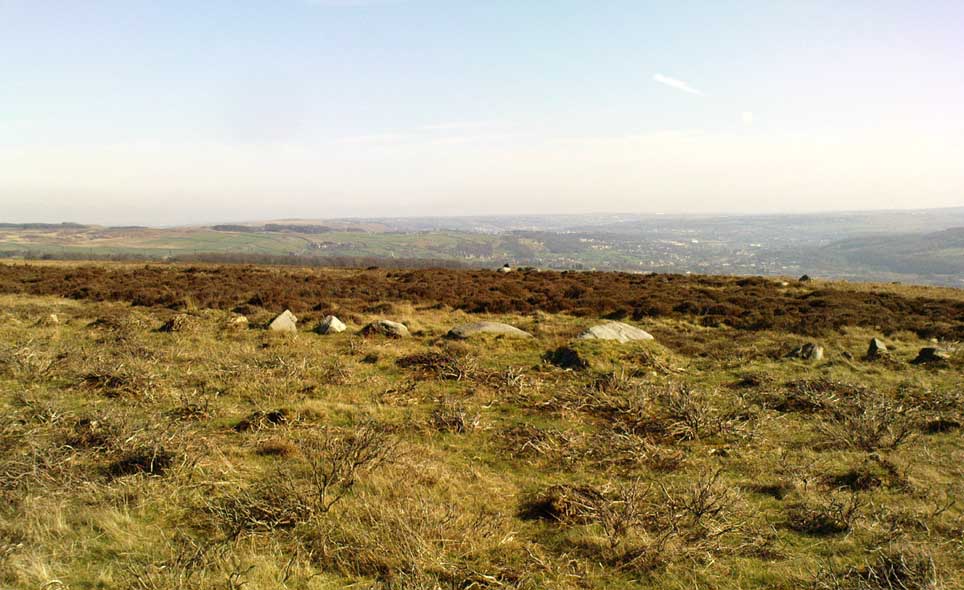
West Woods 02, Calverley, Leeds, West Yorkshire

Cup-and-Ring Stone (lost):  OS Grid Reference –SE 1956 3734

Getting Here

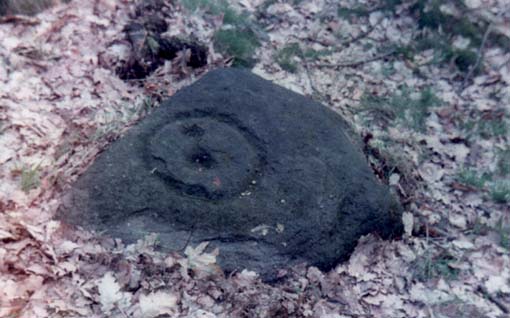
Old photo of lost carving

Although now seemingly lost, it’s location is damn close to this: Along the A657 between Greengates and Bradford, where the New Line meets Carr Road, the dirt-track takes you into Calverley Woods, down Eleanor Drive. About 250 yards along (just before you get to the field on the left), take the footpath down the embankment towards the stream where it bends to the left and where the land levels out (don’t cross the stream). It’s somewhere round there!

Archaeology & History

This was one of two previously unrecognised carvings we came across sometime in 1985 (see West Woods 1 stone), when we were seeking out another missing carving in the same woods.  It was clear and well-defined as the faded photo here shows; but having been back to try find it twice in the last two years in the hope of getting better photos, I’ve been unable to locate it.  The carving was described in an article I did in an old earth mysteries magazine.  It comprises simply of a large ring surrounding and enclosing two deep cups, which were linked to each other by a connecting carved line.  Parts of the stone had been chipped in parts—including a section of the large ring— due to some industrial workings that had happened here in the past. Thankfully I managed to find the old photo and hopefully, perhaps, some local explorer could try and seek out where it’s hiding beneath the trees and other vegetation.

References:

  1. Bennett, Paul, “The Undiscovered Old Stones of Calverley Woods,” in Earth no.2, 1986.

© Paul Bennett, The Northern Antiquarian
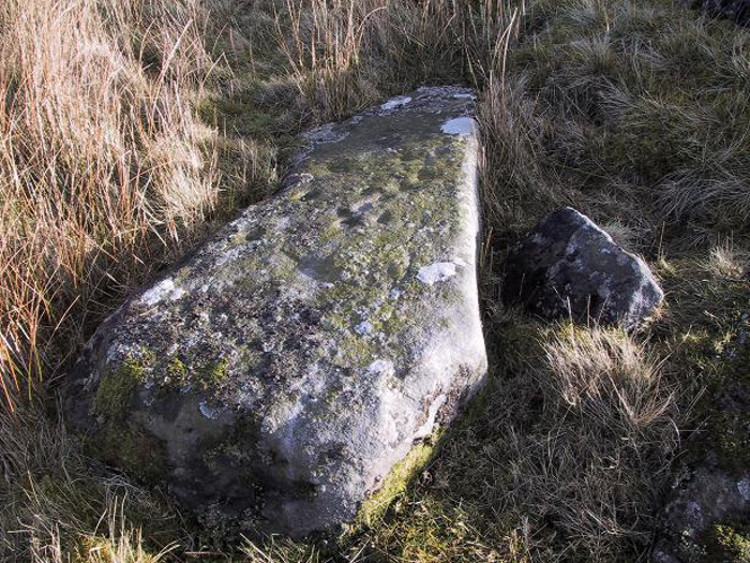

Wester Auchleskine, Balquhidder, Perthshire

Cup-Marked Stone:  OS Grid Reference – NN 54584 20876

Also Known as:

  1. Canmore ID 24154

Getting Here

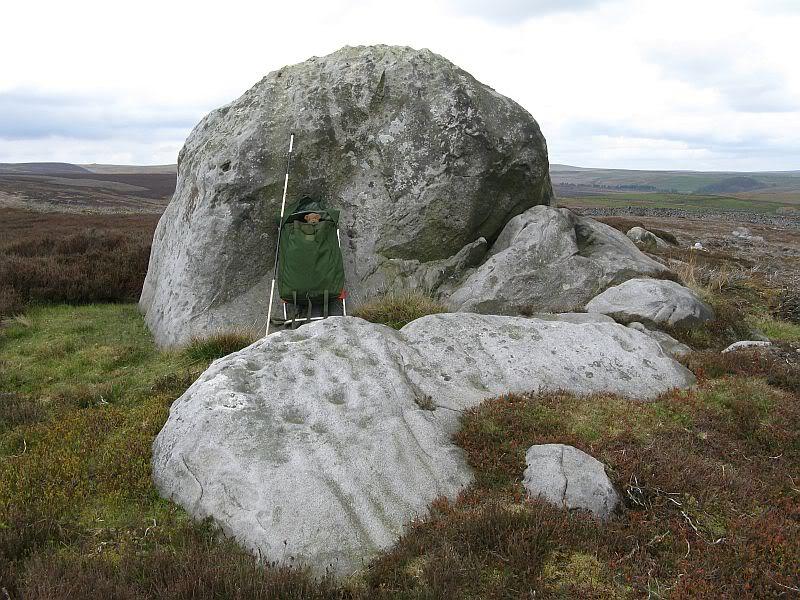
Wester Auchleskine cup-marked stone

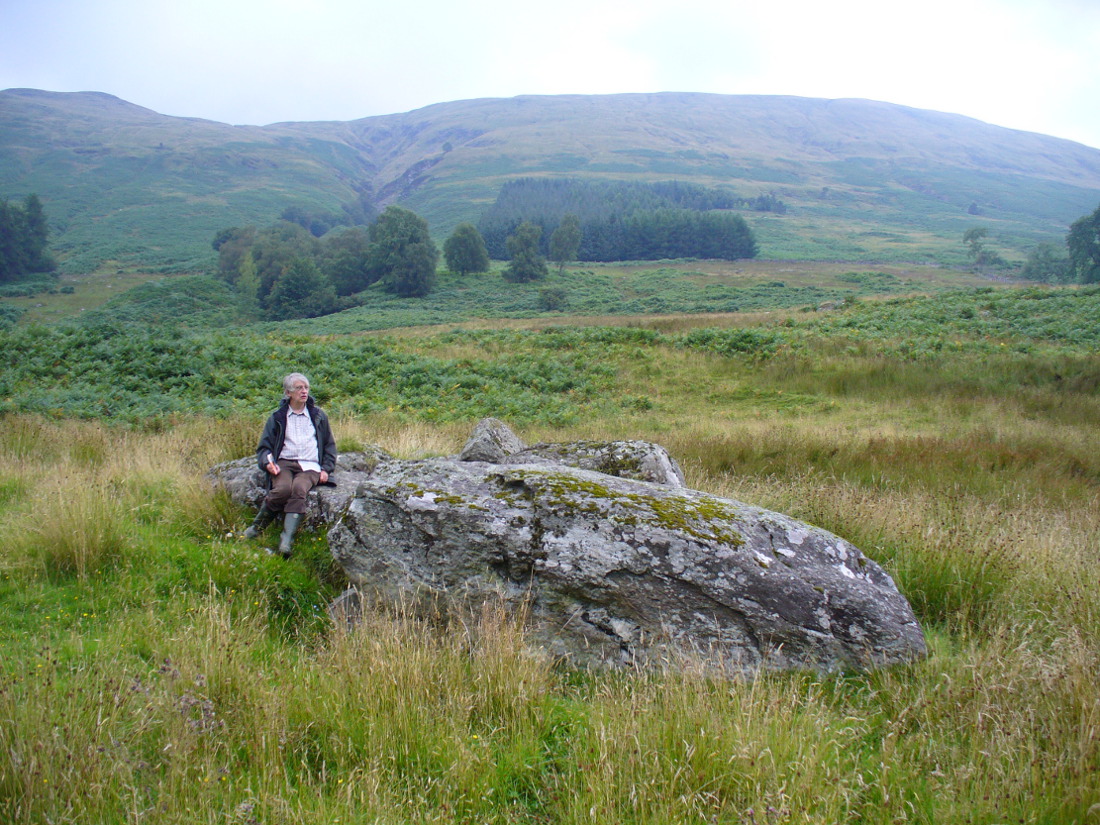
From Balquhidder village, walk eastwards along the road for a few hundred yards until you reach Auchleskine Farm on your left.  A short distance past here there’s a gate taking you into the rough field on the left. Go through here and note a large clump of rocks diagonally up the slope about 100 yards away.  That’s your spot!

Archaeology & History

Very little has been said of this large cup-marked stone, just up from the road near Balquhidder.  It was first found and described in J.M. Gow’s (1887) fine essay on the local antiquities of the area, where he told:

“About 400 yards directly east from the farm-house there is a group of three large water-worn boulders of coarse mica-schist, with veins of quartz, the largest of which is about 15 feet long, 7 feet broad, and nearly 5 feet above ground. On the top of this stone there are seven cup-marks of various sizes. The largest are 5 inches in diameter and 2 inches deep; the smaller ones are shallower and from 1½ to 2½ inches in diameter. There may have been more marks on this stone, as a portion of the top near the marks has been broken off, and there are several other faint hollows, but, in my opinion, not sufficiently pronounced to indicate that they ever were cups.”

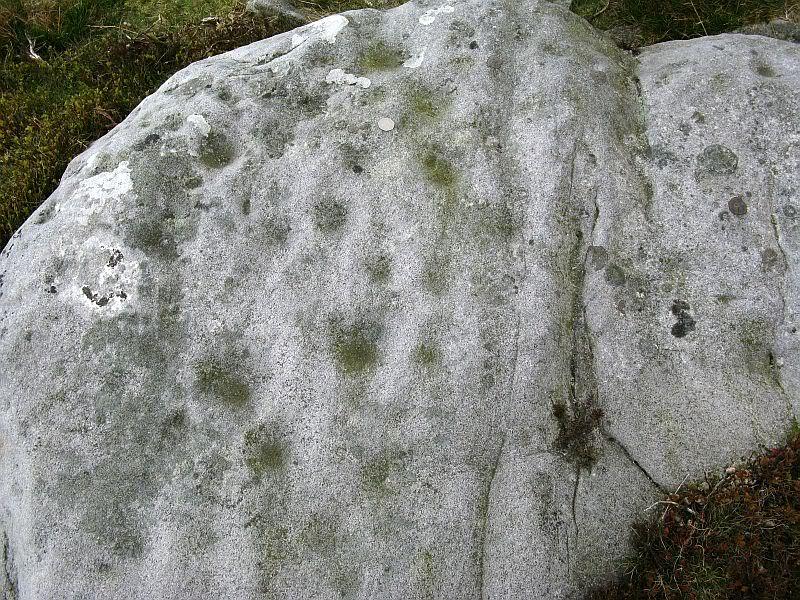
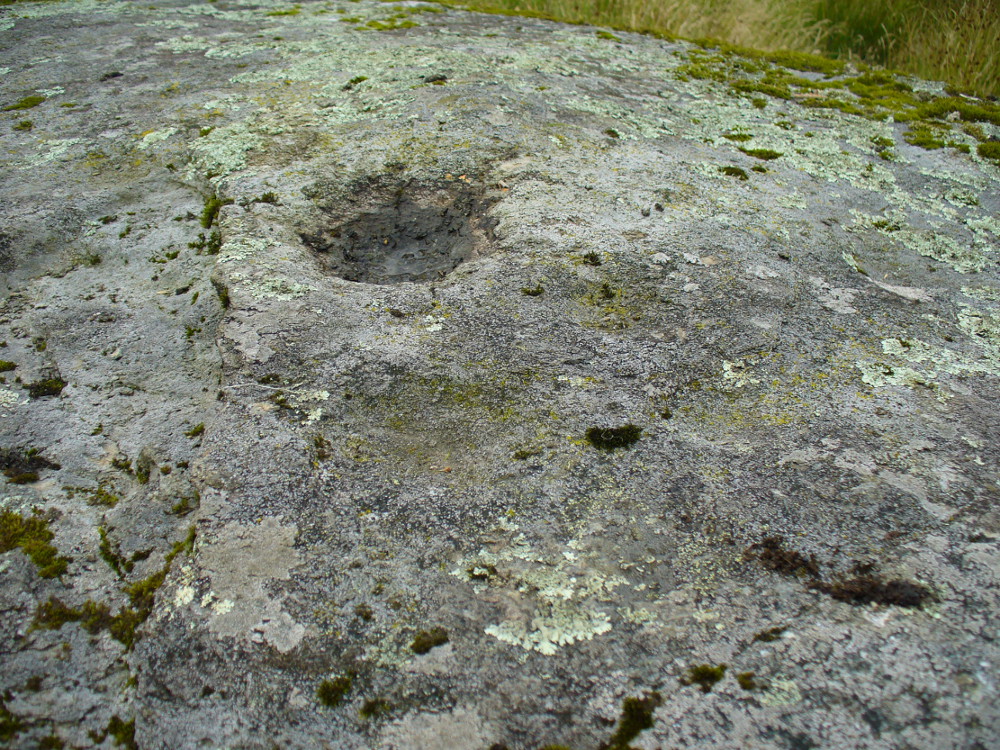
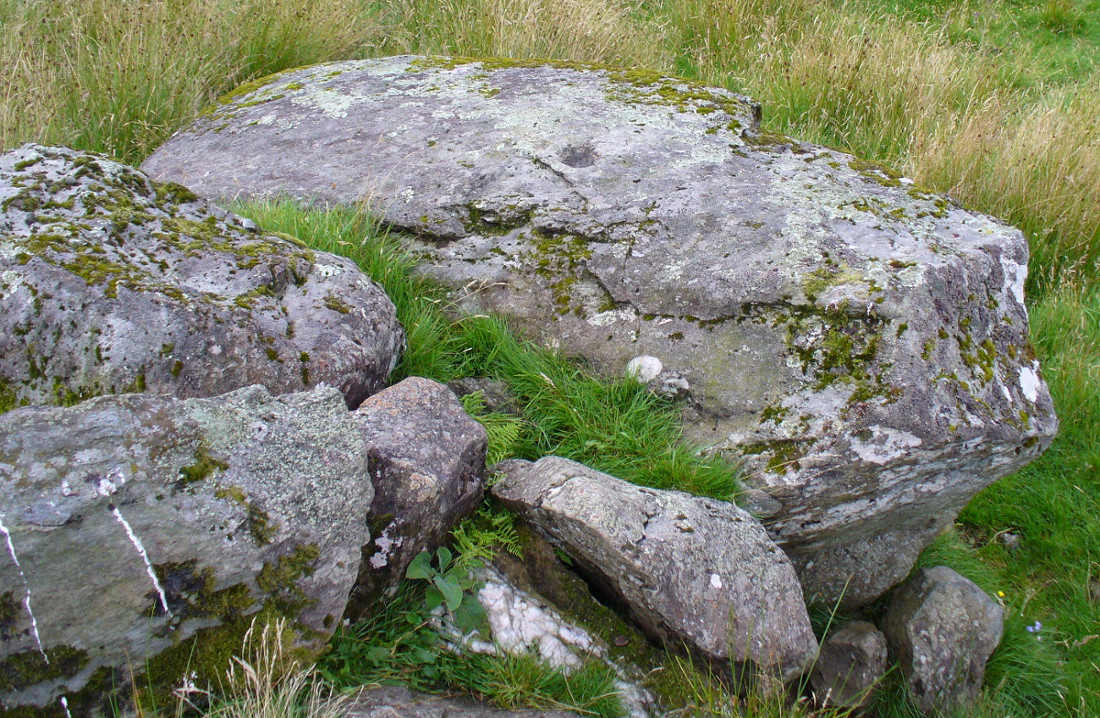
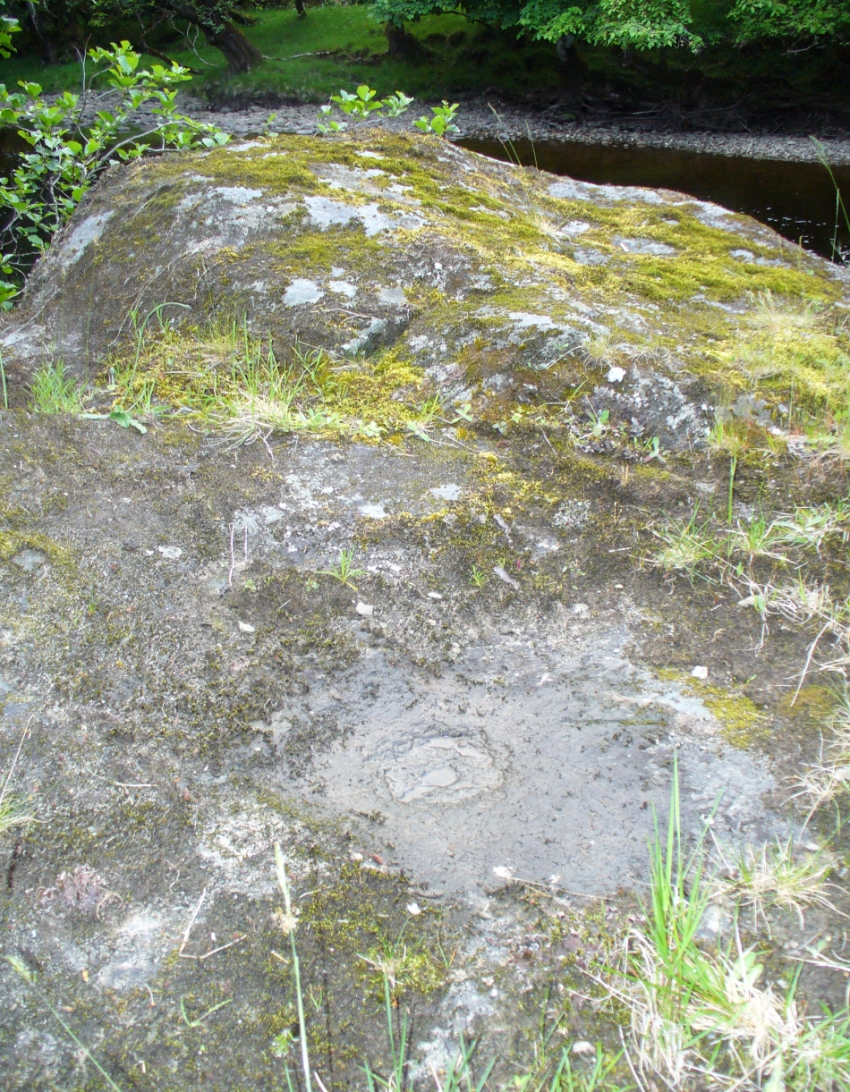
Cupmarks on top of the rock
The carving from above

Although his caution on the number of cups on the stone is to be commended, it was obvious during our visit to the site a few days ago that there are at least 18 cup-marks on the surface of this large rock.  There may be more (the grey cloudy day and misty light wasn’t good in allowing us to see the carving clearly). The most pronounced of the cups are on the very top of the stone, whilst others were carved mainly on the eastern slope of the rock.

At least two other cup-marked stones occur at the farmhouse itself, whilst on the road immediately below was once the cup-marked healing stone known as Clach nan Sul. It’s likely that other carvings are hiding away in the hills hereby…

References:

  1. Gow, James M., “Notes in Balquhidder: Saint Angus, Curing Wells, Cup-Marked Stones, etc”, in Proceedings of the Society of Antiquaries Scotland, volume 21, 1887.

© Paul BennettThe Northern Antiquarian 


Panorama Woods (231b), Ilkley, West Yorkshire

Cup-Marked Stone:  OS Grid Reference – SE 10378 47027

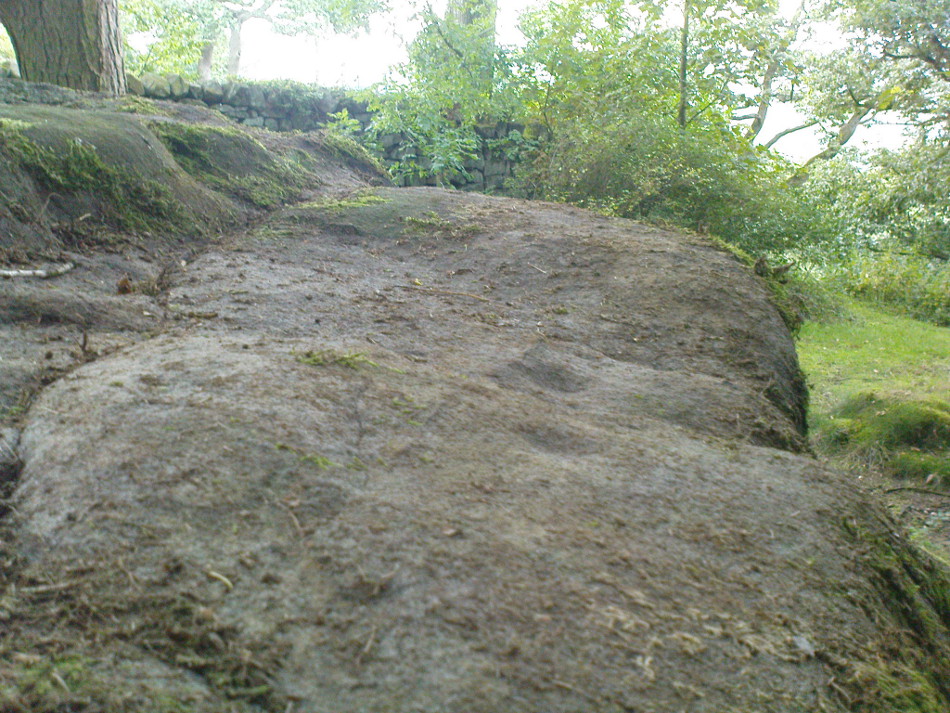
The rock in question

Getting Here

Follow the directions to reach Panorama Woods carving 232.  Barely a yard or two southwest across the small gap where the kids have their little den or hideout, this long curvaceous rock is the fella in question.

Archaeology & History

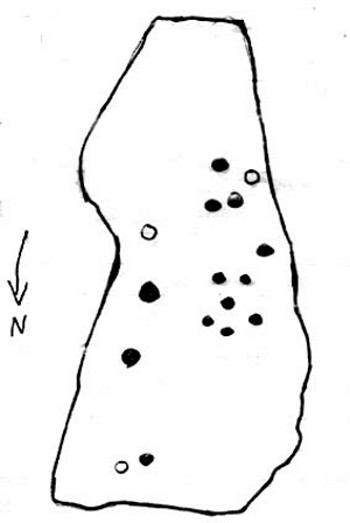
Cup-markings on the rock

Curiously not included in the ‘official’ records, this large piece of rock, living right in between the Panorama Woods carvings 231 and 232, has at least two, possibly three faint cup-marks etched in the top northeastern portion of the rock.  Of the same style and probably period as the basic designs on stones 230 and 231, this is one in a cluster of petroglyphs that used to live at the edge of a prehistoric enclosure, destroyed at the end of the 19th century.

References:

  1. Bennett, Paul, Of Cups and Rings and Things, unpublished: Shipley 1981.
  2. Bennett, Paul, The Panorama Stones, Ilkley, TNA: Yorkshire 2012.

© Paul Bennett, The Northern Antiquarian

Panorama Woods (232), Ilkley, West Yorkshire

Cup-and-Ring Stone:  OS Grid Reference – SE 10380 47027

Also Known as:

  1. Carving no.62 (Hedges)
  2. Enclosure Carving

Getting Here

Panorama Woods Enclosure Carving

Take the Wells Road from Ilkley centre up towards White Wells, bending to the right as you hit the edge of the moor. Keep along the road, past the old college building with its lake and turn right up Westwood Drive.  Keep going all the way up till you hit the small woodland on your right. Where the woodland ends – stop!  Walk into the trees about 10-15 yards and you’ll see the large rocks ahead of you. Amongst other petroglyphs hereby, you’ll find this carving is on one of them.

Archaeology & History

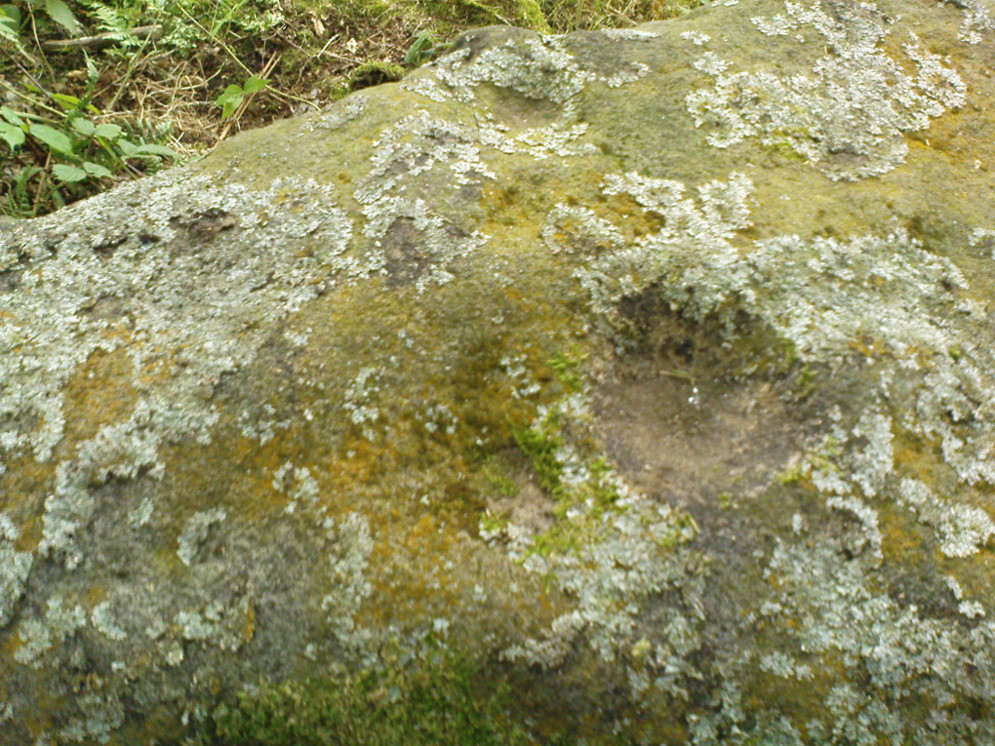
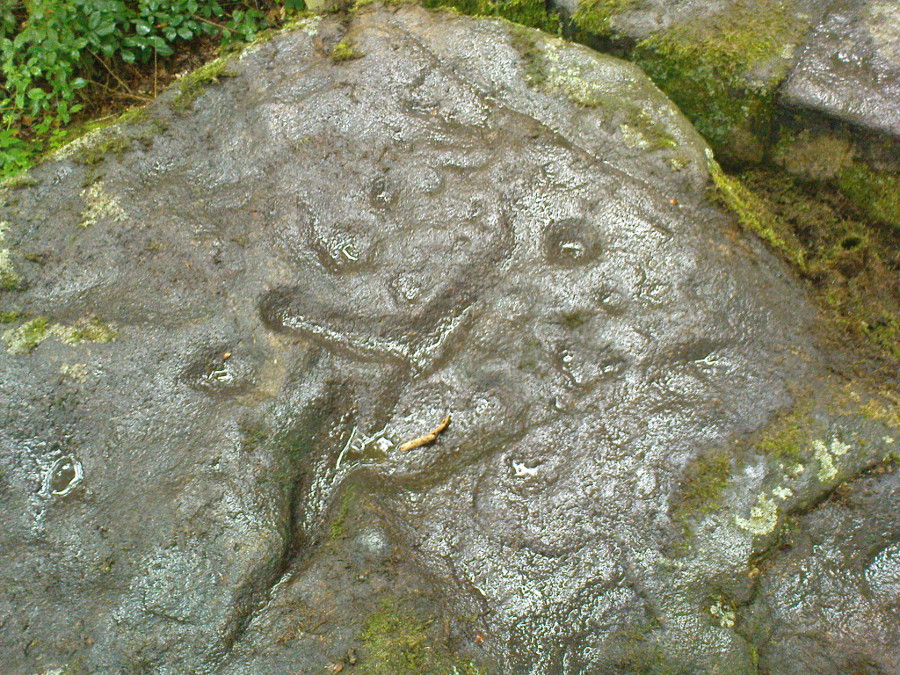
Close-up of deep cups & grooves

Although only given the usual dry description by our academic catalogue chaps, there’s something about this design that I’ve always liked.  We first came across it ourselves in the late 1970s, in search of the legendary Panorama Stones, and found instead this large enclosure design with at least three cups inside it, still clearly visible. It is one of a cluster of carvings hereby, all of which were once adjacent to a prehistoric enclosure, described in the 1880s and destroyed soon after.  This and the associated carvings very probably had some archaeocentric relevance to the lost enclosure.

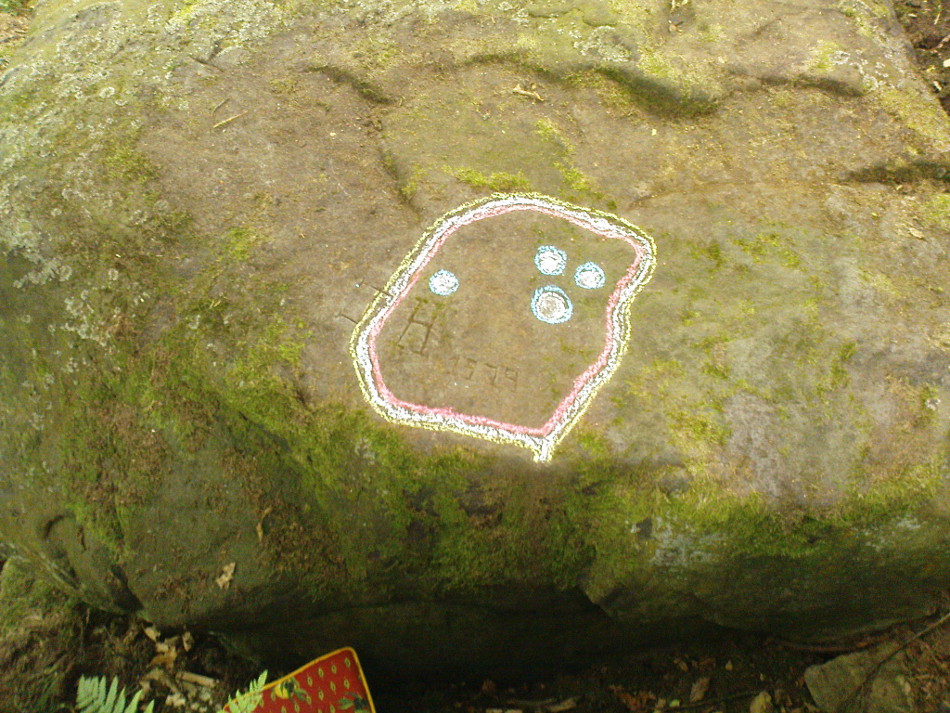
Large carved 'enclosure', recently chalked
Large carved ‘enclosure’, recently chalked
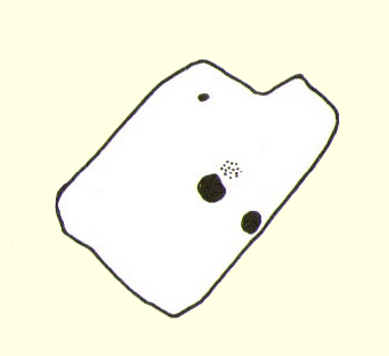
Drawing of the carving (after Hedges 1986)

The carving is sandwiched in between its petroglyphic companions, stone 231 and stone 233.  As can be seen on some of the photos here, more recent vandalism has been inflicted on this carving and the recent chalk colouring is what local archaeologists Gavin Edwards and Alex Gibson have termed “social history”, implying fallaciously that cup-and-ring art could be seen as little more than neolithic and Bronze Age scribblings on rock, without any meaning other than it being comparable to “Leeds United Rules OK.”  They may be right (highly unlikely) – but in reading copiously about prehistoric petroglyphs in cultures beyond the UK, we find that traditional societies tell such carvings relate to their creation myths, or river spirits, or rock spirits, and are intrinsically related to wider animistic cosmologies and social customs.  This indicates, to me at least, that modern archaeologists who think of rock art as little more than childish scribblings still have a great deal to learn and we should beware their uneducated musings about our ancient carvings.

Although the complete carved ‘enclosure’ and its internal cups were mistakenly drawn in John Hedges (1986) survey, he described as being a,

“Roughly incised ‘enclosure’ with five cups in it, twenty eight shallow cups or depressions, one large oval marking, three irregular basins.”

In the later work of rock art students Boughey & Vickerman’s (2003), they simply said of the site:

“Large flat-topped, upstanding rectangular rock.  Twenty-eight shallow cups, a few enclosed in two groups by grooves; irregular small basins.”

References:

  1. Bennett, Paul, Of Cups and Rings and Things, unpublished: Shipley 1981.
  2. Bennett, Paul, The Panorama Stones, Ilkley, TNA: Yorkshire 2012.
  3. Boughey, Keith & Vickerman, E.A., Prehistoric Rock Art of the West Riding, WYAS: Wakefield 2003.
  4. Hedges, John (ed.), The Carved Rocks on Rombalds Moor, WYMCC: Wakefield 1986.

© Paul Bennett, The Northern Antiquarian
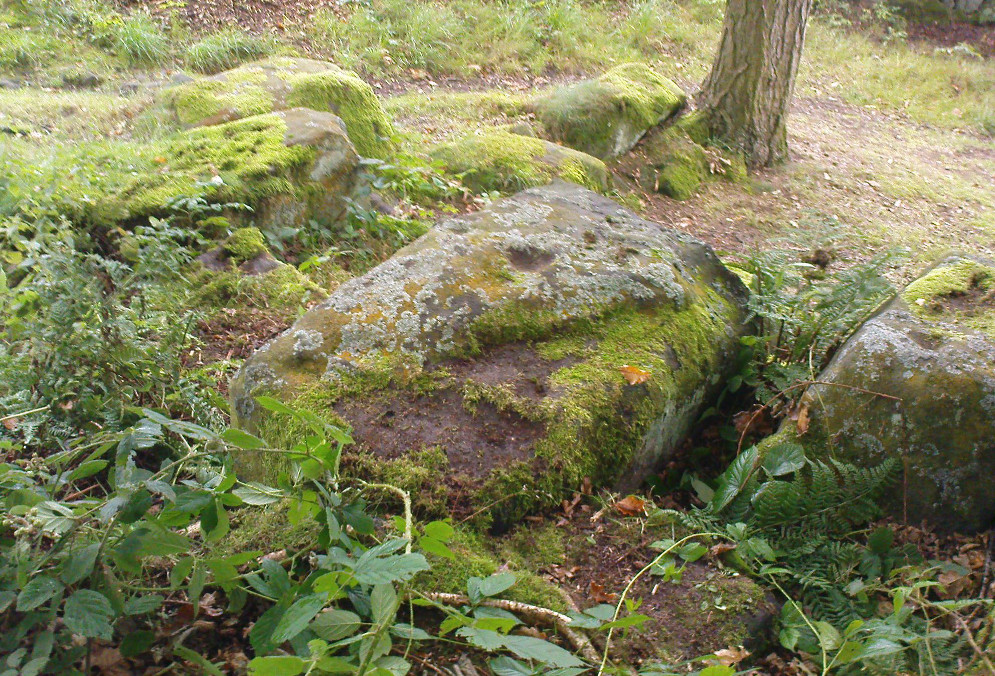

Lady Well, Hartshead, West Yorkshire

Holy Well:  OS Grid Reference – SE 17884 23487

Also Known as:

  1. Ladies Well

Getting Here

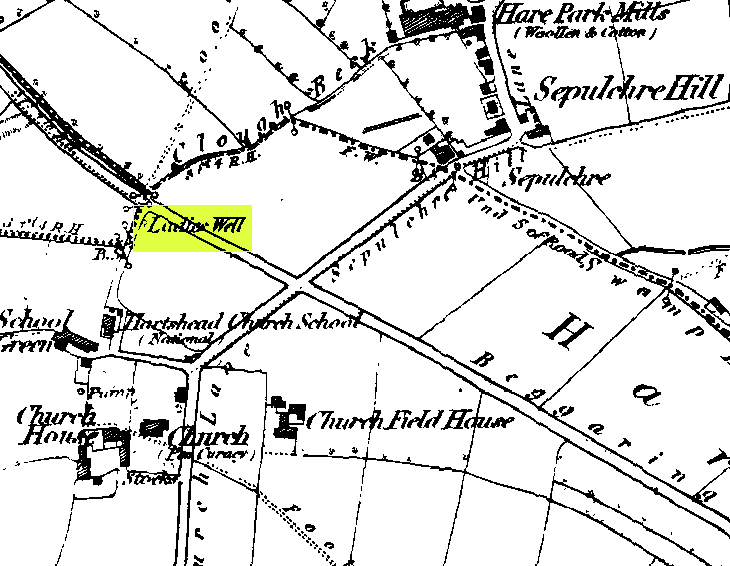
Ladies Well on the 1852 map

This can take a little bitta finding if you don’t know the area. So it’s best starting from Hartshead church, right on top of the hill here.  From whichever direction you’re taking to reach Hartshead, ask a local when you get close and they’ll direct you there. From here, walk out of the churchyard and turn left. Walk barely 50 yards and turn left again along Lady Well Lane. Past the old houses and bear right where it becomes a dirt-track. This then turns left, then again right and – with the fields on either side of you – note the single hawthorn tree ahead of you by the walling. Go into the field at the back of the hawthorn and look under its shady bough. Tis there, I assure you!

Archaeology & History

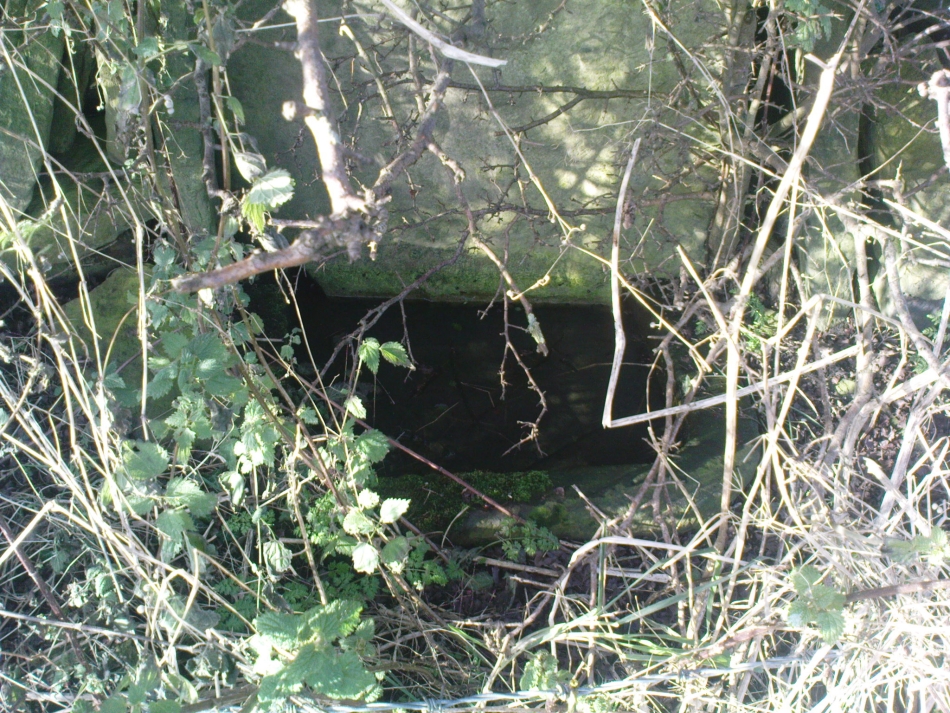
The holy well is beneath this hawthorn tree

Emerging at the edge of the field beneath an old hawthorn tree at the side of the track running to the adjacent church, the waters from here are clean and fresh—though the stone trough into which it flows is constantly clogged up and the ground around it very boggy.  The well has given its name to Lady Well Lane, which leads to the 12th century St. Peter’s Church, with its own ancient and legendary history.  The well is thought to derive its name from ‘Our Lady’, the Virgin Mary, indicating it would have had considerable importance in the religious traditions of the christians who named it, but moreso the original animistic traditions of normal local people who would have used it for much longer…

Close by this old stone trough appears to be another one, covered by moss and the encroaching field.  Whatever medicinal properties the waters may once have had, have long since been forgotten.  Around Lady Well is a healthy abundance of flora: elder, chickweed, nettle, clover, bramble, dandelion, sow thistle, dock and shamanic species.

Folklore

The overgrown Lady Well

Marion Pobjoy (1972), like her predecessors, suggested that this was one of many sites in Calderdale used by St. Paulinus to perform baptisms.  Local folklore tells that Robin Hood stopped here to drink the waters—but then we find an abundance of the pagan outlaw’s activities all round here.  The nearby church of St.Peter is aligned to the equinoxes and may well be an indication of when pre-christian celebrations occurred here.  The yew tree in churchyard was where Robin Hood was supposed to have taken wood to fashion one of his bows.  Modern folklore also ascribes the well to be along a ley line.

References:

  1. Heginbottom, J.A., ‘Early Christian Sites in Calderdale,’ in Proc. Halifax Ant. Soc., 1988.
  2. Pobjoy, Harold N. & Marion, The Story of the Ancient Parish of Hartshead-cum-Clifton, Riding 1972.

© Paul BennettThe Northern Antiquarian


Duncroisk (2), Glen Lochay, Killin, Perthshire

Cup-and-Ring Stone:  OS Grid Reference – NN 53134 35850

Also Known as:

  1. Canmore ID 24169
  2. Duncroisk 3 (Canmore)

Getting Here

Cup-and-rings by the River Lochay

Troublesome to get to unless you’re reasonably fit.  Probably the easiest route is to get to the Duncroisk 3 cup-and-ring stone. Keep walking along the riverside, climb over the first tall wooden fence and onwards till you reach the rocky crag reaching into the river Lochay. By whichever means possible, get yourself up and round this crag, but keep by the riverside till you get to the easier walkable rocky outcrop protruding into the river on the other side of the drop.  Hereby, on one of the stones, look and you’ll find these faint cup-and-ring symbols.

Archaeology & History

Although this carving was first described in Edward Cormack’s (1952) essay on the prehistoric carvings of the district, they have subsequently proved difficult to locate by the Royal Commission lads and other archaeologists.  I’ve been here a few times looking for it and never managed to find it — until last week.  When Mr Cormack first told of the design, he said:

“On a smooth rock surface just above the mouth of the small burn running into the Lochay, immediately west of the cup-marked ridge, are two cup-and-ring markings a yard apart. The rings are curiously rough edged, and do not give the same impression of weathering as those on the ridge; possibly they have been silted over shortly after being cut, and exposed again relatively recently.”

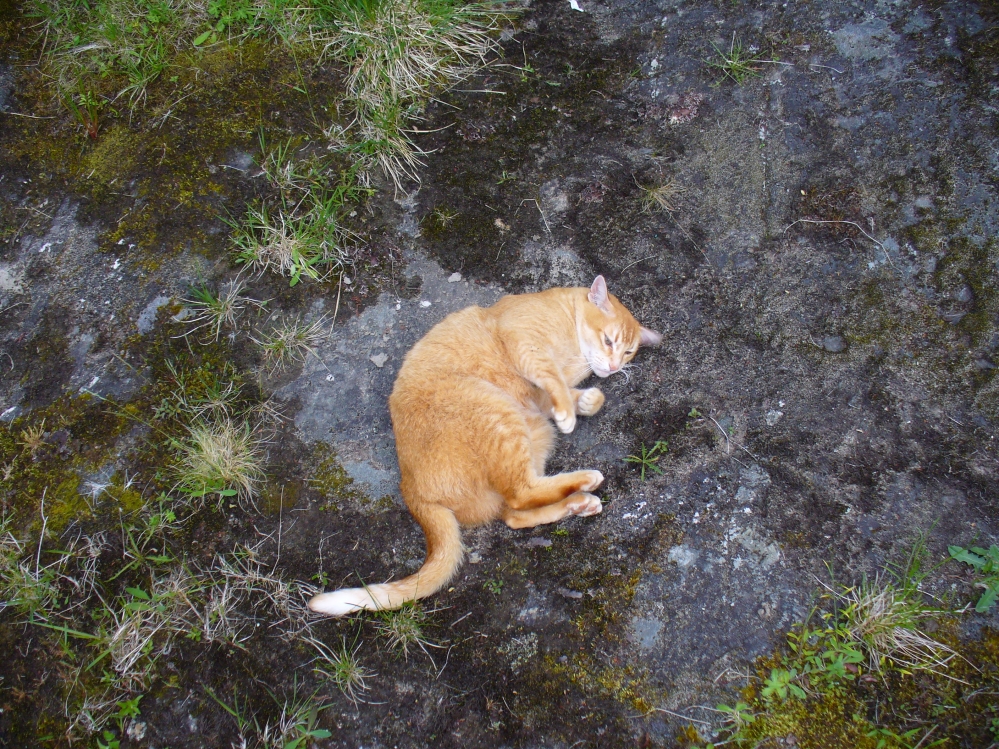
Flambeau the Cat uses the carving as his bed!

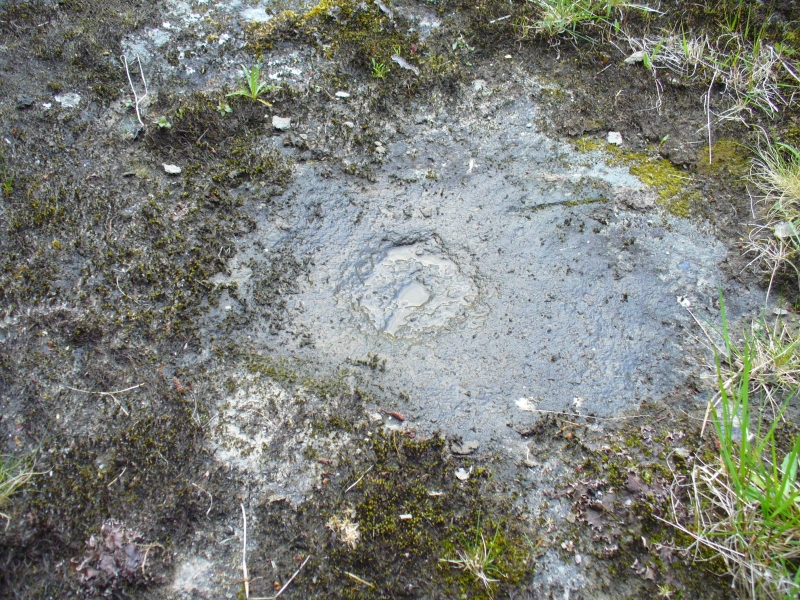
A few decades later, Ron Morris (1981) came across the carving, 10 yards “southeast of an elbow of River Lochay”, as he put it. Described as “hard to find”, he went on to give a basic outline of the design as he saw them, telling there to be “2 cups-and-one-ring, both probably complete, up to 16cm (6in) diameters, with radial grooves from cup to ring—up to 1cm deep.” Or more simply, two cup-and-rings, each with a line running from the centre to the surrounding ring.

After trying to find this carving on several occasions, without success (somehow!), it was brought to my attention under the brilliant guidance of a local cat called Flambeau only last week (no lies!).  In a venture down to the riverside, the great cat (in tandem with Pip the dog, who also ventures out with me to find ancient sites in this region) got to the riverside on the rock in question and began rolling about in the dust on the stone, mewing and purring away merrily!  It was really brilliant to watch. Sincerely heart-warming (soz…but I can’t help it!).

Primary cup-and-ring at Duncroisk-2
Primary cup-and-ring at Duncroisk (2)

I stepped over and complimented him as he looked superb (hence the photo, above) and he just kept purring. Then, curiously, he stood up and began scratching at the dried earth on the rock, mewing away whilst doing this.  Twas very odd indeed.  But there,  exactly where Flambeau has been scratching and rolling about, it seemed a faint cup-mark was apparent.  And such it was!  So I got on my knees and began cleaning away the dirt from the rock — and there, right where he’d been purring and playing, was the lost cup-and-ring carving!

Its location would suggest that the carving had some relationship with water: be that the spirit of the place, or a good site where fish can be had, or a place where someone had drowned, etc.  We’ll probably never know… But it’s a beautiful spot, with the impressive Stag Cottage carvings in the adjoining field, and the newly discovered Corrycharmaig East carvings on the other side of the river — plus many others in the area.

Folklore

The River Lochay where this carving is found is named after a dedication to the Black Goddess, according to Prof. W.J. Watson. (1926)  The stream by the side of the carving which runs into the River Lochay has been the place where faerie music has been heard by local people in times past.

References:

  1. Cormack, E.A., “Cross-Markings and Cup-Markings at Duncroisk, Glen Lochay,” in Proceedings of the Society of Antiquaries, Scotland, volume 84, 1952.
  2. Morris, Ronald W.B., The Prehistoric Rock Art of Southern Scotland, BAR: Oxford 1981.
  3. Royal Commission on the Ancient & Historical Monuments of Scotland, Archaeological Sites and Monuments of Stirling District, Central Region, Society of Antiquaries of Scotland 1979.
  4. Watson, W.J., The History of the Celtic Place-names of Scotland, Edinburgh 1926.

© Paul BennettThe Northern Antiquarian


Rivock Enclosure, Riddlesden, Keighley, West Yorkshire

Enclosure:  OS Grid Reference – SE 0768 4414

Getting Here

Rivock Enclosure walling, looking north

Follow the directions to reach the small Rivock East Carving just on the level of the small moorland.  From here, walk less than 100 yards east, staying just on the edge of the moor, keeping your eyes peeled for the irregular shaped rocks running in lines roughly parallel with the footpath above the edge of the crags.

Archaeology & History

Recent explorations in and around the Rivock Edge area found, not only a number of undiscovered cup-and-ring stones, but the overgrown remains of an undoubted prehistoric enclosure on the ridge of moorland above the rock escarpment which has not previously been reported in archaeological surveys.  Much of the time the area is covered in deep heather, but thanks to this small section of moor being burnt back a short while ago, the lines of walling that mark the enclosure are there for all to see. It’s obvious that some sections of the old walls have been removed in the not-too-distant past for use in more modern walling and, nearby, old quarries and farming have probably been responsible for other destructive elements.

Easternmost line of Rivock enclosure walling

This enclosure is of a rough, rounded, scalene triangular formation, with the main piece of extant walling running roughly northeast-southwest.  The walling is typical of other settlements and enclosures in the region, probably Bronze Age in nature, Iron Age at the latest, with some natural earthfast boulders marking parts of the outline and many smaller pieces of rock and packing stones being added to build up the structure.  The same layout is found at other nearby prehistoric enclosures at Crow Well, Dumpit Hill, Snowden Moor, Woofa Bank and many others.

Of the larger upright stones in the Rivock Enclosure, several of them stand about three feet high, with some of them having been knocked down.  The longest line of walling, running roughly east-west, is less than 50 yards long; whilst the enclosure wall running roughly north-south on its eastern side is 30 yards long.  Much of the walling along its northern side appears overgrown and sections of it are missing.

For a long time I puzzled as to whether there had been any settlements on this part of Rombald’s Moor, rich in cup-and-rings stones — and at last we find that there was at least one such site.  Forays back and forth across the level ground all around here failed to locate any other similar enclosure remains; but it may be that some have been covered (or were destroyed) in the adjacent forestry plantation to the west.  Further explorations by fellow antiquarians may prove worthwhile when the forest is cut down in the next few years.

© Paul BennettThe Northern Antiquarian


Leaston House, Humbie, East Lothian

Cup-and-Ring Stone (lost):  OS Grid Reference – NT 483 634

Also Known as:

  1. Canmore ID 54771

Archaeology & History

The lost Leaston carving

The concentric ring carving shown here was found on the north side of the large gardens at Leaston House early in the 20th century.  It was first reported by the Royal Commission (1924) boys, who told us that the small free standing stone measured 2½ feet long and was 1¾ feet wide, consisting of 5 concentric rings about 15 inches across.  No central cup-marking existed in the middle of this carving — like the Grey Stone at Harewood and a small number of other multiple-ringed petroglyphs. No other notes were made about any other associated monuments.  The carving was included in Ron Morris’ (1981) survey, with no real additional material.   Although the Canmore report told that the carving could be found “in a rockery bordering the lawn north of Leaston House,” its present whereabouts remains a mystery.

Only known photo of the stone

This is one of a number of cup-and-ring stones that have been ‘lost’, either through destruction or through some dood simply taking it for their own private collection (a practice even the modern rock art student, Paul Brown, has openly admitted in one of his books).  Not good.  This lost Leaston Hall carving was probably “acquired” by some local and probably rests either in their garden or hall somewhere.  If anyone knows where it hides, please tell us — as this is an important carving.

References:

  1. Morris, Ronald W.B., “The cup-and-ring marks and similar sculptures of Scotland: a survey of the southern Counties – part 2,” in Proceedings of the Society of Antiquaries, Scotland, volume 100, 1969.
  2. Morris, Ronald W.B., “The Cup-and-Ring and Similar Early Sculptures of Scotland; Part 2 – The Rest of Scotland except Kintyre,” in Transactions of the Ancient Monuments Society, volume 16, 1969.
  3. Morris, Ronald W.B., The Prehistoric Rock Art of Southern Scotland, BAR: Oxford 1981.
  4. Royal Commission on the Ancient & Historical Monuments of Scotland, Inventory of Monuments and Constructions in East Lothian, HMSO: Edinburgh 1924.

Acknowledgements:

With thanks to Janet Donaldson-Elder for the place-name correction!

© Paul Bennett, The Northern Antiquarian


Fortingall Churchyard, Perthshire

Cup-Marked Stone:  OS Grid Reference – NN 7417 4703

Also Known as:

  1. Canmore ID 25003
The stone & the yew
The stone & the yew

Getting Here

Go into the Fortingall churchyard, turning left through the gates (walking across in front of the enclosed sacred yew tree), towards the dip in the walling past the graves.  Go over this wall, turning left and through another small gate.  Immediately through the gate, note the small upright stone on your right, below an offspring of the old yew tree.  That’s the spot!

Archaeology & History

In the legendary churchyard at Fortingall — home to remains from a panoply of beliefs — below the sacred yew tree we find the remains of this hewn piece of stone, recovered from the Earth beneath the roots of the old tree more than 100 years ago.  Upon its crown we see a cluster of cup-markings: Fred Coles (1910) counted 14, I counted 13, the Ordnance Survey boys counted 9, and other surveyors are somewhere in between.

Fred Cole's sketch of the stone
Fred Cole’s sketch of the stone
Photo of the cup-markings

Described and illustrated in the Strathtay rock art survey of Sonia Yellowlees (2004), it seems that the earliest mention of the stone was by our Perthshire megalith hunter Fred Coles (1910).  When he wrote about it, the site had only recently been rediscovered.  He told that he was,

“informed by Rev. W. Camphell, minister of the parish, that in 1903, when some alterations were being made in that portion of the burying-ground belonging to the late Sir Donald Currie of Garth, the workmen came upon this Stone lying at a depth of 8 feet, at a point not many feet distant from the stem of the famous Yew-tree. Noticing the cup-marks on the Stone, the workmen raised it and set it up erect on the site it now occupies, close to the western wall of the Garth burial-ground — about 25 feet from the spot where it was unearthed: In the plan annexed (fig.2) the oblong bounded by the letters A B C D shows the dimensions of the base, and the small cup-marked surface, evidently much broken, and 2 feet 10 inches above ground, shows all that now remains of the work of the prehistoric artificer. There are no rings or grooves, and the cups, except for clearness and neatness of finish, do not present any special features.”

...and another angle.
…and another angle.

Mr Coles then made some intriguing suggestive remarks regarding the position of the carving beneath the ancient yew tree (which to those of you who aren’t aware, is believed to be the oldest yew tree in Europe and has a pagan altar next to it), wondering whether the animistic tradition of the tree had anything to do with the carving itself.  It would certainly make sense.  But there is also the possibility that the carving was brought from elsewhere and placed by the tree at a later date.  We simply don’t know.

References:

  1. Coles, Fred, “Report on Stone Circles Surveyed in Perthshire,” in Proceedings of the Society of Antiquaries, Scotland, volume 44, 1910.
  2. Yellowlees, Walter, Cupmarked Stones in Strathtay, Scotland Magazine: Edinburgh 2004.

© Paul BennettThe Northern Antiquarian 

Fraggle Rock, Hawksworth Moor, West Yorkshire

Cup-and-Ring Stone:  OS Grid Reference — SE 15094 43502

Getting Here

Fraggle Rock, Reva Hill

Probably the easiest (direction wise) is if you’re coming from Dick Hudson’s public house on the southern road surrounding Rombalds Moor. From the pub, head left (east) along Otley Road (passing Weecher reservoir) for 1.9 miles (3.1km) until you reach Reva reservoir where a track leads you to the waters.  A small parking spot is on the left-side of the road. From here, go through the gate and along the footpath across the field for nearly 300 yards to the next gate; go through here and walk to your right for about 60 yards where uyou’ll reach a small straight dyke (keep your eyes peeled!) running NW (to your left): walk along here for nearly 200 yards until it hits another shallow dyke bearing right; follow this dead straight for 35 yards after which it changes direction, but you need to keep walking straight on forward for another 60 yards or so.  Look around!

Archaeology & History

Early photo of the carving
First photo of the carving

This carving is one in a cluster of previously unrecorded petroglyphs, uncovered in the summer of 2011 during a Northern Antiquarian bimble on the northern edge of Rombald’s Moor.  The carvings were found as a bi-product of uncovering a previously undiscovered cairn circle, close to the Twelve Apostles stone circle.  In assessing and exploring the newly-found circle, it was noticed that a small opening in the near horizon highlighted a rise in the landscape barely a mile away.  This ‘opening’ in the land was not visible if you walked 25 yards either side of the cairn circle – but was very notable at the circle itself.
“We need to have a look at that site,” I said.  “It’s position looks to have been relevant to this circle.” (or words to that effect) And a couple of weeks later we met up and walked to the place in question.

Fraggle Rock carving, looking west
Fraggle Rock carving, looking south

Within five minutes we came across a couple of previously unrecorded cup-marked stones, of simple design, right in line with the cairn circle.  As we walked around this spot, then headed back in the direction of the circle, a cluster of small stones were noticed on the slope.  One had what looked like a single cup-marking near its edge, but the rest of the rock was completely covered in vegetation.  Paul Hornby and Michala Potts had, by now, already found several other previously unrecorded cup-marked stones close by; but as I carefully rolled back the vegetation at the edge of this particular rock, cups-and-rings and carved lines seemed to be covering most of its surface.  It was a good one!

Face on the Fraggle Rock

We called it the Fraggle Rock after noticing that when you look at the stone from one end, the two main cup-and-rings are likes two large eyes carved above a large natural down-turning ‘mouth’ feature, similar to some of the creatures’ faces on the muppets or the similar kid’s TV show, Fraggle Rock! (sad aren’t we!?)  The photo here shows you what we mean.

The primary design consists of at least 3 cup-and-rings, 2 partial cup-and-rings, 28 cups and several carved lines along which some cup-markings are linked to others.  The most notable of the carved lines is the longest (barely visible in the photos), running from a single cup-mark at the southernmost rounded end of the stone, almost straight and parallel with a natural ridge or dip along the rock, until it meets the largest of the cup-and-rings (one of the eyes on the Fraggle’s face!).  Don’t ask me why, but for some reason this long faint line seemed the most perplexing element of the carving.

Eastern edge, with cups at ground level
Eastern edge with low cups
Cup-marks on rock edge

Most of the design is carved on the upper face of the stone, but a small part of the rock dips into the ground on its eastern side and a small group of cups and a single carved line, in a very good state of preservation, are etched right at the edge of the stone.  Unusual.  Another faint cup-and-ring is less than 100 yards west; and a fascinating cup-and-lines stone, with at least four long carved ridges running like hair from the top of the stone into the Earth, is a short distance to the north.  A number of others are in this and adjacent fields.

References:

  1. Jack, Jim, “Old Fraggle Rock is Found on Burley Moor,” in Ilkley Gazette, March 4, 2013.

© Paul Bennett, The Northern Antiquarian