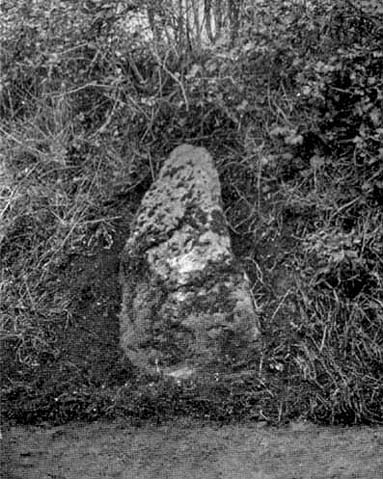
Sowerby Lad, Mytholmroyd, West Yorkshire

Standing Stone (destroyed): OS Grid Reference – SE 024 244

Archaeology & History

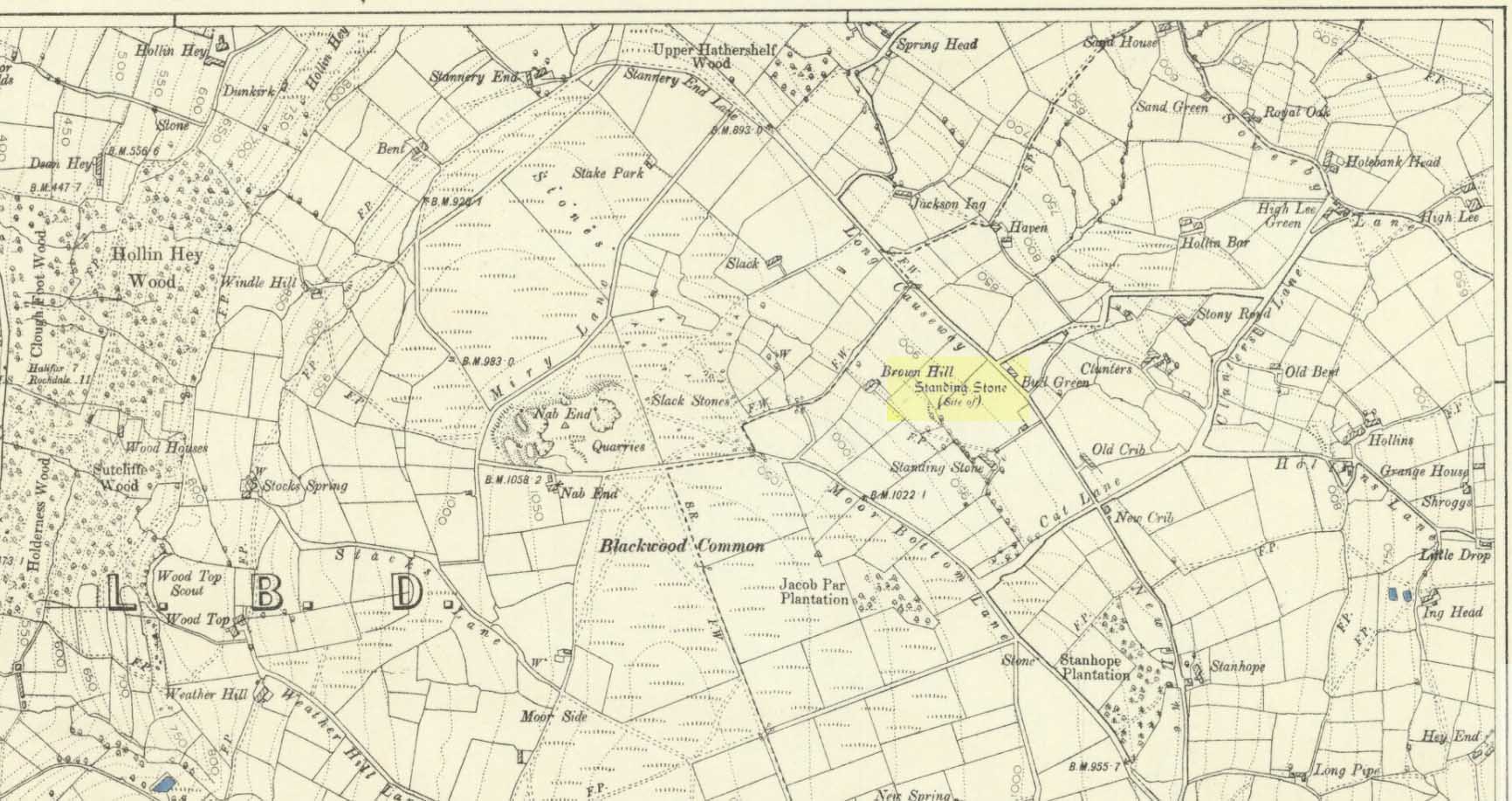
Standing stone on 1894 map

Also known as the Field House Standing Stone, this monolith seems to have gone.  It was first described in local Minister’s Accounts of 1403, and then again in the Wakefield court-rolls of 1515.  By the time John Watson (1775) wrote about the place there had been several other references describing this old “standyngstone”. It was still upright in 1852, but Ordnance Survey showed it as “Site of – ” at the beginning of the 20th century, and the stone had been moved a short distance away, further down from its original position to a spot at the side of the old trackway — but all trace of it has since vanished.

Folklore

This is thought to have been the standing stone which Robin Hood threw here, from the appropriately called Robin Hood’s Penny Stone at Wainstalls. The tale tells how he dug it out of the ground with a spade and threw it three-and-half miles across the valley until it landed here. Ooh, what a strong boy!

References:

  1. Bennett, Paul, The Old Stones of Elmet, Capall Bann: Milverton 2001.
  2. Smith, A.H., The Place-Names of the West Riding of Yorkshire, volume 3, Cambridge University Press 1961.
  3. Watson, John, The History and Antiquities of the Parish of Halifax, T. Lowndes: London 1775.

© Paul Bennett, The Northern Antiquarian
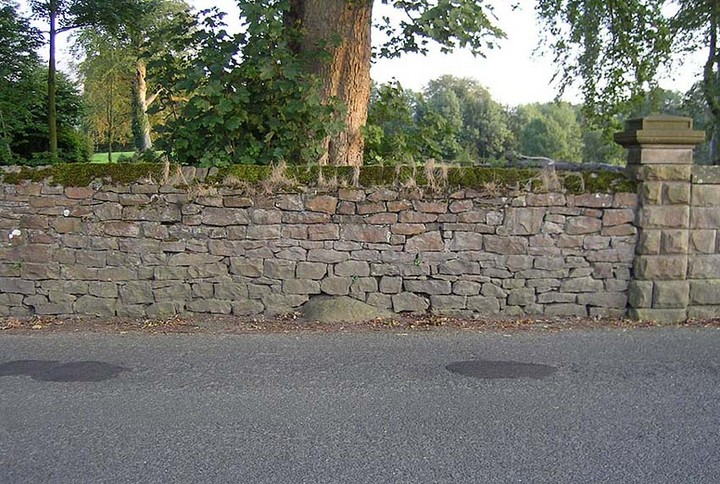

Roms Hill, Wadsworth, Hebden Bridge, West Yorkshire

Standing Stone:  OS Grid Reference – SE 0080 3261

Getting Here

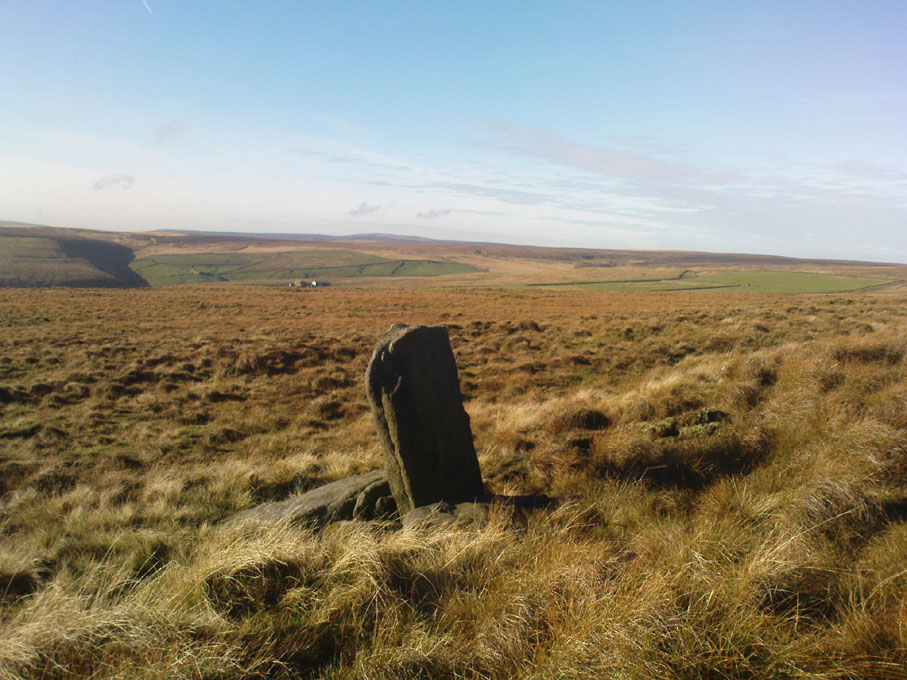
Roms Hill Stone

Whether coming from Hebden Bridge or Oxenhope: at the very top of the long uphill road, at the very top where a small radio station sits by the roadside (the views from here are effing superb!) – stop! On the opposite side of the road from the radio station, get over the fence (I think there’s a gate nearby) and walk roughly westwards down the gently inclining grassland slope.  Keep westward-ish for about 200 yards (if that) and you’re damn close!

Archaeology & History

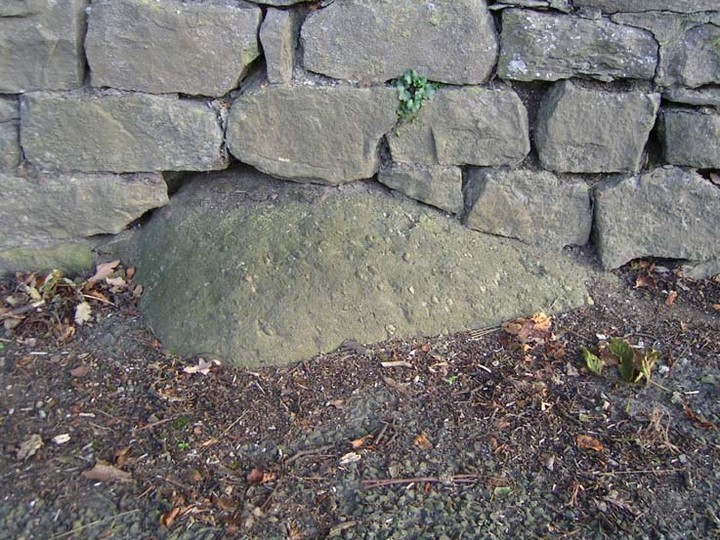
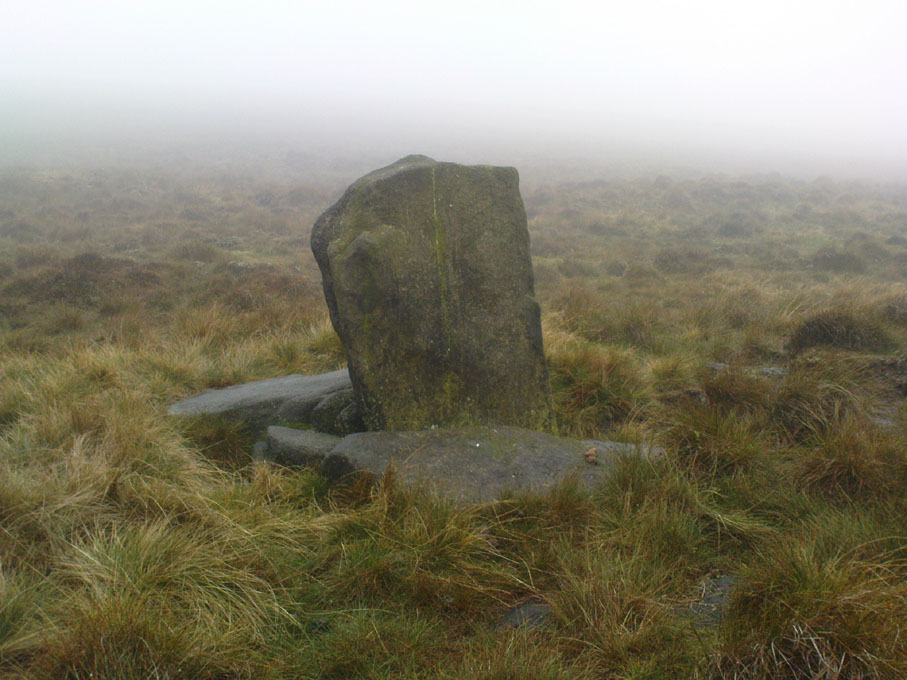
Rediscovered in January 2002, this is a very curious stone, over a metre in height, isolated on the southern edge of Roms Hill, close to the folklore-sounding Halfpenny Hole Clough, near the very top of the hill between Hebden Bridge and Oxenhope. The base of the stone is almost wedged into a space between two rocks and its positioning here seems quite deliberate.  It stands upon a small geological ridge in the ground that stretches for some distance, east and west, either side of here.

Roms Hill Stone in good fog!

Despite this, it seems unlikely to have an authentic prehistoric pedigree, but as there’s little else been said of the stone (apart from Dave Shepherd’s (2003) article on local megalithic remains, many of which are highly dubious as archaeological remains), it deserves a mention here.  It’s not recorded in any of the old boundary records — unlike the upright boundary stone that can be found a few hundred yards northwest of here on the same moorland plain.

The land here has an etymological relationship with the Roms Law (or Grubstones) Circle on Rombald’s Moor, but as yet we can ascertain little more about this site.  Well worth a visit — if only for the superb views it affords!

References:

  1. Shepherd, David, “Prehistoric Activity in the Central Pennines,” in Transactions of the Halifax Antiquarian Society, volume 11 New Series, 2003.

© Paul Bennett, The Northern Antiquarian

Robin Hood’s Penny Stone, Wainstalls, West Yorkshire

Stone Circle (destroyed):  OS Grid Reference – SE 046 288

Archaeology & History

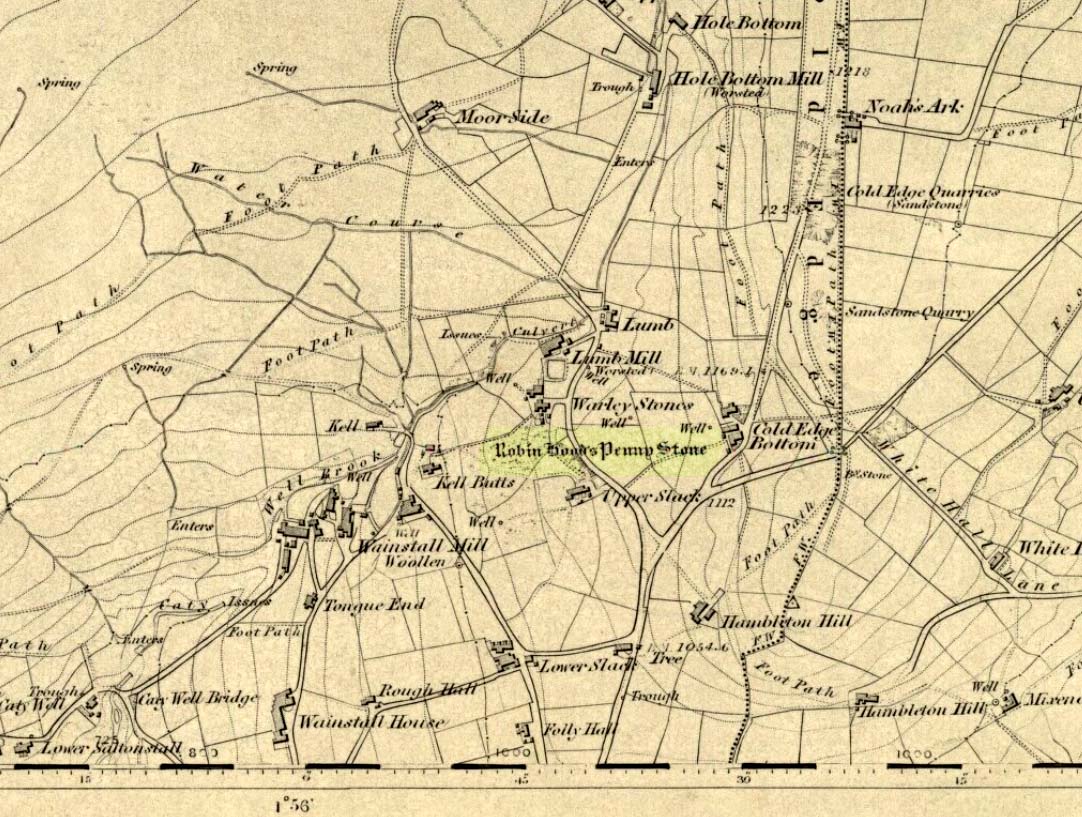
The Pennystone on 1852 map

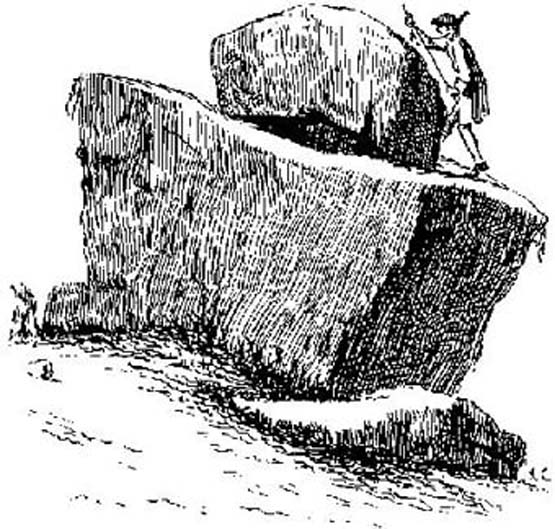
All remains of this site, first mentioned as a stone circle in 1836, have gone. The place could be found by the appropriately named Stone Farm at the top end of Wainstalls and was first mentioned by John Watson (1775), who strangely said nothing about any circle here.  However, this changed when John Crabtree (1836) arrived and described a ring of stones surrounding a large boulder in the centre (illustrated here). The boulder itself was actually called the Robin Hood Penny Stone.

Folklore

Watson's 1775 drawing
Watson’s 1775 drawing

This was one of the many legendary sites from where our legendary outlaw practiced shooting his arrows.  He was also said to have picked up and thrown a large standing stone from this spot, until it landed three-and-a-half miles away on the hillside on the other side of the Calder Valley. (this was known as the Field House, or Sowerby Lad Standing Stone)

References:

  1. Bennett, Paul, The Old Stones of Elmet, Capall Bann 2001.
  2. Crabtree, John, Concise History of the Parish and Vicarage of Halifax, Hartley & Walker: Halifax 1836.
  3. Dobson, R.B. & Taylor, J., Rymes of Robyn Hood, Alan Sutton: Gloucester 1989.
  4. Faull, M.L. & Moorhouse, S.A., West Yorkshire: An Archaeological Guide (4 volumes), WYMCC: Wakefield 1981.
  5. Varley, Raymond, “A Stone-Axe Hammer, Robin Hood’s Penny Stone and Stone Circle at Wainstalls, Warley, near Halifax,” in Yorks. Arch. Journal 69, 1997.
  6. Watson, John, The History and Antiquities of the Parish of Halifax, T. Lowndes: London 1775.

© Paul Bennett, The Northern Antiquarian

Rocking Stone, Rishworth Moor, West Yorkshire

Legendary Rock:  OS Grid Reference – SD 990 150

Archaeology & History

Rishworth Moor Rocking Stone, 1775

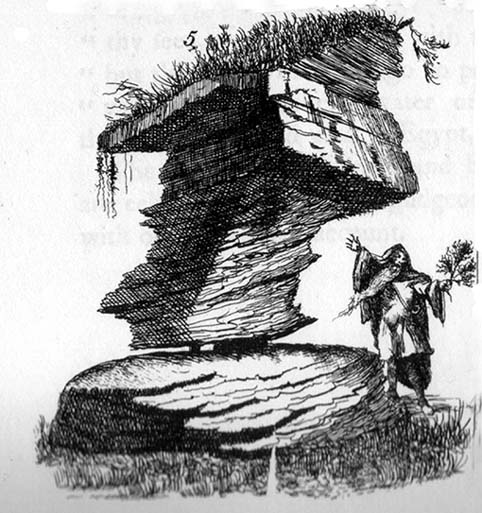
The reverend John Watson (1775) first wrote about this place, describing it as, “a group of stones, laid, seemingly, one above another, to the height of several yards, and called the Rocking stone.”  Very little archaeological remains have been described hereabouts, save the odd flint scatters here and there.  Anything which might have been here in the past was likely destroyed when the M62 was built right next to the site.

Folklore

The rocking stone was long ascribed in local tradition to be a  site used by the druids.  It was said that in bygone days the great boulder would rock, but this must have been a long time ago as even when Mr Watson described it, he told how “that quality is lost.”

Close by is the sometimes dried-up spring known as the Booth Dean Spa, which Watson thought might have been related to whatever ancient rituals occurred here.

References:

  1. Watson, John, The History and Antiquities of the Parish of Halifax, T.Lowndes: London 1775.

© Paul Bennett, The Northern Antiquarian

Ringstones, Lowgill, Lancashire

Stone Circle (destroyed): OS Grid Reference – SD 664 655

Archaeology & History

I have found no archaeological references whatsoever to this site (though to be honest, the Lancashire archaeological fraternity are pretty poor when it comes to finding and recording sites).  The place has its existence preserved in the aptly-named Ringstones Lane and the farmhouse, Ringstones.

Michala Potts found several records of the place in the 17th century, and the site is shown on the 1844 OS-map with the same name, but we have been unable to ascertain when/if any standing stones were here.  The place may well have been a burial-site of some sort, as found at other Ringstone place-names in Lancashire.  But we can clearly see on aerial imagery that there is a large, distinct, circular outline in the heavily ploughed fields about 100 yards north of the farm.  There is what may be the remains of a second circle above this, but the outline is faint; but it appears that an enclosure of some sort, ovoid in shape and a couple of hundred feet across, was also evident in the same field where the more distinct circular outline is seen.

My favourite outline however, is a large linear mark on the ground stretching for several hundred yards running roughly north-south, starting in the field between Aikengill and Ringstones and going dead straight, bypassing the circle and crossing Ringstones Lane, where it seems to disappear and is no longer visible.  The curious ‘ground line’ is roughly 100 feet across.  Cursus anyone!?

© Paul Bennett, The Northern Antiquarian
Wart Stone, Bradford, West Yorkshire

Standing Stone (destroyed):  OS Grid Reference – SE 15940 34211

Also known as:

  1. Ash Stone
  2. Pin Stone

Archaeology & History

Wart Stone on 1852 OS-map

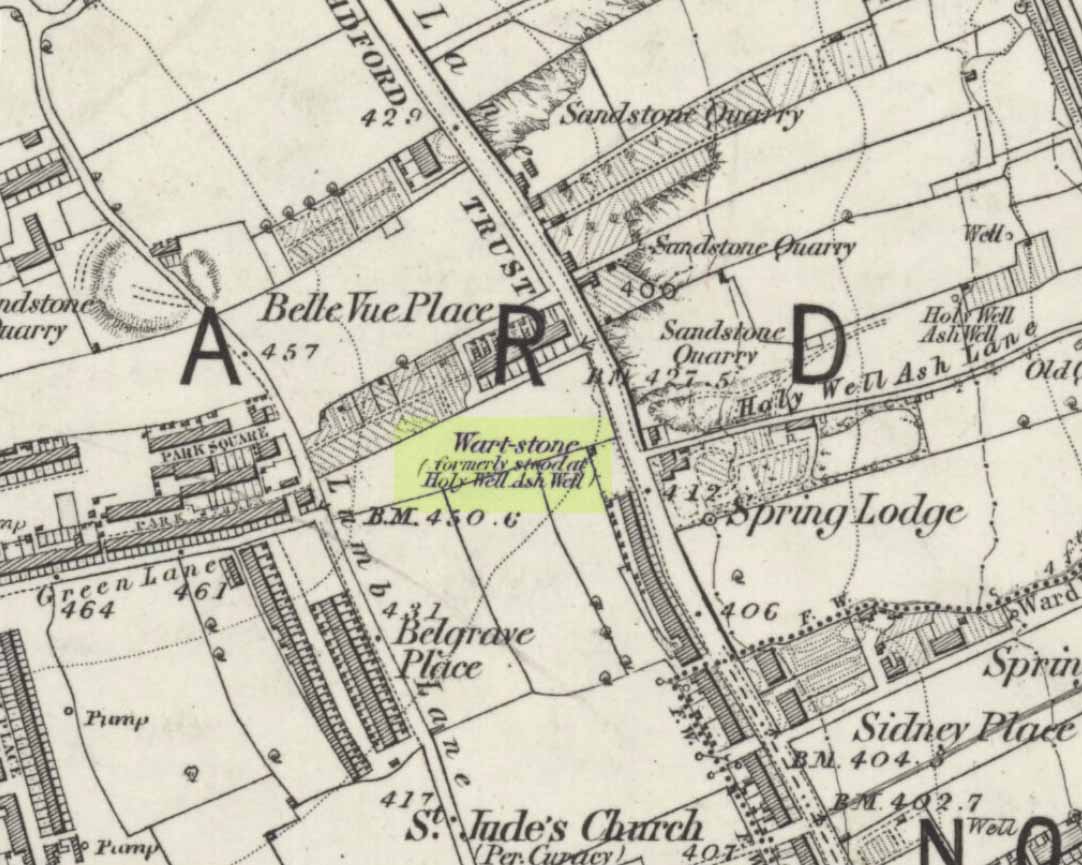
At Bradford City’s football ground there used to be the holy well known as the Holy Ash Well, adjacent to which was this old stone (as shown on the 1852 OS map).  For some reason it was uprooted and moved further up the hill around the end of the 19th century and was resurrected beside the old Belle Vue Hotel on Manningham Lane.  From thereon however, I’ve not been able to trace what happened to it, and presume it’s been destroyed.  It was known by local people to have had a ritual relationship with the adjacent healing well, to which people were said to visit from far and wide.

It seems to have been described first by Abraham Holroyd (1873), who told us that:

“In Manningham Lane there is a fine well, in old deeds called Hellywell, i.e., holy well, in a field now called Halliwell Ash, now a stone quarry… Near this is the ancient Pin Stone.”

The Bradford historian William Preston also made mention of the stone in one of his early surveys, where he told how local people also knew the stone as the Ash Stone, due to its proximity and ritual relationship to a great old tree.

Folklore

Also known as the Wart Stone, thanks to its ability to cure them and other skin afflictions.  Intriguingly, the building which now stands on the site is said to be haunted.

As my old school-mate, Dave Pendleton (1997), said of the place and its associated well:

“Prior to 1886 the only feature of any real note in the Valley Parade environs was a holy well that emerged near the corner of the football grounds Midland Road and Bradford End stands; hence the road Holywell Ash Lane. Today the site of the well is covered by the football pitch.

Only the road name survives as a reminder of what was apparently one of the district’s foremost attractions. On Sundays and holidays people would gather to take the waters and leave pins, coins, rags and food as offerings to the spirit that resided in the waters.

Accounts suggest that the well was covered and had a great ash tree standing over it (hence ‘holy ash’). There was also a standing stone called the wart stone of unknown antiquity. The stone had a carved depression that collected water. It was believed that the water was a miraculous cure for warts. Indeed, as early as 1638 the Holy Well had been credited with healing powers.

The well suffered a decline in popularity during the late nineteenth century and its keepers resorted to importing sulphur water from Harrogate, which they sold for a half penny per cup. The well disappeared under the Valley Parade pitch during the summer of 1886 and the wart stone was moved to the top of Holywell Ash Lane – which then ran straight up to Manningham Lane. The stone was still there as late as 1911 but thereafter it seems to have disappeared into the mists of time.”

Unfortunately we have no old photos or drawings of this lost standing stone – though I imagine that some local, somewhere must be able to help us out with this one.  Surely there’s summat hiding away…

References:

  1. Bennett, Paul, The Old Stones of Elmet, Capall Bann: Milverton 2001.
  2. Holroyd, Abraham, Collecteana Bradfordiana, Saltaire 1873.
  3. Pendleton, David & Dewhirst, John, Along the Midland Road, Bradford City AFC 1997.

© Paul Bennett, The Northern Antiquarian 

Picts Cross Stone, Sellack, Herefordshire

Standing Stone:  OS Grid Reference – SO 5607 2669

Archaeology & History

Picts Cross Stone (after Alfred Watkins, 1930)
Picts Cross Stone (A. Watkins, 1930)

In September, 1928, the old ley-hunter Alfred Watkins was out on one of his many rambles when he “saw a tall stone almost buried in the bank at this crossroads,” appropriately known as Picts Cross, about a mile south of Sellack — so he called it the ‘Picts Cross Stone.’  He also said, “It was Pricker’s and Prick’s Cross in 18th century maps, and Pig’s Cross in the 1832 Ord. Map. Now ‘pig’ is the present Welsh word for “a peak, a point, a pike.””

And a lovely pointy old stone it looks in his old photo!  The monolith is in the hedgerow along the old boundary line.

References:

  1. Watkins, Alfred, The Old Standing Crosses of Herefordshire, Simpkin Marshall: London 1930.

© Paul Bennett, The Northern Antiquarian

Ox-Foot Stone, South Lopham, Norfolk

Standing Stone (destroyed):  OS Grid Reference – TM 052 809

Folklore

This slab of sandstone apparently used to stand upright in one of the fields of Oxfootstone Farm and on its surface is supposed to be the burnt impression of a cow’s hoof-print. Legend tells that there was a fairy cow which would come into the area when times of hardship occurred. During such periods she would freely give her milk to the people, but when the drought was over she stamped down on the stone upon which she stood, burning the imprint of her hoof onto it and magically vanished back from whence she came. A variation of the tale tells of a normal cow whose milk normally supplied the local villagers. But one night a drunken man (in another tale it is a witch) milked the cow dry through a sieve, until only blood came from her udders. At this point, the cow cried out in pain and kicked the stone so hard that she left the mark of her hoof-print on it.

Another tale tells that an ox got a large thorn stuck in its foot and rampaged through the local village, eventually stamping its hoof onto the stone so hard that it left the imprint of its foot here.

Now this might sound presumptious of me — but this tale has all the hallmarks of it being an old folk-remnant telling the origin of some cup-and-ring marked stone.  We find a number of cup-and-rings with creation tales similar to this.  Are there any local archaeologists or enthusiasts in Norfolk who might be able to locate any remains of this possible carved stone?

References:

  1. Burgess, Michael W., The Standing Stones of Norfolk and Suffolk, ESNA 1: Lowestoft 1978.
  2. Dutt, W.A., The Ancient Mark-Stones of East Anglia, Flood & Sons: Lowestoft, 1926.

© Paul Bennett, The Northern Antiquarian

Old Bess Stone, Oakworth Moor, West Yorkshire

Standing Stone:  OS Grid Reference – SD 978 389

Getting Here

A bittova wander with not much to see, if truth be had.  Best way here’s from the top Oakworth Road heading to the Lancashire border, right on the moor-edge.  Go along the Hare Hill Edge road for a coupla miles till you hit the Pennine Way.  Walk along it up onto the moor, following the dead straight walling for several hundred yards.  Where the walling stops, all of a sudden, stop! (there’s a wooden post here)  Now walk left (west) across the heath for less than 100 yards.  You’ll find it…

Archaeology & History

Old Bess Stone, with Crow Hill on the distant skyline

I’ve found nothing of this site in archaeology records – but that’s likely down to me not looking hard enough!  I’m not even sure that it’s prehistoric – but as there’s nowt written about it, and there are other sites which relate to this old stone, it’s certainly worthy of mention.

The stone lays in the grasses, some four-feet long, with a more recent 18th-19th century boundary stone laid a few feet away.  It seems most likely that Old Bess had stood here much longer though.  Old Bess seems to be the first in a row of at least 6 seemingly unrecognized boundary stones running northwest in a straight line up to the Wolf Stones, about half-a-mile from here.  Neither the early, nor modern OS-maps show any of these stones, several of which are accompanied by earlier, more worn stones – two of which have the letters ‘C.C.’ or ‘G.C.’ carved on them.

Old Bess 'hut circle'
Old Bess ‘hut circle’ (it’s there – honest!)

About 10 yards north of Old Bess are the remains of a very noticeable oval-shaped ‘hut circle’ – or something closely resembling such remains.  About five yards across at the most, with stone walling making up the edge of the ring beneath the moorland grasses, an excavation here wouldn’t go amiss!  Although it’s hard to see in this photo (it’s the roughly circular rise in the middle), when you’re on the moor it’s obvious.   It looks and feels as if the remains were something from medieval times, or perhaps even later – but it’d be good to know for sure!  The remains of an old delph 100 yards south may account for more of Old Bess and its accompanying hut circle than owt prehistoric.

From Old Bess, walk in a straight line towards the large rock outcrop of the Wolf Stones, northwest of here.  After a short distance you’ll come across another large stone, cut and shaped in bygone centuries (not prehistoric though) laying in the boggy tussock grass and looking similar to Old Bess.  Another 100 yards on from here, along the same straight line towards the Wolf Stones, you’ll find another cut stone of similar dimensions; and from here you’ll see another stone about the same distance again ahead of you.  These would appear to be the lost medieval boundary stones which led to a boundary dispute between the counties of Yorkshire and Lancashire a few centuries ago.  For those medieval historians amongst you, check ’em out: it would appear that these are the lost stones (pushed over, obviously) which led to the said dispute.  How on earth no-one’s found ’em previously beggars belief!

Folklore

A little-known site with a spirit ancestor giving rise to its name.  Surrounding it are tales of little people, for just above it is where the faerie lived at the Fairy Fold Dike.  While a couple of hundred yards west lived an old hob (another faerie creature) who used to drink from an old well named after him, the Hob Ing Spring.  Victorian lore tells of druidic folklore further up the moor by the old Wolf Stones, which is linked to Old Bess by virtue of the line of old boundary stones running from here.

© Paul Bennett, The Northern Antiquarian

Nettlehole Ridge, Skipton, North Yorkshire

Stone Circle:  OS Grid Reference – SD 9794 5634

Also Known as:

  1. Crookrise Woods

Getting Here

Nettlehole Ridge 'circle'
Nettlehole Ridge ‘circle’

There are several ways to get here, but I took the one from the road (B6265) walking up the track into Crookrise Woods. Unless you’ve got a decent OS-map with it marked on, this might take some finding to some folk as it’s tucked away on the northern edge of Crookrise Woods (which one Southerner bloke told us was private – though he was ‘allowed’ there!). It’s right on the rounded knoll at the top of the woods, beneath the prominent slopes which lead to the moor.

Archaeology & History

Our old mate and Yorkshire historian Arthur Raistrick seems to have been the first to describe this place in the Yorkshire Archaeological Register of 1964 – though the holy wells writer Edna Whelan told me she knew about the place many years back. Today hidden in woodland and mostly overgrown, Raistrick’s brief description of the place said:

“A small stone circle of six stones set symmetrically within a diameter of 26 feet. The stones vary in size from 21 to 58 inches. Surveyed 1963.”

The site has been badly affected by the erosion of time, forestry and god-knows what else.  Scattered around are numerous small stones giving the impression that it may once have been a cairn-circle, more than a stone circle.  Four of the six stones mentioned by Raistrick (1965) are visible, but none are impressive – and unless you’d read about the place first or found it in Mr Burl’s Stones Circles of Britain… (2000), you  wouldn’t really give it the time of day.

Although sadly disappointing in its present status – completely surrounded by trees, with no view at all – it seems probable that it would have had some geomantic relationship with the hillfort-looking site of Rough Haw immediately west, and very probably the adjacent ritual site of Sharp Haw.  It seems that the equinox sun would set between Rough Haw and the other small rounded hill above.

References:

  1. Burl, Aubrey, The Stone Circles of Britain, Ireland and Brittany, Yale University Press 2000.
  2. Raistrick, Arthur, ‘Yorkshire Archaeological Register: Embsay,’ in Yorkshire Archaeological Journal, 1964.

© Paul Bennett, The Northern Antiquarian