Haystack Rock, Ilkley Moor, West Yorkshire

Cup-and-Ring Stone:  OS Grid Reference – SE 13027 46310

Also known as:

  1. Carving no.141 (Hedges 1986)
  2. Carving no.302 (Boughey & Vickerman 2003)
  3. Cottage Rock

Getting Here

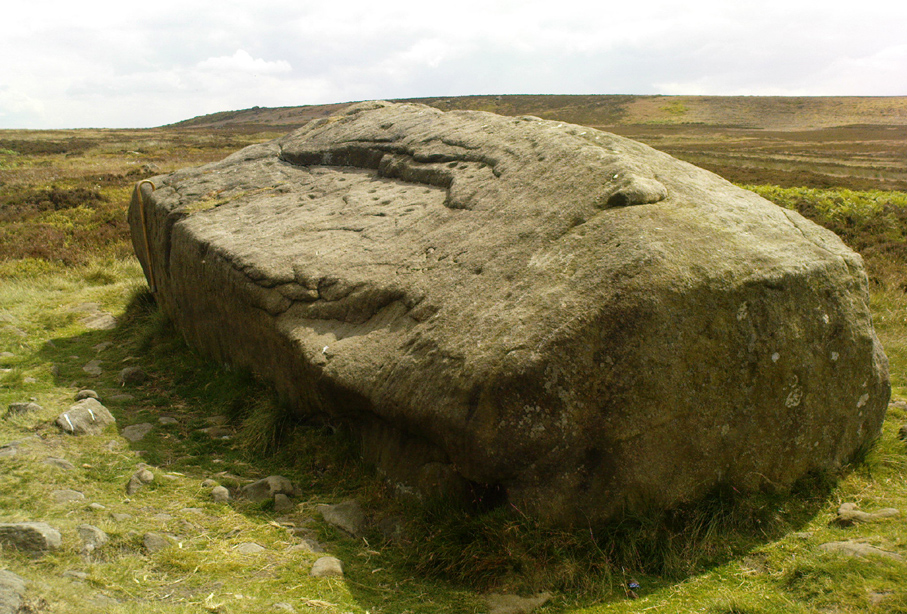
The Haystack Rock
The Haystack Rock

Dead easy to find this one!  Get to the Cow & Calf Hotel and walk up the slope onto the moor ahead of you.  If you want a direction-pointer, head for the large, seemingly overhanging rocks which are the Pancake Stone, at the top of the ridge, but a few hundred yards to the right (west).  Once you reach the level on the moor proper, you’ll see this large haystack-shaped boulder close by.  That’s it!

Archaeology & History

This tends to be one of the spots I stop at when doing my tourist walks, to i) let folk get their breath back after ambling from the car park, via Hanging Stones and Map Stone; ii) to drink in the view, and, iii) to begin acquainting themselves with the landscape as it was when this stone was carved (over many decades, perhaps longer), and the animistic cosmology underlying people’s notions of their land.  It can be quite an education…
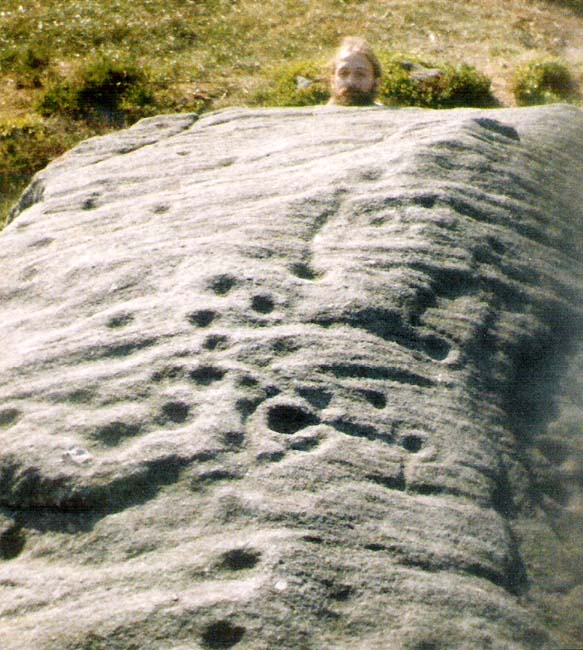
Haystack Rock, with crushed man underneath
Haystack Rock crushes local man
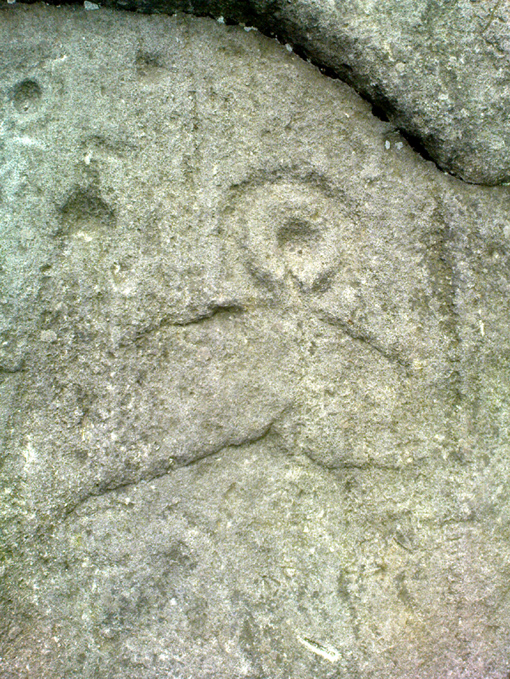
Fertility symbol, or Rorschach response?

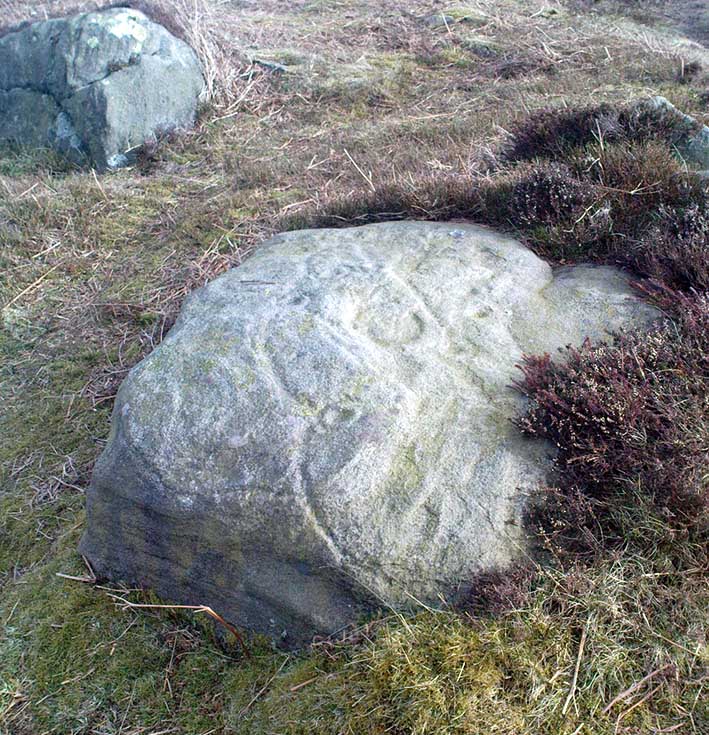
The Haystack Rock was a very important boulder in the mythic landscape on this plain. It stands near the western end of the Green Crag Necropolis: a huge area of land on these moors where, quite simply, the people of these hills laid their dead.  Effectively, the Haystack Rock stands on the edge of Ilkley Moor’s “Land of the Dead”.*

Highlighting this quite firmly, we find that prehistoric walling ‘separates’ this great boulder from the other part of the Plain close to its east and southern sides (walling on its western side is as yet unproven).  It was a boulder that was specifically sectioned-off, away from any tombs.  All along this Plain are numerous small cairns, many with rock-art nearby, and certain parts of the Plain are split into sections by ancient walling (though a precise map of the walling, tombs and rock-art on this moorland ridge has yet to be done).
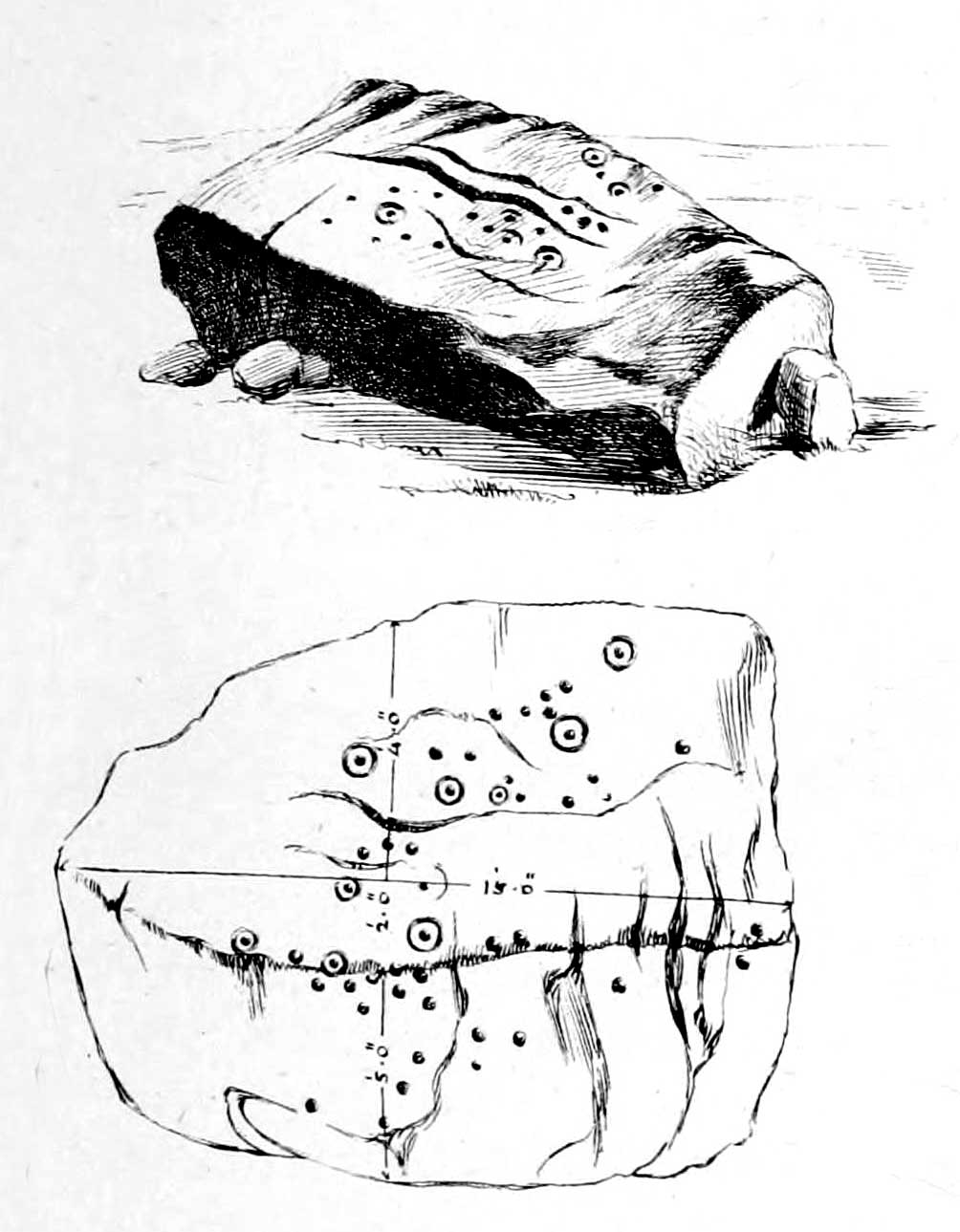
J.Romilly Allen's 1879 images
J.Romilly Allen’s 1879 images

As far as the textbooks are concerned, we find the first mention of this great carved boulder came from J. Romilly Allen at the end of the 1870s.  By 1900, a number of people had been here and written of its grandeur; but, as with cup-and-rings in general, its non-linear form and design elicited the usual notions of bewilderment, druids and puzzled ideas.  Much like today really!
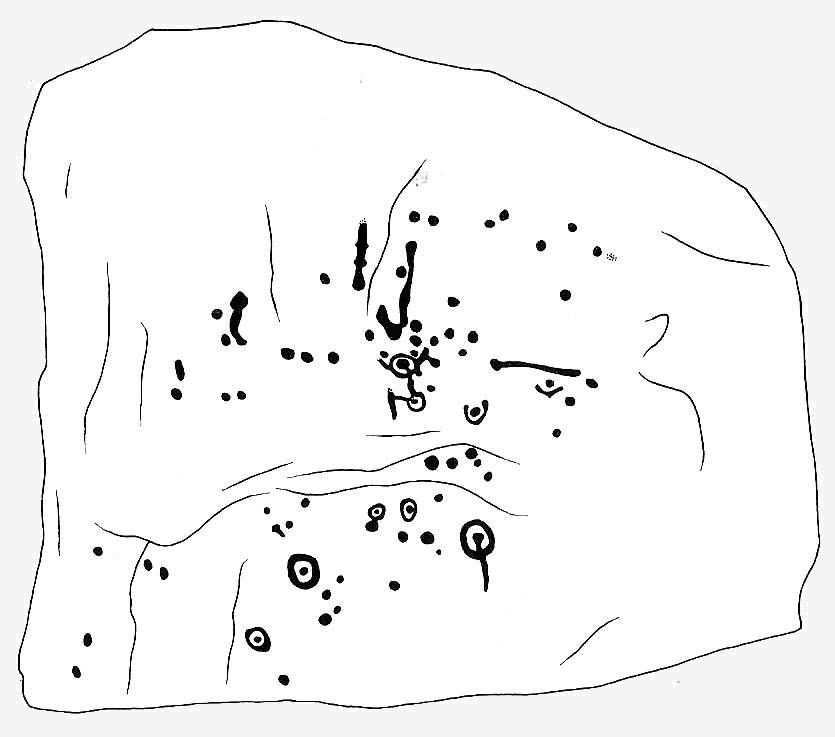
Drawing of the central design (after Hedges, 1986)
Drawing of the central design (Hedges, 1986)

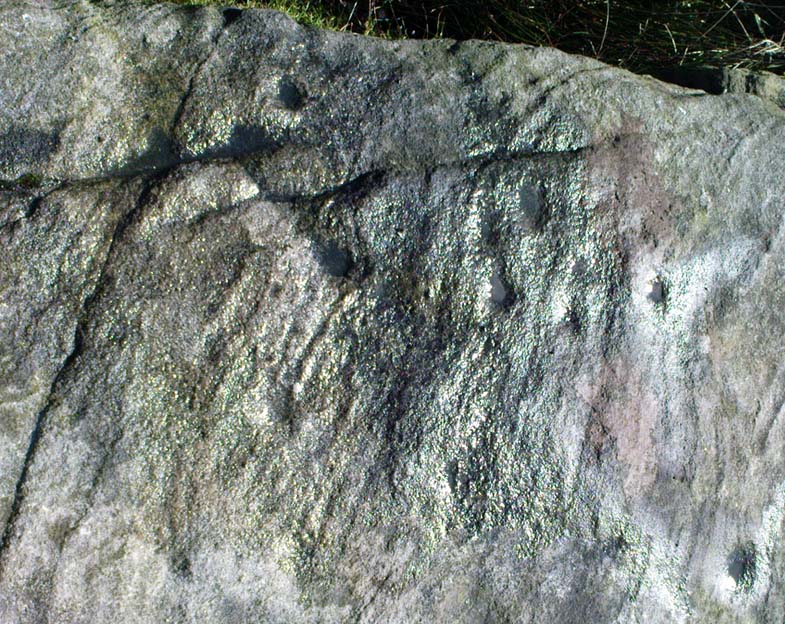
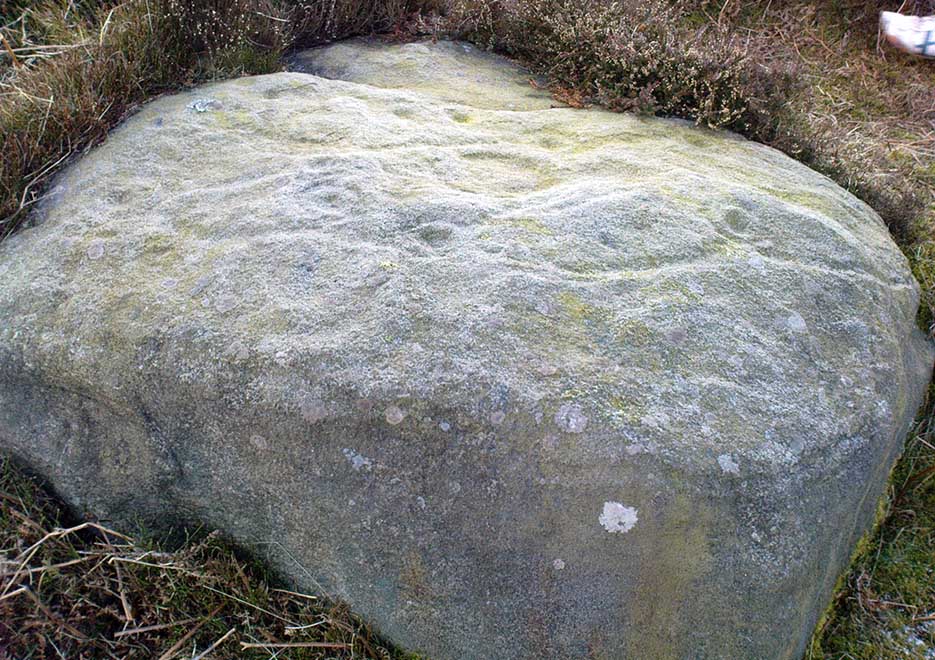
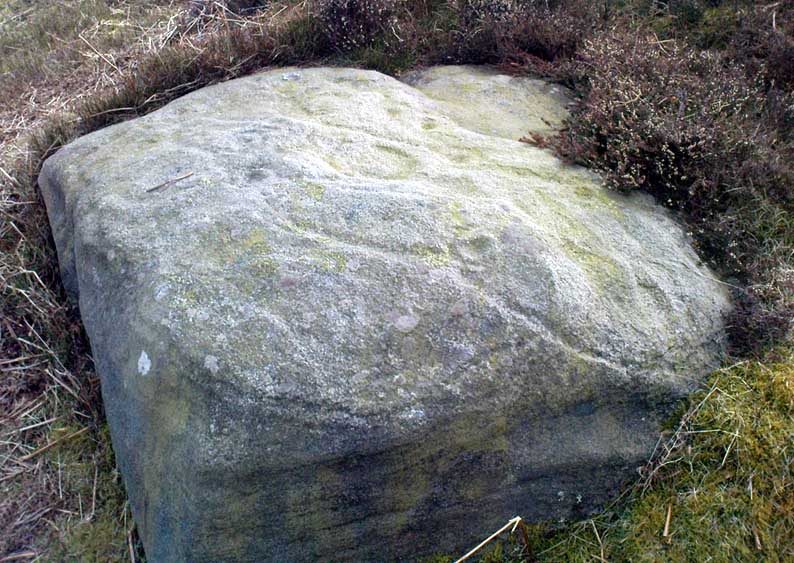
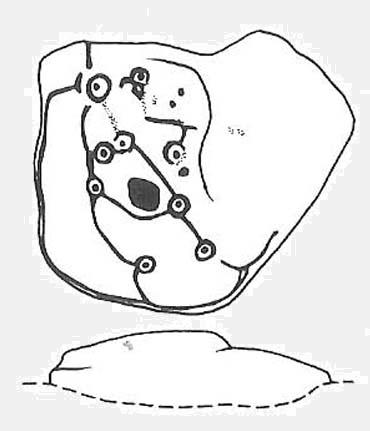
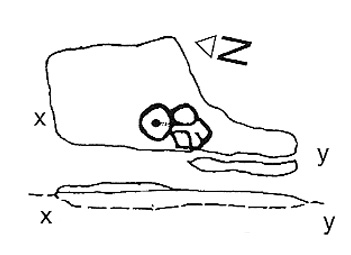
But this is a big and decent carving, with about 60 single cup-markings, 10 cup-and-rings, and various twizzly grooves and lines linking cups to others, and others going to seemingly nowhere.   Some of these lines, of course, may be weathering, or weathered channels emerging from once shorter lines.  We might never really know for sure what the original carving actually looked like.  On the north-facing side is what looks like a decidedly human figurine etched onto this great boulder, in good old cup-and-ring style. I’ve shown this to a few hundred people and they all seem to make the same remark: it’s a woman with her legs wide open — an early form of sheela-na-gig on Ilkley Moor no less! But whether this was intentional (many folk think so), or just us seeing something we want to see (men in particular!), we might never know.
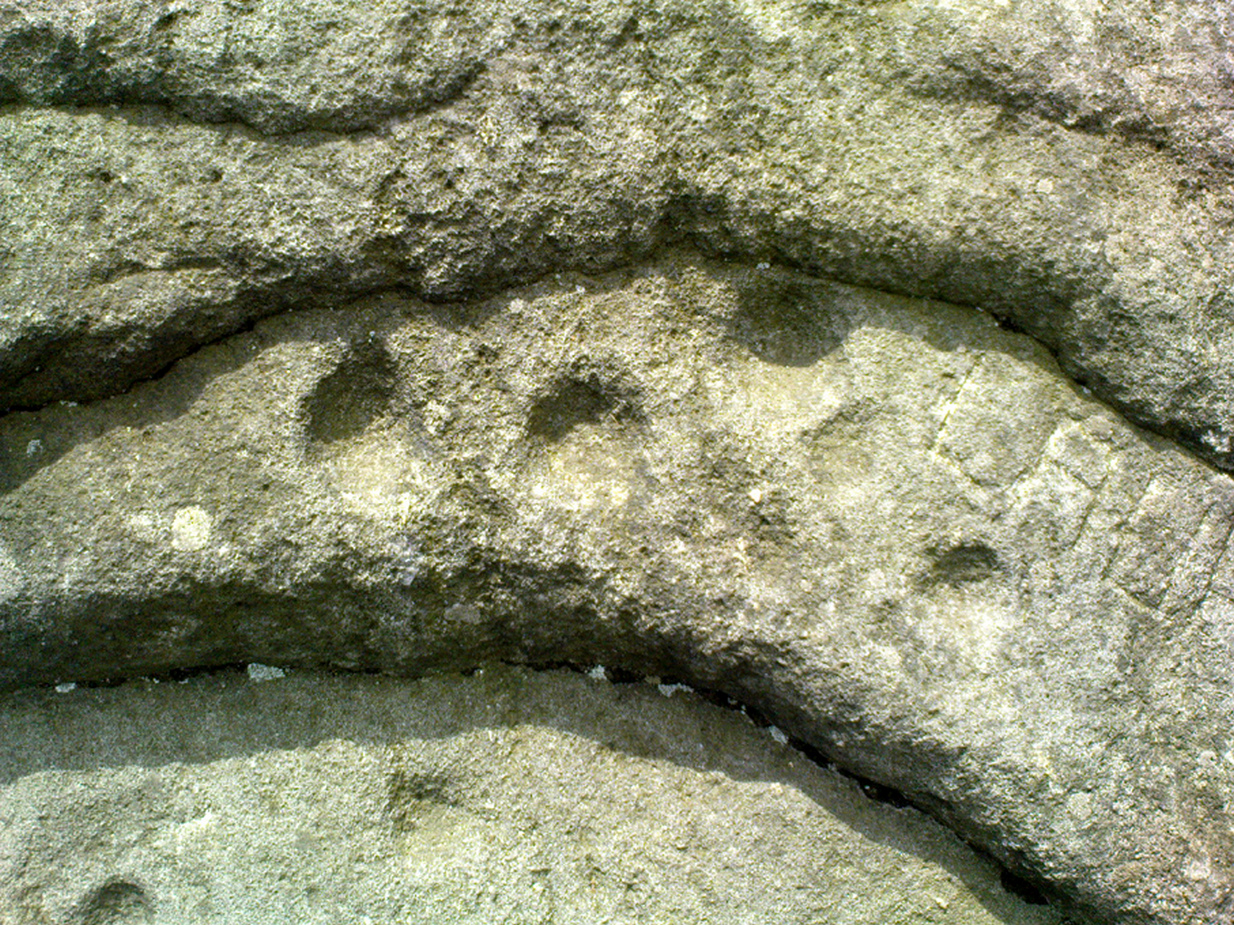
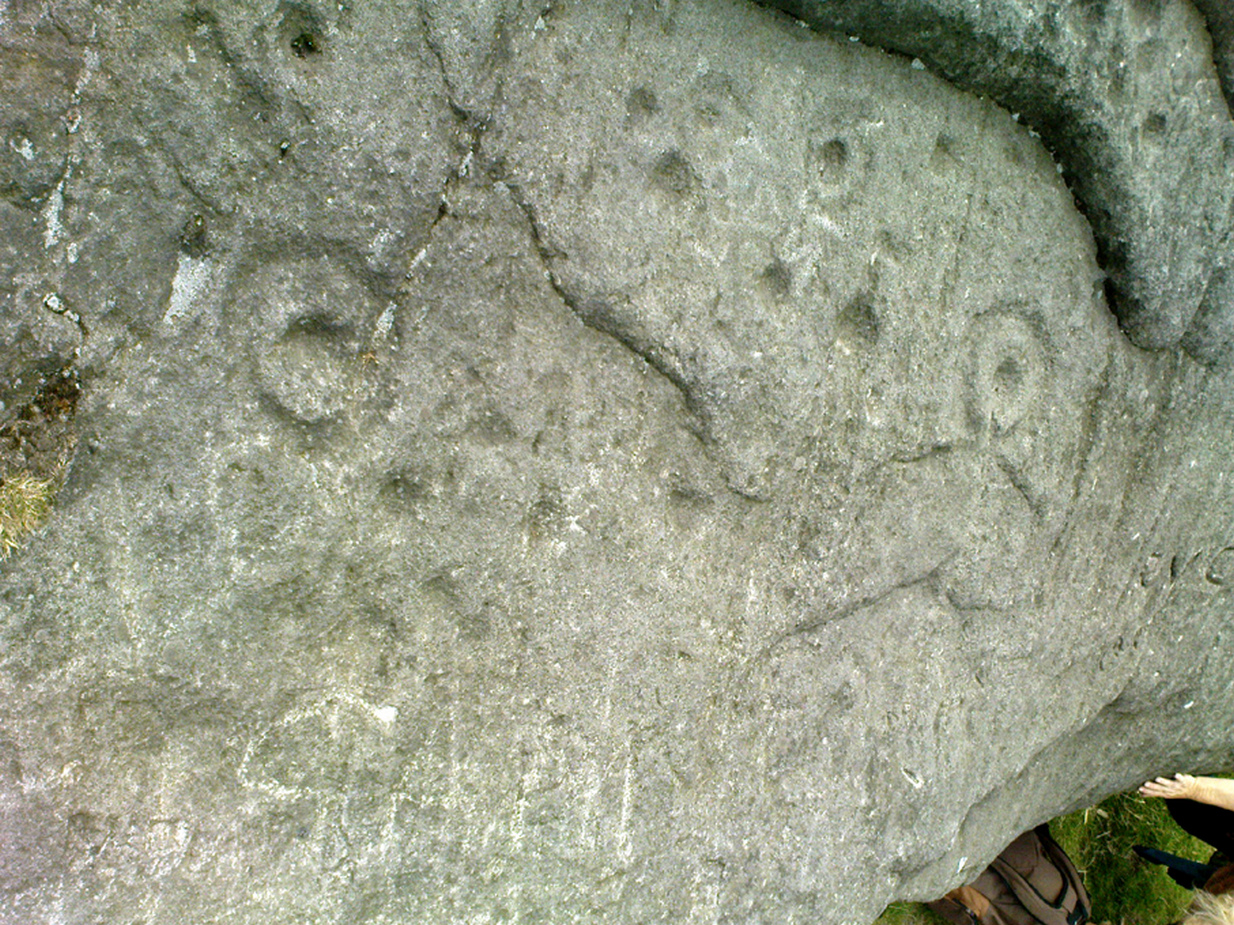
Ancient cup-marks with vandal marks
More cup-and-rings with vandal marks

The black-and-white illustration above that shows what seems to be just about all elements of the carving in considerable detail, may well be accurate, but it’s nothing compared to seeing the carving first-hand.  When it comes to ancient rock-art, detailed drawings are one thing, but the real thing is altogether much much better!  Check it out and see for yourself…

Folklore

I’m not too sure what credibility we should give to Nicholas Size’s (1934) extravagant claims, but this was one of the sites he alleged to have seen visions of druidic rites and ghostly figures!

References:

  1. Allen, J. Romilly, ‘The Prehistoric Rock Sculptures of Ilkley,’ in Journal of the British Archaeological Association, 35, 1879.
  2. Bennett, Paul, The Old Stones of Elmet, Capall Bann: Chieveley 2001.
  3. Boughey, Keith & Vickerman, E.A., Prehistoric Rock art of the West Riding, WYAS: Wakefield 2003.
  4. Forrest,C. & Grainge, William, A Ramble on Rumbald’s Moor, part 3, Wakefield 1869.
  5. Hedges, John, The Carved Rocks on Rombalds Moor, WYMCC: Wakefield 1986.
  6. Size, Nicholas, The Haunted Moor, William Walker: Otley 1934.

* It’s gotta be pointed out that Ilkley Moor’s ‘Land of the Dead’ extends much further than just the Green Crag.  Much of the extended land above here to the south was an important area, where at some places rites of the dead were performed.  The supposed ‘settlement’ nearby (as well as the lesser known one on the moor west of here, on the moor above Ilkley Crags, near Cranshaw Thorn Hill) was likely to be a place where the dead were rested for a period.  But more about that in the section on the Green Crag Settlement…

© Paul Bennett, The Northern Antiquarian


Comet Stone, Cliffe Castle, Keighley, West Yorkshire

Cup-and-Ring Stone: OS Grid Reference – SE 0577 4210

Also known as:

  1. Cliffe Castle Stone
  2. Grubstone Ridge Carving
  3. Keighley Market Stone
  4. Carving no.216 (Hedges)
  5. Carving no.351 (Boughey & Vickerman)
  6. Upwood Hall Stone

Getting Here

Go to the Cliffe Castle Museum on the outskirts of Keighley town centre (dead easy to find with car park to rear) and explore the museum! You’ll find it eventually!

Archaeology & History

Comet Stone, Cliffe Castle Museum, Keighley

This lovely-looking carving has been on a bit of walkabout over the last hundred years or so! We’re not quite sure exactly where it first lived, but old records tell that it was found upon the Grubstones Ridge, which is a small section of the moor around and/or between the Great Skirtful of Stones giant cairn and the curious Roms Law, or Grubstones Circle, both on the very tops of Burley Moor (most folk call think of it as just another section of Ilkley Moor). Here it lived (approx grid reference SE 138 446) for several thousand years until, many centuries later, in the mid-19th century, one of them there christian chaps came along – y’ know the sorts.  He was the reverend J.A. Busfield and came to live upon the heathen edge of our Rombald’s Moor at a great house called Upwood. Like many of these weird people, he took a bit of a shine to our ancient relics and, amidst one of his sojourns to the Grubstones one day, came upon this multiple-ringed stone lying amidst the heather, close to the old circle of Roms Law.  Liking it so much, he thought he’d have it as an ornament in the grounds of his hall at Upwood, on the southern edges of the moor overlooking Riddlesden and Keighley — and there it stayed, living quite comfortably, until 1925.

It then spent nearly fifty years living enclosed in the huge abode of Keighley Museum until, in 1971, it was presented by a certain Mr. R.W. Robinson of the same establishment, to Keighley Council, who thought in their weird ways to lean “it against a pile of rocks on the pavement of Bow Street, near Keighley Bus Station, with a small plaque,” telling of its tale and of other cup-and-rings nearby. And there it stayed until more recent years, when it was returned back to the Cliffe Castle Museum – safe, quiet and looked after each night!

Drawing of the carving
Cowling’s early drawing

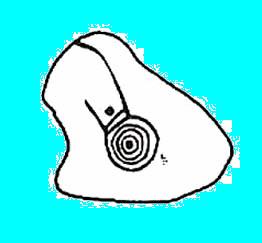
It’s a lovely, almost archetypal carving: a simple cup surrounded by four complete rings, with a ‘tail’ coming off the edge, similar to the image of a comet flying through the skies – which is, perhaps, what this carving represented. Of course, it could have been something completely different!

The region where this stone was located was an important area for the dead in ancient times – a motif that’s common to many cup-and-rings – and it seems probable that the stone itself was once part of a tomb, though we seem to have no record substantiating this. The carving was highlighted by William Cudworth as being in Upwood on a map dated 1847-51. The next description of it was by Arthur Raistrick in 1936. John Hedges (1986) listed it as stone-216 in his survey; then Boughey & Vickerman (2003) re-list it as stone 351.

NOTE – Don’t confuse this carving with another that is held in the same museum here, the Cliffe Castle or Baildon Moor 144 carving. Well worth having a look at!

References:

  1. Boughey, Keith & Vickerman, E.A., Prehistoric Rock Art of the West Riding, WYAS: Leeds 2003.
  2. Cowling, Eric T., Rombald’s Way, Otley 1946.
  3. Hedges, John, The Carved Rocks on Rombald’s Moor, WYMCC: Wakefield 1986.
  4. Raistrick, Arthur, ‘Cup-and-Ring Marked Rocks of West Yorkshire,’ in YAJ, 1936.

© Paul Bennett, The Northern Antiquarian

King’s Park, Stirling, Stirlingshire

Cup-and-Ring Stone:  OS Grid Reference – NS 7837 9299

Also known as:

  1. CEN 12 (R.W.B. Morris survey, 1981)

Getting Here

King's Park cup-and-ring, Stirling
King’s Park cup-and-ring, Stirling

Not too hard to find really.  On the far western edge of the King’s Park golf course, head for the highest point where the small cliffs drop down.  From here, walk down the footpath on the slight slope south, just below where the small copse of trees are, and you’ll see the singular small flat stone in the grasses near the footpath you’re walking along.  If you can’t find it – look around!

Archaeology & History

A little-known but fascinating isolated carving, first described by David Morris at the sixth meeting of the Stirling Natural History and Archaeological Society in 1901.  It is found on the western edge of the town, above the rocky edges not far from the pond of St. Thomas’ Well on the far edge of the golf course.  Morris’ finding was written up in their fine journal, where he wrote:

“In the King’s Park, about 50 yards east of the cliff where a seat overlooks the Douglas Terrace sand quarry, there is a smooth surface of rock showing through the turf, measuring two-and-half feet by one-and-half feet… On it is a cup-shaped hollow, outside the rim of which is a well-marked hollowed ring, beyond which is another faintly marked, concentric circular groove.  The cup-mark measures one-and-a-half inches across; the inner rim of the first circle is 4 inches, and the outer rim is 6 inches in diameter.  The outer circle, if complete, would be 9 inches in diameter.  The depth of the central hollow is half-an-inch, and of the inner groove fully one-quarter of an inch.  The markings are plainly artificial…”

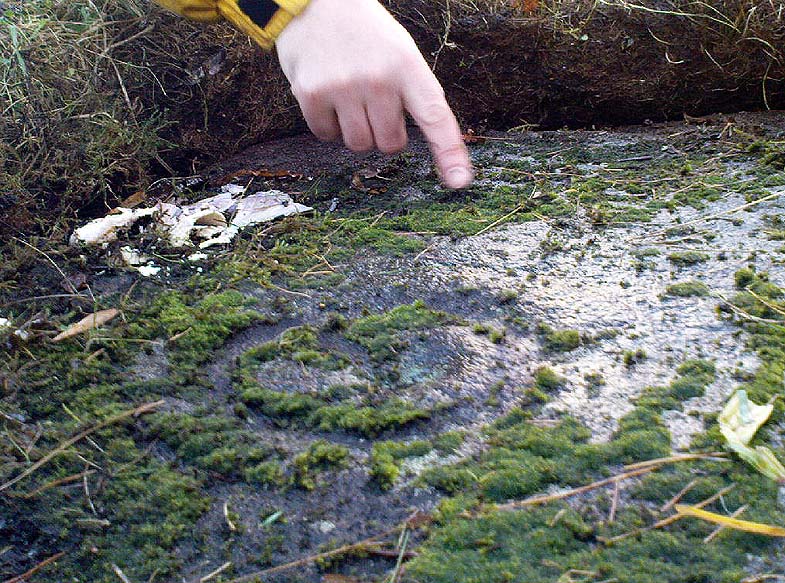
King's Park CR - central design, with finger pointing to northernmost cup!
King’s Park CR – central design, pointing to northernmost cup

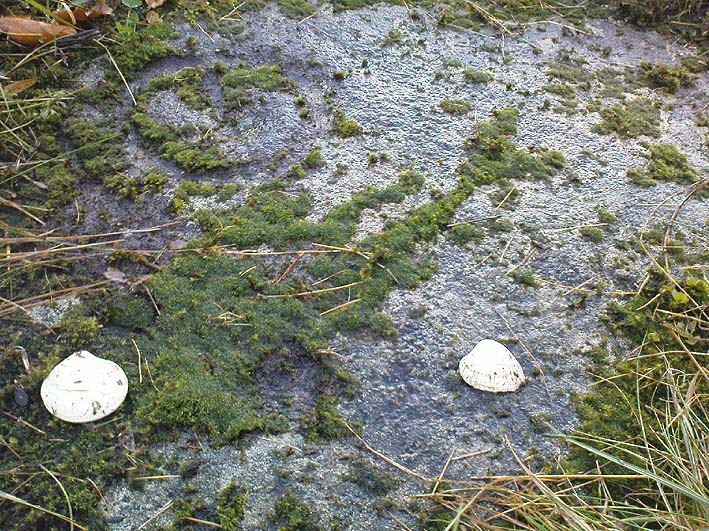
In good sunlight, it is obvious that the carving is a fine example of a double-ringed cup-and-ring carving – though the outer ring may not be complete.  The Scottish Royal Commission lads told that “this rock outcrop bears three cup marks” – one of which has the rings surrounding it.  In the first photo here, the southernmost cup-marking is highlighted in the centre of the two shells which were on the rock when we arrived.

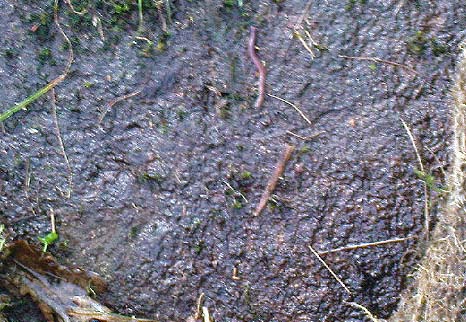
However, there’s definitely more to this carving than previous investigations have outlined.  It seems that the northernmost cup-mark has a ring and a possible outer-ring.  There is also a distinctive linear carving, which at first seems like a primitive triangle, just below the southernmost cup – as we’ve tried illustrating here in the photo which Mikki Potts took.  It’s faint, but once you see it, it’s obvious that it’s there.  Other faint lines of similar nature also seem apparent near the northernmost cup-marking, but we will have to wait for rubbings and further visits in better light to ascertain the full image on this rock.  Well worth checking out if you like your rock art! (can any of you Scottish rock-art fanatics have a closer look at this? – take a rubbing of it and see what other aspects are on this design)

Faint linear carvings on southern end of the rock

One other thing which seemed apparent when we were here: this site has all the geomantic hallmarks of accompanying a burial at some time in the ancient past.  Its isolation here is unusual and the carving is only 50 yards from the highest point hereabouts, where you have 360-degree views all round, typifying the position of many prehistoric tombs.*  Does anyone know about such features, or have records of any field-name surveys taken, which might confirm or deny this thought?  Twouldst be good to know!

References:

  1. Feachem, Richard, Prehistoric Scotland, Batsford: London 1963.
  2. Morris, David B., “Cup and Ring Marked Rock Surface in King’s Park,” in Stirling Natural History & Archaeology Society Transactions, 1900-1901.
  3. Morris, Ronald W.B., The Prehistoric Rock Art of Southern Scotland, BAR 86, Oxford 1981.
  4. Royal Commission on the Ancient and Historical Monuments of Scotland, Stirlingshire – 2 volumes, HMSO: Edinburgh 1963.
  5. Royal Commission on the Ancient & Historical Monuments of Scotland, Archaeological Sites and Monuments of Stirling District, Central Region, Society of Antiquaries of Scotland 1979.

* Since writing the above, thanks the correspondence of Paddybhoy, we’ve learned that there definitely were prehistoric tombs close by; one being just at the bottom of the ridge below the carving, on Douglas Terrace.  Records describe several other prehistoric tombs nearby at Birkhill House, the Birkhill Sandpit and Coneypark Nursery.  However, I still think it most probable that there were other tombs and more rock art, probably along the edges of King Park, aswell as the Cambusbarron plain.  These need locating.

© Paul Bennett, The Northern Antiquarian

Hope Farm, Baildon, West Yorkshire

Cup-and-Ring Stone (lost):  OS Grid Reference – SE 142 396

Archaeology & History

Listed in Boughey & Vickerman’s (2003) survey as ‘stone 186,’ I first came across a reference to this carving when I was young, in a short article by Sidney Jackson (1964) in his Cartwright Hall archaeology journal.  A letter was sent to Mr Jackson in 1963 by a Mr Bernard Stubbs of Baildon, who wrote:

“This morning I visited Hope Farm, Baildon, where Mr Jim Bell, the farmer, told me of a cup-and-ring boulder which he had discovered while digging a hole to bury a sheep, in the polt of land at the rear of the farmhouse… He stated that the hole was covered with cup-and-ring markings.  Unfortunately, the hole has been filled and concreted over.”

And no one has seen it since then!  Damn!  Recently we discovered a cup-marked stone carved on a now-upright stone in old walling in one of the fields immediately west of the farm, but it’s obviously a different one from that described in Mr Stubbs’ letter.  There are several other carvings in this region that are not in the official records, but this particular ‘lost’ stone remains lost for the time being!

References:

  1. Boughey, Keith & Vickerman, E.A., Prehistoric Rock Art of the West Riding, WYAS: Wakefield 2003.
  2. Jackson, Sidney, ‘New Cup-and-Ring Boulder,’ in Cartwright Hall Archaeology Group Bulletin, 9:1, 1964.

© Paul Bennett, The Northern Antiquarian

Hirst Woods, Saltaire, West Yorkshire

Cup-and-Ring Stone (destroyed?):  OS Grid Reference – SE 129 379

Archaeology & History

Over the years, many of us have looked for this site but without any success.  If it hasn’t actually been destroyed, it could be in someone’s garden wall, probably without them even knowing about it.  Indeed, even the grid reference given here is only an approximation (mine differs from the one cited by Boughey & Vickerman, who put the carving closer to SE 126 381) and the stone could have been a few hundred yards either side of here.  The main description of it comes from a letter written by a Mr T.P. Noble in 1964, which was cited in Sidney Jackson’s article ‘Hirst Wood Cup-and-Ring Boulder,’ in Bradford’s Cartwright Hall archaeology journal, where Mr Noble wrote:

“Mr Cooper, who built these houses (Hirst Wood housing estate) about 1935, once told me that there was a perfect example of a cup-and-ring stone here, but later, when he came to search for it, he couldn’t find it.  It appears it must have been removed and possibly broken-up when the foundations of the houses were excavated.”

Of course, as we don’t know the exact whereabouts of the carving, nor have we been left with an illustration of the stone, it’s difficult to say whether the description given by the great archaeologist Sir Mortimer Wheeler in 1958, is referring to the same carving.  Wheeler told us that one day in his childhood when he was out walking with his father, R.M. Wheeler, they came across a seemingly unknown prehistoric carving, saying,

“On one memorable day in the woods beyond Saltaire, we found an unrecorded cup-marked stone (later, I believe, recorded by my father in a British Association Handbook)” – that work being the Handbook to Bradford and Neighbourhood (1900), edited by R.M. Wheeler.

Naathen…if there are any people from the Hirst Wood area reading this and who might know of an old carved rock stuck in some old garden walls nearby, let us know.  You’ll be credited as the person who re-discovered this long lost carving – and we can get the story in the local newspaper.

References:

  1. Boughey, Keith & Vickerman, E.A., Prehistoric Rock Art of the West Riding, WYAS: Wakefield 2003.
  2. Jackson, Sidney, ‘Hirst Wood Cup-and-Ring Boulder,’ in the Cartwright Hall Archaeology Group Bulletin, 9:2, February 1964.

© Paul Bennett, The Northern Antiquarian

Big Rock, Fenny Shaw, Bingley Moor, West Yorkshire

Cup-and-Ring Stone:  OS Grid Reference – SE 11203 43517

Also Known as:

  1. Carving no.95 (Hedges)
  2. Carving no.108 (Boughey & Vickerman)

Getting Here

Big Stone Carving - looking SW
Big Rock Carving – looking SW

The best and easist way to get here is to drive west past Dick Hudson’s pub along the moor road for about a mile till you reach the left turn of Heights Lane. Stop here! (if you’re now going downhill to East Morton, you’ve gone past it) On the opposite side of the road is a gate and a footpath onto the moor at the spot called Fenny Shaw Low Well (small copse of woods adjacent to your right). Walk a quarter-mile up the path, bearing left where the path diverges (ignoring the ‘Private’ sign) and head for the derelict building. Less than 100 yards before it, notice the large boulder to your right, on the slope – that’s it!

Archaeology & History

Old inaccurate drawing of the cups, c.1982
Old inaccurate drawing, c.1982

I first came across this on one of my countless ambles on these moors as a teenager.  It was a cold, windy day as I recall – hence the reason for my sketch of the stone being a bit vague!  The bit of paper on which I drew it, was included in one of my unpublished hand-written booklets.  A few years later an image of the carving appeared in Mr Hedge’s (1986) fine collection, in much better detail than my scratty little pic!

Some of the cups highlighted
Some cup-marks highlighted

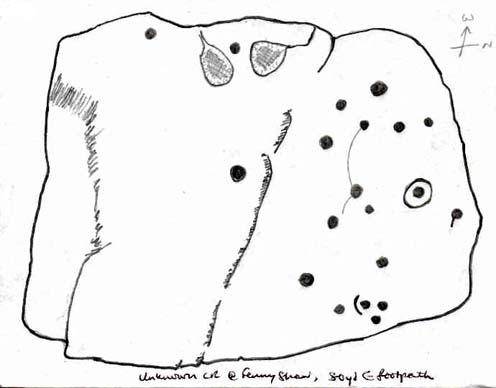
It’s a ‘big rock’ and stands out on the slope here.  There’s at least one complete cup-and-ring which is visible on the northern edge of the rock and there are between 17 and 30 other cups scattered across its surface, which has been greatly eroded by our timely forces of wind, rain, ice and snow.

Hedges’ 1986 sketch

In ambling around looking at the other stones in the vicinity, along with finding the small Littlestone cup-marked rock further up the slope, we also found, just below the faded old Big Stone, another quite large rock upon which, quite recently, someone has decided to etch four complete cup-and-ring symbols.  These appear to have been done either to,

i) assess degrees and speed of erosion on rock carvings;

or,

ii) pure artistry.

Whichever it may be (and there’s been various cries of “vandalism” when such carvings have been etched by some folk on otherwise virgin rock over the years), let it be known that the Big Stone’s partner was etched c.2008-9.  Does anyone out there know who did this ‘new’ carving?

References:

  1. Boughey, K.J.S. & Vickerman, E.A., Prehistoric Rock Art of the West Riding, WYAS: Leeds 2003.
  2. Hedges, John (ed.), The Carved Rocks of Rombald’s Moor, WYMCC: Wakefield 1986.

© Paul Bennett, The Northern Antiquarian

Grey Stone, Harewood, West Yorkshire

Cup-and-Ring Stone:  OS Grid Reference – SE 3148 4307

Also Known as:

  1. Carving no.399 (Boughey & Vickerman)

Getting Here

Various ways to get here, but I suppose the easist is by walking along the path just above the woods from the main A61 road, where there’s the junction turn-off to Wike.  You have to walk perhaps 1000 yards until eventually, a couple of hundred yards up the slope to your left (south) you’ll see the boulder stuck in the field.  You’re there!

Archaeology & History

The Grey Stone, Harewood

Described first by Cowling & Hartley in 1960, this multiple-ringed carving gives the distinct impression that it aint quite as old as our more traditional cup-and-rings on the moors west and north of here – but I s’ppose we’ll never know for sure.  There isn’t a central cup to this concentric-ringed carving, which is quite unusual, and which is why I get the impression that it’s from a later archaeological period.  However, saying that, there are several other faint cup-markings on the southwest and east-faces of the boulder (which I forgot to photograph when I was there – idiot that I am!).  Boughey and Vickerman (2003) illustrate as many as 18 other cup-marks on the rock surface – which they list as stone 399 in their survey.

Although there seems to be no folklore attached to this isolated carving, rock-art authority Graeme Chappell noted how “the midwinter full moon set behind Almscliffe Crags at its extreme northerly setting point in Bronze Age times” from this Grey Stone.

The archaeologist S.A. Moorhouse (1981) also pointed out how some of the many Grey Stones (which usually means ‘a boundary stone’, sometimes very ancient ones) found in northern England, derive their name from the old word har, which “can also mean ‘grey, hoar,’ used to describe natural boulders, possibly with cup-and-ring markings” – just as we have here!

References:

  1. Bennett, Paul, The Old Stones of Elmet, Capall Bann: Milverton 2001.
  2. Boughey, Keith & Vickerman, E.A., Prehistoric Rock Art of the West Riding, WYAS: Wakefield 2003.
  3. Cowling, E.T. & Hartley, C.E., ‘A Ring-Marked Rock: The Grey Stone,’ in YAJ 1960.
  4. Moorhouse, S.A., ‘Boundaries,’ in Faull & Moorhouse’s West Yorkshire: An Archaeological Survey, volume 2, 1981.

© Paul Bennett, The Northern Antiquarian


Map Stone, Ilkley Moor, West Yorkshire

Cup-and-Ring Stone:  OS Grid Reference – SE 12961 46396

Also known as:

  1. Carving No.137 (Hedges)
  2. Carving No.295 (Boughey & Vickerman)
  3. Planet Stone
  4. The Planets Rock

Getting Here

Map Stone, looking east

Best visited in winter and spring – thereafter the vegetation can hide it a little – but even then, it’s not too hard to find.  Start from the Cow & Calf Hotel and walk across the road onto the moor, and head over as if you’re gonna walk above the Cow & Calf Rocks, onto the moorland proper.  When you’ve gone a few hundred yards, walk up the slope (there are several footpaths – you can take your choice).  Once on the ridge on top of the moor proper, you’ll see the Haystack Rock: it’s on the same ridge, right near where the moor drops down the slope about 250 yards west of here, just about next to the footpath that runs along the edge.  Look around!

Archaeology & History

Unlike some folk who’ve seen this old stone, I find this carving superb.  Its one of my favourites up here!  Its alternative name – the Planet Stone – perhaps lends you to expect something more, but this is down to the astronomer who thought this was some type of heavenly image (which is most unlikely).  I prefer to call it the ‘Map Stone’ because the correlates this carving has with indigenous aboriginal cup-and-rings is impressive and — to Aborigines anyway — would have all the hallmarks of a map.  But not a ‘map’ in the traditional sense of modern humans.  The incidence of cups and rings linked by curvaceous lines, typifies routes between water-holes or settlement spots made by ancestral beings — which is just what we find at this carving here.  These ancestral beings need to be seen in a quite mythic sense: they may be creation deities (giants, gods, etc), animal spirits, the routes of shaman spirits, or other expressions of homo-religiosus.

Map Stone (note the carved line along the very edge of the rock)
…and again from another angle

In the Map Stone here, we see that the very edge of the rock (fig.2 & 3) is ‘encircled’, perhaps (and I say perhaps) symbolic of the edge of the world.  The lines and rings upon the top of the rock may symbolize journeys to and from important places.  Another impression I get of this carving, with the “map” idea, is that the large pecked diamond-shaped ‘cup’ near the middle of the carving is a large body of water around which the archaic routeways passed.  The next time anyone visits this stone, have a look at it with this idea in mind.  Its simple, straightforward and makes sense (mind you – that doesn’t mean to say it’s right!).

The first account I’ve found of this comes from the pen of J. Romilly Allen (1882), where this stone “measuring 5ft 3in by 5ft, and 1ft 9in high” was described thus:

“On its upper surface, which is nearly horizontal, are carved thirteen cups, varying in diameter from 2 to 2½ in, eleven of which are surrounded by rings.  There is also an elaborate arrangement of connecting grooves.”

Although we can only work our nine cup-and-rings here today, Mr Allen seemed suitably impressed with this old carving. Stan Beckensall (1999) seemed to have a good feel of this design too, describing it thus:

“Two thirds of the surface of this earthfast sandstone have been used in a design that partly encloses the marked part of the rock with long curvilinear grooves along its edge, and the inner grooves link single rings around cups.  The effect is one of inter-connection and fluidity.”

The Map, or Planets Stone (after Hedges 1986)
Hedges 1986 sketch

The Map Stone was also looked at to examine the potential for Alexander Thom’s proposal of a megalithic inch: a unit of measure speculated to have been used in neolithic and Bronze Age times for the carving of cup-and-ring stones.  Using nine other carvings on these moor as samples, Alan Davies (1983, 1988) explored this hypothesis and gave the idea his approval.  However the selectivity of his data, not only in the carvings chosen, throws considerable doubt on the idea.  Unfortunately the idea doesn’t hold water.  The ‘geometry’ in the size of cup-and-rings relates more to the biometrics of the human hand and not early scientific geometry, sadly….

References:

  1. Allen, J.R., ‘Prehistoric Rock Sculptures of Ilkley,’ in Journal British Arch. Assoc., 35, 1879.
  2. Allen, J.R., ‘Notice of Sculptured Rocks near Ilkley, with some Remarks on Rocking Stones,’ in Journal British Arch. Assoc., 38, 1882.
  3. Allen, J.R., ‘Cup and Ring Sculptures on Ilkley Moor,’ in Reliquary Illus. Archaeology, 2, 1896.
  4. Beckensall, Stan, British Prehistoric Rock Art, Tempus: Stroud 1999.
  5. Boughey, K.J.S. & Vickerman, E.A., Prehistoric Rock Art of the West Riding, WYAS: Exeter 2003.
  6. Collyer, Robert & Turner, J.H., Ilkley: Ancient and Modern, William Walker: Otley 1885.
  7. Cowling, E.T., Rombald’s Way, William Walker: Otley 1946.
  8. Davis, Alan, ‘The Metrology of Cup & Ring Carvings near Ilkley in Yorkshire,’ Science Journal 25, 1983.
  9. Davies, Alan, ‘The Metrology of Cup and Ring Carvings,’ in Ruggles, C., Records in Stone, Cambridge 1988.
  10. Hedges, John, The Carved Rocks on Rombald’s Moor, WYMCC: Wakefield 1986.
Alan Davies' image of the carving - with carved 'lake' near centre
Alan Davies’ image of the carving – with carved ‘lake’ near centre

© Paul Bennett, The Northern Antiquarian


Wycoller Bridge, Trawden, Lancashire

Cup-Marked Stones:  OS Grid Reference – SD 931 393

Getting Here

Easy enough to find once you’ve actually got to Wycoller.  By car, the only real way to get here is from Colne, through the village of Winewall, and along the Wycoller road, which runs to a dead end.  Once here, the old packhorse bridge with these cup-marks on it can’t be missed!

Archaeology & History

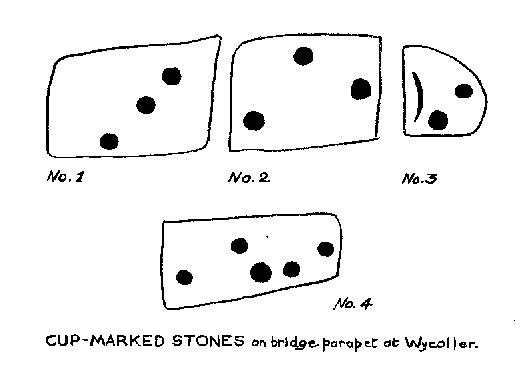
Wycoller Bridge's cup-marked stones (after Jackson, 1962)
Wycoller Bridge’s cup-marked stones (after Jackson, 1962)

A weird one this!  On the famous packhorse bridge close to the old hall, four of the stones have cup-markings etched onto them.  It seems that at least three of the carvings are archaic; with cups on one of the stones being somewhat deep and may actually be medieval.  But we simply don’t know….  A short article describing them was in the Bradford Cartwright Hall Archaeology Bulletin (1962) where they were equally as puzzled about them.  In 1979, J.A. Heginbottom described them in his survey on the prehistoric rock-art of upper Calderdale.  It’s possible that the stones on which the cups were carved might have been taken from a prehistoric tomb on the edge of the moor further up the valley from here.

Folklore

Just next to this bridge is another, much older one, known locally as the Clapper or Druid’s Bridge which perhaps has some bearing on the curious cup-markings.  Legend tells that this older construction was so called “because legend has it that it led to an amphitheatre where the druids held human sacrifices” – and the field just up from here (to the southwest) was known as the Dripping Stone Field.  Hmmmmm…..

References:

  1. Bentley, John, Portrait of Wycoller, Nelson Local History Society 1975.
  2. Heginbottom, J.A., The Prehistoric Rock Art of Upper Calderdale, unpublished report: 1979.
  3. Jackson, Sidney, ‘Cup-Marked Stones at Wycoller,’ in Cartwright Hall Archaeology Group Bulletin, October 1962.

© Paul Bennett, The Northern Antiquarian

Woman Stone, Askwith Moor, North Yorkshire

Cup-and-Ring Stone:  OS Grid Reference – SE 17103 50541

Also Known as:

  1. Carving no.520 (Boughey & Vickerman)

Getting Here

Takes a bit of finding this – but if you like your rock art, it’s worth the search!  You can follow directions for the getting to the Man Stone then, when you reach it, look to the near horizon to the east.  Get to the bottom of the sloping hillside where a large rounded boulder sits and walk up the slope about 10 yards.  Look around here cos you’re very close.

Woman Stone carving
Carving highlighted in chalk

Alternatively, from the Askwith Moor Road, follow the path to the triangulation pillar on Shooting House Hill.  Keep going for another 100 yards and check a small path to your left (south).  Follow this down until you get to the top of the slope.  Go to the bottom of the slope and look around!

This carving is best checked out in winter and early spring: if you go here in summer & autumn there’s bracken covering the entire site & you’ll never find it!

Archaeology & History

Drawing by Inmaculada Ibanez-Sanchez

This stone was first discovered by Graeme Chappell and I during one of our many ambling explorations here in the early 1990s and was first mentioned in my Old Stones of Elmet (pp.149-152).  Marija Gimbutas would have loved this seemingly matriarchal-looking cup-and-ring carving, suggestive of many Mother Goddess images she found across Europe – hence its title!

Woman Stone design (after Boughey & Vickerman)

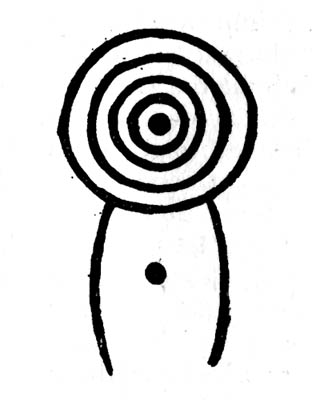
I don’t think that the old-school archaeological types would lower themselves to say such a thing, but as I aint one of them I’m quite confident in saying that this carving does seem to be a pictorial representation of a female figure: one of the earliest of its kind in the British Isles? (check its nearby male compatriot, the Man Stone – a distinctly human figure and one of the earliest of its kind in the British Isles)  Very close by we are left with old place-name remnants pointing directly at the presence of pre-christian goddess remains in the mythic landscape – an issue I’ll expand on in the near future.

In the survey by more recent rock art students Boughey & Vickerman (2003), their illustration of the carving makes it look even more like an early female figure! (though I hear they don’t like people giving the carvings names – unless, of course, one of them lot names it…)

References:

  1. Bennett, Paul, The Old Stones of Elmet, Capall Bann: Milverton 2001.
  2. Boughey, Keith & Vickerman, E.A., Prehistoric Rock Art of the West Riding, WYAS: Wakefield 2003.
  3. Gimbutas, Marija, The Language of the Goddess, Harper-Collins: San Francisco 1989.
  4. Gimbutas, Marija, The Civilization of the Goddess: The World of Old Europe, Harper-Collins: San Franciscoo 1991.

© Paul Bennett, The Northern Antiquarian