Long Barrow (destroyed): OS Grid Reference – SS 5848 9227
Also Known as:
Cae Bryn-y-garn
Archaeology & History
Described in 1925 in a report by the Royal Institute of South Wales as “the remains of a long barrow,” it seems that all remains of this old site have been destroyed. Where the long tomb once stood are now some bungalows (anyone know if they’re haunted!?).
The tomb was quite an impressive one from all accounts: aligning north-northeast, it was some 20 yards long and 10 yards wide (at its widest), standing between 6-8 feet tall. When building operations started here in 1959, a disturbed mound of stones was noticed, but by 1965 the bungalows had been built where once rested the ancient dead.
The field-name to its immediate east — Cae Bryn-y-garn — tells us the old name of the cairn, as known to local folk. Quite what its folklore may have been, I’ve yet to hear…
References:
Royal Commission on the Ancient & Historical Monuments, Wales, An Inventory of the Ancient Monuments in Glamorgan – Volume 1, HMSO: Cardiff 1976.
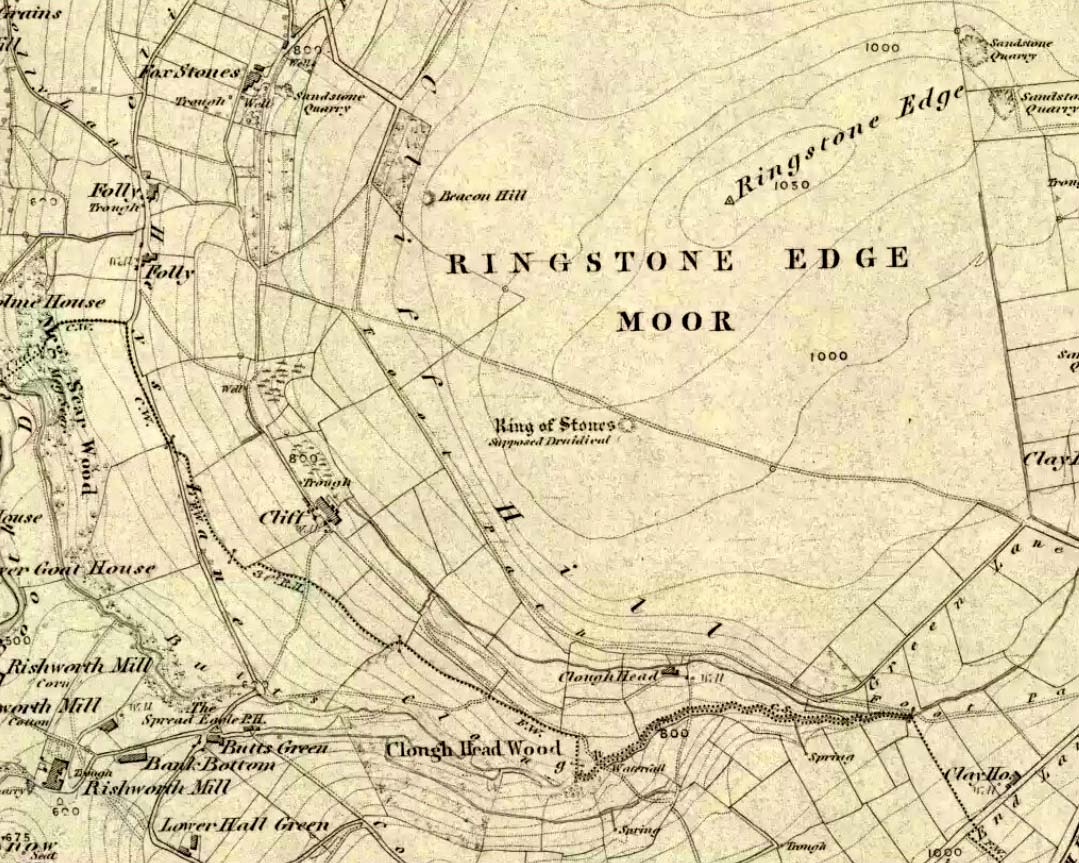
From Ripponden, taken the steep road up to Barkisland, but at the crossroads just before the village, turn right (south) and keep going for a mile till you reach the reservoir. At the far-end of the reservoir, take the track down by its side and follow the footpath that bends round the edge of the grasslands. Go up onto this small moorland and, once you’re on the level, head towards where you’ll see a large pile of stones a coupla hundred yards away. That’s it!
Archaeology & History
If we visit this site today, all we are left with is a scattered mass (or perhaps that should that be ‘mess’) of many hundreds of stones: the last remnants of what once would have been a proud circle of one form or another upon this small moorland plain. Its significance was such that the very moor on which its remains are scattered, was named after it: the Ringstone Edge Moor. But as with many sites from our megalithic period, this old place is but a shadow of its former self.
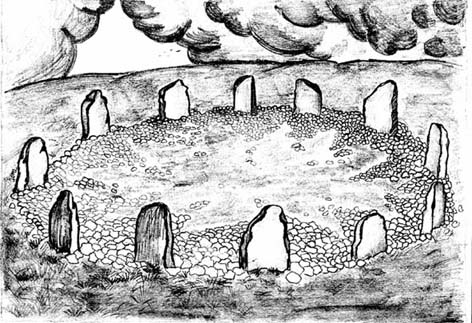
Gone are the upright monoliths which, tradition relates, once surrounded this low scattered circle of small loose stones (which would have made it look not unlike the wonderful stone circle of Temple Wood, Argyll). These standing stones were, so the folk record tells, removed near the end of the 18th century for use in some walling.
Described variously as a stone circle, ring cairn, cairn circle, an enclosure, and more, the site first seems to have been written about in 1775 by the great historian John Watson. When he was vicar of the local parish in Halifax (not far from here) this “ring of stones” as he called them, was “called the Wolf-fold.” Nearly one hundred years later, in F.A. Leyland’s superb commentary to Watson’s work, he wrote,
“The stones which constituted the circle at the time of their removal stood upwards of three feet…and the remain formed a striking object on the moor. The original number of stones of which the circle was formed is unknown, having long been in ruin and reduced in quantity before being finally removed. This was effected about twelve years since by the present tenant of the dam.” – that is, around 1859.
However, when Crabtree (1836) described the circle a decade or two earlier, he made no mention of such standing stones — although we must consider that Crabtree was very much like many modern academic archaeologists who tended to copy the works of others, much less than getting out in the field to see for himself.
At the beginning of the 20th century, the lore telling of the standing stones’ demise was repeated by local historian John Priestley (1903), when he said that: “all the large stones…were carted away about forty years ago” — that is, around 1863.
So it would seem that the very final destruction of the standing stones here, occurred sometime during the four year gap which Messrs. Leyland and Priestley describe.
More than fifty years later, Huddersfield historian James Petch (1924) came here to explore whatever remains he could find, and told:
“On top of a flat plateau on this moor, with an extensive view on all sides save on the north, where there is a gentle slope for some hundreds of yards up to the summit of the hill, there are distinct traces of a circular ring of small stones. Pygmie flints have been picked up within a yard or two, but the only other fact to be noted about this earthwork is that there is a tradition to the effect that much earth has been removed from this site. It is not altogether impossible that this is a scanty remnant of a round barrow.”
This latter remark of Mr Petch seems most probable. The excessive scatter of small stones typifies the remains of many of the Pennine giant cairns, from the Little Skirtful on Burley Moor and giant tombs of the Black Hills near Skipton, to the similar monuments of our Devil’s Apronful, Pendle, etc, etc.
Close to this cairn circle, wrote Sidney Jackson (1968), there used to be the remains of an Iron Age settlement, “marked by wall foundations (but) is now covered by the waters of Ringstone Reservoir.”
Folklore
There is very little folklore that I’ve found here. Watson (1775) throws the usual idea that the place was a site of druidical worship; but other than that we only have a local Ripponden writer’s account, which told that there was once the ghost of a white lady that was once said to walk along the path somewhere between here and the Beacon Hill tumulus, a short distance to the north.
Easy to find if you go at the right time of year — very troublesome to find if you go at the wrong time! Check the place out at the end of winter, beginning of Spring. It’s at the top end of Shipley Glen, just past where the road bends round and goes uphill. About 50 yards up, on the left side of the road walk into the grasslands for less than 100 yards. Look around!
Archaeology & History
An intriguing site this one. Intriguing as it wasn’t in the archaeological registers when I first came across it — and I’m really unsure whether it’s in there now. It probably has, as John Barnatt came here with some earth-mystery folk in 1982! But when I first visited this site in 1975 it seemed no one knew about it — and little has changed since then.
It is an enclosed ring of stones less than 30 feet across with an earth embankment separating it from what seems like a secondary ring on its outer edge, a foot or two away. This didn’t appear to surround the complete ring and may have been damaged. It had an appearance similar in size, shape and form to the Roms Law and Harden Moor sites, and thankfully in reasonable condition. I don’t think any excavation has yet been performed here though.
There are a number of other small standing stones on the outskirts of this ring that may have some relationship with the site, but we need excavation to prove one way or the other. Several very well-preserved cup-marked stones are close by.
Folklore
Intriguing to those of you who are fascinated by alignments between sites, or ‘leys’, as an impressive lines runs through this site. Starting at the little known Hirst Woods Circle and terminating at the giant Great Skirtful of Stones cairn, once passing over the now destroyed Weecher circle and the Brackenhall Green ring on its way.
References:
Bennett, Paul, The Old Stones of Elmet, Capall Bann: Chieveley 2001.
Tumulus (destroyed): OS Grid Reference – TF 232 018
Archaeology & History
Very little was known about this now lost burial mound. It was one of several nearby but, thankfully, the local historian and archaeologist E. Thurnam Leeds (who once lived at the nearby Eyebury Farm) sent a letter to the Society of Antiquaries in London, describing some pottery and other remains that he’d found there:
“The small pot of a late Bronze Age type and the other sherds exhibited were found in a tumulus known as Oliver Cromwell’s Hill, at Eyebury, near Peterborough. As only a portion of the tumulus has been examined as yet, it is proposed to defer a full account of the excavations until further progres has been made. The tumulus is of the round type, about 40 yards in diameter and 5 feet high at the centre. On three sides traces of a ditch were met with, containing soil which had evidently been burnt. Close to the gravel in the centre of the tumulus there were two distinct layers of charcoal, and in two places apparently remains of hearths. The small pot was found only 1½ feet down on the south-eastern side of the mound, 39 feet from the centre. In the centre itself at various depths were found sherds, some of Bronze Age forms; but a pice of a rimmed vase found at a depth of 3 feet 6 inches, about 6 inches above the first charcoal layer, appears to be of Roman date, in which case the centre of the tumulus must have been disturbed in those times, though the charcoal floors were never pierced. Bones of various animals, including sheep, pig, dog and hare, and a large flint flake were also found.”
As far as I’m aware, no further detailed examinations took place at this curiously-named hillock, whose folktale I’ve yet to read.
References:
Leeds, E.T., ‘Letter,’ in Proceedings of the Society of Antiquaries, 22:1, 1910.
Easy enough this one. Take the B4066 west of Woodchester past the Boundary Court and over the cattle grid for 100 yards or so. Note the fence up the slope to your left (south) up the field here head for the triangulation pillar. Once there keep walking for about another 100 yards. You can’t miss it!
Archaeology & History
The mad craniologist John Thurnam (1810-73) was one of several old-school fellas who helped to excavate this grand site on one occasion. Thinking that human sacrifice lay behind virtually all of the burial mounds, Thurnam was part of the Cotteswold Field Club group who investigated the place; and, because of his intellectual capacity in cranial investigations, was listened to by the budding archaeo’s of the day cos he was cleverer than them (hero worshipping). A bit naive of them, but such is the way of some folk! Yet their early account of this site (devoid of Thurnam’s weird notions) is quite invaluable, even today. Described in an address by their President in the Proceedings in 1865, the article tells:
“The Club met at Stroud. The principal work of the day was the opening of a ‘barrow’ on Bown Hill…which had formed the subject of discussion towards the end of the previous season when, the period of the year being too far advanced, the work of exploration was deferred. Workmen had been employed under Dr Paine and Dr Witchell on the two previous days; but beyond the discovery of the entrance to the sepulchral chambers no great progress had been made in the excavation of the mound which, from its size and solidity, proved to be a very laborious operation. In order, therefore, to expedite matters, a strong force of labourers, 22 in number, had been employed from an early hour on the day of the meeting. The mound, which measured about 60 yards in length by 17 in extreme width, was seen to be constructed of angular masses of stone, heaped together without any order or regularity, amongst which were scattered blocks of considerable size and weight.
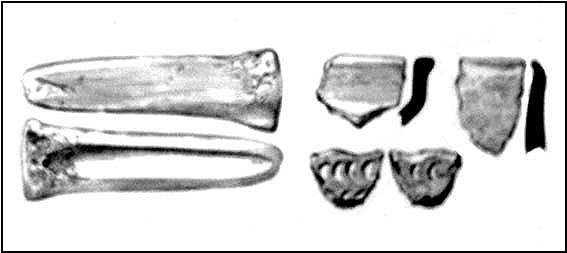
“The excavators had opened a trench about 100 feet in length, in a direction due east and west by compass. The western extremity was the broadest, the mound gradually diminishing in width to the opposite end. The workmen had struck upon the entrance which, when exposed, showed a chamber formed of five large, unhewn stones, two on each side and one placed transversely, the dimensions of which were 4 feet in width by 8 feet 6 inches in length. There was no covering stone, but the entrance was flanked on either side by a wall of dry masonry, very neatly fitted, forming a segment of a circle, which, if completed, would have enclosed a well-like chamber in front of the entrance to the tumulus. This wall had been abruptly broken off; but there were amongst those present some who thought they detected signs of it having been at one time continuous. It was evident that the whole structure had been thoroughly ransacked and broken up by former explorers; and so completely had the work of devestation been accomplished that hardly one stone was left upon another. The chambers, with the one exception already noted, had been entirely demolished, and but a few bones scattered throughout the whole tumulus remained, all more or less in a fragmentary condition. These fragments comprised one fully developed frontal bone, male; portions of two male lower jaws, and portions of two female skulls; several thigh bones, and bones of the leg and foot, including the remains of children, but all much broken. There were found the remains of six indiiduals at the least, viz, two men, two women and two children, the latter between six and eight years of age. There were several bones of cattle and calves; teeth of horse and ox; a portion of the bones of the foreleg of a dog; several boar’s teeth, tusks and grinders, and parts of jaw bones; a bone ‘scoop’, formed of a shank bone of a horse; and a large quantity of a black unctuous substance, having the appearance of wood or animal charcoal; but no burnt bones. A small portion of a small flint flake was detected in the black paste. Besides the organic remains above enumerated, some pieces of rude pottery were found, which, with a Roman brass coin of the Emperor Germanicus, complete the list of objects yielded…”
Some of the remains found in Bown Hill’s long barrow
A few years later George Witts’ (1883) described the tomb but added little to the description above. When Crawford (1925) came here in December, 1920, the greatest height of the tomb was just ten feet and he described that “the extreme eastern end has been destroyed by quarrying.” He could clearly discern various trenches and the remains of previous excavations around the tomb, but added little further, apart from an important geomantic ingredient:
“It stands near the highest point (763 feet) of the hill and commands a magnificent view. South eastwards can be seen the Berkshire Downs (probably the White Horse Hill and Wayland’s Smithy); northwards May Hill and the Malvern Hills are visible; in the western distance are the Brecknock Beacons and the Black Mountains…”
Crawford later received further notes about the 1863 dig at Bown Hill from the son of Dr Paine that had been written following the original excavation. Although they convey little extra from the above account, I’ll add the notes to this entry in the near future.
References:
Crawford, O.G.S., The Long Barrows of the Cotswolds, John Bellows: Gloucester 1925.
Darvill, Timothy, Prehistoric Gloucestershire, Alan Sutton: Gloucester 1987.
Grinsell, L.V., The Ancient Burial Mounds of England, Methuen: London 1936.
Guide, W.V., ‘Address to the Cotteswold Naturalists’ Field Club,’ in Proceedings of the Cotteswold Naturalists’ Field Club, volume 3, 1865.
Witts, George, Archaeological Handbook of Gloucestershire, G. Norman: Cheltenham 1883.
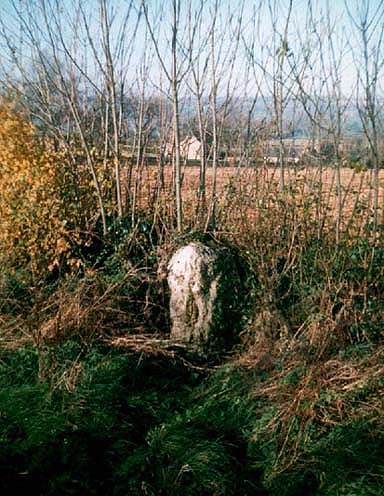
This stone stands on the south-side of the B4450 just north of the crossroads, halfway between Churchill and Chipping Norton. Generally troublesome to see at first as it tends to get hidden in the hedgerow, so you may need to furrow into the but shrubbery to get to it, but it’s not too difficult to locate with a bit of patience.
Archaeology & History
This small standing stone seems to have been described for the first time in O.G.S. Crawford’s (1925) fine survey of the regions prehistoric remains following a letter he received from a local man, Mr A.D. Passmore, who first drew it to the attention of archaeologists. Crawford told:
“This stone is a little over a mile southwest of Chipping Norton station. It stands in the hedge on the northwest side of the road and is about four feet high… Nothing more is known about it, but it seems not unlikely that it may be of considerable antiquity.”
A few years later Leslie Grinsell (1936) mentioned it in his equally fine survey of prehistoric English tombs and associated remains, describing here, “a large stone which may be the remains of a megalithic monument.” Tom Wilson then illustrated it in our crappy little Old Stones of Rollright (1999) work (which really needs updating and expanding). It’s a cute little stone and may have once served as a companion to a prehistoric tomb as there are many others nearby. It is also quite close to one of the local boundary lines and, p’raps, might once have served as a marker hereabouts. We might never know…
References:
Bennett, Paul & Wilson, Tom, The Old Stones of Rollright and District, Cockley: London 1999.
Crawford, O.G.S., The Long Barrows of the Cotswolds, John Bellows: Gloucester 1925.
Grinsell, Leslie V., The Ancient Burial Mounds of England, Methuen: London 1936.
Stone Circle (destroyed): OS Grid Reference – SO 303 976
Archaeology & History
Although geographically closer to the village of Priest Weston, this site — when still in existence — was in the parish of Churchstoke. To be found a half-mile west of White Grit (near the famous Mitchell’s Fold megalithic ring and standing very close to the local boundary line), the Welsh Royal Commision report (1911) told that its position was, “at the foot of the northern slope of Corndon Hill, and close to a stile on the south side of the road near the turning to Cliffdale Mine.” Found close to a number of other prehistoric remains, the Report told:
“It is certain that at this place there once stood a circle of eight or nine stones. An intelligent man, named John Jones, aged 74 years and a resident in the vicinity since his youth, remembers four stones arranged as though forming parts of a circle, with an appendage in a curve “like a hook.” About 100 yards distant was a cairn, the foundation of which is still discernible. The land was then unenclosed, but on its enclosure the cairn and the circle were rifled to provide stone for the construction of the existing fence. Mr Jones pointed out the four stones which had been members of the circle. The Rev. C. Hartshorne’s account of this circle in Salopia Antiqua, 1841, p.33, gives a slightly different account of the stones. He observes, “these three stones (the Whetstones) were formerly placed upright though they now lean, owing to the soft and boggy nature of the soil. The stand equidistant and assume a circcular position… The highest of these is four feet above the surface; 1 foot 6 inches in thickness; and 3 feet in width.”
When the Royal Commission lads got round to examining the remains here, they reported that,
“Only one stone is now to be found, embedded in the ground close to the stile entering the field, and this is so small that it is not likely to have formed one of the stones of the circle, or it must be a mere fragment of a larger mass.”
However, from the air, a very distinct circle is clearly visible, showing that something was here in bygone times. In all likelihood, there’s gonna be something just beneath the surface here to tell us more about whatever once stood here.
References:
Crawford, O.G.S., The Long Barrows of the Cotswolds, John Bellows: Gloucester 1925.
Royal Commission on Ancient & Historical Monuments, Wales, County of Montgomery, HMSO: London 1911.
Various ways up this old hill, visible from all angles it seems. I came up via the housing estate near where us friend lives, near Bare Lane Station, through the houses and up the footpath. But you can just as easy (if not easier) walk up from the country lane and fields beneath its eastern side. Much nicer!
Archaeology & History
Torrisholme Barrow
As many northerners will tell: gerrin information from the Lancashire archaeologists about prehistoric sites is troublesome (must be Southerners running the show!). There’s tons of stuff in this good county, but archaeo-info is pretty poor on the ground. This great old tomb for example, is designated as a “round barrow” on the Lancashire County Council monuments and records listing, but there’s no other info telling when it was dug, who by, the size of the tomb, what was found here, etc. Pretty poor to be honest (c’mon chaps – get yer fingers out!). The best info on-line comes from the more dedicated amateur enthusiasts.
A local historian told us that there was nowt up here, but my nose told me otherwise — so up we tramped! It was pretty obvious once we’d got to the top here, that some ancient mound had been built up.
“This has all the hallmarks of a tomb,” I said.
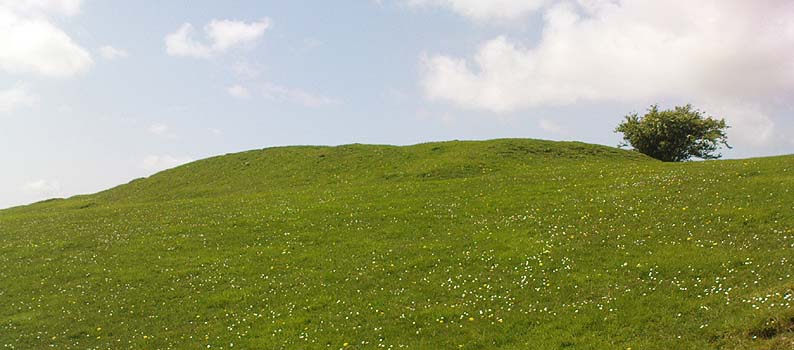
Torrisholme Barrow, looking SW
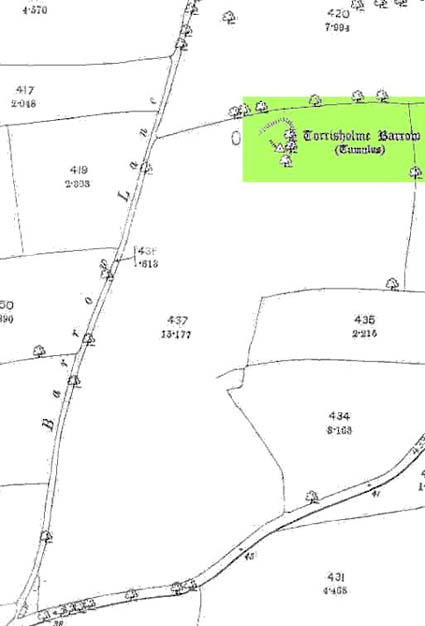
The spirit of the ancestor herein (whoever s/he was) had excellent views and flights to numerous important hills 360° all round here. A perfect place for a tomb! And when we returned into the Darklands of our Yorkshire abodes, we found this notion to be true. Marked on early OS-maps as a tumulus, next to the tell-tale giveaway route of Barrow Lane, there are passing mentions of it in a couple of old local history books I’ve come across, but I’ve yet to find much more about it. It’s a fine mound and of decent size, well worth checking out if you’re in the area. Once I get more details of the archaeological finds from here, I’ll add the data to TNA (but based on past performances and responses from Lancashire archaeo’s, I wouldn’t hold your breath…)
And for any Morecambe historians who might be able to find more: what — if anything — is known of the ‘Fartle Barrow’, now swallowed by the encroachment of the sea, just a few hundred yards west of here?
Folklore
In days of olde, this site was an old moot or meeting hill: one of the northern Law or council meeting hills. Quite how far back this gathering tradition up here goes, aint known. We do know however that there was a christian tradition enacted here, at Easter, of local church doods taking a cross up the top of the hill (does anyone know the story behind the old Cross Hill, half-a-mile south of here?). There’s obviously quite a lot more pre-christian activities occurrent round here than has been previously thought.
At the bottom of the ridge from the (supposedly) singular King’s Park cup-and-ring stone,” in a sand-pit adjoining Douglas Terrace,” we could once find the remains of a now lost prehistoric tomb. First described in the Stirling Natural History Society’s Transactions in 1907, the Scottish Royal Commission lads (1963) told us that, “an urn from this cist was taken to the Smith Institue, Stirling, in a broken condition.” Anymore information about this site, or images of the fragmented urn, would be hugely appreciated.
It does seem very probable that the King’s Park cup-and-ring stone at the top of the ridge from here did relate to local neolithic or Bronze Age burial sites, as I suspected. It’s highly likely that other carvings were (are?) hidden beneath, or round the edges of this Douglas Terrace and Kings Park region, as I suggested a few months ago. It’s imperative that archaeologists in the district pay attention to this area before giving the go-ahead of any further landscape destruction.
References:
Royal Commission on Ancient & Historical Monuments, Scotland, Stirlingshire – volume 1, HMSO: Edinburgh 1963.
Cairns (destroyed): OS Grid Reference – NS 780 926
Archaeology & History
In times past, there were at least two prehistoric tombs in land either side of old Birkhill House, now covered by the M9 motorway. The Scottish Royal Commission lads described the first as being “in the garden of Birkhill House,” continuing:
“This cist contained bones and an urn which measured 5in in height and 6in in diameter, and was ornamented with zigzag lines.”
They think, from its description, that “it may have been a food vessel.” There were also the remains of another tomb to be found in “rising ground to the west side of” Birkhill House. Both of these finds were first described in the local Transactions of the Stirling Natural History and Antiquarian Society in 1880. It seems that little else is known about them. (Thanx again to Paddybhoy for prodding my attention here.)
References:
Royal Commission on Ancient & Historical Monuments, Scotland, Stirlingshire – volume 1, HMSO: Edinburgh 1963.