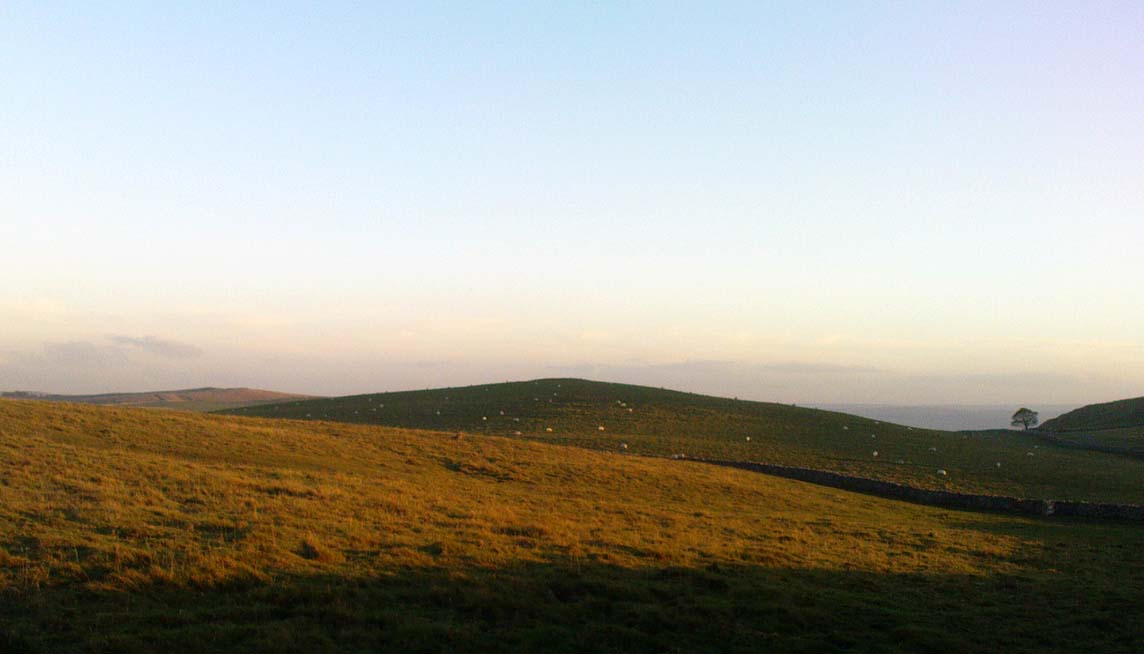
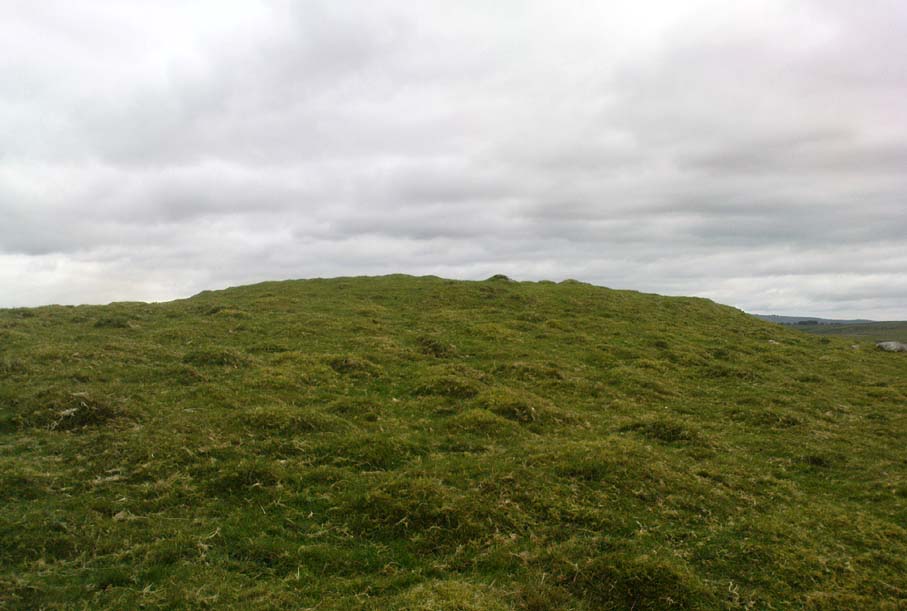
Seaty Hill, Malham Moor, North Yorkshire

Tumulus:  OS Grid Reference – SD 90693 65374

Also Known as:

  1. New Close tumulus

Getting Here

From Malham village go over the lovely old bridge and follow the road up and round, keeping to the left (not up the Gordale Lane) where the junction appears a few hundred yards along.  Follow this steep and winding road all the way to the top for a couple of miles until you hit a junction seemingly in the middle of nowhere.  Park up somewhere to the left and notice the hillock which you’ve just passed on your right (east) with a bittova flat top to it.  Cross the stile and go up to it!

Archaeology & History

Although somewhat overgrown thanks to the persistence of Nature, this good-sized burial mound on top of this, one of many small hills in and around the moors hereby, is a fine specimen to behold and a fine place to sit and drink in the view.  Although not quite having the grandeur of the Great Close Hill tomb a mile to the north, the countryside hereby is still impressive and was of obvious importance in the mythic landscape of our Bronze Age ancestors.  If you think otherwise, there’s obviously summat wrong with you.
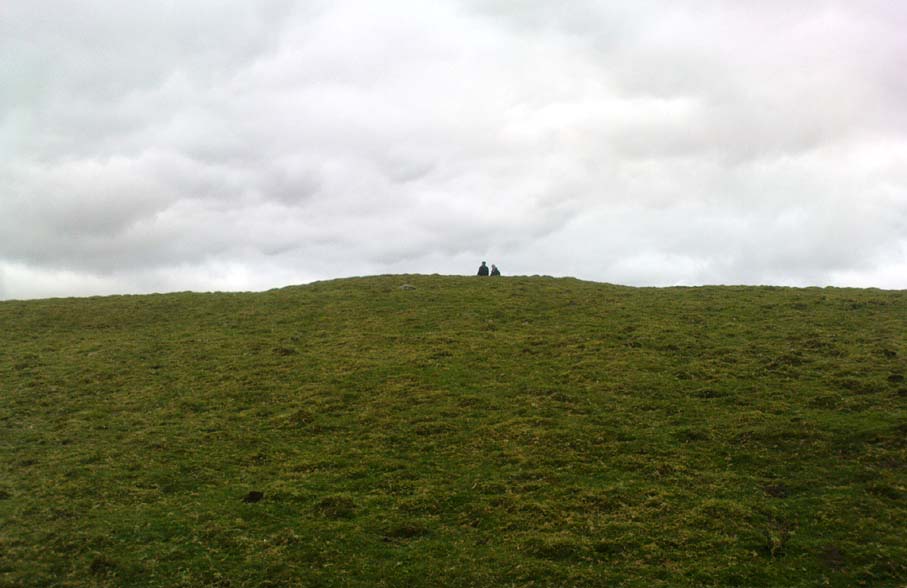
Approaching the tumulus
Seaty Hill tumulus

Although we can only see the remains of one singular round tomb today, at least two other tumuli were once in evidence in this large open field but they were dug out many years back.  There were probably even more of them, but any trace has long since gone.  Thankfully this one was given the attention of decent archaeologists some fifty years back, when Arthur Raistrick (1962) and his mates got stuck into the place.  His initial account of the place told us how it was,

“…surrounded by a shallow ditch and bank enclosing a low mound 66 feet diameter, rising about 4 feet above the ditch bottoms.  In the original surface of the hill top there had been dug two holes, circular and partly impinging on one another, both 3ft 6in deep.  In the northwesterly one of these a skeleton had been carefully placed in a sitting position, with knees drawn well up, and was facing the second hole  which is to the southeast.  This hole was almost filled by a carefully built cairn of limestone boulders, but nothing was found either in or beneath it.  No artifact of any kind was found with the skeleton.  Both holes had been filled in with fine sandy and gravelly loam to the natural ground level and then covered with a low mound, 15 feet in diameter and 1 foot high, of coarser gravel and small boulders.  The second mound, 66 feet diameter, of limestone rubble and boulder clay and 3 feet high above ground level, was put over this and provided with a kerb of large limestone boulders buried in the toe of the mound.  A shallow ditch was then dug and its spoil thrown outwards to form a shallow bank.

“In the surface of the large mound there were not less than 13 secondary burials of early Iron Age, each in a small saucer-shaped depression filled in with gravelly loam.  These burials are extremely fragmentary and are more like token burials than complete ones.  In three of them, beads were found, one of jet, one of blue glass and one of carved limonite.  In a burial nearly over the central older burial, a skeleton was arranged with a bone (musical) pipe between the knees, where also there were several small bones of hand and wrist and part of an iron knife.  The (musical) pipe was made from the tibia of a sheep, perforated  with three finger holes, with a well-shaped speaking lip and mouthpiece.  The pipe was playable… A full account of this unique instrument has been published elsewhere… In two of the burials there were recognizable fragments of iron knives, and in two others pieces of iron of unrecognized use, all in positions which could have been under the knee of a more primitive skeleton.  By analogy and style the primary burial has been assigned to the Early Bronze Age, and the Iron Age burials to the period first century BC to the first century AD.”

It would be intriguing to ascertain how many people from this period were playing flute-like instruments such as the one found here, and whether (as with other musical instruments in all other tribal cultures on Earth) magickal virtues were assigned to it, or the music it liberated.  Certainly in a great number of places around this very area where this instrument was found, many natural sites still abound with the hugely underrated virtue of silence; and upon the still air amidst which music would be cast, the echoes or else faint sense of such sound would evoke a marvel — curious or dreamt — to those upon who it fell.  If you think otherwise, there’s definitely summat wrong with y’!

References:

  1. Raistrick, Arthur & Holmes, Paul F., Archaeology of Malham Moor, Headley Bros: London 1961.

Links:

  1. Articles on the Malham Iron Age Pipe, by Arthur Raistrick, etc

© Paul Bennett, The Northern Antiquarian

Mount Skip, Hebden Bridge, West Yorkshire

Tumulus (destroyed):  OS Grid Reference – SE 0095 2748

Archaeology & History

Up behind the old pub that was The Mount Skip, high on the ridge above Hebden Bridge and Mytholmroyd, overlooking the Calder Valley for many miles, was once — it would seem — a number of fine prehistoric remains, long since destroyed by the industrial advance of quarrying and such likes.  Amidst what seems to have been settlement remains and, perhaps, timber circles, an ancient grave was also known here.  In Mr Ling Roth’s (1906) essay on the prehistoric remains of the Halifax region, he wrote:

“In May, 1897, a grave was discovered at a quarry above Mount Skip Inn.  The first indications were the rolling down of pieces of urns which the delvers called flower pots.  Then in digging into a hole to fix the leg of a crane, human bones were discovered,  Mr Crossley Ainsworth told me: “The grave was about 6ft (1.8m) long, from 14 to 18in (35-45.7cm) wide and about 2ft (61cm) deep…the head and feet were almost exactly north and south, with the face right towards the midday sun.”  The bones were very brittle and crumbled easily in the hand.  There was a lot of charcoal in the grave.  In the ends of the grave which were undisturbed, “there appeared to be about 6in (15cm) thick of charred wood and bones mixed together at the bottom.  Flints were also found.  Also the larger half of a small earthenware vessel which had rolled down into the quarry ; this was picked up by a man named Thos. Greenwood, of Shawcroft Hill.”

The site was mentioned again nearly fifty years later in Geoffrey Watson’s (1952) survey, but with no additional details.

References:

  1. Roth, H. Ling, The Yorkshire Coiners 1767-183; and Notes on Old and Prehistoric Halifax, F. King and Son: Halifax 1906.
  2. Watson, Geoffrey G., Early Man in the Halifax District, Halifax Scientific Society 1952.

© Paul Bennett, The Northern Antiquarian
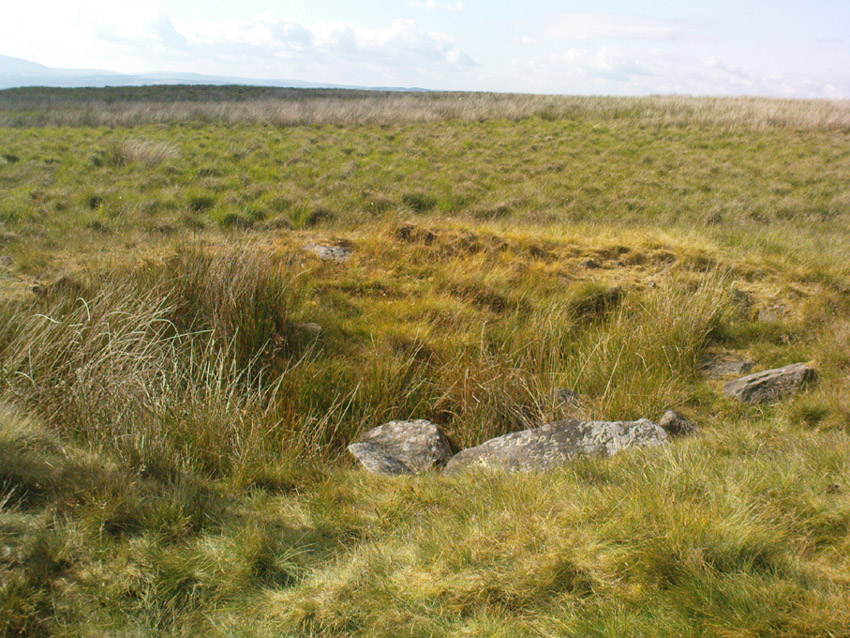

Keighley Train Station, West Yorkshire

Cist:  OS Grid Reference – SE 0656 4131

Archaeology & History

This little known site, long since destroyed during the construction of Keighley Railway Station, was found in a curious spot, close to the bottom of the Aire Valley.  Most (known) prehistoric burials occur on the higher grounds in this area.  And though we don’t appear to have the exact location of the find, it was pretty close to either side of Keighley’s old railway station (which is shown as 100 yards to the other side of the road of the present station on the 1852 OS map).  This may position the site as being on the grounds opposite and below St. Anne’s Church; otherwise it was getting closer to where the River Worth runs by.  In Keighley & Holmes’ early (1858) work they told that,

“Whilst excavating for the Railway within about a hundred yards of the Keighley station, one of the labourers discovered three urns containing a quantity of human bones.  Two of them were unluckily broken, one being large enough to hold eight or nine quarts.  The one brought away whole, and seen by the present writer, may hold about a quart; it is somewhat distastefully designed, moulded by hand out of the common clay, without glaze, and rudely ornamented on the outside by some sharp implement.  The once animated contents of each urn were covered by a square flat stone.”

This final remark seems to indicate the urns were located in a cist (a small stone grave), but we don’t know whether this was found within the remains of a denuded tumulus or stone cairn.  However, considering the lack of any remarks about a large pile of stones (which would have been very noticeable) covering this burial site, it would seem more probable that this site was originally an earth-covered tumulus, whose visibility and knowledge had long since diminished in this part of Airedale.

References:

  1. Keighley, William & Homes, Robert, Keighley, Past and Present, R. Aked: Keighley 1858.

© Paul Bennett, The Northern Antiquarian


Carmyllie Hill, Greystone, Angus

Tumulus:  OS Grid Reference – NO 545 434

Also Known as:

  1. Fairyfold Hillock
  2. Fairy Folk Hillock

Folklore

An intriguing site this, as it doesn’t appear to be in the Canmore archaeological register – unless it’s the Canmore site 34750.  Yet Alexander MacGregor (1937) mentions the place in his folklore study as being a site where the little people lived.  Shown on the first OS-map of the region as ‘Fairyfold Hillock’, Mr MacGregor (1937) said of it:

“Near the summit of Carmylie Hill is a large barrow or tumulus, which was believed at one time by the natives to be a favourite haunt of the fairies, where, with much splendour, they held their nightly revels. It still bears the name of ‘Fairy-Folk Hillock.'”

However it seems that quarrying operations may have destroyed the site.  The tomb here was probably the same one described by Mr Andrew Jervise in the Journal of the Kilkenny and South East of Ireland Archaeological Society (1864-66), where he wrote:

“Many years ago I took note of another example of these ‘footmarks,’ which was found in the parish of Carmyllie…  This was discovered in the course of making agricultural improvements some thirty-five years ago, on which occasion stone coffins or cists were got, and in one of these was a bronze (?) ring, of about three inches in diameter, now said to be lost.  Apart from the cists there was a rude boulder of about two tons weight; and upon the lower side of it, as my informant told me, was scooped the representation of a human foot. This too was associated with the elves; for the hillock upon which these discoveries were made was called the ‘fairies’ knowe;’ and tradition says that, but for a spirit that warned the workmen to suspend operations when they began to prepare for the foundations of the parish church, the church would have been built upon that spot!”

References:

  1. MacGregor, Alexander, Highland Superstitions, Eneas MacKay: Stirling 1937.

© Paul Bennett, The Northern Antiquarian
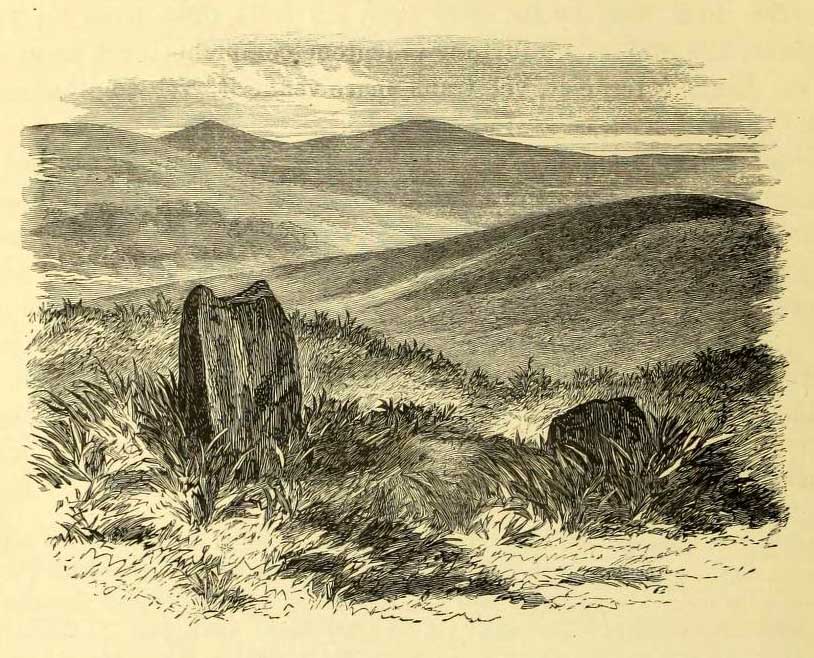

Jeppe Knave Grave, Wiswell, Lancashire

Cairn:  OS Grid Reference – SD 7599 3782

Getting Here

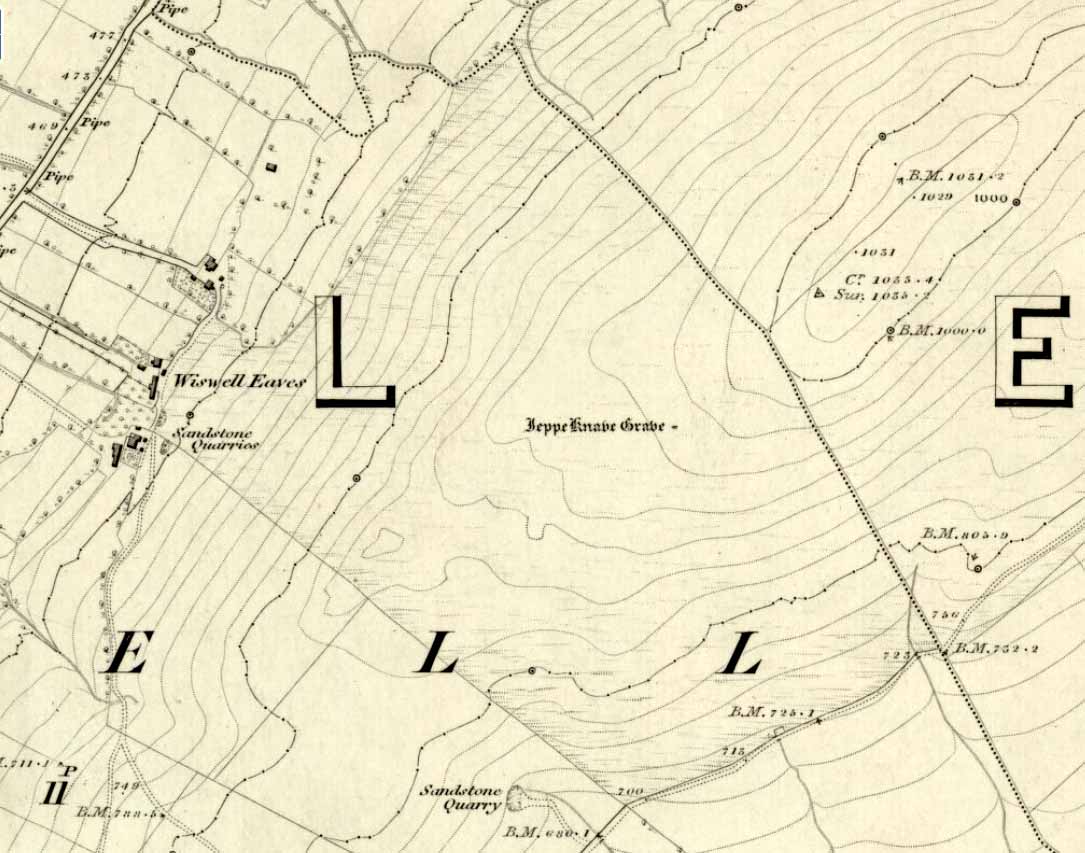
Jeppe Knave Grave on 1848 map

From Sabden, head up the steep Clitheroe Road towards the Nick o’ Pendle, turning left 100 yards before the hilltop and along the dirt-track for a few yards, before veering up the winding footpath to the hilltop.  When you’re at the peak of this little bit o’ moorland, go to your left (west), following the small path into the grasses and heather all the way on for a few hundred yards till you hit the triangulation pillar.  Go past this, over one stile (north) and then immediately at right-angles (west) over another stile and downhill for about 100 yards until you’re on the rough grassland level.  Keep your eyes peeled as you’re walking until you see what looks like a denuded stone-lined pit, much overgrown — with the main feature (showing that you’ve hit the target) being the engraving on one of the larger rocks: “Jeppe Knave Grave”.

Archaeology & History

The Jeppe Knave Grave

First described in early perambulation records of 1326 CE, this is a small but intriguing site found on the far southwestern slopes of Pendle Hill, on the ridge beneath the triangulation pillar of Wiswell Moor.  It’s a small and overgrown cairn with a general archaeological association of prehistory attached—though no detailed excavation has ever been done here, despite local archaeologists having access to a large grant to explore this region a short while ago.¹  But up North, as many of us know, archaeology is given little priority and those who do decent exploratory work under the umbrella of such academic quarters tend to be few and far between.  Thankfully we had the northern antiquarian and local writer John Dixon (1993) nearby who gave us the best overview of the site.  He wrote:

“This landscape feature, known as Jeppe Knave Grave, stands at a place called The Lows high on Wiswell Moor and takes the form of a low grass-covered mound 16M in diameter with a stone filled depression in the centre 5 x 3 M.  This feature appears to be a mutilated cairn and has been tentatively ascribed to the Bronze Age.  The outer ring of stones can be discerned in the rough pasture at the perimeter – yellow in dry conditions, showing the circular shape. Given the large size of the stones here, the cairn may have been of a chambered type/passage tomb of the Neolithic period, and if this was the case the burial (or burials?) was one of great importance.

“Upon the largest stone are inscribed the words ‘JEPPE KNAVE GRAVE and a cross (inscribed by the Scouting Association in the 1960’s). The stone marks the final resting place of Jeppe Curteys (Geoffrey Curtis), a local robber who was decapitated for his crimes in the first year of Edward III, 1327.  The name first occurs in a record of the boundaries between Wiswall and Pendleton dated 1342.

“…In those times the punishment of decapitation was unusual, being reserved for those of noble birth.  So who was this Jeppe Curteys, punished by decapitation and later buried on the high ridge of Wiswell Moor in a pre-Christian burial mound on the then boundary of parishes?  That intriguing story we may never know.  But to be buried in such a manner and place was indeed a great indignity – interment in what might be considered in those times to be a ‘pagan’ or ‘devilish’ spot.  It may be that to bury a man in such a place was to literally ‘send him to the devil’. Alternatively one could ask: ‘Was the site thought then to be the burial spot of some noble ancestor, and Jeppe being of possible noble birth interred with great dignity?  Again we may never know, yet it is significant that this lonely spot is still identified with a man who was executed 700 years ago.

In 1608 it was stated that one Robert Lowe had taken a stone from the grave and used it as a cover of his lime kiln.”

Old codgers from the local Senile Society, inspecting York Minster!
Agatha Lyons’ 1871 sketch

The design of the cairn here is unlike the ones you usually come across on the Lancashire and Yorkshire moorlands.  The edges of the Jeppe Knave Grave are walled and much more well-defined than the large rock piles that we find scattering our uplands.  A similar though larger cairn with features similar to these can be seen in the large Low Hill tumulus on Elslack Moor near Earby, about ten miles northeast of here…

Other prehistoric remains scatter the many rolling hills that you can see from here: mainly prehistoric tombs sat upon hilltops as far as the eye can see.  John pointed out what may be the remains of another tumulus that can be seen on the nearby horizon a few hundred yards NNW from here, overlooking the gorgeous village of Pendleton and the landscape beyond…

References:

  1. Dixon, John, Journeys through Brigantia – volume 9: The Ribble Valley, Aussteiger Publications: Barnoldswick 1993.
  2. Dixon, John, Pendle – A Mythic Landscape, Aussteiger Publications: Barnoldswick 2010.
  3. Whitaker, Thomas Dunham, An History of the Original Parish of Whalley – volume 2, George Routledge: London 1876.

¹ John Dixon informed us how the people in question spent the grant — somewhere in the region of £50,000 — on exploring some modern architectural features, instead of exploring some of the little-known sites and seeking out others on these hills.

* John is the author of many fine historical travel guides, including the Journeys through Brigantia series. See the titles in the Lancashire Bibliography and Yorkshire Bibliography for a more complete listing of all his books to date.  If you wanna buy any of his works, or make enquiries regarding them, email John at: lancashirebooks@fsmail.net – or write to him direct, at: John Dixon, Aussteiger Publications, 21 Lowergate, Clitheroe, Lancashire BB7 1AD.

© Paul BennettThe Northern Antiquarian 


Culliford Tree Barrow, Upwey, Dorset

Tumulus:  OS Grid Reference – SY 6691 8548

Also Known as:

  1. Music Barrow
  2. Warne’s Barrow 22
  3. Whitcombe 1 (Grinsell)

Archaeology & History

Crowned by a clump of trees (planted in 1740), this hilltop site is one of the more impressive of a number of tombs hereby, with its nearest other neighbour being 70 yards southeast of here.  One of Dorset’s early tribal meeting places (Anderson 1934), the tomb was illustrated on Isaac Taylor’s 1765 map of the region and was dug into in 1858 “on the orders of a local magnate” (Marsden 1999), damaging some substantial portion of the tomb.  Of this, craniologist and antiquarian John Thurnam was most displeased; for in his description of the opening of Culliford Tree he wrote:

“A wide trench had been dug through it one side, from the summit and the rubble which had been thrown out had not been replaced… Another subject of regret was the fact that though, as we were told by the neighbouring rustics, human remains, with pottery and certain other relics, were found in the barrow, no authentic account of the exploration had, so far as we could learn, been put to print.”

Leslie Grinsell (1959) found the same trouble in his assessment of this site; and the Royal Commission (1970) lads could only describe the site thus:

“Large trench on south and top almost certainly dug in 1858 when four secondary extended inhumations, one with necklace of amber and two gold-plated beads, and cremation with incense cup in collared urn, were found.”

However, it seems that the necklace and gold-plated beads have been “lost” — i.e., someone has them in their own private collection somewhere!

Folklore

This is one of very few tombs in this part of the country where we find the tradition of fairy music.  Grinsell (1959) told that:

“The Culliford Tree barrow, formerly the meeting place of the Hundred of Culllingford Tree, is also known as the Music Barrow from the belief that music could be heard beneath the mound by those who listened at the apex at midday.”

References:

  1. Anderson, O.S., The English Hundred-Names, Lunds Universitets Arsskrift 1934.
  2. Grinsell, Leslie V., Dorset Barrows, Dorset Natural History & Archaeological Society: Dorchester 1959.
  3. Marsden, Barry M., The Early Barrow Diggers, Tempus: Stroud 1999.
  4. Royal Commission on Historical Monuments, An Inventory of Historical Monuments in the County of Dorset – Volume 2: South-East, Part 3, HMSO: London 1970.
  5. Warne, Charles, Celtic Tumuli of Dorset: An Account of Personal and other Researches in the Sepulchral Mounds of the Durotriges, Smith: London 1866.

© Paul Bennett, The Northern Antiquarian

Elf Howe, Folkton, East Yorkshire

Tumulus (destroyed):  OS Grid Reference – TA 0422 7726

Archaeology & History

A once-impressive haunted burial mound on the southern edge of Folkton parish, all that remains of the place now are aerial images showing the ghostly ring of its former site.  Commenting on the destruction of this burial mound  before he had chance to give it his full attention, in William Greenwell’s (1877) magnum opus he wrote the following:

“Elf Howe had been removed to a great extent, and the grave had been dug out before I had an opportunity of examining it.  I however got an account of what was discovered from the foreman on the farm, and I was able personally to inspect a small portion which had not been disturbed.  The barrow had been 60ft in diameter and 6ft high, and was made of earth and chalk.  Near the centre a deposit of burnt bones was met with, over which some large flints were placed; this was at a depth of 4ft, and as a great quantity of burnt earth was observed immediately round the bones, it is probable that the body had been burnt on the spot where the bones were placed.  Two unburnt bodies were found on the south side of the mound, with one of which a vessel of pottery was associated.  At a distance of 17ft south-south-east of the centre I found the body of a strongly-made man, laid on the right side, with the head to the south and the hands to the knees; he body was placed about 6in above the natural surface.  Immediately below the head was the body of a very young child, the bones of which were too much decayed to admit of anything being made out beyond the fact that it was a child’s body which was laid there.  Still lower, and on the natural surface, was a patella, a radius, and some other bones of a body, which had been disturbed, probably in the interring of the person who was found buried above.  At the centre was a grave, lying northwest and southeast, 7ft by 6½ft and 2½ft deep.  On the bottom at the north side was the body of a strongly-made man in the middle period of life, whose head…was to the south, but my informant could not remember on which side the body was laid; at the head was a ‘food vessel’, which, from the fragments that have been preserved, must have been a rudely-made one with unusually thick walls.”

Folklore

Although antiquarians and archaeologists such as Elgee, Grinsell, Gutch, Johnson and others each tell (in their own respective ways) that Elf Howe “testifies to a widespread belief in goblin-haunted barrows” — albeit in the linguistic ‘elven’ of the Scandinavian invaders — we appear to have lost the original tale behind this fairy-haunted site.

References:

  1. Greenwell, William, British Barrows, Clarendon Press: Oxford 1877.

© Paul Bennett, The Northern Antiquarian

Spell Howe, Folkton, East Yorkshire

Tumulus:  OS Grid Reference – TA 0657 7878

Archaeology & History

This once impressive tumulus a half-mile east of the village was first mentioned in the Bardney Cartulary in the early 13th century, where is was written as Spelhou.  Suggested by Olof Anderson (1934) to have been an early moot site — “the meeting place of the Torbar Hundred” — this appears to be confirmed in Smith’s (1937) etymological analysis where he ascribes Spell Howe to be literally, “‘Speech mound’, from OE spell, speech and haugr” (burial mound).  Rising about four-feet above ground level, this is a traditional ’round barrow’ type of tumulus.  In recent years, reports tell that it has been built onto with some fencing.  Hopefully the present land-owners now look after the place!

References:

  1. Anderson, O.S., The English Hundred-Names, Lunds Universitets Arsskrift 1934.
  2. Mortimer, J.R., Forty Years Researches in British and Saxon Burial Mounds of East Yorkshire, Brown & Sons: Hull 1905.
  3. Smith, A.H., The Place-Names of the East Riding of Yorkshire and York, Cambridge University Press 1937.

© Paul Bennett, The Northern Antiquarian

Larkfield, Maidstone, Kent

Cairnfield (destroyed):  OS Grid Reference – TQ 702 590

Archaeology & History

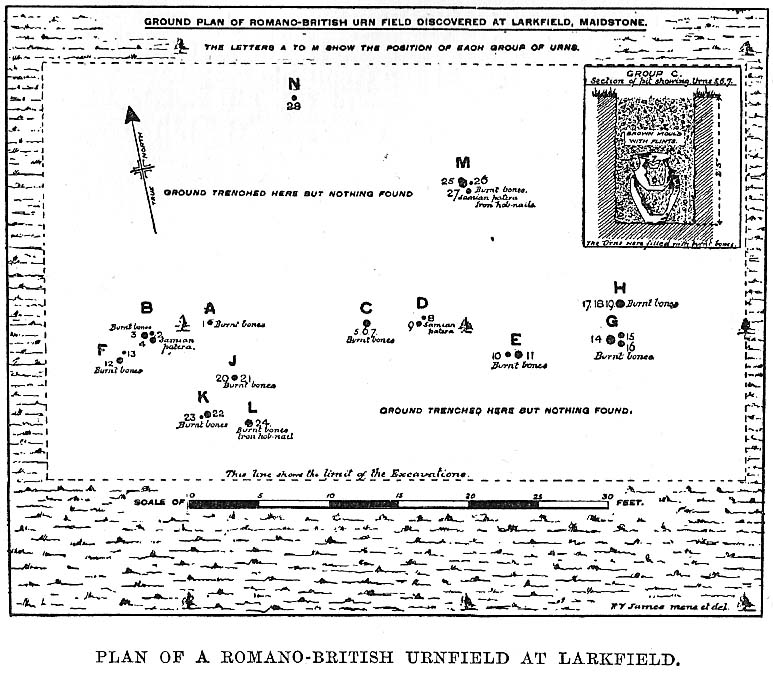
Ground-plan

In recent years it seems that very little has been written about this seemingly lost site, long since destroyed by the self-righteous advance of the Industrialists.  It seems to have been an important place, as there were many cremated remains here in more than a dozen individual burial urns, some with flints deposited in them.  The site was first described in a meeting of members of the Society of Antiquaries in 1898 by a Mr Frederick James.  He talked about the site and some brief digging work around the area, thus:

“The site of the urnfield is on land belonging to Mr William Wigan, of Clare House, East Malling, and it was owing to his kind permission and active cooperation that I was enabled to visit the spot, which is on a small plateau above the River Medway, 350 yards to the southwest of New Hythe church, and between the river and the road leading  from Rochester to Town Malling…

“The immediate neighbourhood…has been from time to time highly productive of archaeological remains dating from the Palaeolithic times and extended down to the Roman occupation… (But at) the Larkfield urnfield, the first indication that was afforded of the uses to which the area had been put in Romano-British times was the accidental discovery, whilst planting fruit trees, of some fragments of pottery (including portion of a Samian patera) found at the point marked A on the plan.  A flat tile was found covering the fragments.”

Much more was found hereby, with the majority of the finds being “a group of urns containing cremated interments found in the urn-pits.”  Although James (1898) described them as dating from the Romano-British period, from his description and illustrations it would seem that the remains here were probably of an earlier date, perhaps Iron- or even Bronze Age.  But we may never know for sure.

Reference:

  1. James, Frederick, “Discovery of a Romano-British Urnfield at Larkfield, near Maidstone,” in Proceedings of the Society of Antiquaries, 17:1, 1898.

© Paul Bennett, The Northern Antiquarian 

Snowden Crags Necropolis, Askwith Moor, North Yorkshire

Cairnfield:  OS Grid Reference – SE 176 514

Also Known as:

  1. Snowden Moor Cairnfield

Getting Here

From the Askwith Moor Road parking spot and walk up the road for about 500 yards an head to your right (east) onto he moor, above the rocky ridge known as Snowden Crags.  After 100 yards or so of walking through the heather, the entire cairnfield is under your very feet!  If the heather’s grown, you probably won’t see a thing.

Archaeology & History

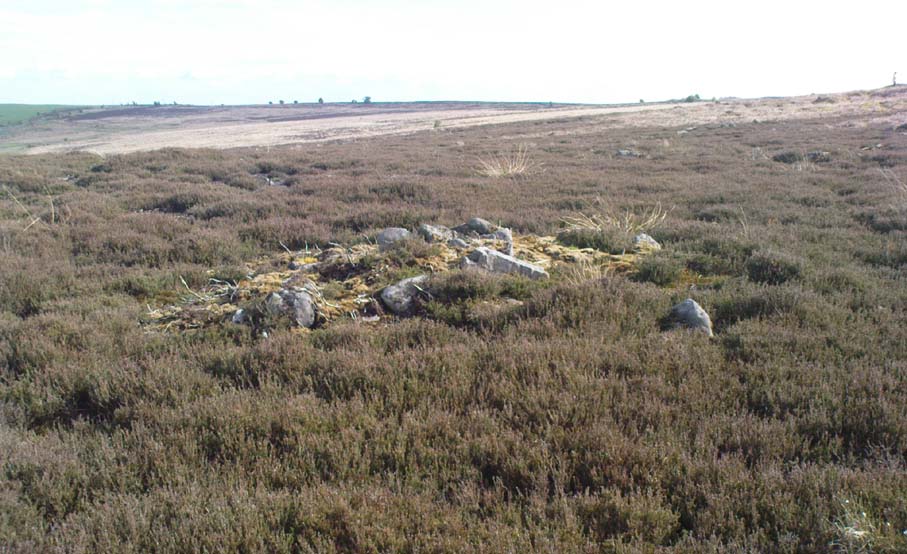
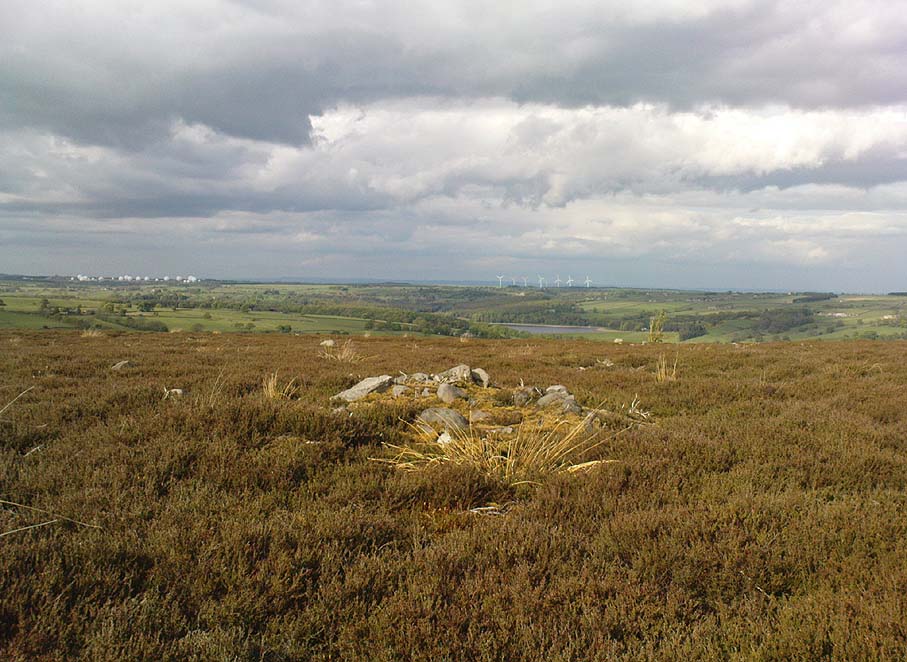
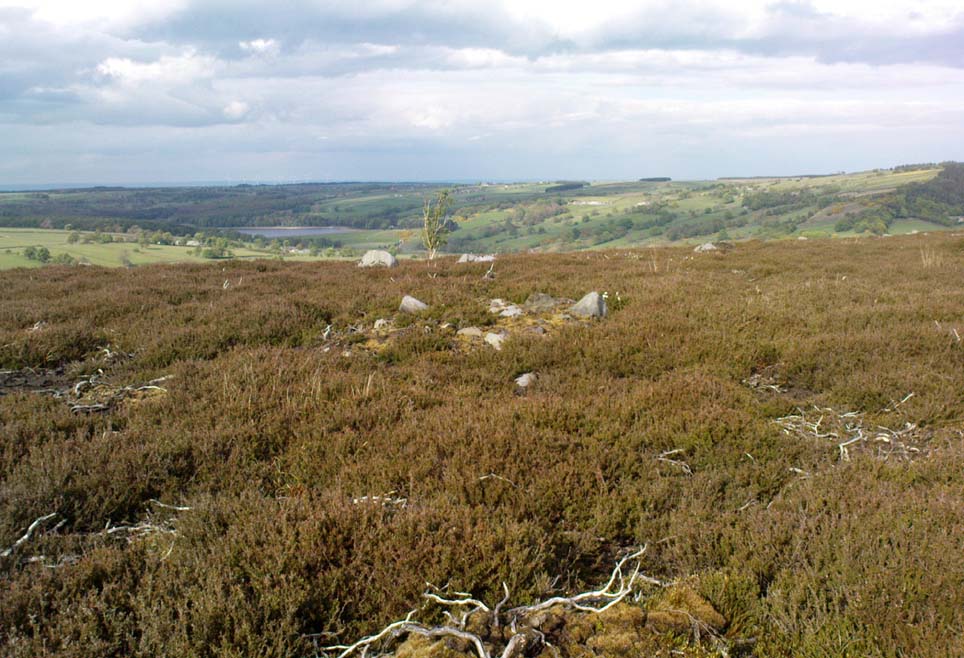
First described in Eric Cowling Rombald’s Way (1946), where he mentions around 30 cairns on the moorland plain immediately west of the Snowden Moor settlement. These were plainly visible when Richard Stroud and I visited here in 2005, thanks mainly to the fact that the heather had been burnt away.  Once it’s grown back, virtually all of these tombs will be hard to find.  I first had fortune to see some of these tombs on a visit here with Graeme Chappell about 15 years ago, but only a little of the cemetery was then visible.  Following another visit to the site this week, a great deal more has become visible, thanks again to heather-burning on the moors.

One of around 30 cairns on the ridge
…and another one!

Curiously omitted from the Nidderdale Archaeological survey report of sites in this region (anyone know why?), the cemetery itself stretches from the western edge of the Snowden Moor settlement, several hundred yards west along the flat moorland plain towards the moorland road, stopping a short distance before the line of old grouse butts.  It is highly likely that some of the stones in the grouse-butts originated in some of the prehistoric cairns along the ridge.  And if summat aint done about it, there’s a likelihood this could easily happen again in the near future.

…and another!

The easternmost cairn touches the very edge of the D-shaped settlement; and another of them is right next to a cup-marked stone.  Whilst a number of the cairns along this ridge are much like those found on the moors above Ilkley, Bingley, Middleton, Askwith Moor, Earby, etc — averaging 2-3 yards in diameter and less than 2 feet high amidst the peat and decaying herbage — one notable feature to many of these tombs is the inclusion of a rather large, singular boulder, against which or around are propped the smaller stones, typical of cairns found elsewhere in the region.  This ‘large boulder’ characteristic is not common at other tombs in the mid-Pennines, but seems specific to this graveyard.   Neither do the large boulders seem set in any particularly consistent fashion.  There is the possibility that they were originally above the smaller cairn of stones, but this is purely hypothetical and non-verifiable without excavations.

The important Snowden Crags cairn circle, discovered by the hardworking Keighley volunteer Michala Potts on Thursday, 20 May, 2010, can be found on the northern part of this cairnfield.

References:

Cowling, Eric T., Rombald’s Way: A Prehistory of Mid-Wharfedale, William Walker: Otley 1946.

© Paul Bennett, The Northern Antiquarian