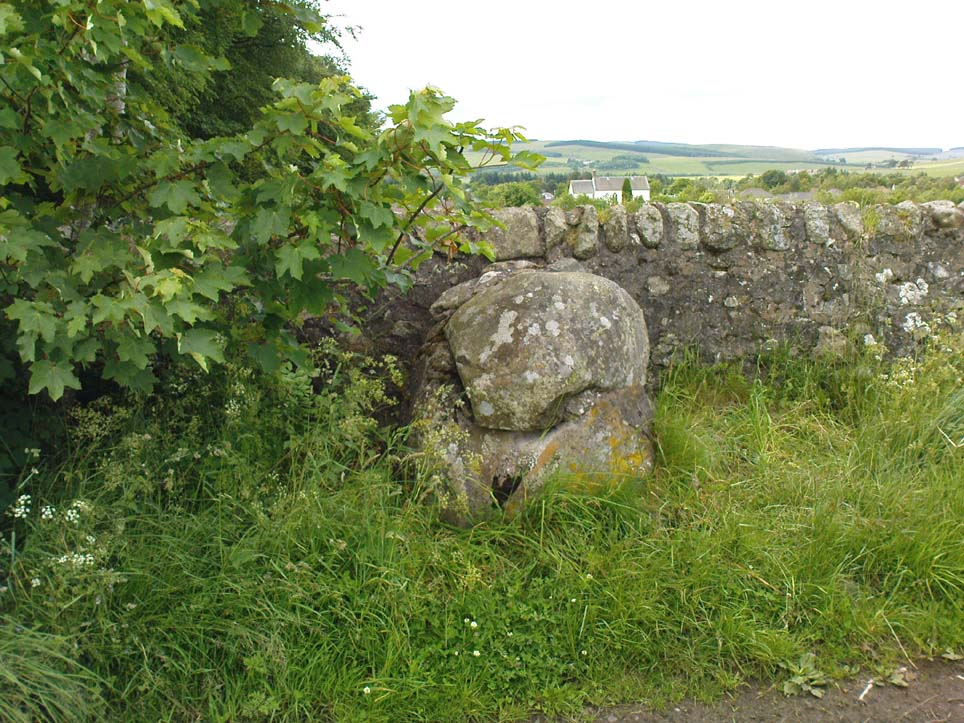
‘Stone Circle’ (destroyed): OS Grid Reference – NS 86 95
Archaeology & History
In Alex Wilson’s (1901) rare work he gives the only reference of what may have been a stone circle once found in the township of Tullibody. On a talk given at the Alloa Archaeology Society in the 19th century, the site was mentioned by one of the speakers in his talk on the standing stones of Stirlingshire and district. Mr Wilson told us:
“…at a meeting in November 1871, Rev. Mr Bryson made one of his first speeches before the Society, and spoke of Boulders found in the district, and how these were gradually disappearing owing to the utilitarian spirit of the age. Mr Bryson related how that he had been informed that about 60 or 70 years ago there existed seven or eight boulders round about the Boulder at Tullibody, which Mr Duncan had spoken of.”
This is a brief but intriguing account! Whether we can ascribe the “seven or eight boulders” in the description as merely glacial erratics, or whether the ruins of a stone circle were here as the description seems to imply, we don’t know. If anyone has any additional information they can add to this account, please let us know.
References:
Wilson, Alex, Review of Proceedings since Inauguaration, Alloa Society of Natural Science and Archaeology, Buchan Bros: Alloa 1901.
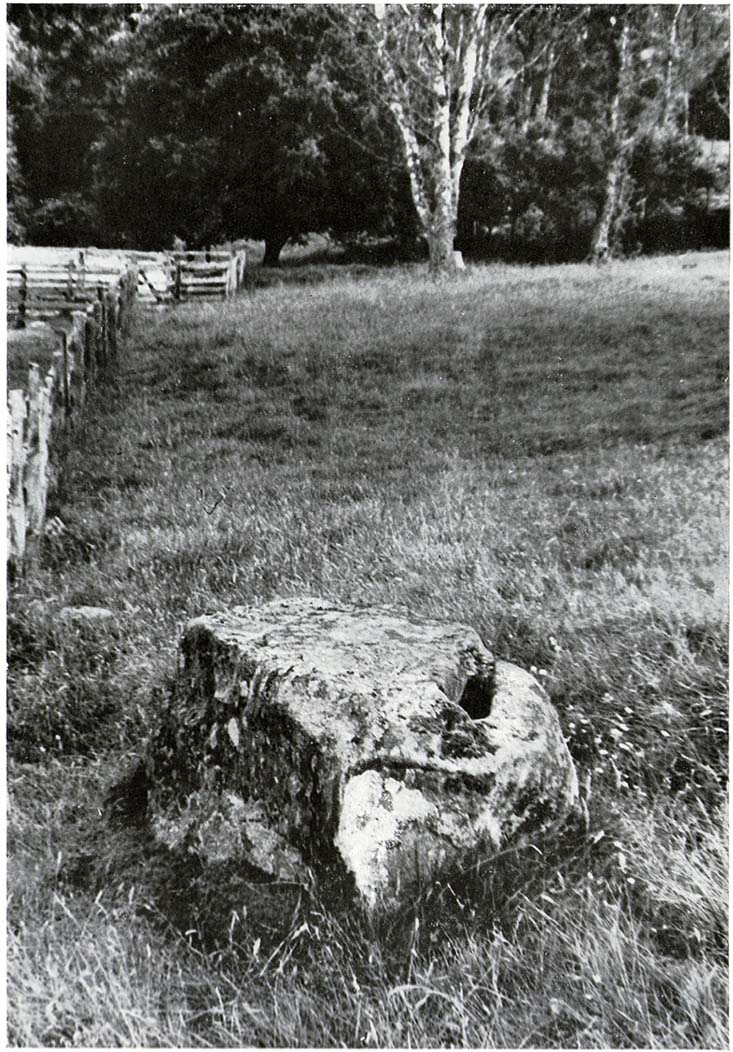
Up the A9 past Blair Atholl, a few miles later there’s the turning for Struan. Scarcely a mile east of old Struan Church, head past the old farmhouse of Old Kindrochat and keep going eastwards along the edge of the trees for about 200 yards until you reach the sheepfold. There you’ll see a singular rock sitting alone by the fence. That’s it!
Archaeology & History
This little known healing stone was, at one time last century, of great repute in the Highlands. Today, very few people even know it exists. One of many rocks that were said to possess healing abilities, this one (obviously) was of great repute in the curing of whooping cough. But it wasn’t the rock alone that did the work here, for upon its edge was a small basin into which rainwater collected and this, when used correctly and in due accord with ancient ritual tradition, could enact the cure. Mr Duncan Fraser said of this fascinating healing stone:
“The grey water-worn stone is about 4ft 6in long, 2ft 6in broad and 2ft high, with a deep gash on top, where the water lingers even in long dry spells. When full it holds about half-a-gallon. People were still coming here with their sick children as late as 1860 — and bringing a spoon made from the horn of a living cow. There was no cure without that.”
The ritual “spoon made from the horn of a living cow” was an important ingredient at another site with the reputation for curing whooping cough about 50 miles south of here, near Balquhidder. (see Whooping Cough Well, Killin) What truly fascinates me is the origin of this stone and its medicinal virtues. When did the healing rites first start here – how long ago…?
References:
Fraser, Duncan, Highland Perthshire, Standard Press: Montrose 1969.
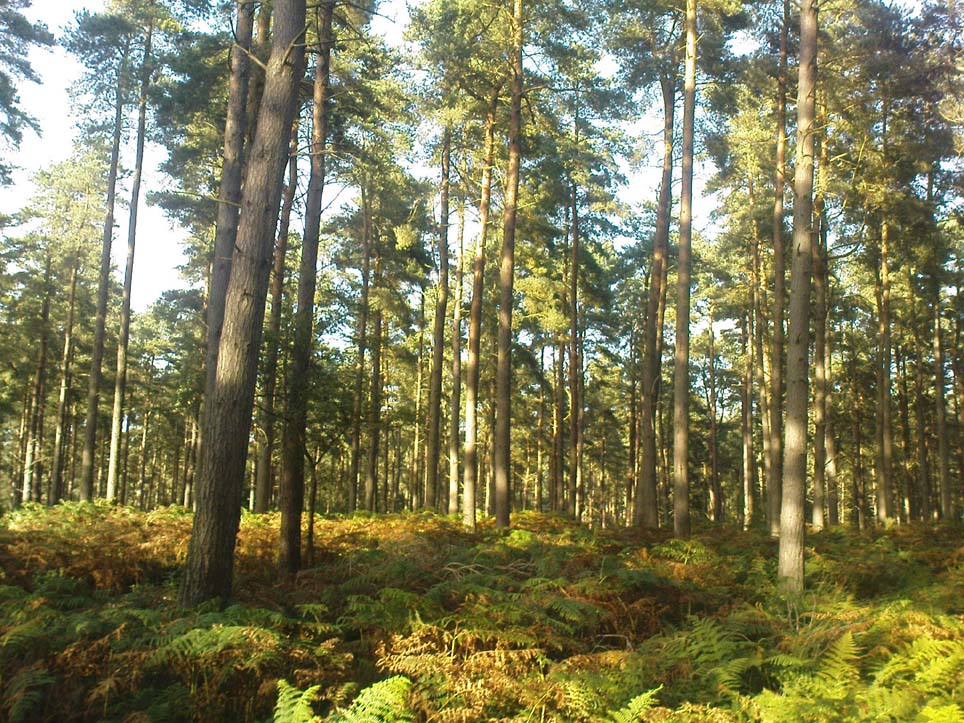
Take the A907 road between Clackmannan and Comrie and, close to Bogside Farm at the roadside, but on the other side of the road where the bridge crosses a burn, take the dirt-track uphill and into the woodland. About 300 yards up (before you hit the signs pointing you to the farm) , walk uphill into the trees on your left until the ground levels out. Look around! (and best visited between December and May, before the bracken covers the place)
Archaeology & History
Visiting this site is pleasure in itself. Situated in an open forest, with traditional pine trees in abundance, there are scattered amidst the edges of this large oval-shaped Iron Age structure, the aged boughs of ash and beech, centuries old, along its edges and throughout the woods. It is a truly superb setting! When visited by the Royal Commission lads in April, 1925, they found the remains here in good condition. A few years later in their impressive Inventory, they told:
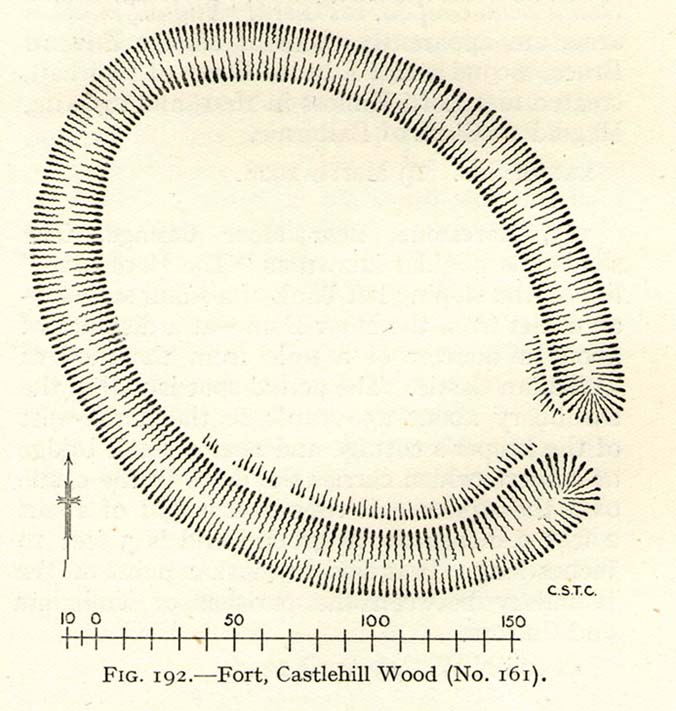
“In Castlehill Wood, about 250 yards to the southwest of Bogside Railway Station, and at an elevation of 200 feet above sea-level, is a small plateau of very regular oval form with its major axis northwest and southeast. It is surrounded by a single ditch, the well-marked enclosure thus produced having a maximum measurement of 185 by 135 feet. At the southeast the ditch has been left uncut in order to provide a passage for entrance. This passage has been about 20 feet wide, and at its inner end there are on either side faint traces of a low mound, which in all probability once ran right round the edge of the enclosure and which may have been palisaded.”
RCHAMS 1933 plan of site
Sadly when I came here a few days ago, much of the was very overgrown with bracken and other vegetation, making it impossible to see the site properly and preventing any decent photos. We’ll go back here in a few months time to get better images!
Folklore
This site was mentioned, albeit briefly, in David Beveridge’s (1885) magnum opus on the history of Culross. With equal brevity he noted several standing stones in the region, saying how tradition afforded them a Danish origin. This site was the same for
“a tradition prevails that after the battle of Inverkeithing the Danish army or a portion of it retreated to a station in the north of Culross parish, where they erected the earthwork or camp of Castlehill, still existing near the Burrowine Farm.”
References:
Beveridge, David, Culross and Tulliallan: Its History and Antiquities – volume 1, William Blackwood: Edinburgh 1885.
Royal Commission on the Ancient & Historical Monuments, Scotland, Inventory of Monuments and Constructions in the Counties of Fife, Kinross and Clackmannan, HMSO: Edinburgh 1933.
Tumuli (destroyed): OS Grid Reference – TM 022 143
Also Known as:
Barrow Hills
Five Barrows
Archaeology & History
Known as Five Barrows presumably from the five main burial mounds that were once here, very little in modern texts seem to describe them. In the grid-reference given above, I’m not 100% certain that this is the correct spot – and as many of them have been destroyed, we’ll stick to this until someone tells us otherwise! (it is only Essex anyway)
The ‘barrow’ site that remains has been ascribed as Romano-British in date, whilst the others don’t seem to get a modern mention. These missing barrows were described in a short article in The Gentleman’s Magazine by a Mr J.A. Repton (1840), who told the following:
“In reading an account of Essex, I find the following Borough, or rather Barrow Hills, on the north side of the Black Water Bay, were considerable in number. These tumuli are supposed to have been raised indiscriminately over the bodies of the Danes and Saxons that fell in the battles occasioned by the frequent landing of the former in this part of the coast. The lands on which the barrow hills stood were completely inclosed from the sea in 1807, and the whole are now levelled, one excepted.
“This barrow I heard was going to be cleared away for manure. I made a point of visiting it under an idea that it might be proved a Roman one; when I arrived at the spot, I found it to be a bowl barrow, about 14 yards diameter, and about 6 or 7 feet high, and rather more than half of it cut away, and what surprises me, not a single urn, bone, or ashes, nor any mark to be found; perhaps the barrows being mostly under water during the tide may account for the disappearance of bones, etc., if there ever were any placed; or rather that the Danes and Saxons were not so careful as the Romans in preserving the remains of their friends. I met one of the old inhabitants who lived in the parish more than forty years; he remembered the number of barrows being destroyed, and said not a single bone or urn was ever found in them.
“Perhaps you can give me some information, whether by digging below the natural surface of the ground, any remains may be traced. It is not a gravelled, but a clean, light clay soil. The land is low and marshy, and celebrated for Maiden salt, and near it there is a decoy. ”
If anyone has further information about the other barrows which are described in several old early accounts, it’d be good to know!
Folklore
Archaeologist and folklorist Leslie Grinsell (1976) noted briefly that the barrows here supposedly covered the remains of Danes who died in battle here.
References:
Grinsell, Leslie V., Folklore of Prehistoric Sites, David & Charles: London 1976.
Repton, J.A., “Borough Hills, Essex,” in The Gentleman’s Magazine, 1840 (part 2, p.114).
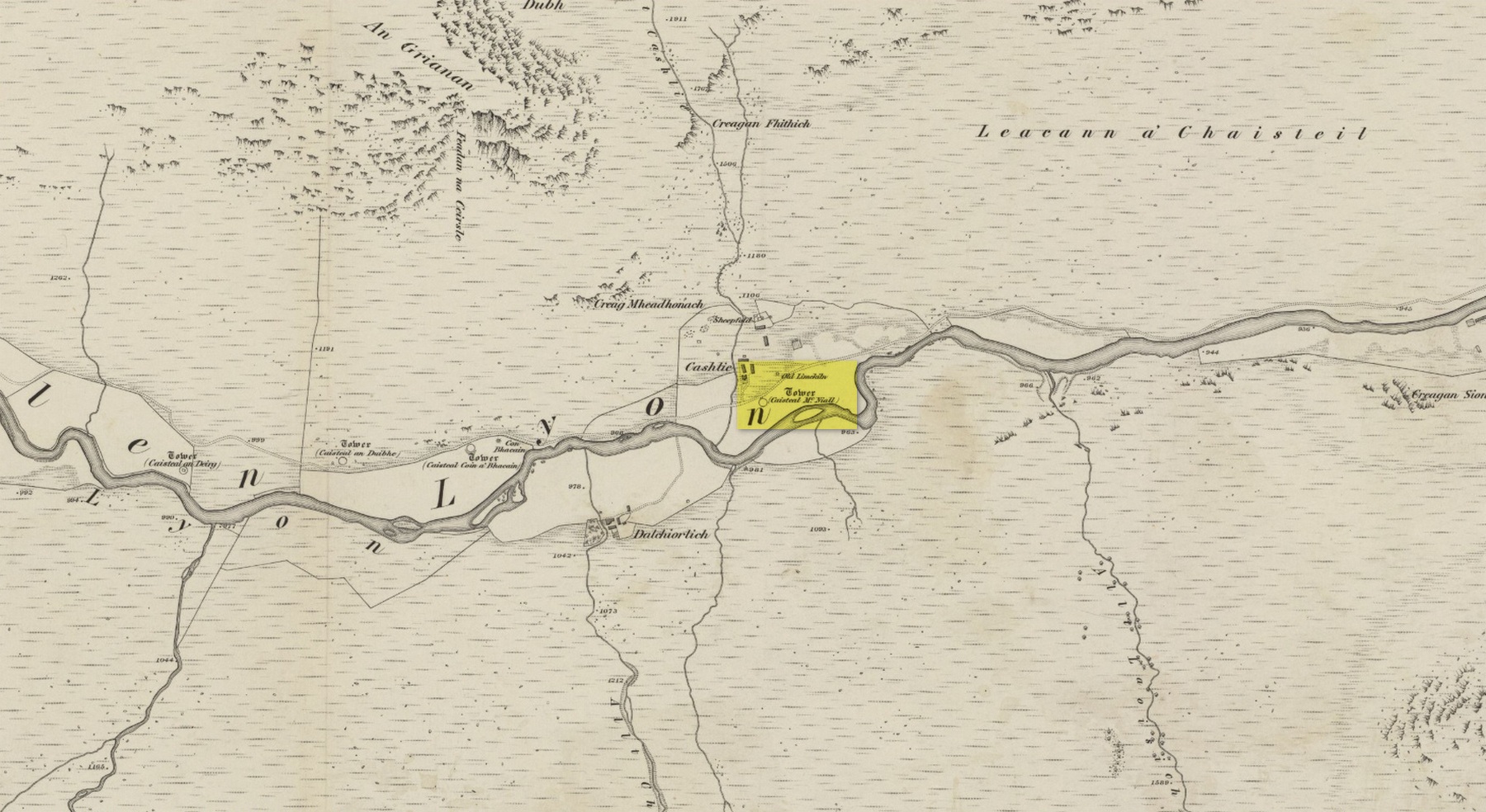
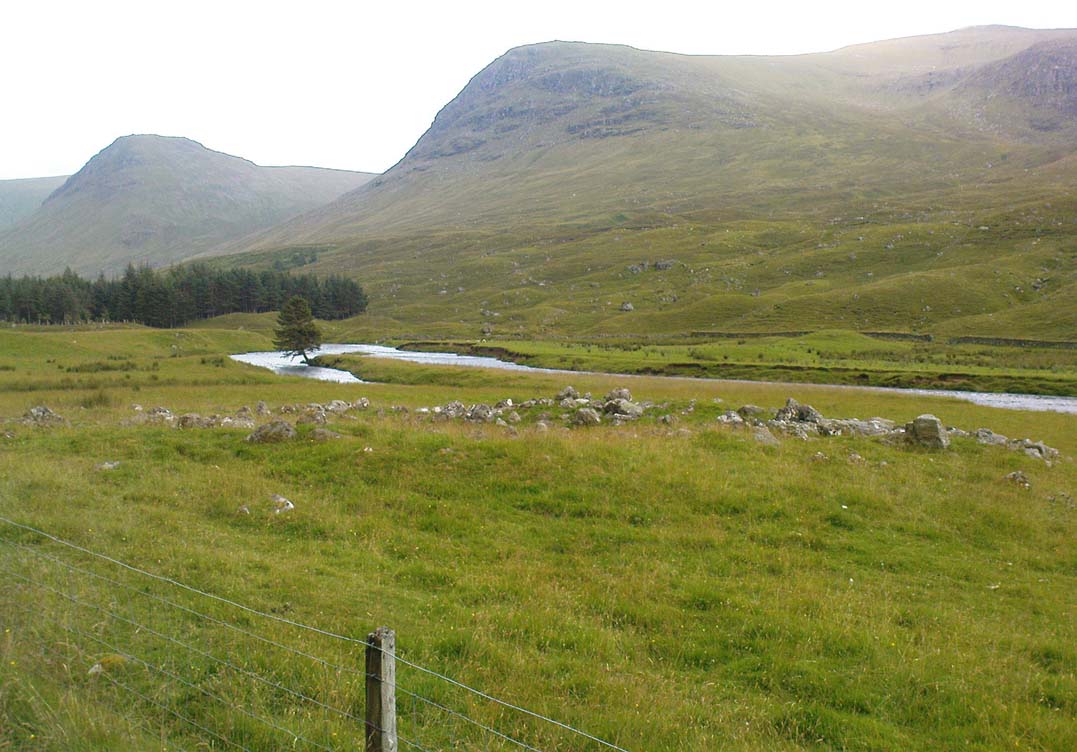
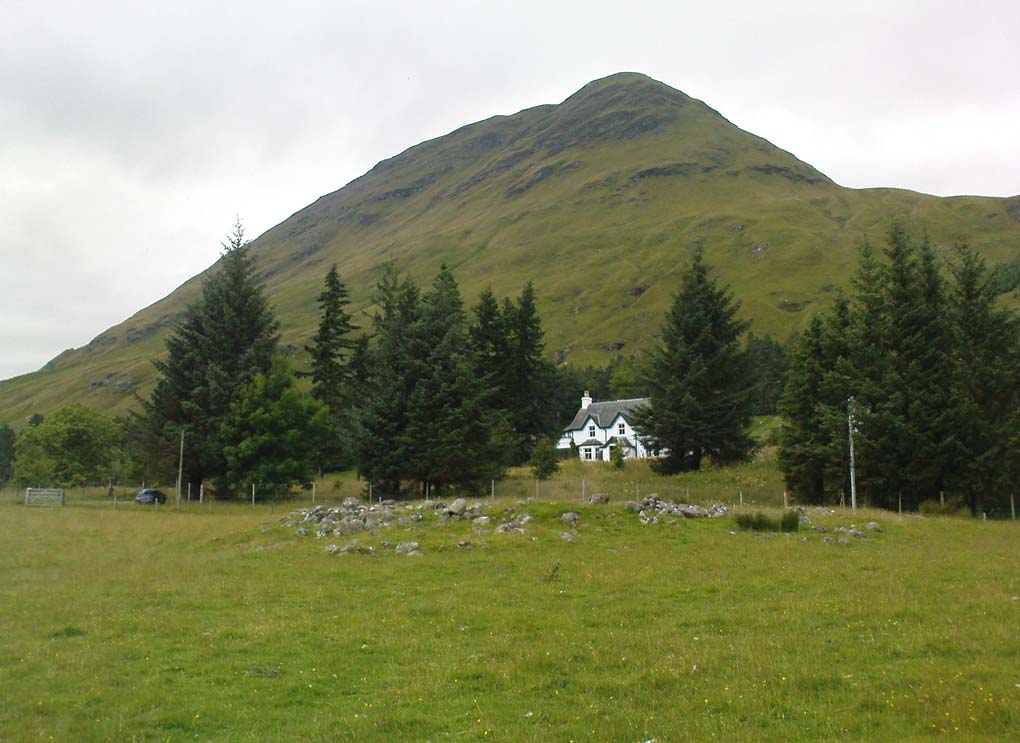
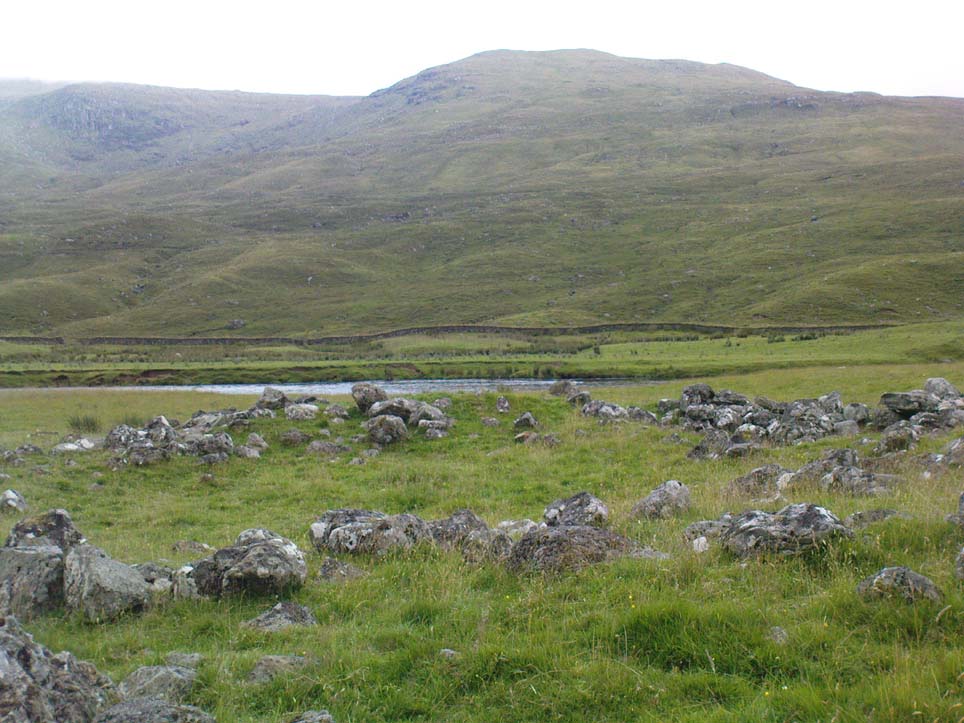
Truly remote, but easy to find once you’re nearing the western end of Glen Lyon. Going upstream, past Cashlie Dam, watch out for the well-preserved stone kiln on the left-hand side of the road, just before Cashlie house. 50 yards or further along, cross the road and in the field by the riverside, the circular mass of stones sorta gives the game away.
Archaeology & History
Shown on modern OS-maps as a ‘homestead’ and described variously by archaeologists and historians as a fort or a round-house, this is just one example of around twenty large prehistoric constructions that scatter the stunning mountainous Glen Lyon region which legend tells were the forts of the great hero-figure, Finn. Three other constructions of the same nature are found just a few hundred yards further up the Glen from here. Each is of roughly the same age and nature by the look of things. Their walls are extremely wide and made up of very large rocks, which would have taken huge efforts to construct.
Caisteal Mhic Neill ruins, looking eastCaisteal Mhic Neill, with An Grianan behind
Highlighted on the 1867 OS-map as a “Tower”, the exact nature of this and its adjacent sites has yet to be academically ascertained, with the Canmore website ascribing the monument as a “settlement” – although, tradition tells them to be Scottish forts or duns, so we’ll stick with that until excavations tell otherwise!
The great Gaelic place-name master W.J. Watson (1912) told that:
“The fourth of the Cashlie towers is a few yards south of the road, right in front of Cashlie farmhouse, now a shooting lodge. Though a quantity of large stones marks the site, the structure has been so badly knocked about that we found it impossible to take measurements sufficient for a plan. It was, however, apparently not circular, but rather oval. Its walls appeared to vary from about 9 feet to 12 feet 6 inches in thickness.”
Close-up of Caisteal walling
This is one of several other duns (or homesteads as the OS-map calls them) close to each other.
Folklore
Ascribed as one of Glen Lyon’s Caisteilean nam Fiann, or “castles of the Fiann”, Mr Watson (1912) again told how “there is a widely known saying, the earliest notice of which occurs in Pennant, who got it doubtless from the Rev. J. Stewart:
‘…Twelve castles had Fionn,
In the dark Bent-glen of the stones.'”
References:
Gillies, William A., In Famed Breadalbane, Munro Press: Perth 1938.
Watson, W.J., “The Circular Forts of North Perthshire,” in Proceedings of the Society of Antiquaries, Scotland, volume 47, 1912.
ACKNOWLEDGEMENTS: Many thanks to Andy Sweet of Stravaiging Around Scotland, for pointing me to the W.J. Watson article. And of course, a huge thanks to Marion—”I don’t have a clue where I am!”—Woolley, for getting us here….
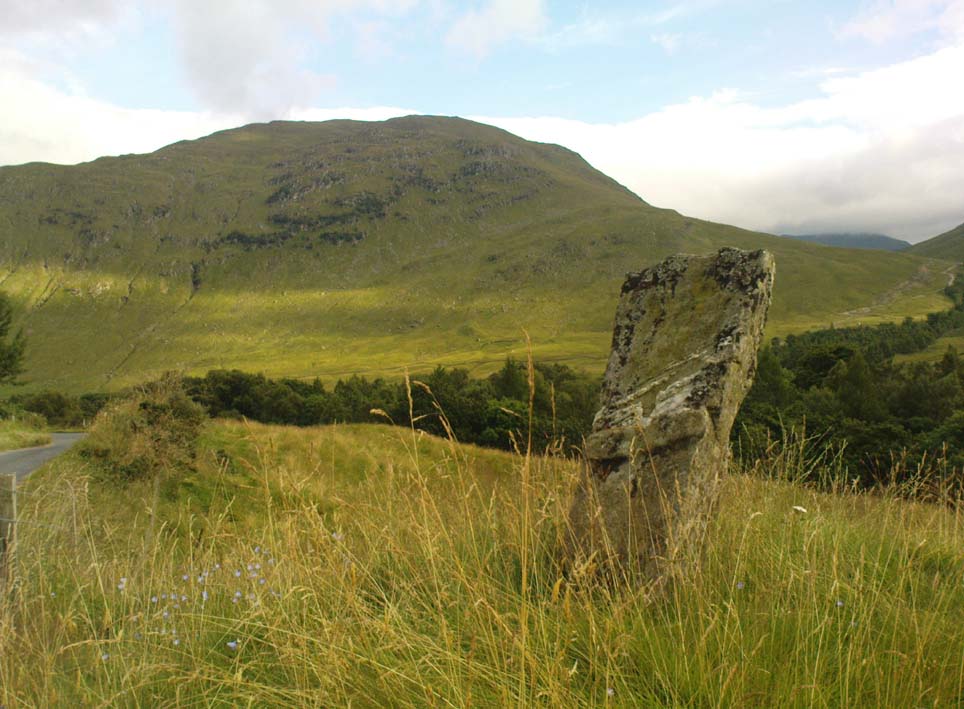
Take the road from Fortingall into the Glen. About 4 miles down, past the farmhouse of Slatich, then Craigianie, watch carefully as you round the small bend in the road, where you’ll see a small standing stone on top of a rounded mound, right by the south side of the road, just over the fence. Go through the gate to enter the field less than 100 yards further on and walk back onto the hillock.
Archaeology & History
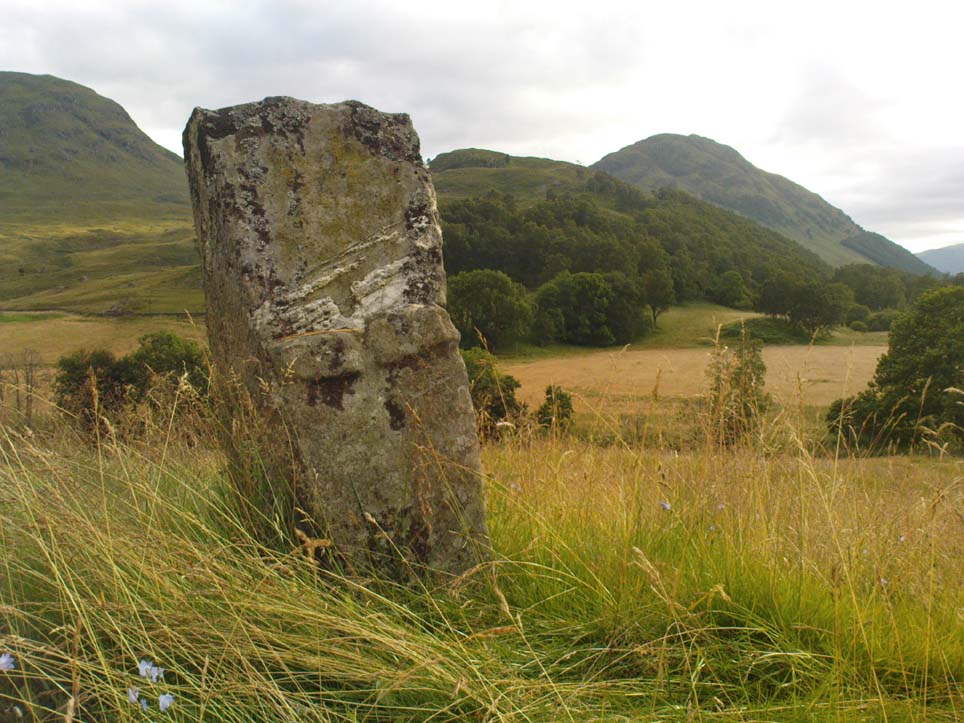
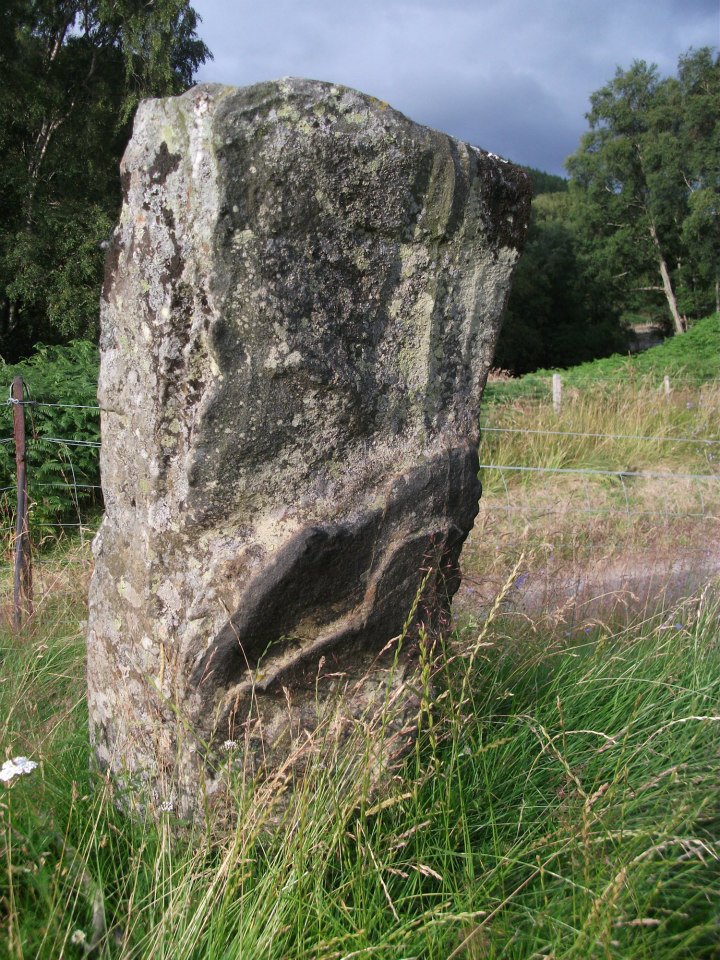
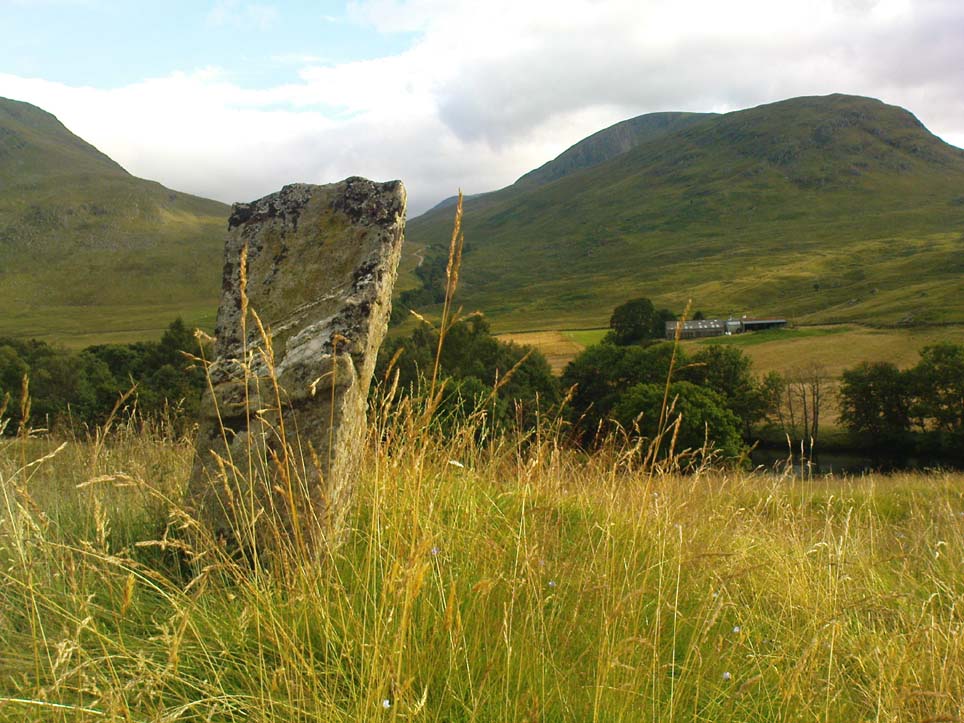
In this magnificent landscape down the longest of Scotland’s glens, standing atop of a knoll known as Tom a’ Mhoid, or “the moot hill” (Watson 1926), is this small standing stone about 4 feet tall which has long been ascribed as an important relic of the early christian period. They may be right – but it could as much be a more archaic monolith, onto which the carved crosses on either side of the stone were later etched, in the light of the myths of St. Adamnan whose name scatters this great glen and after the legend cited below was ascribed to him.
Close-up, showing large cross
The stone ‘cross’ stands atop of what at first sight seems a natural knoll; but all round it we find an excess of man-made remains and walling, all but constituting the hill itself. These are clearly visible on the aerial imagery of GoogleEarth. Antiquarian dogs here would be invaluable to ascertain the correct age and nature of the structures around this ‘cross’.
Faint cross near top of stone
Of the crosses carved onto the stone: the one on the southern face is a small faint one near the top of the upright; whilst the other is much larger and is easily visible, cutting right across the northern face of the monolith. They are clearly of differing styles and would seem to have been carved by different people, perhaps a few centuries apart. Curiously—as Marion Woolley pointed out—the smaller, fainter cross is carved above a ridge on the upright stone, mimicking the position of the stone on the knoll in its landscape setting. Whether this is just a coincidence, or has been done on purpose, we might never know.
In Duncan Fraser’s (1969) excellent local history work, he names the stone here Eonan’s Cross and he too strongly suspects “the stone itself was probably erected at least a thousand years earlier” than the coming of the saint, making this a christianized standing stone – which it certainly looks like. Mr Fraser said that,
“His cross stone, we can be fairly sure, was a Bronze Age standing stone long before it acquired its unusual cross.”
He may well be right…
Folklore
The mythic history of this cross-marked standing stone was told eloquently in one of Hilary Wheater’s (1981) fine short works. After giving a brief story of the tale of St. Adamnan, she went on to tell:
“A terrible plague swept through Scotland in the seventh century. It reached the Vale of Fortingall and so violent was its ravages that all the inhabitants were wiped out. Slowly the sickness began to infiltrate the Glen and in a panic the people of Glenlyon went to their preacher and beseeched him, “Eonan of the ruddy cheeks, rise and check the plague of thy people. Save us from the death and let it not come upon us east or west.”
“Adamnan rose to the occasion and gathered the people of the Glen to a hillock where he usually preached to them. In a house not forty yards away it is said that a child was already dying of ‘the Death.’
“There on the rock, with the people gathered round him, Adamnan prayed. When he was finished he raised his right arm, exhorted the devil body of the pestilence to come to him and, pointing to a large round rock lying on the ground, ordered the plague to enter it. A large circular hole appeared in the rock as the plague bored into it and Adamnan followed up this apparent miracle by the very sensible act of sending all the healthy people of the Glen up to the shielings until all signs of the pestilence disappeared…
“Thus were the people of the Glen saved from the plague. When they came back from their mountain retreat they erected a stone slab with two crosses on it to commemorate their deliverance. The rock itself they called Craig-diannaidh, the ‘rock of safety’, and the round stone with the hole through which the plague descended into the bowels of the Earth lies to this day at the side of the road near the stone slab.”
Adamnan’s Cross
The rocky slope immediately above the stone, on the other side of the road, was once the home of an old urisk who, sadly, long-since left the area – though his spirit can still be felt there. Accounts of many other supernatural creatures are found scattering this part of Glen Lyon…
References:
Barnett, T. Ratcliffe, The Road to Rannoch and the Summer Isles, Robert Grant: Edinburgh 1924.
Fraser, Duncan, Highland Perthshire, Standard Press: Montrose 1969.
Watson, W.J., The history of the Celtic Place-Names of Scotland, Edinburgh 1926.
Wheater, Hilary, Aberfeldy to Glenlyon, Appin: Aberfeldy 1981.
ACKNOWLEDGEMENTS: Massive thanks to Marion—”I don’t have a clue where I am!”—Woolley, for getting us here….and for her photo of the faint cross, above.
Follow the directions to get to the Dunruchan B standing stone, on the slopes south of Craigneich. Once there, on the hillside further above you, you’ll see a large upright stone on the moor about 300 yards to the south, standing just below the rise of a small hillock. That’s it!
Archaeology & History
Fred Coles’ 1911 drawing
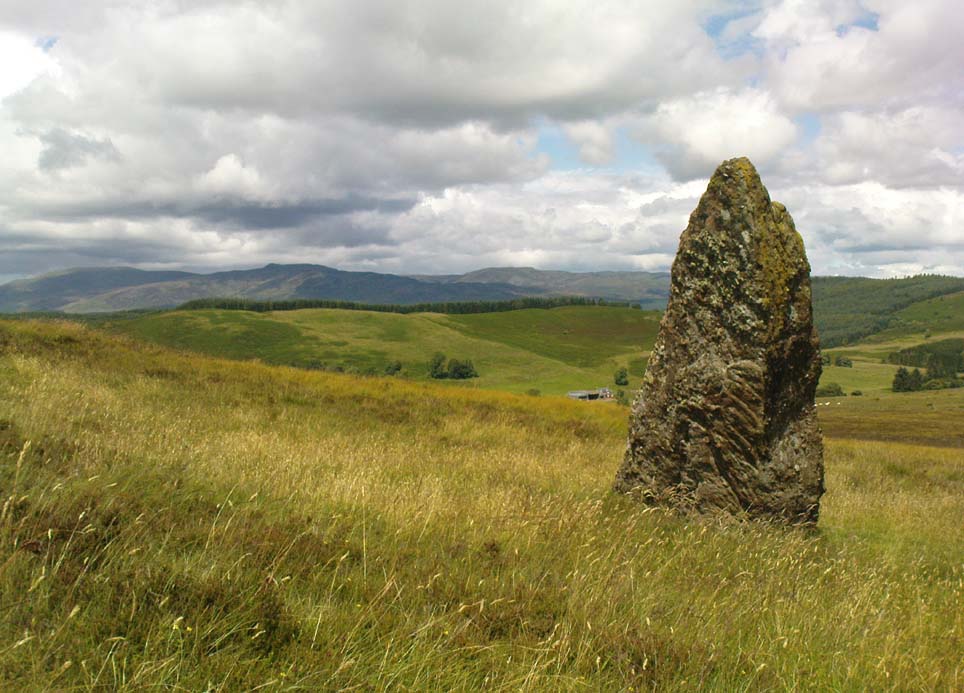
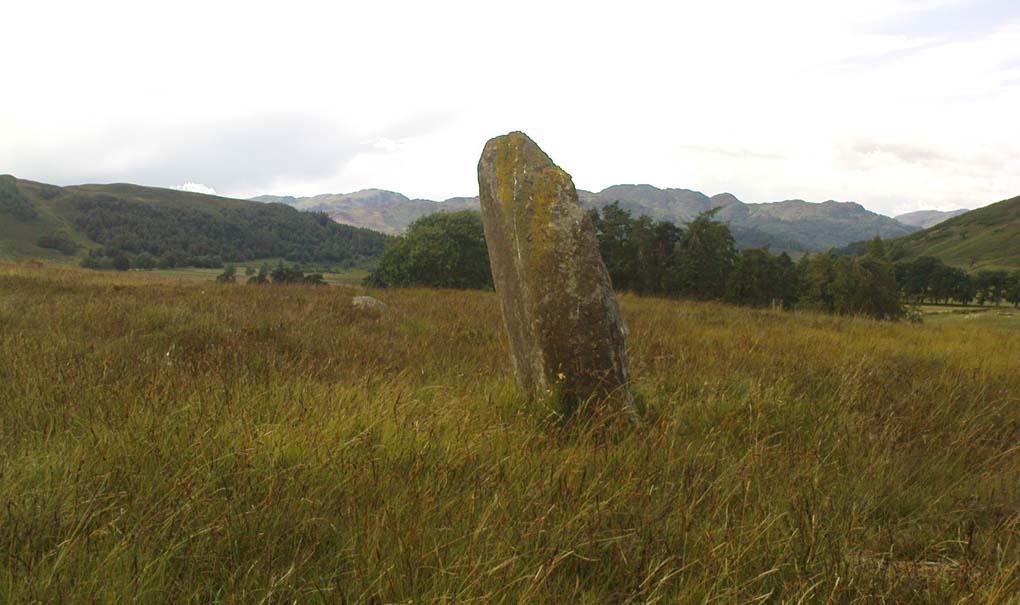
The second biggest of the Dunruchan monoliths is what Fred Coles (1911) described as “the Middle Stone,” or Dunruchan C. Standing just below the rise of a large natural mound of earth, obstructing any immediate view of the western hills, it too has a long upright shape with a pointed end to the stone, leaning at a considerable angle. The massive stone of Dunruchan A is clearly visible on the grassy cairn-scattered plain 543 yards to the east and the smaller Dunruchan B to the north on the slopes below. Dunruchan C was deemed as one of the central stones in this unlikely megalithic stone row by both Aubrey Burl (1993) and Alexander Thom (1990). Mr Coles’ description of the site told:
“This huge block…rugged and irregular…makes, from the extraordinary angle at which it leans over southwards, a surprisingly picturesque object amid the heather and the various small boulders that lie scattered about in its vicinity. Of oblong basal section, the Stone tapers sharply up to a small narrow edge, which is at present 9 feet 4 inches in vertical height above the grassy ledge surrounding the base. In girth it measures over 17 feet, and the slope of its upper surface is over 12 feet in length. Intervening undulations in the moorland prevent one seeing the two Stones which stand farther down south-wards. The main axis of its base is N. 18° W. by S. 18° E. ”
Dunruchan C, looking eastThe leaning pillar of Dunruchan C
Once you walk onto the mound above this stone, the landscape opens up all round you. The southernmost monoliths of the Dunruchan complex awake to the south; what seems to have been another significant boulder sits low down a few hundred yards to the west; the faint outline of a large man-made enclosure of some sort is another 100 yards west of that; and the rocky mountains west and north of here captures you with a relaxing exultation, typical of the Scottish hills. This arena is an absolute must for all megalith fanatics!
Folklore
According to an account in the Ordnance Survey Name Book of 1860, “these stones are believed to mark the graves or commemorate the death of Roman soldiers who fell in a battle fought here between the Romans and the Caledonians.”
References:
Burl, Aubrey, From Carnac to Callanish, Yale University Press 1993.
Cole, Fred, “Report on Stone Circles in Perthshire, Principally Strathearn,” in Proceedings of the Society of Antiquaries, Scotland, volume 45, 1911.
Finlayson, Andrew, The Stones of Strathearn, One Tree Island: Comrie 2010.
Hunter, John, Chronicles of Strathearn, David Phillips: Crieff 1896.
Thom, A., Thom, A.S. & Burl, Aubrey, Stone Rows and Standing Stones – 2 volumes, BAR: Oxford 1990.
Take the same directions as if you’re visiting the Dunruchan A standing stone, taking the small track up across the other side of the road from the Craigneich standing stone. As you walk up the field from the roadside, don’t go through the gate, but just walk straight uphill, following the fence through boggy & overgrown vegetation. When you get to where the hill starts to level out and the fence cuts across in front of you, notice the small standing stone on the other side of the fence, about one hundred yards up. That’s it!
Archaeology & History
Fred Coles’ 1911 drawing
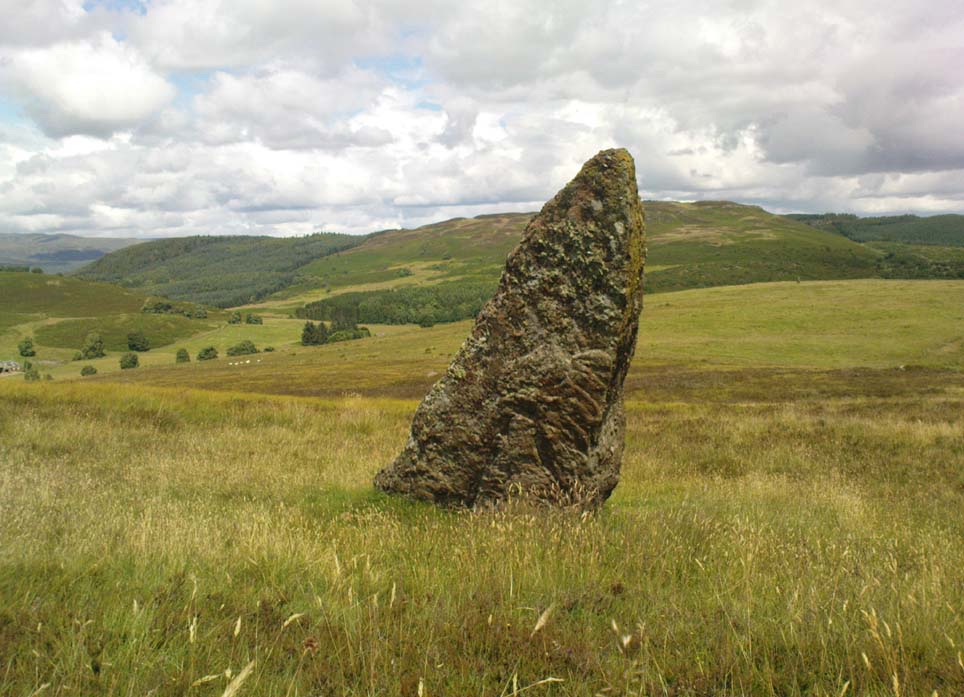
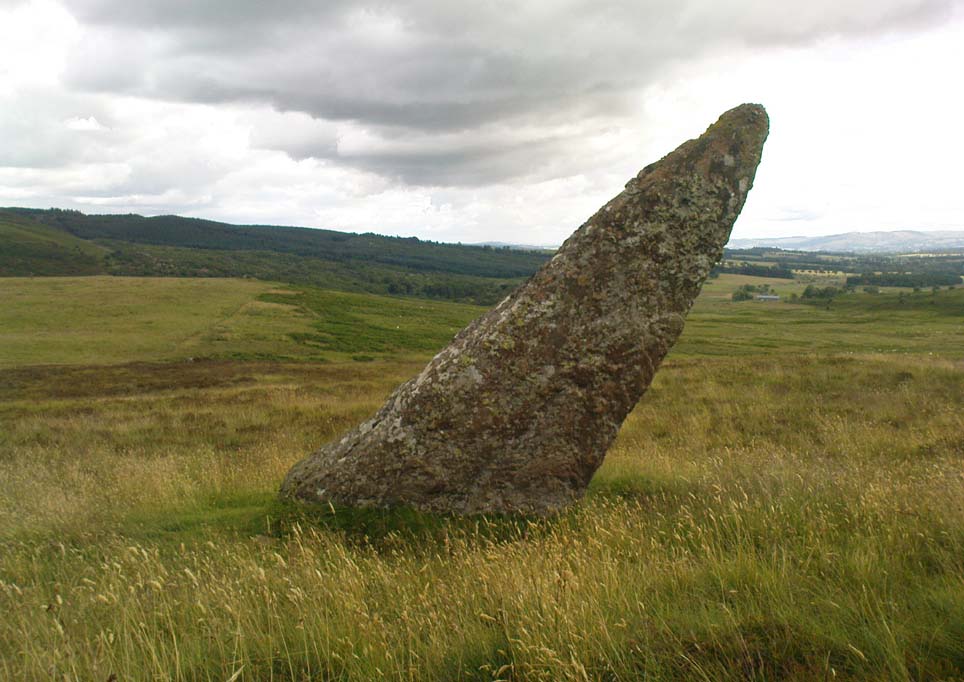
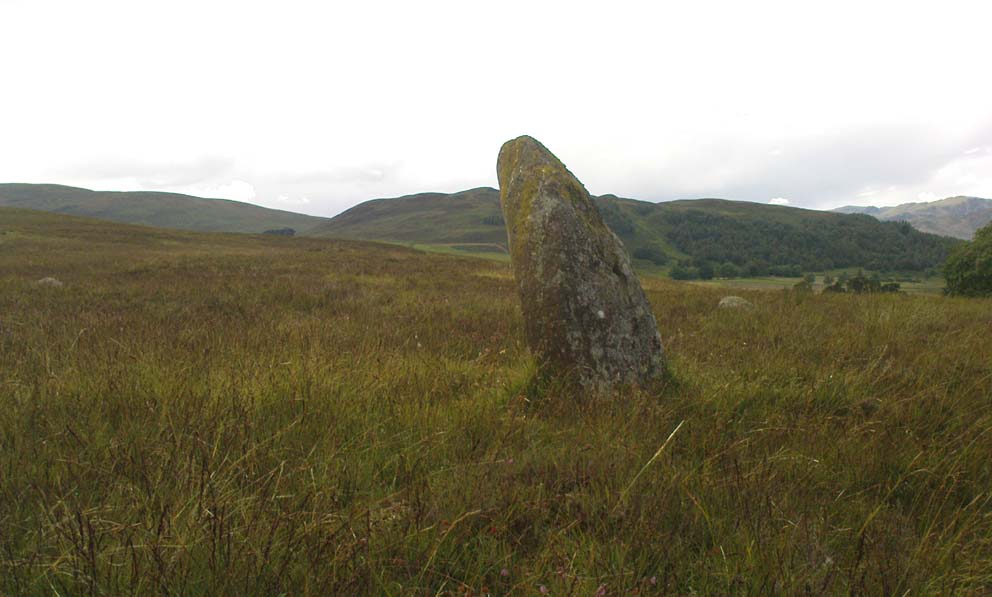
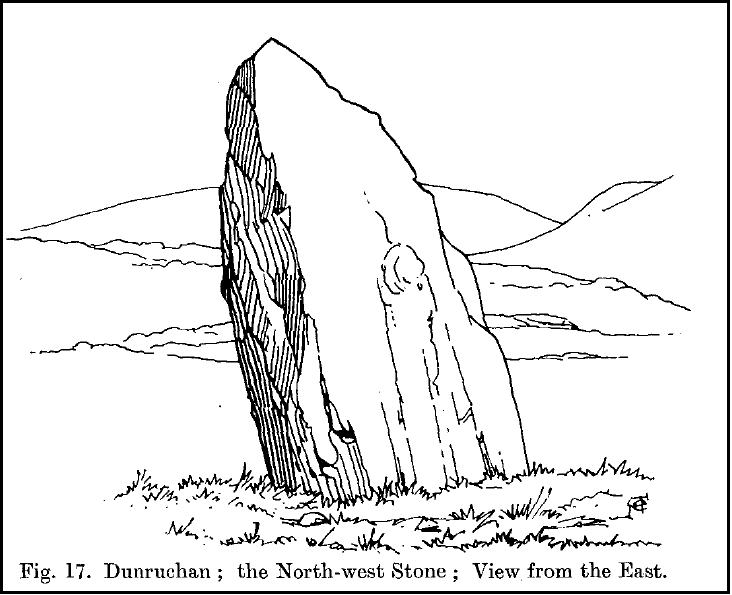
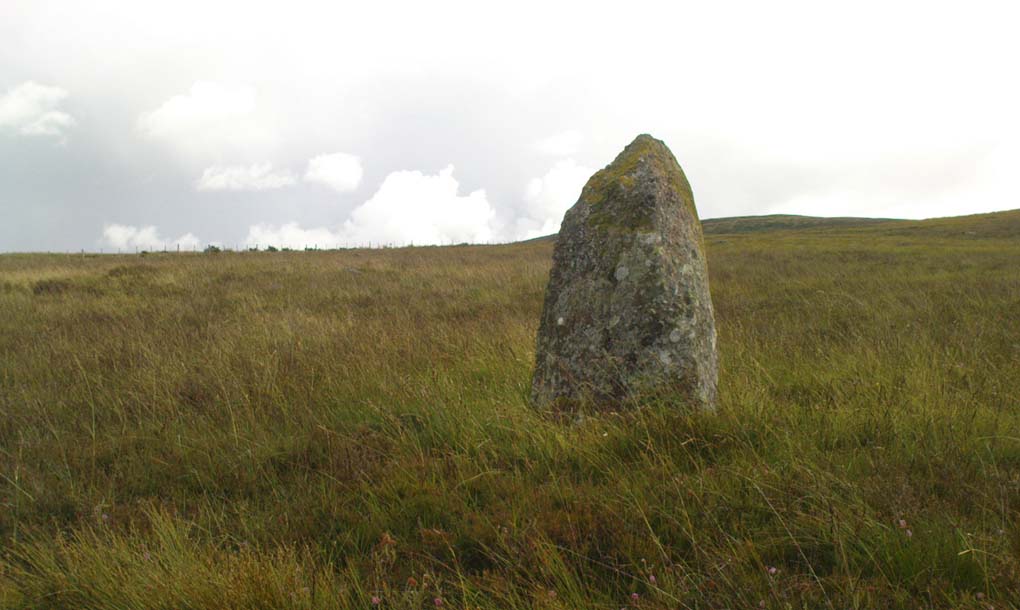
This, the smallest of the six Dunruchan standing stones, is what Fred Coles (1911) described as “the North-West Stone,” or Dunruchan B. In size alone it has a very different character to the others on the hillside immediately above and almost seems out of character when compared to the rest. Standing amidst typical moorland vegetation, this pointed upright is more than five feet tall, and from here its huge companions can be seen rising from the Earth to both east and south. Coles’ description of this monolith was as follows:
“This block of conglomerate, not half the height of (Dunruchan A)…occupies a rather lower position 385 yards to the west. Its basal girth is 8 feet 10 inches and its height 5 feet 1 inch, the south being the smoothest of its four sides. It is not now quite vertical, having a lean to the south. Like the great North-east Stone, this one tapers to a rather fine point… From this Stone the other four in the group as well as that at Craigneich are visible. ”
Dunruchan B, looking NWDunruchan B, looking S
However, we couldn’t make out all the standing stones in this complex like Coles reported. The huge leaning monolith of Dunruchan C is the closest of the others from here and, perhaps, would be the reason the cluster have been added to the lists of megalithic stone rows by Burl (1993) and Thom (1990), as a spacious curved row geometrically links them together – but I’ve gotta say, I’m sceptical about this as a deliberate megalithic alignment. However, I’ve no doubt that Alfred Watkins and his fellow ley hunters would add this to their inventory of Perthshire ley lines.
Folklore
According to an account in the Ordnance Survey Name Book of 1860, “these stones are believed to mark the graves or commemorate the death of Roman soldiers who fell in a battle fought here between the Romans and the Caledonians.”
References:
Burl, Aubrey, From Carnac to Callanish, Yale University Press 1993.
Cole, Fred, “Report on Stone Circles in Perthshire, Principally Strathearn,” in Proceedings of the Society of Antiquaries, Scotland, volume 45, 1911.
Finlayson, Andrew, The Stones of Strathearn, One Tree Island: Comrie 2010.
Hunter, John, Chronicles of Strathearn, David Phillips: Crieff 1896.
Thom, A., Thom, A.S. & Burl, Aubrey, Stone Rows and Standing Stones – 2 volumes, BAR: Oxford 1990.
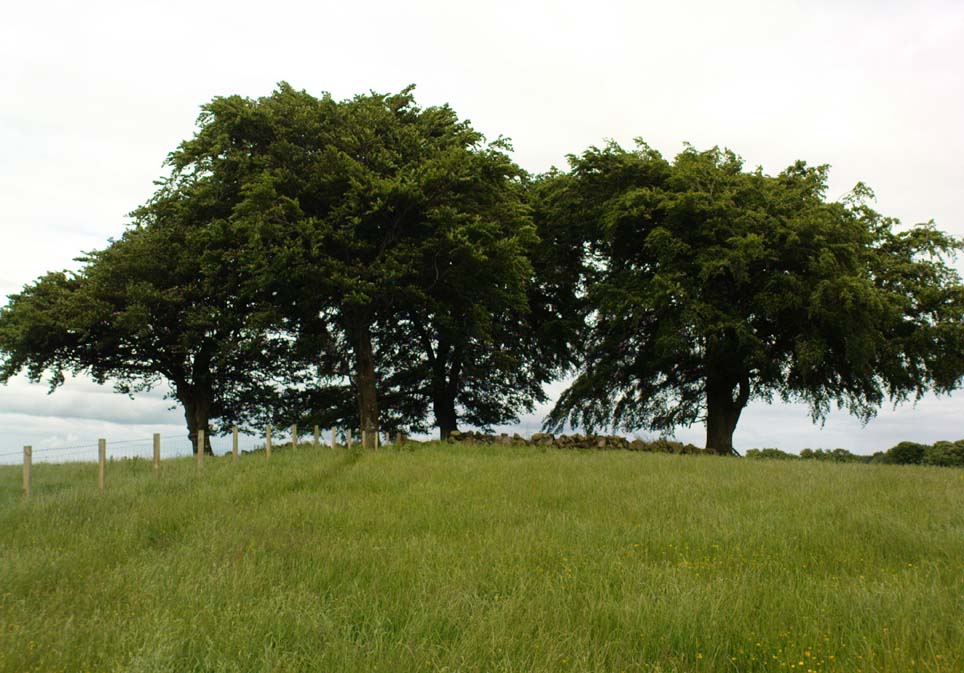
Go along the A977 road out of Powmill village towards Crook of Devon, and as the road swerves uphill, past the Powmill Milk Bar on the right-hand side of the road, take your next right. Go along this small country lane for a mile or so, past Maidenwells Farm; then as you go uphill, stop at the very top. Look in the field on your left, where a small round clump of trees are surrounded by circular walling. The cairn’s inside the protective walling.
Archaeology & History
This Bronze Age tomb sits quietly amidst the ring of trees and walling which give the site cover and protection and, of course, an excellent view of the landscape for the spirit of whichever ancestor lives here. The place seems to have been described first of all in the Old Statistical Account of the area, in 1796, where they told:
“In the middle of Carleith are the ruins of an old building, perfectly circular, and nearly 24ft in diameter. Not long ago, the proprietor ordered this ground to be planted, and the stones were dug up to make a dyke. Two stone coffins were found each 4 feet long by 3 feet broad, and contained some human bones and teeth.”
The cairn’s within the trees…
Today, the overgrown remains of the cairn measure roughly 10 yards across, with the beeches reaching their great roots into and around the old tomb. The sides of the stone cist are still visible amidst the undergrowth. It was measured and described in a letter to the Ordnance Survey by J.S. Nichol in 1959, who thought there may have been more than one tomb here.
Folklore
Although we don’t know for certain, one of the legendary witches known as ‘Meg of Aldie’ was said to frequent an old site close to where she lived – perhaps the Carleith cairn. The site is a damn good contender for such heathen rites!
References:
Simpkins, Ewart, County Folklore – volume VII: Fife, Folklore Society: London 1914.
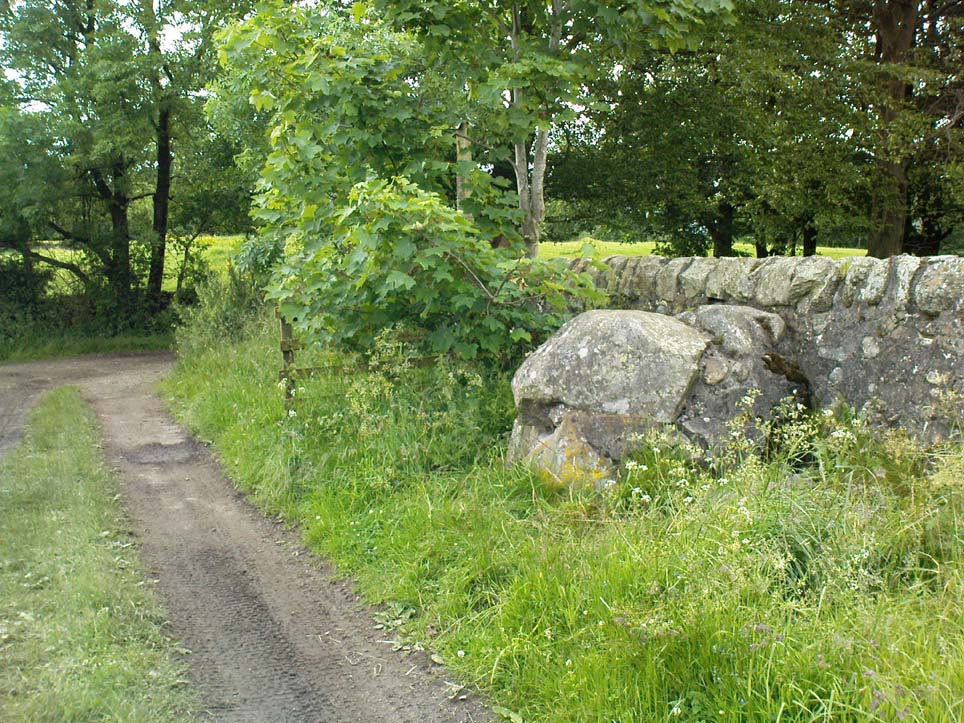
In the lovely village that is the Crook of Devon, go down Church Lane, past the houses, until you meet with the dirt-track on your left that runs straight up beneath a grove of trees heading into the green fields. Go up here 100 yards until you meet another track that goes sharp left. Just here, 10 yards along, a solitary tree sits by the wall; and just past it is a large boulder up against the walling. This is the Bull Stone!
Archaeology & History
Bull Stone, Crook of Devon
If you didn’t know owt about this place, you wouldn’t even give it a second-thought. A decent-sized rock, obviously broken-up and then plastered back together again, is innocuously resting up against the wall. But it appears to have had some significance in bygone centuries, although its full story has yet to be recovered. It was described in the Royal Commission (1933) report for antiquities, where they told:
“Built against the dike on the north side of an old roadway, half a mile to the south of Crook of Devon, is a huge sandstone boulder known as ‘The Bull Stone.’ It is probably an old boundary mark or, like the Leslie Stone…it may have some association with the old-time pastime of bull-baiting. The stone was broken up a number of years ago, and the fragments were carted away to be built up in another dike hard by, but, in response to public agitation, they were returned to the original site and cemented together. The boulder rises 3½ feet above ground and has a girth of about 13 feet at the base. It is not set up vertically, but lies on its side.”
It may originally have been a standing stone as local lore tells that it once stood as high as a grown man, but is now only half that size. It may have been one of the meeting places of the legendary witches at the Crook of Devon, but this is guesswork on my behalf (so best ignored!).
References:
Royal Commission on the Ancient & Historical Monuments of Scotland, Fife, Kinross and Clackmannan, HMSO: Edinburgh 1933.