Invercharnan, Glen Etive, Argyll

Cairn:  OS Grid Reference – NN 1439 4761

Also Known as:

  1. Canmore ID 23689

Getting Here

As you enter the top eastern end of Glencoe, take the only tiny road to your left (south) into Glen Etive, past the great Buachaille Etive Mor (she kills four or five folk a year, so a local told me, as if to remind me who’s boss!), past Dalness for another couple of miles until you hit Invercarnan (watch you don’t miss it). Behind you are the great falls screaming down the mountain slopes on Buachaille’s south-side; but on the east-side of the road another 500 yards down (you’ll have to gerrout and walk down near the riverside – if you hit the tidgy bridge, you’ve missed it) on the far side of the trees behind the singular house, the little mound can be seen.

Archaeology & History

Down this awesome valley (perhaps mi favourite – it’s difficult to say) is very very little in terms of ancient remains – at least according to the record books. I find this hard to believe. Etive is scattered with various ancient legends of hero-figures and mythical creatures, and harbours geological features, waterfalls and magic unlike anywhere else in these great mountains.  The tomb here is only a small one, but it’s pretty well-preserved.  It’s about 30 feet across and three or four feet high. Described by the Royal Commission lads, thus:

“One of the best-preserved cairns in Lorn is situated in pasture on the west bank of the River Etive, some 700m south of Invercharnan.  Bowl-shaped in profile, it measures 8.25m in diameter by 1.6m in height, and has been constructed with a kerb of boulders on which a second retaining course of stones has been carefully set.”

…Tis an utterly gorgeous arena. The cairn is good – but it’s the land upon which it rests that truly holds you. I was just ambling here – and the rain didn’t stop for three solid days, but I could have stayed amidst its blessing for an eternity. On the walk back up to my tent, two mature stags came out from the trees and enacted a play-fight right in front of me, careless of me being there.  It was utterly superb to watch!  I was saturated, cold, hungry – but watching this stopped it all.  I bimbled back to mi tent in that dreamy state beloved of such places when the elements are alive.

Anyway – back to normality!  Just north of the old tomb – which I didn’t know at the time as I had no decent map – is found the ‘Crag of the Cailleach’ (a favourite creature of mine); and there are also a couple of old fairy place-names a few hundred yards to the southeast.  There’s got to be more ancient stuff around here tat are off the record-books.  Bimbling expeditions are a-calling…!

References:

  1. Barnett, T. Ratcliffe, The Land of Lorne and the Isles of Rest, W. & R. Chambers: Edinburgh 1933.
  2. Royal Commission on the Ancient & Historical Monuments of Scotland, Argyll – volume 2: Lorn, HMSO: Edinburgh 1974.

© Paul Bennett, The Northern Antiquarian


Giants’ Graves, Halton Gill, North Yorkshire

Cairns:  OS Grid Reference – SD 856 733

Also known as:

  • Giant’s Grave

Getting Here

Easy enough to get to – and a lovely place to behold for an amble!  From Settle, take the B6479 road up to Horton-in-Ribblesdale (ask a local if you’re too dumb to find it!), turning right at Stainforth and up the single-track road towards Pen-y-Ghent.  Keep yer eyes peeled for Rainscar – you’ve about a mile to go.  If you end up at Pen-y-Ghent House you’ve gone past ’em.  Turn back for 2-300 yards.  It’s on the right-hand side of the road as you’re coming up, about 100 yards up the footpath.

Archaeology & History

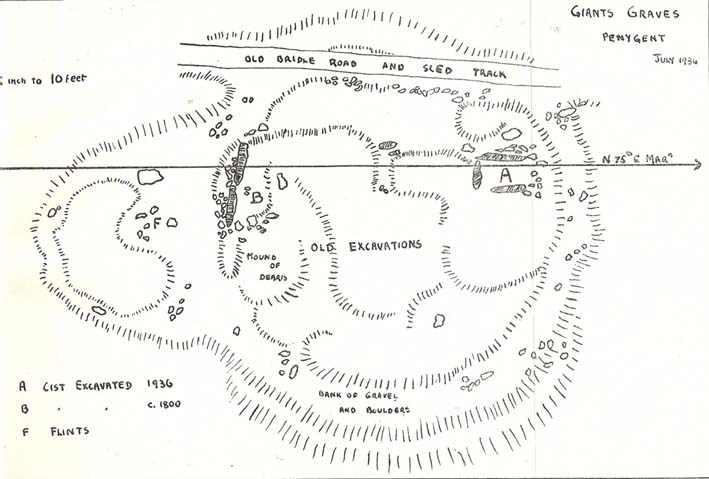
The Giants' Grave plan
The Giants’ Graves (after W. Bennett, YAJ 1937)

The earliest description I’ve found of this is in Terence Dunham Whitaker’s History and Antiquities of Craven (1878), where he reckoned the remains here to be of Danish origin.  The same thing was professed by the southerner, archdeacon W. Boyd, who said as such to the local people hereabouts more than 100 years ago, but they thought him a bit stupid and laughed at his notions! (though it does seem that Boyd wasn’t liked locally, tending to think himself better than the local people, who told him very little of local lore and legend)  Describing the remains, Whitaker said there were skeletons found in the tombs:

“The bodies have been inclosed in a sort of rude Kist vaen, consisting of limestone pitched on edge, within which they appear to have been artificially bedded in peat earth.”

But Harry Speight (1892) doubted this, saying that Whitaker never even visited the site!  When he went here he told us that,

“What is left at present are a few mounds of earth, the largest, which is divided into two, and lies north and south, measures about 28 feet by 25 feet. There is another apparent grave-mound on the east side of it, and again to the north is an oblong excavation or trench, 7 feet wide and nearly 30 feet long, in which several bodies or coffins may have been deposited. Several large oblong stones lay flay upon the ground beside the graves, but these were removed a few years ago and degraded to the service of gate-posts.”

The site was excavated in June 1936 by Arthur Raistrick and W. Bennett (1937) after they had been badly damaged and the stones robbed for walling and other profane building operations.  Herein were found two burial cists with fragments of human bones in each tomb.  In Bennett’s short account he told:

“The site consists of a nearly circular bank, about eight feet wide, and in parts two feet high, surrounding a much disturbed area.  Within the area are the remains of two cists and a number of hollows that certainly represent other similar structures.  The farmer tells of the removal of more than twenty large stones from these hollows, for use as gateposts, wall throughs and drain covers.*  The bank encloses an area fifty-four feet east to west…and fifty feet north to south.  At the west end there is a smaller bank, roughly in form of a circular apse, extending a further thirty feet.  Many large boulders and vast quantities of smaller stone are incorporated in the bank.

“Near the east end, with its axis bearing N75E, is a cist — three stones in position.  This was cleared to a depth of eighteen inches, and though no floor stone was present, among the sifted soil were found (i) broken bones, including parts of humourus, axis, vertebrae, ulna, ribs and cranium, all human; (ii) five teeth — two molars, one wisdom tooth, and two incisors, which appear to represent tow individuals.  Sir Arthur Keith reports that the bones submitted to his examination may represent more than one adult person, and there is also a fragment of a child’s tibia.  Most of the limb bones belong to a man of medium stature… He suggests from the condition of the bones a person of the Iron Age.  While this is possible with a secondary interment in the area, it is rather unlikely, as all the bones came from within the built cists, and not from the earthen part of the mound, where secondary burials would be expected.

“At the west end are two large stones, the side stones of cists or of a chamber.  The ground in front of them has been excavated many years ago…and partially refilled with boulders… Within the small extension on the west a trial excavation showed eighteen inches to two feet of random boulders, and beneath them, on the old sub-soil surface, two inches of fine grey sand, with two small flints — one of them a well-worked blade.  These probably pre-date the construction of the circle.

“The whole site is suggestive of a multiple cist burial mound, or even a “passage grave” type.  The obvious hollows, from which many of the larger stones have been lifted, are aligned in a parallel series, along an axis N75E, directed towards the two remaining large stones at the west, which may be part of a chamber wall and not part of a cist.”

Recent archaeological analysis has suggested these may be the remains of an old chambered cairn, although there is today far too much damage that’s been done to give us an accurate portrayal of what this originally looked like.  The Dawson Close prehistoric settlement is less than half-a-mile further up the ridge.

Folklore

The folklore here is simple: these are the graves of giants who lived in the valley of Littondale in ancient times.

References:

  1. Bennett, Walter, ‘Giants’ Graves, Penyghent,’ in Yorkshire Archaeological Journal, part 131, 1937.
  2. Boyd, W. & Shuffrey, W.A., Littondale Past and Present, Richard Jackson: Leeds 1893.
  3. Feather, Stuart & Manby, T.G., ‘Prehistoric Chambered Tombs of the Pennines,’ in YAJ 42, 1970.
  4. Speight, Harry, The Craven and North-West Yorkshire Highlands, Elliott Stock: London 1892.
  5. Whitaker, Thomas Dunham, History and Antiquities of the Deanery of Craven, Joseph Dodgson: Leeds 1878 (3rd edition).

* It might be worthwhile exploring the local gateposts and walls to see if any of these covering stones had cup-and-rings carved on them, as was traditional in many parts of Yorkshire and northern England.

© Paul Bennett, The Northern Antiquarian


Ford, Kilmartin, Argyll

Tumulus:  OS Grid Reference – NM 86899 03572

Getting Here

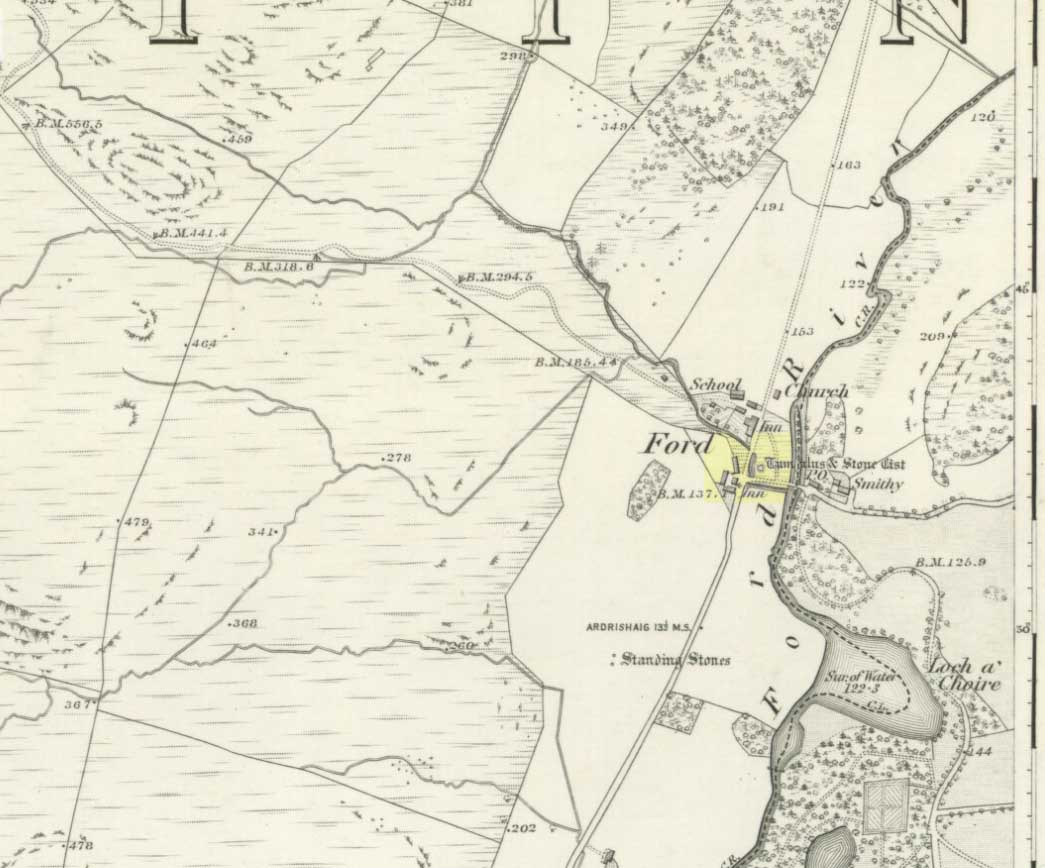
Ford Tumulus on 1875 map

Although I describe this site in association with the township of Kilmartin, it is in fact several miles north of there – but I reckoned that if I say it’s near Kilmartin, then those of you who don’t really know this region, will have some idea of its locale.  So – from Lochgilphead, go up north thru Kilmartin, another coupla miles on, till you reach the small road to your right (signposted ‘Ford’).  Just keep driving for a couple more miles until you hit the village.  If you park by the only shop, you’re just past the old tomb.  Diagonally across on the opposite side of the road from the Ford Hotel, right by the road-junction, just before the little shop, you’ll see a notable rounded mound overgrown in shrubs. Embedded in this are the remains of an old tomb.

Archaeology & History

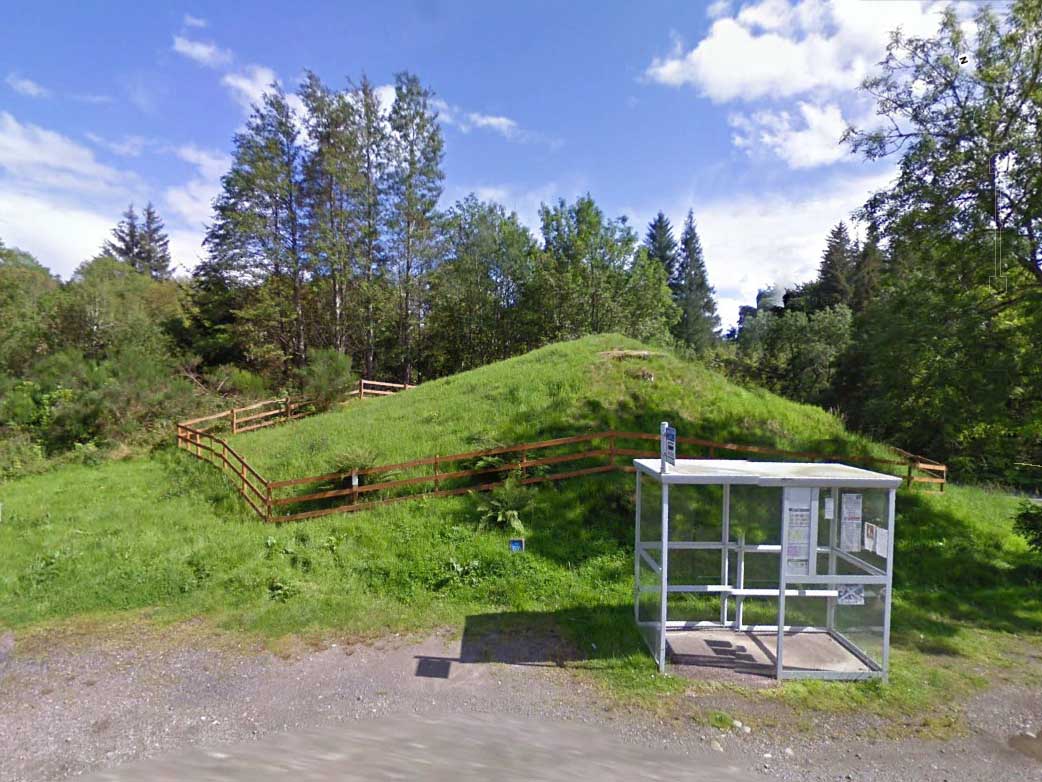
Ford tumulus (photo, couresty J. Reid)

This typical-looking fairy-mound just by the road junction in the village is where me and my daughter used to scramble around, sometimes playing and sometimes seeing if we could find anything of note in this ancient hillock, but all trace of any prehistoric stonework seems to be well-buried.  When excavators explored the site in bygone times, a small stone cist was found, which aligned (yet again) north-south and measured internally, roughly, 3ft x 2ft.  Only small!

A food vessel in Edinburgh’s central museum, “found in a cist in the neighbourhood of the lower end of Loch Awe” is thought to have come from this tomb.

References:

  1. Royal Commission on the Ancient & Historical Monuments of Scotland, Argyll – volume 6: Mid-Argyll and Cowal, HMSO 1988.

© Paul Bennett, The Northern Antiquarian


East Adderbury Cursus, Banbury, Oxfordshire

Cursus: OS Grid Reference – SP 473 372

Also known as:

  1. Bodicote Cursus

Found a few miles south of Banbury and running in a southeast to northwest alignment, Paul Devereux wrote that,

“the crop marks of this cursus fragment were first photographed by James Pickering in 1972…between the villages of East Adderbury and Bodicote…close to the River Cherwell.  The southeast end is square; the other terminus is unknown.”

References:

  1. Pennick, Nigel, & Devereux, Paul, Lines on the Landscape, Hale: London 1989.

© Paul BennettThe Northern Antiquarian 2016


Druimyeonbeg, Isle of Gigha, Argyll

Cist (destroyed):  OS Grid Reference – NR 6463 4958

Also Known as:

  1. Canmore ID 38525

Archaeology & History

An old stone-lined burial cist could once be seen in this locale: reported in 1953 to have been “discovered in the southwest corner of a field south of Druimyeonbeg farmhouse.”  When it was uncovered by the farmer, the covering capstone was missing.  Any relics that may have been there were destroyed and there’s now no trace of anything.

References:

  1. Royal Commission on the Ancient & Historical Monuments of Scotland, Argyll – Volume 1: Kintyre, Glasgow 1971.

© Paul Bennett, The Northern Antiquarian


Dorchester Cursus, Oxfordshire

Cursus:  OS Grid Reference – SU 569 958SU 581 948

Also Known as:

  1. Dorchester-on-Thames Cursus
  2. Overy Cursus

Archaeology & History

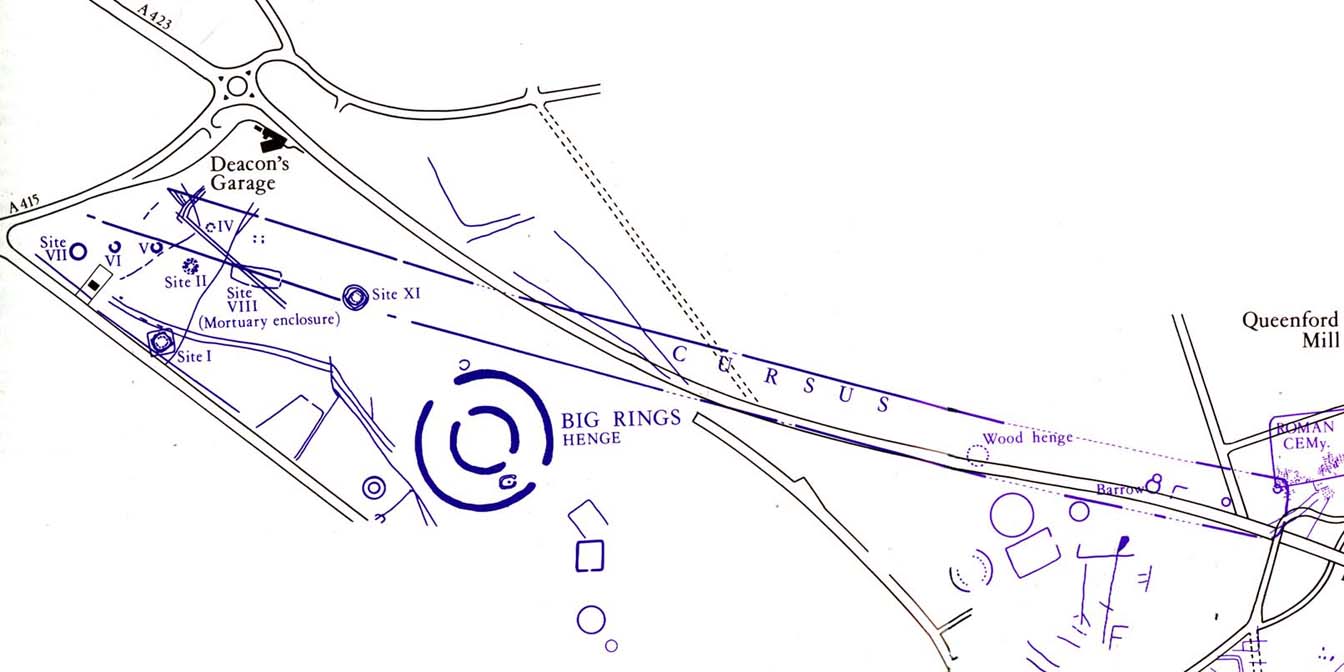
Dorchester cursus (after Atkinson)

Nowadays marked on modern Ordnance Survey maps as part of a ‘Neolithic Sacred Complex,’ this linear monument was part and parcel of the Dorchester Big Rings henge complex and was associated with a  number of other important prehistoric sites, many of which have been destroyed by ecological disfigurement projects in recent years.  In Gordon Copley’s (1958) description of the monument, not long after its initial discovery, he said that this “was a cursus which consists of parallel ditches some 4000 feet long with 210 feet between them.”  In more recent times Paul Devereux (1989) described how the cursus here,

“ran for three-quarters of a mile (1.2km) in a northwest to southeast direction on the north side of the Thames and was 210 feet (64 metres) wide. The cursus was part of a complex of crop marks, the most notable being” the henge. “The northwest end of the cursus remains unknown; the southeast end was rounded. The southeast segment…was on a slightly skew alignment compared to the rest of the feature, though it may have been the earliest part of the monument – bones found there were radio-carbon dated to around 3000 BC. The southern ditch of the cursus ran through and connected two earlier sites which shared a different alignment. Deposits of cremated bones, a stone arrowhead, fragments of pottery, a polished flint axe, and a circle of pits, probably the remains of a ‘woodhenge’ structure, were all found with the cursus.”

Dorchester cursus plan 1985

Jean Cook (1985) told that later excavations on the site in 1981, found that the shallow ditch which surrounded the entire cursus, “was interrupted by a central entrance on the southeast side.  The southeastern terminal ditch respected a small prehistoric monument which has been dated to approximately 2000 BC.”  This and other factors has led to the thought that the cursus may not all have been built at the same time.  And indeed excavations at other sites scattering the northwestern ends of the cursus (shown in the plan here, Ed.) proved that a D-shaped enclosure “pre-dates the rest of the structure.”  Other mortuary sites scattered the edges of the cursus that were added in the centuries which followed, but which need excavation work to uncover their secrets.  Although much of this was done in the Atkinson digs, they were summarised well by Jean Cook (1985), who told:

“Site VIII, excavated in 1948, was a monument known as a mortuary enclosure.  Sometimes such structures take the form of long barrows, but this one was a rectangular enclosure bounded on all four sides by a ditch with an internal bank.  There were narrow entrance gaps on the two longer sides and a wider entrance in the centre of the shorter southern side.  It is dated by the substantial sherds of Ebbsfleet ware (pottery) which were found in the upper filling of the ditch; part of a human jaw from within the enclosure helps to confirm the mortuary function.

“Site XI, excavated in 1949, consisted of three or more concentric ditches, of different dates, enclosing an incomplete ring of 14 pits.  The middle ditch seems to have surrounded an oval barrow or enclosure and to have then been converted to a circular plan.  Some of the pits contained animal bones, one contained an antler pick and one contained a complete human cremation, but there were no accompanying grave goods.

“Both these sites were in existence before the cursus was built. (my italics, Ed.)  This is shown by the fact that the southernmost ditch of the cursus cuts through Site VIII and abuts Site XI.  These two earlier sites seem to share the same alignment, but once the cursus was constructed it set a new alignment which may have been of significance until the end of the 3rd millenium BC.  Three monuments built after the construction of the cursus were located inside it, two of them being along the central axis, and two others were just outside the southernmost ditch of the cursus but shared the same general alignment.

“Sites IV, V and VI, which were also excavated in 1949, have a similar overall plan and all of them contained a number of cremation deposits suggesting that amongst other things they acted as cemeteries.  All three sites had a circular plan and consisted of an outer bank, to define the central area, and an inner ditch, the purpose of which seems to have been to provide earth for the bank.  In Site IV the ditch was made up of eight oval pits, enclosing an area of about six metres in diameter.  There was a broad entrance gap on the southeast side.  Inside the enclosed area there were 25 deposits of cremated bones.  An arrowhead was found with one of the cremations.  Site V was very similar in construction, except that the entrance gap was on the northwestern side and contained 21 cremation deposits.  No grave goods were found.  Site VI again had a similar plan with the entrance gap to the north.  There were 49 cremation deposits , one accompanied by a flint fabricator, an arrowhead and burnt flint flakes.

“Site 1 was excavated in 1946 and consisted of a small square ditch, enclosing another more or les circular ditch with an internal bank.  Inside this ditch were 13 holes, forming a ring with an entrance gap on the western side.  There were no entrances in the surrounding ditches.  A crouched burial was found within the entrance to the ring of holes but there were no accompanying grave goods.  Four cremations were found, two accompanied by fragmentary bone pins, in or besides four of the central holes.  At a later stage in the neolithic period, parts of the ditch may have been enlarged to make temporary shelters: it is not clear to which period of use the cremations belong.

“Site II, also excavated in 1946, consisted of a causewayed (interrupted) ring ditch which was enlarged on two occasions.  The third ditch had an internal bank in which were 19 cremation deposits.  Two more cremations were found at the centre of the enclosed area.  There was no evidence for any gap.  Bone pins were found with four of the cremations as were flint fragments.  In addition, antlers and other flint fragments were found, as well as pieces of pottery.

“In 1981 a small semi-circular enclosed ditch was excavated within the southeast terminal of the cursus.  Though sited off-centre, the ditch shared the same alignment with the cursus.  An antler (dated to c.2000 BC) was found close to the bottom of the ditch.  After the ditch had virtually filled up with silt, the surviving low central mound was used for cremation deposits, one of them associated with a heavily burnt flint blade.”

Paul Devereux (1989) pointed out how one of the archaeologists studying this site found that if the axis of the monument was extended southeast, across the river, it lined up perfectly with another set of perfectly straight lines which were thought “likely to be a Roman trackway.”  Unfortunately much of this area has been destroyed through the self-righteous ignorance of modern industrialism.

References:

  1. Atkinson, R.J.C. et al, Excavations at Dorchester, Oxon, Department of Antiquities: Oxford 1951.
  2. Barclay, A., Lambrick, G., Moore, J. & Robinson, M., Lines in the Landscape, OAU: Oxford 2003.
  3. Cook, Jean, “The Earliest Evidence,” in Dorchester through the Ages, Oxford University 1985.
  4. Cook, Jean & Rowley, Trevor (eds.), Dorchester through the Ages, Oxford University 1985.
  5. Copley, Gordon J., An Archaeology of South-East England, Phoenix House: London 1958.
  6. Loveday, Roy, Inscribed Across the Landscape, Tempus: Stroud 2006.
  7. Pennick, Nigel & Devereux, Paul, Lines on the Landscape, Hale: London 1989.

© Paul Bennett, The Northern Antiquarian


Dobrudden Necropolis, Baildon Moor, West Yorkshire

Cairns:  OS Grid Reference – SE 138 402

Getting Here

Easy one this!  Go up thru Baildon, on towards Baildon Moor over the cattle-grid.  Take your first left and go up for several hundred yards past the reservoir until you reach the track on the left which takes you onto the Low Plain, Baildon Moor.

Archaeology & History

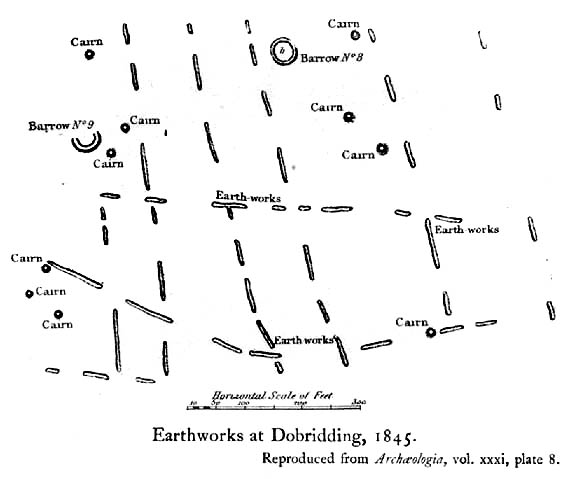
1845 plan of Cairns & Earthworks on Baildon Moor (after J.N.M. Colls)

In the year 1845, on the Low Plain on the western side of Baildon Hill, an intrepid archaeologist and historian, Mr. J.N.M. Colls, came across extensive earthworks and a number of prehistoric tombs in a very small area. Upon excavation, the ‘earthworks’ were found to be what sounds like neolithic walling running parallel to each other in a roughly north-south direction (north is the traditional direction for death).  Scattered amidst these lines he found more than a dozen cairns and barrows, along with remains of “a circle, or ring.”  Although the majority of what Colls wrote about has been destroyed, leaving only scanty remains of a once considerable archaeological arena, his lengthy description deserves being reprinted in full.  He wrote:

“This level (the Low Plain) bears numerous traces of earthworks or other embankments running in many cases parallel with one another, at distances varying from 50 to 80 yards apart, and intersected by other works of similar construction.  These earthworks can be remembered to have been from four to five feet in height; their bases nearly invariably appear to have been eight feet in diameter, composed of loose blocks of calliard, or close-grained sandstone, and earth.  The greater part of the stone has been torn away to make and repair the roads of the neighbouring district; and the surface of the earth has been so nearly levelled that it is only by the scattered and disfigured remains, carefully delineated upon my plan, that any idea can be formed of their original character.

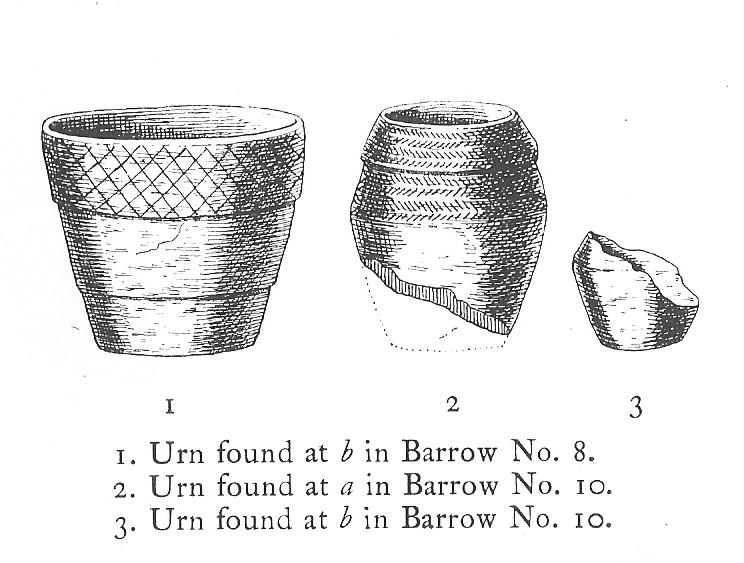
“In connection with these earthworks, and upon the north side of them, immediately above a steep fall to the next lower level (approx SE 1372 4020, Ed.), is a circle, or ring, formed originally of earthworks of precisely similar character, size and construction to those I have just described.  The diameter of this ring is about fifty feet; its interior area is perfectly level; but the earthwork forming its circumference has been defaced and torn up for a considerable extent for the stone it contained.  Circles of this nature have generally been termed druidical, from their presumed use as places of worship or sacrifice.  I therefore opened its centre, in the hope of finding some trace of fire confirmatory of its character; and commenced clearing away a layer of peat earth, of from 10-11 inches in depth.  I then found a layer of calliard boulders one-and-a-half feet in depth, the lower ones slightly burned, and resting upon a deposit of peat-ashes three inches in depth and from 2-3 feet in diameter (see Barrow No.8 in plan, Ed.).  This I should have concluded to be the remains of a beacon fire, but, upon continuing the excavations, I found about three feet SSE of this deposit of ashes (at point b on the plan) a rude urn standing in an upright position, at a depth of two feet from the surface, a layer of calliard stones having been removed from above it, one of which appeared to have covered it.  This urn was 12 inches in diameter and 9-10 inches in depth, of a circular or bowl shape, the upper stage of it being rudely ornamented by incised lines crossing each other at acute angles: it was filled with calcined bones (some remaining tolerably perfect), ashes and charcoal; and I selected some half-dozen of them as specimens, which Mr Keyworth, surgeon and lecturer on anatomy at York, has examined… He is of the opinion that they belonged to a very young subject, perhaps from 9-12 or 13 years of age; he thinks it possible however, that they may all have belonged to the same subject… The urn in which the were placed appears to have been rudely formed by the hand, without the assistance of a lathe; in substance about half-an-inch…it appears pretty evident that this urn has been formed of the black earth of the mountain and coal measures of which Baildon Hill is formed…

“A little to the west by south of the circle…are the almost obliterated remains of another circle (fig.9 on the plan), which I had not an opportunity of thoroughly examining; the slight traces remaining bear strong testimony of its character being similar to that of fig.8.

“Scattered over the surface of the Plain, and at irregular distances, cairns or heaps of stones, composed of bare sandstone and calliards (and not mixed with earth), frequently occur; they are generally about twenty feet in diameter and appear to have been originally 4 or 5 feet in height: these remains still require examination.  In passing over them, I remarked that some of the stones of which they and the earthworks near them were constructed, had marks, or characters, but so rude that a doubt remains whether they may not have been caused by the action of the atmosphere on the softer portions of the stone.”

Urns found near Dobrudden

This final remark seems to be the very first written intimation of the cup-and-ring marked stones which can still be found amidst the grasses in the very area Mr Colls described.  Sadly, much of the other remains shown in the drawing have been all but obliterated, or grown over.  However, the decent concentration of cup-and-ring stones in this small area (see other Baildon Moor entries), highlights once again an associated prevalence of these carvings with our ancestor’s notions of death.

Sadly, year by year, the important neolithic and Bronze Age english heritage remains across this upland ridge are slowly being destroyed.  The lack of attention and concern by regional archaeologists and local councillors, and the gradual encroachment of human erosion are the primary causative factors.  Hopefully there are some sincere archaeologists in the West Yorkshire region who will have the strength to correctly address this issue. Under previous archaeological administrators, Bradford Council have allowed for the complete destruction of giant tombs, stone circles and other important prehistoric remains in their region—a habit that seems not to be curtailed as they maintain a program of footpath “improvements” on local moors without any hands-on assessment of the archaeology on the ground.

…to be continued…

References:

  1. Baildon, W. Paley, Baildon and the Baildons – volume 1, St. Catherine Press: Adelphi 1913.
  2. Barnes, Bernard, Man and the Changing Landscape, Eaton Press: Wallasey 1982.
  3. Colls, J.N.M., ‘Letter upon some Early Remains Discovered in Yorkshire,’  in Archaeologia, volume 31, 1846.

© Paul Bennett, The Northern Antiquarian


Devil’s Apronful, Appletreewick, North Yorkshire

Cairn:  OS Grid Reference – SE 07485 59355

Getting Here

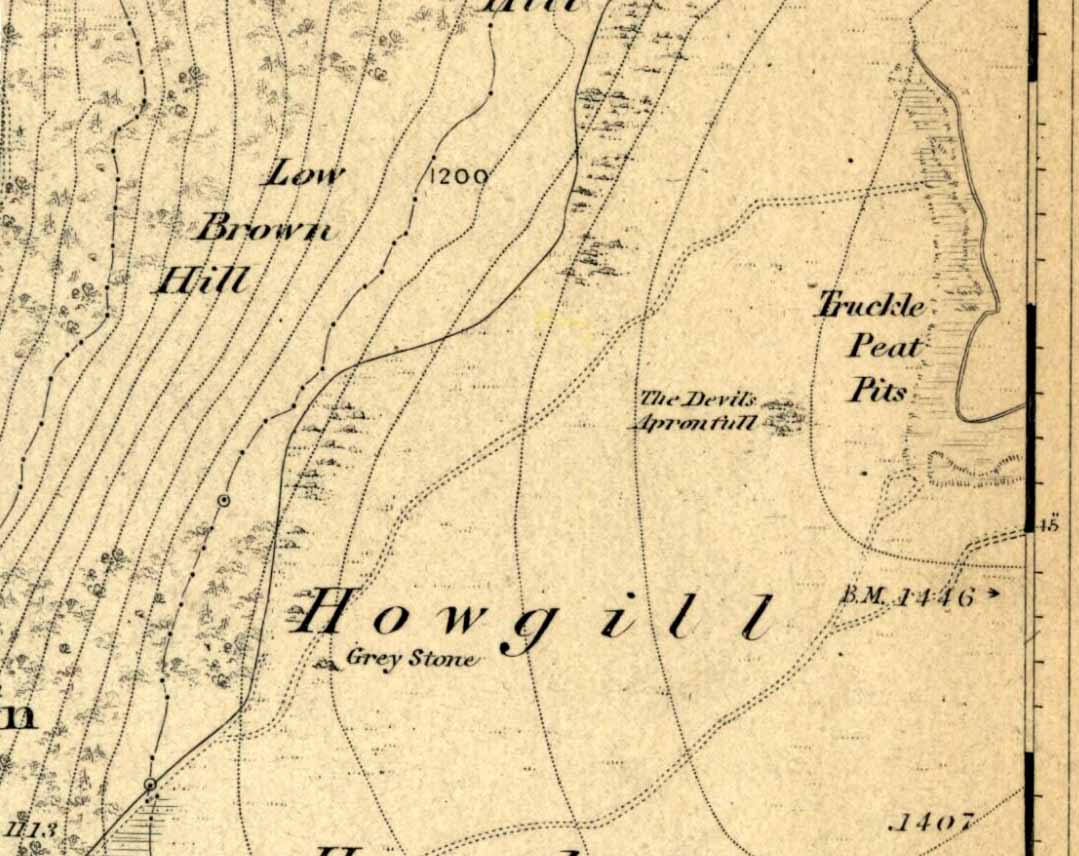
Devils Apronful on 1853 map

An excellent spot with fantastic views. There’s many ways to approach the place, but a good one is from the roadside by Howgill, then following the track uphill until you reach the moor, then head towards the spectacular and legendary, Simon’s Seat (which folklore ascribes to be named after the great druid, Simon Magus). You’ll pass an old Grey Stone (two large rocks) from which you can espy the old tomb if you stand on top of ’em. Keep walking uphill and it’s about 100 yards off the footpath to your right. A large boulder is nestled just beneath the tomb itself, which stands out on a ridge.

Archaeology & History

When Harry Speight visited here (1900) he described it as being 40 yards in circumference. He also described “an upright stone below the cairn” with apparent cup-markings on the west-side.  I’m not quite sure where this has got to – but the site has shrunk somewhat since Speight’s day.  It’s only about 20 feet across now, and the middle of it has been hollowed into a grouse-shooting butt for the toffs!

About 100 yards southeast (towards the Truckle Stones) are the remains of some neolithic walling in a straight line.

Folklore

One of many old tombs in our northern hills said to have been created by the devil who, as usual, accidentally dropped some stones he was carrying. The old folklorist Thomas Parkinson (1888) said the following of this place:

“The Apronful of Stones is a group of rocks heaped together in delightful confusion, their disorder and name being thus explained:  Once upon a time—whether when he built the bridge over the valley, or at some other time, the record saith not—the Devil was determined to fill up the ravine, or gill, of the Dibble. For this purpose he was carrying these enormous crags in his apron, when, too intent upon his object to properly observe where he placed his feet, he caught with one foot upon the top of Nursa Knott, and, stumbling, the strings of the apron broke, and the contents were thrown upon the ground as they now appear. It is also said of them that if any of them, even now, were to be removed, they would certainly be brought back to their original place during the succeeding night.”

Another legend tells that the Devil’s Apronful is also the grave of some local unnamed hero.

References:

  1. Parkinson, Thomas, Yorkshire Legends and Traditions – volume 1, Elliott Stock: London 1888.
  2. Speight, Harry, Upper Wharfedale, Elliott Stock: London 1900.

© Paul Bennett, The Northern Antiquarian


Crow Hill Circle, Midgley Moor, West Yorkshire

Ring Cairn: OS grid reference – SE 026 271

Getting There

Best approached by taking the same direction to the unexcavated Foster Clough ‘enclosure.’ From here, walk towards the walling about 100 yards to your east. Follow it along on the moorside for another 100 yards then follow the small sheep-path up the angle of the slope onto the moor itself. Once you’re at the top and on the level, it’s right ahead of you! If the heather’s deep though, you might as well give up before y’ start! (honest – I went there a while back for a night’s sleep & couldn’t find the damn thing!) But if you’ve made the effort getting here, wander 200 yards towards Crow Hill and keep yer eye out for the large heather-clad tumulus.

Archaeology & History

This site was rediscovered in October 1995, when I was bimbling about on the southern side of Crow Hill. It was one of those good periods, when the heather had been extensively burnt back, so enabling a better examination of the moors for any potential prehistoric remains. I unknowingly walked right into the middle of this small ring of stones with a fella called John Billingsley, who seemed quite unaware of what I was getting excited about until I pointed out to him exactly what we were standing in the middle of! (he couldn’t see what was under his nose, which was a bit weird considering he edits an earth-mystery mag) But I wouldn’t have even been looking for this site, were it not for what happened just a few days earlier…

I was on one of my many ambles across the moortops, which to many people watching would seem like some seemingly aimless, lost soul – an apt description at times! – wandering across the hills (those who know me well, have long called such seemingly aimless treks, Barmy Bennett Expeditions!). It was a lovely day: a shallow snow-cover lay across the moors and as the wind brushed across the earth and up, Her wisps of breath were freezing. But I was well-wrapped and sat, upon occasion, behind the small rock outcrops I was checking for cup-and-rings for shelter when needed. But as the day fell on and the sun touched the western hills, I had to turn for home as the cold was strengthening. Being on the moors at night, in this sort of weather, is never a good idea unless you’ve got your gear with you — and this day I hadn’t. So I set off back for home in Hebden Bridge, in that dreamy sort of state which the hills elicit after a day’s ambling. The colours of Earth and Sky were crisp in the bracing air and as I headed for the footpath towards the old stone known as Churn Milk Joan, I gazed at Crow Hill a half-mile or so away…

Without warning, it came like a thunderbolt up through my dreaming mind: ‘There’s a stone circle over there!‘ came the words. And though the words were quiet and simple, their effect was anything but! I focused quickly – very quickly! My mind staggered out of the dreaming and into the ego state, trying quick to rationalise what had just emerged from my unconscious. An adrenalin rush hit me and amidst the snow-filled hills I started to bound, gazelle-like, across the wibbling moors, straight towards Crow Hill. But then I stopped!

“Wait… She’s nearly dark,” I said to myself. “You’ve no food and there’s gonna be no no light. Come back in a day or two and you’ll have all the time you need to explore.”

And so I wandered back in the dark to the warmth of fire and home and waited a few days, for the Earth to drink Her snow, and hope that the curious intuition — as it had been on numerous other occasions — proved fruitful. And so it did…

If you can find the place (almost impossible when the heather’s in full growth), you’ll see that this ‘cairn circle’ is little more than 32 feet across, with the tallest stone in the ring little more than 2 feet tall. A curious small squared circle of loose stones exists in the south side of the ring and a raised embankment surrounds the site. Scatterings of small, football-sized stones are found both in, out and at the edge of the circle. (Please note – to those of you who wanna cross-reference – that the photos alleging to show this site on The Megalithic Portal are not of the right place.)

Close by are other neolithic remains, including extensive walling, 2 or 3 other small standing stones and a large tumulus which one rather myopic hobbyist (Mike Haigh) reckoned – in a poor attempt at sarcasm – might be the burial tomb of a successful local farmer.  Hmmmm…..

The site was later described in an article by the same Mike Haigh (in Billingsley’s Aspects of Calderdale) as being discovered by John Billingsley himself, which wasn’t just a mistake but a rather huge lie.  John was there with me when I found it, as he knows full well.  But it seems here we have an example of people who like to try give themselves credit for discovering things that they did not do.*  Even sillier, Mr Billingsley then moaned when I described the site (in my Old Stones of Elmet) without mentioning his name! But in all honesty, if that’s the disreputable way in which they go about their business, what do they expect in return!? (What’s worse is that the site was first described in an article in his own Northern Earth Mysteries mag in 1995, which I co-authored, and then when I asked if he could point out the error and correct it, he ignored the request in just the same way politicians do.  Pure bloody ignorance no less.  But then, he is one of those incoming Southern-types – y’ know the sort…)

This aside: the entire region hereabouts requires considerable archaeological attention as we have here the remains of either a neolithic settlement, or graveyard, or both!

* see the note at the bottom of the ‘About TNA‘ page on such issues.

References:

  1. Abraham, John Harris, Hidden Prehistory around the North West, Kindle 2012.
  2. Bennett, Paul, The Old Stones of Elmet, Capall Bann: Milverton 2001.
  3. Billingsley, J. & Bennett, P., ‘Recent Fieldwork on Midgley Moor,’ in NEM, 65, 1995.

© Paul Bennett, The Northern Antiquarian

Cnoc na Croise, Ardminish, Gigha, Argyll

Cairns:  OS Grid Reference – NR 6439 4828

Also Known as:

  1. Canmore ID 38549

Archaeology & History

In Thomas Pennant’s A Tour in Scotland and Journey to the Hebrides, 1772 (1790:226), he described there being three prehistoric cairns about four-hundred yards west of Ardminish, or a couple or hundred yards north of the Achamore Standing Stone, on Cnoc na Croise, but they seem to have been destroyed.  At least two of them were between 4 and 5 yards across and contained cists.  A search for the site by the Royal Commission lads in the 1960s found nothing—although they may have been looking in the wrong place (the grid reference given above is an approximation).  Does anyone know anything more about these seemingly lost sites?

References:

  1. Royal Commission for Ancient & Historical Monuments of Scotland, Argyll – volume 1: Kintyre, HMSO 1971.

© Paul Bennett, The Northern Antiquarian