Bowling Green Stone, Shipley, West Yorkshire

Cup-Marked Stone:  OS Grid Reference – SE 14505 37525

Also Known as:

  1. Carving no.8 (Boughey & Vickerman)
  2. Shipley Old Hall Carving

Getting Here

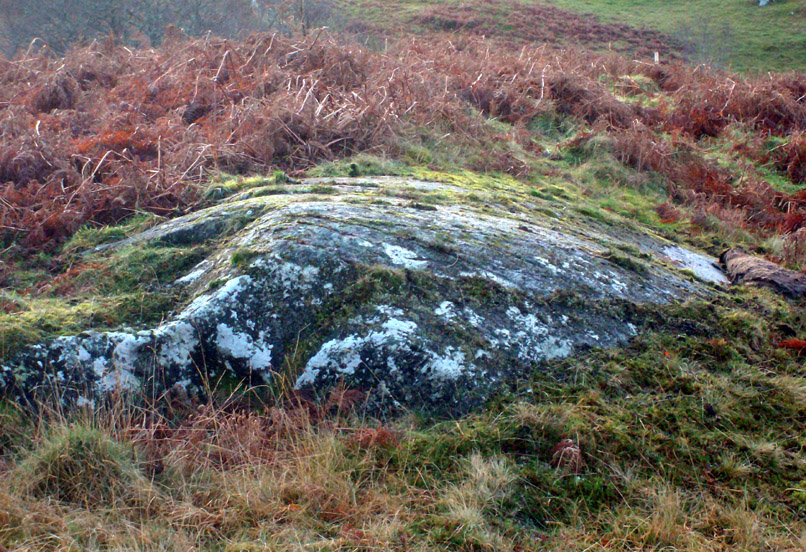
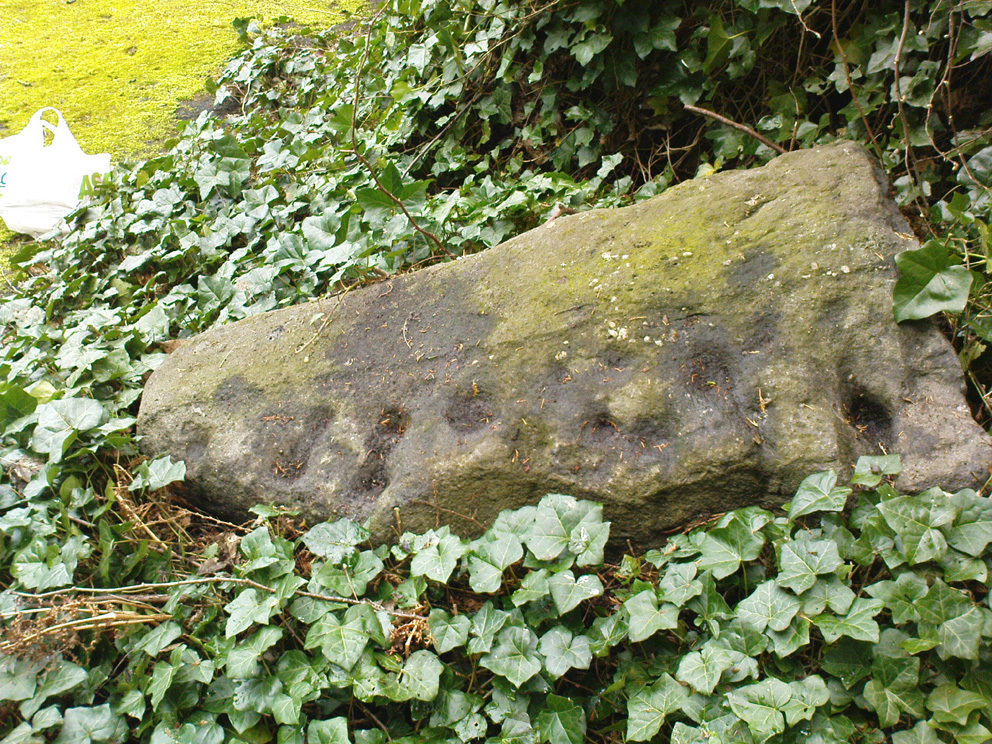
Carved stone beside the path

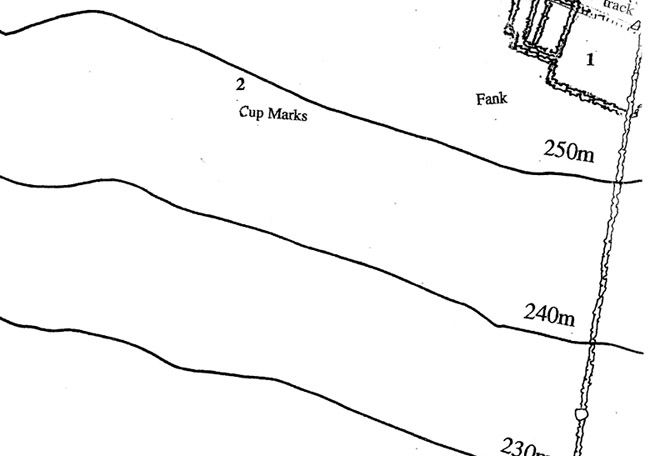
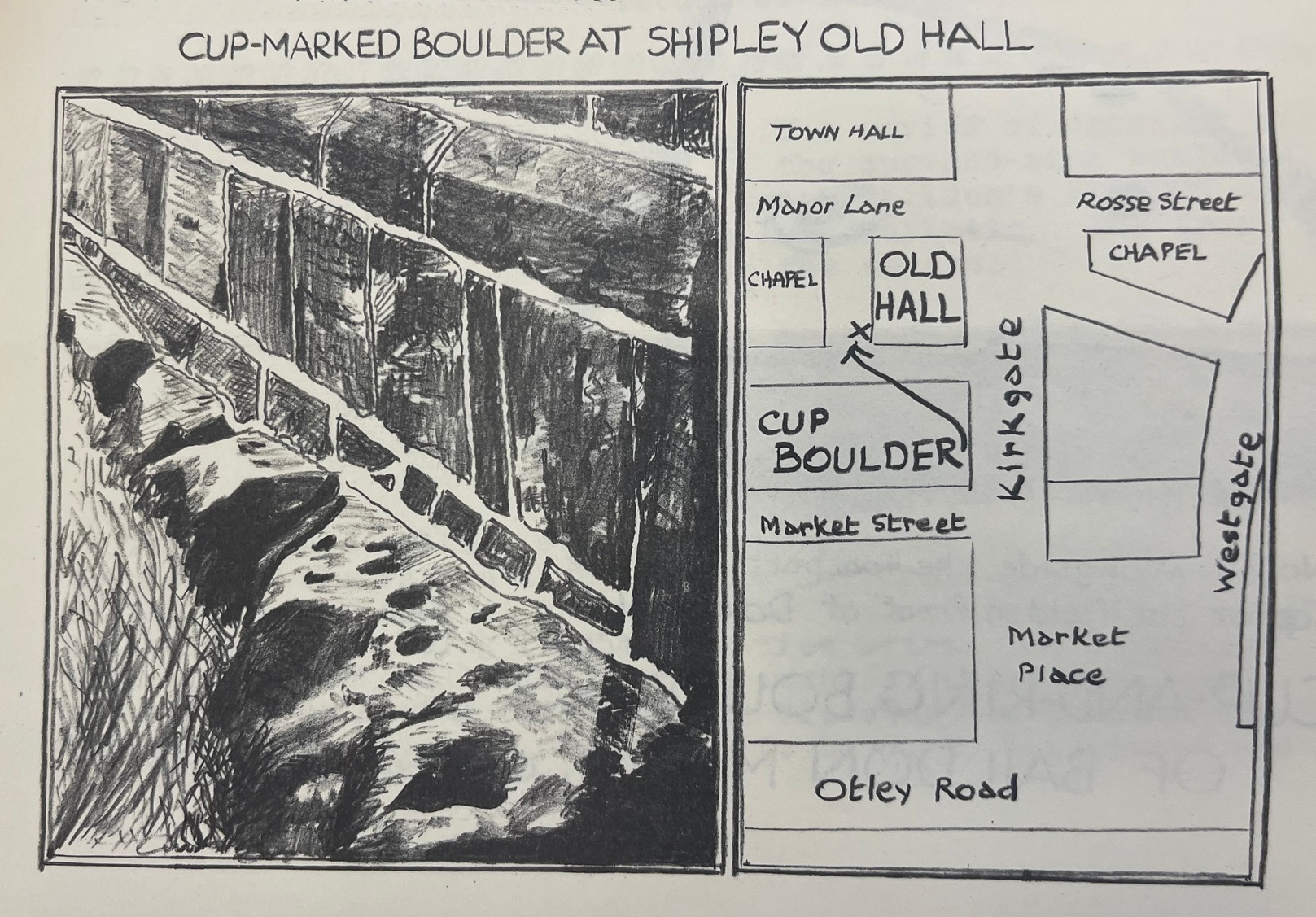
From Shipley town centre open market, take the Kirkgate road up to Saltaire, past the old town hall. On the other side of the road take the little path into the Bowling Club, in the trees (if you hit the church you’ve gone too far).  Once standing in front of the bowling green itself, you need to walk along the left-side path. Two-thirds of the way down, now laid in the ivy-covered area below the old quarry face, you’ll find what you’re looking for.

Archaeology & History

I remember first seeking out this carving when I was still at school and wondering how the hell it got here – and believed it to be a fallen standing stone at the time!  It seems that the stone was cut and readied for use as a gatepost instead, at some time long ago.

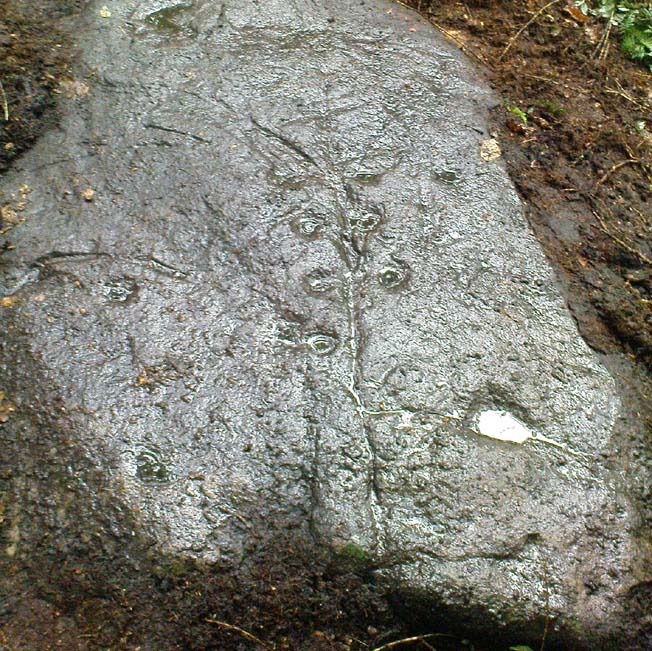
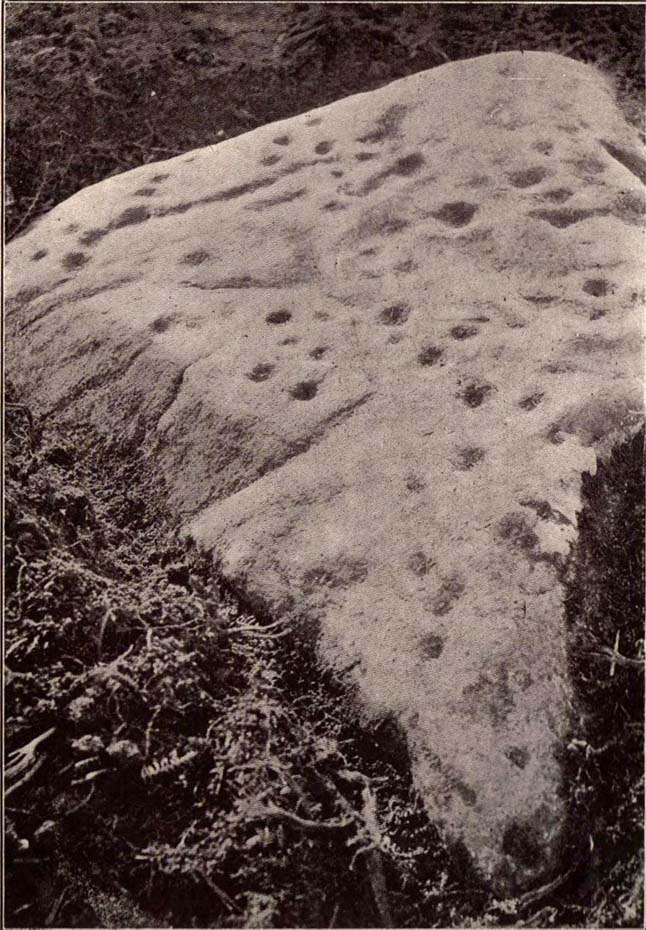
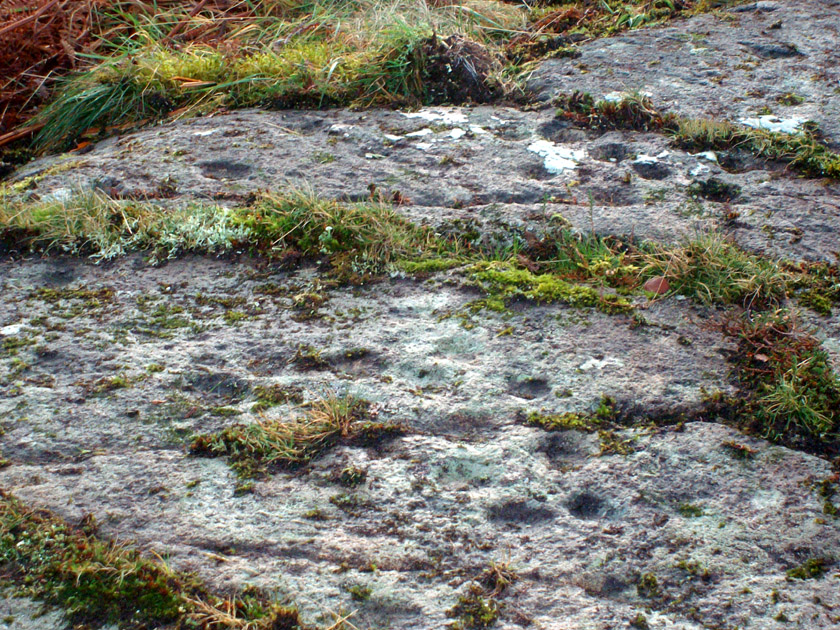
Close-up showing cups & lines
In its previous locale

The curious cup-marked stone has travelled about a bit, somehow.  Formerly at the edge of a field in the grounds of Bradford Grammar School 3 miles away (at SE 1523 3583), the fella was then built into the wall of the now-demolished Shipley Old Hall, before reaching its present resting place at the edge of the bowling green.  Consisting of around 16 cup-markings with carved lines seeming to link them here and there, it was first mentioned by the late great Sydney Jackson (1955) in an early edition of the Bradford Archaeology Journal.  The carving was recently included in the Boughey & Vickerman (2003) survey, where they described it as,

“Medium-sized fairly smooth grit rock with coarse line down top, probably natural, evidence of quarrying on edge.  Sixteen or seventeen cups, one with a groove out has a deeper cut within it and twelve of the others are linked in pairs by short grooves.  This has been interpreted as feathering for quarrying, but the grooves are across the line of likely split, rather than along it.”

And for those of you who live nearby: if you check this out, see if you can locate an earthfast boulder near here which I recall having a cluster of distinct cup-marks running on top of the rock along one side. I couldn’t find it when I looked a short while ago, it’s not in the archaeology survey lists, and it remains lost—in the heart of Shipley no less!

References:

  1. Boughey, Keith & Vickerman, E.A., Prehistoric Rock Art of the West Riding, WYAS: Wakefield 2003.
  2. Jackson, Sydney, “Cup-Marked Boulder, Shipley Old Hall,” in Bradford Cartwright Hall Archaeology Group Bulletin, 1:10, 1955.

© Paul Bennett, The Northern Antiquarian

Castle Campbell, Dollar, Clackmannanshire

Cup-Marked Stone:  OS Grid Reference – NS 9613 9928

Getting Here

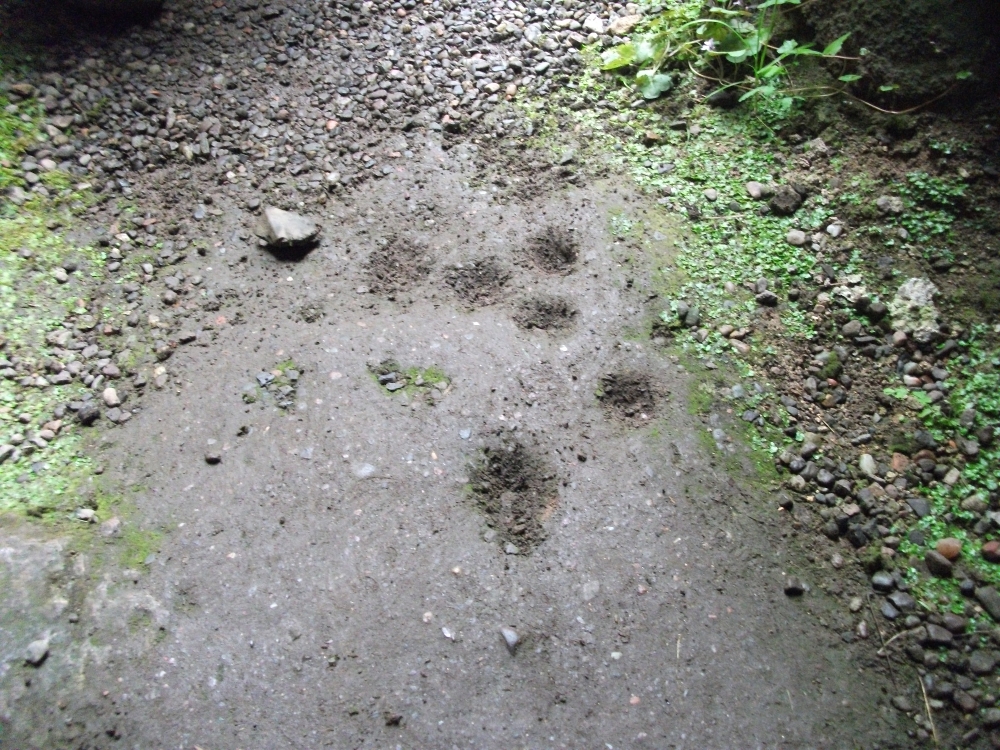
Cup-markings at Castle Campbell

From Dollar, take the steep road up to Castle Campbell (ask a local if you get lost).  When you’ve got into the building and paid your fiver, walk straight forward as if you’re heading to the front gardens, but stay within the castle by walking left on the inner-front section of the building, all the way along to the dark room in the far corner at the end of the path.  Just before you walk into the end room, look at the ground rock beneath your feet.

Archaeology & History

My first and only visit to the superb half-restored ruins of Castle Campbell was in the company of the author Marion Woolley.  It was a damn good day and the castle here is really worth checking out!  But as Marion and I wandered the grounds and internal remains, my eyes caught sight of what looked like a cluster of cup-markings, never previously recorded, on a section of earthfast rock over which a section of the Castle had been built.

A distinct arc of at least four cup-marks was accompanied with outlying single cups on either side of it.  Beneath the gravel it seemed that more were waiting to be be unearthed—but we left them alone.  As you can see in the photo here, the cup-marks seem typical of those we find in their thousands across northern Britain.  However, the rock hereby is volcanic and conglomerate and may be the result of such natural processes.  I’m truly not sure.  A local archaeologist in Stirling thought the carving looked authentic – but we need to return here and brush off the rest of the gravel to see in greater detail the extent of the cups.  There seemed to be more of them hiding at the edges.

If anyone finds out more about this, or gets some better photos, or ascertains this as a simple geophysical artifact, please lemme know.

© Paul Bennett, The Northern Antiquarian

Balbirnie Carving (01), Markinch, Fife

Cup-and-Ring Stone: OS Grid Reference – NO 28587 02966

Also Known as:

  1. Balfarg
  2. Fif 1 (Morris 1981)

Getting Here

The cup-and-ring marked slab

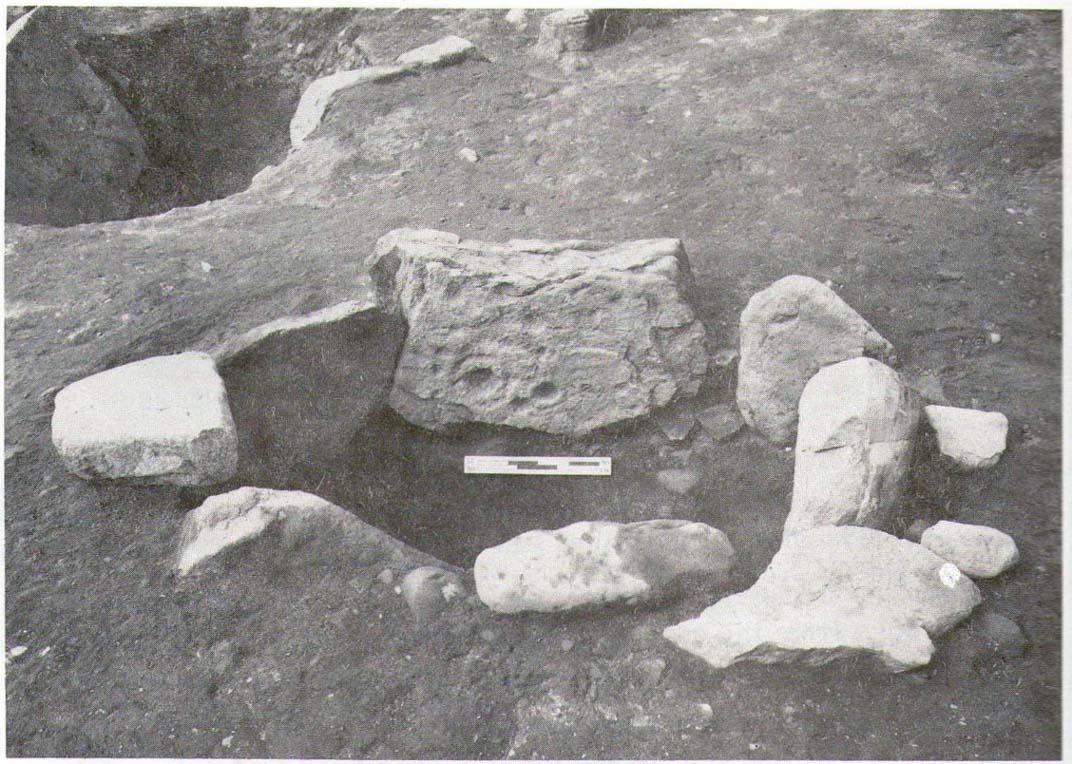
Follow the same directions to find the Balfarg Stone Circle.  From the A92 going north from Glenrothes, turn E onto the country lane to Star and Kennoway. 100 yards on there’s a sign for Balbirnie; turn right here and about 200 yards on, where the road bends right, the circle’s just below you). This carving is perched on its side in one of the preserved grave cists within the circle, easily visible at ground level.

Archaeology & History

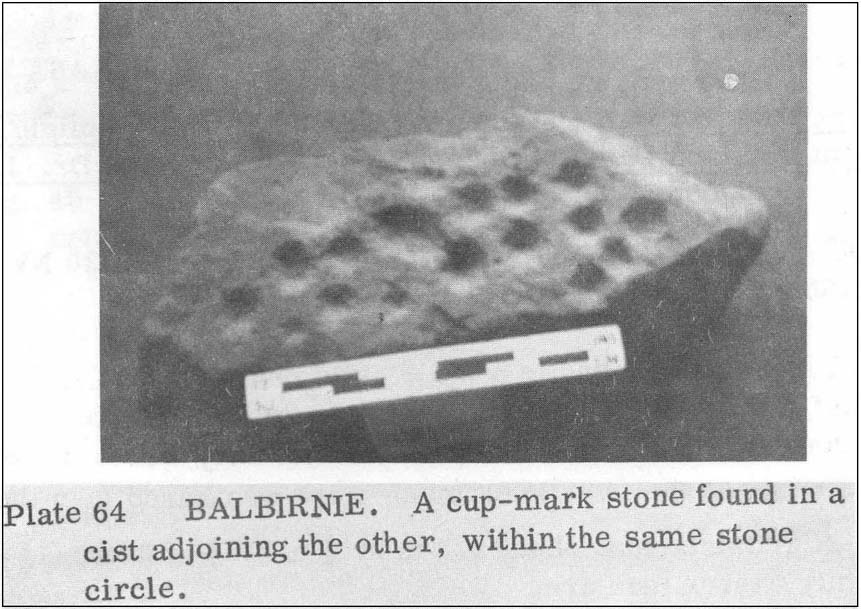
This carving (and its adjacent compatriot) was found inside the Balbirnie stone circle when it stood in its original position more than 100 yards northwest of the place it presently occupies (at NO 2850 0304). Thankfully, when the megalithic ring was moved and reconstructed, its original status was kept, including the repositioning of this impressive small cup-and-ring stone – despite it being a copy of the original.

Early photo of the carving

Like a good number of prehistoric tombs, this small carved stone was stood on edge, facing into the stone-lined tomb (cist), obviously representative of some important element in the Land of the Ancestors: perhaps a map of the landscape therein; perhaps a personal token; perhaps indicative of the spirits of the dead; perhaps a magickal amulet for safe guidance. There are a number of ritual possibilities here, and whichever it was, we can be sure the symbols were representative of the animistic cosmology of the neolithic people living hereby, linking the living with the dead.

As you can see from the original photograph, a number of cup-marks along the edges of the stone are accompanied by two or three cup-and-rings, one of which is very faint. Some carved lines run between some facets of the carving, linking one mythic element to another. Ron Morris (1981) described the carving, simplistically, as,

“Under a cairn, within a ring of stones, one of 5 cists had, carved on the inside of a side-slab (sandstone), ¾m by ½m by ¼m (2¾ft x 1¾ft x ¾ft): 2 cups-and-one-ring—one faint and incomplete—and also 8 cups, 2 with ‘tails’. Greatest diameter of ring 12cm (5in), and carving depths up to 2cm (1in).”

References:

  1. Burl, Aubrey, Rings of Stone, BCA: London 1979.
  2. Morris, Ronald W.B., The Prehistoric Rock Art of Southern Scotland, BAR: Oxford 1981.

© Paul Bennett, The Northern Antiquarian

Balbirnie Carving (02), Markinch, Fife

Cup-and-Ring Stone: OS Grid Reference – NO 2850 0304

Also Known as:

  1. Balfarg
  2. Fif 1b (Morris 1981)

Getting Here

Old photo of the Balbirnie 2 carving

This carved stone is now held in one of the museums. To get a better idea of its original locale, take the directions to reach the Balfarg Stone Circle (from the A92 going north from Glenrothes, turn E onto the country lane to Star and Kennoway. 100 yards on there’s a sign for Balbirnie; turn right here and about 200 yards on, where the road bends right, the circle’s just below you) and look at the small stone-lined tombs (cists), within which this carving was first found.

Archaeology & History

This carving (and its adjacent compatriot) was first found within the Balfarg stone circle that originally stood more than 100 yards northwest of the site it now occupies (at NO 2850 0304). Found inside the edge of another prehistoric stone-lined tomb (cist) within the stone circle, the small elongated stone possessed at least 16 singular cup-marks along one flat face of the rock. Two adjacent cup-marks may be linked by a small line running between them. As you can see in the old photograph here, most of the cups run in two parallel lines, similar to the primary feature found on the more famous Idol Stone on Ilkley Moor.

Described in association with the Balbirnie 1 carving by Ronald Morris (1981) as simply, “a slab in another cist (with) cup-marks,” like its partner just a few yards away this carving was again representative of some important mythic element in the Land of the Dead to the person whose body was laid here.

References:

  1. Morris, Ronald W.B., The Prehistoric Rock Art of Southern Scotland, BAR: Oxford 1981.

© Paul Bennett, The Northern Antiquarian

Crook Farm (north), Baildon Moor, West Yorkshire

Cup-and-Ring Stone:  OS Grid Reference – SE 13703 39616

Getting Here

Crook Farm North CnR

Take the road up alongside and past Shipley Glen, taking the turn to go to Crook Farm caravan site. Go right to the very end of the car-park, then walk up the footpath through the trees on your left.  Keep going uphill about 100 yards by the field-wall until the land begins to level out – and shortly before the first gate into the field (on your right) keep your eyes peeled for the triangular stone in the ground, barely 10 yards away from the walling.  Alternatively, from the entrance into the Dobrudden caravan park walk to the far-end of the level area in front of the little cafe and walk along the footpath that crosses the grassland to the walling nearly 300 yards away (south).  Follow the wall down below the gate and zigzag about. You’re damn close!

Archaeology & History

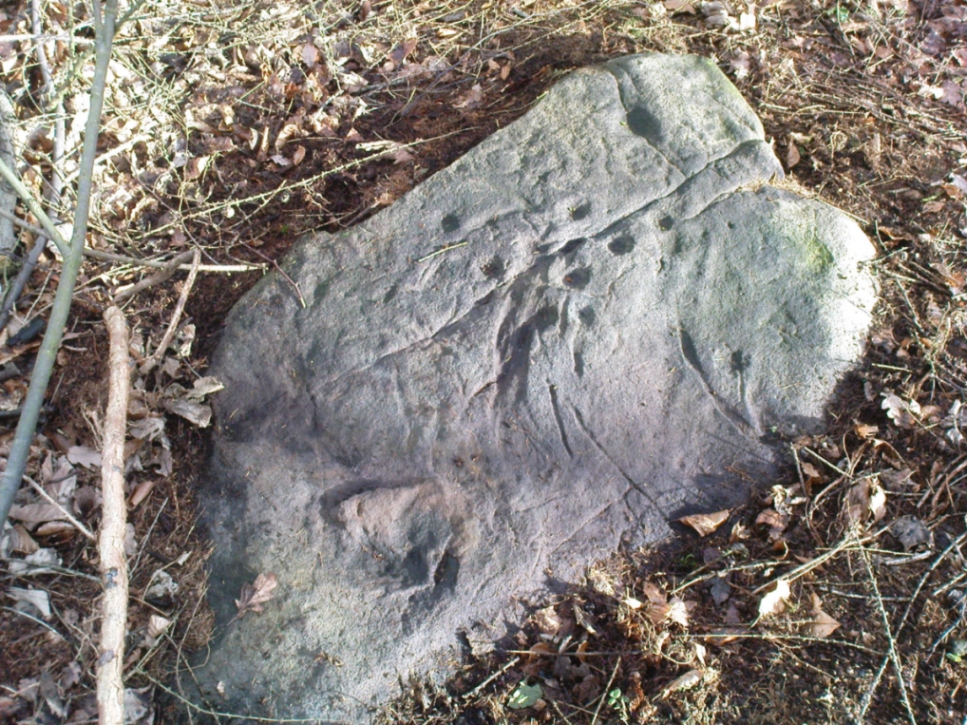
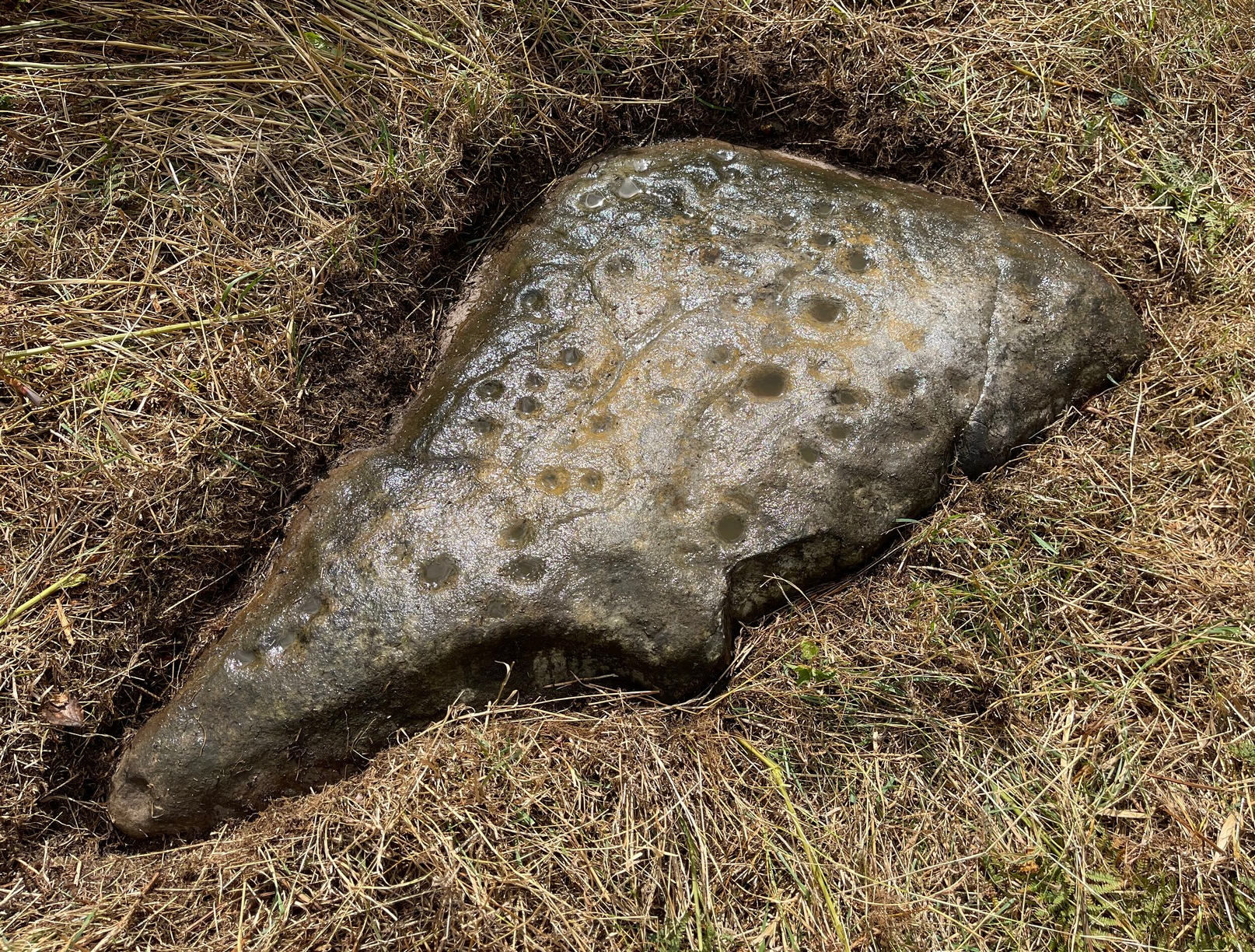
Crook Farm north carving

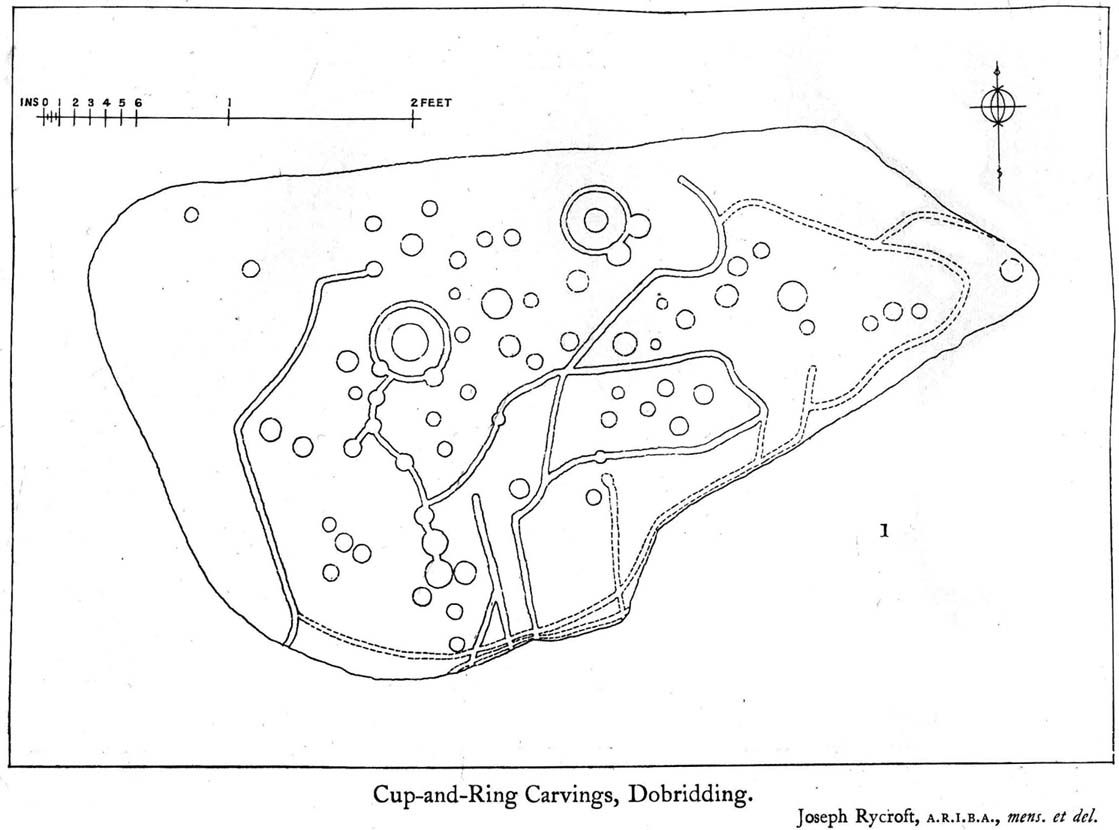
For some reason this has always been one of my favourite cup-and-ring stones on Baildon Moor and it’s well worth checking out if you visit the area!  It was rediscovered by the Bradford historian W.E. Preston, who photographed the carving around 1912.  Shortly afterwards he took fellow historians Joseph Rycroft and W. Paley Baildon to see this (and others he’d located) and subsequently both a drawing and Mr Preston’s photo of the site was included in Mr Baildon’s (1913) magnum opus the following year.

As you can see from the relative photos—with literally 100 years between them—erosion hasn’t taken too much toll and this neolithic or Bronze Age carving remains in very good condition.

Rycroft’s early drawing
Preston’s 1912 photo

Covered with upwards of fifty cup-markings, there are also two cup-and-rings and numerous carved lines meandering around and enclosing some of the many cups.  One cup-mark was cut into the narrow end or ‘nose’ of the stone.

It’s a fascinating design, with another ‘Cassiopeia’ cluster of cups in one section, beloved of archaeoastronomers who explore these stones.  Mr Rycroft’s drawing of the design (left) is perhaps the best one, to date.

Along this same ridge there are remains of other prehistoric sites, more cup-and-rings, remains of prehistoric walling and what may be a small cairn circle (to be described later).

References:

  1. Baildon, W. Paley, Baildon and the Baildons – parts 1-15, Adelphi: London 1913-1926.
  2. Bennett, Paul, Of Cups and Rings and Things, unpublished: Shipley 1981.
  3. Bennett, Paul, Megalithic Ramblings between Ilkley and Baildon, unpublished: Shipley 1982.

© Paul Bennett, The Northern Antiquarian


Corrycharmaig (1), Glen Lochay, Killin, Perthshire

Cup-Marked Stone:  OS Grid Reference – NN 52794 35503

Also Known as:

  1. Allt Coire Charmaig
  2. Canmore ID 24163

Getting Here

Corrycharmaig 1 stone

Go thru Killin and, just past the Bridge of Lochay hotel, take the tiny road on your left.  Go down here for 3 miles till you pass the gorgeous Stag Cottage (with its superb cup-and-rings in the field across the road) for another 300 yards, until you see Duncroisk Farmhouse set back on your right.  On the other side of the road, go thru the giant deer-gates (close ‘em behind you) to the river-bridge and across it.  Walk along the track till you reach the turning to Corrycharmaig House on the right (over the stream), but here, go up into the field thru the gate.  Walk up the hill ahead of you with its trees on the left, walking up onto the grassy level, over the deer-fence, then up again to the rounded knoll another 100 yards up.  You’re here!

Archaeology & History

On my first visit to this stone, in overcast and wet conditions — the easternmost of at least four separate carved rock faces along the same geological ridge — I only noticed a handful of cup-marks etched onto the northeastern section of the stone. But I was sure there were supposed to be more.  And when I returned home to check up, found that Ron Morris (1981) said there were “40 widely scattered cups of which, however, 29 well-defined cups are in a compact group, of which 6 are in a line.”  Much more than what I saw! And when I checked further, it was evident that even more cup-marks were once visible on the rock.  In the very first description of this carved stone, E.A. Cormack (1952) told:

“On the easterly area there are about 70 small cups, roughly one inch in diameter, in groups of ten to twelve. Most are on the flatter rock surface, but some are on the steeper slope facing south, which also bears the marks of deep glacial scorings.”

A sample of cups on ‘Corrycharmaig 1’

So on our visit here again a few weeks ago when we stayed at Corrycharmaig house*, a couple more visits allowed a slightly better investigation, albeit in even wetter and cloudier conditions than our first visit!  And the more we looked, the more we could see; and it was plainly evident that a number of cup-marks had become receptacles for moss-growth!  We counted at least 40 cup-markings on this ‘Corrycharmaig 1’ stone, but it seemed pretty obvious that beneath the grasses and vegetation, more carvings would be found.

Walking SSE along the same rocky ridge brings you to the other rock faces of Corrycharmaig (2), (3) and (4) — all with their own carvings.  Corrycharmaig 2 possessing the only known complete cup-and-ring on the ridge.  More carvings remain hidden nearby…

References:

  1. Cormack, E.A., “Cross-Markings and Cup-Markings at Duncroisk, Glen Lochay,” in Proceedings of the Society of Antiquaries, Scotland, volume 84, 1952.
  2. Morris, Ronald W.B., The Prehistoric Rock Art of Southern Scotland, BAR 86: Oxford 1981.
  3. Royal Commission on the Ancient & Historical Monuments of Scotland, Archaeological Sites and Monuments of Stirling District, Central Region, Society of Antiquaries of Scotland 1979.

© Paul Bennett, The Northern Antiquarian

Duncroisk 6, Glen Lochay, Killin, Perthshire

Cup-Marked Stone:  OS Grid Reference – NN 53466 36485

Getting Here

Position of ‘Duncroisk 6’ cup-marked stone

Follow the same directions to reach the Duncroisk Crosses stone.  From here, look up the slope to your right and you’ll see the line of fencing running uphill.  Follow this until you reach the ruined remains of the old sheepfold building.  From here, look towards the tree-lined gorge of Duncroisk Burn, a few hundred yards west and walk towards it for about 50-60 yards.  There’s a group of three rocks hereby, two are large, but the carving’s on the smallest one in the middle.

Archaeology & History

This cup-marked stone was rediscovered as a result of the fine archaeological survey work by that Glasgow bunch of Certified Field Archaeologists, in their assessment of remains in and around Duncroisk Farm.  As well as mentioning — albeit briefly — the carvings of Duncroisk Farm and Duncroisk Crosses, Dugald MacInnes (2001) and his team came across another that hadn’t been recorded before.  Described in their survey as ‘feature 2’, he told,

“Some 20 metres downslope from the sheep fank and about 60 metres NW from it, there is a group of large boulders.  On the southeast sloping face of one of these there are three previously unrecorded cup-marks.  These are oriented vertically on a northeast to southwest alignment and are no more than 4cm apart.  They are all about 7cm in diameter and 2.5cm deep.”

The carved rock is a relatively small one sitting roughly in between two much larger rocks, both of which are easily visible from the Duncroisk Crosses stone less than 100 yards down the slope.  It’s probably only gonna be of interest to the rock-art purists among you and some may even question its veracity, particularly the bottom of the three cups, which gives the impression of being unfinished.  If you visit the site in summer and autumn it will be much harder to find, as it gets overgrown with bracken. (we did take a number of photos of this stone, but managed to somehow delete them all before saving to disk – so have gotta check it again when we next visit here)

References:

  1. MacInnes, Dugald, An Archaeological Field Survey of a Deserted Settlement at Duncroisk Farm, Glen Lochay, Association of Certified Field Archaeologists: Glasgow 2001.

© Paul Bennett, The Northern Antiquarian

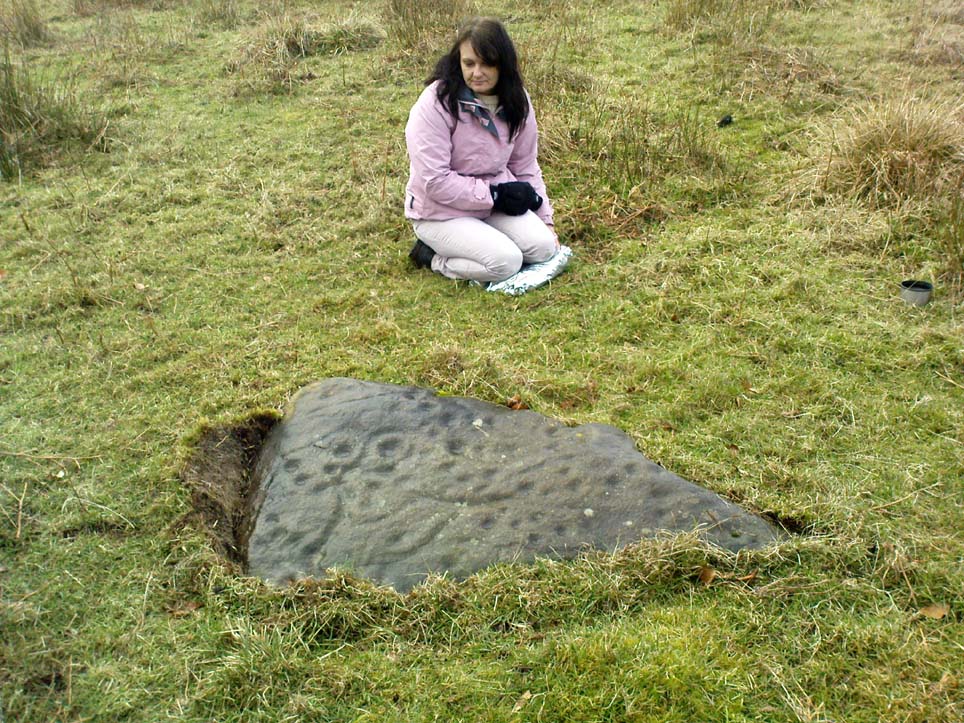
Corrycharmaig (4), Glen Lochay, Killin, Perthshire

Cup-Marked Stone:  OS Grid Reference – NN 52768 35504

Getting Here

‘Corrycharmaig 4’ cup-marked stone

Follow the same directions to get to the Corrycharmaig 3 carving; and just a yard or two to the right of the far western edge of the rock, you’ll see another smaller slightly sloping rock, closer to the fencing, with faint cup-markings.  That’s the one! (note that the 10-figure grid reference given here might need adjusting slightly)

Archaeology & History

This small slightly sloping piece of exposed rock is on the western extremity of the Corrycharmaig cluster of carvings, but is a distinctly separate piece of rock from the Corrycharmaig 3 stone (though part of the same outcrop).  The stone itself has two sections to it, with a natural crack in the rock defining eastern and western section — both of which possess cup-marks.

The easternmost section of the stone has seven cup-marks, some of which were only recently uncovered.  A large single cup-mark sits near the middle of this portion of the rock; this is probably what Mr Cormack (1952) was talking about when he told that, “further west (of the Corrycharmaig 3 carving, PB) is one isolated larger cup of 4-inch diameter.”  On the western side of the stone, we find just two or three cup-marks, though one large cup-marking here would seem to be Nature’s handiwork.

It is highly likely that beneath the excessive vegetational growth around this carving and others along this ridge, other sections of prehistoric carvings remain to be found.

References:

  1. Cormack, E.A., “Cross-Markings and Cup-Markings at Duncroisk, Glen Lochay,” in Proceedings of the Society of Antiquaries, Scotland, volume 84, 1952.
  2. Morris, Ronald W.B., The Prehistoric Rock Art of Southern Scotland, BAR 86: Oxford 1981.
  3. Royal Commission on the Ancient & Historical Monuments of Scotland, Archaeological Sites and Monuments of Stirling District, Central Region, Society of Antiquaries of Scotland 1979.

© Paul Bennnett, The Northern Antiquarian


Rhiwderin, Newport, Monmouthshire

Cup-Marked Stone (lost):  OS Grid Reference – ST 260 870

Archaeology & History

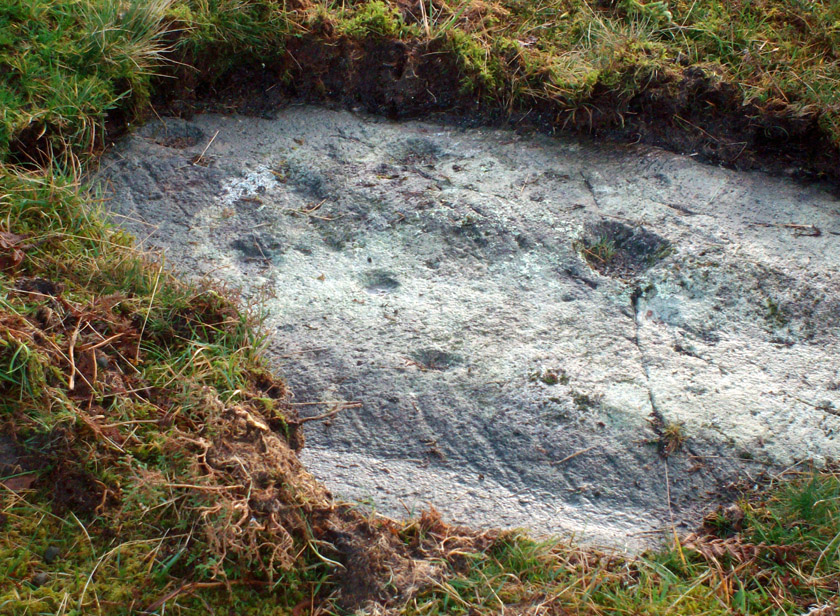
Rhiwderin cup-marks

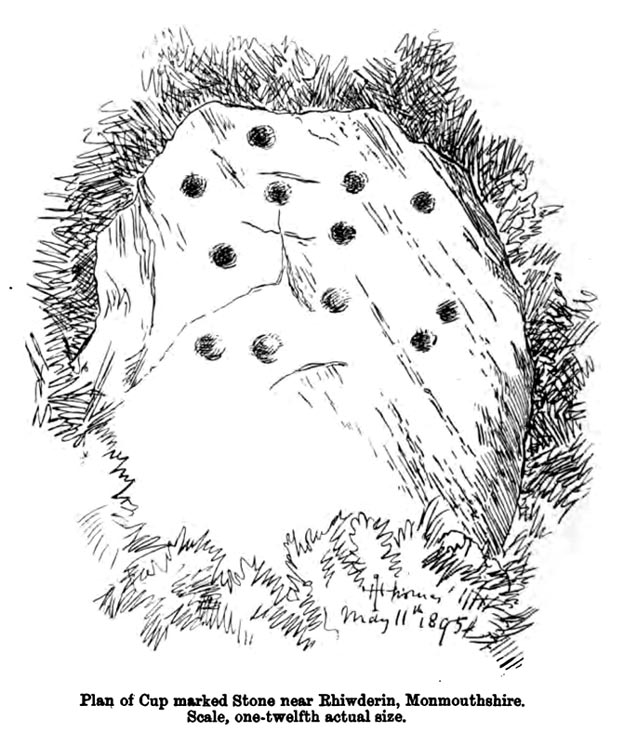
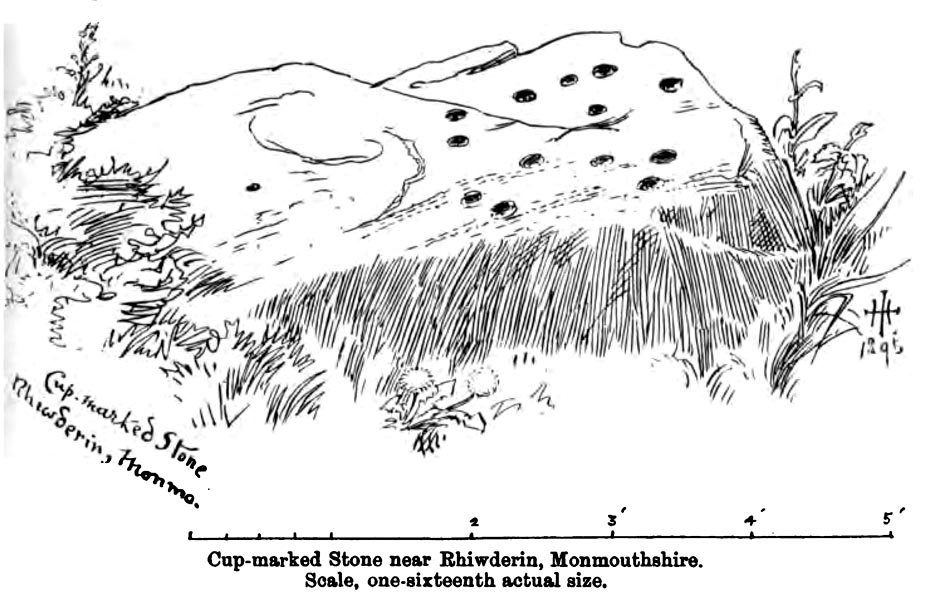
This fine-looking cup-marked stone was uncovered during a botanical outing in the last decade of the 19th century.  Described as being around the township of Rhiwderin, the exact whereabouts of the carving is unknown and it’s not been seen since the first description of it in an early edition of Archaeologia Cambrensis by Mr T.H. Thomas. (1895)  John Sharkey (2004) mentioned the site in his recent survey of Welsh rock art, saying simply “location unknown.”

The missing Rhiwderin stone

Although we know there are no hard and fast rules for working out the location of cup-and-ring markings, one may be fortuitous in exploring any nearby Bronze Age or neolithic tombs (cairns, tumuli, etc) in the Rhiwderin district, as they do tend to enjoy the company of such sites — but I must stress, this is by no means a dead cert!

Mr Thomas’s description of the carving was as follows:

“I enclose a sketch of what seems to be a cup-marked stone which I observed yesterday near Rhiwderin, Monmouth.  Unless there be some operation which simulates such markings with which I am unacquainted, I take the specimen to add an instance of these mysterious prehistoric remains to the very short list given for Wales by Mr. Romilly Allen, and to be the first reported for South Wales.

“The stone displaying the cup-markings is a mass of millstone grit, earth-fast, the slanting surface appearing above the turf being about a yard wide, and 4 feet long.  Upon the upper half of the surface is a group of twelve cups from 1½ to 2in diameter, and about 1in deep. On first noticing the cups they were taken for holes out of which quartz pebbles, abundant in the local millstone grit, had been weathered, but examination of the block showed that no pebbles of large size exist, or had existed in it, and the conclusion was arrived at that the cups are artificial.

“On turning back some of the turf covering the base of the slope of the stone, no other cups were discovered.

“The stone lies within an old enclosure, as shown by wild apple-trees and an abundance of daffodils, and still more clearly by ruins, which seem those of a cottage or small farm near by. This contiguity to a habitation which does not seem to have been abandoned more than a century, made me suspect some medieval or more recent origin for the markings. I cannot, however, account for them otherwise than by supposing them to be cup-markings in the technical archaeological sense.

“The stone was observed while in the company of Dr C.T. Vachell of Cardiff, searching for varieties of narcissus which occur at several points in the neighbourhood…”

If anyone comes across this lost carving, please let us know!

References:

  1. Sharkey, John, The Meeting of the Tracks: Rock Art in Ancient Wales, Gwasg Carreg Gwalch: Llanrwst 2004.
  2. Thomas, T.H., ‘Archaeological Notes and Queries,’ in Archaeologia Cambrensis, volume 12 (5th series), 1895.

© Paul Bennett, The Northern Antiquarian 

Guisecliff Wood (629), Bewerley, North Yorkshire

Cup-and-Ring Stone:  OS Grid Reference – SE 16415 63565

Also Known as:

  1. Carving no.629 (Boughey & Vickerman)

Getting Here

A box of cup-and-rings!

Takes a bitta finding this one – especially a this time of year when the bracken’s high – but it’s worth the walk.  You’re probably best finding your way to the open-air carving on the slopes above Westcliff Farm, the Guisecliff Wood 626 carving (it’s pretty easy to find).  From here, walk eastwards across the top of the two fields until you hit the old gate that take you back into the woods.  Now it gets difficult!  Walk less than 100 yards in the same direction, if you’re lucky, along the small footpath that runs pretty level through the trees, keeping your eyes peeled for a large sloping rock above you.  I’d say that it’s probably best to start checking the relevant rocks (large ones) after 50 yards in the trees, just to be on the safe side.  If you aint been here before it’s probably best to check it out at the end of Winter or during Spring time.  Good luck!

Archaeology & History

As noted by several people in our visit here the other day, some aspects of this carving are similar in design to the Tree of Life Stone on the eastern edge of Askwith Moor, 10 miles south of here.  But the features on this large carved rock have intriguing elements of their own here: not least of which is the large square ‘box’ into which a cluster of otherwise normal cup-and-rings are enclosed.  It’s a unique feature in prehistoric carvings in this part of the world — although such ‘box’ motifs can be seen further north at Dod Law in Northumberland.

The fainter cup-and-rings
Boughey & Vickerman’s 2003 drawing

There are two distinct sections of carvings on the stone, both of which have a similar tree-motif patterns, but the boxed one grabs your attention more once you’ve sat with the stone for a while. The other small cluster of cups are a little more difficult to notice, but once you see them they almost grow into life!  You can just make out the surrounding rings and lines around some of these fainter cups, which I tried to capture in the photos (but without much success).

Our visit here didn’t pass without some voicing the thought that ‘box’ section could have been added at a much later date — perhaps a Victorian addition?  But we could be way off the mark with that one!

There’s every likelihood of other carvings being found in and above the woodlands here, though any further exploratory excursions here can wait till winter time, as the Nature’s summer growth here is considerable and covers most of the rocks in green.  The carving was first described in Boughey & Vickerman’s (2003) text as a

“Very large rock with extensive flat surface on which there seems to be two separate designs.  Seven cups are joined in a branch-like pattern, the whole within a square groove from which the ‘stem’ of the branch just protrudes; away from this is an approximately linear feature with three cups enclosed by linked rings at one end and then six more cups with a partial ring.”

If you’re a rock art enthusiast, or a real healthy heathen, this site is well worth checking out!

References:

  1. Boughey, Keith & Vickerman, E.A., Prehistoric Rock Art of the West Riding, WYAS 2003.

Links:

  1. More images of Guisecliff Wood carvings

© Paul Bennett, The Northern Antiquarian