Cat Nab, Brotton, North Yorkshire

Tumulus (destroyed):  OS Grid Reference – NZ 6692 2154

Archaeology & History

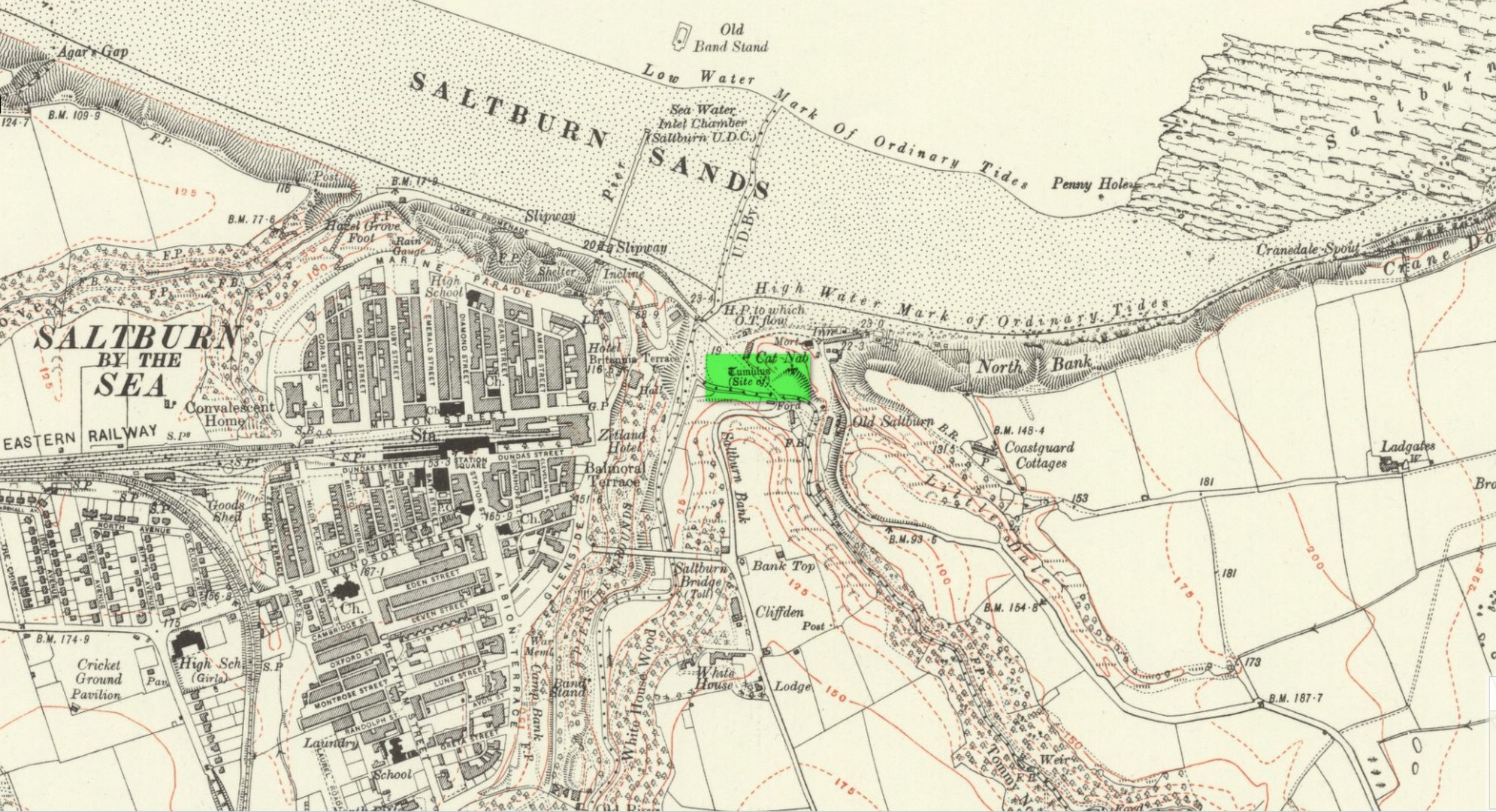
Location on 1930 OS-map

This long lost burial mound was first located by the local antiquarian William Hornsby in the early 20th century.  It had been constructed close to the summit of the prominent rise  of Cat Nab, immediately east above Saltburn.  Its position was shown on the 1930 OS-map of the area.  Destroyed by quarrying, it was thankfully excavated by Hornsby in 1913; and although his finds were never published, he left notes which told us that,

“there were two cremations and the sherds of at least three vessels: a collared urn, a pygmy cup and a vessel with an everted rim.” (Crawford 1980)

Crawford (1980) told that these finds could been seen in the Middlesborough Collection.

References:

  1. Crawford, G.M., Bronze Age Burial Mounds in Cleveland, Cleveland County Council 1980.

Acknowledgements:  Huge thanks for use of the Ordnance Survey map in this site profile, reproduced with the kind permission of the National Library of Scotland

© Paul BennettThe Northern Antiquarian


Way Hagg, West Ayton Moor, North Yorkshire

Cup-Marked Stones (lost):  OS Grid Reference – SE 9657 8840

Archaeology & History

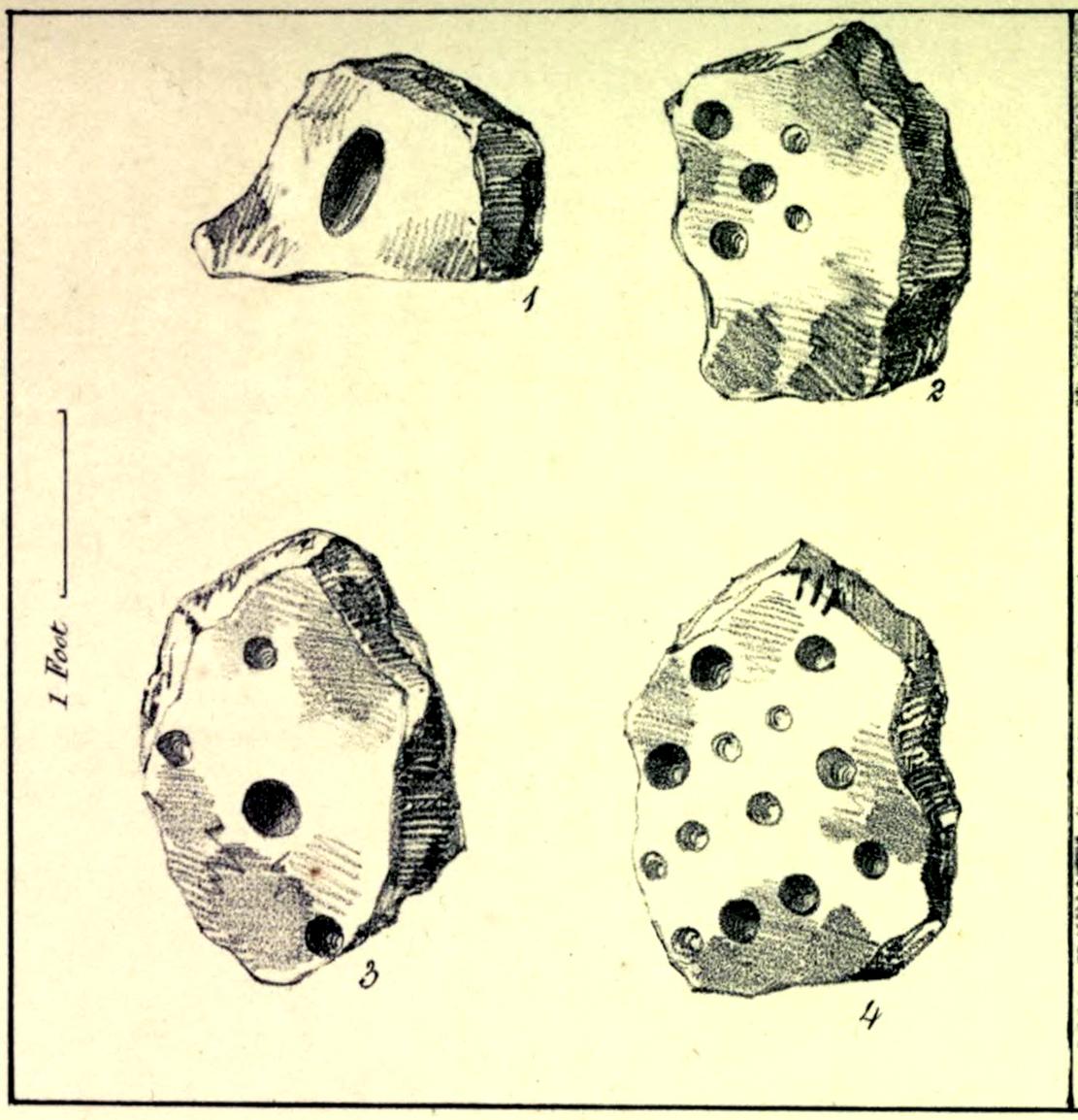
In the autumn of 1848, antiquarian John Tissiman (1850) and his associates took to uncovering two burial mounds amidst a large cluster of them on the eastern edge of West Ayton Moor.  This one at Way Hagg was quite a big fella, measuring 36 yards across.  When they cut into its northern edge towards the centre, 8-10 feet in, they came across an upright stone, nearly two feet high, on which five cup-marks had been cut. (see sketch, no.2)  Slightly beyond this were three other stones (in sketch, nos.1, 3 & 4), each with cup-marks on them, beneath which was a tall urn.  Whether or not the carvings had been deliberately positioned to cover the urn, we do not know. Nonetheless, we can be reasonably assured that these petroglyphs had some mythic association with death when they were placed here.

Tissiman gave us the following detailed measurements of the respective carvings:

1: Nearly even surface. Length, from 16 to 18 inches; breadth, 10 to 20 ditto; depth, 8 to 9 ditto; with large oval hole cut in the centre, 7½ inches long, 4 inches broad, and 3½ inches in depth.  On the opposite side are three holes, from 2 to 3 inches in diameter, and from 1 inch to 1½ deep.  2: Uneven surface. Length, 23 inches; breadth, 14 inches; depth, 13 inches; with five holes, from l½ to 3½ inches in diameter, and 1 to 1½ inches in depth.  3: Uneven surface. Length, 33 inches; breadth, 22 inches; depth, 10 inches, with four holes, the largest being 4½ inches in diameter and 3 inches deep; the others, from 1½ inches to 2 inches in diameter, and 1 to 1½ inches deep.  4: Uneven surface. Length, 27 inches; breadth, 23½ inches; depth, 10 inches, with 13 holes, from 1½ inches to 5 inches in diameter, and ¾ of an inch to 3 inches in depth; also three lines at the end of the stone.”

The carvings were included in Brown & Chappell’s (2005) fine survey, but they weren’t able to find out what happened to them after Tissiman’s excavation. They remain lost.  If anyone has any information as to where they might be, please let us know.

References:

  1. Brown, Paul & Chappell, Graeme, Prehistoric Rock Art in the North York Moors, Tempus: Stroud 2005.
  2. Tissiman, John, “Report on Excavations in Barrows, in Yorkshire,” in Journal British Archaeological Association, April 1850.

Acknowledgements:  Huge thanks for use of the Ordnance Survey map in this site profile, reproduced with the kind permission of the National Library of Scotland

© Paul BennettThe Northern Antiquarian

Fernybank, Glen Esk, Lochlee, Angus

Ring Cairn (destroyed):  OS Grid Reference – NO 5381 7877

Archaeology & History

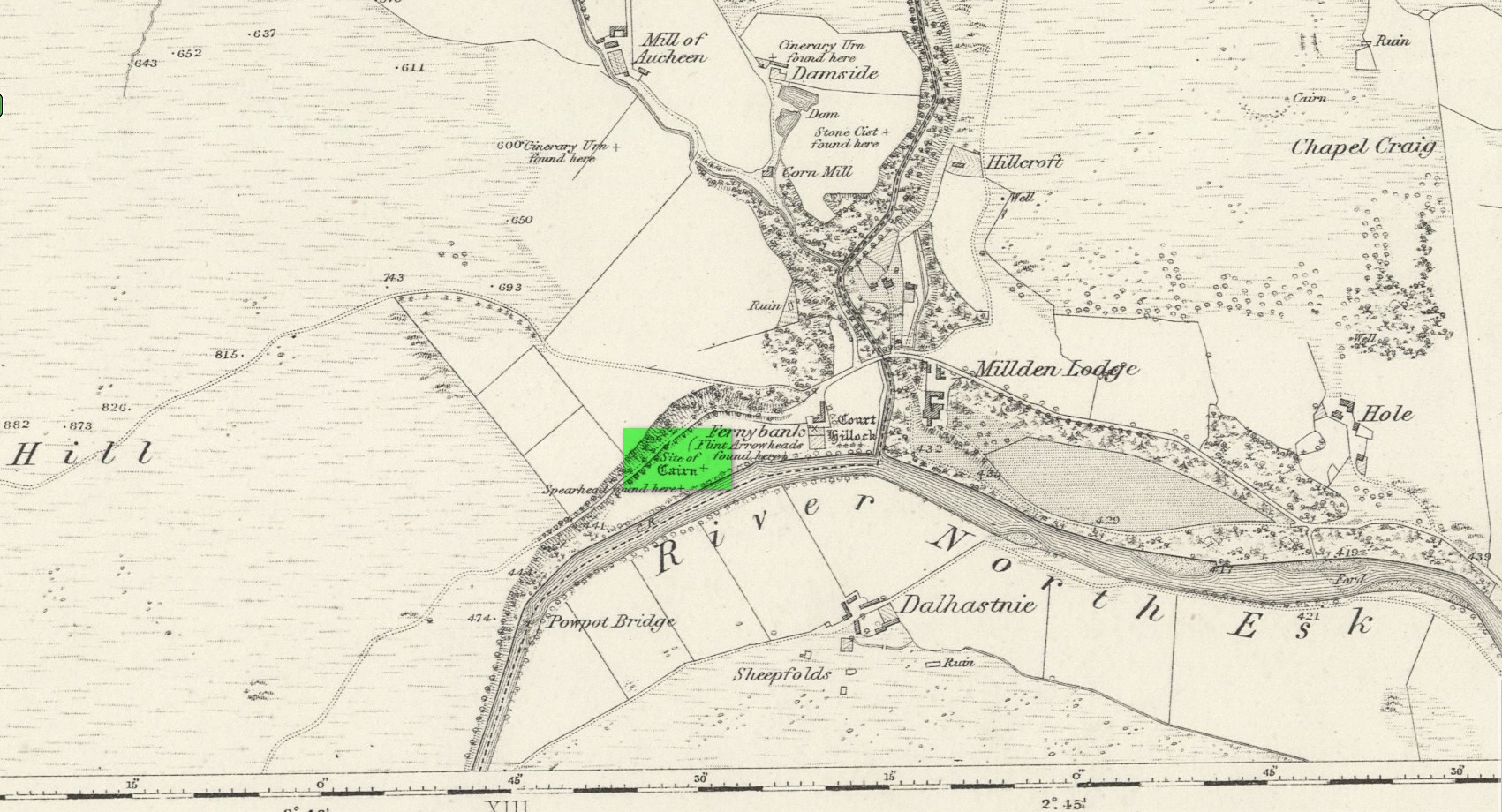
Location of site on 1864 OS-map

This is one of many sites that were thankfully recorded by the fine pen of Andrew Jervise (1853) in the middle of the 19th century, without whose diligence in antiquarian interests all knowledge would have vanished.  His works remind me very much of those by the late-19th early-20th century writer Harry Speight in Yorkshire, whose veritable madness on that region’s history remains unsurpassed even to this day.  But I digress…

Jervise told us that,

“About the year 1830, while the tenant of Fernybank was levelling a hillock in the haugh between the farm-house and the Powpot Bridge (about two miles north-west of Colmeallie), he removed a number of stones varying in length and breadth from eighteen to twenty-four inches. They were ranged singly, and stood upright in a circle at short distances from each other, enclosing an area of about twelve feet in diameter. On the knoll being trenched down, the encircled part (unlike the rest of the haugh, which was of a gravelly soil) was found to be composed of fine black earth; but on several cart-loads being removed, operations were obstructed by a mass of stones that occupied much the same space and form as the layer of earth. Curiosity prompted the farmer to continue his labours further, but after digging to the depth of three or four feet, and finding stones only, he abandoned the work in despair, without having discovered anything worthy of notice… Had this cairn been thoroughly searched, it is probable that some traces of sepulture might have been found in it.”

A short time after this however, Jervise reported the finding of “old warlike instruments, both in the shape of flint arrow-heads and stone hatchets, have been found in the same haugh, and so late as 1851 a spear-head made of iron, and about fifteen inches long, was also discovered; it was much corroded, but had part of the wooden hilt in it.”  These were prehistoric artifacts that were subsequently moved to Edinburgh’s central museum where, I presume, they remain to this day.

About ten years later the Ordnance Survey lads came here and were fortunate to be able to meet with the same man who’d uncovered the site.  They told that,

“in contradiction to (Jervise’s narrative), the tenant of Fernybank who gave the information to Mr. Jervise, states that he continued the search to the bottom of the Cairn and found a quantity of Charred wood.”

There were a number of other prehistoric sites in this neck o’ the woods, many of which were also destroyed but, again, were thankfully recorded by Mr Jervise.

References:

  1. Jervise, Andrew, The History and Traditions of the Land of the Lindsays in Angus and Mearns, Sutherland and Knox: Edinburgh 1853.

Acknowledgements:  Huge thanks for use of the Ordnance Survey map in this site profile, reproduced with the kind permission of the National Library of Scotland

© Paul BennettThe Northern Antiquarian

Keppoch, Gilmerton, Perthshire

Cup-and-Ring Stone (lost):  OS Grid Reference – NN 880 252

Archaeology & History

A long lost carving, probably quite impressive in design, was recorded by John Laurie, schoolmaster in Monzie.  He told us that,

“a large Druid stone with rude carving upon it lies on the side of the public road between the villages of Monzie and Keppoch.  This stone was one of a Circle which Mr Monroe, the then minister, caused to be broken and dispersed.”

When Fred Coles looked for the remains of this “circle” at the beginning of the 20th century, he questioned Laurie’s location of the site, but found remains of one in an adjacent field consisting of two stones, but told that “on neither of them could we discern any carving of any sort.” It’s likely that the carving has been completely destroyed, or if we’re lucky it may be hiding in some nearby walling.

References:

  1. Coles, Fred, “Report on Stone Circles Surveyed in Perthshire, Principally Strathearn” in Proceedings of the Society of Antiquaries, Scotland, volume 45, 1911.
  2. Laurie, John, “Parish of Monzie,” in New Statistical Account of Scotland – volume X: Perth, William Blackwood: Edinburgh 1845.

© Paul BennettThe Northern Antiquarian

Amble Links, Amble, Northumberland

Tumuli (destroyed):  OS Grid Reference – NU 273 046

Archaeology & History

In a lengthy letter describing the cist burial at Cliff House, its author, Mr W. Dunn (1857) told that there were additional prehistoric remains nearby, that had only recently been destroyed.  He told:

“It appears that, a few years ago, in the immediate proximity of the present discovery (at Cliff House, Ed.) two or more tumuli were found which contained urns and bones; and flint arrow heads of elaborate finish have been occasionally met with.”

I can find no additional information about these sites.

In the same article, a Mr Kell told that during the construction of the Amble piers a half-mile to the west, “some years ago, he was sojourning in the neighbourhood, and …human remains were found on the removal of sand by the waves in a violent gale from the East.”  What else is known of this place?

References:

  1. Dunn, W., “Ancient Sepulchral Remains,” in Proceedings Society of Antiquaries Newcastle-upon-Tyne, volume 1, no.34, 1857.

© Paul BennettThe Northern Antiquarian

Cliff House, Amble, Northumberland

Cist (destroyed):  OS Grid Reference – NU 2730 0486

Archaeology & History

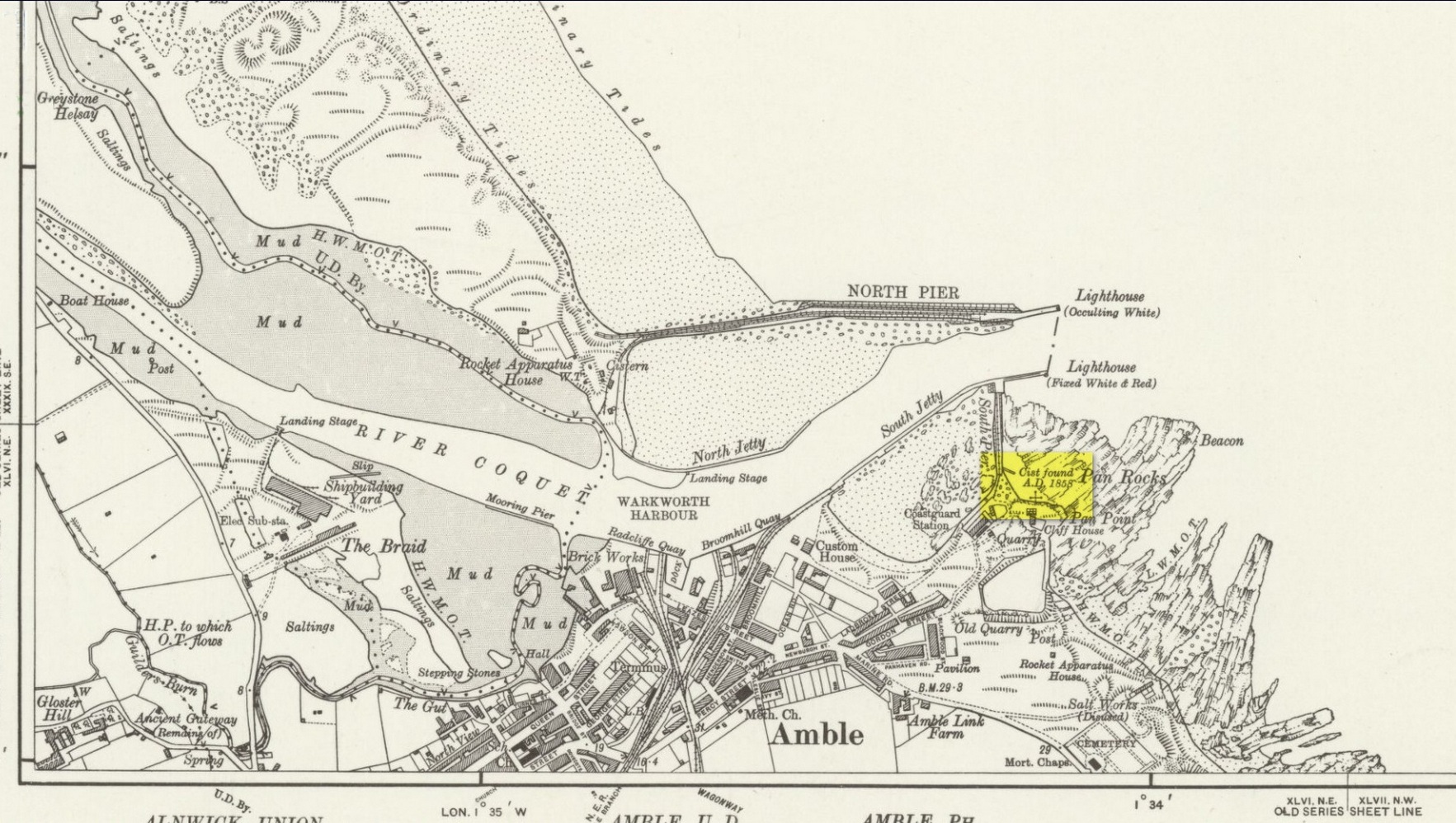
Site location on 1926 map

In November 1857, Collingwood Bruce read out a paper that had been sent to him by the Rector of Warkworth village (Rev. W. Dunn), describing “ancient sepulchral remains” that had been found near the cliff-edge above Pan Rocks near Amble’s lighthouse.  It was a lengthy account which, in passing, also mentioned several other prehistoric sites close by that have long since been destroyed and which we have very little information about.  Mr Dunn’s (1857) letter told:

“In the middle of April last, about 50 yards NE of the Cliff House, Amble, and about 20 yards from the end of what is called Warkworth South Pier, the pilots came upon a long upright stone, standing out of the shale to the height of twelve or fourteen inches,which had been laid bare by the recent heavy gales, but which, from its rude appearance, did not afford the idea of anything beyond a mere accidental tilting.  Alongside this upright stone was a large unwrought slab, which, on being raised, was found to be the covering of a cist or sepulchral chamber containing a perfect skeleton. The figure was lying on its left side, with the head to the south-west, having the knees much doubled and with the right arm thrown back.  By its side stood an urn of unbaked clay.  This urn, now in the Museum of the Duke of Northumber­land, resembles in size and shape that which was found a few years since at Hawkhill, and which is preserved in the Museum of the Antiquarian Society of Newcastle.  It contained a small quantity of dark earth.

“Having given this general outline of the discovery, I shall proceed to offer such observations as I have been able to make,and have considered worth recording. I grieve to say that before the period of my visit the spoiler had been busy with these venerable remains. The skull had been broken up, the jaws smashed, every tooth appropriated, and the bones indiscriminately mingled, after many a century of undisturbed repose.

“The cist or chamber containing the remains was composed of four slabs inserted edge-wise in a cavity which appeared to have been dug out of the friable shale which lies upon the harder rock in this locality. It ranged south-east and north-west, and measured as follows: depth, 18½ inches; width, 26 inches; length at bottom, 4 feet; at top, 3 ft 4 in.; the difference between top and bottom measurements being accounted for by the shrinking of the ends.  The cavity in the shale was much larger than the cist, and the space between the slabs and the shale was closely filled-in with stones, roughly broken, commingled with earth and larger stones.  The side slabs projected somewhat beyond the ends.  The bottom of the cist was covered to the depth of about half an inch, with dark, unctuous mould.  Amongst the rubbish comprising the filling-up of the space above-mentioned, was found an angular piece of silex, probably an unfinished arrow­head; and in the south-west corner of the cist lay a large, smooth cobble stone, which, when considered in conjunction with the flint flake, the imagination may easily construe into the club of this ancient denizen of our shores.  The slab which constituted the cover of the cist was of great size and extended in every direc­tion considerably beyond it; and the upright stone was set up, not at one of the ends, but along its length.  It is remarkable that a close inspection of these stones gave no trace of chisel-marks in any part.  In order that the cover might lie level, pieces of shale, flags, etc., were laid on the uprights which formed the cist, wherever an irregularity presented itself.

“Within the memory of man, the rock ran out from this point for some yards into the sea at a considerable elevation; but the construction of a pier in the immediate neighbourhood has caused the removal of much of the stone, and the spray of our wild sea waves now dashes over the spot which for countless generations may have been peacefully tenanted by these nameless bones.  At the same time, it does not appear probable that at any period there has been at this particular point a very deep covering of the sand and bent-grass which are found thick and rank upon the adjacent links.

“The skull must have been very characteristic, having attracted general observation from the extraordinary lowness of the frontal region, the great development of the occipital portion of the head, and the width and length of the lower jaw from its anterior junction to the articulation of the temporal bone.  One person observed that during life the man “must have measured as much to the top of his eyebrows as to the top of his head.”  The teeth are said to have been very beautiful and regular, and quite sound.  With the exception of a front tooth, which was missing in the lower jaw, they were perfect.  The thigh-bone measured 19½ inches, indicating a man of large size; whilst the porous internal organization of the bones gave probable evidence of comparative youth.

“The urn is unbaked, of a light clay colour, and measures in height 8 inches, in depth 7¼ inches, and in diameter 5½ inches.  It is ornamented with zigzag scoring, alternating with dotted lines,and upright (and sometimes slanting) scorings, which appear to have been made with some rude instrument whilst the clay was moist.  The scorings are continued over the edge of the rim.  On being rather roughly seized by one of the men, it being expected that it contained treasure, a piece was broken off; but no material injury has been occasioned.  The stone found in the cist does not resemble any that one may pick up on the neighbouring shore, and attracted attention from its bearing no assignable relation to what I may call the masonry of the tomb.  I have since learnt that stones are not infrequently found in Teutonic graves on the Continent, and that recently a singular oval stone was found in a tumulus on Petersfield Heath.”

All trace of this site has disappeared.  Mr Bruce posited the idea that the round stone in the cist may have been the one that ended the life of the buried man!  An intriguing thought.  And that the urn “no doubt, contained some portion of the feast prepared on the occasion of his funeral.”
References:

  1. Dunn, W., “Ancient Sepulchral Remains,” in Proceedings Society of Antiquaries Newcastle-upon-Tyne, volume 1, no.34, 1857.

© Paul BennettThe Northern Antiquarian

Reva Hill (1), Hawksworth, West Yorkshire

Cup-Marked Stone:  OS Grid Reference – SE 15230 43179

Getting Here

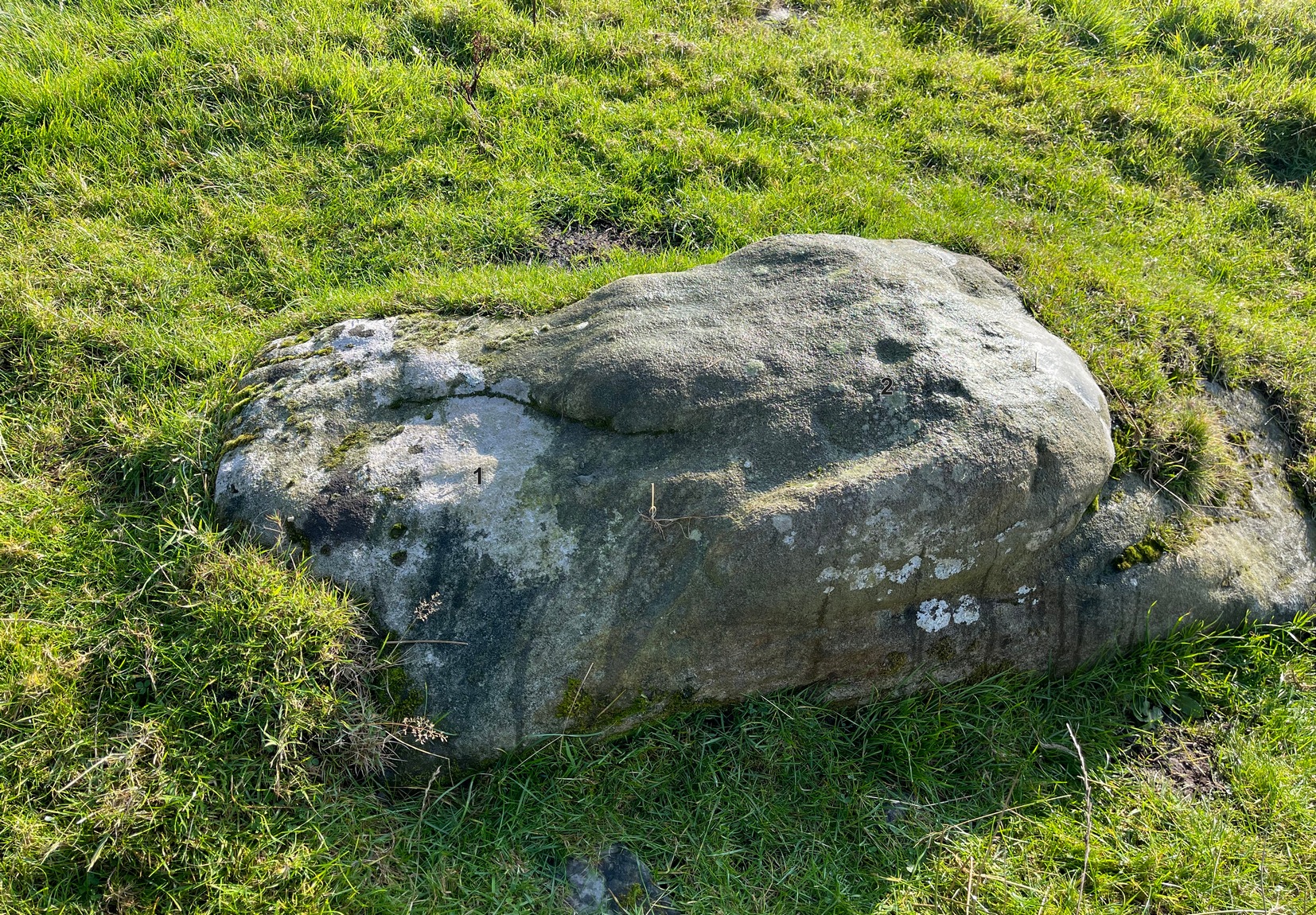
Main cups numbered

Numerous ways to get here, it’s probably the easiest (direction wise) to reach here starting from Dick Hudson’s public house on the southern road surrounding Rombalds Moor. From the pub, head left (east) along Otley Road (passing Weecher reservoir) for 1.9 miles (3.1km) until you reach Reva reservoir where a track leads you to the waters. A small parking spot is on the left-side of the road. From here, go through the gate and up the footpath (north) for about 200 yards then turn right and go up the field towards the wall where, about 20 yards before it, you’ll see find the stone in question.

Archaeology & History

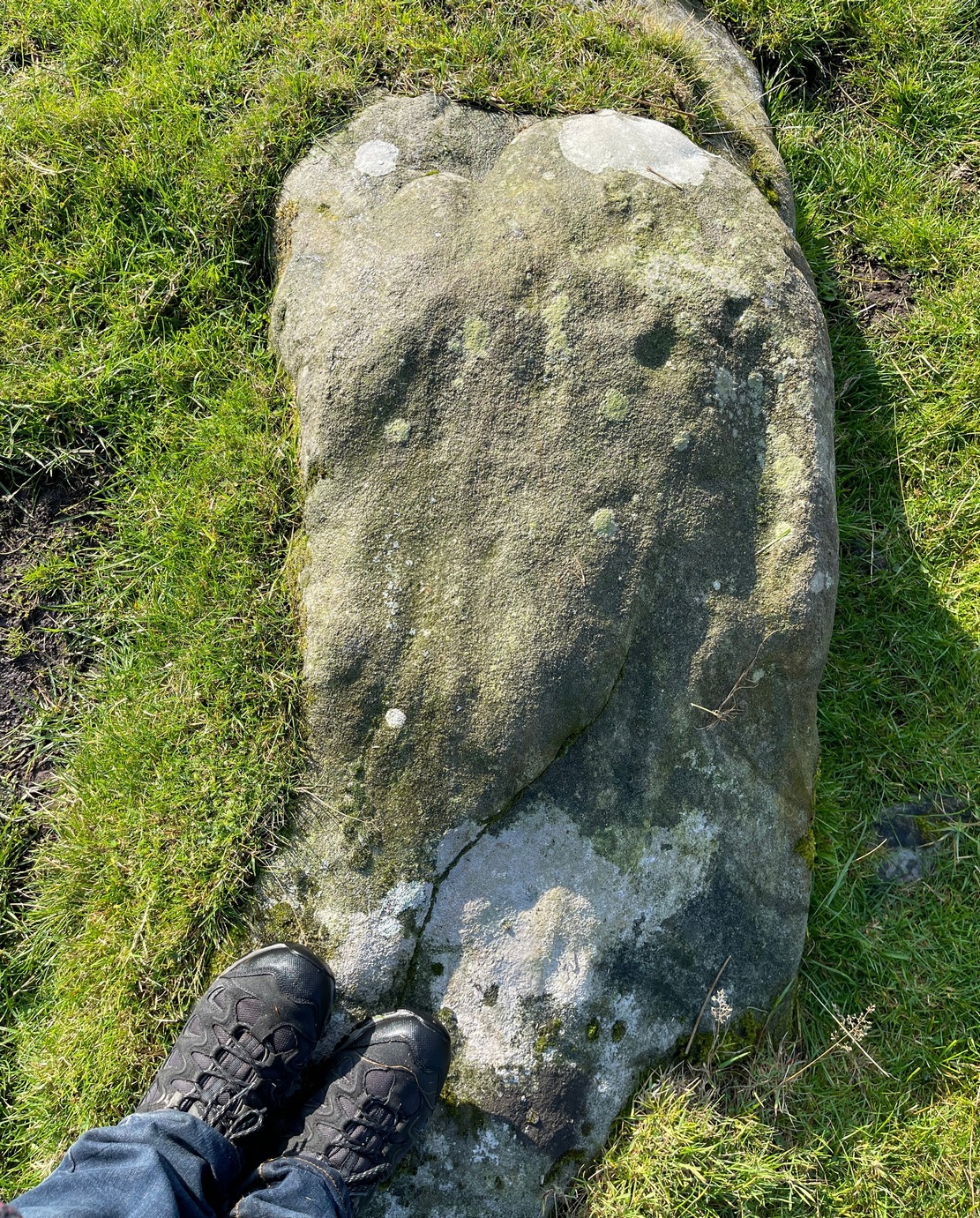
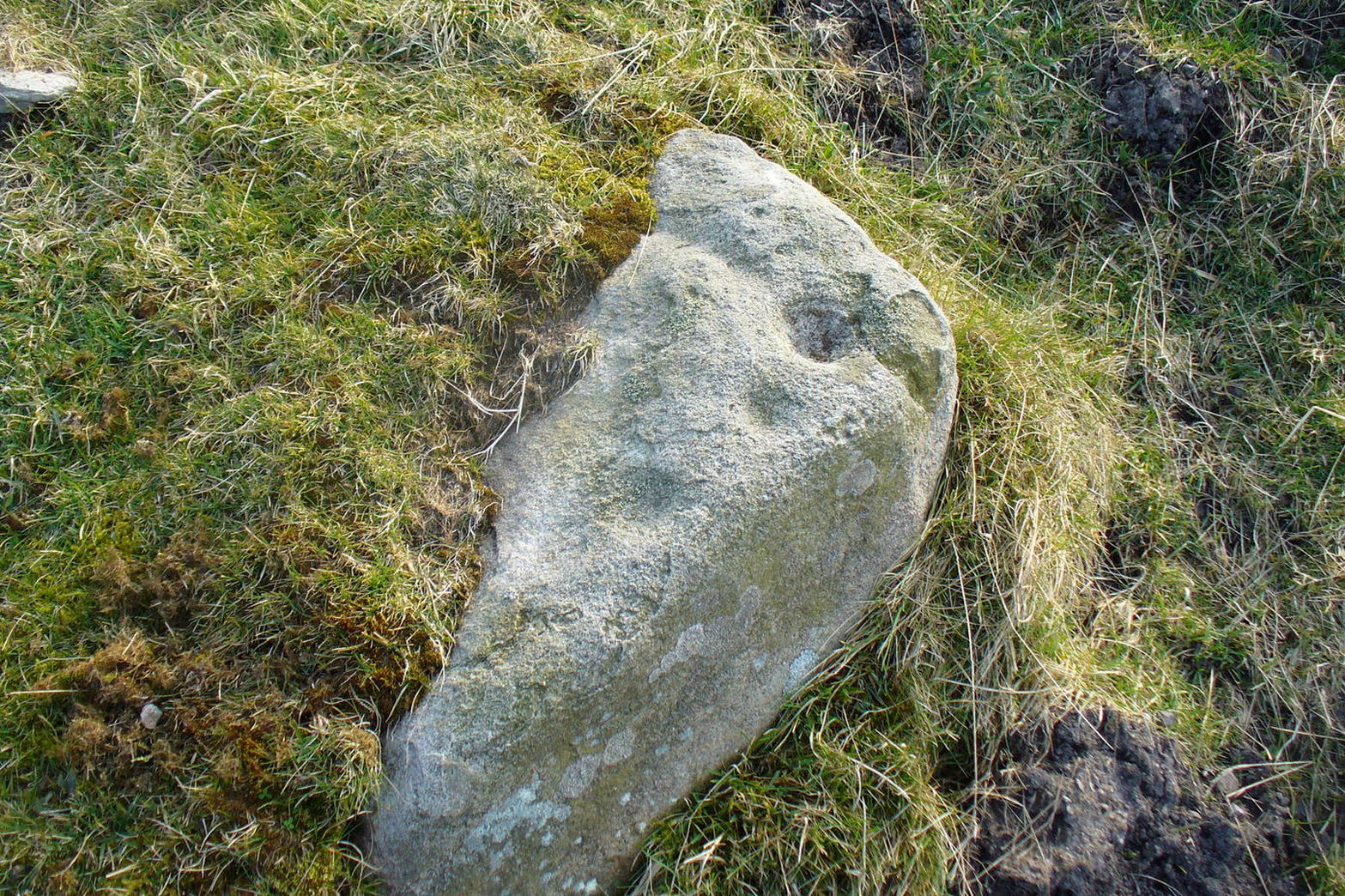
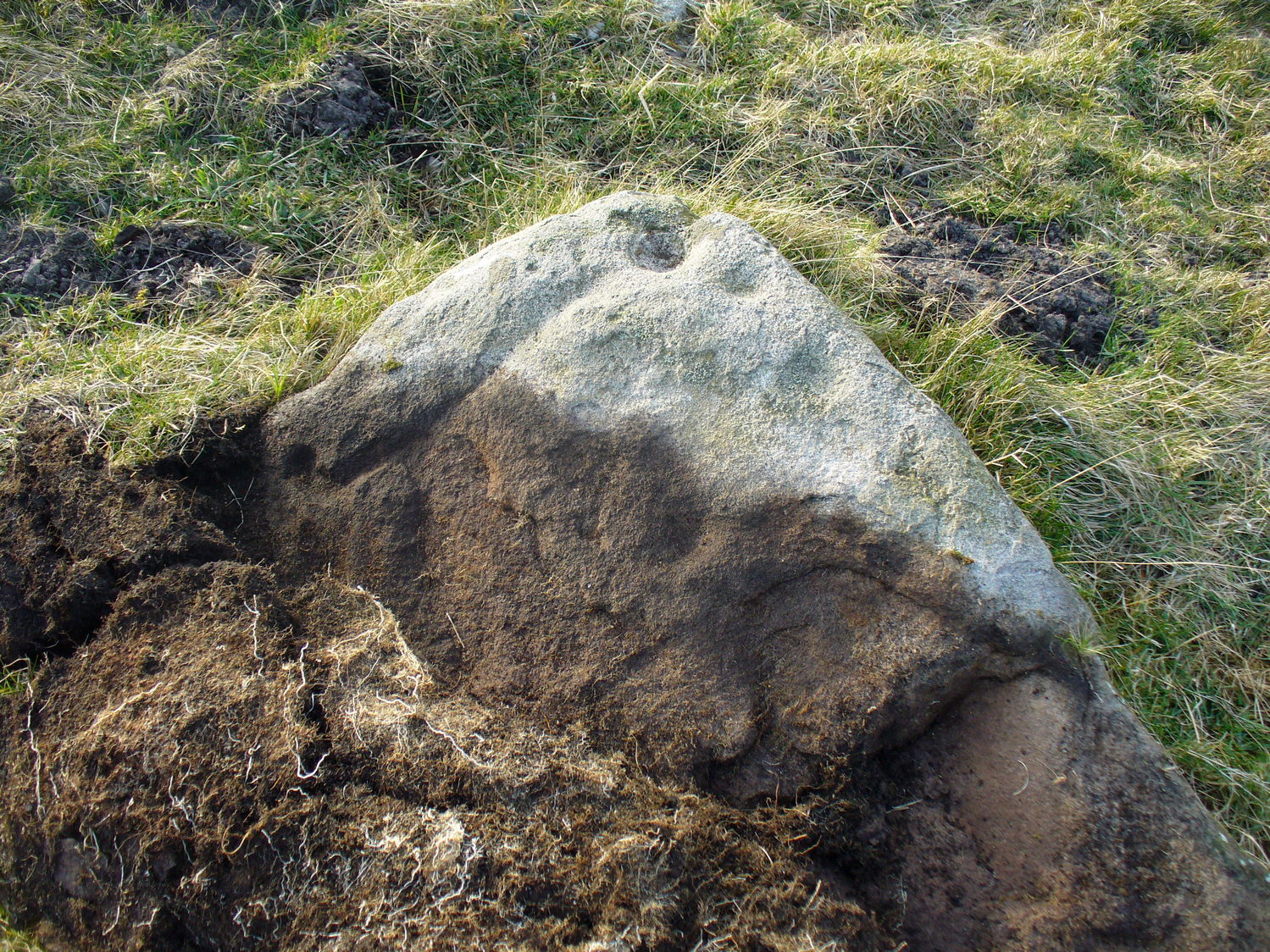
This long earthfast stone has two distinct cup-markings: one near its northern upper end, and the other near the lower southern end, as highlighted on the above photo. (forgive the poor image, but we took it when the sun was pretty high in the sky)  It seems as if there are two or three other very faint cup-marks on the upper end of the stone, close to the most distinct one, but none of our photos show them with any clarity.

Acknowledgements:  Huge thanks to Sarah Walker and Thomas Cleland for help with location and imagery for this stone.

© Paul BennettThe Northern Antiquarian

Easter Coillechat, Kilmadock, Stirlingshire

Cairn:  OS Grid Reference – NN 68830 04347

Getting Here

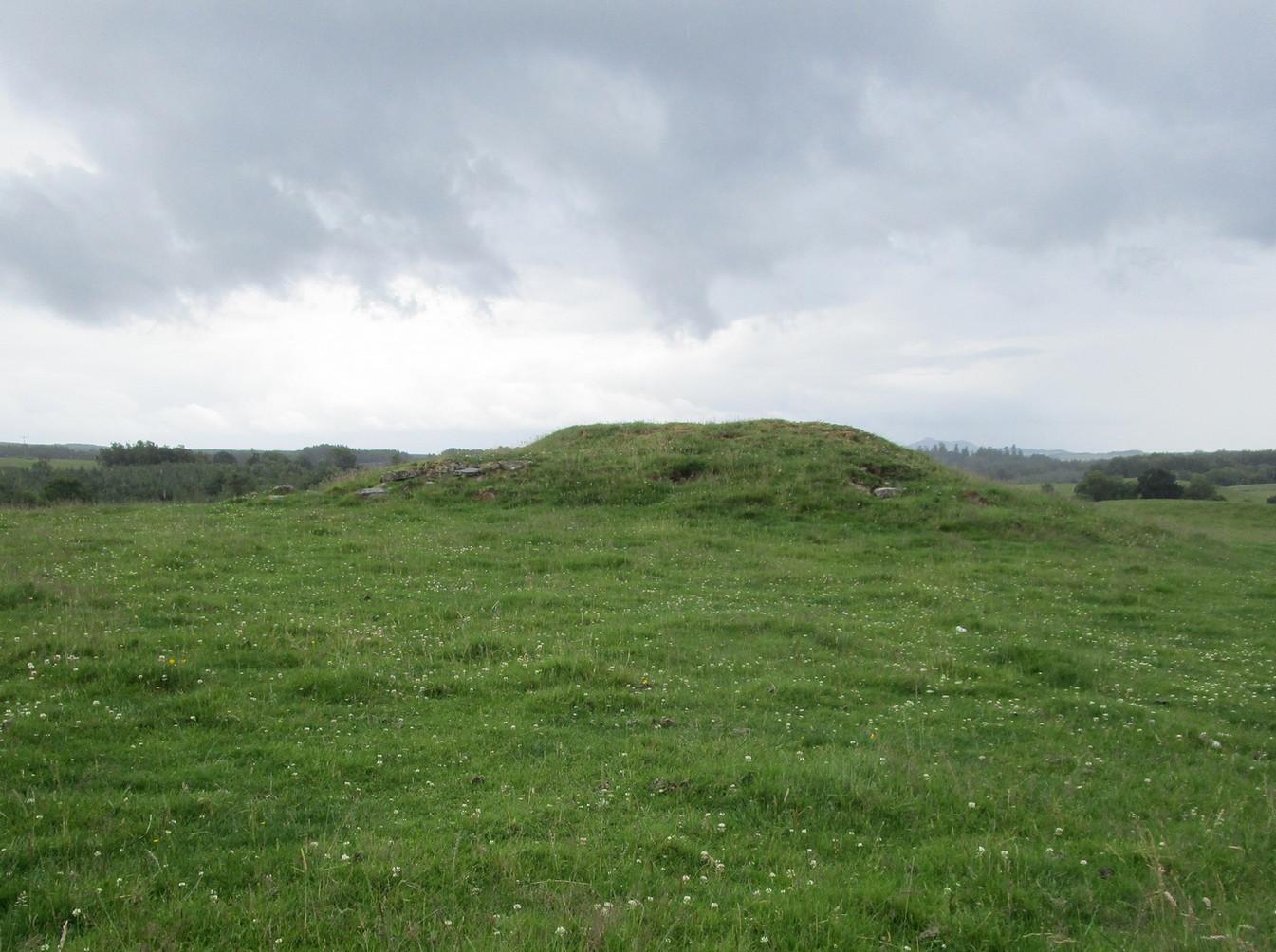
The cairn, looking NW

From Doune, take the A84 road to Callander.  As you pass through the hamlet of Buchany, keep your eyes peeled a few hundred yards on as the road dips down and swerves gently right, for the road sign of Drumloist (or Moist as some locals keep amending!) which goes up to the right.  It’s a small single track road that zigs and zags slowly uphill.  After exact one mile you reach a small track on your right (there one left too).  Carefully park hereby (don’t block the gate!).  Across the road, go through the gate on your right and walk along the edge of the field until you reach the burn.  Go across it, and then across the field, through the gate and you’ll see it ahead of you.  In the tick season (summer) treat the brackens as possessed by a plague and avoid it!

Archaeology & History

Looking at its stony face

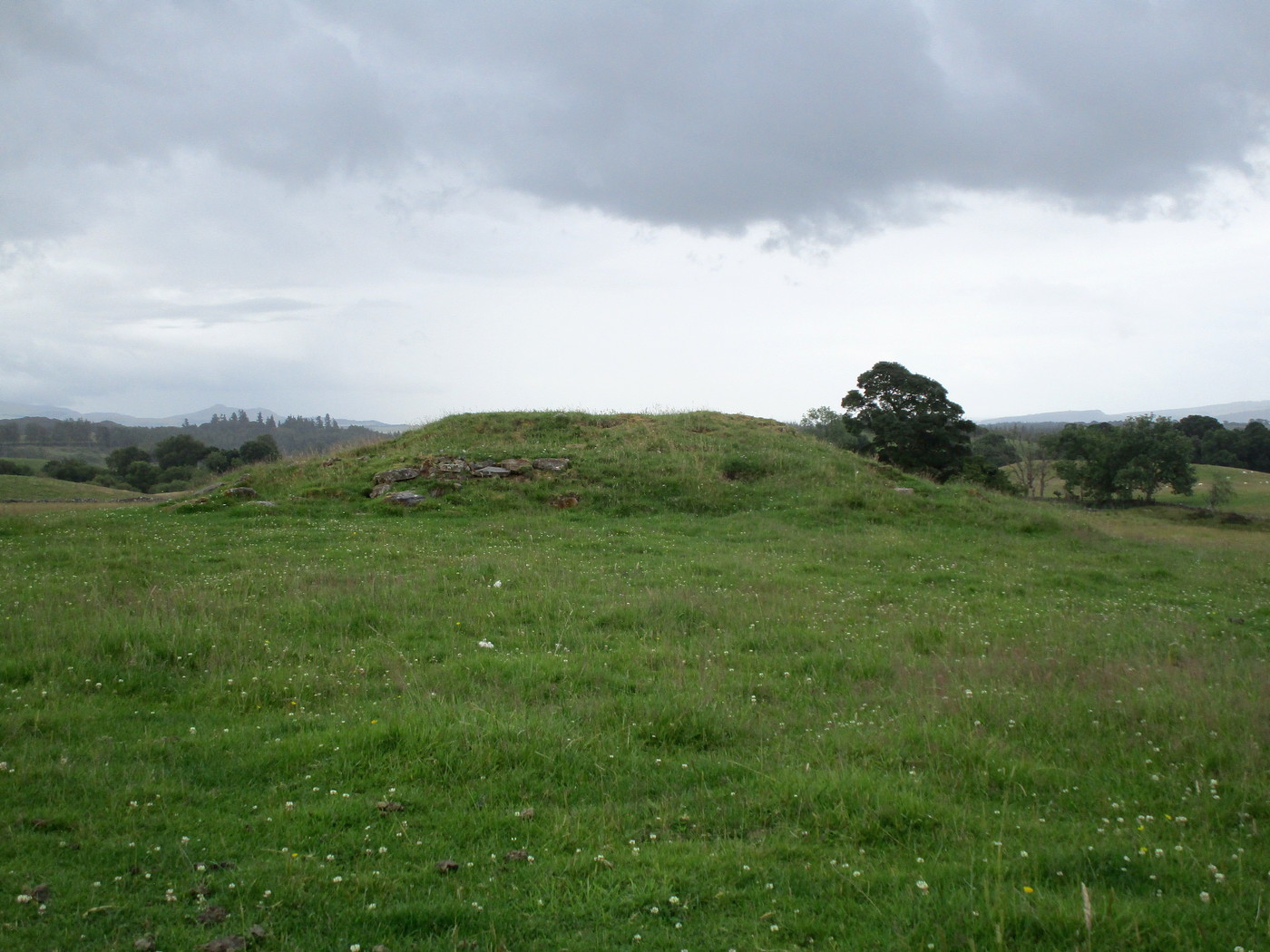
A curiously forgotten place, hidden from sight, this large rounded grass-covered mound with small upright stones around one side, seems timeless amidst the open fields.  It seems alone, but the denuded chambered tomb of Ballachraggan is just visible 1.4 miles to the northwest on the near-horizon; and there’s a hidden cairnfield just a half-mile away.  This cairn measures 18 yards (N-S) by 16 yards (E-W) and stands 7-8 feet high when you look at it from its southern side.  The top of the mound is a mix of stone and grass with a slight dip in the middle, perhaps by someone in ages past digging, albeit only slightly—perhaps scared away by the old folk buried herein.

One of the most notable aspects of this site is the complete silence.  On my last two visits hereby, a fusion of mists from the low cloud above and the breathing Earth below gave an atmosphere the likes of which lived when this tomb was first built.  On one occasion hereby, no vehicles for several hours gave the silence a curious atmosphere (those of you who like sitting in the rain with the wilderness will know what I mean).  To me this is a gorgeous site…

© Paul BennettThe Northern Antiquarian

Tom Tallon’s Grave, Kirknewton, Northumberland

Tumulus (destroyed):  OS Grid Reference – NT 9323 2800

Also Known as:

  1. Auld Wife’s Apronful o’ Stanes
  2. Tom Tallon’s Tumulus

Archaeology & History

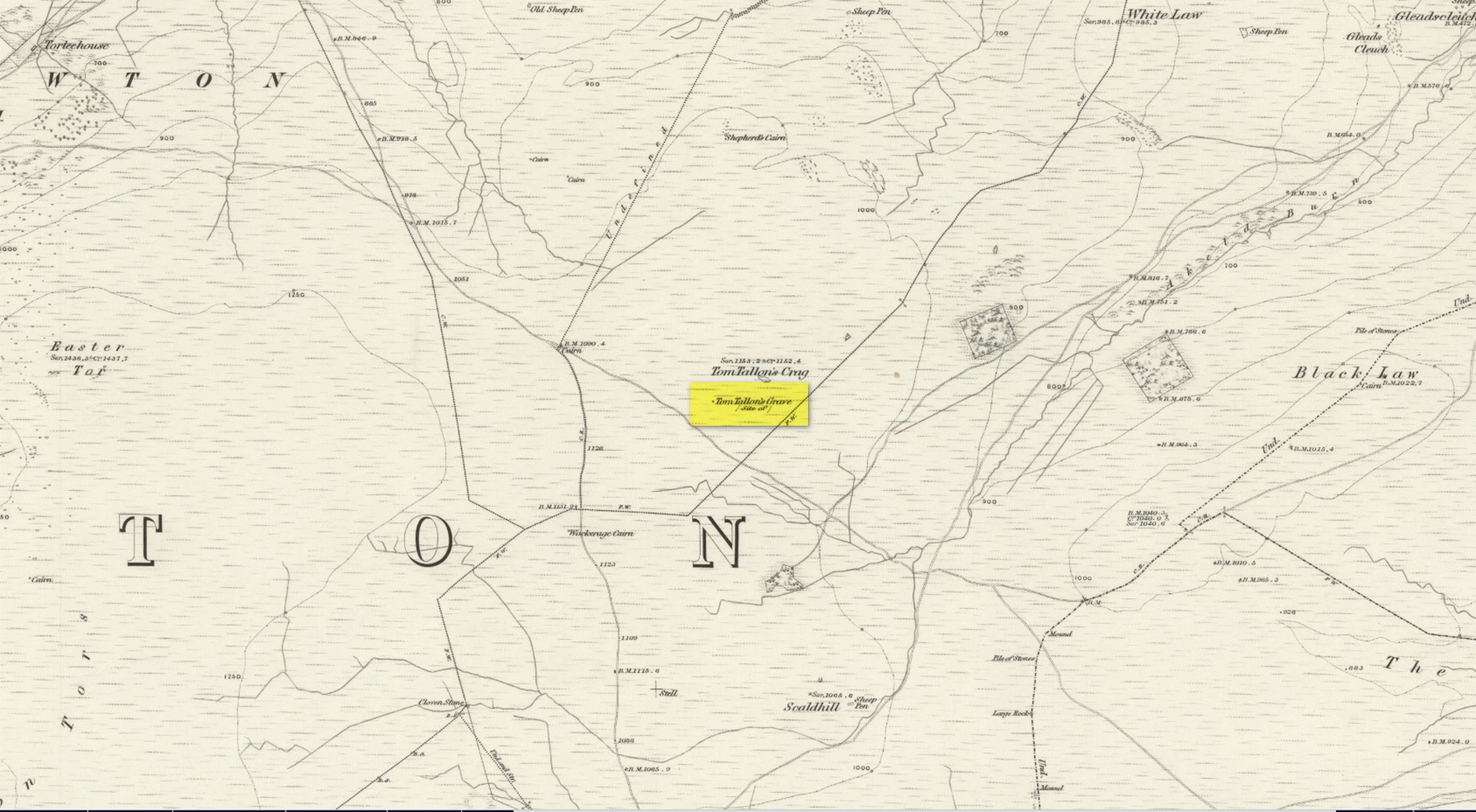
Site on the 1866 OS-map

Highlighted on the earliest OS-maps about half a mile to the south of the great prehistoric camp of Yeavering Bell and 100 yards southwest of Tom Tallon’s Crag, there once stood an apparently “massive” Bronze Age tumulus, or cairn, called Tom Tallon.  I’d hedge a bet that it was much older, from the neolithic period.  It was described by P.A. Graham (1921) as “the largest cairn in the district,” but when it was visited by the antiquarian Henry MacLauchlan in July 1858, he reported that “it was being removed to make a fence”!!!  Unbe-fuckin’-lievable… Who were the dickheads that did that?!

Folklore

The Ordnance Survey Name Book of 1860 for Tom Tallon’s Crag told that,

“There is a vague tradition about Tom Tallon having been a Warrior and Slain here – hence the name, but nothing authentic respecting Tom, can now be ascertained.”

The word tom derives from “a rounded hill”, sometimes associated with a tumulus and in Scotland (just over the border) associated “with a dwelling place of the fairies” with tallon suggested by Graham (1921) to derive from “tal, a forehead or promontory, and Llan, an enclosure.”

What is quite obviously an older name, or certainly one that was more recognised by local people, is its title of the Auld Wife’s Apronful of Stones: a title we find associated with a number of the giant cairns in northern England and Scotland.  It relates to the creation myth of the site, whereby the countless stones that made up the cairn were dropped or thrown across the landscape by a giantess who inhabited this area.

References:

  1. Hall, James, A Guide to Glendale, M. Brand: Wooler 1887.
  2. Graham, P. Anderson, Highways and Byways in Northumbria, MacMillan: London 1921.
  3. MacLauchlan, Henry, “Notes on Camps in the Parishes of Branxton, Carham, Ford, Kirknewton and Wooller, in Northumberland,” in History Berwickshire Naturalists Club, volume 24, 1922.

© Paul BennettThe Northern Antiquarian

Lauder Common, Lauder, Berwickshire

Cairn:  OS Grid Reference – NT 49340 46162

Getting Here

Modern cairn on the old one

Take the B6362 high road between Lauder and Stow and, regardless of which direction you’re coming from, when you reach the top heights of the moorland road with views all around, you need to keep your eyes peeled for where a dirt-track runs south and, diagonally across the road on its north side, is a dirt-track-cum-parking-spot (if you came from Stow, you should’ve already noticed the cairn on the skyline on your way up).  There’s a hut circle in the heather by the parking spot.  From here, just walk over the heather nearly 300 yards north.  Y’ can’t really miss it.

Archaeology & History

Looking to the southeast

The first thing that you see as you approach here is a modern cairn which is sat upon the more ancient and completely overgrown one.  You can’t really see the “ancient” section of it until you walk round to its more northern side, where you’ll then notice how the new cairn has been built on top of a small but artificial rise in the ground, about ten yards across.  This is the original ancient cairn.  Sections of the ground have come away on its southern side, revealing a scattered mass of loose stones.  It doesn’t seem to have been excavated but has all the hallmarks of being typically Bronze Age by the look of it.  Of particular note is the superb view from here, not least towards the legendary Fairyland of the Eildon Hills, standing out clearly about 10 miles to the south…

© Paul BennettThe Northern Antiquarian