Holy Well, Gunwalloe, Cornwall

Holy Well (lost):  OS Grid Reference – SW 6602 2053

Archaeology & History

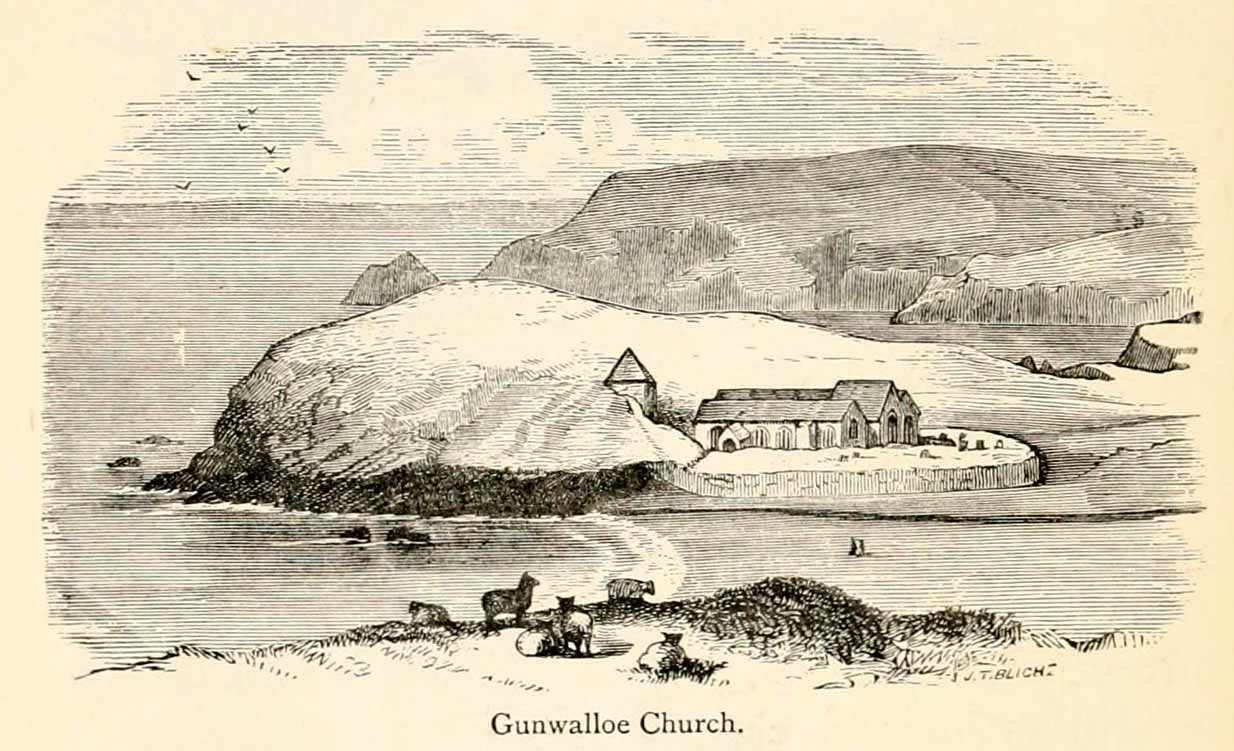
The old church at this headland just above the sea was, said Padel (1988), dedicated to Saint Gunwalloe or Winwalloe in 1332 and is thought to have been the character (a hermit by all accounts) who deemed this well to be ‘holy’.  In Alfred Cummings (1875) history of Gunwalloe parish, he devotes a short but singular chapter to this holy well which, according to most accounts, has fallen back to Earth.  It was found, said Cummings, “close to the church porch, only a few feet over the precipitous rock…and (was) doubtless the resort in former days of many a lad and maiden.”

Yet even in his day, he lamented its loss, telling that.

“The spring that once bubbled up in its rocky basin is no longer there; sand and stones fill up the well at each high tide, and though occasionally cleaned out for the satisfaction of the wayfarer’s curiosity is yet only an imperfect semblance of its former self.”

Yet remnants of practices and traditions of the well were thankfully remembered:

Gunwalloe church in 1885

“That Gunwalloe was considered by the country folk a well of some importance there can be little doubt, for one day in the year, which was called Gunwalloe Day, was set apart for cleaning out this holy well — it was quite at a different time of year to this parish feast — and now only remembered by two old men out of the whole population of the place.

“They fix the time in their memories as the period of tilling barley, for they recollect that on this Gunwalloe Day it was the custom for the men to mend all the cliff roads (doubtless these were useful in days of smuggling when a successful run was a desirable thing), and so strictly was it kept that, if any were found labouring in the fields, a party would go and take them by force, and press them into the service of the holiday makers, who, having mended the roads and cleared the holy well at Gunwalloe, wound up the day with merriment and revelry.”

Such practices are long since gone of course and, so most modern accounts would tell us, the holy well with it.  But when J. Meyrick (1982) came looking for the site on the summer solstice of 1980, he seemed a little more fortunate than his predecessors.  Located just a few yards from the detached church tower, he spoke with a

“Mrs Wilson, a churchwarden (who) told me that in heavy rain the tower continues to be flooded so the spring is still somewhere about, and curiously enough by the stile to the beach is a small granite trough with rainwater put there by someone no doubt in lieu of the Well and who is to say that the water is not holy!  The stream across the dune still meanders a few feet beneath the tower and into this the water from the well would have run, but there seems now no sign of an originating spring in the rocks around.”

Folklore

The church itself possesses a folktale found up and down the land.  “It is said,” wrote Blight (1885),

“that the builders intended to erect the church on higher ground, nearer the centre of the parish, at Hingey; but as fast as materials were brought to the place they were, by some mysterious agency, removed during the night to the present site.  And here the church was built, it being found useless to contend with a supernatural power.”

The supernatural agencies that are nearly always responsible for such actions tend to be the devil, fairies or other types of little-people.

References:

  1. Blight, J.T., Churches of West Cornwall, Parker: London 1885.
  2. Cummings, Alfred H., The Churches and Antiquities of Cury and Gunwalloe, W. Lake: Truro 1875.
  3. Meyrick, J., A Pilgrim’s Guide to the Holy Wells of Cornwall, J. Meyrick: Falmouth 1982.
  4. Padel, O.J., Cornish Place-Names, Alison Hodge: Penzance 1988.
  5. Quiller-Couch, M. & L., Ancient and Holy Wells of Cornwall, C.J. Clark: London 1894.

© Paul BennettThe Northern Antiquarian

Bishop’s Well, Tottenham, Middlesex

Holy Well (destroyed):  OS Grid Reference – TQ 332 911

Also Known as:

  1. My Lady’s Hole

Archaeology & History

Long since gone after drainage operations on Tottenham Cemetery made the waters dry-up, this was one of several holy wells in the Tottenham area.  Its history has been described in various old tomes, but the most definitive is found in William Robinson’s (1840) classic on the parish of Tottenham, when the well was still visible.  He told us:

“There is a spring which issues from the side of a small hillock on the south side of the Moselle, nearly opposite the Vicarage, leading thence to the Church, called Bishop’s Well.  This spring was formerly considered famous for many strange and wonderful cures performed on the diseased by the use of this water.  It has been for some years neglected, but of late the owner of the field in which this well is, had it cleansed, and planted some trees round it, and put up posts and rails to prevent the cattle treading down the sides of it.  It is said that the water of this well never freezes.  In former times this well was in great repute from the purity of its water.  The ladies in the vicinity of it were accustomed to send their servants in the morning and evening for water for their tea, from which circumstance it was for many years known by the name of “My Lady’s Hole.”  The water of this well is not only esteemed for its medicinal qualities, but particularly for curing disorders of the eye.

“There were formerly many other springs about the village, especially one which issued out of the hill on which the Church stands; and another in Spottons Wood otherwise Spottons Grove, on the north side of Lordship Lane, which in the fifteenth century was of considerable notoriety; but none of which have in former times been so much frequented and held in such repute as Bishop’s Well.”

(Please note: the grid-reference for this site is an approximation)

References:

  1. Foord, Alfred Stanley, Springs, Streams and Spas of London: History and Association, T. Fisher Unwin: London 1910.
  2. Hope, Robert Charles, Legendary Lore of the Holy Wells of England, Elliott Stock: London 1893.
  3. Robinson, William, The History and Antiquities of the Parish of Tottenham, Nichols & Sons: London 1840.
  4. Sunderland, Septimus, Old London Spas, Baths and Wells, John Bale: London 1915.
  5. Thornbury, Walter & Walford, Edward, Old and New London – volume 5, Cassell: London 1878.

© Paul BennettThe Northern Antiquarian


Woodhenge Circle (4), Durrington, Wiltshire

Round Barrow (destroyed):  OS Grid Reference — SU 1510 4330

Also Known as:

  1. Durrington 70

Archaeology & History

Cunnington’s sketch of the barrow remains

This was one of four ploughed-out round barrows (or ‘ring ditches’ in modern archaeo-jargon) that once existed immediately southeast of the well-known Woodhenge and was the closest of the four to the monument, being just 60 yards away. It was first noticed as a faint crop mark in an aerial survey photograph taken in 1926 of the fields hereby.  When it was investigated at ground level by Mr & Mrs Cunnington in August 1928, “no trace could be detected on the surface” of any extant monument—which they described as ‘Circle  IV’ in their superb survey.

The Cunnington’s (1929) account of the excavation they did here was pretty brief, telling:

“The soil was removed and the chalk brushed over that part of the area enclosed within firm lines.  Beyond a few shards of pottery in the soil, nothing whatever was found.  As the ditch was comparatively shallow and the filling-in was in patches dark in colour, with much ash and some burnt flints in it, a considerable length was dug out, as shown (in the sketch, above).  A few fragments of pottery similar to some of that from Woodhenge were found in and below the old turf line.

“The only find of interest was that of a piece of glass slag on the actual bottom of the ditch.  It is true it was at the shallowest point, but there was no evidence of disturbance.

“Conclusion — Like those of the other rings (Woodhenge Circles 1, and 3, PB) this ditch may have originally surrounded a Bronze Age burial, placed on the surface and covered with a mound, both of which were destroyed when the ground was levelled.”

References:

  1. Cunnington, M.E., Woodhenge, George Simpson: Devizes 1929.
  2. Royal Commission Historical Monuments, England, Stonehenge and its Environs, Edinburgh University Press 1979.
  3. Wainwright, G.J. & Longworth, Ian, Durrington Walls: Excavations 1966-1968, Society of Antiquaries: London 1971.

© Paul Bennett, The Northern Antiquarian


Woodhenge Circle (3), Durrington, Wiltshire

Round Barrow (destroyed):  OS Grid Reference — SU 1511 4327

Also Known as:

  1. Durrington 69

Archaeology & History

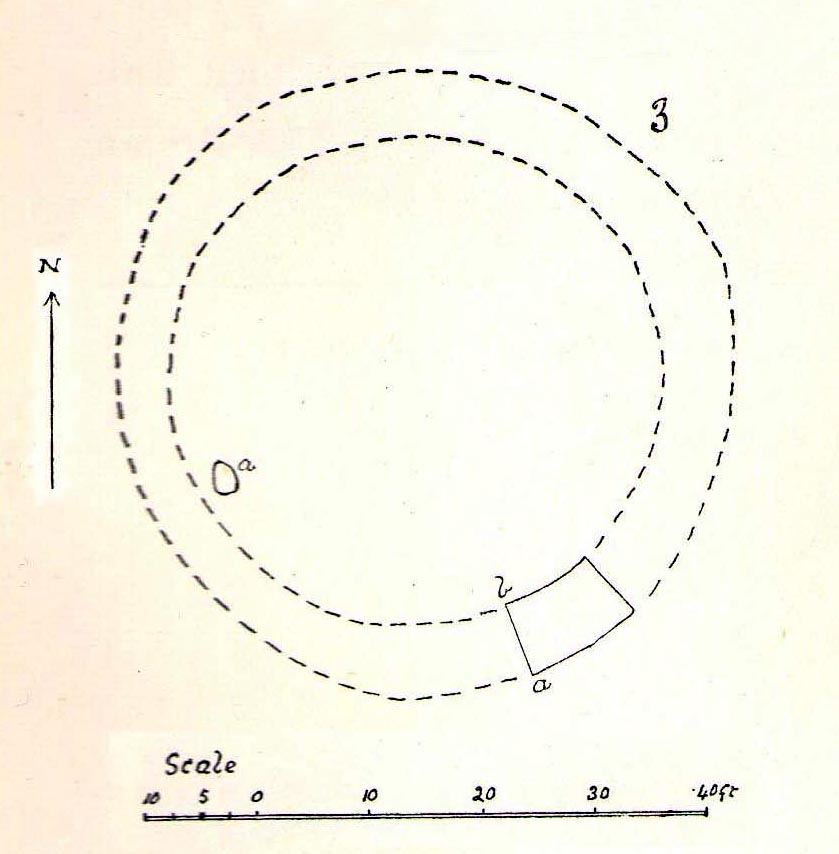
Cunningham’s sketch of Woodhenge-3 barrow

This was one of four ploughed-out round barrows (or ‘ring ditches’ in modern archaeo-jargon) that once existed immediately southeast of the well-known Woodhenge complex, constructed approximately 95 yards away.  As with others in this field, the site was first noticed as a faint crop mark in an aerial survey photograph taken in 1926.  When it was subsequently investigated at ground-level by Mr & Mrs Cunnington in August 1928, “no trace could be detected on the surface” of the monument in question—which they described as ‘Circle  III’ in their superb survey.

Very little was found in the Cunnington’s (1929) excavation, as their following brief account indicates:

“The soil was removed and the surface of the chalk brushed, over the whole of the area enclosed within this ditch.

“Only one small oval-shaped hole was found, near the edge of the ditch at “a” (above), 33in x 22in, and only 5in deep in the chalk; in it were a number of fragments of bones of a small ox and pig, a piece of burnt clay and a flint scraper weathered white.

“As there was nothing dateable in the circle it was not thought worth while to excavate more than a short section of the ditch.  Pottery comparable with that found at Woodhenge came from the old turf line and from the bottom of the ditch.

“Conclusion — Like those of the other circles (Woodhenge circles 1, 2 and 4, PB) it is probable that this ditch was originally made round a Bronze Age burial that had been placed on the surface, and that it was destroyed together with the covering mound when the ground was levelled.”

References:

  1. Cunnington, M.E., Woodhenge, George Simpson: Devizes 1929.
  2. Royal Commission Historical Monuments, England, Stonehenge and its Environs, Edinburgh University Press 1979.
  3. Wainwright, G.J. & Longworth, Ian, Durrington Walls: Excavations 1966-1968, Society of Antiquaries: London 1971.

© Paul Bennett, The Northern Antiquarian


Petrifying Well, Guilsborough, Northamptonshire

Sacred Well (lost):  OS Grid Reference – SP 664 733

Archaeology & History

It’s difficult to know precisely which category this site should come under: sacred well or just a healing well.  I’ve opted for ‘sacred’, due to its peculiar and rare properties, i.e., turning things into stone.  For a spring to do such a thing would have been seen by our ancestors as it having some sort of magickal or supernatural ability.  Sadly however, it seems that all trace of this well has long since gone.

It was described only in passing in Peter Hill’s (2005) folklore survey of Northamptonshire, to which he gave no reference. He told us simply,

“Guilsborough had a petrifyiong spring near the Grange, which was ‘good for several diseases.”

None of the early OS-maps of the area show any such ‘well’ immediately in or around Guilsborough’s Grange and so I surmise (perhaps in error) that one of the two ponds to the south of the Grange is fed by the spring in question.  It would be good to know for certain!

References:

  1. Hill, Peter, Folklore of Northamptonshire, Tempus: Stroud 2005.

© Paul BennettThe Northern Antiquarian


Southdown Cottage, Cotmandene, Dorking, Surrey

Tumulus (destroyed):  OS Grid Reference – TQ 1686 4958

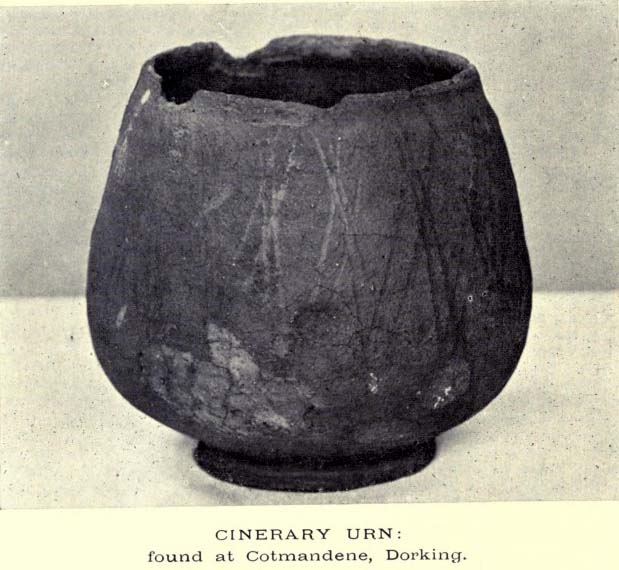
The Cotmandene urn

Archaeology & History

Highlighted on the 1914 OS-map (as ‘Site of’), nothing now remains of the prehistoric structure that either covered or surrounded the ancient burial urn, found fortuitously by a Mr Turner in the garden of Southdown Cottage at the beginning of the 20th century.  Believed to be either Iron Age or Romano-British in origin, the find was noted by Mr Malden (1913) in his brief in the Surrey ArchaeologicalCollections, who wrote:   

“Early in 1913 it came to my knowledge that some years ago some discoveries had been made in the garden of a house on Cotmandene, Dorking.  Mr Turner…was digging for sand in his garden when he found a small cinerary urn (see illustration), with ashes in it.  The height is only 5 inches, the diameter across the top about 4 inches, but at the widest part 5⅜.  The urn is so small that it probably contained the ashes of a child: it is wheel-made, but badly; the diameter is not precisely the same across the top from every direction: Mr Reginald Smith attributes it to the first century BC.  Some fragments of other urns were found.  Mr Turner has kindly presented the whole specimen to the Society’s Museum.  At a lower depth in the same garden were numerous flints, some implements, many flakes, and traces of a hearth with several burnt stones. These clearly belonged to an earlier date, considerably, than the interments, but as the finds were made about 1906-7, and not investigated till this year, it is impossible to be precise about the depth at which they occurred.”

References:

  1. Malden, H.E., “A Cinerary Urn and other Matters found at Dorking and Betchforth,” in Surrey Archaeological Collections, volume 26, 1913.

© Paul BennettThe Northern Antiquarian


Rolleston’s Barrow, Rushmore, Tollard Royal, Wiltshire

Tumulus:  OS Grid Reference – ST 95552 18233

Archaeology & History

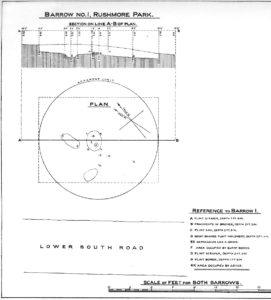
Plan of Rollestons Barrow, 1880

In what today seems a barely visible tumulus, amidst the large cluster that could once be found upon the large estate grounds of Rushmore House, were once the overgrown ruins of an old tumulus.  It seems to have been rediscovered in the 19th century, when the legendary antiquarian, General Pitt-Rivers, moved onto the huge estate.  It was all but hidden even in his day, he told, but being “of such slight elevation that, like many others, it had never been noticed.”  It was the first of all the barrows they excavated on his Estate, and is to be found “near the house on the south side of the lower south coach road.”

So, in 1880, he got some of the estate lads to help him and Rolleston start a dig into the old tomb – and they weren’t to be disappointed.  It wasn’t anything special, but it was the first amongst many hereby.  In Pitt-River’s (1888) massive tome on the prehistory of the region, he told us:

“This was the first barrow opened at Rushmore, on the 10th August, 1880. Professor Rolleston and the Rev. H. Winwood were present at the opening. The elevation was so slight that it had hitherto escaped notice.  In the centre, 1 foot 6 inches beneath the crest, a layer of charcoal and ashes, 9 feet by 6 feet, was found containing a burnt body.  The body appears to have been burnt on the spot, and not gathered up after cremation, but a mound raised over the funereal pile.  A few fragments of bronze, probably the remains of some implement which had corroded or been burnt, were found in the ashes, and in the body of the barrow two flint scrapers, a well-formed flint borer, and a boat-shaped flint…were found (see illustration above, PB).  A few scattered fragments of pottery found in the barrow were of a superior and harder baked quality than is usual in barrows.  No trace of a ditch was found around the barrow, but towards the north of the centre, a depression—EE on plan—which might, or might not, have been a grave, but filled with mould and without remains, was discovered.  The barrow is undoubtedly of the Bronze Age, and is interesting on account of it being the last at the opening of which Professor Rolleston assisted shortly before his death.”

As a result of this, he decided to name to barrow after his old friend and also planted a beech tree on top of it in remembrance of him.

References:

  1. Pitt-Rivers, A.H.L.F., Excavations in Cranborne Chase, near Rushmore – volume 2, Harrison & Sons: London 1888.

© Paul BennettThe Northern Antiquarian


Old Pleck Barrow, Rushmore, Tollard Royal, Wiltshire

Tumulus (destroyed):  OS Grid Reference — ST 95459 17548

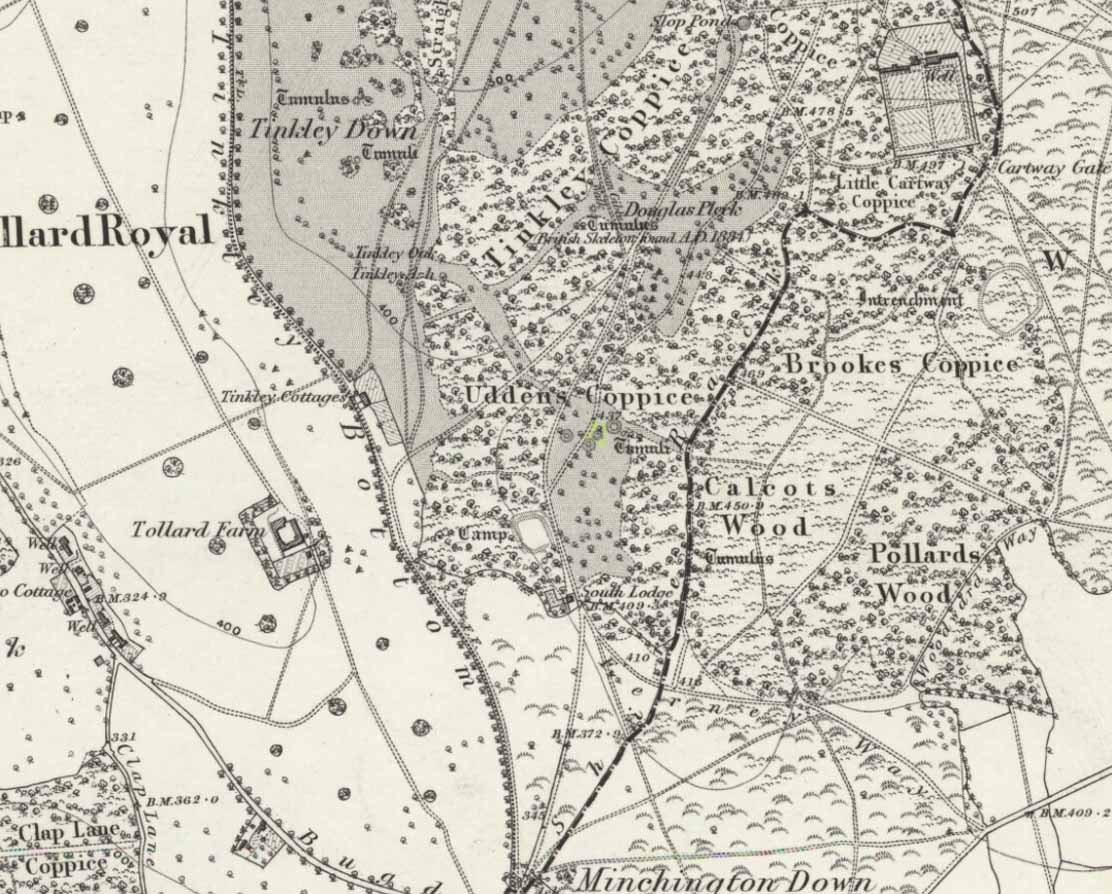
Old Pleck on 1889 OS-map

Archaeology & History

This long-lost burial mound was one in a large group of prehistoric tombs that were explored in the 19th century by the legendary antiquarian, General Pitt-Rivers. It had already been destroyed before the General came to live on his Rushmore estate in southern Wiltshire, but thankfully, his diligence as an inquirer prevailed and he was able to recover at least something of the old site.  Shown on the 1889 OS-map of the area (despite already having been destroyed), in Pitt-River’s (1888) extensive writings he told how, in the scattered woodlands hereby, was

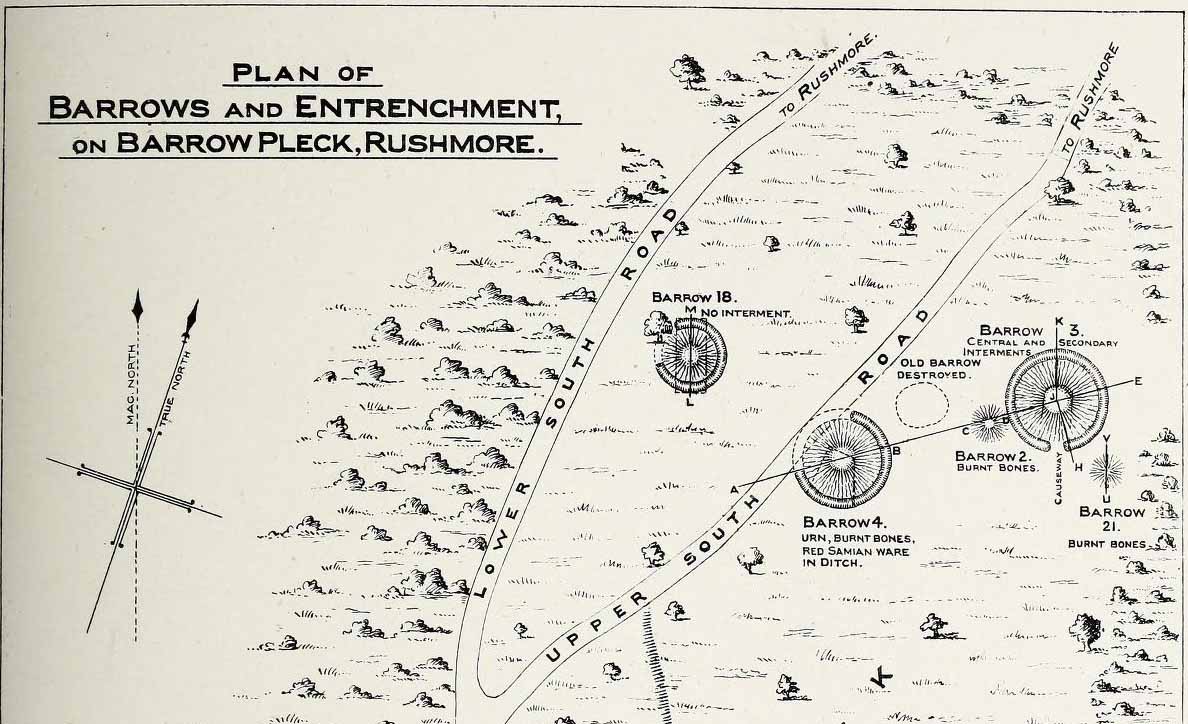
Pitt-Rivers 1888 site-map
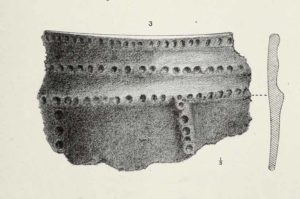
Old Pleck Barrow urn

a collection of large barrows near the South Lodge.  They were covered with a thick grove of hazel and other underwood.  One of the barrows—marked by a dotted circle (see sketch-map, left, PB)—had been destroyed before my arrival at Rushmore in 1880.  The earth of the barrow had been removed and a good urn found in it, which had been broken and scattered, but I was fortunate enough to recover one of the fragments which had been preserved by the estate carpenter.

From a sketch that was made of the urn remnant, Pitt-Rivers told how “the character of its ornamentation” resembled that on another urn found in one of the nearby tumuli.

References:

  1. Pitt-Rivers, A.H.L.F., Excavations in Cranborne Chase, near Rushmore – volume 2, Harrison & Sons: London 1888.

© Paul BennettThe Northern Antiquarian 


Uphall Camp, Ilford, Essex

Hillfort (destroyed):  OS Grid Reference –TQ 4383 8510

Archaeology & History

Uphall Camp, 1893

This prehistoric site was a giant – a huge colossus of an ‘enclosure’, a ‘settlement’, a ‘camp’—call-it-what-you-will.  More than a mile in circumference and with an internal area of 48 acres (big enough to hold 37 football fields!), archaeologist Pamela Greenwood (1989) told us, not only that it was “the largest recorded hillfort in Essex”, but that it compared in size with the immensity of Maiden Castle in Dorset!  Yet despite it being cited by the Oxford Archaeology report of Jonathan Millward (2016) as “the most significant archaeological site within the Borough” from the Iron Age period, it has fallen prey to the thoughtless actions of the self-righteous Industrialists who, as usual, have completely destroyed it.  It was already in a “bad” state when the Royal Commission lads visited here around 1916, saying how it was “in some danger of destruction.” Thankfully, in earlier centuries, we did have more civilized and educated people who seemed proud to describe what there was of their local history.

Early literary accounts seem sparse; although in Mr Wright’s (1831) huge commentary to Philip Morant’s (1768) Antiquities of Essex, he thought that the adjoining parish of Barking—whose ancient boundary line is marked here by the southern embankments of the enclosure—derived from the Saxon words burgh-ing, which he transcribed as ‘the fortress in the meadow’.  The same derivation was propounded in Richard Gough’s 1789 edition of Camden’s Britannia, from the “Fortification in the meadows.”  It seems a more reasonable derivation than that ascribed in the Oxford Names Companion (2002) as the “(settlement of) the family or followers of a man called *Berica” (the asterisk here denotes the fact that no personal name of this form has ever been found and is pure guesswork).  But according to the English Place-Name Society text on Essex by Paul Reaney (1935), the early spellings of Barking implies a derivation from ‘birch trees.’  Anyway….
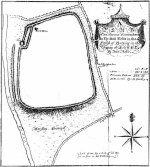
Uphall Camp c.1735

A fine plan of the site was drawn by John Noble some time around 1735 although, curiously, he seems to have written no notes about the place.  The first real citation of Uphall Camp as an antiquity seems to have been by Morant himself (1768).  In a work bedevilled by genealogical and ecclesiological tedium, he occasionally breaks from that boredom to tell of the landscape and the people living here, mentioning our more ancient monuments—but only in passing, as illustrated here:

“Near the road leading from Ilford to Berking, on the north west side of the brook which runs across it, are the Remains of an ancient Entrenchment: one side of which is parallel with the lane that goes to a farm called Uphall; a second side is parallel with the Rodon, and lies near it; the third side looks towards the Thames; the side which runs parallel with the road itself has been almost destroyed by cultivation, though evident traces of it are still discernible.”

Just over thirty years later we were thankfully given a more expansive literary portrayal by Daniel Lysons. (1796)  Lysons was drawing some of his material from a manuscript on the history of Barking by a Mr Smart Lethieullier, written about 1750 (this manuscript was unfortunately destroyed by fire, and no copies of it ever made).  He told us:

“In the fields adjoining to a farm called Uphall, about a quarter of a mile to the north of Barking-town, is a very remarkable ancient entrenchment: its form is not regular, but tending to a square; the circumference is 1792 yards, (i.e., one mile and 32 yards,) inclosing an area of forty-eight acres, one rood, and thirty-four perches.  On the north, east, and south sides it is single trenched: on the north and east sides the ground is dry and level (being arable land), and the trench from frequent ploughing almost filled up: on the south side is a deep morass: on the west side, which runs parallel with the river Roding, and at a short distance from it, is a double trench and bank: at the north west corner was an outlet to a very fine spring of water, which was guarded by an inner work, and a high keep or mound of earth.  Mr. Lethieullier thinks that this entrenchment was too large for a camp: his opinion therefore is, that it was the site of a Roman town.  He confesses that no traces of buildings have been found on that spot, which he accounts for on the supposition that the materials were used for building Barking Abbey, and for repairing it after it was burnt by the Danes.  As a confirmation of this opinion, he relates, that upon viewing the ruins of the Abbey-church in 1750, he found the foundations of one of the great pillars composed in part of Roman bricks. A coin of Magnentius was found also among the ruins.”

But this is a spurious allusion; albeit an understandable one when one recognizes that the paradigm amongst many writers at the time was to say that anything large and impressive was either a construction of the Romans or the Danes, as the early British—it was deemed—were incapable of building such huge monuments.  How wrong they were!

In Mrs Ogborne’s (1814) description of Uphall Camp, she thought that its form and character betrayed anything Roman and—although she wasn’t specific—seemed to prefer the idea that our earliest Britons had built this place.  And she was right!  She wrote:

“There is, about a quarter of a mile from Barking, adjoining Uphal farm, on the road to Ilford, an antient entrenchment, a mile and 32 yards in circumference, with the corners rounded off; the west side, parallel with the river Rodon, has a double trench and bank, and a high keep, or mound of earth, about 94 yards round the base, about nine in height, on the side of the river, and seven on the opposite side: there was an outlet to a spring of water at the north-west corner; the south side has a morass; the north and east sides are single trenched, which is almost lost by cultivation, and in some places barely discernible.”

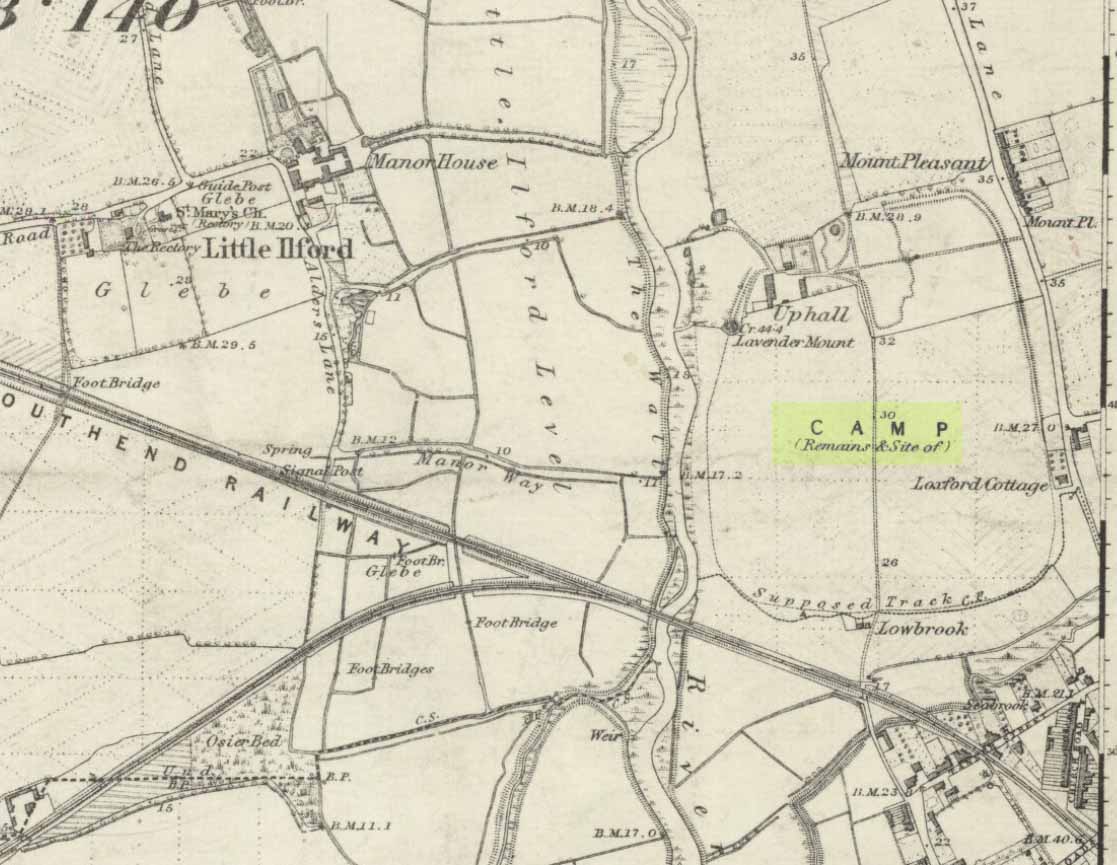
Uphall Camp on 1873 map

Uphall Camp on 1897 map

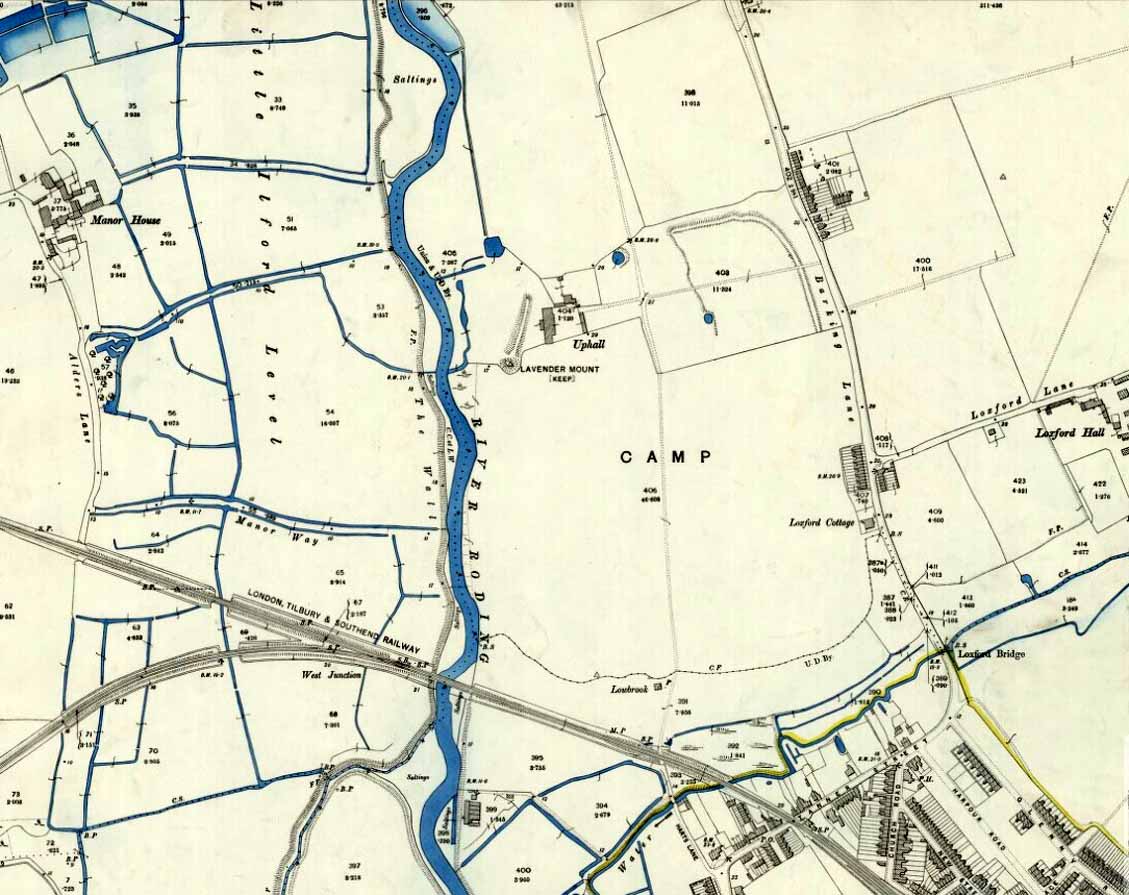
When the Ordnance Survey lads gave the site their attention in the 1870s, they showed its real size for the first time—cartographically at least!  As the two old maps either side here show, it was a big one!  Although some sections of the edges of the ‘camp’ were diminishing at the time, much of it was still in evidence.  And when the local writer Edward Tuck (1899) wrote about it, he told us,

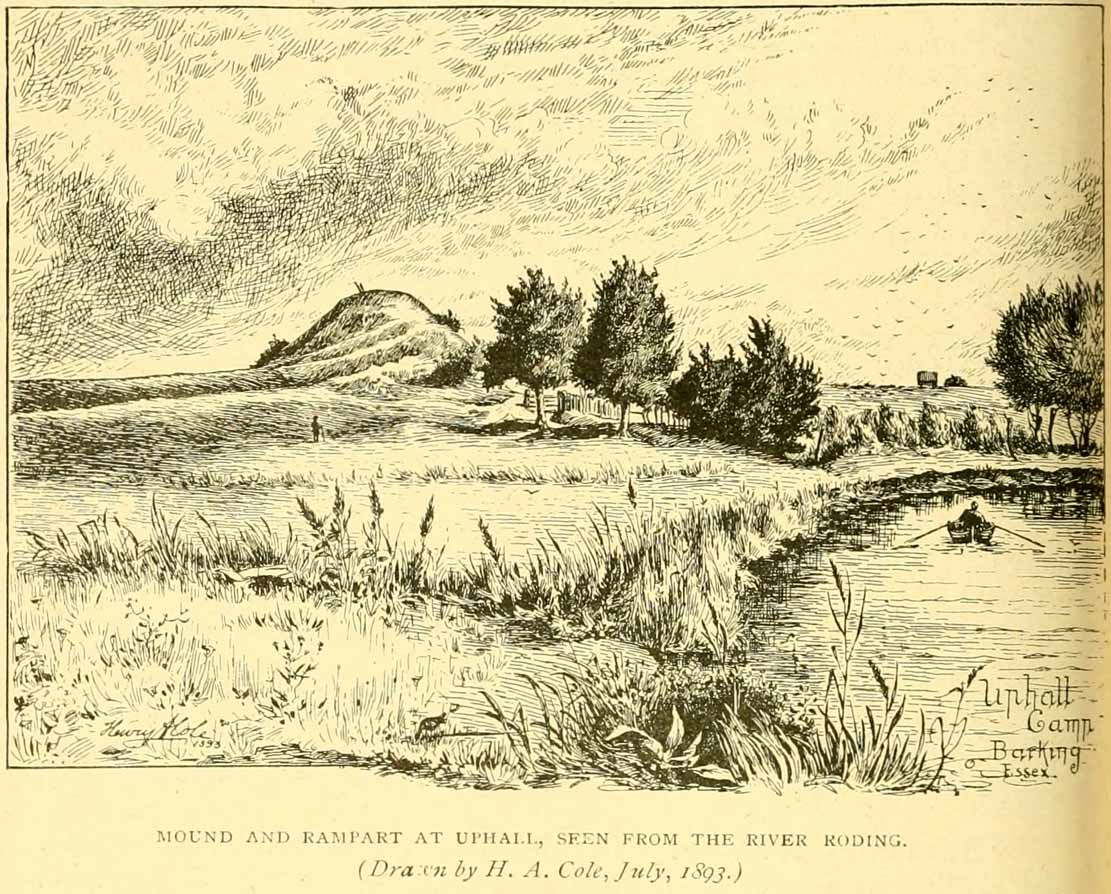
“On the north and east sides the ground is dry and level (being arable land) and the trench from frequent ploughings is almost filled up. On the south side is a deep morass; on the west side which runs parallel with the river Roding, and at a short distance from it is a double trench and bank; at the north-west corner is an outlet to a very fine spring of water, which is guarded by an inner work and a high keep or mound of earth designated “Lavender Mound.”  Mrs. Ogborne in her History of Essex gives a charming drawing of this mound as it was in 1814, and says that the mound was then about 94 yards round the base, and about nine yards in height, with trees growing upon it, and its surface covered with soft verdure.”
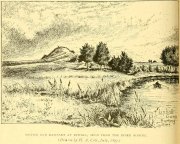
Uphall earthworks in 1893

Several other writers mentioned the remaining embankments of Uphall Camp, which was beginning to fade fast as the city-builders spread themselves further afield.  A chemical factory did most of the damage (as they still do, in more ways than one!).  When the Royal Commission (1921) lads came here they curiously deemed it as an “unclassified” structure; but in those days unless things were Roman in this neck of the woods, it could unduly puzzle them!  Their account of it told that,

“the remaining earthworks consist of a short length of rampart with an irregularly shaped mound at the north end, which is known locally as Lavender Mount, and another short length north of the farmhouse; there are also traces of the east side of the camp running parallel with Barking Lane.  An early plan shows part of the north and east sides of the earthwork and suggests that it was roughly rectangular in outline.  In 1750 the north, east and south sides are said to have had a single trench, and the west side a double trench and bank.

“The mound is 21 ft. high and 85 ft. in diameter at the base. The date of the earthwork is doubtful, but it does not appear to be pre-Roman.”

1908 photo of Lavender Mount

1814 sketch of Lavender Mount

The ‘Lavender Mount’ aspect in this monument, seemed a peculiar oddity.  Even modern archaeologists aren’t sure of what it might have been, erring on the side of caution with interpretations saying it was a keep of some sort, or a small beacon hill.  It might have been of course; but if it was a beacon hill, there would very likely be some written account of it – but none exist as far as I’m aware.  Initial impressions when just looking at the images is that it was a tumulus, but the position of the mound on top of the raised earthen embankments tells us that it was constructed after the Iron Age ramparts.  Writers of the Victoria County History (1903) said the same, suggesting a Saxon or more likely Danish origin.  The area around Lavender Hill was eventually explored by archaeologists in 1960, and several times thereafter – and what they uncovered showed us a continuity of usage that spanned several thousand years!

The 1960 excavation took place where, adjacent to the embankment, “the bank and ditch contained middle-Iron Age pottery”, along with traces of the large wooden fencing-posts (palisade) that initially surrounded and protected the enclosure. In Pamela Greenwood’s (1989) archaeological report, she told us that in further digs in 1983-4 there were discoveries of neolithic and Bronze Age flint remains.  The finds included,

“a leaf-shaped arrowhead and a discoidal scraper… fragments of an Ardleigh type urn, probably from a middle Bronze Age burial disturbed by later activity.  An L-shaped ditch, possibly part of an enclosure or field boundary, was found during the watching-brief. It contained flint-gritted pottery, perhaps attributable to the Bronze Age.”

But the majority of the finds at Uphall came from the mid-Iron Age period.  Greenwood continued:

“The settlement, judging from the relatively small area of the fortification actually excavated, was laid out in a regular way.  As might be expected, the round-houses appear to be aligned, indicating some sort of street-pattern.  ‘Four-poster’ structures have been located in particular areas, again pointing to some sort of designation of special zones of activity. Large quantities of charred grain from the post-pits and surroundings would confirm that these structures are granaries….

“The middle Iron Age structures are of several types: round-houses or round-buildings, pennanular enclosures, (wooden) ‘four-posters’; rectangular structures, ditches, post-holes and innumerable and ill-assorted small pits, small gullies and holes dug into the gravel.  Many of the last three types are undatable and could belong to the Iron Age, Roman, medieval or later activity on the site.”

I could just copy and paste the rest of Greenwood’s report here, but it’s quite extensive and interested readers should refer to her own account in the London Archaeologist .  It’s a pity that it’s been destroyed.

References:

  1. Crouch, Walter, “Ancient Entrenchments at Uphall, near Barking, Essex,” in Essex Naturalist, volume 7, 1887.
  2. Crouch, Walter, “Uphall Camp,” in Transactions of the Essex Archaeological Society, volume 9 (New Series), 1906.
  3. Doubleday, H.A. & Page, William (eds.), Victoria History of the County of Essex – volume 1, Archibald Constable: Westminster 1903.
  4. Greenwood, Pamela, “Uphall Camp,” in Essex Archaeology & History News, 1987.
  5. Greenwood, Pamela, “Uphall Camp, Ilford, Essex,” in London Archaeologist, volume 6, 1989.
  6. Hanks, Patrick, et al, The Oxford Names Companion, Oxford University Press 2002.
  7. Hogg, A.H.A., British Hill-Forts: An Index, BAR: Oxford 1979.
  8. Kemble, James, Prehistoric and Roman Essex, History Press: Stroud 2009.
  9. Lysons, Daniel, The Environs of London – volume 4, T. Cadell: London 1796.
  10. Millward, Jonathan, London Borough of Redbridge: Archaeological Priority Areas Appraisal, Oxford Archaeology 2016.
  11. Morant, Philip, The History and Antiquities of Essex – volume 1, T.Osborne: London 1768.
  12. Norris, F.J., “Uphall Camp”, in Gentleman’s Magazine, 1888.
  13. Ogborne, Elizabeth, The History of Essex, Longmans: London 1814.
  14. Reaney, Paul, The Place-Names of Essex, Cambridge University Press 1935.
  15. Royal Commission Ancient & Historical Monuments, England, An Inventory of the Historical Monuments in Essex – volume 2, HMSO: London 1921.
  16. Tuck, Edward, A Sketch of Ancient Barking, Its Abbey, and Ilford, Wilson & Whitworth: Barking 1899.
  17. Wilkinson, P.M., “Uphall Camp,” in Essex Archaeology & History, volume 10, 1979.
  18. Wright, Thomas & Bartlett, W., The History and Topography of the County of Essex – volume 2, G. Virtue: London 1831.

© Paul BennettThe Northern Antiquarian
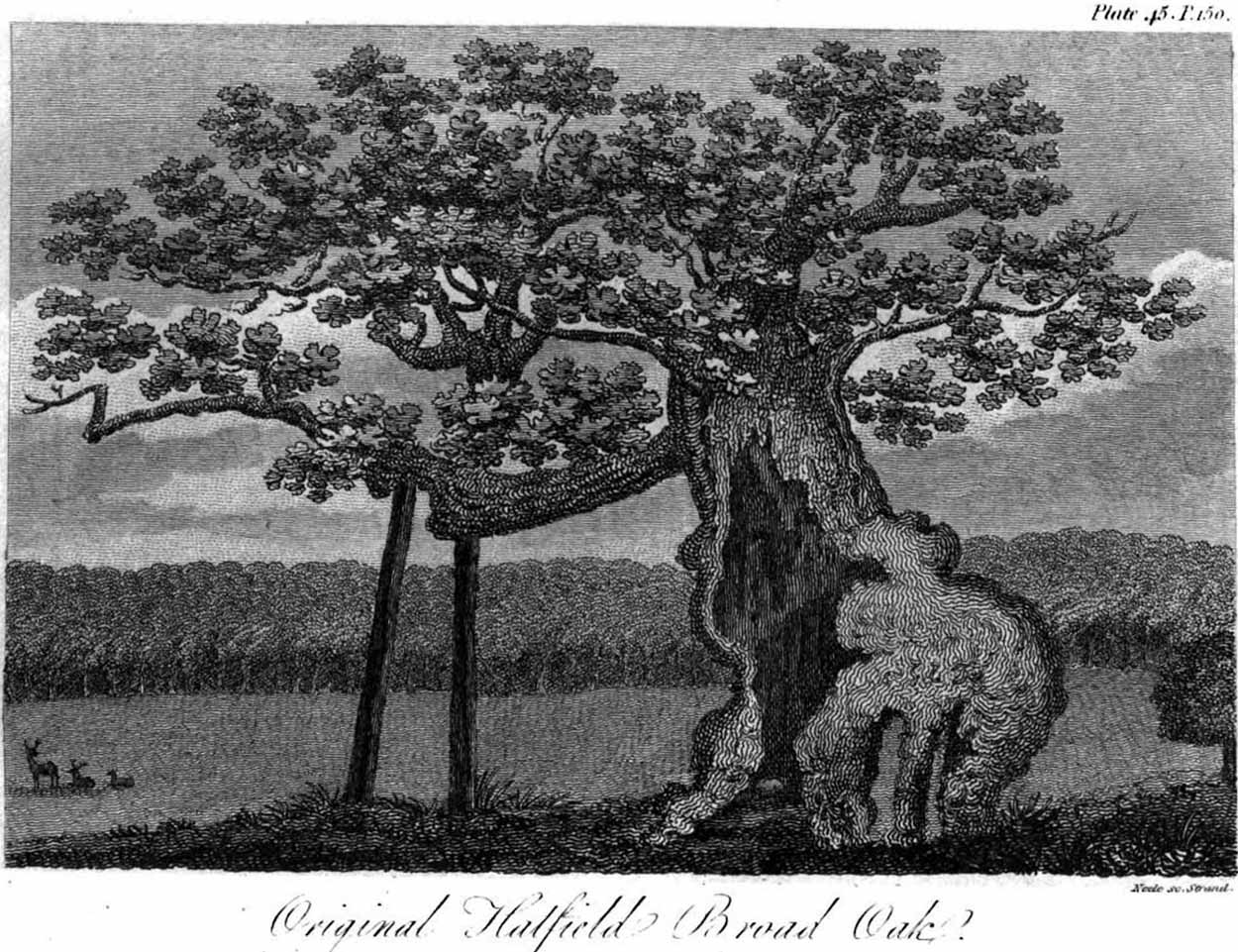

Broad Oak, Hatfield Broad Oak, Essex

Legendary Tree:  OS Grid Reference – TL 5352 2083

Also Known as:

  1. Doodle Oak

Archaeology & History

Hatfield’s Doodle Oak, 1807

Erroneously ascribed by the reverend Winsland (1952) as being the ‘Doodle Oak’, the ancient and giant tree called the Broad Oak was, as records show, always known by this name, but was subsequently replaced by another after its demise.  It was this second tree that became known as the Doodle Oak.  Winsland described it as “an immense and famous oak tree”, under whose “spreading branches in olden days the Lord of the Manor probably held his court and dispensed justice.”

The tree was described as early as 1136 AD and was probably an early tribal meeting site, or moot spot.  In Philip Morant’s (1763) work, he described it as,

“A tree of extraordinary bigness. There has been another since…called Doodle Oak.”

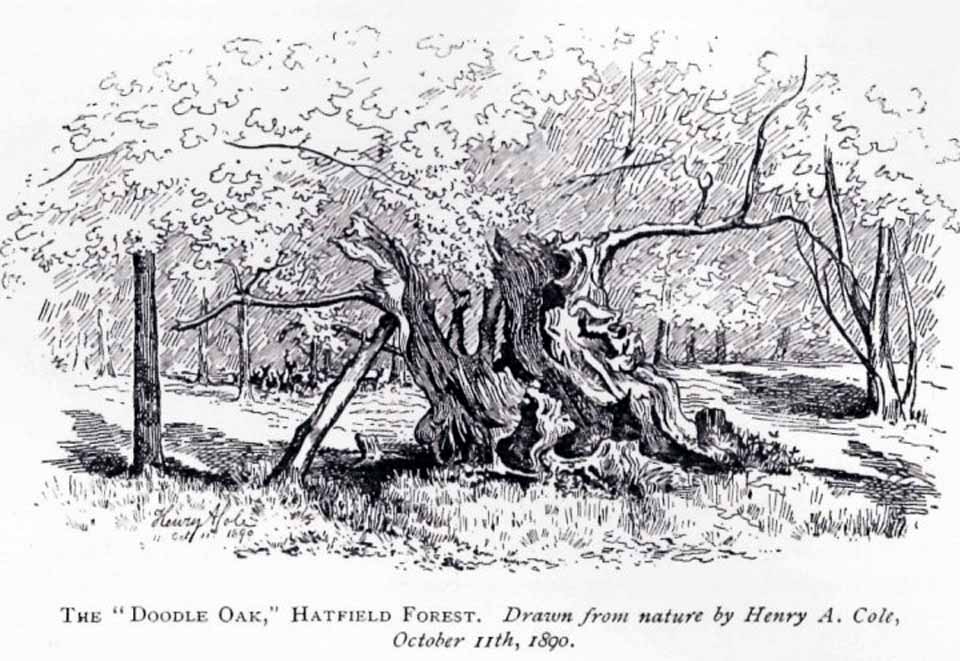
The old Oak in 1890

The Doodle Oak was thought to date from around 10-11th century and its predecessor may have been upwards of a thousand years old before this one took its place.  In 1949, one patient botanist, Maynard Greville, investigated the Doodle Oak tree-rings and found it to be 850 years old.  Other estimates suggest it was a hundred years older than that!  Whichever was the correct one, a measurement of its trunk found it to be some 19 yards in circumference – one of the largest trees ever recorded in Britain!

Sketches of its dying body were thankfully made near the beginning and the end of the 19th century: one in Mr Vancouver’s (1807) Agriculture of Essex, and the other by Henry Cole of the Essex Naturalist journal.

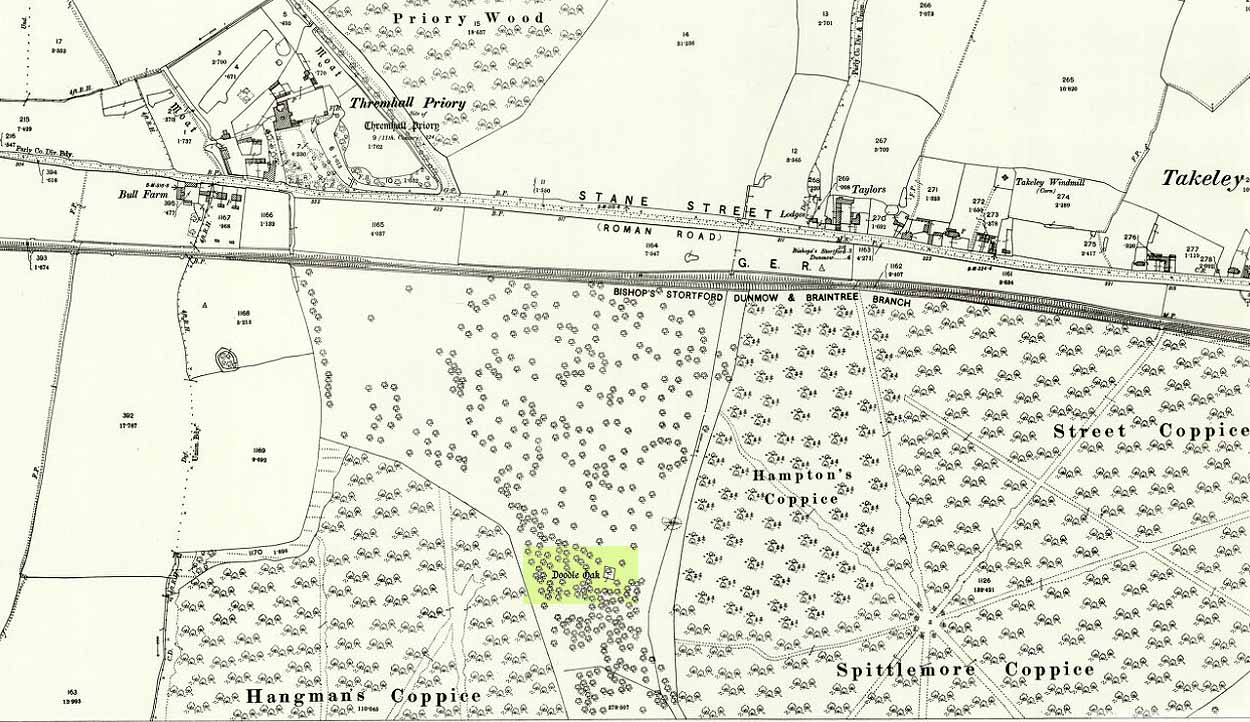
Doodle Oak on 1896 map

Some speculate that the Broad Oak of ancient times and the subsequent Doodle Oak were at very different places in the parish, but without hard evidence this idea is  purely hypothetical.  And whilst the name ‘broad’ oak is easily explained, the name ‘doodle’ is slightly more troublesome.  However, a seemingly likely etymology is found in the Essex dialect word dool, which Edward Gepp (1920) told,

“seems to mean, (1) a landmark; (2) a path between plots in a common field.”

The former of the two would seem to be the most likely.  This is echoed to a greater degree in Wright’s (1900) magnum opus, where he found the dialect word dool all over the southeast, meaning,

“a boundary mark in an unenclosed field.”

Giant trees on ancient boundaries, like the Broad Oak of earlier times, would seem to be the most probable reason for its name.  Today, all that’s left of the site is a small plaque on a small tree-stump, telling us what once stood here…

References:

  1. Gepp, Edward, Contributions to an Essex Dialect Dictionary, George Routledge: London 1920.
  2. Morant, Philip, The History and Antiquities of the County of Essex – volume 2, 1763.
  3. Reaney, P.H., The Place-Names of Essex, Cambridge University Press 1935.
  4. Vancouver, Charles, General View of the Agriculture of the County of Essex – volume 2, Richard Phillips: Blackfriars 1807.
  5. Winsland, Charles, The Church of Saint Mary the Virgin, Hatfield Broad Oak, Anchor: Bishop Stortford 1952.
  6. Wright, Thomas, English Dialect Dictionary – volume 2, Henry Frowde: London 1900.

© Paul BennettThe Northern Antiquarian