Petrifying Well, Lymm, Cheshire

Sacred Well (lost):  OS Grid Reference – SJ 68 87?

Archaeology & History

We are unsure of the precise location of this site, described in some detail by the early Victorian naturalist Leo Grindon (1882) during one  his many botanical rambles in and around Manchester nearly 150 years ago.  He described it to be along a little valley known as Ridding’s Brook, located near “the water at Lymm” which he described as,

“a vast reservoir, brought into existence by the construction of the viaduct at the foot.  The site now occupied by the water was originally a little vale, down which flowed a streamlet called the Dane.  Becoming very narrow where the roadway now is, to throw a barricade across was easy.  The construction of this gave distinctiveness also to the “dell,” the pretty hollow, full of trees, into which, when the water is high, the overplus, creeping under the road by a concealed channel, springs so cheerily.”

This is undoubtedly the Lymm Dam as it’s known today.  From here, he told, “visitors should continue along the hillside, opposite the church, and as far as the grove of trees” and then “cross by the rustic bridge, and, turning to the left, ascend the little valley called Ridding’s Brook.”  It is here where a magickal well whose waters turned plants into stone could be found.  Grindon said of it:

“The special interest of the valley lies, after all, in its curious dropping and petrifying spring.  At the further extremity, upon the right, the steep clay bank, instead of receding, is hollowed underneath for the length of a hundred yards or so, the upper edge projecting to a considerable distance beyond the base, so as to overhang the stream, and form a sloping roof to it.  The surface is completely covered with luxuriant moss, and from the land overhead comes an incessant filter of water, which at once nourishing the moss and entangled in it, causes it to hang down in long vegetable ringlets.  At a distance they seem soft, but examination shows that every drop has brought along with it a particle of earth, which being deposited in the very substance of the moss, is gradually converting it into stone.  Every cluster, externally so green and living, is in its heart a petrifaction.”
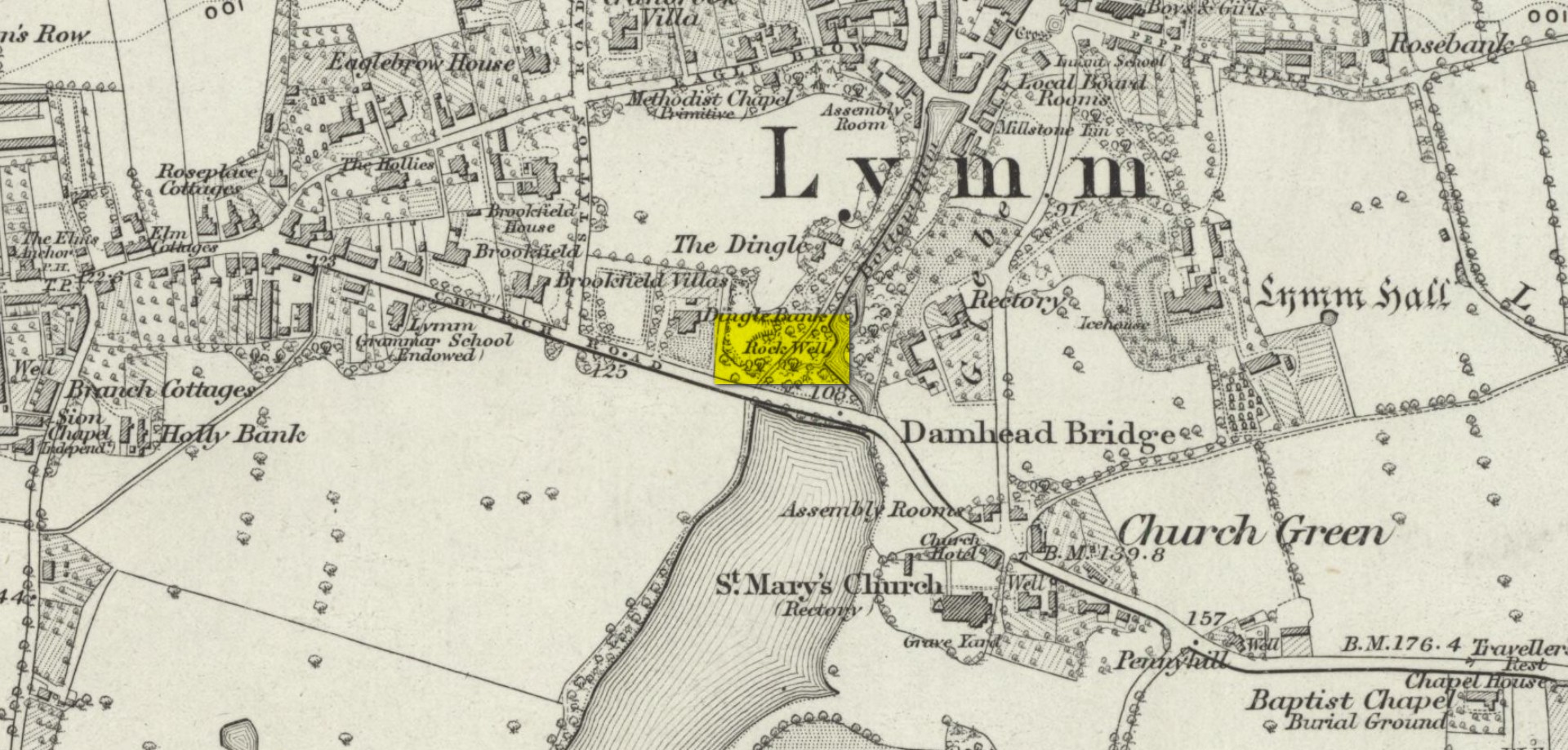
“Rock Well” on 1882 map

Waters that turn objects into stone were obviously seen as possessing a somewhat supernatural propensity in many cultures—and although I can find nothing in the local records of the myths or medicinal properties of this site (early animistic folklore records were sadly neglected by the many Industrial historians in Lancashire, meaning we lost masses of valuable village traditions), there’s little doubt it would have possessed a mythic history of its own in the local area.

It’s possible that a Well shown on the 19th century Ordnance Survey maps as a ‘Rock Well’ could be the petrifying waters in question, but until site gains the attention of a diligent local student of occult history, we’ll not know for sure… Does anyone know if it still exists…?

References:

  1. Grindon, L.H., Country Rambles and Manchester Walks and Wild Flowers, Palmer & Howe: Manchester 1882.

Acknowledgements:  Huge thanks for use of the Ordnance Survey map in this site profile, reproduced with the kind permission of the National Library of Scotland.

© Paul BennettThe Northern Antiquarian 

Petrifying Well, Guilsborough, Northamptonshire

Sacred Well (lost):  OS Grid Reference – SP 664 733

Archaeology & History

It’s difficult to know precisely which category this site should come under: sacred well or just a healing well.  I’ve opted for ‘sacred’, due to its peculiar and rare properties, i.e., turning things into stone.  For a spring to do such a thing would have been seen by our ancestors as it having some sort of magickal or supernatural ability.  Sadly however, it seems that all trace of this well has long since gone.

It was described only in passing in Peter Hill’s (2005) folklore survey of Northamptonshire, to which he gave no reference. He told us simply,

“Guilsborough had a petrifyiong spring near the Grange, which was ‘good for several diseases.”

None of the early OS-maps of the area show any such ‘well’ immediately in or around Guilsborough’s Grange and so I surmise (perhaps in error) that one of the two ponds to the south of the Grange is fed by the spring in question.  It would be good to know for certain!

References:

  1. Hill, Peter, Folklore of Northamptonshire, Tempus: Stroud 2005.

© Paul BennettThe Northern Antiquarian


St. Patrick’s Stone, Portpatrick, Wigtownshire

Cup-Marked Stone (destroyed):  OS Grid Reference – NX 0010 5411

Archaeology & History

Very little is known about this long-lost carving, whose primary information comes from the folklore records.  Apparently it was found on a rock a short distance south of the destroyed St. Patrick’s Well and the two sites seem to have had a traditional relationship with each other.  The carving had a foot-shaped motif on the rock, and a number of other cup-markings; but I can find no account as to whether the ‘foot’ carving possessed ‘toes’, as seen on the impressive Cochno Stone, north of Glasgow.  It may have been little more that the petroglyphic ‘feet’ seen on the recently discovered and aptly-named Footprint Stone, or those on the newly rediscovered Witches Stone; but we cannot discount it being larger, like the Footprint Stone of Dunadd.  If we could locate an early sketch of the stone, all would be revealed!   Sadly, as E.M.H. M’Kerlie (1916) told us,

“this rock was blasted at the time when the government essayed to make the harbour one of great importance”,

several years after the nearby holy well had been re-routed. Fucking idiots!  Any further info on this site would be most welcome.

Folklore

The local story that was told about St. Patrick creating these carvings seems to have been described first of all by Andrew Agnew (1864), who wrote:

“Once, when about to revisit his native land, he crossed the Channel at a stride, leaving the mark of his foot distinctly impressed on one of the rocks of the harbour; unfortunately, in making a new jetty, this interesting memento was destroyed.”

(The mention of the jetty would seem to imply that the carving was closer to the sea than the grid-reference cited above.) In another tale, St. Patrick rested his hand onto the same rock and the marks of his hand and fingers were left there.  This folklore motif is found across the world.  It relates to cosmological creation myths of indigenous spirits and deities in the tribes and cultures who narrate it.  In this instance, the myth of St Patrick replaced a much earlier mythic tale of another giant or deity, whose name we have lost.  Unless, of course, such petroglyphs were still being carved in Galloway by local people in the 4th-5th centuries.

A further tale of St Patrick, at Portpatrick, replaced a quite obvious shamanistic tale. When he journeyed back from Ireland to Galloway, Agnew again told us:

“Having preached to an assembly on the borders of Ayrshire, the barbarous people seized him, and, amidst shouts of savage glee, struck his head from his body in Glenapp.  The good man submitted meekly to the operation; but no sooner was it over than he picked up his own head, and, passing through the crowd, walked back to Portpatrick, but finding no boat ready to sail he boldly breasted the waves and swam across to the opposite shore, where he safely arrived (according to the unanimous testimony of Irishmen innumerable), holding his head between his teeth!”

Legends such this are found in shamanistic pantheons worldwide.  Shamans primary renown is their ability to travel and recover from the Lands of the Dead, always journeying into impossible and inhospitable arenas, with tales of being dismembered, beheaded, dying, and returning to life to help the tribe with whatever it was that required such a task (usually a healing function).  This story of St Patrick – and many other saints – are mere glosses onto the earlier animistic stories, then abridged as being better, more spiritually mature, more egocentric. But their roots are essentially animistic.

References:

  1. Agnew, Andrew, The Agnews of Lochnaw: The History of the Hereditary Sheriffs of Galloway, A. & C. Black: Edinburgh 1864.
  2. Agnew, Andrew, The Hereditary Sheriffs of Galloway – volume 1, David Douglas: Edinburgh 1893.
  3. Conway, Daniel, “Holy wells in Wigtonshire,” in Archaeological & Historical Collections Relating to Ayr & Wigton, volume 3, 1882.
  4. Harper, Malcolm MacLachan, Rambles in Galloway, Edmonston & Douglas: Edinburgh 1876.
  5. M’Kerlie, E.M.H., Pilgrim Spots in Galloway, Sands: Edinburgh 1916.
  6. MacKinlay, James M., Folklore of Scottish Lochs and Springs, William Hodge: Glasgow 1893.
  7. Morris, Ruth & Frank, Scottish Healing Wells, Alethea: Sandy 1982.
  8. Royal Commission Ancient & Historical Monuments of Scotland, Inventory of Monuments and Constructions in Galloway – County of Wigtown, HMSO: Edinburgh 1912.
  9. Walker, J. Russel, “‘Holy Wells’ in Scotland,” in Proceedings of the Society of Antiquaries of Scotland, vol.17 (New Series, volume 5), 1883.

© Paul BennettThe Northern Antiquarian