Wytchley Warren, Edith Weston, Rutland

Tumulus (destroyed):  OS Grid Reference – SK 961 052

Also Known as:

  1. Wicheley Warren

Archaeology & History

This tomb and, it would seem, another 200 yards away, have long since been smashed up.  The only decent reference to the site comes from Reginald Haines’ address to the Society of Antiquaries in January, 1903, where he told:

“In a quarry worked for freestone on Major Brathwaite’s land…was found in 1900 a skeleton, probably neolithic.  The body was in a crouching position, with ‘the knees tucked under the chin,’ at a depth of about 3 feet.  Unfortunately, no one interested in such things was at hand, and the remains were incontinently thrown aside and (are) presently buried under a mass of rubbish from the tunnels which were being worked for stone.  Mr V.B. Crowther-Beynon was only able to recover a few teeth, though he seems to have found a few fragments of animal bones and bits of pottery at or near the spot.

“In December 1901, at a point about 200 yards from the last, where a fresh excavation was being made, a second interment was found.  In this case the soil containing the remains came down in one block, and a few broken fragments of bone came to light, with a lower jaw.  The jaw is now in Mr V.B. Crowther-Beyson’s possession, who communicated with Lord Avebury on the subject, sending the jaw, and received the following reply:

“‘to judge from your description (i.e., of the interment) it is certainly probable that the interment you mention belonged to the stone (neolithic) age.  This, however, in the absence of weapons or implements, cannot be put higher than a probability.  I think that lower jaws like very this might be found among our existing people, though I fear with hardly such good teeth.  Their soundness and the way they were worn point strongly to a great antiquity.’

“Near the second interment occurred little patches of burnt soil of a conspicuously red colour.  These may have been the sites of hearths.”

Mr Haines makes a final note about the scarcity of prehistoric remains found hereby, saying that “the only other relics of the stone age that claim notice here are an arrow-head of flint, picked up in a field near Market Overton in November 1990, by Mr Wing” — which is quite a distance away!

References:

  1. Haines,  “Prehistoric Graves at Wicheley Warren,” in Proceedings of the Society of Antiquaries, volume 19, no.2, 1903.

© Paul Bennett, The Northern Antiquarian

Lippersley Pike, Denton Moor, North Yorkshire

Cairn:  OS Grid Reference – SE 14335 52478

Getting Here

Follow the directions to reach the Lippersley Pike cup-marked stone, then keep walking westwards, but go up the slope immediately on your right (north) and walk upwards along the path to the notable stone structure at the top-end of the ridge a coupla hundred yards ahead.  Once there, you’re standing on it!

Archaeology & History

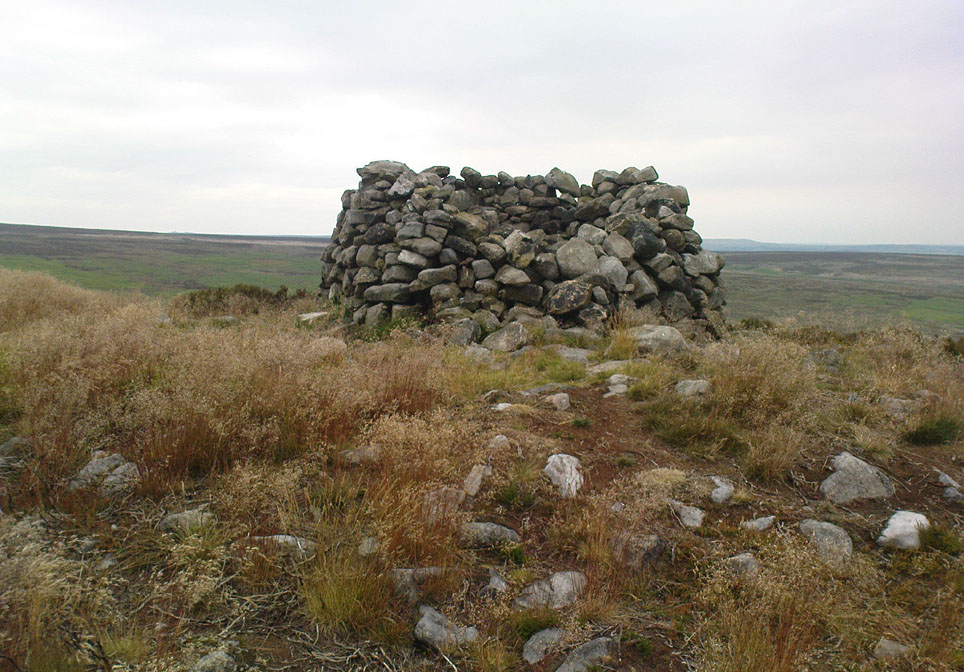
Lippersley Pike & shooter’s butt

A little known site with some excellent 360° views all round, reaching as far west as Pendle Hill, north past Simon’s Seat, and east onto the far reaches of the North York Moors.  The landscape here is truly superb!  And humans have been here since, it would seem, mesolithic periods at least, if Cowling’s finds are owt to go by! For although he described the much denuded tomb that we can still see under the herbage and recently-built shelter, there was also, “on the northern slope…a small occupation immediately below the summit on the northern side.”  We found remains of it on our visit here the other day.  But of the tomb itself — which Mr Cowling thought was neolithic in age — he wrote:

“The highest point of Lippersley Pike, on Denton Moor, is crowned by a stone cairn 1083 feet above sea level, and overlooks, on the northern side, a small site which appears to have been occupied by the ‘Broad Blade’ people, for there occur several pieces of patinated flint, along with scrapers and worked blades.”

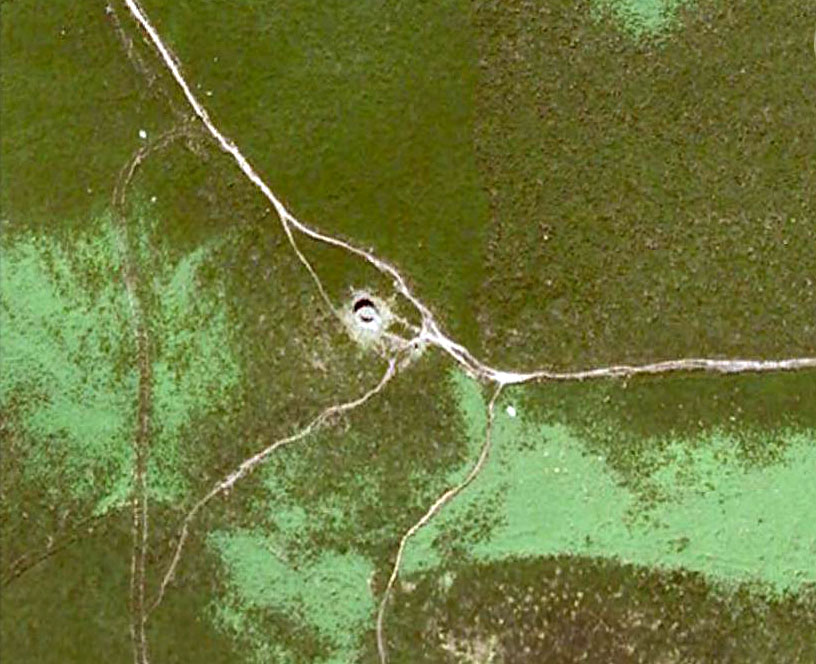
Aerial view of Lippersley Pike

Cowling then describes a number of flints and other prehistoric working utensils that he found all round here.  The remains of the cairn measure some 25 feet east-west and 23 feet north-south.  There has been no excavation here, although the fella’s who dug out much of the stone to build the shooter’s butt on its top may have found summat, but have kept it quiet!

The cairn is an ancient marker along the boundary line marking the townships of Denton and Great Timble and was visited in perambulation walks in previous centuries.  Grainge (1871) describes the extensive perambulation in his Knaresborough Forest work.  ‘Lippersley’ itself first appears in records from 1576, although A.H. Smith (1963:5) does not suggest an etymology.  The place is worth visiting as a good starting point to explore the other little-known prehistoric remains on these moors, including the Crow Well settlement, the Heligar Pike tomb, etc, etc.

References:

  1. Cowling, E.T., Rombald’s Way: A Prehistory of Mid-Wharfedale, William Walker: Otley 1946.
  2. Grainge, William, The History and Topography of Harrogate and the Forest of Knaresborough, John Russell Smith: London 1871.
  3. Grainge, William, The History and Topography of the Townships of Little Timble, Great Timble and the Hamlet of Snowden, William Walker: Otley 1895.
  4. Smith, A.H., The Place-Names of the West Riding of Yorkshire – volume 5, Cambridge University Press 1963.

© Paul Bennett, The Northern Antiquarian

Pillar of Eliseg, Pentrefelin, Llangollen, Denbighshire

Cross:  OS Grid Reference – SJ 20267 44522

Also Known as:

  1. Eliseg’s Pillar

Getting Here

The Eliseg Pillar

From Llangollen, take the A542 north for about three miles up along the famous Vale of Llangollen.  At the ruined abbey of Valley Crucis continue along the same road for another ½-mile whence, at the side of the road in a field and upon a small mound, stands the ancient monument: the Pillar of Eliseg.

Archaeology & History

The sandstone pillar or pillar-shaft stands upon a large square-shaped base stone which sits atop a tumulus — a Bronze Age burial mound (cairn) inside which were found, during excavations in 1803, the remains of a body, perhaps that of a Romano-British or Dark-Ages chieftain (possibly Eliseg?), with what were described as “blue stones” both beneath and on top; the cremated body lying within a stone-slab chamber along with a silver coin.  But the ancient pillar monument itself is much later in date — probably mid-9th century AD, though there has been speculation by some historians that the pillar was actually a tall cross, alas without its head, dating from a couple of centuries earlier, with the inscription being carved onto it sometime between 840-845 AD.  It was erected by Prince Cyngen fab Cadell (Concenn) about the year 844 in memory of his great-grandfather Eliseg or Elise.  Cyngen died in Rome in 854 AD.

Over the centuries the pillar has suffered from the ravages of time.  Its long Latin inscription was originally 31 lines divided into readable paragraphs running horizontally but now only 7 or 8 of these lines are visible.  But fortunately the writer and historian Edward Lhuyd made a drawing of the monument and its inscription back in 1696.  The inscription when translated reads as follows:

1. Concenn son of Cadell, Cadell son of Brochmail, Brochmail son of Eliseg, Eliseg son of Guoillauc

2. Concenn therefore being great-grandfather of Eliseg erected this stone to his great-grandfather Eliseg

3. It is Eliseg who annexed the inheritance of Powys…throughout nine (years) from the power of the English which he made into a sword-land by fire

4. Whosoever shall read this hand-inscribed inscription stone, let him give a blessing on the soul of Eliseg

5. It is Concenn Who…with his hand…to his own kingdom of Powys…and which…the mountain…the monarchy Maximus…of Britain…Concenn, Pascent…Maun, Annan.

6. Britu, moreover, (was) the son of Guorthigirn (Vortigern) Whom (St) Germanus blessed and whom Severa bore to him, the daughter of Maximus the king who slew the king of the Romans and

7. Convarch painted this writing at the command of his king Concenn

8. The blessing of the Lord (be) upon Concenn and all members of his family and upon all the land of Powys Until the day of judgement or doom. Amen.

The upper section of the pillar, which is broken at the top, was re-erected on top of the burial mound in 1779 which probably means that the monument is not in its original place.  The lower section was sadly broken away from the shaft during the English Civil war and has long since disappeared. However, this monument is still quite an impressive site and can be seen from a great distance around.

References:

  1. Bartrum, P.C.,  Early Welsh Genealogical Tracts, Cardiff: UWP, 1966.
  2. Barber, Chris, More Mysterious Wales, Paladin 1987.
  3. Houlder, Christopher, Wales: An Archaeological Guide – the prehistoric, Roman and early medieval field monuments, Faber and Faber, London 1974.
  4. Tyack, George S., The Cross in Ritual, Architecture and Art, William Andrews: London 1900.
  5. Westwood, J.O., Lapidarium Walliæ – The Early Incised and Sculptured Stones of Wales, Oxford University Press 1879.

Copyright © Ray Spencer 2011 


Bedd y Cawr, Llanymynech, Montgomeryshire

Chambered Cairn (destroyed):  OS Grid Reference – SJ 266 223

Also Known as:

  1. Llanymynych Hill
  2. Llech y Wydhon
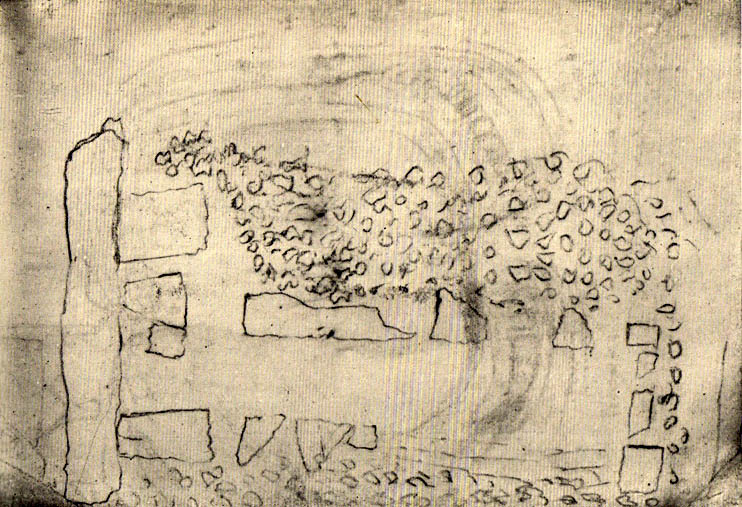
Scruffy 1835 ground plan of the lost tomb

Archaeology & History

An exact grid-reference for this once-impressive chambered tomb is difficult as “nothing remains of this site at the present day” (Daniel 1950) and the majority of the hilltop itself (a prehistoric hillfort no less), has been turned into one of those awful golf courses which are still spreading like cancer over our ancient hills.  It was obviously very close to the Shropshire border, as the folklorist Charlotte Burne (1853) said the grave was “on the Shropshire side of Llanymynech Hill,” perhaps placing it in the township of Pant.  But traditionally it remains within Llanymynech, within and near the top of the huge hillfort and east of Offa’s Dyke.

The old tomb was mentioned in an early letter of the great druid revivalist, Edward Lhwyd, who left us with the old ground-plan, reproduced above; and based on Lhwyd’s drawing and early narratives, Glyn Daniel (1950) thought the site “was perhaps a gallery grave”.  The best description we have of Bedd y Cawy was penned by John Fewtrell (1878) in his essay on the local parish in which he told:

“This interesting relic of antiquity stood on the north-eastern end of the hill.  It was formed of four upright stones, on the top of which was placed a flat slab measuring 7ft by 6ft, and 18 in thickness.  It is known by the name “Bedd-y-Cawr” (the Giant’s grave).  The British name appears to support the theory that the cromlech is a burying place, and not an altar devoted to religious purposes.  The word is derived probably from the Welsh cromen, a roof, or vault, and lech, a stone, meaning a vault formed by a slab supported upon uprights ; or, according to some, ” the inclining flat stone”.  Rowlands derives it from the Hebrew cærem-luach, “a devoted stone”, but this is far-fetched for a word or name in common use among our British forefathers.  Many regard the cromlech as a distinct species of monument, differing from either a dolmen or a cairn.

“When the covering of stones or earth has been removed by the improving agriculturist, the great blocks which form the monolithic skeleton of the mound and its chamber usually defy the resources at his command.  As the skeleton implies the previous existence of the organised body of which it formed the framework, so, upon this theory, the existence of a ‘ cromlech ‘ implies the previous existence of the chambered tumulus of which it had formed the internal framework.  Sepulchral tumuli were formerly classified according to their external configuration or internal construction; but more extended and critical observation has shown that mere variations of form afford no clue to the relative antiquity of the structures. But as it has always been the custom of the prehistoric races to bury with their dead objects in common use at the time of their interment, such as implements, weapons, and personal ornaments, we have in these the means of assigning the period of the deposit relatively to the Stone, Bronze, or Iron age.” Sometimes no traces whatever of human remains are found in the chamber.  Search was made to some depth in this cromlech, but nothing was found.”

In Fewtrell’s same essay he also described another megalithic site (also destroyed) on the southwestern part of the Llanymynech Hill, where,

“stood two rows of flat stones, parallel, 6 feet asunder, and 36 in length. A tradition exists which states that in digging near this place a Druid’s cell was discovered, but of what shape or size it does not relate.  There were a number of human bones and teeth in a state of good preservation also discovered.  In digging between the parallel rows a stratum of red earth was found, about an inch thick.”

Folklore

As the name of this old tomb tells, it was once reputed as “the Grave of the Giant”, but in Charlotte Burne’s huge work on the folklore of Shropshire (volume 1), she told it to be the tomb of his lady:

‘The Giant’s Grave’ is the name given to a mound on the Shropshire side of Llanymynech Hill, where once was a cromlech, now destroyed. The story goes that a giant buried his wife there, with a golden circlet round her neck, and many a vain attempt has been made by covetous persons to find it, undeterred by the fate which tradition says overtook three brothers, who overturned the capstone of the cromlech, and were visited by sudden death immediately afterwards.”

There is also a legendary cave beneath Llanymynech Hill which have long been regarded as the above of goblins and faerie folk.  More of this will be told in the profile for the hillfort itself.

References:

  1. Burne, Charlotte Sophia (ed.), Shropshire Folk-lore, Trubner: London 1853.
  2. Daniel, Glyn E., The Prehistoric Chamber Tombs of England and Wales, Cambridge University Press 1950.
  3. Fewtrell, John, “Parochial History of Llanymynech,” in Collections Historical & Archaeological Relating to Montgomeryshire, volume 11, 1878.
  4. Wynne, W.W.E., “Letters of E. Lhwyd,” in Archaeologia Cambrensis, vol.3, 1848.

© Paul Bennett, The Northern Antiquarian


Round Hill, Middleton Moor, North Yorkshire

Tumulus:  OS Grid Reference – SE 107 509

Also known as:

  1. Black Hill tumulus

Getting Here

Round Hill tumulus, Middleton Moor

From Ilkley town centre, taken the road north across the River Wharfe, turning left and up the country lane towards Nesfield.  As you’re driving with the farmed fields on either side, you’ll go round a couple of swerves in the lane and reach the open moorland on your right, just past the small copse of trees on the same side.  There’s a small place to pullover on the right 100 yards on and walk up the footpath running northeast onto the moor.  Go past the disused quarry and up further till you reach the rounded hill where the tumulus stands.

Archaeology & History

On the moors north of Ilkley – as shown on OS-maps since the 1850s – on the southeastern edge of Middleton Moor, is this singular tumulus, a short distance west of some old quarrying at the curiously-named Lurgy Delf.  The small hill is easy to find and appears at the western edge of a whole host of neolithic and Bronze Age remains.  It is included as a boundary marker between Middleton and Langbar, as marked by an old stone on its southern side.  Eric Cowling (1946) described this as “a spread of stones on Round Hill” in the same context as other burial mounds and cairns in the region, also naming it as the Black Hill tumulus.  Many flints had been found all round here and it stands at the western edge of a great number of cup-and-ring stones, stretching eastwards across the moors for several miles.  To my knowledge, no excavation has taken place here.

References:

  1. Cowling, Eric T., Rombald’s Way, William Walker: Otley 1946.

© Paul Bennett, The Northern Antiquarian

Boatbridge Quarry, Thankerton, Lanarkshire

Cists (destroyed):  OS Grid Reference – NS 981 376

Also Known as:

  1. Tinto Quarry

Archaeology & History

The sites that were once here have long since been destroyed as a result of quarrying operations.  But thankfully this place was given a quick appraisal by those renowned Scottish archaeologists, Anna Ritchie and D.V. Clarke, before final destruction.  They recorded the site in an early edition of Discovery & Excavation in Scotland:

“Two short cists were discovered in November, 1970, during the removal of a long low gravel ridge protruding into the flood plain of the River Clyde.  The two cists were both aligned NE-SW and were 14m apart.  Both employed identical construction techniques.  The side slabs overlapped both end slabs and the N end slab was shorter than the other three slabs, necessitating a building-up of the floor by some 30cm.  Both appear to have had a double layer of capstones although this is uncertain in one case.  The cists contained and adult and child without grave goods on a gravel floor in one, and an adult with a beaker on a ‘crazy-paving’ floor in the other.”

Crazy-paving in prehistoric times sounds good!  The Scots got there first!

References:

  1. Clarke, D.V. & Ritchie, Anna, “Boatbridge Quarry: Short Cists,” in Discovery & Excavation in Scotland, 1971.

© Ian Carr, The Northern Antiquarian 


Solar Stone, Askwith Moor, North Yorkshire

Cup-and-Ring Stone:  OS Grid Reference – SE 17738 51003

Also Known as:

  1. Carving no.567 (Boughey & Vickerman)
  2. TV Stone

Getting Here

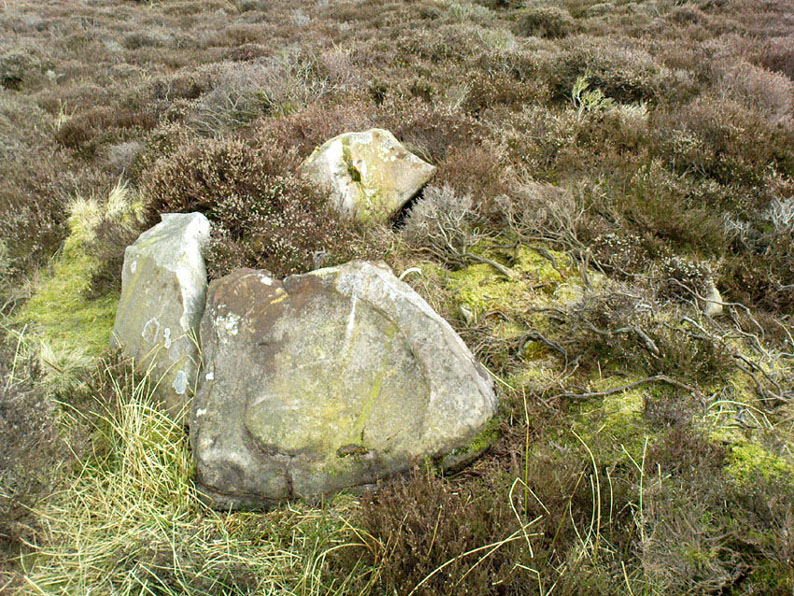
Stone at cairn edge

From the scruffy Askwith Moor lay-by car-park, along Askwith Moor road, follow the fence north up along the roadside until you reach the gate on your right.  Go thru this and head due west into the moor, towards the small cluster of other carved stones (carvings 581, 582, etc), particularly the Small Rings Stone (carving 579).  Around here, you’ll notice a cluster of about 10 mounds in the heather, which seem to be prehistoric cairns, and this particular stone rest against the northwestern side of one of them, about 30 yards west of carving 579.  If you’re patient, you’ll find it! (if you fancy a look at all these on the moor, gimme a shout & I’ll take you straight to ’em – but you need to make a booking!)

Archaeology & History

This carving takes a bitta finding amidst the mass of deep heather and open moorland and is probably only gonna be of interest to real cup-and-ring fanatics.  But it’s the setting which makes it more intriguing — for me anyhow!

Trying to highlight the internal CnR
Solar Stone carving

Like other carvings on this moorland, we find it in direct association with a prehistoric tomb (though it aint been excavated), resting up against the edge of one.  However, it seems to have been moved from its original position and may, perhaps, have actually faced the other way at some time in the past.  We might never know.  However, some student in the recent past saw fit to name this small carving the ‘TV Stone’, thanks to the slightly cronky outline of an old television screen, with its small half-cup-and-ring near the bottom corner of the rock.  You can see where they were coming from!

Boughey & Vickerman (2003) made only a brief note of the stone, seeing only the cup-and-half-ring here; but there seems to be a faint cup-marking near the middle of their TV screen, along with faded evidence of an incomplete ring around it.  You can just about make it out in the poor photos we took of it. (sadly, we were without water when we visited it, which would have highlighted the additional cup-and-slight ring more clearly)

Close-up of cup-and-half-ring

We gave this stone the title ‘Solar Stone’* as it seems more appropriate and would certainly have more mythic relevance to the people who carved this.  The curious natural ring, or TV outline, running round most of the stone (with the faded cup-and-part-ring near its centre) may have been attached with more animistic attributes than us moderns tend to give things — children notwithstanding!  Circular forms in Nature have universal tendencies in more traditional cultures with such heavenly bodies as sun or moon, which might have been relevant here with the stones association with a tomb.

…Again, we might never know…

References:

  1. Boughey, Keith & Vickerman, E.A., Prehistoric Rock Art of the West Riding, WYAS: Wakefield 2003.

* though did debate in somewhat primitive northern lingo: “Ugh – errr…solar? lunar? Ey? — Solar? Lunar?” uttering the same queried mantra numerous times between ourselves till we got tired and stuck with ‘solar’, as seems common these days (though I preferred ‘lunar’, it’s gotta be told!).

© Paul Bennett, The Northern Antiquarian


Bleara Moor, Earby, Lancashire

Tumulus:  OS Grid Reference – SD 9242 4539

Getting Here

To get here, take the same direction as to reach the Bleara Lowe tumulus, stopping a short distance away when you reach the large heap just by the walling where the moorland levels out.  Y’ can’t really miss it!

Archaeology & History

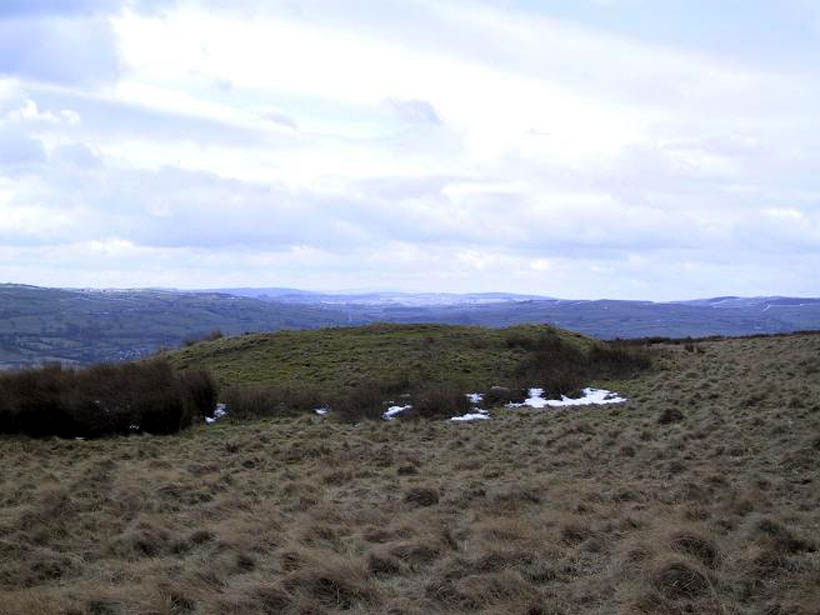
Bleara Moor tumulus

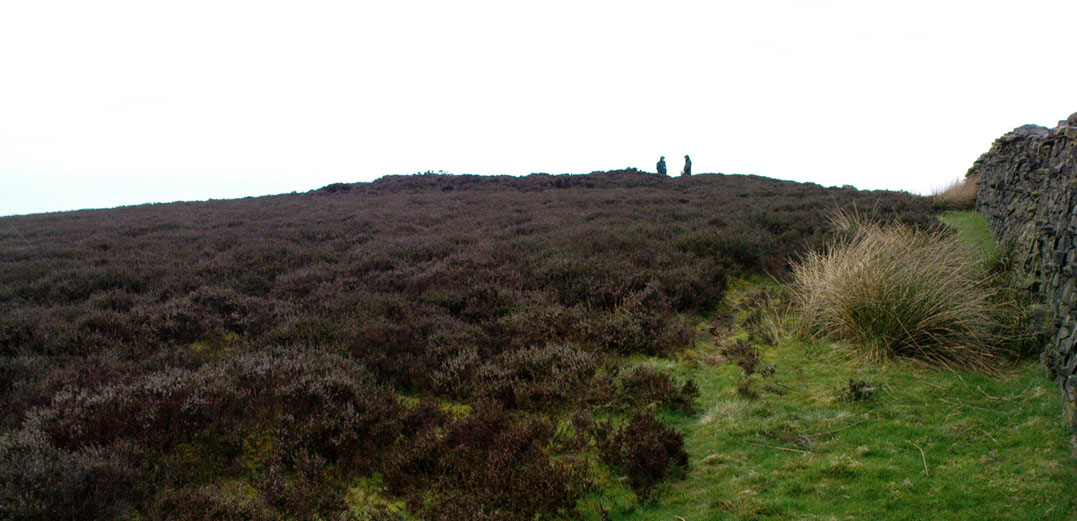
Found on the top of the slope above the Bleara Moor Cairnfield, this is quite a large burial mound that seems to have been forgotten on the small moorland heights above Earby and Lothersdale.  No archaeological excavation has been done here and there seem to be no accounts of any finds in local antiquarian records.  When we visited the place it was very overgrown and covered in heather, but it stood out in the open landscape.  Slightly larger than its more famous companion to the east, this tomb stands three- to four-feet high on average, with a diameter of around 25 yards on its longest northeast/southwest axis.  Consistent in structure with the larger cairns on Burley Moor like the Little Skirtful, this tomb was probably built in the Bronze Age.  It also seems that a lot of stone has been robbed from this cairn for use in the local walling.  The site was given a minimal description on the Pastscape website, where it was described as:

“Round cairn 230m W of Bleara Howe (sic). Scheduled RSM No 23718. A partly mutilated slightly oval mound of peat and heather-covered stones up to 1.2m high with max dimensions of 23m NNE-SSW x 21m WNW-ESE.”

The views from here are considerable and this probably had some relevance when it was first built, but I’m not aware if an assessment of this aspect of the site has been made.  More information about the Bleara Moor tumulus (and its companions!) would be hugely appreciated!

© Paul Bennett, The Northern Antiquarian

Bleara Lowe, Earby, Lancashire

Tumulus:  OS Grid Reference – SD 92663 45387

Getting Here

Bleara Lowe mound, looking NW

There’s no footpath to this site, but we came to it via the car park on Coolham Lane on the southeast side of Earby.  Walking uphill, we got over the wooden stile on the moorside and walked up the side of the walling, all the way upwards till we reached the top of the moor.  You’ll pass the large Bleara Moor tumulus just by the walling, then head towards the rounded hillock on the top of the moor a coupla hundred yards away.  Y’ can’t really miss it!

Archaeology & History

As with many sites in this area, very little has been said of this usually overgrown Bronze Age burial mound.  Although no known recorded excavation of the tomb has ever been done, someone dug into the top of the mound in the 1960s, but we have no record of any finds.  The tomb stands on the local boundary line between Earby and Lothersdale to the east and was known as ‘Bleara Haugh’ in the 1819 Enclosure Act.  But little else has ever been said of it.

Bleara Lowe
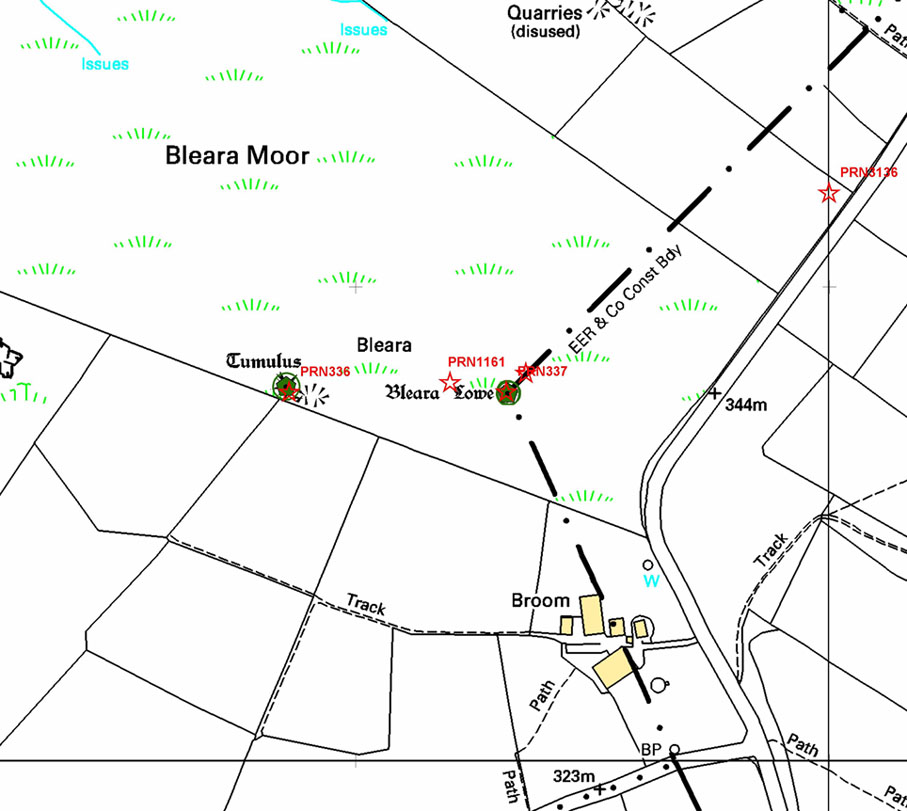
OS-map of site

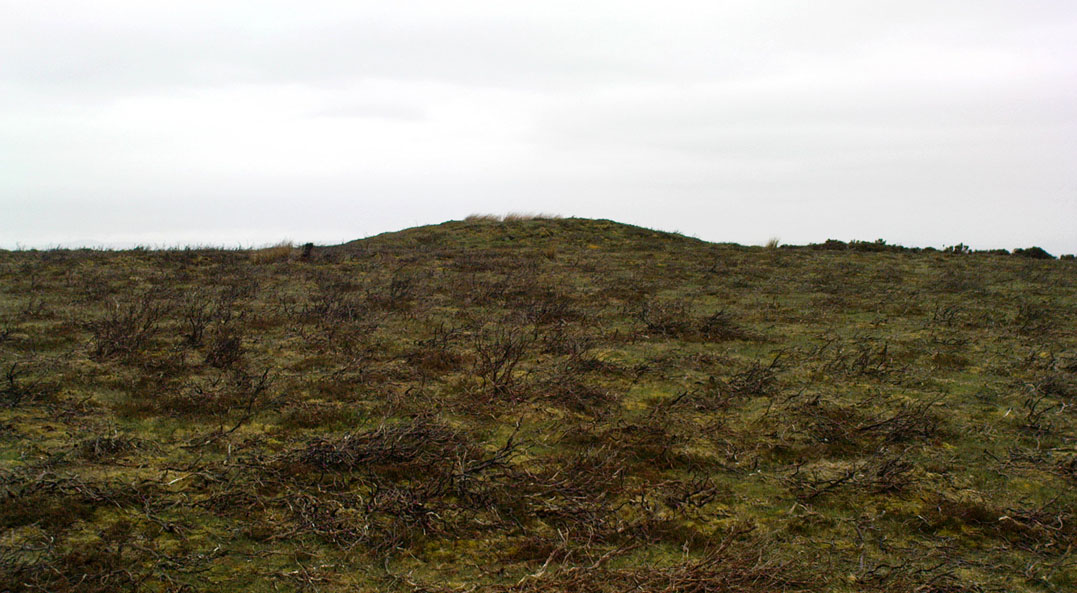
When we visited the place a few months ago, we were fortunate in that the heather had been burnt back, so allowing a much better view of the site than normally afforded when it’s covered in heather.  The rounded mound was between 4 and 5 feet high and measured approximately 20 yards across.  The pit which had been dug into the top of the mound was still visible, though much overgrown.  The view from the tomb itself was very impressive — which would have been of some importance in the construction of the place.  The Pastscape website describes Bleara Lowe as:

“A slightly oval mound of peat and heather-covered stones up to 1.4m high with max dimensions of 21m E-W x 19m N-S. There is a rectangular hollow 3m x 1.5m x 0.4m deep on the cairn’s summit.”

Another larger tumulus or overgrown cairn can be found over 200 yards west of here; plus a number of small singular prehistoric cairns have been located further down the western slope of the moor, known as the Bleara Moor Cairnfield.  None of these sites have ever been excavated.

© Paul Bennett, The Northern Antiquarian


Lilla Cross, Fylingdales Moor, North Yorkshire

Cross:  OS Grid Reference – SE 88923 98686

Also Known as:

  1. Lilla’s Cross

Getting Here

Lilla Cross is situated on Fylingdales Moor, north Yorkshire, between Pickering and Whitby at the junction of two major moorland footpaths. It is located close to the Fylingdales Ballistic Missile Early Warning Station – which resemble giant golf balls on the horizon.

Archaeology & History

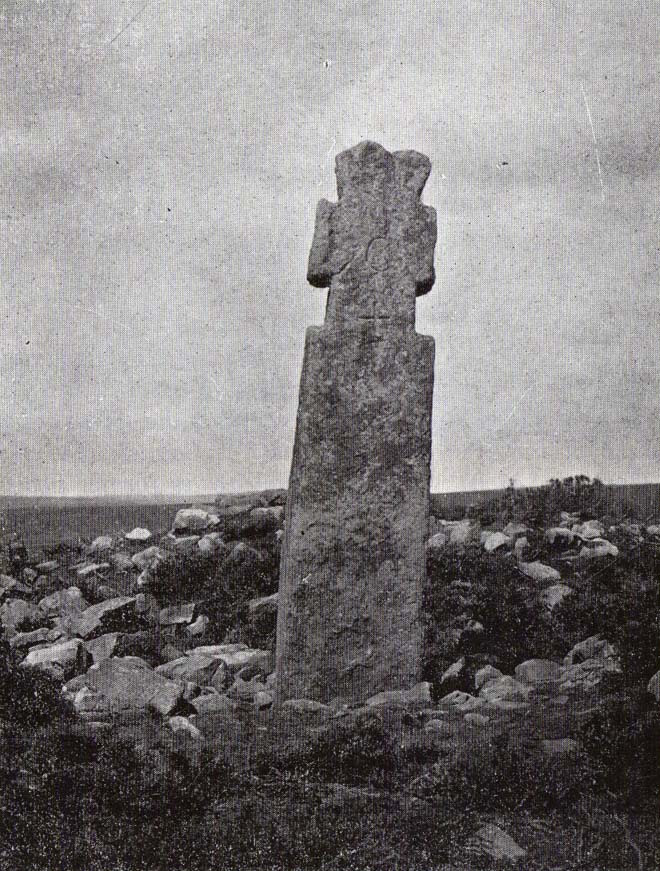
Woodwark’s 1930s photo of Lilla Cross

The ancient cross is 10 foot high and free-standing but it sits upon what is probably a ruined Bronze-Age bowl barrow called Lilla Howe; the recumbent stones that lie around the base of the cross may form part of that. It is a sturdy, stocky cross that has some letters carved onto it, one in particular being a large letter “C” possibly meaning Christos (Christ) and with that a small thin cross; there are a few other faint letters but these are difficult to decipher now. A plaque on a nearby stone gives information about the cross. I think Lilla Cross was used as a sort of Medieval milestone or way-marker – hence the lettering on the cross.

In 1952 the cross was moved to Sil Howe near Goathland but 10 years later in 1962 it was returned to its original site on top of Lilla Howe. In the 1920s excavations on the barrow revealed some artefacts of jewellery, but no remains of Edwin’s trusty chief minister were found; the jewellery was, in fact, said to date from the mid 9th century. Lilla Cross has been referred to by historians as the oldest christian cross on the north York Moors.

Folklore

Lilla Cross on 1854 Map

According to the legend, in AD 625 or 626 King Edwin of Northumbria was travelling with his entourage across the moors, but an assassin had been dispatched by the king of the west Saxons to kill Edwin. The assassin lunged forward with his poison tipped sword, but Lilla his chief minister at the king’s court, leapt in between his sovereign and the swordsman. Poor Lilla took the full thrust of the sword and died on the spot thus saving the king from being murdered. King Edwin, who was greatly impressed by this selfless act of devotion, ordered that Lilla being a newly converted christian be buried here in a christian way though he asked that a number of articles be placed with the body including gold and silver. The king then had a cross erected in memory at the spot where Lilla died. But it seems likely that the cross dates from the 10th century, though there may have been an earlier Saxon cross here.

References:

  1. Ogilvie, Elizabeth & Sleightholme, Audrey, An Illustrated Guide to the Crosses on the North Yorkshire Moors, Village Green Press: Thorganby 1994.
  2. White, Stanhope, Standing Stones and Earthworks on the North Yorkshire Moors, Fretwell & Cox: Keighley 1987.
  3. Woodwark, T.H., The Crosses on the North York Moors, Whitby Literary & Philosophical Society 1934.

© Ray Spencer, 2011