Ursa Major Stone, Brae of Cultullich, Aberfeldy, Perthshire

Cup-Marked Stone:  OS Grid Reference – NN 87958 49022

Also Known as:

  1. Brae of Cultullich (3)

Getting Here

The stone from the trackside

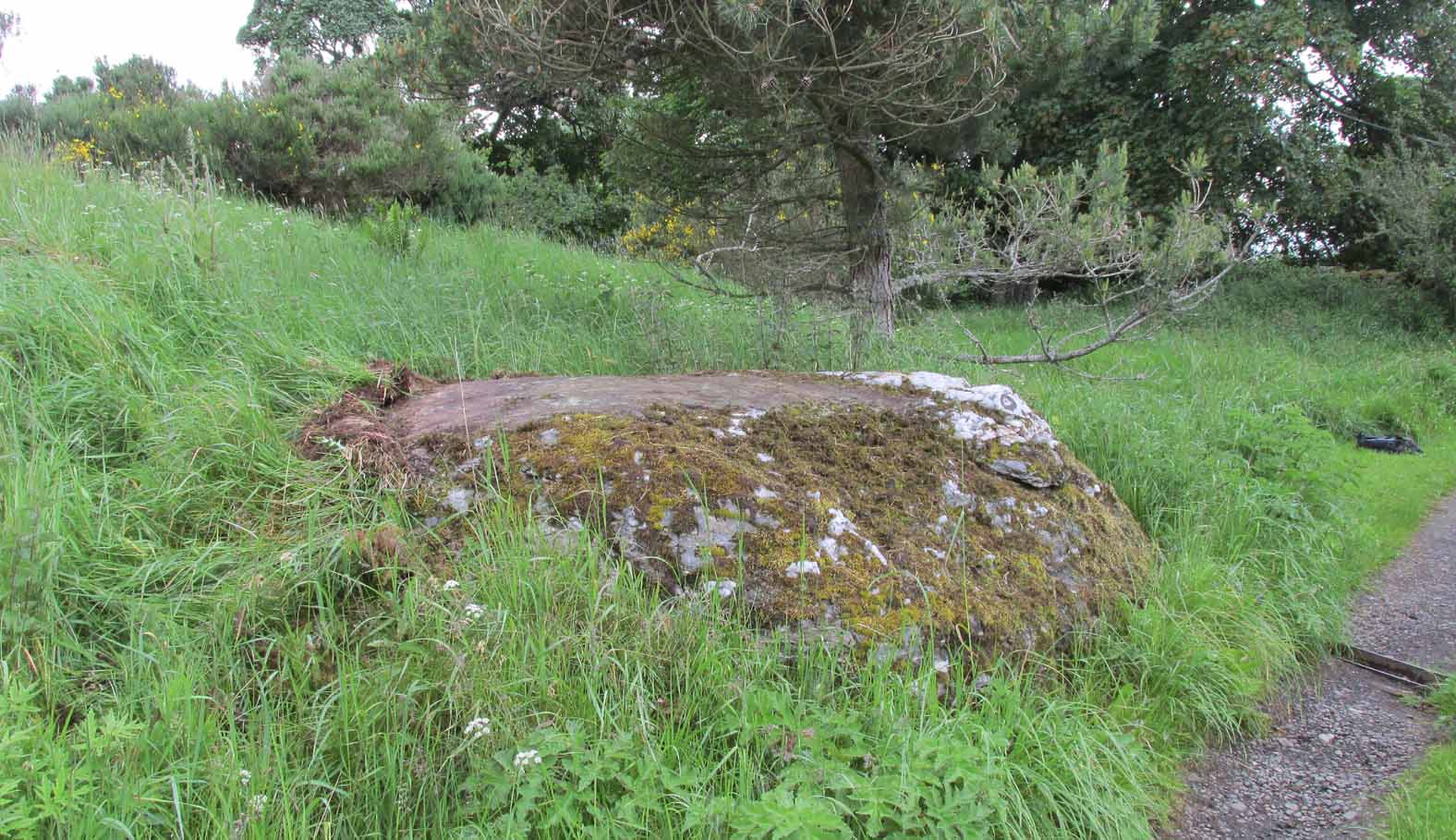
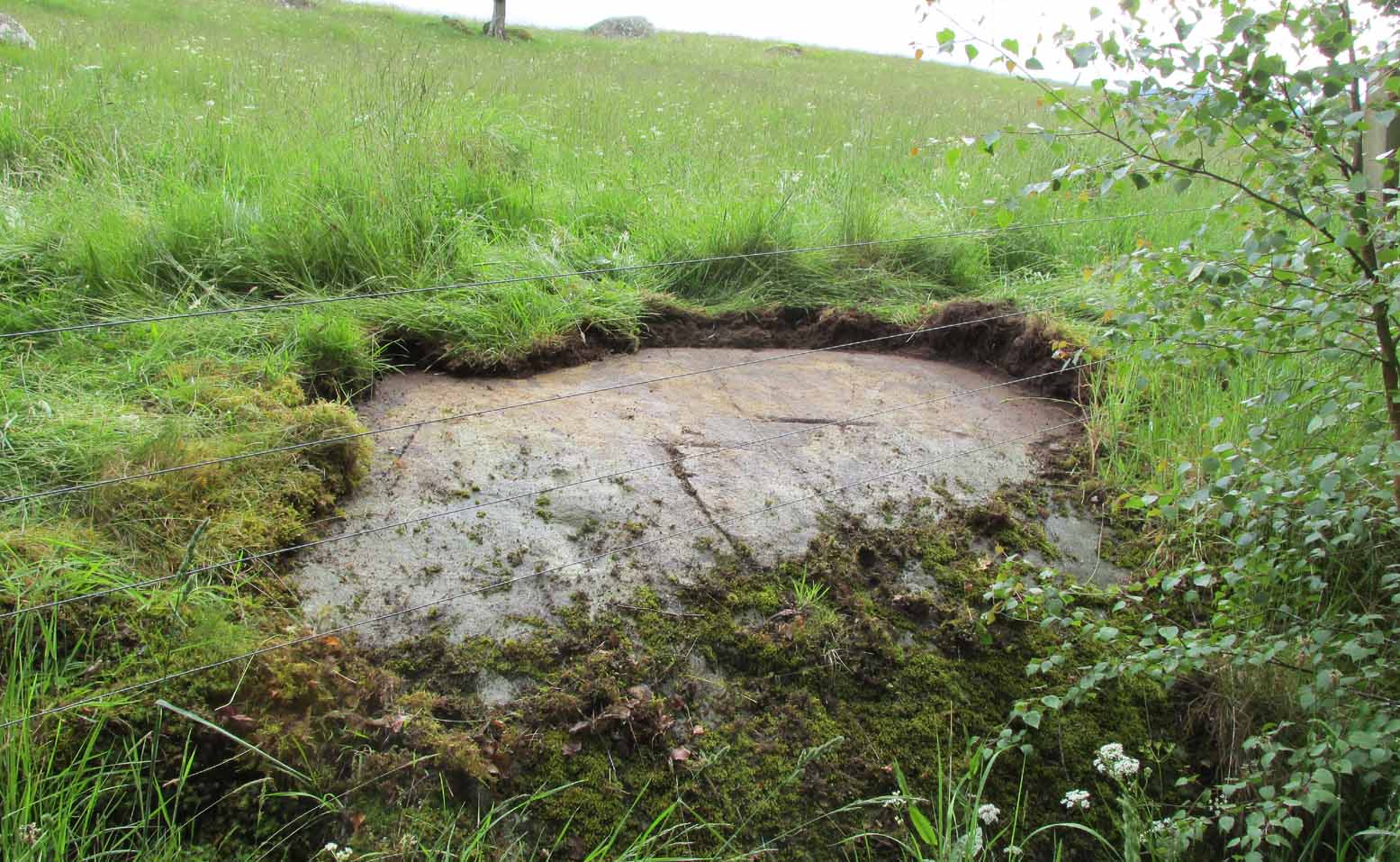
Out of Aberfeldy, take the A826 road as if you’re going up Glen Cochill.  Not far up, just where the housing of Aberfeldy itself ends and the green fields open up either side of you, keep on the road for a half-mile where you meet a small copse of trees on your left, with a dirt-track that runs down the slope.  Go down the track, bending to the right, then the left and then on for a quarter of a mile until the lines of trees appear either side of you.  Barely 200 yards along, the track swerves slowly to your right, and the field above you slopes uphill.  Keep your eyes peeled at the fencing on your right and you’ll see a stone sloping towards you right by the fence with faint cup-marks on it.  You’ll find it!

Archaeology & History

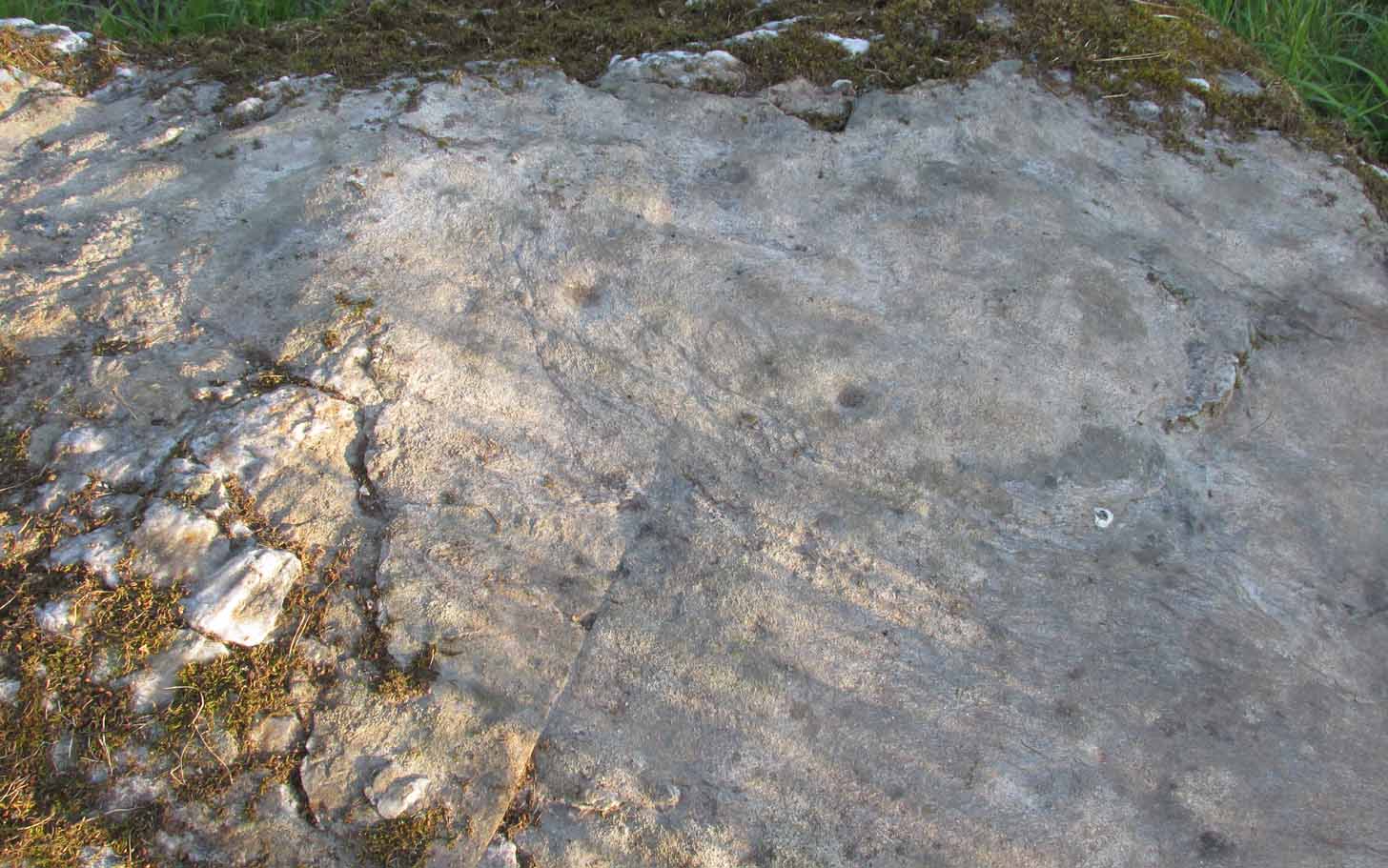
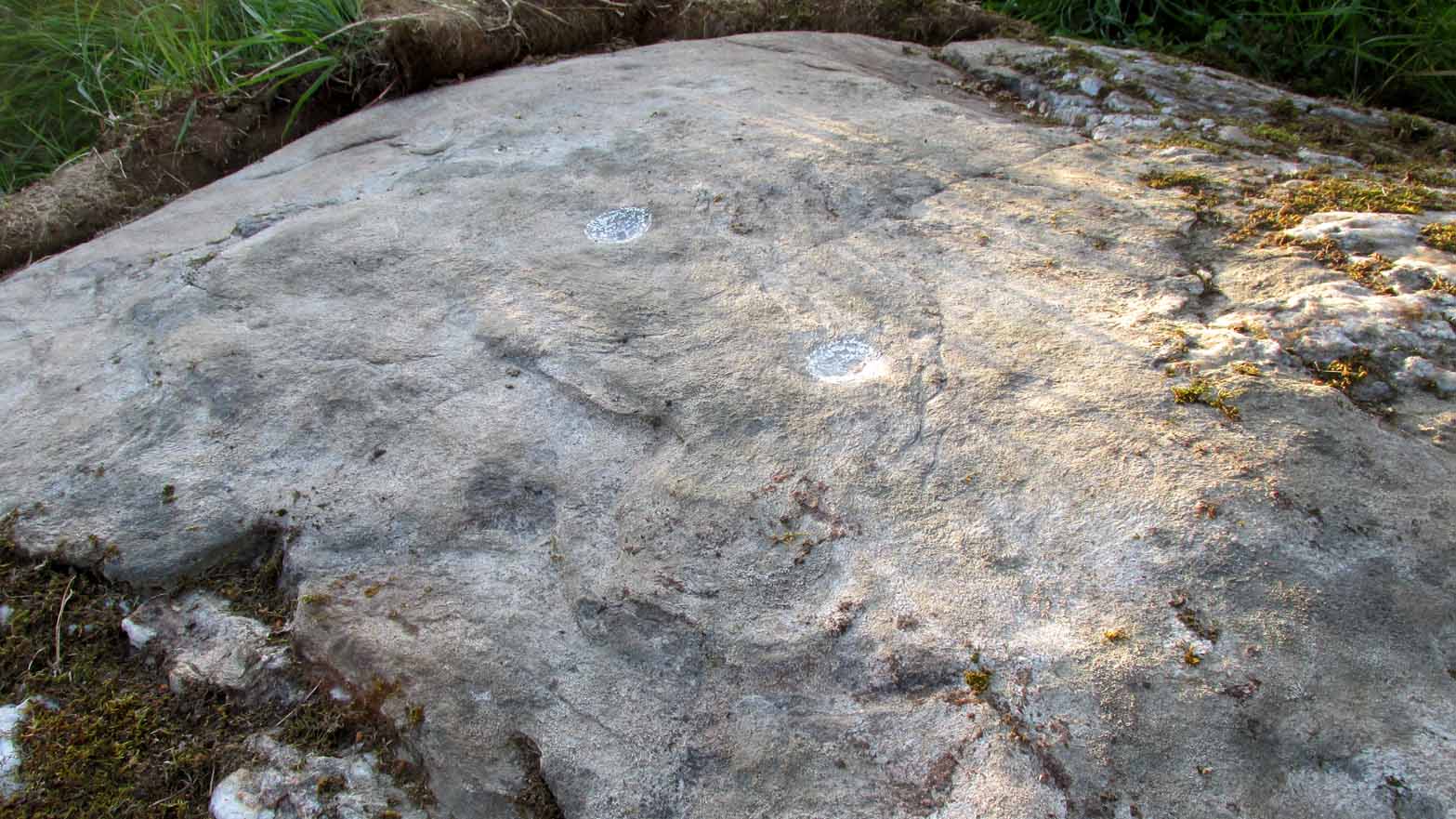
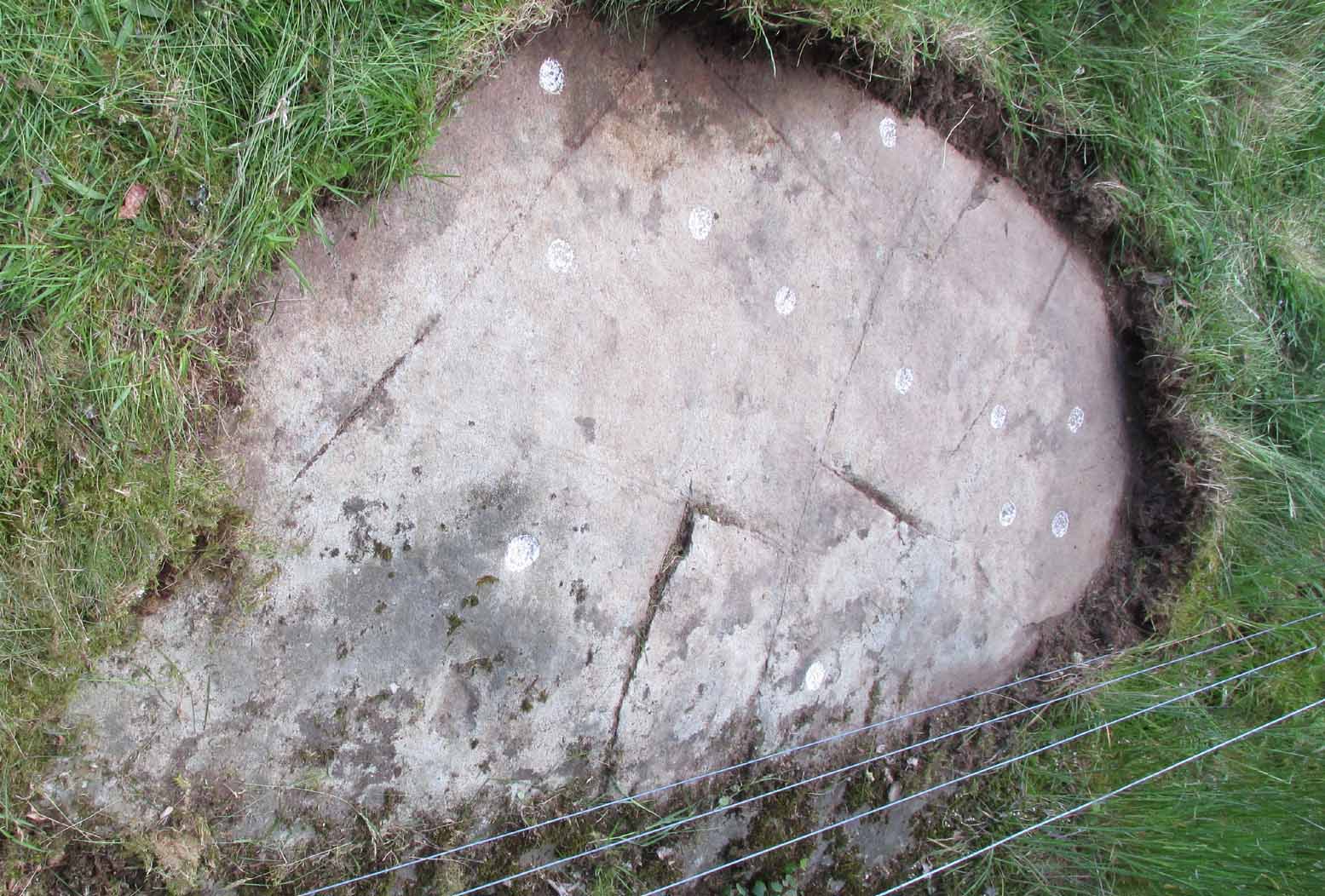
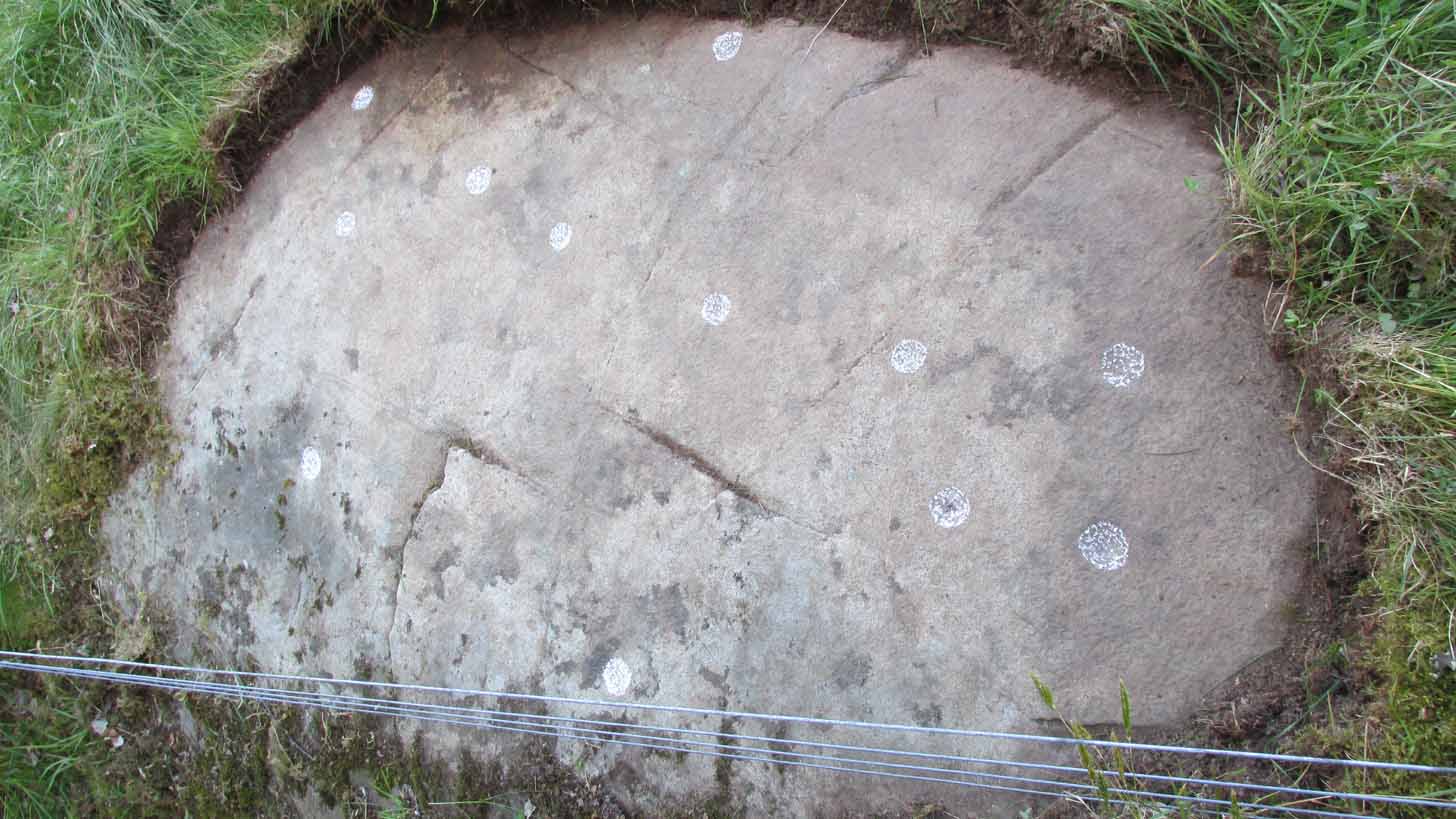
A truly fascinating cup-marked stone recently uncovered by Paul Hornby on another one of our TNA meanderings. Fascinating because of the curious arrangement of the cups on the stone.  Often, cup-marked stones have little to interest the causal visitor – but this one’s different.  As can be seen quite clearly, the cups are arranged in the shape of the constellation of the Great Bear, or Ursa Major – albeit with an extra ‘star’ in this design.  But it’s damn close!  In all likelihood (he says with his sceptical head on 😉 ), the design is fortuitous when it comes to the Ursa Major.  I know from many years experience how easy it is to see meaningful shapes and designs in the almost entirely abstract British petroglyphs, but the design is very close to the constellation we all got to know when we were kids.

Looking along the stone
Gazing down at Ursa Major

The stone itself slopes upwards at an angle of about 60º, before starting to level out as it rises.  All of the cup-marks have been pecked onto this sloping surface (the vast majority of carvings are found on top of stones).  Altogether, at least twelve faint and shallow cups were exposed when we looked at it—measuring the usual inch to inch-and-half across—but it is likely that more of them are hidden beneath the turf at the top of the stone.  We could discern no rings or other features in the design.

This is just one carving amidst a good cluster of petroglyphs within a few hundred yards of each other (the Quartz Stone being one of the nearest) that are well worth checking out if you like your rock art.  It may also be of interest to astronomy students, or those exploring archaeo-astronomy.

References:

  1. Yellowlees, Sonia, Cupmarked Stones in Strathtay, RCHAMS 2004.

© Paul BennettThe Northern Antiquarian


Auchinellan, Ford, Kilmartin, Argyll

Standing Stone:  OS Grid Reference – NM 86681 03320

Also Known as:

  1. Achadh nan Carradh
  2. Achnacarra
  3. Canmore ID 22802

Getting Here

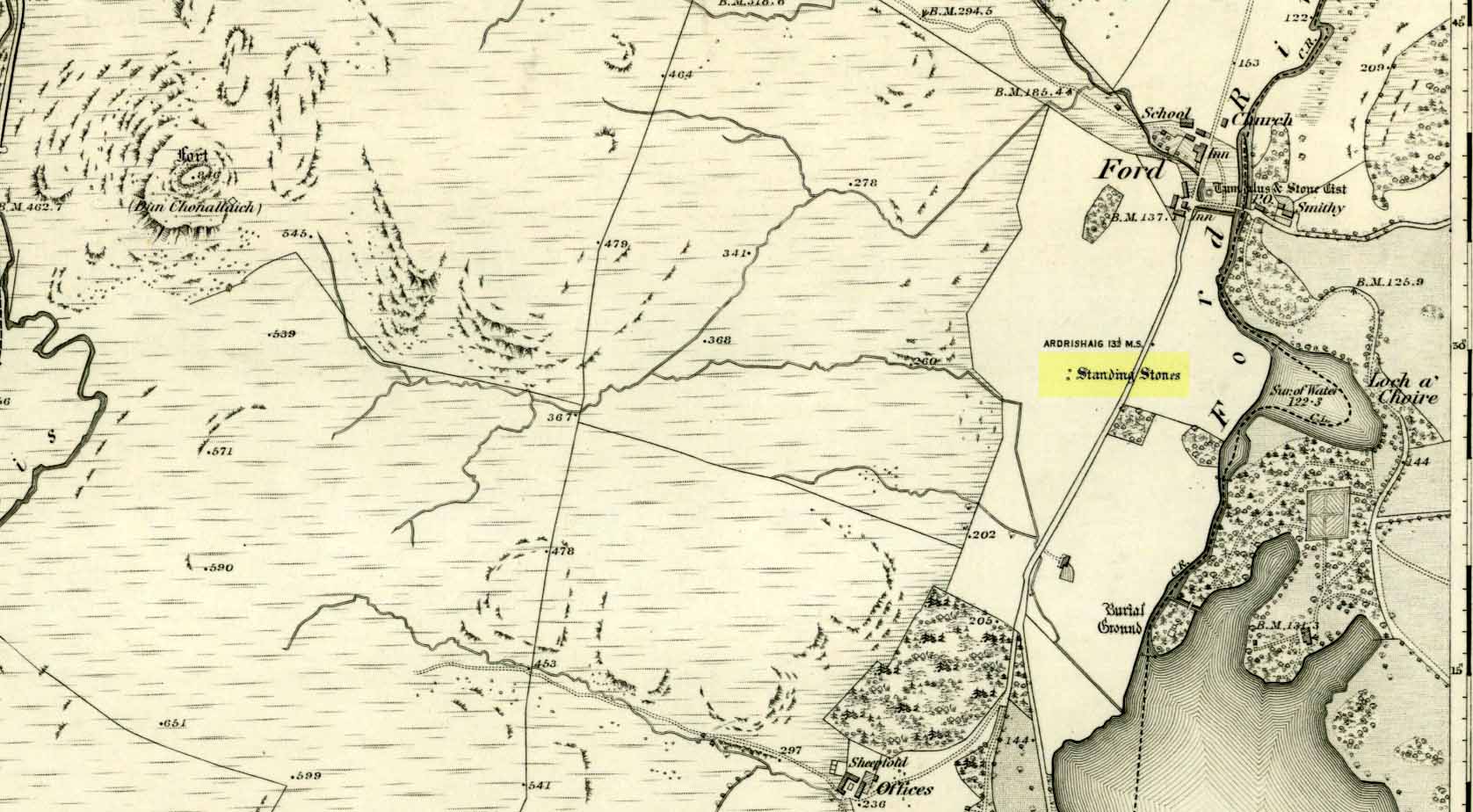
Two stones on 1875 map

Unless you’re venturing down the tiny Loch Awe roads, the easiest way here is to turn right off the A816 Lochgilphead-Oban road, 1½ miles north of Kilmartin.  Go along this winding minor road for literally 2½ miles where, after coming out the tree-lined road, just past the small Loch Ederline, the fields re-appear on both sides of the road.  Just here, where the trees end, just a few hundred yards before the hamlet of Ford, in one of the field on the left, you’ll see a tall upright stone.  That’s it!

Archaeology & History

I was very fortunate, many years ago, to live in the old farmhouse of Auchinellan in the trees by this ancient stone.  It became a companion of mine many-a-time, as I sat with it in rain and mist and darkness sometimes, beneath the bright Moon.  It always had a good feeling about it.  And so when a small bunch of us visited here again recently, it was almost as if I’d never been away.  Tis a magickal part of our landscape.

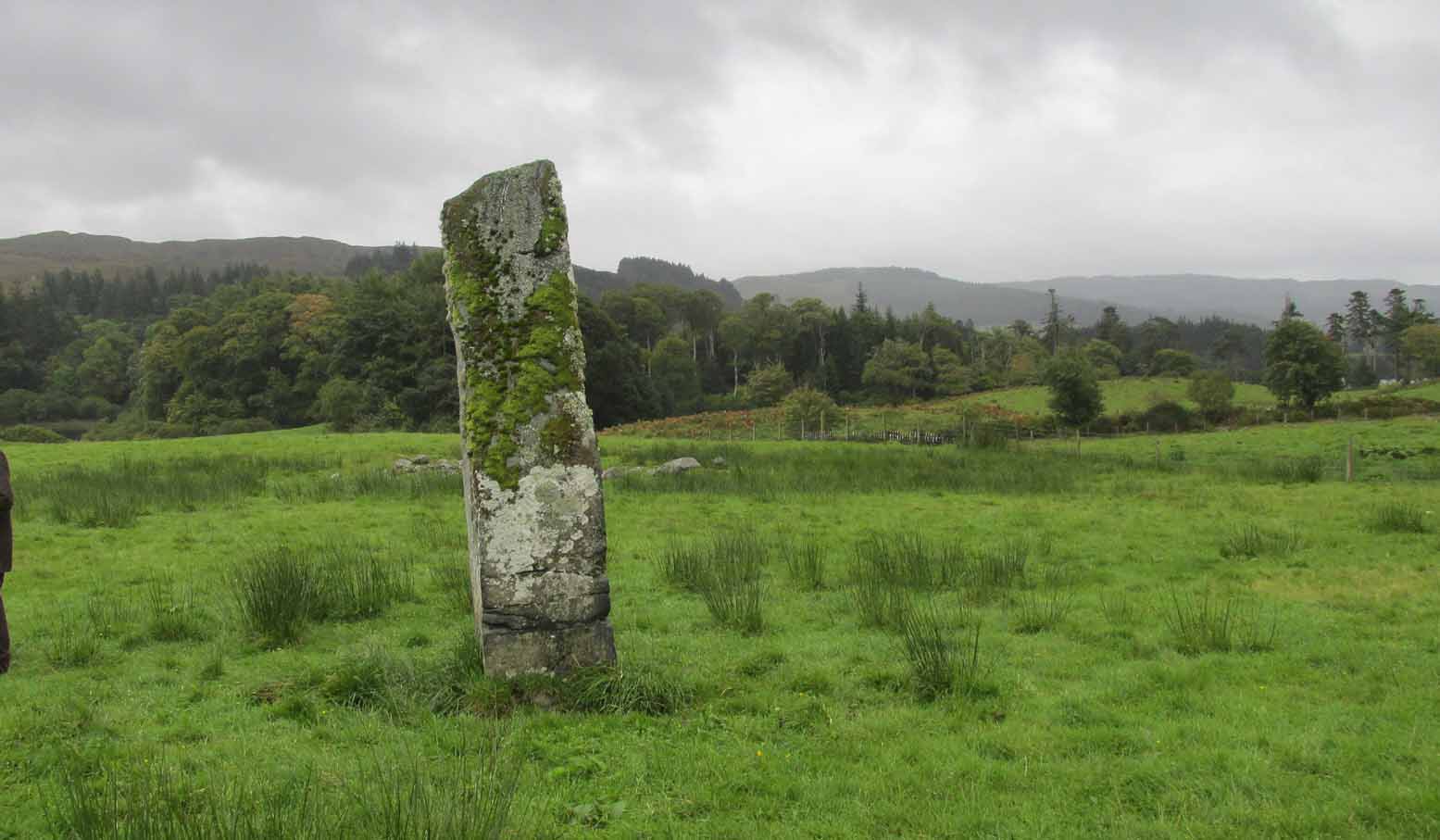
The old stone looking N
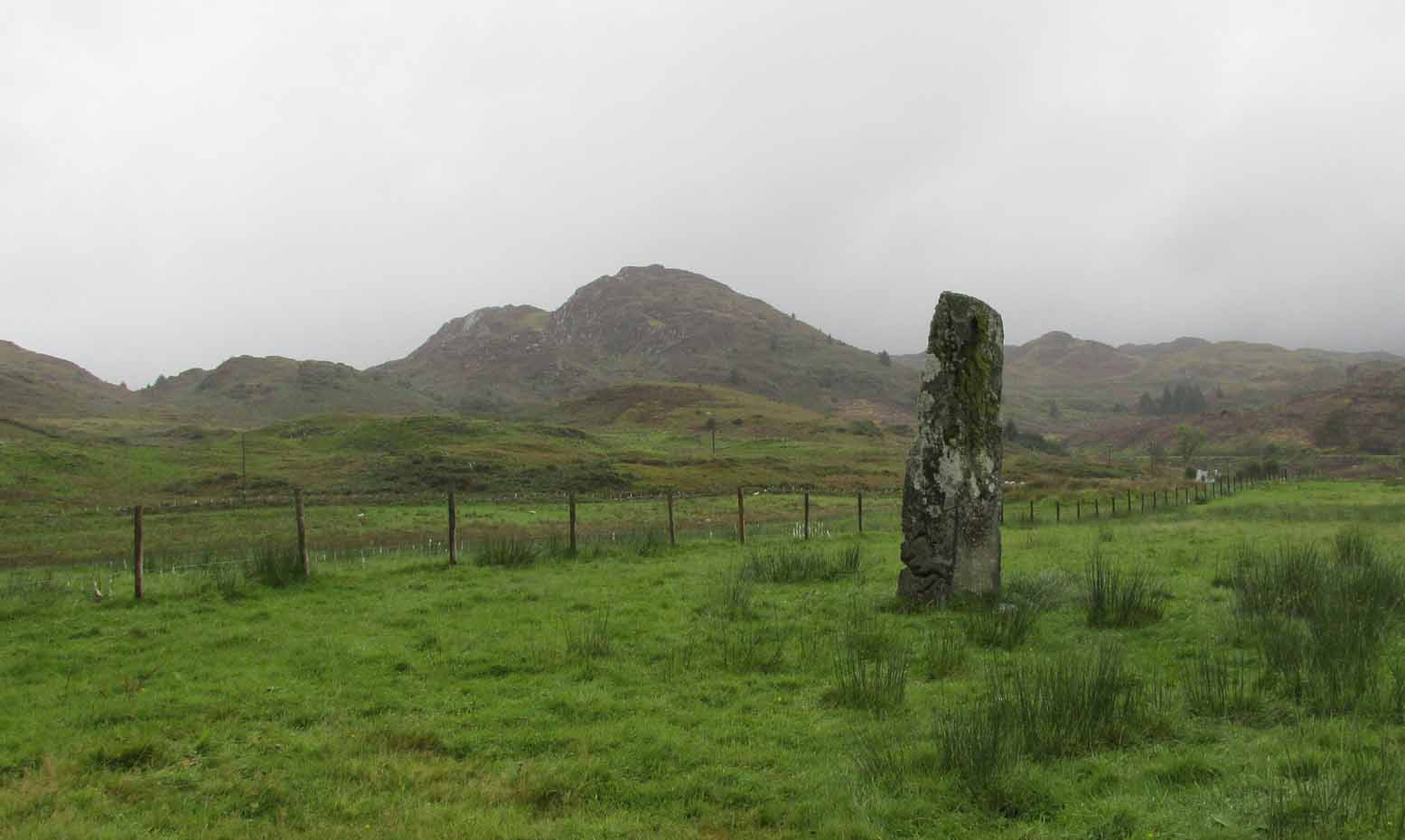
The old stone looking NW

Standing ten-foot-tall on a grassy plain with craggy hills all round, this old fella once had a companion close by its side—a stone one!  Accounts of it are curious to say the least, with one telling us that it was only “a few inches high” – which is just daft.  The now-lost stone was in fact about six-feet tall and the story of its disappearance was that it was moved into the grounds of Auchinellan House where I used to live, somewhere in the garden.  I could never find it, and local folk told me that the old fella who lived in the mansion would have known about it, but died shortly before I moved in.  Clive Ruggles (1984) told that it could be found at grid-reference NM 8653 0268, but that would be smack bang on the manor house.

As far as I can tell, the first written testimony of this stone was by the Ordnance Survey lads after they’d visited here in 1871 and, several years later, highlighted it on their maps. (above)  On this is clearly shown, just yards apart, the two standing stones.  Much later, when the Royal Commission (1988) doods did their survey, they described the stone in their usual brief way:

“Situated on the top of a slight rise in a pasture field 270m SW of the Ford Hotel, there is a standing stone which measures 0.7m by 0.55m at the base and rises with straight sides to a flat top at a height of 3m…”

The site was included in Thom’s (1990) major survey on prehistoric stone rows where, again, only a brief description is given, saying:

“On a terrace near Loch Ederline is a standing stone which leans to the E.  It is 9ft 6 (2.9m) high.”

It’s a beautiful place in a beautiful setting and is one of countless prehistoric monuments in this part of Scotland.  Well worth having a look at.

Folklore

The Gaelic names for this site—Achnacarra and Achadh nan Carradh—means “the field of the burial stone”, which relates to the folklore of the stones reputedly marking the place of an ancient grave.

References:

  1. Campbell, Marion, Mid Argyll – An Archaeological Guide, Dolphin: Glenrothes 1984.
  2. Campbell, Marion & Sandeman, M., “Mid Argyll: An Archaeological Survey,” in Proceedings Society of Antiquaries Scotland, volume 95, 1964.
  3. Royal Commission on the Ancient & Historical Monuments of Scotland, Argyll – Volume 6: Mid-Argyll and Cowal, HMSO: Edinburgh 1988.
  4. Ruggles, Clive L.N., Megalithic Astronomy, BAR: Oxford 1984.
  5. Thom, Alexander, Thom, A.S. & Burl, Aubrey, Stone Rows and Standing Stones – volume 1, BAR: Oxford 1990.

Acknowledgements:  Big thanks to Neens Harris, Paul Hornby & Frank Mercer.  And the stunning resource of Scotland’s 1st edition OS-maps is Reproduced with the kind permission of the National Library of Scotland

Links:

  1. Auchinellan (Ford) Stone on The Megalithic Portal

© Paul BennettThe Northern Antiquarian


Flat Howe (2), Sleights Moor, Sleights, North Yorkshire

Cairn:  OS Grid Reference – NZ 85510 04614

Also Known as:

  1. Flat Howe (south)

Getting Here

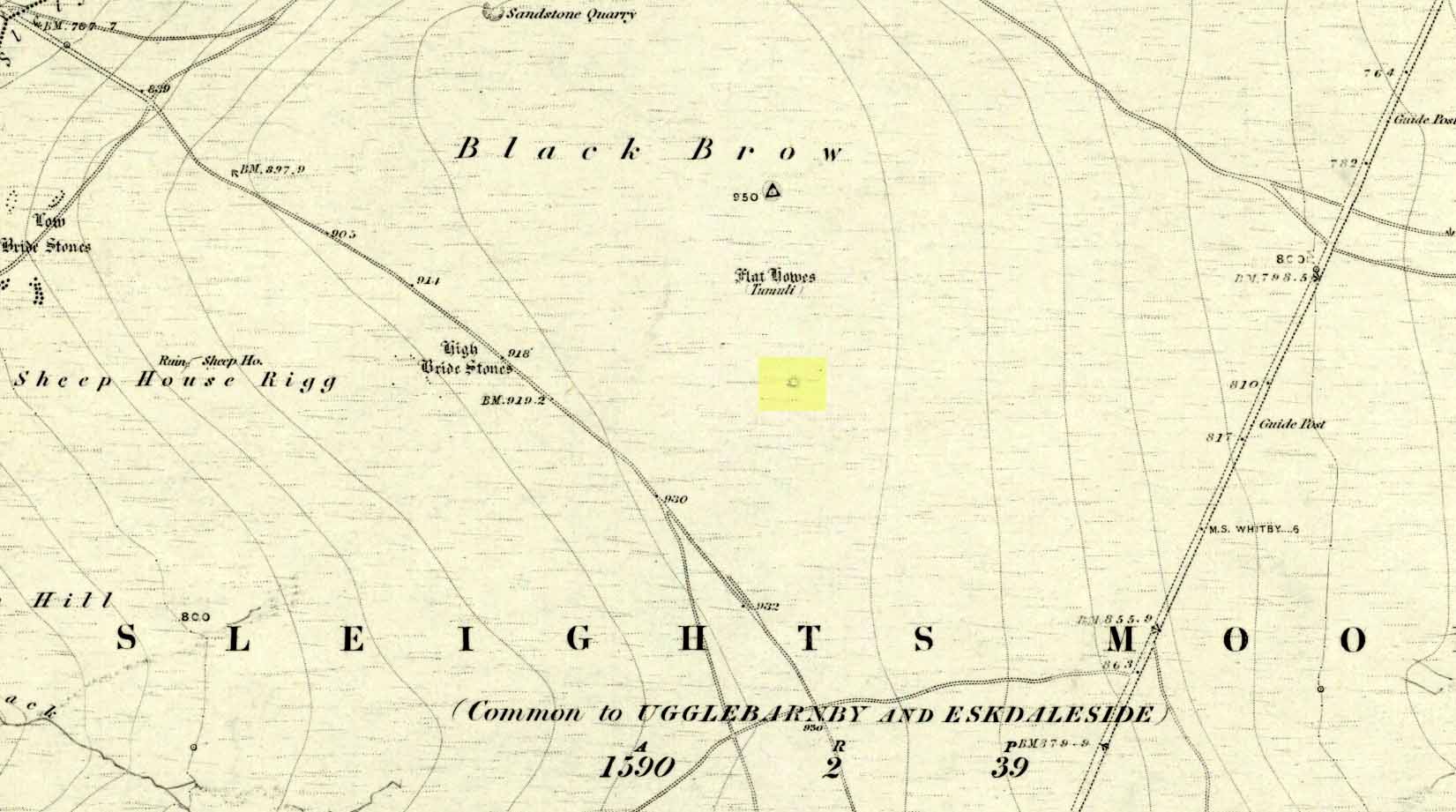
Flat Howe-2 on 1853 map

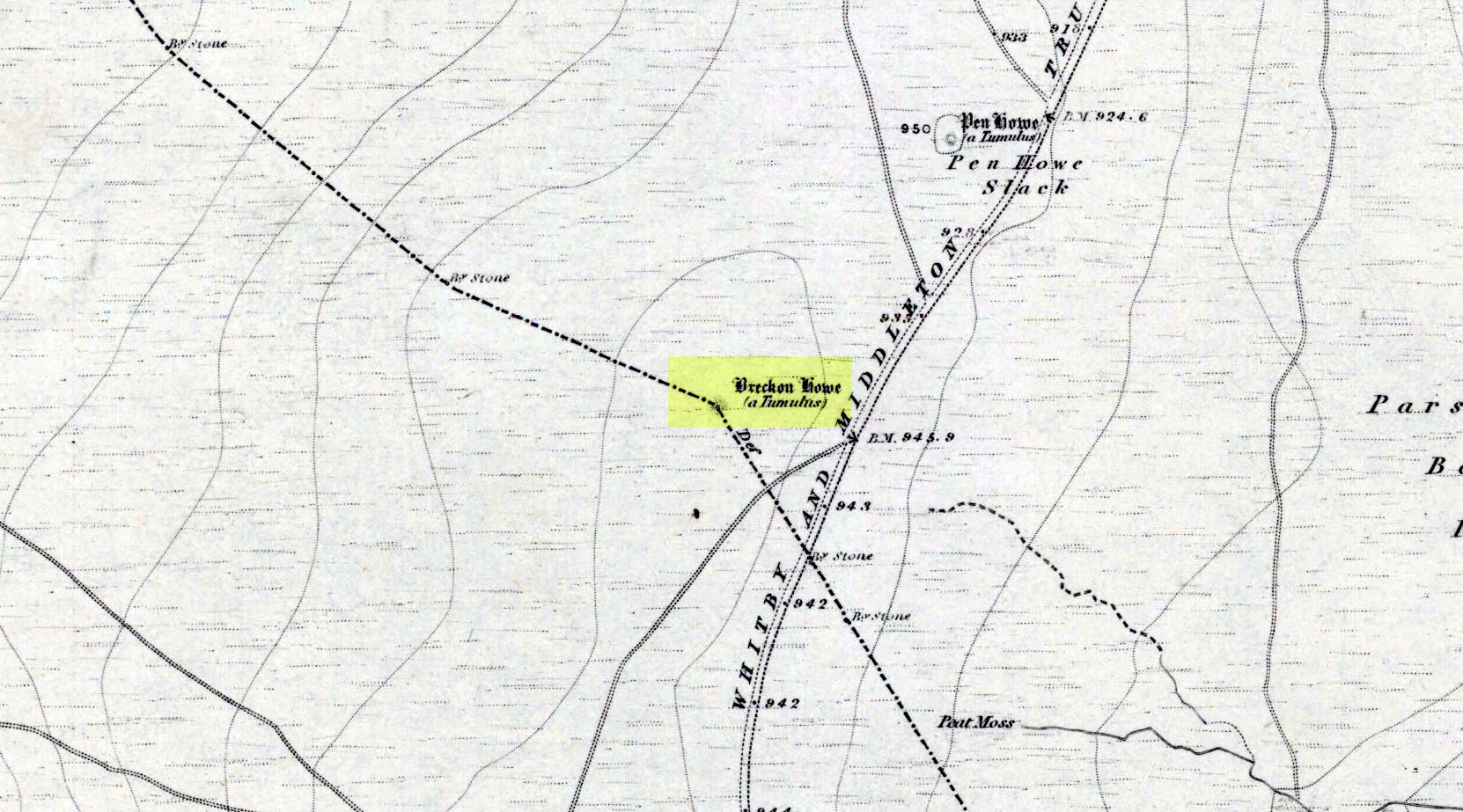
Along the A169 road that runs may miles from Whitby to Pickering, as you go through the small town of Sleights, the road gets steep for a mile or so, until you reach the moorland tops, where the road runs dead straight.  After 1.2 miles (1.93km) along the straight road, a small minor road is to your right.  Go along here for literally half-a-mile (0.8km) where you’ll see a small dirt-track on your right, with a locked gate.  There’s room to park here.  Walk straight onto the moor towards the large rounded mound about 200 yards northeast.  That’s it!

Archaeology & History

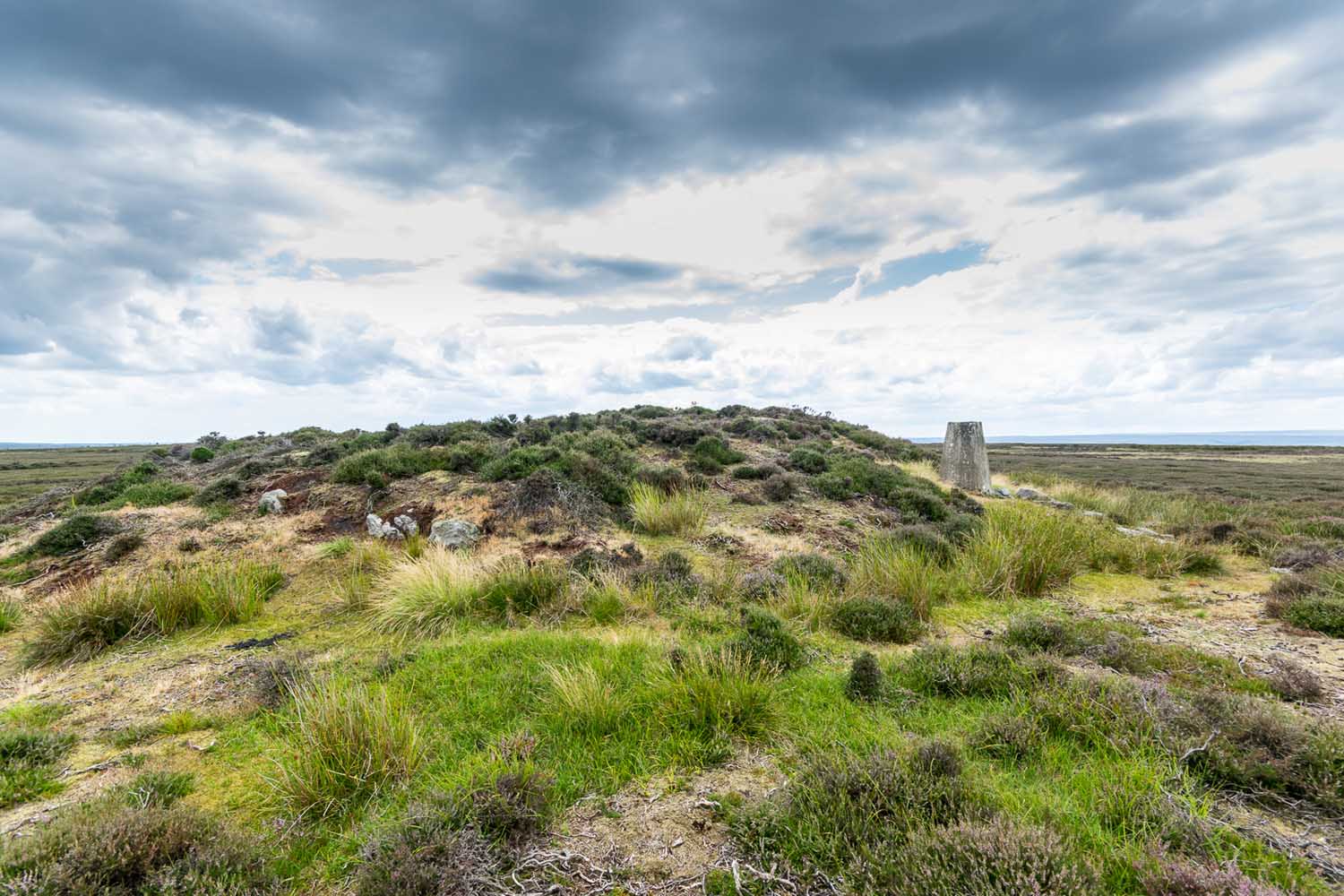
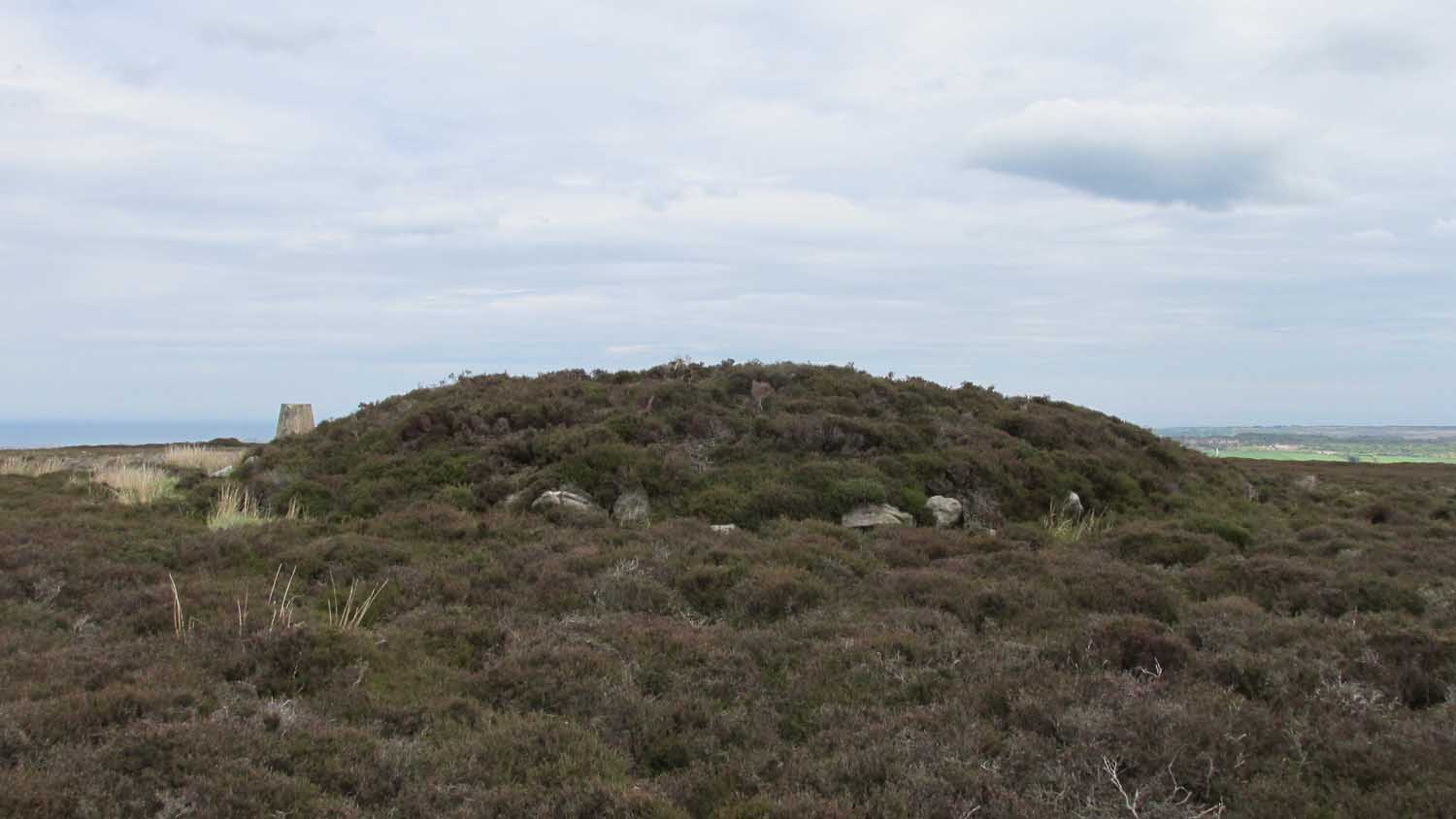
Highlighted as a blip on the 1853 OS-map (see above) 250 yards south of Flat Howe (1), this is the slightly smaller of the two prehistoric cairns on this flat piece of moorland (which covered in scattered woodland at the time of its construction).  It has been severely robbed of stones by some land-owning fuckwits in the 19th century, who saw fit to build a shooting hut into the tomb itself!  Knob-heads!   As a result, much of the content of the cairn has been severely depleted, with only its western side having any real height to it.

Flat Howe 2 looking south (photo, James Elkington)
Flat Howe 2, looking east

Just like Flat Howe 1, it seems that it’s never been excavated, so we can only guess about how old it is; though it is very probably Bronze Age.  The cairn is roughly 25 yards across and oval in form, but was probably more circular before those morons built their hunting lodge into it.  Its western side stands some 4-5 feet tall, which was probably the uniform height all round it before it was vandalized.  A few yards to the south is what may be a cup-marking on one of the flat earthfast rocks, although I’m slightly sceptical of it.

The position of the site in the landscape is a fine one: living on a large flat open expanse of land, which was probably cleared of some trees when it was first built, allowing for a very wide view in all directions, just like its companion 250 yards to the north.  Well worth checking out.

Folklore

It’s worth repeating the myth we have of a place on Sleights Moor that I’ve also cited in the Flat Howe 1 site profile.  Although we have nothing specific relating to this tomb, an olde creation myth tells us that the local giants, Wade and his wife Bel, left their young son (whose name seems to have been forgotten) somewhere on Sleights Moor (which aint a big place).  The story was first written down by George Young (1817) in his magnum opus on Whitby and the tale was subsequently re-told by many others – Mrs Gutch (1901) for one:

“Young Wade, even when an infant, could throw a rock several tons weight to a vast distance; for one day when his mother was milking her cow near Swarthoue, the child, whom she had left on Sleights moor, became impatient for the breast, and seizing a stone of vast size, heaved it across the valley in wrath, and hit his mother with such violence, that though she was not materially hurt, her body made an impression on the stone which remained indelible, till the stone itself was broken up, a few years ago, to mend the highways!”

This rock was Bel’s Rock, whose exact location seems to have been lost.

References:

  1. Elgee, Frank, Early Man in Northeast Yorkshire, Frank Bellows: Gloucester 1930.
  2. Elgee, Frank, The Moorlands of North-Eastern Yorkshire, A. Brown: London 1912.
  3. Grinsell, Leslie V., The Ancient Burial Mounds of England, Methuen: London 1936.
  4. Gutch, Mrs, County Folk Lore – volume 2: Examples of Printed Folk-lore Concerning the North Riding of Yorkshire, York and the Ainsty, David Nutt: London 1901.
  5. Jeffrey, P. Shaw, Whitby Lore and Legend, Home: Whitby 1923.
  6. Roberts, Anthony, Sowers of Thunder, Rider: London 1978.
  7. Smith, A.H., The Place-Names of the North Riding of Yorkshire, Cambridge University Press 1928.
  8. Young, George, A History of Whitby and Streoneshalh Abbey – volume 2, Clarke & Medd: Whitby 1817.

Acknowledgements:  A huge thanks to Lindsay Mitchell for getting us up to see this great tomb and its companion; and to James Elkington for use of the photograph.

Links:  Flat Howe on The Megalithic Portal

© Paul BennettThe Northern Antiquarian


Sheriff Hill, Malham, North Yorkshire

Cairn:  OS Grid Reference – SD 8994 6405

Also Known as:

  1. Friar’s Heap
  2. Monk’s Grave

Getting Here

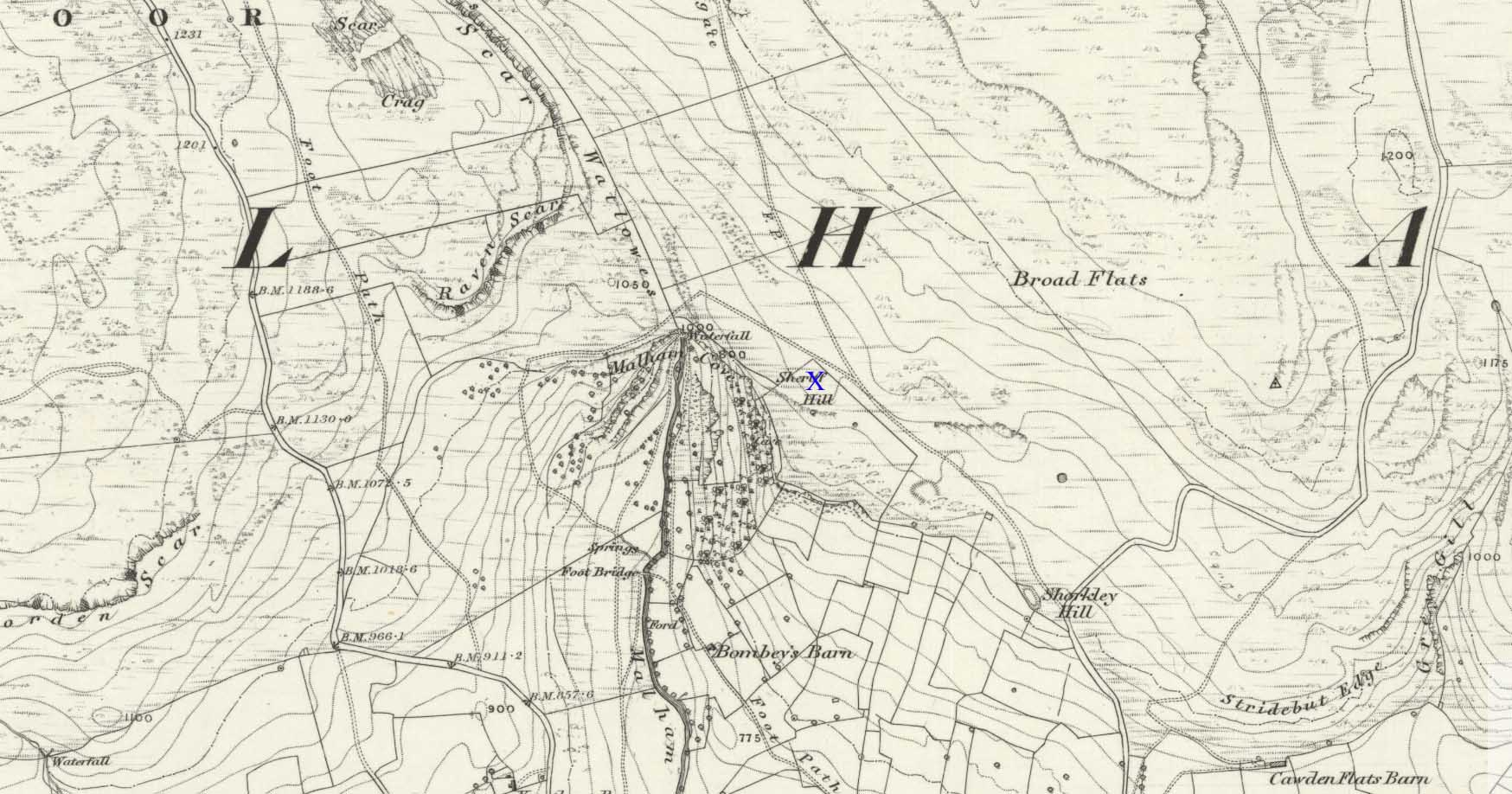
‘X’ marks the spot!

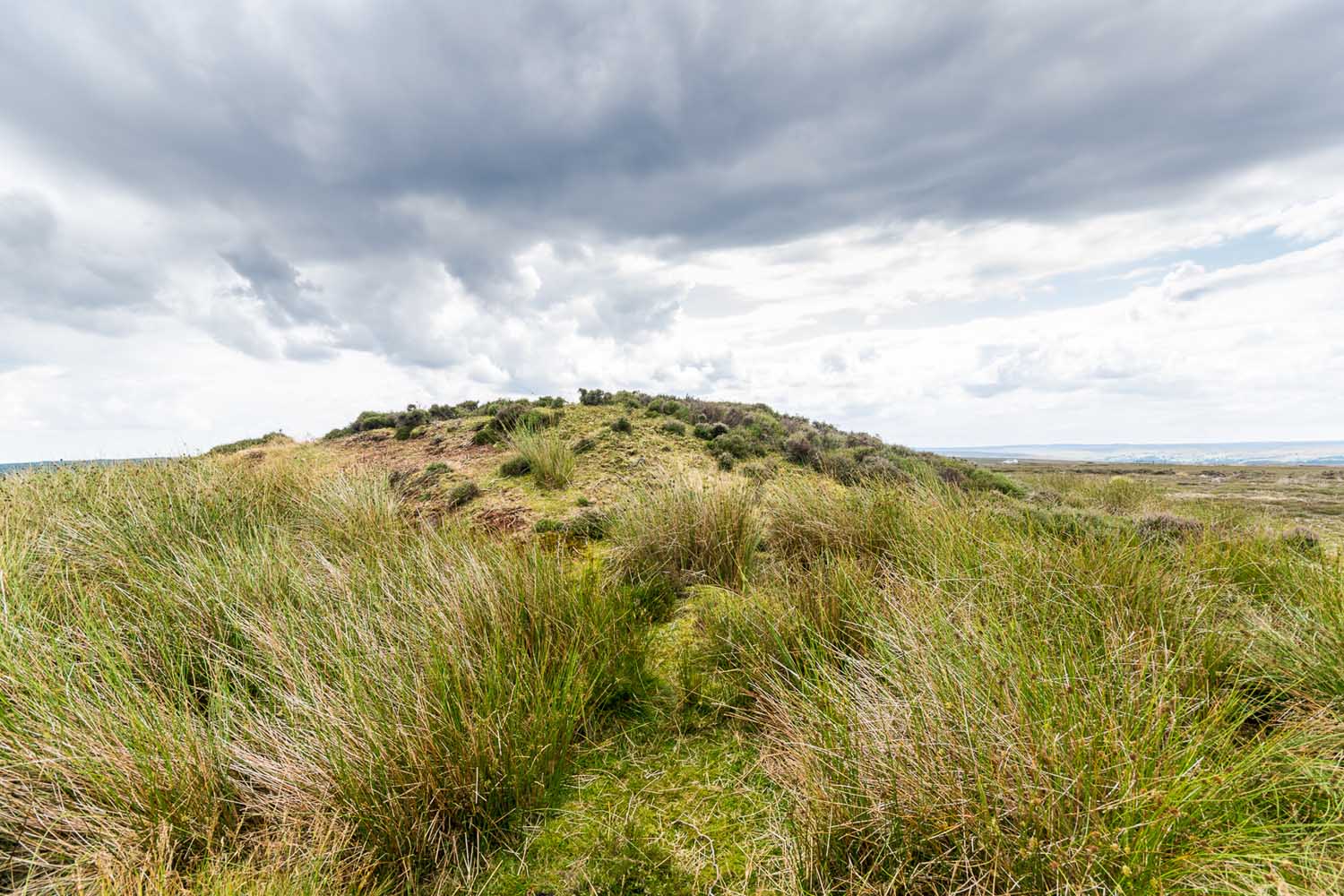
There’s nowhere to park any vehicles anywhere near this place if you wanna reach this site.  And so, from Malham village, take steep eastern road up Malham Rakes (ask a local if needs be) for exaclt half-a-mile (0.81 km) where, at a bittova sharp turn in the road, there’s a footpath on your left.  Walk along here for about 350 yards until you hit a straight line of walling on your left.  Follow this along, about 30 yards before it turns at a right-angle. On the other side of the wall from here, a barely discernible denuded heap is in the overgrown field.  That’s it!

Archaeology & History

To be found above the grand rise of Malham Cove—on its eastern side—the earliest mention I’ve found of this once-large prehistoric burial cairn was in the Cravendale travelogue of William Howson (1850).  His description was only a brief one, telling us how,

“The workmen engaged on the fences have lately opened a large barrow, which is known by the local as the Friars’ Heap, near the eastern arm of the Cove, and a quantity of human bones were found.”

In Howson’s opinion he thought “the spot is much more likely to be connected with the marauding Scots than the peaceful monks”; but he was wrong on both counts.  When the site was later visited and described by the great northern antiquarian, Harry Speight – aka, Johnnie Gray (1891) – he told us that the place “was much more likely to have been a British or Danish burial mound.”

Originally standing to a height of more than six-feet, the tomb has subsequently been reduced to half that height.  The most lengthy descriptions of it were written by the regional antiquarian Arthur Raistrick.  In his topographical literary meanderings across the Malham landscape, he gives a fine overview of its features and locale:

“Across the clints the old valley which leads to the edge of the Cove is seen, and looking upstream a grand impression of the Dry Valley, properly called Watlowes, is obtained.  Across the foot of the valley a stile crosses rhe wall, and a footpath goes up the hill near to the boundary wall of the Cove; this is Sheriff Hill.  At the prominent corner of the wall where the path resumes a level course, it joins the path from Malham Lings called Trougate.  Between here and the road there are abundant traces of the Celtic fields, nestling under the small limestone crags that offer shelter from the northeast, evidently as unwelcome a quarter for the wind when these were occupied as today.  Where the wall turns at right-angles again towards the Cove, there is a very prominent circular mound nearly a hundred feet in diameter.  This is a burial mound of late Iron Age.  It was dug into about the year 1845 and in addition to many human bones , fragments of an iron spearhead were found.  It is to be regretted that no careful account of this excavation was preserved, as there seems no doubt that this was a multiple burial of some importance.  Like other burial mounds in this district, the site was well chosen with a most extensive view which includes many notable hill summits…”

This latter remark could well have come from the pen of the old ley-hunter, Alfred Watkins (1925), who noted time and again how landscape features would seemingly connect one site with another, and another. (the modern idea of leys as ‘energy-lines’ is an American invention and wholly without merit)

A few years after Raistrick gave us his initial description, the cairn was excavated.  In his short work on the archaeology of Malham Moor (1961), he wrote:

“A burial mound (that was) three-quarters removed at the time of the enclosures (about 1845) when the mound was dug as a quarry for walling stones. The remaining fragment was trenched right through and was found to be built entirely of stone with a kerb of large flaggy stone laid on the slope at the foot of the mound.  Many fragments of decorated pottery were founmd under the turf cover and were associated with what appeared to be discarded gravel from the original quarrying, so may have come from the centre.  At the inner edge of the kerb and under a carefully placed cover-stone, a smal oval vessel was got.  This is of thick bluey-grey paste, red outside and very flaky so that part of the surface is lost on the two-thirds of the vessel which remains.  Prof Stuart Piggott has reported on the pottery.  Of this vessel he says — “an oval cup of the so-called ‘Incense Cup’ class: one sherd is of the wall and base of one end, the other a piece spalled off from the inside of the base. I only know of one paralle to this remarkable pot, another oval incense-cup from Far Fields, Lockton, N.R. Yorks, in the York Museum.  A very odd little oval ‘cup’ of sandstone from Defford, Bredon, Worcs, in the Hastings Muesum at Worcerster is a stray find and might be of any age, and anyway only provides a vague parallel.”

Another “vessel is represented by sherd of what appears to be a small cinerary urn of collared or overhanging-rim type with the yellow-brown surface characteristic of so many pots of this class.  The decoration appears to be in alternating panels of vertical and horizontal lines of uncertain width, the whole forming the so-called ‘hurdle’ pattern.  The ornament is made of double lines of twisted cord, one with a right-hand and the other with a left-and twist: such ornament is widely distributed on such vessels…

“A third “vessel is represented by a few sherds with purple-red exterior, decorated with impressed cord, whipped cord and grooving.  It is diffcitul to say what sort of pot is represented, but I suspect something within the food vessel class… The whole assemblage could well be contemporary and would fall withini the Middle Bronze Age of conventional nomenclature, somwhat in the middle of the second millenium BC…”

The most striking feature of this site is its position in the landscape, typical of large cairns in the Pennines and much further afield.  The view to the south is extensive and would have had some bearing on its construction, as such heights allow for the spirits of the dead to move across the landscape.  The huge cliffs of Malham Cove below may also have been an important factor.  In the days when this tomb was built, a great waterfall existed at the Cove that has subsequently fallen back to Earth.  In many traditional cultures, water is an extremely important element.  Its relationship to life is obvious; but also in the Lands of the Dead water feeds the spirit on its journeys.  These animistic and geomantic features are essential in looking at the nature of the placement of sites—and this at Sheriff Hill would have been no exception.

Enjoy your sojourns and meditations here…

References:

  1. Gray, Johnnie, Airedale, from Goole to Malham, 1891.
  2. Howson, William, An Illustrated Guide to the Curiosities of Craven, Whittaker: London 1850.
  3. Raistrick, Arthur, Malham and Malham Moor, Dalesman: Clapham 1947.
  4. Raistrick, Arthur & Holmes, Paul F., Archaeology of Malham Moor, Headley Bros: London 1961.

© Paul BennettThe Northern Antiquarian


St. Margaret’s Stone, Dunfermline, Fife

Cup-Marked Stone:  OS Grid Reference – NT 10837 85060

Getting Here

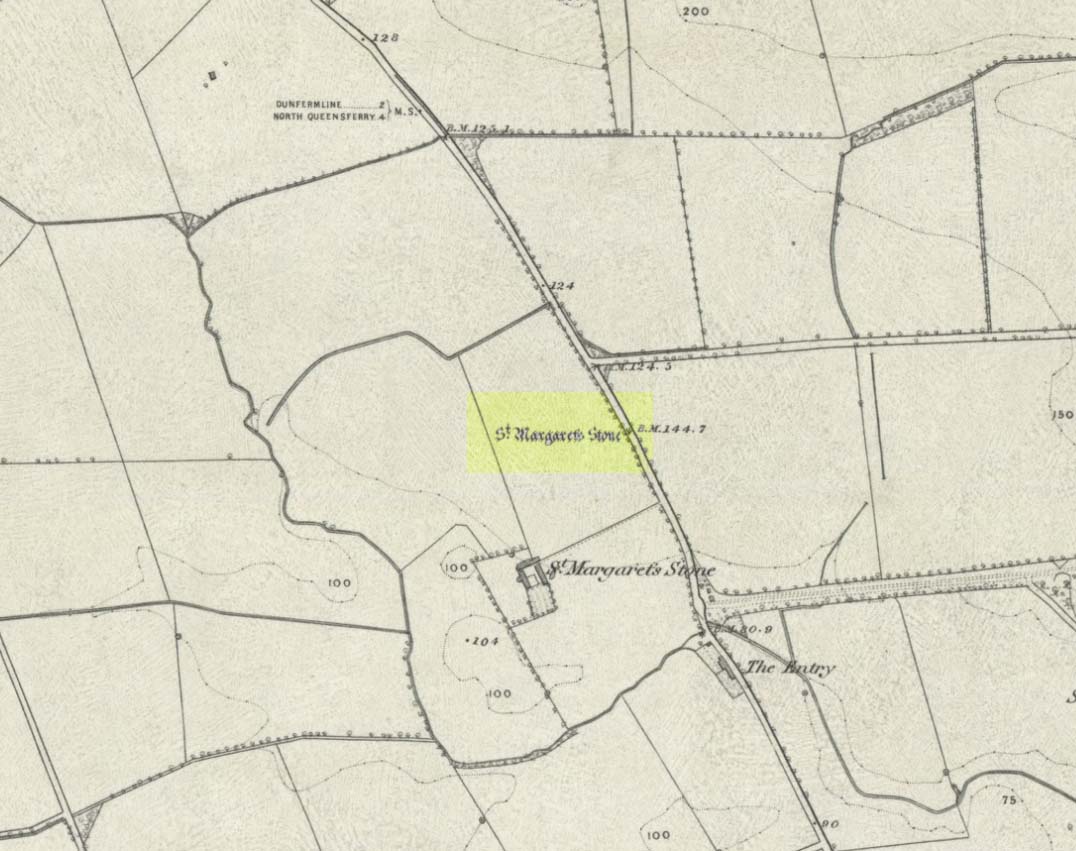
St Margarets Stone on 1856 OS-map

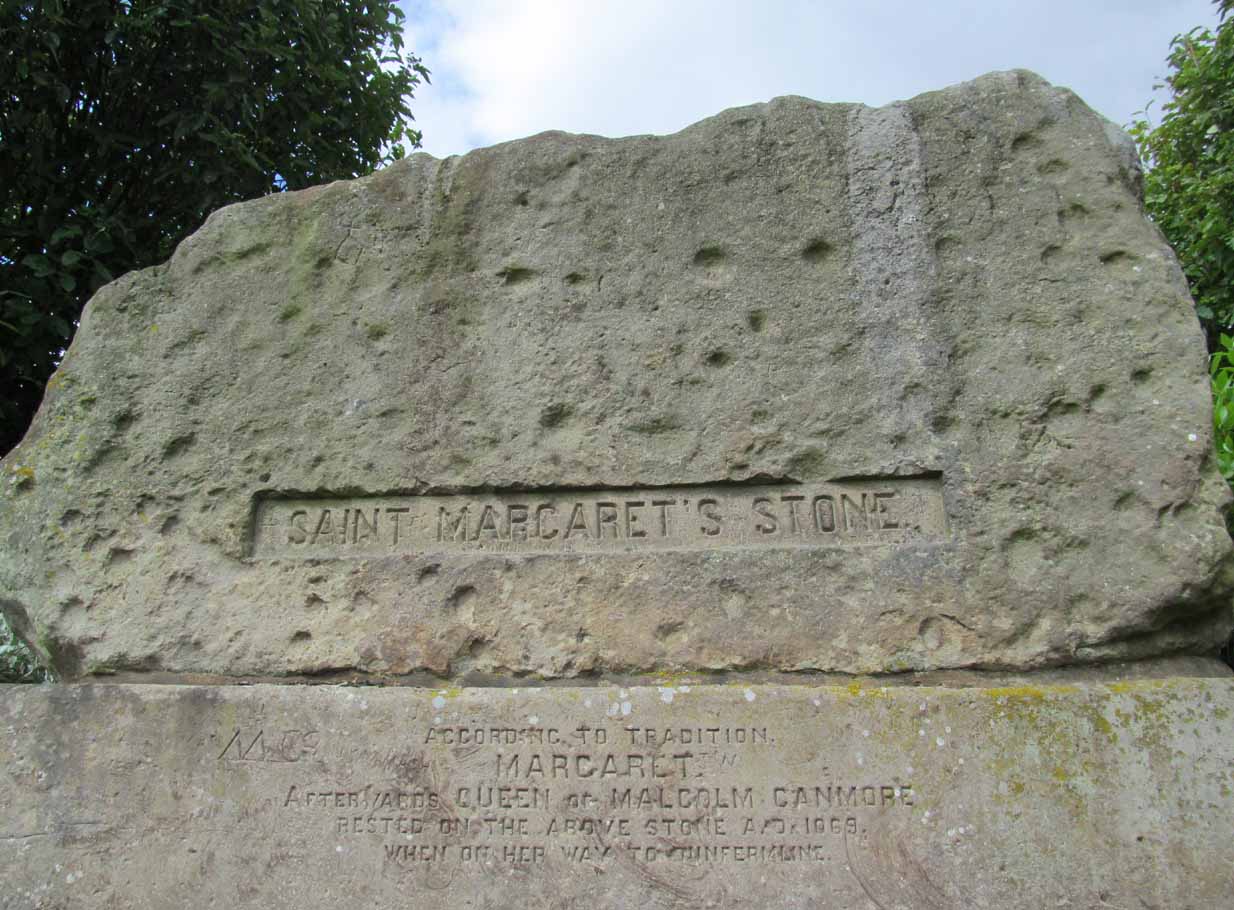
Take the A823 road out of Dunfermline south towards Rosyth. A half-mile before you hit the motorway roundabout, at the roundabout where Carnegie Avenue takes you east, turn west and park up along the road where the modern business park lives.  30-40 yards from the roundabout, set back on the pavement, you can’t really miss the huge flat slab of stone, covered in cup-markings, resting on a stone plinth with ‘St Margaret’s Stone’ stamped on it!

Archaeology & History

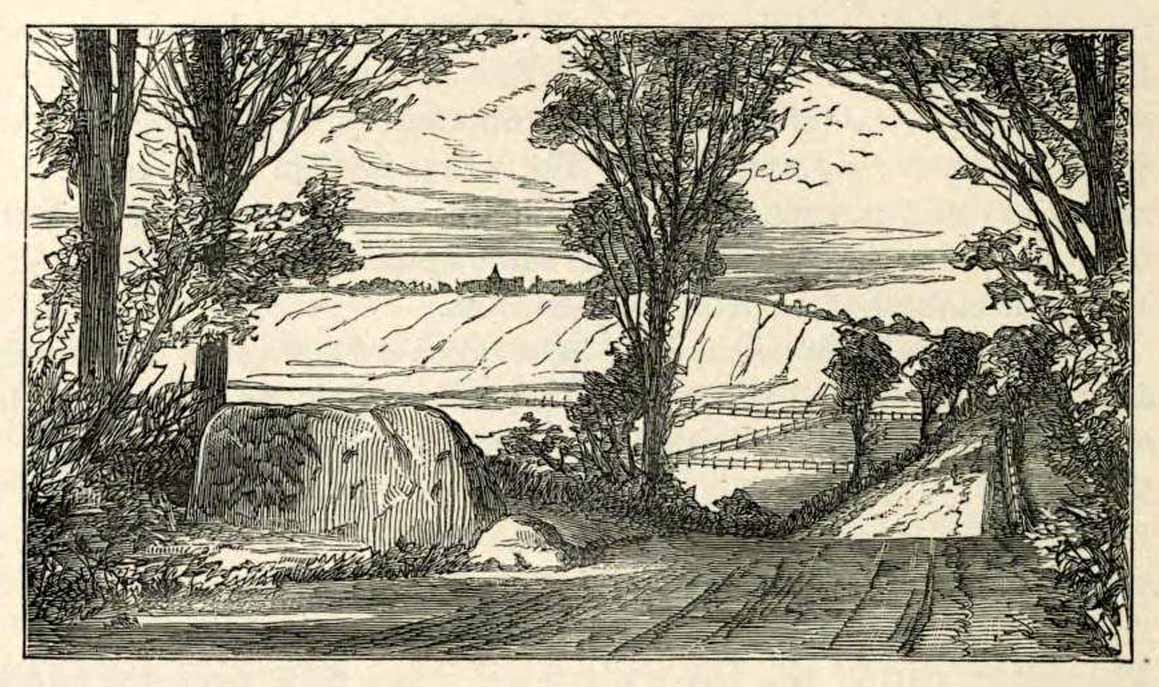
On the 1856 OS-map of this area, St Margaret’s Stone is shown at the roadside just above a farm of the same name, a short distance away from its present location.  In October 1879, Alexander Stewart (1889) told us that funds were raised and steps taken to properly fix and preserve this ancient ‘resting-place’ of Queen Margaret on the Queensferry Road.  It was quite a few years later before it was moved the few hundred yards further to its present location.

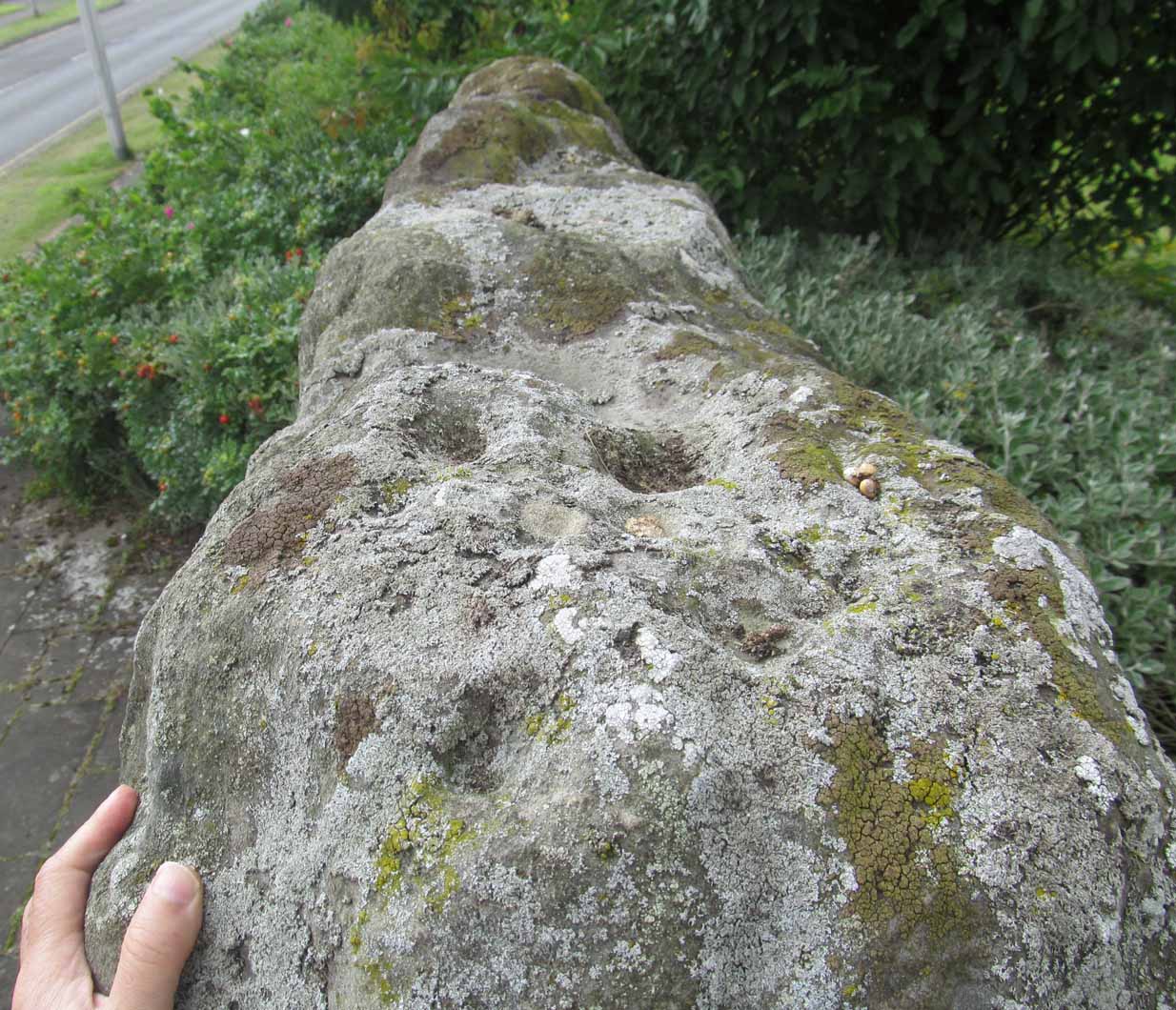
Cups on stone’s edge

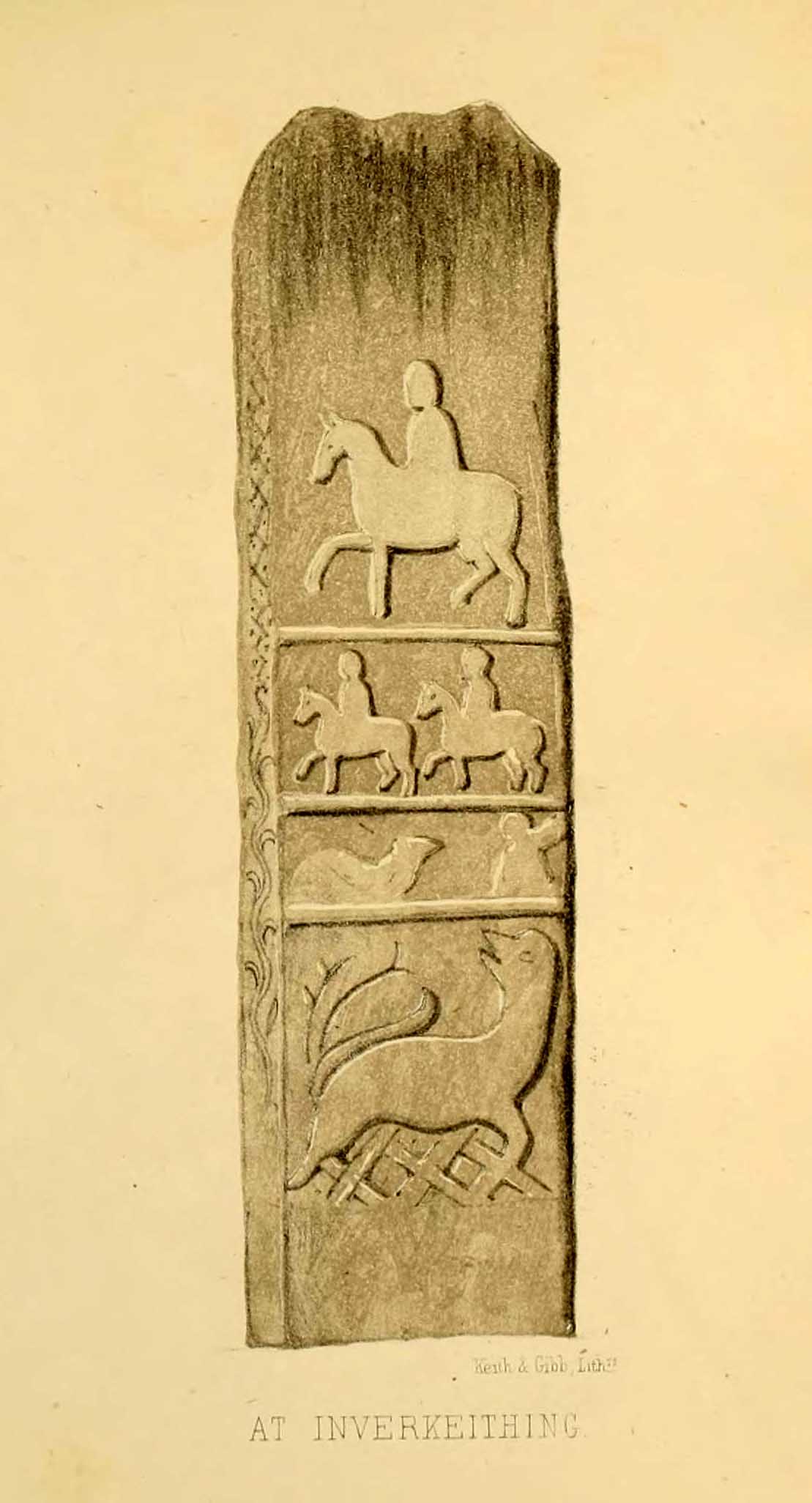
Early writers tell us that originally its position in the landscape was on the crest of one of the rises in the land between Dunfermline and the sea, making it visible for some considerable distance.  This would seem to have been a deliberate placement.  In my mind, and in accordance with the placement of many a prehistoric tomb, St Margaret’s Stone may originally have been part of a neolithic or Bronze age cairn, long since gone.  The size and shape of the rock implies it too, with similarities here of the impressive cist or gravestone found inside the Netherlargie North cairn at Kilmartin.  However, this wasn’t the thought of the prodigious Scottish historian, William Skene.  He thought that St Margaret’s Stone originally stood upright, being a Pictish-style standing stone that was mentioned in the first Statistical Account of the area.  The brilliant Scottish antiquarian, John Stuart (1856)—who gave us an illustration of the ‘standing stone’ in question—told us:

“It has been supposed by some that “St. Margaret’s Stone,” a block now lying on the side of the highway leading from Inverkeithing to Dunfermline, and about midway between these places, can be identified with the standing stone referred to in the Statistical Account.  Mr Skene has noted below a sketch of St. Margaret’s Stone:-  “The sculpture upon this stone has been lately chipped off in mere wantonness, so as to leave few traces of the subject recorded upon it.”  He farther states that it formerly stood erect, and was called “The Standing Stone.” According to Mr. Skene’s measurement, St. Margaret’s stone is about nine feet and a half in length, one foot in thickness, and four feet broad at the widest end, and broken off to a narrow point at the other.”

The missing ‘standing stone’

In this instance, Skene was confusing St Margaret’s Stone with the lost Pictish monolith (left) that used to exist nearby, which had carved horse figures and other memorial designs upon it and which he thought had faded away.  Whereas the large slab we are looking at here, and which Skene visited and measured, is covered on one side by a gathering of prehistoric cup-markings—much earlier than any Pictish or early christian carvings.  At first glance, it seems that some of these cups may well be natural, but it has to be said that some of them are distinctly man-made.  And if we were to believe the archaeo-accounts of the stone, the cupmarks are only to found on one side of the stone.  This is incorrect.  As we can see here, a number of cupmarks run along the edge of the stone.  We cannot say for sure whether all of them are artificial, but they certainly look like it!  Also, on the other side of the flat surface, one or two single cups are visible.  It would be good if we could get an artist to give us a detailed impression of the prehistoric carvings without the modern engraving of St Margaret’s Stone etching on the main face. (is there anybody out there!?)

The Royal Commission (1933) lads visited the stone in 1925 and, several years later in their write-up, told us simply:

“This stone…stands with its main axis due north and south and measures 8 feet 6 inches, by 4 feet 7 inches, by 1 foot 6 inches.  On one side the entire surface is cup-marked, the markings varying in size from 1¼ inches to 3¼ inches and having an average depth of from ½ to ¾ inch.”

When the Scottish petroglyph writer and explorer, Ron Morris (1968) came to the site, he gave it an equally brief description, merely telling us:

“On standing stone (8 1/2 feet high, 4 1/2 feet wide), built in to roadside fence, over 80 cups, up to 4in in diam, 3/4in deep, some run together as rough dumbells.”

It’s well worth checking out!

Folklore

St Margarets Stone in 1825

When the Saxon Queen Margaret landed on the shores just west of Queensferry at Rosyth Castle (NT 1087 8200), legend reputes that she and her entourage made Her way north towards Dunfermline.  Halfway along the ancient track She rested at this large stone which, thereafter, gained the name by which we know it today.  It was said that Queen Margaret subsequently visited the stone on a regular basis for periods of solitude.  The tale probably has some germ of true in it.  Additional ingredients also told that,

“The large stone here is associated with St Margaret and was visited by women who hoped to conceive or sought a successful birth.  The eight-foot high stone is said to mark the resting place of St Margaret when she journeyed between Queensferry and Dunfermline.  Margaret had eight successful pregnancies and probably needed to rest quite a few times on her travels!”

The fertility aspects of the rock were not the only pre-christian virtues attached to it.  We also find that oft-cited motif of rocks moving of their own accord: in this case, as J.B. MacKie (1905) told us, local people had always

“been told that the stone rose from its bed and whirled thrice round in the air every time it heard the cock at the adjoining farm crow.”

Cocks crowing are symbolic of sunrise, obviously, and this lore may simply represent a folk memory of the spirit in/of the stone being animated at that time of day.  It’s a motif found at ancient sites all over the place!

References:

  1. Chalmers, Peter, Historical and Statistical Account of Dunfermline, William Blackwood: Edinburgh 1844.
  2. Fernie, John, A History of the Town and Parish of Dunfermline, John Miller: Dunfermline 1815.
  3. Henderson, Ebenezer, The Annals of Dunfermline, John Tweed: Glasgow 1879.
  4. MacKie, J.B., Margaret, Queen and Saint, Oliphant: Edinburgh 1905.
  5. Morris, Ronald W.B., “The cup-and-ring marks and similar sculptures of Scotland: a survey of the southern Counties – part 2,” in Proceedings of the Society of Antiquaries, Scotland, volume 100, 1968.
  6. Royal Commission Ancient & Historical Monuments of Scotland, Inventory of Monuments and Constructions in the Counties of Fife, Kinross, and Clackmannan. HMSO: Edinburgh 1933.
  7. Rupert-Jone, John A., Rosyth, A. Romanes: Dunfermline 1917.
  8. Stewart, Alexander, Reminiscences of Dunfermline and Neighbourhood, Scott Ferguson: Edinburgh 1889.
  9. Stuart, John, Sculptured Stones of Scotland – volume 1, Spalding Club: Aberdeen 1856.

© Paul Bennett, The Northern Antiquarian 

Flat Howe (1), Sleights Moor, Sleights, North Yorkshire

Tumulus:  OS Grid Reference – NZ 85483 04866

Also Known as:

  1. Flat Howe (north)

Getting Here

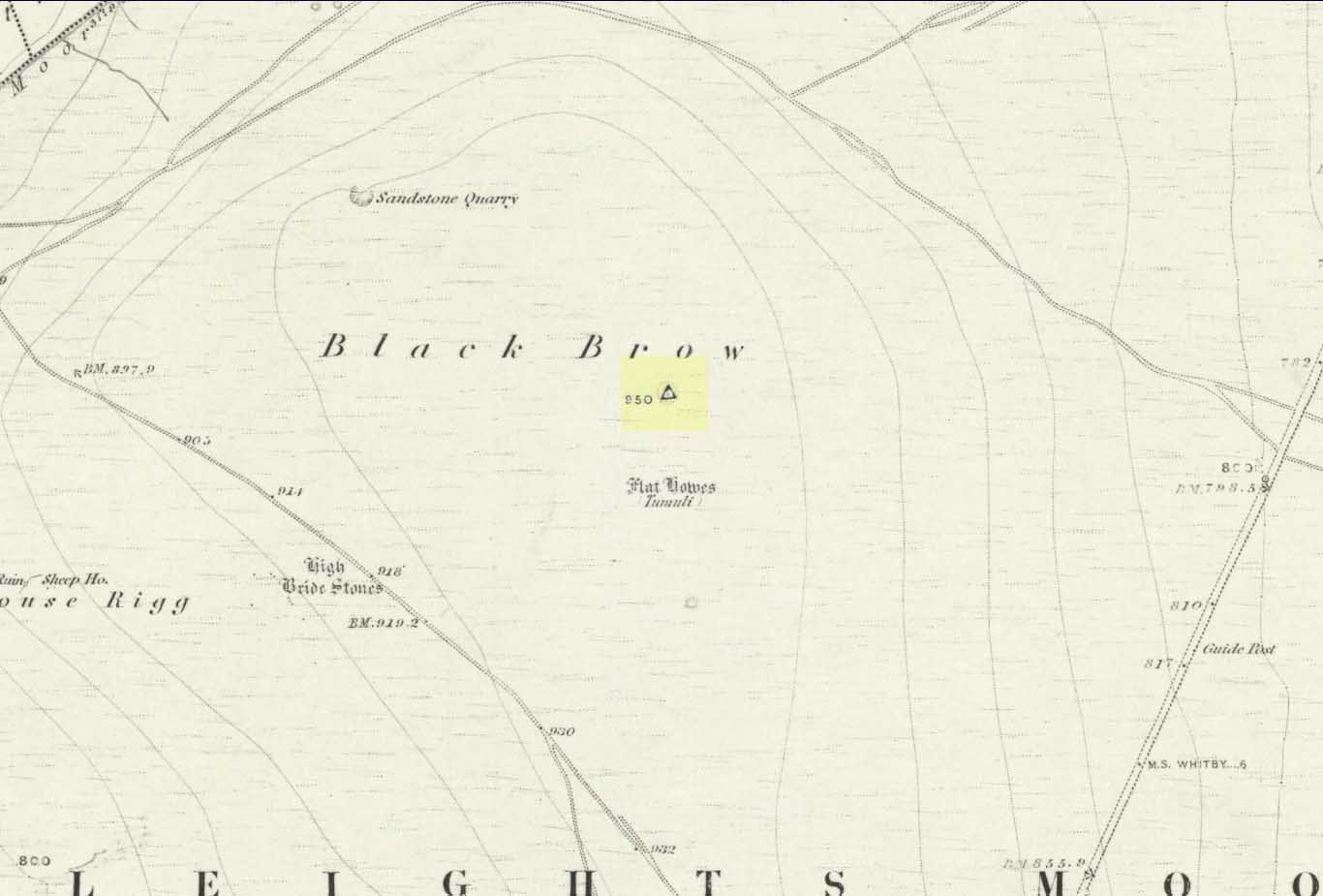
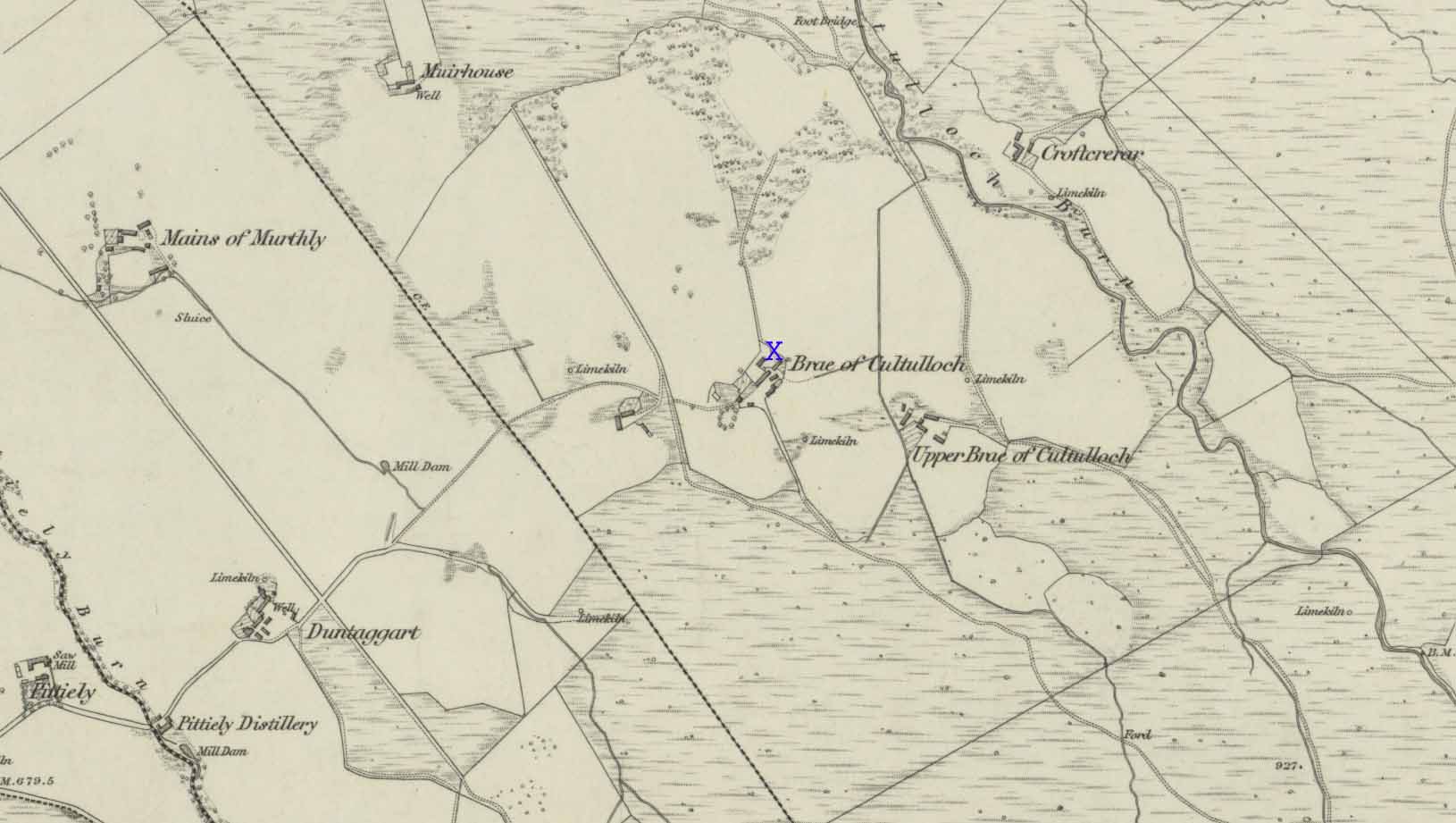
Flat Howe-1 on 1853 map

Along the A169 road that runs may miles from Whitby to Pickering, as you go through the small town of Sleights, the road gets steep for a mile or so, until you reach the moorland tops, where the road runs dead straight.  After 1.2 miles (1.93km) along the straight road, a small minor road is to your right.  Go along here for literally half-a-mile (0.8km) where you’ll see a small dirt-track on your right, with a locked gate.  There’s place to park here.  You’ll see the large rounded mound of Flat Howe-2 about 200 yards NE.  Head there, then another 250 yards north.  You’ve arrived!

Archaeology & History

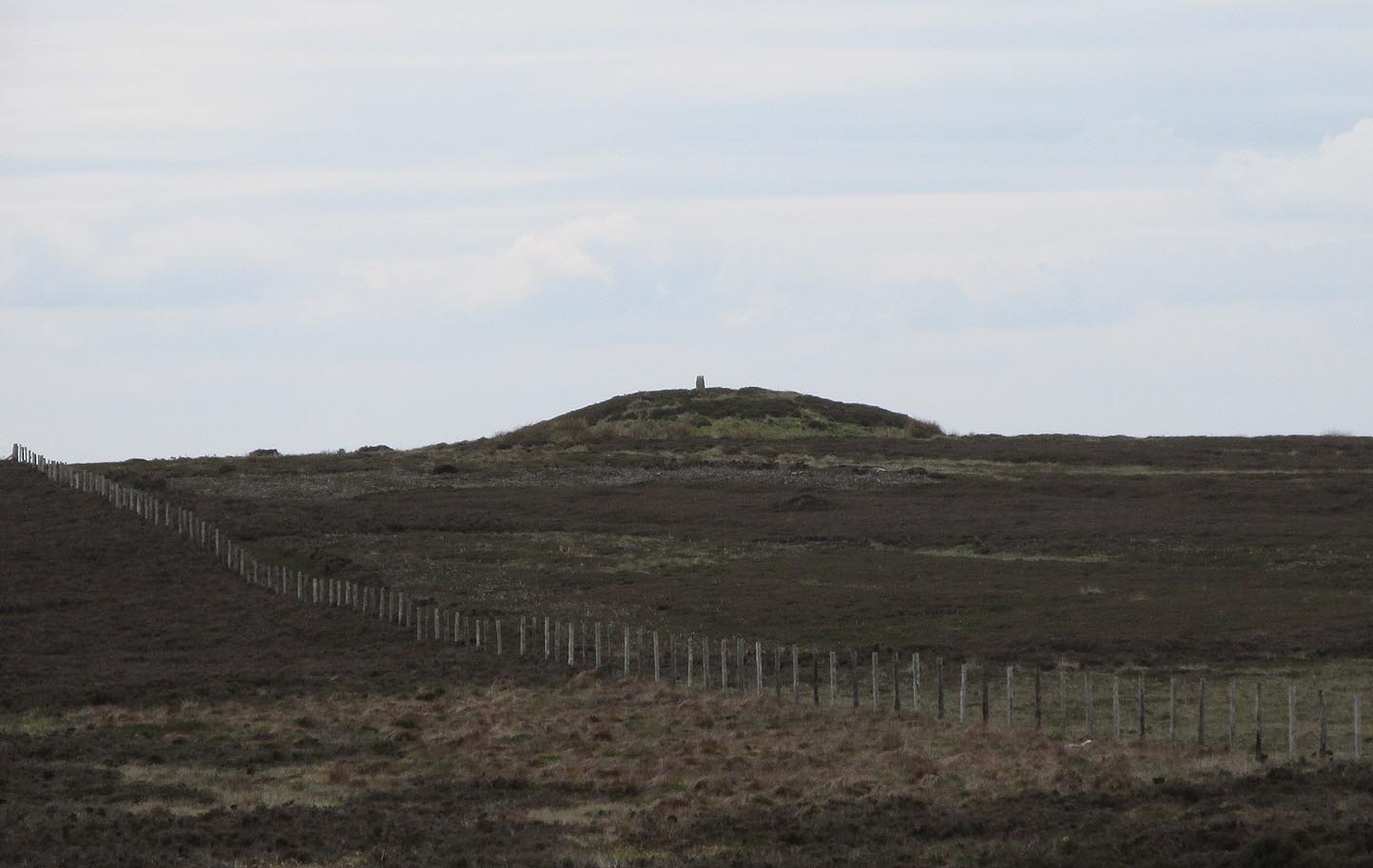
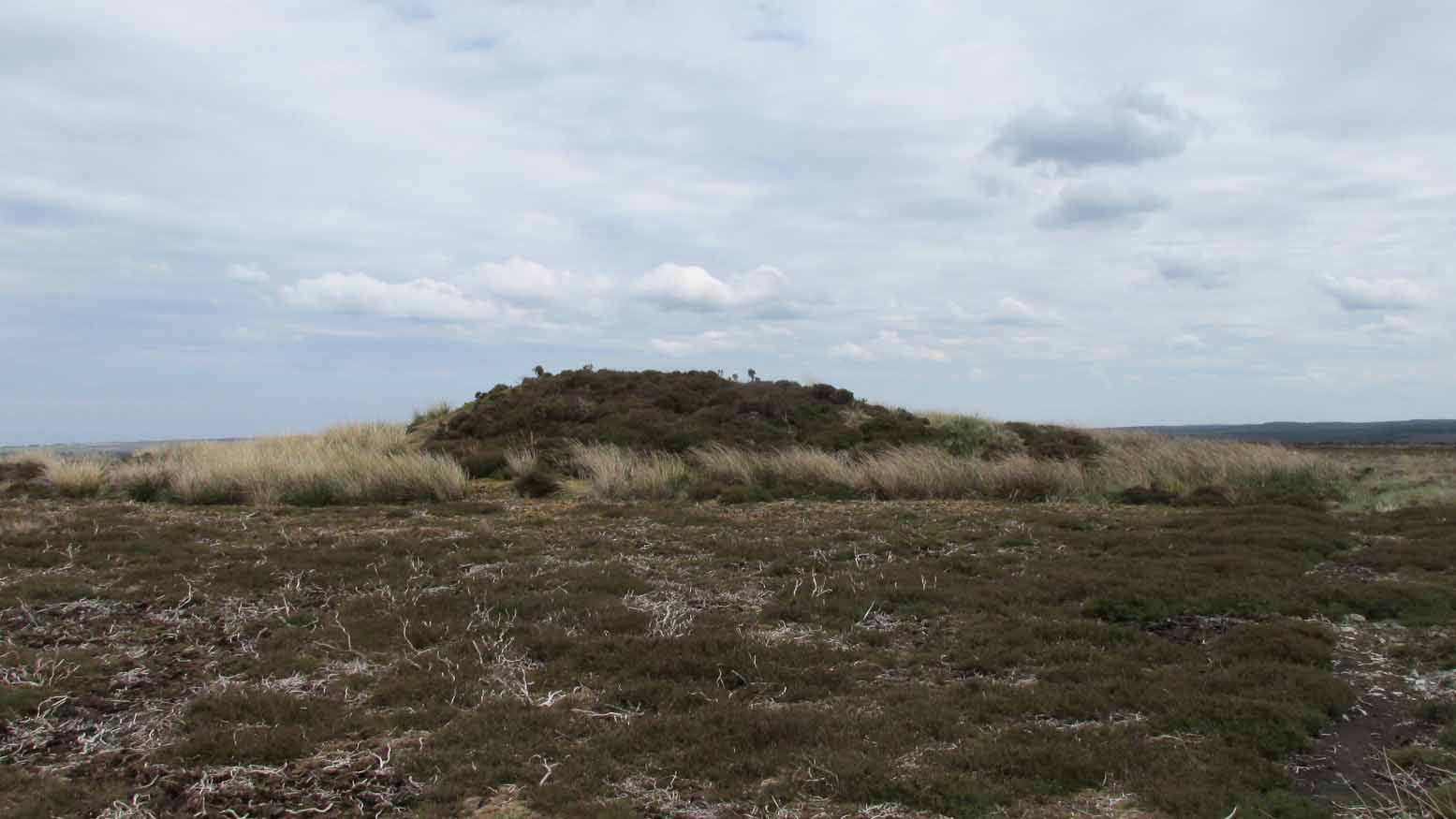
Of the two ‘Flat Howe’ burial mounds on Sleights Moor, this is the northern one of the two, being 250 yards (230m) away from its southern companion (at NZ 85510 04614).  It’s quite a big fella too – and so you’d expect there to be quite a bit of information about it.  But there isn’t!  No recorded excavation has taken place here, despite the top of the monument being cut into.  But this might have occurred when the Ordnance Survey lads built one of their triangulation pillars into the side of it.  Thankfully it’s not done too much damage.

I was quite surprised to find that even Frank Elgee (1912; 1930) had little to say about either of the two Flat Howes, simply mentioning them in passing in relation to the numerous other prehistoric tombs on these moors.  Despite this, the archaeologist L.V. Grinsell (1936) thought this site to be one of “the finest peristalith barrows I have ever seen.”  And this one in particular is still very impressive.

Flat Howe from the south
Flat Howe (by James Elkington)

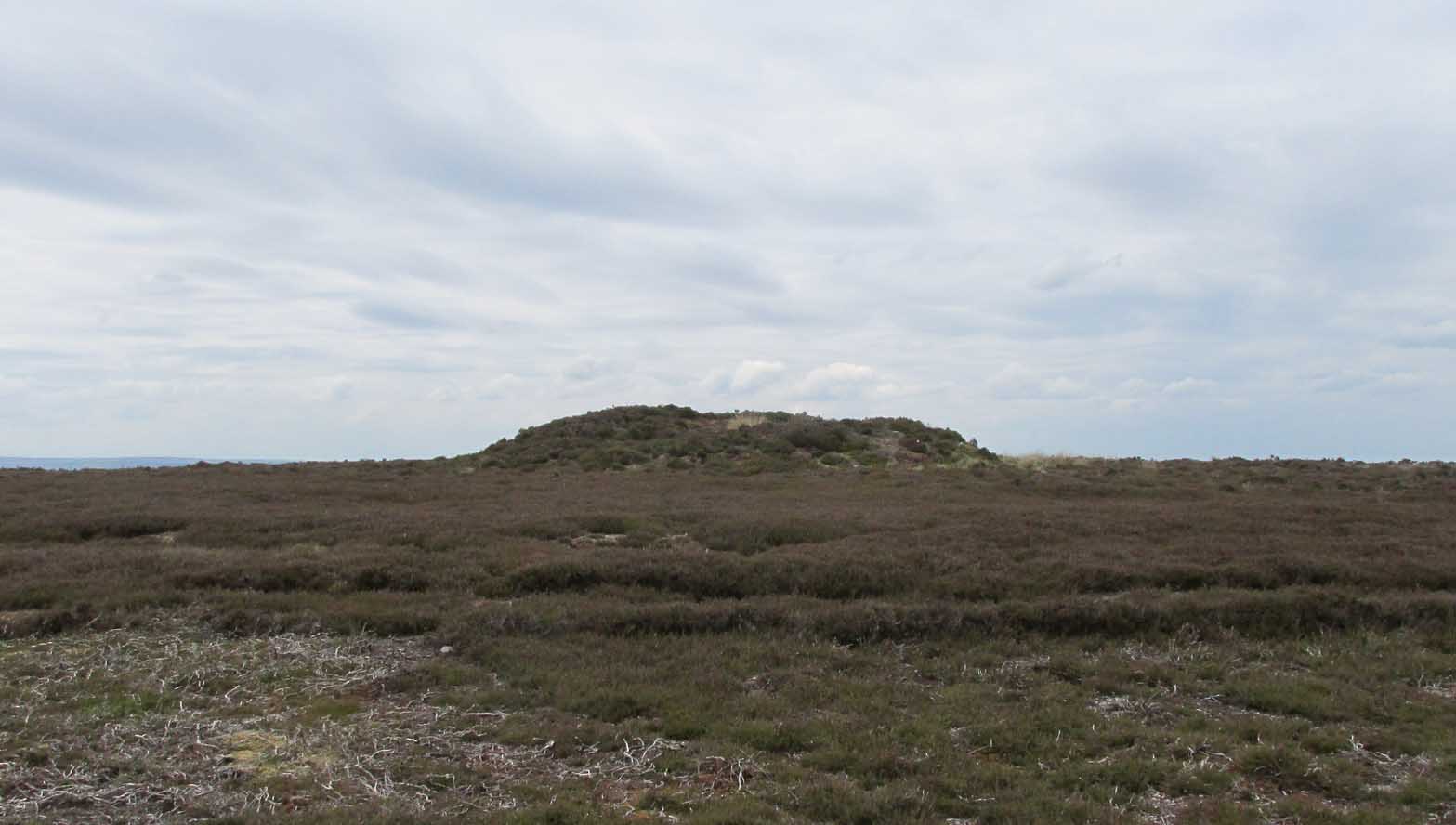
First shown on the 1853 OS-map, this large heather-covered mound of earth and stone is some six feet high and measures roughly 22 yards (20m) east-west by 19 yards (17.5m) north-south.  The tomb was originally constructed within a circle of reasonably large boulders, some of which were upright.  These can still be seen, mainly along the western and southern sides of the monument, although many have been dislodged over time and fallen at various angles, as you can see in the photo.  Whether or not these stones were erected first and then the mound built inside the ring, we do not know.  It’s the highest point in the landscape on Sleights Moor, with damn good views in all directions: an element that is common to many large prehistoric tombs, for obvious reasons.  Other tombs of similar size and probably similar periods in prehistory can be seen close by and on the skyline.  Whether this was a deliberate visual ingredient by our tribal ancestors is difficult to say, as the moors here were covered in scattered woodlands in prehistoric times.  Only detailed archaeo-botanical surveys would be able to tell us one way or the other.

Folklore

Flat Howe, with large stones defining its edge

Although we have nothing specific relating to this tomb, an olde creation myth told us that the local giants, Wade and his wife Bel, left their young son (whose name seems to have been forgotten) somewhere on Sleights Moor (which aint a big place).  It is worth narrating simply because it may have related to this tomb or its companion close by.  Giant legends have long been associated with the creation of many prehistoric tombs in this country and abroad.  The story was first written down by George Young (1817) in his magnum opus on Whitby and the tale was subsequently re-told by many others – Mrs Gutch (1901) for one:

“Young Wade, even when an infant, could throw a rock several tons weight to a vast distance; for one day when his mother was milking her cow near Swarthoue, the child, whom she had left on Sleights moor, became impatient for the breast, and seizing a stone of vast size, heaved it across the valley in wrath, and hit his mother with such violence, that though she was not materially hurt, her body made an impression on the stone which remained indelible, till the stone itself was broken up, a few years ago, to mend the highways!”

This rock was Bel’s Rock, whose exact location seems to have been lost.

References:

  1. Elgee, Frank, Early Man in Northeast Yorkshire, Frank Bellows: Gloucester 1930.
  2. Elgee, Frank, The Moorlands of North-Eastern Yorkshire, A. Brown: London 1912.
  3. Grinsell, Leslie V., The Ancient Burial Mounds of England, Methuen: London 1936.
  4. Gutch, Mrs, County Folk Lore – volume 2: Examples of Printed Folk-lore Concerning the North Riding of Yorkshire, York and the Ainsty, David Nutt: London 1901.
  5. Jeffrey, P. Shaw, Whitby Lore and Legend, Home: Whitby 1923.
  6. Roberts, Anthony, Sowers of Thunder, Rider: London 1978.
  7. Smith, A.H., The Place-Names of the North Riding of Yorkshire, Cambridge University Press 1928.
  8. Young, George, A History of Whitby and Streoneshalh Abbey – volume 2, Clarke & Medd: Whitby 1817.

AcknowledgementsA huge thanks to Lindsay Mitchell for getting us up to see this great tomb and its companion; and to James Elkington for use of the photograph.

LinksThe Megalithic Portal on Flat Howe

© Paul BennettThe Northern Antiquarian


Nor Hill, Skipton Moor, North Yorkshire

Cup-Marked Stone:  OS Grid Reference – SE 02181 51125

Getting Here

Along the A65 near Draughton, go (south) uphill at Height Lane until it levels out.  ¾-mile (1.2km) up, a modernized stone milepost is where the road crosses the ancient Roman Road. From here, walk west for just over a mile (1.8km), past the trees on your right, until you approach another small copse further along on your right.  In the field just before the copse, walk uphill until you reach the highest of the two rises and walk about. You’re damn close!

Archaeology & History

Nor Hill cupmarked stone
Cupmarks, top & side

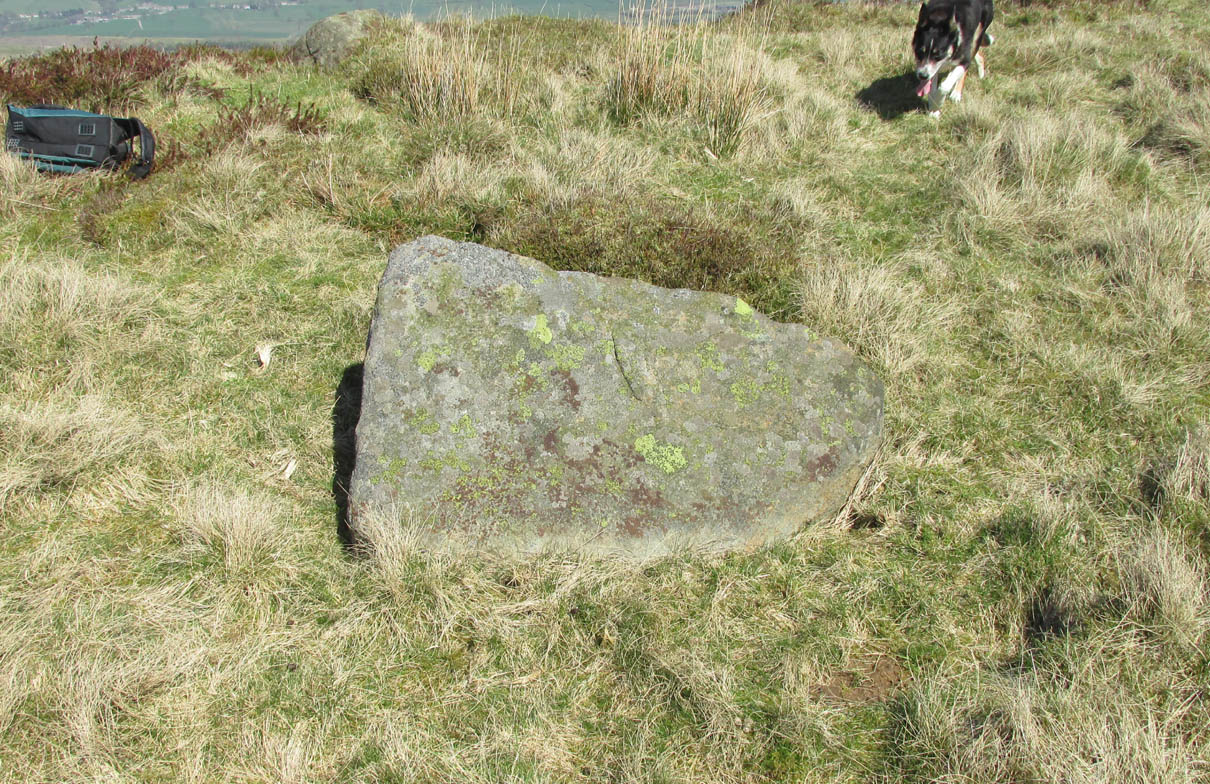
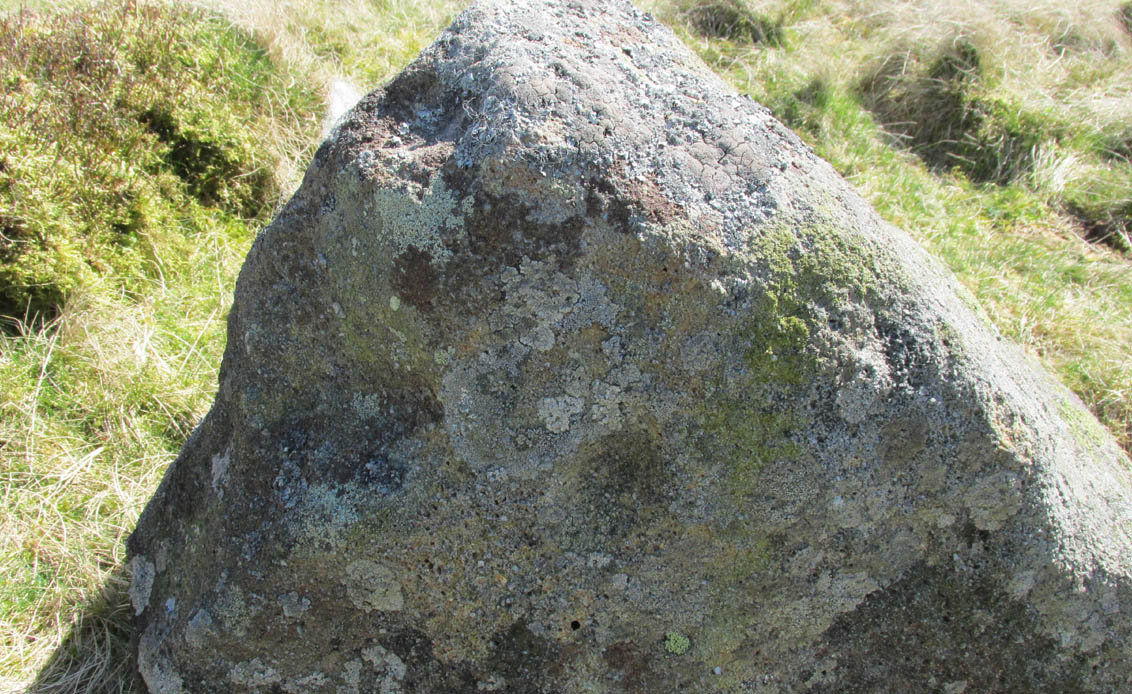
This small cup-marked rock was rediscovered by Chris Swales in April 2018.  It’s probably only for the purist petroglyph fanatics amongst you, consisting of just a single cup-mark on its vertical west-face, and another near its top western edge.  Official records show no other carvings in the immediate vicinity, but local antiquarians may find it profitable in surveying the area for other potential remains.

© Paul BennettThe Northern Antiquarian


Rough Haw Carvings, Flasby, North Yorkshire

Cup-Marked Stone: OS Grid Reference – SD 96396 55834

Rough Haw cupmarks

Getting Here

The quickest way to get here is to follow the directions to the Sharp Haw Trig Stone. From the Trig Stone keep heading down the footpath until you see the gate at the bottom. Go through the gate and Rough Haw is straight in front of you.  Head towards Rough Haw and you will see a track going straight up the middle. Go right up that track and over the top till your on the summit, keep walking forward about 50-60 yards and you will see it.

Archaeology & History

Second lot of cups

Some petroglyphs have been found near the top of the prehistoric Iron Age settlement called Rough Haw, a few miles north of Skipton. Not previously recorded, this long flat stone and its companion are littered in cup markings (perhaps a couple of dozen).  There could be more cups and other markings than we saw today, but by the time we reached here the sun had disappeared, so poor daylight made it difficult to see if there were any more.  Another venture up onto this hillfort might be worthwhile to see if anymore can be found.

© Chris Swales, The Northern Antiquarian

Southdown Cottage, Cotmandene, Dorking, Surrey

Tumulus (destroyed):  OS Grid Reference – TQ 1686 4958

The Cotmandene urn

Archaeology & History

Highlighted on the 1914 OS-map (as ‘Site of’), nothing now remains of the prehistoric structure that either covered or surrounded the ancient burial urn, found fortuitously by a Mr Turner in the garden of Southdown Cottage at the beginning of the 20th century.  Believed to be either Iron Age or Romano-British in origin, the find was noted by Mr Malden (1913) in his brief in the Surrey ArchaeologicalCollections, who wrote:   

“Early in 1913 it came to my knowledge that some years ago some discoveries had been made in the garden of a house on Cotmandene, Dorking.  Mr Turner…was digging for sand in his garden when he found a small cinerary urn (see illustration), with ashes in it.  The height is only 5 inches, the diameter across the top about 4 inches, but at the widest part 5⅜.  The urn is so small that it probably contained the ashes of a child: it is wheel-made, but badly; the diameter is not precisely the same across the top from every direction: Mr Reginald Smith attributes it to the first century BC.  Some fragments of other urns were found.  Mr Turner has kindly presented the whole specimen to the Society’s Museum.  At a lower depth in the same garden were numerous flints, some implements, many flakes, and traces of a hearth with several burnt stones. These clearly belonged to an earlier date, considerably, than the interments, but as the finds were made about 1906-7, and not investigated till this year, it is impossible to be precise about the depth at which they occurred.”

References:

  1. Malden, H.E., “A Cinerary Urn and other Matters found at Dorking and Betchforth,” in Surrey Archaeological Collections, volume 26, 1913.

© Paul BennettThe Northern Antiquarian

Rolleston’s Barrow, Rushmore, Tollard Royal, Wiltshire

Tumulus:  OS Grid Reference – ST 95552 18233

Archaeology & History

Plan of Rollestons Barrow, 1880

In what today seems a barely visible tumulus, amidst the large cluster that could once be found upon the large estate grounds of Rushmore House, were once the overgrown ruins of an old tumulus.  It seems to have been rediscovered in the 19th century, when the legendary antiquarian, General Pitt-Rivers, moved onto the huge estate.  It was all but hidden even in his day, he told, but being “of such slight elevation that, like many others, it had never been noticed.”  It was the first of all the barrows they excavated on his Estate, and is to be found “near the house on the south side of the lower south coach road.”

So, in 1880, he got some of the estate lads to help him and Rolleston start a dig into the old tomb – and they weren’t to be disappointed.  It wasn’t anything special, but it was the first amongst many hereby.  In Pitt-River’s (1888) massive tome on the prehistory of the region, he told us:

“This was the first barrow opened at Rushmore, on the 10th August, 1880. Professor Rolleston and the Rev. H. Winwood were present at the opening. The elevation was so slight that it had hitherto escaped notice.  In the centre, 1 foot 6 inches beneath the crest, a layer of charcoal and ashes, 9 feet by 6 feet, was found containing a burnt body.  The body appears to have been burnt on the spot, and not gathered up after cremation, but a mound raised over the funereal pile.  A few fragments of bronze, probably the remains of some implement which had corroded or been burnt, were found in the ashes, and in the body of the barrow two flint scrapers, a well-formed flint borer, and a boat-shaped flint…were found (see illustration above, PB).  A few scattered fragments of pottery found in the barrow were of a superior and harder baked quality than is usual in barrows.  No trace of a ditch was found around the barrow, but towards the north of the centre, a depression—EE on plan—which might, or might not, have been a grave, but filled with mould and without remains, was discovered.  The barrow is undoubtedly of the Bronze Age, and is interesting on account of it being the last at the opening of which Professor Rolleston assisted shortly before his death.”

As a result of this, he decided to name to barrow after his old friend and also planted a beech tree on top of it in remembrance of him.

References:

  1. Pitt-Rivers, A.H.L.F., Excavations in Cranborne Chase, near Rushmore – volume 2, Harrison & Sons: London 1888.

© Paul BennettThe Northern Antiquarian