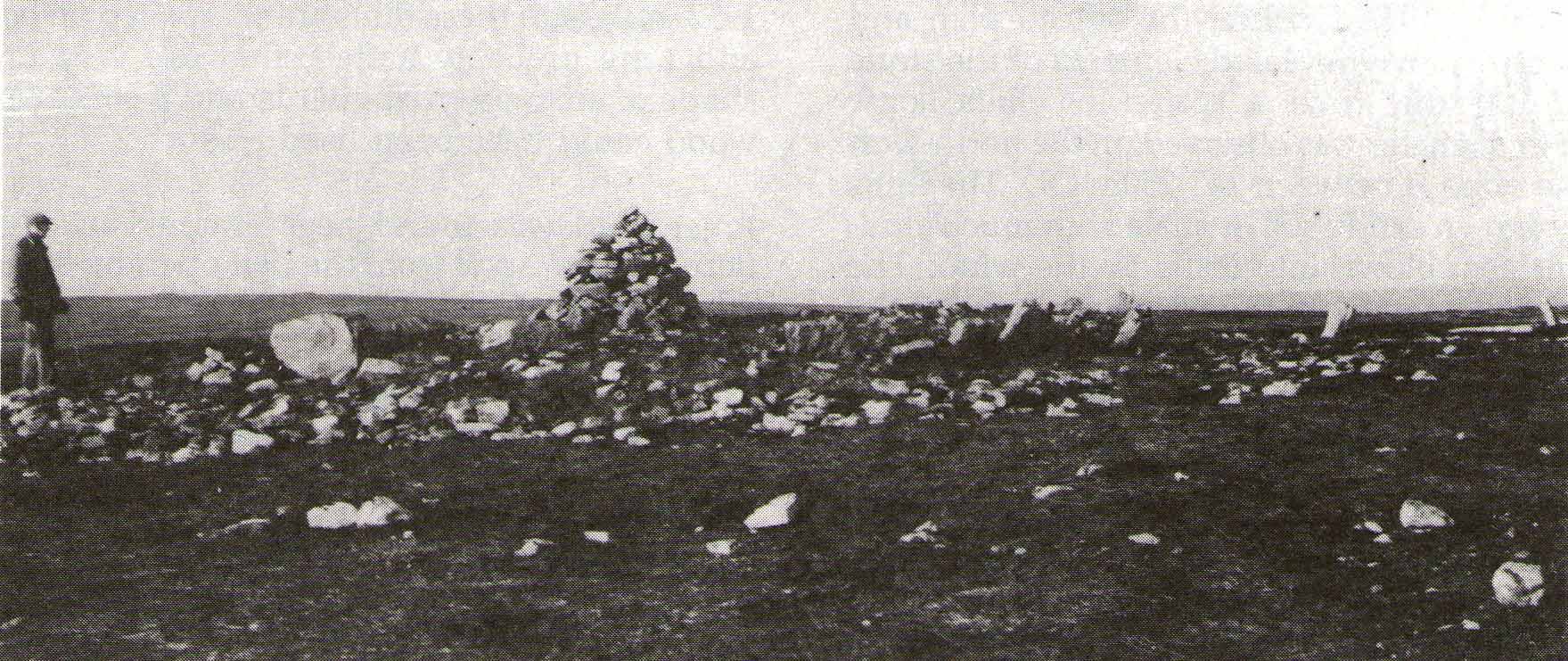
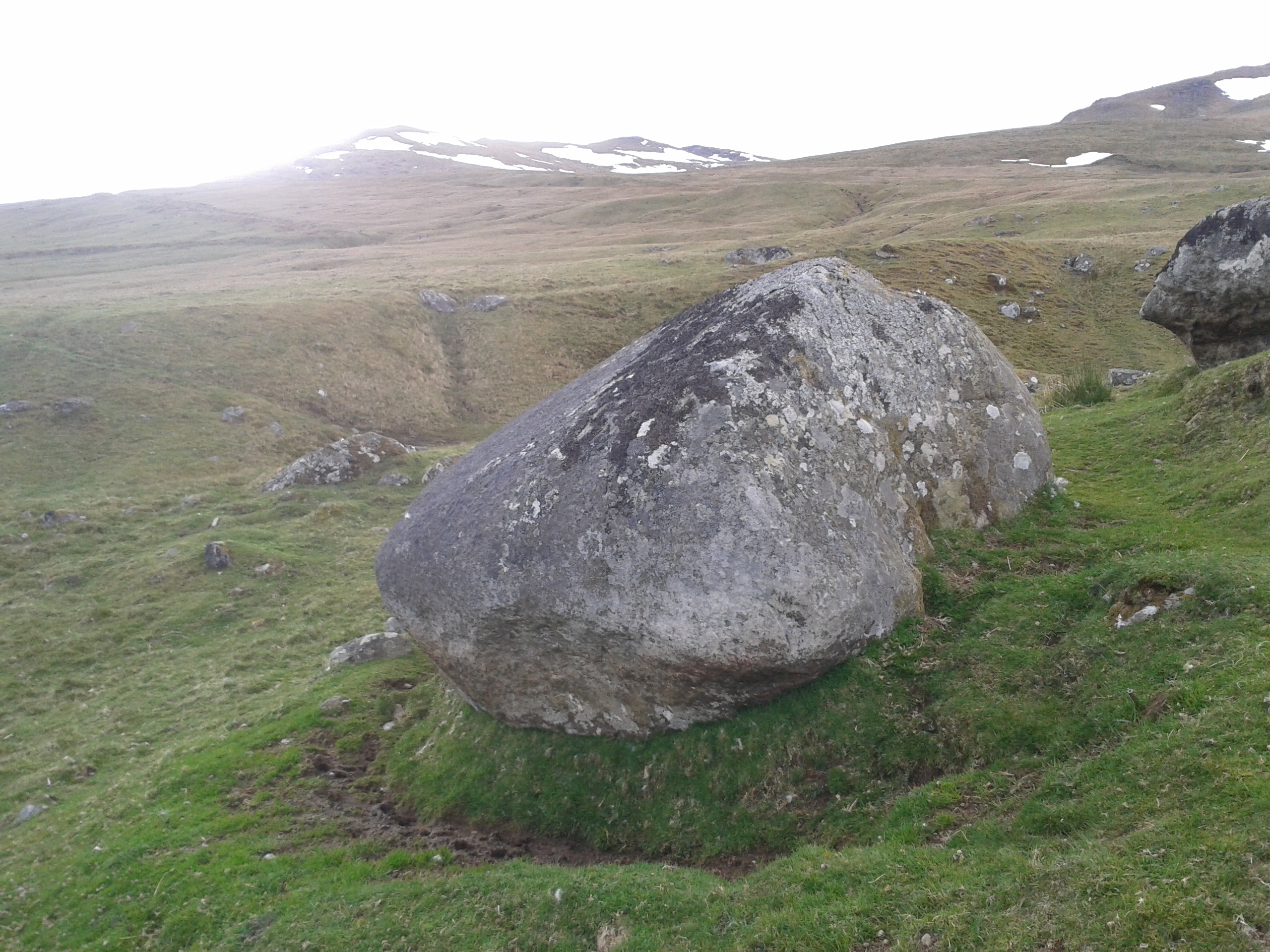
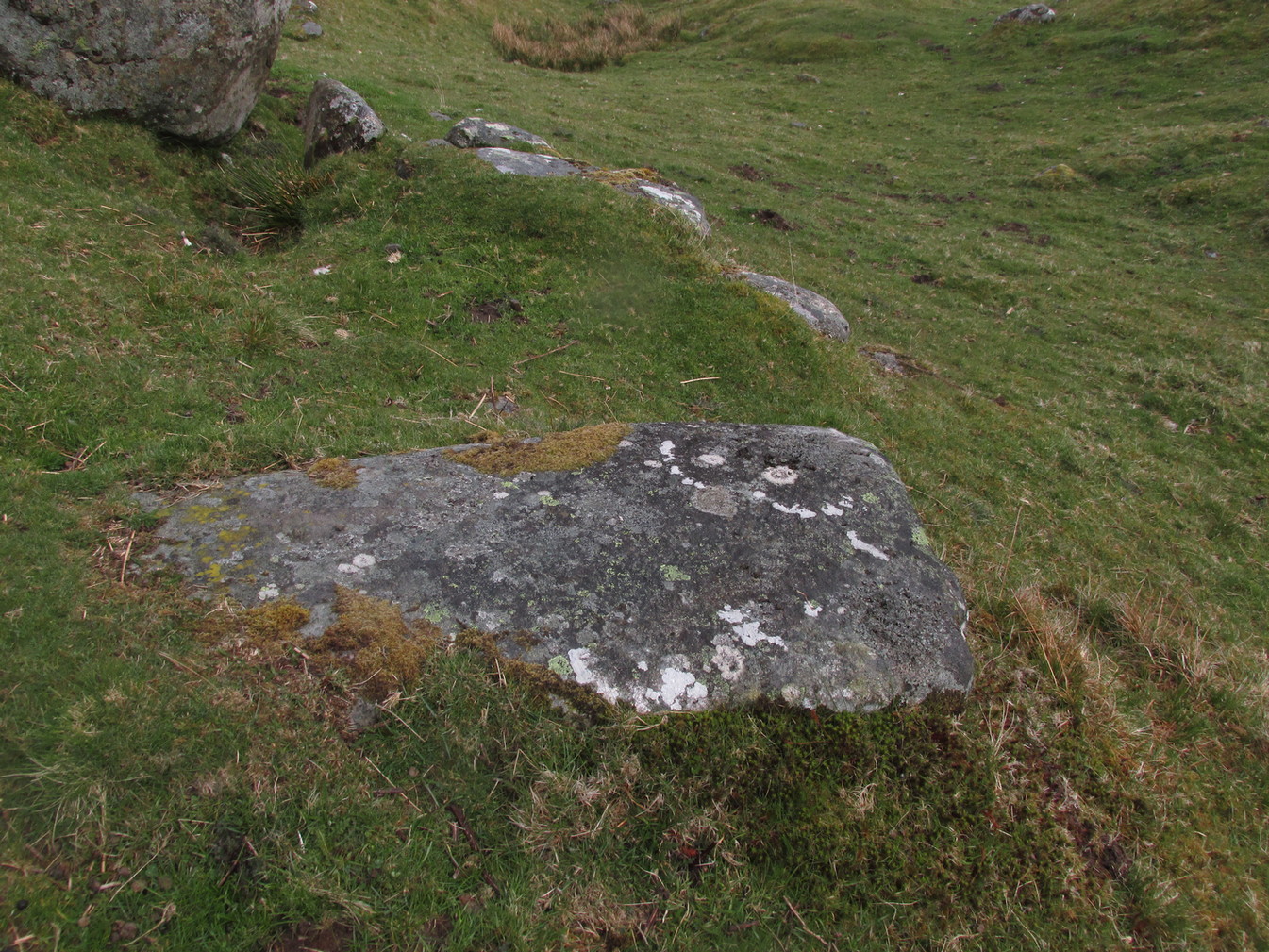
West Dron Hill, Bridge of Earn, Perthshire

Cup-and-Ring Stone:  OS Grid Reference – NO 11845 15169

Getting Here

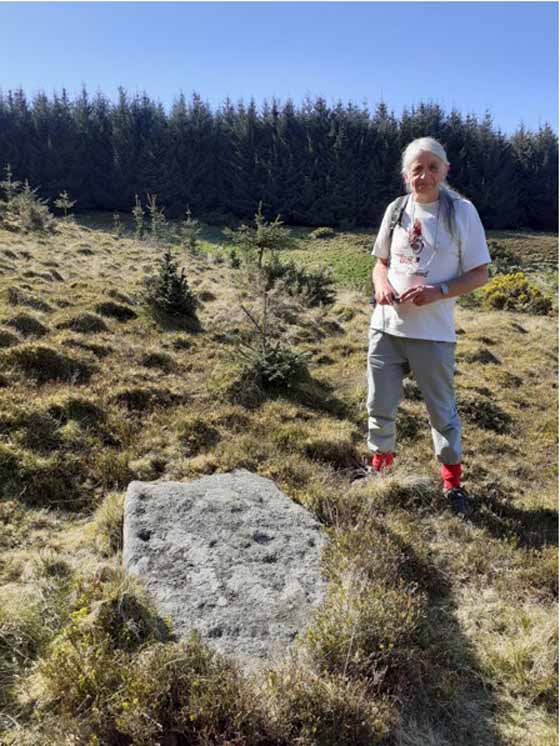
West Dron’s petroglyph

In the middle of Bridge of Earn village, take the Heughfield Road until, ⅓-mile on you hit the T-junction.  Turn left along Forgandenny Road and go along the curvaceous road for just over a mile where you need to keep your eyes peeled for the small left turn that takes you up the dead straight road.  At the top, turn left at the junction and go ⅔-mile, turning right at the next junction until after 400 yards you reach the houses on your right.  Go up the footpath opposite the houses (south) until, after nearly 400 yards, it splits.  Bear right and zigzag up the track for nearly a mile till you reach a large opening in the forest.  40 yards up the slope to your left is the stone—at last!

Archaeology & History

After the trail to get here, you might not be overly impressed by what you see – and it’s nothing special to look at to be honest.  But its location is a good one: reasonably high up on a sloping plateau which would have given good views were it not for the surrounding forestry plantations.  The only literary description of the site was the brief one in Discovery & Excavation Scotland, shortly after being rediscovered.  Mrs Johnson (1960) wrote:

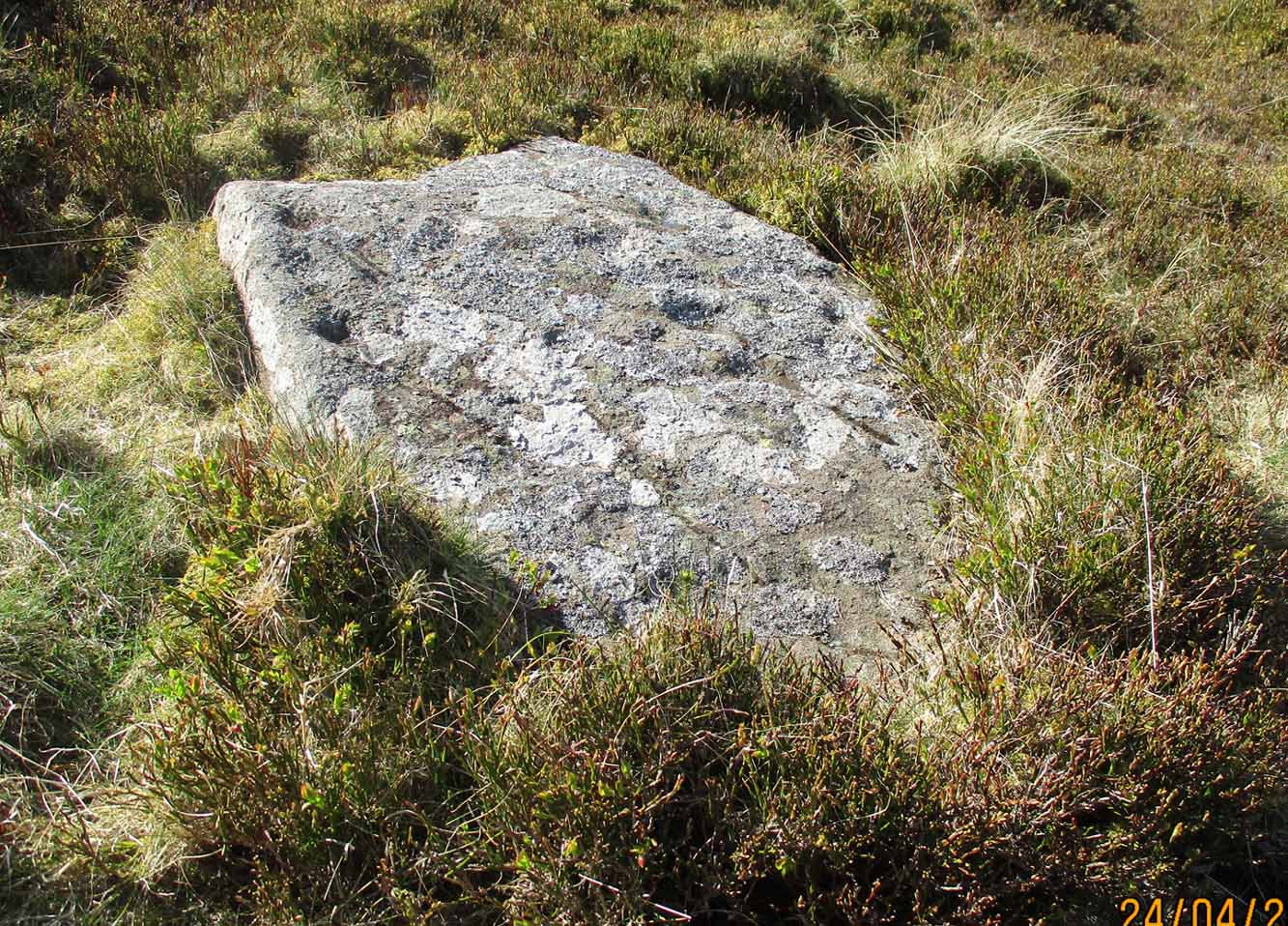
Close-up of the carving

“A cup-marked stone was found by Mr. J. R. Morrison on the N side of West Dron hill.  The stone measures approx. 4ft long by 1ft 9in broad.

There are 17 cup-marks: five of which have channels, and two of which are joined in the form of a dumb-bell.  The stone lies with its longer axis NE-SW, and its broad face uppermost.”

Its seeming isolation is a peculiarity that I don’t buy.  Other carvings are going to be in the locale, probably on the same north- or north-east facing ridges – but due to the dense forestry, any other petroglyphs will remain hidden for quite some time…

References:

  1. Johnson, M., “Dron, Perthshire,” in Discovery & Excavation Scotland, SRG 1960.

Acknowledgements:  Huge thanks to Theresa Hughes for the use of her photos of this carving.

© Paul BennettThe Northern Antiquarian


Loch of Blairs, Forres, Morayshire

Cist:  SO Grid Reference – NJ 0194 5540

Also Known as:

  1. Canmore ID 15792

Archaeology & History 

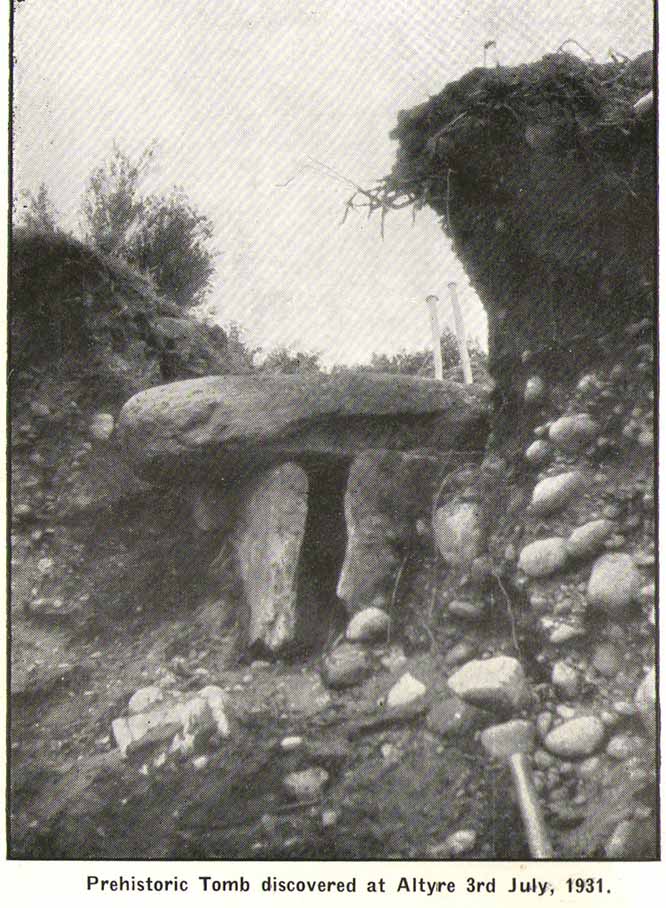
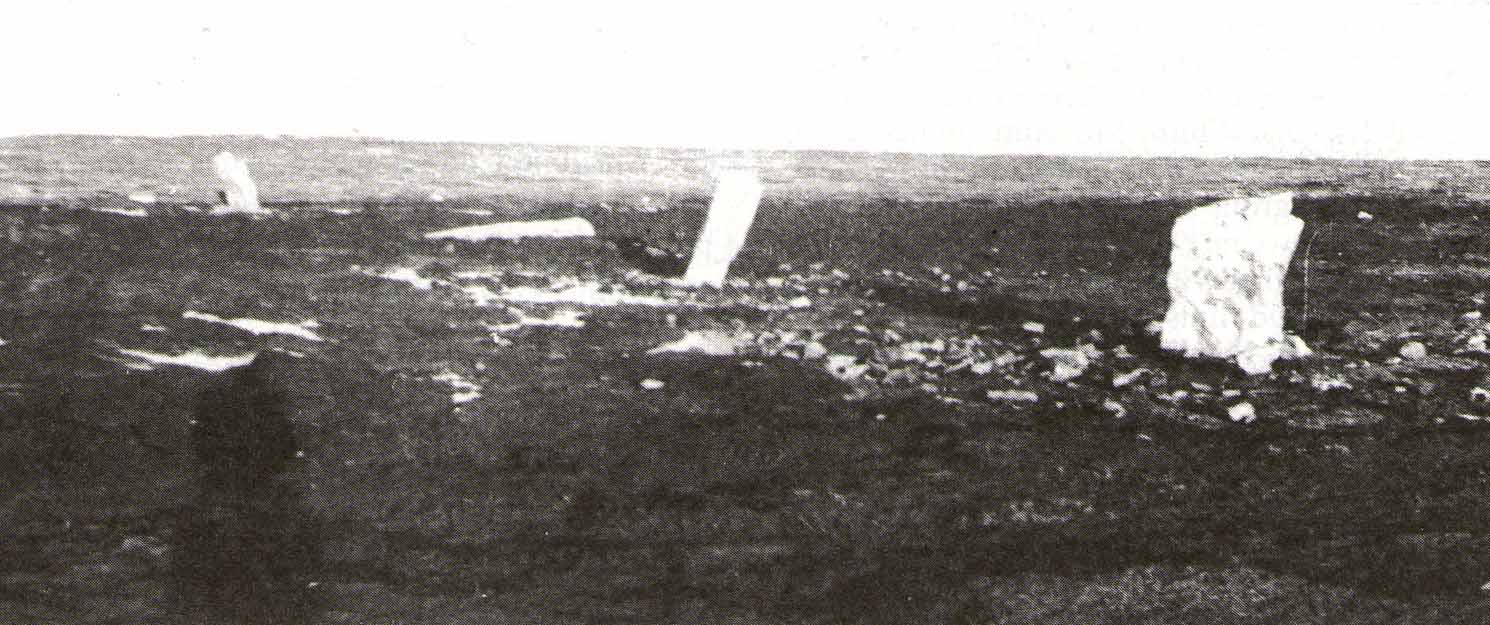
This is another of the many sites in the country that was uncovered fortuitously, as a result of widening the road just west of the Loch of Blairs.  It’s in relative isolation from other prehistoric sites.  The best description of it was by local antiquarian and folklorist James Ritchie (1932), to whom we owe our gratitude for the old photo.  “This cist,” he wrote, 

“as such tombs are called, had been discovered by workmen who were digging sand from a mound just by the main road to Grantown.  Flat, rectangular stones formed its ends and sides; its top was a single slab of massive proportions.  All around were packed smooth. water-worn boulders, that had once lain in the bed of the Findhorn.  The opening of the cist revealed the ashes of some long-departed dweller in Moray, together with pieces of what had been beautifully moulded pot of clay. On examination of the remains by antiquarian experts, the date of the burial was estimated to be at least a thousand years BC.”

The attached photo makes the site look larger than it is; as the length of the chamber is just 2ft 7in long, by 1ft 8in across, with the covering stone being nearly twice as large as the cist itself.  The urn found inside the cist now resides in the Scottish National Museum of Antiquities. 

References:

  1. Ritchie, James B., The Pageant of Morayland, Elgin Courant 1932.

© Paul BennettThe Northern Antiquarian

Scotland Well, Scotlandwell, Kinross

Healing Well:  OS Grid Reference – NO 18474 01656

Also Known as:

  1. Scotlandwell

Scotland well on 1856 map

Getting Here

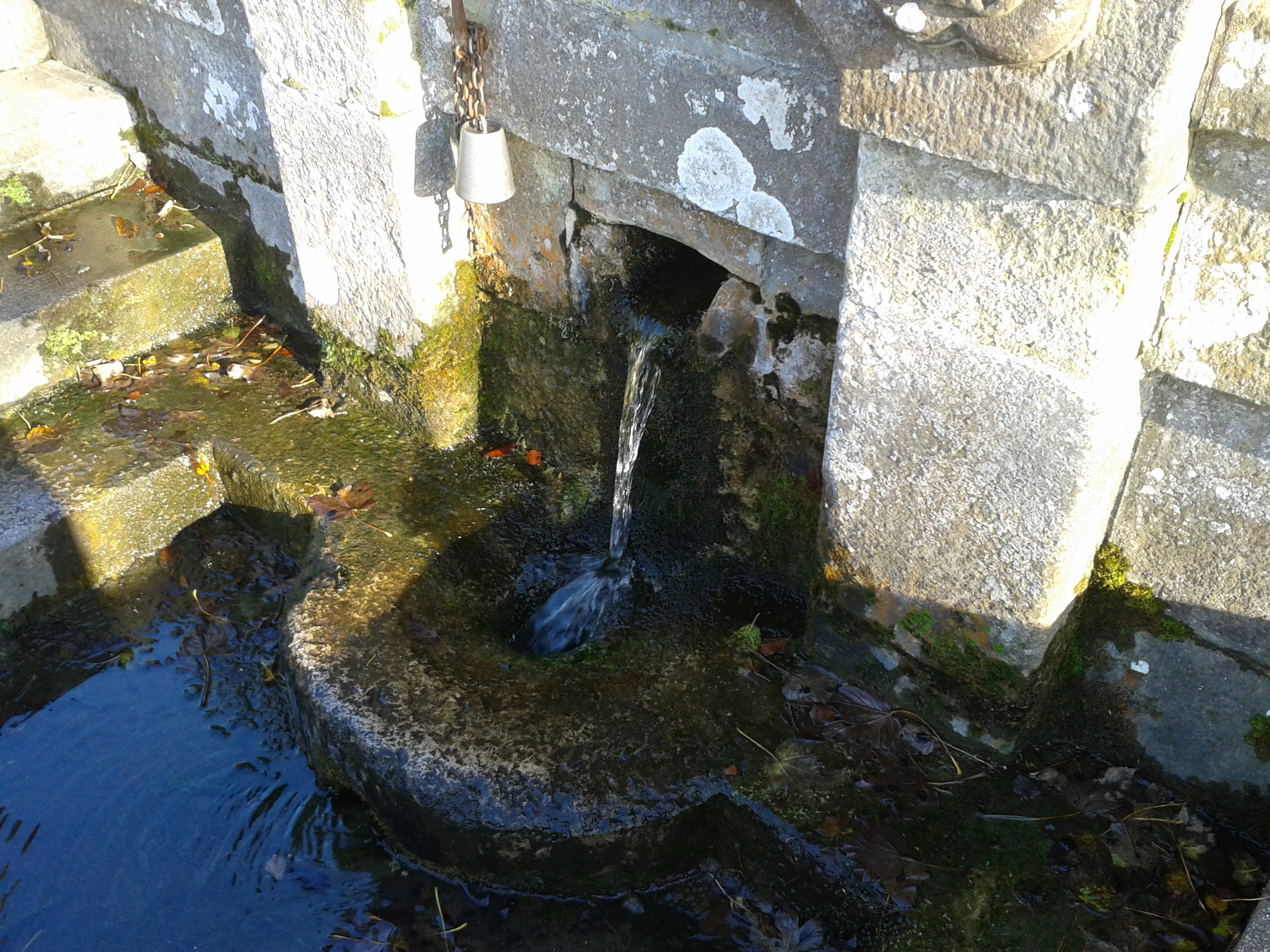
Whichever way you come into the hamlet—be it along the A911 from either Milnathort or Glenrothes, or up the B920 from Ballingry side—the only little carpark to use is about 20 yards from the main road junction, on the west-side of the road, appropriately named Well Road.  The site is unmissable beneath the small well-house at the end of this short cul-de-sac.

Archaeology & History

When a village is named after a well, you know that its waters held some considerable importance!  Mentioned as early as 1218 as “de fonte Scotie” and subsequently many variations thereof in centuries thereafter, the place-names authority Simon Taylor (2017) thinks it may have been mentioned as early as 1090 CE.

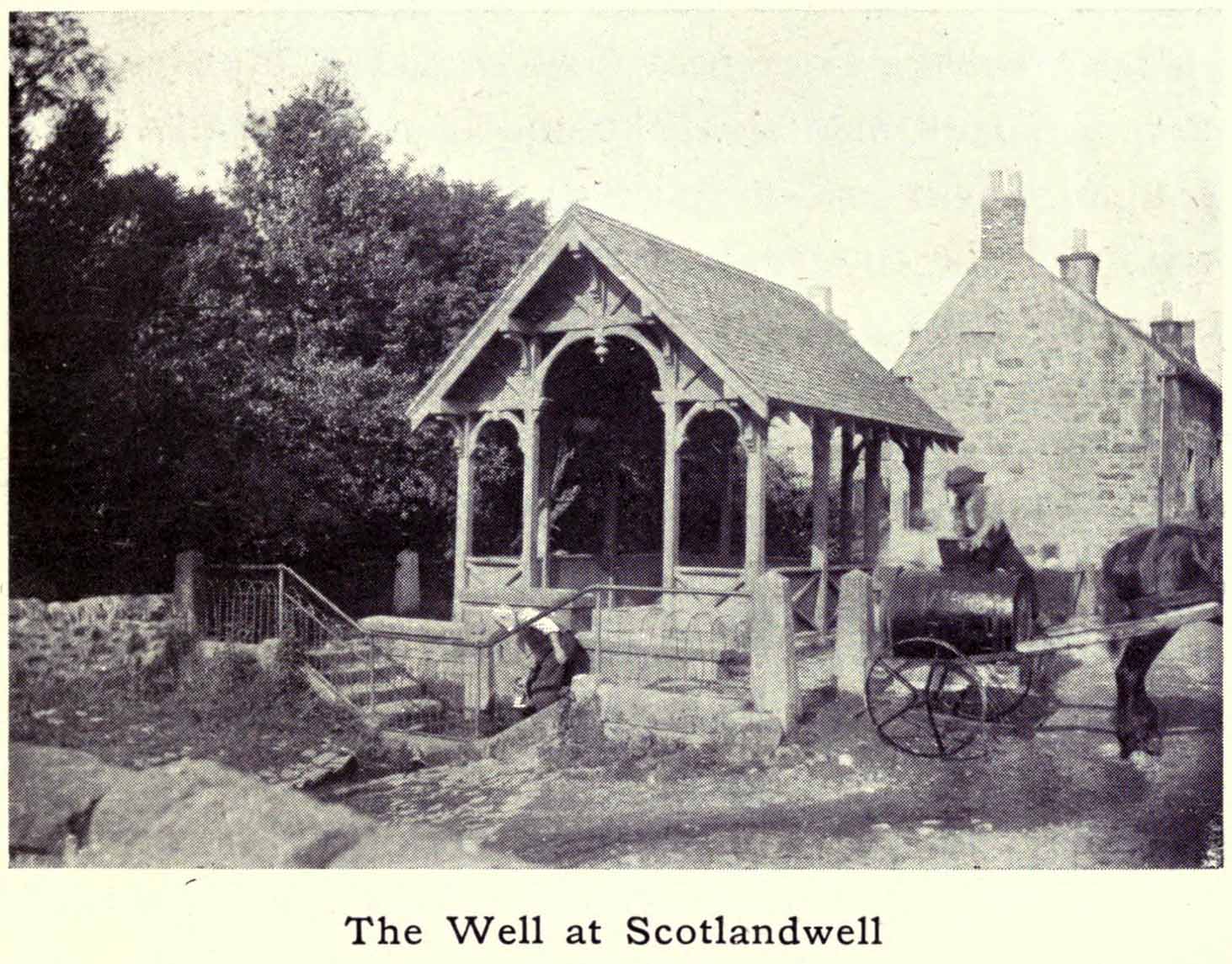
Scotland Well in 1915

The clear cold waters

Although there has never been a direction dedication of the Scotland Well to any saint, as J.M. MacKinlay (1904) and others have pointed out, in the village itself was an ancient medieval hospital that belonged to “the Trinity or Red Friars” that was built for the benefit of the poor by the Bishop of St. Andrews, some 22 miles to the east.  The hospital was at first dedicated to St. Thomas and subsequently to the Virgin, or St Mary.  Holy wells dedicated to both saints are renowned the world over as having great medicinal properties, but no extant written document relates either saint to the well.

Folklore

The main reason for this site maintaining such an honourable place in Scottish history is its association with the two great Scottish heroes, Sir William Wallace and King Robert the Bruce.  In the pseudonymous Historica’s (1934) literary rambles, he told that, after coming down out of the Lomond Hills,

“We descend the narrow defile—the Howgate—into Scotlandwell—Fons Scotia—famous for its medicinal springs, where tradition says King Robert the Bruce came to take the waters for scrofula and leprosy in 1295.  The great Sir William Wallace—according to ‘Blind Harry’—also has associations here.  His famous swim to the Castle Island, for a boat to take over some of his men to capture the english on St. Serf’s, took place from below Scotlandwell.”

In Ruth & Franks Morris’ (1982) fine survey of Scottish wells, they told that upon their visit to the Scotland Well, three people they met still thought highly of its curative properties.  “Of these three people,” they said,

“one was a sufferer from cancer which was the cause of a painful skin rash.  He had been persuaded to try the water and found that it did him so much good that he was driven from Edinburgh to the well, a round trip of some 80 miles, at at regular intervals to drink the water and take back with him two demi-johns of it.”

According to the man concerned, it did him the world of good and cleared the stubborn body rash he’d been suffering!

References:

  1. Day, J.P., Clackmannan and Kinross, Cambridge University Press 1915.
  2. Historicus, Historic Scenes within our Limits, Kinross-shire Advertiser: Kinross 1934.
  3. MacKinlay, James M., Influence of the Pre-Reformation Church on Scottish Place-Names, William Blackwood: Edinburgh 1904.
  4. Morris, Frank & Ruth, Scottish Healing Wells, Alethea: Sandy 1982.
  5. Taylor, Simon, The Place-Names of Kinross-shire, Shaun Tyas: Donington 2017.

Acknowledgements:  Big thanks for being able to use the 1st edition OS-map for this site profile, Reproduced with the kind permission of the National Library of Scotland

© Paul BennettThe Northern Antiquarian


Simon Howe Stone Row, Goathland, North Yorkshire

Stone Row:  OS Grid Reference – SE 83016 98119 (SSW) to SE 83031 98142 (NNE)

Getting Here

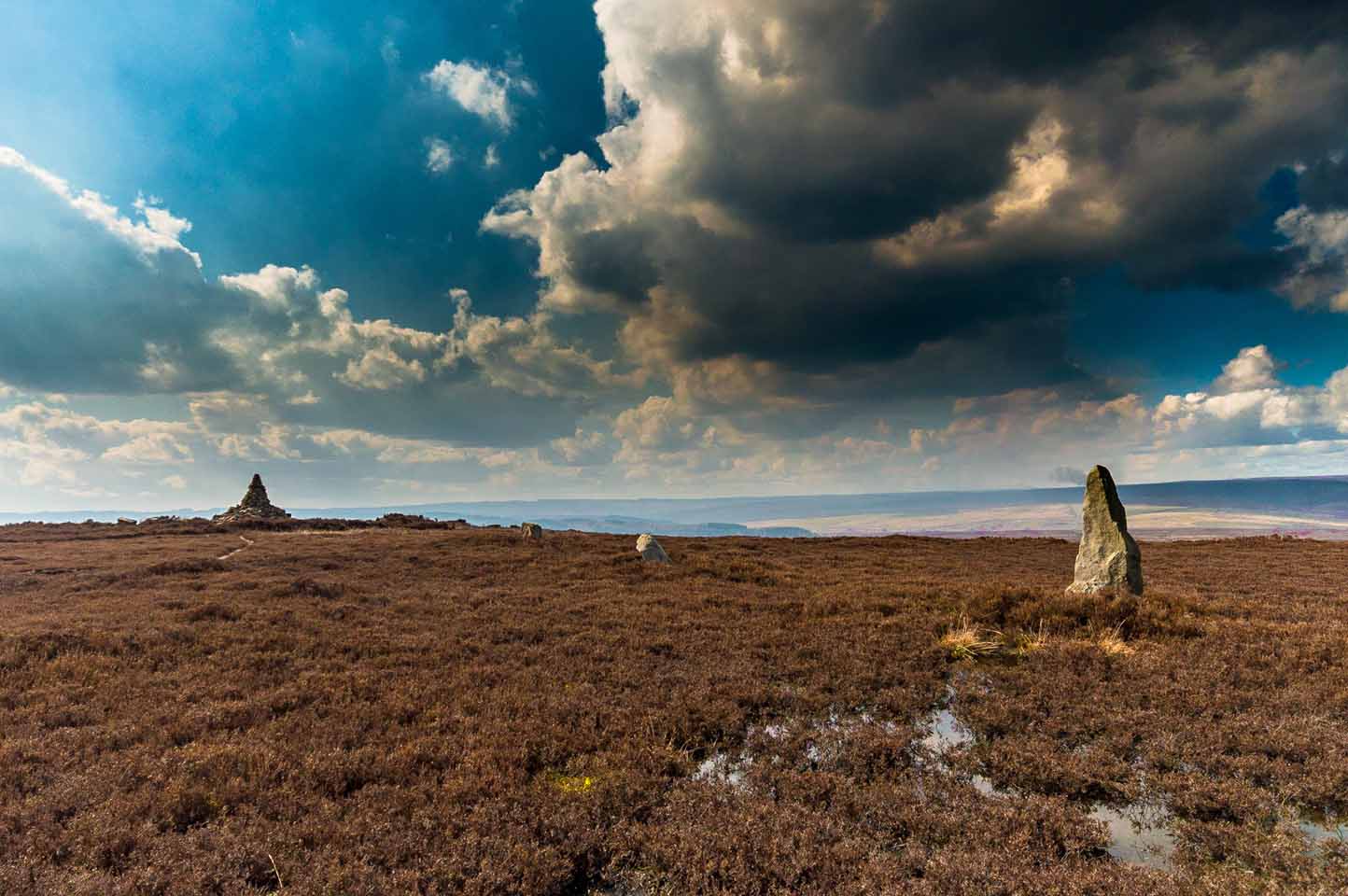
Simon Howe stone row (photo by James Elkington)

From Pickering take the moor road towards Whitby (A169) for approx. 12 miles.  After passing the Fylingdales Early Warning radar on the right (you can’t miss it), the road dips down to cross Eller Beck as a dog leg. After a half mile turn off left (west) towards Goathland (signposted). Follow the road under the North Yorks Moor railway bridge and after a third-of-a-mile the road turns slightly left.  Park in the little layby and follow the track onto the moors. Cross the small stream and walk along the narrow track through gorgeous heather for a mile and a half. Ahead you will see Simon Howe prominent on a ridge, with a stone row leading to it.

Archaeology & History

Not included in either of the giant megalithic alignments surveys of Burl or Thom, it seems that the first archaeological reference to this site was made by Raymond Hayes (1988).   He visited the site in 1947, shortly after a moorland fire had cleared away all the vegetation, allowing for a clearer view of the stones and, after his brief description of the adjacent Simon Howe tomb, he told that,

“The ridge is also the site of what is an unusual feature for the moors: a stone alignment consisting of three, formerly five upright stones that lead to a low eroded cairn c.65m to the south(west).  A moor fire in 1947 revealed the fourth, fallen stone, and I was able to locate the socket of a fifth.”

Raymond Hayes 1947 photo

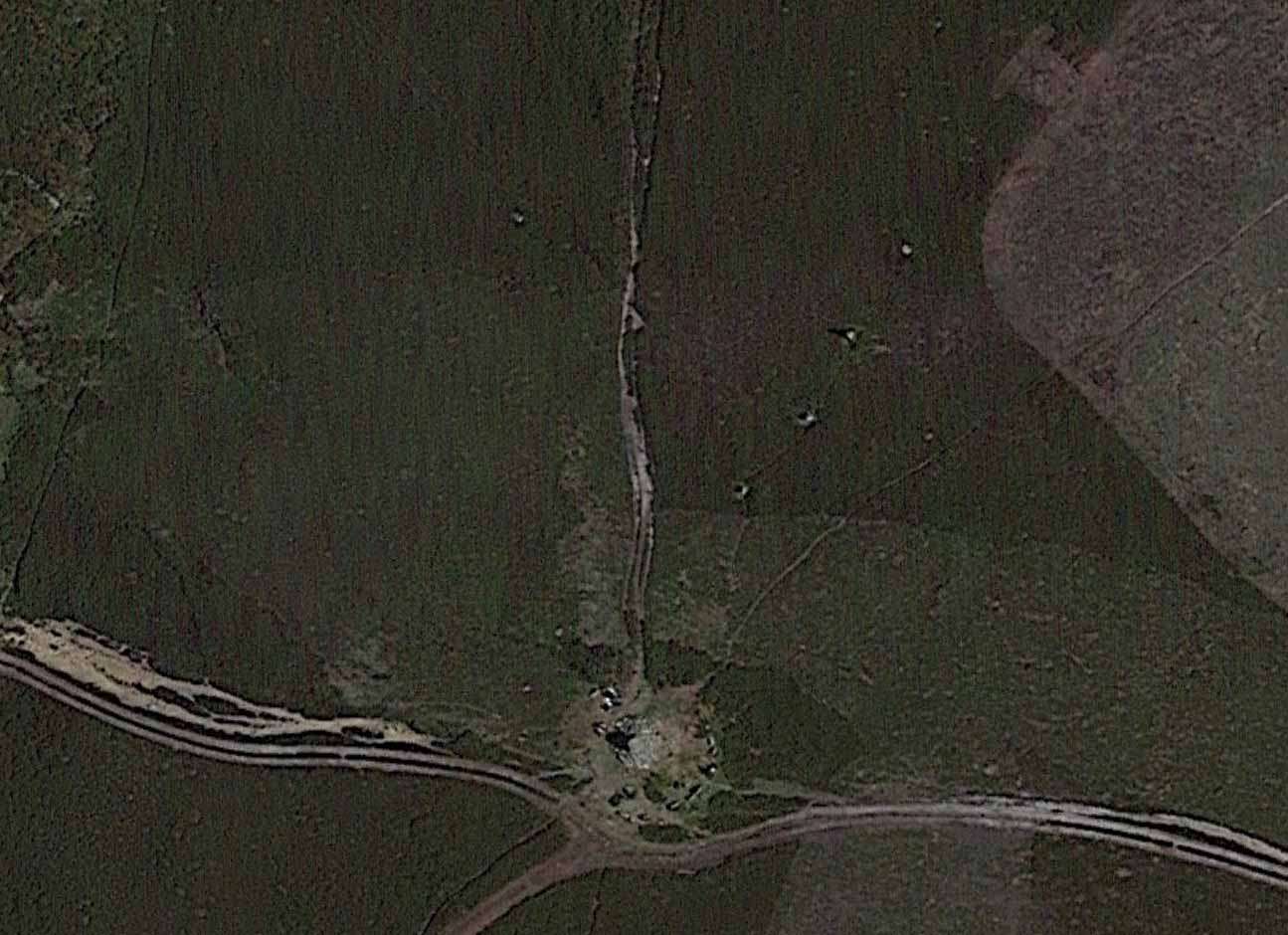
Stone row on GoogleEarth

From hereon, Hayes seemed to more interested in seeking out and describing a large number of flints that he found scattered on the ground around Simon Howe and its associated monoliths than the stones themselves.  Very sad…  The exact position of the missing fifth stone seems to be shown on Hayes’ plan as being closest to the cairn, about 10-15 yards away, but no trace of this remains.  However, of the remaining monoliths, they are all clearly visible from the air on Google Earth!

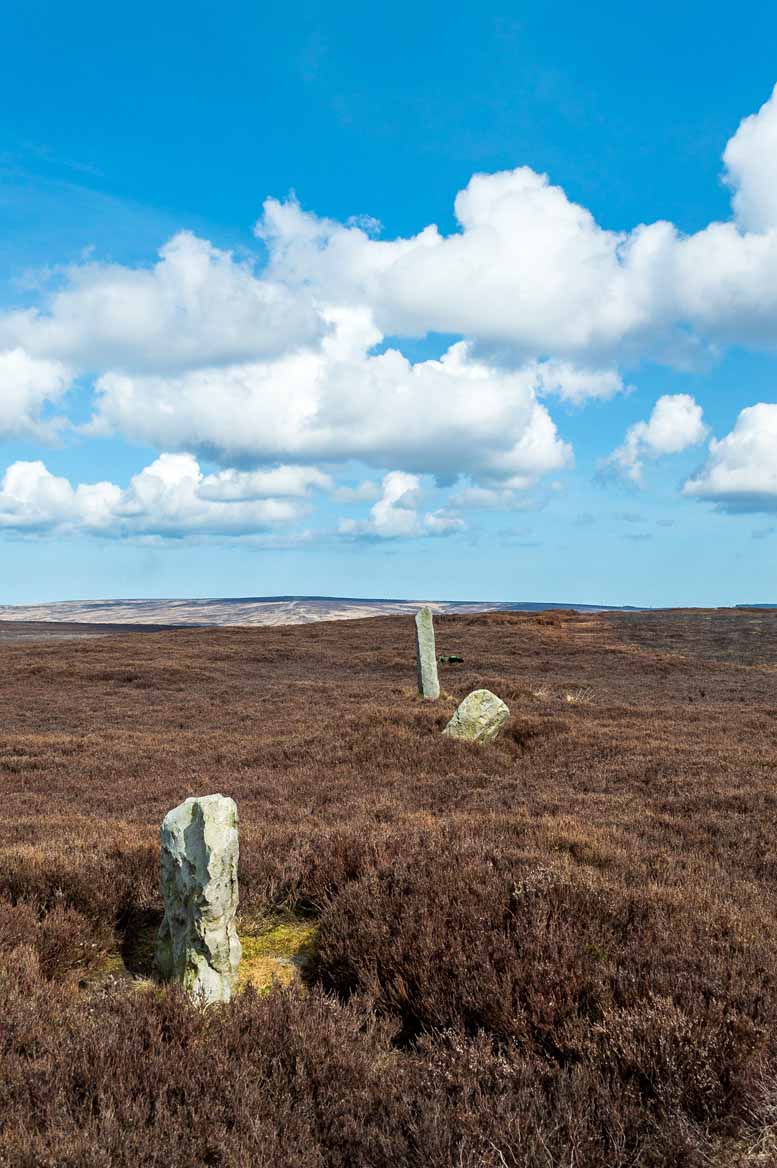
Looking SW (Photo by James Elkington)

Looking NE (photo by James Elkington)

The most southerly of the four stones (SE 83016 98119) stands just over 3 feet tall and the second upright, leaning at an angle, is just slightly taller, with the tallest of the three uprights at the northeastern end, being some 6 feet tall.   The fourth fallen stone (SE 83031 98142) lies just beyond this in the heather and which, if resurrected, would stand some 4 feet in height.  The length of the row, stone-to-stone, is just over 29 yards (26.6m).  I’m not aware if this site has ever been assessed as having an astronomical function, but its angle to the northeast might suggest a lunar rising.  Perhaps more pertinent would be another prehistoric cairn that can be seen less than 100 yards away past the northern end of the stone row: as North is the cardinal direction symbolizing Death in traditional lore…

References:

  1. Hayes, Raymond H., North-East Yorkshire Studies: Archaeological Papers, YAS: Leeds 1988.
  2. White, Stanhope, Standing Stones and Earthworks on the North Yorkshire Moors, privately printed: Scarborough 1987.
  3. Windle, Bertram C.A., Remains of the Prehistoric Age in England, Methuen: London 1909.

Links: 

  1. Simon Howe Stone Row on Stone Rows of Great Britain

Acknowledgements:  A huge thanks to James Elkington for use of his excellent photos in this site profile, as well as telling us about Getting Here. 🙂

© Paul BennettThe Northern Antiquarian

Simon Howe, Goathland, North Yorkshire

Cairn:  OS Grid Reference – SE 83007 98096

Getting Here

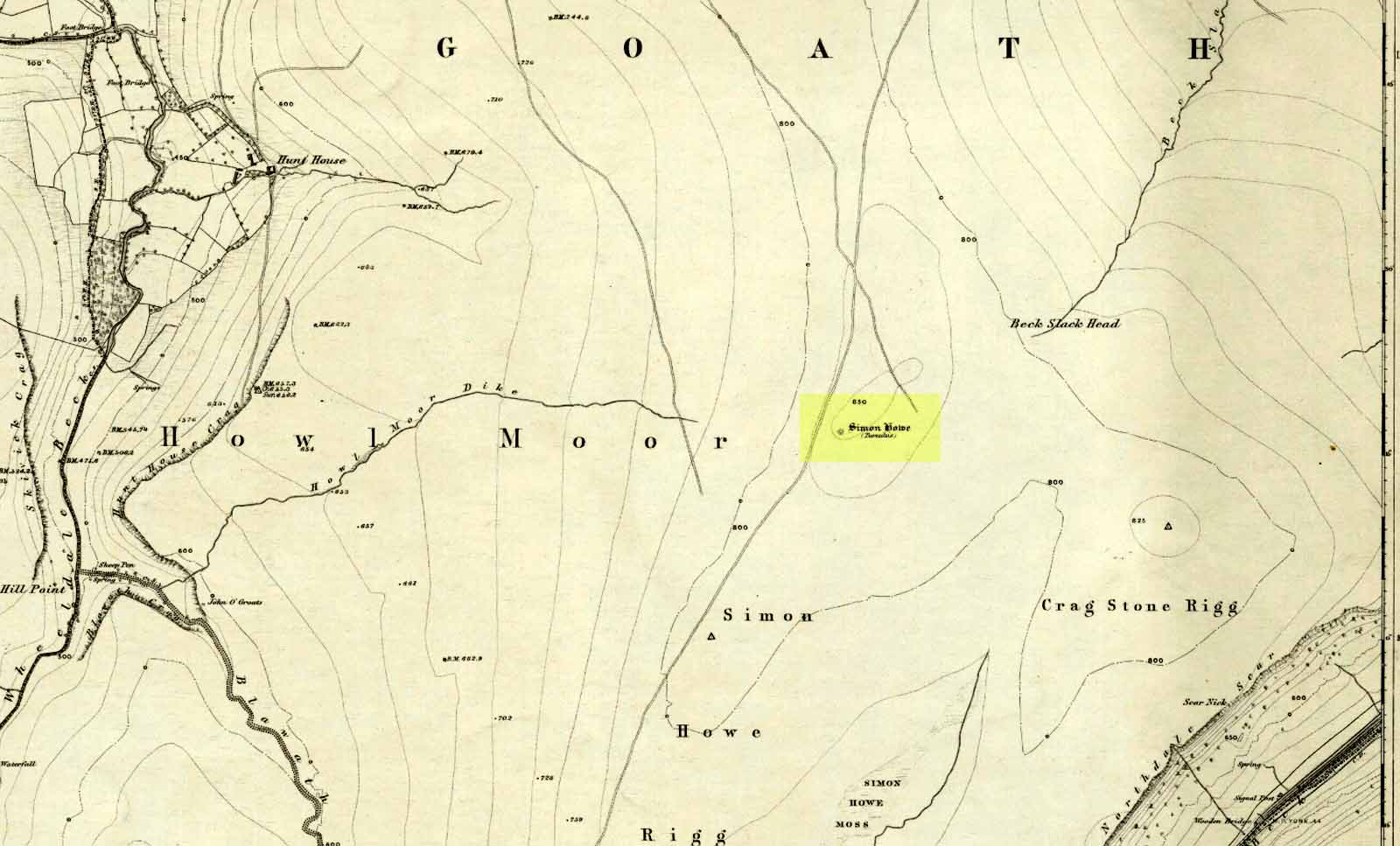
Simon Howe on 1854 map

From Pickering take the moor road towards Whitby (A169) for approx. 12 miles.  After passing the huge Fylingdales Early Warning radar on the right (you can’t miss it), the road dips down to cross Eller Beck as a dog leg. After a half mile turn off left (west) towards Goathland (signposted). There’s a free car park on the left where you can sit for awhile and enjoy the views.  Follow the road under the North Yorks Moor railway bridge, and after a third-of-a-mile the road turns slightly left.  Park in the little lay-by and follow the track onto the moors. Cross the small stream and walk along the narrow track through gorgeous heather for a mile and a half. Ahead you will see Simon Howe prominent on a ridge, with a stone row leading to it.

Archaeology & History

This impressive prehistoric tomb was first described in deeds as early as 1335 as Simondshou, which A.H. Smith (1928) translates to mean ‘Sigemund’s mound’ – alluding it to have been either the burial of someone with that name, or a name given to it by the incoming Vikings, oh so many centuries ago.  The latter is the more probable of the two…

Simon Howe (photo by James Elkington)

Hayes’ 1947 photo of Simon Howe

With excellent views in all directions, this monument is found high up in the landscape at the meeting of four paths that are closely aligned to the cardinal directions.  It was highlighted as a tumulus on the 1854 OS-map of the region and subsequently included in Windle’s (1909) listings as a “round barrow”, found in association with “three upright stones” running to the northeast. There are in fact four stones.

Not much has been written about it in archaeological circles.  Thankfully a brief survey of it was undertaken in 1947 by Raymond Hayes (1988) after a moorland blaze had cleared the heather, enabling good conditions to see the site more clearly.  He told that,

“Simon Howe…is very mutilated, what survives indicates that it was 11.50m in diameter and it is clear that it incorporated a stone kerb.”

This “stone kerb”, or surrounding ring of stones, is a feature found at other tombs on these hills—Flat Howe (1) being just one example.  However, in contrast to Flat Howe (1), Simon Howe has had most of its central mound totally stripped by peoples unknown a few centuries ago.  The remains we see today look more like a small ruined stone circle with internal rubble and a new walker’s cairn growing slowly from its centre.  Outside the cairn, just a few yards northeast, a fascinating megalithic stone row emerges.  Whether these were erected at the same time (in the early to mid-Bronze age, in my opinion) only an excavation would tell.

References:

  1. Hayes, Raymond H., North-East Yorkshire Studies: Archaeological Papers, YAS: Leeds 1988.
  2. Smith, A.H., The Place-Names of the North Riding of Yorkshire, Cambridge University Press 1928.
  3. White, Stanhope, Standing Stones and Earthworks on the North Yorkshire Moors, privately printed: Scarborough 1987.
  4. Windle, Bertram C.A., Remains of the Prehistoric Age in England, Methuen: London 1909.

Links

  1. Simon Howe on The Megalithic Portal
  2. Simon Howe on Stone Rows of Great Britain

Acknowledgements:  A huge thanks to James Elkington for use of the photograph in this site profile, as well as telling us about Getting Here.  And the map accompanying this site profile is Reproduced with the kind permission of the National Library of Scotland

© Paul BennettThe Northern Antiquarian


Allt a’ Choire Chireinich (06), Ben Lawers, Kenmore, Perthshire

Cup-Marked Stone:  OS Grid Reference – NN 65309 39553

Getting Here

Allt a’ Choire Chireinich 6

Follow the directions to reach the faint but impressive Allt a’ Choire Chireinich (04) petroglyph.  Standing here, you’ll notice the large boulder that looks as if it’s fallen down the slope immediately to your left.  You can’t really miss it.

Archaeology & History

Beneath the gorgeous excess of ancient lichens you can make out at least three cup-marks on the south-facing sloping rock-face in the top-half of the boulder.  There may be some other faint cups on here, but due to the lichens they are very difficult to see, so I’m erring on the side of caution regarding their veracity.  This is another one of those carvings likely to be interest only to the most ardent petroglyphic nuts amongst you.

© Paul BennettThe Northern Antiquarian

Allt a’ Choire Chireinich (05), Ben Lawers, Kenmore, Perthshire

Cup- Marked Stone:  OS Grid Reference – NN 65305 39555

Getting Here

Allt a’ Choire Chireinich 5

Follow the directions to reach the faint but impressive Allt a’ Choire Chireinich (04) petroglyph.  Standing here, look straight down at the dried-up burn barely ten feet below you, where you’ll see a small sloping rock.  That’s it!

Archaeology & History

Nothing much to see here apart from a single shallow cup-marking.  Most likely of interest only to the most ardent petroglyphic explorer, but worth looking at when you’re visiting the more impressive carvings nearby.

© Paul BennettThe Northern Antiquarian

St. Patrick’s Well, Ballinvalley Upper, County Wicklow

Holy Well (destroyed):  OS Grid Reference – T 2481 8173 

Archaeology & History

Highlighted on the 1838 OS-map, Grogan and Kilfeather (1997) report that there are  “no visible remains” to be seen of this holy well.  The cult of St Patrick is still celebrated in Ireland every year on 17 March.

References:

  1. Grogan, Eion & Kilfeather, Annaba, Archaeological Inventory of County Wicklow, Stationery Office: Dublin 1997.
  2. Lynch, Geraldine, “The Holy Wells of County Wicklow,” in Wicklow History and Society (edited by K. Hannigan & W. Noland), Dublin 1994.

© Paul BennettThe Northern Antiquarian 

Woodhenge Circle (4), Durrington, Wiltshire

Round Barrow (destroyed):  OS Grid Reference — SU 1510 4330

Also Known as:

  1. Durrington 70

Archaeology & History

Cunnington’s sketch of the barrow remains

This was one of four ploughed-out round barrows (or ‘ring ditches’ in modern archaeo-jargon) that once existed immediately southeast of the well-known Woodhenge and was the closest of the four to the monument, being just 60 yards away. It was first noticed as a faint crop mark in an aerial survey photograph taken in 1926 of the fields hereby.  When it was investigated at ground level by Mr & Mrs Cunnington in August 1928, “no trace could be detected on the surface” of any extant monument—which they described as ‘Circle  IV’ in their superb survey.

The Cunnington’s (1929) account of the excavation they did here was pretty brief, telling:

“The soil was removed and the chalk brushed over that part of the area enclosed within firm lines.  Beyond a few shards of pottery in the soil, nothing whatever was found.  As the ditch was comparatively shallow and the filling-in was in patches dark in colour, with much ash and some burnt flints in it, a considerable length was dug out, as shown (in the sketch, above).  A few fragments of pottery similar to some of that from Woodhenge were found in and below the old turf line.

“The only find of interest was that of a piece of glass slag on the actual bottom of the ditch.  It is true it was at the shallowest point, but there was no evidence of disturbance.

“Conclusion — Like those of the other rings (Woodhenge Circles 1, and 3, PB) this ditch may have originally surrounded a Bronze Age burial, placed on the surface and covered with a mound, both of which were destroyed when the ground was levelled.”

References:

  1. Cunnington, M.E., Woodhenge, George Simpson: Devizes 1929.
  2. Royal Commission Historical Monuments, England, Stonehenge and its Environs, Edinburgh University Press 1979.
  3. Wainwright, G.J. & Longworth, Ian, Durrington Walls: Excavations 1966-1968, Society of Antiquaries: London 1971.

© Paul Bennett, The Northern Antiquarian
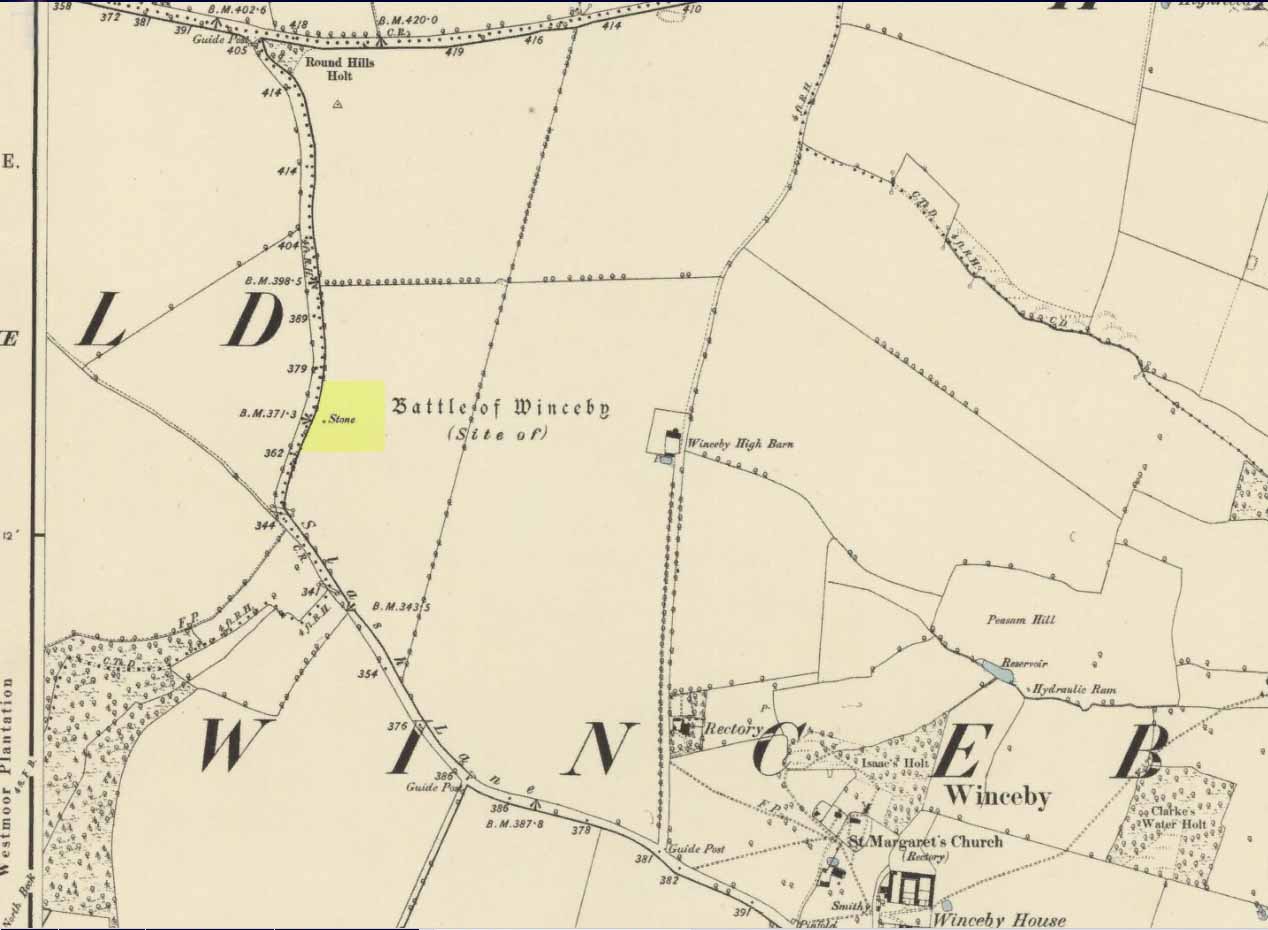

Woodhenge Circle (3), Durrington, Wiltshire

Round Barrow (destroyed):  OS Grid Reference — SU 1511 4327

Also Known as:

  1. Durrington 69

Archaeology & History

Cunningham’s sketch of Woodhenge-3 barrow

This was one of four ploughed-out round barrows (or ‘ring ditches’ in modern archaeo-jargon) that once existed immediately southeast of the well-known Woodhenge complex, constructed approximately 95 yards away.  As with others in this field, the site was first noticed as a faint crop mark in an aerial survey photograph taken in 1926.  When it was subsequently investigated at ground-level by Mr & Mrs Cunnington in August 1928, “no trace could be detected on the surface” of the monument in question—which they described as ‘Circle  III’ in their superb survey.

Very little was found in the Cunnington’s (1929) excavation, as their following brief account indicates:

“The soil was removed and the surface of the chalk brushed, over the whole of the area enclosed within this ditch.

“Only one small oval-shaped hole was found, near the edge of the ditch at “a” (above), 33in x 22in, and only 5in deep in the chalk; in it were a number of fragments of bones of a small ox and pig, a piece of burnt clay and a flint scraper weathered white.

“As there was nothing dateable in the circle it was not thought worth while to excavate more than a short section of the ditch.  Pottery comparable with that found at Woodhenge came from the old turf line and from the bottom of the ditch.

“Conclusion — Like those of the other circles (Woodhenge circles 1, 2 and 4, PB) it is probable that this ditch was originally made round a Bronze Age burial that had been placed on the surface, and that it was destroyed together with the covering mound when the ground was levelled.”

References:

  1. Cunnington, M.E., Woodhenge, George Simpson: Devizes 1929.
  2. Royal Commission Historical Monuments, England, Stonehenge and its Environs, Edinburgh University Press 1979.
  3. Wainwright, G.J. & Longworth, Ian, Durrington Walls: Excavations 1966-1968, Society of Antiquaries: London 1971.

© Paul Bennett, The Northern Antiquarian