Cup-and-Ring Stone (destroyed?): OS Grid Reference – SE 314 537
Archaeology & History
The chances of this carving still being alive, so to speak, are pretty slim. It was reported by a Mr. Sullivan to the old Yorkshire petroglyph researcher Stuart Feather back in 1965, in the days when English archaeologists didn’t really give a shit about rock art. Sad but true. The carving was found in the grounds of what used to be the ICI Fibres Research Centre, in the present landscape of Hornbeam Business Park, a hundred yards or more west of Hookstone Beck. According to Feather’s report, the carving consisted of “a single-ringed cup and a groove” surrounding “two short pecked grooves and a meandering groove leading off,” all with clear signs of being pecked and carved in the old-school manner. All trace of the carving has vanished and it was probably destroyed by the Industrialists. (the grid-reference to this site is an approximation)
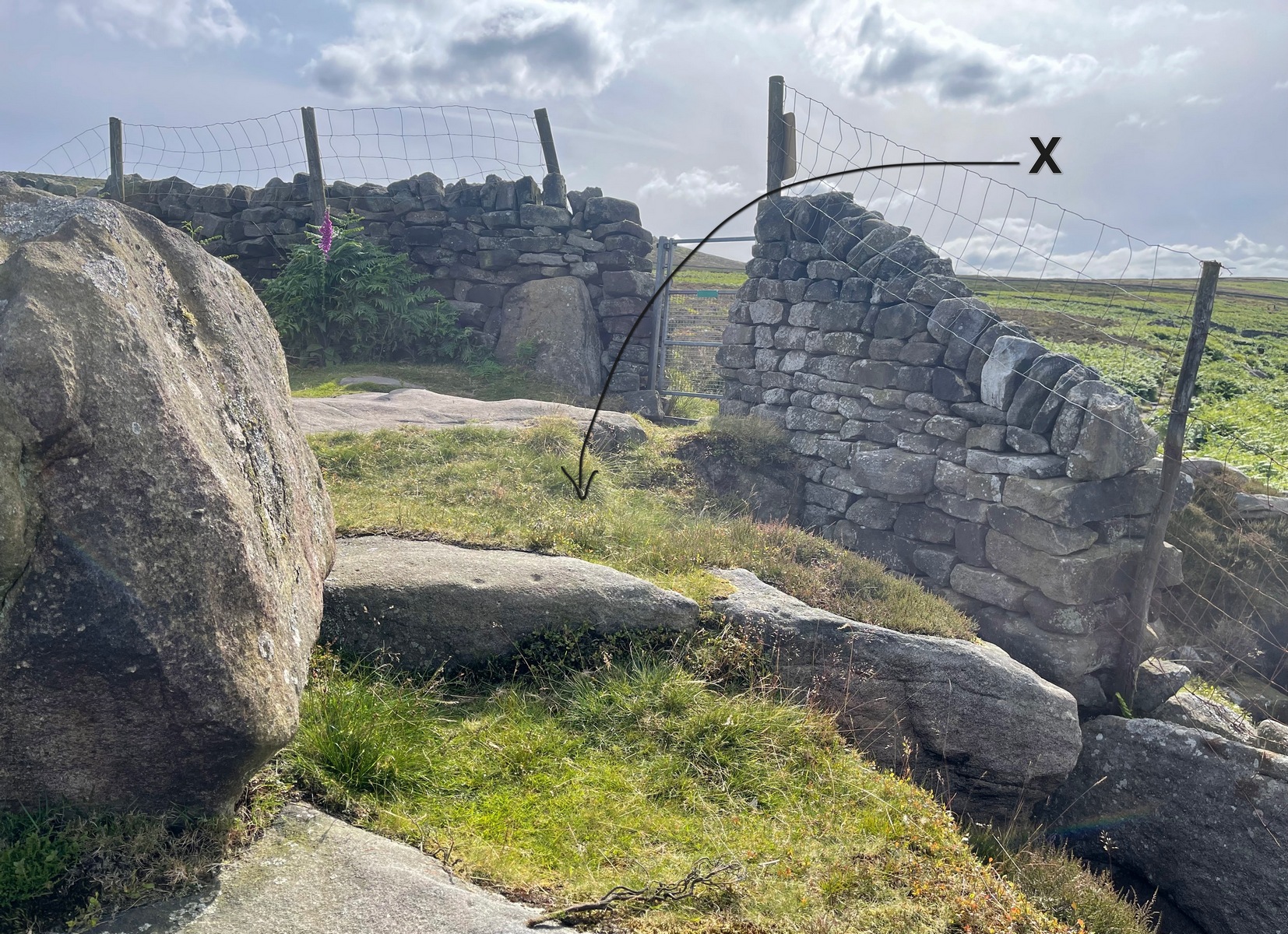
Easiest way is to park up at the Askwith Moor car-park spot, turn right and walk along the road for about 350 yards until you reach the gate on the right (not the one across the road!). You then need to head to the Death Head’s Stone carving about 450 yards across the moor to the east. It’s pretty conspicuous. From here, walk through the heather 80-odd yards northwest. You’ll walk past some extensive rubble walling (whose nature yet eludes us) before you get there.
Archaeology & History
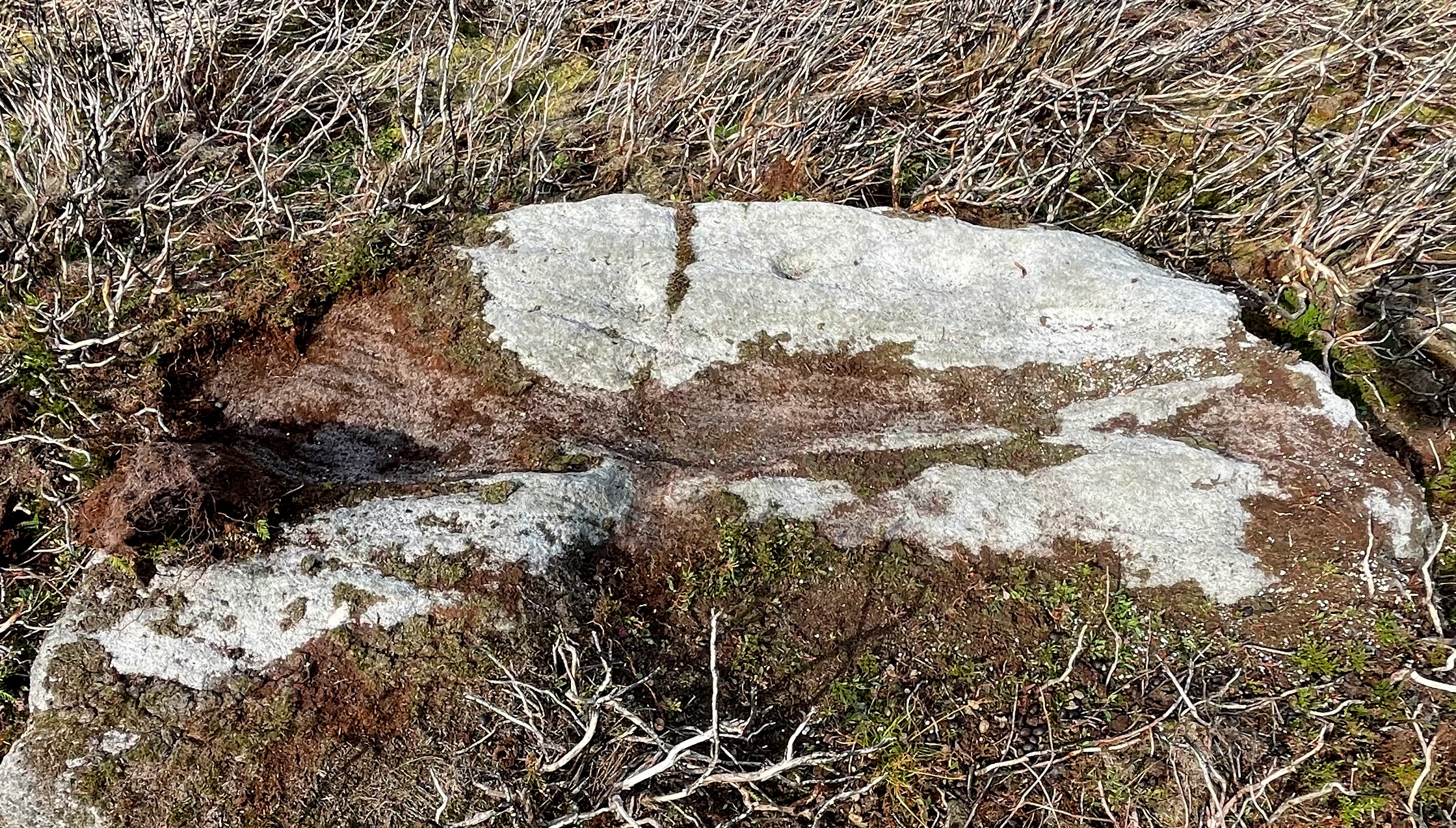
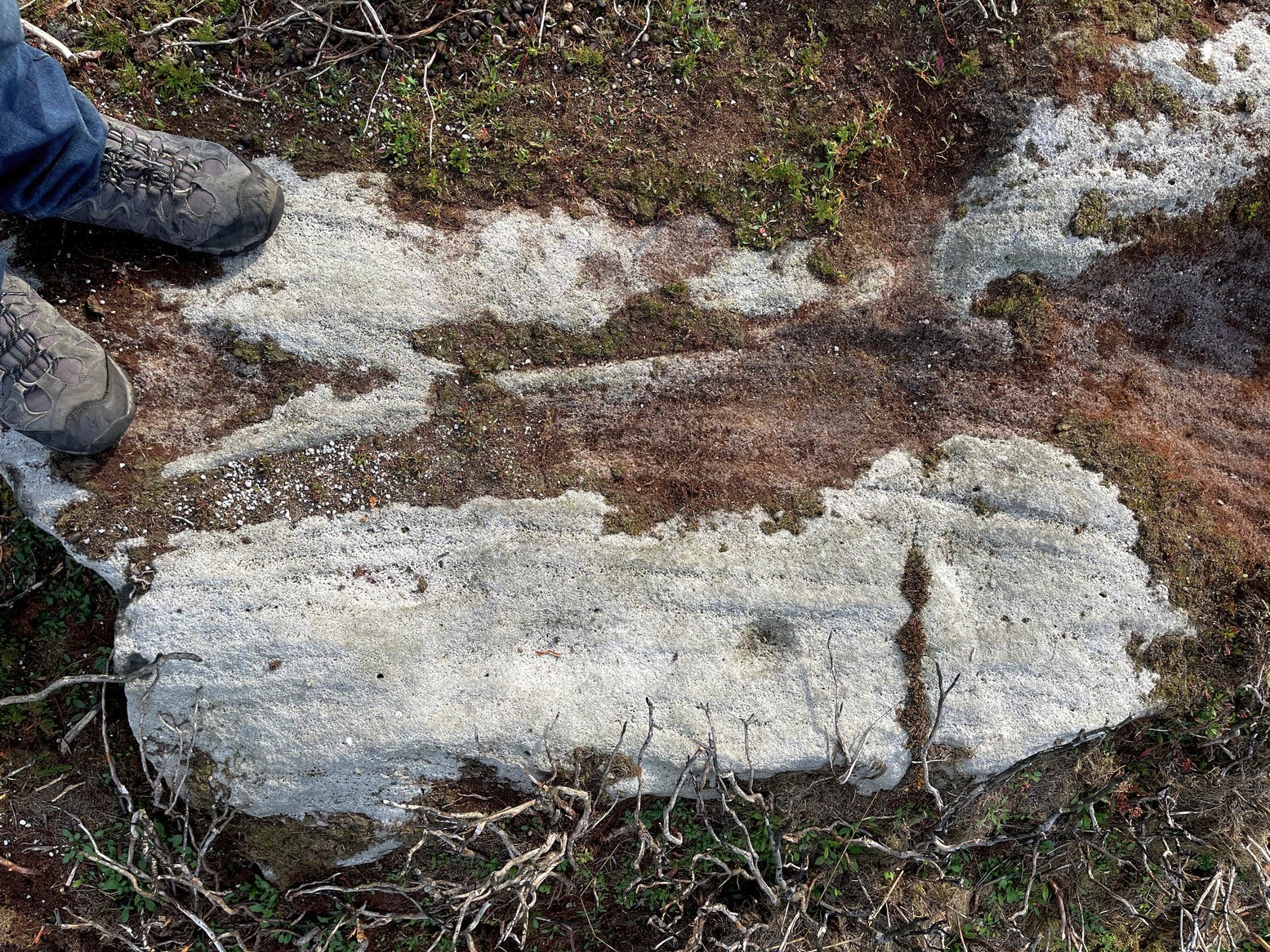
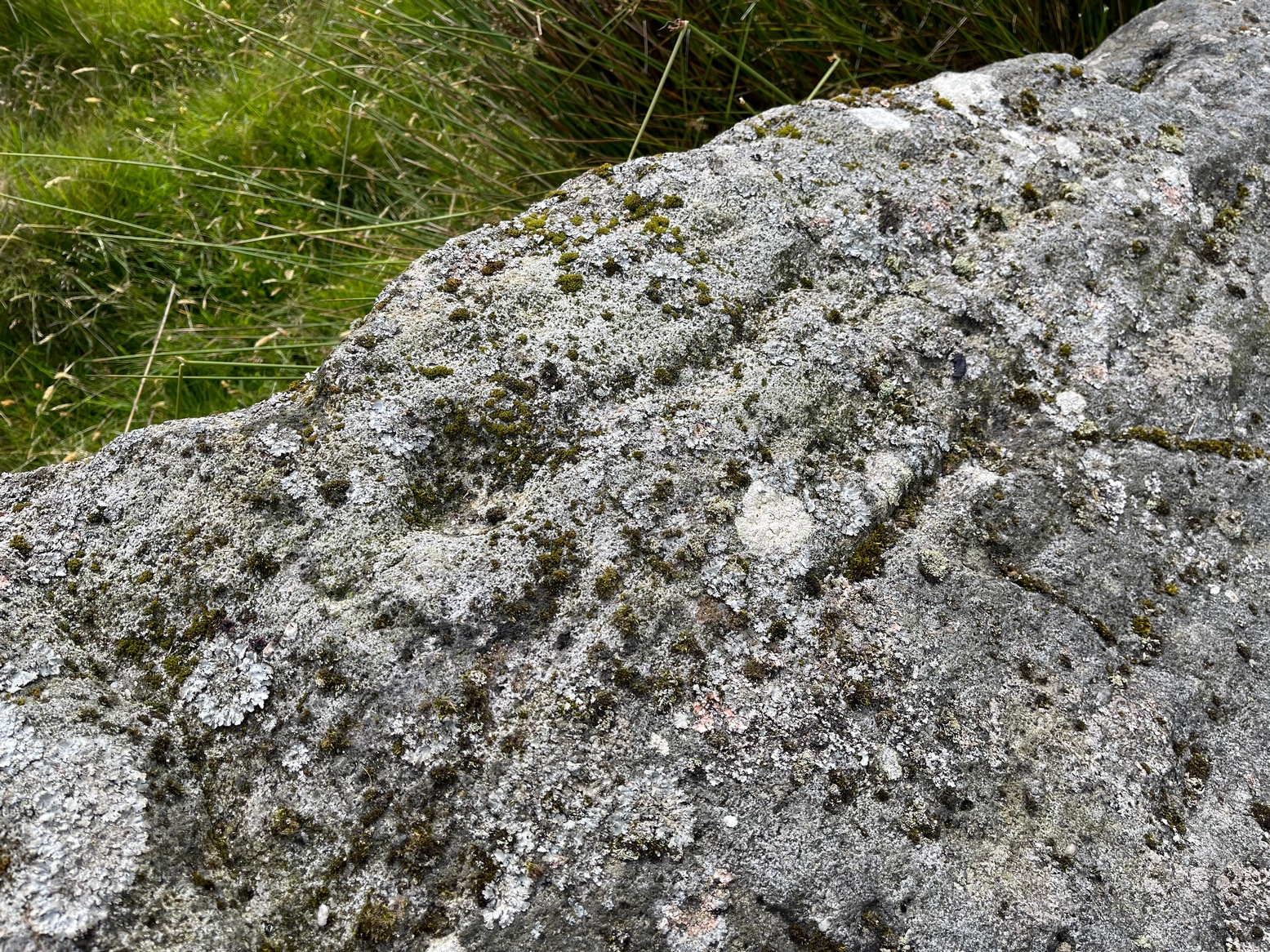
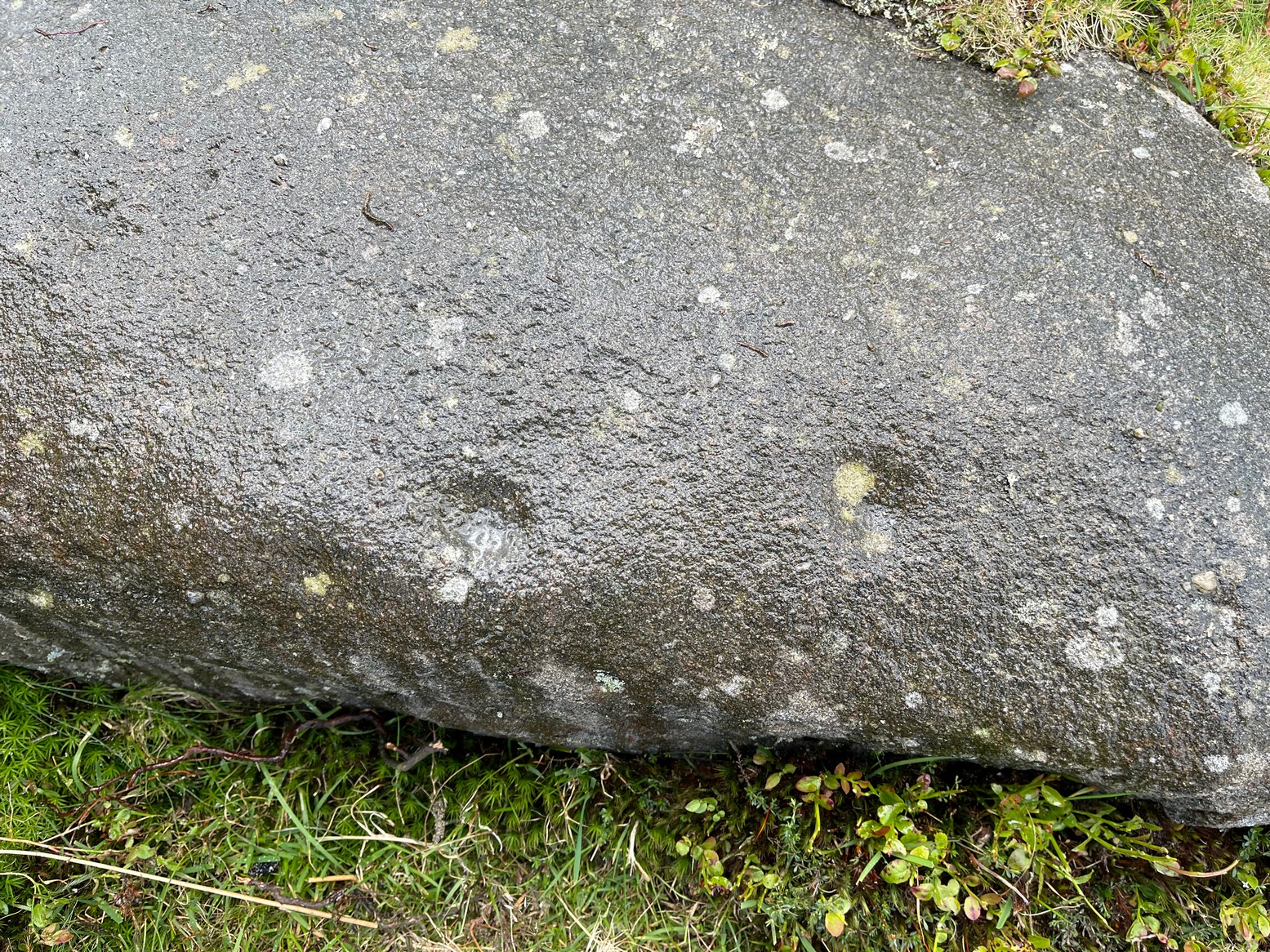
Looking down at the cups
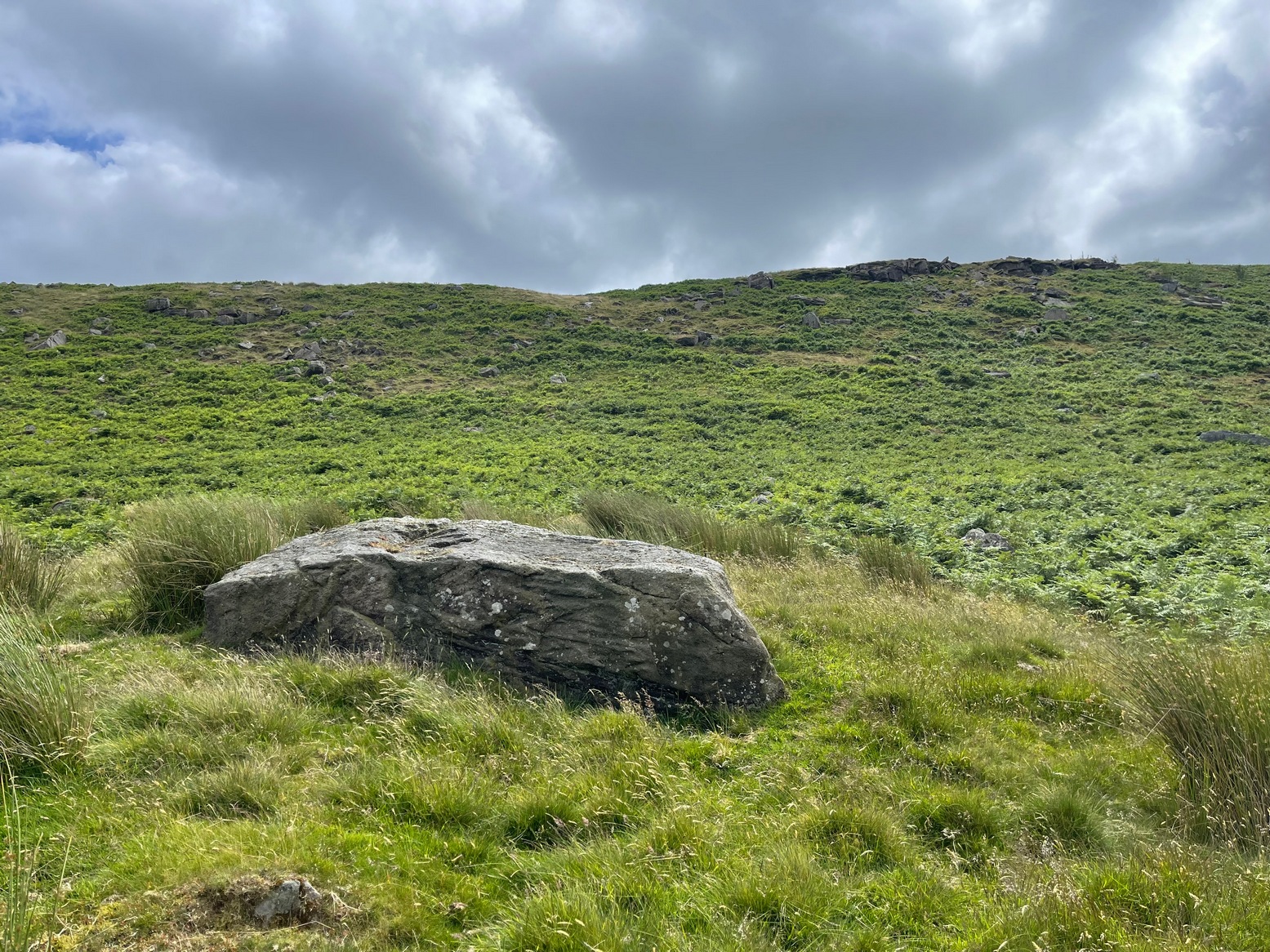
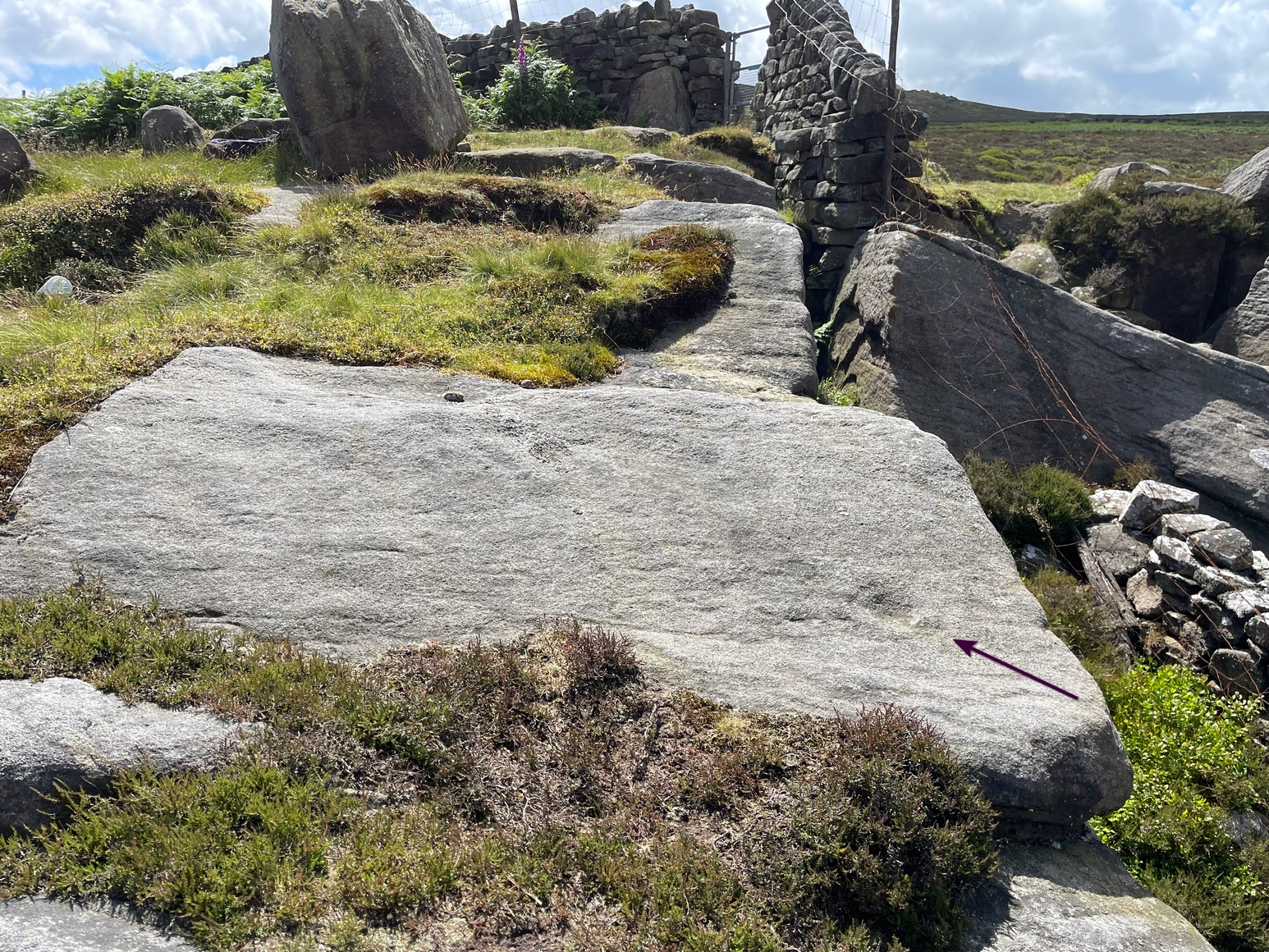
Discovered recently by Sarah Walker on a venture to see the extensive settlement and graveyard around Snowden Crags, this petroglyph is a simple basic design cut into a relatively large flat stone just above ground level. Found less than 100 yards east of the dubious Snowden Carr (565)carving, there are two large cup-marks on this one: one of them is an inch deep and two-inches across and may originally have been geophysical in nature, but has subsequently been worked by human hands. To its side is another much fainter and shallower cup-mark about the same width. On some photos there’s what appears to be a very faint large ring surrounding the faint cup, but until visits are made at low sun and the stone brushed with water, we cannot be sure whether it’s real or just a trick of the light. There may be more cups on this stone beneath the peat. We didn’t brush it all off.
Some 30-40 yards to the east is the rubble of an extensive prehistoric man-made structure, the nature of which has yet to be discerned. The Snowden Moor cairnfield begins immediately to the northwest, with the first tomb barely 50 yards away.
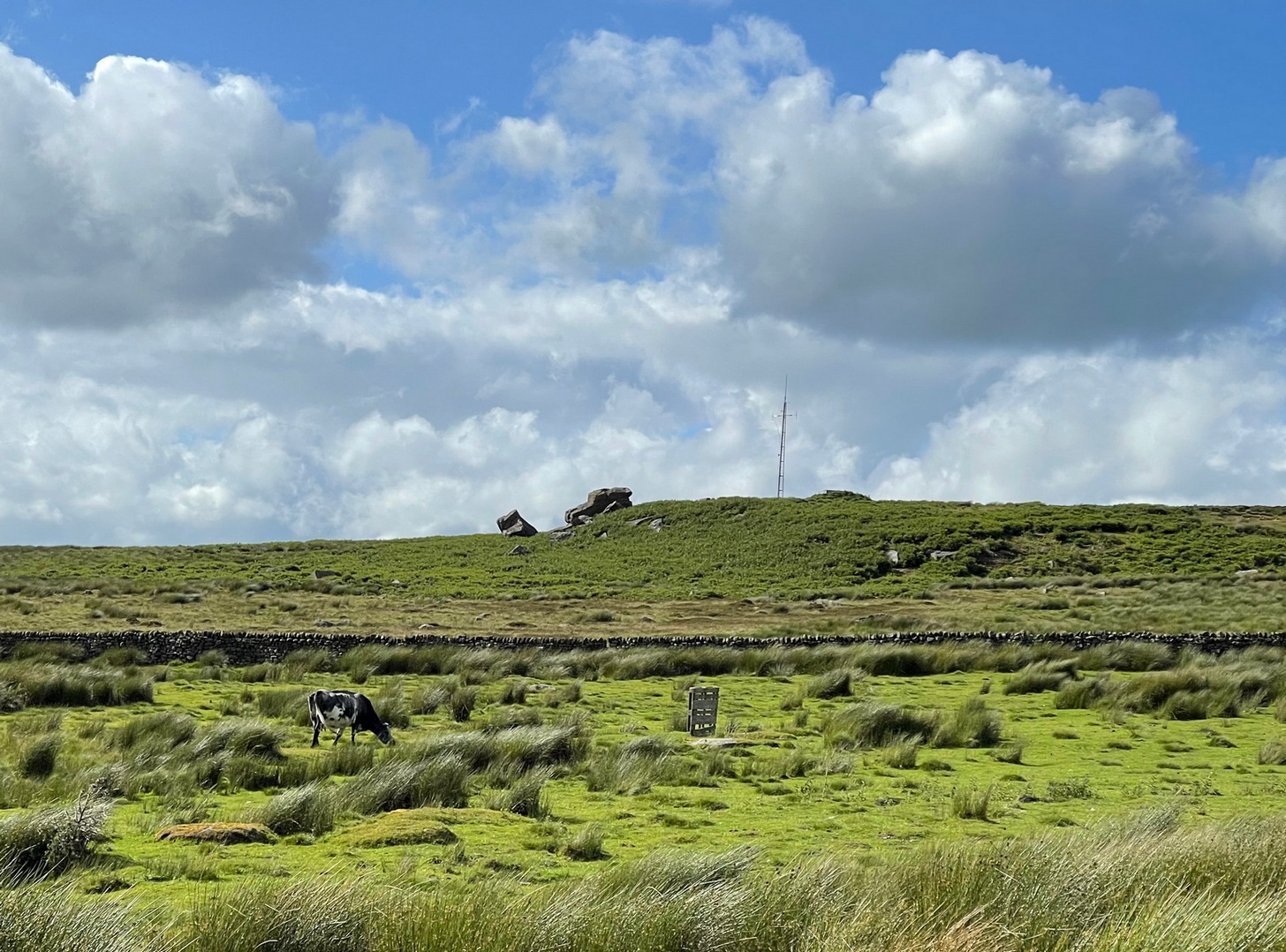
The easiest way to get reach here is via the Doubler Stones, which is usually approached either from the long and winding country lanes Silsden-side (you can’t drive all the way and there are hardly any parking spots en route), or from a long walk over the moors. Taking the latter route, probably the easiest is by starting at Whetstone Gate right on the moortop, on the Ilkley-Keighley road. From here, walk west along the footpath by the wallside for more than ½-mile until you reach the West Buckstones. From here, take the footpath NW (not SW) alongside the walling for literally one mile, where a notable angular skewing of three walls appears: keep to the left and walk alongside that wall for another ⅓-mile (0.5km) then climb over the wall and head straight for the small TV mast. The Giant’s Chair’s just below it.
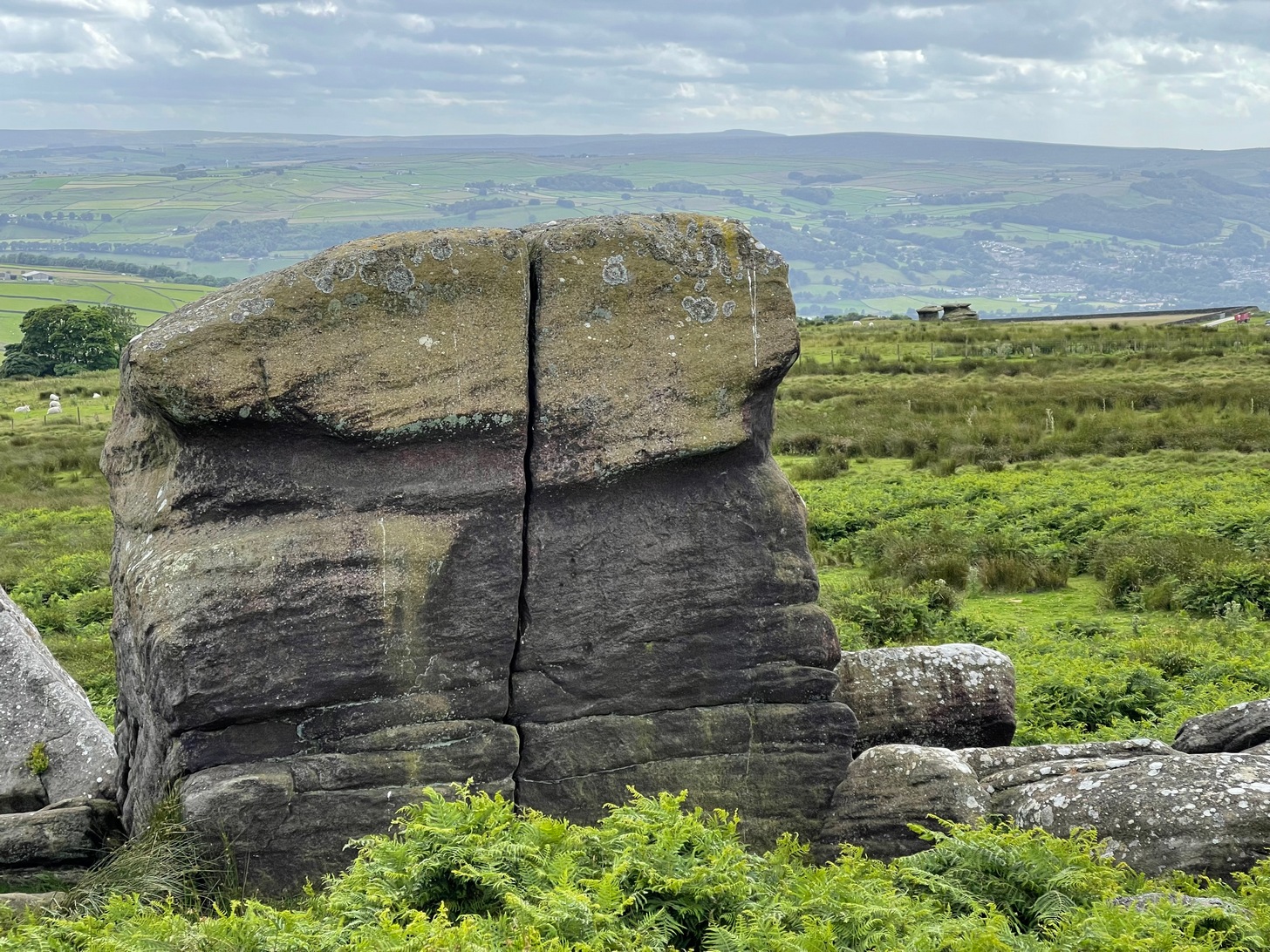
Some time in the mid- to late-1970s, on one of our early ventures to see the legendary Doubler Stones, this great rock outcrop of the Giant’s Chair also, understandably, drew our attention. And, as young fertile teenage lads, we all but flew up onto the top of this great rocky rise with relative ease. Now, nearly fifty years later, I’m unable to climb onto its top without ropes. (sigh….) It’s not easy. Anyhow, when we were on top of this rock as kids, a number of notable cup-markings stood out to us—in no distinct order, as I recall. But on the day of our clambering visit, She was grey and overcast; as She was on the two or three other visits we made to the stone, sitting on its top, fondling the cup-marks and eating our sarnies. All that I ever noticed were the cup-markings.
A few years after my early visits here, John Hedges (1986) wrote about this “very large high rock.” He mentioneed the cup-markings, obviously, but he also mentioned some things that we’d missed, saying that here are,
“Six large shallow worn cups, one with (a) partial ring and another with possible ring. One cup on SW end.”
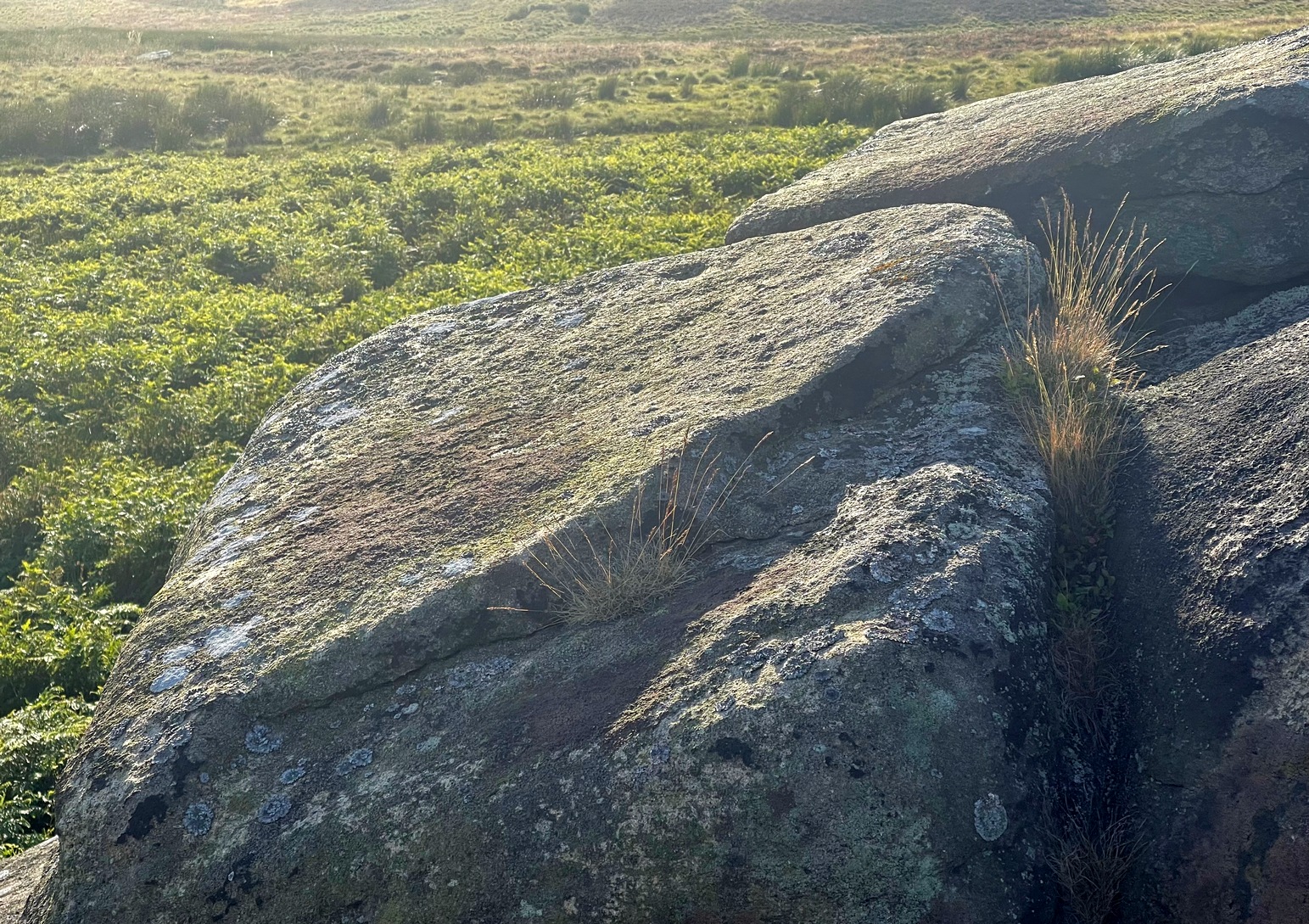
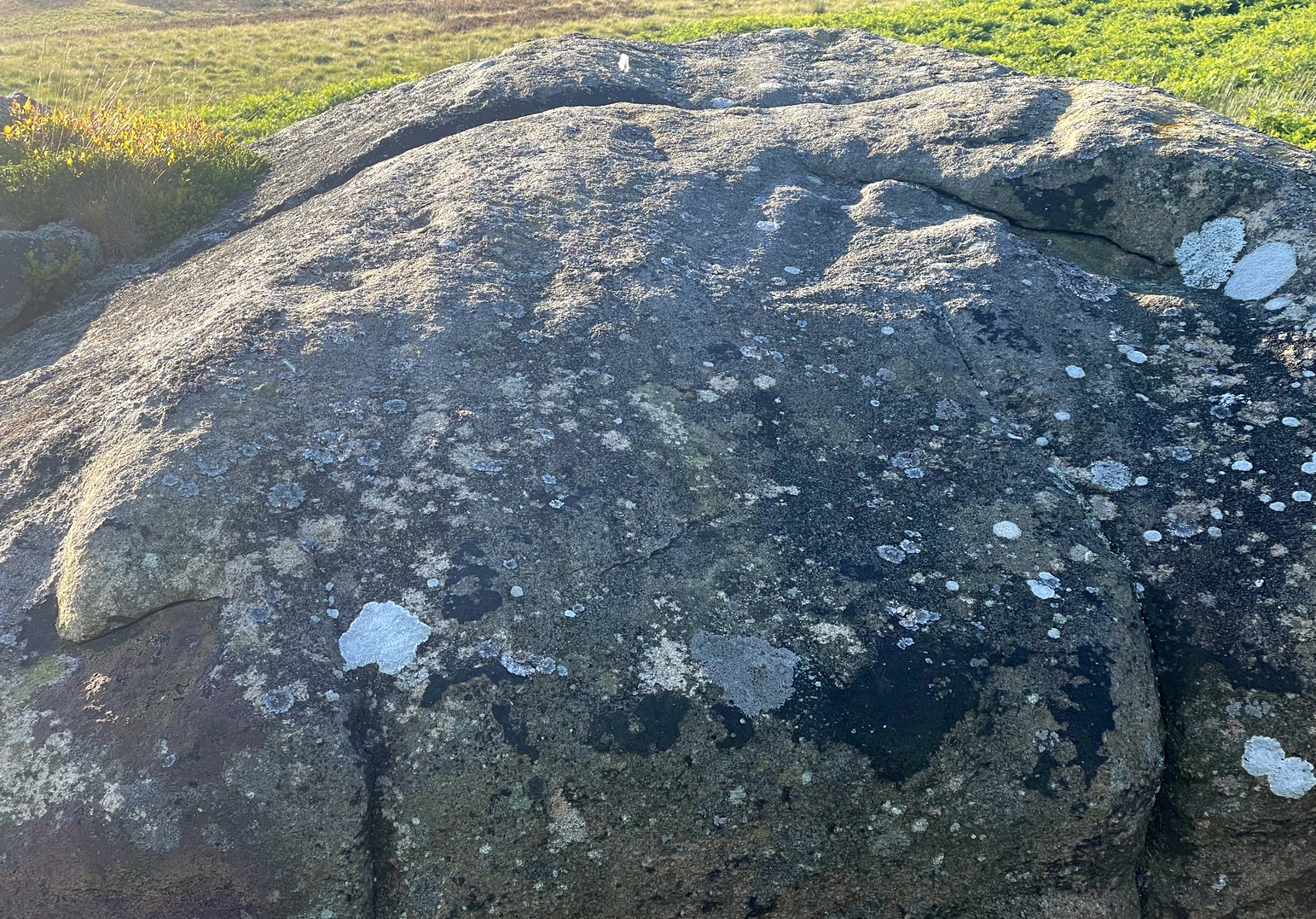
Single cup-mark (?)One of the cup-and-rings (?), top-left
Sadly, I’ve never seen these rings and, these days, my ageing bones might not allow me back onto its surface to see them. (the expression, “sad bastard” comes to mind!) On a recent visit here with Sarah Walker of Silsden, neither of us could get our useless arses on top! (the photos taken here were done with me stood on top of an adjacent rock, hands held high, trying to get at least some elements of the carving—with a minor bit of success, I think) I take comfort in the fact that when Boughey & Vickerman (2003) subsequently added this carving in their enlarged inventory, that they never got to see them either, as they gave it the completely wrong grid-reference! And so, due to the ineptitude of us old folk, I await some younger and more competent explorers who can climb up on top and send us some good photos of the design, when weather and lighting conditions allow for good imagery. Are there any takers…?
References:
Boughey, Keith & Vickerman, E.A., Prehistoric Rock Art of the West Riding, WYAS: Wakefield 2003.
Deacon, Vivien, The Rock Art Landscapes of Rombalds Moor, West Yorkshire, ArchaeoPress: Oxford 2020.
Hedges, John (ed.), The Carved Rocks on Rombalds Moor, WYMCC: Wakefield 1986.
Acknowledgements: Big thanks to Sarah Walker for helping, albeit unsuccessfully, to scale this old rock to see the cup-and-rings on my last visit here. At least we tried…
For those who like a walk: take the route to reach the Swastika Stone and keep walking west along the Millenium Way footpath, past the Piper’s Stone carving and over the next two walls. Then, stagger down the steep hill and head for the large upright near-cuboid block of stone and, once here, walk 30 yards to your east! Alternatively, from the Silsden-side, go along Brown Bank Lane up and past Brown Bank caravan park, and at the second crossroads turn right and travel for exactly 1¼ miles (2km) along Straight Lane (from hereon there’s nowhere to park!) which runs naturally into Moorside Lane, and notice the raised gate entrance into the field on your right. Walk to the top of this field, go through the next gate and, less than 100 yards uphill (south) you’ll find the stone in question.
Archaeology & History
Cup, incomplete ring & line
Rediscovered by Paul Bowers in 2011, this is another one of those petroglyphs that’s difficult to make out unless the light is falling just right across the surface of the stone. Two distinct cup-marks can be seen near the more southern-edge of the stone, one of which has a near-complete, albeit unfinished ring around it, and from this a seemingly carved line runs roughly parallel with the edge of the stone, down towards another equally distinct cup close to the southwestern edge of the rock. Most of the stone is nicely covered in a decent lichen cover, so the design’s a bit difficult to see when the light’s not right. But, if you’ve made it this far, the petroglyph 30 yards to the west will make up for any disappointment you may have!
References:
Boughey, Keith & Vickerman, E.A., Prehistoric Rock Art of the West Riding Supplement, 2018.
Get up to the Swastika Stone, then head west along the footpath towards the Piper Stone. Shortly before there, you’ll see the small cup-marked Piper’s Crag (3) carving, just by the walling. From this carving, just step a few yards down the slope and on the smooth sloping rock face is this faded carving. You’ll see it.
Archaeology & History
A larger than normal single cup-mark near the bottom slope of this rock has an incomplete ring around its east and southern edges, possibly with another broken element of it on its northern edge. It’s difficult to work out whether or not this is one of Nature’s curious markings and so needs looking at in different lights to work it out, one way or the other. It’s included in Boughey & Vickerman’s (2018) updated rock art survey, but there are a number quite natural cup-marks in that tome, so we need to exercise a little bit of caution here. However, it does seem to have a greater degree of authenticity than some of the other dubious single cup-marked stones in their book. Check it out on your way to the Piper’s Stone.
References:
Boughey, Keith & Vickerman, E.A., Prehistoric Rock Art of the West Riding Supplement, 2018.
Heading up from Ilkley, follow the directions to reach the Swastika Stone, then keep walking (west) along the footpath to the small clump of trees, and keep walking past them too and keep going along the same path as if you’re heading toward the Piper’s Stone. About 200 yards before reaching it, just where the gate and boundary stone is in the old walling, there’s a small line of crags to the right of your feet and there, at the edge of the path, is the stone in question. You’ll see it (unless it’s a cloudy gray day, in which case you might struggle).
Archaeology & History
The two cup-marks
This is one of a number of cup-marked stones that you’ll find scattering this part of the moor, almost all of which are Nature’s handiwork (a few of these natural carvings have somehow found their way into Keith Boughey’s [2018] updated West Riding rock art book). I’m not 110% certain that this doesn’t have Nature’s name on it either, but it’s got a greater degree of probability to it than some of the others. It’s a simple little thing, as y’ can see, consisting of just the two cup-marks, smaller than usual, living next to each other. If it’s the real deal, we can surmise that it may have been carved by a young person back-in-the-days. In the walling just above this stone you can see the medieval boundary stone, which might—just might—have a prehistoric pedigree to it….
References:
Boughey, Keith & Vickerman, E.A., Prehistoric Rock Art of the West Riding Supplement, 2018.
Cup-Marked Stone (removed): OS Grid Reference – NT 128 709
Archaeology & History
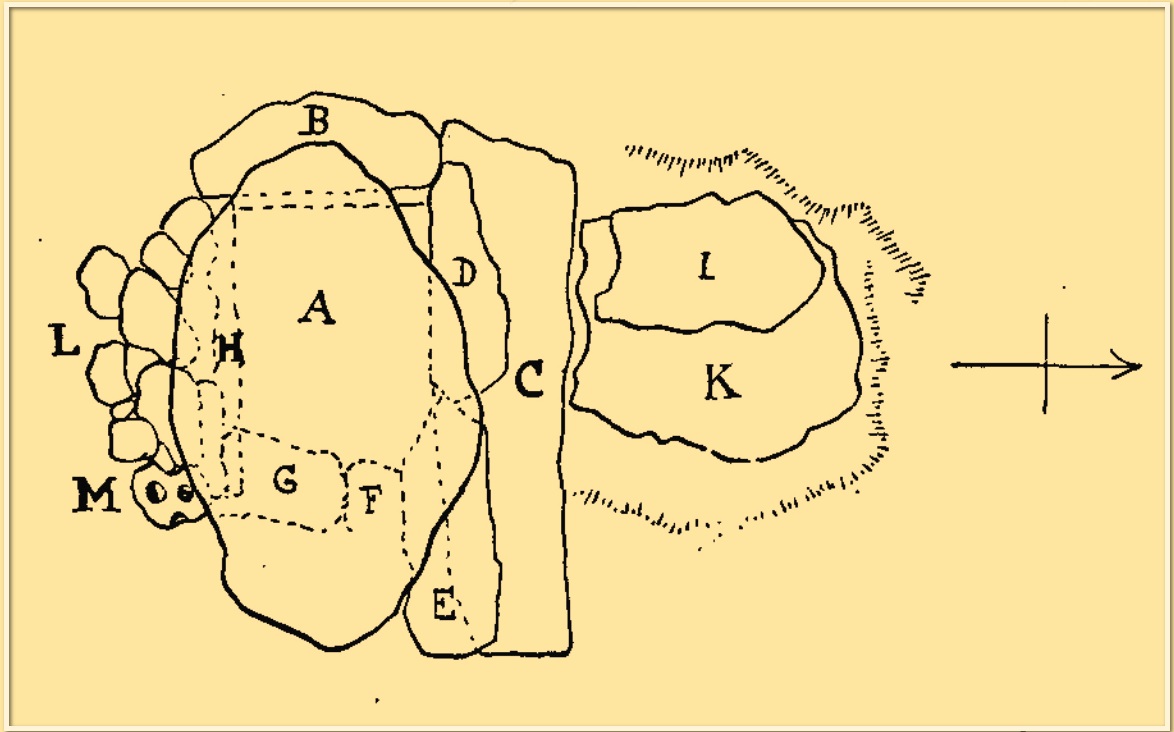
“M” marks the cupmark
A simple cup-marked stone was located inside a prehistoric burial cist that was discovered by quarry workmen in November 1897. The cist was subsequently excavated by Fred Coles (1898) who found therein (amongst other things) a simple cup-marked stone whose present locale is a box somewhere in Edinburgh’s National Museum (could someone send us a photo please?). The carving comprises simply of two complete cups and portion of a third, all close to each other on a small stone that was located on the south-side of the cist (see ‘M’ in the attached diagram). Coles described the carving thus:
“During the removal of (some) small stones, one, when the damp soil was rubbed of, showed two cup-marks, about 1½ inch wide each and ½ inch apart. The stone itself measures 5 inches by 4¾, and appears to be but a fragment of a larger one, one edge showing part of a third cup. The cups all show the tool-marks usually noticed on these mysterious sculpturings.”
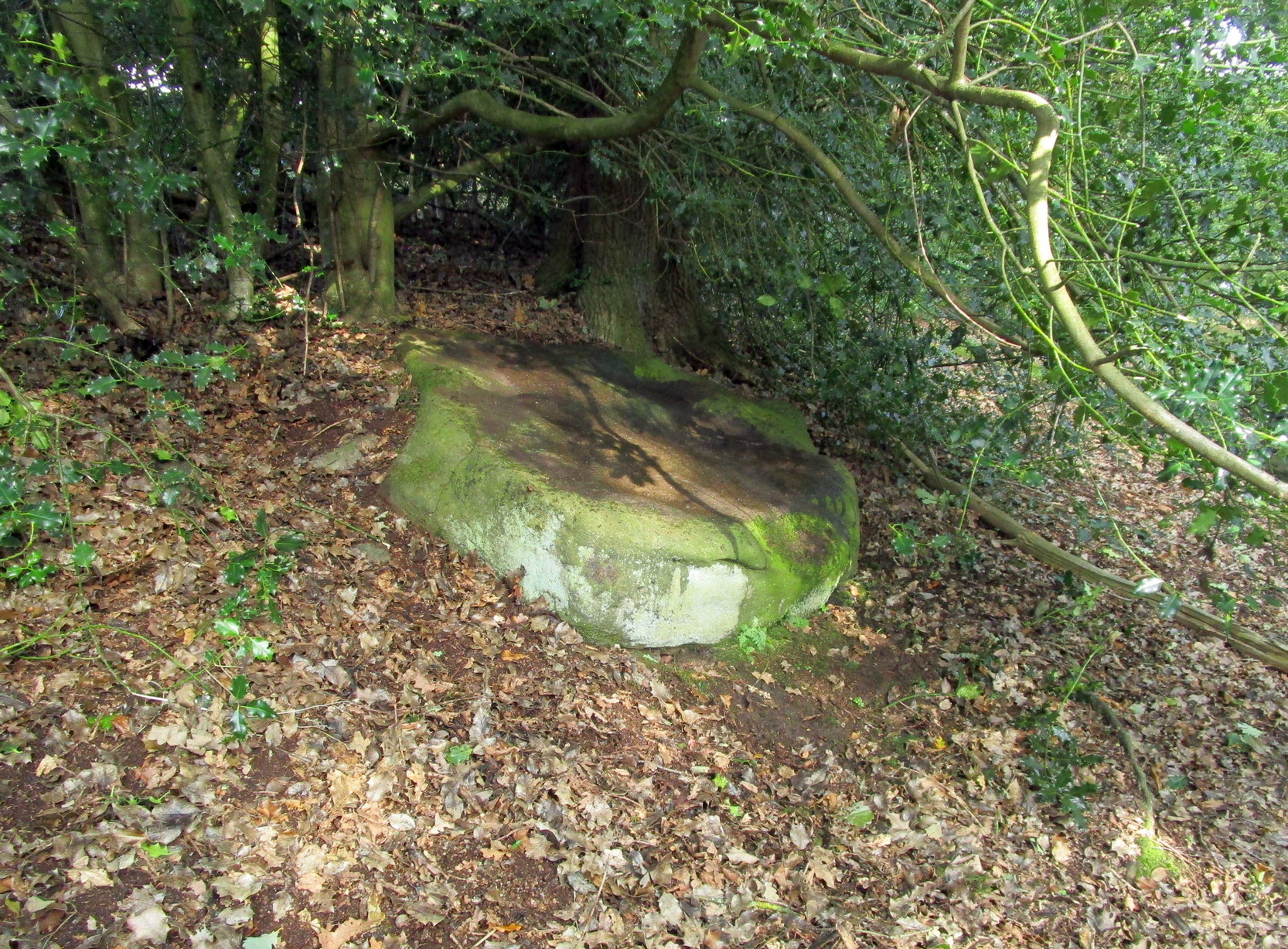
You can take the same directions to get here is you follow the route for the Hawksworth Spring (01) carving, or take this alternative route. Take the standard road from Guiseley along Hawksworth Road. When you reach the first row of old houses in the village, a couple of hundred yards on you reach the village school and, shortly after the footpath is sign-posted. Walk left (downhill) through the field for half-a-mile until you reach the woods. 100 yards into the into the trees, walk to your right and follow the line of walling straight for 400 yards, then veering right up the slope and it then slowly bends round, keeping to the wallside all along. It then starts heading back downhill. As it does so, 10 yards from the wall into the woods you’ll see the broken triangular rock of the Hawksworth Spring (01) carving. Walk another 10 yards where the large holly bushes are and you’ll see the large sloping stone in front of you.
Archaeology & History
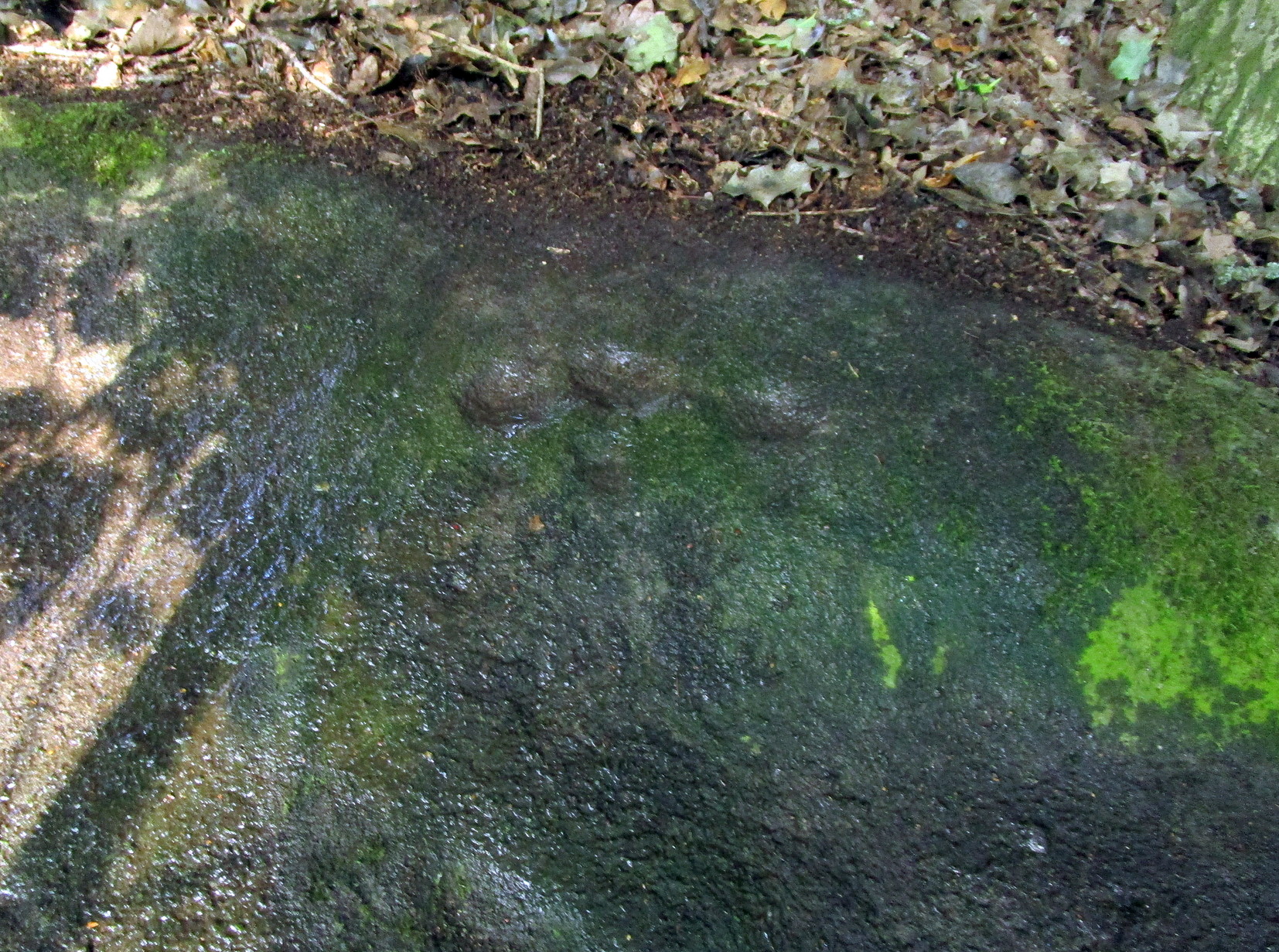
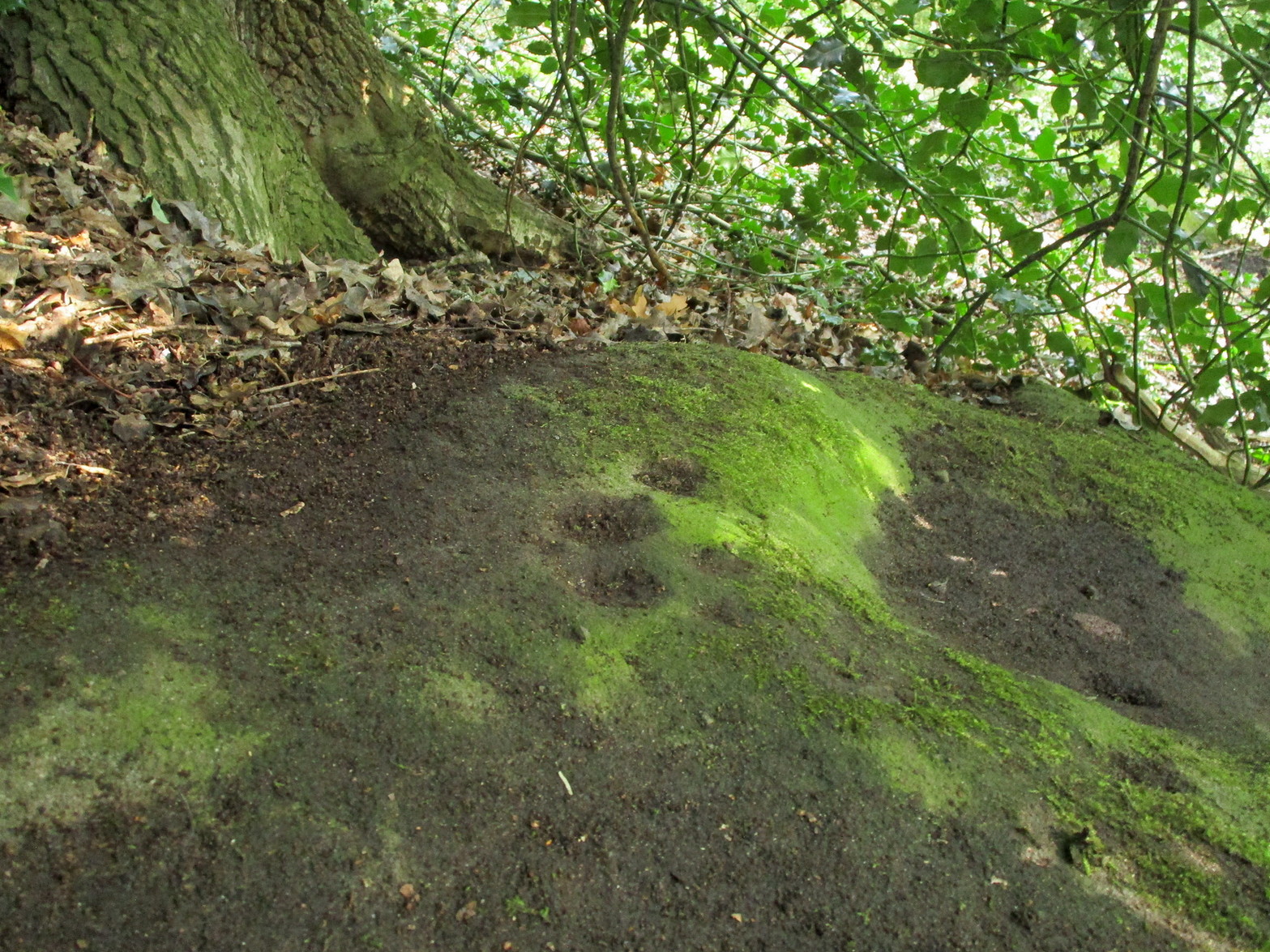
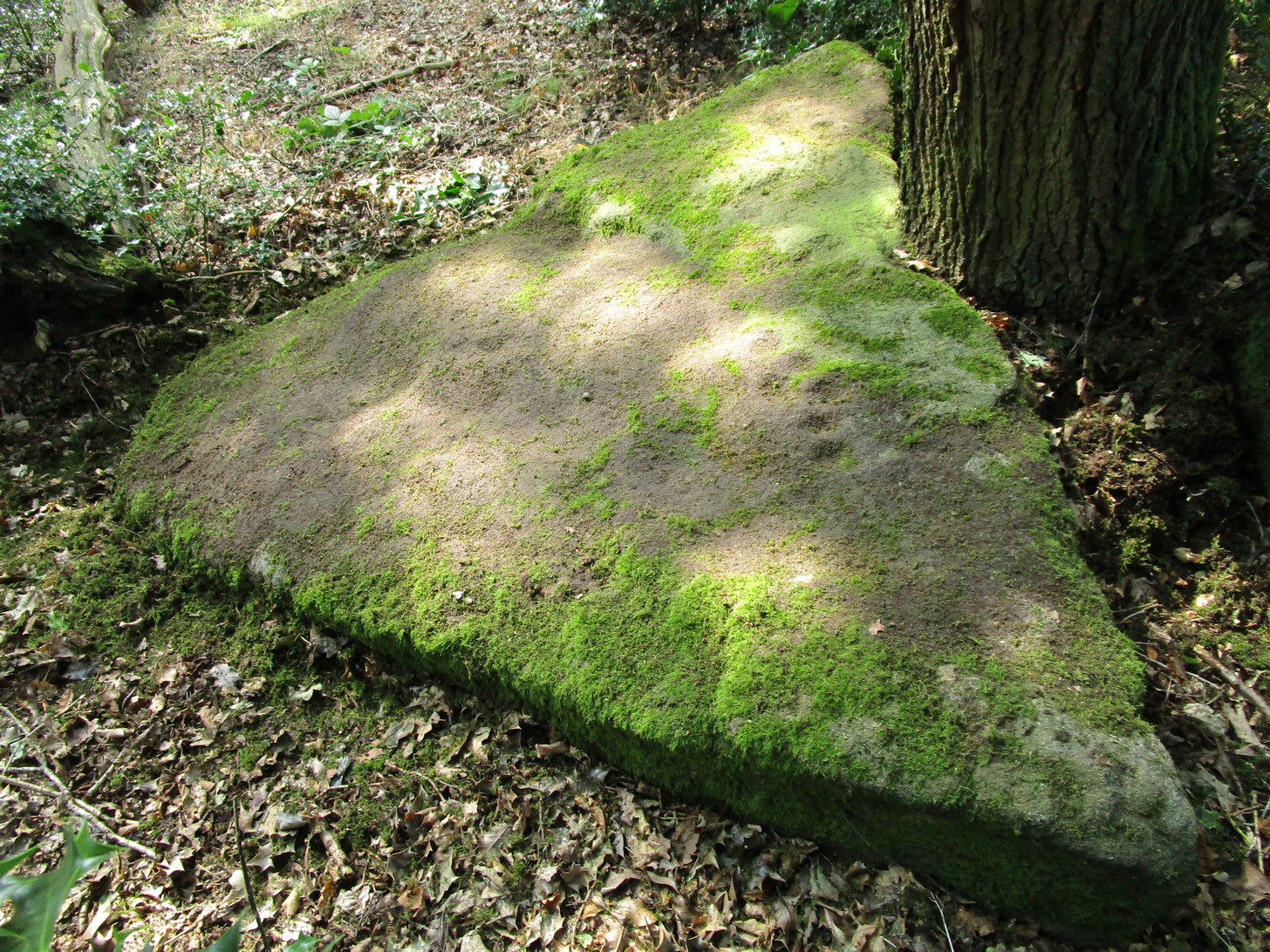
This carving is similar in nature to its companion 10 yards away, inasmuch as each of them possess two small arcs of cup-marks almost in the same format, very close together, one above the other near the top of the stone. It’s possible that the mythic nature/function of this particular element of arcs is the same on each stone—although fuck knows what it might be!
Clear line & faint line of arcsClear arc of cups
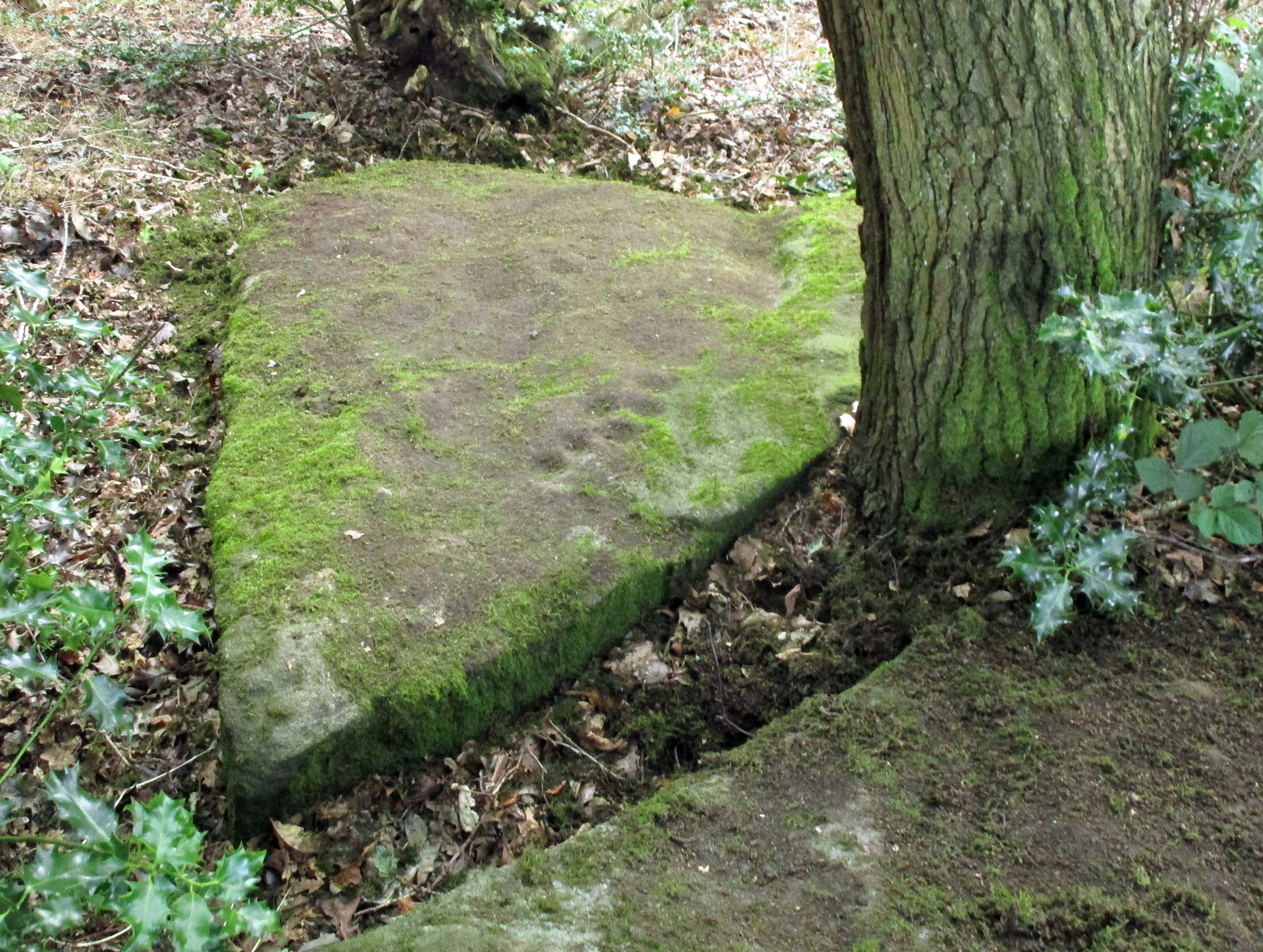
Below this double arc (only one of which is clearly visible in the photos) we see a scatter of other cup-marks—perhaps six, perhaps seven—one of which appears to have a very faint incomplete ring round it. When Liz Sykes and I visited the place, the light of day and the shadows across the rock didn’t help to convince us one way or the other, so we await news from other visitors who get better light conditions to tell us whether our hopeful eyes were deceiving us or not. There are a number of other marks on its surface, but these are much more recent and very obviously cut, or rather scratched, by metal artifacts with no bearing on the prehistoric design.
References:
Boughey, K.J.S. and Vickerman, E.A., Prehistoric Rock of the West Riding (Supplement), Shipley 2018.
Acknowledgements: Huge thanks to Liz Sykes for her renowned cleaning skills!
Through Baildon town centre, take the road onto Baildon Moor, but instead of turning left up to Baildon Hill, keep straight on the Hawksworth road and 100 yards along you’ll see a car-park is on the right-hand side, just before you start going downhill. From here, walk down the road a couple of hundred yards until you see the footpath (keep your eyes peeled!) turning right towards The Whitehouse, and from there take the footpath dead straight down to the woods below. Cross the stream, turn right, then immediately left uphill by the wall-side. Shortly before reaching the top you’ll see a large triangular sloping slab of rock with a tree at its top. That’s it! Alternatively you can come via Hawksworth village by following the directions to the Hawksworth Spring (02) carving, which is just 10 yards east of this one. Easy!
Archaeology & History
Sketch of carving (after Hedges 1986)Note the faint cup, top-right
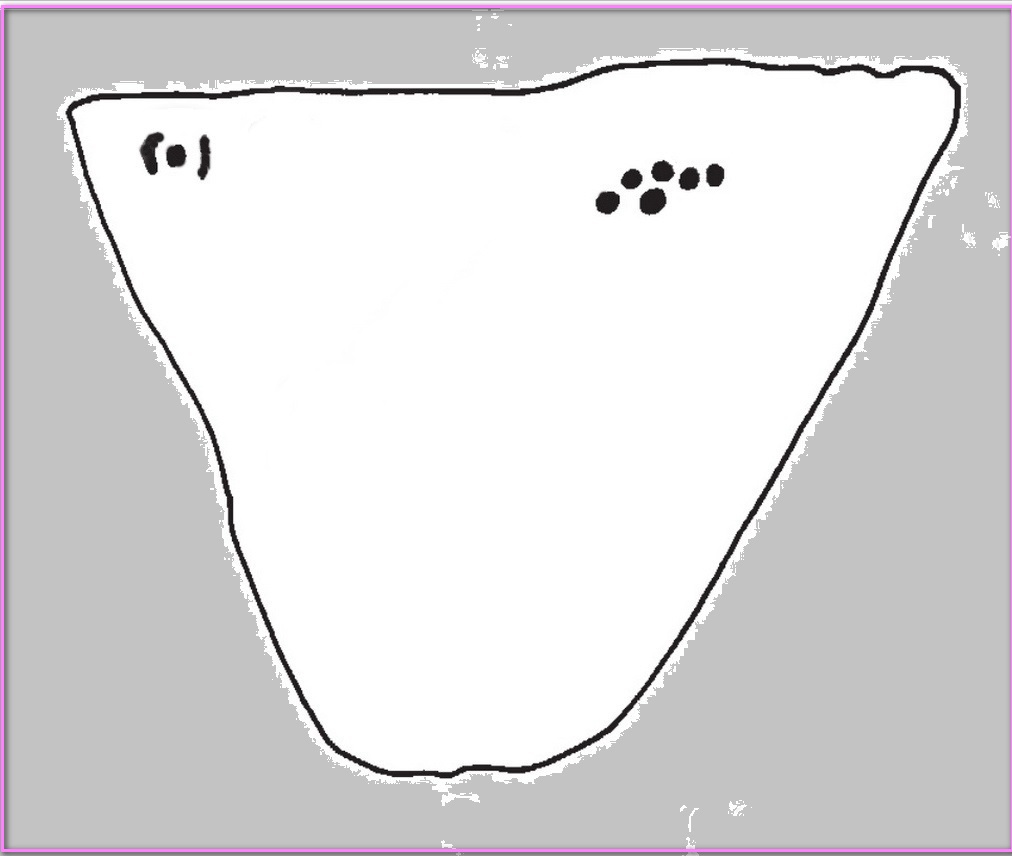
This minimalist design is best seen from above the adjacent rock which, in times gone by, was attached to this very same stone. The main aspect of the carving are the two short rows of three cups, running almost alongside each other, in a likeness which my compatriot Liz Sykes said “was like some animal footprints.” It’s not a bad description to be honest (this same motif is found on a companion petroglyph just a few yards to the east: the Hawksworth Spring [2] stone). If you follow the direction of the “animal tracks” to the western end of the stone, you’ll see another isolated cup with a faint incomplete ring around it. You can just make it out on the photo to the right. Another single cup-mark seems apparent two-thirds the way down the stone.
References:
Hedges, John (ed.), The Carved Rocks on Rombalds Moor, WYMCC: Wakefield 1986.
Acknowledgements: Huge thanks to Liz Sykes for her renowned cleaning skills!
Cup-Marked Stone (missing): OS Grid Reference – SE 1687 3868
Archaeology & History
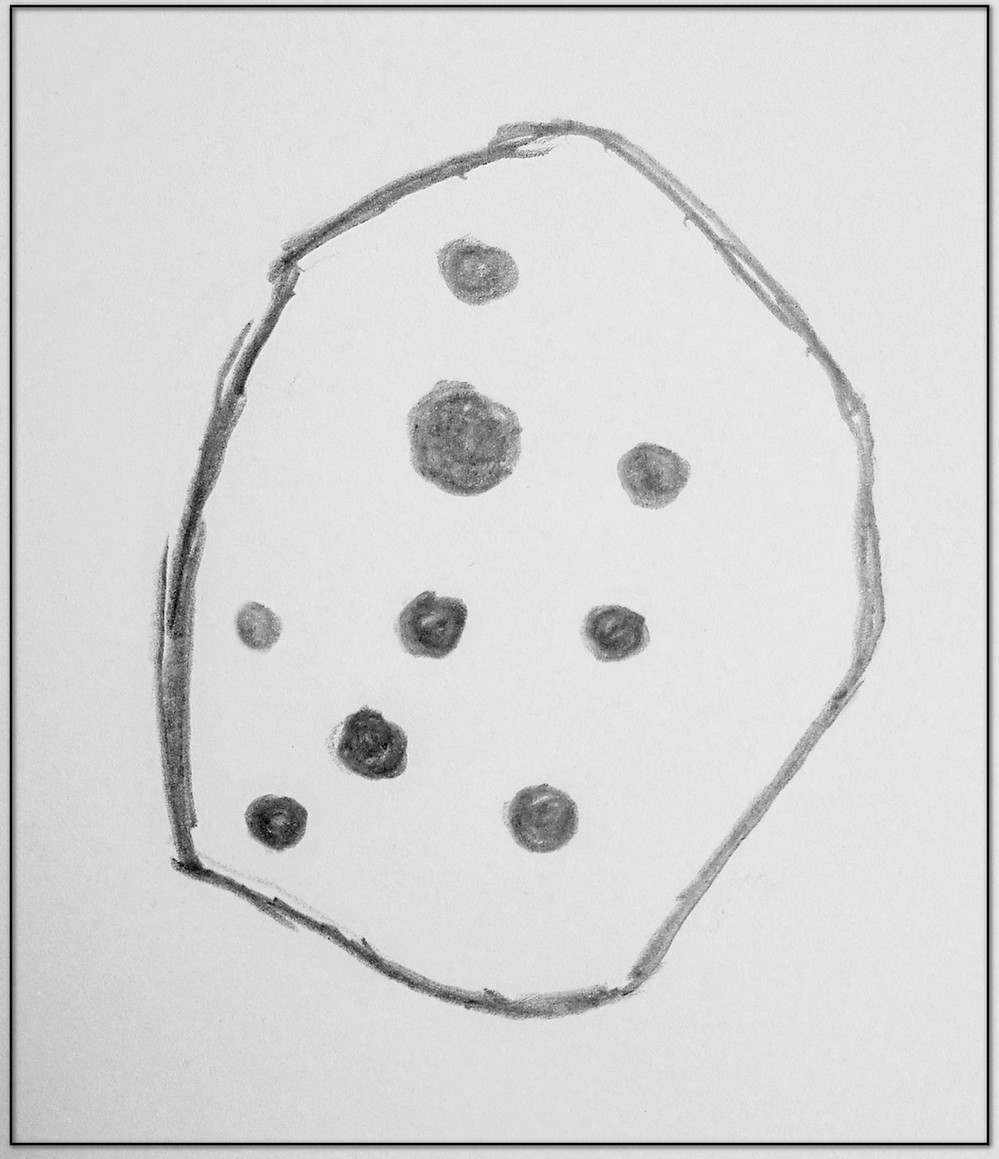
Sketch of the missing cup-marked stone
This carving was originally located somewhere close to the old disused Brackenhall Mills on the edge of Thackley, just before you drop down to Thackley tunnel. It was uprooted sometime in the 1950s and taken several miles away to the Cartwright Hall Museum at Manningham, Bradford, where it sat outdoors behind some fencing for many a-year, accompanied by the large fossil of an ancient tree.
I first saw it there when I lived close by in 1981, in the days before I had such a thing as a camera. Hence I only have this scruffy old sketch of the design, which I did without adding any notes to help remind me which carving it was! So this sketch has sat, all-but-forgotten, on a scrap of paper since then, until I recently sussed out which carving it was!
The stone itself was akin to a very large portable rock, with a simplistic design consisting of at least nine cup-marks cut into one of the rounded faces. One account of the stone suggested there may have been a possible incomplete ring around one of the cups. When I went back to see the stone about 20 years ago, it had gone. So I called into the adjacent museum to inquire what had become of it. The curator (or whoever it was) that I spoke with told me that the stone had been put into a box and placed in the cellars, but refused to let me see it. I asked to make an appointment to see the stone and he refused that too. It has not been seen since. Does anyone know what’s become of it?
References:
Keighley, J.J., “The Prehistoric Period,” in Faull & Moorhouse’s, West Yorkshire: An Archaeological Survey to AD 1500 (WYMCC: Wakefield 1981).