Herder’s Cross, Wycoller, Lancashire

Cross:  OS Grid Reference – SD 94057 39369

Also Known as:

  1. Herders Common Cross

Getting Here

From Laneshaw Bridge, near Colne, take the long country road that goes up above Wycoller to Stanbury and Haworth over the Yorkshire-Lancashire border.  A couple of miles uphill, there’s a parking spot with views across the moors.  Stop here.  Cross the road and walk up for about 100 yards, going thru the rickety gate on the left, and up the field (past the small disused quarry) until you see the large rock looming ahead of you, perched on its own.  That’s it!

Archaeology & History

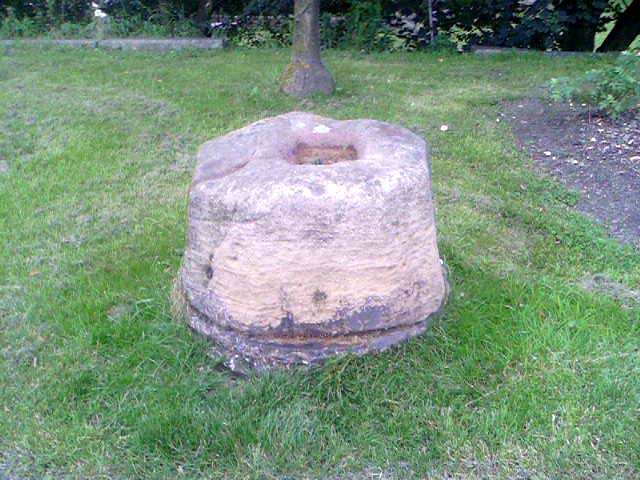
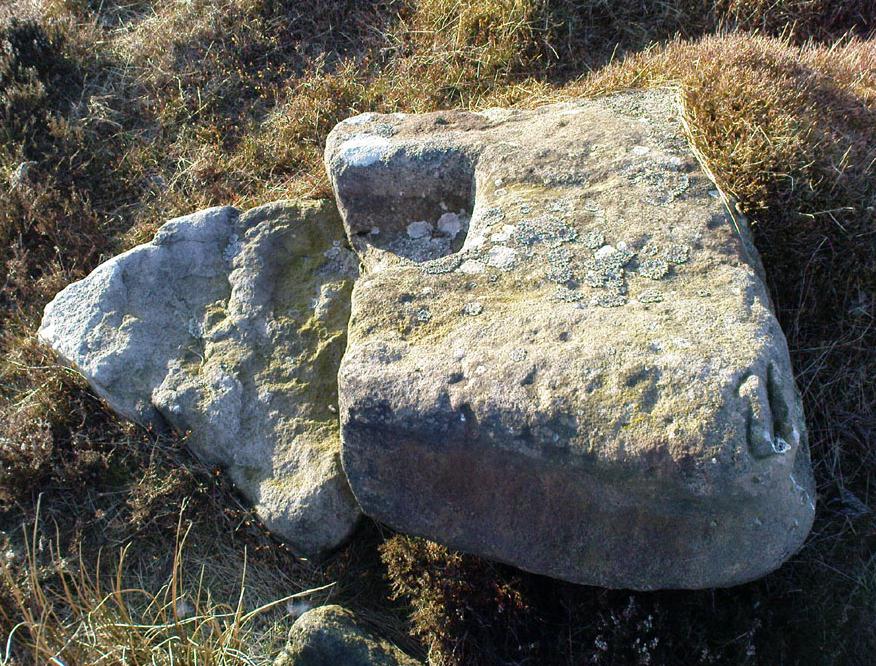
Herders Cross stone

This is a really curious spot to me.  A large singular boulder sat on the edge of an uninhabited moorland with no real history of heathenism, nor religious practices; yet someone at sometime in the not-too-distant past saw something here that made them cut a large square hollow into the top of this stone, in which they stuck an old cross.  We came across this site a few weeks ago quite by accident, but realised that the deep hollow in the rock was an old cross base; so when I got home I checked Taylor’s (1906) magnum opus, expecting to find some info therein.  But even Taylor seemed to know nothing of this place.

A week or two later, Paul Hornby pointed me in the direction of an unpublished essay by a local chap called Clifford Byrne (1974) who’d studied some of the early christian remains in the region and who wrote the following of what he named “Herders Cross”:

“This cross, or more properly its socket, is probably one of the least known in the area.  It was shown to the writer by Mr Stanley Cookson of Trawden, who discovered the socket in passing, so to speak.  On the road to Haworth from Laneshawbridge, opposite the site of Foster’s Leap rocks, on the east side of the road, is a really huge boulder on the moor top.  In the south side is the cross socket, whilst on the north side of the rock can be made out a right-angled mark which implies that either the socket was being placed on that side in the first instance, or that two sockets were once envisaged…

“Old maps show the rock in situ with a “shaft” protruding from the top.  Some yards west a shallow pony track  bypasses the site, whilst some four or five hundred yards east a very well worn and ancient road, long unused, passes in the direction of Emmot Holy Well.  The cross may thus have been a Wayside Cross showing the way to this Holy spring which is remembered as being propitious in the cure of rheumatism.”
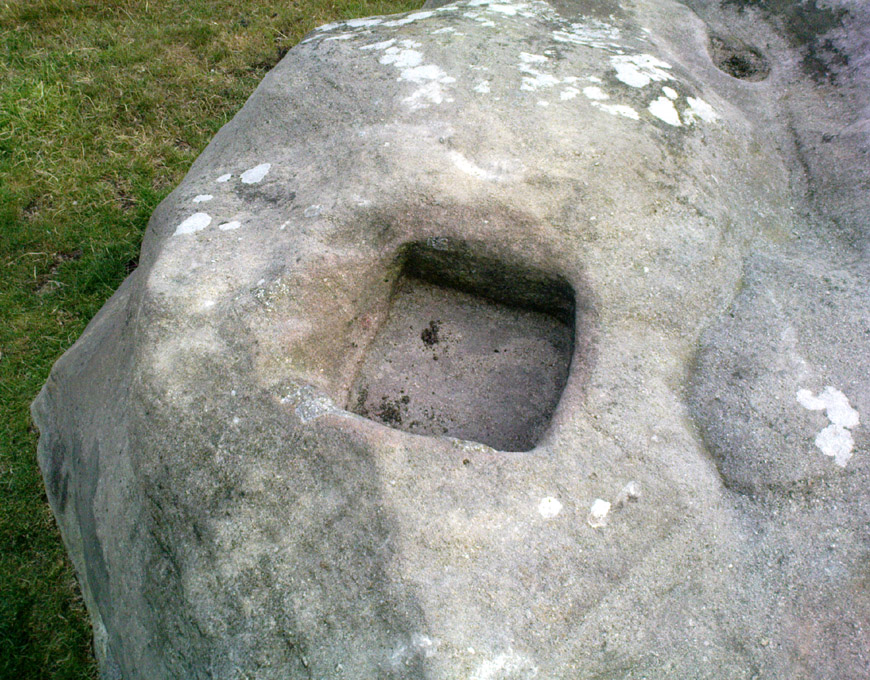
Cross-base socket

This may be so; but I suspect earlier, heathen remains upon the moors here to explain the curious position of both this and another cross-base some 400 yards away.  Some dubious cup-marks can be seen by the side of the stone hollow; and other dubious ones have been found on the moors above here.  There is folklore of a lost stone circle on the hills above here, and a scattering of little-known faerie lore, indicating hidden sites and lost myths.  These ingredients are more likely the reasons that Herders Cross was erected here, overlooking the countryside south and west, with the holy hill of Pendle rising in the centre of the distant landscape…

References:

  1. Byrne, Clifford, A Survey of the Wayside Crosses in North East Lancashire, unpublished 1974.
  2. Taylor, Henry, The Ancient Crosses and Holy Wells of Lancashire, Sherratt & Hughes: Manchester 1906.

© Paul Bennett, The Northern Antiquarian

Black Knoll Cross, Morton Moor, West Yorkshire

Cross:  OS Grid Reference – SE 1034 4465

Also Known as:

  1. Black Knowle Cross

Getting Here

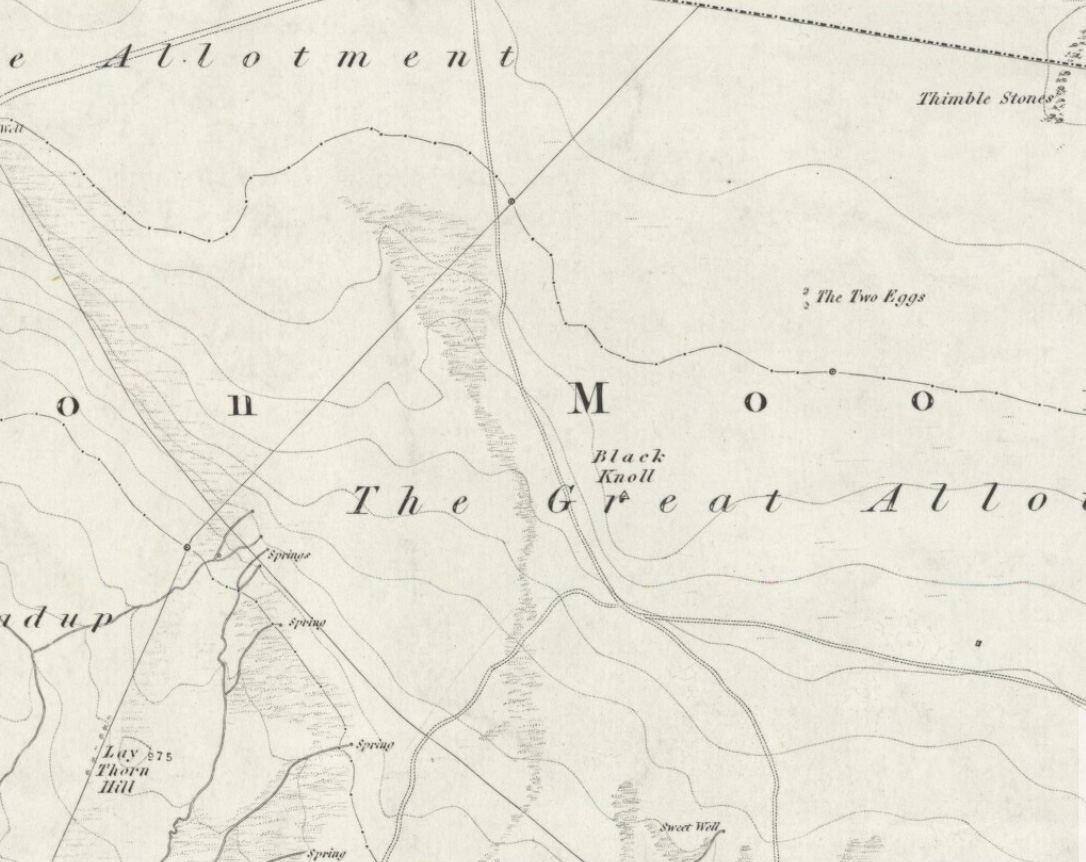
Black Knoll on 1851 map

Get up to the Twin Towers right at the top of Ilkley Moor (Whetstone Gate), then walk east along the footpath, past the towers for about another 100 yards, looking out on the other side of the wall until it meets with some other walling running downhill onto Morton Moor.  Follow this walling into the heather for a few hundred yards.  Where it starts dropping down the slope towards the small valley, stop!  From here, follow the ridge of moorland along to your left (east) and keep going till you’re looking down into the little valley proper.  Along the top of this ridge if you keep your eyes peeled, you’ll find the stone cross base sitting alone, quietly…

Archaeology & History

This old relic, way off any path in the middle of the moor, has little said of it.  Whilst its base is still visible — standing on a geological prominence and fault line — and appears to taken the position of an older standing stone, christianised centuries ago, the site is but a shadow of its former self.  When standing upright may centuries back, the “cross” was visible from many directions. We discovered this for ourselves about 20 years back, when Graeme Chappell and I sought for and located this all-but-forgotten monument.  When we found the stone base, what seemed like the old stone cross lay by its side, so we repositioned it back into position on July 15, 1991.  However, in the intervening years some vandal has been up there and knocked it out of position, seemingly pushing it downhill somewhere.  When we visited the remains of the cross-base yesterday (i.e., Dave, Michala Potts and I) this could no longer be located.  A few feet in front of the base however, was another piece of worked masonry which, it would seem, may have once been part of the same monument.

Cross-base, looking north
Close-up of cross-base

Years ago, after Graeme and I had resurrected the “cross” onto its base, I went to visit the Bradup stone circle a few weeks later and found, to my surprise, the upright stone in position right on the skyline a mile to the northeast, standing out like a sore thumb!  This obviously explained its curious position, seemingly in the middle of nowhere upon a little hill.  This old cross, it would seem, was stuck here to replace the siting of what seems like a chunky 3½-foot long standing stone, lying prostrate in the heather about 10 yards west of the cross base.

Stuart Feather (1960) seems to be the only fella I can find who described this lost relic, thinking it may have had some relationship with a lost road that passed in the valley below here, as evidenced by the old milestone which Gyrus and I resurrected more than 10 years back.  Thankfully (amazingly!) it still stands in situ!

If you aint really into old stone crosses, I’d still recommended having a wander over to this spot, if only for the excellent views and quietude; and…if you’re the wandering type, there are some other, previously undiscovered monuments not too far away, awaiting description…

References:

  1. Bennett, Paul, The Old Stones of Elmet, Capall Bann: Chieveley 2001.
  2. Feather, Stewart, “A Cross Base on Rombald’s Moor,” in Bradford Antiquary, May 1960.
  3. Feather, Stewart, “Crosses near Keighley,” in Cartwright Hall Archaeology Group Bulletin 5:6, 1960.

© Paul BennettThe Northern Antiquarian


Thursday Market Cross, York, North Yorkshire

Cross (destroyed):  OS Grid Reference – SE 603 519

Archaeology & History

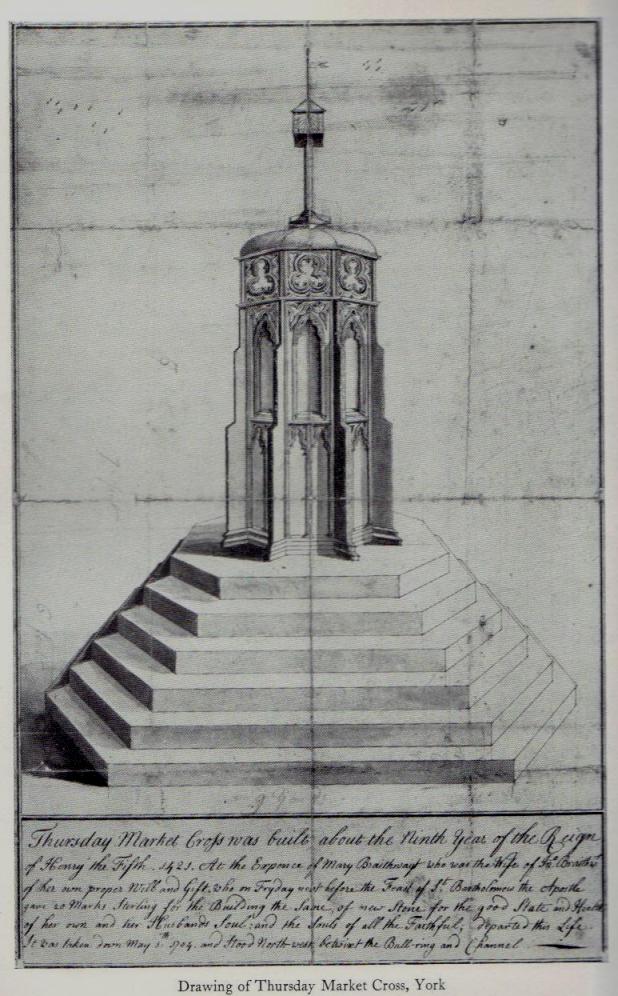
Early drawing of York’s Market Cross

This old cross was demolished long since, but I think it’s important to rejunevate a memory of its existence back into our times.  Little has been written about the site as it was destroyed more than 200 years ago and images of the edifice are rare indeed!  It was found near the modern centre of the city and although this ornate-looking thirty-foot tall cross was obviously impressive, an even earlier upright stone stood here in the 13th and 14th century.  But this new carved monument took precedence over its older and lesser upright.  First described — I think! — by Thomas Gent (1730), he told us that,

“The old cross stood towards the Kennel, against the middle of the market.  The lower part was an octagon, had an ascent of six high steps, covered with Tyles for Butchers, higher up with nitches, in which had been effigies and a small pillar above with four Dials and over them a Fane.”

A few years later when Francis Drake (1788) described the same monument, he added very few extra details; though told us it had five steps and not six — but this seems to have been an error on his behalf.  In C.B. Knight’s (1944) work we have what seems to be the most complete historical description of this lost stone edifice.  He wrote:

“In 1429 a new stone cross had been erected in Thursday Market in place of its predecessor by Marion Braythwayt, widow of John Braythwayt, who was Lord Mayor in 1394… This Cross was described by a writer in 1683 as “a fair Cross of stone, built upon the ascent of five steps, and hath neatly cut in stone a turret or battlement eight square, upon which is placed a round pillar with a four-square stone upon the top, which hath a sundial placed upon every square, and a vane above.  The Cross hath a penthouse round about it, covered over with tile, to shelter the market people in rainy weather, and is supported upon eight posts, upon one of which, on the south side, is fixed an iron yard-wand, the standard measure of the market.”  In 1705 the ancient Market Cross…was pulled down.”

References:

  1. Cobb, Gerald, “Note on a Drawing of Thursday Market Cross, York,” in The Antiquaries Journal, 43:1, 1963.
  2. Davies, Robert, Walks about the City of York, Nichols & Sons: Westminster 1880.
  3. Drake, Francis, Eboracum; or the History and Antiquities of the City of York, Wilson & Spence: York 1788.
  4. Gent, Thomas, The Antient and Modern History of the Famous City of York, Thomas Hammond: York 1730.
  5. Knight, Charles Bruton, A History of the City of York, Herald: York & London 1944.

© Paul Bennett, The Northern Antiquarian 


Corwen Cross, Denbighshire

Cross & Cup-Marked Stone:  OS Grid Reference – SJ 0787 4340

Getting Here

Simple.  The church in the centre of the village across from the T-junction with the A5 is where it’s at!

Archaeology & History

Cross-base with cup-marks (from Owen, 1886)

At Corwen churchyard we find a number of curious old stone relics — not least of which is this seemingly 12th century christian cross, more than seven-feet tall, on the west side of the church. Not only does this have a curious history in itself, but the base on which the cross stands has what may be at least seven cup-markings etched on it.  These were first mentioned – I think – by Elias Owen in his Old Stone Crosses of the Vale of Clwyd, (1886) who wrote:

“The stone basement in which the (cross) shaft is placed is elliptical in form, with transverse and conjugate diameters measuring respectively 64 and 60 inches; it is 12 inches or so thick, is of a slaty nature and might have been procured in the neighbourhood… There are seven peculiar artificial depressions along the surface of the pedestal, strongly resembling the cup-markings which are found occasionally on the capstones of cromlechs, etc. They are irregularly arranged: on the north side there are three, almost in a line; and on other parts of the stone there are four of these marks. They differ somewhat from each other in size and shape, but they are for the most part circular, though one is more of an oblong than a circle. They vary also in depth, one being two-and-half inches deep, while the others are shallow. The largest is three inches in diameter; the others are not so broad.”

Owen makes note of a previous description of the Corwen “cross” by Thomas Pennant in 1784, where sounds as if this stone had a decidedly megalithic precursor. He told us:

“A most singular cross in the churchyard merits attention: the shaft is let into a flat stone, and that again is supported by four or five rude stones, as if the whole had been formed in imitation of, and in veneration of, the sacred Cromlech of very early times.”

Two other crosses are found at Corwen church – one of which has a decidely heathen legend attached to it. The Carreg y Big yn y Fach Rhewllyd monolith is also found here, in the porch wall.  A few miles east of here we also find another cup-marked stone, shown on The Old-Fashioned Antiquarian website.  Looks a good n’!

References:

  1. Owen, Elias, Old Stone Crosses of the Vale of Clwyd and Neighbouring Parishes, Bernard Quaritch: London & Oswestry 1886.

© Paul Bennett, The Northern Antiquarian

Fearby Cross, Masham, North Yorkshire

Cross: OS Grid Reference – SE 1984 8127

Getting Here

Take the road from Masham into this lovely hamlet and, as you reach the staggered crossroads, you’ll see a small village green with a single tree at where the four roads meet.  In the grass below the tree is this forgotten monument!

Archaeology & History

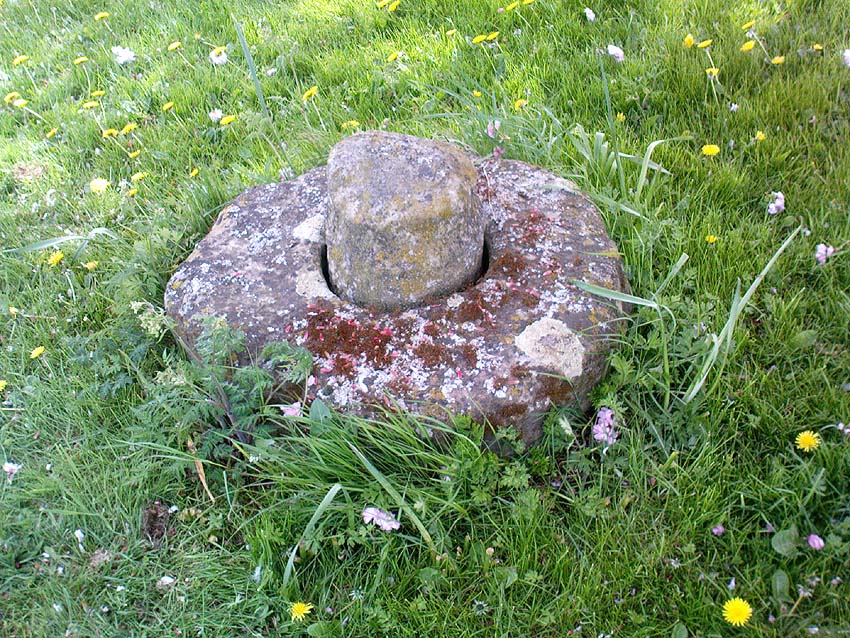
Fearby Cross remains

Found at the meeting point of five old lanes, little has been written about the old cross remnants here, which is barely a foot high and rests on its roughly circular stone base.  It sits where five old tracks meet and is thought to be medieval in origin.  Speculation alone pronounces the site to have been a place where local council proclamations occurred, and where funerals stopped and the dead were rested.

One intriguing piece of information narrated by Edmund Bogg (1906) that may have had some relevance to the siting of this old cross, told that between here and the hamlet of Healey a mile west,

“there were formerly circles of upright stones and other relics suggestive of druidical origin.”

Any historical information or folklore relating to these apparent megalithic remains needs to be uncovered!

References:

  1. Bogg, Edmund, Richmondshire and the Vale of Mowbray, James Miles: Leeds 1906.

© Paul Bennett, The Northern Antiquarian

Slaithwaite Cross, West Yorkshire

Cross:  OS Grid Reference – SE 077 139?

Archaeology & History

The great Huddersfield historian, Philip Ahier (1948), in describing the lack of documentary evidence for several crosses in the neighbouring region, “at Deighton, Cowcliffe, Marsh and Golcar,” found out that,

“One did exist at Slaithwaite in front of the Manor House in the early past of the last century.  In March 1931, the base of this cross, commonly known as the Dial Stone, was removed to Doughlas in the Isle of Man, where it rested in the garden of Mr Harry Wood; in August 1939, it was brought back to Slaithwaite and now stands in the Recreation Park.”

However, this site differs from another two that I’ve found records for on the outskirts of this township.  Does anyone know what became of this old stone cross?  Izzit still about?  Its folk-name of the Dial Stone may make it a little easier to locate — but at the same time it does bring up the query, Why was it called that?

References:

  1. Ahier, Philip, The Story of the Three Parish Churches of St. Peter the Apostle, Huddersfield – volume 1, Advertiser Press: Huddersfield 1948.

© Paul Bennett, The Northern Antiquarian 


Market Cross, Thornton-le-Dale, North Yorkshire

Cross:  OS Grid Reference – SE 8340 8304

Getting Here

Dead easy.  Take the A170 road from Pickering to Thornton-le-Dale and as you go into the large village, you’ll hit the old crossroads with the village green.  Here be your cross!

Archaeology & History

Shown on the 1854 OS-map, I first came across a description of this old site in Creaser & Rushton’s (1972) scarce but lovely little work on the history of the old village here, where they told that,

“A cross has stood here since John de Eston in 1281 had the grant of a Tuesday market and two yearly fairs.  It was repaired in 1820.  Every year, the Abbot of Whitby unloaded 1500 red and 1500 white herrings here from his packhorse ponies for transhipment to the Master of St. Leonard’s Hospital at York.”

Or at least, that’s what he got folk to write down in the record-books!  Close by were the old village stocks of the village (whose usage should be resurrected in many parts of this country nowadays).

References:

  1. Creaser, A. & Rushton, J.H., A Guide and History of Thornton-le-Dale, Pickering, Yorkshire, E. Dewing: Pickering 1972.

© Paul BennettThe Northern Antiquarian


Old Market Cross, Sedbergh, Cumbria

Cross (destroyed):  OS Grid Reference – SD 6573 9212

Archaeology & History

More than 150 years ago outside St. Andrew’s Church in Sedbergh, A.E. Platt wrote (1876) that,

“there was a cross standing in the Market Place adjoining the churchyard on the north, but the last remains of it, and the stone steps it stood on, were taken away some years since by private persons, and may now be seen used as gateposts to a farmyard, some ten miles from their original position.”

Intriguing stuff!  Does anyone know which farmyard might still possess these old relics?  When the legendary Harry Speight (1892: 443) ventured by here fifteen years later he knew little about their new location, but simply echoed what Platt had previously written.  It would be good to know what has become of them…

References:

  1. Platt, A.E., The History of the Parish and Grammar School of Sedbergh, Yorkshire, Atkinson & Pollitt: Kendal 1876.
  2. Speight, Harry, The Craven and Northwest District Highlands, Elliot Stock: London 1892.

© Paul Bennett, The Northern Antiquarian

Market Cross, Keighley, West Yorkshire

Cross: OS Grid Reference – SE 06042 41002

Getting Here

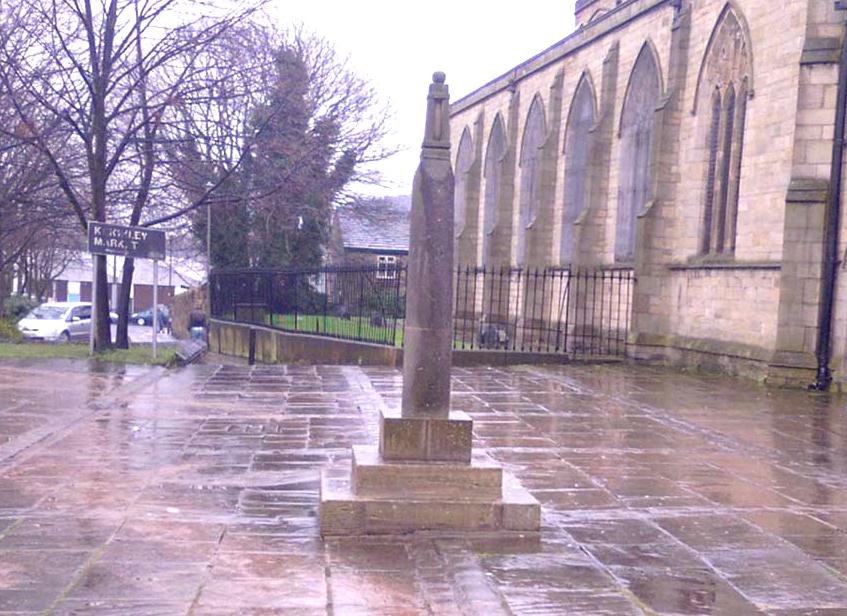
Dead easy this one!  Go along North Street in Keighley, towards the main church in the middle of town (a St. Andrew’s church, previously St. Pete), by the once-infamous Lord Rodney pub, and the old stone edifice stands outside by the Green.  The much better Red Pig public house is across the road from here.

Archaeology & History

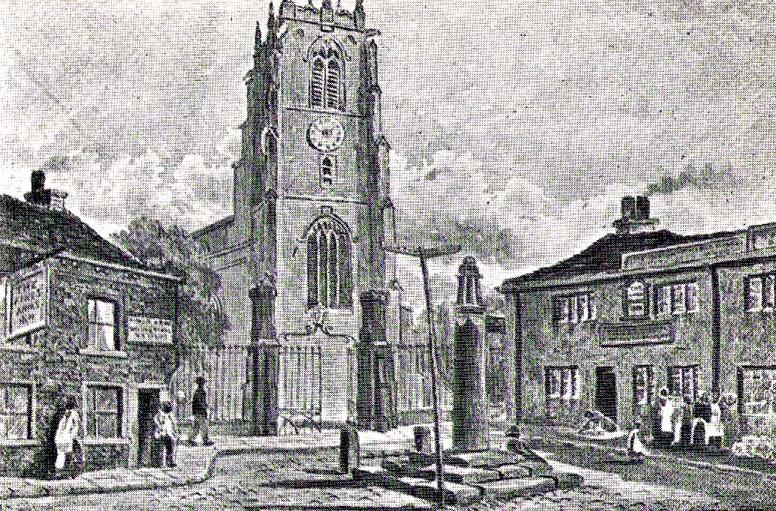
Keighley's Town Cross, 1847 - illustrated on a painting by Edwin Riby
Keighley’s Town Cross, 1847 – on a painting by Edwin Riby

For a relatively trivial archaeological site, it’s got a bittova history.  Not that this is an old site either!  We’re not sure just when this cross was made, but it’s certainly no more than 300 years old.  Before standing in its present position outside St. Andrew’s Church, sometime before 1840 it was said to have been a few hundred yards away above the present roundabout on Oakworth Road; and one record tells that it originally came from nearby Utley, a mile to the north.  Due to lack of decent records, we’re not sure about its early status as a market cross, nor when it was first erected.  Indeed, even the steps on which the cross presently stands are clearly more recent than the ones illustrated on Edwin Riby’s 1847 portrait, reproduced here.

Keighley Cross, on a grey wet day!

It would be good to get a complete history of this archaeological relic but it’s difficult with artifacts such as these; and although gaining access to the church now takes less time and effort than it used to (the vicar here used to be quite unhelpful, but has recently changed his ways – which is good!), it’s only open at certain times of the week.*  Friday afternoons seem OK to have a look round.  Please – if folk begin having trouble gaining access to the Church once more, let us know on here so we can make complaints about it.  The Church is paid for by local tax-payer’s cash, and so needs to be open to all of us.  Let’s hope this humble ingredient can be maintained for the good of all in this otherwise regressive social community (Keighley, that is…).

There’s also some very curious folklore to be added here in relation to the market and its cross, but its tale is gonna have to wait…

References:

  1. Gray, Johnnie, Through Airedale, from Goole to Malham, Elliott Stock: London 1891.
  2. Keighley, William, Keighley, Past and Present, R. Aked: Keighley 1858.

* There isn’t even a notice giving information, email or phone numbers, telling you who you can contact if you want to know anything about the history of the church, or visit it — which is quite dreadful considering how much money they get paid by tax-payers for their supposed socio-spiritual duties.

© Paul Bennett, The Northern Antiquarian

Exley Head Cross, Keighley, West Yorkshire

Cross:  OS Grid Reference – SE 04818 40146

Getting Here

Exley Head Cross base, at roadside

From Keighley town centre, take the main road to Oakworth (B6143) and you’ll see it right by the main roadside, about a mile up on the left-hand side upon a small grassy area in Exley Head, just past the turning up to Wheathead.

Archaeology & History

The upright stone monolith, or cross, which would once have stood here has long since disappeared.  All we are left with today is the large cross-base by the roadside: roughly squared, with a large hollow at the centre in which the upright stone cross originally stood erect!  In the past, a number of archaeologists and historians have speculated that the Exley Head Cross dated from as early as the 9th up till the 15th century. We may never find out for certain, though it’s likely a post-Domesday medieval relic.  It’s position at the roadside gives it the category of being a ‘Wayside Cross’ and it is likely one in a deliberate sequence that were placed along the ancient route from above Keighley, to Oakworth and over the border into Lancashire, near Wycoller and beyond.

Close-up of Exley Head Cross base

Quite why it was placed here is something we may never know: though it is close by an old crossroads and could have replaced an earlier heathen site, but I’ve found no records to indicate this. Its position in the landscape would also have been more impressive before the housing was here, previously giving a wide open view of the Aire Valley below.  I’d be grateful for any more info on this site.

References:

  1. Brigg, J.J. & Villy, F., “Three Ancient Crosses near Keighley,” in Bradford Antiquary, New Series 6, 1921.

© Paul Bennett, The Northern Antiquarian