Craven Hall Hill (2), Hawksworth Moor, West Yorkshire

Ring Cairn:  OS Grid Reference – SE 14442 44281

Getting Here
Craven Hall ring cairn

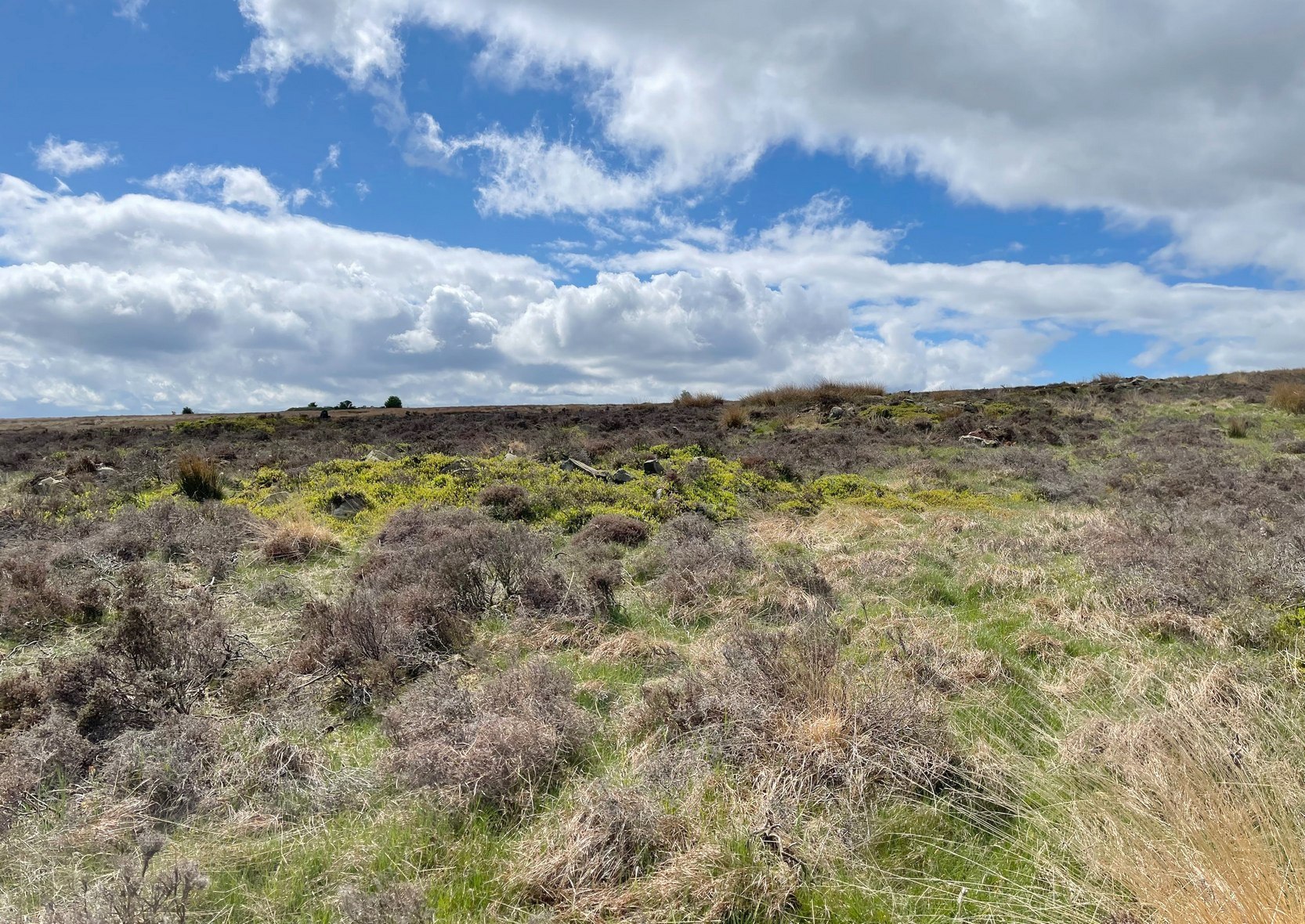
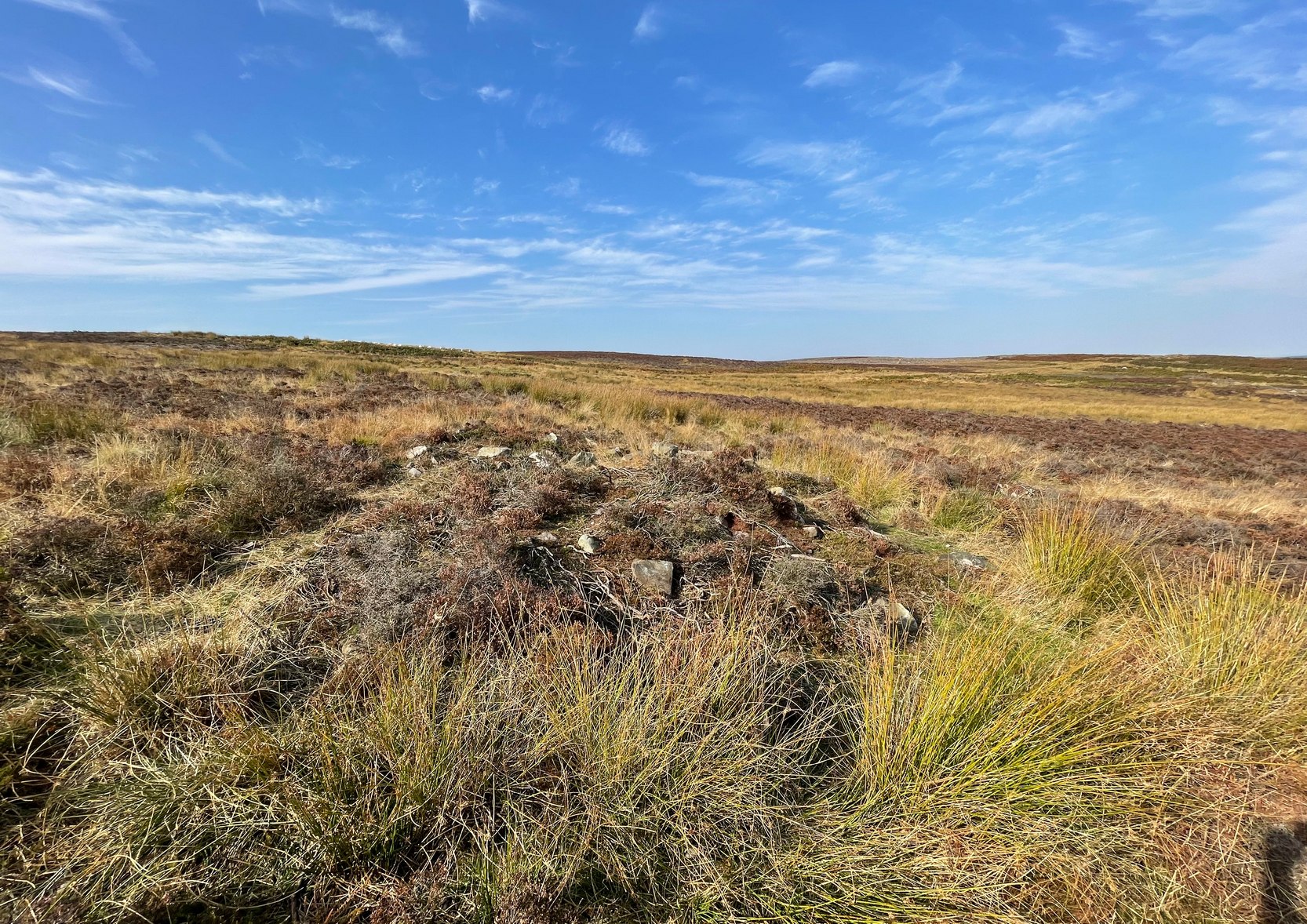
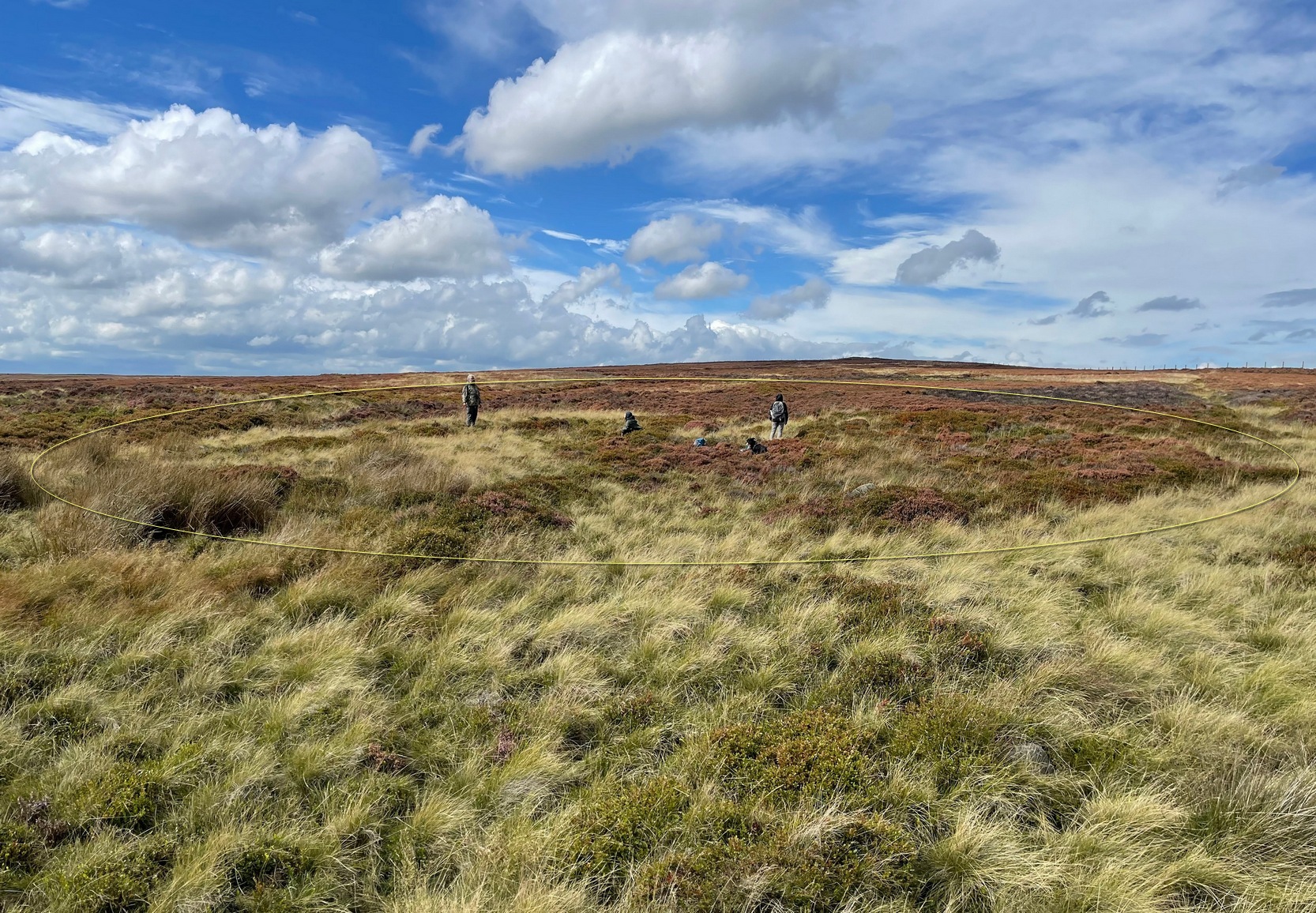
Your best starting point is from the Great Skirtful of Stones giant cairn.  From here follow the fencing that runs down the slope to your left (south-east) for roughly 160 yards (148m) – past the Great Skirtful Ring – until you reach the gate.  Go through it and keep walking down the same fence-line for 300 yards then walk south onto the moorland proper (there are no paths here).  You’ll pass over several undulations in the heather (some of these are the edges of ancient trackways) and 55-60 yards south from the fencing you’ll walk over and into this overgrown prehistoric ring.  It’s very difficult to see when the vegetation is deep, so persevere!

Archaeology & History
Site shown on 1851 map

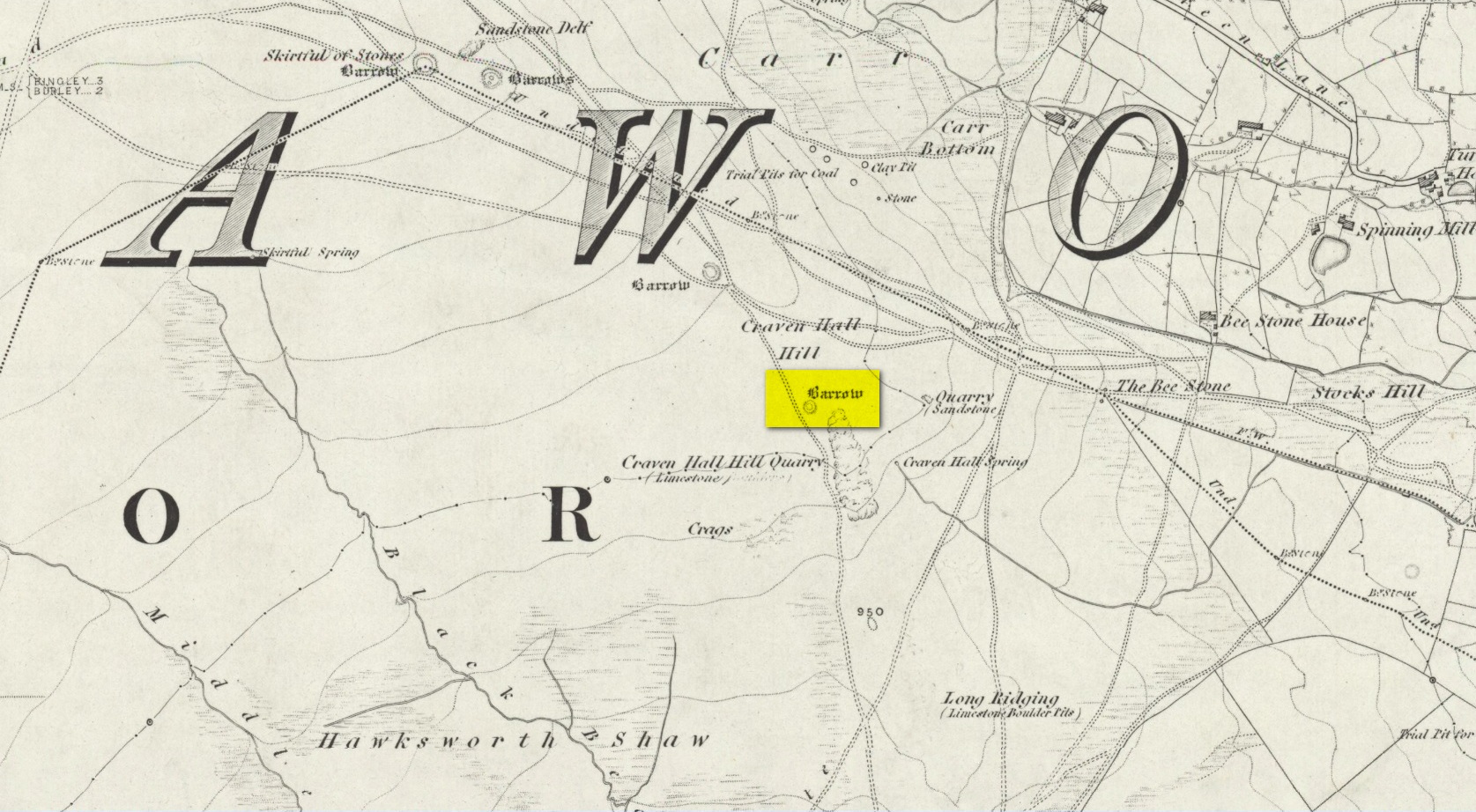
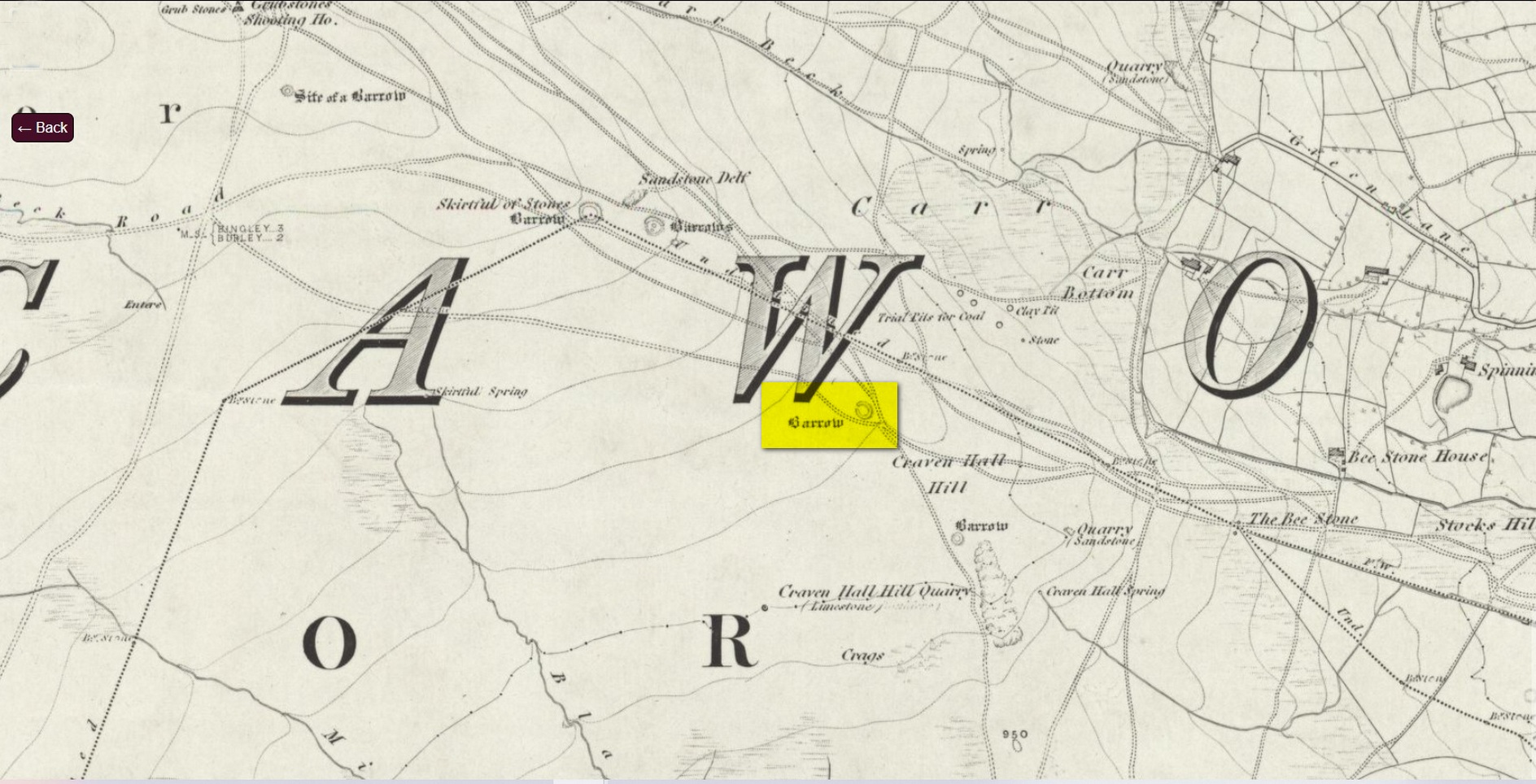
This is an interesting site.  Marked on the 1851 Ordnance Survey map as a “barrow” (right), it is shown with trackways on either side of it to the north and south, and with an opening or entrance on its northwestern side.  Yet since that date, very little archaeological attention has been given to it and the site remains unexcavated, despite its location being repeated on all subsequent maps since then.  The designation of the site as a barrow or burial site, without being excavated, was educated guesswork at the time as the place seems to be what we today define as a ring cairn.  And whilst this seems likely, there are some oddities here.

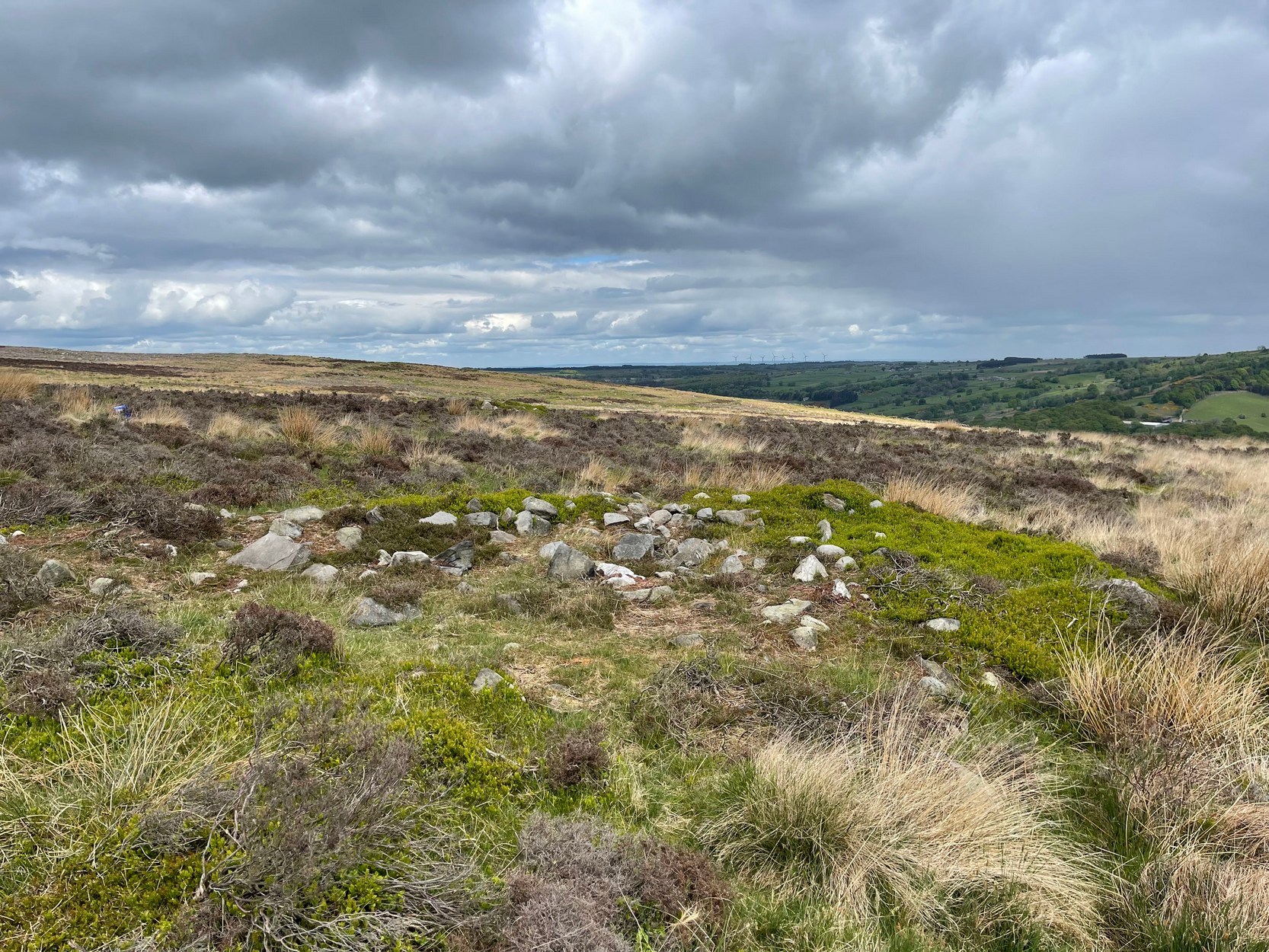
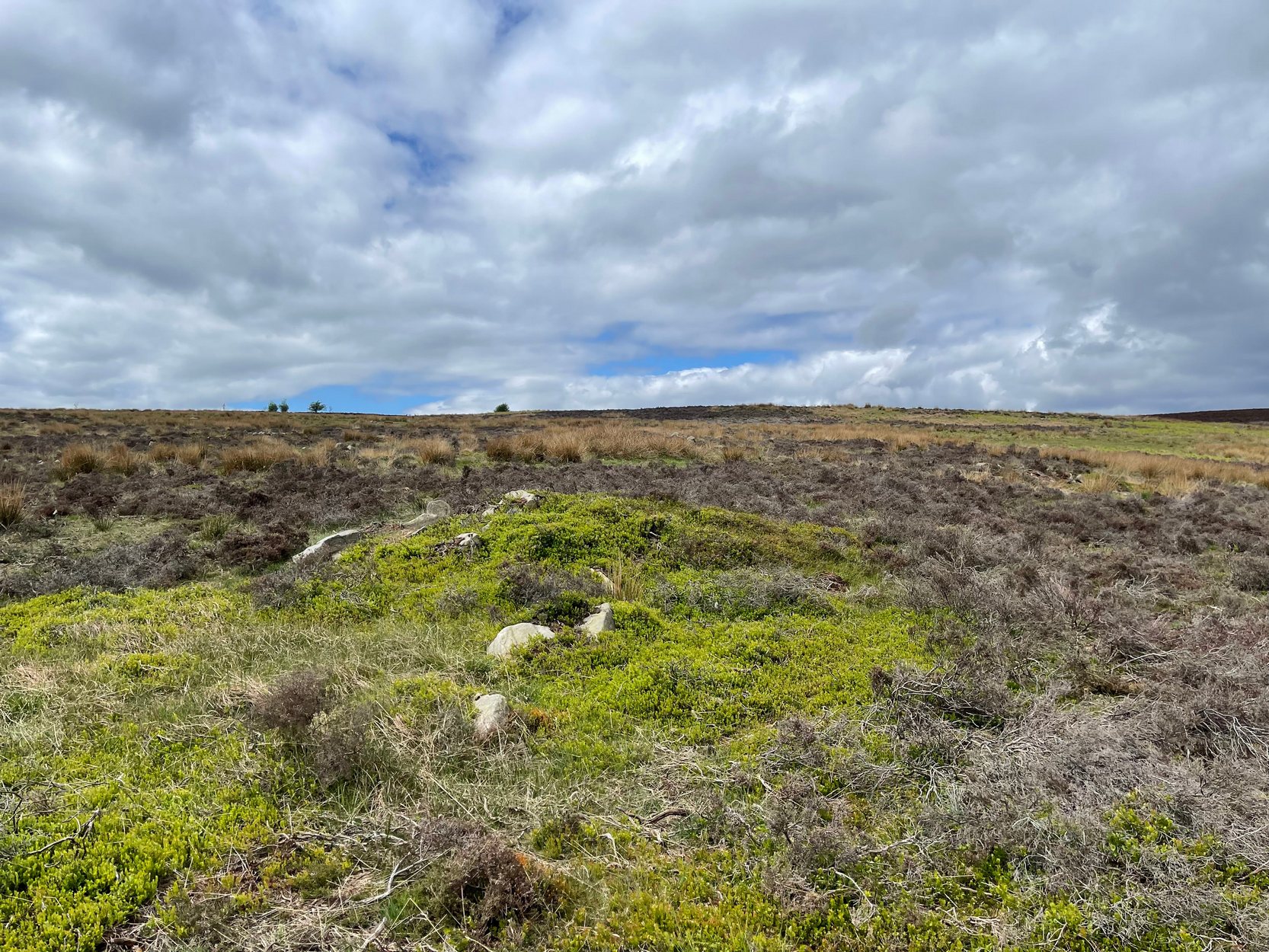
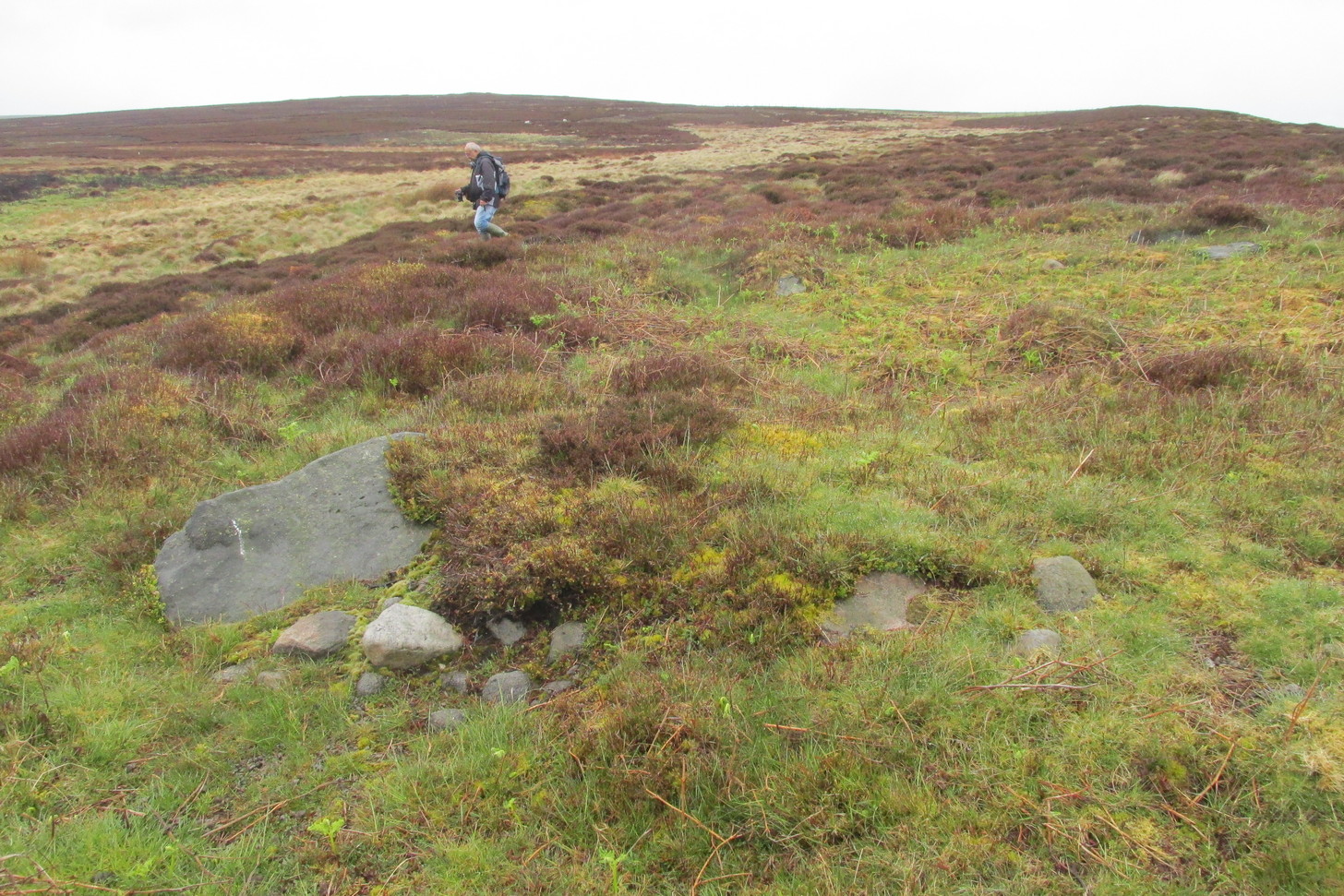
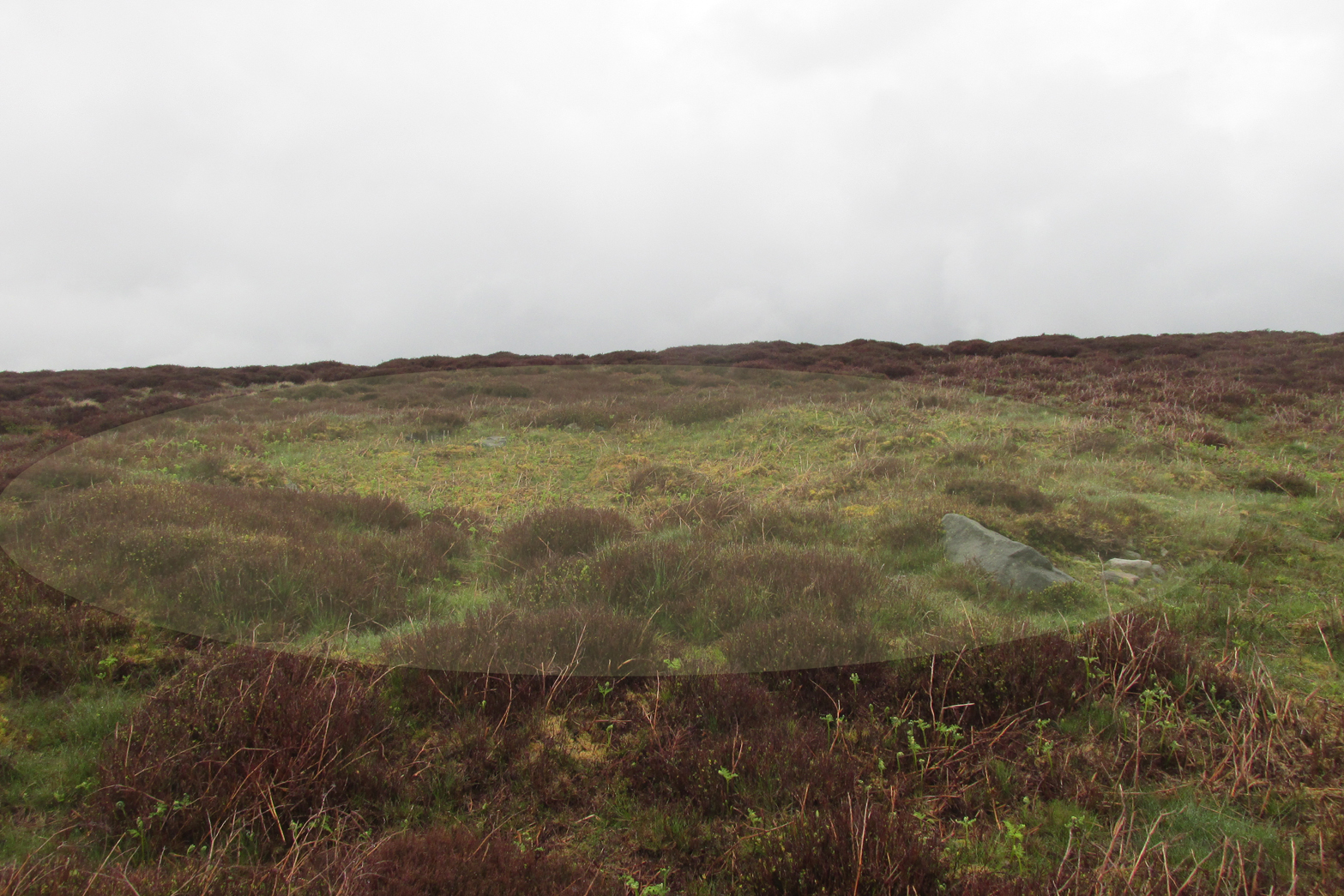
Measuring roughly 25 yards (SE – NW) by 21 yards (NE – SW), this overgrown oval ‘ring’ is a similar architectural structure to the more famous Roms Law circle more than half-a-mile northwest of here—but bigger!  And, unlilke Roms Law, this overgrown circle seems to have been untouched for many centuries.  The oval surrounding ‘ring’ itself is composed of thousands of small packing stones between, seemingly, a number of much larger upright stones, reaching a maximum height of more than three feet high at the northernmost edge.  The ‘ring’ ostensibly looks like a wide surrounding wall which measures two yards across all round the structure.
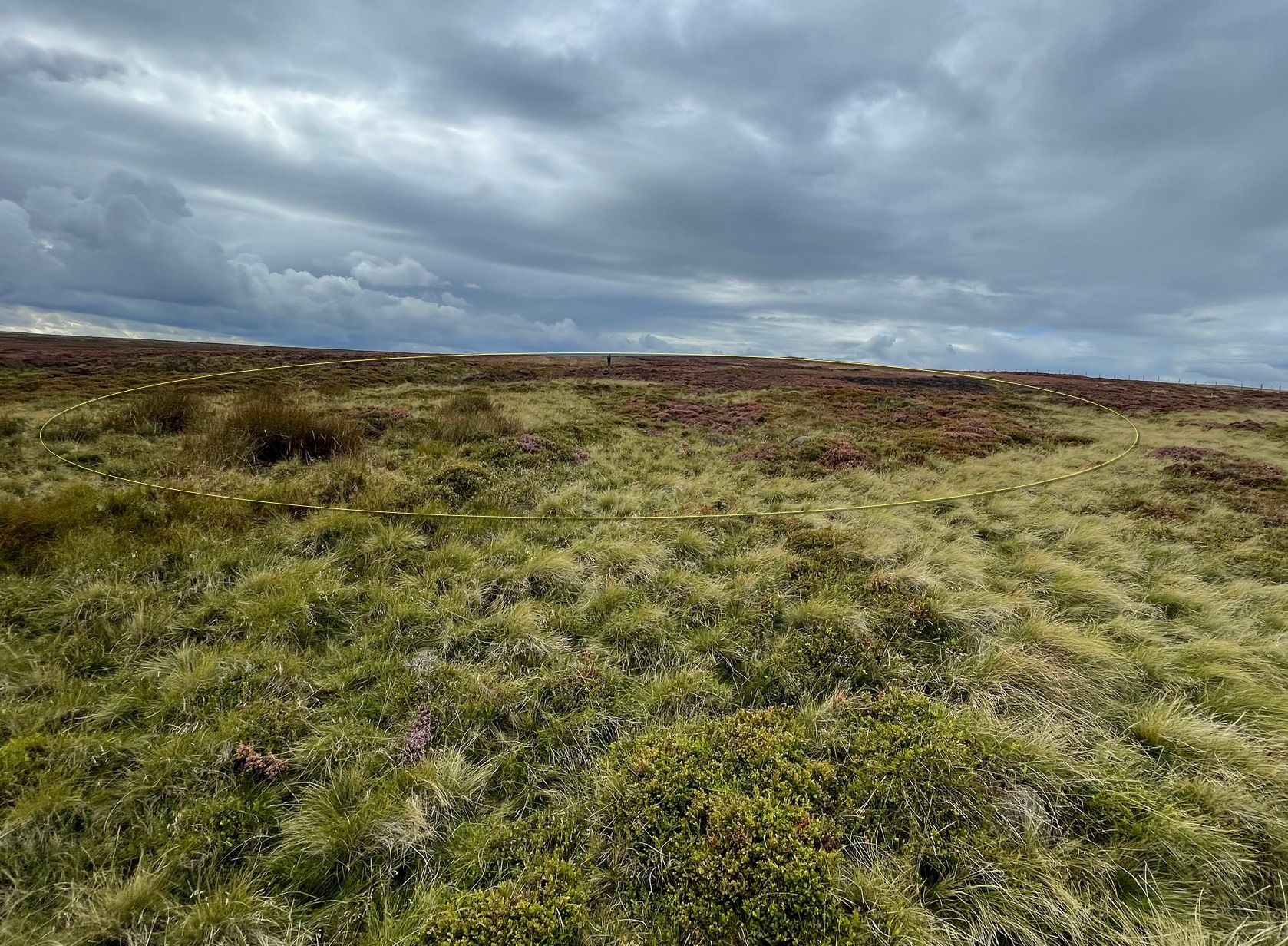
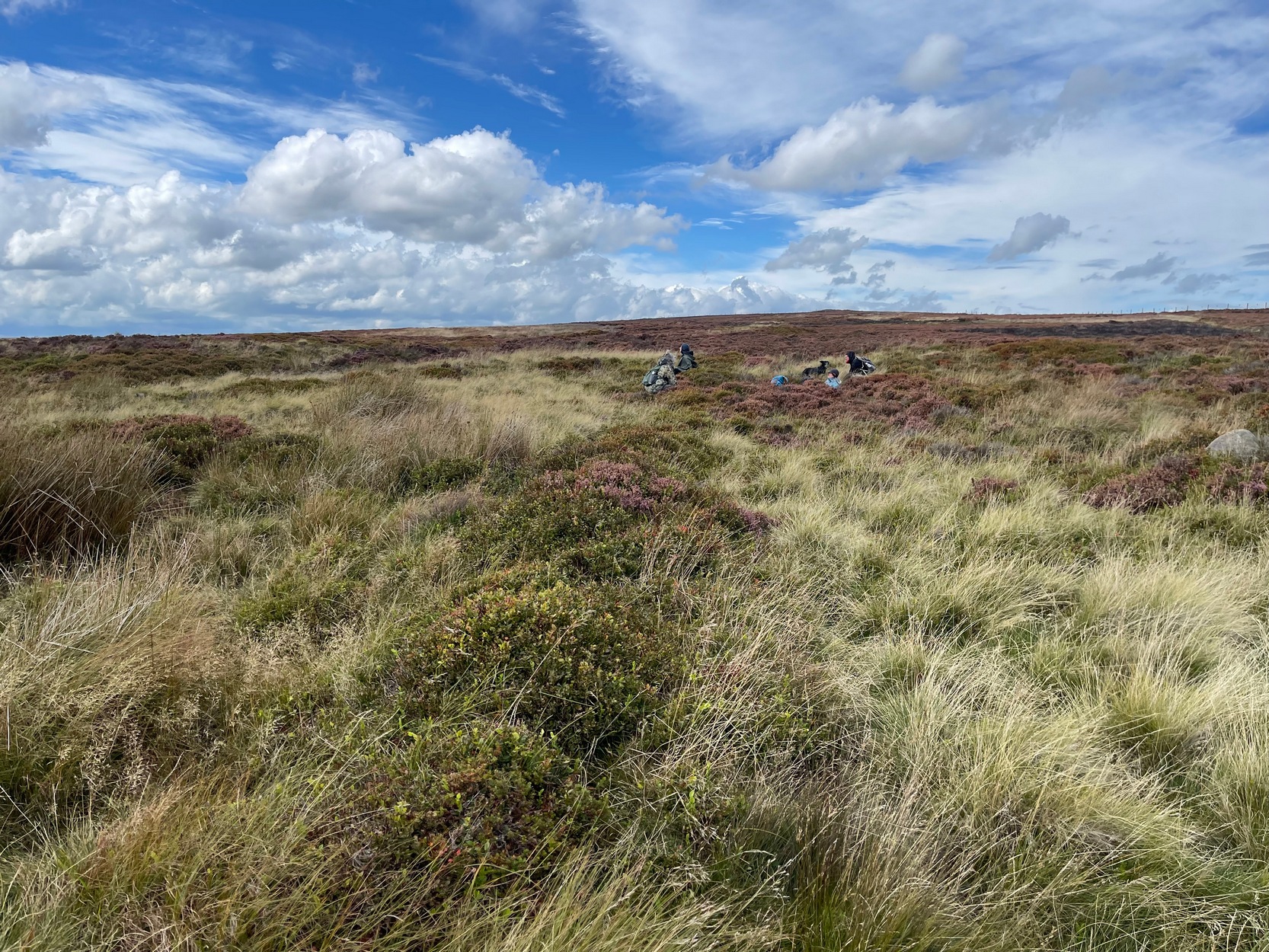
Track running into the ring
Raised line into the ring

Internally, there seems little evidence of a burial — although our recent visits here, as the photos indicate, took place when the moorland vegetation was deep and covered almost the entire site.  The outline of the site is obviously visible, even in deep heather, but the smaller details remain hidden.  But in addition to the main ring, another very distinct ingredient here is the existence of an extended length of man-made parallel walling, probably a trackway, that runs into the circle from the southeast all the way through the circle and out the other side and then continuing northwest heading roughly towards the Great Skirtful giant cairn on the horizon 500 yards to the northwest.
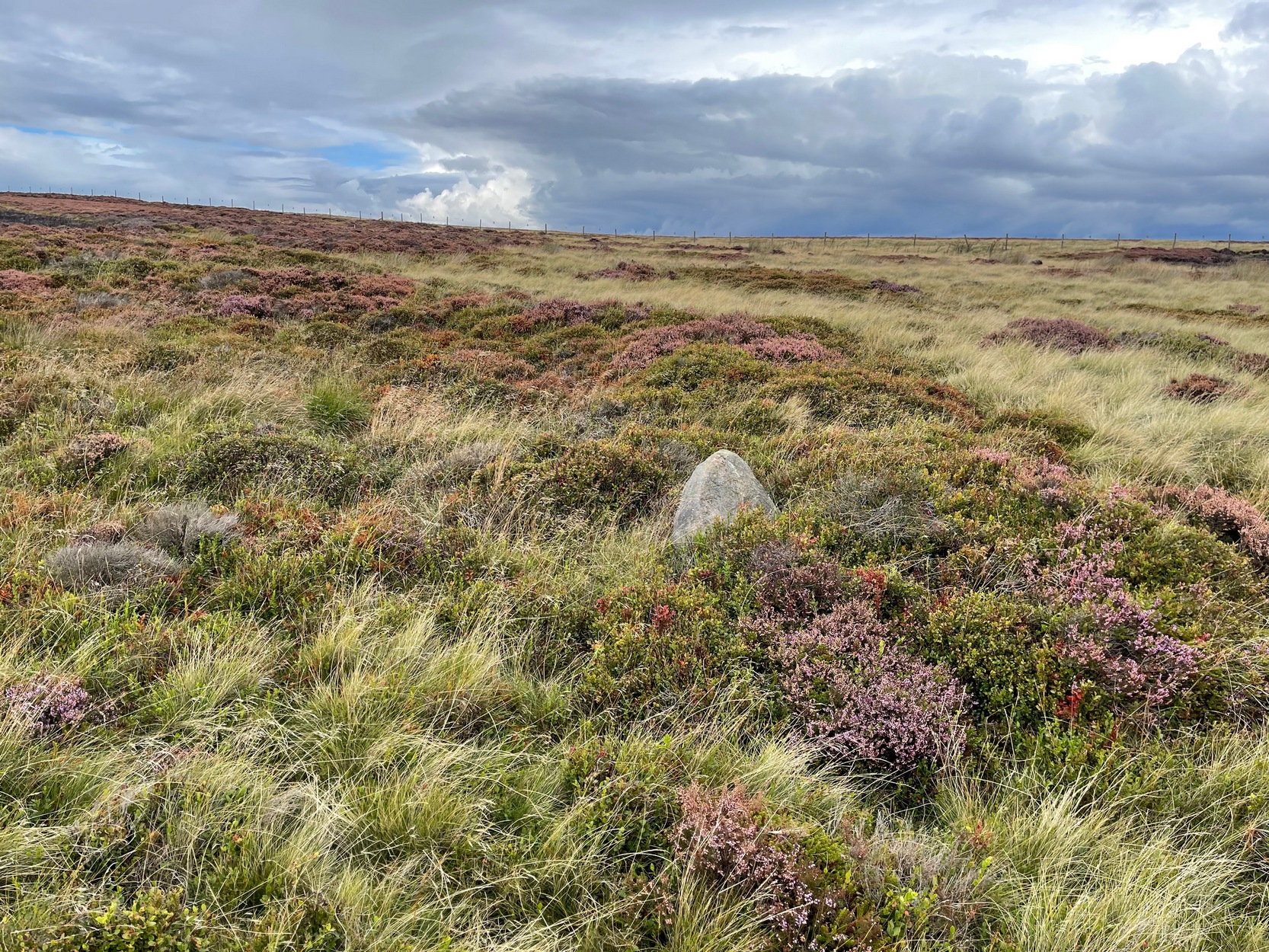
Stone at NE arc of walling

Due to the landscape being so overgrown, it’s difficult to ascertain where this ‘trackway’ begins and ends.  Added to this, we find that there are additional ‘trackways’ that run roughly parallel to the one that runs through the circle—and these ‘trackways’ are very old indeed, some of them likely have their origins way back in prehistory.  The one that runs through the middle of this ring cairn may be a ceremonial pathway along which, perhaps, our ancestors carried their dead.  If we follow it out from here and keep walking along the track 300 yards to the southeast, we eventually run right to the edge of the Craven Hall (3) circle.  Parallel to this is another ancient trackway that runs northwest to the edge of the Roms Law circle.  It seems very much as if we have ceremonial trackways linking sites to each other: ancestral pathways, so to speak.

Have a gander at this when you’re next in the area.  There are many other sites nearby that are off the archaeological radar.  In recent years, a number of northern antiquarians wandering over this landscape are finding more and more ancient remains: walling, circles, cairns, trackways.  It’s a superb arena—but sadly, most of it is hidden beneath deep moorland vegetation.

References:

  1. Faull, M.L. & Moorhouse, S.A. (eds.), West Yorkshire: An Archaeological Guide to AD 1500 – volume 1, WYMCC: Wakefield 1981.

Acknowledgements:  Huge thanks for use of the Ordnance Survey map in this site profile, reproduced with the kind permission of the National Library of Scotland

© Paul BennettThe Northern Antiquarian

Snowden Carr, Askwith, North Yorkshire

Cairnfield:  OS Grid Reference – SE 1777 5099

Getting Here

Cairns, front & rear

Park up at the singular dusty car-park on the east-side of Askwith Moor Road.  If you walk to the sloping eastern edge of the car-park and then go down and over the collapsed fence onto the moorland immediately east, walk in the direction of the Tree of Life Stone to the north-east (be aware that there’s no footpath here and it’s boggy as fuck in places) .  Just over halfway towards the carving, nearly 400 yards from where you’ve parked, you’ll begin to see various ruinous piles and scatters of stone.  You can’t really miss them!

Archaeology & History

Cairn, looking north

In a region teeming with prehistoric sites, the great Eric Cowling (1937) seems to have been the person who stumbled across this “barrow group”, as he called it, during one of his rock art forays in this neck o’ the woods.  Little has been written of them since.  Not to be confused with the Snowden Moor cairnfield more than 350 yards to the north, at this place we find at least a dozen quite distinct cairns scattered around the grid-reference cited, most of them much larger in size than the cairns to the north, ranging between five to twelve yards across and up to three feet high.  They have all been opened and robbed, with considerable disturbance on the largest of the ‘barrows’.  We know not who may have done this, but there’s been a history of quarrying close by and it may have been some of the workmen who did the damage, knowingly or otherwise.

Large scatter of cairn-spoil
Cairn covered in bilberries!

As far as I’m aware, no burial or funerary remains have been found here—but there’s been negligible archaeological attention given to any of the sites on this moorland, meaning that we can draw no real conclusions about the nature of the cairns.  They seem to be far too large to be clearance cairns; and the proximity of large scale prehistoric settlements and rock art all round here would strongly suggest they possessed a funerary nature.  Several impressive petroglyphs exist right at the edge of this group, literally yards away from them.  Check them all out out the next time you see the Tree of Life stone

References:

  1. Cowling, Eric T., ‘Cup and Ring Markings to the North of Otley,’ in Yorkshire Archaeological Journal, volume 33 (part 131), 1937.
  2. Cowling, Eric T., Rombald’s Way: A Prehistory of Mid-Wharfedale, William Walker: Otley 1946.

© Paul BennettThe Northern Antiquarian

Warsett Hill, Brotton, North Yorkshire

Round Barrows (destroyed):  OS Grid Reference – NZ 692 214

Archaeology & History

Tumuli shown on 1920 map

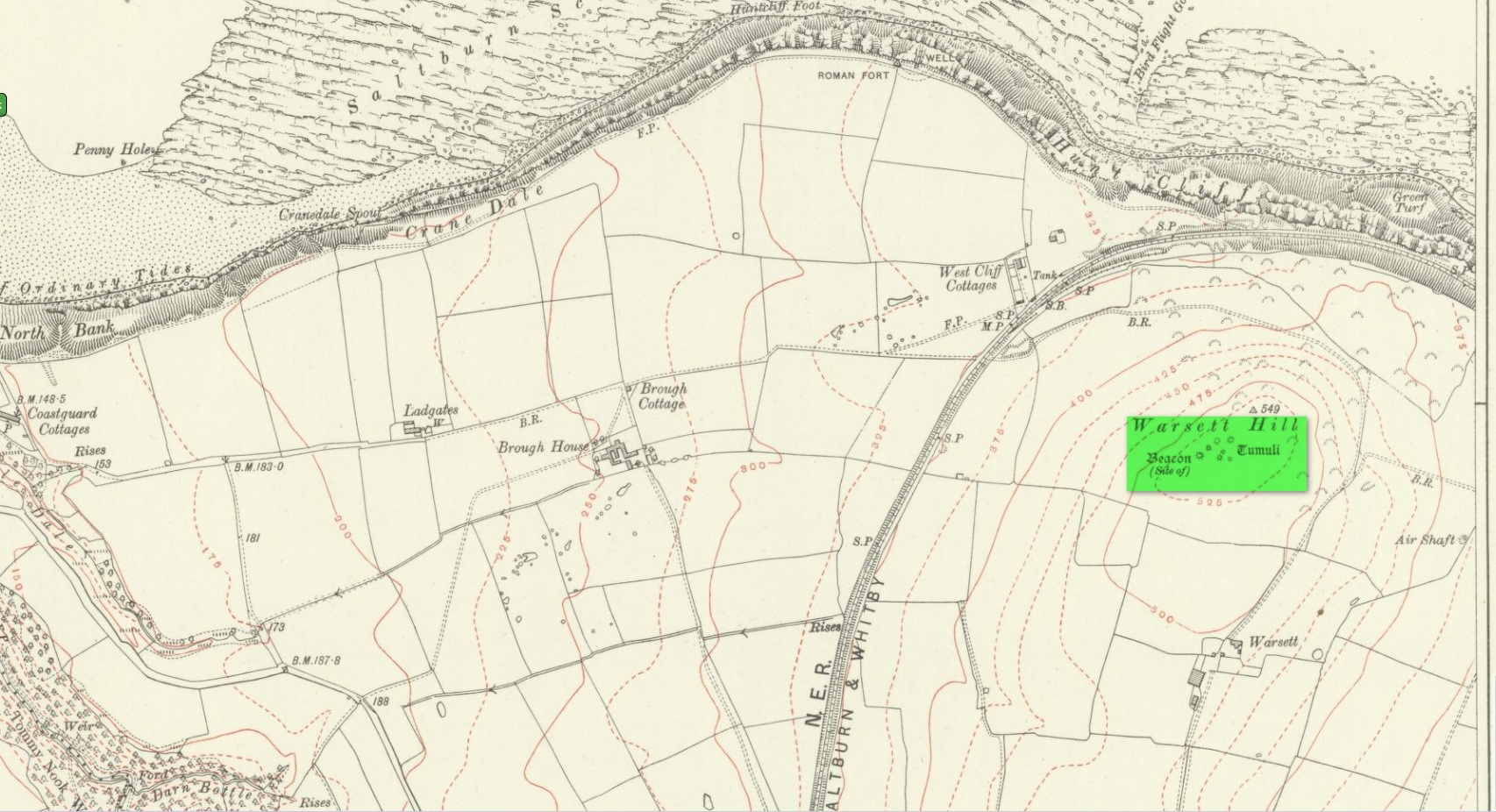
On top of the large plateau that is Warsett Hill, on the southwest side of the old trig-point, could once be seen a cluster of at least seven burial mounds or tumuli.  The mounds are shown on the first OS-map of the area, but merely as mounds.  It wasn’t until there’d been a subsequent investigation here by local historian J.C. Atkinson in the 19th century that they were highlighted on the 1920 map as “Tumuli.”  Sadly, since then, they’ve all been destroyed.

Very brief notes were written on six out of the seven tombs here by William Hornsby (1917), with only one of them receiving any real attention.  “Of the other six,” Crawford (1980) wrote,

“there is very little information; all were excavated by Atkinson prior to 1893, but his excavations revealed no finds and he stated that all of the mounds had been previously disturbed.  They were later dug by Hornsby, who stated that although he found no sepulchral deposits, all the mounds contained flints.”

In medieval times this became a beacon site, where bonfires were lit.  I can find no further information about this. (NB: This site should not to be confused with another Warsett Hill that exists two miles southeast of here above Skinningrove.)

References:

  1. Crawford, G.M., Bronze Age Burial Mounds in Cleveland, Cleveland County Council 1980.
  2. Hornsby, William & Stanton, R., “British Barrows near Brotton,” in Yorkshire Archaeological Journal, volume 24, 1917.

Acknowledgements:  Huge thanks for use of the Ordnance Survey map in this site profile, reproduced with the kind permission of the National Library of Scotland

© Paul BennettThe Northern Antiquarian

Craven Hall Hill (3), Hawksworth Moor, West Yorkshire

Ring Cairn:  OS Grid Reference – SE 14574 44098

Getting Here

Site shown on 1851 map

Unless the heather’s been burnt back, this takes a bitta finding.  Direction-wise, the easiest is from the moorland road above Menston.  Go up Moor Lane and then turn right along Hillings Lane. 350 yards on is a dirt-track on your right marked as Public Footpath.  Walk up here for two-thirds of a mile—going past where the track goes left to the Shooting Range—to where the track splits.  Bear left and after 250 yards you reach a fence on your left where the moorland proper begins.  Follow this fence SW for 300 yards until it does a right angle turn.  Just before this, you’ll see a large worn overgrown trackway or path running north into the moorland.  Walk up here for nearly 100 yards and look around.  Best o’ luck!

Archaeology & History

Western arc of earth & stone

Shown on the 1851 OS-map adjacent to the long prehistoric trackway that runs past Roms Law, the Great Skirtful and other prehistoric sites, the antiquarian wanderings of Forrest & Grainge (1868) came past here and, although didn’t mention the Craven Hall cairns directly, they did write of “a group of barrows” hereabouts, and this may have been one of them.  James Wardell (1869)  gave an even more fleeting skip, only mentioning “pit dwellings” hereby.  A little closer to certainty was the literary attention Collyer & Turner’s (1885) pen gave, where they described, “near the adjoining old trackway, which runs from East to West, will be seen a small barrow”—but this could be either of the Craven Hill sites.  And the usually brilliant Harry Speight (1900) gave the place only more brevity….

Structurally similar to Roms Law nearly ¾-mile northwest of here, this little-known and much denuded prehistoric tomb has seen better days.  It is barely visible even when the heather’s low—and when we visited recently, the heather was indeed low but, as the photos here indicate, it’s troublesome to see.  It’s better, of course, with the naked eye.

Highlighted ring cairn, looking NE
Highlighted ring cairn, looking SE

It’s the most easterly cairn in the large Bronze Age necropolis (burial ground) on Hawksworth Moor.  Measuring some 12 yards across and roughly circular in form, the ring is comprised mainly of many small stones compacted with peat, creating a raised embankment barely two feet high above the heath and about a yard across on average.  A number of larger stones can be seen when you walk around the ring, but they don’t appear to have any uniformity in layout such as found at the more traditional stone circles.  However, only an excavation will tell us if there was ever any deliberate positioning of these larger stones.  It would also tell us if there was ever a burial or cremation here, but the interior of the ring has been dug out, seemingly a century or two ago…

References:

  1. Collyer, Robert & Turner, J.H., Ilkley: Ancient and Modern, William Walker: Otley 1885.
  2. Faull, M.L. & Moorhouse, S.A. (eds.), West Yorkshire: An Archaeological Guide to AD 1500 – volume 1, WYMCC: Wakefield 1981.
  3. Forrest, C. & Grainge, William, A Ramble on Rumbald’s Moor, among the Rocks, Idols and Altars of the Ancient Druids in the Spring of 1869, H. Kelly: Wakefield 1868.
  4. Speight, Harry, Upper Wharfedale, Elliott Stock: London 1900.
  5. Wardell, James, Historical Notes of Ilkley, Rombald’s Moor, Baildon Common, and other Matters of the British and Roman Periods, Joseph Dodgson: Leeds 1869.

© Paul BennettThe Northern Antiquarian

Allington Hill, Bottisham, Cambridgeshire

Tumulus (destroyed):  OS Grid Reference – TL 5801 5874

Archaeology & History

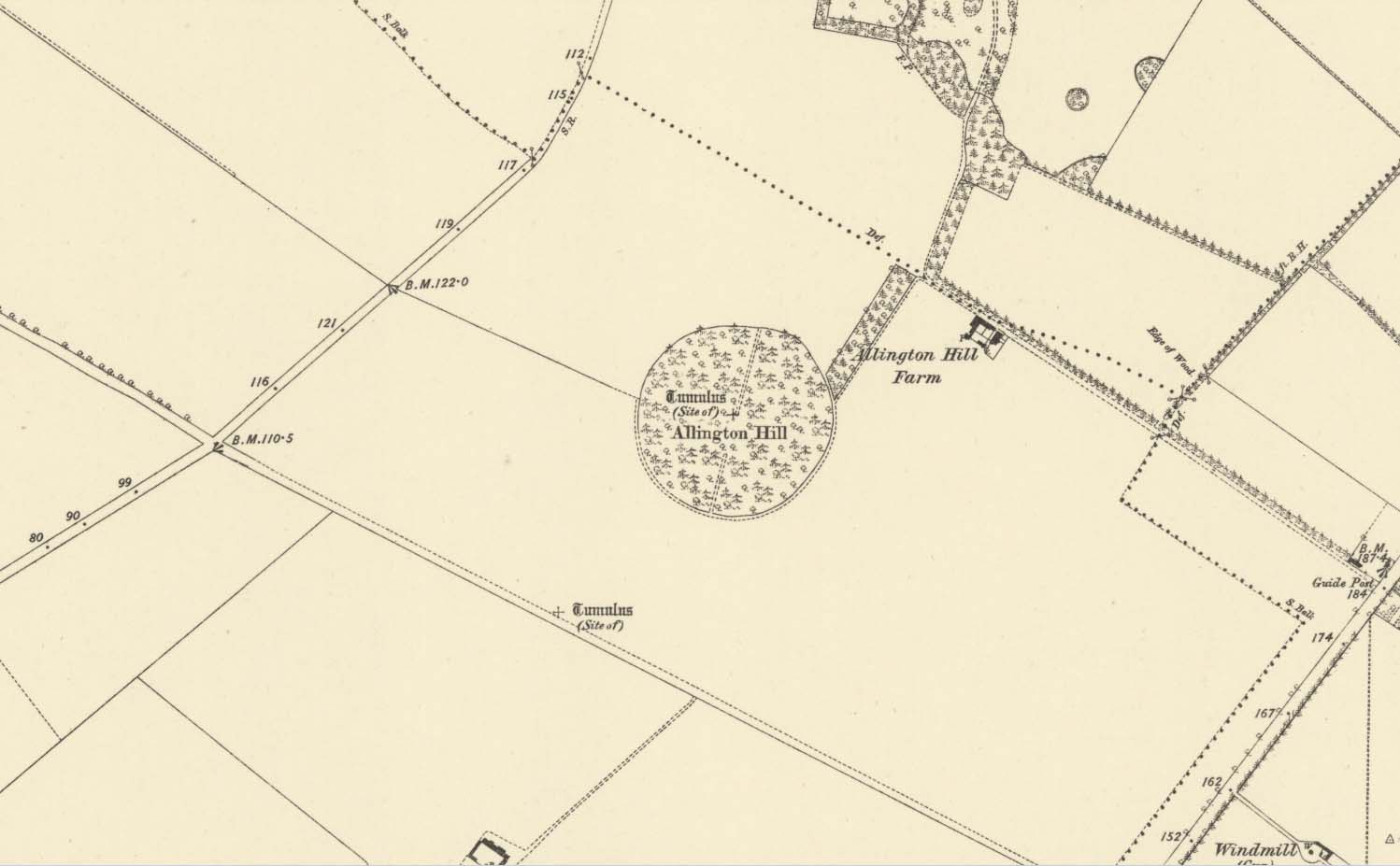
Site marked on 1886 map

In times of olde on this prominent tree-covered hill, a tomb of some ancient ancestor once lived.  It had already been destroyed by some retards by the time the Ordnance Survey lads came here in 1885; but thankfully, memory gave its existence the note it deserved.  The place had thankfully been given the once-over by some archaeologists in the middle of that century, giving us a pretty good idea as to its size and nature.  Measuring some 90 feet across and fourteen feet high, this was no mere toddler!

A Mr W.T. Collings (1846) gave his Intelligence Report to the archaeological journal of the period, from which the following description is gained:

“The excavation of this tumulus in 1845 was made from east to west, commencing from the eastern side, in the direction of its centre, in which, at a depth of about three feet, there was found a cinerary urn in an inverted position, slightly tilted on one side, and surrounded by charcoal and burnt earth.  It was filled with charcoal, but contained only one small fragment of bone. This vessel, which was of the simplest manufacture, moulded by the hand, and sun-baked, measured in height five inches, and its diameter at the largest part was five inches and a half.  From the deep red colouring, and the general appearance of the surrounding soil, it would seem that a small hole had been first dug, charcoal and bones burnt in it, the vase placed on the fire in an inverted position, and the whole covered up.  About ten feet eastward of the central deposit, on the south side of the line of excavation, and half a foot deeper, a deposit of fragments of bone was found apparently calcined, but with little charcoal or burnt earth, forming a layer not more than three inches thick, and two feet in circumference.  There were several pieces of the skull, a portion of the alveolar process, inclosing a tooth, apparently that of a young person, pieces of the femur and clavicle, and other fragments.  A little to the north of this spot there appeared a mass of charcoal and burnt earth, containing nothing of interest. After digging five or six feet deeper, operations were discontinued; and on the next day shafts were excavated from the centre, so as completely to examine every part, without any further discovery, and in every direction charcoal was found mingled with the heap, not in patches, but in fragments.”

Collings reported the existence of another burial mound a short distance to the south.  It was one of at least five such tumuli in the immediate locale, all of which have been destroyed by retards in the area.

References:

  1. Collings, W.T., “Archaeological Intelligence,” in Archaeological Journal, volume 3, 1846.
  2. Hore, J.P., The History of Newmarket – volume 1, A.H. Baily: London 1886.
  3. Royal Commission Ancient Historical Monuments, Inventory of Historical Monuments in the County of Cambridgeshire – Volume 2: North-East Cambridgeshire, HMSO: London 1972.

© Paul BennettThe Northern Antiquarian

Caesar’s Camp Barrow, Wimbledon, Surrey

Tumulus (destroyed):  OS Grid Reference – TQ 222 709

Archaeology & History

It seems that a great number of prehistoric remains used to exist in and around the Wimbledon Common area.  This one is mentioned only briefly in Thomas Stackhouse’s (1833) rare work on early British remains, where he wrote:

“Near an old single-trenched Camp at the South West comer of Wimbledon Common, is a very small flat Barrow cut into the form of a cross: I don’t know that it has been noticed by any writer.”

The “single-trenched Camp” he described is today known as Caesar’s Camp hillfort.  By the time the Wimbledon historian William Bartlett (1865) came to write his survey, the site had been destroyed.  In Mr Johnson’s (1903) survey, he seems to confuse this site with the large barrow cemetery that used to exist on the northern edges of Wimbledon Common described by William Stukeley and others.

(the grid-reference to this site is an approximation).

References:

  1. Bartlett, William A., The History and Antiquities of Wimbledon, Surrey, J. & S. Richards: Wimbledon 1865.
  2. Johnson, Walter, Neolithic Man in North-East Surrey, Elliot Stock: London 1903.
  3. Stackhouse, Thomas, Two Lectures on the Remains of Ancient Pagan Britain, privately printed: London 1833.

© Paul BennettThe Northern Antiquarian

Cedars Road, Clapham, Surrey

Tumulus (possible):  OS Grid Reference – TQ 2856 7555

Also Known as:

  1. Mount Nod

Archaeology & History

Located on the old boundary line between Clapham and Battersea, what might have been a forgotten tumulus, whose memory was thankfully preserved by the renowned folklorist and historian Walter Johnson (1903), was described in his work on prehistoric Surrey.  He seemed to think it serious enough to add to his survey, where he told us that,

“there still exists, near Cedars Road, Clapham, what may possibly be a round barrow.  It is in the garden of a house opposite St. Saviour’s Church, and is visible to anyone passing along the old, narrow passage called Wix’s Lane.  Mr. J.W. Grover, who brought the matter before the Archaeological Association in 1884, had been struck by the discovery that old maps marked the spot ‘Mount Nod Fields.’  …The mound must originally have been 70 or 80 feet across, but had been tampered with on one side for the construction of an ice-house.  Mr. Grover suggested that the mound may be of Celtic date.  To us, the height—some 12 feet or more—together with marked signs of reconstruction at a comparatively modern date, indicate the necessity of withholding judgment. The original tumulus may simply have been increased in height, but…digging alone could settle the question.”

Local historian Michael Green (2010) has found that there were prehistoric tombs on Clapham Common only 500 yards away, so this one along Cedar Road was not in isolation.  Is the site named on the boundary perambulation records?  Has it been explored since Johnson wrote about it and, if so, has its veracity as a prehistoric tomb been ascertained, or is it merely the remains of some post-medieval creation?

References:

  1. Green, Michael, “Mount Pond, Clapham Common: Archaeology and History“, Clapham Society Local History Series, 2010.
  2. Grover, J.W., “Mount Nod, Clapham,” in Journal of the Archaeological Association, volume 40, 1884.
  3. Johnson, Walter, Neolithic Man in North-East Surrey, Elliot Stock: London 1903.

© Paul BennettThe Northern Antiquarian

Two Captains, Stetchworth, Cambridgeshire

Tumuli (destroyed):  OS Grid Reference – TL 6246 6048

Also Known as:

  1. Two Howes

Archaeology & History

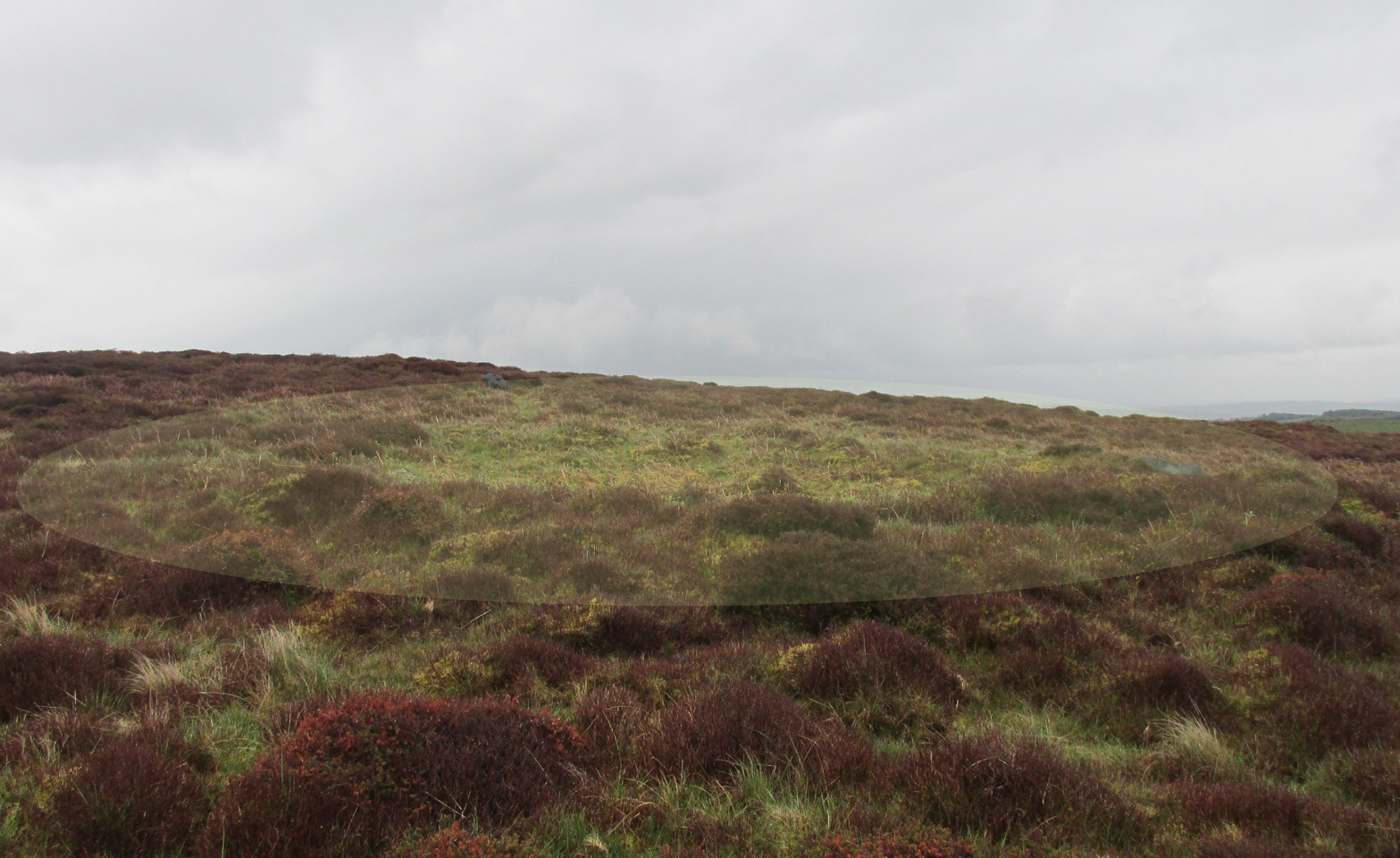
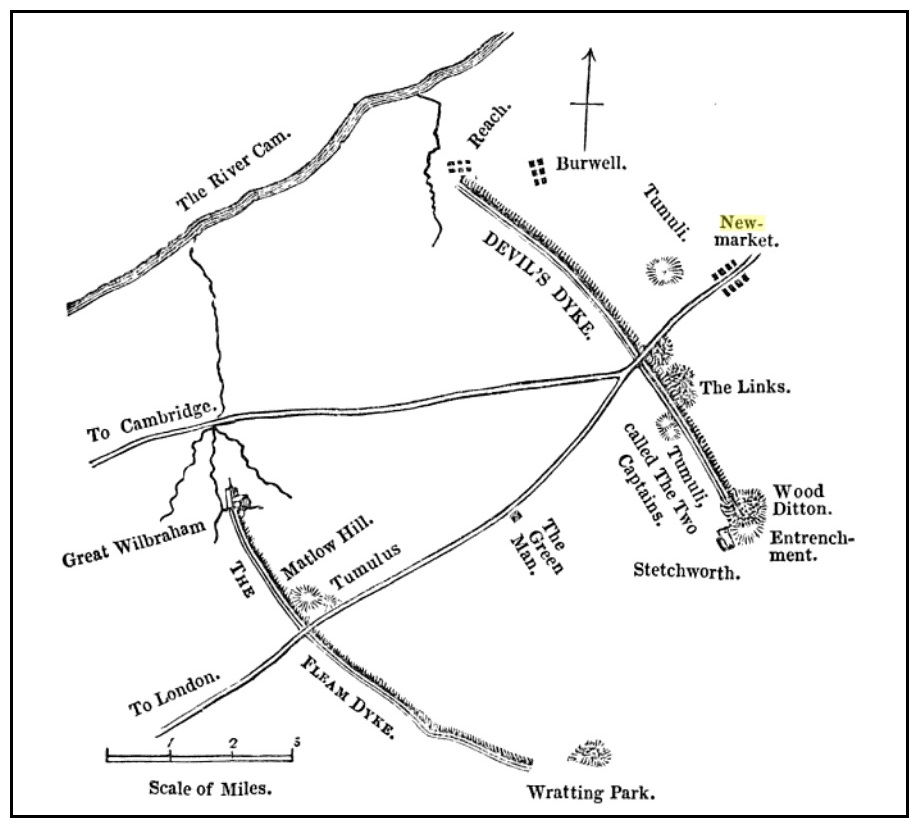
Mentioned as early as the 15th century in the Ely Cartulary as the “Tuomhowe,” or “two hills”, the place-name authority P.H. Reaney (1945) identifies this with the two “barrows” which our early cartographers map as our ‘Two Captains’.

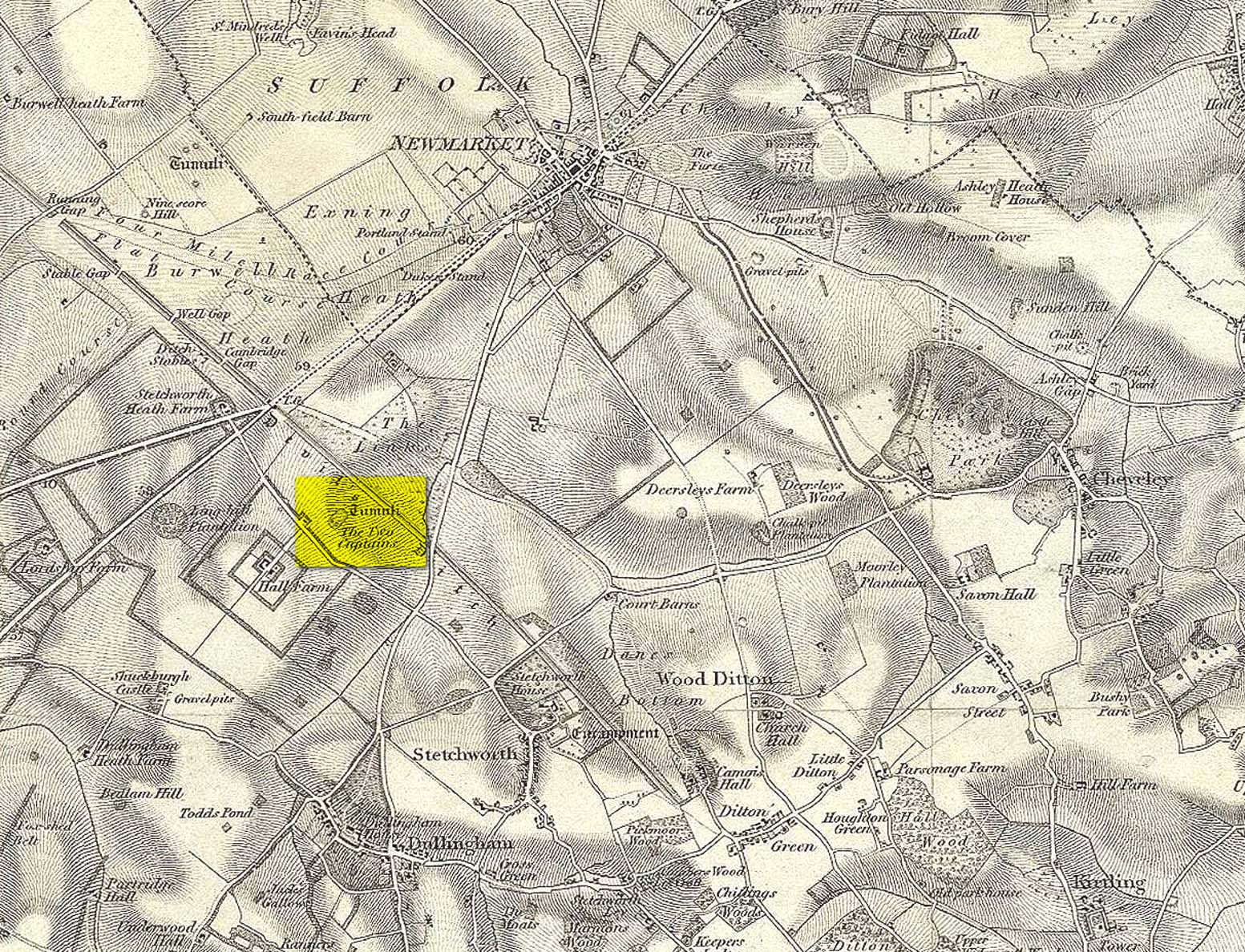
Site shown on 1834 map
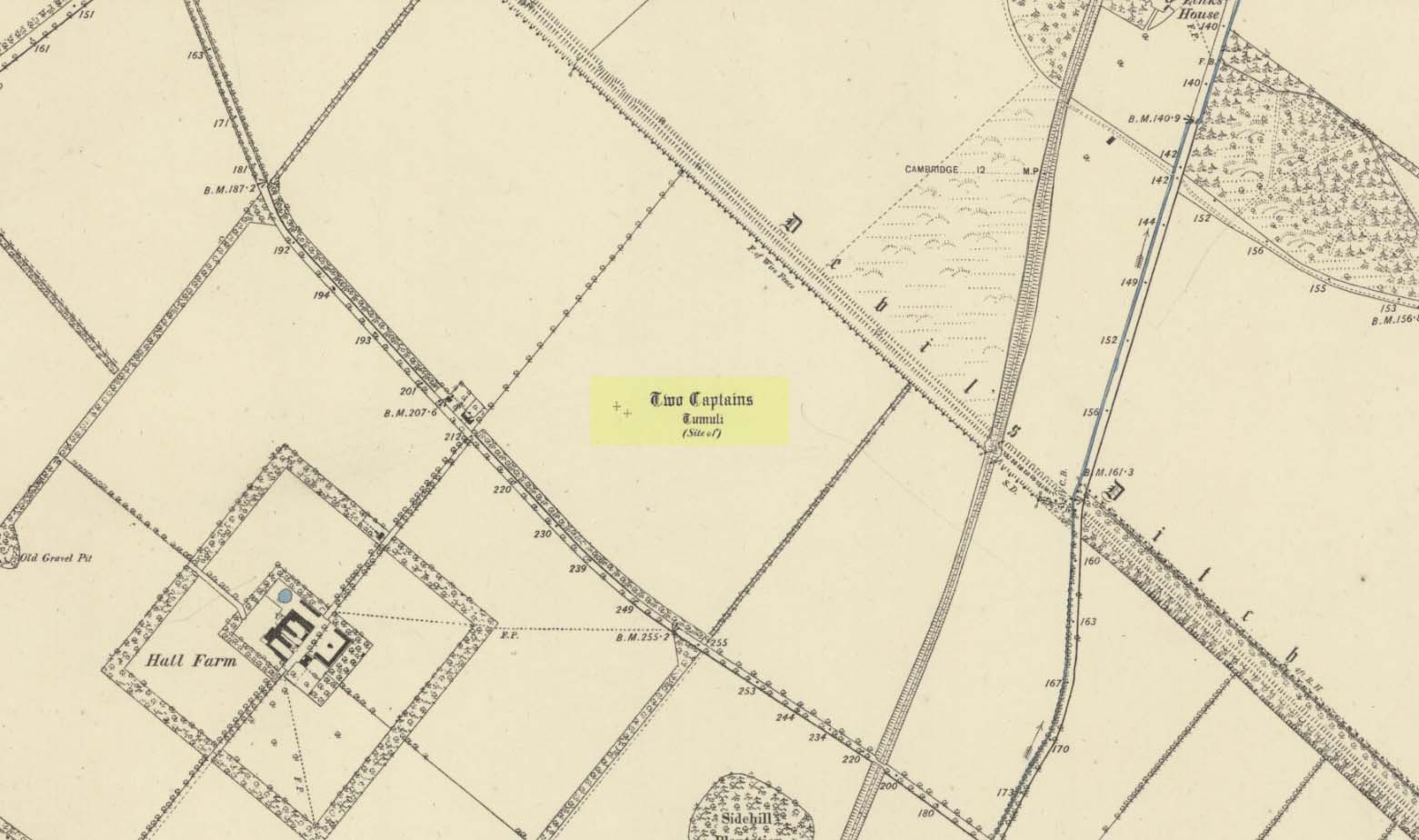
Site of the Two Captains on the 1885 OS map

In the 1834 survey by the Ordnance Survey lads, these conspicuous burial mounds were clearly marked on the west side of the Devil’s Dyke, less than 2 miles south of the Newmarket Necropolis.  They were seen first-hand by a number of local walkers, including A.J. King (1845) in his account of the aforementioned dyke.  But on the 1885 OS map, the old tombs had apparently gone.  Evidently some local knob-head had come along and took it upon himself to destroy these two burial mounds, which had lived here for thousands of years.  However, despite the OS-maps indicating that it had been totally destroyed in the 1880s, a couple of later writers said that faint traces were still visible, including the historian Charles Harper. (1904)  When he came here, he told how

“Little is now left of this once prominent mound, once important enough to be marked on Ordnance maps, but now ploughed nearly flat.  It stands in the third field from the road, on the right hand, a field now under corn, but until forty years ago a wood.”

A.J. King’s 1845 map

Very little is known about the place and even the late great barrow fetishist, L.V. Grinsell (1936) could dig nothing out, despite the two tombs mentioned in passing by a number of writers.

Folklore

In Grinsell’s (1976) book on the folklore of ancient sites, he drops the Two Captains into a simple category of them relating to some battle, without any information.  But it seems there isn’t much to go on.  The local history work of Charles Harper (1904) intimates the same thing, bringing attention to the folklore of the adjacent Devil’s Dyke, as

“it is one of the many sites identified as the scene of Boadicea’s defeat by Suetonius Paulinus, but we are sceptical of this particular one, although the ancient tumulus on the outer face of the Ditch, still called the Two Captains, points to some forgotten conflict in which two leaders were slain and buried on the contested field.”

References:

  1. Gomme, G.L., The Gentleman’s Library: Archaeology – volume 2, Elliot Stock: London 1886.
  2. Grinsell, Leslie V., The Ancient Burial Mounds of England, Methuen: London 1936.
  3. Grinsell, Leslie, Folklore of Prehistoric Sites in Britain, David & Charles: Newton Abbot 1976.
  4. Harper, Charles G., The Newmarket, Bury, Thetford and Cromer Road, Chapman & Hall: London 1904.
  5. King, A.J., “The Devil’s Dyke, Newmarket,” in The Gentleman’s Magazine, January 1845.
  6. Reaney, P.H., The Place-Names of Cambridgeshire and the Isle of Ely, Cambridge University Press 1943.
  7. Royal Commission Ancient Historical Monuments, Inventory of Historical Monuments in the County of Cambridgeshire – Volume 2: North-East Cambridgeshire, HMSO: London 1972.
  8. Tymms, S., “The Devil’s Dyke, Newmarket” in Proceedings Suffolk Inst. Archaeology. 1, 1849-53 168-70

© Paul BennettThe Northern Antiquarian


Cowpasture Road, Ilkley, West Yorkshire

Cist (destroyed):  OS Grid Reference – SE 1192 4759

Archaeology & History

Urn found below Cowpasture Rd in 1874

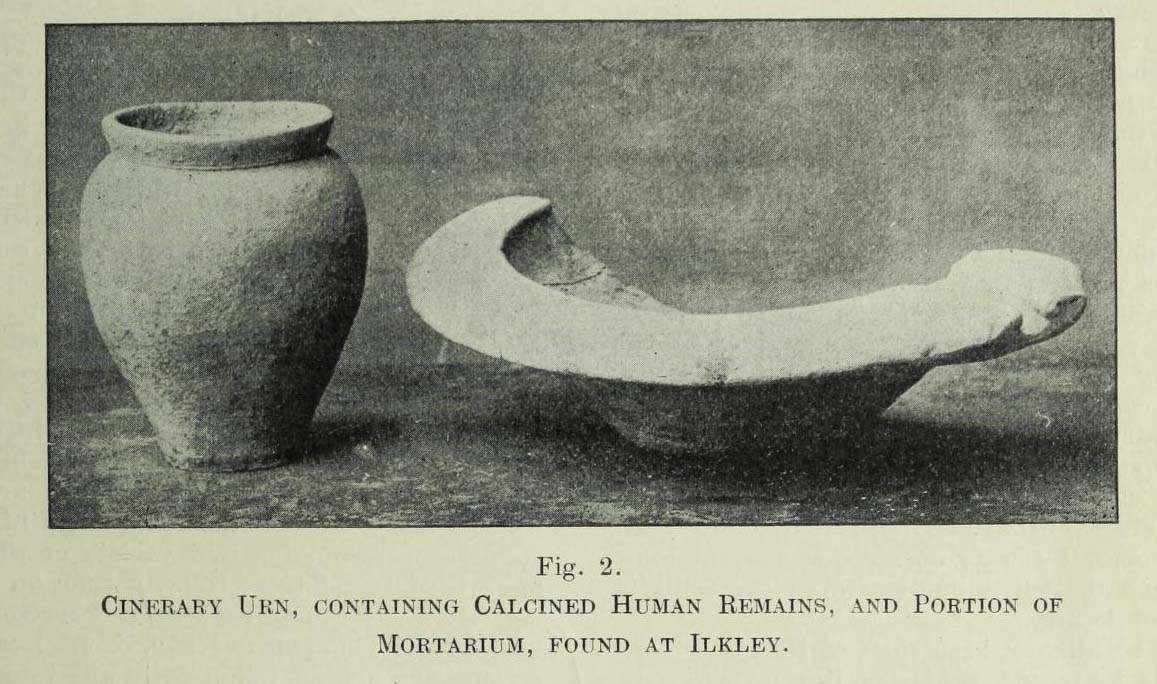
In a lecture given by Frank Hall at the Ilkley Library in February, 1910, he described a number of prehistoric remains found in the area—including the remnants of a “cinerary urn, containing calcined human remains” and more, as illustrated in the old photo here.  He contextualized the findings as being typical of the remains found “under a large heap of earth and stones which we now call a ‘barrow’, ‘cairn’ or ‘tumulus'” and believed that one must have existed here in bygone times.  The urn, he told us,

“was found within a few yards of these premises, for it was dug up when the excavations were being carried out for the erection of Messrs Robinson and Sons’ buildings on the opposite side of Cowpasture Road, in March 1874.”

Although we list this site as a cist, we don’t know for sure; but due to the lack of descriptive and historical data about a mound of any form in this area, it is most likely to have been a cist burial and not a tumulus or barrow which Mr Hall inferred.  Its location near the valley bottom is unusual when we consider the huge number of cairns on the moors above here; but a cist was found in a similar low-lying geographical position on the south side of the moors near Bingley, 5.8 miles due south, when construction of local sewage works were being done.

References:

  1. Hall, Frank, The Contents of Ilkley Museum, William Walker: Otley 1910.

© Paul BennettThe Northern Antiquarian


Woodhenge Circle (4), Durrington, Wiltshire

Round Barrow (destroyed):  OS Grid Reference — SU 1510 4330

Also Known as:

  1. Durrington 70

Archaeology & History

Cunnington’s sketch of the barrow remains

This was one of four ploughed-out round barrows (or ‘ring ditches’ in modern archaeo-jargon) that once existed immediately southeast of the well-known Woodhenge and was the closest of the four to the monument, being just 60 yards away. It was first noticed as a faint crop mark in an aerial survey photograph taken in 1926 of the fields hereby.  When it was investigated at ground level by Mr & Mrs Cunnington in August 1928, “no trace could be detected on the surface” of any extant monument—which they described as ‘Circle  IV’ in their superb survey.

The Cunnington’s (1929) account of the excavation they did here was pretty brief, telling:

“The soil was removed and the chalk brushed over that part of the area enclosed within firm lines.  Beyond a few shards of pottery in the soil, nothing whatever was found.  As the ditch was comparatively shallow and the filling-in was in patches dark in colour, with much ash and some burnt flints in it, a considerable length was dug out, as shown (in the sketch, above).  A few fragments of pottery similar to some of that from Woodhenge were found in and below the old turf line.

“The only find of interest was that of a piece of glass slag on the actual bottom of the ditch.  It is true it was at the shallowest point, but there was no evidence of disturbance.

“Conclusion — Like those of the other rings (Woodhenge Circles 1, and 3, PB) this ditch may have originally surrounded a Bronze Age burial, placed on the surface and covered with a mound, both of which were destroyed when the ground was levelled.”

References:

  1. Cunnington, M.E., Woodhenge, George Simpson: Devizes 1929.
  2. Royal Commission Historical Monuments, England, Stonehenge and its Environs, Edinburgh University Press 1979.
  3. Wainwright, G.J. & Longworth, Ian, Durrington Walls: Excavations 1966-1968, Society of Antiquaries: London 1971.

© Paul Bennett, The Northern Antiquarian