St Faith’s Well, Leven, East Yorkshire

Holy Well (destroyed):  OS Grid Reference – TA 09126 45628

Also Known as: 

  1. Humber Historic Environment Record HER 3714

Archaeology & History

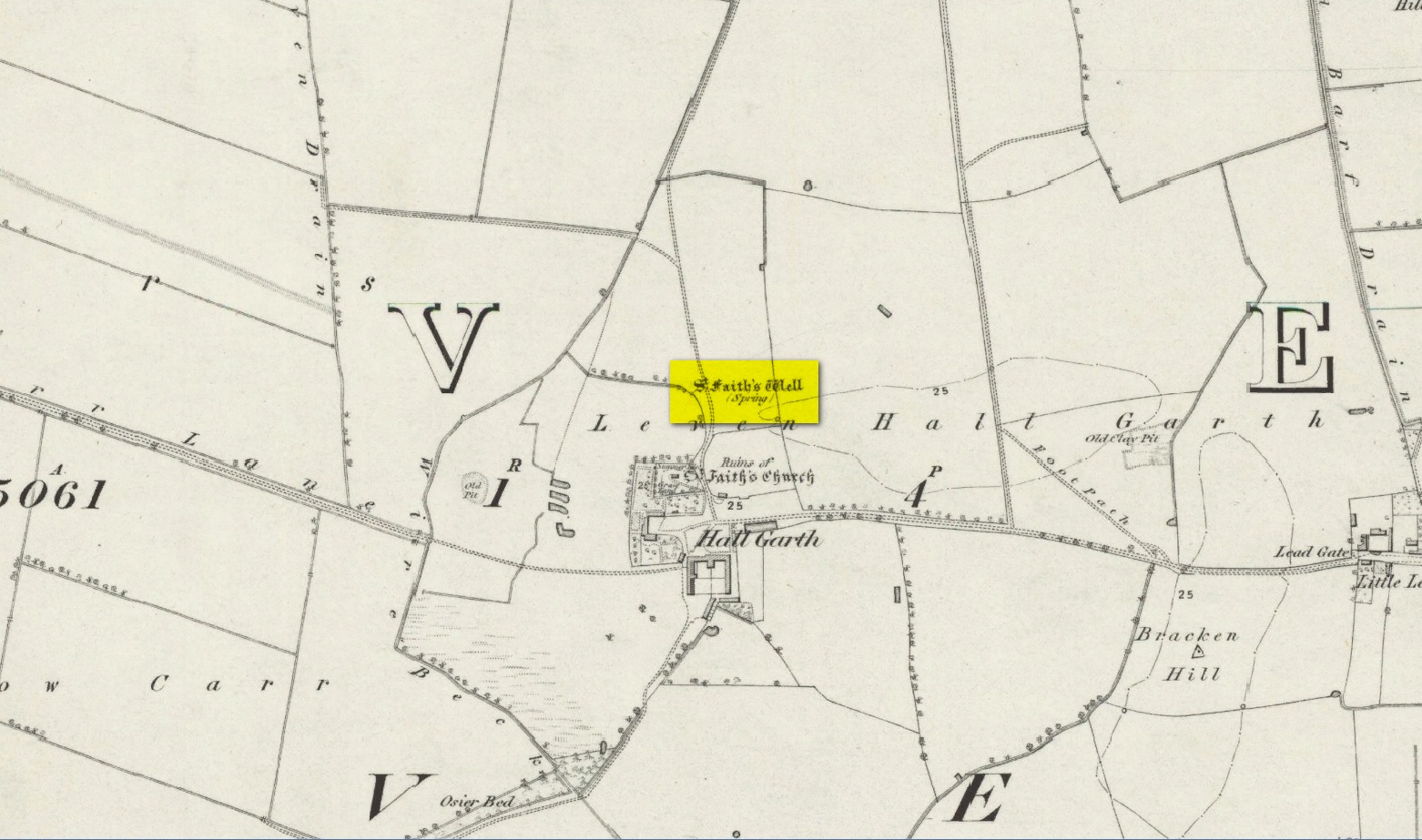
The site of the well is on the Carrs to the west of Leven village, immediately north of the old cemetery adjoining Hall Garth house.  Reverend William Smith, writing in 1923, told us:

St Faiths Well on 1855 map

“St Faith’s Well lay on the left of the road known as St Faith’s Lane, which leads to the old churchyard to which the spring was near.  St Faith belonged to France, and when quite a young maiden, was martyred because of her christianity.  She lived and died in the third century….

“St Faith’s Well was filled in about a hundred years ago and the site lost.  This, however, has lately been approximately fixed by the aid of water divining.  A Leven man, who can wield the hazel wand, went over the ground near to which the well was thought to have been, and the wand indicated a spot under which, on digging to the depth of about three feet, “the water fairly bubbled up”, and it was judged this was the place where the well lay.  St Faith’s Well is said to have given water both pure and abundant, and to have been in the old days the only supply of drinking water to the people of the Carrs.”

St Faith’s Saint’s day is the 6th October and she was a saint whose patronage was invoked by pilgrims, prisoners and soldiers.  From this, is it perhaps reasonable to infer that St Faith’s Well may have been a station for pilgrims to the local shrines of St John of Beverley and St Philip Ingleberd at Keyingham?  Also a stopping point for fugitives seeking sanctuary at Beverley?

There was another holy well dedicated to St Faith at Hexton in north Hertfordshire.

References:

  1. Cox, J.Charles, The Sanctuaries & Sanctuary Seekers of Mediæval England, George Allen: London 1911.
  2. Farmer, David H., Oxford Dictionary of Saints, Oxford University Press: Oxford 1987.
  3. Smith, Rev. William, Ancient Springs & Streams of the East Riding of Yorkshire, A. Brown: Hull 1923.

© Paul T Hornby 2021

Bride’s Well, Ballintemple, Wicklow

Holy Well:  OS Grid Reference – T 17340 77380

Archaeology & History

The earliest OS-map of this area shows this well a hundred yards or so northwest of an old church and just a few yards east of the stream that is now in woodland; but unlike today, when the early survey was done there were no trees, enabling a clear view of the waters.  When Myles Ronan (1927) wrote of the place, he told that it was still visible.  The site was added to the Grogan & Kilfeather (1997) county inventory where they suggested it’s probable relationship with the legendary St Brigid.  This seems highly probable.  Does anyone know if the Well is still there?

References:

  1. Grogan, Eion & Kilfeather, Annaba, Archaeological Inventory of County Wicklow, Stationery Office: Dublin 1997.
  2. Ronan, Myles V., “The Ancient Churches of the Deanery of Arklow”, in Journal Royal Society Antiquaries, Ireland, December 1927.

© Paul BennettThe Northern Antiquarian

St. Philip’s Well, Keyingham, East Yorkshire

Holy Well (destroyed):  OS Grid Reference – TA 23584 25549

Archaeology & History

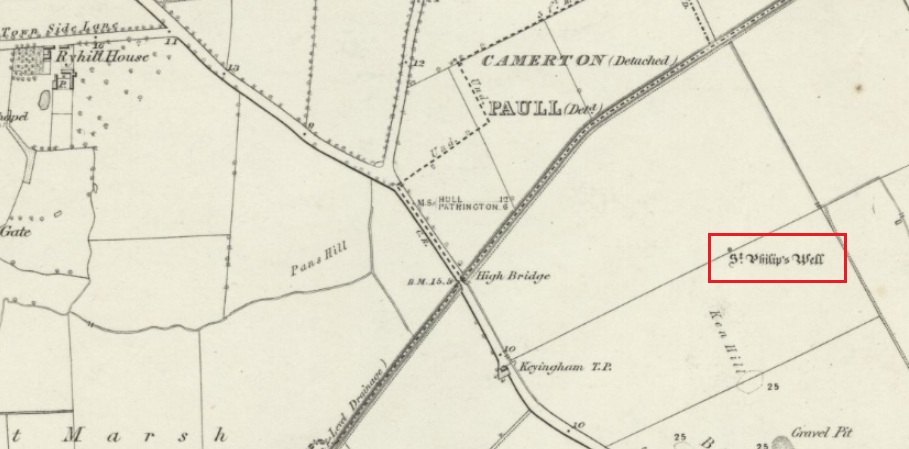
The Well shown on the 1855 6″ OS map

This holy well was formerly on the northern boundary of a field adjoining the north side of the A1033 west of Keyingham.

In view of the surviving folklore relating to the well it seems that its dedication to St. Philip may have been an effort by the Church to ‘Christianise’ it; and the St Philip here is not the Biblical Apostle, but a local saint – Philip Ingleberd (died c.1325 and also known as Philip Inglebred), whose memory was celebrated by a nearby Cross and a shrine at St Nicholas Church in the village.  The well and the cross may have been dedicated some time after 1392 following a ‘miracle’ relating to Philip’s tomb.  These were destroyed by the mob in the Reformation, although the cross-base survives.  It seems the well may have been restored in the late seventeenth century.  By the early twentieth century the well was described as laying on the Common to the west of the village, by then filled in, only showing signs it ever existed by making the ground near its site wet and boggy in a rainy season.

Folklore

George Poulson writing in 1841 told that,

“…a few fields more to the west is a well, called St. Philip’s Well; on a small stone are inscribed W. H. W. D. IG67. W. K.  It is called the wishing well; and the country lasses were in the habit of dropping pins, or even a sixpence into it, for the purpose of ensuring to themselves either particular or general good luck.”

William Smith (1923) described the well as one of six wishing wells or pin wells in Yorkshire and, moreover, the only ‘Cross Well’ in the East Riding.  At none of these wells was evil allowed to be foreshadowed, and the wells were only to show to a girl the portrait of her future husband.  He told us that,

“In every case the wish had to be with truthful devotion, and not divulged to any living person, or the desired consummation would not be gained…. Tradition adds that the well was much visited by maidens, who, on dropping their pins or coins, expressed the wish to see their lovers mirrored on its waters. Thus they kept a custom, dating to the time when the well was counted to be under the control of the fairies.”

And as Keyingham Common was once the abode of the fairies, it is worth noting that some 700 yards west of the site of the well a ‘Pans Hill’ is shown on the old maps, although whether this rural spirit of classical myth ever made it up to the East Riding is altogether another matter….

References:

  1. Arrowsmith, Nancy & Moorse, George, A Field Guide to the Little People, Macmillan: London 1977.
  2. Hope, Robert, Legendary Lore of the Holy Wells of England, Elliot Stock: London 1893.
  3. Poulson, George, History and Antiquities of the Seigniory of Holderness, Thomas Topping: Hull 1841.
  4. Smith, Rev. William, Ancient Springs & Streams of the East Riding of Yorkshire, A.Brown: Hull 1923.

© Paul T Hornby 2021

St. Hilda’s Well, Whitby, North Yorkshire

Holy Well (destroyed):  OS Grid Reference – NZ 9006 1102

Archaeology & History

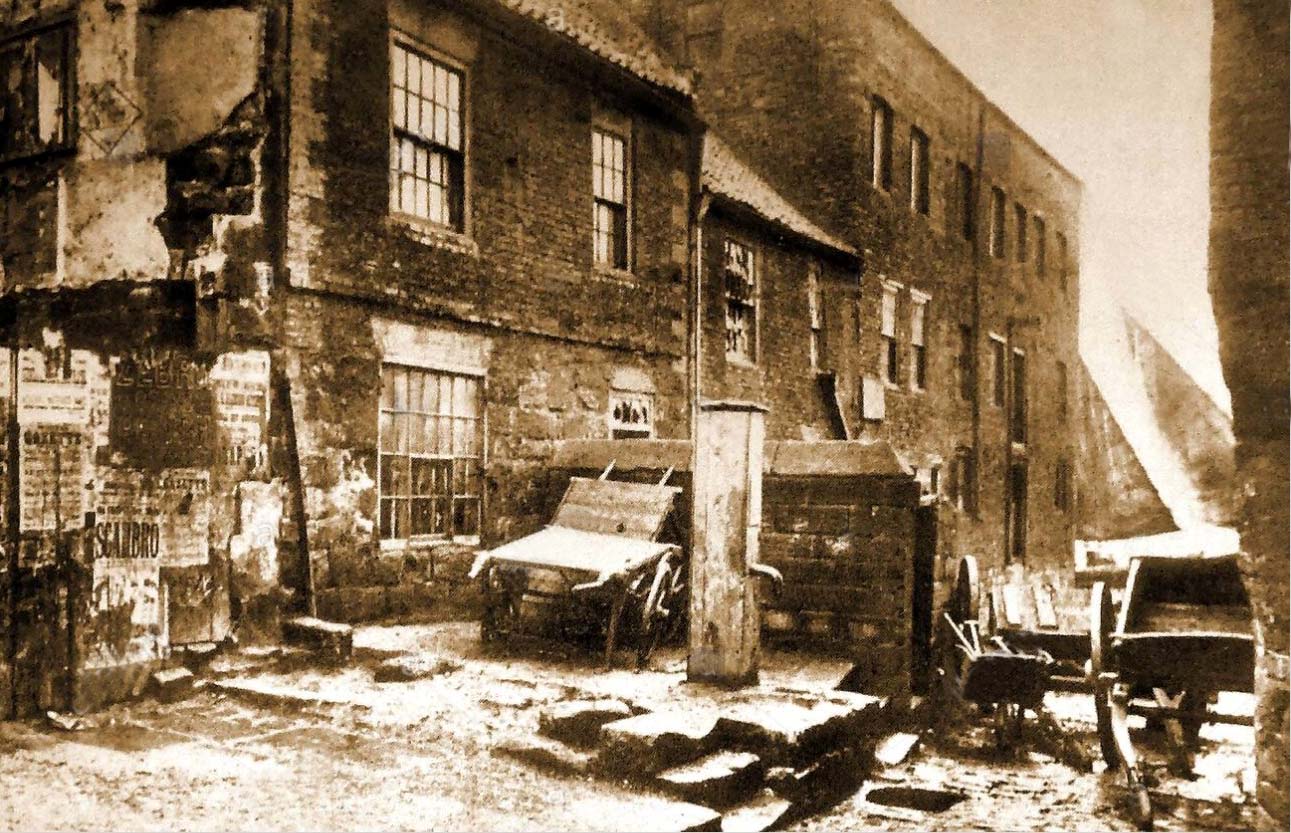
Virgin’s Pump, c.1890

This is one of at least five wells dedicated to St. Hilda in North Yorkshire that my old colleague Graeme Chappell has uncovered over his many years of research.  It’s sadly been destroyed, and accounts of it seem to be few and far between; but from the short description of it by Mr J.C. Atkinson (1894)—and helped out by its later title—we at least know where it once was.

In his account of the old roads in the village, Grape Lane was mentioned as far back as 1396, and close by, he wrote,

“is a spring called Seynt-Hild-keld, possibly where the so-called “Virgin pump” stands, or stood, not so very long since.”

This ‘ere “virgin pump” is shown in an old photo taken about 1890, just round the corner from Grape Lane where, today, is the car park on Church Street, opposite The Endeavour.

Folklore

St Hilda was a 7th century saint who was reputed to have founded Whitby Abbey.  Her festival date was November 17.

References:

  1. Atkinson, J.C., Memorials of Old Whitby, MacMillan: London 1894.

© Paul BennettThe Northern Antiquarian

Wallace’s Thorn, Dunfermline, Fife

Legendary Tree:  OS Grid Reference – NT 090 873

Archaeology & History 

This little-known tree, said to have been planted in memory of Sir William Wallace’s mother, is long gone.  The only notice I can find of it, is in the writings of Pete Chalmers (1844), who told us:

“There is a tradition that the mother of Sir William Wallace was buried in the old church-yard, on the spot where the present thorn-tree is growing, but how she came to die here history seems to be silent.  It is added that her son wished afterwards to erect a monument to her memory, but being in pursuit of, or flight from, his enemies, had not time to do so, and, as a substitute, planted a thorn-tree.”

Much of what constitutes “the old church-yard” has long been covered by the new cathedral and so the precise location of this old thorn tree will never be known, which is a pity, for as Chalmers told,

“This tree had reached an immense size, and was seemingly of great age about 60 years ago (c.1784), when it was blown down by a storm and replaced by a stem from the old tree, now advanced to a considerable height and magnitude—the only living and remaining memorial of the filial affection of the Scottish Patriot.”

Due to a lack of writings from the viewpoint of Wallace and the Scottish people, we are only left with fragments regarding the why’s and wherefores of Wallace and his mum being in Dunfermline.  Chalmers thought,

“Possibly the occasion of their being here is referred to in the following lines of the poet, an account of a pretended pilgrimage of Wallace and his mother to St Margaret’s shrine.”

He then cites a more assured account of Sir William being in the area, saying:

“It is recorded of this renowned person, that, on one occasion, in 1808, when he was surrounded by his enemies, he came from the fastnesses where he had taken refuge, to the Forest of Dunfermline, and by the mediation of his friends, proposed, on certain conditions, yiz., the assurance of safety in life, limbs, sad estate, to surrender himself.  These conditions were indignantly refused by the haughty and infuriated Edward (the Tosser), who cursed him, by the fiend, for a traitor, and even set a price on his head. On hearing this, the Patriot ” betook himself again to the wilds and mountains, and subsisted on plunder.”

References:

  1. Chalmers, Peter, Historical and Statistical Account of Dunfermline, William Blackwood: Edinburgh 1844.

© Paul BennettThe Northern Antiquarian

St. Andrew’s Cross, Dunfermline, Fife

Cross (destroyed):  OS Grid Reference – NT 1017 8630

Also Known as:

  1. Canmore ID 50858

Archaeology & History

In Pete Chalmers (1844) historical brief about the long lost chapel and hospital of St. Leonard (and its associated holy well), mention is made of this long forgotten relic.  Its memory was preserved in an old place-name, and was to be found less than half-a-mile southeast of St. Leonard’s sites on,

“the high part of the road, about a quarter of a mile to the south, the Spital-Crosshead, (named) from a pillar which, according to tradition, was erected there, decorated on the top by a St Andrew’s Cross, and removed probably towards the close of the 16th or 17th century.”

The cross is believed to have been erected in the 15th century.

References:

  1. Chalmers, Peter, Historical and Statistical Account of Dunfermline, William Blackwood: Edinburgh 1844.

© Paul BennettThe Northern Antiquarian

St. Leonard’s Well, Dunfermline, Fife

Holy Well (destroyed):  OS Grid Reference – NT 0976 8666

Archaeology & History

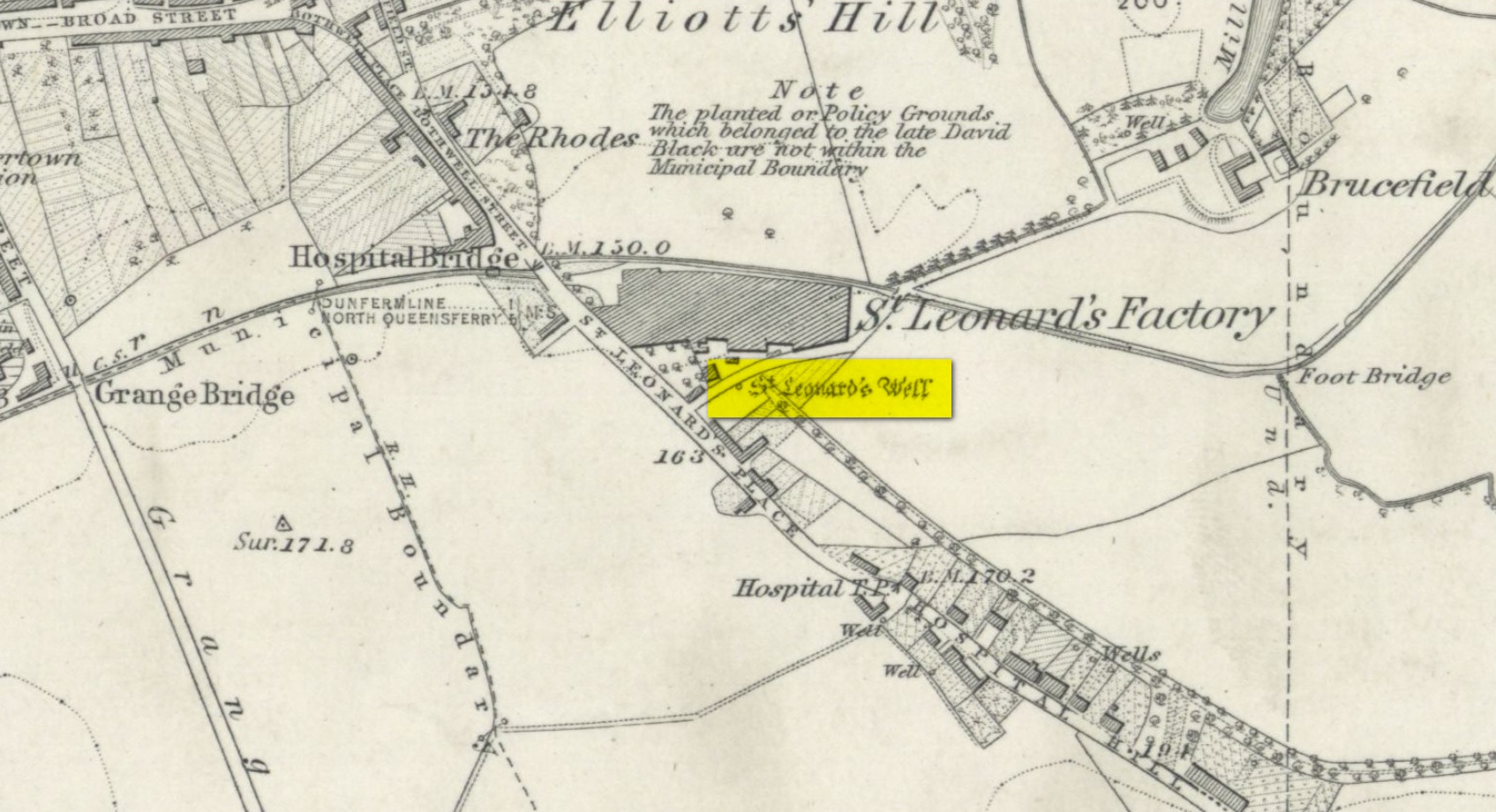
Site shown on 1856 map

There seems to be very little information available about this holy well, lost long ago and now hidden beneath the foundations of a food superstore!  It was found in close association with both a chapel and a hospital in St. Leonard’s name—both of which have also been destroyed.  The water from here may have been used by the monks for patients in the hospital, but that’s purely speculative.  St. Leonard was known to be connected with lepers, which may be something that the waters here were used to treat.  But again, I’m speculating…

When the Ordnance Survey lads came here in 1853, the waters were still running and they subsequently added it to their map a few years later.  The site was still visible when Erskine Beveridge (1917) came here, telling us briefly that,

“St. Leonard’s Well still remains a little to the south-east, and, though now built up, is recognisable.”

But a few years later it had been destroyed and its position was shown on the updated OS-map of 1926 as “Site of.”  The old well had gone…

References:

  1. Beveridge, Erskine, The Burgh Records of Dunfermline, William Brown: Edinburgh 1917.
  2. Simpkins, John Ewart, Examples of Printed Folk-lore Concerning Fife, with some Notes on Clackmannan and Kinross-shires, Sidgwick & Jackson: London 1914.
  3. Walker, J. Russel, “‘Holy Wells’ in Scotland,” in Proceedings of the Society of Antiquaries of Scotland, vol.17 (New Series, volume 5), 1883.

Acknowledgements:  Big thanks for use of the 1st edition OS-map in this site profile, Reproduced with the kind permission of the National Library of Scotland

© Paul BennettThe Northern Antiquarian

Wallace’s Well, Dunfermline, Fife

Healing Well:  OS Grid Reference – NT 08782 87275

Also Known as:

  1. Spa Well
  2. Wallace Spa

Archaeology & History

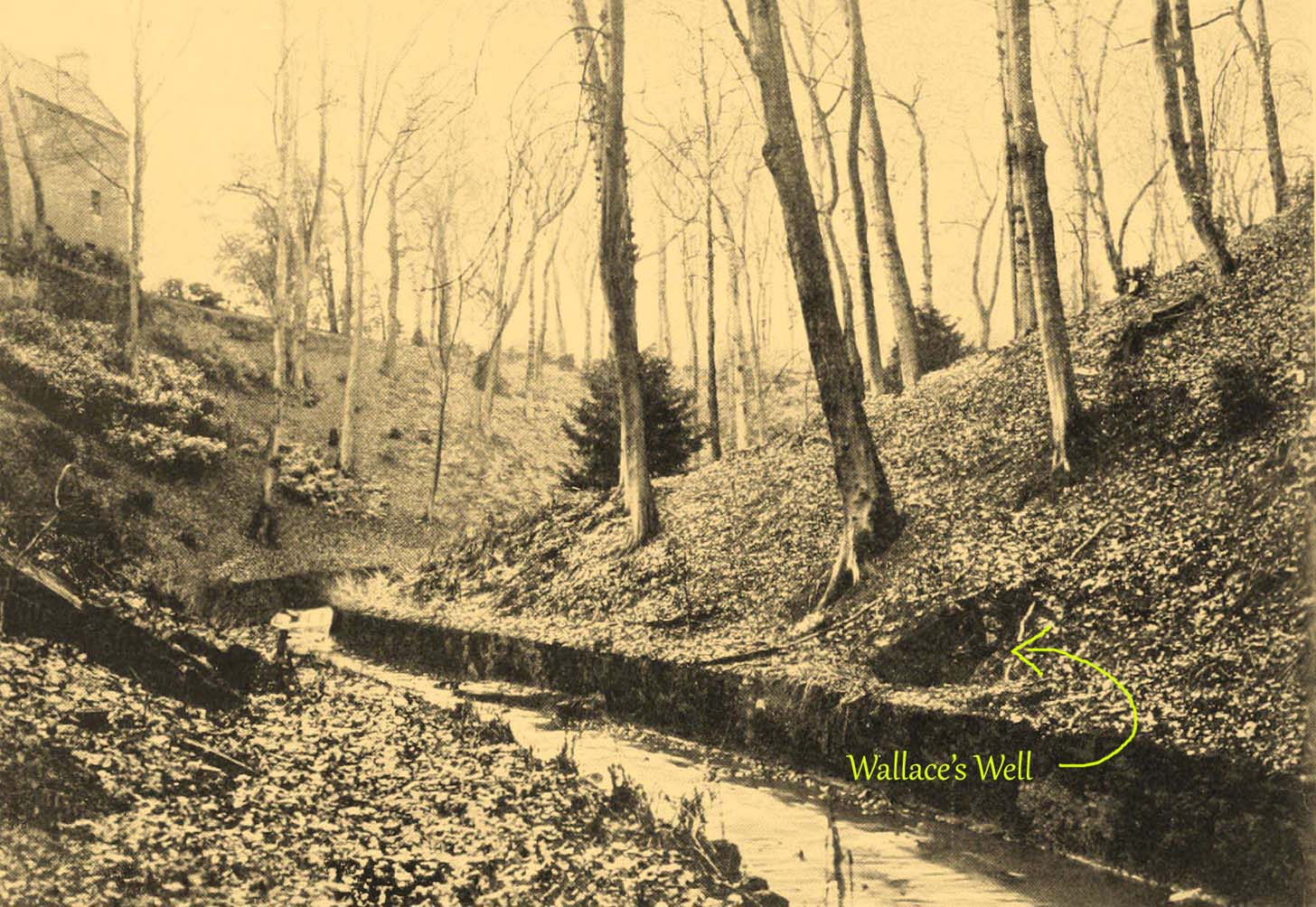
The ruins of this little-known site, dedicated to the legendary Sir William Wallace, can still be seen in the form of an overgrown stone ruin just off the footpath that runs through the Pittencrieff Glen out of the town centre.  In earlier times the waters were evidently of some repute, as a Council meeting in May 1773 reported with some disdain the closure of the waters by a Mr Chalmers:

“This Day the Council considering that the entry from the Town to the Well of Spaw is now shut up by Mr. Chalmers, which was a particular privilege to ye Inhabitants of the Burgh, Do hereby appoint the Provost to intimate to Mr. Chalmers that the Town will not give up that privilege, and to require him to oppen an entry thereto as formerly.”

We don’t know whether the miserable Mr Chalmers gave access to the well, as there seem to be no Council meeting notes telling us the outcome.  My guess would be that the local people got their way, hopefully at Chalmers expense!  More than 70 years later, another Mr Chalmers (1844) wrote about the well in a more respectful light:

“On the north edge of the rivulet, a little below this bridge, at the foot of the Tower Hill, there is a famous well, named the Wallace Spa, or well of Spa, which was formerly much resorted to by the inhabitants of the town for its excellent water, but which has been long since disused. It is noticed here simply on account of the traditionary antiquity of its name, Sir William Wallace, it is said, having once, in the haste of a flight, drank a little of it, out of the palm of his hand.”

In spite of there being local folklore of William Wallace, the local historian Ebeneezer Henderson (1879), in his giant work on Dunfermline, thought there was a more prosaic origin to the well’s name. He told,

“This well is still in existence, about fifty yards south of the ruins of Malcolm Canmore’s Tower — Tower Hill.  The water is reported as being “very cold at all times.” The water should be analysed.  The well during the period of its being used was known as the “Spaw Well,” and the ” Well of Spaw,” and, by and by an easy, natural transition, ” Wallace Spa;” and thus the name of the well has sometime been connected with that of the great Scottish hero.”

The Well after 1900
pre-1900 image

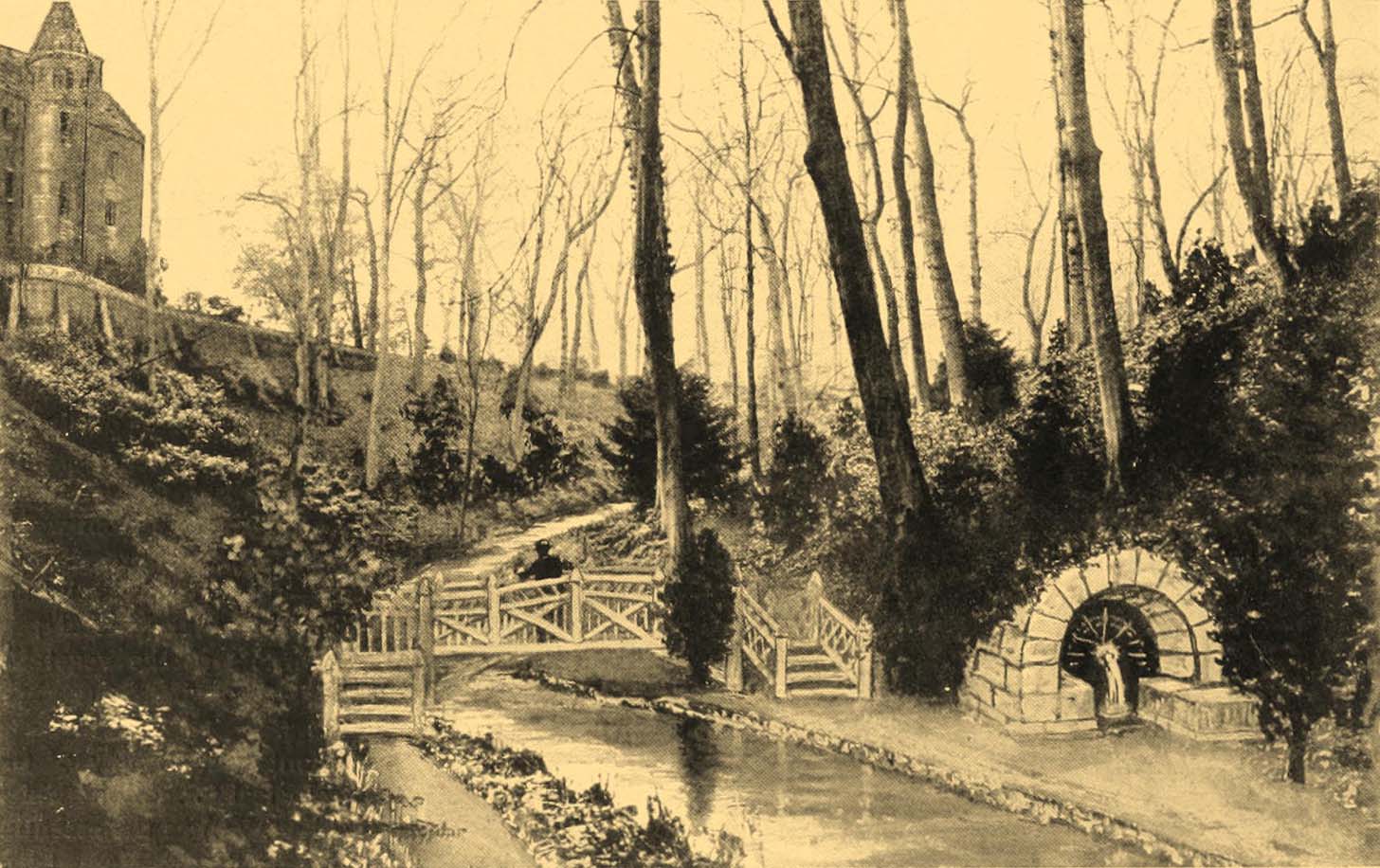
By the end of the 19th century, the well had become almost buried by earth and foliage, but was subsequently brought back to life following architectural improvements of the glen around the turn of the 20th century.  In Patrick Geddes’ (1904) work he gives us “before and after” portraits (attached here) showing how it had been restored.  He also mentioned “its tradition of medicinal value”, but could give no further information regardings the ailments it was reputed to cure…

References:

  1. Chalmers, Peter, Historical and Statistical Account of Dunfermline, William Blackwood: Edinburgh 1844.
  2. Geddes, Patrick, City Development: A Study of Parks, Gardens and Culture-Institutes, St George Press: Birmingham 1904.
  3. Henderson, Ebenezer, The Annals of Dunfermline, John Tweed: Glasgow 1879.

© Paul BennettThe Northern Antiquarian

St. Brendan’s Well, Abernethy, Perthshire

Holy Well (lost):  OS Grid Reference – NO 191 161

Also Known as:

  1. Brendan’s Well
  2. Brendi’s Well

Archaeology & History

In 1897, when Butler wrote his history of the village, he told that a certain well, “adjacent to the Gattaway stream” (thought to be the Nethy Burn which passes Gattaway farm) was known to old locals as Brendan’s Well, with the name still surviving as ‘Bredni Well’.  There were a number of large boulders around it that had been scattered by blasting, but which Butler thought were, “in all probability placed originally near the wall as a guide for pilgrims.”

The site was included in Ruth & Frank Morris’ (1982) survey, adding simply that the site was named “after the saint who lived here in the seventh century.”  In the christian calendar, St. Brendan’s day was May 16.

When the local antiquarian Paul Hornby looked for the well, a local lady told him that she thought an occasional but regular boggy patch that appeared in her garden was due to the underground waters from St Brendan’s Well.

References:

  1. Butler, D., The Ancient Church and Parish of Abernethy, Edinburgh 1897. Page(s): 102
  2. Morris, Ruth & Frank, Scottish Healing Wells, Alethea: Sandy 1982.

© Paul BennettThe Northern Antiquarian

Lambeth Wells, Lambeth, London, Surrey

Healing Wells (destroyed):  OS Grid Reference – TQ 3094 7889

Also Known as:

  1. Lambeth Spa
  2. Near Well and Far Well

Archaeology & History

This once famous healing or spa well has long gone.  It was located where the buildings that now constitute 104-105 Lambeth Walk presently stand: an area which the great London historian William Thornbury (1878) told was already “a favourite resort of Londoners, and celebrated for the variety of sweet-smelling flowers and medicinal herbs growing there,” complementing the healing waters before and during the spa craze.  The great herbalist John Gerard did his collections here.

I can find no information regarding its early use by our peasant ancestors, so its written history simply begins when it had been appropriated by those well-to-do up-market types who took this medicinal spring for their commercial gain in the early days of the trendy spas.  Supplied by two separate springs known as the Nearer and Farther Wells respectively, the Well House built here was “formally opened in April 1696” and subsequently had almost daily accompaniments of music, including French and country dancing!  But as the popularity of the Lambeth Spa increased, so did its problems.  Phyllis Hembry (1990) told that by July 1715, one visitor to the spa,

“was so depressed to find that the many people there were mostly rakes, whores and drunkards, idlers such as Guard officers, or young pleasure-seeker like attorneys’ clerks, mingling with loose women of the the meanest sort.  The Lambeth Wells also became a public nuisance, so a dancing license was refused in 1755.”

The so-called Great Room which had been the place of great occasions by spa users ended up being the meeting place “for Methodist meetings.” Oh how the winter nights must have flown by…..

There was a decided improvement in the years that followed and social events at the spa increased again.  It became what Thornbury said “was another place of amusement.”  The Lambeth Wells, he wrote,

“were held for a time in high repute, on account of their mineral waters, which were advertised as to be sold, according to John Timbs, at “a penny a quart, the same price paid by St. Thomas’s Hospital.” About 1750, we learn from the same authority, there was a musical society held here, and lectures, with experiments in natural philosophy, were delivered by Dr. Erasmus King and others. Malcolm tells us that the Wells opened for the season regularly on Easter Monday, being closed during the winter. They had “public days” on Mondays, Thursdays, and Saturdays, with “music from seven in the morning till sunset; on other days till two!” The price of admission was threepence. The water was sold at a penny a quart to the “quality” and to those who could pay for it; being given gratis to the poor.  We incidentally learn that there were grand gala and dancing days here in 1747 and 1752, when “a penny wedding, in the Scotch manner, was celebrated for the benefit of a young couple.”

By this time, a rival St. George’s Spa of had been created a short distance away on the parish boundary and with it, the popularity and attendance at Lambeth Wells began to decline.  By the end of the 18th century, the rot had truly set in and its days were finally numbered.

As for the medicinal properties of these wells, little seems to have been recorded.  Aside from repeating the common description of them being mineral waters, William Addison (1951) simply added that they were also purgative.

References:

  1. Addison, William, English Spas, Batsford: London 1951.
  2. Allen, Thomas, The History and Antiquities of the Parish of Lambeth, J. Allen: London 1827.
  3. Allen, Thomas, A History of the County of Surrey – volume 1, Isaac Taylor: London 1831.
  4. Foord, Alfred Stanley, Springs, Streams and Spas of London: History and Association, T. Fisher Unwin: London 1910.
  5. Hembry, Phyllis, The English Spa 1560-1815, Athlone Press: London 1990.
  6. Nichols, John, The History and Antiquities of the Parish of Lambeth, J. Nichols: London 1786.
  7. Rattue, James, The Holy Wells of Surrey, Umbra: Weybridge 2008.
  8. Sunderland, Septimus, Old London Spas, Baths and Wells, John Bale: London 1915.
  9. Thornbury, William, History of Old and New London – volume 6, Cassell: London 1878.

Links:

  1. Lambeth Wells on the Vauxhall History website

© Paul BennettThe Northern Antiquarian