Clach na h’ Iobairte, Kinloch Rannoch, Perthshire

Standing Stone:  OS Grid Reference – NN 61702 58975
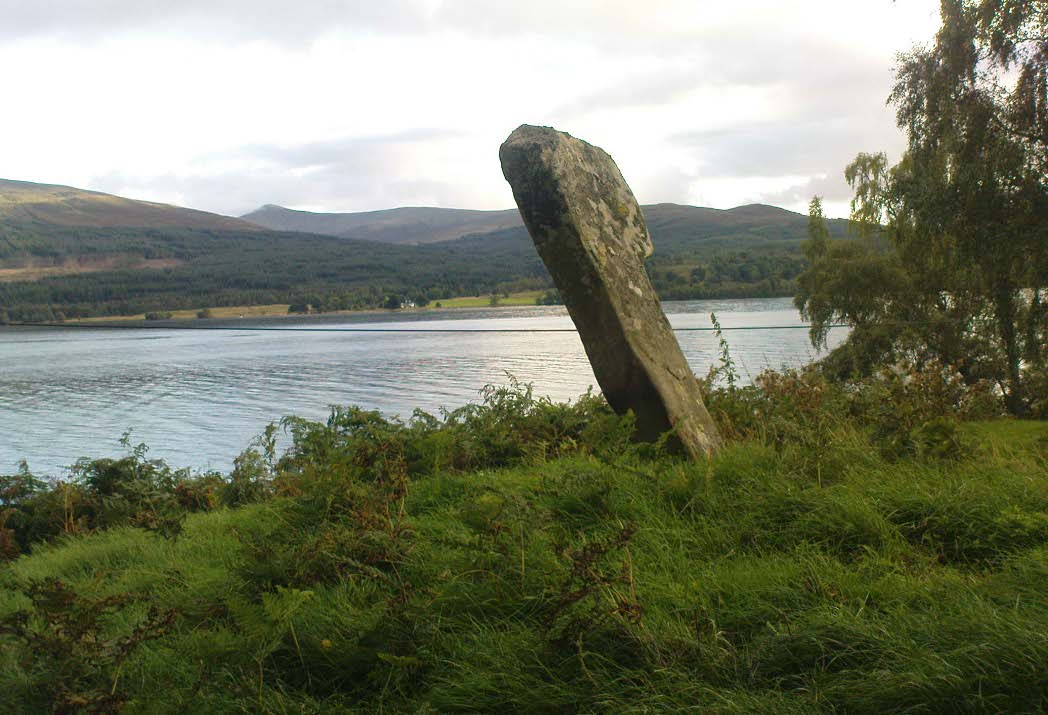
Clach na h-Iobairte, looking south

Also Known as:

  1. Canmore ID 24576
  2. Chieftain’s Grave
  3. Clach na h-Iobairte
  4. Clach na h-Jobairte
  5. Craiganour Stone
  6. Craig-na-Odhar
  7. Stone of Sacrifice
  8. Stone of the Offering

Getting Here

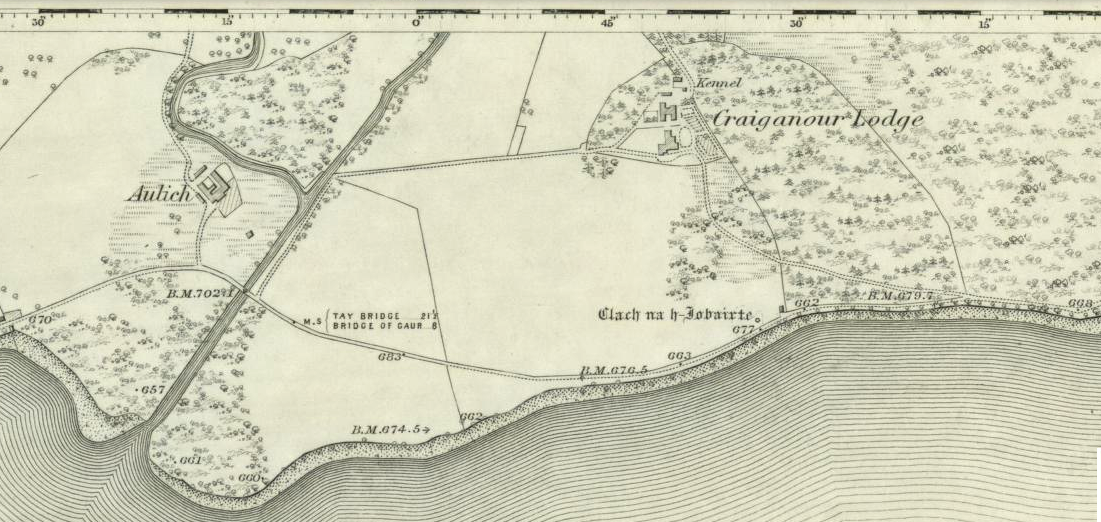
Standing stone shown on the 1867 OS-map

From the gorgeous village of Kinloch Rannoch, take the road along the north side of Loch Rannoch for about 2½ miles.  As you go along the road, for a good mile or so it is wooded. Where the woods stop and the first field appears on your right, stop!  You’ll see the standing stone perched erotically at an angle above you.

Archaeology & History
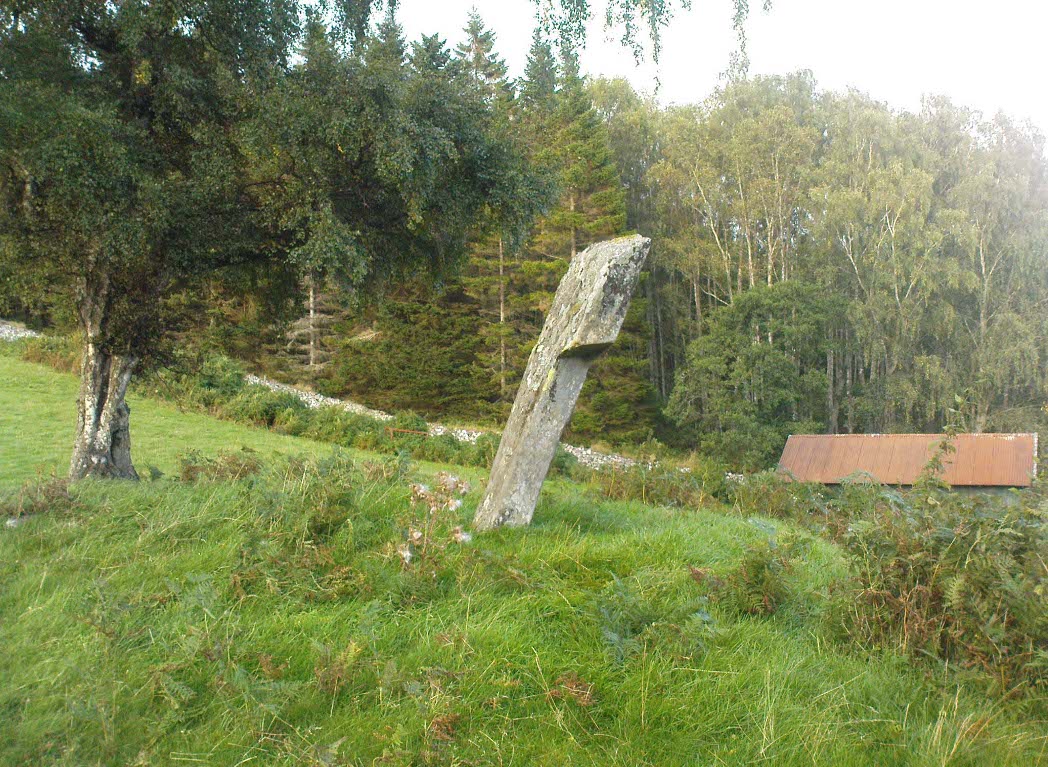
Clach na h-Iobairte, looking east

A fascinating site in a quite beautiful setting, typical of the Highlands.  This stone of many names is a curiously-shaped monolith: like an erect stone penis at the edge of the field when seen from the roadside, calling out to christians and pagans alike, to be castigated or rubbed—whatever the religious preference of the surveyor!  Leaning over at a slight angle, the stone is still nearly six feet tall and lives upon a large and equally prehistoric stone cairn about 30 feet across.  This cairn, it is said, has been added to by locals when the field was cleared of stone and piled on top of the old tomb.  No excavations have been done here, nor at the large ‘hut circle’ in the same field about 50 yards away.

Folklore

So far I have only found a short narrative of this stone in the pages of T.R. Barnett’s (1944) loving account of the Perthshire hills, where he tells that, close by the stone at Aulich, was once

“a famous smith, said to be in league with the devil, and he made the finest claymores in Rannoch.”

References:

  1. Barnett, T. Ratcliffe, The Road to Rannoch and the Summer Isles, John Grant: Edinburgh 1944.
  2. Cunningham, A.D., A History of Rannoch, privately printed 2004.

© Paul Bennett, The Northern Antiquarian 

Corrycharmaig East (4), Glen Lochay, Perthshire

Cup-Marked Stone:  OS Grid Reference – NN 5311 3582  —  NEW FIND

Getting Here

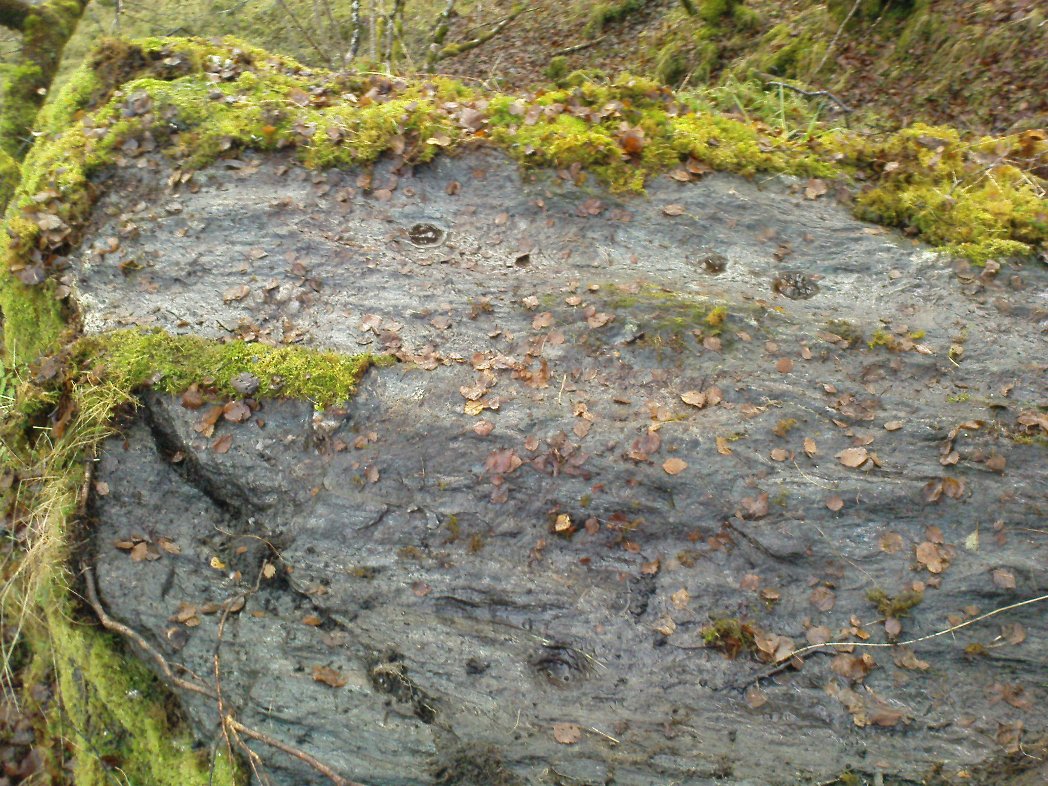
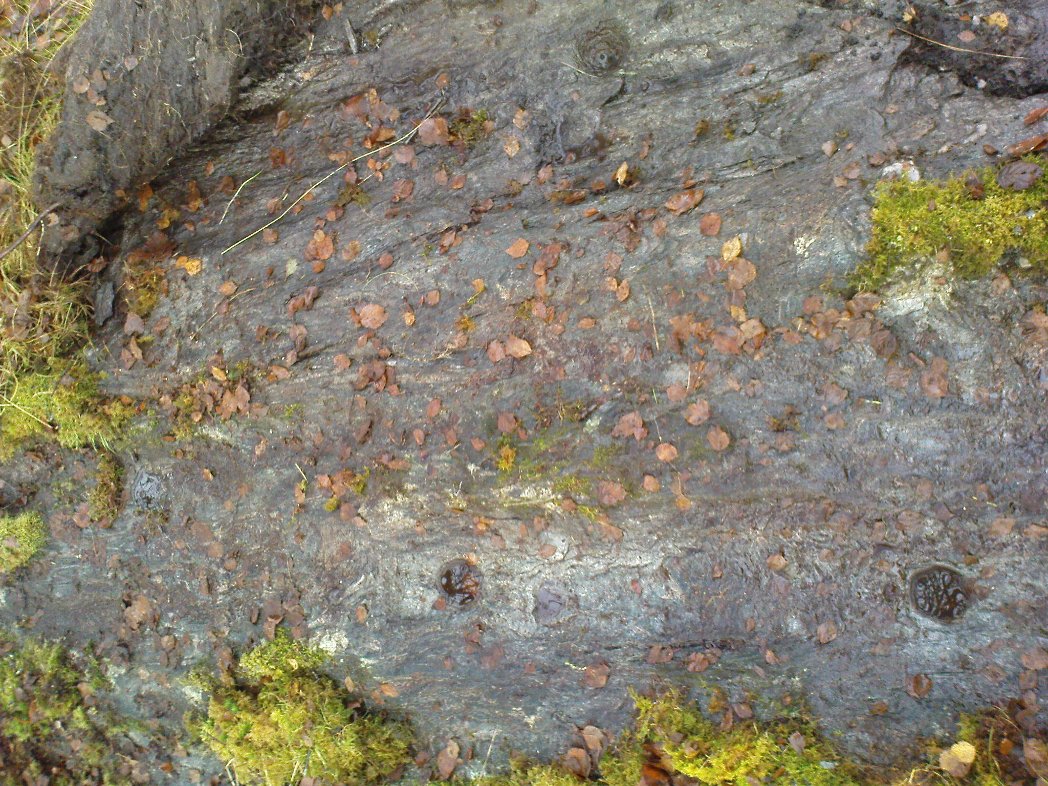
Cup-markings to top & bottom of stone

Follow the same directions as if you’re going to the Corrycharmaig East 3 carving.  Walk off the rocky outcrop here, below the tree, and head diagonally across the boggy grasses back towards the River Lochay.  After about 50 yards you’ll see a rocky promontory ahead of you that overlooks the very edge of the river, with trees around it.  That’s the spot – right on the edge above the river!

Archaeology & History

Cup-markings on the Corrycharmaig East 4 stone

For me, this was the most intriguing of the newly-found Corrycharmaig East carvings.  Intriguing because this is on the same geological ridge as that on which the brilliant Stag Cottage carvings are found, right across on the other side of the river.  That singular rise of rock emerging from the field, heading to the river, continues on this side — though is much less conspicuous here, and is much smaller and covered with olde trees and Nature’s marshy greenery.  It was this fact which led me to look at these rocks in the first place…wondering if our neolithic ancestors had continued etching their mythographies on the other side of the living waters.  And so it turned out.

But don’t expect anything like as impressive as the Stag Cottage carvings.  Here instead, as the photos show, are just five distinct cup-markings: three running along one line near the SE side of the stone, with another two on its NW side.  The cups are all roughly the same size, being a couple of inches across; one is an inch deep.  There may be more beneath the excess of mosses along this and the adjacent rocks, but I didn’t look.

© Paul Bennett, The Northern Antiquarian

Corrycharmaig East (2), Glen Lochay, Perthshire

Cup-&-Ring Stone:  OS Grid Reference – NN 5294 3588

Getting Here

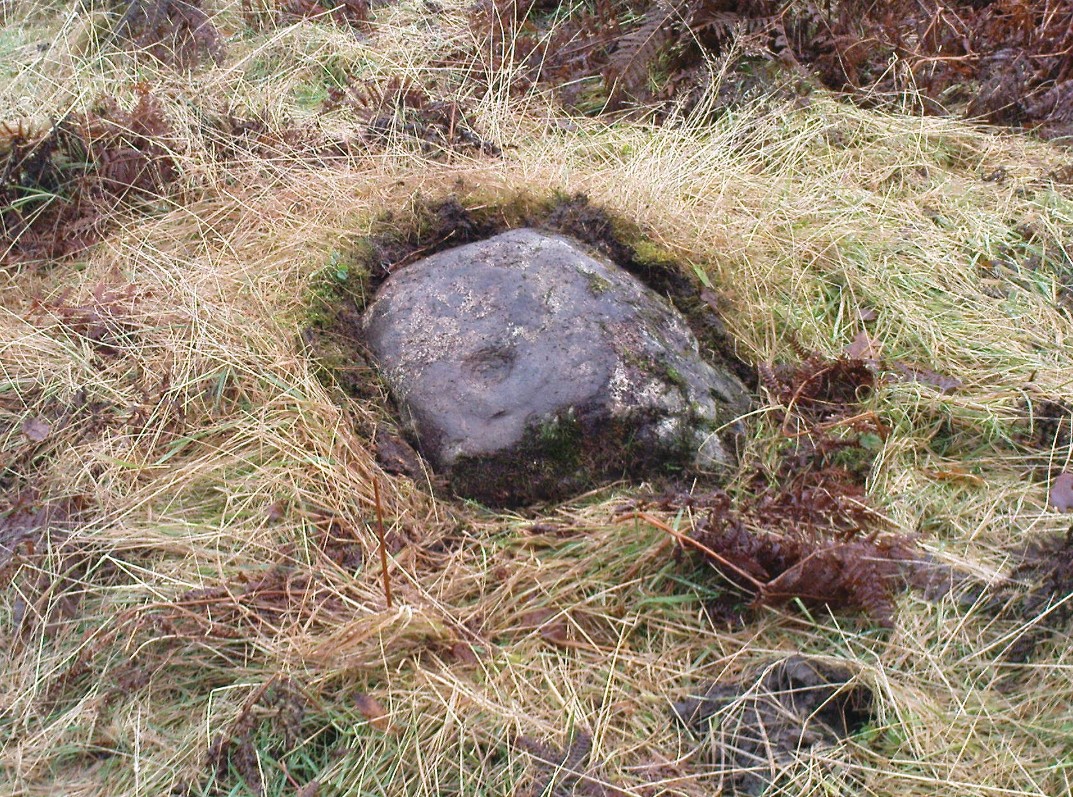
Faint cup-and-ring of Corrycharmaig East 2
Faint cup-and-ring

Follow the directions as if you’re visiting the other Corrycharmaig carvings, but as you cross the bridge over the River Lochay, turn immediately left and follow the edge of the river down the field till you reach the fence.  Go over here, but then head up the slope away from the river, over another fence up the small grassy hill ahead of you.  As you near the very top of the hill, you’ll find the stone in question.

Archaeology & History

Small overgrown cairn 10 yards away

Found near to the famous Stag Cottage and Duncroisk carvings, this previously unknown example is found on a small rounded female stone, barely 2 feet by 2 feet across.  The most notable feature is the large cup-marking, 2-3 inches wide and half-and-inch deep.  When I first found the stone, twas a cloudy grey day and I wasn’t sure whether a small carved arc along one edge of the cup continued into a semi-circle — but as the photo here shows, the cup-mark seems to have a large faint ring going about three-quarters of the way round it.  Hopefully I’ll get some better images of the stone when I visit again in the coming weeks.

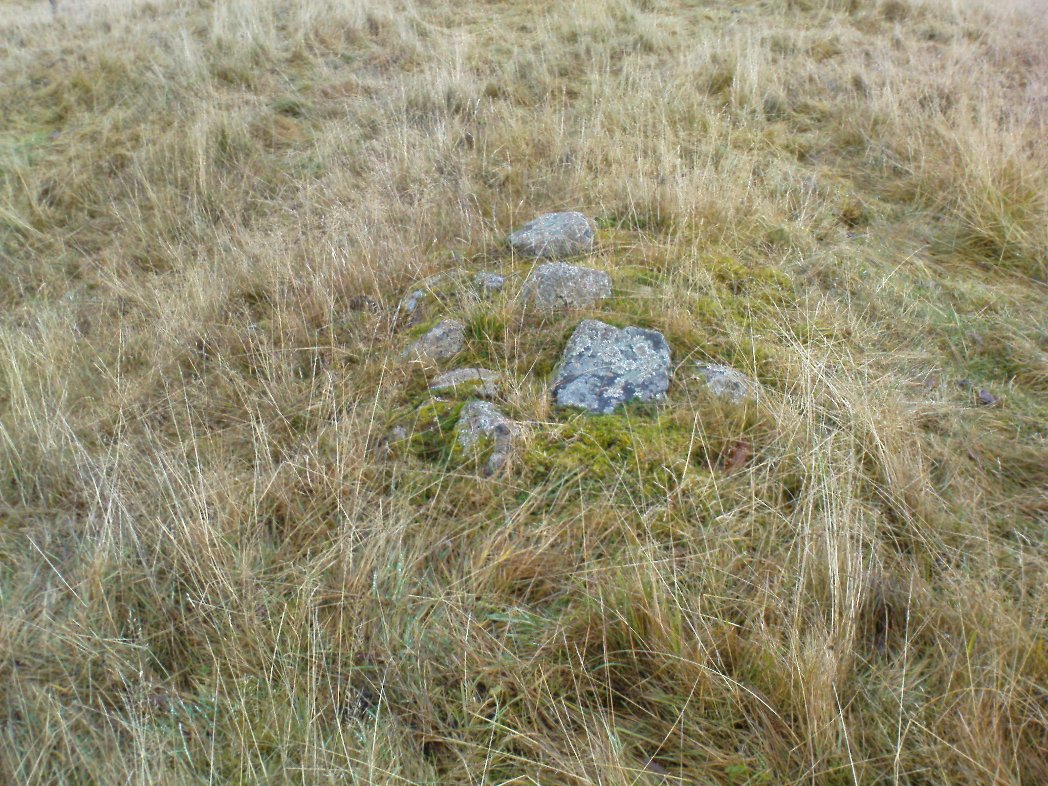
The stone gave the impression that it belonged in a cairn of sorts, but a brief rummage in the grasses immediately around the rock showed nothing.  However, barely 10 yards down the grassy slope there was a small overgrown cairn — though it didn’t seem to have that prehistoric pedigree about it.  This carving is one in a group of at least four others—including Corrycharmaig East 3—not previously catalogued.  It’s likely that more remain undiscovered on the many other rocks nearby.

© Paul Bennett, The Northern Antiquarian

Corrycharmaig East 03, Glen Lochay, Perthshire

Cup-Marked Stone:  OS Grid Reference – NN 53056 35877 — NEW FIND

Getting Here

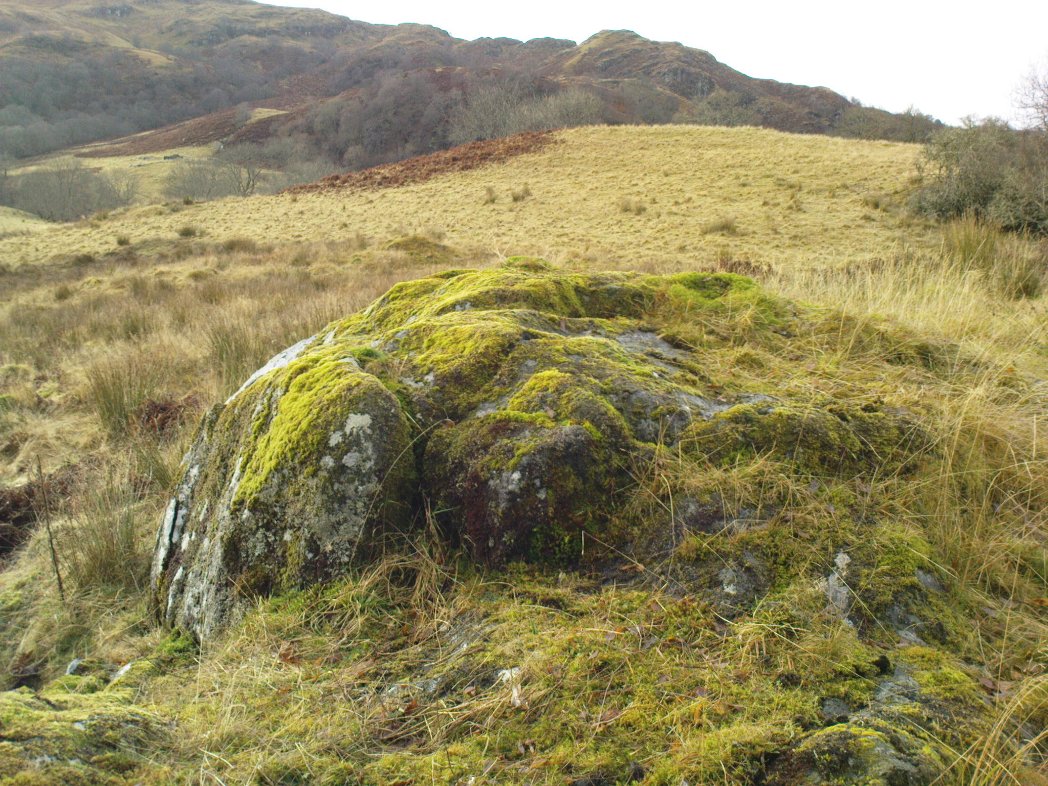
Cup-marked rocks of E.Corrycharmaig 3 (with the green hill of CE02 behind)

Follow the directions from Killin, down Glen Lochay, as if you’re going to the other Corrycharmaig carvings; but as you cross the bridge over the River Lochay, turn immediately left and follow the edge of the river along the field, crossing the first fence, keeping close to the riverside and over and over another fence.  Head across the boggy grassland and you’ll see a small green outcrop of rocks just above the tree-line above the river.  That’s the spot!

Archaeology & History

Two of at least 6 cup-markings on these mossy rocks

Another carving that’s a short distance from the famous Stag Cottage carvings on the opposite side of the river.  This lovely moss-covered rocky mass has two sections of cup-markings on it – both of which have proved difficult to photograph because of the vivid green primal cover.  It’s found less than 100 yards from the CE04 carving and below the hillock of the CE02 cup-and-ring (as you can see in the photo above).

The rock itself has two carved sections: an upper and lower section, with at least three cup-markings on the lower section and three on the upper portion as well.  Some natural geological marks on the lower part of the rock may have been added to, but this is by no means clear.  There may well be other elements to this ancient carving, but I wasn’t about to strip all the lovely moss from the stone just to find out.  It’s a truly beautiful stone in a gorgeous setting and, despite the day being grey and overcast, I wasn’t about to defile the greenery here.  It’s one of a group of at least four carvings east of Corrycharmaig that have not previously been catalogued.  Other carvings likely remain to be found close by.

© Paul Bennett, The Northern Antiquarian

High Cross, Shrewsbury, Shropshire

Cross (destroyed):  OS Grid Reference – SJ 492 126

Also Known as:

  1. Butter Cross
  2. The Cross

Archaeology & History

This long-lost medieval ornamented cross, found not far from the legendary Grope Cunt Lane (I kid you not) was located close to the middle of old Shrewsbury town, “at the junction of Pride Hill, Castle St and St. Mary’s St,” according to the 1902 OS-map of the region.

Although Shrewsbury’s High Cross is believed to have been built in the 12th or 13th century, we don’t know for sure when it was first erected — and indeed, written records of the place don’t appear to begin until the year 1557, where it was described as the ‘Hye Crosse.’  A few years later in the Parish Registers for the Lichfield diocese, dated 1590, the monument was mentioned again as ‘the Highe Crosse’; and subsequent accounts of it are found in various local history accounts from 1695 to 1799.

The site was named as the Butter Cross in street-name listings of 1804, telling it as a site where this food was sold and we know that the High Cross was the centre of a local market and social gathering place in previous centuries.  Gelling (2004) told that “the medieval cross was taken down in 1705, but the name continued to be applied to structures which replaced it, and which were used as a market place for dairy produce.”

In earlier times, the High Cross is said in legend to have been where executions were enacted.  Alfred Rimmer (1875) narrates the oft-told tale of those who died here, saying:

“The High Cross of Shrewsbury has long been destroyed, but its place is pointed out in old documents.  Unhappily, it is not connected with pleasant associations, for before it the last of the British princes, David, a brother of Llewellyn, was cruelly put to death by Edward I; and at a later period many of the nobility who were taken at the battle of Shrewsbury were there executed, the High Cross being considered the most appropriate place for such a spectacle.”

The prince that Rimmer mentions was Dafydd III, the last prince of Wales, executed in the year 1283.

References:

  1. Gelling, Margaret, The Place-Names of Shropshire – volume 4, EPNS: Nottingham 2004.
  2. Hobbs, J.L., Shrewsbury Street Names, Wilding & Son: Shrewsbury 1954.
  3. Rimmer, Alfred, Ancient Stone Crosses of England, Virtue: London 1875.

© Paul Bennett, The Northern Antiquarian

Sweet Willy Well, Wrose, Shipley, West Yorkshire

Healing Well: OS Grid Reference – SE 16561 36440

Also Known as:

  1. Lin Well
  2. Silver Stream
  3. Sugar Stream

Getting Here

Sweet Willy Well, Eccleshill

Whether you’re coming here from Wrose or Eccleshill, go along Wrose Road and turn down Livingstone Road at the traffic lights. Down here, when the road splits, head to your right until you meet with those stupid road-block marks (where you can only get one car through). Just here, walk down the slope and path on your right, and before you hit the bottom of the slope, walk down the small valley for about 20 yards until you see the small stream appear from beneath some overgrown man-made stone lintels. That’s it!

Archaeology & History

When I was a kid I used to play down this tiny valley when the waters here still had small fish swimming away (we used to call them ‘tiddlers’). The fish seem to have gone, but there are still waterboatmen on the surface, indicating that we still have fresh water here – and on my most recent visit, I cautiously tasted the waters and found them OK (the prevalence of broken bottles and beer cans from locals doesn’t inspire you to drink here though).

Initially located on the local boundary line between Eccleshill and Wrose, the waters used to be found running into a trough about 100 yards further up the small valley, but this has been lost and housing now covers its original site.  You can see how the stream has cut the valley further upstream, but now it bubbles up from beneath the rocks shown in the photo.  Bradford historian Robert Allen (1927) described the site in his survey as originally being between North Spring and South Spring Wood.

Although the name Sweet Willy Well remains a mystery, one of its other titles — the Lin Well — relates to the presence of linnets that used to be found in great numbers here.  The ‘Sugar Stream’ name is one we knew it as locally as children, due to the once sweet taste of the waters.  It is likely to have had medicinal properties, but these have been forgotten.  No archaeological survey has ever been done of this site.

References:

  1. Allen, Robert C. (ed.), The History Of Bolton In Bradford-Dale; with Notes on Bradford, Eccleshill, Idle, Undercliffe, Feather Bros: Bradford 1927.

© Paul Bennett, The Northern Antiquarian

Northcliffe Woods, Shipley, West Yorkshire

Cup-and-Ring Stone: OS Grid Reference – SE 13642 36608

Getting Here

Shipley FieldsCR518
Cup-and-ring stone at Northcliffe

Takes a bit of finding this one, and isn’t that impressive, so is probably only of value to the real enthusiasts. From Shipley, head up to Northcliffe and take the walk into the woods. Walk along the valley bottom, past the old train line at the bottom of the valley, and keep going for a few hundred yards until you meet with the small pond or damn on your left. Somehow cross over the stream and walk up the overgrown hill right above the pond. You’ll notice a single rock, on the right-hand side of the tiny stream running down the slope you’re walking up, just on the top of the ridge near the tree-line about 20 yard or so before the golf course. That’s it!

Archaeology & History

NorthcliffCR dr
Drawing of the Northcliff carving

This little-know cup-and-ring stone, seemingly in isolation just over the northern edge of the golf-course about 20 yards into the woods at the top of the ridge, cannot be contextualized with any adjacent monuments as the area has been badly damaged by the industrialists, as usual, with both quarrying and the golf course – much like the damage done at Pennythorn Hill, above Baildon.

This rock has what seems to be at least five cup-markings: two quite prominent, the others smaller and more faded.  Earlier surveys by the likes of Sidney Jackson (1962) saw another two cups on the stone, but these seem to be natural.  A curious large ring runs around the cup near the top of the stone, but this is pretty faint nowadays.  One of the cups along the edge of the stone also looks like it may have had an arc carved around the top of it, but this needs exploring at different times of day and in different lighting conditions to verify or deny this.

References:

  1. Jackson, Sidney, “Cup-Marked Rock, Northcliff Wood,” in Cartwright Hall Archaeology Group Bulletin, 7:6, 1962.

© Paul Bennett, The Northern Antiquarian

Alresford Hill, Alresford, Essex

Tumulus (destroyed):  OS Grid Reference – TM 0628 2022

Archaeology & History

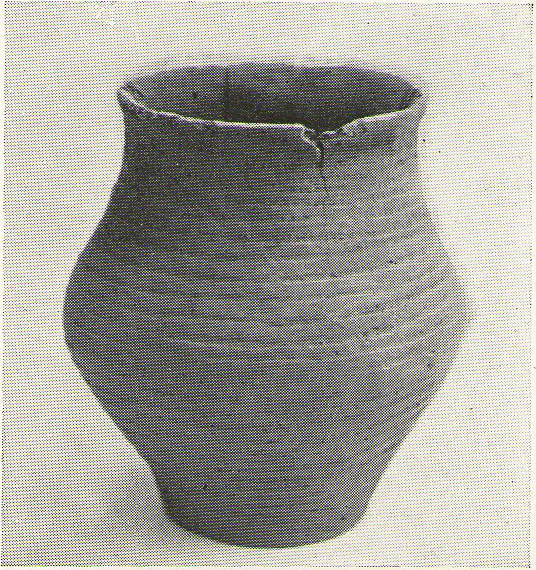
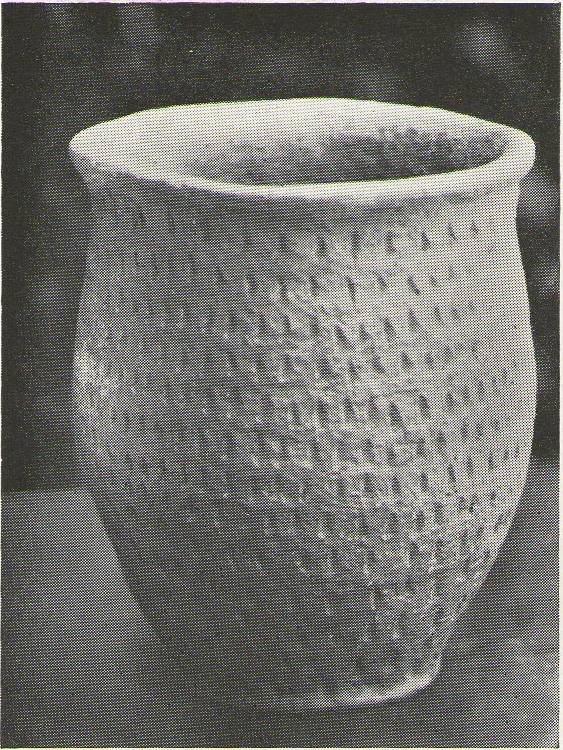
Alresford Hill urn

In a region well known for the finding of early British remains (Belloc 1905), another prehistoric burial mound was destroyed in the Essex landscape simply due to ignorance and neglect.  Thankfully once more we have local antiquarians and an astute schoolgirl for discovering and preserving a record of this site, otherwise we’d have no record of the place at all!  Described in M.R. Hull’s (1946) article on some of the Bronze Age relics of the area, he told how a well-preserved urn in the edge of the tumulus,

“was found in June 1942 by a schoolgirl, Miss Anne Pilkington, on the top of the hill overlooking Alresford Creek and the Colne Estuary, about 70 yards northwest of Bench Mark 74.8 and 560 yards slightly west of south from Alresford church, west of the road to the creek and south of the lane running west along the north side of the field.  This is the northern limit of a huge gravel-pit. She noticed the vessel standing upright in the side of the pit and recovered it. Nothing else was noticed…

“Afterwards the diary of our late Fellow, Mr P.G. Laver came into my hands and I find under the date 8th July, 1922, that he noticed, when motoring past the site, ‘a definite tumulus, but much ploughed down, now barely 18ins above the field level.  It is close to the road through the field, the centre being roughly 20 yards S of the road and about 200 yards from the road to the ford.’ The sketch-plan leaves no doubt on the identity of the site.”

Annoyingly though, Mr Hull didn’t think it worthwhile to reproduce this alleged sketch-map.  He did however give us a good description of the urn and its position in the ground, saying,

“The vessel is stated to have been about 5ft below the surface when found, but I am not certain whether the top-soil had been removed or not.  The clay is fine, burnt light red, but black within, and the whole body is covered with horizontal lines impressed in exactly the same way as (those on the Flag Inn urn), but much less clearly.  The base is slightly hollowed beneath and is not far from having a foot-ring.”

Folklore

Mr Hull (1946) also made an interesting comment on the views of local people about the site where Anne had found this urn, reminding me of what Highland and hill folk would have put down to faerie-lore, though no such memory was noted. He told:

“On enquiry I learnt that no one had observed a mound at the spot, but that it had been observed that exactly there the corn, when the field was cultivated, grew taller and greener in a large round patch”!

References:

  1. Belloc, Hilaire, The Old Road, Archibald Constable: London 1905.
  2. Hull, M.R., “Five Bronze Age Beakers from North-East Essex,” in Antiquaries Journal, volume 26, Jan-April 1946.

© Paul Bennett, The Northern Antiquarian


Flag Inn, St. Osyth, Essex

Tumulus (destroyed):  OS Grid Reference – TM 117 178

Archaeology & History

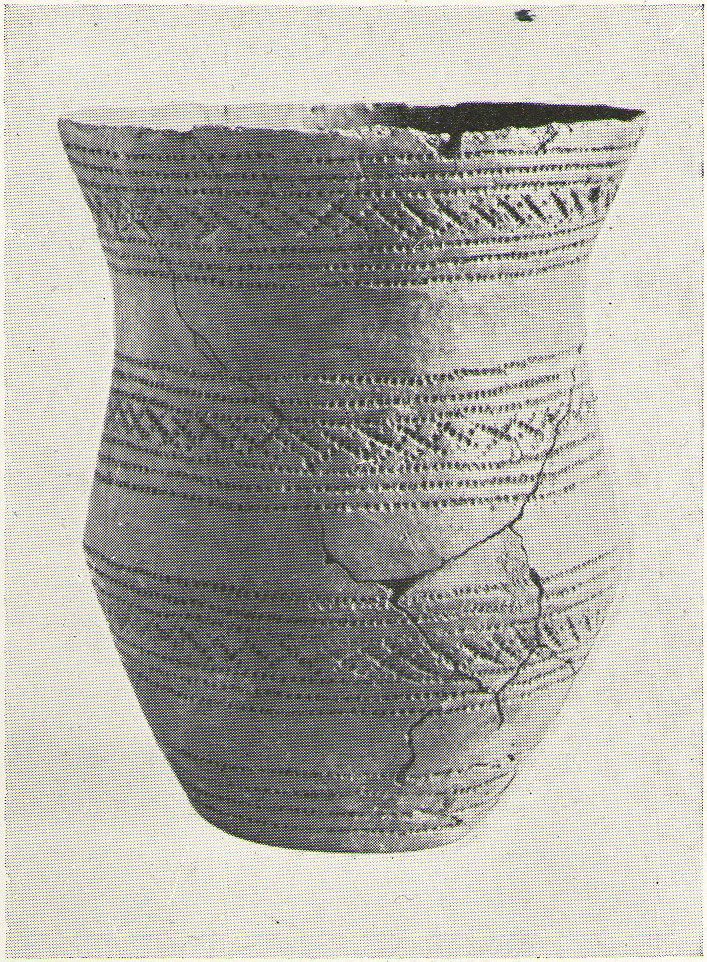
Bronze Age beaker from the Flag Inn tumulus

Roughly halfway between Thorrington and St. Osyth, a few hundred yards east of the Flag Creek on the grassy wasteland south of the historic Flag Inn, could once be found a fine tumulus, of whose past we sadly know so little.  Nothing now remains of the old burial mound apart from a carved urn that once lived therein and was recovered from the site before its final demise.  According to M.R. Hull (1946) the well-preserved Bronze Age beaker found here—which he said “stood out as different” from others in this area—

“was found in 1930 on the 50ft contour-line about 200 yards south-southeast of the Flag Inn, in a gravel pit, in St. Osyth parish. The position is a mile and a quarter north-northwest of St. Osyth church.  On this occasion it was not possible to examine the site, which could only be established with moderate accuracy some time after the discovery…

“The clay is fine, of light red colour, ornamented with three bands of trellis pattern, each bounded by three horizontal lines, and a band of four such lines at the base, all executed with an instrument making a short line of square impressions, probably the end of a comb used in weaving.”

References:

  1. Hull, M.R., “Five Bronze Age Beakers from North-East Essex,” in Antiquaries Journal, volume 26, Jan-April 1946.

© Paul Bennett, The Northern Antiquarian


Perces, Halstead, Essex

Tumulus (destroyed):  OS Grid Reference – TL 8228 2704

Archaeology & History

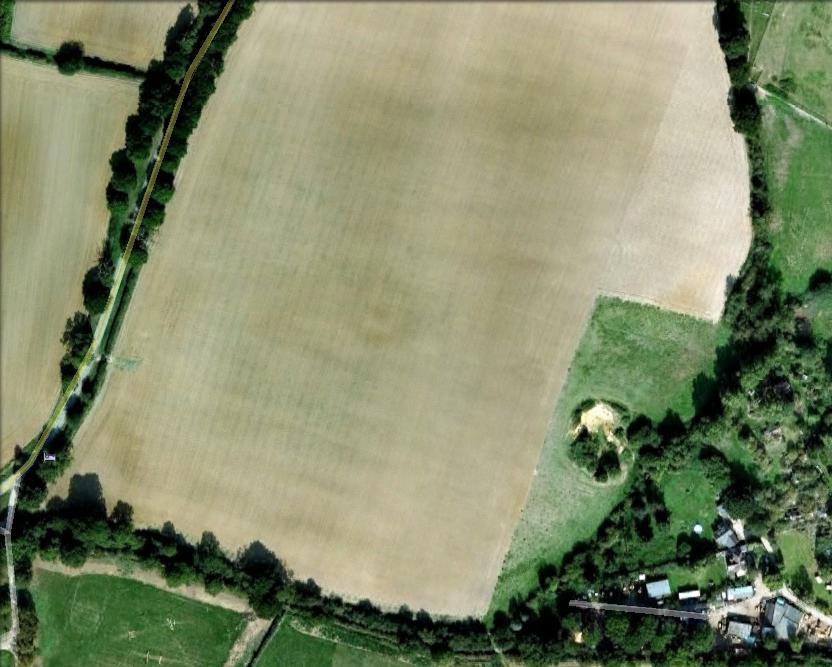
Aerial image showing ghostly circular outline

This is one of many lost prehistoric burial sites destroyed in Essex in recent centuries and whose only remains now, as seen here to the right, are the ghostly outlines left in the Earth when looking down from above.  We are very fortunate indeed in even having a record of this place—this time thanks to an astute fellow antiquarian hearing of some old remains alleged to have been in an old burial mound, south of Greenstead Green.

It’s short story was described in M.R. Hull’s (1946) essay on a series of Bronze Age beakers in Essex that were found in association with once-proud tumuli, living amidst a landscape held as sacred by our peasant ancestors.  Although we have no good description of the tumulus, Mr Hull said that this well-preserved clay beaker,

Perces Bronze Age beaker

“was found in 1930 on the 200ft contour-line 366 yards due south of Piercys in the parish of Halstead…that is 2¼ miles south-southeast of Halstead Church.  I visited the site immediately after the discovery with our late Fellow, Mr P.G. Laver, and the finder assured us that no other remains were found.  He had dug a small pit into the natural gravel, and in doing so came upon this vessel at a depth of 7ft from the surface.  When we arrived the burial pit had been destroyed, and, although the depth of the vessel from the surface suggests that a tumulus existed, we were unable to see any remains of it.  We found a calcined flint…in the excavation. The vessel…(of) clay is fine, containing a very small quantity of quartz-like grit; the colour is a warm red-brown, and the body is decorated all over with finger-nail impressions.”

References:

  1. Hull, M.R., “Five Bronze Age Beakers from North-East Essex,” in Antiquaries Journal, volume 26, Jan-April 1946.

© Paul Bennett, The Northern Antiquarian