Witches’ Stone, Ratho, Midlothian

Cup-Marked Stone (destroyed):  OS Grid Reference – NT 1273 6973
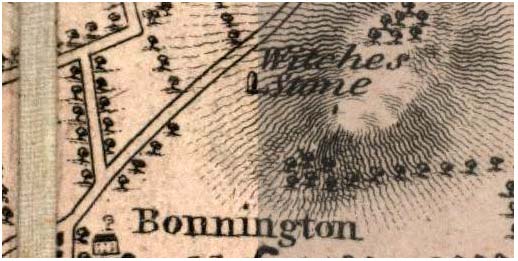
Witches Stone on 1817 map

Also Known as:

  1. Canmore ID 50366
  2. Witch’s Stone

Archaeology & History

This fascinating looking carving (in my personal Top 10 of all-time favourites cup-and-rings in the UK!) was unfortunately destroyed sometime between 1918 and 1920.  A huge pity, as the design on the rock is almost unique in its ‘linear’ system of cups running a considerable length across the surface of the stone (like the similar design found at Old Bewick in Northumberland).

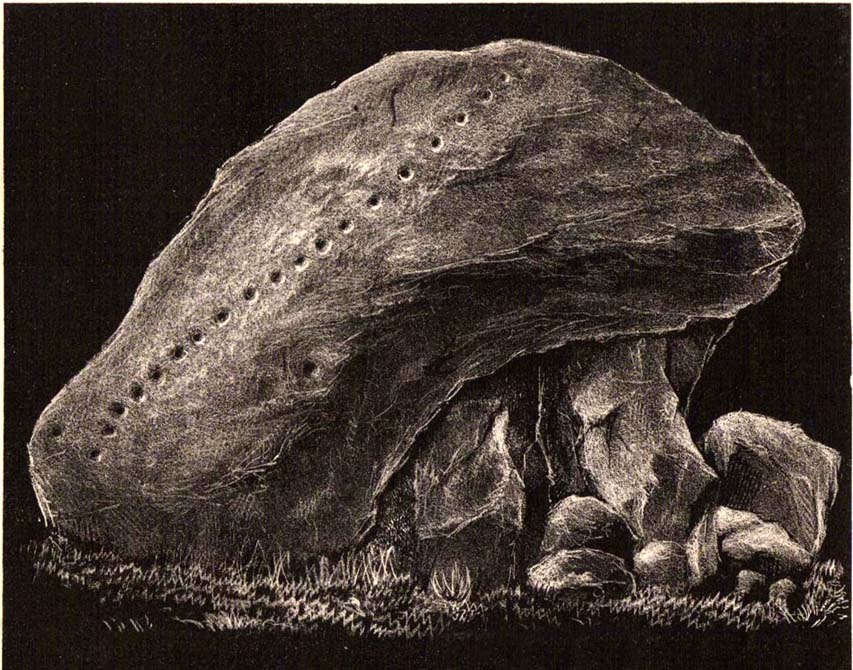
Wilson’s 1851 drawing of the Witches’ Stone
Simpson’s 1866 drawing of the Witches Stone

Shown first of all on Kirkwood’s Environs of Edinburgh map in 1817 (above), this legendary rock was found amidst a cluster of other cup-and-ring stones at Tormain (some are still there) and was initially said by Daniel Wilson (1851) to have been the giant capstone of a cromlech that once stood here, but whose structure had fallen away.  This idea is implied in the earliest drawing we have of the stone in Wilson’s magnum opus (above); Sir J.Y. Simpson (1867) gave us a similar impression with his drawing a few years later.  But upon visiting the Witches Stone just as his book was going to the press, Mr Wilson visited the site and proclaimed that he “altogether doubted if they are the remains of a cromlech”, and what rested here were more probably just fascinating geological remains, with even more fascinating carvings on top!

In the years that followed Wilson’s initial description, the Witches Stone was visited and described by a number of eager antiquarians.  Simpson (1867) gave us a quite revealing account, telling:

“On the farm of Bonnington, about a mile beyond the village of Ratho…are the remains of ‘this partially ruined cromlech’…with the capstones partially displaced, as if it had slid backwards upon the oblique plane of the huge stones or stone which still supports it.  Two or three large blocks lie in front of the present props.  Its site occupies a most commanding view of the valley of the Almond, and of the country and hills beyond.  The large capstone is a block of secondary basalt or whinstone, about twelve feet long, ten in breadth and two in thickness.  Its upper surface has sculptured along its median line a long row of some twenty-two cup-cuttings; and two more cup-cuttings are placed laterally: one, half a foot to the left of the central row and at its base; the other, two feet to the right of the tenth central cup and near the edge of the block. The largest of the cups are about three inches in diameter and half an inch in depth; but most of them are smaller and shallower than this…”

A few years later another early petroglyph authority, J. Romilly Allen (1882), visited the Witches Stone and found “an Ordnance bench mark (had been) cut on the stone itself”!  He then continued with his own description of this once-important megalithic site:

“The Witch’s Stone is a natural boulder of whinstone, rounded and smoothed by glacial action, whoso upper surface slopes at an angle of about 35° with the horizon. The length of the sloping face is 8 feet and at the top is a flat place 2 feet wide. The breadth of the stone is 11 feet 3 inches at the upper end, and 4 feet at the lower end. The thickness varies from 2 to 3 feet. The highest part of the stone is 6 feet 6 inches above the ground, and the lowest 1 foot 6 inches. It rests on what has originally been a portion of the same boulder, but is now a mass of whinstone broken up into several fragments, which serve as supports to prop up the stone above.  Viewed from the north side the whole presents the appearance of a cromlech, the upper stone forming the cap, and the disintegrated portion below the supports. This notion, however, will be clearly seen to be erroneous on looking at it from the opposite side, as shown on the accompanying sketch…where the crack separating the two portions of the boulder is very apparent… The sculpturings consist of twenty-four cups varying in diameter from 1½ to 3 inches. Twenty-two of these cups are arranged in an approximately straight line along the sloping face of the stone, and divide it into two almost equal parts. The two remaining cups lie, one 7½ inches to the left of the lowest cup of the central row, and the other 2 feet 3 inches to the right of the ninth cup up the stone… The field in which the Witch’s Stone is situated is called “Knock-about.” The sloping face of the stone has been much polished by the practice of people climbing on to the top and sliding down. Some of the cups are almost obliterated in consequence. The stone forms a very prominent feature in the view, and must always have attracted attention from its peculiar shape.”

Some twenty years after Allen, the megalithomaniac Fred Coles (1903) came and checked the Witches Stone out for himself and, as happens, had a few additional things to say about the place:

“Although this huge boulder and its cup-marks have been more than once figured and described, I found, on a close examination of the broad surface of the Stone, that none of the illustrations showed the cup-marks in their exact relation to each other, nor in their true relation to the contour of the Stone. The drawing shown above…was made after a careful measurement by triangulation of the Stone; and it is claimed to be the first that shows that the cups, two and twenty in number, are not disposed in one continuous line, but that thirteen follow each other from the high south edge of the stone for a distance of exactly 6 feet, and nine others lie a few inches to the west, occupying a space 3 feet long of the overcurving edge of the north end.  It is further shown that, at a point 2 feet 3 inches west of the ninth cup-mark, there is another one quite as large as the largest in the rows near the middle of the Stone. The south edge (A B) has slipped a little down from its original height, the boulder being frost-split horizontally; its height there above ground is 8 feet. The northern and narrower end is about 2 feet above ground, and does not touch the ground, as it rests upon its lower portion, beyond which it projects a few inches. The cup-marks run due north.”
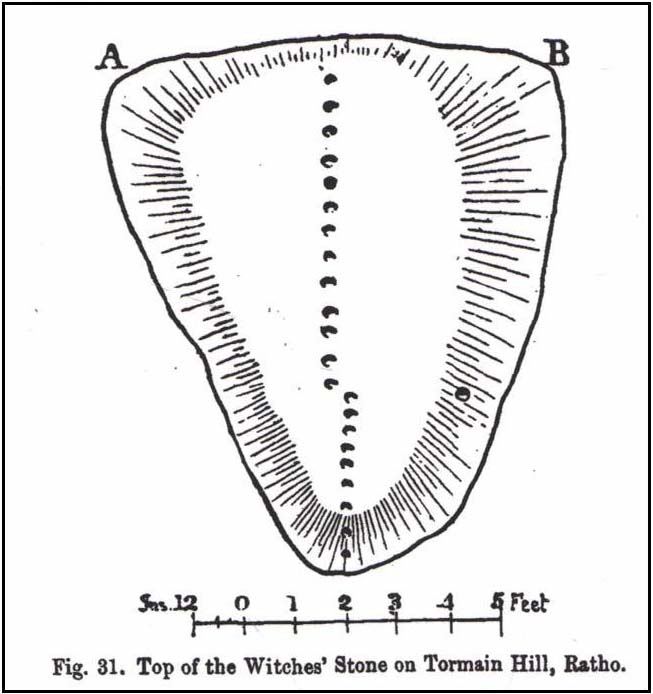
Fred Coles 1903 drawing

If the Witches Stone was in fact a natural outcrop stone and not a cromlech, this very last point telling that “the cup-marks run due north” probably had much greater importance than a mere compass-bearing to the people who etched this carving.  For in pre-christian religious structures across the northern hemisphere, north is commonly representative of death and the land of the gods.  In magickal rites “it is the place of greatest symbolic darkness,” as neither sun nor moon ever rise or set there.  Additionally, north is the place where, in shamanic traditions, the heavens are tied to the Earth: the cosmic axis itself that links heaven, Earth and underworld.  In early neolithic traditions this mythic structure was probably endemic. Whether its magickal relevance was intended here, at this stone, we will probably never know…

Folklore

Folklore tells that the Witches Stone was one of the sites used in magickal rites by the Scottish occultist, Michael Scot.  J.R. Allen’s (1882) description of “the sloping face of the stone has been much polished by the practice of people climbing on to the top and sliding down,” may relate to folk memory of fertility rites once practiced here, as found at similarly carved rocks in the UK and across the world.

References:

  1. Allen, J. Romilly, “Notes on some Undescribed Stones with Cup Markings in Scotland,” in Proceedings of the Society of Antiquaries Scotland, volume 16, 1882.
  2. Coles, Fred R., “Notes on Some Hitherto Undescribed Cup-and-Ring Marked Stones,” in Proceedings of the Society of Antiquaries Scotland, volume 37, 1903.
  3. McLean, Adam, The Standing Stones of the Lothians, Megalithic Research Publications: Edinburgh no date (c.1978).
  4. Morris, Ronald W.B., The Prehistoric Rock Art of Southern Scotland, BAR: Oxford 1981.
  5. Royal Commission on the Ancient & Historical Monuments of Scotland, Inventory of Monuments and Constructions in the Counties of Midlothian and West Lothian, HMSO: Edinburgh 1929.
  6. Simpson, James, Archaic Sculpturings of Cups, Circles, etc., Upon Stones and Rocks in Scotland, England and other Countries, Edmonston & Douglas: Edinburgh 1867.
  7. Smith, John Alexander, “Notes of Rock Sculpturings of Cups and Concentric Rings, and ‘The Witch’s Stone’ on Tormain Hill; also of some Early Remains on the Kaimes Hill, near Ratho, Edinburghshire,” in Proceedings of the Society of Antiquaries Scotland, volume 10, 1874.
  8. Wilson, Daniel, The Archaeology and Prehistoric Annals of Scotland, Sutherland & Knox: Edinburgh 1851.

© Paul Bennett, The Northern Antiquarian

St. Helen’s Well, Eshton, North Yorkshire

Holy Well:  OS Grid Reference – SD 93096 56992

Also Known as:

  1. Helen’s Well

Getting Here

St. Helen’s Pool, Eshton

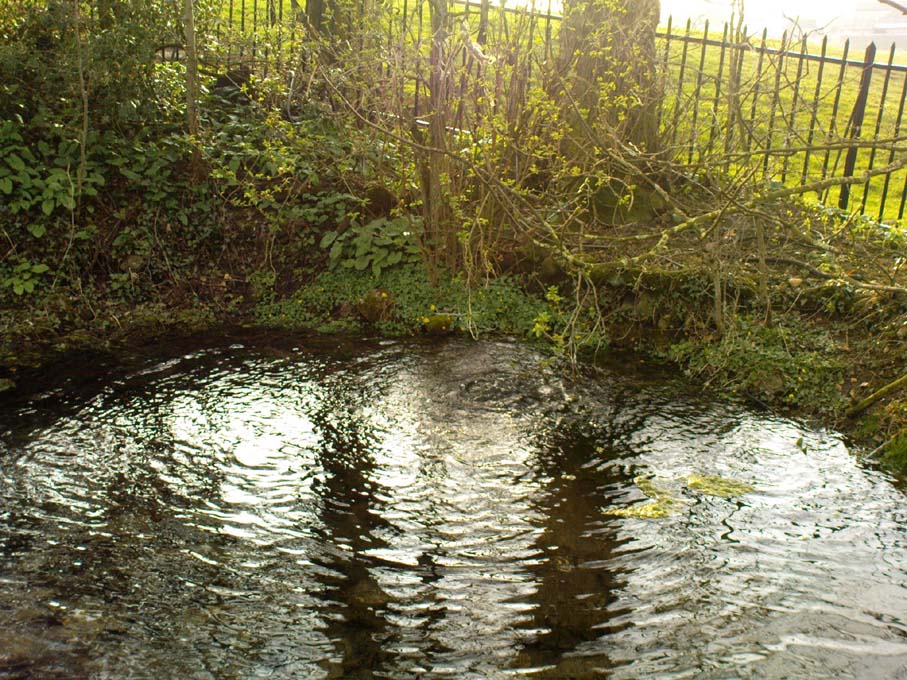
On the A65 road from Skipton to Gargrave, just at the eastern end of Gargrave, take the small Eshton Road running north over the canal. Go through Eshton itself, making sure you bear right at the small road a few hundred yards past the old village.  Keep your eyes peeled a few hundred yards down as you hit the river bridge and stop here.  Just 50 yards before this is a parking spot where some Water Board building stands.  Walk back up the road barely 20 yards and you’ll see, right by the roadside, a small clear pool on your left, encircled by trees.  Go through the little stile here and you’re right by the water’s side!

Archaeology & History

This is actually a listed monument (unusual for wells up North!), just off the roadside between Nappa Bridge and Eshton Hall. Two or three old stone heads (deemed to be ‘Celtic’ in age and origin, though I had my doubts) have recently been stolen from this holy pool close to where the water emerges from the ground, just beneath the surface. You can see where the water bubbles up strongly from the Earth when you visit here, forming the small pool in front of it, around which at certain times of year people still attach ‘memaws’ (an old word for ritual ‘offerings’) on the small shrubs.  If you drink from here, just where the water bubbles up (careful not to fall in!), it’s freezing — but tastes absolutely gorgeous!  And better than any tap-water you’ll ever drink!

Mentioned briefly in Mr Hope’s (1893) fine early survey; the earliest description of this site in relation to the mythic ‘Helen’ dates from 1429, where T.D. Whitaker (1878) described the dedication to an adjacent chapel, long gone.  Whitaker’s wrote:

“…One of the most copious springs in the kingdom, St. Helen’s Well fills at its source a circular basin twenty feet in circumference, from the whole bottom of which it boils up without any visible augmentation in the wettest seasons, or diminution in the driest.  In hot weather the exhalations from its surface are very conspicuous.  But the most remarkable circumstance about this spring is that, with no petrifying quality in its own basin, after a course of about two hundred yards over a common pebbly channel, during which it receives no visible accession from any other source, it petrifies strongly where it is precipitated down a steep descent into the brook.  To this well anciently belonged a chapel, with the same dedication; for in the year 1429, a commission relating to the manor of Flasby sat “in capella beate Elene de Essheton; and on the opposite side of the road to the spring is a close called the Chapel Field.  This was probably not unendowed, for I met with certain lands in Areton, anciently called Seynt Helen Lands.”

When the old countryman Halliwell Sutcliffe (1939) talked of this healing spring, his tone was more in keeping with the ways of local folk.  Sutcliffe loved the hills and dales and old places to such an extent that they were a part of his very bones.  And this comes through when he mentions this site. Telling where to find the waters, he continued:

“Its sanctuary is guarded by a  low mossy wall.  Neglected for years out of mind, it retains still clear traces of what it was in older times.  An unfailing spring comes softly up among stones carved with heart-whole joy in chiselling.  Scattered now, these stones were once in orderly array about what is not a well, in the usual sense, but rather a wide rock-pool, deep here and shallow there, with little trees that murmur in the breeze above.  Give yourself to this place, frankly and with the simplicity is asks.  It does not preach or scold, or rustle with the threat of unguessed ambushes among the grassy margin.  Out of its inmost heart it gives you all it knows of life.”

Old well in the field

In the field across the road where the chapel was said to have been, we find another stone-lined fresh-water well bubbling from the ground into a stone trough (at grid-ref SD 93118 56958).  The waters here are also good and refreshing.  But whether this fine water source had any tales told of it, or curative properties (it will have done), history has sadly betrayed its voice.

Folklore

The waters here have long been reputed as medicinal.  R.C. Hope (1893) said “this well was a certain cure for sore and weak eyes.”  Whitaker and others told there to be hangings of rags and other offerings (known in Yorkshire as ‘memaws’).  Sutcliffe described,

“The pilgrims coming with their sores, of body and soul… The Well heard tales that were foul with infamies of the world beyond its sanctuary.  Men came with blood-guilt on their hands, and in their souls a blackness and a terror.  Women knelt here in bleak extremity of shame.  The Well heard all, and from its own unsullied depths sent up the waters of great healing.  And the little chant of victory began to stir about the pilgrims’ hearts…and afterwards the chant gained in volume.  It seemed to them that they were marching side by side with countless, lusty warriors who aforetime had battled for the foothold up the hills.  And, after that, a peace unbelievable, and the quiet music of Helen’s Well, as her waters ran to bless the farmward lands below.  All this is there for you to understand today, if you will let the Well explain the richness of her heritage, the abiding mystery of her power to solace and to heal.”

And so it is with many old springs… The rite of memaws enacted at St. Helen’s Well is a truly archaic one: whereby a person bringing a cloth or stone or coin — using basic principles of sympathetic magick — asks the spirit of the waters to cleanse them of their illness and pass it to the rags that are tied to the adjacent tree; or perhaps some wish, or desire, or fortune, be given in exchange for a coin or something if personal value.  The waters must then be drunk, or immerse yourself into the freezing pool; and if the person leaving such offerings is truly sincere in their requests, the spirit of the water may indeed act for the benefit of those concerned.

Such memaws at St. Helen’s Well are still left by local people and, unfortunately, some of those idiotic plastic pagans, who actually visit here and tie pieces of artificial material to the hawthorn and other trees, which actually pollutes the Earth and kills the spirit  here.  Whilst the intent may be good, please, if you’re gonna leave offerings here, make sure that the rags you leave are totally biodegradable.  The magical effectiveness of your intent is almost worthless if the material left is toxic to the environment and will certainly have a wholly negative effect on the spirit of the place here.  Please consider this to ensure the sacred nature of this site.

…to be continued…

References:

  1. Hope, Robert Charles, Legendary Lore of the Holy Wells of England, Elliott Stock: London 1893.
  2. Smith, A.H., The Place-Names of the West Riding of Yorkshire – volume 6, Cambridge University Press 1961.
  3. Sutcliffe, Halliwell, The Striding Dales, Frederick Warne: London 1939.
  4. Whelan, Edna, The Magic and Mystery of Holy Wells, Capall Bann: Chieveley 2001.
  5. Whelan, Edna & Taylor, Ian, Yorkshire Holy Wells and Sacred Springs, Northern Lights: Dunnington 1989.
  6. Whitaker, T.D., The History and Antiquities of the Deanery of Craven, Joseph Dodgson: Leeds 1878.

© Paul Bennett, The Northern Antiquarian


Benson Cursus, Benson, Oxfordshire

Cursus Monument:  OS Grid Reference – SU 624 910 to SU 629 919

Also Known as:

  1. Crowmarsh Cursus

Archaeology & History

Major Allen’s 1933 photo

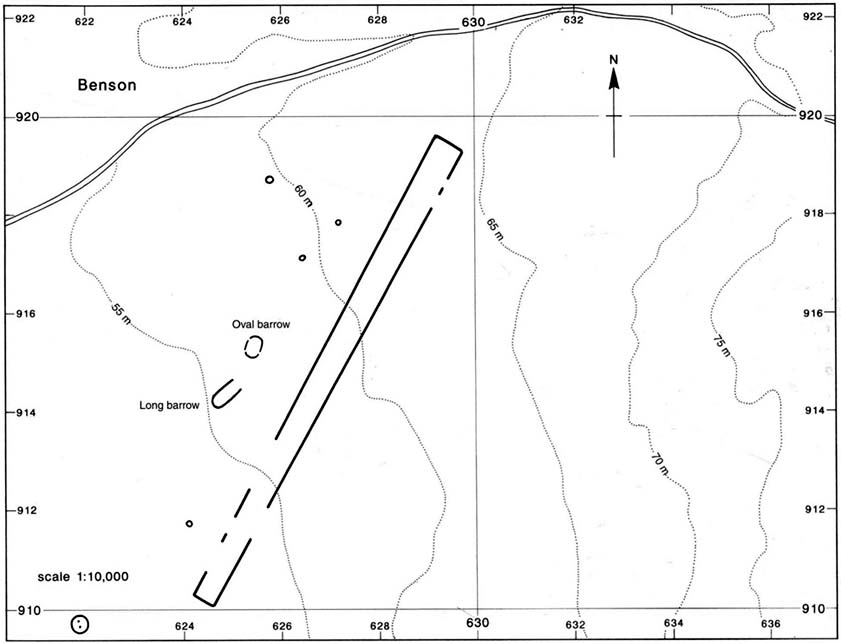
Any remains of this once sacred site are now beneath the airport between Benson and Ewelme, a couple of miles northeast of Wallingford, on the eastern side of the River Thames.  A great pity.  It was one of the early cursus monuments discovered as a result of Major G.W. Allen’s many aerial surveys in southern England — as shown in his photo here  — and subsequently described in Mr Leeds’ (1934) Antiquaries Journal article.  A cluster of cursus monuments were built in this part of England in neolithic times, and Roy Loveday (2006) includes the Benson Cursus as an ingredient within the ‘sacred landscape’ region of what he calls “the Dorchester-on-Thames complex.”  The Benson Cursus and surrounding regional monuments,

“in fact possesses features that would declare it as an inter-regional sanctuary if encountered in an historical setting; namely, intensity of monument construction, longevity of respect, addition of later exotic monuments with far-flung parallels, large numbers of burials, and placement in a landscape structured, partly at least, by other monuments.  These elements recur from Delphi to Uppsala, and from Pachacarmaca to Mecca, at sites that Mircea Eliade (sic) has termed hierophanies — locations where the otherworld of gods and ancestors communicate with the living.”

Loveday’s 2006 plan
Benson Cursus plan (after Barclay & Lambrick)

It’s good to know that the correct paradigms are at last emerging from those archaeocentric minds!

In Mr Loveday’s (2006) plan of the cursus, no entrances could be found into the monument apart from a small section along the northeastern length of the structure (left).  From its southernmost point, this giant monument runs along a SSW-NNE alignment — one echoed in other nearby cursuses — for 1192 yards (1090m) and is 71 yards (65m) across, covering 7.3 hectares in all.  No internal structures were noted anywhere within the monument.

…to be continued…

References:

  1. Barclay, A., Lambrick, G., Moore, J. & Robinson, M., Lines in the Landscape, OAU: Oxford 2003.
  2. Benson, D. & Miles, D., The Upper Thames Valley: An Archaeological Survey of the River Gravels, Oxford Archaeology Unit 1974.
  3. Eliade, Mircea, The Sacred and the Profane, Harcourt, Brace & World: New York 1959.
  4. Leeds, E.T., “Rectangular Enclosures of the Bronze Age in the Upper Thames Valley, in Antiquaries Journal, 14:4, 1934.
  5. Loveday, Roy, Inscribed Across the Landscape, Tempus: Stroud 2006.

© Paul Bennett, The Northern Antiquarian

Lesser Cursus, Larkhill, Wiltshire

Cursus Monument:  OS Grid Reference – SU 1056 4350

Also Known as:

  1. Small Cursus
  2. Stonehenge Smaller Cursus

Archaeology & History

James Fergusson’s drawing of both cursus monuments

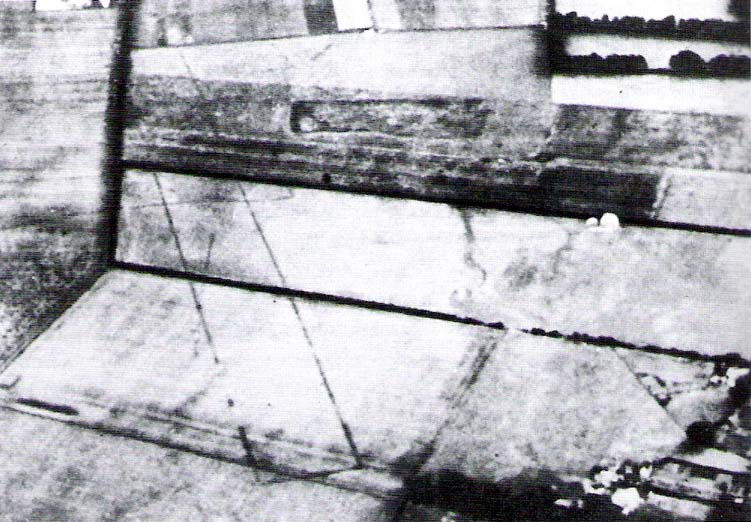
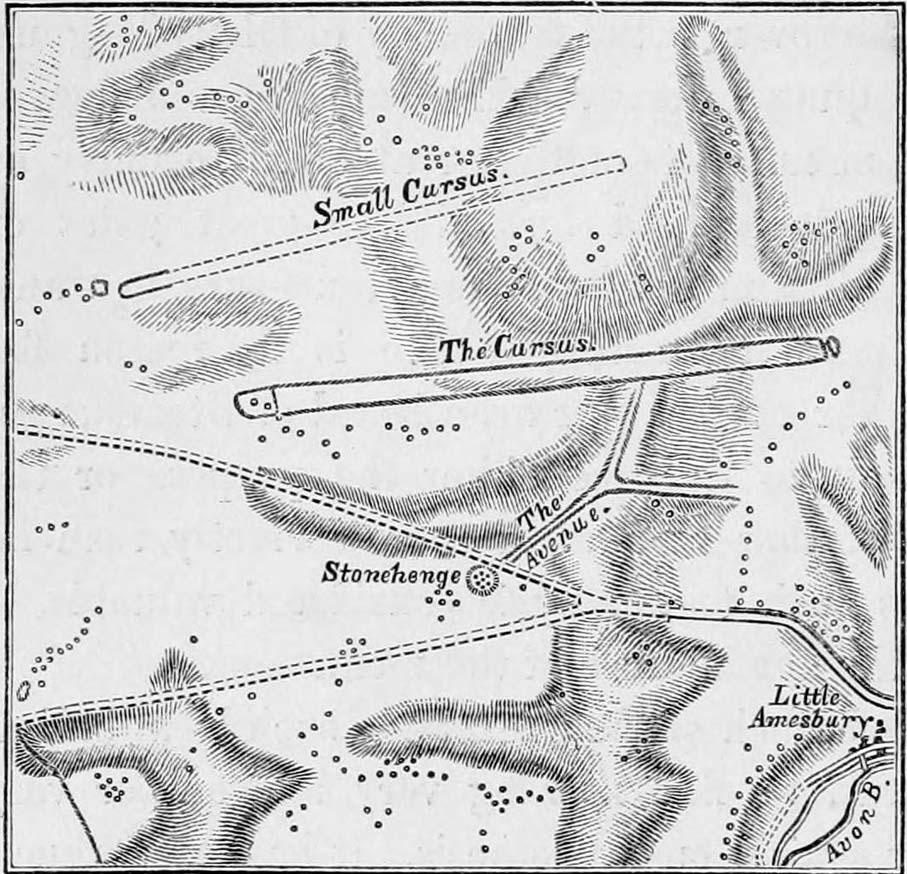
Just like its much larger companion, the Stonehenge Cursus earthwork a short distance to the south, this Lesser or Small Cursus is generally deemed by archaeologists to “speak of a clear religious or ritual aspect to this patch of downland that…reaches back generations before the first Stonehenge was built.” (Pitts 2001)  The monument was aligned roughly east-west, showing possible relationships with the rising and setting of both sun and moon. (though I wouldn’t get too carried away with that misself…)

When Fergusson (1872) described this and its larger cursus companion a few hundred yards away, he thought they may have been dug to mark out lines of battle in prehistoric times, denouncing the horse-racing course hypothesis that was still in vogue at the time.  His theory drew evidence from the numerous prehistoric tombs scattering this area of Salisbury Plain, but seemed more influenced by notions of prehistoric barbarism and warfare than ideas relating to a cult of the dead — which was yet to reach it heights in the archaeological minds of Victorian England.  But, like other cursus monuments all over the British Isles, this one also seemed to have a distinct relationship with monuments of the dead: for at its western extremity (until being ploughed out of existence) was a large round barrow, catalogued as the “Winterbourne 35” tomb.  Tim Darvill (2006) tells its wider tale:

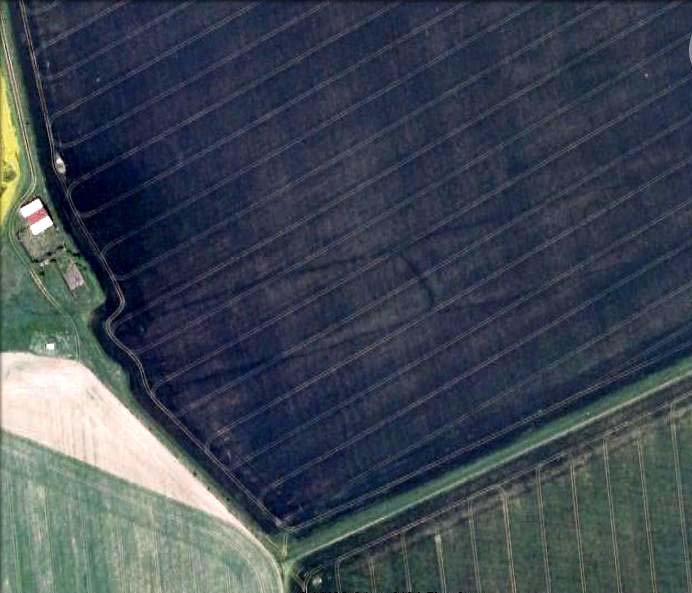
“Levelled by ploughing between 1934 and 1954, the Lesser Cursus was investigated in 1983 as part of the Stonehenge Environs Project… Three trenches were cut into different parts of this large monument, showing that there were at least two main phases to its construction.  Phase 1 comprised a slightly trapezoidal enclosure 200m by 60m, whose ditch may have been recut more than once and in part at least deliberately back-filled.  In Phase 2 this early enclosure was remodelled by elongating the whole structure eastwards by another 200m.  This extension comprised only two parallel side ditches, making the whole thing about 400m long with a rectilinear enclosure at the west end with entrances in its northeast and southeast corners giving access into a second rectilinear space, in this case open to the east.”

Lesser Cursus aerial view
Ground-plan of the Lesser Cursus (after Richards 1990)

The entire structure had finds dating from the periods between 3650-2900 BC; and the aerial imagery showing an oval-shaped structure near the eastern end was confirmed by geophysical surveys — though precisely what this is has yet to be ascertained.

It seems likely that this and other cursus monuments were, to a very great degree, not only related to mortuary practices but — as their development occurred at the same time as the destruction of Britain’s great forests began — to be monuments to the gods themselves.  This seems very evident at a couple of cursus monuments where animal deposits were made in some of the great mounds at their terminii, where archaeologists had previously assumed— incorrectly — the mounds to have been human burial mounds.  More about this in due course…

References:

  1. Darvill, Tim, Stonehenge: The Biography of a Landscape, Tempus: Stroud 2006.
  2. Devereux, Paul, The Haunted Land, Piatkus: London 2001.
  3. Fergusson, James, Rude Stone Monuments in all Countries, John Murray: London 1872.
  4. Loveday, Roy, Inscribed Across the Landscape, Tempus: Stroud 2006.
  5. North, John, Stonehenge, Harper-Collins: London 1997.
  6. Pitts, Mike, Hengeworld, Arrow: London 2001.
  7. Richards, Julian, The Stonehenge Environs Project, English Heritage: London 1990.

© Paul Bennett, The Northern Antiquarian

Stonehenge Cursus, Wiltshire

Cursus Monument:  OS Grid Reference – SU 1095 4292 to SU 1370 4319

Also Known as:

  1. The Cursus
  2. The Greater Cursus, Stonehenge

Archaeology & History

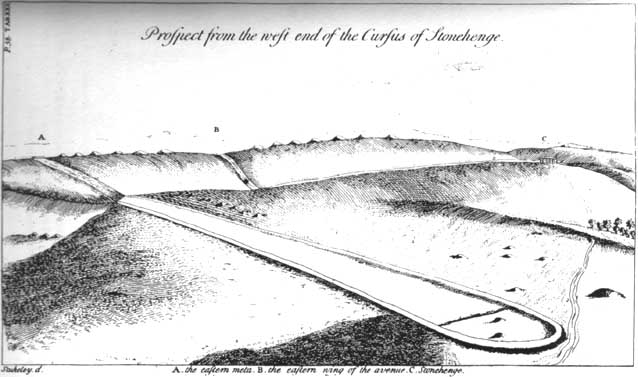
Stukeley’s Stonehenge Cursus

Not far south of the smaller Lesser Cursus monument, this huge linear earthwork was the very first cursus to be described, by William Stukeley no less, who thought it to be an old race-course for charioteers and the like!  He stumbled upon this: a curious gigantic linear earthwork feature, stretching for nearly two miles roughly east-west and as wide a football field, cut into the Wiltshire Earth, betraying all notions of ‘primitive’ histories as proclaimed by the ‘intellectuals’ of his day.  They were clearly wrong!  This immense enigmatic structure, still baffles the same creed of intellectuals to this day — but at least our old ancestors have been granted greater abilities than previously believed.  In his book on Stonehenge in 1740, Mr Stukeley described this,

“most noble work, contriv’ed to reach from the highest ground of two hills, extended the intermediate distance over a gentle valley; so that the whole cursus lies conveniently under the eye of the most numerous quantity of spectators. To render this more convenient for site, it is projected on the side of more rising ground, chiefly looking towards Stonehenge. A delightful prospect from the temple, when this vast plain was crowded with chariots, horsemen and foot, attending these solemnities with innumerable multitudes.”

Sir Norman Lockyer propounded its function as astronomical, aligning with the Pleiades around 2000 BC — a date we now know to be inconsistent with its construction, although as John North said in his Stonehenge (1997):

“Lockyer’s chronology was certainly better than the general archaeological consensus at the time.”

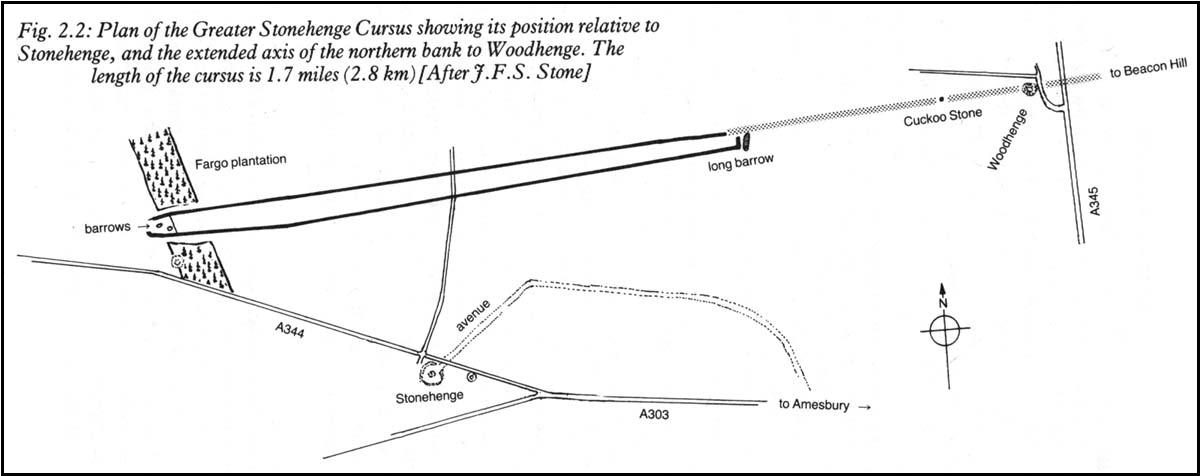
But further archaeological alignments and leys have been suggested running eastwards from here.  And as Paul Devereux pointed out, “In the case of this cursus, archaeology got there first.”  J.F.S. Stone, who carried out some excavations at the cursus in 1947, noted that

“its axis, if projected 1500 yards east, strikes Woodhenge and passes the Cuckoo or Cuckold Stone by the way.”

This was endorsed in 1981 by archaeologists John Hedges and David Buckley:

“In addition to aligning upon Woodhenge, the Greater Stonehenge cursus also sights upon the Cuckoo or Cuckold Stone.”

Alignment to Beacon Hill

In Roy Loveday’s (2006) survey of cursus monuments he told how this alignment goes much further, telling how it aligns “on the lower, northernmost prominence of Beacon Hill 8km away”, crossing Woodhenge on its way.  Such suggestions used to bring outcries of derision from the archaeological fraternity, but it seems archaeologists themselves are making such claims more and more these days.  At the forefront of modern alignment research in previous decades was Paul Devereux — and it was he who first noted the line-up with the distant Beacon Hill from the Great Cursus, telling:

“The course of the alignment can be extended eastwards a few miles beyond Woodhenge to cross the barrow-dotted ridge of Beacon Hill — a perfect example of a Wakins-style ‘initial point.’ The ridge is highly visible from Woodhenge.  It disappears from view as one walks westwards down the cursus, but reappears clearly as the west end is approached.  Indeed, the west end is so placed that it is at about the furthest point from which the Beacon Hill ridge , and the intermediate on which the eastern end of the cursus fall, can be seen together.”

…to be continued…

References:

  1. Burl, Aubrey, A Brief History of Stonehenge, Robinson: London 2007.
  2. Hedges, John & Buckley, David G., The Springfield Cursus and the Cursus Problem, Essex County Council 1981.
  3. Loveday, Roy, Inscribed Across the Landscape, Tempus: Stroud 2006.
  4. North, John, Stonehenge, Harper-Collins: London 1997.
  5. Pennick, N. & Devereux, P., Lines on the Landscape: Leys and other Linear Enigmas, Hale: London 1989.
  6. Stone, J.F.S., ‘The Stonehenge Cursus and its Affinities,’ in Archaeological Journal, 104, 1947.

© Paul Bennett, The Northern Antiquarian

Thornborough Cursus, North Yorkshire

Cursus Monument:  OS Grid Reference – SE 286 794

Archaeology & History

In the midst of the great henge monuments at Thornborough — specifically, the central henge — archaeologist Ian Longworth (1965) said there “was built …a still earlier structure known as a cursus.”  This giant monument was one of the earlier such sites located in Britain.  Longworth continued, saying:

“This was a ceremonial avenue, running for nearly a mile in a northeast / southwesterly direction.  The avenue is defined by ditches 144 feet apart with a bank running along the inside of each ditch.  The ditches are now completely filled with plough soil and, as with other cursus monuments in the county, were discovered from the air as two dark lines in the cereal crop… Probably used for ritual ceremonies, no clues remain to show what actually took place.”

Thornborough Cursus (& henges)

This cursus runs almost at right angles to the alignment of the three Thornborough Henges, on the southern side of the central henge, and was first found through the aerial photography of J.K. St. Joseph between 1945 and 1952. When excavation work was carried out, “a crouched burial was found in a stone cist within the southwest end” of the cursus.  This end of the monument is rounded, like the Stonehenge Cursus; whilst the northeast end of the monument has not been located. The southwest end of the cursus begins at OS grid-reference SE 2799 7906 and its northeasterly end is roughly at SE 2881 7954.  The middle of the known cursus is roughly in Thornborough’s central henge.

Paul Devereux (1989) said that the monument, “which had become silted-up and grass-covered by the time the henge was built, had two main orientations, with a curvilinear, irregular section just to the east of the henge.”  Although Norris Ward (1969) thought that the cursus actually went all the way down the River Ure, it stops some distance beforehand, though may obviously have had some important relationship with the waters.

References:

  1. Longworth, Ian H., Regional Archaeologies: Yorkshire, Cory, Adams & Mackay: London 1965.
  2. Pennick, N. & Devereux, P., Lines on the Landscape, Hale: London 1989.
  3. Thomas, Charles, ‘Folklore from a Northern Henge Monument,’ in Folklore Journal, volume 64:3, 1953.
  4. Ward, Norrie, Yorkshire’s Mine, J.M. Dent: London 1969.

© Paul Bennett, The Northern Antiquarian

Spread Eagle Cursus, Aberllynfi, Breconshire

Cursus Monument:  OS Grid Reference – SO 162 376

Archaeology & History

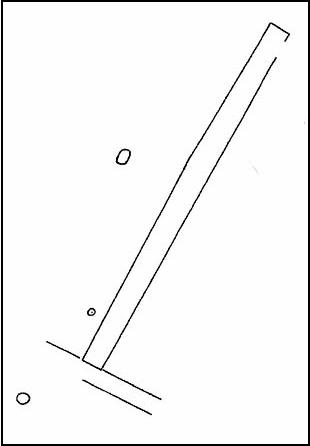
It seems that very little remains of this site, and there is some doubt over its authenticity.  Described in Alex Gibson’s (1999b) essay on the cursus monuments of Wales, he said this ‘cursus’ consists of,

“A cropmark of two parallel ditches orientated SE-NW, 15m apart and traceable for some 130m. It runs perpendicular to the present course of the River Wye 50m to the NE.  No terminals are visible, but there is a large ring ditch across the river 450m to the NW. A closely-grouped cluster of some 8 ring ditches is visible on a gravel terrace some 150m to the E,” but adds finally that “the identification of this site is suspect and may represent a fossil field system.”

The likelihood of the site being genuine seems to come from the “cluster of eight ring ditches on the gravel terrace some 150m to the east.”  Gibson (1999) also thinks how “the parallel ditches seem to be aligned on a ninth large ring-ditch 450m to the northwest and across the river.”  Ley-hunters have been scorned by archaeo’s for making such confounded comments!   The presence of a long cairn south of the cursus was also thought to add weight to the sites veracity.

Does anyone know what the present position on this site happens to be?

References:

  1. Gibson, Alex, The Walton Basin Project, CBA: York 1999.
  2. Gibson, Alex, ‘Cursus Monuments and Possible Cursus Monuments in Wales,’ in Barclay & Harding’s Pathways and Ceremonies, Oxbow: Oxford 1999b.

© Paul Bennett, The Northern Antiquarian

Sarn-y-Bryn-Caled, Belan, Montgomeryshire

Cursus:  OS grid reference – SJ 217 048

Also Known as:

  1. Welshpool Cursus

Archaeology & History

Much has been written about this ancient site.  Indeed, the archaeologist Alex Gibson (1999) told that, “the ritual complex at Sarn-y-bryn-caled has been extensively studied…and a development sequence based on relative and absolute chronologies, as well as site analogy, has been proposed.”  Created over a lengthy period spanning nearly 2000 years, Gibson (1999b) described this monument as a

“cropmark showing as two parallel ditches, 12m apart, running SW-NE for a distance of 370m. Causeways are visible through both side ditches. The terminals are not readily visible on the aerial photographs but have been proven with geophysical survey. The terminal ditches are straight and at right angles to the side ditches. Excavations proved the ditches to be 2m across at the gravel surface and c.0.8m deep. Charcoal from the base of the ditch provided a C14 date of 4960<>70BP. Silting patterns in both ditches and the raised profile of the gravel surface suggest external banks. Towards the NE end of the cursus is a cluster of circular ritual monuments comprising a large pit, timber circle, two ring ditches and a pennanular ring ditch. A possible second pennanular enclosure was located towards the SW end by geophysical survey.”

Less than 200 yards north of the northeast terminal is a second cursus-looking monument, ascribed in Gibson’s (1999b) survey as Sarn-y-bryn-caled II and which runs dead straight for 250 yards.  Although being nearly 40 foot across, Gibson thinks this long stretch is more likely to be the remains of an old trackway or road, telling that the very title — Sarn-y-bryn-caled — or “road by the hard hill”, may derive from this secondary linear feature.

Folklore anyone…?

References:

  1. Gibson, Alex & Simpson, Derek (eds.), Prehistoric Ritual and Religion, Sutton: Stroud 1998.
  2. Gibson, Alex, The Walton Basin Project, CBA: York 1999.
  3. Gibson, Alex, ‘Cursus Monuments and Possible Cursus Monuments in Wales,’ in Barclay & Harding’s Pathways and Ceremonies, Oxbow: Oxford 1999b.

© Paul Bennett, The Northern Antiquarian

Dorchester Cursus, Oxfordshire

Cursus:  OS Grid Reference – SU 569 958SU 581 948

Also Known as:

  1. Dorchester-on-Thames Cursus
  2. Overy Cursus

Archaeology & History

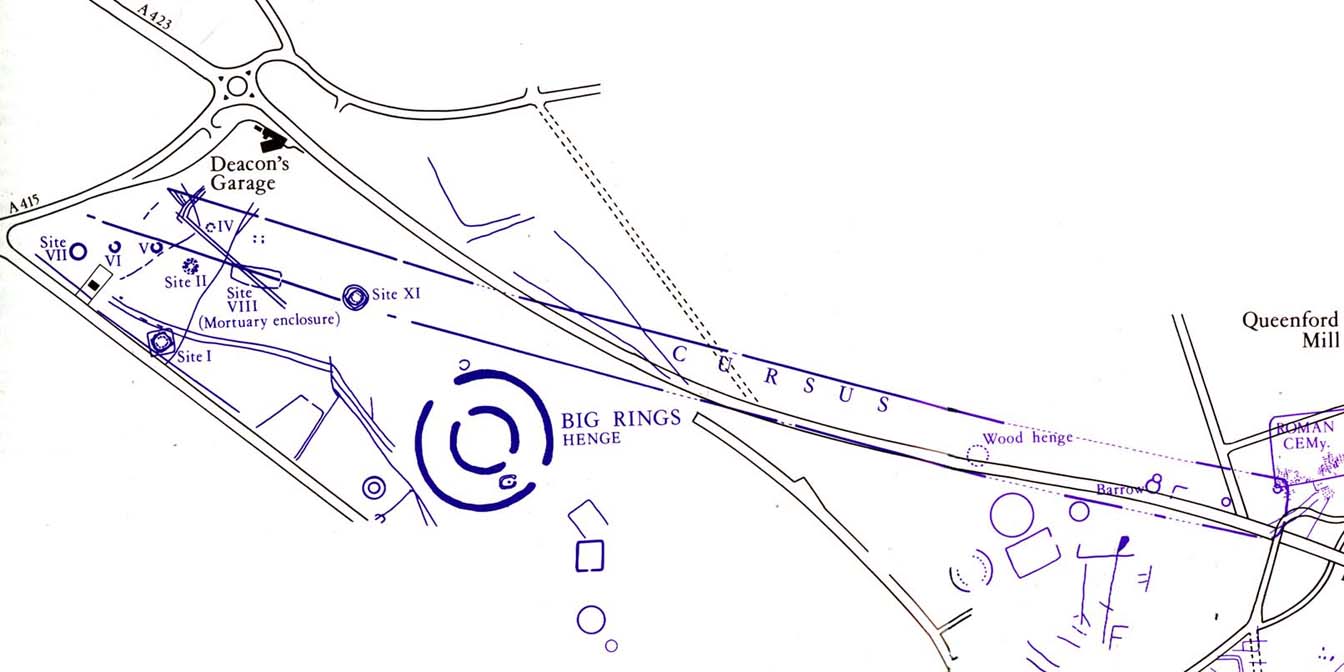
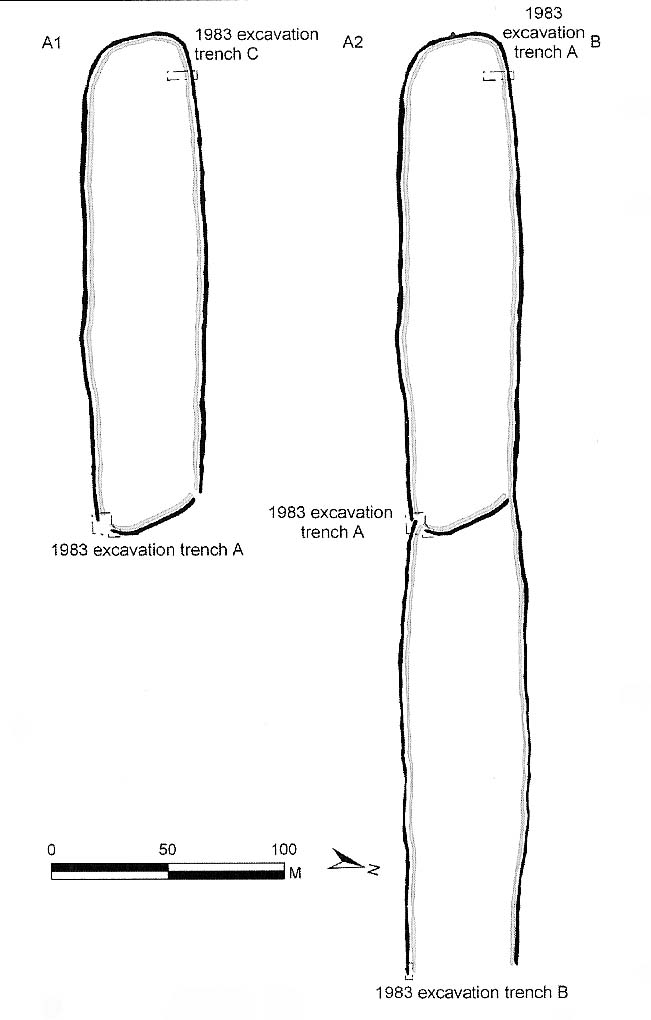
Dorchester cursus (after Atkinson)

Nowadays marked on modern Ordnance Survey maps as part of a ‘Neolithic Sacred Complex,’ this linear monument was part and parcel of the Dorchester Big Rings henge complex and was associated with a  number of other important prehistoric sites, many of which have been destroyed by ecological disfigurement projects in recent years.  In Gordon Copley’s (1958) description of the monument, not long after its initial discovery, he said that this “was a cursus which consists of parallel ditches some 4000 feet long with 210 feet between them.”  In more recent times Paul Devereux (1989) described how the cursus here,

“ran for three-quarters of a mile (1.2km) in a northwest to southeast direction on the north side of the Thames and was 210 feet (64 metres) wide. The cursus was part of a complex of crop marks, the most notable being” the henge. “The northwest end of the cursus remains unknown; the southeast end was rounded. The southeast segment…was on a slightly skew alignment compared to the rest of the feature, though it may have been the earliest part of the monument – bones found there were radio-carbon dated to around 3000 BC. The southern ditch of the cursus ran through and connected two earlier sites which shared a different alignment. Deposits of cremated bones, a stone arrowhead, fragments of pottery, a polished flint axe, and a circle of pits, probably the remains of a ‘woodhenge’ structure, were all found with the cursus.”

Dorchester cursus plan 1985

Jean Cook (1985) told that later excavations on the site in 1981, found that the shallow ditch which surrounded the entire cursus, “was interrupted by a central entrance on the southeast side.  The southeastern terminal ditch respected a small prehistoric monument which has been dated to approximately 2000 BC.”  This and other factors has led to the thought that the cursus may not all have been built at the same time.  And indeed excavations at other sites scattering the northwestern ends of the cursus (shown in the plan here, Ed.) proved that a D-shaped enclosure “pre-dates the rest of the structure.”  Other mortuary sites scattered the edges of the cursus that were added in the centuries which followed, but which need excavation work to uncover their secrets.  Although much of this was done in the Atkinson digs, they were summarised well by Jean Cook (1985), who told:

“Site VIII, excavated in 1948, was a monument known as a mortuary enclosure.  Sometimes such structures take the form of long barrows, but this one was a rectangular enclosure bounded on all four sides by a ditch with an internal bank.  There were narrow entrance gaps on the two longer sides and a wider entrance in the centre of the shorter southern side.  It is dated by the substantial sherds of Ebbsfleet ware (pottery) which were found in the upper filling of the ditch; part of a human jaw from within the enclosure helps to confirm the mortuary function.

“Site XI, excavated in 1949, consisted of three or more concentric ditches, of different dates, enclosing an incomplete ring of 14 pits.  The middle ditch seems to have surrounded an oval barrow or enclosure and to have then been converted to a circular plan.  Some of the pits contained animal bones, one contained an antler pick and one contained a complete human cremation, but there were no accompanying grave goods.

“Both these sites were in existence before the cursus was built. (my italics, Ed.)  This is shown by the fact that the southernmost ditch of the cursus cuts through Site VIII and abuts Site XI.  These two earlier sites seem to share the same alignment, but once the cursus was constructed it set a new alignment which may have been of significance until the end of the 3rd millenium BC.  Three monuments built after the construction of the cursus were located inside it, two of them being along the central axis, and two others were just outside the southernmost ditch of the cursus but shared the same general alignment.

“Sites IV, V and VI, which were also excavated in 1949, have a similar overall plan and all of them contained a number of cremation deposits suggesting that amongst other things they acted as cemeteries.  All three sites had a circular plan and consisted of an outer bank, to define the central area, and an inner ditch, the purpose of which seems to have been to provide earth for the bank.  In Site IV the ditch was made up of eight oval pits, enclosing an area of about six metres in diameter.  There was a broad entrance gap on the southeast side.  Inside the enclosed area there were 25 deposits of cremated bones.  An arrowhead was found with one of the cremations.  Site V was very similar in construction, except that the entrance gap was on the northwestern side and contained 21 cremation deposits.  No grave goods were found.  Site VI again had a similar plan with the entrance gap to the north.  There were 49 cremation deposits , one accompanied by a flint fabricator, an arrowhead and burnt flint flakes.

“Site 1 was excavated in 1946 and consisted of a small square ditch, enclosing another more or les circular ditch with an internal bank.  Inside this ditch were 13 holes, forming a ring with an entrance gap on the western side.  There were no entrances in the surrounding ditches.  A crouched burial was found within the entrance to the ring of holes but there were no accompanying grave goods.  Four cremations were found, two accompanied by fragmentary bone pins, in or besides four of the central holes.  At a later stage in the neolithic period, parts of the ditch may have been enlarged to make temporary shelters: it is not clear to which period of use the cremations belong.

“Site II, also excavated in 1946, consisted of a causewayed (interrupted) ring ditch which was enlarged on two occasions.  The third ditch had an internal bank in which were 19 cremation deposits.  Two more cremations were found at the centre of the enclosed area.  There was no evidence for any gap.  Bone pins were found with four of the cremations as were flint fragments.  In addition, antlers and other flint fragments were found, as well as pieces of pottery.

“In 1981 a small semi-circular enclosed ditch was excavated within the southeast terminal of the cursus.  Though sited off-centre, the ditch shared the same alignment with the cursus.  An antler (dated to c.2000 BC) was found close to the bottom of the ditch.  After the ditch had virtually filled up with silt, the surviving low central mound was used for cremation deposits, one of them associated with a heavily burnt flint blade.”

Paul Devereux (1989) pointed out how one of the archaeologists studying this site found that if the axis of the monument was extended southeast, across the river, it lined up perfectly with another set of perfectly straight lines which were thought “likely to be a Roman trackway.”  Unfortunately much of this area has been destroyed through the self-righteous ignorance of modern industrialism.

References:

  1. Atkinson, R.J.C. et al, Excavations at Dorchester, Oxon, Department of Antiquities: Oxford 1951.
  2. Barclay, A., Lambrick, G., Moore, J. & Robinson, M., Lines in the Landscape, OAU: Oxford 2003.
  3. Cook, Jean, “The Earliest Evidence,” in Dorchester through the Ages, Oxford University 1985.
  4. Cook, Jean & Rowley, Trevor (eds.), Dorchester through the Ages, Oxford University 1985.
  5. Copley, Gordon J., An Archaeology of South-East England, Phoenix House: London 1958.
  6. Loveday, Roy, Inscribed Across the Landscape, Tempus: Stroud 2006.
  7. Pennick, Nigel & Devereux, Paul, Lines on the Landscape, Hale: London 1989.

© Paul Bennett, The Northern Antiquarian