Lee Hall Well, Bellingham, Northumberland

Healing Well:  OS Grid Reference – NY 861 797

Archaeology & History

Very little is known about this forgotten heathen water source.  It was described in some notes attached on a piece of paper accompanying John Warburton’s description of Lee Hall and its surroundings.  The notes were first printed in an early edition of Archaeologia Aeliana and subsquently included in Binnall & Dodds’ (1942) fine survey on the holy wells of the region.  It’s exact whereabouts appears to be lost, but it may be either the small pool across from the present Hall, or a small spring found in the edge of the small copse of trees just east of Lee Hall Farm.  Does anyone know?

Folklore

Written verbatim in that dyslexic olde english beloved of antiquarians like misself, the only piece of folklore said of this spring of water told:

“At the Lee hall an exclent spring, the vertue is such that if the lady of the Hall dip aney children that have the rickets or any other groone destemper, it is either a speedy cure of death.  The maner and form is as followeth: The days of dipping are on Whitsunday Even, on Midsumer Even, on Saint Peeter’s Even.  They must bee dipt in the well before the sun rise and in the River Tine after the sun bee sett: then the shift taken from the child and thrown into the river and if it swim…child liveth, but if it sink dyeth.”

The latter sentence echoing the crazy folklore of the christians to identify witches in bygone days!

References:

  1. Binnall, P.B.G. & Dodds, M. Hope, ‘Holy Wells in Northumberland and Durham,’ in Proceedings of the Society of Antiquaries of Newcastle-upon-Tyne (4th Series), 10:1, July 1942.

© Paul Bennett, The Northern Antiquarian


Barrow Well, Compton Martin, Somerset

Sacred Well:  OS Grid Reference – ST 537 573

Archaeology & History

This rather delapidated spring of water (there are actually two springs here) marks the western edge of the parish boundary, just on the south-side of the A368 road towards Ubley, on what Phil Quinn (1999) described as “a neglected triangle of shrubby ground.”  Its name derives from once being associated with a prehistoric tomb, or barrow, as the associated field-names of Barrows Orchard and Barrow Cross here indicates.  Sadly however, all remains of whatever tomb there once was appears to have gone.  Aerial imagery shows what may have been two or three barrows in the said field.

Folklore

A haunted site: the folklore here is akin to banshee-lore and similar mythic figures.  The fact that it marked the old boundary line between here and Ubley may have something to do with it.  Quinn (1999) says how,

“Local folklore states that the well was haunted by the ghost of a woman washing cabbages”!

But this vegetative lore is likely a mistranslation of a local dialect word.  Precisely what the spirit was supposedly ‘washing’ seems to have been lost in translation.

References:

  1. Quinn, Phil, The Holy Wells of Bath and Bristol Region, Logaston: Almeley 1999.

© Paul Bennett, The Northern Antiquarian


St. Patrick’s Well, Carrowreagh, Donegal

Holy Well:  OS Grid Reference – C 367 196

Folklore

To be found somewhere between the two outer embankments on the southern side of the legendary Grianan of Aileach, this — one of many St. Patrick’s Wells in Ireland — is typically attributed with healing properties.  It was described in Henry Morris’ (1938) survey (amongst others) as being the place where, in the 5th century when St. Patrick came here, Prince Eoghan was baptised and thereafter turned his back on the heathen gods of his ancestors for this new christian cult which was just growing at that time. (‘Eoghan,’ pronounced owen)  Thereafter other people were baptised by the waters from here, which in ancient days would have been the water supplies for those at the Grianan.

Henry Swan (1938) told that in previous times there once grew a legendary tree by this well, into which pilgrims inserted pins and other artefacts as offerings and to make wishes to the spirit of the waters. A similar thing (with the same underlying mythic structure) occurred at the tree and holy well of Loch Maree.

Up until quite recently, the well was very overgrown and in a condition that Rear Admiral Pascual o’ Dogherty called “disgusting.”  He called for renovation work and action to bring this ancient site back into good health, and thankfully, as a result of the man’s proclamations, St. Patrick’s Well here has been brought back into a good state of life.  Excellent stuff good sir!

References:

  1. Lacy, Brian, Archaeological Survey of County Donegal, DCC: Lifford 1983.
  2. Morris, Henry, ‘The Holy Wells of Inishowen,’ in H.P. Swan’s Book of Inishowen, Buncrana 1938.
  3. o’ Muirgheasa, Enri, ‘The Holy Wells of Donegal,’ in Béaloideas 6:2, 1936.
  4. Swan, Harry Percival, The Book of Inishowen, William Doherty: Buncrana 1938.

© Paul Bennett, The Northern Antiquarian

St. Helen’s Well, Colne, Lancashire

Holy Well:  OS Grid Reference – SD 890 397

Getting Here

This site can be reached with relative ease from Colne’s train station by crossing the road and going up Bridge Street, turning immediately left along Shaw Street for several hundred yards until you reach Waterside Road on your left-hand side.  From here, as Mr Tom Sharples told, “St. Helen’s Well is presently within the area of overgrown and unmanaged scrub woodland adjacent to Waterside Road.”  Look around!

Archaeology & History

First described on the Megalithic Portal by the pseudonymous Brionnfhionn, this recently rediscovered holy well can be found on the southern side of Colne, at Waterside.  A few months after the MegPortal announcement, a more detailed overview of the site was published on GoogleDocs, from where Mr Tom Sharples has kindly allowed us to repeat the information that both he and Susan Bryant-Lauder compiled there.

The site was relocated after reference had been found in Geoff Crambie’s (1978) A Colne Festival, where he wrote:

“1935 saw the end of St. Helen’s Mill in Waterside.  Built by Nicholas England in 1835, it was named after the St. Helen’s Well nearby, which was reputed to have been named by the Romans.”

The local writer Dorothy Harrison (1988) also mentioned the site, though only in passing, when she told,

“Along with St. Helen’s Well, Buck Spout provided the main source of drinking water in Waterside.”

There has to be some more information about this little-known site hidden in some old Lancastrian history or folklore work, somewhere – surely!?

References:

  1. Crambie, Geoff, A Colne Festival, Turner & Earnshaw: 1978.
  2. Harrison, Dorothy (ed.), The History of Colne, Pendle Heritage Centre 1988.

© Paul Bennett, The Northern Antiquarian

Fairy Well, Barrow Gurney, Somerset

Sacred Well:  OS Grid Reference – ST 53243 68625

Getting Here

Fairy Spring on 1921 OS-map

Go up the nicely-named Wildcountry Lane at the staggered crossroads on the edge of Barrow Gurney for about a half-mile, watching out for the dip in the road where it crosses the stream.  Walk up the stream here for a coupla hundred yards, keeping your eyes peeled for the small spring on your left just past where a footpath crosses the stream.

Archaeology & History

Little of historical nature is known of this site, found in the dip near the stream, though it was much frequented in bygone centuries as a curative place for sore eyes.

Folklore

Although named after the little people, Phil Quinn (1999) wrote that,

“even the oldest villager cannot remember how the fairies became connected with this well.  All that is told is that the people would go to the well to bathe their eyes, for the water was believed to be good in the treatment of all eye complaints. A local woman remembers that her father, who worked the land in this neighbourhood, would always drink from the well using a cup which was never taken away or used for any other purpose.”

It is likely that the fairy association here derived from the proximity of a nearby prehistoric tomb, cairn or similar archaeological remain.  The aptly-named Barrow Wood immediately east and other ‘barrow’ place-names nearby would add weight to this notion. (faerie-lore has widespread associations with prehistoric tombs and similar relics)

References:

  1. Quinn, Phil, The Holy Wells of Bath and Bristol Region, Logaston: Almeley 1999.

© Paul Bennett, The Northern Antiquarian

Pots and Pans Stone, Greenfield, Lancashire

Legendary Rocks:  OS Grid Reference – SE 01008 05072

Also Known as:

  1. Druid Stone

Getting Here

Pots & Pans on 1854 OS-map

Dead easy! From the townships of Grasscroft, Uppermill, or Greenfield, take the legendary moorland road up to Saddleworth tops (A635), keeping your eye on the modern obelisk on the hilltop to your left and you’ll see a large rock outcrop almost next to it.  That’s where you’re heading.  Once you reach near the moorland level, walk in whatever way you see fit towards the obelisk and large stones.  Enjoy…!  I s’ppose though, it’d be better for you if you started from the valley bottom at Uppermill and walked up the hill.

Folklore

Seemingly a ritual place of the sun, this fine site was known by the local folk-name of the Druid Stones, according to Jessica Lofthouse. (1976)  But more importantly in legend, this great rocky outcrop was the abode of an old giant called Alphin, who had a rival called Alder who also wandered the moors here.  Both these giants vied for the hand of a lady called Rimmon, who preferred Alphin to Alder. In good old fashioned ways they contested for her hand, throwing giant rocks across the moors at each other, but “Alphin was hit and killed, with Rimmon looking on.”  His grave lies on these moors somewhere, seemingly unfound.   …And intriguingly it seems that we’ve actually located a prehistoric tomb which may account for the legend of Alphin’s death! (Watch this space!)

A slight variation on the tale describes the Lady Rimmon to be of fairy stock, named ‘Raura Peena’ (a phonetic spelling of a local dialect name), who in one account from the Notes & Queries journal, 1850, tried luring a local man into her magickal recess of the Fairy Holes, on the slopes beneath the Pots and Pans Stone.

Local tradition also tells that the naturally-worn ‘bowls’ atop of the rocks held magical properties — water being collected from them was said to be good to cure eye problems.  This is a curative theme we find at some bullauns, cup-marked stones and old cross-bases and would strongly indicates that pre-christian practices did once take place here.

References:

  1. Lofthouse, Jessica, North Country Folklore, Robert Hale: London 1976.

© Paul Bennett, The Northern Antiquarian

St. Thomas’ Well, Cambusbarron, Stirlingshire

Holy Well: OS Grid Reference – NS 7790 9304

Archaeology & History

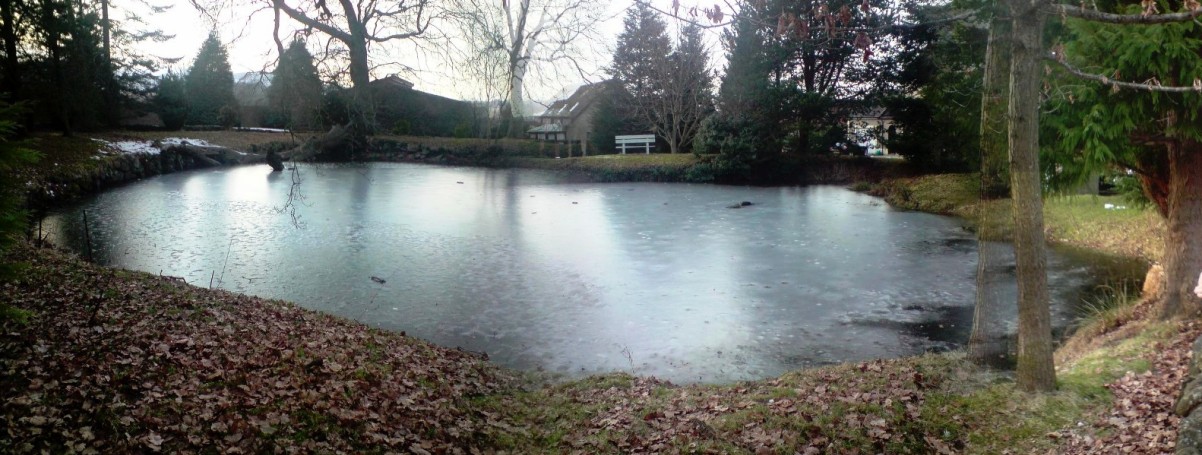
St.Thomas Well pond – on a freezing grey day!

Very close to the edge of the M9, this old water source is thankfully still visible, though not in its original state.  At the bottom of the ridge, loosely enclosed in the grounds of St. Thomas Well House, we find that the original well has been submerged into the pond which covers it.

Folklore

I’ve not yet found the mythic origins behind the dedication to this site, though St. Thomas’ Day is the winter solstice on December 21, and his mythic status was that of didymus, or twin.  In Yorkshire, folk customs surrounding this figure have been found to be inextricably intertwined with death rites, Robin Hood and shamanism!  But this Stirlingshire site is as yet silent.  The presence of numerous prehistoric burials very close by may have something to do with its dedication, as such sites would heighten the likelihood of there being ‘heathen’ practices close by, to which the said ‘St Thomas’—or one of his emissaries—could subdue with their christian figure.  But that’s pure speculation on my part…

References:

  1. Attwater, Donald, The Penguin Dictionary of Saints, Penguin: Harmondsworth 1965.
    Morris, Ruth & Frank, Scottish Healing Wells, Alethea: Sandy 1982.
  2. Fleming, J.S., Old Nooks of Stirling, Delineated and Described, Munro & Jamieson: Stirling 1898.
  3. Royal Commission on the Ancient & Historical Monuments, Scotland, Stirlingshire – volume 2, HMSO: Edinburgh 1963.

© Paul Bennett, The Northern Antiquarian


St. Michael’s Well, Kirklington, North Yorkshire

Holy Well:  OS Grid Reference – SE 317 813

Getting Here

Having not been here, I can’t say for sure exactly where this forgotten site happens to live!  It may be the one shown on modern OS-maps, behind the old post office, on the west-side of the village, but I aint sure.  If any local people out there who can help us, we would be hugely grateful!

Archaeology & History

Not to be confused with the other St. Michael’s Well a few miles away in the village of Well, this is a little-known holy well that was described by the historian H.B. McCall (1910), who wrote:

“As Burneston had Saint Lambert’s Fountain, mentioned so early as the 12th Century, so Kirklington possesses its holy well, beside the old Mill House on the north side of the village.  Althoguh its name has now passed from the popular remembrance, it is provided in a lease of lands to Roger Croft, in 1628, that his cattle shall have right of access to go into the water near unto a spring called ‘Michaell-well’. both in winter and summer; and we are left in no doubt as to where the spring was situated, for Mrs Alice Thornton has recorded that her father brought water to the Hall in lead pipes from a cistern of the same metal, “near St. Michael’s Well near the mill-race.””

Does anyone know anything more of this all-but-forgotten site? 

A short distance to the north in the same village, another sacred water source known as the Lady Well can also be found.

References:

  1. McCall, H.B., Richmondshire Churches, Elliott Stock: London 1910.

© Paul Bennett, The Northern Antiquarian 


Elm Crag Well, Bingley, West Yorkshire

Healing Well:  OS Grid Reference – SE 1028 3907

Getting Here

From Bingley, take the B6429 road up to Harden.  After going up the wooded winding road for a few hundred yards, stop where it levels out.  Cross onto the right-hand side of the road and walk up the slope a little, veering to your right.  You’ll notice a small disused building just off the roadside, in overgrowth, with a pool of water.  You need to be about 100 yards up the slope above it!

Archaeology & History

Elm Crag Well, Bell Bank Wood, Bingley

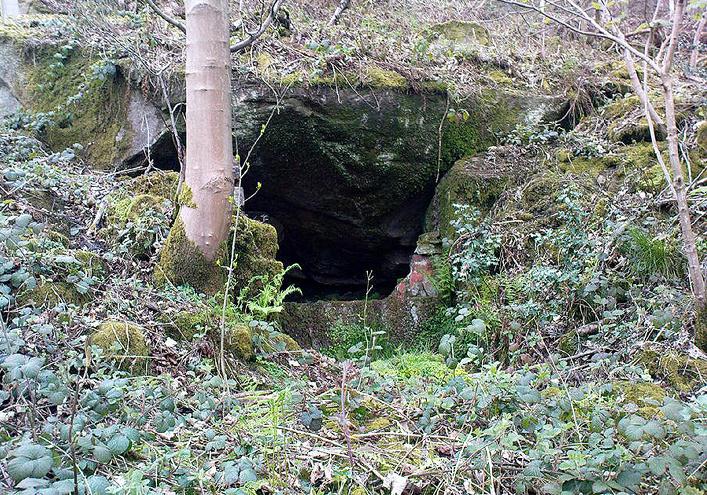
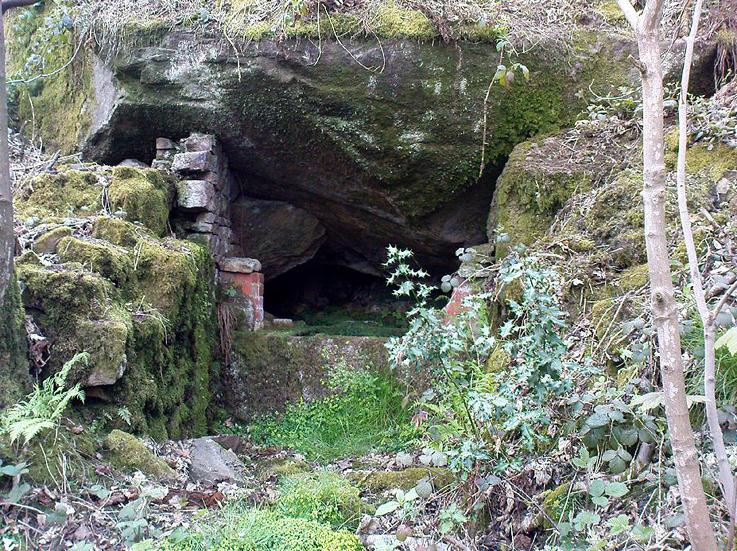
This is a beautiful old place.  If you walk straight up to it from the roadside, past the derelict building, you have to struggle through the brambles and prickly slope like we did – but it’s worth it if you like your wells!  However, if you try getting here in the summertime, expect to be attacked on all sides by the indigenous flora!  The waters here emerge from a low dark cave, in which, a century of three ago, someone placed a large stone trough.  When I first came here about 25 years ago, some halfwits had built an ugly red-brick wall into the cave which, thankfully, someone has had the sense to destroy and rip-out.

Shown on the 1852 Ordnance Survey map and highlighted as a ‘spring,’ Harry Speight (1898) gives a brief mention to this site, though refers us to an even earlier literary source when it was first mentioned. In John Richardson’s 18th century survey of the Craven area, he makes reference to an exceedingly rare fern, Trichomanes radicans, which was later included in Bolton’s classic monograph on British ferns of 1785.  In it, Bolton wrote that the very first specimen of this plant was “first discovered by Dr. Richardson in a little dark cavern, under a dripping rock, below the spring of Elm Crag Well, in Bell Bank.”

Elm Crag Well
Elm Crag Well

The waters from here come from two sides inside the small cave and no longer run into the lichen-encrusted trough, seemingly just dropping down to Earth and re-emerging halfway down the hillside.  But the waters here taste absolutely gorgeous and are very refreshing indeed!  And the old elms which gave this old well its name can still be seen, only just hanging on to the rocks above and to the side, with not much time left for the dear things.

References:

  1. Bolton, James, Filices Britannicae: An History of the British Proper Ferns, Thomas Wright 1785.
  2. Speight, Harry, Chronicles and Stories of Old Bingley, Elliott Stock: London 1898.

© Paul Bennett, The Northern Antiquarian


Fairy Loch, Arrochar, Argyll

Sacred Loch:  OS Grid Reference – NS 3384 9937

Also Known as:

  1. Lochan Uiane

Getting Here

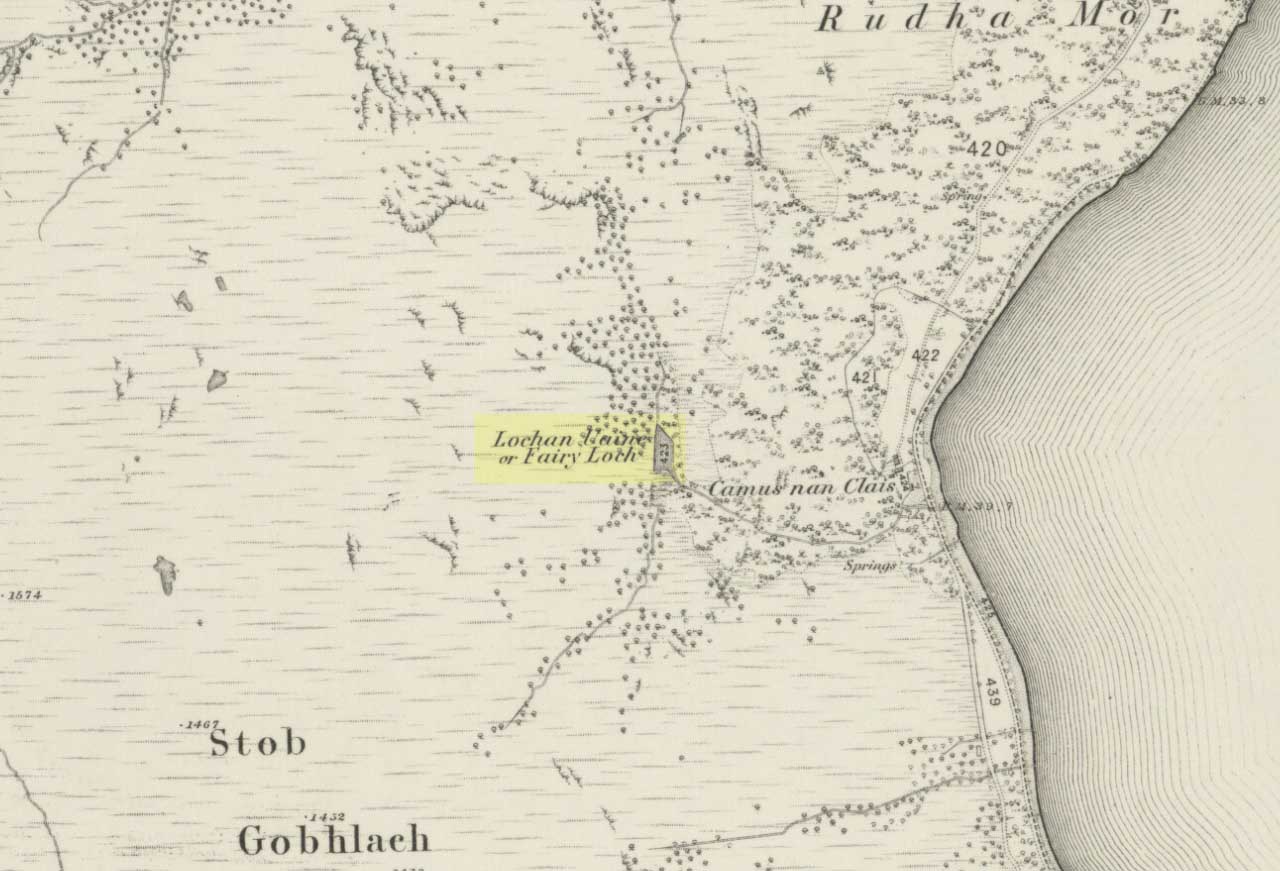
Fairy Loch on 1865 map

To get here, go down the A82 about four-and-a-half miles south of Tarbet (along the Loch Lomond road). Near a burn coming down the hill is an old house, long in ruin, and near the side of this is an old path – more for deer than city-folk. Go up through the wooded hillside for about a half-mile (amble the trek and make it a nice hour’s walk to get into the place). I’d take the stream itself, as you get more into the nature of the place once you get up the slope: there’s more to see, feel and a healthy water supply en route.

Folklore

This is more of a ‘holy loch’ than a holy well — for obvious reasons.  Although it’s not much bigger than a large pond, it is little-known, but has long had the tradition of being an abode of the sith, or faerie-folk. There is, of course, a tendency to find prehistoric remains where the sith have their repute, but there seems little on official records nearby.

Tradition tells that the loch was actually formed in ancient times by locals damming the burn for water supply. Another tells the same in order that a mill could be fed with constant water – though no mill can be found. If this latter tradition is true however, the fairy creature here could have been a brownie – though they are generally more a lowland elemental. One of the reasons the place has been named after the little people is that when certain light falls on it, at the right time of day and year, green triangular shapes emerge from the water formed by deposits hidden beneath the surface (hence the original Gaelic name, Lochan Uaine, or the Green Loch).

Local historian Norman Douglas echoed the folktale described many years earlier by the great John Gregorson Campbell (1900), telling that,

“another story is that the local people would deposit their sheeps’ fleeces in the Fairy Loch overnight, wish for them to be dyed a certain colour, and overnight the fairies would carry out their wish.”

References:

  1. Campbell, John G., Superstitions of the Highlands and Islands of Scotland, James MacLehose: Glasgow 1900.
  2. Douglas, Norman, Arrochar, Reiver Press: Galashiels n.d. (c.1971)

© Paul Bennett, The Northern Antiquarian