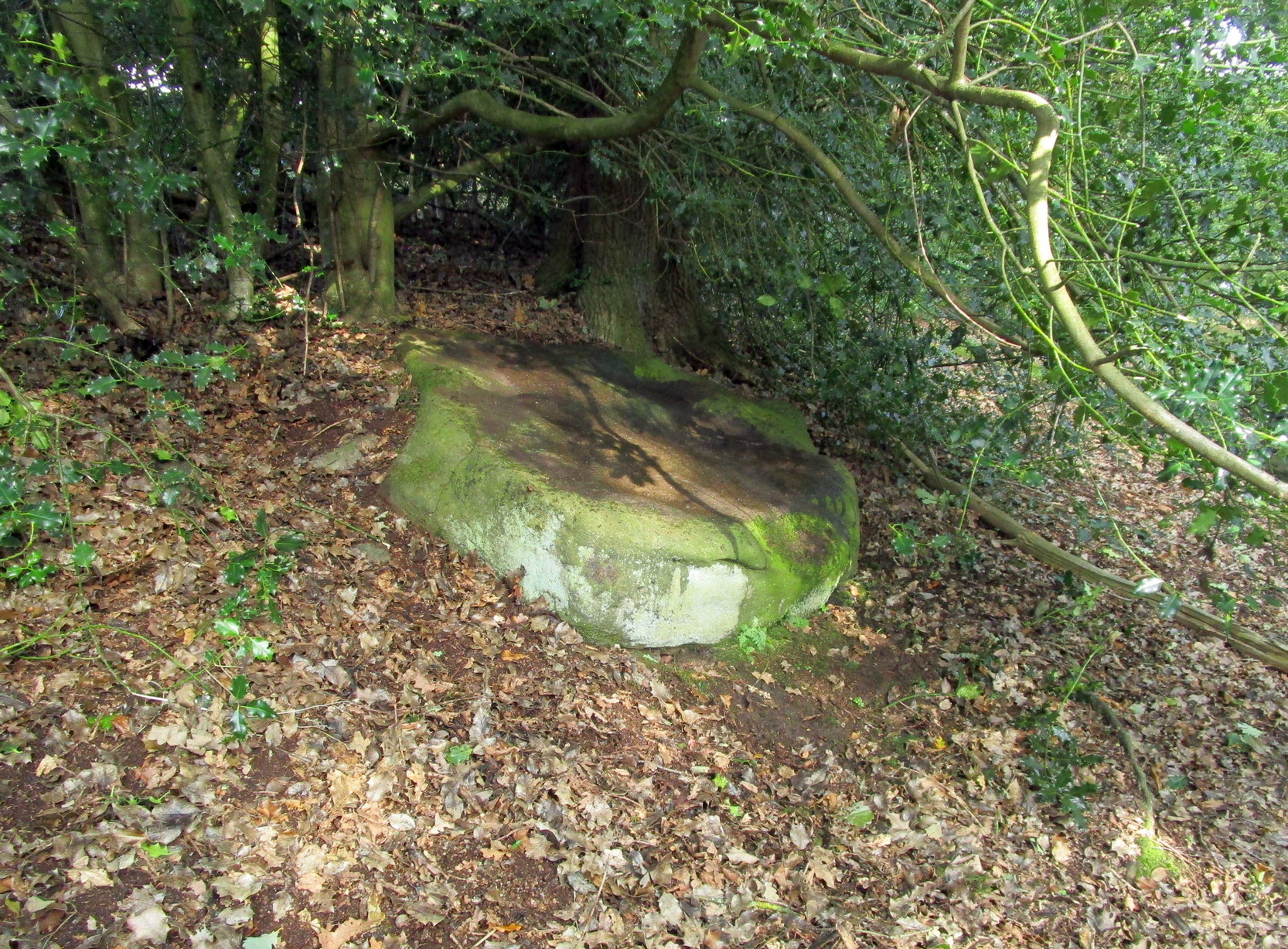
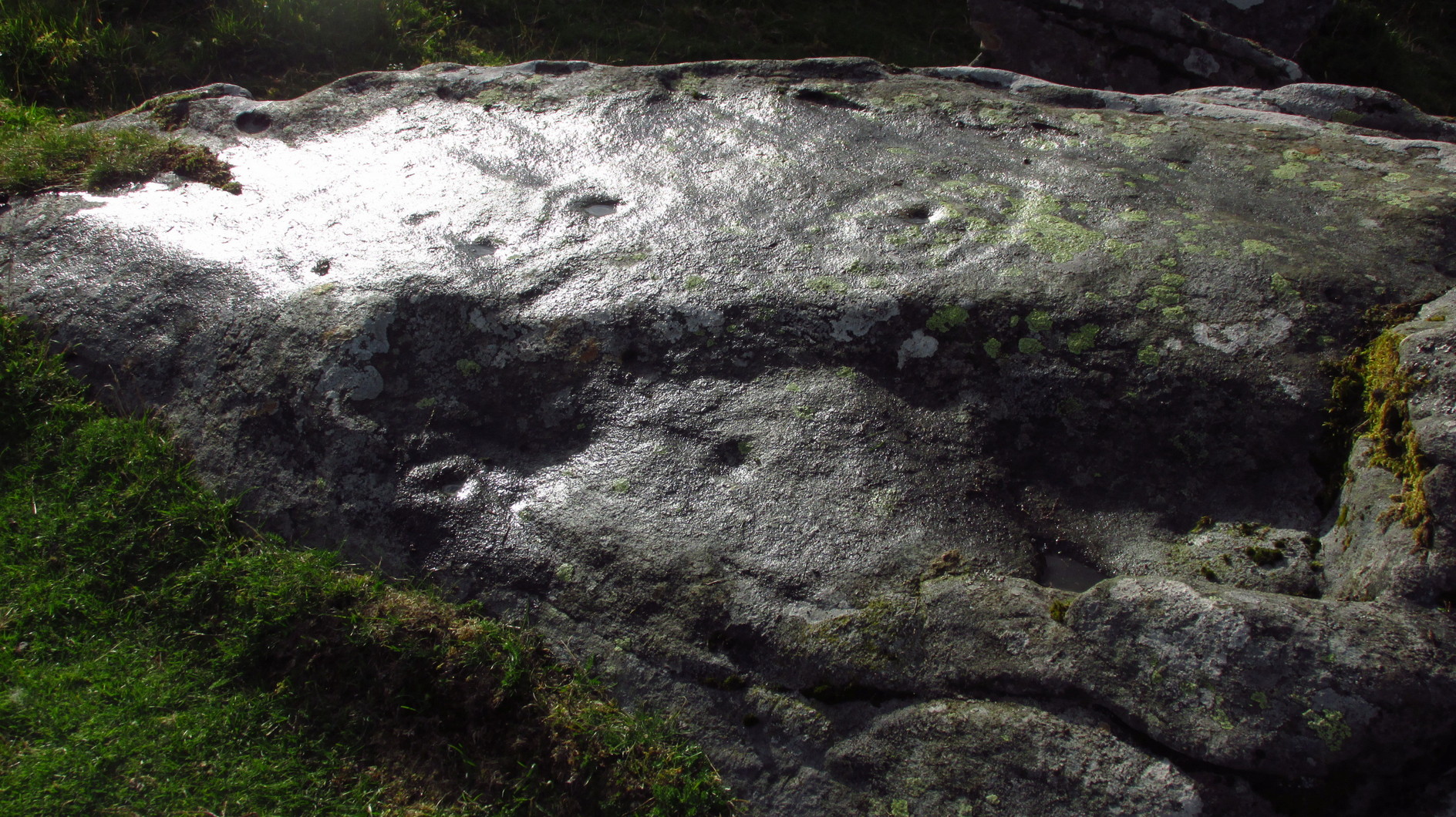
You can take the same directions to get here is you follow the route for the Hawksworth Spring (01) carving, or take this alternative route. Take the standard road from Guiseley along Hawksworth Road. When you reach the first row of old houses in the village, a couple of hundred yards on you reach the village school and, shortly after the footpath is sign-posted. Walk left (downhill) through the field for half-a-mile until you reach the woods. 100 yards into the into the trees, walk to your right and follow the line of walling straight for 400 yards, then veering right up the slope and it then slowly bends round, keeping to the wallside all along. It then starts heading back downhill. As it does so, 10 yards from the wall into the woods you’ll see the broken triangular rock of the Hawksworth Spring (01) carving. Walk another 10 yards where the large holly bushes are and you’ll see the large sloping stone in front of you.
Archaeology & History
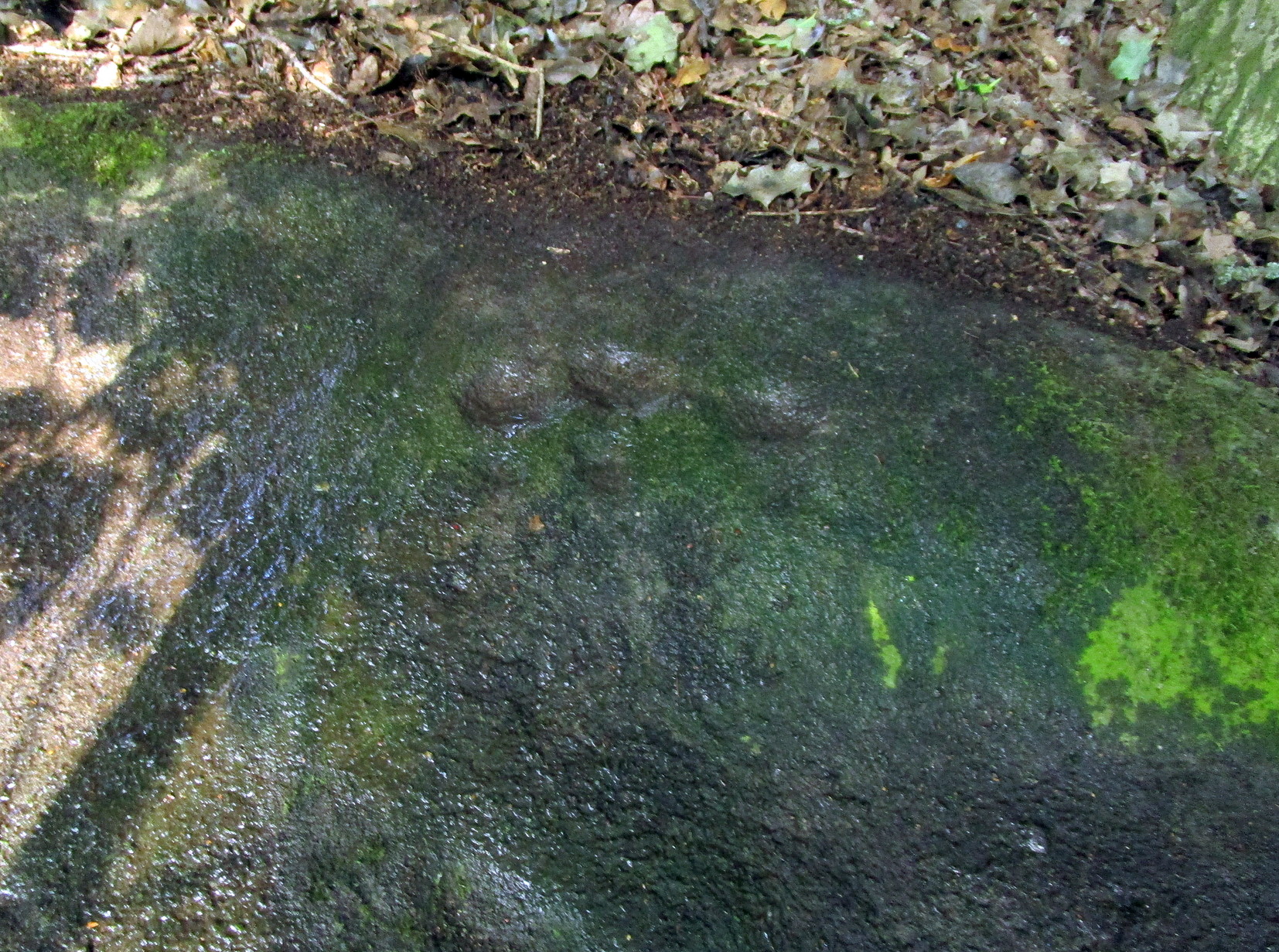
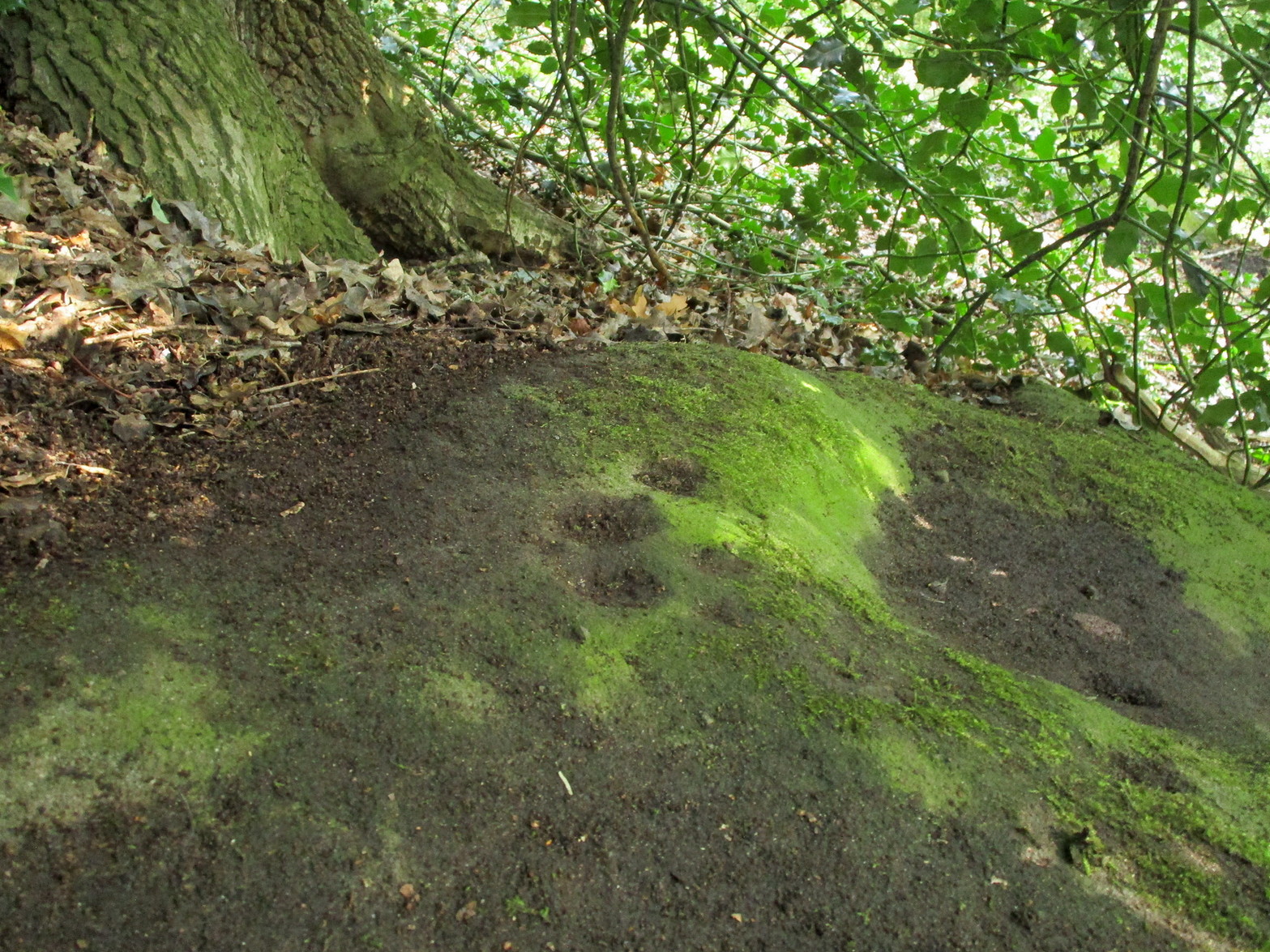
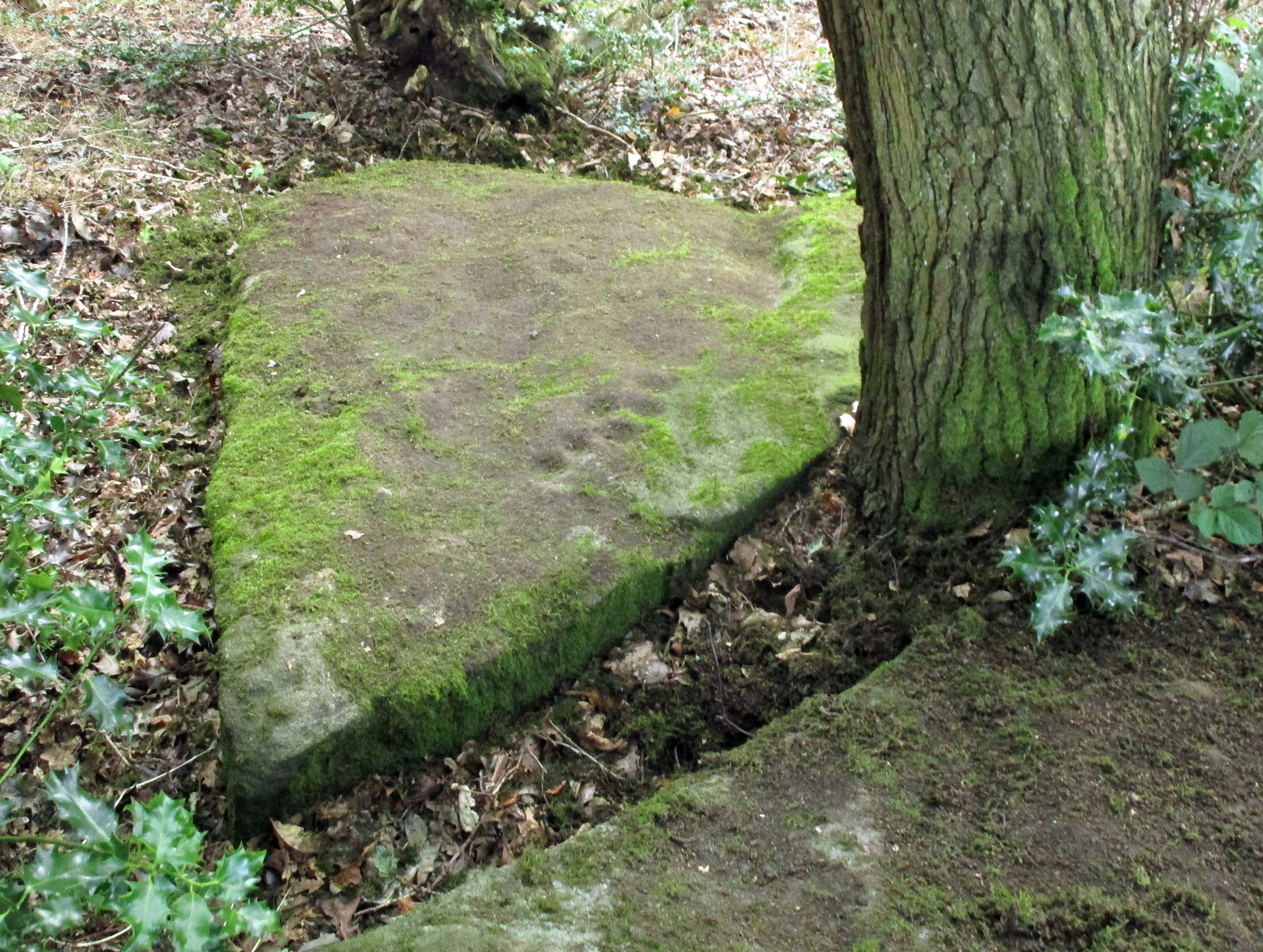
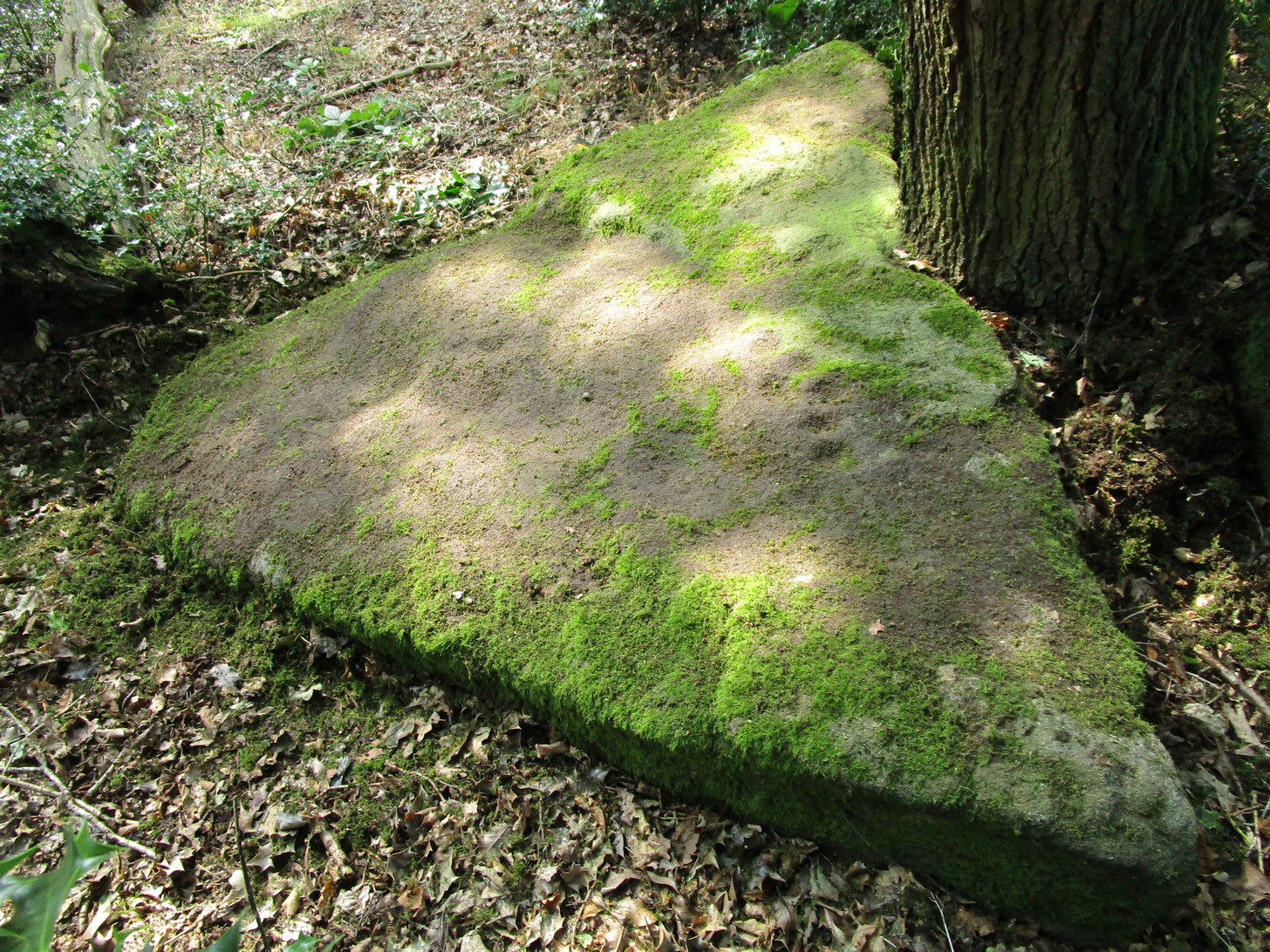
This carving is similar in nature to its companion 10 yards away, inasmuch as each of them possess two small arcs of cup-marks almost in the same format, very close together, one above the other near the top of the stone. It’s possible that the mythic nature/function of this particular element of arcs is the same on each stone—although fuck knows what it might be!
Clear line & faint line of arcsClear arc of cups
Below this double arc (only one of which is clearly visible in the photos) we see a scatter of other cup-marks—perhaps six, perhaps seven—one of which appears to have a very faint incomplete ring round it. When Liz Sykes and I visited the place, the light of day and the shadows across the rock didn’t help to convince us one way or the other, so we await news from other visitors who get better light conditions to tell us whether our hopeful eyes were deceiving us or not. There are a number of other marks on its surface, but these are much more recent and very obviously cut, or rather scratched, by metal artifacts with no bearing on the prehistoric design.
References:
Boughey, K.J.S. and Vickerman, E.A., Prehistoric Rock of the West Riding (Supplement), Shipley 2018.
Acknowledgements: Huge thanks to Liz Sykes for her renowned cleaning skills!
Holy Well (destroyed): OS Grid reference – SX 3285 8477
Archaeology & History
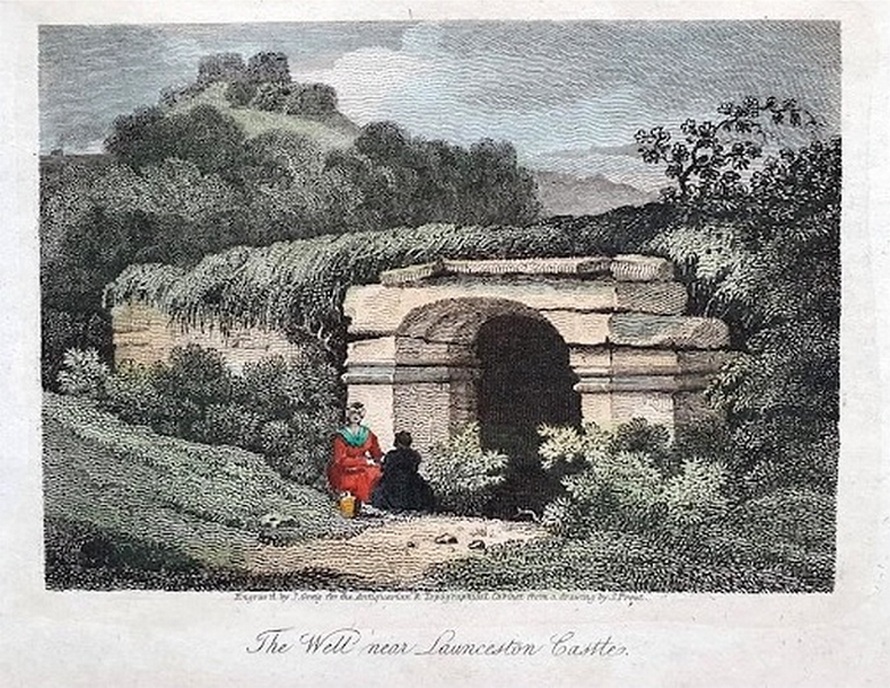
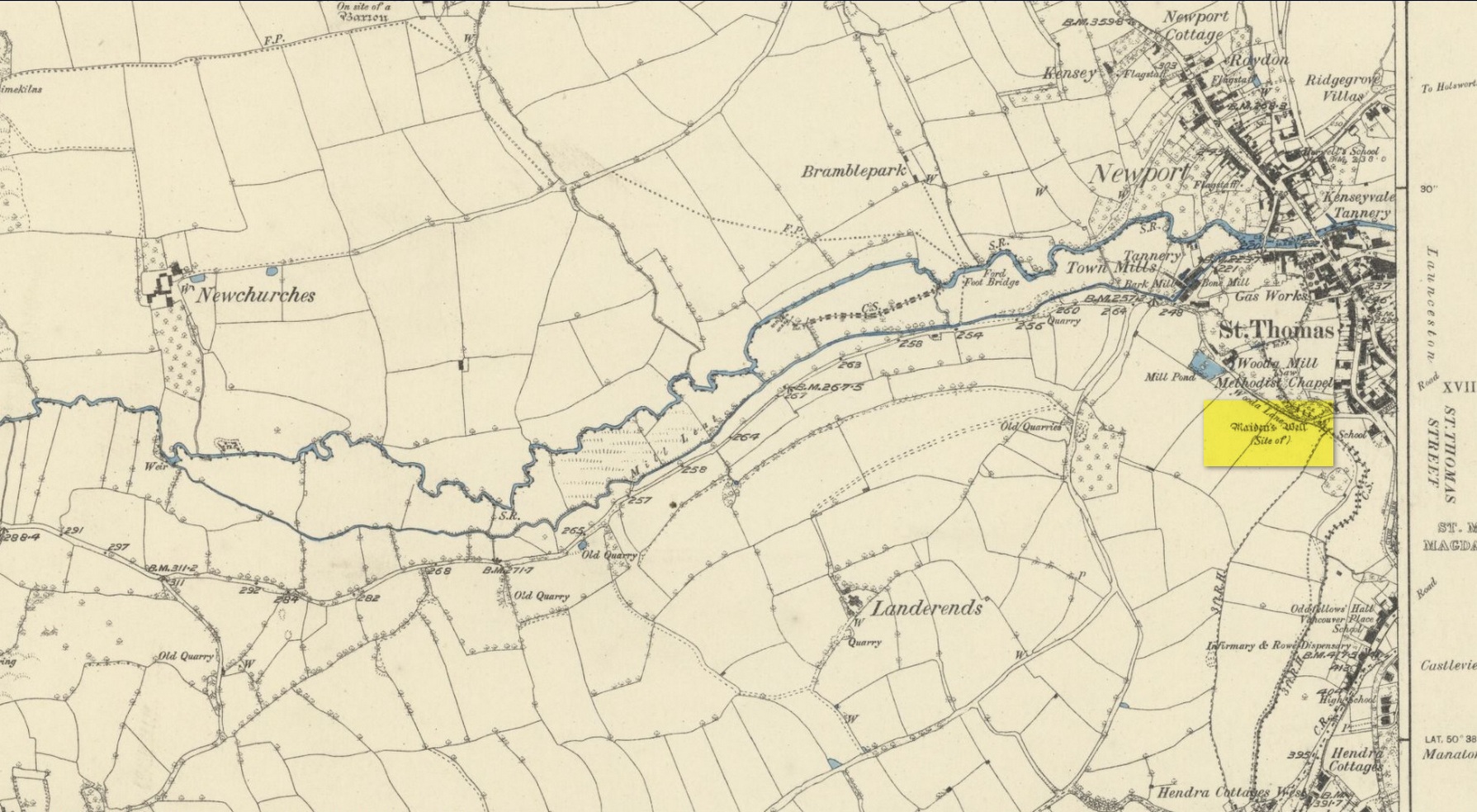
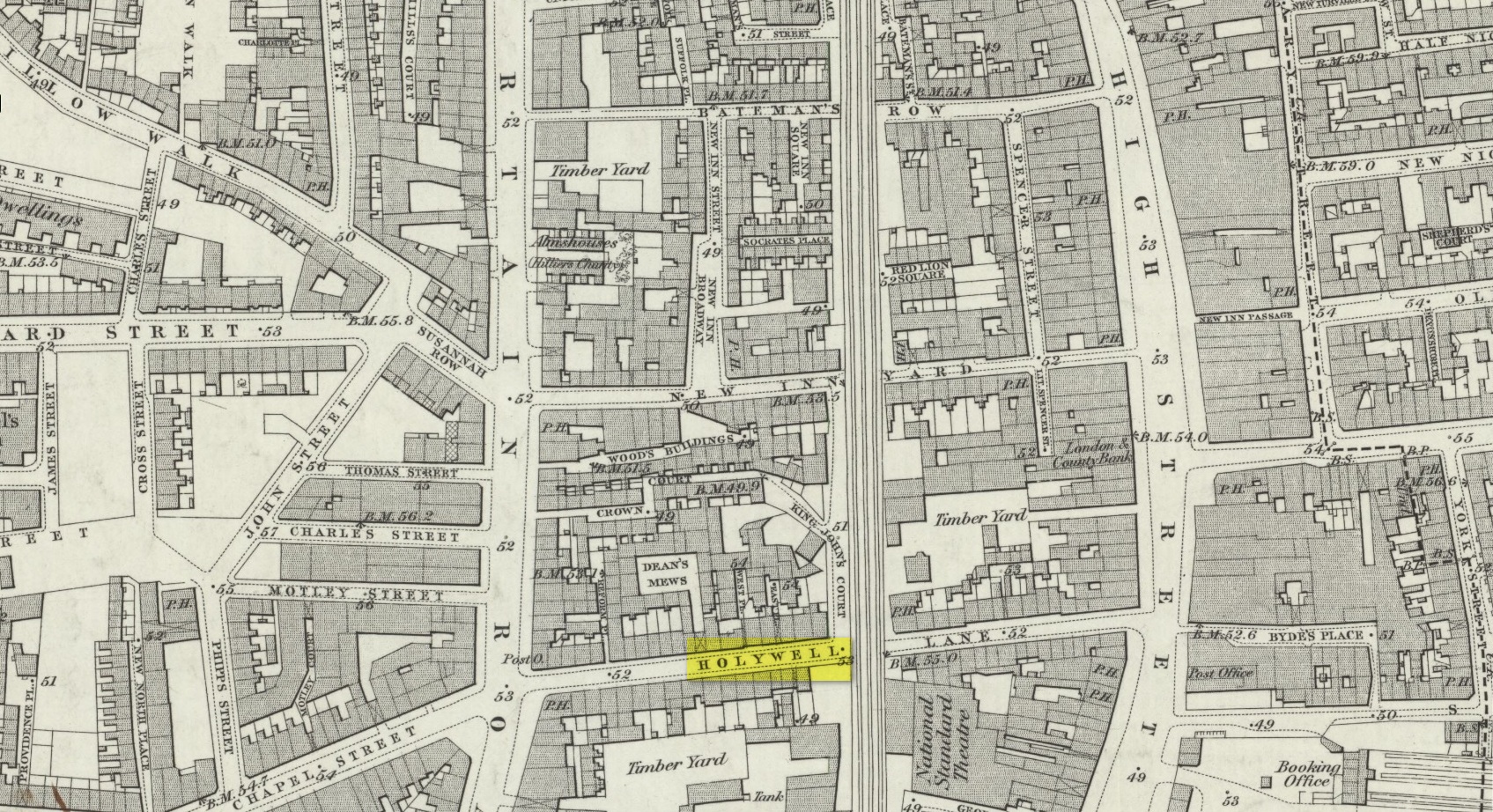
Very little is known about this holy well on the north-western side of town that was apparently destroyed sometime in the 19th century; for when the Ordnance Survey lads visited here in 1882, they found no running water but only the location of where it had been and they indicated this on their 1884 map of the area, marked as “Site of.”
Site of well on 1884 map
It was first mentioned in a short topographical notice in 1582, which told that the “Magden Well in the Quarrie Haye”—along with another well—was “found to be in decay.” (Peter 1885) Then, when the Ordnance Survey lads resurveyed the area once more in 1951, they could find no trace of it. It was mentioned in passing in Peter’s (1885) local history work, but there seems to be little else written about the place, which is a little odd for this part of the world. Anyone know anything more…?
References:
Peter, Richard, The Histories of Launceston and Dunheved, W. Brendon: Plymouth 1885.
Acknowledgements: Big thanks for use of the early edition OS-map in this site profile, Reproduced with the kind permission of the National Library of Scotland.
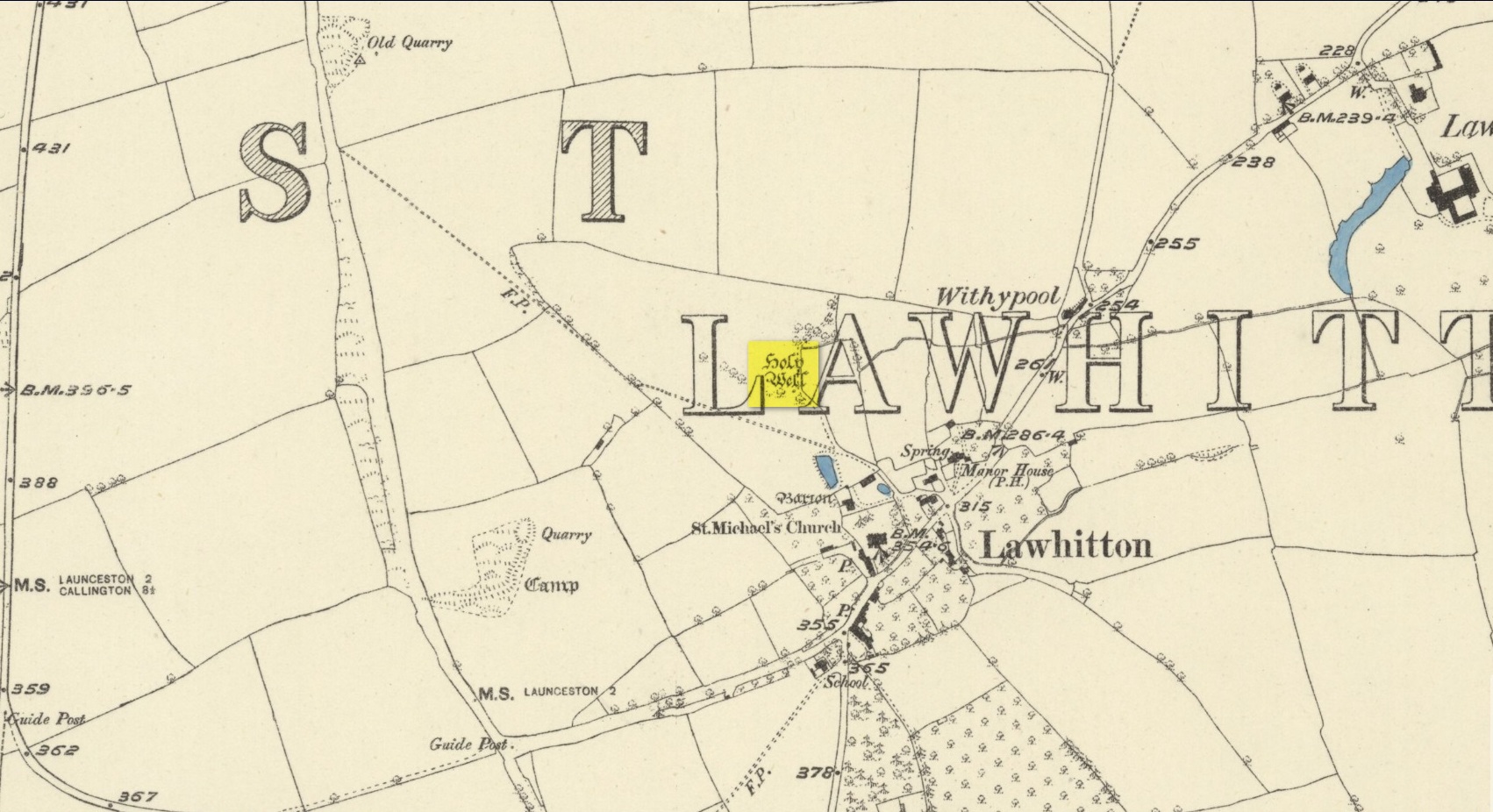
Highlighted on the 1882 OS-map several hundred yards north of St. Michael’s church, this site seems to have fallen back to Earth as no remains of it have been found in recent visits. It was described in Charles Henderson’s (1914) notes as the “holy well at Barton Farm”, and was visited by J. Meyrick (1982) in April of 1980, who told that it could be found by taking “the track immediately east of Lawhitton church which runs through the farm of Mr Lancaster… After going through the yard proceed ¼ mile down track to the valley where you reach a stream and the Well is on the right.” It was sought after by Cheryl Straffon (1998) but following her visit to find the Well she told that “there was nothing now to see except a kind of natural basin by the small bridge.”
References:
Henderson, Charles, Notebooks of Parochial Antiquities, Unpublished MS 1914.
Meyrick, J., A Pilgrims Guide to the Holy Wells of Cornwall, Falmouth 1982.
Straffon, Cheryl, Fentynyow Kernow: In Search of Cornwall’s Holy Wells, Meyn Mamvro: Penzance 1998.
Acknowledgements: Big thanks for use of the early edition OS-map in this site profile, Reproduced with the kind permission of the National Library of Scotland.
Cup-Marked Stone (lost): OS Grid reference – NN 8866 5320
Also Known as:
Sunday Well
Tobar an Donich
Archaeology & History
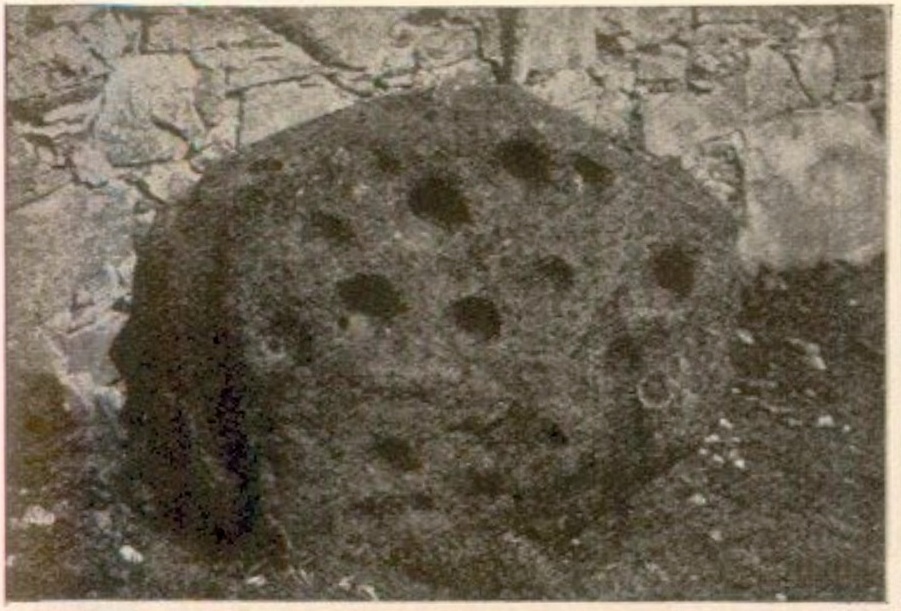
Tobairandonaich stone, c.1920
Located some 30 yards south of a holy well known (in English language) as the Sunday Well, this carving was rediscovered shortly before John Dixon (1922) wrote his survey of petroglyphs in the Strathtay region. It would seem to have been a large “portable” cup-marked stone that had been placed, face-downward, into an old doorstep at the stable at Easter Tobairandonaich and forgotten about, long long ago. Then, at the beginning of the 20th century when the people living here had to clear a drain beneath the stable, the stone was moved and the cup-markings were noticed. The carving was a pretty simplistic design, as you can see, which was described by Mr Dixon as follows:
“The stone…has nineteen cups all on the same face. The largest cup is 3¾ inches in diameter and 2 inches deep. The next largest has the same diameter, but is 1½ inch deep. Other five of the cups are very nearly the same size. The smallest cup is 1¾ inch in diameter and ½ inch deep, but weathering has effected much towards almost obliterating some of the smaller cups. The stone is of whinstone with slight veins of quartz. It is oval in form and varies in thickness from 2½ inches to 4 inches. Its greatest diameter is 3 feet 2 inches, and its least diameter 2 feet 8 inches.”
Tom MacLaren’s 1921 sketch
The stone would seem to have disappeared as no one has seen it for fifty years or more. It may (hopefully) be in one of the walls, or perhaps buried somewhere under the soil. Or maybe, tragically, some fuckwit has destroyed it. Twouldst be good to find out one way or the other. The photograph above, taken by Mr Dixon sometime around 1920, is the only thing that remains of the carving.
In this small part of Strathtay we are fortunate in finding a cluster of petroglyphs with folklore about them relating to our faerie and witch folk. Some larger man-made stone “bowls” in the area were also used as “praying stones.” I have little doubt that the people who originally used this carving as a doorstep were fully aware of the cup-marks—and I’d suggest that they even put it here on purpose, probably as a form of protection from the fairies who might have stolen or caused sickness to the horses.
References:
Dixon, John H., “Cup-Marked Stones in Strathtay, Perthshire,” in Proceedings Society Antiquaries, Scotland, volume 56, 1922.
Kennedy, James, Folklore and Reminiscences of Strathtay and Grandtully, Munro Press: Perth 1927.
Yellowlees, Walter, Cupmarked Stones in Strathtay, Scotland Magazine: Edinburgh 2004.
Holy Well (destroyed): OS Grid reference – TQ 3337 8245
Archaeology & History
Holywell Lane on 1877 map
First described at the beginning of the 12th century as “fons qui dicitur Haliwelle“, these sacred waters were thereafter described in a variety of documents before eventually, in 1382, giving its name to the road on which it was found. When the topographer John Stow (1603) described the well—along with those of St. Clement’s and Clerken Well—it was once “sweet, wholesome, and clear” and “frequented by scholars and youths of the city in the summer evenings.” However, in his day it was already in decline, as he told that the “Holy well is much decayed and spoiled, with filthiness purposely laid there, for the heightening of the ground for garden plots.”
The history of the site was mentioned in John Noorthouck’s (1773) survey, where he told us:
“In the parish are two prebends, and part of a third, belonging to St Paul’s cathedral, in the city of London: The first dominated by Eald-Street, or Old Street, received that appellation from the Saxons being part of the Roman military way: the second, which had been a separate village for many years, by the name of Hochestone, vulgarly Hoxton, likewise itself to be of a Saxon origin: the third called Haliwell, had its name from a vicinal fountain, which, for the salubrity of its water, had the epithet Holy conferred on it.
In King John’s Court, Holywell-lane, are to be found the ruins of the priory of St. John Baptist, of Benedictine nuns, founded by Robert the son of Gelranni, prependary of Haliwell, and confirmed by charter of Richard I in the year1189. It was rebuilt in the reign of Henry VII by Sir Thomas Lovell, knight of the garter; who was there buried: and the following ditty was in consequence painted in most of the windows.
“All the nuns of Holywell,
“Pray for the soul of Thomas Lovell.”
The complete demise of the well occurred in the early part of the 19th century and efforts to locate its original position have proved troublesome. Indeed, the modern Holywell Lane would seem to be little more than an approximation of its whereabouts. It was an issue explored at some length in the great A.S. Foord’s (1910) magnum opus, who wrote:
“In recent times efforts have been made to locate the well, and some of the results communicated to Notes and Queries. A Mr. R. Clark drew attention, through the medium of that publication, to an article in The Builder of September 19, 1896, which states that ”the ancient holy well should be looked for in the area between Bateman’s Row and New Inn Yard and behind the Board School in Curtain Road, that is to say, west of New Inn Street.” This is all very circumstantial, but the writer bases his statement on the survey by Peter Chassereau, taken in 1745, in which the supposed position of the well is marked by a cross and the words “Ye well from which the liberty derives its name.” It should be borne in mind however that, as pointed out by Colonel W. F. Prideaux, Chassereau did not make his survey till more than two hundred years had elapsed from the date of the dissolution of the Nunnery (1539); the position of the well could therefore have been only a matter of tradition. Another contributor to Notes and Queries (8th Series, May 22, 1897), quotes an article in the Journal of the Royal Institute of British Architects (vol. iv., 3rd series, p. 237), by Mr. E. W. Hudson, who says that the well of the priory was situate on the south side of what is known as Bateman’s Row, but was formerly (before 1799) called Cash’s Alley, near Curtain Road. This agrees substantially with Mr. Clark’s statement. Mr. Lovegrove, writing in 1904, says: “The well itself is to be found in a marble-mason’s yard in Bateman’s Row, but is covered over.” The same writer notes that of the Nunnery buildings only a piece of stone wall about 50 feet long, in a timber yard at 186, High Street, Shoreditch, is now left.”
References:
Foord, Alfred Stanley, Springs, Streams and Spas of London: History and Association, T. Fisher Unwin: London 1910.
Gover, J.E.B., Mawer, Allen & Stenton, F.M., The Place-Names of Middlesex, Cambridge University Press 1942.
Lovegrove, G.H., “Holywell Priory, Shoreditch,” in Home Counties, volume 6, 1904.
Mills, A.D., A Dictionary of London Place-Names, Oxford University Press 2001.
Noorthouck, John, A New History of London, Including Westminster and Southwark, R. Baldwin: London 1773.
Stow, John, A Survey of London, John Windet: London 1603.
Sunderland, Septimus, Old London Spas, Baths and Wells, John Bale: London 1915.
Wood, Alexander, Ecclesiastical Antiquities of London, Burns & Oates: London 1874.
Through Baildon town centre, take the road onto Baildon Moor, but instead of turning left up to Baildon Hill, keep straight on the Hawksworth road and 100 yards along you’ll see a car-park is on the right-hand side, just before you start going downhill. From here, walk down the road a couple of hundred yards until you see the footpath (keep your eyes peeled!) turning right towards The Whitehouse, and from there take the footpath dead straight down to the woods below. Cross the stream, turn right, then immediately left uphill by the wall-side. Shortly before reaching the top you’ll see a large triangular sloping slab of rock with a tree at its top. That’s it! Alternatively you can come via Hawksworth village by following the directions to the Hawksworth Spring (02) carving, which is just 10 yards east of this one. Easy!
Archaeology & History
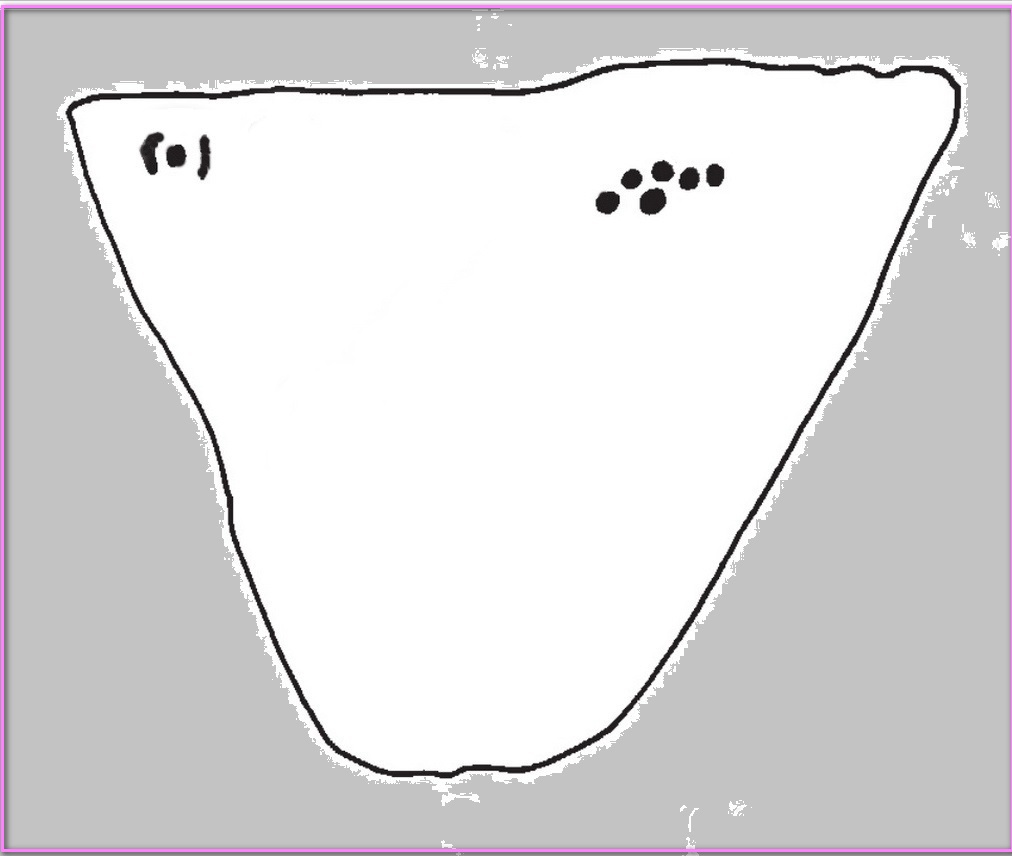
Sketch of carving (after Hedges 1986)Note the faint cup, top-right
This minimalist design is best seen from above the adjacent rock which, in times gone by, was attached to this very same stone. The main aspect of the carving are the two short rows of three cups, running almost alongside each other, in a likeness which my compatriot Liz Sykes said “was like some animal footprints.” It’s not a bad description to be honest (this same motif is found on a companion petroglyph just a few yards to the east: the Hawksworth Spring [2] stone). If you follow the direction of the “animal tracks” to the western end of the stone, you’ll see another isolated cup with a faint incomplete ring around it. You can just make it out on the photo to the right. Another single cup-mark seems apparent two-thirds the way down the stone.
References:
Hedges, John (ed.), The Carved Rocks on Rombalds Moor, WYMCC: Wakefield 1986.
Acknowledgements: Huge thanks to Liz Sykes for her renowned cleaning skills!
Take the A59 road from Harrogate and Skipton and at the very top of the moors near the Gill Head Enclosures, take the small Kex Ghyll road up past the disused quarry works north for a mile or so. At the junction go left for about 1½ miles where, on your left, is Burnt House farm. A hundred yards past here is a small spot to park on the right-hand side of the road, opposite the gate to Rocking Hall House (make sure you leave enough room for tractors to pass you!). Across the road is the track to Rocking Hall and, 2 miles along the track, look out for the copse of trees ½-mile NE. Head towards it and, as you get close to the wall, walk slowly downhill towards the stream where a single block of stone lives. You’ll find it!
Archaeology & History
Design from above
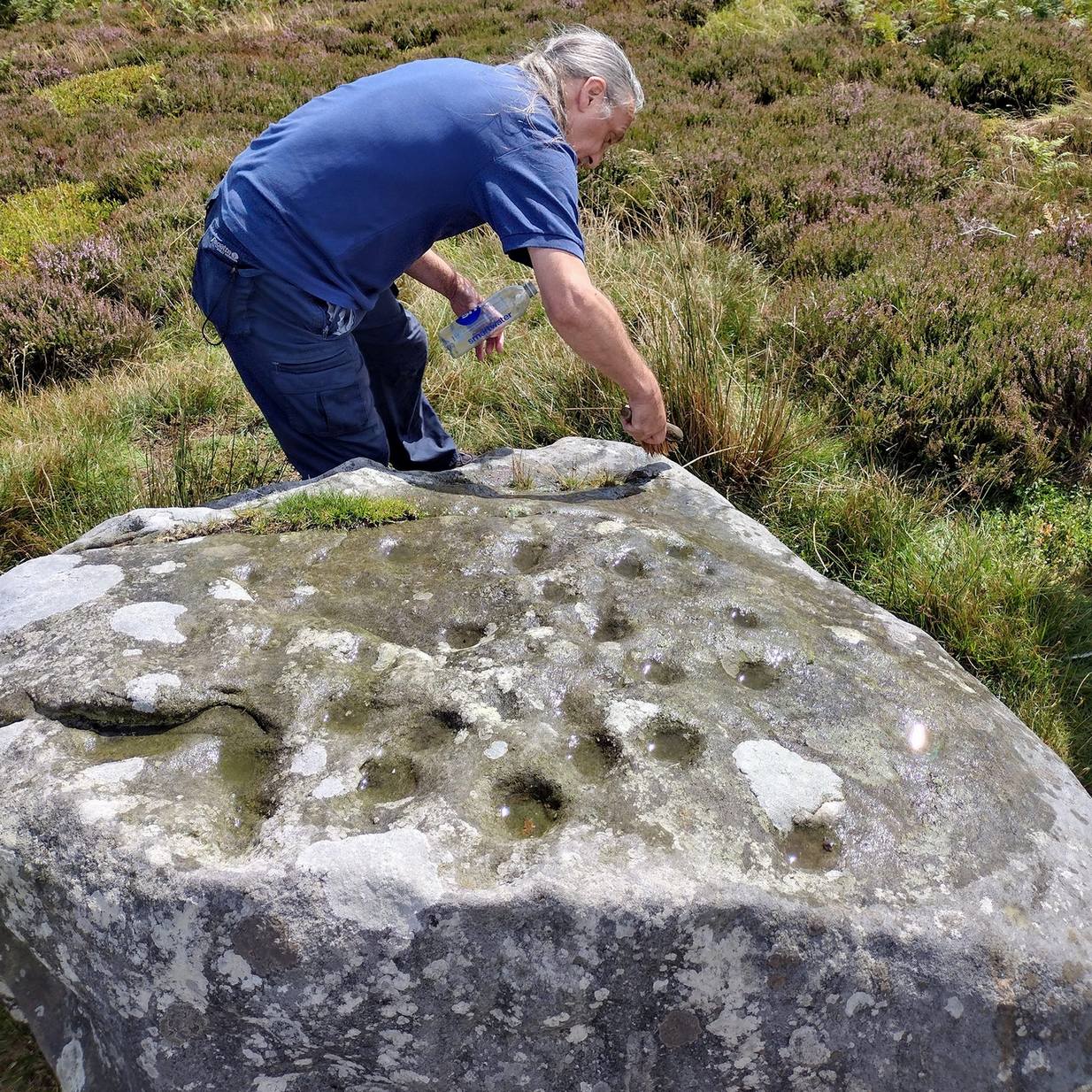
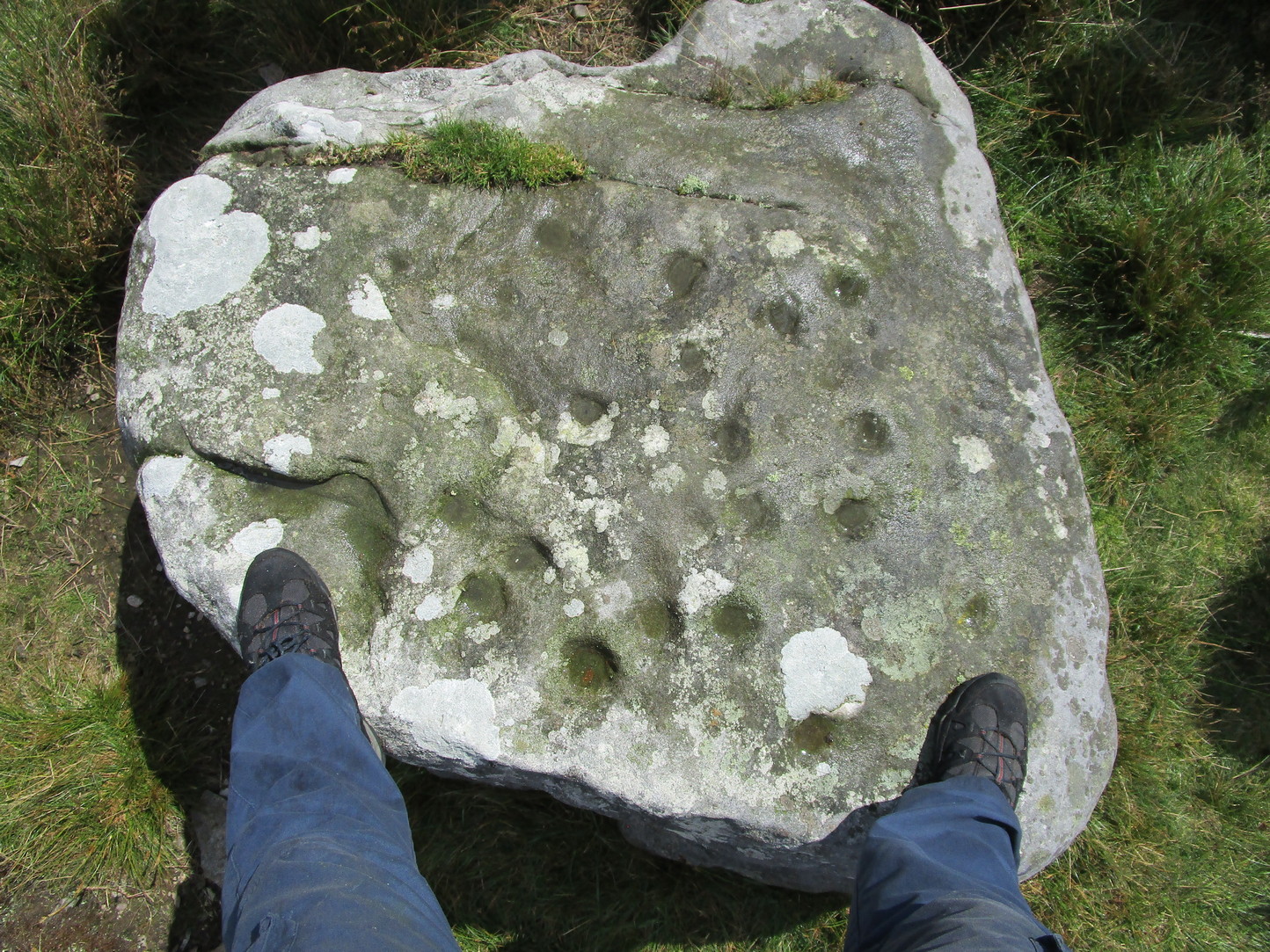
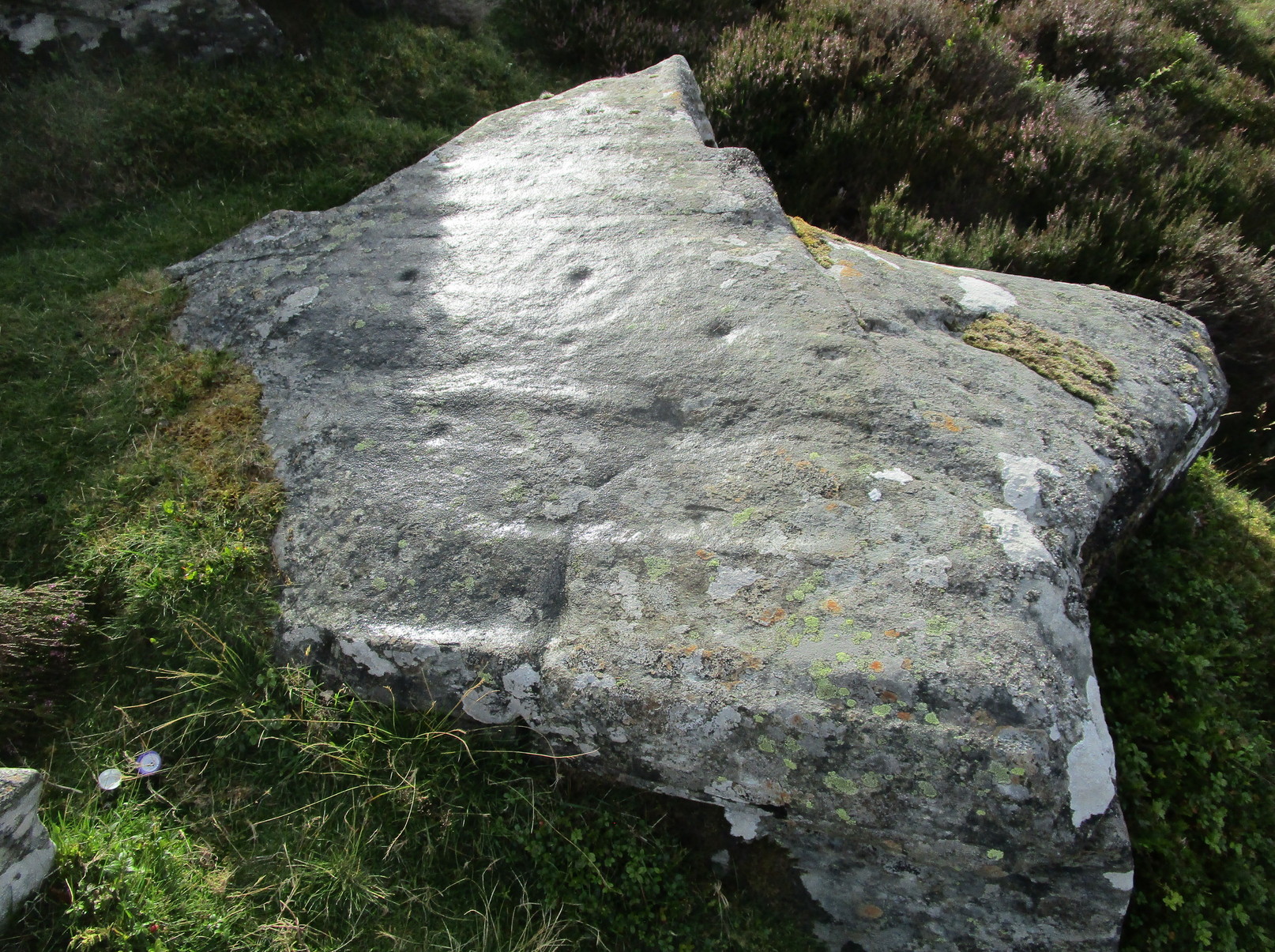
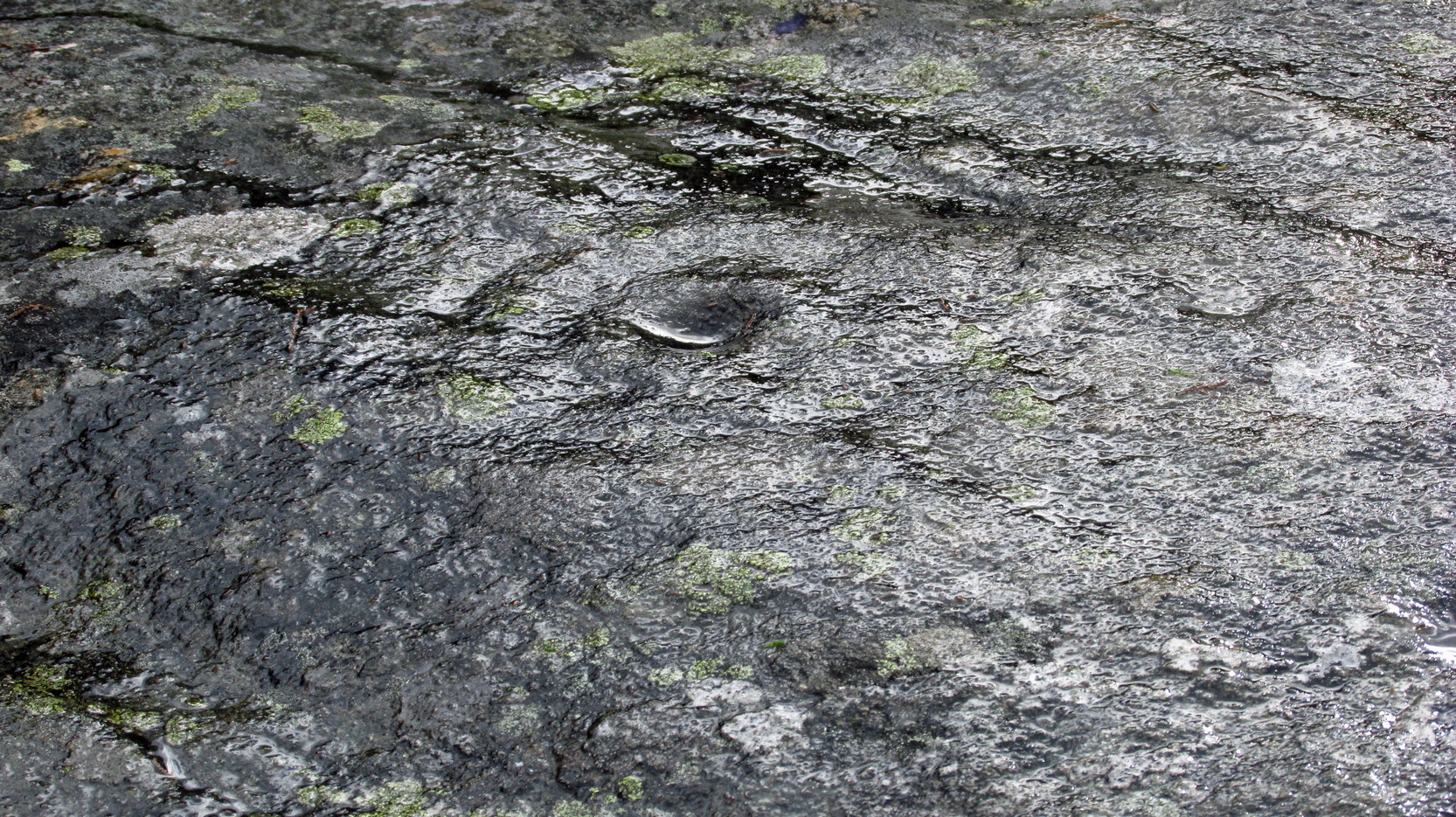
Rediscovered on Rocking Moor by Rod Chambers on August 15, 2023, this reasonably large sloping block of stone has between 21 and 24 cups cut quite deeply and scattered erratically into it, very similar to one some 200 yards to the northwest (Raven Stones carving 559). It seems pretty obvious that some of these cups were Nature’s handiwork, but have been modified by human hands. There’s nothing complex about it, but there may be a semi-circular arc around one of the cups, centre-left of the natural crack that cuts across the top of the stone, but this is very faint and could be just a trick of the eyes. Going there at sunrise and wetting the stone might tell us for sure.
Acknowledgements: Big thanks to Rod Chambers for use of his photo in this site profile.
From Kenmore go east up the steep mountain road towards Glen Quaich, or if you’re coming from Amulree, go west along the same glen. After 2½ miles (4km) up the Kenmore route (nearly 9 miles on the Amulree route) you’ll reach a small lochan on your left (you’ve got a very small parking spot a coupla hundred yards before the loch). A gate and stile past the loch takes you east along a track into the moors. More than a mile on, the track splits, but you need to keep to the left and follow the track along the wall-side for another 400 yards or so, where you’ll see a small crag of rocks 100 yards down the slope on your right. Once here, the deformed triangle-shaped stone to the left-side of the cluster is the one you’re looking for.
Archaeology & History
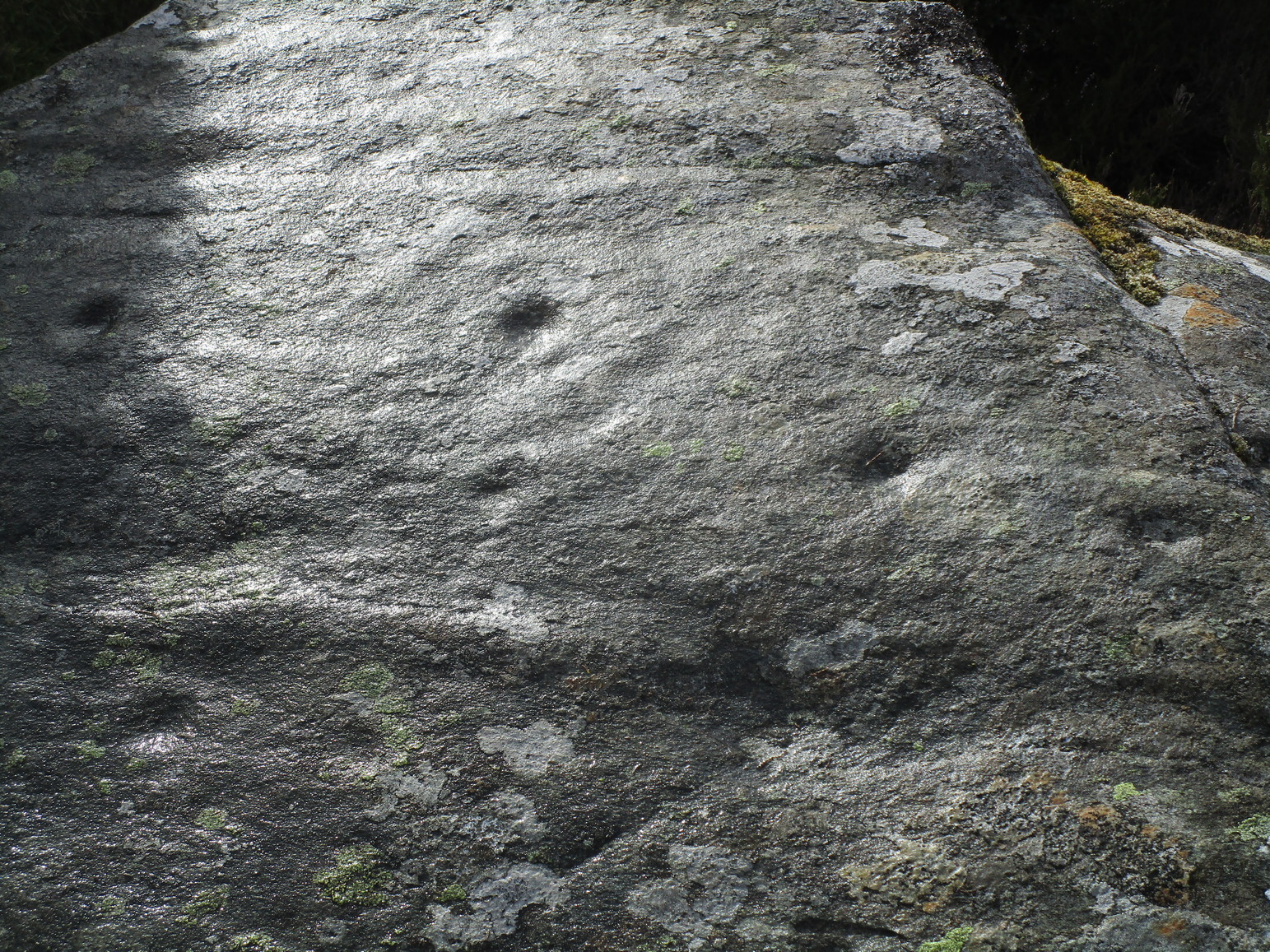
About four yards west of the Craig Hill cluster (3) carving, this gently smooth sloping rock was initially noted to have between six and seven cup-marks on it. Under the grey skies it was difficult to see any of this clearly, and so we wet the surface when Nature gave us some short bursts of light through the clouds which then enabled us to get a much better look at the design—but it’s still far from clear.
Curious eye motifCentral elements of carving
We found at least eight cups on here, two of which had single rings: the one near the top of the stone seems to be complete, whilst the other nearest the bottom of the stone looks to be incomplete. Another cup had a curious double ring; whilst the one nearest the middle of the stone has what may be three rings, with what could be a carved line running from its centre—but it’s very difficult to say with certainty until we’ve made another visit. I have little doubt that there’s more to this petroglyph than we could make out beneath the grey skies. On the west-side of the stone, the “curious” double-ring has, as its outer surround, an “eye” motif, or lozenge, which is also found on the Craig Hill cluster (3) stone a few steps away. The eye motif on both stones have the same levels of erosion and, I would suggest, were carved within a century or two of each other; perhaps even around the same time.
This one’s well worth checking out!
Acknowledgements: Huge thanks to Prof Paul Hornby for use of his photos in this site profile; and to Myrna Hurley for getting us up there. Cheers doods. 😉
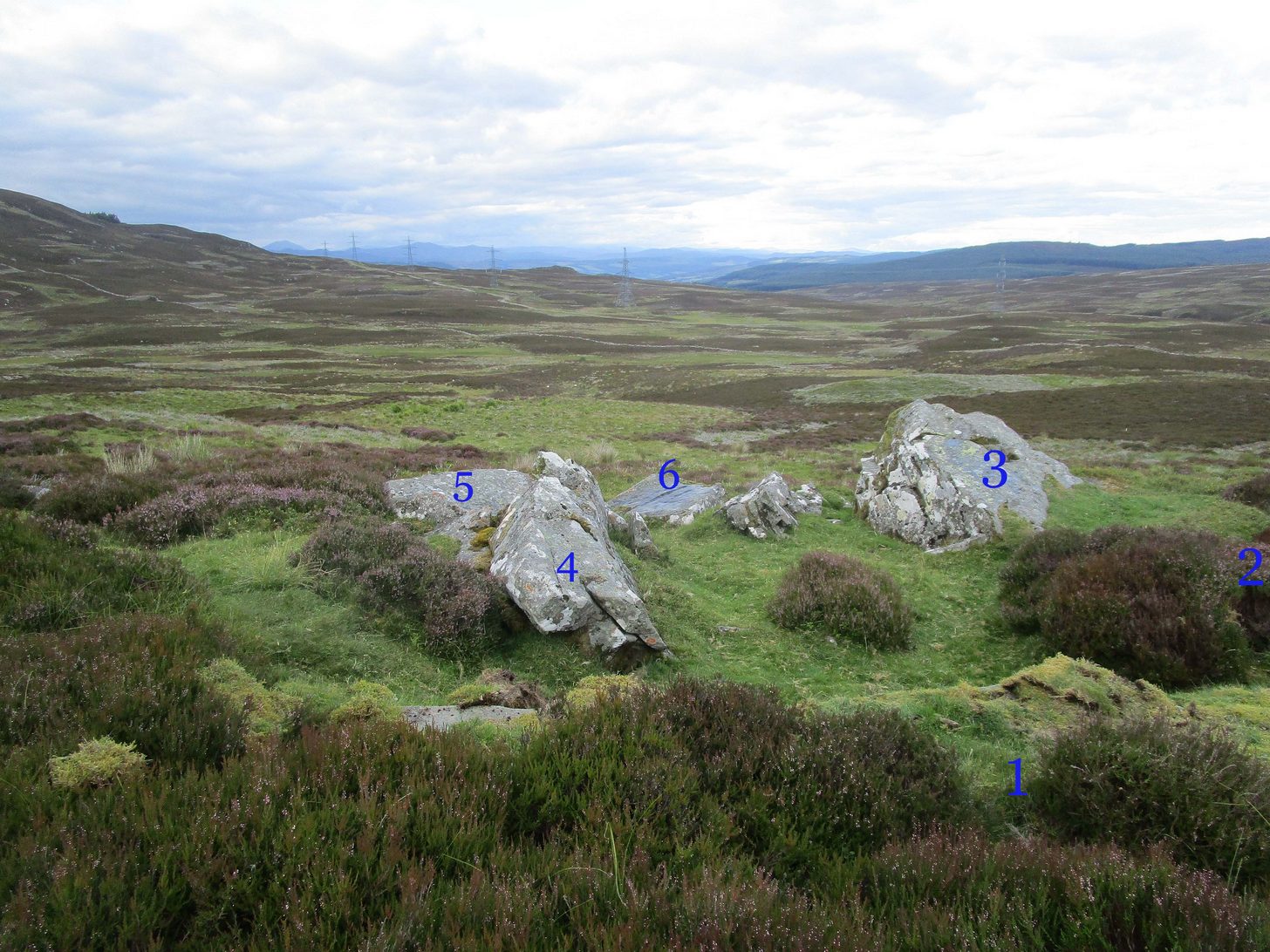
From Kenmore go east up the steep mountain road towards Glen Quaich, or if you’re coming from Amulree, go west along the same glen. After 2½ miles (4km) up the Kenmore route (nearly 9 miles on the Amulree route) you’ll reach a small lochan on your left (you’ve got a very small parking spot a coupla hundred yards before the loch). A gate and stile past the loch takes you east along a track into the moors. More than a mile on, the track splits, but you need to keep to the left and follow the track along the wallside for another 400 yards or so, where you’ll see a small crag of rocks 100 yards down the slope on your right. That’s your target!
Archaeology & History
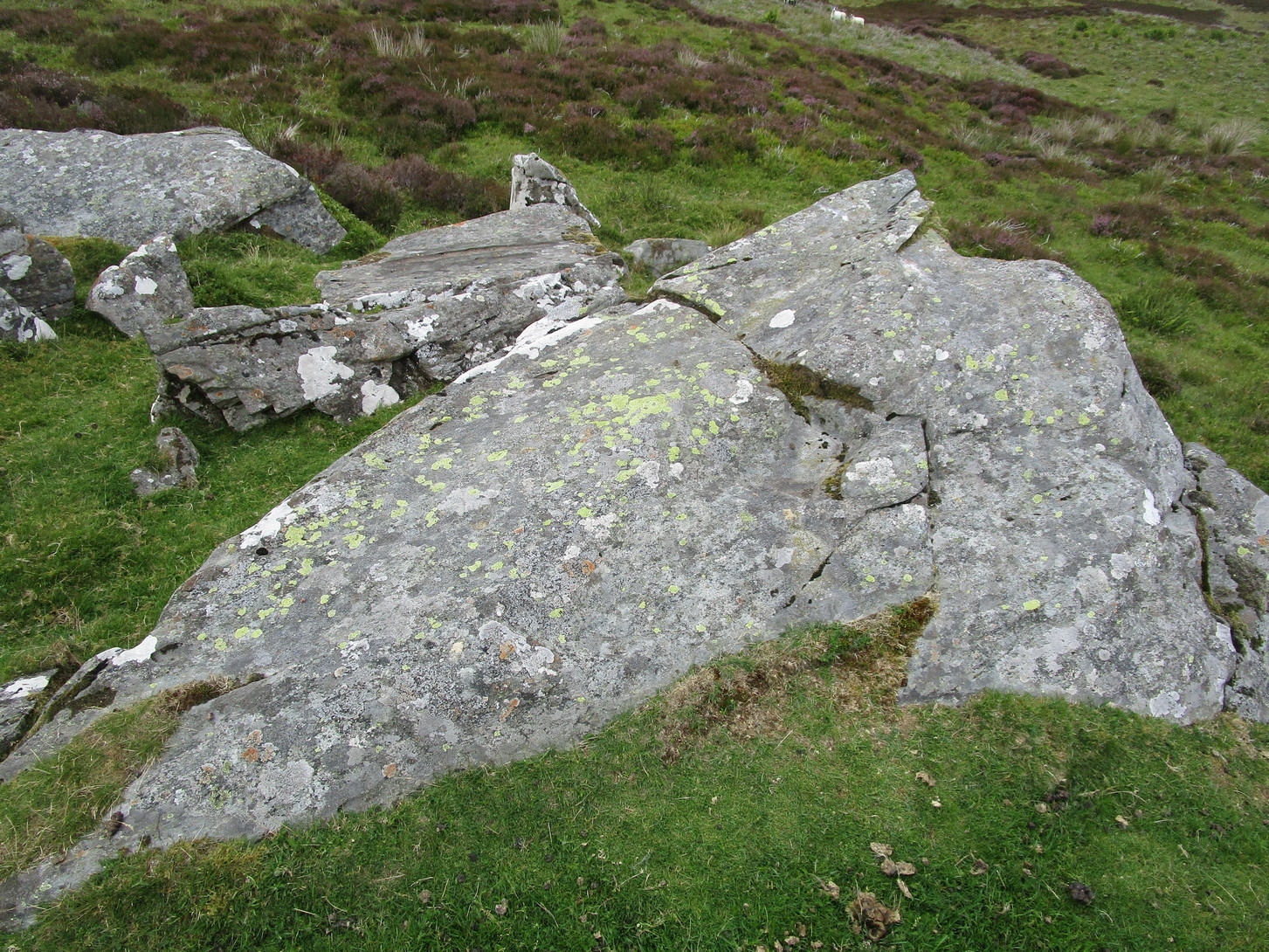
The stone in question
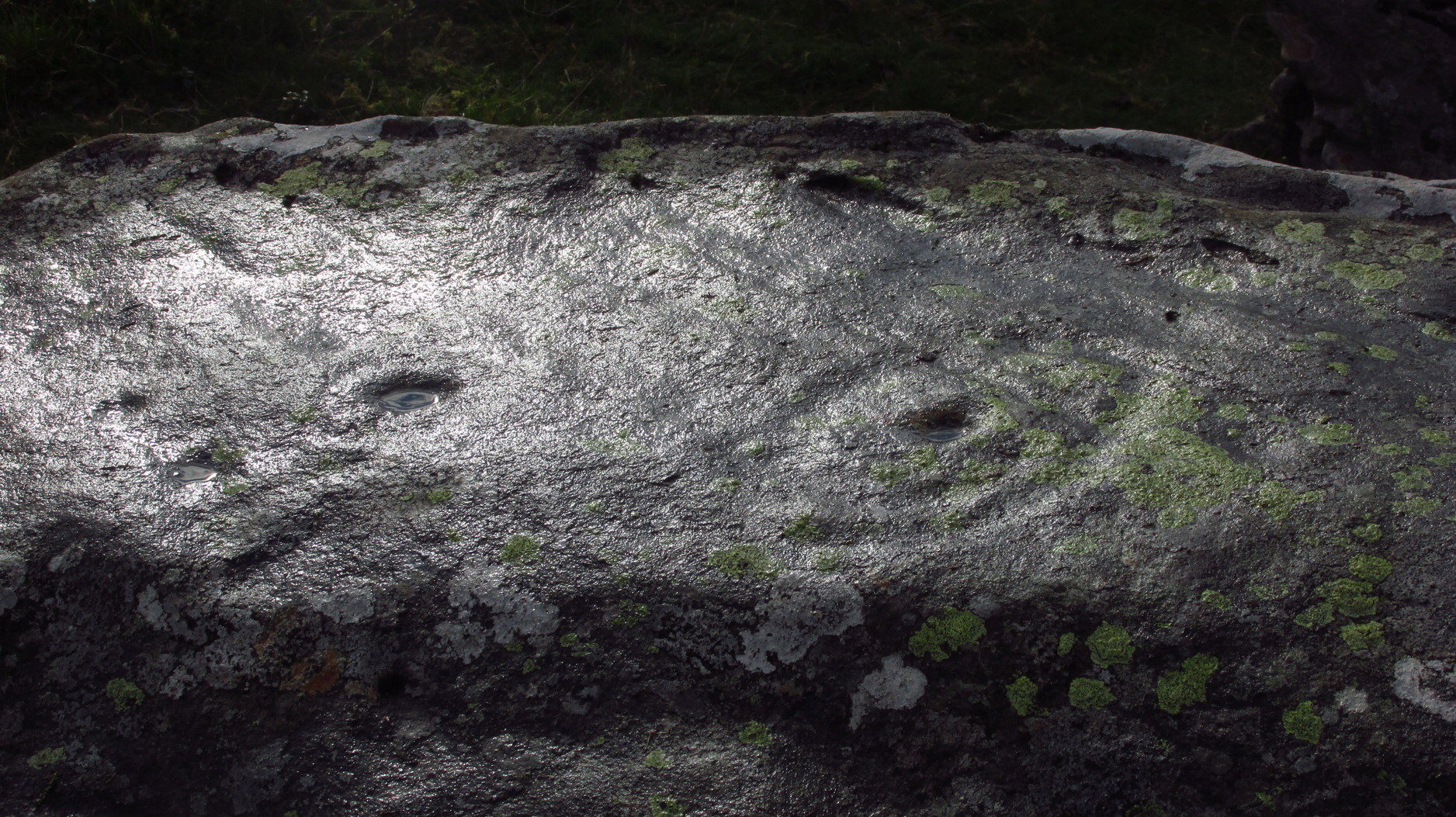
One of at least six rocks next to each other that possess cup-and-rings, this is the most notable of the bunch inasmuch as it’s the one that stands out above all the others. At first sight it doesn’t look impressive: a shallow scatter of nine or ten cup-marks can be seen when the light’s alright, but that’s about it. This is what George Currie (2005) noticed when he first came across it in 2004, describing it simply as “a boulder with 10 cups” a few yards away from one of it’s fellow petroglyphs (CR19, or the Craig Hill cluster-2 carving). But there’s much more to it than that. Unfortunately when we visited here, we weren’t blessed with good daylight, so were unable to get a decent appraisal of the entire design and have most probably missed some elements.
Curious double-ringed eyeGeneral overview of design
On the top sloping surface are six or seven cup-marks; another two or three are on a secondary lower level of the stone. Of those on the top, at least two of them have surrounding rings: one with a carved line coming out to the south-east; the other having a more extravagant appearance, surrounded by what looks like a secondary outer “oval”, or eye-shaped design. It’s unusual. Other lines intersect these cup-and-rings, but it was difficult to say with any certainty whether they were Nature’s handiwork, or had been modified by humans. Below these on a slightly lower level are two or three single cup-marks, one of which, close to the edge of the rock, appears to have an incomplete ring round it—but this might have just been a trick of the light. Another visit is required for a better appraisal…
Acknowledgements: Huge thanks to Prof Paul Hornby for use of his photos in this site profile; and to Myrna Hurley for getting us up there. Cheers doods. 😉
Healing Well (destroyed): OS Grid Reference – SE 45 21
Archaeology & History
The waters of the once-renowned Organn Well goes down in history as being one of the first wells in Britain whose waters were used in a town pump. Written minutes from an early council meeting described how people gathered in the market place to discuss the objective of making such a pump in the times of Queen Elizabeth 1, in 1571. It was completed a year later and, some 450 years on, this old relic can still be seen. The Well used to be found off Penny Lane (now Wakefield Road), some 4-500 yards to the southwest and as such it’s exact position has been difficult to locate. But the fact that the waters were piped such a distance strongly suggests that the water supply from the Well was damn good – and most probably damn refreshing too! The old charter told us, in that wonderfully dyslexic manner of the period,
“…that a conduit in the Markett Place with lead pipes leading to water from Organ Well to the said conduit shall bee cleansed and repayred at the charge and contribution of severall inhabitants of the Towne and espetially by those that fetch water from the same conduit. And according to the auncient custome of the said Towne, whoe shall not beare theire p’t of the chardge p’portionable to what water they from the same at the discretion of the Majo’ for the time being and his brethren shall be debarred from the benefitt of the said conduit except they shall be poore people. And likewise that none shall receive any water from the said conduite for to brewe or steep barley w’thall at such time or times as others have need the same for meat water and water to washe w’hall, but onely at such times as there is water to spare over and besides what is convenient for meat and washing.”
More than two hundred years later the water pump was in dire need of attention, as George Fox (1827) told:
“Being in a ruinous state about the year 1810 and the supplies of water being insufficient for the public use; a clause was inserted in the act of parliament… wherein the pump, its pipes, and all other appurtenances belonging to it were vested in the power of the commissioners of the streets, who where bound to see it kept in proper repair.”
And so the water from the Organn Well continued to supply the townsfolk.
The etymology of this well—along with another of the same name near Harrogate—truly puzzled me for a long time; that was until I came across, quite by accident, records from early texts on herbalism. As a result, it seems very likely that it derives its name from the old English ‘organe,’ which, according to Stracke (1974) and others relates to both varieties of the indigenous herb marjoram (Origanum vulgare and O.marjorana) — a grand medicinal plant that’s pretty common in northern England (I used to go out gathering it each year in my younger days). There were obviously profuse supplies of this herb growing in and around the well and, as all good herbalists will tell you, when they grow by an old spring or well, their medicinal properties are much better than normal. The waters and the plant obviously had a good symbiosis; or, as the old women who’d collect the waters and the herbs in days prior to the pump would have told us, “the spirits of the water here are good”…
References:
Fox, George, The History of Pontefract in Yorkshire, J.Fox: Pontefract 1827.
Padgett, Lorenzo, Chronicles of Old Pontefract, Oswald Homes: Pontefract 1905.
Stracke, J. Richard (ed.), The Laud Herbal Glossary, Rodopi: Amsterdam 1974.